← Table of contents
Malay Magic

Chapter II · Man and his Place in the Universe

Reading edition

(a) Creation of Man

A common feature in Malay romances and legends is a description of the supernatural development of a young child in the interior of some vegetable production, usually a bamboo.

Sir W. E. Maxwell has pointed out the fact of the existence, both in Malay and Japanese legends, of the main features of this story, to which he assigns a Buddhistic origin. He tells the story as follows:—

I myself have heard among the Selangor Malays similar legends to the above, which, as already pointed out, are common in Malay romances. A parallel myth is described in the following words:—

The usual story of the first creation of man, however, appears to be a Malay modification of Arabic beliefs.

Thus we are told that man was created from the four elements—earth, air, water, and fire—in a way which the following extract, taken from a Selangor charm-book, will explain:—

“God Almighty spake unto Gabriel, saying,

‘Be not disobedient, O Gabriel,

But go and get me the Heart of the Earth.’

But he could not get the Heart of the Earth.

‘I will not give it,’ said the Earth.

Then went the Prophet Israfel to get it,

But he could not get the Heart of the Earth.

Then went Michael to get it,

But he could not get the Heart of the Earth.

Then went Azrael to get it,

And at last he got the Heart of the Earth.

When he got the Heart of the Earth

The empyrean and crystalline spheres shook,

And the whole Universe (shook).

But the Heart of the Earth was then too hard;

He mixed Water with it, and it became too soft,

(So) he mixed Fire with it, and at last struck out the image of Adam.

Then he raised up the image of Adam,

And craved Life for it from Almighty God,

And God Almighty gave it Life.

Then sneezed God Almighty, and the image of Adam brake in pieces,

And he (Azrael) returned to remake the image of Adam.

Then God Almighty commanded to take steel of Khorassan,

And drive it down his back, so that it became the thirty-three bones,

The harder steel at the top, the softer below it.

The harder steel shot up skywards,

And the softer steel penetrated earthwards.

Thus the image of Adam had life, and dwelt in Paradise.

(There) Adam beheld (two ?) peacocks of no ordinary beauty,

And the Angel Gabriel appeared.

‘Verily, O Angel Gabriel, I am solitary,

Easier is it to live in pairs, I crave a wife.’

God Almighty spake, saying, ‘Command Adam

To pray at dawn a prayer of two genuflexions.’

Then Adam prayed, and our Lady Eve descended,

And was captured by the Prophet Adam;

But before he had finished his prayer she was taken back,

Therefore Adam prayed the prayer of two genuflexions as desired,

And at the last obtained our Lady Eve.

When they were married (Eve) bore twins every time,

Until she had borne forty-four children,

And the children, too, were wedded, handsome with handsome, and plain with plain.”

The magician who dictated the above account stated that when Azrael stretched forth his hand to take the Heart of the Earth, the Earth-spirit caught hold of his middle finger, which yielded to the strain, and thus became longer than the rest, and received its Malay name of the “Devil’s Finger” (jari hantu).

The following extract (from a Malay treatise quoted by Newbold) fairly describes the general state of Malay ideas respecting the constitution of the human body:—

(b) Sanctity of the Body

So in Leyden’s translation of the Malay Annals (1821) we read—

1. The royal Betel-box.

2. The Long K’ris—a kind of rapier used for Malay executions.

3. The two royal Swords; one on the right hand and one on the left (all of the articles mentioned hitherto being carried in front of the Sultan).

4. The royal “Fringed” Umbrella (payong ubor-ubor), carried behind the right-hand sword-bearer.

5. The royal “Cuspadore,” carried behind the left-hand sword-bearer.

6. The royal Tobacco-box, carried at the Sultan’s back.

A list of the Jĕlĕbu regalia (given me by Ungku Said Kĕchil of Jĕlĕbu) ran as follows:—

1. A single-bladed Sword (pĕdang pĕmanchor).

2. The Long K’ris (k’ris panjang, pĕnyalang), used for executions.

3. The royal Lances (tombak bĕndrang).

4. The royal Umbrella (payong kabĕsaran).

5. The royal Standard and Pennants (tunggul ular-ular).

6. The royal Ceiling-cloth and Hangings (tabir, langit-langit dewangga).

7. The “Moving Mountains” (gunong dua bĕrangkat), perhaps the names of two peaked pillows.

8. The royal Drums (gĕndang naubat); said to be “headed” with the skins of lice (kulit tuma) and to emit a single chord of twelve tones when struck (dua-b’las bunyi sakali di-pukol).

9. The royal Trumpet (lĕmpiri or nĕmpiri). Each of these was also said to emit a single chord of twelve notes. 10. The royal Gong. 11. The royal Guitar (kĕchapi).

Illustration from Malay Magic Being an introduction to the folklore and popular religion of the Malay Peninsula

12. The royal rĕbab or Malay fiddle.

But the extraordinary strength of the Malay belief in the supernatural powers of the regalia of their sovereigns can only be thoroughly realised after a study of their romances, in which their kings are credited with all the attributes of inferior gods, whose birth, as indeed every subsequent act of their after life, is attended by the most amazing prodigies.

They are usually invulnerable, and are gifted with miraculous powers, such as that of transforming themselves, and of returning to (or recalling others to) life; in fact they have, in every way, less of the man about them and more of the god. Thus it is that the following description of the dress of an old-time Raja falls easily into line with what would otherwise appear the objectless jargon which still constitutes the preamble of many a Malay prince’s letters, but which can yet be hardly regarded as mere rhetoric, since it has a deep meaning for those who read it:—

“He wore the trousers called bĕraduwanggi, miraculously made without letting in pieces; hundreds of mirrors encircled his waist, thousands encircled his legs, they were sprinkled all about his body, and larger ones followed the seams.”

Next came his coat. It was “of reddish purple velvet, thrice brilliant the lustre of its surface, seven times powerful the strength of the dye; the dyer after making it sailed the world for three years, but the dye still clung to the palms of his hands.”

“The next article described is his turban, which, among the Malays, is a square handkerchief folded and knotted round the head.”

He wore the Malay national garment—the sarong. It was “a robe of muslin of the finest kind; no ordinary weaving had produced it; it had been woven in a jar in the middle of the ocean by people with gills, relieved by others with beaks; no sooner was it finished than the maker was put to death, so that no one might be able to make one like it. It was not of the fashion of the clothing of the rajas of the present day, but of those of olden time. If it were put in the sun it got damper, if it were soaked in water it became drier. A slight tear mended by darning only increased its value, instead of lessening it, for the thread for the purpose cost one hundred dollars. A single dewdrop dropping on it would tangle the thread for a cubit’s length, while the breath of the south wind would disentangle it.”

Finally, we get a description of the way in which the Raja (S’ri Rama) set out upon his journey.

In addition to the sanctity of the regalia, the king, as the divine man, possesses an infinite multitude of prerogatives which enter into almost every act of his private life, and thus completely separate him from the generality of his fellow-men.

These prerogatives are too numerous to be mentioned in detail, but the following extract from Leyden’s translation of the “Malay Annals” will give a general idea of their character and extent:—

A number of other particulars bearing on this subject will be found in other parts of the text, and in the Appendix references are given to other works for additional details, which are too numerous to be recorded here.

Similar prohibitions are still in force at the courts of the Malay Sultans in the Peninsula, though a yellow umbrella is now generally substituted for the white, at least in Selangor.

A distinction is also now drawn between manufactured yellow cloth and cloth which has been dyed yellow with saffron, the wrongful use of the latter (the genuine article) being regarded as the more especially heinous act.

Finally, it must be pointed out that the greatest possible importance is attached to the method of saluting the king.

In the “Sri Rama” (the Malay Ramayana) we read, even of the chiefs, that—

“While yet some way off they bowed to the dust,

When they got near they made obeisance,

Uplifting at each step their fingers ten,

In the king’s audience hall the formal salutations are performed in a sitting posture, and in this case, too, the greatest attention is paid to the height to which the hands are raised. The chief twice makes salutation in a sitting posture as he advances, and at the third advance bends over the Sultan’s hands, two more salutations being made on his way back to his place.

A flagrant infringement of any of the prerogatives of the Sultan, such as those I have described, is certain, it is thought, to prove fatal, more or less immediately.

The only person who, in former days, was not in the least affected by the royal taboos which protected the regalia from the common touch was the (now I believe extinct) official who held the post of Court Physician (Maharaja Lela). He, and he alone, might go freely in the royal apartments wherever he chose, and the immunity and freedom which he enjoyed in this respect passed into a proverb, the expression “to act the Court Physician” (buat Maharaja Lela) being used to describe an altogether unwarrantable familiarity or impertinence.
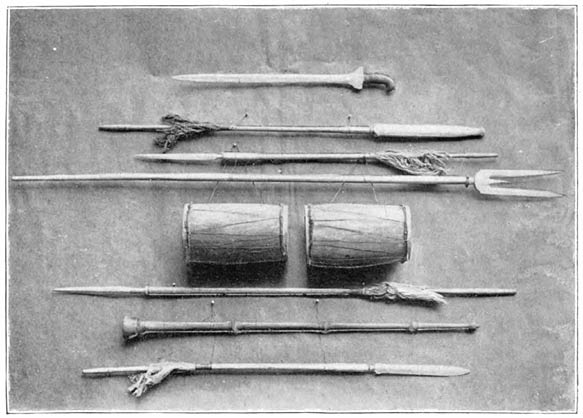
Plate 1.—Some of the Selangor Regalia.

Plate 1.—Some of the Selangor Regalia.

Models, representing part of the regalia of H.H. the Sultan of Selangor—two small drums, the tufted (cowtail) lances, the trident, the k’ris (dagger) called B’rok Bĕrayun, and the sacred trumpet (lĕmpiri).

Page 40.

This trumpet and the drums of the Selangor regalia were kept by the present Sultan (then Raja Muda, or Crown Prince of Selangor) in a small galvanised iron cupboard which stood (upon posts about three feet high) in the middle of a lawn outside His Highness’ “garden residence” at Bandar. His Highness himself informed me that they had once been kept in the house itself, but when there they were the source of infinite annoyance and anxiety to the inmates on account of their very uncanny behaviour!

Having shown the wide gulf which divides the “divine man” from his fellows, I have still to point out the extent to which certain portions of the human frame have come to be invested with sanctity, and to require to be treated with special ceremonies. These parts of the anatomy are, in particular, the head, the hair, the teeth, the ears, and the nails, all of which I will take in their order.

To the same category (of sacred things having physical connection with the body) should doubtless be referred such objects as the eyebrows, the saliva, and soil taken from the (naked) footstep, all of which are utilised by the magician to achieve his nefarious ends.

(c) The Soul

Thus in a charm given in the Appendix we find—

“Hither, Soul, come hither!

Hither, Little One, come hither!

Hither, Bird, come hither!

As this mannikin is the exact reproduction in every way of its bodily counterpart, and is “the cause of life and thought in the individual it animates,” it may readily be endowed with quasi-human feelings, and “independently possess the personal consciousness and volition of its corporeal owner.” Thus we find the following appeal addressed to the soul in the charm just quoted:—

“Do not bear grudges,

Do not bear malice,

Do not take it as a wrong,

Do not take it as a transgression.”

These quasi-human attributes of the soul being so complete, it is an easy stretch of the imagination to provide it with a house, which is generally in practice identified with the body of its owner, but may also be identified with any one of its temporary domiciles. Thus in the charm already quoted we read—

“Return to your own House and House-ladder,

To your own House-floor, of which the planks have started,

And your Roof-thatch ‘starred’ with holes.”

“Cluck! cluck! Soul of this sick man, So-and-so!

Return into the Frame and Body of So-and-so,

To your own House and House-ladder, to your own Clearing and Yard,

To your own Parents, to your own Casing.”

And this is no mere chance expression, for in another charm the soul is adjured in these words:—

“As you remember your own parents, remember me,

The soul “appears to men (both waking and asleep) as a phantom separate from the body of which it bears the likeness,” “manifests physical power,” and walks, sits, and sleeps:—

“Cluck! cluck! Soul of So-and-so, come and walk with me,

Come and sit with me,

At the present day the ordinary Malay talks usually of only a single soul, although he still keeps up the old phraseology in his charms and charm-books. For the rest, it would appear that there may be some method in the selection and arrangement of colours.

Now in all, I believe, of what are now called the Federated Malay States, and probably in all Malay States whatsoever, yellow is the colour used by royalty, whereas the more exalted and sacred colour, white (with occasional lapses into yellow), has been adopted by Malay medicine-men as the colour most likely to conciliate the spirits and demons with whom they have to deal. Thus the soul-cloth, which, by the way, is always five cubits long (lima hasta), is sometimes white and (much more rarely) yellow, and hence in the first instance just quoted, the yellow cloth, being, next to white, of the colour which is most complimentary to the demons, is the one which is put outside; and in the second instance, for similar reasons, the white cosmetic is to be used first.

(d) Animal, Vegetable, and Mineral Souls

To the Malay who has arrived at the idea of a generally animated Nature, but has not yet learned to draw scientific distinctions, there appears nothing remarkable or unnatural in the idea of vegetation-souls, or even in that of mineral-souls—rather would he consider us Europeans illogical and inconsistent were he told that we allowed the possession of souls to one half of the creation and denied it to the other.

The following tale, which is entitled Charitra Mĕgat Sajobang, and is told by Selangor Malays, will serve as an illustration of the idea of Human Origin:—

“There was a married Sakai couple living at Ulu Klang, and they had a son called Mĕgat Sajobang. When he grew up he said to his mother, ‘Mother, get me a passage, I want to go and see other countries.’ She did so, and he left Ulu Klang; and ten or twelve years later, when he had grown rich enough to buy a splendid ship (p’rahu), he returned with his wife, who was with child, and seven midwives, who were watched over by one of his body-guard with a drawn sword. His mother heard the news of his return, and she made ready, roasting a chika (monkey) and lotong (monkey), and went with his father on board their bark canoe to meet their son.

“As they approached they hailed him by his name; but he was ashamed of their humble appearance, and forbade his men to let them on board. Though his wife advised him to acknowledge them, ‘even if they were pigs or dogs,’ the unfilial son persisted in turning them away. So they went back to the shore and sat down and wept; and the old mother, laying her hand upon her shrivelled breast, said, ‘If thou art really my son, reared at my breast, mayest thou be changed into stone.’ In response to her prayer, milk came forth from her breast, and as she walked away, the ship and all on board were turned into stone. The mother turned round once more to look at her son, but the father did not, and by the power of God they were both turned into trees of the species pauh (a kind of mango) one leaning seawards and the other towards the land. The fruit of the seaward one is sweet, but that of the landward one is bitter.

“The ship has now become a hill, and originally was complete with all its furniture, but the Malays used to borrow the plates and cups, etc., for feast days and did not return them, until at last there were none left.”

↑

Colours of Cloths (used to enwrap the lump of earth from the footprint). Colours of Cosmetics (used by the sick man). Colours of Rice (such as may be used by medicine-men).

... white white Highest Color.

yellow ... yellow Medium Color. ,,

Illustration from Malay Magic Being an introduction to the folklore and popular religion of the Malay Peninsula

... ... blue.

red red red.

... ... purple or orange

... ... green.

black black black. Lowest Color. ,,

Notes in this chapter

Note 1 · Journal of the Royal Asiatic Society, N.S. vol. xiii. part iv. Cp. also the note to page 8 supra, in which the Golden Dragon is made to say,Note 2 · Hikayat; i.e. “romance.” ↑Note 3 · Mantri; i.e. “Minister of State.” ↑Note 4 · Bĕtong; i.e. “big.” ↑Note 5 · Manuwangi; perhaps a mistake for manuwanggi, cp. bĕraduwanggi, infra. ↑Note 6 · J.R.A.S., S.B., No. 17. Notes and Queries, No. 4, sec. 94. ↑Note 7 · Sĕmangs are aboriginal non-Muhammadan inhabitants of the interior of the Peninsula. Their type approximates to that of the Negritos of the ANote 8 · Teh, short for Puteh, “white”; Pûrba, or Pûrva, Sanskrit “first.” This name is also given to the first Malay Raja in the Sajarah Malayu. ↑Note 9 · J.R.A.S., S.B., No. 9, pp. 90, 91. For a similar story vide Leyden’s Malay Annals, p. 29: “It happened on a certain day that the river of PaNote 10 · It is Gabriel who performs this office in the account which follows. ↑Note 11 · “Concerning the creation of Adam, here intimated, the Mohammedans have several peculiar traditions. They say the angels Gabriel, Michael, anNote 12 · “The Creator determined to make man, and for that purpose He took some clay from the earth and fashioned it into the figure of a man. Then HNote 13 · Newbold, op. cit. vol. ii. pp. 351, 352. In Selangor, some of the greater bones, at least, have their own mystic nomenclature, e.g. the backNote 14 · Of the superstition which forbids the imitation of the royal insignia I can speak personally, as when a set of models of the Selangor regaliNote 15 · “The kabesaran or regalia of every petty state is supposed to be endowed with supernatural powers, for instance that of the ex-Panghulu of NNote 16 · Ibid. ↑Note 17 · Ibid. p. 195. ↑Note 18 · Leyden, Malay Annals, pp. 22–23. The words in brackets are mine.—W. S. ↑Note 19 · Newbold, op. cit. vol. ii. p. 199; cp. Leyden, Mal. Annals, pp. 38, 39. Limbuara, limbuana, or sĕmbuana (= singhabuana) is the name given toNote 20 · J.R.A.S., S.B., No. 9, pp. 91, 92. ↑Note 21 · It would appear from Malay romances that the full complement of musical instruments forming part of a royal orchestra was, at all events somNote 22 · This list was given me by H. H. Raja Bôt of Selangor. Besides the above there are several royal “properties” not usually included in any lisNote 23 · “All the insignia of royalty were hastily fashioned by the goldsmiths of Pĕnjum, and whenever To’ Râja or Wan Bong appeared in public they wNote 24 · Maxw. in Raja Donan, J.R.A.S., S.B., No. 18, p. 253. ↑Note 25 · Note 26 · It is usually upon a portion of his insignia (as, for instance, his k’ris, which is dipped into water which he drinks) that a Malay sovereigNote 27 · The following recital of the titles of a Sumatran Raja will show at least the extraordinary pretensions to sanctity which to this day (with,Note 28 · I.e. purple, vide Klinkert, s.v.; cf. the following from J.R.A.S., S.B., No. No. 9 , p. 93: “Tan Saban was frequently to be seen on the outwNote 29 · Lit. “corpse grooves.” ↑Note 30 · The usual form is pĕnggonggong, from gonggong, to carry in the mouth. ↑Note 31 · Their Malay names are “Si-mulajadi,” “Ashik sa-kampong,” “Si-putar leman,” “Asam garam,” “Ahadan mabuk,” “Sa-palit gila” “Sri gĕgah,” and “DNote 32 · The Malay word is changgei, which means “long nails” (whether natural or artificial); artificial nails are several inches in length, being mNote 33 · A long step and a slow swing of the arms reminds the Malay of the way a man steps and raises his arm to plant bean-seeds six feet apart; a qNote 34 · In house-building it is further forbidden to dovetail or make the ends of the timbers (e.g. of the roof) fit accurately together, and also tNote 35 · I.e. the sarong or Malay national garment; for the custom, vide Cliff., In Court and Kampong, p. 158, and for an exception, ib. 27. ↑Note 36 · The hilt of the creese (k’ris) must, however, be hidden by a fold of the cloth about the wearer’s waist. ↑Note 37 · “The covered portion of the barge which carries the Sultan’s principal wife is decorated with six scarlet-bordered white umbrellas. Two offiNote 38 · Leyden, Malay Annals, pp. 94, 95. ↑Note 39 · Code of Malacca, translated in Newbold, op. cit. vol. ii. pp. 234, 235. ↑Note 40 · In Selangor this royal right to one of each pair of elephant’s tusks is still a tradition to which an allusion is occasionally made. There aNote 41 · Notes and Queries, No. 4, issued with J.R.A.S., S.B., No. 17, sect. 75. ↑Note 42 · J.R.A.S., S.B., No. 30, p. 127. ↑Note 43 · Swettenham, op. cit. pp. 211–226. ↑Note 44 · Others are titah (commands); patek (slave); mĕrka or murka (wrath); karnia or kurnia (favour); and nĕgrah or anugrah (permission); the penalNote 45 · Marhum, one who has found mercy, i.e. the deceased. It is the custom of Malays to discontinue after the death of a king the use of the titleNote 46 · Newbold, op. cit. vol. ii. p. 288, note. ↑Note 47 · The bakong is a kind of lily; the sirih is the Malay betel-vine. ↑Note 48 · J.R.A.S., S.B., No. 17, p. 93. ↑Note 49 · Touching hands is done with both hands together. If you touch hands with a man who is somewhat your superior in rank, it is proper, in drawiNote 50 · Cliff., Stud. in Brown Humanity, p. 175. ↑Note 51 · Cliff., In Court and Kampong, p. 113, and compare the following:—“Visitors to Jugra may often in the evening see a party of some 30 or 40 meNote 52 · This dressing up of the buffaloes, when taken in conjunction with the suspension of the breast-ornament about their necks, suggests the survNote 53 · Among the Malays the use of the naubat is confined to the reigning Rajas of a few States, and the privilege is one of the most valuable insiNote 54 · I was told that these dangerous genii or spirits resided in the naubat or Big State Drum, the two gĕndang or Small State Drums, the two langNote 55 · But in Malay Sketches (p. 215) we read that in Perak the royal instruments accompany the royal water-parties, and that “the royal bugler sitNote 56 · The Malay headman (Haji Brahim), the priest of the local mosque, the Bilal (an inferior attendant at the mosque), and some thirty Malays belNote 57 · Frazer, Golden Bough, vol. i. p. 189. ↑Note 58 · For the ideas referred to in this and the preceding paragraph, cp. Frazer, op. cit. vol. i. pp. 187–207. Cp. also for the abstention from haNote 59 · Raja Bĕrma, son of Raja Jaman of Bandar (Wan Bong). Cp. also Clifford, In Court and Kampong, p. 114, “He wore his fine black hair long, so tNote 60 · Frazer, op. cit. vol. i. p. 193. ↑Note 61 · Vide infra, Chap. VI. p. 569, seqq., etc. ↑Note 62 · Vide infra, Chap. VI. pp. 353–355, Adolescence. ↑Note 63 · “Ces danseurs et ces danseuses ont tous des ongles faux, et fort longs, de cuivre jaune.”—La Loubère, Royaume de Siam, tome i. pp. 148–150 (Note 64 · Vide infra, Chap. VI. pp. 355–360. ↑Note 65 · Or Sumangat. The derivation of the word is unknown: possibly it may be connected with sangat, “excessive,” or bangat, “sudden, quick.” The mNote 66 · In calling the soul, a clucking sound, represented in Malay by the word kur or kĕrr, by which fowls are called, is almost always used; in faNote 67 · Vide App. vi. ↑Note 68 · In another charm we find the sick man’s body compared to a weather-beaten barque at sea. ↑Note 69 · Vide App. cclxxi. ↑Note 70 · The entire conception of the soul among the Malays agrees word for word with Professor Tylor’s classical definition in Primitive Culture, voNote 71 · Cp. Tylor, Prim. Cult. vol. i. p. 422. ↑Note 72 · What these seven souls were it is impossible without more evidence to determine. All that can be said is that they were most probably seven Note 73 · Professor Tylor calls this “a combination of several kinds of spirit, soul, or image, to which different functions belong” (op. cit. vol. i.Note 74 · Infra, Chap. VI. p. 569. ↑Note 75 · Infra, Chap. V. p. 241. ↑Note 76 · Infra, Chap. VI. p. 575. ↑Note 77 · Infra, Chap. VI. p. 568. ↑Note 78 · Infra, Chap. VI. p. 431. ↑Note 79 · We might then expect to get some such table as the following:—Note 80 · Infra, Chap. V. pp. 211, 250, 251. ↑Note 81 · Or is this phenomenon of a bird-shaped soul inhabiting certain trees to be explained by the “notion of a vegetable soul, common to plants anNote 82 · Professor Tylor’s pregnant phraseology in this connection is entirely applicable to the Malays, who “talk quite seriously to beasts alive orNote 83 · Infra, Medicine, Divination, etc. ↑Note 84 · Infra, Hunting charms. ↑Note 85 · Infra, Fowling charms. ↑Note 86 · Infra, Vegetation charms. ↑Note 87 · Infra, Fishing charms. ↑Note 88 · Infra, Mining charms. ↑Note 89 · The central idea of this conception appears to be that these animals, birds, and trees were once human beings, but were turned into their prNote 90 · Vide introductory remarks to Hunting, Fowling, Fishing, Planting, and Mining charms. ↑Note 91 · “The Raja of the Bamboo.—Some years ago I collected a number of legends current among Malayan tribes having as their principal incident the Note 92 · “Roorda van Eysinga’s edition of the Sri Rama opens with an account of how Maharaja Dasaratha sent his Chief Mantri,3 Puspa Jaya Karma, to sNote 93 · “‘Now there was a clump of the bĕtong4 bamboo (sa’rumpun buluh bĕtong), the colour of which was like gold of ten touch (amas sapuloh mutu), Note 94 · “Now, the Perak river overflows its banks once a year, and sometimes there are very great floods. Soon after the marriage of Nakhodah Kasim Note 95 · “The child was called Tan Puteh, but her father gave her the name of Teh Purba.8 As she grew up the wealth of her foster-parents increased; Note 96 · When he got the Heart of the Earth he10 made from it the Image of Adam.Note 97 · A parallel account adds that the Heart of the Earth was white, and gives a fuller description of the interview between Azrael and his formidNote 98 · “Plato, Socrates, Galen, Aristotle, and other philosophers affirm that God created man of a fixed number of bones, blood-vessels, etc. For iNote 99 · In dealing with this branch of the subject I will first take the case of the kings and priestly magicians who present the most clearly-markeNote 100 · Of Malacca Newbold says: “The articles of Malay regalia usually consist of a silasila, or book of genealogical descent, a code of laws, a veNote 101 · “The limbing is a sort of lance; the tombak bandrang a spear of state, four or seven of which are usually carried before the chiefs in the iNote 102 · “My name is Bichitram Shah, who am raja.... This is the sword, Chora sa mendang kian (i.e. mandakini), and that is the lance, Limbuar (i.e. Note 103 · “The Chora sa medang kian (i.e. mandakini) is the celebrated sword with which Peramas Cumunbang killed the enormous serpent Sicatimuna, whicNote 104 · Of the Perak regalia we read: “Tan Saban was commanded by his mistress to open negotiations with Johor, and this having been done, a prince Note 105 · In Selangor the regalia consisted of the royal instruments of music—(the big State Drum or naubat, beaten at the king’s coronation; the two Note 106 · 7. The eight royal tufted Lances (tombak bĕndrang or bandangan), whose bearers were followed by two personal attendants, the latter of whom Note 107 · Of the Pahang regalia I have not been able to obtain a list with any pretensions to completeness, but from a remark by Mr. Clifford (the preNote 108 · This latter peculiarity (of the multiplication of notes) is quite in accordance with the traditions of the king’s musical instruments in MalNote 109 · My informant declared that these objects came into existence of themselves (tĕrjali sĕndiri), at a spot between the two peaks of a burning mNote 110 · An enumeration of the writer’s regalia often forms an important part of a letter from one Malay sovereign to another, more especially when tNote 111 · Then his waistband (kain ikat pinggang) was of “flowered cloth, twenty-five cubits in length, or thirty if the fringe be included; thrice a Note 112 · His dagger was “a straight blade of one piece which spontaneously screwed itself into the haft. The grooves, called rĕtak mayat,29 started fNote 113 · “The sword that he wore was called lang pĕngonggong,30 ‘the successful swooper,’ lit. the ‘kite carrying off its prey.’Note 114 · “He next took his royal handkerchief, knotting it so that it stood up with the ends projecting; one of them he called dĕndam ta’ sudah (endlNote 115 · “He adopted the art called sedang budiman, the young snake writhed at his feet (i.e. he started at mid-day when his own shadow was round hisNote 116 · “Sultan Muhammed Shah again established in order the throne of his sovereignty. He was the first who prohibited the wearing of yellow clotheNote 117 · “At funerals, whether the deceased has been a great or insignificant person, if he be a subject, the use of the Payong (umbrella) and the PuNote 118 · In addition to the royal monopoly of such objects as have been mentioned, Sir W. E. Maxwell mentions three royal perquisites (larangan raja)Note 119 · The only tree in Ridley’s list42 whose name at all resembles the “kĕtiar” is the katiak, which is identified as Acronychia Porteri, Wall (RuNote 120 · A description of the gathering of the eggs of river turtles by the royal party in Perak will be found in Malay Sketches.43Note 121 · Besides the above there are not a few linguistic taboos connected with the king’s person, such as the use of the words santap, to eat; bĕradNote 122 · It must not be forgotten, too, in discussing the divine attributes of the Malay king, that he is firmly believed to possess a personal influNote 123 · The hands closed together like the rootlets of the bakong palm47Note 124 · The fingers one on the other like a pile of sirih47 leaves.”48Note 125 · Equals in rank when saluting one another touch49 (though they do not shake) each other’s hands, but a person of humble birth must not touch Note 126 · In saluting a great Chief, like the Dato’ Maharaja Pĕrba Jĕlai, the hands are “lifted up in salutation with the palms pressed together, as iNote 127 · Thus the death of Pĕnghulu Mohit, a well-known Malay headman of the Klang district, in Selangor, which took place while I was in charge of tNote 128 · The following story (though I tell it against myself) is perhaps the best illustration I can give of the great danger supposed to be incurreNote 129 · Drops of perspiration, for instance, would form upon the Trumpet when a leading member of the Royal House was about to die (this actually haNote 130 · The head, in the first place, is undoubtedly still considered by the Malays to possess some modified degree of sanctity. A proof of this is Note 131 · From the principle of the sanctity of the head flows, no doubt, the necessity of using the greatest circumspection during the process of cutNote 132 · Thus we invariably find clippings of the victim’s hair mentioned (together with parings of his nails, etc.) as forming part of the ingredienNote 133 · The same difficulties and dangers which beset the first cutting of the hair apply, though perhaps in a less degree, to the first paring of tNote 134 · The ear-boring and tooth-filing ceremonies which still not infrequently take place at the age of puberty in both sexes are of no less religiNote 135 · The Malay conception of the Human Soul (Sĕmangat)65 is that of a species of “Thumbling,” “a thin, unsubstantial human image,” or mannikin, wNote 136 · This mannikin, which is usually invisible but is supposed to be about as big as the thumb, corresponds exactly in shape, proportion, and eveNote 137 · Hither, Filmy One, come hither!”67Note 138 · The state of disrepair into which the soul’s house (i.e. the sick man’s body) is described as having fallen, is here attributed to the soul’Note 139 · As you remember your own House and House-ladder, remember me.”69Note 140 · Come and sleep with me, and share my pillow.”70Note 141 · It would probably be wrong to assume the foregoing expressions to have always been merely figurative. Rather, perhaps, we should consider thNote 142 · Every man is supposed (it would appear from Malay charms) to possess seven souls72 in all, or, perhaps, I should more accurately say, a seveNote 143 · And, finally, it might explain why the lime-branch which is hung up in the mosquito-curtain (in another form of soul-abduction76) is requireNote 144 · The “lump of earth from the victim’s footprint” used in one form of the soul-abduction ceremony77 is to be wrapped up in three thicknesses oNote 145 · The working out of this system, however, must await fresh evidence, and all I would do now is to emphasise the importance of colour in such Note 146 · Hitherto I have treated of human souls only, but animal, mineral, and vegetable souls will now be briefly discussed. Speaking generally, I bNote 147 · “Among races within the limits of savagery, the general doctrine of souls is found worked out with remarkable breadth and consistency. The sNote 148 · Realising this, we are prepared to find that the Malay theory of Animism embraces, at least partially, the human race,83 animals84 and birdsNote 149 · Side by side with this general conception of an universally animate nature, we find abundant evidences of a special theory of Human Origin wNote 150 · “Ta’ lapok de’ hujan, Ta’ lĕkang de’ panas, Pĕsaka di toras (? turis) di-tĕladan, Pĕsaka di-lintas tumbang.”Note 151 · Green is not a common colour. Blue appears to be rarely used. It is, however, the colour assigned to a (fabulous (?)) champaka flower, which
Explore with AITake your curiosity a little further.

Reading settings