Volume 2 / Part 2 — Chapter VIII. Obstacles.
Reading edition
Mephistopheles on Crags—Emerson on Monadnoc—Ruskin on Alpine peasants—Holy and Unholy Mountains—The Devil’s Pulpit—Montagnards—Tarns—Tenjo—T’ai-shan—Apocatequil—Tyrolese Legends—Rock Ordeal—Scylla and Charybdis—Scottish Giants—Pontifex—Devil’s Bridges—Le géant Yéous.
Related to the demons of Barrenness, and to the hostile human demons, but still possessing characteristics of their own, are the demons supposed to haunt gorges, mountain ranges, ridges of rocks, streams which cannot be forded and are yet unbridged, rocks that wreck the raft or boat. Each and every obstruction that stood in the way of man’s plough, or of his first frail ship, or his migration, has been assigned its demon. The reader of Goethe’s page has only to turn to the opening lines of Walpurgisnacht in Faust to behold the real pandemonium of the Northern man, as in Milton he may find that of the dweller amid fiery deserts and volcanoes. That labyrinth of vales, crossed with wild crag and furious torrent, is the natural scenery to surround the orgies of the phantoms which flit from the uncultured brain to uncultured nature. Elsewhere in Goethe’s great poem, Mephistopheles pits against the philosophers the popular theory of the rugged remnants of chaos in nature, and the obstacles before which man is powerless.
Faust. For me this mountain mass rests nobly dumb;
I ask not whence it is, nor why ‘tis come?
Herself when Nature in herself did found
This globe of earth, she then did purely round;
The summit and abyss her pleasure made,
Mountain to mountain, rock to rock she laid;
The hillocks down she neatly fashion’d then,
To valleys soften’d them with gentle train.
Then all grew green and bloom’d, and in her joy
She needs no foolish spoutings to employ.
Mephistopheles. So say ye! It seems clear as noon to ye,
Yet he knows who was there the contrary.
I was hard by below, when seething flame
Swelled the abyss, and streaming fire forth came;
When Moloch’s hammer forging rock to rock,
Far flew the fragment-cliffs beneath the shock:
Of masses strange and huge the land was full;
Who clears away such piles of hurl’d misrule?
Philosophers the reason cannot see;
There lies the rock, and they must let it be.
We have reflected till ashamed we’ve grown;
The common folk can thus conceive alone,
And in conception no disturbance know,
Their wisdom ripen’d has long while ago:
A miracle it is, they Satan honour show.
My wanderer on faith’s crutches hobbles on
The great American poet made his pilgrimage to the mountain so beautiful in the distance, thinking to find there the men of equal elevation. Did not Milton describe Freedom as ‘a mountain nymph?’
To myself I oft recount
The tale of many a famous mount,—
Wales, Scotland, Uri, Hungary’s dells;
Roys, and Scanderbergs, and Tells.
Here Nature shall condense her powers,
Her music, and her meteors,
And lifting man to the blue deep
Where stars their perfect courses keep,
Like wise preceptor, lure his eye.
To sound the science of the sky.
But instead of finding there the man using those crags as a fastness to fight pollution of the mind, he
searched the region round
And in low hut my monarch found:
He was no eagle, and no earl;—
Alas! my foundling was a churl,
With heart of cat and eyes of bug,
I cannot forbear enlivening my page with the following sketch of a visit of English officers to the realm of Ten-jo, the long-nosed Mountain-demon of Japan, which is very suggestive of the mental atmosphere amid which such spectres exist. The mountains and forests of Japan are, say these writers, inhabited as thickly by good and evil spirits as the Hartz and Black Forest, and chief among them, in horrible sanctity, is O-yama,—the word echoes the Hindu Yama, Japanese Amma, kings of Hades,—whose demon is Ten-jo. ‘Abdul and Mulney once started, on three days’ leave, with the intention of climbing to the summit—not of Ten-jo’s nose, but of the mountain; their principal reason for so doing being simply that they were told by every one that they had better not. They first tried the ascent on the most accessible side, but fierce two-sworded yakomins jealously guarded it; and they were obliged to make the attempt on the other, which was almost inaccessible, and was Ten-jo’s region. The villagers at the base of the mountain begged them to give up the project; and one old man, a species of patriarch, reasoned with them. ‘What are you going to do when you get to the top?’ he asked. Our two friends were forced to admit that their course, then, would be very similar to that of the king of France and his men—come down again.
The old man laughed pityingly, and said, ‘Well, go if you like; but, take my word for it, Ten-jo will do you an injury.’
They asked who Ten-jo was.
‘Why Ten-jo,’ said the old man, ‘is an evil spirit, with a long nose, who will dislocate your limbs if you persist in going up the mountain on this side.’
‘How do you know he has got a long nose?’ they asked, ‘Have you ever seen him?’
‘Because all evil spirits have long noses’—here Mulney hung his head,—‘and,’ continued the old man, not noticing how dreadfully personal he was becoming to one of the party, ‘Ten-jo has the longest of the lot. Did you ever know a man with a long nose who was good?’
‘Come on,’ said Mulney hurriedly to Abdul, ‘or the old fool will make me out an evil spirit.’
‘Syonara,’ said the old man as they walked away, ‘but look out for Ten-jo!’
After climbing hard for some hours, and not meeting a single human being,—not even the wood-cutter could be tempted by the fine timber to encroach on Ten-jo’s precincts,—they reached the top, and enjoyed a magnificent view. After a rest they started on their descent, the worst part of which they had accomplished, when, as they were walking quietly along a good path, Abdul’s ankle turned under him, and he went down as if he had been shot, with his leg broken in two places. With difficulty Mulney managed to get him to the village they had started from, and the news ran like wild-fire that Ten-jo had broken the leg of one of the adventurous tojins.
‘I told you how it would be,’ exclaimed the old man, ‘but you would go. Ah, Ten-jo is a dreadful fellow!’
It is obvious that to a demon dwelling in a high mountain a long nose would be variously useful to poke into the affairs of people dwelling in the plains, and also to enjoy the scent of their sacrifices offered at a respectful distance. That feature of the face which Napoleon I. regarded as of martial importance, and which is prominent in the warriors marked on the Mycenæ pottery, has generally been a physiognomical characteristic of European ogres, who are blood-smellers. That the significance of Ten-jo’s long nose is this, appears probable when we compare him with the Calmuck demon Erlik, whose long nose is for smelling out the dying. The Cossacks believed that the protector of the earth was a many-headed elephant. The snouted demon (figure 15) is from a picture of Christ delivering Adam and Eve from hell, by Lucas Van Leyden, 1521.
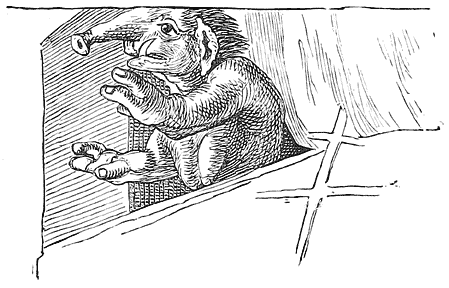
Fig. 15.—Snouted Demon.
The plaudits which welcomed the first railway train that sped beneath the Alps, echoing amid their crags and gorges, struck with death the old phantasms which had so long held sway in the imagination of the Southern peasantry. The great tunnel was hewn straight through the stony hearts of giants whom Christianity had tried to slay, and, failing that, baptised and adopted. It is in the Tyrol that we find the clearest survivals of the old demons of obstruction, the mountain monarchs. Such is Jordan the Giant of Kohlhütte chasm, near Ungarkopf, whose story, along with others, is so prettily told by the Countess Von Gunther. This giant is something of a Ten-jo as to nose, for he smells ‘human meat’ where his pursued victims are hidden, and his snort makes things tremble as before a tempest; but he has not the intelligence ascribed to large noses, for the boys ultimately persuade him that the way to cross a stream is to tie a stone around his neck, and he is drowned. One of the giants of Albach could carry a rock weighing 10,000 pounds, and his comrades, while carrying others of 700 pounds, could leap from stone to stone across rivers, and stoop to catch the trout with their hands as they leaped. The ferocious Orco, the mountain-ghost who never ages, fulfils the tradition of his classic name by often appearing as a monstrous black dog, from whose side stones rebound, and fills the air with a bad smell (like Mephisto). His employment is hurling wayfarers down precipices. In her story of the ‘Unholdenhof’—or ‘monster farm’ in the Stubeithal—the Countess Von Gunther describes the natural character of the mountain demons.
Some of these giants, as has been intimated, were converted. Such was the case with Heimo, who owned and devastated a vast tract of country on the river Inn, which, however, he bridged—whence Innsbruck—when he became a christian and a monk. This conversion was a terrible disappointment to the devil, who sent a huge dragon to stop the building of the monastery; but Heimo attacked the dragon, killed him, and cut out his tongue. With this tongue, a yard and a half long, in his hand, he is represented in his statue, and the tongue is still preserved in the cloister. Heimo became a monk at Wilten, lived a pious life, and on his death was buried near the monastery. The stone coffin in which the gigantic bones repose is shown there, and measures over twenty-eight feet.
The myth of Scylla, which relates that she was a beautiful maiden, beloved by Glaucus, whom Circe through jealousy transformed to a monster by throwing magic herbs into the well where she was wont to bathe, is recalled by various European legends. In Thuringia, on the road to Oberhof, stands the Red Stone, with its rosebush, and a stream issuing from beneath it, where a beautiful maid is imprisoned. Every seven years she may be seen bathing in the stream. On one occasion a peasant passing by heard a sneeze in the rock, and called out, ‘God help thee!’ The sneeze and the benediction were repeated, until at the seventh time the man cried, ‘Oh, thou cursed witch, deceive not honest people!’ As he then walked off, a wailing voice came out of the stone, ‘Oh, hadst thou but only wished the last time that God would help me. He would have helped me, and thou wouldst have delivered me; now I must tarry till the Day of Judgment!’ The voice once cried out to a wedding procession passing by the stone, ‘To-day wed, next year dead;’ and the bride having died a year after, wedding processions dread the spot.
The legends of giants and giantesses, so numerous in Great Britain, are equally associated with rocky mountain-passes, or the boulders they were supposed to have tossed thence when sportively stoning each other. They are the Tor of the South and Ben of the North. The hills of Ross-shire in Scotland are mythological monuments of Cailliachmore, great woman, who, while carrying a pannier filled with earth and stones on her back, paused for a moment on a level spot, now the site of Ben-Vaishard, when the bottom of the pannier gave way, forming the hills. The recurrence of the names Gog and Magog in Scotland suggests that in mountainous regions the demons were especially derived from the hordes of robbers and savages, among whom, in their uncultivable hills, the ploughshare could never conquer the spear and club. Richard Doyle enriched the first Exhibition of the Grosvenor Gallery in London, 1877, with many beautiful pictures inspired by European Folklore. They were a pretty garniture for the cemetery of dead religions. The witch once seen on her broom departing from the high crags of Cuhillan, cheered by her faithful dwarf, is no longer unlovely as in the days when she was burned by proxy in some poor human hag; obedient to art—a more potent wand than her own—she reascends to the clouds from which she was borne, and is hardly distinguishable from them. Slowly man came to learn with the poet—
It was the mountain streams that fed
Then the giants became fairies, and not a few of these wore at last the mantles of saints. A similar process has been undergone by another subject, which finds its pretty epitaph in the artist’s treatment. We saw in two pictures the Dame Blanche of Normandy, lurking in the ravine beside a stream under the dusk, awaiting yon rustic wood-cutter who is presently horizontal in the air in that mad dance, after which he will be found exhausted. As her mountain-sister is faintly shaped out of the clouds that cap Cuhillan, this one is an imaginative outgrowth of the twilight shadows, the silvery glintings of moving clouds mirrored in pools, and her tresses are long luxuriant grasses. She is of a sisterhood which passes by hardly perceptible gradations into others, elsewhere described—the creations of Illusion and Night. She is not altogether one of these, however, but a type of more direct danger—the peril of fords, torrents, thickets, marshes, and treacherous pools, which may seem shallow, but are deep.
Many are the legends of the opposition offered by demons to bridge-building, and of the sacrifices which had to be made to them before such works could be accomplished. A few specimens must suffice us. Mr. Dennys relates a very interesting one of the ‘Loh-family bridge’ at Shanghai. Difficulty having been found in laying the foundations, the builder vowed to Heaven two thousand children if the stones could be placed properly. The goddess addressed said she would not require their lives, but that the number named would be attacked by small-pox, which took place, and half the number died. A Chinese author says, ‘If bridges are not placed in proper positions, such as the laws of geomancy indicate, they may endanger the lives of thousands, by bringing about a visitation of small-pox or sore eyes.’ At Hang-Chow a tea-merchant cast himself into the river Tsien-tang as a sacrifice to the Spirit of the dikes, which were constantly being washed away.
The ‘Devil’s Bridges,’ to which Mephistopheles alludes so proudly, are frequent in Germany, and most of them, whether natural or artificial, have diabolical associations. The oldest structures often have legends in which are reflected the conditions exacted by evil powers, of those who spanned the fords in which men had often been drowned. Of this class is the Montafon Bridge in the Tyrol, and another is the bridge at Ratisbon. The legend of the latter is a fair specimen of those which generally haunt these ancient structures. Its architect was apprentice to a master who was building the cathedral, and laid a wager that he would bridge the Danube before the other laid the coping-stone of the sacred edifice. But the work of bridging the river was hard, and after repeated failures the apprentice began to swear, and wished the devil had charge of the business! Whereupon he of the cloven foot appeared in guise of a friar, and agreed to build the fifteen arches—for a consideration. The fee was to be the first three that crossed the bridge. The cunning apprentice contrived that these three should not be human, but a dog, a cock, and a hen. The devil, in wrath at the fraud, tore the animals to pieces and disappeared; a procession of monks passed over the bridge and made it safe; and thereon are carved figures of the three animals. In most of the stories it is a goat which is sent over and mangled, that poor animal having preserved its character as scape-goat in a great deal of the Folklore of Christendom. The Danube was of old regarded as under the special guardianship of the Prince of Darkness, who used to make great efforts to obstruct the Crusaders voyaging down it to rescue the Holy Land from pagans. On one occasion, near the confluence of the Vilz and Danube, he began hurling huge rocks into the river-bed from the cliffs; the holy warriors resisted successfully by signing the cross and singing an anthem, but the huge stone first thrown caused a whirl and swell in that part of the river, which were very dangerous until it was removed by engineers.
It is obvious, especially to the English, who have so long found a defensive advantage in the silver streak of sea that separates them from the Continent, that an obstacle, whether of mountain-range or sea, would, at a certain point in the formation of a nation, become as valuable as at another it might be obstructive. Euphemism is credited with having given the friendly name ‘Euxine’ to the rough ‘Axine’ Sea,—‘terrible to foreigners.’ But this is not so certain. Many a tribe has found the Black Sea a protection and a friend. In the case of mountains, their protective advantages would account at once for Milton’s celebration of Freedom as a mountain nymph, and for the stupidity of the people that dwell amid them, so often remarked; the very means of their independence would also be the cause of their insulation and barbarity. It is for those who go to and fro that knowledge is increased. The curious and inquiring are most apt to migrate; the enterprising will not submit to be shut away behind rocks and mountains; by their departure there would be instituted, behind the barriers of rock and hill, a survival of the stupidest. These might ultimately come to worship their chains and cover their craggy prison-walls with convents and crosses. The demons of aliens would be their gods. The climbing Hannibals would be their devils. It might have been expected, after the passages quoted from Mr. Ruskin concerning the bovine condition of Alpine peasantries, that he would salute the tunnel through Mont Cenis. The peasantries who would see in the sub-alpine engine a demon are extinct. Admiration of the genii of obstruction, and horror of the demons that vanquished them, are discoverable only in folk-tales distant enough to be pretty, such as the interesting Serbian story of ‘Satan’s jugglings and God’s might,’ in which fairies hiding in successively opened nuts vainly try to oppose with fire and flood a she-demon pursuing a prince and his bride, to whose aid at last comes a flash of lightning which strikes the fiend dead.
This little tale interprets with fine insight the demonology of barrenness and obstruction. The boy’s wrath against the unconscious cause of his troubles is the rage often observed in children who retaliate upon the table or chair on which they have been bruised, and it repeats embryologically the rage of the world’s boyhood inspired by ascription of personal motives to inanimate obstructions. Possibly such wrath might have added something to the force with which man entered upon his combat with nature; but George Sand’s tale reminds us that whatever was gained in force was lost in its misdirection. Success came in the proportion that fury was replaced by the youth’s growing recognition that he was dealing with facts that could not be raged out of existence. It is crowned when he makes friends with the unconquerable remnant of the giant, and sees that he is not altogether evil.
It is at this stage that the higher Art, conversant with Beauty, enters to relieve man of many moral wounds received in the struggle. Clothed with moss and clematis, Yéous appears not so hideous after all. Further invested by the genius of a Turner, he would be beautiful. Yéous is a fair giant after all, only he needed finish. He is a type of nature.
The boyhood of the world has not passed away with Miquel. We find a fictitious dualism cherished by the lovers of nature in their belief or feeling that nature exerts upon man some spiritual influence. Ruskin has said that in looking from the Campanile at Venice to the circle of snow which crowns the Adriatic, and then to the buildings which contain the works of Titian and Tintoret, he has felt unable to answer the question of his own heart, By which of these—the nature or the manhood—has God given mightier evidence of Himself? So nature may teach the already taught. While Ruskin looks from the Campanile, the peasant is fighting the mountain and calling its rocky grandeurs by the devil’s name; before the pictures he kneels. Untaught by art and science, the mind can derive no elevation from nature, can find no sympathy in it. It is a false notion that there is any compensation for the ignorant, denied access to art-galleries, in ability to pass their Sundays amid natural scenery. Health that may bring them, but mentally they are still inside the prison-walls from which look the stony eyes of Fates and Furies. Natural sublimities cannot refine minds crude as themselves; they must pass through thought before they can feed thought; it is nature transfigured in art that changes the snow-clad mountain from a heartless giant to a saviour in snow-pure raiment.