Volume 2 / Part 4 — Chapter XIX. The Man of Sin.
Reading edition
Hindu myth—Gnostic theories—Ophite scheme of redemption—Rabbinical traditions of primitive man—Pauline Pessimism—Law of death—Satan’s ownership of man—Redemption of the elect—Contemporary statements—Baptism—Exorcism—The ‘new man’s’ food—Eucharist—Herbert Spencer’s explanation—Primitive ideas—Legends of Adam and Seth—Adamites—A Mormon ‘Mystery’ of initiation.
In a Hindu myth, Dhrubo, an infant devotee, passed much time in a jungle, surrounded by ferocious beasts, in devotional exercises of such extraordinary merit that Vishnu erected a new heaven for him as the reward of his piety. Vishnu even left his own happy abode to superintend the construction of this special heaven. In Hebrew mythology the favourite son, the chosen people, is called out of Egypt to dwell in a new home, a promised land, not in heaven but on earth. The idea common to the two is that of a contrast between a natural and a celestial environment,—a jungle and beasts, bondage and distress; a new heaven, a land flowing with milk and honey,—and the correspondence with these of the elect child, Dhrubo or Israel.
The tendency of Christ’s mind appears to have been rather in the Aryan direction; he pointed his friends to a kingdom not of this world, and to his Father’s many mansions in heaven. But the Hebrew faith in a messianic reign in this world was too strong for his dream; a new earth was appended to the new heaven, and became gradually paramount, but this new earth was represented only by the small society of believers who made the body of Christ, the members in which his blood flowed.
Paul’s pessimistic conception of this world and of human nature was radical, and it mainly formed the mould in which dogmatic Christianity subsequently took shape. His general theology is a travesty of the creation of the world and of man. All that work of Elohim was, by implication, natural, that is to say, diabolical. The earth as then created belonged to the Prince of this world, who was the author of sin, and its consequence, death. In Adam all die. The natural man is enmity against God; he is of the earth earthy; his father is the devil; he cannot know spiritual things. All mankind are born spiritually dead. Christ is a new and diviner Demiurgos, engaged in the work of producing a new creation and a new man. For his purpose the old law, circumcision or uncircumcision, are of no avail or importance, but a new creature. His death is the symbol of man’s death to the natural world, his resurrection of man’s rising into a new world which mere flesh and blood cannot inherit. As God breathed into Adam’s nostrils the breath of life, the Spirit breathes upon the elect of Christ a new mind and new heart.
The ‘new creature’ must inhale an entirely new physical atmosphere. When Paul speaks of ‘the Prince of the Power of the Air,’ it must not be supposed that he is only metaphorical. On this, however, we must dwell for a little.
‘The air,’ writes Burton in his ‘Anatomy of Melancholy,’ ‘The air is not so full of flies in summer as it is at all times of invisible devils. They counterfeit suns and moons, and sit on ships’ masts. They cause whirlwinds of a sudden, and tempestuous storms, which though our meteorologists generally refer to natural causes, yet I am of Bodine’s mind, they are more often caused by those aerial devils in their several quarters. Cardan gives much information concerning them. His father had one of them, an aerial devil, bound to him for eight and twenty years; as Agrippa’s dog had a devil tied to his collar. Some think that Paracelsus had one confined in his sword pommel. Others wear them in rings;’ and so the old man runs on, speculating about the mysterious cobwebs collected in the ceiling of his brain.
The atmosphere mentally breathed by Burton and his authorities was indeed charged with invisible phantasms; and every one of them was in its origin a genuine intellectual effort to interpret the phenomena of nature. It is not wonderful that the ancients should have ascribed to a diabolical source the subtle deaths that struck at them from the air. A single breath of the invisible poison of the air might lay low the strongest. Even after man had come to understand his visible foes, the deadly animal or plant, he could only cower and pray before the lurking power of miasma and infection, the power of the air. The Tyndalls of a primitive time studied dust and disease, and called the winged seeds of decay and death ‘aerial devils,’ and prepared the way for Mephistopheles (devil of smells), as he in turn for the bacterial demon of modern science.
Out of such intellectual atmosphere came Paul’s sentence (Eph. ii. 2) about ‘the Prince of the Power of the Air.’ It was a spiritualisation of the existing aerial demonology. When Paul and his companions carried their religious agitation into the centres of learning and wealth, and brought the teachings of a Jew to confront the temples of Greece and Rome, they found themselves unrelated to that great world. It had another habit of mind and feeling, and the idea grew in him that it was the spirits of the Satanic world counteracting the spirit sent on earth from the divine world. This animated its fashions, philosophy, science, and literature. He warns the Church at Ephesus that they will need the whole armour of God, because they are wrestling not with mere flesh and blood, but against the rulers of the world’s darkness, the evil spirits in high places—that is, in the Air.
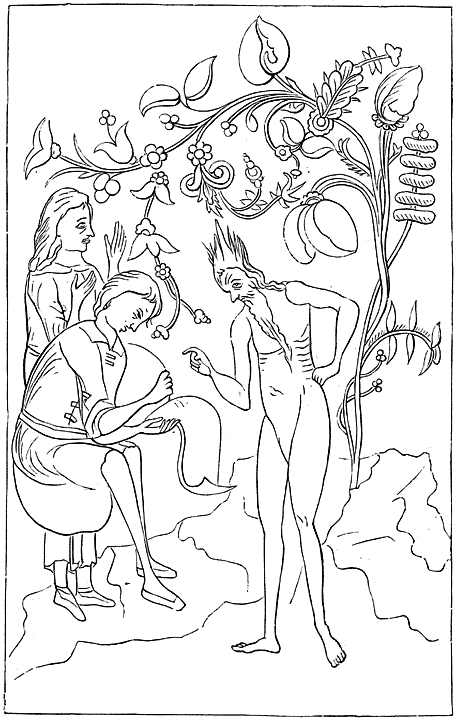
Fig. 7.—Adam Signing Contract for his Posterity To Satan.
As heirs of this new nature and new world, with its new atmosphere, purchased and endowed by Christ, the Pauline theory further presupposes, that the natural man, having died, is buried with Christ in baptism, rises with him, and is then sealed to him by the Holy Ghost. For a little time such must still bear about them their fleshy bodies, but soon Christ shall come, and these vile bodies shall be changed into his likeness; meanwhile they must keep their bodies in subjection, even as Paul did, by beating it black and blue (ὑπωπιάζω), and await their deliverance from the body of the dead world they have left, but which so far is permitted to adhere to them. This conception had to work itself out in myths and dogmas of which Paul knew nothing. ‘If any man come after me and hate not his father and mother, and his own (natural) life also, he cannot be my disciple.’ The new race with which the new creation was in travail was logically discovered to need a new Mother as well as a new Father. Every natural mother was subjected to a stain that it might be affirmed that only one mother was immaculate—she whose conception was supernatural, not of the flesh. Marriage became an indulgence to sin (whose purchase-money survives still in the marriage-fee). The monastery and the nunnery represented this new ascetic kingdom; that perilous word ‘worldliness’ was transmitted to be the source of insanity and hypocrisy.
‘I turn to the same old book, and I find out that the Son of Mary, who was the Son of God, the darling of heaven, the champion of the ages, by some called Lord, by some called Jesus, by others called Christ, but this morning by us called by the three blessed titles, Lord Jesus Christ, by one magnificent stroke made it possible for us all to be saved. He not only told us that there was a hell, but he went into it. He walked down the fiery steeps. He stepped off the bottom rung of the long ladder of despair. He descended into hell. He put his bare foot on the hottest coal of the fiercest furnace.
‘He explored the darkest den of eternal midnight, and then He came forth lacerated and scarified, and bleeding and mauled by the hands of infernal excruciation, to cry out to all the ages, ‘I have paid the price for all those who would make me their substitute. By my piled-up groans, by my omnipotent agony, I demand the rescue of all those who will give up sin and trust in me,’ Mercy! mercy! mercy! But how am I to get it? Cheap. It will not cost you as much as a loaf of bread. Only a penny? No, no. Escape from hell, and all the harps, and mansions, and thrones, and sunlit fields of heaven besides in the bargain, ‘without money, and without price.’’
A clergyman informed me that he knew of a case in which a man, receiving back his child after christening, kissed it, and said, ‘I never kissed it before, because I knew it was not a child of God; but now that it is, I love it dearly.’ But why not? Some even now teach that a white angel follows the baptized, a black demon the unbaptized.
The belief was wide-spread that unbaptized children were turned into elves at death. In Iceland it is still told as a bit of folk-lore, that when God visited Eve, she kept a large number of her children out of sight, ‘because they had not been washed,’ and these children were turned into elves, and became the progenitors of that uncanny race. The Greek Church made so much of baptism, that there has been developed an Eastern sect which claims John the Baptist as its founder, making little of Christ, who baptized none; and to this day in Russia the peasant regards it as almost essential to a right reception of the benedictions of Sunday to have been under water on the previous day—soap being sagaciously added. The Roman Catholic Church, following the provision of the Council of Carthage, still sets a high value on baptismal exorcism; and Calvin refers to a theological debate at the Sorbonne in Paris, whether it would not be justifiable for a priest to throw a child into a well rather than have it die unbaptized. Luther preserved the Catholic form of exorcism; and, in some districts of Germany, Protestants have still such faith in it, that, when either a child or a domestic animal is suspected of being possessed, they will send for the Romish priest to perform the rite of exorcism.
When, a little time ago, a New Zealand chief showed his high appreciation of a learned German by eating his eyes to improve his own intellectual vision, the case seemed to some to call for more and better protected missionaries; but the chief might find in the sacramental communion of the missionaries the real principle of his faith. The celebration of the ‘Lord’s Supper’ when a Bishop is ordained has only to be ‘scratched,’ as the proverb says, to reveal beneath it the Indians choosing their episcopal totem. As Israel observed the Passover—eating together of the lamb whose blood sprinkled on their door-posts had marked those to be preserved from the Destroying Angel in Egypt—they who believed that Jesus was Messias tasted the body and blood of their Head, as indicating the elect out of a world otherwise given over to the Destroyer spiritually, and finally to be delivered up to him bodily. ‘He that eateth my flesh and drinketh my blood dwelleth in me and I in him.’ These were to tread on serpents, or handle them unharmed, as it is said Paul did. They were not really to die, but to fall asleep, that they might be changed as a seed to its flower, through literal resurrection from the earth.
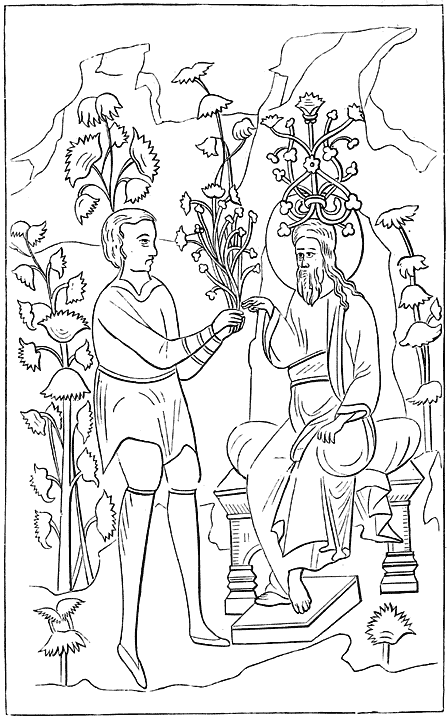
Fig. 8.—Seth Offering a Branch to Adam.
The difficulty of tracing the ethnical origin of such legends as these is much greater than that of tracing their common natural origin. The effect of certain kinds of food upon the human system is very marked, even apart from the notorious effects of the drinks made from the vegetative world. The effects of mandrake, opium, tobacco, various semi-poisonous fungi, the simplicity with which differences of race might be explained by their vegetarian or carnivorous customs, would be enough to suggest theories of the potency of food over the body and soul of man such as even now have their value in scientific speculation.
In our old Russian picture (Fig. 8) Seth is shown offering a branch of the Tree of Knowledge to his father Adam. That it should spring up to be the Tree of Life is simply in obedience to Magian and Gnostic theories, which generally turn on some scheme by which the Good turns against the Evil Mind the point of his own weapon. These were the influences which gave to christian doctrines on the subject their perilous precision. The universal tradition was that Adam was the first person liberated by Christ from hell; and this corresponded with an equally wide belief that all who were saved by the death of Christ and his descent into hell were at once raised into the moral condition of Adam and Eve before the Fall,—to eat the food and breathe the holy air of Paradise.
An honest mirror was held up before this theology by the christian Adamites. Their movement (second and third centuries) was a most legitimate outcome of the Pauline and Johannine gospel. The author of this so-called ‘heresy,’ Prodicus, really anticipated the Methodist doctrine of ‘sanctification,’ and he was only consistent in admonishing his followers that clothing was, in the Bible, the original badge of carnal guilt and shame, and was no longer necessary for those whom Christ had redeemed from the Fall and raised to the original innocence of Adam and Eve. These believers, in the appropriate climate of Northern Africa, had no difficulty in carrying out their doctrine practically, and having named their churches ‘Paradises,’ assembled in them quite naked. There is still a superstition in the East that a snake will never attack one who is naked. The same Adamite doctrine—a prelapsarian perfection symbolised by nudity—was taught by John Picard in Bohemia, and a flourishing sect of ‘Adamites’ arose there in the fifteenth century. The Slavonian Adamites of the last century—and they are known to carry on their services still in secret—not only dispense with clothing, but also with sacraments and ceremonies, which are for the imperfect, not for the perfected. Again and again has this logical result of the popular theology appeared, and with increasingly gross circumstances, as the refined and intelligent abandon except in name the corresponding dogmas. It is an impressive fact that Paul’s central doctrine of ‘a new creature’ is now adopted with most realistic orthodoxy by the Mormons of Utah, whose initiation consists of a dramatic performance on each candidate of moulding the body out of clay, breathing in the nostrils, the ‘deep sleep’ presentation of an Eve to each Adam, the temptation, fall, and redemption. The ‘saints’ thus made, unfortunately, seem to have equally realistic ideas that the Gentiles are adherents of the Prince of this world, and their sacramental bands have shown some striking imitations of those events of history which, when not labelled ‘Christian,’ are pronounced barbarous. Now that the old dogmatic system is being left more and more to the ignorant and vulgar to make over into their own image and likeness, it may be hoped that elsewhere also the error that libels and outrages nature will run to seed; for error, like the aloe, has its period when it shoots up a high stem and—dies.