Volume 2 / Part 4 — Chapter XVII. The Prince of this World.
Reading edition
Temptations—Birth of Buddha—Mara—Temptation of power—Asceticism and Luxury—Mara’s menaces—Appearance of the Buddha’s Vindicator—Ahriman tempts Zoroaster—Satan and Christ—Criticism of Strauss—Jewish traditions—Hunger—Variants.
The Devil, having shown Jesus all the kingdoms of this world, said, ‘All this power will I give thee, and the glory of them: for that is delivered unto me, and to whomsoever I will I give it,’ The theory thus announced is as a vast formation underlying many religions. As every religion begins as an ideal, it must find itself in antagonism to the world at large; and since the social and political world are themselves, so long as they last, the outcome of nature, it is inevitable that in primitive times the earth should be regarded as a Satanic realm, and the divine world pictured elsewhere. A legitimate result of this conclusion is asceticism, and belief in the wickedness of earthly enjoyments. To men of great intellectual powers, generally accompanied as they are with keen susceptibilities of enjoyment and strong sympathies, the renunciation of this world must be as a living burial. To men who, amid the corruptions of the world, feel within them the power to strike in with effect, or who, seeing ‘with how little wisdom the world is governed,’ are stirred by the sense of power, the struggle against the temptation to lead in the kingdoms of this world is necessarily severe. Thus simple is the sense of those temptations which make the almost invariable ordeal of the traditional founders of religions. As in earlier times the god won his spurs, so to say, by conquering some monstrous beast, the saint or saviour must have overcome some potent many-headed world, with gems for scales and double-tongue, coiling round the earth, and thence, like Lilith’s golden hair, round the heart of all surrendered to its seductions.
When the Prince passed out at the palace gates, the king Mara, knowing that the youth was passing beyond his evil power, determined to prevent him. Descending from his abode and floating in the air, Mara cried, ‘Lord, thou art capable of such vast endurance, go not forth to adopt a religious life, but return to thy kingdom, and in seven days thou shalt become an emperor of the world, ruling over the four great continents.’ ‘Take heed, O Mara!’ replied the Prince; ‘I also know that in seven days I might gain universal empire, but I have no desire for such possessions. I know that the pursuit of religion is better than the empire of the world. See how the world is moved, and quakes with praise of this my entry on a religious life! I shall attain the glorious omniscience, and shall teach the wheel of the law, that all teachable beings may free themselves from transmigratory existence. You, thinking only of the lusts of the flesh, would force me to leave all beings to wander without guide into your power. Avaunt! get thee away far from me!’
Mara withdrew, but only to watch for another opportunity. It came when the Prince had reduced himself to emaciation and agony by the severest austerities. Then Mara presented himself, and pretending compassion, said, ‘Beware, O grand Being! Your state is pitiable to look on; you are attenuated beyond measure, and your skin, that was of the colour of gold, is dark and discoloured. You are practising this mortification in vain. I can see that you will not live through it. You, who are a Grand Being, had better give up this course, for be assured you will derive much more advantage from sacrifices of fire and flowers.’ Him the Grand Being indignantly answered, ‘Hearken, thou vile and wicked Mara! Thy words suit not the time. Think not to deceive me, for I heed thee not. Thou mayest mislead those who have no understanding, but I, who have virtue, endurance, and intelligence, who know what is good and what is evil, cannot be so misled. Thou, O Mara! hast eight generals. Thy first is delight in the five lusts of the flesh, which are the pleasures of appearance, sound, scent, flavour, and touch. Thy second general is wrath, who takes the form of vexation, indignation, and desire to injure. Thy third is concupiscence. Thy fourth is desire. Thy fifth is impudence. Thy sixth is arrogance. Thy seventh is doubt. And thine eighth is ingratitude. These are thy generals, who cannot be escaped by those whose hearts are set on honour and wealth. But I know that he who can contend with these thy generals shall escape beyond all sorrow, and enjoy the most glorious happiness. Therefore I have not ceased to practise mortification, knowing that even were I to die whilst thus engaged, it would be a most excellent thing.’
It is added that Mara ‘fled in confusion,’ but the next incident seems to show that his suggestion was not unheeded; for ‘after he had departed,’ the Grand Being had his vision of the three-stringed guitar—one string drawn too tightly, the second too loosely, the third moderately—which last, somewhat in defiance of orchestral ideas, alone gave sweet music, and taught him that moderation was better than excess or laxity. By eating enough he gained that pristine strength and beauty which offended the five Brahmans so that they left him. The third and final effort of Mara immediately preceded the Prince’s attainment of the order of Buddha under the Bo-tree. He now sent his three daughters, Raka (Love), Aradi (Anger), Tanha (Desire). Beautifully bedecked they approached him, and Raka said, ‘Lord, fearest thou not death?’ But he drove her away. The two others also he drove away as they had no charm of sufficient power to entice him. Then Mara assembled his generals, and said, ‘Listen, ye Maras, that know not sorrow! Now shall I make war on the Prince, that man without equal. I dare not attack him in face, but I will circumvent him by approaching on the north side. Assume then all manner of shapes, and use your mightiest powers, that he may flee in terror.’
Having taken on fearful shapes, raising awful sounds, headed by Mara himself, who had assumed immense size, and mounted his elephant Girimaga, a thousand miles in height, they advanced; but they dare not enter beneath the shade of the holy Bo-tree. They frightened away, however, the Lord’s guardian angels, and he was left alone. Then seeing the army approaching from the north, he reflected, ‘Long have I devoted myself to a life of mortification, and now I am alone, without a friend to aid me in this contest. Yet may I escape the Maras, for the virtue of my transcendent merits will be my army.’ ‘Help me,’ he cried, ‘ye thirty Barami! ye powers of accumulated merit, ye powers of Almsgiving, Morality, Relinquishment, Wisdom, Fortitude, Patience, Truth, Determination, Charity, and Equanimity, help me in my fight with Mara!’ The Lord was seated on his jewelled throne (the same that had been formed of the grass on which he sat), and Mara with his army exhausted every resource of terror—monstrous beasts, rain of missiles and burning ashes, gales that blew down mountain peaks—to inspire him with fear; but all in vain! Nay, the burning ashes were changed to flowers as they fell.
‘Come down from thy throne,’ shouted the evil-formed one; ‘come down, or I will cut thine heart into atoms!’ The Lord replied, ‘This jewelled throne was created by the power of my merits, for I am he who will teach all men the remedy for death, who will redeem all beings, and set them free from the sorrows of circling existence.’
Mara then claimed that the throne belonged to himself, and had been created by his own merits; and on this armed himself with the Chakkra, the irresistible weapon of Indra, and Wheel of the Law. Yet Buddha answered, ‘By the thirty virtues of transcendent merits, and the five alms, I have obtained the throne. Thou, in saying that this throne was created by thy merits, tellest an untruth, for indeed there is no throne for a sinful, horrible being such as thou art.’
Then furious Mara hurled the Chakkra, which clove mountains in its course, but could not pass a canopy of flowers which rose over the Lord’s head.
And now the great Being asked Mara for the witnesses of his acts of merit by virtue of which he claimed the throne. In response, Mara’s generals all bore him witness. Then Mara challenged him, ‘Tell me now, where is the man that can bear witness for thee?’ The Lord reflected, ‘Truly here is no man to bear me witness, but I will call on the earth itself, though it has neither spirit nor understanding, and it shall be my witness.’ Stretching forth his hand, he thus invoked the earth: ‘O holy Earth! I who have attained the thirty powers of virtue, and performed the five great alms, each time that I have performed a great act have not failed to pour water on thee. Now that I have no other witness, I call upon thee to give thy testimony!’
The angel of the earth appeared in shape of a lovely woman, and answered, ‘O Being more excellent than angels or men! it is true that, when you performed your great works, you ever poured water on my hair.’ And with these words she wrung her long hair, and from it issued a stream, a torrent, a flood, in which Mara and his hosts were overturned, their insignia destroyed, and King Mara put to flight, amid the loud rejoicings of angels.
Then the evil one and his generals were conquered not only in power but in heart; and Mara, raising his thousand arms, paid reverence, saying, ‘Homage to the Lord, who has subdued his body even as a charioteer breaks his horses to his use! The Lord will become the omniscient Buddha, the Teacher of angels, and Brahmas, and Yakkhas (demons), and men. He will confound all Maras, and rescue men from the whirl of transmigration!’
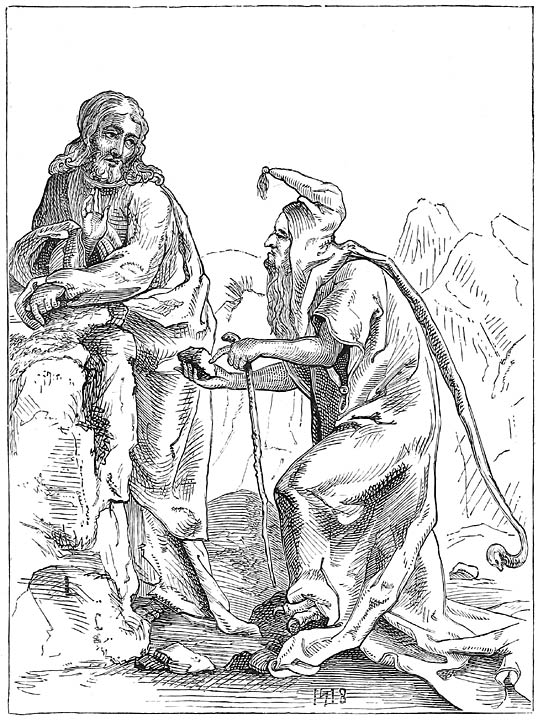
Fig. 6.—Temptation of Christ (Lucas van Leyden).
In the account of Matthew, Satan begins his temptation of Jesus in the same way and amid similar circumstances to those we find in the Siamese legends of Buddha. It occurs in a wilderness, and the appeal is to hunger. The temptation of Buddha, in which Mara promises the empire of the world, is also repeated in the case of Satan and Jesus (Fig. 6). The menaces, however, in this case, are relegated to the infancy, and the lustful temptation is absent altogether. Mark has an allusion to his being in the wilderness forty days ‘with the beasts,’ which may mean that Satan ‘drove’ him into a region of danger to inspire fear. In Luke we have the remarkable claim of Satan that the authority over the world has been delivered to himself, and he gives it to whom he will; which Jesus does not deny, as Buddha did the similar claim of Mara. As in the case of Buddha, the temptation of Jesus ends his fasting; angels bring him food (διηκόνουν ἀυτῶ probably means that), and thenceforth he eats and drinks, to the scandal of the ascetics.
However this may be, we may with certainty repair to the common source of all such myths in the higher nature of man, and recognise the power of a pure genius to overcome those temptations to a success unworthy of itself. We may interpret all such legends with a clearness proportioned to the sacrifices we have made for truth and ideal right; and the endless perplexities of commentators and theologians about the impossible outward details of the New Testament story are simple confessions that the great spirit so tried is now made to label with his name his own Tempter—namely, a Church grown powerful and wealthy, which, as the Prince of this World, bribes the conscience and tempts away the talent necessary to the progress of mankind.