Volume 2 / Part 2 — Chapter I. Hunger.
Reading edition
Hunger-demons—Kephn—Miru—Kagura—Ráhu the Hindu sun-devourer—The earth monster at Pelsall—A Franconian custom—Sheitan as moon-devourer—Hindu offerings to the dead—Ghoul—Goblin—Vampyres—Leanness of demons—Old Scotch custom.—The origin of sacrifices.
In every part of the earth man’s first struggle was for his daily food. With only a rude implement of stone or bone he had to get fish from the sea, bird from the air, beast from the forest. For ages, with such poor equipment, he had to wring a precarious livelihood from nature. He saw, too, every living form around him similarly trying to satisfy its hunger. There seemed to be a Spirit of Hunger abroad. And, at the same time, there was such a resistance to man’s satisfaction of his need—the bird and fish so hard to get, the stingy earth so ready to give him a stone when he asked for bread—that he came to the conclusion that there must be invisible voracious beings who wanted all good things for themselves. So the ancient world was haunted by a vast brood of Hunger-demons. There is an African tribe, the Karens, whose representation of the Devil (Kephn) is a huge stomach floating through the air; and this repulsive image may be regarded as the type of nearly half the demons which have haunted the human imagination. This, too, is the terrible Miru, with her daughters and slave, haunting the South Sea Islander. ‘The esoteric doctrine of the priests was, that souls leave the body ere breath has quite gone, and travel to the edge of a cliff facing the setting sun (Rā). A large wave now approaches the base of the cliff, and a gigantic bua tree, covered with fragrant blossoms, springs up from Avaiki (nether world) to receive on its far-reaching branches human spirits, who are mysteriously impelled to cluster on its limbs. When at length the mystic tree is covered with human spirits, it goes down with its living freight to the nether world. Akaanga, the slave of fearful Miru, mistress of the invisible world, infallibly catches all these unhappy spirits in his net and laves them to and fro in a lake. In these waters the captive ghosts exhaust themselves by wriggling about like fishes, in the vain hope of escape. The net is pulled up, and the half-drowned spirits enter into the presence of dread Miru, who is ugliness personified. The secret of Miru’s power over her intended victims is the ‘kava’ root (Piper mythisticum). A bowl of this drink is prepared for each visitor to the shades by her four lovely daughters. Stupefied with the draught, the unresisting victims are borne off to a mighty oven and cooked. Miru, her peerless daughters, her dance-loving son, and the attendants, subsist exclusively on human spirits decoyed to the nether world and then cooked. The drinking-cups of Miru are the skulls of her victims. She is called in song ‘Miru-the-ruddy,’ because her cheeks ever glow with the heat of the oven where her captives are cooked. As the surest way to Miru’s oven is to die a natural death, one need not marvel that the Rev. Mr. Gill, who made these statements before the Anthropological Institute in London (February 8, 1876), had heard ‘many anecdotes of aged warriors, scarcely able to hold a spear, insisting on being led to the field of battle in the hope of gaining the house of the brave.’ As the South Sea paradise seems to consist in an eternal war-dance, or, in one island, in an eternal chewing of sugar-cane, it is not unlikely that the aged seek violent death chiefly to avoid the oven. We have here a remarkable illustration of the distinguishing characteristic of the demon. Fearful as Miru is, it may be noted that there is not one gratuitous element of cruelty in her procedure. On the contrary, she even provides her victims with an anæsthetic draught. Her prey is simply netted, washed, and cooked, as for man are his animal inferiors. In one of the islands (Aitutaki), Miru is believed to resort to a device which is certainly terrible—namely, the contrivance that each soul entering the nether world shall drink a bowl of living centipedes; but this is simply with the one end in view of appeasing her own pangs of hunger, for the object and effect of the draught is to cause the souls to drown themselves, it being apparently only after entire death that they can be cooked and devoured by Miru and her household.
Fortunately for the islanders, Miru is limited in her tortures to a transmundane sphere, and room is left for many a slip between her dreadful cup and the human lip. The floating stomach Kephn is, however, not other-worldly. We see, however, a softened form of him in some other tribes. The Greenlanders, Finns, Laps, conceived the idea that there is a large paunch-demon which people could invoke to go and suck the cows or consume the herds of their enemies; and the Icelanders have a superstition that some people can construct such a demon out of bones and skins, and send him forth to transmute the milk or flesh of cattle into a supply of flesh and blood. A form of this kind is represented in the Japanese Kagura (figure 3), the favourite mask of January dancers and drum-beaters seeking money. The Kagura is in precise contrast with the Pretas (Siam), which, though twelve miles in height, are too thin to be seen, their mouths being so small as to render it impossible to satisfy their fearful hunger.
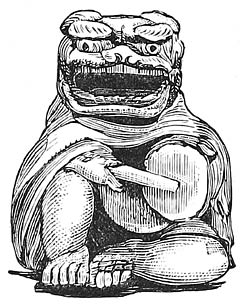
Fig. 3—A Swallower.
Especially notable is the breaking of their culinary utensils by the Hindus during an eclipse. In Copenhagen there is a collection of the votive weapons of ancient Norsemen, every one broken as it was offered up to the god of their victory in token of good faith, lest they should be suspected of any intention to use again what they had given away. For the same reason the cup was offered—broken—with the libation. The Northman felt himself in the presence of the Jötunn (giants), whose name Grimm identifies as the Eaters. For the Hindu of to-day the ceremonies appropriate at an eclipse, however important, have probably as little rational meaning as the occasional Belfire that lights up certain dark corners of Europe has for those who build it. But the traditional observances have come up from the childhood of the world, when the eclipse represented a demon devouring the sun, who was to have his attention called by outcries and prayers to the fact that if it was fire he needed there was plenty on earth; and if food, he might have all in their houses, provided he would consent to satisfy his appetite with articles of food less important than the luminaries of heaven.
The fires kindled by the Hindus to frighten Ráhu on his latest appearance might have defeated the purpose of the expedition by the smoke it was sending up, had not two officers leaped upon the fire and scattered its fuel; but just about the time when these courageous gentlemen were trampling out the fires of superstition whose smoke would obscure the vision of science, an event occurred in England which must be traced to the same ancient belief—the belief, namely, that when anything is apparently swallowed up, as the sun and moon by an eclipse, or a village by earthquake or flood, it is the work of a hungry dragon, earthworm, or other monster. The Pelsall mine was flooded, and a large number of miners drowned. When the accident became known in the village, the women went out with the families of the unfortunate men, and sat beside the mouth of the flooded pit, at the bottom of which the dead bodies yet remained. These women then yelled down the pit with voices very different from ordinary lamentation. They also refused unanimously to taste food of any kind, saying, when pressed to do so, that so long as they could refrain from eating, their husbands might still be spared to them. When, finally, one poor woman, driven by the pangs of hunger, was observed to eat a crust of bread, the cries ceased, and the women, renouncing all hope, proceeded in silent procession to their homes in Pelsall.
The Hindu people casting their food out of the window during an eclipse, the Pelsall wives refusing to eat when the mine is flooded, are acting by force of immemorial tradition, and so are doing unconsciously what the African woman does consciously when she surrounds the bed of her sick husband with rice and meat, and beseeches the demon to devour them instead of the man. To the same class of notions belong the old custom of trying to discover the body of one drowned by means of a loaf of bread with a candle stuck in it, which it was said would pause above the body, and the body might be made to appear by firing a gun over it—that is, the demon holding it would be frightened off. A variant, too, is the Persian custom of protecting a woman in parturition by spreading a table, with a lamp at each corner, with seven kinds of fruits and seven different aromatic seeds upon it.
In 1769, when Pennant made his ‘Scottish Tour,’ he found fully observed in the Highlands the ceremony of making the Beltane Cake on the first of May, and dedicating its distributed fragments to birds and beasts of prey, with invocation to the dread being of whom they were the supposed agents to spare the herds. Demons especially love milk: the Lambton Worm required nine cows’ milk daily; and Jerome mentions a diabolical baby which exhausted six nurses.
The Devil nominally inherits, among the peasantry of Christendom, the attributes of the demons which preceded him; but it must be understood that in every case where mere voracity is ascribed to the Devil, a primitive demon is meant, and of this fact the superstitious peasant is dimly conscious. In Franconia, when a baker is about to put dough biscuits into an oven to be baked, he will first throw half-a-dozen of them into the fire, saying, ‘There, poor devil! those are for you.’ If pressed for an explanation, he will admit his fear that but for this offering his biscuits are in danger of coming out burnt; but that the ‘poor devil’ is not bad-hearted, only driven by his hunger to make mischief. The being he fears is, therefore, clearly not the Devil at all—whose distinction is a love of wickedness for its own sake—but the half-starved gobbling ghosts of whom, in Christian countries, ‘Devil’ has become the generic name. Of their sacrifices, Grace before meat is a remnant. In Moslem countries, however, ‘Sheitan’ combines the demonic and the malignant voracities. During the late lunar eclipse, the inhabitants of Pera and Constantinople fired guns over their houses to drive ‘Sheitan’ (Satan) away from the moon, for, whoever the foe, the Turk trusts in gunpowder. But superstitions representing Satan as a devourer are becoming rare. In the church of Nôtre Dame at Hal, Belgium, the lectern shows a dragon attempting to swallow the Bible, which is supported on the back of an eagle.
I will raise the dead to be devourers of the living!
Upon the living shall the dead prey!
Such ideas as these are represented in Europe in some varieties of the Kobold and the Goblin (Gk. κόβαλος). Though the goblin must, according to folk-philosophy, be fed with nice food, it is not a deadly being; on the contrary, it is said the Gobelin tapestry derives its name because the secret of its colours was gained from these ghosts. Though St. Taurin expelled one from Evreux, he found it so polite that he would not send it to hell, and it still haunts the credulous there and at Caen, without being thought very formidable.
The demon that ‘lurks in graveyards’ is universal, and may have suggested cremation. In the East it is represented mainly by such forms as the repulsive ghoul, which preys on dead bodies; but it has been developed in some strange way to the Slavonic phantom called Vampyre, whose peculiar fearfulness is that it represents the form in which any deceased person may reappear, not ghoul-like to batten on the dead, but to suck the blood of the living. This is perhaps the most formidable survival of demonic superstition now existing in the world.
In Germany, though the more horrible forms of the superstition are rare, the ‘Nachzehrer’ is much dreaded. Even in various Protestant regions it is thought safest that a cross should be set beside every grave to impede any demonic propensities that may take possession of the person interred; and where food is not still buried with the corpse to assuage any pangs of hunger that may arise, a few grains of corn or rice are scattered upon it in reminiscence of the old custom. In Diesdorf it is believed that if money is not placed in the dead person’s mouth at burial, or his name not cut from his shirt, he is likely to become a Nachzehrer, and that the ghost will come forth in the form of a pig. It is considered a sure preventative of such a result to break the neck of the dead body. On one occasion, it is there related, several persons of one family having died, the suspected corpse was exhumed, and found to have eaten up its own grave-clothes.
Dr. Dyer, an eminent physician of Chicago, Illinois, told me (1875) that a case occurred in that city within his personal knowledge, where the body of a woman who had died of consumption was taken out of the grave and the lungs burned, under a belief that she was drawing after her into the grave some of her surviving relatives. In 1874, according to the Providence Journal, in the village of Peacedale, Rhode Island, U.S., Mr. William Rose dug up the body of his own daughter, and burned her heart, under the belief that she was wasting away the lives of other members of his family.
The characteristics of modern ‘Spiritualism’ appear to indicate that the superstitious have outgrown this ancient fear of ghostly malevolence where surrounded by civilisation. It is very rare in the ancient world or in barbarous regions to find any invocations for the return of the spirits of the dead. Mr. Tylor has quoted a beautiful dirge used by the Ho tribe of India, beginning—
We never scolded you, never wronged you;
Come to us back!
It may be remarked, in this connection, that in nearly all the pictures of demons and devils, they are represented as very lean. The exceptions will be found generally in certain Southern and tropical demons which represent cloud or storm—Typhon, for instance—and present a swollen or bloated appearance. No Northern devil is fat. Shakespeare ascribes to Cæsar a suspicion of leanness—
Yond’ Cassius hath a lean and hungry look:
He thinks too much: such men are dangerous.
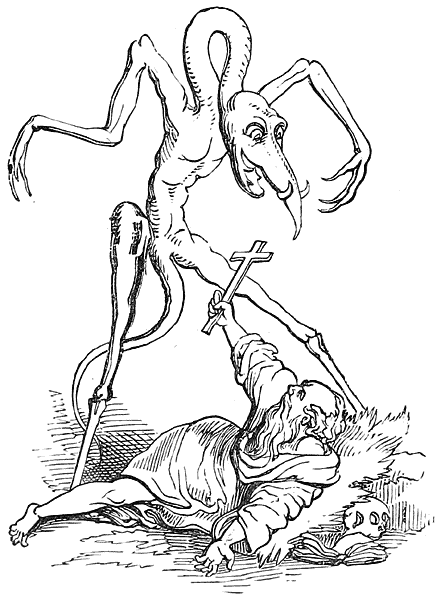
Fig. 4.—St. Anthony’s Lean Persecutor (Salvator Rosa).
I know that I hung
On a wind-rocked tree
Nine whole nights,
With a spear wounded,
And to Odin offered
Myself to myself.