Volume 2 / Part 2 — Chapter VII. Barrenness.
Reading edition
Indian famine and Sun-spots—Sun-worship—Demon of the Desert—The Sphinx—Egyptian plagues described by Lepsius: Locusts, Hurricane, Flood, Mice, Flies—The Sheikh’s ride—Abaddon—Set—Typhon—The Cain wind—Seth—Mirage—The Desert Eden—Azazel—Tawiscara and the Wild Rose.
Almost pathetic does the long and vast history appear just now, when competent men of science are giving us good reason to believe that right knowledge of the sun, and the relation of its spots to the rainfall, might have covered India with ways and means which would have adapted the entire realm to its environment, and wrested from Indra his hostile thunderbolt—the sunstroke of famine. The Hindus have covered their lands with temples raised to propitiate and deprecate the demons, and to invoke the deities against such sources of drouth and famine. Had they concluded that famine was the result of inexactly quartered sun-dials, the land would have been covered with perfect sun-dials; but the famine would have been more destructive, because of the increasing withdrawal of mind and energy from the true cause, and its implied answer. Even so were conflagrations in London attributed to inexact city clocks; the clocks would become perfect, the conflagrations more numerous, through misdirection of vigilance. But how much wiser are we of Christendom than the Hindus? They have adapted their country perfectly for propitiation of famine-demons that do not exist, at a cost which would long ago have rendered them secure from the famine-forces that do exist. We have similarly covered Christendom with a complete system of securities against hells and devils and wrathful deities that do not exist, while around our churches, chapels, cathedrals, are the actually-existent seething hells of pauperism, shame, and crime.
‘Nothing can advance art in any district of this accursed machine-and-devil-driven England until she changes her mind in many things.’ So wrote John Ruskin recently. Of course, so long as the machine toils and earns wealth and other power which still goes to support and further social and ecclesiastical forms, constituted with reference to salvation from a devil or demons no longer believed in, the phrase ‘machine-and-devil-driven’ is true. Until the invention and enterprise of the nation are administered in the interest of right ideas, we may still sigh, like John Sterling, for ‘a dozen men to stand up for ideas as Cobden and his friends do for machinery.’ But it still remains as true that all the machinery and wealth of England devoted to man might make its every home happy, and educate every inhabitant, as that every idolatrous temple in India might be commuted into a shield against famine.
In countries where drouth, barrenness, and consequent famine were occasional, as in India, it would be an inevitable result that they would represent the varying moods of a powerful will, and in such regions we naturally find the most extensive appliances for propitiation. The preponderant number of fat years would tell powerfully on the popular imagination in favour of priestly intercession, and the advantage of sacrifices to the great Hunger-demon who sometimes consumed the seeds of the earth. But in countries where barrenness was an ever-present, visible, unvarying fact, the Demon of the Desert would represent Necessity, a power not to be coaxed or changed. People dwelling in distant lands might invent theoretical myths to account for the desert. It might be an accident resulting from the Sun-god having given up his chariot one day to an inexperienced driver who came too close to the earth. But to those who lived beside the desert it could only seem an infernal realm, quite irrecoverable. The ancient civilisation of Egypt, so full of grandeur, might, in good part, have been due to the lesson taught them by the desert, that they could not change the conditions around them by any entreaties, but must make the best of what was left. If such, indeed, was the force that built the ancient civilisation whose monuments remain so magnificent in their ruins, its decay might be equally accounted for when that primitive faith passed into a theological phase. For as Necessity is the mother of invention, Fate is fatal to the same. Belief in facts, and laws fixed in the organic nature of things, stimulates man to study them and constitute his life with reference to them; but belief that things are fixed by the arbitrary decree of an individual power is the final sentence of enterprise. Fate might thus steadily bring to ruin the grandest achievements of Necessity.
On the verge of the Desert, Prime Minister to the Necropolis at whose gateway it stands, the Sphinx reposes amid the silence of science and the centuries. Who built it? None can answer, so far as the human artist, or the king under whom he worked, is concerned. But the ideas and natural forces which built the Sphinx surround even now the archæologist who tries to discover its history and chronology. As fittest appendage to Carlyle’s interpretation, let us read some passages from Lepsius.
‘The Oedipus for this king of the Sphinxes is yet wanting. Whoever would drain the immeasurable sand-flood which buries the tombs themselves, and lay open the base of the Sphinx, the ancient temple-path, and the surrounding hills, could easily decide it. But with the enigmas of history there are joined many riddles and wonders of nature, which I must not leave quite unnoticed. The newest of all, at least, I must describe.
‘I had descended with Abeken into a mummy-pit, to open some newly discovered sarcophagi, and was not a little astonished, upon descending, to find myself in a regular snow-drift of locusts, which, almost darkening the heavens, flew over our heads from the south-west from the desert in hundreds of thousands to the valley. I took it for a single flight, and called my companions from the tombs, where they were busy, that they might see this Egyptian wonder ere it was over. But the flight continued; indeed the work-people said it had begun an hour before. Then we first observed that the whole region, near and far, was covered with locusts. I sent an attendant into the desert to discover the breadth of the flock. He ran for the distance of a quarter of an hour, then returned and told us that, as far as he could see, there was no end to them. I rode home in the midst of the locust shower. At the edge of the fruitful plain they fell down in showers; and so it went on the whole day until the evening, and so the next day from morning till evening, and the third; in short to the sixth day, indeed in weaker flights much longer. Yesterday it did seem that a storm of rain in the desert had knocked down and destroyed the last of them. The Arabs are now lighting great smoke-fires in the fields, and clattering and making loud noises all day long to preserve their crops from the unexpected invasion. It will, however, do little good. Like a new animated vegetation, these millions of winged spoilers cover even the neighbouring sand-hills, so that scarcely anything is to be seen of the ground; and when they rise from one place they immediately fall down somewhere in the neighbourhood; they are tired with their long journey, and seem to have lost all fear of their natural enemies, men, animals, smoke, and noise, in their furious wish to fill their stomachs, and in the feeding of their immense number. The most wonderful thing, in my estimation, is their flight over the naked wilderness, and the instinct which has guided them from some oasis over the inhospitable desert to the fat soil of the Nile vale. Fourteen years ago, it seems, this Egyptian plague last visited Egypt with the same force. The popular idea is that they are sent by the comet which we have observed for twelve days in the South-west, and which, as it is now no longer obscured by the rays of the moon, stretches forth its stately tail across the heavens in the hours of the night. The Zodiacal light, too, so seldom seen in the north, has lately been visible for several nights in succession.’
Other plagues of Egypt are described by Lepsius:—
‘Suddenly the storm grew to a tremendous hurricane, such as I have never seen in Europe, and hail fell upon us in such masses as almost to turn day into night.... Our tents lie in a valley, whither the plateau of the pyramids inclines, and are sheltered from the worst winds from the north and west. Presently I saw a dashing mountain flood hurrying down upon our prostrate and sand-covered tents, like a giant serpent upon its certain prey. The principal stream rolled on to the great tent; another arm threatened mine without reaching it. But everything that had been washed from our tents by the shower was torn away by the two streams, which joined behind the tents, and carried into a pool behind the Sphinx, where a great lake immediately formed, which fortunately had no outlet. Just picture this scene to yourself! Our tents, dashed down by the storm and heavy rain, lying between two mountain torrents, thrusting themselves in several places to the depth of six feet in the sand, and depositing our books, drawings, sketches, shirts, and instruments—yes, even our levers and iron crow-bars; in short, everything they could seize, in the dark foaming mud-ocean. Besides this, ourselves wet to the skin, without hats, fastening up the weightier things, rushing after the lighter ones, wading into the lake to the waist to fish out what the sand had not yet swallowed; and all this was the work of a quarter of an hour, at the end of which the sun shone radiantly again, and announced the end of this flood by a bright and glorious rainbow.
‘Now comes the plague of mice, with which we were not formerly acquainted; in my tent they grow, play, and whistle, as if they had been at home here all their lives, and quite regardless of my presence. At night they have already run across my bed and face, and yesterday I started terrified from my slumbers, as I suddenly felt the sharp tooth of such a daring guest at my foot.
‘Above me a canopy of gauze is spread, in order to keep off the flies, these most shameless of the plagues of Egypt, during the day, and the mosquitos at night.... Scorpions and serpents have not bitten us yet, but there are very malicious wasps, which have often stung us.
Amid such scenery the Sphinx arose. Egypt was able to recognise the problem of blended barrenness and beauty—alternation of Nature’s flowing breast and leonine claw—but could she return the right answer? The primitive Egyptian answer may, indeed, as I have guessed, be the great monuments of her civilisation, but her historic solution has been another world. This world a desert, with here and there a momentary oasis, where man may dance and feast a little, stimulated by the corpse borne round the banquet, ere he passes to paradise. So thought they and were deceived; from generation to generation have they been destroyed, even unto this day. How destroyed, Lepsius may again be our witness.
‘The Sheîkh of the Saadîch-derwishes rides to the chief Sheîkh of all the derwishes of Egypt, El Bekri. On the way thither, a great number of these holy folk, and others, too, who fancy themselves not a whit behind-hand in piety, throw themselves flat on the ground, with their faces downward, and so that the feet of one lie close to the head of the next; over this living carpet the sheîkh rides on his horse, which is led on each side by an attendant, in order to compel the animal to the unnatural march. Each body receives two treads of the horse; most of them jump up again without hurt, but whoever suffers serious, or as it occasionally happens, mortal injury, has the additional ignominy to bear of not having pronounced, or not being able to pronounce, the proper prayers and magical charms that alone could save him.’
‘What a fearful barbarous worship’ (the Sikr, in which the derwishes dance until exhausted, howling ‘No God but Allah’) ‘which the astounded multitude, great and small, gentle and simple, gaze upon seriously, and with stupid respect, and in which it not unfrequently takes a part! The invoked deity is manifestly much less an object of reverence than the fanatic saints who invoke him; for mad, idiotic, or other psychologically-diseased persons are very generally looked upon as holy by the Mohammedans, and treated with great respect. It is the demoniacal, incomprehensibly-acting, and therefore fearfully-observed, power of nature that the natural man always reveres when he perceives it, because he is sensible of some connection between it and his intellectual power, without being able to command it; first in the mighty elements, then in the wondrous but obscure law-governed instincts of animals, and at last in the yet more overpowering ecstatical or generally abnormal mental condition of his own race.’
The right answer to the enigma of the Sphinx is Man. But this creature prostrating himself under the Sheîkh’s horse, or under the invisible Sheîkh called Allah, and ascribing sanctity to the half-witted, is not Man at all. Those hard-worked slaves who escaped into the wilderness, and set up for worship an anthropomorphic Supreme Will, and sought their promised milk and honey in this world alone, carried with them the only force that could rightly answer the Sphinx. Their Allah or Elohim they heard say,—‘Why howlest thou to me? Go forward.’ Somewhat more significant than his usual jests was that cartoon of Punch which represented the Sphinx with relaxed face smiling recognition on the most eminent of contemporary Israelites returning to the land of his race’s ancient bondage, to buy the Suez Canal. The Suez Canal half answers the Sphinx; when man has subdued the Great Desert to a sea, the solution will be complete, and the Sphinx may cast herself into it.
Far and wide through the Southern world have swarmed the locusts described by Lepsius, and with them have migrated many superstitions. The writer of this well remembers the visit of the so-called ‘Seventeen-year locusts,’ to the region of Virginia where he was born, and across many years can hear the terrible never-ceasing roar coming up from the woods, uttering, as all agreed, the ominous word ‘Pharaoh.’ On each wing every eye could see the letter W, signifying War. With that modern bit of ancient Egypt in my memory, I find the old Locust-mythology sufficiently impressive.
By an old tradition the Egyptians, as described by Lepsius, connected the locusts with the comet. In the Apocalypse (ix.) a falling star is the token of the descent of the Locust-demon to unlock the pit that his swarms may issue forth for their work of destruction. Their king Abaddon, in Greek Apollyon,—Destroyer,—has had an evolution from being the angel of the two (rabbinical) divisions of Hades to the successive Chiefs of Saracenic hordes. It is interesting to compare the graphic description of a locust-storm in Joel, with its adaptation to an army of human destroyers in the Apocalypse. And again the curious description of these hosts of Abaddon in the latter book, partly repeat the strange notions of the Bedouins concerning the locust,—one of whom, says Niebuhr, ‘compared the head of the locust to that of the horse; its breast to that of a lion; its feet to those of a camel; its body to that of the serpent; its tail to that of the scorpion; its horns (antennæ) to the locks of hair of a virgin.’ The present generation has little reason to deny the appropriateness of the biblical descriptions of Scythian hordes as locusts. ‘The land is as the garden of Eden before them, and behind them a desolate wilderness.’
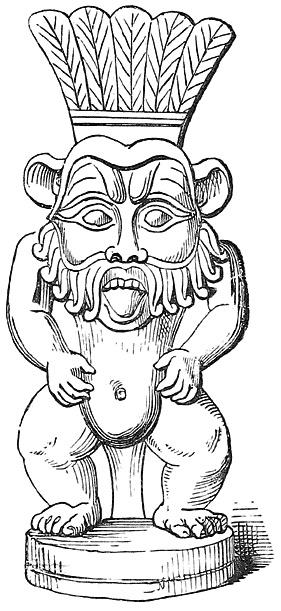
Fig. 14.—Typhon (Wilkinson).
Azazel—‘of doubtful meaning’—is the biblical name of the Demon of the Desert (Lev. xvi.). ‘Aaron shall cast lots upon the two goats: one lot for Jehovah, and the other for Azazel. And Aaron shall bring the goat upon which the lot for Jehovah fell, and offer him for a sin-offering: But the goat, on which the lot for Azazel fell, shall be presented alive before Jehovah, to make an atonement with him, to let him go to Azazel in the wilderness.... And Aaron shall lay both his hands upon the head of the live goat, and confess over him all the iniquities of the children of Israel, and all their transgressions in all their sins, putting them upon the head of the goat, and send him away by the hand of a fit man into the desert. And the goat shall bear upon him all their iniquities unto a land not inhabited; and he shall let go the goat in the desert.’ Of the moral elements here involved much will have to be said hereafter. This demon ultimately turned to a devil; and persisting through both forms is the familiar principle that it is ‘well enough to have friends on both sides’ so plainly at work in the levitical custom; but it is particularly interesting to observe that the same animal should be used as offerings to the antagonistic deities. In Egyptian Mythology we find that the goat had precisely this two-fold consecration. It was sacred to Chem, the Egyptian Pan, god of orchards and of all fruitful lands; and it became also sacred to Mendes, the ‘Destroyer,’ or ‘Avenging Power’ of Ra. It will thus be seen that the same principle which from the sun detached the fructifying from the desert-making power, and made Typhon and Osiris hostile brothers, prevailed to send the same animal to Azazel in the Desert and Jehovah of the milk and honey land. Originally the goat was supreme. The Samaritan Pentateuch, according to Aben Ezra (Preface to Esther), opens, ‘In the beginning Ashima created the heaven and the earth.’ In the Hebrew culture-myth of Cain and Abel, also brothers, there may be represented, as Goldziher supposes, the victory of the agriculturist over the nomad or shepherd; but there is also traceable in it the supremacy of the Goat, Mendez or Azima. ‘Abel brought the firstling of the goats.’
Very striking is the American (Iroquois) myth of the conflict between Joskeha and Tawiscara,—the White One and the Dark One. They were twins, born of a virgin who died in giving them life. Their grandmother was the moon (Ataensic, she who bathes). These brothers fought, Joskeha using as weapon the horns of a stag, Tawiscara the wild-rose. The latter fled sorely wounded, and the blood gushing from him turned to flint-stones. The victor, who used the stag-horns (the same weapon that Frey uses against Beli, in the Prose Edda, and denoting perhaps a primitive bone-age art), destroyed a monster frog which swallowed all the waters, and guided the torrents into smooth streams and lakes. He stocked the woods with game, invented fire, watched and watered crops, and without him, says the old missionary Brebeuf, ‘they think they could not boil a pot.’ The use by the desert-demon Tawiscara of a wild rose as his weapon is a beautiful touch in this myth. So much loveliness grew even amid the hard flints. One is reminded of the closing scene in the second part of Goethe’s Faust. There, when Faust has realised the perfect hour to which he can say, ‘Stay, thou art fair!’ by causing by his labour a wilderness to blossom as a rose, he lies down in happy death; and when the demons come for his soul, angels pelt them with roses, which sting them like flames. Not wild roses were these, such as gave the Dark One such poor succour. The defence of Faust is the roses he has evoked from briars.