Volume 2 / Part 3 — Chapter VI. The Serpent in India.
Reading edition
The Kankato na—The Vedic Serpents not worshipful—Ananta and Sesha—The Healing Serpent—The guardian of treasures—Miss Buckland’s theory—Primitive rationalism—Underworld plutocracy—Rain and lightning—Vritra—History of the word ‘Ahi’—The Adder—Zohák—A Teutonic Laokoon.
That Serpent-worship in India was developed by euphemism seems sufficiently shown in the famous Vedic hymn called Kankato na, recited as an antidote against all venom, of which the following is a translation:—
‘1. Some creature of little venom; some creature of great venom; or some venomous aquatic reptile; creatures of two kinds, both destructive of life, or poisonous, unseen creatures, have anointed me with their poison.
‘2. The antidote coming to the bitten person destroys the unseen venomous creatures; departing it destroys them; deprived of substance it destroys them by its odour; being ground it pulverises them.
‘3. Blades of sara grass, of kusara, of darhba, of sairya, of munja, of virana, all the haunt of unseen venomous creatures, have together anointed me with their venom.
‘4. The cows had lain down in their stalls; the wild beasts had retreated to their lairs; the senses of men were at rest; when the unseen venomous creatures anointed me with their venom.
‘5. Or they may be discovered in the dark, as thieves in the dusk of evening; for although they be unseen yet all are seen by them; therefore, men be vigilant.
‘6. Heaven, serpents, is your father; Earth, your mother; Soma, your brother; Aditi, your sister; unseen, all-seeing, abide in your holes; enjoy your own good pleasure.
‘7. Those who move with their shoulders, those who move with their bodies, those who sting with sharp fangs, those who are virulently venomous; what do ye here, ye unseen, depart together far from us.
‘8. The all-seeing Sun rises in the East, the destroyer of the unseen, driving away all the unseen venomous creatures, and all evil spirits.
‘9. The Sun has risen on high, destroying all the many poisons; Aditya, the all-seeing, the destroyer of the unseen, rises for the good of living beings.
‘10. I deposit the poison in the solar orb, like a leathern bottle in the house of a vendor of spirits; verily that adorable Sun never dies; nor through his favour shall we die of the venom; for, though afar off, yet drawn by his coursers he will overtake the poison: the science of antidotes converted thee, Poison, to ambrosia.
‘11. That insignificant little bird has swallowed thy venom; she does not die; nor shall we die; for although afar off, yet, drawn by his coursers, the Sun will overtake the poison: the science of antidotes has converted thee, Poison, to ambrosia.
‘12. May the thrice-seven sparks of Agni consume the influence of the venom; they verily do not perish; nor shall we die; for although afar off, the Sun, drawn by his coursers, will overtake the poison: the science of antidotes has converted thee, Poison, to ambrosia.
‘13. I recite the names of ninety and nine rivers, the destroyers of poison: although afar off, the Sun, drawn by his coursers, will overtake the poison: the science of antidotes will convert thee, Poison, to ambrosia.
‘14. May the thrice-seven peahens, the seven-sister rivers, carry off, O Body, thy poison, as maidens with pitchers carry away water.
‘15. May the insignificant mungoose carry off thy venom, Poison: if not, I will crush the vile creature with a stone: so may the poison depart from my body, and go to distant regions.
Though, in the sixth verse of this hymn, the serpents are said to be born of Heaven and Earth, the context does not warrant the idea that any homage to them is intended; they are associated with the evil Rakshasas, the Sun and Agni being represented as their haters and destroyers. The seven-sister rivers (streams of the sacred Ganges) supply an antidote to their venom, and certain animals, the partridge and the mungoose, are said, though insignificant, to be their superiors. The science of antidotes alluded to is that which Indra taught to Dadhyanch, who lost his head for communicating it to the Aswins. It is notable, however, that in the Vedic period there is nothing which represents the serpent as medicinal, unless by a roundabout process we connect the expression in the Rig-Veda that the wrath of the Maruts, or storm-gods, is ‘as the ire of serpents,’ with the fact that their chief, Rudra, is celebrated as the bestower of ‘healing herbs,’ and they themselves solicited for ‘medicaments.’ This would be stretching the sense of the hymns too far. It is quite possible, however, that at a later day, when serpent-worship was fully developed in India, what is said in the sixth verse of the hymn may have been adduced to confirm the superstition.
It seems clear, then, that at the time the Kankato na was written, the serpent was regarded with simple abhorrence. And we may remember, also, that even now, when the Indian cobra is revered as a Brahman of the highest caste, there is a reminiscence of his previous ill repute preserved in the common Hindu belief that a certain mark on his head was left there by the heel of Vishnu, Lord of Life, who trod on it when, in one of his avatars, he first stepped upon the earth. Although in the later mythology we find Vishnu, in the intervals between his avatars or incarnations, reposing on a serpent (Sesha), this might originally have signified only his lordship over it, though Sesha is also called Ananta, the Infinite. The idea of the Infinite is a late one, however, and the symbolisation of it by Sesha is consistent with a lower significance at first. In Hindu popular fables the snake appears in its simple character. Such is the fable of which so many variants are found, the most familiar in the West being that of Bethgelert, and which is the thirteenth of the 4th Hitopadesa. The Brahman having left his child alone, while he performs a rite to his ancestors, on his return finds a pet mungoose (nakula) smeared with blood. Supposing the mungoose has devoured his child, he slays it, and then discovers that the poor animal had killed a serpent which had crept upon the infant. In the Kankato na the word interpreted by Sáyana as mungoose (Viverra Mungo, or ichneumon) is not the same (nakula), but it evidently means some animal sufficiently unimportant to cast contempt upon the Serpent.
The universality of the Serpent as emblem of the healing art—found as such among the Egyptians, Greeks, Germans, Aztecs, and natives of Brazil—suggests that its longevity and power of casting its old skin, apparently renewing its youth, may have been the basis of this reputation. No doubt, also, they would have been men of scientific tendencies and of close observation who first learned the snake’s susceptibilities to music, and how its poison might be drawn, or even its fangs, and who so gained reputation as partakers of its supposed powers. Through such primitive rationalism the Serpent might gain an important alliance and climb to make the asp-crown of Isis as goddess of health (the Thermuthis), to twine round the staff of Esculapius, to be emblem of Hippocrates, and ultimately survive to be the sign of the European leech, twining at last as a red stripe round the barber’s pole. The primitive zoologist and snake-charmer would not only, in all likelihood, be a man cunning in the secrets of nature, but he would study to meet as far as he could the popular demand for palliatives and antidotes against snake-bites; all who escaped death after such wounds would increase his credit as a practitioner; and even were his mitigations necessarily few, his knowledge of the Serpent’s habits and of its varieties might be the source of valuable precautions.
Such probable facts as these must, of course, be referred to a period long anterior to the poetic serpent-symbolism of Egypt, and the elaborate Serpent mythology of Greece and Scandinavia. How simple ideas, having once gained popular prestige, may be caught up by theologians, poets, metaphysicians, and quacks, and modified into manifold forms, requires no proof in an age when we are witnessing the rationalistic interpretations by which the cross, the sacraments, and the other plain symbols are invested with all manner of philosophical meanings. The Serpent having been adopted as the sign-post of Egyptian and Assyrian doctors—and it may have been something of that kind that was set up by Moses in the wilderness—would naturally become the symbol of life, and after that it would do duty in any capacity whatever.
We might also credit the primitive people with sufficient logical power to understand why they should infer that an animal so wonderfully and elaborately provided with deadliness as the Serpent should have tasks of corresponding importance. The medicine which healed man (therefore possibly gods), the treasures valued most by men (therefore by anthropomorphic deities), the fruit of immortality (which the gods might wish to monopolise),—might seem the supreme things of value, which the supreme perfection of the serpent’s fang might be created to guard. This might be so in the heavens as well as in the world or the underworld. The rainbow was called the ‘Celestial Serpent’ in Persia, and the old notion that there is a bag of gold at the end of it is known to many an English and American child.
Whatever may have been the nature of the original suggestion, there are definite reasons why, when the Serpent was caught up to be part of combinations representing a Principle of Evil, his character as guardian of treasures should become of great importance. Wealth is the characteristic of the gods of the Hades, or unseen world beneath the surface of the earth.
In the vast Sinhalese demonology we find the highest class of demons (dewatawas) described as resident in golden palaces, glittering with gems, themselves with skins of golden hue, wearing cobras as ornaments, their king, Wessamony seated on a gem-throne and wielding a golden sword. Pluto is from the word for wealth (πλοῦτος), as also is his Latin name Dis (dives). For such are lords of all beneath the sod, or the sea’s surface. Therefore, it is important to observe, they own all the seeds in the earth so long as they remain seeds. So soon as they spring to flower, grain, fruitage, they belong not to the gods of Hades but to man: an idea which originated the myth of Persephone, and seems to survive in a school of extreme vegetarians, who refuse to eat vegetables not ripened in the sun.
These considerations may enable us the better to apprehend the earlier characters of Ahi, the Throttler, and Vritra, the Coverer. As guardians of such hidden treasures as metals and drugs the Serpent might be baroneted and invoked to bestow favours; but those particular serpents which by hiding away the cloud-cows withheld the rain, or choked the rivers with drought, all to keep under-world garners fat and those of the upper world lean, were to be combated. Against them man invoked the celestial deities, reminding them that their own altars must lack offerings if they did not vanquish these thievish Binders and Concealers.
The Serpent with its jewelled raiment, its self-renovating power, and its matchless accomplishments for lurking, hiding, fatally striking, was gradually associated with undulations of rivers and sea-waves on the earth, with the Milky-way, with ‘coverers’ of the sky—night and cloud—above all, with the darting, crooked, fork-tongued lightning. It may have been the lightning that was the Amrita churned out of the azure sea in the myth of the ‘Mahábhárata,’ when the gods and demons turned the mountain with a huge serpent for cord (p. 59), meaning the descent of fire, or its discovery; but other fair and fruitful things emerged also,—the goddess of wine, the cow of plenty, the tree of heaven. The inhabitants of Burmah still have a custom of pulling at a rope to produce rain. A rain party and a drought party tug against each other, the rain party being allowed the victory, which, in the popular notion is generally followed by rain. I have often seen snakes hung up after being killed to bring rain, in the State of Virginia. For there also rain means wealth. It is there believed also that, however much it may be crushed, a snake will not die entirely until it thunders. These are distant echoes of the Vedic sentences. ‘Friend Vishnu,’ says Indra, ‘stride vastly; sky give room for the thunderbolt to strike; let us slay Vritra and let loose the waters.’ ‘When, Thunderer, thou didst by thy might slay Vritra, who stopped up the streams, then thy dear steeds grew.’
Vritra, though from the same root as Varuna (the sky), means at first a coverer of the sky—cloud or darkness; hence eventually he becomes the hider, the thief, who steals and conceals the bounties of heaven—a rainless cloud, a suffocating night; and eventually Vritra coalesces with the most fearful phantasm of the Aryan mind—the serpent Ahi.
This euphemistic variant is, however, the only exception I can find to the baleful branches into which the root ah has grown through the world; one of its fearful fruits being the accompanying figure, copied from one of the ornamental bosses of Wells Cathedral.
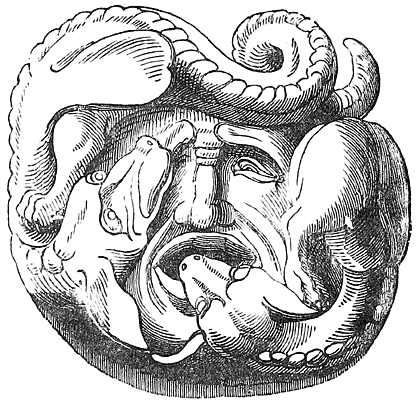
Fig. 25.—Anguish.
It is curious that this old Persian fable should have survived in the witch-lore of America, and at last supplied Nathaniel Hawthorne with the theme of one of his beautiful allegorical romances,—that, namely, of the man with a snake in his bosom which ever threatened to throttle him if he did not feed it. It came to the American fabulist through many a mythical skin, so to say. One of the most beautiful it has worn is a story which is still told by mothers to their children in some districts of Germany. It relates that a little boy and girl went into the fields to gather strawberries. After they had gathered they met an aged woman, who asked for some of the fruit. The little girl emptied her basket into the old woman’s lap; but the boy clutched his, and said he wanted his berries for himself. When they had passed on the old woman called them back, and presented to each a little box. The girl opened hers, and found in it two white caterpillars which speedily became butterflies, then grew to be angels with golden wings, and bore her away to Paradise. The boy opened his box, and from it issued two tiny black worms; these swiftly swelled to huge serpents, which, twining all about the boy’s limbs, drew him away into the dark forest; where this Teutonic Laokoon still remains to illustrate in his helplessness the mighty power of little faults to grow into bad habits and bind the whole man.