Volume 2 / Part 2 — Chapter XII. Death.
Reading edition
The Vendetta of Death—Teoyaomiqui—Demon of Serpents—Death on the Pale Horse—Kali—War-gods—Satan as Death—Death-beds—Thanatos—Yama—Yimi—Towers of Silence—Alcestis—Hercules, Christ, and Death—Hel—Salt—Azraël—Death and the Cobbler—Dance of Death—Death as Foe, and as Friend.
The following sketch, by Mr. Gideon Lang, will show the intensity of this conviction among the natives of New South Wales:—
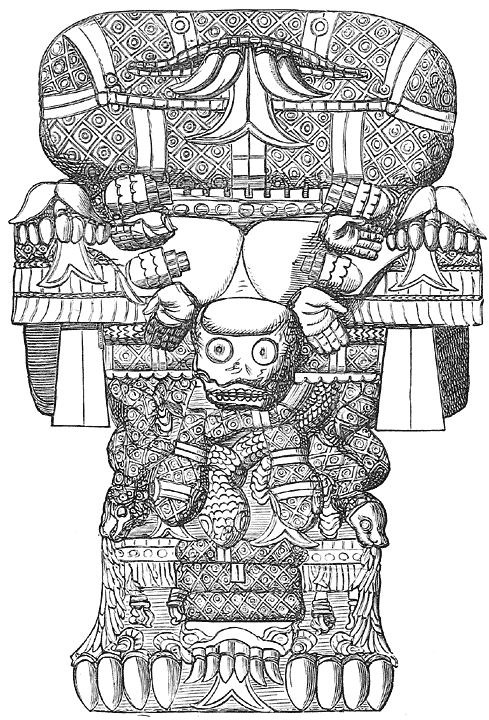
Fig. 17.—Teoyaomiqui.
What the savage is really trying to slay when he goes forth to avenge his relative’s death on the first alien he finds may be seen in the accompanying figure (17), which represents the Mexican goddess of death—Teoyaomiqui. The image is nine feet high, and is kept in a museum in the city of Mexico. Mr. Edward B. Tylor, from whose excellent book of travels in that country the figure is copied, says of it:—‘The stone known as the statue of the war-goddess is a huge block of basalt covered with sculptures. The antiquaries think that the figures on it stand for different personages, and that it is three gods—Huitzilopochtli, the god of war; Teoyaomiqui, his wife; and Mictlanteuctli, the god of hell. It has necklaces of alternate hearts and dead men’s hands, with death’s heads for a central ornament. At the bottom of the block is a strange sprawling figure, which one cannot see now, for it is the base which rests on the ground; but there are two shoulders projecting from the idol, which show plainly that it did not stand on the ground, but was supported aloft on the tops of two pillars. The figure carved upon the bottom represents a monster holding a skull in each hand, while others hang from his knees and elbows. His mouth is a mere oval ring, a common feature of Mexican idols, and four tusks project just above it. The new moon laid down like a bridge forms his forehead, and a star is placed on each side of it. This is thought to have been the conventional representation of Mictlanteuctli (Lord of the Land of the Dead), the god of hell, which was a place of utter and eternal darkness. Probably each victim as he was led to the altar could look up between the two pillars and see the hideous god of hell staring down upon him from above. There is little doubt that this is the famous war-idol which stood on the great teocalli of Mexico, and before which so many thousands of human beings were sacrificed. It lay undisturbed under ground in the great square, close to the very site of the teocalli, until sixty years ago. For many years after that it was kept buried, lest the sight of one of their old deities might be too exciting for the Indians, who, as I have mentioned before, had certainly not forgotten it, and secretly ornamented it with garlands of flowers while it remained above ground.’
If my reader will now turn to the (fig. 11) portrait of the Demon of Serpents, he will find a conception fundamentally similar to the Mexican demoness of death or slaughter, but one that is not shut up in a museum of antiquities; it still haunts and terrifies a vast number of the people born in Ceylon. He is the principal demon invoked in Ceylon by the malignant sorcerers in performing the 84,000 different charms that afflict evils (Hooniyan). His general title is Oddy Cumara Hooniyan Dewatawa; but he has a special name for each of his six several apparitions, the chief of these being Cali Oddisey, or demon of incurable diseases, therefore of death, and Naga Oddisey, demon of serpents—deadliest of animals. Beneath him is the Pale Horse which has had its career so long and far,—even to the White Mare on which, in some regions, Christ is believed to revisit the earth every Christmas; and also the White Mare of Yorkshire Folklore which bore its rider from Whitestone Cliff to hell. This Singhalese form also, albeit now associated by Capuas with fatal disease, was probably at first, like the Mexican, a war goddess and god combined, as is shown by the uplifted sword, and reeking hand uplifted in triumph. Equally a god of war is our ‘Death on the Pale Horse,’ which christian art, following the so-called Apocalypse, has made so familiar. ‘I looked, and behold a pale horse: and his name that sat on him was Death, and Hell followed with him. And power was given to him over the fourth part of the earth, to kill with sword, and with hunger, and with death, and with the beasts of the earth.’ This is but a travesty of the Greek Ares, the Roman Mars, or god of War. In the original Greek-form Ares was not solely the god of war, but of destruction generally. In the Œdipus Tyrannus of Sophocles we have the popular conception of him as one to whom the deadly plague is ascribed. He is named as the ‘god unhonoured among gods,’ and it is said:—‘The city is wildly tossing, and no more can lift up her head from the waves of death; withering the ripening grain in the husks, withering the kine in their pastures; blighted are the babes through the failing labours of women; the fire-bearing god, horrid Pestilence, having darted down, ravages the city; by him the house of Cadmus is empty, and dark Hades enriched with groans and lamentations.’
Mother of the deadliest ‘Calas’ of Singhalese demonolatry, sister of the Scandinavian Hel in name and nature, is Kali. Although the Hindu writers repudiate the idea that there is any devil among their three hundred and thirty millions of deities, it is difficult to deny Kali that distinction. Her wild dance of delight over bodies of the slain would indicate pleasure taken in destruction for its own sake, so fulfilling the definition of a devil; but, on the other hand, there is a Deccan legend that reports her as devouring the dead, and this would make her a hunger-demon. We may give her the benefit of the doubt, and class her among the demons—or beings whose evil is not gratuitous—all the more because the mysteriously protruding tongue, as in the figure of Typhon (p. 185), probably suggests thirst. Hindu legend does, indeed, give another interpretation, and say that when she was dancing for joy at having slain a hundred-headed giant demigod, the shaking of the earth was so formidable that Siva threw himself among the slain, whom she was crushing at every step, hoping to induce her to pause; but when, unheeding, she trod upon the body of her husband, she paused and thrust out her tongue from surprise and shame. The Vedic description of Agni as an ugra (ogre), with ‘tongue of flame,’ may better interpret Kali’s tongue. It is said Kali is pleased for a hundred years by the blood of a tiger; for a thousand by that of a man; for a hundred thousand by the blood of three men.
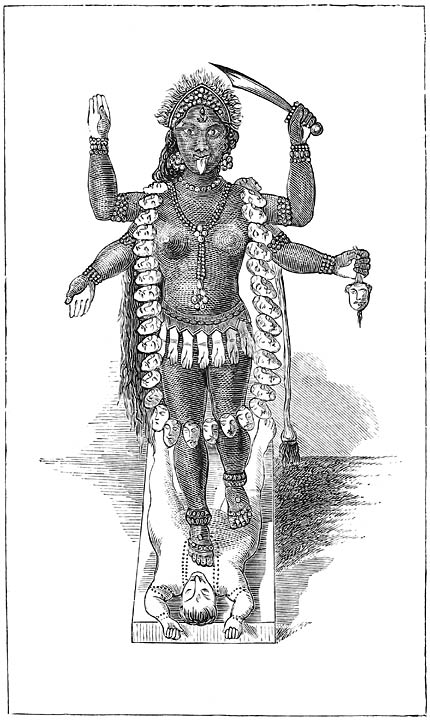
Fig. 18.—Kali.
How are we to understand this dance of Death, and the further legend of her tossing dead bodies into the air for amusement? Such a figure found among a people who shudder at taking life even from the lowest animals is hardly to be explained by the destructiveness of nature personified in her spouse Siva. Her looks and legends alike represent slaughter by human violence. May it not be that Kali represents some period when the abhorrence of taking life among a vegetarian people—a people, too, believing in transmigration—might have become a public danger? When Krishna appeared it was, according to the Bhágavat Gita, as charioteer inciting Arjoon to war. There must have been various periods when a peaceful people must fall victims to more savage neighbours unless they could be stimulated to enter on the work of destruction with a light heart. There may have been periods when the human Kalis of India might stimulate their husbands and sons to war with such songs as the women of Dardistan sing at the Feast of Fire (p. 91). The amour of the Greek goddess of Beauty with the god of War, leaving her lawful spouse the Smith, is full of meaning. The Assyrian Venus, Istar, appeared in a vision, with wings and halo, bearing a bow and arrow for Assurbanipal. The Thug appears to have taken some such view of Kali, regarding her as patroness of their plan for reducing population. They are said to have claimed that Kali left them one of her teeth for a pickaxe, her rib for a knife, her garment’s hem for a noose, and wholesale murder for a religion. The uplifted right hand of the demoness has been interpreted as intimating a divine purpose in the havoc around her, and it is possible that some such euphemism attached to the attitude before the Thug accepted it as his own benediction from this highly decorated personage of human cruelty.
The ancient reverence for Kali has gradually passed to her mitigated form—Durgá. Around her too are visible the symbols of destruction; but she is supposed to be satisfied with pumpkin-animals, and the weapons in her ten hands are believed to be directed against the enemies of the gods, especially against the giant king Muheshu. She is mother of the beautiful boy Kartik, and of the elephant-headed inspirer of knowledge Ganesa. She is reverenced now as female energy, the bestower of beauty and fruitfulness on women.
The identity of war-gods and death-demons, in the most frightful conceptions which have haunted the human imagination, is of profound significance. These forms do not represent peaceful and natural death, not death by old age,—of which, alas, those who cowered before them knew but little,—but death amid cruelty and agony, and the cutting down of men in the vigour of life. That indeed was terrible,—even more than these rude images could describe.
But there are other details in these hideous forms. The priest has added to the horse and sword of war the adored serpent, and hideous symbols of the ‘Land of the Dead.’ For it is not by terror of death, but of what he can persuade men lies beyond, that the priest has reigned over mankind. When Isabel (in ‘Measure for Measure’) is trying to persuade her brother that the sense of death lies most in apprehension, the sentenced youth still finds death ‘a fearful thing.’
Ay, but to die, and go we know not where;
To lie in cold obstruction and to rot;
This sensible warm motion to become
A kneaded clod; and the delighted spirit
To bathe in fiery floods, or to reside
In thrilling region of thick-ribbed ice;
To be imprisoned in the viewless winds,
And blown with violence round about
The pendent world; or to be worse than worst
Of these, that lawless and incertain thoughts
Imagine howling!—’tis too horrible!
The weariest and most loathed worldly life
That age, ache, penury, and imprisonment
Can lay on nature, is a paradise
To what we fear of death.
In all these apprehensions of Claudio there is no thought of annihilation. What if he had seen death as an eternal sleep? Let Hamlet answer:—
To die,—to sleep;—
No more;—and, by a sleep, to say we end
The heartache, and the thousand natural shocks
That flesh is heir to,—’tis a consummation
Devoutly to be wished.
The greater part of the human race still belong to religions which, in their origin, promised eternal repose as the supreme final bliss. Had death in itself possessed horrors for the human mind, the priest need not have conjured up beyond it those tortures that haunted Hamlet with the dreams of possible evils beyond which make even the wretched rather bear the ills they have than fly to others they know not of. It would have been sufficient sanction to promise immortality only to the pious. But as in Claudio’s shuddering lines every hell is reflected—whether of ice, fire, or brutalisation—so are the same mixed with the very blood and brain of mankind, even where literally outgrown. Christianity superadded to the horrors by importing the idea that death came by human sin, and so by gradual development ascribing to Satan the power of death; thereby forming a new devil who bore in him the power to make death a punishment. How the matter stood in the mediæval belief may be seen in figure 19, copied from a Russian Bible of the (early) seventeenth century. Lazarus smiles to see the nondescript soul of Dives torn from him by a devil with a hook, while another drowns the groans with a drum. Satan squirts an infernal baptism on the departing soul, and the earnest co-operation of the archangel justifies the satisfaction of Lazarus and Abraham. This degraded belief is still found in the almost gleeful pulpit-picturings of physical agonies as especially attending the death-beds of ‘infidels,’—as Voltaire and Paine,—and its fearful result is found in the degree to which priesthoods are still able to paralyse the common sense and heart of the masses by the barbaric ceremonials with which they are permitted to surround death, and the arrogant line drawn between unorthodox goats and credulous sheep by ‘consecrated’ ground.
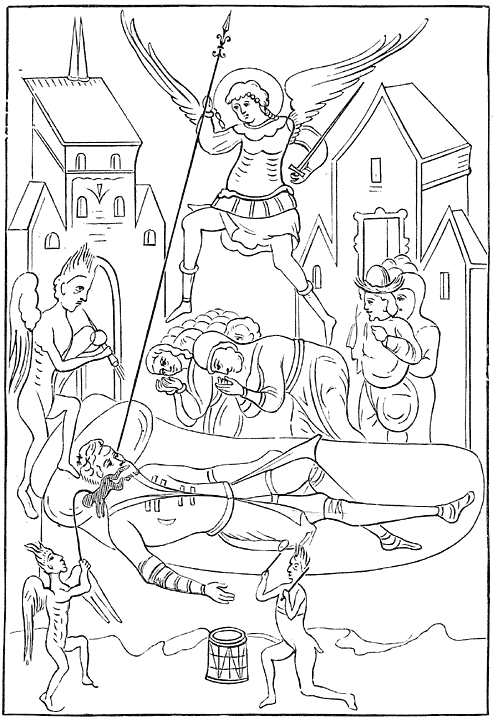
Fig. 19.—Dives and Lazarus (Russian; 17th cent.).
Such was the Iranian Yima. He was that ‘flos regum’ whose reign represented ‘the ideal of human happiness, when there was neither illness nor death, neither heat nor cold,’ and who has never died. ‘According to the earlier traditions of the Avesta,’ says Spiegel, ‘Jima does not die, but when evil and misery began to prevail on earth, retires to a smaller space, a kind of garden or Eden, where he continues his happy life with those who remained true to him.’ Such have been the antecedents of our many beautiful myths which ascribe even an earthly immortality to the great,—to Barbarossa, Arthur, and even to the heroes of humbler races as Hiawatha and Glooscap of North American tribes,—who are or were long believed to have ‘sailed into the fiery sunset,’ or sought some fair island, or to slumber in a hidden grotto, until the world shall have grown up to their stature and requires their return.
In Japan the (Sintoo) god of Hell is now named Amma, and one may suspect that it is some imitation of Yama by reason of the majesty he still retains in the popular conception. He is pictured as a grave man, wearing a judicial cap, and no cruelties seem to be attributed to him personally, but only to the oni or demons of whom he is lord.
The kindly characteristics of the Hindu Yama seem in Persia to have been replaced by the bitterness of Ahriman, or Anra-mainyu, the genius of evil. Haug interprets Anra-mainyu as ‘Death-darting.’ The word is the counterpart of Speñta-mainyu, and means originally the ‘throttling spirit;’ being thus from anh, philologically the root of all evil, as we shall see when we consider its dragon brood. Professor Whitney translates the name ‘Malevolent.’ But, whatever may be the meaning of the word, there is little doubt that the Twins of Vedic Mythology—Yama and Yami—parted into genii of Day and Night, and were ultimately spiritualised in the Spirit of Light and Spirit of Darkness which have made the basis of all popular theology from the time of Zoroaster until this day.
The audience at the Crystal Palace which recently witnessed the performance of Euripides’ Alcestis could hardly, it is to be feared, have realised the relation of the drama to their own religion. Apollo induces the Fates to consent that Admetus shall not die provided he can find a substitute for him. The pure Alcestis steps forward and devotes herself to death to save her husband. Apollo tries to persuade Death to give back Alcestis, but Death declares her fate demanded by justice. While Alcestis is dying, Admetus bids her entreat the gods for pity; but Alcestis says it is a god who has brought on the necessity, and adds, ‘Be it so!’ She sees the hall of the dead, with ‘the winged Pluto staring from beneath his black eyebrows.’ She reminds her husband of the palace and regal sway she might have enjoyed in Thessaly had she not left it for him. Bitterly does Pheres reproach Admetus for accepting life through the vicarious suffering and death of another. Then comes Hercules; he vanquishes Death; he leads forth Alcestis from ‘beneath into the light.’ With her he comes into the presence of Admetus, who is still in grief. Admetus cannot recognise her; but when he recognises her with joy, Hercules warns him that it is not lawful for Alcestis to address him ‘until she is unbound from her consecration to the gods beneath, and the third day come.’
It only requires a change of names to make Alcestis a Passion-play. The unappeasable Justice which is as a Fate binding the deity, though it may be satisfied vicariously; ‘the last enemy, Death;’ the atonement by sacrifice of a saintly human being, who from a father’s palace is brought by love freely to submit to death; the son of a god (Zeus) by a human mother (Alcmene),—the god-man Herakles,—commissioned to destroy earthly evils by twelve great labours,—descending to conquer Death and deliver one of the ‘spirits in prison,’ the risen spirit not recognised at first, as Jesus was not by Mary; still bearing the consecration of the grave until the third day, which forbade intercourse with the living (‘Touch me not, for I am not yet ascended to my Father’),—all these enable us to recognise in the theologic edifices around us the fragments of a crumbled superstition as they lay around Euripides.
From the old pictures of Christ’s triumphal pilgrimage on earth parallels for the chief Labours of Herakles may be found; he is shown treading on the lion, asp, dragon, and Satan; but the myths converge in the Descent into Hades and the conquest of Death. It is remarkable that in the old pictures of Christ delivering souls from Hades he is generally represented closely followed by Eve, whose form so emerging would once have been to the greater part of Europe already familiar as that of either Alcestis, Eurydice, or Persephone. One of the earliest examples of the familiar subject, Christ conquering Death, is that in the ancient (tenth century) Missal of Worms,—that city whose very name preserves the record of the same combat under the guise of Siegfried and the Worm, or Dragon. The cross is now the sword thrust near the monster’s mouth. The picture illustrates the chant of Holy Week: ‘De manu Mortis liberabo eos, de Morte redimam eos. Ero Mors tua, O Mors; morsus tuus ero, inferne.’ From the pierced mouth of Death are vomited flames, which remind us of his ethnical origin; but it is not likely that to the christianised pagans of Worms the picture could ever have conveyed an impression so weirdly horrible as that of their own goddess of Death, Hel. ‘Her hall is called Elvidnir, realm of the cold storm: Hunger is her table; Starvation, her knife; Delay, her man; Slowness, her maid; Precipice, her threshold; Care, her bed; burning Anguish, the hangings of her apartments. One half of her body is livid, the other half the colour of human flesh.’
To the House men enter—but cannot depart from:
To the Road men go—but cannot return.
The abode of darkness and famine
Where Earth is their food: their nourishment Clay:
Light is not seen; in darkness they dwell:
Ghosts, like birds, flutter their wings there;
On the door and the gate-posts the dust lies undisturbed.
The Semitic tribes, undisturbed, like the importers of their theology into the age of science, by the strata in which so many perished animal kingdoms are entombed, attributed all death, even that of animals, to the forbidden fruit. The Rabbins say that not only Adam and Eve, but the animals in Eden, partook of that fruit, and came under the power of Sammaël the Violent, and of his agent Azraël, the demon of Death. The Phœnix, having refused this food, preserved the power of renovating itself.
It is an example of the completeness and consistency with which a theory may organise its myth, that the fatal demons are generally represented as abhorring salt—the preserving agent and foe of decay. The ‘Covenant of Salt’ among the ancient Jews probably had this significance, and the care with which Job salted his sacrifice is considered elsewhere. Aubrey says, ‘Toads (Saturnine animals) are killed by putting salt upon them. I have seen the experiment.’ The devil, as heir of death-demons, appears in all European folklore as a hater of salt. A legend, told by Heine, relates that a knight, wandering in a wood in Italy, came upon a ruin, and in it a wondrous statue of the goddess of Beauty. Completely fascinated, the knight haunted the spot day after day, until one evening he was met by a servant who invited him to enter a villa which he had not before remarked. What was his surprise to be ushered into the presence of the living image of his adored statue! Amid splendour and flowers the enraptured knight is presently seated with his charmer at a banquet. Every luxury of the world is there; but there is no salt! When he hints this want a cloud passes over the face of his Beauty. Presently he asks the servant to bring the salt; the servant does so, shuddering; the knight helps himself to it. The next sip of wine he takes elicits a cry from him: it is liquid fire. Madness seizes upon him; caresses, burning kisses follow, until he falls asleep on the bosom of his goddess. But what visions! Now he sees her as a wrinkled crone, next a great bat bearing a torch as it flutters around him, and again as a frightful monster, whose head he cuts off in an agony of terror. When the knight awakes it is in his own villa. He hastens to his ruin, and to the beloved statue; he finds her fallen from the pedestal, and the beautiful head cut from the neck lying at her feet.
The Semitic Angel of Death is a figure very different from any that we have considered. He is known in theology only in the degradation which he suffered at the hands of the Rabbins, but originally was an awful but by no means evil genius. The Persians probably imported him, under the name of Asuman, for we do not find him mentioned in their earlier books, and the name has a resemblance to the Hebrew shamad, to exterminate, which would connect it with the biblical ‘destroyer’ Abaddon. This is rendered more probable because the Zoroastrians believed in an earlier demon, Vízaresha, who carried souls after death to the region of Deva-worshippers (India). The Chaldaic Angel of Death, Malk-ad Mousa, may have derived his name from the legend of his having approached Moses with the object of forcing his soul out of his body, but, being struck by the glory of Moses’ face, and by virtue of the divine name on his rod, was compelled to retire. The legend is not so ancient as the name, and was possibly a Saga suggested by the name; it is obviously the origin of the tradition of the struggle between Michael and Satan for the body of Moses (Jude 9.). This personification had thus declined among the Jews into being evil enough to be identified with Samaël,—who, in the Book of the Assumption of Moses, is named as his assailant,—and subsequently with Satan himself, named in connection with the New Testament version. It was on account of this degradation of a being described in the earlier books of the Bible as the commissioner of Jehovah that there was gradually developed among the Jews two Angels of Death, one (Samaël, or his agent Azraël) for those who died out of the land of Israel, and the other (Gabriel) for those who had the happier lot of dying in their own country.
This relegation of Samaël to the wandering Jews—who if they died abroad were not supposed to reach Paradise with facility, if at all—is significant. For Samaël is pretty certainly a conception borrowed from outlying Semitic tribes. What that conception was we find in Job xviii. 18, where he is ‘the king of Terrors,’ and still more in the Arabic Azraël. The legend of this typical Angel of Death is that he was promoted to his high office for special service. When Allah was about to create man he sent the angels Gabriel, Michael, and Israfil to the earth to bring clay of different colours for that purpose; but the Earth warned them that the being about to be formed would rebel against his creator and draw down a curse upon her (the Earth), and they returned without bringing the clay. Then Azraël was sent by Allah, and he executed his commission without fear; and for this he was appointed the angel to separate souls from bodies. Azraël had subordinate angels under him, and these are alluded to in the opening lines of the Sura 79 of the Koran:
By the angels who tear forth the souls of some with violence;
And by those who draw forth the souls of others with gentleness.
The souls of the righteous are drawn forth with gentleness, those of the wicked torn from them in the way shown in the Russian picture (Fig. 19), which is indeed an illustration of the same mythology.
Azraël was often represented as presenting to the lips a cup of poison. It is probable that this image arose from the ancient ordeal by poison, whereby draughts, however manipulated beforehand with reference to the results, were popularly held to be divinely mingled for retributive or beneficent effects. ‘Cup’ thus became among Semitic tribes a symbol of Fate. The ‘cup of consolation,’ ‘cup of wrath,’ ‘cup of trembling,’ which we read of in the Old Testament; the ‘cup of blessing,’ and ‘cup of devils,’ spoken of by Paul, have this significance. The cup of Nestor, ornamented with the dove (Iliad, xi. 632), was probably a ‘cup of blessing,’ and Mr. Schliemann has found several of the same kind at Mycenæ. The symbol was repeatedly used by Christ,—‘Let this cup pass from me,’ ‘The cup that my Father hath given me to drink shall I not drink it,’ ‘Are ye able to drink of the cup that I drink of,’—and the familiar association of Azraël’s cup is expressed in the phrase ‘taste of death.’
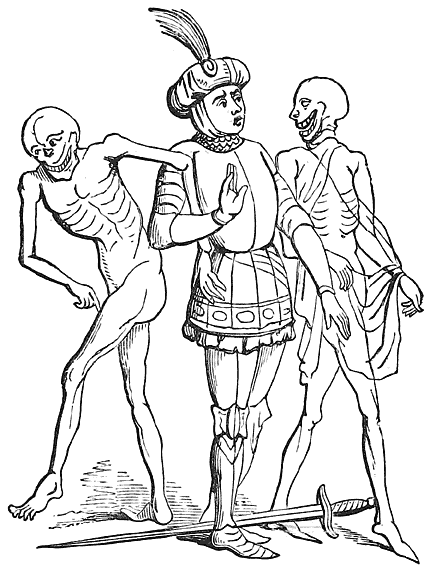
Fig. 20.—The Knight and Death.
In the northern world we are all too sombre in the matter. It is the ages of superstition which have moulded our brains, and too generally given to our natural love of life the unnatural counterpart of a terror of death. What has been artificially bred into us can be cultivated out of us. There are indeed deaths corresponding to the two Angels—the death that comes by lingering disease and pain, and that which comes by old age. There are indeed Azraëls in our cities who poison the food and drink of the people, and mingle death in the cup of water; and of them there should be increasing horror until the gentler angel abides with us, and death by old age becomes normal. The departure from life being a natural condition of entering upon it, it is melancholy indeed that it should be ideally confused with the pains and sorrows often attending it. It is fabled that Menippus the Cynic, travelling through Hades, knew which were the kings there by their howling louder than the rest. They howled loudest because they had parted from most pleasures on earth. But all the happy and young have more reason to lament untimely death than kings. The only tragedy of Death is the ruin of living Love. Mr. Watts, in his great picture of Love and Death (Grosvenor Gallery, 1877), revealed the real horror. Not that skeleton which has its right time and place, not the winged demon (called angel), who has no right time or place, is here, but a huge, hard, heartless form, as of man half-blocked out of marble; a terrible emblem of the remorseless force that embodies the incompleteness and ignorance of mankind—a force that steadily crushes hearts where intellects are devoting their energies to alien worlds. Poor Love has little enough science; his puny arm stretched out to resist the colossal form is weak as the prayers of agonised parents and lovers directed against never-swerving laws; he is almost exhausted; his lustrous wings are broken and torn in the struggle; the dove at his feet crouches mateless; the rose that climbed on his door is prostrate; over his shoulder the beam-like arm has set the stony hand against the door where the rose of joy must fall.
The aged when they die do but follow the treasures that have gone before. One by one the old friends have left them, the sweet ties parted, and the powers to enjoy and help become feeble. When of the garden that once bloomed around them memory alone is left, friendly is death to scatter also the leaves of that last rose where the loved ones are sleeping. This is the real office of death. Nay, even when it comes to the young and happy it is not Death but Disease that is the real enemy; in disease there is almost no compensation at all but learning its art of war; but Death is Nature’s pity for helpless pain; where love and knowledge can do no more it comes as a release from sufferings which were sheer torture if prolonged. The presence of death is recognised oftenest by the cessation of pain. Superstition has done few heavier wrongs to humanity than by the mysterious terrors with which it has invested that change which, to the simpler ages, was pictured as the gentle river Lethe, flowing from the abode of sleep, from which the shades drank oblivion alike of their woes and of the joys from which they were torn.