Volume 2 / Part 2 — Chapter IV. Elements.
Reading edition
A Scottish Munasa—Rudra—Siva’s lightning eye—The flaming sword—Limping demons—Demons of the storm—Helios, Elias, Perun—Thor arrows—The Bob-tailed Dragon—Whirlwind—Japanese thunder god—Christian survivals—Jinni—Inundations—Noah—Nik, Nicholas, Old Nick—Nixies—Hydras—Demons of the Danube—Tides—Survivals in Russia and England.
In the ‘Rig-Veda’ there is a remarkable hymn to Rudra (the Roarer), which may be properly quoted here:—
1. Sire of the storm gods, let thy favour extend to us; shut us not out from the sight of the sun; may our hero be successful in the onslaught. O Rudra, may we wax mighty in our offspring.
2. Through the assuaging remedies conferred by thee, O Rudra, may we reach a hundred winters; drive away far from us hatred, distress, and all-pervading diseases.
3. Thou, O Rudra, art the most excellent of beings in glory, the strongest of the strong, O wielder of the bolt; bear us safely through evil to the further shore; ward off all the assaults of sin.
4. May we not provoke thee to anger, O Rudra, by our adorations, neither through faultiness in praises, nor through wantonness in invocations; lift up our heroes by thy remedies; thou art, I hear, the chief physician among physicians.
5. May I propitiate with hymns this Rudra who is worshipped with invocations and oblations; may the tender-hearted, easily-entreated, tawny-haired, beautiful-chinned god not deliver us up to the plotter of evil [literally, to the mind meditating ‘I kill’].
6. The bounteous giver, escorted by the storm-gods, hath gladdened me, his suppliant, with most invigorating food; as one distressed by heat seeketh the shade, may I, free from harm, find shelter in the good-will of Rudra.
7. Where, O Rudra, is that gracious hand of thine, which is healing and comforting? Do thou, removing the evil which cometh from the gods, O bounteous giver, have mercy upon me.
8. To the tawny, the fair-complexioned dispenser of bounties, I send forth a great and beautiful song of praise; adore the radiant god with prostrations; we hymn the illustrious name of Rudra.
9. Sturdy-limbed, many-shaped, fierce, tawny, he hath decked himself with brilliant ornaments of gold; truly strength is inseparable from Rudra, the sovereign of this vast world.
10. Worthy of worship, thou bearest the arrows and the bow; worthy of worship, thou wearest a resplendent necklace of many forms; worthy of worship, thou rulest over this immense universe; there is none, O Rudra, mightier than thou.
11. Celebrate the renowned and ever-youthful god who is seated on a chariot, who is, like a wild beast, terrible, fierce, and destructive; have mercy upon the singer, O Rudra, when thou art praised; may thy hosts strike down another than us.
12. As a boy saluteth his father who approacheth and speaketh to him, so, O Rudra, I greet thee, the giver of much, the lord of the good; grant us remedies when thou art praised.
13. Your remedies, O storm-gods, which are pure and helping, O bounteous givers, which are joy-conferring, which our father Manu chose, these and the blessing and succour of Rudra I crave.
14. May the dart of Rudra be turned aside from us, may the great malevolence of the flaming-god be averted; unbend thy strong bow from those who are liberal with their wealth; O generous god, have mercy upon our offspring and our posterity (i.e., our children and children’s children).
In other hymns the malevolent character of Rudra is made still more prominent:—
7. Slay not our strong man nor our little child, neither him who is growing nor him who is grown, neither our father nor our mother; hurt not, O Rudra, our dear selves.
In this hymn (verse 1) Rudra is described as ‘having braided hair;’ and in the ‘Yajur-veda’ and the ‘Atharva-veda’ other attributes of Siva are ascribed to him, such as the epithet nîla-grîva, or blue-necked. In the ‘Rig-veda’ Siva occurs frequently as an epithet, and means auspicious. It was used as a euphemistic epithet to appease Rudra, the lord of tempests; and finally, the epithet developed into a distinct god.
The parentage of Siva is further indicated in the legends that his glance destroyed the head of the youthful deity Ganesa, who now wears the elephant head, with which it was replaced; and that the gods persuaded him to keep his eyes perpetually winking (like sheet-lightning), lest his concentrated look (the thunderbolt) should reduce the universe to ashes. With the latter legend the gaze of the evil eye in India might naturally be associated, though in the majority of countries this was rather associated with the malign influences ascribed to certain planets, especially Saturn; the charms against the evil eye being marked over with zodiacal signs. The very myth of Siva’s eye survives in the Russian demon Magarko (‘Winker’) and the Servian Vii, whose glance is said to have power to reduce men, and even cities, to ashes.
The terrible Rudra is represented in a vast number of beliefs, some of them perhaps survivals; in the rough sea and east-wind demon Oegir of the northern world, and Typhon in the south; and in Luther’s faith that ‘devils do house in the dense black clouds, and send storms, hail, thunder and lightning, and poison the air with their infernal stench,’ a doctrine which Burton, the Anatomist of Melancholy, too, maintained against the meteorologists of his time.
In Greece similar swords were wielded by Zeus, and also by the god of war. Through Zeus and Ares, the original wielders of the lightning—Indra and Siva—became types of many gods and semi-divine heroes. The evil eye of Siva glared from the forehead of the Cyclopes, forgers of thunderbolts; and the saving disc of Indra flashed in the swords and arrows of famous dragon-slayers—Perseus, Pegasus, Hercules, and St. George. The same sword defended the Tree of Life in Eden, and was borne in the hand of Death on the Pale Horse (a white horse was sacrificed to Sviatevit in Russia within christian times). And, finally, we have the wonderful sword which obeys the command ‘Heads off!’ delighting all nurseries by the service it does to the King of the Golden Mountain.
These storm-demons in their chariots have their forerunner in Vata or Vayu, the subject of one of the most beautiful Vedic hymns. ‘I celebrate the glory of Vata’s chariot; its noise comes rending and resounding. Touching the sky he moves onward, making all things ruddy; and he comes propelling the dust of the earth.
Not less remarkable is the Targum of Jonathan Ben Uzziel to 1 Kings xix., where around Elias on the mountain gather ‘a host of angels of the wind, cleaving the mountain and breaking the rocks before the Lord;’ and after these, ‘angels of commotion,’ and next ‘of fire,’ and, finally, ‘voices singing in silence’ preceded the descent of Jehovah. It can hardly be wondered that a prophet of whom this story was told, and that of the storm evoked from a small cloud, should be caught up into that chariot of the Vedic Vayu which has rolled on through all the ages of mythology.
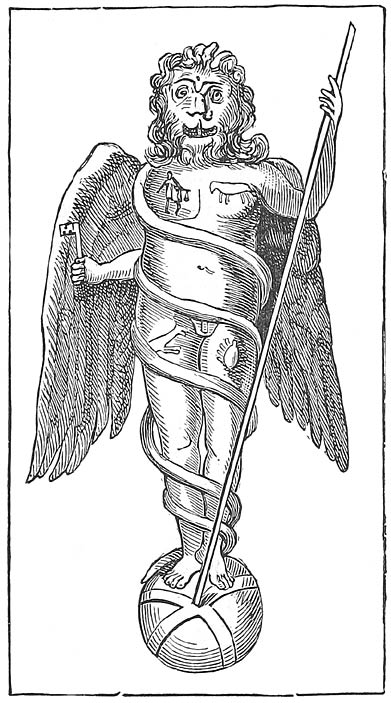
Fig. 5.
The notion is widely prevalent in some districts of France that all whirlwinds, however slight, are caused by wizards or witches, who are in them, careering through the air; and it is stated by the Melusine that in the department of the Orne storms are attributed to the clergy, who are supposed to be circling in them. The same excellent journal states that some years ago, in that department, a parishioner who saw his crops threatened by a hail-storm fired into the cloud. The next day he heard that the parish priest had broken his leg by a fall for which he could not account.
The following examples are given by Kuhn. Near Stangenhagen is a treasure hid in a mountain which Lord von Thümen tried to seek, but was caught up with his horse by a whirlwind and deposited at home again. The Devil is believed to be seated at the centre of every whirlwind. At Biesenthal it is said a noble lady became the Wind’s bride. She was in her time a famous rider and huntress, who rode recklessly over farmers’ fields and gardens; now she is herself hunted by snakes and dragons, and may be heard howling in every storm.
I suspect that the bristling hair so frequently portrayed in the Japanese Oni, Devils, refers to their frequent residence at the centre of a gale of wind. Their demon of the storm is generally pictured throned upon a flower of flames, his upraised and extended fingers emitting the most terrific lightnings, which fall upon his victims and envelop them in flames. Sometimes, however, the Japanese artists poke fun at their thunder-god, and show him sprawling on the ground from the recoil of his own lightnings. The following extract from The Christian Herald (London, April 12, 1877) will show how far the dread of this Japanese Oni extends: ‘A pious father writes, ‘A few days ago there was a severe thunderstorm, which seemed to gather very heavily in the direction where my son lived; and I had a feeling that I must go and pray that he might be protected, and not be killed by the lightning. The impression seemed to say, ‘There is no time to be lost.’ I obeyed, and went and knelt down and prayed that the Lord would spare his life. I believe he heard my prayer. My son called on me afterwards, and, speaking of the shower, said, ‘The lightning came downwards and struck the very hoe in my hands, and numbed me.’ I said, ‘Perhaps you would have been killed if some one had not been praying for you.’ Since then he has been converted, and, I trust, will be saved in God’s everlasting kingdom.’’
Such paragraphs may now strike even many christians as ‘survivals.’ But it is not so very long since some eminent clergymen looked upon Benjamin Franklin as the heaven-defying Ajax of Christendom, because he undertook to show people how they might divert the lightnings from their habitations. In those days Franklin personally visited a church at Streatham, whose steeple had been struck by lightning, and, after observing the region, gave an opinion that if the steeple were again erected without a lightning-rod, it would again be struck. The audacious man who ‘snatched sceptres from tyrants and lightnings from heaven,’ as the proverb ran, was not listened to: the steeple was rebuilt, and again demolished by lightning.
Below in the abyss the forceful multitudes may they sacrifice.
The overwhelming fear of Anu in the midst of Heaven encircles his path.
The spirits of earth, the mighty gods, withstand him not.
The king like a lightning-flash opened.
Adar, the striker of the fortresses of the rebel band, opened.
Like the streams in the circle of heaven I besprinkled the seed of men.
His marching in the fealty of Bel to the temple I directed,
(He is) the hero of the gods, the protector of mankind, far (and) near....
O my lord, life of Nebo (breathe thy inspiration), incline thine ear.
O Adar, hero, crown of light, (breathe) thy inspiration, (incline) thine ear.
The overwhelming fear of thee may the sea know....
Thy setting (is) the herald of his rest from marching,
Thy father on his throne thou dost not smite.
Bel on his throne thou dost not smite.
The spirits of earth on their throne may he consume.
May thy father into the hands of thy valour cause (them) to go forth.
May Bel into the hands of thy valour cause (them) to go forth.
(The king, the proclaimed) of Anu, the firstborn of the gods.
In this primitive fragment we find the hero of the mountain (Noah), invoking both Bel and Nebo, aerial and infernal Intelligences, and Adar the Chaldæan Hercules, for their ‘inspiration’—that breath which, in the biblical story, goes forth in the form of the Dove (‘the herald of his rest’ in the Accadian fragment), and in the ‘wind’ by which the waters were assuaged (in the fragment ‘the spirits of the earth’ which are given into the hand of the violent ‘hero of the mountain,’ whom alone the gods ‘will not urge’).
In many regions of Christendom it is related that these demons, relatives of the Swan-maidens, considered in another chapter, have been converted into friendly or even pious creatures, and baptized into saintly names. Sometimes there are legends which reveal this transition. Thus it is related that in the year 1440, the dikes of Holland being broken down by a violent tempest, the sea overflowed the meadows; and some maidens of the town of Edam, in West Friesland, going in a boat to milk their cows, espied a mermaid embarrassed in the mud, the waters being very shallow. They took it into their boat and brought it to Edam, and dressed it in women’s apparel, and taught it to spin. It ate as they did, but could not be brought to speak. It was carried to Haarlem, where it lived for some years, though showing an inclination to water. Parival, who tells the story, relates that they had conveyed to it some notions of the existence of a deity, and it made its reverences devoutly whenever it passed a crucifix.
Another creature of the same species was in the year 1531 caught in the Baltic, and sent as a present to Sigismund, King of Poland. It was seen by all the persons about the court, but only lived three days.
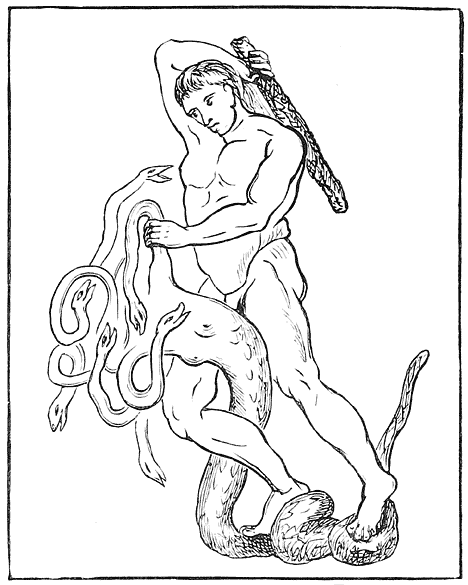
Fig. 6.—Hercules and the Hydra (Louvre).
The once perilous Strudel and Wirbel of the Danube are haunted by diabolical legends. From Dr. William Beattie’s admirable work on ‘The Danube’ I quote the following passages:—‘After descending the Greinerschwall, or rapids of Grein above mentioned, the river rolls on for a considerable space, in a deep and almost tranquil volume, which, by contrast with the approaching turmoil, gives increased effect to its wild, stormy, and romantic features. At first a hollow, subdued roar, like that of distant thunder, strikes the ear and rouses the traveller’s attention. This increases every second, and the stir and activity which now prevail among the hands on board show that additional force, vigilance, and caution are to be employed in the use of the helm and oars. The water is now changed in its colour—chafed into foam, and agitated like a seething cauldron. In front, and in the centre of the channel, rises an abrupt, isolated, and colossal rock, fringed with wood, and crested with a mouldering tower, on the summit of which is planted a lofty cross, to which in the moment of danger the ancient boatmen were wont to address their prayers for deliverance. The first sight of this used to create no little excitement and apprehension on board; the master ordered strict silence to be observed, the steersman grasped the helm with a firmer hand, the passengers moved aside, so as to leave free space for the boatmen, while the women and children were hurried into the cabin, there to await, with feelings of no little anxiety, the result of the enterprise. Every boatman, with his head uncovered, muttered a prayer to his patron saint; and away dashed the barge through the tumbling breakers, that seemed as if hurrying it on to inevitable destruction. All these preparations, joined by the wildness of the adjacent scenery, the terrific aspect of the rocks, and the tempestuous state of the water, were sufficient to produce a powerful sensation on the minds even of those who had been all their lives familiar with dangers; while the shadowy phantoms with which superstition had peopled it threw a deeper gloom over the whole scene.’
Concerning the whirlpool called Wirbel, and the surrounding ruins, the same author writes: ‘Each of these mouldering fortresses was the subject of some miraculous tradition, which circulated at every hearth. The sombre and mysterious aspect of the place, its wild scenery, and the frequent accidents which occurred in the passage, invested it with awe and terror; but above all, the superstitions of the time, a belief in the marvellous, and the credulity of the boatmen, made the navigation of the Strudel and the Wirbel a theme of the wildest romance. At night, sounds that were heard far above the roar of the Danube issued from every ruin. Magical lights flashed through their loopholes and casements, festivals were held in the long-deserted halls, maskers glided from room to room, the waltzers maddened to the strains of an infernal orchestra, armed sentinels paraded the battlements, while at intervals the clash of arms, the neighing of steeds, and the shrieks of unearthly combatants smote fitfully on the boatmen’s ear. But the tower on which these scenes were most fearfully enacted was that on the Longstone, commonly called the ‘Devil’s Tower,’ as it well deserved to be—for here, in close communion with his master, resided the ‘Black Monk,’ whose office it was to exhibit false lights and landmarks along the gulf, so as to decoy the vessels into the whirlpool, or dash them against the rocks. He was considerably annoyed in his quarters, however, on the arrival of the great Soliman in these regions; for to repel the turbaned host, or at least to check their triumphant progress to the Upper Danube, the inhabitants were summoned to join the national standard, and each to defend his own hearth. Fortifications were suddenly thrown up, even churches and other religious edifices were placed in a state of military defence; women and children, the aged and the sick, as already mentioned in our notice of Schaumburg, were lodged in fortresses, and thus secured from the violence of the approaching Moslem. Among the other points at which the greatest efforts were made to check the enemy, the passage of the Strudel and Wirbel was rendered as impregnable as the time and circumstances of the case would allow. To supply materials for the work, patriotism for a time got the better of superstition, and the said Devil’s Tower was demolished and converted into a strong breastwork. Thus forcibly dislodged, the Black Monk is said to have pronounced a malediction on the intruders, and to have chosen a new haunt among the recesses of the Harz mountains.’
When the glaciers send down their torrents and flood the Rhone, it is the immemorial belief that the Devil may be sometimes seen swimming in it, with a sword in one hand and a golden globe in the other. Since it is contrary to all orthodox folklore that the Devil should be so friendly with water, the name must be regarded as a modern substitute for the earlier Rhone demon. We probably get closer to the original form of the superstition in the Swiss Oberland, which interprets the noises of the Furka Glacier, which feeds the Rhone, as the groans of wicked souls condemned for ever to labour there in directing the river’s course; their mistress being a demoness who sometimes appears just before the floods, floating on a raft, and ordering the river to rise.
There is a tidal demonolatry also. The author of ‘Rambles in Northumberland’ gives a tradition concerning the river Wansbeck: ‘This river discharges itself into the sea at a place called Cambois, about nine miles to the eastward, and the tide flows to within five miles of Morpeth. Tradition reports that Michael Scott, whose fame as a wizard is not confined to Scotland, would have brought the tide to the town had not the courage of the person failed upon whom the execution of this project depended. This agent of Michael, after his principal had performed certain spells, was to run from the neighbourhood of Cambois to Morpeth without looking behind, and the tide would follow him. After having advanced a certain distance he became alarmed at the roaring of the waters behind him, and forgetting the injunction, gave a glance over his shoulder to see if the danger was imminent, when the advancing tide immediately stopped, and the burgesses of Morpeth thus lost the chance of having the Wansbeck navigable between their town and the sea. It is also said that Michael intended to confer a similar favour on the inhabitants of Durham, by making the Wear navigable to their city; but his good intentions, which were to be carried into effect in the same manner, were also frustrated by the cowardice of the person who had to guide the tide.’
The gentle and just king Æolus, who taught his islanders navigation, in his mythologic transfiguration had to share the wayward dispositions of the winds he was said to rule; but though he wrecked the Trojan fleet and many a ship, his old human heart remained to be trusted on the appearance of Halcyon. His unhappy daughter of that name cast herself into the sea after the shipwreck of her husband (Cėyx), and the two were changed into birds. It was believed that for seven days before and seven after the shortest day of the year, when the halcyon is breeding, Æolus restrains his winds, and the sea is calm. The accent of this fable has been transmitted to some variants of the folklore of swans. In Russia the Tsar Morskoi or Water Demon’s beautiful daughters (swans) may naturally be supposed to influence the tides which the fair bathers of our time are reduced to obey. In various regions the tides are believed to have some relation to swans, and to respect them. I have met with a notion of this kind in England. On the day of Livingstone’s funeral there was an extraordinary tide in the Thames, which had been predicted and provided for. The crowds which had gathered at the Abbey on that occasion repaired after the funeral to Westminster Bridge to observe the tide, and among them was a venerable disbeliever in science, who announced to a group that there would be no high tide, ‘because the swans were nesting.’ This sceptic was speedily put to confusion by the result, and perhaps one superstition the less remained in the circle that seemed to regard him as an oracle.
The Russian peasantry live in much fear of the Rusalkas and Vodyanuie, water-spirits who, of course, have for their chief the surly Neptune Tsar Morskoi. In deprecation of this tribe, the peasant is careful not to bathe without a cross round the neck, nor to ford a stream on horseback without signing a cross on the water with a scythe or knife. In the Ukrain these water-demons are supposed to be the transformed souls of Pharaoh and his host when they were drowned, and they are increased by people who drown themselves. In Bohemia fishermen are known sometimes to refuse aid to one drowning, for fear the Vodyany will be offended and prevent the fish, over which he holds rule, from entering their nets. The wrath of such beings is indicated by the upheavals of water and foam; and they are supposed especially mischievous in the spring, when torrents and floods are pouring from melted snow. Those undefined monsters which Beowulf slew, Grendel and his mother, are interpreted by Simrock as personifications of the untamed sea and stormy floods invading the low flat shores, whose devastations so filled Faust with horror (II. iv.), and in combating which his own hitherto desolating powers found their task.
The Sea sweeps on in thousand quarters flowing,
Itself unfruitful, barrenness bestowing;
It breaks, and swells, and rolls, and overwhelms
The desert stretch of desolated realms....
Let that high joy be mine for evermore,
To shut the lordly Ocean from the shore,
The watery waste to limit and to bar,
And push it back upon itself afar!
In such brave work Faust had many forerunners, whose art and courage have their monument in the fairer fables of all these elemental powers in which fear saw demons. Pavana, in India, messenger of the gods, rides upon the winds, and in his forty-nine forms, corresponding with the points of the Hindu compass, guards the earth. Solomon, too, journeyed on a magic carpet woven of the winds, which still serves the purposes of the Wise. From the churned ocean rose Lakshmí (after the solar origin was lost to the myth), Hindu goddess of prosperity; and from the sea-foam rose Aphrodite, Beauty. These fair forms had their true worshipper in the Northman, who left on mastered wind and wave his song as Emerson found it—
The gale that wrecked you on the sand,
It helped my rowers to row;
The storm is my best galley hand,
And drives me where I go.