Volume 2 / Part 2 — Chapter V. Animals.
Reading edition
Animal demons distinguished—Trivial sources of Mythology—Hedgehog—Fox—Transmigrations in Japan—Horses bewitched—Rats—Lions—Cats—The Dog—Goethe’s horror of dogs—Superstitions of the Parsees, people of Travancore, and American Negroes, Red Indians, &c.—Cynocephaloi—The Wolf—Traditions of the Nez Perces—Fenris—Fables—The Boar—The Bear—Serpent—Every animal power to harm demonised—Horns.
The animal demons—those whose evil repute is the result of something in their nature which may be inimical to man—should be distinguished from the forms which have been diabolised by association with mythological personages or ideas. The lion, tiger, and wolf are examples of the one class; the stag, horse, owl, and raven of the other. But there are circumstances which render it very difficult to observe this distinction. The line has to be drawn, if at all, between the measureless forces of degradation on the one side, discovering some evil in animals which, but for their bad associations, would not have been much thought of; and of euphemism on the other, transforming harmful beasts to benignant agents by dwelling upon some minor characteristic.
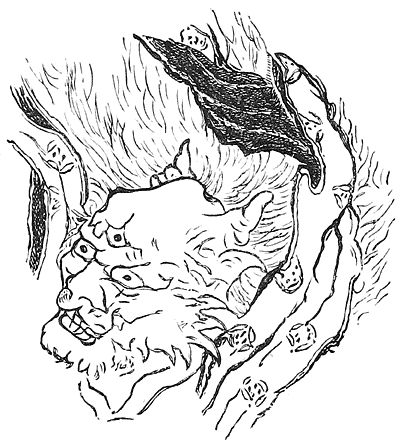
Fig. 7.—Japanese Demon.
The popular feeling which underlay much of the animal-worship in ancient times was probably that which is reflected in the Japanese notions of to-day, as told in the subjoined sketch from an amusing book.
This was the belief of the Corinthians in the Taraxippos, or shade of Glaucus, who, having been torn in pieces by the horses with which he had been racing, and which he had fed on human flesh to make more spirited, remained to haunt the Isthmus and frighten horses during the races.
The Lion is a symbol of majesty and of the sun in his glory (reached in the zodiacal Leo), though here and there his original demonic character appears,—as in the combats of Indra, Samson, and Herakles with terrible lions. Euphemism, in one sense, fulfils the conditions of Samson’s riddle—Sweetness coming out of the Strong—and has brought honey out of the Lion. His cruel character has subtly fallen to Sirius the Dog-star, to whom are ascribed the drought and malaria of ‘dog-days’ (when the sun is in Leo); but the primitive fact is intimated in several fables like that of Aristæus, who, born after his mother had been rescued from the Lybian lion, was worshipped in Ceos as a saviour from both droughts and lions. The Lion couching at the feet of beautiful Doorga in India, reappears drawing the chariot of Aphrodite, and typifies the potency of beauty rather than, as Emerson interprets, that beauty depends on strength. The chariot of the Norse Venus, Freyja, was drawn by Cats, diminished forms of her Southern sister’s steeds. It was partly by these routes the Cat came to play the sometimes beneficent rôle in Russian, and to some extent in German, French, and English folklore,—e.g., Puss in Boots, Whittington and his Cat, and Madame D’Aulnoy’s La Chatte Blanche. The demonic characteristics of the destructive cats have been inherited by the black,—or, as in Macbeth, the brindled,—cat. In Germany the approach of a cat to a sick-bed announces death; to dream of one is an evil omen. In Hungary it is said every black cat becomes a witch at the age of seven. It is the witch’s favourite riding-horse, but may sometimes be saved from such servitude by incision of the sign of the cross. A scratch from a black cat is thought to be the beginning of a fatal spell.
Dr. Dennys tells us that in China there exists precisely the same superstition as in Scotland as to the evil omen of a cat (or dog) passing over a corpse. Brand and Pennant both mention this, the latter stating that the cat or dog that has so done is killed without mercy. This fact would seem to show that the fear is for the living, lest the soul of the deceased should enter the animal and become one of the innumerable werewolf or vampyre class of demons. But the origin of the superstition is no doubt told in the Slavonic belief that if a cat leap over a corpse the deceased person will become a vampyre.
In Russia the cat enjoys a somewhat better reputation than it does in most other countries. Several peasants in the neighbourhood of Moscow assured me that while they would never be willing to remain in a church where a dog had entered, they would esteem it a good sign if a cat came to church. One aged woman near Moscow told me that when the Devil once tried to creep into Paradise he took the form of a mouse: the Dog and Cat were on guard at the gates, and the Dog allowed the evil one to pass, but the Cat pounced on him, and so defeated another treacherous attempt against human felicity.
The Cat superstition has always been strong in Great Britain. It is, indeed, in one sense true, as old Howell wrote (1647)—‘We need not cross the sea for examples of this kind, we have too many (God wot) at home: King James a great while was loath to believe there were witches; but that which happened to my Lord Francis of Rutland’s children convinced him, who were bewitched by an old woman that was a servant of Belvoir Castle, but, being displeased, she contracted with the Devil, who conversed with her in the form of a Cat, whom she called Rutterkin, to make away those children out of mere malignity and thirst of revenge.’ It is to be feared that many a poor woman has been burned as a witch against whom her cherished cat was the chief witness. It would be a curious psychological study to trace how far the superstition owns a survival in even scientific minds,—as in Buffon’s vituperation of the cat, and in the astonishing story, told by Mr. Wood, of a cat which saw a ghost (anno 1877)!
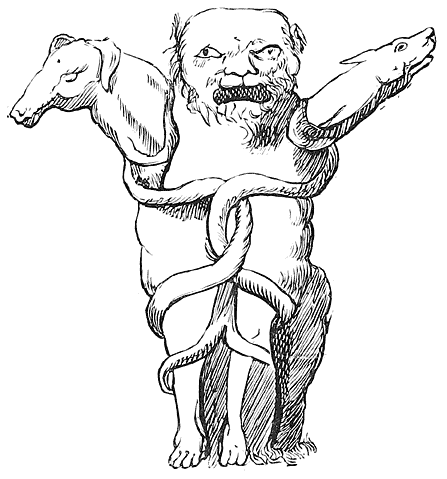
Fig. 8.—Cerberus (Calmet).
In the early Vedic Mythology it is the abode of the gods that is guarded by the two dogs, identified by solar mythologists as the morning and evening twilight: a later phase shows them in the service of Yama, and they reappear in the guardian of the Greek Hades, Cerberus, and Orthros. The first of these has been traced to the Vedic Sarvara, the latter to the monster Vritra. ‘Orthros’ is the phonetical equivalent of Vritra. The bitch Sarama, mother of the two Vedic dogs, proved a treacherous guard, and was slain by Indra. Hence the Russian peasant comes fairly by another version of how the Dog, while on guard, admitted the Devil into heaven on being thrown a bone. But the two watch-dogs of the Hindu myth do not seem to bear an evil character. In a funeral hymn of the ‘Rig-Veda’ (x. 14), addressed to Yama, King of Death, we read:—‘By an auspicious path do thou hasten past the two four-eyed brindled dogs, the offspring of Sarama; then approach the beautiful Pitris who rejoice together with Yama. Intrust him, O Yama, to thy two watch-dogs, four-eyed, road-guarding, and man-observing. The two brown messengers of Yama, broad of nostril and insatiable, wander about among men; may they give us again to-day the auspicious breath of life that we may see the sun!’
And now thousands of years after this was said we find the Dog still regarded as the seer of ghosts, and watcher at the gates of death, of whose opening his howl forewarns. The howling of a dog on the night of December 9, 1871, at Sandringham, where the Prince of Wales lay ill, was thought important enough for newspapers to report to a shuddering country. I read lately of a dog in a German village which was supposed to have announced so many deaths that he became an object of general terror, and was put to death. In that country belief in the demonic character of the dog seems to have been strong enough to transmit an influence even to the powerful brain of Goethe.
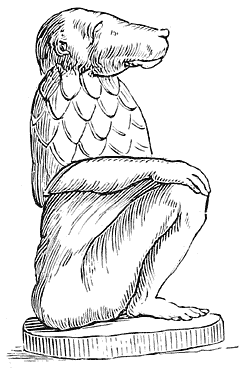
Fig. 9.—Canine Lar (Herculaneum).
The passage in ‘Faust’ has been traced to Goethe’s antipathy to dogs, as expressed in his conversation with Falk at the time of Wieland’s death. ‘Annihilation is utterly out of the question; but the possibility of being caught on the way by some more powerful and yet baser monas, and subordinated to it; this is unquestionably a very serious consideration; and I, for my part, have never been able entirely to divest myself of the fear of it, in the way of a mere observation of nature.’ At this moment, says Falk, a dog was heard repeatedly barking in the street. Goethe, sprang hastily to the window and called to it: ‘Take what form you will, vile larva, you shall not subjugate me!’ After some pause, he resumed with the remark: ‘This rabble of creation is extremely offensive. It is a perfect pack of monades with which we are thrown together in this planetary nook; their company will do us little honour with the inhabitants of other planets, if they happen to hear anything about them.’
In visiting the house where Goethe once resided in Weimar, I was startled to find as the chief ornament of the hall a large bronze dog, of full size, and very dark, looking proudly forth, as if he possessed the Goethean monas after all. However, it is not probable that the poet’s real dislike of dogs arose solely from that speculation about monades. It is more probable that in observing the old wall-picture in Auerbach’s cellar, wherein a dog stands beside Mephistopheles, Goethe was led to consider carefully the causes of that intimacy. Unfortunately, and notwithstanding the fables and the sentiment which invest that animal, there are some very repulsive things about him, such as his tendency to madness and the infliction on man of a frightful death. The Greek Mania’s ‘fleet hounds’ (Bacchæ 977) have spread terrors far and wide.
Those who carefully peruse the account given by Mr. Lewes of the quarrel between Karl August and Goethe, on account of the opposition of the latter to the introduction of a performing dog on the Weimar stage—an incident which led to his resignation of his position of intendant of the theatre—may detect this aversion mingling with his disgust as an artist; and it may be also suspected that it was not the mere noise which caused the tortures he described himself as having once endured at Göttingen from the barking of dogs.
It is, however, not improbable that in the wild notion of Goethe, joined with his cynophobia, we find a survival of the belief of the Parsees of Surat, who venerate the Dog above all other animals, and who, when one is dying, place a dog’s muzzle near his mouth, and make it bark twice, so that it may catch the departing soul, and bear it to the waiting angel.
The devil-worshippers of Travancore to this day declare that the evil power approaches them in the form of a Dog, as Mephistopheles approached Faust. But before the superstition reached Goethe’s poem it had undergone many modifications; and especially its keen scent had influenced the Norse imagination to ascribe to it præternatural wisdom. Thus we read in the Saga of Hakon the Good, that when Eystein the Bad had conquered Drontheim, he offered the people choice of his slave Thorer or his dog Sauer to be their king. They chose the Dog. ‘Now the dog was by witchcraft gifted with three men’s wisdom; and when he barked he spoke one word and barked two.’ This Dog wore a collar of gold, and sat on a throne, but, for all his wisdom and power, seems to have been a dog still; for when some wolves invaded the cattle, he attacked and was torn to pieces by them.
Among the negroes of the Southern States in America I have found the belief that the most frequent form of a diabolical apparition is that of a large Dog with fiery eyes, which may be among them an original superstition attributable to their horror of the bloodhound, by which, in some regions, they were pursued when attempting to escape. Among the whites of the same region I have never been able to find any instance of the same belief, though belief in the presage of the howling dog is frequent; and it is possible that this is a survival from some region in Africa, where the Dog has an evil name of the same kind as the scape-goat. Among some tribes in Fazogl there is an annual carnival at which every one does as he likes. The king is then seated in the open air, a dog tied to the leg of his chair, and the animal is then stoned to death.
It is remarkable that these fragments of European superstition should meet in the Far West a plentiful crop of their like which has sprung up among the aborigines, as the following extract from Mr. Brinton’s work, ‘Myths of the New World,’ will show: ‘Dogs were supposed to stand in some peculiar relation to the moon, probably because they howl at it and run at night, uncanny practices which have cost them dear in reputation. The custom prevailed among tribes so widely asunder as Peruvians, Tupis, Creeks, Iroquois, Algonquins, and Greenland Eskimos to thrash the curs most soundly during an eclipse. The Creeks explained this by saying that the big Dog was swallowing the sun, and that by whipping the little ones they could make him desist. What the big Dog was they were not prepared to say. We know. It was the night goddess, represented by the Dog, who was thus shrouding the world at mid-day. In a better sense, they represented the more agreeable characteristics of the lunar goddess. Xochiquetzal, most fecund of Aztec divinities, patroness of love, of sexual pleasure, and of child-birth, was likewise called Itzcuinan, which, literally translated, is ‘bitch-mother.’ This strange and to us so repugnant title for a goddess was not without parallel elsewhere. When in his wars the Inca Pachacutec carried his arms into the province of Huanca, he found its inhabitants had installed in their temples the figure of a Dog as their highest deity.... This canine canonisation explains why in some parts of Peru a priest was called, by way of honour, allco, Dog!... Many tribes on the Pacific coast united in the adoration of a wild species, the coyote, the Canis latrans of naturalists.’ Of the Dog-demon Chantico the legend of the Nahuas was, ‘that he made a sacrifice to the gods without observing a preparatory fast, for which he was punished by being changed into a Dog. He then invoked the god of death to deliver him, which attempt to evade a just punishment so enraged the divinities that they immersed the world in water.’
The common phrase ‘hell-hounds’ has come to us by various routes. Diana being degraded to Hecate, the dogs of Hades, Orthros and Cerberus, multiplied into a pack of hounds for her chase, were degraded with her into infernal howlers and hunters. A like degradation of Odin’s hunt took place at a later date. The Wild Huntsman, being a diabolical character, is considered elsewhere. Concerning the Dog, it may be further said here, that there are probably various characteristics of that animal reflected in his demonic character. His liability to become rabid, and to afflict human beings with hydrophobia, appears to have had some part in it. Spinoza alludes to the custom in his time of destroying persons suffering from this canine rabies by suffocation; and his English biographer and editor, Dr. Willis, tells me that in his boyhood in Scotland he always heard this spoken of as the old custom. That such treatment could have prevailed can hardly be ascribed to anything but a belief in the demonic character of the rabid dog, cognate with the unconscious superstition which still causes rural magistrates to order a dog which has bitten any one to be slain. The notion is, that if the dog goes mad thereafter, the man will also. Of course it would be rational to preserve the dog’s life carefully, in order that, if it continues healthy, the bitten may feel reassured, as he cannot be if it be dead.
But the degradation of the dog had a cause even in his fidelity as a watch. For this, as we have just seen, made him a common form among Lares or domestic demons. The teraphim also were often in this shape. Christianity had therefore a special reason for ascribing an infernal character to these little idols, which interfered with the popular dependence on the saints. It will thus be seen that there were many causes operating to create that formidable class of demons which were called in the Middle Ages Cynocephaloi. The ancient holy pictures of Russia especially abound in these dog-headed devils; in the sixteenth century they were frequently represented rending souls in hell; and sometimes the dragon of the Apocalypse is represented with seven horrible canine heads.
The two monsters formed when Ráhu was cloven in twain, in Hindu Mythology, reappear in Eddaic fable as the wolves Sköll and Hati, who pursue the sun and moon. As it is said in the Völuspá:—
Eastward in the Iron-wood
The old one sitteth,
And there bringeth forth
Fenrir’s fell kindred.
Of these one, the mightiest,
The moon’s devourer,
In form most fiend-like,
And filled with the life-blood
Of the dead and the dying,
Reddens with ruddy gore
The seats of the high gods.
Euphemism attending propitiation of such monsters may partly explain the many good things told of wolves in popular legend. The stories of the she-wolf nourishing children, as Romulus and Remus, are found in many lands. They must, indeed, have had some prestige, to have been so largely adopted in saintly tradition. Like the bears that Elisha called to devour the children, the wolves do not lose their natural ferocity by becoming pious. They devour heretics and sacrilegious people. One guarded the head of St. Edmund the Martyr of England; another escorted St. Oddo, Abbot of Cluny, as his ancestors did the priests of Cluny. The skin of the wolf appears in folklore as a charm against hydrophobia; its teeth are best for cutting children’s gums, and its bite, if survived, is an assurance against any future wound or pain.
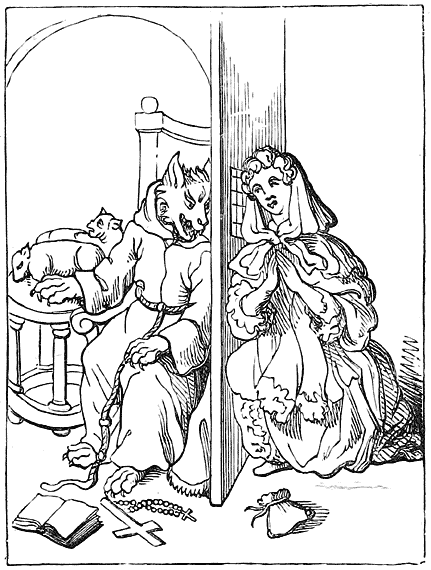
Fig. 10.—The Wolf as Confessor (probably Dutch).
The tragedy which is so foolishly sprung upon the nerves of children, Little Red Riding-Hood, shows the wolf as a crafty animal. There are many legends of a like character which have made it a favourite figure in which to represent pious impostors. In our figure 10, the wolf appears as the ‘dangerous confessor;’ it was intended, as Mr. Wright thought, for Mary of Modena, Queen of James II., and Father Petre. At the top of the original are the words ‘Converte Angliam’ and beneath, ‘It is a foolish sheep that makes the wolf her confessor.’ The craft of the wolf is represented in a partly political partly social turn given by an American fabulist to one of Æsop’s fables. The wolf having accused the lamb he means to devour of fouling the stream, and receiving answer that the lamb was drinking farther down the current, alters the charge and says, ‘You opposed my candidature at the caucus two years ago.’ ‘I was not then born,’ replies the lamb. The wolf then says, ‘Any one hearing my accusations would testify that I am insane and not responsible for my actions,’ and thereupon devours the lamb with full faith in a jury of his countrymen. M. Toussenel says the wolf is a terrible strategist, albeit the less observant have found little in his character to warrant this attribute of craft, his physiognomy and habits showing him a rather transparent highwayman. It is probable that the fables of this character have derived that trait from his association with demons and devils supposed to take on his shape.
The extreme point of demonic power has always been held by the Serpent. So much, however, will have to be said of the destructiveness and other characteristics of this animal when we come to consider at length its unique position in Mythology, that I content myself here with a pictorial representation of the Singhalese Demon of Serpents. If any one find himself shuddering at sight of a snake, even in a country where they are few and comparatively harmless, perhaps this figure (11) may suggest the final cause of the shudder.
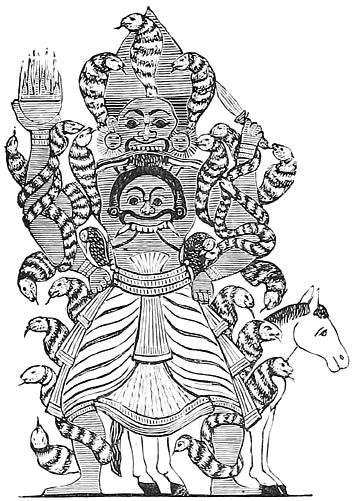
Fig. 11.—Singhalese Demon of Serpents.
In conclusion, it may be said that not only every animal ferocity, but every force which can be exerted injuriously, has had its demonic representations. Every claw, fang, sting, hoof, horn, has been as certain to be catalogued and labelled in demonology as in physical science. It is remarkable also how superstition rationalises. Thus the horn in the animal world, though sometimes dangerous to man, was more dangerous to animals, which, as foes of the horned animals, were foes to man’s interests. The early herdsman knew the value of the horn as a defence against dog and wolf, besides its other utilities. Consequently, although it was necessary that the horn-principle, so to say, in nature must be regarded as one of its retractile and cruel features, man never demonised the animals whose butt was most dangerous, but for such purpose transferred the horns to the head of some nondescript creature. The horn has thus become a natural weapon of man-demons. The same evolution has taken place in America; for, although among its aboriginal legends we may meet with an occasional demon-buffalo, such are rare and of apocryphal antiquity. The accompanying American figure (12) is from a photograph sent me by the President of Vanderbilt University, Tennessee, who found it in an old mound (Red Indian) in the State of Georgia. It is probably as ancient as any example of a human head with horns in the world; and as it could not have been influenced by European notions, it supplies striking evidence that the demonisation of the forces and dangers of nature belongs to the structural action of the human mind.
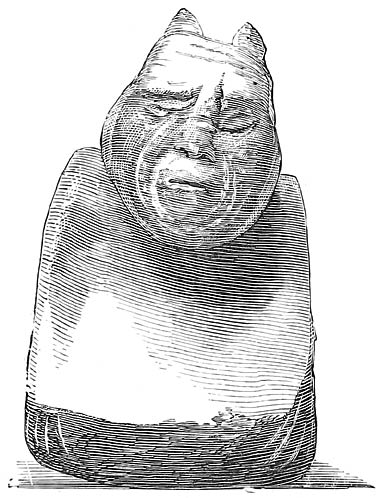
Fig. 12.—American Indian Demon.