Volume 2 / Part 1 — Chapter IV. The Abgott.
Reading edition
The ex-god—Deities demonised by conquest—Theological animosity—Illustration from the Avesta—Devil-worship an arrested Deism—Sheik Adi—Why demons were painted ugly—Survivals of their beauty.
The phenomena of the transformation of deities into demons meet the student of Demonology at every step. We shall have to consider many examples of a kind similar to those which have been mentioned in the preceding chapter; but it is necessary to present at this stage of our inquiry a sufficient number of examples to establish the fact that in every country forces have been at work to degrade the primitive gods into types of evil, as preliminary to a consideration of the nature of those forces.
The operation of this force in the degradation of deities, is particularly revealed in the Sacred Books of Persia. In that country the great religions of the East would appear to have contended against each other with especial fury, and their struggles were probably instrumental in causing one or more of the early migrations into Western Europe. The great celestial war between Ormuzd and Ahriman—Light and Darkness—corresponded with a violent theological conflict, one result of which is that the word deva, meaning ‘deity’ to Brahmans, means ‘devil’ to Parsees. The following extract from the Zend-Avesta will serve as an example of the spirit in which the war was waged:—
‘All your devas are only manifold children of the Evil Mind—and the great one who worships the Saoma of lies and deceits; besides the treacherous acts for which you are notorious throughout the seven regions of the earth.
‘You have invented all the evil which men speak and do, which is indeed pleasant to the Devas, but is devoid of all goodness, and therefore perishes before the insight of the truth of the wise.
That is to say—Ours is the true god: your god is a devil.
The Zoroastrian conversion of deva (deus) into devil does not alone represent the work of this odium theologicum. In the early hymns of India the appellation asuras is given to the gods. Asura means a spirit. But in the process of time asura, like dæmon, came to have a sinister meaning: the gods were called suras, the demons asuras, and these were said to contend together. But in Persia the asuras—demonised in India—retained their divinity, and gave the name ahura to the supreme deity, Ormuzd (Ahura-mazda). On the other hand, as Mr. Muir supposes, Varenya, applied to evil spirits of darkness in the Zendavesta, is cognate with Varuna (Heaven); and the Vedic Indra, king of the gods—the Sun—is named in the Zoroastrian religion as one of the chief councillors of that Prince of Darkness.
By his light he hath lighted the lamp of the morning.
I am he that placed Adam in my Paradise.
I am he that made Nimrod a hot burning fire.
I am he that guided Ahmet mine elect,
I gifted him with my way and guidance.
Mine are all existences together,
They are my gift and under my direction.
I am he that possesseth all majesty,
And beneficence and charity are from my grace,
I am he that entereth the heart in my zeal;
And I shine through the power of my awfulness and majesty.
I am he to whom the lion of the desert came:
I rebuked him and he became like stone.
I am he to whom the serpent came,
And by my will I made him like dust.
I am he that shook the rock and made it tremble,
The reverence shown in these sacred sentences for Hebrew names and traditions—as of Adam in Paradise, Marah, and the smitten rock—and for Ahmet (Mohammed), appears to have had its only requital in the odious designation of the worshippers of Taous as Devil-worshippers, a label which the Yezedis perhaps accepted as the Wesleyans and Friends accepted such names as ‘Methodist’ and ‘Quaker.’
Mohammed has expiated the many deities he degraded to devils by being himself turned to an idol (mawmet), a term of contempt all the more popular for its resemblance to ‘mummery.’ Despite his denunciations of idolatry, it is certain that this earlier religion represented by the Yezedis has never been entirely suppressed even among his own followers. In Dr. Leitner’s interesting collection there is a lamp, which he obtained from a mosque, made in the shape of a peacock, and this is but one of many similar relics of primitive or alien symbolism found among the Mussulman tribes.
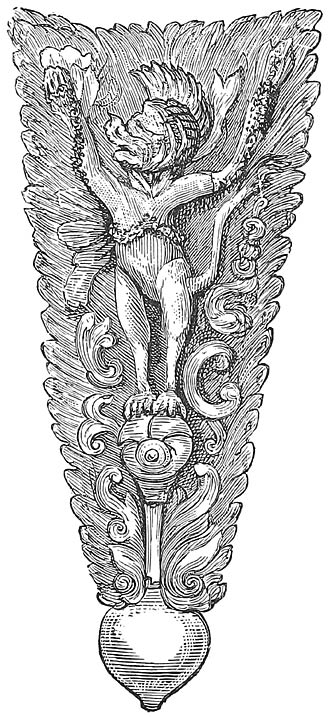
Fig. 2.—Handle of Hindu Chalice.