Volume 2 / Part 4 — Chapter XXI. Antichrist.
Reading edition
The Kali Age—Satan sifting Simon—Satan as Angel of Light—Epithets of Antichrist—The Cæsars—Nero—Sacraments imitated by Pagans—Satanic signs and wonders—Jerome on Antichrist—Armillus—Al Dajjail—Luther on Mohammed—‘Mawmet’—Satan ‘God’s ape’—Mediæval notions—Witches Sabbath—An Infernal Trinity—Serpent of Sins—Antichrist Popes—Luther as Antichrist—Modern notions of Antichrist.
In the ‘Padma Purana’ it is recorded that when King Vena embraced heretical doctrine and abjured the temples and sacrifices, the people following him, seven powerful Rishis, high priests, visited him and entreated him to return to their faith. They said, ‘These acts, O king, which thou art performing, are not of our holy traditions, nor fit for our religion, but are such as shall be performed by mankind at the entrance of Kali, the last and sinful age, when thy new faith shall be received by all, and the service of the gods be utterly relinquished.’ King Vena, being thus in advance of his time, was burned on the sacred grass, while a mantra was performed for him.
This theory of Kali is curious as indicating a final triumph of the enemies of the gods. In the Scandinavian theory of ‘Ragnarok,’ the Twilight of the gods, there also seems to have been included no hope of the future victory of the existing gods. In the Parsí faith we first meet with the belief in a general catastrophe followed by the supremacy and universal sway of good. This faith characterised the later Hebrew prophecies, and is the spirit of Paul’s brave saying, ‘When all things shall be subjected unto him, then also shall the Son himself be subject unto him that put all things under him, that God may be all in all.’
When, however, theology and metaphysics advanced and modelled this fiery lava of prophetic and apostolic ages into dogmatic shapes, evil was accorded an equal duration with good. The conflict between Christ and his foes was not to end with the conversion or destruction of his foes, but his final coming as monarch of the world was to witness the chaining up of the Archfiend in the Pit.
Nero had answered to the portrait of ‘the son of perdition sitting in the temple of God’ perfectly. He aspired to the title ‘King of the Jews.’ He solemnly assumed the name of Jupiter. He had his temples and his priests, and shared divine honours with his mistress Poppæa. Yet, when Nero and his glory had perished under those phials of wrath described in the Apocalypse, a more exact image of the insidious ‘False Christ’ appeared in Vespasian. His alleged miracles (‘lying wonders’), and the reported prediction of his greatness by a prophet on Mount Carmel, his oppression of the Jews, who had to contribute the annual double drachma to support the temples and gods which Vespasian had restored, altogether made this decorous and popular emperor a more formidable enemy than the ‘Beast’ Nero whom he succeeded. The virtues and philosophy of Marcus Aurelius still increased the danger. Political conditions favoured all those who were inclined to compromise, and to mingle the popular pagan and the Jewish festivals, symbols, and ceremonies. In apocalyptic metaphor, Vespasian and Aurelius are the two horns of the Lamb who spake like the Dragon, i.e., Nero (Rev. xiii. 11).
What masses of fantastic nonsense it was possible to cram into one brain was shown in the time of Nero, the brain being that of Simon the Magician. Simon was, after all, a representative man; he reappears in christian Gnosticism, and Peter, who denounced him, reappears also in the phrenzy of Montanism. Take the followers of this Sorcerer worshipping his image in the likeness of Jupiter, the Moon, and Minerva; and Montanus with his wild women Priscilla and Maximilla going about claiming to be inspired by the Holy Ghost to re-establish Syrian orthodoxy and asceticism; and we have fair specimens of the parties that glared at each other, and apostrophised each other as children of Belial. They competed with each other by pretended miracles. They both claimed the name of Christ, and all the approved symbols and sacraments. The triumph of one party turned the other into Antichrist.
Thus in process of time, as one hydra-head fell only to be followed by another, there was defined a Spirit common to and working through them all—a new devil, whose special office was hostility to Christ, and whose operations were through those who claimed to be christians as well as through open enemies.
The ‘Little Horn’ of Daniel has proved a cornucopia of Antichrists. Not only the christians but the Jews and the mussulmans have definite beliefs on the subject. The rabbinical name for Antichrist is Armillus, a word found in the Targum (Isa. xi. 4): ‘By the word of his mouth the wicked Armillus shall die.’ There will be twelve signs of the Messiah’s coming—appearance of three apostate kings, terrible heat of the sun, dew of blood, healing dew, the sun darkened for thirty days, universal power of Rome with affliction for Jews, and the appearance of the first Messias (Joseph’s tribe), Nehemiah. The next and seventh sign will be the appearance of Armillus, born of a marble statue in a church at Rome. The Romans will accept him as their god, and the whole world be subject to him. Nehemiah alone will refuse to worship him, and for this will be slain, and the Jews suffer terrible things. The eighth sign will be the appearance of the angel Michael with three blasts of his trumpet—which shall call forth Elias, the forerunner, and the true Messias (Ben David), and bring on the war with Armillus who shall perish, and all christians with him. The ten tribes shall be gathered into Paradise. Messias shall wed the fairest daughter of their race, and when he dies his sons shall succeed him, and reign in unbroken line over a beatified Israel.
‘Mawmet’ was used by Wicliffe for idol in his translation of the New Testament, Acts vii. 41, ‘And they made a calf in those days and offered a sacrifice to the Mawmet’ (idol). The word, though otherwise derived by some, is probably a corruption of Mohammed. In the ‘Mappa Mundi’ of the thirteenth century we find the representation of the golden calf in the promontory of Sinai, with the superscription ‘Mahum’ for Mohammed, whose name under various corruptions, such as Mahound, Mawmet, &c., became a general byword in the mediæval languages for an idol. In a missionary hymn of Wesley’s Mohammed is apostrophised as—
That Arab thief, as Satan bold,
Who quite destroyed Thy Asian fold;
and the Almighty is adjured to—
The Unitarian fiend expel,
And chase his doctrine back to Hell.
In these days, when the very mention of the Devil raises a smile, we can hardly realise the solemnity with which his work was once viewed. When Goethe represents Mephistopheles as undertaking to teach Faust’s class in theology and dwells on his orthodoxy, it is the refrain of the faith of many generations. The Devil was not ‘God’s Ape,’ as Tertullian called him, in any comical way; not only was his ceremonial believed to be modelled on that of God, but his inspiration of his followers was believed to be quite as potent and earnest. Tertullian was constrained to write in this strain—‘Blush, my Roman fellow-soldiers, even if ye are not to be judged by Christ, but by any soldier of Mithras, who when he is undergoing initiation in the cave, the very camp of the Powers of Darkness, when the wreath is offered him (a sword being placed between as if in semblance of martyrdom), and then about to be set on his head, he is warned to put forth his hand and push the wreath away, transferring it to, perchance, his shoulder, saying at the same time, My only crown is Mithras. And thenceforth he never wears a wreath; and this is a mark he has for a test, whenever tried as to his initiation, for he is immediately proved to be a soldier of Mithras if he throws down the wreath offered him, saying his crown is in his god. Let us therefore acknowledge the craft of the Devil, who mimics certain things of those that be divine, in order that he may confound and judge us by the faith of his own followers.’
This was written before the exaltation of Christianity under Constantine. When the age of the martyrdom of the so-called pagans came on, these formulæ became real, and the christians were still more confounded by finding that the worshippers of the Devil, as they thought them, could yield up their lives in many parts of Europe as bravely for their faith as any christian had ever done. The ‘Prince of this world’ became thus an unmeaning phrase except for the heretics. Christ had become the Prince of this world; and he was opposed by religious devotees as earnest as any who had suffered under Nero. The relation of the Opposition to the Devil was yet more closely defined when it claimed the christian name for its schism or heresy, and when it carried its loyalty to the Adversary of the Church to the extent of suffering martyrdom. ‘Tell me, holy father,’ said Evervinus to St. Bernard, concerning the Albigenses, ‘how is this? They entered to the stake and bore the torment of the fire not only with patience, but with joy and gladness. I wish your explanation, how these members of the Devil could persist in their heresy with a courage and constancy scarcely to be found in the most religious of the faith of Christ?’
Under these circumstances the personification of Antichrist had a natural but still wonderful development. He was to be born of a virgin, in Babylon, to be educated at Bethsaida and Chorazin, and to make a triumphal entry into Jerusalem, proclaiming himself the Son of God. In the interview at Messina (1202) between Richard I. and the Abbot Joachim of Floris, the king said, ‘I thought that Antichrist would be born at Antioch or in Babylon, and of the tribe of Dan, and would reign in the temple of the Lord in Jerusalem, and would walk in that land in which Christ walked, and would reign in it for three years and a half, and would dispute against Elijah and Enoch, and would kill them, and would afterwards die; and that after his death God would give sixty days of repentance, in which those might repent which should have erred from the way of truth, and have been seduced by the preaching of Antichrist and his false prophets.’
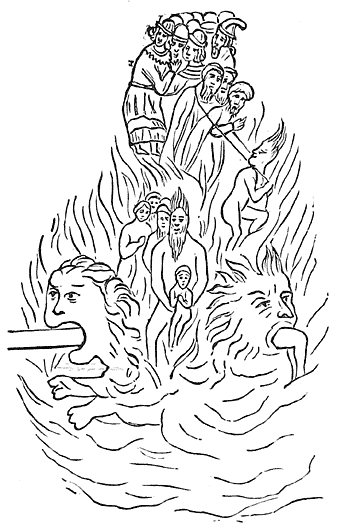
Fig 9.—Procession of the Serpent of Sins.
This belief was reflected in Western Europe in the belief that the congregation of Witches assembled on their Sabbath (an institution then included among paganisms) to celebrate grand mass to the Devil, and that all the primitive temples were raised in honour of Satan. In the Russian Church the correspondence between the good and evil powers, following their primitive faith in the conflict between Byelbog and Tchernibog (white god and black god), went to the curious extent of picturing in hell a sort of infernal Trinity. The Father throned in Heaven with the Son between his knees and the Dove beside or beneath him, was replied to by a majestic Satan in hell, holding his Son (Judas) on his knees, and the Serpent acting as counteragent of the Dove. This singular arrangement may still be seen in many of the pictures which cover the walls of the oldest Russian churches (Fig. 9). The infernal god is not without a solemn majesty answering to that of his great antagonist above. The Serpent of Sins proceeds from the diabolical Father and Son, passing from beneath their throne through one of the two mouths of Hell, and then winds upward, hungrily opening its jaws near the terrible Balances where souls are weighed (Fig. 10). Along its hideous length are seated at regular intervals nine winged devils, representing probably antagonists of the nine Sephiroth or Æons of the Gnostic theology. Each is armed with a hook whereby the souls weighed and found wanting may be dragged. The sins which these devils represent are labelled, generally on rings around the serpent, and increase in heinousness towards the head. It is a curious fact that the Sin nearest the head is marked ‘Unmercifulness.’ Strange and unconscious sarcasm on an Omnipotent Deity under whose sway exists this elaboration of a scheme of sins and tortures precisely corresponding to the scheme of virtues and joys!
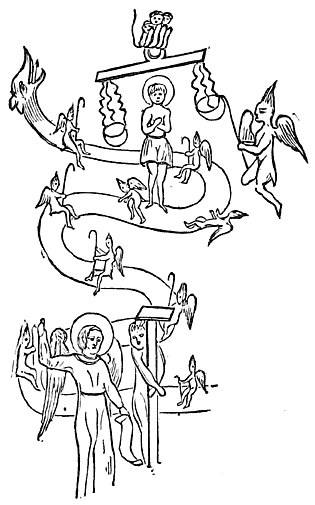
Fig. 10.—Ancient Russian Wall-Painting.
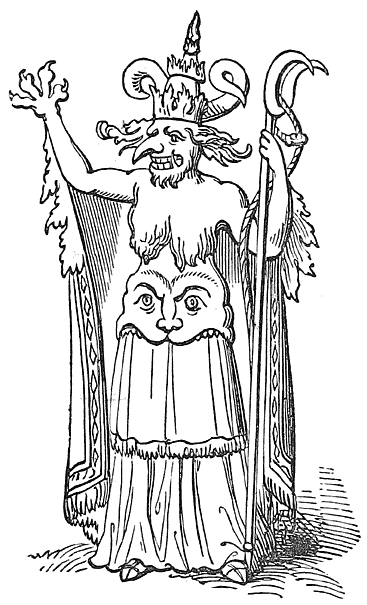
Fig. 11.—Alexander VI. as Antichrist.
Truly said the Epistle of John, there be many Antichrists. If this was true before the word Christianity had been formed, or the system it names, what was the case afterwards? For centuries we find vast systems denouncing each other as Antichrist. And ultimately, as a subtle hardly-conscious heresy spread abroad, the great excommunicator of antichrists itself, Rome, acquired that title, which it has never shaken off since. The See of Rome did not first receive that appellation from Protestants, but from its own chiefs. Gregory himself (A.C. 590) started the idea by declaring that any man who held even the shadow of such power as the Popes arrogated to themselves after his time would be the forerunner of Antichrist. Arnulphus, Bishop of Orleans, in an invective against John XV. at Rheims (A.C. 991), intimated that a Pope destitute of charity was Antichrist. But the stigma was at length fixed (twelfth century) by Amalrich of Bena (‘Quia Papa esset Antichristus et Roma Babylon et ipse sedit in Monte Oliveti, i.e., in pinguedine potestatis’); and also by the Abbot Joachim (A.C. 1202). The theory of Richard I., as stated to Joachim concerning Antichrist, has already been quoted. It was in the presence of the Archbishops of Rouen and Auxerre, and the Bishop of Bayonne, and represented their opinion and the common belief of the time. But Joachim said the Second Apocalyptic Beast represented some great prelate who will be like Simon Magus, and, as it were, universal Pontiff, and that very Antichrist of whom St. Paul speaks. Hildebrand was the first Pope to whom this ugly label was affixed, but the career of Alexander VI. (Roderic Borgia) made it for ever irremovable for the Protestant mind. There is in the British Museum a volume of caricatures, dated 1545, in which occurs an ingenious representation of Alexander VI. The Pope is first seen in his ceremonial robes; but a leaf being raised, another figure is joined to the lower part of the former, and there appears the papal devil, the cross in his hand being changed to a pitchfork (Fig. 11). Attached to it is an explanation in German giving the legend of the Pope’s death. He was poisoned (1503) by the cup he had prepared for another man. It was afterwards said that he had secured the papacy by aid of the Devil. Having asked how long he would reign, the Devil returned an equivocal answer; and though Alexander understood that it was to be fifteen years, it proved to be only eleven. When in 1520 Pope Leo X. issued his formal bull against Luther, the reformer termed it ‘the execrable bull of Antichrist.’ An Italian poem of the time having represented Luther as the offspring of Megæra, the Germans returned the invective in a form more likely to impress the popular mind; namely, in a caricature (Fig. 12), representing the said Fury as nursing the Pope. This caricature is also of date 1545, and with it were others showing Alecto and Tisiphone acting in other capacities for the papal babe.
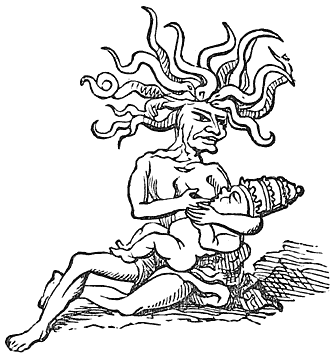
Fig. 12.—The Pope Nursed by Megæra.
The Lutherans had made the discovery that the number of the Apocalyptic Beast, 666, put into Hebrew numeral letters, contained the words Aberin Kadescha Papa (our holy father the Pope). The downfall of this Antichrist was a favourite theme of pulpit eloquence, and also with artists. A very spirited pamphlet was printed (1521), and illustrated with designs by Luther’s friend Lucas Cranach. It was entitled Passional Christi und Antichristi. The fall of the papal Antichrist (Fig. 13), has for its companion one of Christ washing the feet of his disciples.
But the Catholics could also make discoveries; and among many other things they found that the word ‘Luther’ in Hebrew numerals also made the number of the Beast. It was remembered that one of the earliest predictions concerning Antichrist was that he would travesty the birth of Christ from a virgin by being born of a nun by a Bishop. Luther’s marriage with the nun Catharine von Bora came sufficiently near the prediction to be welcomed by his enemies. The source of his inspiration as understood by Catholics is cleverly indicated in a caricature of the period (Fig. 14).
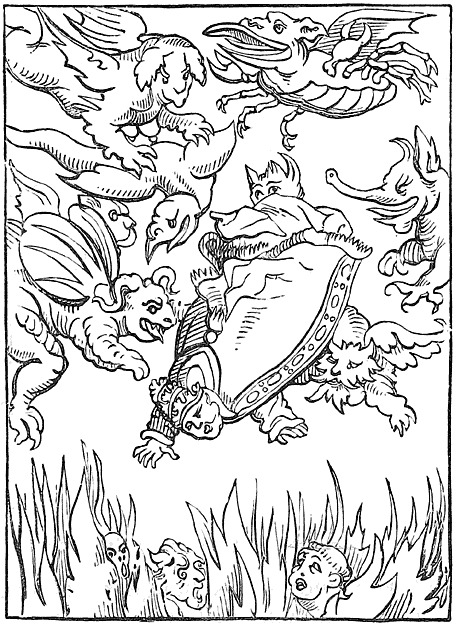
Fig. 13.—Antichrist’s Descent (L. Cranach).
The theory that the Papacy represents Antichrist has so long been the solemn belief of rebels against its authority, that it has become a vulgarised article of Protestant faith. On the other hand, Catholics appear to take a political and prospective view of Antichrist. Cardinal Manning, in his pastoral following the election of Leo XIII., said: ‘A tide of revolution has swept over all countries. Every people in Europe is inwardly divided against itself, and the old society of Christendom, with its laws, its sanctities, and its stability, is giving way before the popular will, which has no law, or rather which claims to be a law to itself. This is at least the forerunning sign of the Lawless One, who in his own time shall be revealed.’
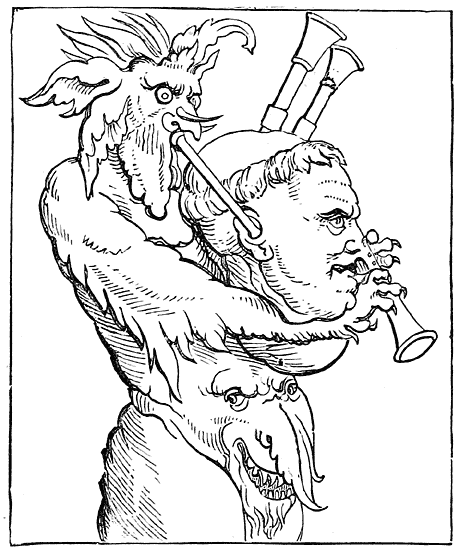
Fig. 14.—Luther’s Devil as seen by Catholics.
Throughout the endless exchange of epithets, it has been made clear that Antichrist is the reductio ad absurdum of the notion of a personal Devil. From the day when the word was first coined, it has assumed every variety of shape, has fitted with equal precision the most contrarious things and persons; and the need of such a novel form at one point or another in the progress of controversy is a satire on the inadequacy of Satan and his ancient ministers. Bygone Devils cannot represent new animosities. The ascent of every ecclesiastical or theological system is traceable in massacres and martyrdoms; each of these, whether on one side or the other, helps to develop a new devil. The story of Antichrist shows devils in the making. Meantime, to eyes that see how every system so built up must sacrifice a virtue at every stage of its ascent, it will be sufficiently clear that every powerful Church is Adversary of the religion it claims to represent. Buddhism is Antibuddha; Islam is Antimohammed; Christianity is Antichrist.