Volume 2 / Part 4 — Chapter XXIV. Witchcraft.
Reading edition
Minor gods—Saint and Satyr—Tutelaries—Spells—Early Christianity and the poor—Its doctrine as to pagan deities—Mediæval Devils—Devils on the stage—An Abbot’s revelations—The fairer deities—Oriental dreams and spirits—Calls for Nemesis—Lilith and her children—Neoplatonicism—Astrology and Alchemy—Devil’s College—Shem-hammphorásch—Apollonius of Tyana—Faustus—Black Art Schools—Compacts with the Devil—Blood-covenant—Spirit-seances in old times—The Fairfax delusion—Origin of its devil—Witch, goat, and cat—Confessions of Witches—Witchcraft in New England—Witch trials—Salem demonology—Testing witches—Witch trials in Sweden—Witch Sabbath—Mythological elements—Carriers—Scotch Witches—The cauldron—Vervain—Rue—Invocation of Hecaté—Factors of Witch persecution—Three centuries of massacre—Würzburg horrors—Last victims—Modern Spiritualism.
Me puer Hebræus, Divos Deus ipse gubernans,
Cedere sede jubet, tristremque redire sub orcum;
Aris ergo dehinc tacitis abscedito nostris.
But while the rage of these Fathers towards all the great gods and goddesses, who in their grand temples represented ‘the pride of life,’ was remorseless, they were comparatively indifferent to the belief or disbelief of the lower classes in their small tutelary divinities. They appear almost to have encouraged belief in these, perhaps appreciating the advantages of the popular custom of giving generous offerings to such personal and domestic patrons. At a very early period there seems to have arisen an idea of converting these more plebeian spirits into guardian angels with christian names. Thus Jerome relates in his Life of the first Hermit Paul, that when St. Anthony was on his way to visit that holy man, he encountered a Centaur who pointed out the way; and next a human-like dwarf with horns, hooked fingers, and feet like those of a goat. St. Anthony believing this to be an apparition of the Devil, made the sign of the Cross; but the little man, nowise troubled by this, respectfully approached the monk, and having been asked who he was, answered: ‘I am a mortal, and one of those inhabitants of the Desert whom the Gentiles in their error worship under the names of Fauns, Satyrs, and Incubi: I am delegated by my people to ask of thee to pray for us to our common God, who we know has descended for the salvation of the world, and whose praises resound in all the earth.’ At this glorification of Christ St. Anthony was transported with joy, and turning towards Alexandria he cried, ‘Woe to thee, adulterous city, which adorest animals as gods!’
Perhaps the evolution of these desert demons into good christians would have gone on more rapidly and completely if the primitive theologians had known as much of their history as comparative mythology has disclosed to the modern world. St. Anthony was, however, fairly on the track of them when he turned towards Alexandria. Egypt appears to have been the especial centre from which were distributed through the world the fetish guardians of provinces, towns, households and individuals. Their Serapes reappear in the Teraphim of Laban, and many of the forms they used reappear in the Penates, Lares, and genii of Latin countries. All these in their several countries were originally related to its ancient religion or mythology, but before the christian era they were very much the same in Egypt, Greece, and Italy. They were shaped in many different, but usually natural forms, such as serpents, dogs, boys, and old men, though often some intimation was given of their demonic character. They were so multiplied that even plants and animals had their guardians. The anthropomorphic genii called the Patrii, who were supposed to preside over provinces, were generally represented bearing weapons with which they defended the regions of which they were patrons. These were the Averrunci or Apotropæi.
It was in these diminutive forms that great systems survived among the common people. Amid natural convulsions ancient formations of faith were broken into fragments; in the ebb and flow of time these fragments were smoothed, as it were, into these talismanic pebbles. Yet each of these conveyed all the virtue which had been derived from the great and costly ceremonial system from which it originally crumbled; the virtue of soothing the mind and calming the nerves of sufferers with the feeling that, though they might have been assailed by hostile powers, they had friendly powers too who were active in their behalf—Vindicators, to recall Job’s phrase—who at last would stand by them to the end. In the further ebb and flow of generations the mass of such charms are further pulverised into sand or into mud; but not all of them: amid the mud will be found many surviving specimens, and such mud of accumulated superstitions is always susceptible of being remoulded after such lingering models, should occasion demand.
Erasmus, in his ‘Adages,’ suggests that it was from these genii of ‘the Gentiles’ that the christians derived their notion of each person being attended by two angels, a good and a bad. Probably he was but half right. The peoples to whom he refers did not generally believe that each man was attended by a bad spirit, a personal enemy. That was an honour reserved for individuals particularly formidable to the evil powers,—Adam, Jacob, Hercules, or Zoroaster. The one preternatural power attending each ordinary individual defended him from the general forces of evil. But it was Christianity which, in the gradual effort to substitute patron-saints and guardian-angels of its own for the pagan genii, turned the latter from friends to enemies, and their protecting into assailing weapons.
All the hereditary household gods of what is now called Christendom were diabolised. But in order that the masses might turn from them and invoke christian guardians, the Penates, Lares, and genii had to be belittled on the one hand, and the superior power of the saints and angels demonstrated. When Christianity had gained the throne of political power, it was easy to show that the ‘imps,’ as the old guardians were now called, could no longer protect their invokers from christian punishment, or confer equal favours.
Christianity conquered Europe by the sword, but at first that sword was not wielded against the humble masses. It was wielded against their proud oppressors. To the common people it brought glad tidings of a new order, in which, under the banner of a crucified working-man and his (alleged) peasant mother, all caste should disappear but that of piety and charity. Christ eating with publicans and sinners and healing the wayside cripples reappeared in St. Martin dividing his embroidered cloak with a beggar—type of a new aristocracy. They who worshipped the Crucified Peasant in the rock-cave of Tours which St. Martin had consecrated, or in little St. Martin’s Church at Canterbury where Bertha was baptized, could not see the splendid cathedrals now visible from them, built of their bones and cemented with their blood. King Ethelbert surrendered the temple of his idol to the consecration of Augustine, and his baptized subjects had no difficulty in seeing the point of the ejected devil’s talons on the wall which he assailed when the first mass was therein celebrated.
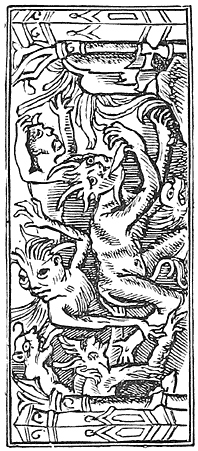
Fig. 18.—Devils (Old Missal).
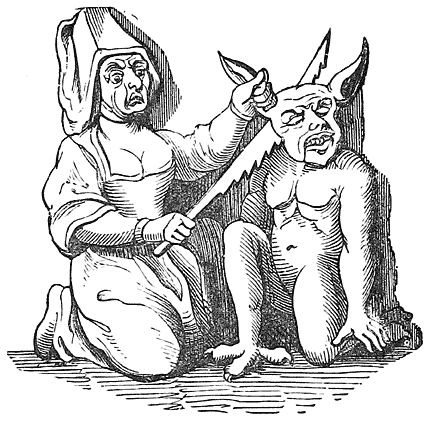
Fig. 19.—Carving at Corbeil.
Gammer. But, Hodge, had he no horns to push?
Hodge. As long as your two armes. Saw ye never fryer Rushe
Painted on cloth, with a side long cowe’s tayle
And crooked cloven feet, and many a hooked nayle?
For all the world (if I should judge) should reckon him his brother;
Loke, even what face fryer Rushe had, the devil had such another.
One dangerous element was the contempt into which, by many causes, the infernal powers had been brought. But a more dangerous one lay in another direction. Though the current phrases of the New Testament and of the Fathers of the Church, declaring this world, its wealth, loves, and pleasures, to be all the kingdom of Satan, had become cant in the mouths of priests ruling over Europe, it had never been cant to the humble peasantries. Although they had degraded many devils imported by the priests, it had been in connection with the declining terrors of their native demonologies. But above these degraded and hated gnomes and elves, whose paternity had been transferred from Sœtere to Satan, there was an array of beautiful deities—gentle gods and goddesses traditionally revered and loved as protectors of the home and the family—which had never really lost their hold on the common people. They might have shrunk before the aggressive victories of the Saints into little Fairies, but their continued love for the poor and the oppressed was the romance of every household. What did these good fairies do? They sometimes loaded the lowly with wealth, if summoned in just the right way; they sang secrets to them from trees as little birds, they smoothed the course of love, clothed ash-maidens in fine clothes, transported people through the air, enabled them to render themselves invulnerable, or invisible, to get out of prisons, to vanquish ‘the powers that be,’ whether ‘ordained of God’ or not. Now all these were benefits which, by christian theory, could only be conferred by that Prince of this World who ministered to ‘the pride of life.’
Into homes which the priest and his noble had stripped of happiness and hope,—whose loving brides were for baptized Bluebeards, whose hard earnings were taken as the price of salvation from devils whose awfulness was departing,—there came from afar rumours of great wealth and splendour conferred upon their worshippers by Eastern gods and goddesses. The priests said all those were devils who would torture their devotees eternally after death; yet it could not be denied that the Moors had the secret of lustres and ornamentation, that the heathen East was gorgeous, that all Christendom was dreaming of the wealth of Ormus and of Ind. Granted that Satan had come westward and northward, joined the scurvy crew of Loki, and become of little importance; but what of Baal or Beelzebub, of Asmodeus, of the genii who built Solomon’s temple, of rich Pluto, of august Ahriman? Along with stories of Oriental magnificence there spread through Christendom names of many deities and demons; many of them beautiful names, too, euphemism having generally managed to bestow melodious epithets alike on deities feared and loved. In Faust’s ‘Miraculous Art and Book of Marvels, or the Black Raven’ (1469), the infernal heirarchy are thus named:—King, Lucifer; Viceroy, Belial; Gubernatores, Satan, Beelzebub, Astaroth, Pluto; Chief Princes, Aziel, Mephistopheles, Marbuel, Ariel, Aniguel, Anisel, Barfael. Seductive meanings, too, corresponding to these names, had filtered in some way from the high places they once occupied into the minds of the people. Lucifer was a fallen star that might rise again; Belial and Beelzebub were princes of the fire that rendered possible the arts of man, and the Belfires never went out in the cold North; Astarte meant beauty, and Pluto wealth; Aziel (Asael) was President of the great College of occult arts, from whom Solomon learned the secrets by which he made the jinni his slaves; Marbuel was the artist and mechanic, sometimes believed to aid artisans who produced work beyond ordinary human skill; Ariel was the fine spirit of the air whose intelligence corresponded to that of the Holy Ghost on the other side; Aniguel is the serpent of Paradise, generally written Anisel; Anizazel is probably a fanciful relative of Azazel, ‘the strong god;’ and Barfael, who in a later Faust book is Barbuel, is an orientalised form of the ‘demon of the long beard’ who holds the secret of the philosopher’s stone.
In a later chapter the growth of favourable views of the devil is considered. Some of the legends therein related may be instructively read in connection with the development of Witchcraft. Many rumours were spread abroad of kindly assistance brought by demons to persons in distress. But even more than by hopes so awakened was the witch aided by the burning desire of the people for vengeance. They wanted Zamiel (Samaël) to help them to mould the bullet that would not miss its mark. The Devil and all his angels had long been recognised by their catechists as being utilised by the Deity to execute his vengeance on the guilty; and to serfs in their agony that devil who would not spare prince or priest was more desired than even the bestower of favours to their starving minds and bodies.
Under the long ages of war in Europe, absorbing the energies of men, women had become the preservers of letters. The era of witchcraft in Europe found that sex alone able to read and write, arts disesteemed in men, among the peasantry at least. To them men turned when it had become a priestly lesson that a few words were more potent than the weapons of princes. Besides this, women were the chief sorcerers, because they were the chief sufferers. In Alsace (1615), out of seventy-five who perished as witches, sixty-two were women. The famous Malleus Maleficorum, which did more evil than any work ever published, derives femina from fide minus. Although in the Faust legend Mephistopheles objects to marriage, many stories represent diabolical weddings. Particular details were told of the marriage of Satan with the daughter of a Sorceress at Egnischen (1585), on which occasion the three towers of the castle there were said to have been illuminated, and a splendid banquet spread, the favourite dish being a ragout of bats. There was exquisite music, and a ‘beautiful man’ blessed the nuptials. How many poor peasant girls must have had such dreams as they looked up from their drudgery to the brilliant chateaux?
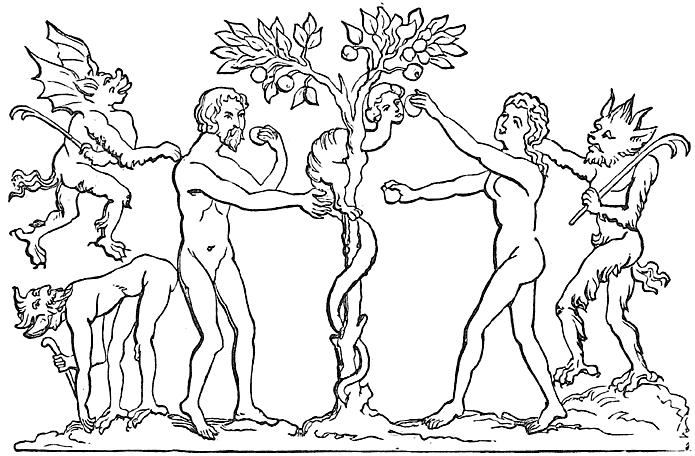
Fig. 20.—Lilith as Cat.
In the illuminated manuscript known as ‘Queen Mary’s Psalter’ (1553) there is a picture of the Fall of Man (Fig. 20) which possesses far-reaching significance. It is a modification of that idea, which gained such wide currency in the Middle Ages, that it was the serpent-woman Lilith who had tempted Adam to eat the forbidden fruit. In this picture, while the beautiful face and ample hair of Lilith are given, instead of the usual female bust she has the body of a cat. This nocturnal animal, already sacred to Freyja, the Teutonic Venus, whose chariot it drew, gained a new mythological career in the North by the large number of Southern and Oriental stones which related it to the lunar and amorous demonesses. When the gods fled before the Titans, Diana, as Ovid relates, changed herself to a cat, and as infernal Hecate that animal was still beside her. If my reader will turn to vol. i. p. 130, some of the vast number of myths which prepared the cat to take its place as familiar of the witch may be found. Whether the artist had Lilith in his mind or not, the illumination in ‘Queen Mary’s Psalter’ represents a remarkable association of myths. For Lilith was forerunner of the mediæval mothers weeping for their children; her voice of perpetual lamentation at the cruel fate allotted her by the combined tyranny of God and man was heard on every sighing wind; and she was the richly dressed bride of the Prince of Devils, ever seeking to tempt youth. Such stories floated through the mind of the Middle Ages, and this infernal Madonna is here seen in association with the cat, beneath whose soft sparkling fur the goddess of Love and Beauty was supposed to be still lurking near the fireside of many a miserable home. Some fragrance of the mystical East was with this feline beauty, and nothing can be more striking than the contrast which the ordinary devils beside her present. Their unseductive ugliness and meanness is placed out of sight of the pair tempted to seek the fruit of forbidden knowledge. They inspire the man and woman in their evidently eager grasping after the fruit, which here means the consultation of fair fortune-tellers and witches to obtain that occult knowledge for which speculative men are seeking in secret studies and laboratories.
Those who have paid attention to the subject of Witchcraft need not be reminded that its complexity and vastness would require a larger volume than the present to deal with it satisfactorily. The present study must be limited to a presentation of some of the facts which induce the writer to believe that, beneath the phenomena, lay a profound alienation from Christianity, and an effort to recall the banished gods which it had superseded.
Imported into Greece, these notions and their cult had a twofold development. Among the Platonists they turned to a naturalistic and allegorical Demonology; among the uncultivated they formed a Diabolarchy, which gathered around the terrible lunar phantasm—Hecate.
The astrological College of Egypt gave to the Jews their strange idea of the high school maintained among the devils, already referred to in connection with Asmodeus, who was one of its leading professors. The rabbinical legend was, that two eminent angels, Asa and Asael, remonstrated with the Creator on having formed man only to give trouble. The Creator said they would have done the same as man under similar circumstances; whereupon Asa and Asael proposed that the experiment should be tried. They went to earth, and the Creator’s prediction was fulfilled: they were the first ‘sons of God’ who fell in love with the daughters of men (Gen. vi. 2). They were then embodied. In heaven they had been angels of especial knowledge in divine arts, and they now used their spells to reascend. But their sin rendered the spells powerless for that, so they repaired to the Dark Mountains, and there established a great College of Sorcery. Among the many distinguished graduates of this College were Job, Jethro, and Bileam. It was believed that these three instructed the soothsayers who attempted to rival the miracles of Moses before Pharaoh. Job and Jethro were subsequently converted, but Bileam continued his hostility to Israel, and remains a teacher in the College. Through knowledge of the supreme spell—the Shem-hammphorásch, or real name of God—Solomon was able to chain Professor Asmodeus, and wrest from him the secret of the worm Schámir, by whose aid the Temple was built.
Dr. Wuttke, while writing his recent work on German superstitions, was surprised to learn that there still exist in France and in Wurtemberg schools for teaching the Black Art. A priest in the last-named country wrote him that a boy had confessed to having passed the lower grade of such a school, but, scared by the horrid ceremonies, had pronounced some holy words which destroyed the effect of the wicked practices, and struck the assembled Devil-worshippers with consternation. The boy said he had barely escaped with his life. I have myself passed an evening at a school in London ‘for the development of Spirit-mediums,’ and possibly Dr. Wuttke’s correspondent would describe these also as Devil-worshippers. No doubt all such circles might be traced archæologically to that Sorcerers’ College said by the rabbins to have been kept by Asa and Asael. But what moral force preserved them? They do but represent a turning of methods made familiar by the Church to coax benefits from other supernatural powers in the hope that they would be less dilatory than the Trinity in bestowing their gifts. What is the difference between St. Wolfram’s God and King Radbot’s Devil? The one offers a golden mansion on earth warranted to last through eternity, the other a like mansion in the skies receivable after death. The Saint agrees that if Radbot’s Devil can build him such a house the king would be quite right to worship the architect. The question of the comparative moral merits of the two invisible Powers is not mentioned. This legend, related in a preceding chapter, is characteristic of the motives to which the priesthood appealed through the Middle Ages. It is no wonder that the people began to appeal to the gods of their traditional Radbots, nor that they should have used the ceremonial and sacramental formulas around them.
But to these were added other formulas borrowed from different sources. The ‘Compact with the Devil’ had in it various elements. It appears to have been a custom of the Odinistic religion for men to sign acts of self-dedication to trusted deities, somewhat corresponding to the votive tablets of Southern religion. It was a legend of Odin that when dying he marked his arm with the point of a spear, and this may have been imitated. In the ‘Mysteries’ of pagan and christian systems blood played an important part—the human blood of earlier times being symbolised by that of animals, and ultimately, among christians, in wine of the Eucharist. The primitive history of this blood-covenant is given in another chapter. Some astrological formulas, and many of the deities invoked, spread through Europe with the Jews. The actual, and quite as often fabulous, wealth of that antichristian race was ascribed to Antichrist, and while christian princes thought of such gold as legitimate spoil, the honest peasants sought from their astrologers the transmitted ‘key of Solomon,’ in virtue of which the demons served him. The famous ‘Compact’ therefore was largely of christian-judaic origin, and only meant conveyance of the soul in consideration of precisely the same treasures as those promised by the Church to all whose names were written in the Lamb’s Book,—the only difference being in the period when redemption of the respective issues of priest and astrologer should fall due. One was payable during this life, the other after death.
In an old parish register of Fewston, Yorkshire, are the following entries:—‘1621. Anne, daughter of Edward Fairfax, baptized the 12th June.’ ‘1621. Edward Fairfax, Esq., a child named Anne, buried the 9th October.’ Then in the History of Knaresborough we read of this child, ‘She was held to have died through witchcraft.’ In what dreams did that child, supposed to have been snatched away by diabolic malice, return as a pure spirit uplifted in light, yet shadowed by the anxiety and pain of the bereaved family! A medium is at hand, one through whose mind and heart all the stormy electricities of the time are playing. The most distinguished representative of the Fairfax family is off fighting for Parliament against the King. Edward Fairfax is a zealous Churchman. His eldest daughter, Helen, aged twenty-one, is a parishioner of the Rev. Mr. Smithson, yet she has come under the strong influence of a Nonconformist preacher, Mr. Cook. The scholarly clergyman and his worldly Church on one side, and the ignorant minister with his humble followers on the other, are unconscious personifications of Vice and Virtue, while between them poor Helen is no Heraklea.
Nineteen days after the burial of her little sister Anne, as mentioned above, Helen is found ‘in a deadly trance.’ After a little she begins to speak, her words showing that she is, by imagination, ‘in the church at Leeds, hearing a sermon by Mr. Cook.’ On November 3, as she lies on her bed, Helen exclaims, ‘A white cat hath been long upon me and drawn my breath, and hath left in my mouth and throat so filthy a smell that it doth poison me!’ Next we have the following in the father’s diary: ‘Item. Upon Wednesday, the 14th of November, she saw a black dog by her bedside, and, after a little sleep, she had an apparition of one like a young gentleman, very brave, his apparel all laid with gold lace, a hat with a golden band, and a ruff in fashion. He did salute her with the same compliment as she said Sir Fernandino Fairfax useth when he cometh to the house and saluteth her mother.... He said he was a Prince, and would make her Queen of England and of all the world if she would go with him. She refused, and said, ‘In the name of God, what art thou?’ He presently did forbid her to name God; to which she replied, ‘Thou art no man if thou canst not abide the name of God; but if thou be a man, come near, let me feel of thee;’ which he would not do, but said, ‘It is no matter for feeling.’ She proceeded, ‘If thou wert a man, thou wouldst not deny to be felt; but thou art the devil, and art but a shadow.’
It is possible that Helen Fairfax had read in Shakspere’s ‘Lear,’ printed twelve years before, that
The Prince of Darkness is a gentleman;
But the reader will remark how her vision anticipates that of Faust, the transformation of the poodle to finely-dressed Mephistopheles. On the next apparition a bit from Patmos is interpolated, the Devil appearing as a beast with many horns; but the folklore of Yorkshire prevails, and ‘presently he was like a very little dog, and desired her to open her mouth and let him come into her body, and then he would rule all the world.’ Lastly, he ‘filled the room with fire.’
In the account thus far we have the following items of ancient mythology:—1, the Cat; 2, the Dog; 3, the Pride of Life (Asmodeus), represented in the fine dress and manners of the fiend; 4, the Prince of this World, offering its throne; 5, the Egyptian belief in potency of the Name; 6, the Hunger-Demon, who dares not be felt, because his back is hollow, and, though himself a shadow, casts none; 7, the disembodied devil of the rabbins, who seeks to enter a human form, in order to enjoy the higher powers of which man is capable; 8, the fiend of fire.
The period in which Helen Fairfax lived supplied forms for the ‘materialisation’ of these notions flitting from the ancient cemeteries of theology. The gay and gallant Asmodeus had been transformed into a goat under the ascetic eye of Europe; his mistress is a naked witch; her familiar and slave is a cat. This is the conventionalised theologic theory, as we find it in many examples, one of which is here shown (Fig. 21), as copied from a stone panel at the entrance of Lyons Cathedral. This is what Helen’s visions end in. She and her younger sister of seven years, and a young neighbour, a girl of twelve, who have become infected with Helen’s hysterics, identify six poor women as witches, and Edward Fairfax would have secured their execution had it not been for the clergyman Smithson.
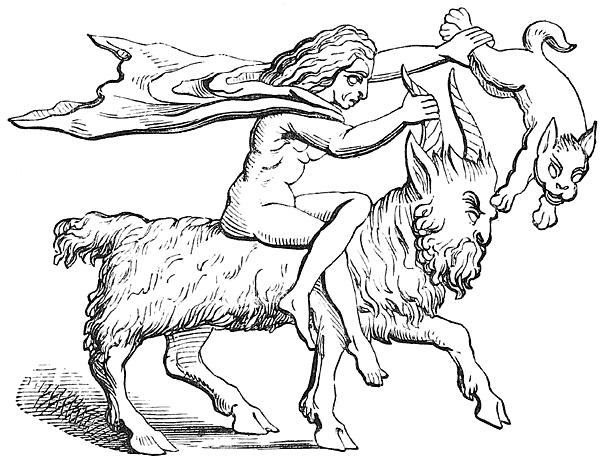
Fig. 21.—A Witch (Lyons Cathedral).
Cats played a large part in this as in other witch-trials. They had long been regarded as an insurance of humble households. In many regions still may be found beliefs that a three-coloured cat protects against fire; a black cat cures epilepsy, protects gardens; and in Bohemia a cat is the favourite bridal gift to procure a happy wedded life. One who kills a cat has no luck for seven years. The Yorkshire women called witches remembered these proverbs to their cost. Among the cats regarded by the Fairfaxes as familiars of the accused, some names are notable. One is called ‘Gibbe.’ This is the Icelandic gabba, to ‘delude,’ and our gibber; it is the ‘Gib’ cat of Reinicke Fuchs, and of the ‘Romaunt of the Rose.’ In ‘Gammer Gurton’ we read, ‘Hath no man gelded Gyb, her cat;’ and in Henry IV. i. 2, ‘I am as melancholy as a gib cat.’ Another of the cats is called Inges. That is, ignis, fire—Agni maintaining his reign of terror.
It is hardly possible to determine now the value of the alleged confessions of witches. They were extorted by torture or by promises of clemency (the latter rarely fulfilled); they were shaped by cross-examiners rather than by their victims; and their worth is still more impaired where, as is usual, they are not given in detail, but recorded in ‘substance,’ the phraseology in such case reflecting the priest’s preconceived theory of witches and their orgies. It is to be feared, for instance, that ‘devil’ is often written instead of some name that might now be interesting. Nevertheless, there seems to be ground for believing that in many cases there were seances held to invoke supernatural powers.
There are interspersed through the proceedings suggestions of mercy on condition of confession, which, joined to these theoretical questions, render it plain that the retractations which the so-called witches made were true, and that in New England, at least, there was little if any basis for the delusion beyond the experiment of the two Spanish Indians. The terrible massacre of witches which occurred there was the result of the decision of English judges and divines that witchcraft is recognised in the Bible, and there assigned the death-penalty.
It will be observed here that ancient mythology to Salem is chiefly that of the Bible, modified by local conditions. White man and black man represent Christ and Antichrist, and we have the same symbols on both sides,—eucharists, baptisms, and names written in books. The survivals from European folklore met with in the New England trials are—the cat, the horse (rarely), and the dog. In one case a dog suffered from the repute of being a witch, insomuch that some who met him fell into fits; he was put to death. Riding through the air continues, but the American witches ride upon a stick or pole. The old-fashioned broom, the cloud-symbol of the Wild Huntsman, is rarely mentioned. One thing, however, survives from England, at least; the same sharp controversy that is reflected in the Fairfax case. Cotton Mather tried one of the possessed with the Bible, the ‘Assembly’s Catechism,’ his grandfather’s ‘Milk for Babes,’ his father’s ‘Remarkable Providence,’ and a book to prove there were witches. ‘And when any of those were offered for her to read in, she would be struck dead and fall into convulsions.’ But when he tried her with Popish and Quaker books, the English Prayer-Book, and a book to prove there were no witches, the devil permitted her to read these as long as she pleased. One is at a loss which most to admire, the astuteness of the accused witch in bearing testimony to the Puritan religion, or the phenomenon of its eminent representative seeking a witness to it in the Father of lies.
If now we travel towards the East we find the survivals growing clearer, as in the West they become faint.
In 1669 the people of the villages of Mohra and Elfdale in Sweden, believing that they were troubled by witches, were visited by a royal commission, the result of whose investigations was the execution of twenty-three adults and fifteen children; running of the gauntlet by thirty-six between the ages of nine and sixteen years; the lashing on the hand of twenty children for three Sundays at the church-door, and similar lashing of the aforesaid thirty-six once a week for a year. Portions of the confessions of the witches are given below from the Public Register as translated by Anthony Horneck, D.D., and printed in London, anno 1700. I add a few words in brackets to point out survivals.
‘We of the province of Elfdale do confess that we used to go to a gravel-pit which lay hard by a cross-way (Hecate), and there we put on a vest (Wolf-girdle) over our heads, and then danced round, and after this ran to the cross-way, and called the Devil thrice, first with a still voice, the second time somewhat louder, and the third time very loud, with these words—Antecessor, come and carry us to Blockula. Whereupon immediately he used to appear, but in different habits; but for the most part we saw him in a grey coat and red and blue stockings: he had a red beard (Barbarossa), a high-crowned hat (Turn-cap), with linen of divers colours wrapt about it, and long garters upon his stockings.
‘Then he asked us whether we would serve him with soul and body. If we were content to do so, he set us upon a beast which he had there ready, and carried us over churches and high walls; and after all we came to a green meadow where Blockula lies. We must procure some scrapings of altars, and filings of church clocks; and then he gives us a horn with a salve in it, wherewith we do anoint ourselves (chrism); and a saddle with a hammer (Thor’s), and a wooden nail, thereby to fix the saddle (Walkyr’s); whereupon we call upon the Devil and away we go.’
‘For their journey, they said they made use of all sorts of instruments, of beasts, of men, of spits, and posts, according as they had opportunity: if they do ride upon goats (Azazel) and have many children with them, that all may have room, they stick a spit into the backside of the Goat, and then are anointed with the aforesaid ointment. What the manner of their journey is, God only knows. Thus much was made out, that if the children did at any time name the names (Egyptian spells) of those that had carried them away, they were again carried by force either to Blockula, or to the cross-way, and there miserably beaten, insomuch that some of them died of it.’
‘A little girl of Elfdale confessed that, naming the name of Jesus as she was carried away, she fell suddenly upon the ground, and got a great hole in her side, which the Devil presently healed up again, and away he carried her; and to this day the girl confessed she had exceeding great pain in her side.’
‘They unanimously confessed that Blockula is situated in a delicate large meadow, whereof you can see no end. The place or house they met at had before it a gate painted with divers colours; through this gate they went into a little meadow distinct from the other, where the beasts went that they used to ride on; but the men whom they made use of in their journey stood in the house by the gate in a slumbering posture, sleeping against the wall (castle of Waldemar). In a huge large room of this house, they said, there stood a very long table, at which the witches did sit down; and that hard by this room was another chamber where there were very lovely and delicate beds. The first thing they must do at Blockula was, that they must deny all, and devote themselves body and soul to the Devil, and promise to serve him faithfully, and confirm all this with an oath (initiation). Hereupon they cut their fingers (Odinism), and with their blood write their name in his book (Revelations). They added that he caused them to be baptized, too, by such priests as he had there (Antichrist’s Sacraments).’
‘And he, the Devil, bids them believe that the day of judgment will come speedily, and therefore sets them on work to build a great house of stone (Babel), promising that in that house he will preserve them from God’s fury, and cause them to enjoy the greatest delights and pleasures (Moslem). But while they work exceeding hard at it, there falls a great part of the wall down again.’
‘They said, they had seen sometimes a very great Devil like a Dragon, with fire round about him, and bound with an iron chain (Apocalyptic), and the Devil that converses with them tells them that if they confess anything he will let that great Devil loose upon them, whereby all Sweedeland shall come into great danger.
‘They added that the Devil had a church there, such another as in the town of Mohra. When the Commissioners were coming he told the Witches they should not fear them; for he would certainly kill them all. And they confessed that some of them had attempted to murther the Commissioners, but had not been able to effect it.
‘Some of the children talked much of a white Angel (Frigga as christian tutelary), which used to forbid them what the Devil had bid them do, and told them that those doings should not last long. What had been done had been permitted because of the wickedness of the people.
‘Those of Elfdale confessed that the Devil used to play upon an harp before them (Tannhauser), and afterwards to go with them that he liked best into a chamber, when he committed venerous acts with them (Asmodeus); and this indeed all confessed, that he had carnal knowledge of them, and that the Devil had sons and daughters by them, which he did marry together, and they ... brought forth toads and serpents (Echidna).
‘After this they sat down to table, and those that the Devil esteemed most were placed nearest to him; but the children must stand at the door, where he himself gives them meat and drink (Sacrament). After meals they went to dancing, and in the meanwhile swore and cursed most dreadfully, and afterwards went to fighting one with another (Valhalla).
‘The Lords Commissioners were indeed very earnest, and took great pains to persuade them to show some of their tricks, but to no purpose; for they did all unanimously confess that since they had confessed all, they found that all their witchcraft was gone, and that the Devil at this time appeared to them very terrible, with claws on his hands and feet, and with horns on his head, a long tail behind, and showed to them a pit burning, with a hand put out; but the Devil did thrust the person down again with an iron fork; and suggested to the witches that if they continued in their confession, he would deal with them in the same manner.’
The ministers of both Elfdale and Mohra were the chief inciters of this investigation, and both testified that they had suffered many tortures in the night from the witches. One was taken by the throat and so violently used that ‘for some weeks he was not able to speak or perform divine service.’
The names used by the Scotch witches are often suggestive of pagan survivals. Thus in the trial at the Paisley Assizes, 1678, concerning the alleged bewitching of Sir George Maxwell, Margaret Jackson testified to giving up her soul by renouncing her baptism to a devil named Locas (Loki?); another raised a tempest to impede the king’s voyage to Denmark by casting into the sea a cat, and crying Hola (Hela?); and Agnes Sampson called the Devil to her in the shape of a dog by saying, ‘Elva (Elf?), come and speak to me!’
It is necessary to pass by many of the indications contained in the witch-trials that there had been an effort to recur to the pleasures and powers traditionally associated with the pagan era of Europe, and confirmed by the very denunciations of contemporary paganism with its pomp and luxury by the priesthood. The promises held out by the ‘Devil’ to Elfdale peasants and puritanised Helen Fairfax are unmistakable. But it is necessary to remark also that the ceremonies by which, as was clearly proved in various cases, the fortune-tellers or ‘witches’ endeavoured to imitate the spells of Dr. Faustus were archæological.
Around the cauldron, which was used in imitation of the Alchemists, a rude Zodiac was marked, some alchemic signs being added; and in the cauldron were placed ingredients concerning many of which the accounts are confused. It is, however, certain that the chief ingredients were plants which, precisely as in ancient Egypt, had been gathered at certain phases of the moon, or seasons of the year, or from some spot where the sun was supposed not to have shone on it. It was clearly proved also that the plants chiefly used by the sorceresses were rue and vervain. Vervain was sacred to the god of war in Greece and Rome, and made the badge of ambassadors sent to make treaties of peace. In Germany it was sacred to Thor, and he would not strike with his lightning a house protected by it. The Druids called it ‘holy herb;’ they gathered it when the dog-star rose, from unsunned spots, and compensated the earth for the deprivation with a sacrifice of honey. Its reputation was sufficient in Ben Jonson’s day for him to write—
Bring your garlands, and with reverence place
The vervain on the altar.
The charm which vervain had for the mediæval peasant was that it was believed, if it had first touched a Bel-fire, to snap iron; and, if boiled with rue, made a liquid which, being poured on a gunflint, made the shot as sure to take effect as any Freischütz could desire.
Rue was supposed to have a potent effect on the eye, and to bestow second sight. So sacred was it once in England that missionaries sprinkled holy water from brushes made up of it, whence it was called ‘herb of grace.’ Milton represents Michael as purging Adam’s eyes with it. In the Tyrol it is believed to confer fine vision and used with agrimony (flowers of Argos, the many-eyed); in Posen it is said also to heal serpent-bites. By this route it came into the cauldron of the wizard and witch. In Drayton’s incantation it is said—
Then sprinkles she the juice of rue,
With nine drops of the midnight dew
From lunary distilling.
Rue was thus consecrated as the very substance of Hecate, the mother of all European witches. M. Maury supposes that it was because it was a narcotic and caused hallucinations. Hallucinations were, no doubt, the basis of belief in second sight. But whatever may be the cause, rue was the plant of witchcraft; and Bishop Taylor speaks of its being used by exorcists to try the devil, and thence deriving its appellation ‘herb of grace.’ More probably it was used to sprinkle holy water because of a traditional sanctity. All narcotics were supposed to be children of the night; and if, in addition, they were able to cause hallucinations, they were supposed to be under more especial care of the moon.
After reading a large number of reports concerning the ordeals and trials of witches, and also many of their alleged confessions, I have arrived at the conclusion that there were certainly gatherings held in secret places; that some of the ordinary ceremonies and prayers of the Church were used, with names of traditional deities and Oriental demons substituted for those of the Trinity and saints; that with these were mingled some observances which had been preserved from the ancient world by Gnostics, Astrologists, and Alchemists. That at these gatherings there was sometimes direct devil-worship is probable, but oftener the invocations were in other names, and it is for the most part due to the legal reporters that the ‘Devil’ is so often named. As to the ‘confessions,’ many, no doubt, admitted they had gone to witches’ Sabbaths who had been there only in feverish dreams, as must have been the case of many young children and morbid pietists who were executed; others confessed in hope of escape from charges they could not answer; and others were weary of their lives.
The writer of this well remembers, in a small Virginian village (Falmouth), more than thirty years ago, the terrible persecutions to which an old white woman named Nancy Calamese was subjected because of her reputation as a witch. Rumours of lizards vomited by her poor neighbours caused her to be dreaded by the ignorant; the negroes were in terror of her; she hardly dared pass through the streets for fear of being hooted by boys. One morning she waded into the Rappahannock river and drowned herself, and many of her neighbours regarded the suicide as her confession. Probably it was a similar sort of confession to many that we read in the reports of witch trials.
The retribution that followed was more ferocious than could have visited mere attempts by the poor and ignorant to call up spirits to their aid. Every now and then the prosecutions disclose the well-known animus of heresy, persecution, and also the fury of magistrates suspicious of conspiracies. In England, New England, and France, particularly, an incipient rationalism was revealed in the party called ‘Saducees,’ who tried to cast discredit on the belief in witchcraft. This was recognised by Sir Mathew Hale in England and Cotton Mather in New England, consequently by the chief authorities of church and state in both countries, as an attack on biblical infallibility, since it was said in the Bible, ‘Thou shalt not suffer a witch to live.’ The leading wizards and witches were probably also persons who had been known in connection with the popular discontent and revolutionary feeling displayed in so many of the vindictive conjurations which were brought to light.
The Reformation swept away in Northern countries, for the upper classes, as many Christian saints and angels as priestcraft had previously turned to enemies for the lower. The poor and ignorant simply tried to evoke the same ideal spirit-guardians under the pagan forms legendarily associated with a golden age. Witchcraft was a pathetic appeal against a cruel present to a fair, however visionary, past. But Protestantism has brought on famine of another kind—famine of the heart. The saints of the Church have followed those of paganism; and although one result of the process has been a vast increase in enterprise, science, and wealth, man cannot live by these alone. Modern spiritualism, which so many treat with a superciliousness little creditable to a scientific age, is a cry of starved sentiment and affections left hopeless under faded heavens, as full of pathetic meaning as that which was wrung from serfs enticed into temples only to find them dens of thieves. Desolate hearts take up the burthen of desolate homes, and appeal to invisible powers for guidance; and for attestation of hopes which science has blighted, ere poetry, art, and philanthropy have changed these ashes into beauty. Because these so-called spirits, evoked by mediums out of morbid nerves, are really longed-for ideals, the darker features of witchcraft are not called about them. That fearful movement was a wronged Medea whose sorrows had made Hecate—to remember the dreadful phrase of Euripides—‘the chosen assistant dwelling in the inmost recesses of her house.’ Modern spiritualism is Rachel weeping for her children, not to be comforted if they are not. But the madness of the one is to be understood by the plaintive appeal of the other.