Volume 2 / Part 2 — Chapter VI. Enemies.
Reading edition
Aryas, Dasyus, Nagas—Yakkhos—Lycians—Ethiopians—Hirpini—Polites—Sosipolis—Were-wolves—Goths and Scythians—Giants and Dwarfs—Berserkers—Britons—Iceland—Mimacs—Gog and Magog.
We paint the Devil black, says George Herbert. On the other hand the negro paints him white, with reason enough. The name of the Devil at Mozambique is Muzungu Maya, or Wicked White Man. Of this demon they make little images of extreme hideousness, which are kept by people on the coast, and occasionally displayed, in the belief that if the White Devil is lurking near them he will vanish out of sheer disgust with a glimpse of his own ugliness. The hereditary horror of the kidnapper displayed in this droll superstition may possibly have been assisted by the familiarity with all things infernal represented in the language of the white sailors visiting the coast. Captain Basil Hall, on visiting Mozambique about fifty years ago, found that the native dignitaries had appropriated the titles of English noblemen, and a dumpy little Duke of Devonshire met him with his whole vocabulary of English,—‘How do you do, sir. Very glad see you. Damn your eyes. Johanna man like English very much. God damn. That very good? Eh? Devilish hot, sir. What news? Hope your ship stay too long while very. Damn my eye. Very fine day.’
This legend, which reminds one irresistibly of the expulsion of reptiles by saints from Ireland, and other Western regions, is the more interesting if it be considered that these Yakkhos are the Sanskrit Yakshas, attendants on Kuvera, the god of wealth, employed in the care of his garden and treasures. They are regarded as generally inoffensive. The transfer by English authorities of the Tasmanians from their native island to another, with the result of their extermination, may suggest the possible origin of the story of Giri.
Buddha’s dealings with the serpent-men or nagas is related as follows in the same volume:—
‘The vanquisher (i.e., of the five deadly sins), ... in the fifth year of his buddhahood, while residing at the garden of (the prince) Jeto, observing that, on account of a disputed claim for a gem-set throne between the naga Mahodaro and a similar Chalodaro, a maternal uncle and nephew, a conflict was at hand, ... taking with him his sacred dish and robes, out of compassion to the nagas, visited Nagadipo.... These mountain nagas were, moreover, gifted with supernatural powers.... The Saviour and dispeller of the darkness of sin, poising himself in the air over the centre of the assembly, caused a terrifying darkness to these nagas. Attending to the prayer of the dismayed nagas, he again called forth the light of day. They, overjoyed at having seen the deity of felicitous advent, bowed down at the feet of the divine teacher. To them the vanquisher preached a sermon of reconciliation. Both parties rejoicing thereat, made an offering of the gem-throne to the divine sage. The divine teacher, alighting on the earth, seated himself on the throne, and was served by the naga kings with celestial food and beverage. The lord of the universe procured for eighty kotis of nagas, dwelling on land and in the waters, the salvation of the faith and the state of piety.’
In considering animal demons, the primitive demonisation of the Wolf has been discussed. But it is mainly as a transformation of man and a type of savage foes that this animal has been a prominent figure in Mythology.
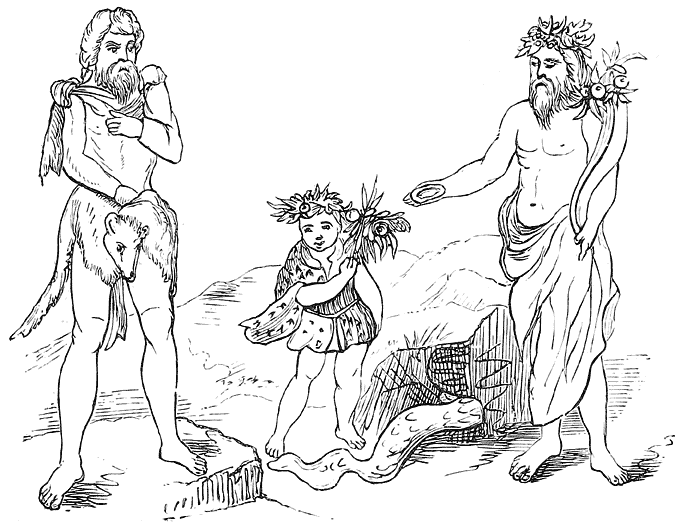
Fig. 13.—Italian and Roman Genii.
The form on the right in Fig. 13 represents the genius of the city of Rome, and is found on some of Hadrian’s coins; he holds the cornucopia and the sacrificial dish. The child and the serpent in the same picture represent the origin of the demonic character attributed to the Eleans by the Arcadians. This child-and-serpent symbol, which bears resemblance to certain variants of Bel and the Dragon, no doubt was brought to Elea, or Velia in Italy, by the Phocæans, when they abandoned their Ionian homes rather than submit to Cyrus, and founded that town, B.C. 544. The two forms were jointly worshipped with annual sacrifices in the temple of Lucina, under the name Sosipolis. The legend of this title is related by Pausanias. When the Arcadians invaded the Eleans, a woman came to the Elean commander with an infant at her breast, and said that she had been admonished in a dream to place her child in front of the army. This was done; as the Arcadians approached the child was changed to a serpent, and, astounded at the prodigy, they fled without giving battle. The child was represented by the Eleans decorated with stars, and holding the cornucopia; by the Arcadians, no doubt, in a less celestial way. It is not uncommon in Mythology to find the most dangerous demons represented under some guise of weakness, as, for instance, among the South Africans, some of whom recently informed English officers that the Galeikas were led against them by a terrible sorcerer in the form of a hare. The most fearful traditional demon ever slain by hero in Japan was Shuden Dozi—the Child-faced Drinker. In Ceylon the apparition of a demon is said to be frequently under the form of a woman with a child in her arms.
Many animal demons are mere fables for the ferocity of human tribes. The Were-wolf superstition, which exists still in Russia, where the transformed monster is called volkodlák (volk, a wolf, and dlak, hair), might even have originated in the costume of Norse barbarians and huntsmen. The belief was always more or less rationalised, resembling that held by Verstegan three hundred years ago, and which may be regarded as prevalent among both the English and Flemish people of his day. ‘These Were-wolves,’ he says, ‘are certain sorcerers, who, having anointed their bodies with an ointment they make by the instinct of the devil, and putting on a certain enchanted girdle, do not only unto the view of others seem as wolves, but to their own thinking have both the nature and shape of wolves so long as they wear the said girdle; and they do dispose themselves as very wolves, in worrying and killing, and waste of human creatures.’ During the Franco-German war of 1870–71, a family of ladies on the German side of the Rhine, sitting up all night in apprehension, related to me such stories of the ‘Turcos’ that I have since found no difficulty in understanding the belief in weird and præternatural wolves which once filled Europe with horror. The facility with which the old Lycian wolf-girdle, so to say, was caught up and worn in so many countries where race-wars were chronic for many ages, renders it nearly certain that this superstition (Lycanthropy), however it may have originated, was continued through the custom of ascribing demonic characteristics to hostile and fierce races. It has been, indeed, a general opinion that the theoretical belief originated in the Pythagorean doctrine of metempsychosis. Thus Shakspere:—
Thou almost makest me waver in my faith,
To hold opinion with Pythagoras,
That souls of animals infuse themselves
Into the trunks of men: thy currish spirit
Governed a wolf, who, hanged for human slaughter,
Even from the gallows did his fell soul fleet,
And whilst thou layest in thy unhallowed dam
Infused itself in thee; for thy desires
Are wolfish, bloody, starved, and ravenous.
But the superstition is much older than Pythagoras, who, no doubt, tried to turn it into a moral theory of retributions,—as indeed did Plato in his story of the Vision of Er the Armenian.
Professor Weber and others have adduced evidence indicating that although belief in the transformation of men into beasts was not developed in the Vedic age of India, the matrix of it was there. But of our main fact—the association of demonic characters with certain tribes—India has presented many examples. In the mountains of Travancore there are tribes which are still generally believed to be on terms of especial familiarity with the devils of that region; and the dwellers on the plains relate that on these mountains gigantic demons, sixteen or seventeen feet high, may sometimes be seen hurling firebrands at each other.
Underlying many of the legends of giants and dwarfs may be found a similar demonologic formation. A principle of natural selection would explain the existence of tribes, which, though of small stature, are able to hold their own against the larger and more powerful by their superior cunning. That such equalisation of apparently unequal forces has been known in pre-historic ages may be gathered from many fables. Before Bali, the monarch already mentioned, whose power alarmed the gods themselves, Vishnu appeared as a dwarf, asking only so much land as he could measure with three steps; the apparently ridiculous request granted, the god strode over the whole earth with two steps and brought his third on the head of Bali. In Scandinavian fable we have the young giantess coming to her mother with the plough and ploughman in her apron, which she had picked up in the field. To her child’s inquiry, ‘What sort of beetle is this I found wriggling in the sand?’ the giantess replies, ‘Go put it back in the place where thou hast found it. We must be gone out of this land, for these little people will dwell in it.’
The Sagas contain many stories which, while written in glorification of the ‘giant’ race, relate the destruction of their chiefs by the magical powers of the dwarfs. I must limit myself to a few notes on the Ynglinga Saga. ‘In Swithiod,’ we are told, ‘are many great domains, and many wonderful races of men, and many kinds of languages. There are giants, and there are dwarfs, and there are also blue men. There are wild beasts, and dreadfully large dragons.’ We learn that in Asaland was a great chief, Odin, who went out to conquer Vanaland. The Vanalanders are declared to have magic arts,—such as are ascribed to Finns and Lapps to this day by the more ignorant of their neighbours. But that the people of Asaland learned their magic charms. ‘Odin was the cleverest of them all, and from him all the others learned their magic arts.’ ‘Odin could make his enemies in battle blind, or deaf, or terror-struck, and their weapons so blunt that they could no more cut than a willow twig; on the other hand, his men rushed forward without armour, were as mad as dogs or wolves, bit their shields, and were as strong as bears or wild bulls, and killed people at a blow, and neither fire nor iron told upon them. These were called Berserkers.’ (From ber, bear, and serkr, sark or coat; the word being probably, as Maurer says, a survival of an earlier belief in the transformation of men into bears.) But the successors of Odin did not preserve his occult power. Svegdir, for instance, saw a large stone and a dwarf at the door entering in it. The dwarf called him to come in and he should see Odin. ‘Swedger ran into the stone, which instantly closed behind him, and Swedger never came back.’ The witchcraft of the Finn people is said to have led Vanlandi (Svegdir’s son) to his death by Mara (night-mare). Vanlandi’s son too, Visbur, fell a victim to sorcery. Such legends as these, and many others which may be found in Sturleson’s Heimskringla, have influenced our popular stories whose interest turns on the skill with which some little Jack or Thumbling overcomes his adversary by superior cunning.
The man of the smaller stature, making up for his inferiority by invention, perhaps first forged the sword, the coat of mail, and the shield, and so confronted the giant with success. The god with the Hammer might thus supersede the god of the Flint Spear. Magic art seemed to have rendered invulnerable the man from whom the arrow rebounded.
It would appear from King Olaf Tryggvason’s Saga that nine hundred years ago the Icelanders and the Danes reciprocally regarded each other as giants and dwarfs. The Icelanders indited lampoons against the Danes which allude to their diminutive size:—
The gallant Harald in the field
Between his legs lets drop his shield,
Into a pony he was changed, &c.
On the other hand, the Danes had by no means a contemptuous idea of their Icelandic enemies, as the following narrative from Heimskringla proves. ‘King Harald told a warlock to hie to Iceland in some altered shape, and to try what he could learn there to tell him: and he set out in the shape of a whale. And when he came near to the land he went to the west side of Iceland, north around the land, when he saw all the mountains and hills full of land-serpents, some great, some small. When he came to Vapnafiord he went in towards the land, intending to go on shore; but a huge dragon rushed down the dale against him, with a train of serpents, paddocks, and toads, that blew poison towards him. Then he turned to go westward around the land as far as Eyafiord, and he went into the fiord. Then a bird flew against him, which was so great that its wings stretched over the mountains on either side of the fiord, and many birds, great and small, with it. Then he swam further west, and then south into Breidafiord. When he came into the fiord a large grey bull ran against him, wading into the sea, and bellowing fearfully, and he was followed by a crowd of land-serpents. From thence he went round by Reikaness and wanted to land at Vikarsted, but there came down a hill-giant against him with an iron staff in his hands. He was a head higher than the mountains, and many other giants followed him.’ The most seductive Hesperian gardens of the South and East do not appear to have been so thoroughly guarded or defended as Iceland, and one can hardly call it cowardice when (after the wizard-whale brought back the log of its voyage) it is recorded: ‘Then the Danish king turned about with his fleet and sailed back to Denmark.’
Mr. Mayers, in his ‘Chinese Reader’s Manual,’ suggests that the designation of Formosa as ‘Isles of the Genii’ (San Shén Shan) by the Chinese, has some reference to their early attempts at colonisation in Japan. Su Fuh, a necromancer, who lived B.C. 219, is said to have announced their discovery, and at the head of a troop of young men and maidens, voyaged with an expedition towards them, but, when within sight of the magic islands, were driven back by contrary winds.
Gog and Magog stand in London Guildhall, though much diminished in stature, to suit the English muscles that had to bear them in processions, monuments of the præternatural size attributed to the enemies which the Aryan race encountered in its great westward migrations. Even to-day, when the progress of civilisation is harassed by untamed Scythian hordes, how strangely fall upon our ears the ancient legends and prophecies concerning them!
Thus saith the Lord Jehovah:
Behold I am against thee, O Gog,
Prince of Rosh, of Meshech, and of Tubul:
And I will turn thee back, and leave but the sixth part of thee;
And I will cause thee to come up from the north parts,
And will bring thee upon the mountains of Israel:
And I will smite thy bow out of thy left hand,
And will cause thine arrows to fall from thy right hand.
Thou shalt fall upon the mountains of Israel,
In the Koran it is related of Dhulkarnein:—‘He journeyed from south to north until he came between the two mountains, beneath which he found a people who could scarce understand what was said. And they said, O Dhulkarnein, verily Gog and Magog waste the land; shall we, therefore, pay thee tribute, on condition that thou build a rampart between us and them? He answered, The power wherewith my Lord hath strengthened me is better than your tribute; but assist me strenuously and I will set a strong wall between you and them.... Wherefore when this wall was finished, Gog and Magog could not scale it, neither could they dig through it. And Dhulkarnein said, This is a mercy from my Lord; but when the prediction of my Lord shall come to be fulfilled, he will reduce the wall to dust.’
The terror inspired by these barbarians is reflected in the prophecies of their certain irruption from their supernaturally-built fastnesses; as in Ezekiel:—
Thou shalt ascend and come like a storm,
Thou shalt be like a cloud to cover the land,
Thou and all thy bands,
And many people with thee;
and in the Koran, ‘Gog and Magog shall have a passage open for them, and they shall hasten from every high hill;’ and in the Apocalypse, ‘Satan shall be loosed out of his prison, and shall go out to deceive the nations which are in the four quarters of the earth, Gog and Magog, to gather them in battle: the number of whom is as the sand of the sea.’ Five centuries ago Sir John Maundeville was telling in England the legend he had heard in the East. ‘In that same regioun ben the mountaynes of Caspye, that men clepen Uber in the contree. Betwene the mountaynes the Jews of 10 lynages ben enclosed, that men clepen Gothe and Magothe: and they mowe not gon out on no syde. There weren enclosed 22 kynges, with hire peple, that dwelleden betwene the mountayns of Sythe. There King Alisandre chacede hem betwene the mountaynes, and there he thought for to enclose hem thorghe work of his men. But when he saughe that he might not doon it, ne bringe it to an ende, he preyed to God of Nature, that he wolde performe that that he had begoune. And all were it so, that he was a Payneme, and not worthi to ben herd, zit God of his grace closed the mountaynes to gydre: so that thei dwellen there, all fast ylokked and enclosed with highe mountaynes all aboute, saf only on o syde; and on that syde is the See of Caspye.’