Volume 2 / Part 2 — Chapter XI. Disease.
Reading edition
The Plague Phantom—Devil-dances—Destroying Angels—Ahriman in Astrology—-Saturn—Satan and Job—Set—The Fatal Seven—Yakseyo—The Singhalese Pretraya—Reeri—Maha Sohon—Morotoo—Luther on Disease-demons—Gopolu—Madan—Cattle-demon in Russia—Bihlweisen—The Plough.
A familiar fable in the East tells of one who met a fearful phantom, which in reply to his questioning answered—‘I am Plague: I have come from yon city where ten thousand lie dead: one thousand were slain by me, the rest by Fear.’ Perhaps even this story does not fully report the alliance between the plague and fear; for it is hardly doubtful that epidemics retain their power in the East largely because they have gained personification through fear as demons whose fatal power man can neither prevent nor cure, before which he can only cower and pray.
The influence of the Moon upon tides, the sleeplessness it causes, the restlessness of the insane under its occasional light, and such treacheries of moonshine as we have already considered, have populated our uninhabited satellite with demons. Lunar legends have decorated some well-founded suspicions of moonlight. The mother draws the curtain between the moonshine and her little Endymion, though not because she sees in the waning moon a pining Selene whose kiss may waste away the beauty of youth. A mere survival is the ‘bowing to the new moon:’ a euphonism traceable to many myths about ‘lunacy,’ among them, as I think, to Delilah (‘languishing’), in whose lap the solar Samson is shorn of his locks, leaving him only the blind destructive strength of the ‘moonstruck.’
The dawn of Ormuzd corresponds with April. The sun returns from winter’s death by sign of the lamb (our Aries), and thenceforth every month corresponds with a thousand years of the reign of the Beneficent. September is denoted by the Virgin and Child. To the dark domain of Ahriman the prefecture of the universe passes by Libra,—the same balances which appear in the hand of Satan. The star-serpent prevails over the Virgin and Child. Then follow the months of the scorpion, the centaur, goat, &c., every month corresponding to a thousand years of the reign of Ahriman.
A penitential Psalm (Assyrian) reads as follows:—
O my Lord! my sins are many, my trespasses are great; and the wrath of the gods has plagued me with disease, and with sickness and sorrow.
I fainted, but no one stretched forth his hand!
I groaned, but no one drew nigh!
I cried aloud, but no one heard!
O Lord, do not abandon thy servant!
In the waters of the great storm seize his hand!
This Psalm would hardly be out of place in the English burial-service, which deplores death as a visitation of divine wrath. Wherever such an idea prevails, the natural outcome of it is a belief in demons of disease. In ancient Egypt—following the belief in Ra the Sun, from whose eyes all pleasing things proceeded, and Set, from whose eyes came all noxious things,—from the baleful light of Set’s eyes were born the Seven Hathors, or Fates, whose names are recorded in the Book of the Dead. Mr. Fox Talbot has translated ‘the Song of the Seven Spirits:’—
They are seven! they are seven!
In the depths of ocean they are seven!
In the heights of heaven they are seven!
In the ocean-stream in a palace they were born!
Male they are not: female they are not!
Wives they have not: children are not born to them!
Rule they have not: government they know not!
Prayers they hear not!
These demons have a way of herding together; the Assyrian tablets abundantly show that their occupation was manifested by diseases, physical and mental. One prescription runs thus:—
The god (...) shall stand by his bedside:
Those seven evil spirits he shall root out, and shall expel them from his body:
And those seven shall never return to the sick man again!
The phylactery was tied into a knot. Justin Martyr says that the Jewish exorcists used ‘magic ties or knots.’ The origin of this custom among the Jews and Babylonians may be found in the Assyrian Talismans preserved in the British Museum, of which the following has been translated by Mr. Fox Talbot:—
Hea says: Go, my son!
Take a woman’s kerchief,
Bind it round thy right hand, loose it from the left hand!
Knot it with seven knots: do so twice:
Sprinkle it with bright wine:
Bind it round the head of the sick man:
Bind it round his hands and feet, like manacles and fetters.
Sit down on his bed:
Sprinkle holy water over him.
He shall hear the voice of Hea,
Darkness shall protect him!
Reeri is the Demon of Blood-disease. His form is that of a man with face of a monkey; he is fiery red, rides on a red bull, and all hemorrhages and diseases of the blood are attributed to him. Reeri has eighteen different disguises or avatars. One of these recalls his earlier position as a demon of death, before Vishnu revealed to Capuas the means of binding him: he is now supposed to be present at every death-bed in the form of a delighted pigmy, one span and six inches high. On such occasions he bears a cock in one hand, a club in the other, and in his mouth a corpse. In the same country Maha Sohon is the ‘great graveyard demon.’ He resides in a hill where he is supposed to surround himself with carcases. He is 122 feet high, has four hands and three eyes, and a red skin. He has the head of a bear; the legend being that while quarrelling with another giant his head was knocked off, and the god Senasura was gracious enough to tear off the head of a bear and clap it on the decapitated giant. His capua threatens him with a repetition of this catastrophe if he does not spare any threatened victim who has called in his priestly aid. Except for this timidity about his head, Maha is formidable, being chief of 30,000 demons. But curiously enough he is said to choose for his steeds the more innocent animals,—goat, deer, horse, elephant, and hog.
One of the demons most dreaded in Ceylon is the ‘Foreign Demon’ Morotoo, said to have come from the coast of Malabar, and from his residence in a tree disseminated diseases which could not be cured until, the queen being afflicted, one capua was found able to master him. Seven-eighths of the charms used in restraining the disease-demons of Ceylon, of which I have mentioned but a few, are in the Tamil tongue. In various parts of India are found very nearly the same systematic demonolatry and ‘devil-dancing;’ for example in Travancore, to whose superstitions of this character the Rev. Samuel Mateer has devoted two chapters in his work ‘The Land of Charity.’
The genius of William Blake, steeped in Hebraism, never showed greater power than in his picture of Plague. A gigantic hideous form, pale-green, with the slime of stagnant pools, reeking with vegetable decays and gangrene, the face livid with the motley tints of pallor and putrescence, strides onward with extended arms like a sower sowing his seeds, only in this case the germs of his horrible harvest are not cast from the hands, but emanate from the fingers as being of their essence. Such, to the savage mind, was the embodiment of malaria, sultriness, rottenness, the putrid Pretraya, invisible, but smelt and felt. Such, to the ignorant imagination, is the Destroying Angel to which rationalistic artists and poets have tried to add wings and majesty; but which in the popular mind was no doubt pictured more like this form found at Ostia (fig. 16), and now passing in the Vatican for a Satan,—probably a demon of the Pontine Marshes, and of the fever that still has victims of its fatal cup (p. 291). In these fearful forms the poor savage believed with such an intensity that he was able to shape the brain of man to his phantasy; bringing about the anomaly that the great reformer, Luther, should affirm, even while fighting superstition, that a Christian ought to know that he lives in the midst of devils, and that the devil is nearer to him than his coat or his shirt. The devils, he tells us, are all around us, and are at every moment seeking to ensnare our lives, salvation, and happiness. There are many of them in the woods, waters, deserts, and in damp muddy places, for the purpose of doing folk a mischief. They also house in the dense black clouds, and send storms, hail, thunder and lightning, and poison the air with their infernal stench. In one place, Luther tells us that the devil has more vessels and boxes full of poison, with which he kills people, than all the apothecaries in the whole world. He sends all plagues and diseases among men. We may be sure that when any one dies of the pestilence, is drowned, or drops suddenly dead, the devil does it.
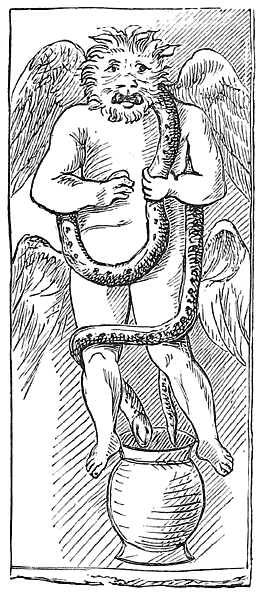
Fig. 16.—Demon found at Ostia.
Knowing nothing of Zoology, the primitive man easily falls into the belief that his cattle—the means of life—may be the subjects of sorcery. Jesus sending devils into a herd of swine may have become by artificial process a divine benefactor in the eye of Christendom, but the myth makes Him bear an exact resemblance to the dangerous sorcerer that fills the savage mind with dread. It is probable that the covetous eye denounced in the decalogue means the evil eye, which was supposed to blight an object intensely desired but not to be obtained.
Gopolu, already referred to (p. 136) as the Singhalese demon of hydrophobia, bears the general name of the ‘Cattle Demon.’ He is said to have been the twin of the demigod Mangara by a queen on the Coromandel coast. The mother died, and a cow suckled the twins, but afterwards they quarrelled, and Gopolu being slain was transformed into a demon. He repaired to Arangodde, and fixed his abode in a Banyan where there is a large bee-hive, whence proceed many evils. The population around this Banyan for many miles being prostrated by diseases, the demigod Mangara and Pattini (goddess of chastity) admonished the villagers to sacrifice a cow regularly, and thus they were all resuscitated. Gopolu now sends all cattle diseases. India is full of the like superstitions. The people of Travancore especially dread the demon Madan, ‘he who is like a cow,’ believed to strike oxen with sudden illness,—sometimes men also.
In Russia we find superstition sometimes modified by common sense. Though the peasant hopes that Zegory (St. George) will defend his cattle, he begins to see the chief foes of his cattle. As in the folk-song—
We have gone around the field,
We have called Zegory....
O thou, our brave Zegory,
Save our cattle,
In the field and beyond the field,
In the forest and beyond the forest,
Under the bright moon,
Under the red sun,
From the rapacious wolf,
From the cruel bear,
Nevertheless when a cattle plague occurs many villages relapse into a normally extinct state of mind. Thus, a few years ago, in a village near Moscow, all the women, having warned the men away, stripped themselves entirely naked and drew a plough so as to make a furrow entirely around the village. At the point of juncture in this circle they buried alive a cock, a cat, and a dog. Then they filled the air with lamentations, crying—‘Cattle Plague! Cattle Plague! spare our cattle! Behold, we offer thee cock, cat, and dog!’ The dog is a demonic character in Russia, while the cat is sacred; for once when the devil tried to get into Paradise in the form of a mouse, the dog allowed him to pass, but the cat pounced on him—the two animals being set on guard at the door. The offering of both seems to represent a desire to conciliate both sides. The nudity of the women may have been to represent to the hungry gods their utter poverty, and inability to give more; but it was told me in Moscow, where I happened to be staying at the time, that it would be dangerous for any man to draw near during the performance.