A CYCLOPÆDIA OF PRACTICAL RECEIPTS, &c. VOLUME II (continued 43)
Reading edition
Oxalate of lime. The principal crystalline forms of oxalate of lime, when it occurs as a urinary deposit, are the octahedral and the dumb-bell. Of these the most common is the octahedral. These octahedra (which have one axis much shorter than the other two) vary considerably in size, but there is reason to believe that the diversity in appearance which they exhibit is due to crystals of precisely the same shape occupying different positions as to the direction of their axes, when examined by the microscope. There are a great many diversities of the dumb-bell form of oxalate of lime, which seem to be derived from circular and oval crystals. The subjoined cuts illustrate the varieties of crystalline oxalates the most generally met with. When the crystals of oxalate are extremely minute, they are very liable to be overlooked, since they then appear as almost opaque cubes, and may not unnaturally be taken for urate of soda, to which they bear no slight resemblance; but from which they differ by being insoluble in potash or acetic acid, and not dissolving on the application of heat. We have already alluded to their resemblance to the dumb-bells of the earthy phosphates. Another distinctive feature is that the oxalates rarely sink to the bottom of the vessel, but are diffused through the mucous cloud, which forms in urine after a short time.
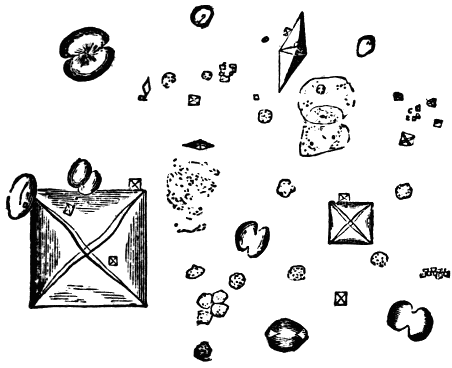
Oxalate of lime. (Beale.)
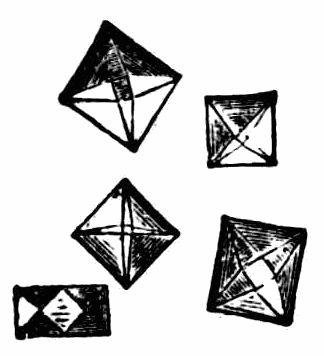
Cystine. Cystine is an occasional ingredient in urine, when it occurs as a whitish precipitate crystallised in hexagonal plates. At other times, but not so frequently, it is met with dissolved in the urine. It may be separated from the urine holding it in solution by the addition of an excess of acetic acid. Under the microscope cystine bears somewhat of a resemblance to uric acid, from which, however, it differs when under treatment with ammonia. When ammonia is added to cystine the cystine dissolves, but by the spontaneous evaporation of the ammonia remains behind in its original form; whilst, if the ammonia be allowed to escape under the same circumstance from the urate of ammonia which has been formed, this remains behind as an amorphous mass. Ammonia, therefore, dissolves the cystine without entering into chemical union with it. Potash also readily dissolves
Obs. In the examination of urine it is important that the investigation should be conducted upon a portion taken from the whole of the urine excreted during twenty-four hours, and not on an isolated quantity voided at any particular time.
The compiler of the present article has to acknowledge his indebtedness to Dr Lionel Beale’s very valuable and exhaustive work, ‘Kidney Diseases, Urinary Deposits, &c.,’ as well as to Dr W. Roberts’s excellent book, ‘Urinary and Renal Diseases,’ to both of which volumes the reader, desirous of further and more explicit information on the subject, is referred.
URINOM′ETER. An hydrometer adapted to determining the density of urine. That of Dr Prout is the simplest and best. Urinometers should always be tested by placing them in distilled water at 60° Fahr. from 1·015 to 1·025 Beale.
URN POWDER. Crocus martis, or jeweller’s rouge.
URTICAR′IA. See Rash.
US′QUEBAUGH. Syn. Escubac. Literally, mad water, the Irish name of which, ‘whisky,’ is a corruption. At the present time it is applied to a strong cordial spirit, much drunk in Ireland, and made in the greatest perfection at Drogheda.
Prep. 1. Brandy or proof spirit, 3 galls.; dates (without their kernels) and raisins, of each, bruised, 1⁄4 lb.; juniper berries, bruised, 1 oz.; mace and cloves, of each 3⁄4 oz.; coriander and aniseed, of each 1⁄2 oz.; cinnamon, 1⁄4 oz.; macerate, with frequent agitation, for 14 days, then filter, and add of capillaire or simple syrup, 1 gall.
2. Pimento and caraways, of each 3 oz.; mace, cloves, and nutmegs, of each 2 oz; aniseed, corianders, and angelica root, of each 8 oz.; raisins, stoned and bruised, 14 lbs.; proof spirit, 9 galls.; digest as before, then press, filter, or clarify, and add of simple syrup, q. s. Should it turn milky, add a little strong spirit, or clarify it with alum, or filter through magnesia.
Obs. Usquebaugh is either coloured yellow with saffron (about 1⁄4 oz. per gall.), or green with sap-green (about 1⁄2 oz. per gall.); either being added to the other ingredients before maceration in the spirit.
UVA URSI. The Arctostaphylus Uva Ursi (the Bearberry) is an indigenous plant, the leaves of which are employed in medicine. Bearberry leaves contain a large percentage of tannic acid, with a small quantity of gallic acid, some resin, and a little volatile oil and extractive, together with a crystallisable principle named arbutin, which is said to be a very powerful diuretic. Another crystallisable resinous body named arbutin has also been discovered in them. Bearberry leaves either in the form of powder, infusion, or extract, are chiefly used in chronic diseases of the bladder, in which there is an abnormal secretion of mucus, such as catarrhus vesicæ, but neither acute nor active inflammation.
VACCINA′TION. See Cow-pox. (Pox.)
VAC′CINE MATTER. Syn. Lympha vacciniæ, L. This is collected either upon the points of lancet-like pieces of ivory, or by opening the pustule, and applying a small glass ball and tube (like those called by the boys in London candle-pops, or fire-pops) to the orifice, expelling part of the air in the ball by bringing a lighted taper near it; then, withdrawing the taper, the matter is sucked into the ball, in which it may be sealed up hermetically or cemented, and thus kept for a length of time. It is, however, now generally preserved between two small pieces of glass, or in straight capillary glass tubes. It is said that cotton thread is a convenient and efficient vehicle. The matter may be liquefied with a little clean water before application. A degree of heat scarcely higher than that of the blood lessens its efficacy.
VAC′UUM. Empty space; a portion of space void of matter. For experimental and manufacturing purposes, a sufficient vacuum is produced either by means of the air-pump, or by filling an inclosed space by steam, which is then condensed by the application of cold. Evaporation proceeds much more rapidly, and liquids boil at much lower temperatures in an exhausted receiver than when exposed to the air. Thus, under ordinary circumstances, in the air, ether boils at 96°, alcohol at 177°, and Water at 212° Fahr.; but in vacuo water boils at about 88°, alcohol at 56°, and ether at -20° Fahr. In the best vacuum obtainable by a powerful air-pump, water placed over oil of vitriol, to absorb the aqueous vapour as it forms, will often enter into violent ebullition whilst ice is in the act of formation on its surface. The reduction of the boiling-point with reduced pressure is practically taken advantage of by the pharmaceutist in the preparation of extracts, by the sugar refiner in the evaporation of his syrups, by the distiller in the production of certain liqueurs, and by the chemist in a variety of processes of interest or utility. See Extracts, Evaporation, Refrigeration, &c.
VALE′′RIAN. Syn. Valerianæ radix (B. P.), Valerianæ radix, Valeriana (Ph. L. E. & D.), L. “The root of the wild plant Valeriana officinalis (Linn.), or wild valerian.” (Ph. L.) An excitant, antispasmodic, tonic, and emmenagogue, not only acting on the secretions, but exercising a specific influence over the cerebro-spinal system, and in largeDose, 10 to 30 or 40 gr., thrice daily; in hysteria, epilepsy, headache (affecting only one side), morbid nervous sensibility, &c. Even the odour of it exerts a species of fascination over cats.
VALERIAN′IC ACID. HC5H9O2. Syn. Valeric acid; Acidum valerianicum, A. valericum, L. Prep. 1. A mixture of potato oil or corn-spirit oil (hydrated oxide of amyl) with about 10 times its weight of quicklime and hydrate of potassa in equal proportions, placed in a glass flask, is kept heated to about 400° Fahr., for 10 or 12 hours, by means of a bath of oil or fusible metal; the nearly white solid residuum is mixed with water, an excess of sulphuric acid added to the mixture, and the whole subjected to distillation; the distillate is supersaturated with potassa, evaporated nearly to dryness, to dissipate any undecomposed potato oil, and then mixed with weak sulphuric acid in excess; a light oily liquid (terhydrated valerianic acid) separates, which by cautious rectification, yields at first water containing a little acid, and afterwards pure monohydrated valerianic acid, which is perfectly identical with that prepared from valerian root.
2. (Ph. D.) See Valerianate of Sodium. This is a most economical process.
Prop., &c. A limpid oily liquid, smelling strongly of valerian root; it has an acid taste and reaction, and leaves a sensation of sweetness and a white spot on the tongue; is inflammable; boils at 347°; is freely soluble in alcohol and ether; dissolves in 30 parts of water, and forms salts called valerianates, most of which have a sweetish taste, are soluble, and uncrystallisable; sp. gr. ·937; placed in contact with water, it absorbs a portion of it, and is converted into the terhydrated acid, with increase of sp. gr., and reduction of the boiling-point.
VALE′′RIC ACID. See Valerianic acid.
VALO′NIA. The cup of a large species of acorn, imported from the Levant. Used in tanning leather.
VANAD′IC ACID. V2O2. Syn. Vanadic anhydride, Teroxide of v.; Acidum vanadicum, L. Prep. (Johnston.) From the native vanadate of lead, by dissolving it in nitric acid, passing sulphuretted hydrogen through the solution, to throw down lead and arsenic, filtering, and evaporating the resulting blue liquid to dryness; the residuum is then dissolved in a solution of ammonia, and a piece of sal ammoniac, considerably larger than can be dissolved, introduced; as the latter dissolves, a pulverulent precipitate of vanadate of ammonium is formed, which must be washed, first in a solution of sal ammoniac, and then in alcohol of ·860; by exposing this salt, in an open platinum crucible, to a heat a little below redness, and keeping it constantly stirred, until it acquires a dark red colour, pure vanadic acid is obtained.
Prep., &c. Vanadic acid is orange coloured, scarcely soluble in water, and forms, with the alkaline bases, soluble salts called vanadates; and with the other bases sparingly soluble salts. All of these have an orange or yellow colour. “Vanadate of ammonia mixed with solution of galls forms a black fluid, which is the best writing ink hitherto known. The quantity of salt required for this purpose is very small; the writing is perfectly black, and not obliterated by alkalies, acids, chlorine, or other reagents,” (Ure.)
VANA′DIUM. V. A rare metal discovered by Sefstom, in 1830. in some Swedish iron extracted from an iron mine near Jönköping. It has since been found in a Vanadinite lead ore met with in Scotland, Zimpanan in Mexico, and Chili, and in the iron slag of Staffordshire. Of late years a more abundant source of Vanadium has been discovered by Professor Roscoe in the cupriferous stratum of the New Red Sandstone at Alderley Edge in Cheshire. There are four, and possibly five oxides of this element.
Vanadic oxychloride. Syn. Vanadic oxytrichloride. (VOCl3.) Roscoe states there are several oxychlorides of vanadium, which, however, have not been studied. The most interesting of them is the oxytrichloride, which corresponds to the phosphorous oxychloride. This oxytrichloride is a yellow fuming liquid, which is instantly decomposed by water into vanadic and hydrochloric acids. The oxytrichloride may be obtained by heating vanadic anhydride and charcoal (mixed together) in a current of hydrogen, after which it is heated in a current of dry chlorine. An easier method is by passing dry chlorine over the sesquioxide of vanadium.
Vanadic pentoxide. Syn. Vanadic Anhydride (V2O5.). At a red hot heat this oxide fuses, and on cooling, crystallises in rhombic prisms. It is but little soluble in water; the aqueous solution, which is of a yellow tint, is strongly acid, and produces a marked reddening effect on litmus. Vanadic anhydride forms both normal and acid salts. The ammonic vanadiate (Roscoe’s meta vanadiate) is the chief source of the acid. This salt may be obtained by adding pieces of sal ammoniac to a crude solution of potassic vanadiate, the resulting ammonic vanadiate being insoluble in a saturated solution of sal ammoniac, is deposited in small crystalline grains. The vanadic anhydride may be obtained from the ammonic vanadiate by heating an aqueous solution of the salt in the open air, when the ammonia is driven off, and the vanadic anhydride is left behind. The acid ammonic vanadiate, mixed with tincture of galls, makes a very durable writing ink, unacted upon either by alkalies or chlorine. Acids turn such blue without, however, destroying it.
Vanadic triox′ide. (V2O2.), is the Vanadyl of Roscoe, who obtained it in the form of a grey metallic-looking powder, by the transmission of a current of dry hydrogen charged with the vapours of oxychloride of Vanadium, through a tube containing ignited charcoal. It dissolves in dilute acids, with evolution of hydrogen. Solutions of its salts are lavender coloured. Berzelius regarded this oxide as a metal.
Tests. The vanadiates mostly occur of a red or yellow colour. When treated with sulphuretted hydrogen, they yield a solution of a fine blue colour, a reaction that distinguishes them from the chromates, which, under similar treatment, would give a green liquid. When mixed with borax and exposed to the reducing flame of the blowpipe, compounds containing vanadium give a green glass, which turns to yellow in the oxidizing flame. Professor Roscoe, to whose researches we are indebted for all the chemical knowledge we possess respecting vanadium, says:—“All the main facts now established in connection with the chemical department of this element proved it to bear a strong analogy to the elements phosphorus and arsenic; in fact, it occupied a previously vacant place in a well-defined group of triad, or, as some chemists prefer to consider them, pentad elements. There was a property of vanadium in virtue of which it might ultimately obtain considerable importance in the arts, though in the present infancy of the history of the metal it was difficult to foretell this with any certainty. This property was the power of forming a permanent black for dyeing purposes. The black produced by the action of vanadium had the advantage over copper and aniline blacks, viz. that it was permanent, whereas the latter were liable to turn green. This application of an element that was first introduced into notice as a chemical curiosity furnished one more example of the importance of original scientific investigation. However far a newly discovered substance might seem to be removed from purposes of practical utility, we never know at what moment it might be turned to account for the benefit of the human race.”
VANIL′LA. Syn. Vanille, Fr. The dried pods of various species of Vanilla, a genus of the natural order Orchidaceæ. It is chiefly used in the manufacture of chocolate and perfumery. As a medicine it is much employed on the Continent as an aromatic stimulant and neurotic.—Dose, 6 to 12 gr.; in asthenic fevers, hysteria, hypochondriasis, impotency, &c.
Vanilla is reduced to powder (PULVIS VANILLÆ; POUDRE DE VANILLE) by slicing it, and triturating the fragments with twice or thrice their weight of well-dried lump sugar. For SUCRE DE VANILLE, 11 parts of sugar are employed.
The following table given by Messrs Tieman and Harmann, in the Journal of the Berlin Chemical Society, represents the quantities of Vanillin (the aromatic principle of Vanilla) contained in that substance, as obtained from different sources:—
Vanillin per Cent.
Mexican Vanilla (1873, harvest) 1·69
Mexican Vanilla (1874, harvest) 1·86
Mexican Vanilla Medium quality 1·32
Bourbon, best quality (1874-75) 1·91
Bourbon, (1874-75) 1·97
Bourbon, (1874-75) 2·90
Bourbon, Small medium (1874-75) 1·55
Java, best quality (1873) 2·75
Java, best quality (1874) 1·56
VANILLIN. A crystallised substance obtained from pine juice by Messrs Tiemann and Harmann. It has been shown to be identical with the aromatic principle of Vanilla.
In a paper read before the Royal Society the authors have described the process by which vanillin was artificially prepared by them. They state that the sap of the cambium of coniferous trees contains a beautiful crystalline glucoside coniferine, which was discovered by Kartig, and examined some years ago by Rubel, who arrived at the formula C24H32O12 + 3 Aq. A minute study of this compound leads us to represent the molecule of coniferine by the expression, C16H22O3 × 2 Aq., the per centages of which nearly coincide with the theoretical values of Kubel’s formula.
Submitted to fermentation with emulsine, coniferine splits into sugar, and a splendid compound, crystallising in prisms, which fuse at 73°. This body is easily soluble in ether, less so in alcohol, almost insoluble in water; its composition is represented by the formula C10H12O3. The change is represented by the equation—
C16H22O8 + H2O = C6H12O6 + C10H12O3.
Under the influence of oxidising agents, the product of fermentation undergoes a remarkable metamorphosis. On boiling it with a mixture of potassium bichromate and sulphuric acid, there passes with the vapour of water in the first place ethylic aldehyd, and subsequently an acid compound soluble in water, from which it may be removed by ether. On evaporating the ethereal solution, crystals in stellar groups are left behind, which fuse at 81°. These crystals have the taste and odour of vanilla.
An accurate comparative examination has proved them to be identical with the crystalline substance which constitutes the aroma of vanilla, and which is often seen covering the surface of vanilla pods.
On analysis, the crystals we obtained were found to contain C8H8O3. This is exactly the composition which recent researches of Carles have established for the aromatic principle of vanilla. The transformation of the crystalline product of fermentation into vanillin is represented by the following equation:
C10H12O3 + O = C2H4O + C8H8O3.
To remove all doubt regarding the identity of artificial vanillin with the natural compound, we have transformed the former into a series of salts, which have the general formula, C8H7MO3, and into two substitution products, C8H7BrO31, and C8H7TO3, both of which had previously been prepared by Carles from the natural compound.
VAN SWIETEN’S SOLUTION. Contains 1⁄1000th part of its weight of corrosive sublimate; or 1⁄2 gr. per fl. oz.
VAPOUR. Vapours are really gases, and amenable to substantially the same physical laws; as ordinarily understood, however, the difference between a gas and a vapour is the following:—A gas is a form of matter which exists, at ordinary temperatures and pressures, in a state of vapour; whilst a vapour has been formed by the application of heat to a body usually existing in the solid or liquid form; gases, therefore, differ from vapours only in being derived from bodies which, in the solid or liquid form, boil at very much lower temperatures.
Vapour of Ammonia. Syn. Vapor ammoniæ. (St Th. Hosp.) Solution of ammonia (·959), water, equal parts. A teaspoonful in a pint of water at 80° F. for each inhalation. In chronic laryngitis and functional aphonia.
Vapour of Benzoin. Syn. Vapor benzoini. (St Th. Hosp.) Compound tincture of benzoin, 1 oz. A teaspoonful to 1 pint of water at 140° F. In acute inflammation of the pharynx and larynx.
Vapour of Carbolic Acid. Syn. Vapor acidi carbolici. (St Th. Hosp.) Carbolic acid, 420 gr.; water, 1 dr.; 20 drops of this in 1 pint of water, at 140° F., for each inhalation. For syphilitic and carcinomatous ulcerations.
Vapour of Chlorine. Syn. Vapor chlori. (B. P.) Put chlorinated lime, 2 oz., into a suitable apparatus, moisten it with cold water, and let the vapour that arises be inhaled.
Vapour of Conia. Syn. Vapor coniæ. (B. P.) Mix extract of hemlock, 60 gr.; solution of potash, 1 dr.; and distilled water, 9 dr. Put 20 minims of the mixture on a sponge, in a suitable apparatus, that the vapour of hot water passed over it may be inhaled.
Vapour of Creosote. Syn. Vapor creosoti. (B. P.) Mix creosote, 12 minims, and boiling water, 8 oz., in an apparatus so arranged that air may be inhaled through the solution.
Vapour of Hop. Syn. Vapor lupuli. (St Th. Hosp.) Oil of hops, 6 minims; light carbonate of magnesia, 10 gr.; water, 1 oz. A teaspoonful in 1 pint of water, at 140° F., for each inhalation. Sedative.
Vapour of Hydrocyanic Acid. Syn. Vapor acidi hydrocyanici. (B. P.) Mix from 10 to 15 minims of diluted hydrocyanic acid with 1 dr. of cold water in a suitable apparatus, and let the vapour that arises be inhaled.
Vapour of Iodine. Syn. Vapor iodi. Mix tincture of iodine, 1 fl. dr., and water, 1 oz., and, having applied a gentle heat, let the vapour that arises be inhaled.
Vapour of Lactic Acid. Syn. Vapor acidi lactici. (St Th. Hosp.) Lactic acid, 20 minims; distilled water, 1 oz.; mix. For spray inhalation. Dissolves the membranous exudation in diphtheria,
Vapour of Oil of Juniper. Syn. Vapor olei juniperi. (St Th. Hosp.) English oil of juniper, 20 minims; light carbonate of magnesia, 10 gr.; water, 1 oz. A teaspoonful to 1 pint of water at 140° F. for each inhalation. For vocal weakness.
Vapour of Oil of Mountain Pine. Syn. Vapor pini plumilionis. (St Th. Hosp.) Oil of mountain pine, 1⁄2 dr.; light carbonate of magnesia, 15 gr.; water, 1 oz.; 1 dr. to 1 pint of water at 140° F. for each inhalation. In chronic laryngitis.
Vapour of Oil of Myrtle. Syn. Vapor olei myrti. (St Th. Hosp.) Oil of myrtle, 6 minims; light carbonate of magnesia, 6 gr.; water, 1 oz. A teaspoonful in a pint of water at 140° F. for each inhalation. In acute tonsillitis.
Vapour of Nitrite of Amyl. Syn. Vapor amyl nitritis. (St Th. Hosp.) Nitrite of amyl, 8 minims; rectified spirit, 1 oz. A teaspoonful in a pint of water at 100° F. for each inhalation. In asthma and spasm of the glottis.
Vapour of Scotch Pine. Syn. Vapor pini Sylvestris. Oil of Scotch pine (fir-wood oil), 40 minims; light carbonate of magnesia, 20 gr.; water, 1 oz.; 1 dr. to 1 pint of water at 140° F. for each inhalation. In chronic laryngitis.
Vapour of Sulphurous Acid. Syn. Vapor acidi sulphurosi. (St Th. Hosp.) Sulphurous acid, 15 minims; water, 1 oz. For spray inhalation. Stimulant and antiseptic.
Vapour of Thymol. Syn. Vapor thymolis. Thymol, 6 gr.; rectified spirit, 1 dr.; light carbonate of magnesia, 3 gr.; water, 1 oz. 1 dr. to 1 pint of water at 140° F. for each inhalation. In pharyngitis and laryngitis when associated with exanthemata.
VARICOSE VEINS. See Varix.
VARIX. The permanent unequal dilation of a vein or veins, which are then said to be ‘varicose.’ It is known by the presence of a soft tumour, which does not pulsate, and often assumes a serpentine figure. Varicose veins of the groin and scrotum generally form a collection of knots. The treatment consists of cold applications, and pressure from bandages. Some cases are relieved by ligature. When occurring in the legs, much standing or walking should be avoided, and the use of the elastic stockings made for the purpose will be proper.
VAR′NISH. Syn. Vernis, Fr. Any liquid matter, which, when applied to the surface of a solid body, becomes dry, and forms a
Varnishes are commonly divided into two classes—FAT or OIL VARNISHES and SPIRIT VARNISHES. The fixed or volatile oils, or mixtures of them, are used as vehicles or solvents in the former, and concentrated alcohol in the latter.[254] The sp. gr. of alcohol for the purpose of making varnishes should not be more than ·8156 (= 67 o. p.), and it should be preferably chosen of even greater strength. A little camphor is often dissolved in it, to increase its solvent power. The oil of turpentine, which is the essential oil chiefly employed for varnishes, should be pure and colourless. Pale drying linseed oil is the fixed oil generally used; but poppy oil and nut oil are also occasionally employed. Among the substances which are dissolved in the above menstrua are—amber, animé, copal, elemi, lac, mastic, and sandarach, to impart body and lustre; benzoin, on account of its agreeable odour; annotta, gamboge, saffron, socotrine aloes, and turmeric, to give a yellow colour; dragon’s blood and red sandal wood, to give a red tinge; asphaltum, to give a black colour and body; and caoutchouc to impart toughness and elasticity.
In the preparation of spirit varnishes care should be taken to prevent the evaporation of the alcohol as much as possible, and also to preserve the portion that evaporates. On the large scale, a common still may be advantageously employed; the head being furnished with a stuffing-box, to permit of the passage of a vertical rod, connected with a stirrer at one end and a working handle at the other. The gum and spirit being introduced, the head of the still closely fitted on and luted, and the connection made with a proper refrigerator, heat (preferably that of steam or a water bath) should be applied, and the spirit brought to a gentle boil, after which it should be partially withdrawn, and agitation continued until the gum is dissolved. The spirit which has distilled over should be then added to the varnish, and after thorough admixture the whole should be run off, as rapidly as possible, through a silk-gauze sieve, into stone jars, which should be immediately corked down, and set aside to clarify. On the small scale, spirit varnishes are best made by maceration in closed bottles or tin cans, either in the cold or by the heat of a water bath. In order to prevent the agglutination of the resin, it is often advantageously mixed with clean siliceous sand or pounded glass, by which the surface is much increased, and the solvent power of the menstruum greatly promoted.
To ensure the excellence of oil varnishes, one of the most important points is the use of good drying oil. Linseed oil for this purpose should be very pale, perfectly limpid or transparent, scarcely odorous, and mellow and sweet to the taste.—100 galls. of such an oil is put into an iron or copper boiler, capable of holding fully 150 galls., gradually heated to a gentle simmer, and kept near that point for about 2 hours, to expel moisture; the scum is then carefully removed, and 14 lbs. of finely pulverised scale litharge, 12 lbs. of red lead, and 8 lbs. of powdered umber (all carefully dried and free from moisture), are gradually sprinkled in; the whole is then kept well stirred, to prevent the driers sinking to the bottom, and the boiling is continued at a gentle heat for about 3 hours longer; the fire is next withdrawn, and, after 30 to 40 hours’ repose, the scum is carefully removed, and the clear supernatant oil decanted from the ‘bottoms,’—The product forms the best boiled or drying oil of the varnish maker.—Another method is to heat a hogshead of the oil gradually for 2 hours, then to gently simmer it for about 3 hours longer, and, after removing the scum, to add, gradually, 1 lb. of the best calcined magnesia, observing to mix it up well with the oil, and, afterwards to continue the boiling pretty briskly for at least an hour, with constant agitation. The fire is then allowed to die away, and, after 24 hours, the oil is decanted as before. The product is called ‘clarified oil,’ and requires to be used with driers. It should be allowed to lay in the cistern for 2 or 3 months to clarify.
In the preparation of oil varnishes, the gum is melted as rapidly as possible, without discolouring or burning it; and when completely fused, the oil, also heated to nearly the boiling point, is poured in, after which the mixture is boiled until it appears perfectly homogeneous and clear, like oil, when the heat is raised, the driers (if any are to be used) gradually and cautiously sprinkled in, and the boiling continued, with constant stirring, for 3 or 4 hours, or until a little, when cooled on a palette knife, feels strong and stringy between the fingers. The mixture is next allowed to cool considerably, but while still quite fluid, the turpentine, previously made moderately hot, is cautiously added, and the whole thoroughly incorporated. The varnish is then run through a filter or sieve into stone jars, cans, or other vessels, and set aside to clarify itself by subsidence. When no driers are used, the mixture of oil and gum is boiled until it runs perfectly clear, when it is removed from the fire, and, after it has cooled a little, the turpentine is added as before.
It is generally conceived that the more perfectly the gum is fused, or run, as it is called, the larger and stronger will be the product; and the longer the boiling of the ‘gum’ and oil is continued, within moderation, the freer the resulting varnish will work and cover. An excess of heat renders the varnish stringy, and injures its flowing qualities. For pale varnishes as little heat as possible should be employed throughout the whole process. Good body varnishes should contain1⁄2 lb.; carriage, wainscot, and mahogany varnish, fully 1 lb.; and gold size and black japan, fully 1⁄2 lb. of gum per gall., besides the asphaltum in the latter. Spirit varnishes should contain about 21⁄2 lbs. of gum per gall. The use of too much driers is found to injure the brilliancy and transparency of the varnish. Copperas does not combine with varnish, but only hardens it; sugar of lead, however, dissolves in it to a greater or less extent. Boiling oil of turpentine combines very readily with melted copal, and it is an improvement on the common process, to use it either before or in conjunction with the oil, in the preparation of copal varnish that it is desired should be very white. Gums of difficult solubility are rendered more soluble by being exposed, in the state of powder, for some time to the air.
Varnishes, like wines, improve by age; and should always be kept as long as possible before use.
From the inflammable nature of the materials of which varnishes are composed, their manufacture should be only carried on in some detached building of little value, and built of uninflammable materials. When a pot of varnish, gum, or turpentine catches fire, it is most readily extinguished by closely covering it with a piece of stout woollen carpeting, which should be always kept at hand, ready for the purpose.
An excellent paper, by Mr J. W. Niel, on the manufacture of varnishes, will be found in the ‘Trans. of the Soc. of Arts,’ vol. xlix. See also the articles Alcohol, Amber, Copal, Oils, &c., in this work.
Varnish, Am′ber. Prep. 1. Take of amber (clear and pale), 6 lbs.; fuse it, add of hot clarified linseed oil, 2 galls.; boil until it ‘strings well,’ then let it cool a little, and add of oil of turpentine 4 galls, or q. s. Nearly as pale as copal varnish; it soon becomes very hard, and is the most durable of the oil varnishes; but it requires some time before it is fit for polishing, unless the articles are ‘stoved.’ When required to dry and harden quicker, drying oil may be substituted for the linseed oil, or ‘driers’ may be added during the boiling.
2. Amber, 4 oz.; pale boiled oil, 1 quart; proceed as last. Very hard.
3. Pale transparent amber, 5 oz.; clarified linseed oil or pale boiled oil, and oil of turpentine, of each 1 pint; as before.
Obs. Amber varnish is suited for all purposes where a very hard and durable oil varnish is required. The paler kind is superior to copal varnish, and is often mixed with the latter to increase its hardness and durability. The only objection to it is the difficulty of preparing it of a very pale colour. It may, however, be easily bleached with some fresh-slaked lime.
Varnish, Balloon. See Varnish, Flexible (below).
Varnish, Bessemer’s. This consists of a pale oil copal varnish, diluted with about 6 times its volume of oil of turpentine, the mixture being subsequently agitated with about 1-30th part of dry slaked lime, and decanted after a few days’ repose. Five parts of the product mixed with 4 parts of bronze powder forms ‘Bessemer’s gold paint.’
Varnish, Black. Prep. 1. (Black amber varnish.) From amber, 1 lb.; fuse, add, of hot drying oil, 1⁄2 pint; powdered black resin, 3 oz.; asphaltum (Naples), 4 oz.; when properly incorporated and considerably cooled, add of oil of turpentine, 1 pint. This is the beautiful black varnish of the coachmakers.
2. (Ironwork black.) From asphaltum, 48 lbs.; fuse, add of boiled oil, 10 galls.; red lead and litharge, of each 7 lbs.; dried and powdered white copperas, 3 lbs.; boil for 2 hours, then add of dark gum amber (fused), 8 lbs.; hot linseed oil, 2 galls.; boil for 2 hours longer, or until a little of the mass, when cooled, may be rolled into pills, then withdraw the heat, and afterwards thin it down with oil of turpentine, 30 galls. Used for the ironwork of carriages, and other nice purposes.
(3. Black japan, Bituminous varnish.)—a. From Naples asphaltum, 50 lbs.; dark gum animé, 8 lbs.; fuse, add of linseed oil, 12 galls.; boil as before, then add of dark gum amber, 10 lb., previously fused and boiled with linseed oil, 2 galls.; next add of driers q. s., and further proceed as ordered in No. 2. Excellent for either wood or metals.
b. From burnt umber, 8 oz.; true asphaltum, 4 oz.; boiled linseed oil, 1 gall.; grind the umber with a little of the oil; add it to the asphaltum, previously dissolved in a small quantity of the oil by heat; mix, add the remainder of the oil, boil, cool, and thin with a sufficient quantity of oil of turpentine. Flexible.
4. (Brunswick black.)—a. To asphalt, 2 lbs., fused in an iron pot, add of hot boiled oil, 1 pint; mix well, remove the pot from the fire, and, when cooled a little, add of oil of turpentine, 2 quarts. Used to blacken and polish grates and ironwork. Some makers add driers.
b. From black pitch and gas-tar asphaltum, of each 25 lbs.; boil gently for 5 hours, then add, of linseed oil, 8 galls.; litharge and red lead, of each 10 lbs.; boil as before, and thin with oil of turpentine, 20 galls. Inferior to the last, but cheaper.
Varnish, Body. Prep. 1. From the finest African copal, 8 lbs.; drying oil, 2 galls.; oil of turpentine, 31⁄2 galls.; proceed as for AMBER VARNISH. Very hard and durable.
2. Pale gum copal, 8 lbs.; clarified oil, 2 galls.; dried sugar of lead, 1⁄2 lb.; oil of turpentine, 31⁄2 galls.; proceed as before, and mix the product, whilst still hot, with the following varnish:—Pale gum animé, 8 lbs.; linseed oil, 2 galls.; dried white copperas, 1⁄4 lb.; oil of turpentine, 31⁄2 galls.; the mixed varnishes are to
Varnish, Bookbinder’s. Prep. Take of pale gum sandarach, 3 oz.; rectified spirit, 1 pint; dissolve by cold digestion and frequent agitation. Used by binders to varnish morocco leather book-covers. A similar varnish is also prepared from very pale shell-lac and wood naphtha.
Varnish for Boots and Shoes. See Boots and Shoes.
Varnish, Cabinet-maker’s. French polish is occasionally so called.
Varnish, Carriage. Prep. 1. (Spirit.) Take of gum sandarach, 11⁄4 lb.; very pale shell-lac, 3⁄4 lb.; very pale transparent resin, 1⁄2 lb.; rectified spirit of ·8221 (64 o. p.), 3 quarts; dissolve, and add of pure Canadian balsam, 11⁄2 lb. Used for the internal parts of carriages, &c. Dries in 10 minutes or less.
2. (Oil.)—a. (Best pale.) Take of pale African copal, 8 lbs.; fuse, add of clarified linseed oil, 21⁄2 galls.; boil until very stringy, then add of dried copperas and litharge, of each 1⁄4 lb.; again boil, thin with oil of turpentine, 51⁄2 galls.; mix, whilst both are hot with the following varnish, and immediately strain the mixture into a covered vessel:—Gum animé, 8 lbs.; clarified linseed oil, 21⁄2 galls.; dried sugar of lead and litharge, of each 1⁄4 lb.; boil as before, thin with oil of turpentine, 51⁄2 galls. Dries in 4 hours in summer, and 6 in winter. Used for the wheels, springs, and carriage parts of coaches, and other vehicles, and by house painters, decorators, &c., who want a strong, quick-drying, and durable varnish.
b. (Second quality.) From gum animé (‘sorts’), 8 lbs.; clarified oil, 3 galls.; litharge, 5 oz.; dried and powdered sugar of lead and white copperas, of each 4 oz.; boil as last, and thin with oil of turpentine, 51⁄2 galls. Used as the last.
Varnish, Chinese. Prep. From mastic and sandarach, of each 2 oz.; rectified spirit (64 o. p.), 1 pint; dissolve. Dries in 6 minutes. Very tough and brilliant.
Varnish, Copal. Prep. 1. (Oil.)—a. From pale hard copal, 2 lbs.; fuse, add of hot drying oil, 1 pint; boil as before directed, and thin with oil of turpentine, 3 pints, or q. s. Dries hard in 12 to 24 hours.
b. From clear and pale African copal, 8 lbs.; pale drying oil, 2 galls.; rectified oil of turpentine, 3 galls.; proceed as before and immediately strain it into the store can or cistern. Very fine, hard, and durable.
2. (Spirit.)—a. From coarsely powdered copal and glass, of each 4 oz.; alcohol of 90% (64 o. p.), 1 pint; camphor, 1⁄2 oz.; heat the mixture, with frequent stirring, in a water bath, so that the bubbles may be counted as they rise until solution is complete, and, when cold, decant the clear portion.
b. From copal (which has been melted, dropped into water, and then dried and powdered), 4 oz.; gum sandarach, 6 oz.; mastic, 2 oz.; pure Chio turpentine, 3 oz.; powdered glass, 5 oz.; spirit of 90%, 1 quart; dissolve by a gentle heat. Dries rapidly.
3. (Turpentine.) To oil of turpentine, 1 pint, heated in a water bath, add in small portions at a time, of powdered copal (prepared as above), 3 to 4 oz.; dissolve, &c., as before. Dries slowly, but is very pale and durable.
4. (Japanner’s copal varnish.) From pale African copal, 7 lbs.; pale drying oil, 1⁄2 gall.; oil of turpentine, 3 galls.; proceed as in No. 1. Dries in 20 to 60 minutes, and may be polished as soon as hard, particularly if stoved. See Japanning.
Obs. All copal varnishes, when properly made, are very hard and durable, though less so than those of amber; but they have the advantage over the latter of being paler. They are applied on coaches, pictures, polished metal, wood, and other objects requiring a good durable varnish. Animé is frequently substituted for copal in the copal varnishes of the shops. See Varnishes, Body, Carriage, and Copal, &c.
Varnish, Crystal. Prep. 1. From genuine pale Canada balsam and rectified oil of turpentine, equal parts. Used for maps, prints, drawings, and other articles of paper, and also to prepare tracing paper, and to transfer engravings.
2. Mastic, 3 oz.; rectified spirit, 1 pint; dissolve. Used to fix pencil drawings.
Varnish, Drying. Spirit copal varnish.
Varnish, Dutch. Lac and toy varnishes are often so called.
Varnish, Etch′ing. See Etching.
Varnish, Fat. See Oil varnish.
Varnish, Flexible. Syn. Balloon varnish, Caoutchouc v., India-rubber v. Prep. 1. From india rubber (cut small), 11⁄2 oz.; chloroform, ether (washed), or bisulphuret of carbon, 1 pint; digest in the cold until solution is complete. Dries as soon as it is laid on. Pure gutta percha may be substituted for india rubber.
2. India rubber, in shavings, 1 oz.; rectified mineral naphtha or benzol. 1 pint; digest at a gentle heat in a closed vessel, and strain. Dries very badly, and never gets perfectly hard.
3. India rubber, 1 oz.; drying oil, 1 quart; dissolve by heat. Very tough; dries in about 48 hours.
4. Linseed oil, 1 gall.; dried white copperas and sugar of lead, of each 3 oz.; litharge, 8 oz.; boil, with constant agitation, until it strings well, then cool slowly, and decant the clear portion. If too thick, thin it down with quick-drying linseed oil. The above are used for balloons, gas bags, &c. See Balloon, Caoutchouc, &c.
Varnish, Furniture. A solution of pure whiteVarnishes, Body, Carriage, and Copal, &c.
Varnish, Gilder’s. Prep. (Watin.) Pale gum-lac in grains, gamboge, dragon’s blood, and annotta, of each 121⁄2 oz.; saffron, 31⁄4 oz.; dissolve each resin separately in 5 pints of alcohol of 90%, and make two separate tinctures of the dragon’s blood and annotta, with a like quantity of spirit; then mix the solutions in the proper proportions to produce the required shade. Used for gilded articles, &c.
Varnish, Glass. A solution of soluble glass. Used to render wood, &c., fire-proof.
Varnish, Gun-barrel. Prep. From shell-lac, 11⁄2 oz.; dragon’s blood, 3 dr.; rectified spirit, 1 quart. Applied after the barrels are ‘browned.’
Varnish, Hair. Prep. From hog’s bristles (chopped small), 1 part; drying oil, 10 parts; dissolve by heat. Said to be used to give cotton or linen cloth the appearance of horse-hair.
Varnish, India-rubber. Varnish. See Flexible (above).
Varnish, Italian. Prep. Boil Scio turpentine until brittle, powder it, and dissolve this in oil of turpentine. Used for prints, &c.
Varnish, Japan. Pale amber or copal varnish. Used for japanning tin, papier mâché, &c.
Varnish, Lac. Prep. 1. Pale seed-lac (or shell-lac), 8 oz.; rectified spirit, 1 quart; dissolve.
2. Substitute lac bleached with chlorine for seed-lac. Both are very tough, hard, and durable, but quite inflexible. Wood naphtha may be substituted for spirit. Used for pictures, metal, wood, or leather, and particularly for toys.
Varnish, Lac (Aqueous). Prep. From pale shell-lac, 5 oz.; borax, 1 oz.; water, 1 pint; digest at nearly the boiling point until dissolved; then strain. Equal to the more costly spirit varnish for many purposes; it is an excellent vehicle for water colours, inks, &c.; when dry, it is waterproof.
Varnish, Lac (Coloured). Syn. Lacquer, Brasswork varnish. Prep. 1. Take of turmeric (ground), 1 lb.; rectified spirit, 2 galls.; macerate for a week, strain, with expression, and add to the tincture, gamboge, 11⁄2 oz.; pale shell-lac, 3⁄4 lb.; gum sandarach, 31⁄2 lbs.; when dissolved, strain, and further add of good turpentine varnish, 1 quart. Gold coloured.
2. Seed-lac, 3 oz.; turmeric, 1 oz.; dragon’s blood, 1⁄4 oz.; rectified spirit, 1 pint; digest for a week, frequently shaking, then decant the clear portion. Deep gold coloured.
3. Spanish annotta, 3 lbs.; dragon’s blood, 1 lb.; gum sandarach, 31⁄4 lbs.; rectified spirit, 2 galls.; turpentine varnish, 1 quart; as before. Red coloured.
4. Gamboge, 1 oz.; Cape aloes, 3 oz.; pale shell-lac, 1 lb.; rectified spirit, 2 galls.; as before. Pale brass coloured.
5. Seed-lac, dragon’s blood, annotta, and gamboge, of each 1⁄4 lb.; gum sandarach, 2 oz.; saffron, 1 oz.; rectified spirit, 1 gall. Resembles the last.
Obs. Lacquers are used upon polished metals and wood, to impart to them the appearance of gold. Articles in brass, tin plate, and pewter, or which are covered with tinfoil, are more especially so treated. As lacquers are required of different depths and shades of colour, it is best to keep a concentrated solution of each of the colouring ingredients ready, so that it may be added, at any time, to produce any desired tint.
Varnish, Mahogany. Prep. From gum animé (‘sorts’), 8 lbs.; clarified oil, 3 galls.; litharge and powdered dried sugar of lead, of each 1⁄4 lb.; proceed as for body varnish, and thin with oil of turpentine, 5 galls., or q. s.
Varnish, Mastic. Syn. Picture varnish, Turpentine v., Tingry’s essence v. Prep. 1. Take of pale and picked gum mastic, 5 lbs.; glass (pounded as small as barley, and well Washed and dried), 3 lbs.; finest newly rectified oil of turpentine (lukewarm), 2 galls.; put them into a clean 4-gall. tin bottle or can, bung down securely, and keep rolling it backwards and forwards pretty smartly on a counter, or any other solid place, for at least 4 hours, when, if the gum is all dissolved, the varnish may be decanted, strained through muslin into another bottle, and allowed to settle; if the solution is still incomplete, the agitation must be continued for some time longer, or the gentle warmth applied as well. Very fine.
2. (Second quality.) From mastic, 4 lbs.; oil of turpentine, 2 galls.; dissolve with heat.
Obs. Mastic varnish is much used for pictures, &c.; when good, it is tough, hard, brilliant, and colourless. It greatly improves by age, and, when possible, should never be used before it has been made at least a twelve-month. Should it get ‘chilled,’ 1 lb. of well-washed siliceous sand should be made moderately hot and added to each gallon, which must then be well agitated for 5 minutes, and afterwards allowed to settle.
Varnish, Oak. Syn. Wainscot varnish, Common turpentine v. Prep. 1. Clear pale resin, 31⁄2 lbs.; oil of turpentine, 1 gall.; dissolve.
2. To the last add of Canada balsam, 1 pint, Both are cheap and excellent common varnishes for wood or metal.
Varnish, Oil. The finer qualities are noticed under Amber, Body, Carriage, and Copal Varnish; the following produces the ordinary oil varnish of the shops:—Take of good clear resin, 3 lbs.; drying oil, 1⁄2 gall.; melt, and thin with oil of turpentine, 2 quarts. A good and durable varnish for common work.
Varnish, Painter’s. See Carriage, Copal,Mahogany, Oak, Oil, and other varnishes; the selection depending greatly on the colour and quality of the work.
Varnish, Patent Leather. This is carefully prepared drying oil. The skins being stretched on a board, and every trace of grease being removed from them by means of a mixture of fullers earth and water, they are ready to receive the varnish, which is then spread upon them, very thinly, by means of a species of scraper. The first coat varnish consists of pale Prussian blue (that containing some alumina), 5 oz.; drying oil, 1 gall.; boiled to the consistence of single size, and, when cold, ground with a little vegetable black; it is stoved and afterwards polished with fine-grained pumice—the second coating resembles the first, excepting in having a little pure Prussian blue mixed with it;—the third coat varnish consists of a similar mixture, but the oil is boiled until it strings well, and a little more pure Prussian blue and vegetable black are added;—the last coat varnish, or finish, is the same as the third, but must contain 1⁄2 lb. of pure dark-coloured Prussian blue, and 1⁄4 lb. of pure vegetable black per gall., to which a little oil copal or amber varnish is often added; each coat being duly stoved and pumiced before the next is applied. The heat of the stove or oven is commonly 120° Fahr. for ‘enamelled skins,’ as those of the calf and seal, intended for ‘uppers,’ and 175° to 180° for stout ‘japan leather,’ the exposure in the stove is commonly for 6 to 10 hours. The skins are next oiled and grained. The ‘graining’ of the ‘enamelled skins’ is done by holding the skin in one hand, and with a curved board lined with cork (graining stick), lightly pressed upon the fleshy side, working it up and down until the proper effect is produced.
Varnish, Picture. Several varnishes, especially mastic varnish, are called by this name. Pale copal or mastic varnish is generally used for oil paintings, and crystal, white hard spirit, or mastic varnish, for water-coloured drawings on paper.
Varnish, Printer’s. Diluted with twice its volume of oil of turpentine, it forms a good common varnish.
Varnish, Sealing-wax. Black, red, or any coloured sealing-wax, broken small, with enough rectified spirit (or methylated spirit) to cover it, digested till dissolved. A most useful varnish for wood-work of electrical or chemical apparatus, for tops of corks, &c.
Varnish, Spirit. Prep. 1. (Brown hard.)—a. From gum sandarach, 3 lbs.; pale seed-lac or shell-lac, 2 lbs.; rectified spirit (65 o. p.), 2 galls.; dissolve, and add of turpentine varnish, 1 quart; agitate well, strain (quickly) through gauze, and in a month decant the clear portion from the sediment. Very fine.
b. From seed-lac and yellow resin, of each 11⁄2 lb.; rectified spirit, 5 quarts; oil of turpentine, 11⁄4 pint; dissolve. Inferior to the last.
2. (White hard.)—a. From gum sandarach (picked), 5 lbs.; camphor, 2 oz.; washed and dried coarsely pounded glass, 3 lbs.; rectified spirit (65 o. p.), 7 quarts; proceed as in making mastic varnish; when strained, add of pure Canada balsam, 1 quart. Very pale, durable, and brilliant.
b. From gum sandarach and gum mastic, of each, picked, 4 oz.; coarsely powdered glass, 8 oz.; rectified spirit, 1 quart; dissolve, and add of pure Strasburg turpentine, 3 oz. Very fine.
3. (Soft brilliant.) From sandarach, 6 oz.; elemi (genuine), 4 oz.; animé, 1 oz.; camphor, 1⁄2 oz.; rectified spirit, 1 quart; as before.
4. (Scented.) To the preceding add some gum benzoin, balsam of Peru, balsam of Tola, oil of lavender, or the essence of musk or ambergris. The first two can only be employed for dark varnishes.
Obs. The above varnishes are chiefly applied to articles of the toilette, as work-boxes, card-cases, &c.; but are also suitable to other articles, whether of paper, wood, linen, or metal, that require a brilliant and quick-drying varnish. They dry almost as soon as applied, and are usually hard enough to polish in 24 hours. They are, however, much less durable, and more liable to crack, than oil varnishes.
Varnish, Stopping-out. Syn. Petit vernis, Fr. From lampblack, made into a paste with turpentine. Used by engravers. See Etching.
Varnish, Tingry’s. Mastic varnish.
Varnish, Toy. Similar to common spirit varnish, but using carefully rectified wood naphtha as the solvent. See Varnishes, Lac and Spirit.
Varnish, Transfer. Syn. Mordant varnish. Prep. From mastic (in tears) and sandarach, of each 4 oz.; rectified spirit, 11⁄2 pint; dissolve, and add of pure Canada balsam, 1⁄2 pint. Used for transferring and fixing engravings or lithographs on wood, and for gilding, silvering, &c. See Varnish, Crystal.
Varnish, Turpentine. See Varnishes, Mastic, and Oak.
Varnish, Wainscot. See Varnish, Oak.
Varnish, Wax. Syn. Milk of wax; Emulsio ceræ spirituosa, L. Prep. 1. Take of white wax (pure), 1 lb.; melt it with as gentle a heat as possible, add of warm rectified spirit, sp. gr. ·830 (60 o. p.), 1 pint; mix perfectly, and pour the liquid out upon a cold porphyry slab; next grind it with a muller to a perfectly smooth paste, adding more spirit as required; put the paste into a marble mortar, make an emulsion with water, 31⁄2 pints, gradually added, and strain it through muslin. Used as a varnish for paintings; when dry, a hot iron is passed over it, or heat is otherwise evenly applied, so as to fuse it, and render it transparent, after which, when quite cold, it is
2. Wax (pure), 5 oz.; oil of turpentine, 1 quart; dissolve. Used for furniture. See Varnish, Sealing-wax.
Varnish, White. See Varnish, Spirit, 2, a and b.
VAR′NISHING. To give the highest degree of lustre to varnish after it is laid on, as well as to remove the marks of the brush, it undergoes the operation of polishing. This is performed by first rubbing it with very finely powdered pumice stone and water, and afterwards with an oiled rag and tripoli, until the required polish is produced. The surface is, last of all, cleaned with soft linen cloths, cleared of all greasiness with powdered starch, and then rubbed bright with the palm of the hand.
In varnishing great care must be taken that the surface is free from grease or smoke; as, unless this be the case, the best oil or turpentine varnish in the world will not dry and harden. Old articles are usually washed with soap and water, by the painters, before being varnished, to prevent any misadventure of the kind alluded to.
VASELINE. See Cosmoline.
VEAL. “The grain should be close, firm, and white, and the fat of a pinkish white, not a dead white, and the kidneys well covered with a thick white fat.” (Soyer.)
Veal, like pork, requires to be well dressed, to develop its nutritive qualities. It should also be eaten fresh, as a peculiar principle is generated in it when improperly kept, which acts as a malignant poison. See Roasting, &c.
VEG′ETABLE AL′KALI†. Potassa.
VEGETABLE JUICES. See below.
VEGETABLES. Vegetables are organic beings, which are distinguished from animals by a number of characteristics, but, like them, are composed of certain proximate principles, or compounds, which possess a high degree of scientific interest, and in many cases are invaluable to man. Among the most important of these are—albumen, gluten, gum, lignin, starch, sugar, tannin, wax, the fixed and volatile oils, the resins, and gum-resins, the alkaloids, and innumerable forms of extractive matter. Several of these substances are noticed under their respective names.
The method of propagating plants from their seeds, depending on their simple exposure, at the proper season, to warmth and moisture, under the protection of the soil, is well known; that by propagation from ‘slips’ and ‘cuttings,’ which will doubtless prove interesting to the amateur gardener, are noticed below.
The choice of slips and cuttings should be made from the side shoots of trees and plants, and, when possible, from such as recline towards the grounds, observing, when they are removed by the knife, to leave a little wood of a former year or season’s growth attached to them, as such are found to take root more readily than when they are wholly composed of new wood. The time to take slips or cuttings is as soon as the sap gets into full motion. Before setting them the latter should be cut across, just below an eye or joint, with as smooth a section as possible, observing not to injure the bud. The superfluous leaves may be removed, but a sufficient number should be left on for the purposes of vegetation. The common practice of removing all or nearly all the leaves of cuttings is injudicious. In some cases leaves alone will strike root. When cuttings are set in pots, they should be so placed as to reach to the bottom and touch the sides throughout their whole length, when they will seldom fail to become rooted plants. In the case of tubular-stalked plants it is said to be advantageous to insert both ends into the soil, each of which will take root, and may then be divided, when two plants will be produced instead of one. An equable temperature, a moist atmosphere, a shady situation, and a moderate supply of water, are the principal requisites to induce speedy rooting. Excess of any of these is prejudicial. When the size of the cuttings admit, it is better to place them under a hand- or bell-glass, which will preserve a constant degree of heat, and prevent evaporation from the surface of the leaves, which is the most common cause of their dying, especially in hot, dry weather.
Qual. The vegetable kingdom furnishes by far the larger portion of the food of man, and indirectly, perhaps, the whole of it. The great value of culinary vegetables and fruit in a mixed diet need not be insisted on, since it is a fact which is almost universally known and appreciated.
In the choice of culinary vegetables observe, that if they are stiff and break freely and crisply, they are fresh, and fit for food; if, on the contrary, they have a flabby appearance, or are soft or discoloured, they are stale, and should be rejected.
The dose of the generality of vegetable substances that exercise no very marked action on the human frame is about 1⁄2 to 1 dr. of the powder, night and morning; or 1 oz., or q. s. to impart a moderately strong colour or taste, may be infused or boiled in 1 pint of water, and a wine-glassful or thereabouts taken 2 or 3 times a day.
Collection and Pres. The following general directions are given in the London Pharmacopœia for the collection and preservation of vegetable substances—(vegetabilia, Ph. L.):—
“Vegetables are to be collected in dry weather, and when neither wet with rain nor dew; they are to be collected annually, and are not to be kept beyond a year.
“Barks are to be collected at that season in which they can be most easily separated from the wood.” Spring is the season here alluded to; as at this time, after the sap begins
“Flowers are to be collected recently blown.” The red rose, however, must be gathered before the buds are expanded.
“Fruits and seeds are to be collected when ripe.
“Herbs and leaves are to be gathered after the flowers have expanded, and before the seeds are mature.
“Roots and rhizomes (underground stems), for the most part, are to be dug up after the old leaves and stalks have fallen, and before the new ones appear.” (“Roots, which are required to be preserved fresh, should be buried in dry sand.”—Ph. L. 1836.)
“Seeds are to be collected when they are ripe, and before they drop from the plant.” (“They ought to be preserved in their seed vessels.”—Ph. L. 1836.)
“The different parts of vegetables are to be kept dried for use, except where we shall otherwise direct. Expose those you wish to dry, within a short time after they have been gathered, in shallow wicker baskets, to a gentle heat, in a dark place, and where there is a current of air. Then, the moisture being driven off, gradually increase the heat to 150° Fahr., in order that they may be dried. Finally, preserve the more delicate parts, viz. flowers and leaves, in black glass vessels, well closed, and keep the rest in proper vessels, preventing the access of light and moisture.”
Fruits, culinary vegetables, and vegetable juice, of every class, may be preserved for any length of time by several of the methods described under Putrefaction. On the small scale the following method is often adopted:—The substances to be preserved are put into strong glass or stoneware bottles, with necks of a proper size, which are then corked with the greatest care, tied or wired, and lined with a mixture of lime and soft cheese, or with a paste formed of linseed meal and water, spread on rags; or tin cases are employed, and are soldered up instead of being corked. The bottles are then placed in an oven, the temperature of which is cautiously raised to fully 212° Fahr.; or they are enclosed, separately, in canvas bags, and put into a copper of water to which some salt has been added, which is then gradually heated until it boils, and thus kept for 15 or 20 minutes; the whole is next left to cool, when the bottles are taken out and carefully examined before being laid by, lest they should have cracked or the lute have given way.
Herbs and flowers are now generally preserved for distillation by means of common salt. The objection which is raised against the use of fresh aromatic plants is thus obviated, whilst the odours of the distilled products are rendered superior to those obtained from either the recent or dried plant, fruit, or flower, without the great loss, inconvenience, or trouble attending the common methods. Besides, many aromatic and odorous substances almost entirely lose their properties by drying; while most of them yield more oil, and that of a finer quality, in the fresh than in the dried state. The odours of roses, elder flowers, and a variety of others are vastly improved by this treatment, and these flowers may thus be preserved with ease and safety from season to season, or even longer, if required. The process simply consists in intimately mixing the flowers or other vegetables, soon after being gathered, with about 1⁄4 their weight, or less, of good dry salt, and ramming down the mixture as tightly as possible in strong casks. The casks are then placed in a cold cellar, and covered with boards, on which heavy weights are put, to keep the mass tight and close. See Fruits, Putrefaction, &c.
Vegetables, Juices of. 1. (Expressed vegetable juice, Simple v. j.; Succi expressi, L.) These are obtained by bruising the fresh leaves, or other vegetable matter, in a marble mortar, or in a mill, and expressing the liquid portion by means of a powerful screw press. After defecation for 12 or 14 hours in a cold situation, the juice is either decanted or filtered from the feculous sediment, and is next heated for some minutes to about 185° Fahr., to coagulate albuminous matter. The clear portion is subsequently separated as before, and the product preserved for use in well-closed and well-filled bottles, in a cool situation. Some plants, as borage, cabbage, &c., require the addition of 1⁄8 of water before being pressed. The expression of the juice of lemons, oranges, quinces, &c., is facilitated by previously mixing the pulp with clean chopped straw. Buckthorn berries, mulberries, &c., after being crushed between the hands, are commonly left for 3 or 4 days to undergo a slight fermentation before pressing them.
The expression of the juices of the narcotic plants, and of some other vegetables, has lately assumed considerable interest, from these juices being now extensively used in pharmacy for the preparation of extracts and the preserved juices, noticed below. It appears that the juice of young plants just coming into flower yield only 2⁄3 the amount of extract which may be obtained from the same quantity of juice expressed from the matured plant, or when the flowers are fully blown, and the strength of the product is also inferior; the case appears to be best met by selecting the plants when more than half the flowers are fully blown. The leaves alone should be preferably employed, and should be exclusively of the second year’s growth, when the plants are biennials. (Squire.) The homœopathists commonly employ the whole flowering herb.
The INSPISSATED VEGETABLE JUICES (SUCCUS SPISSATIS) are now included among the extracts.
The principal simple vegetable juices of commerce are—
Buckthorn juice (SUCCUS RHAMNI—Ph.Rhamnus catharticus, or buckthorn berries.
Citron juice (SUCCUS CITRI), chiefly imported from Italy in large casks.
Lemon juice (SUCCUS LIMONUM), Ph. L. from lemons that spoil before they can be sold; also imported.
Mulberry juice (SUCCUS MORI—Ph. L.), from the fruit of the mulberry.
Orange juice (SUCCUS AURANTII), obtained from the same source as that of lemons.
Concentrated orange juice (SUCCUS SPISSATIS AURANTII vel AURANTIORUM) and CONCENTRATED LEMON JUICE (SUCCUS SPISSATUS LIMONUM) are prepared by evaporating the fresh juices of oranges and lemons, either alone or mixed with sugar, and are employed as substitutes for the fruit, where the latter cannot be obtained.
2. (Alcoholised vegetable juices, Preserved v. j.; Tinctures of recent plants; Succi alcoholati, L.; Alcoolatures, Fr.) Prep. a. The juice, obtained by powerful pressure, in the manner noticed above, is allowed to remain for 24 hours in a cold place, when the clear portion is decanted from the feculous matter which has subsided, and is then agitated with one half its volume of rectified spirit (56 o. p.); after another 24 hours the clear portion is again decanted and, if necessary, filtered through bibulous paper or linen. In this way are now generally prepared the preserved juices of aconite, belladonna, colchicum (corms), hemlock, henbane, foxglove, elaterium, lactuca virosa, taraxacum, &c., sold in this country.
b. (P. Cod.) To the fresh leaves, bruised in a marble mortar, is added an equal weight of rectified spirit, and after maceration for 15 days the whole is pressed, and the resulting tincture filtered. In this manner are prepared tinctures of the fresh leaves of aconite (tinctura aconiti cum foliis recentibus), belladonna, foxglove, hemlock, henbane, strong-scented lettuce (Lactuca virosa), stramonium, trailing poison oak (Rhus toxicodendron), mugwort (Artemisia vulgaris), colchicum (corms), squirting cucumber, white poppy, taraxacum, &c., of the Paris Codex.
Obs. These tinctures are much more powerful, and more certain in their operation, than those prepared from the dried plants. The commencing dose is from 2 to 5 drops, the effects of which should be carefully watched. The products of the first of the above formulæ keep as well as the ordinary tinctures, and there is less waste of spirit than with the second. That of the P. Cod. is, however, preferred by M. Soubeiran, as affording more uniform products; an opinion which is questionable. Béral orders equal weights of juice and spirit; Mr Squire recommends 1⁄2 part; Messrs Bentley & Davenport 1⁄4 part (both by volume), and Mr Gieseke only 1⁄5 part (by weight), of spirit to 1 part of the expressed juice. The homœopathists generally go with M. Béral. “Our own experience, which has been very considerable, and extends over upwards of 16 years, leads us to prefer the proportions given in formula a, which are similar to those of Mr Squire. If less spirit be employed, the product is apt to suffer rapid deterioration when kept in a warm shop or surgery.” (Cooley.)
3. (Etherized vegetable juices; Succi ætherizati,—L.; Ethérolatures, Sucs éthéres, Fr.) For these we are indebted to M. Bouchardat. They are prepared as follows: Ether is gradually added to the depurated freshly expressed juice, until, after active agitation, a thin layer of it rises to the surface on the mixture being allowed to repose for a minute or two; the whole is then set aside for 24 hours, when the supernatant ether is expertly removed by means of a pipette or syringe, and the juice is filtered; lastly, the decanted ether is returned to the filtrate, and the etherised juice is at once put into well-stoppered bottles. For use, one of the bottles is reversed, and the dose taken from the lower part, so that the ether remains behind. We find, in practice, that decantation, carefully conducted, may be substituted for filtration; thus not only rendering the process less costly, but ensuring a more uniform product.
The etherised juices are said to retain their active properties for an indefinite period. The method has been successfully applied to the juices of aconite, anemone, black hellebore, and hemlock, and is probably applicable to many others; but, we think, not to the juices of all the narcotic plants, as has been asserted.
Vegetable Fibres. The following method for the identification of vegetable fibres is intended to supplement the information previously given on this subject. Its originator, M. Vetillard, applies it for distinguishing the fibres of linen, hemp, cotton, jute, China grass, and New Zealand flax. The following extract descriptive of the process is from the ‘Journal of Applied Chemistry’:—
“If a woven or spun fibre is to be examined it must first be disintegrated into the single fibres, and any colour or finish must be removed as completely as possible. Vertical and longitudinal microscopic sections are next made. These are rendered transparent by glycerin or chloride of calcium, and treated with tincture of iodine, made by simply dissolving iodine in a solution of iodide of potassium. The excess of this tincture is removed, a drop of dilute sulphuric acid added, and the sections examined by the aid of the microscope.
Linen Fibre.—Bundles of similar fibres, with a fine canal in the centre, long, uniformly thick, and pointed at the ends. Longitudinal section; the fibres are coloured blue, the canal yellow. Cross section: regular
Hemp.—Fibres aggravated; each fibre covered with a thin skin; coloured yellow. They are thick and less uniform than the linen fibres. The ends are thick and of the shape of spatulas, and become blue or greenish blue with iodine. Cross section: irregular polygons, firmly connected; rim yellow, the mass blue, the centre colourless.
Cotton.—Longitudinal section: single fibres, spirally wound on their own axis, with a central canal and broad ends; coloured blue by iodine. The cross sections are rounded in the shape of kidneys, and coloured blue, with yellow spots interspersed.
China Grass.—Longitudinal section: fibres separated lengthwise, of varying thickness. The interior canal is often filled with a yellow granular substance, which is coloured brown by iodine. The fibre is turned blue by iodine. Cross section: irregular, with re-entrant angles, and little cohesion. The fibres are stouter than all other fibres, and are turned blue by iodine.
Jute.—Fibres strongly coherent, the ends undulating and difficult to separate. Central canal wide, empty, and gently rounded at the ends; coloured yellow. Cross section: polygons strongly coherent and regular, much like those of hemp, but the central opening is larger; coloured yellow, darker at the rim.
New Zealand Flax.—Bundles of cells of the leaves, easily separated with a needle into stiff little fibres, provided with a canal of uniform width. The sides are rolled inwards, coloured yellow. The cross section resembles that of jute, but the corners of the polygons are rounded off. They are coloured yellow by iodine tincture.
VEGETA′TION. Vegetation (which is here employed in the sense of plants in general) is very unequally distributed over the earth’s surface. Thus, towards the poles plants are found, not only in diminished numbers compared to their occurrence in warmer and more temperate regions, but also of much smaller size or stunted growth. No plants at all are met in the regions of eternal frost and snow, whilst in equatorial climes they attain to the most gigantic proportions, and are possessed of the most exquisite colours and perfumes, and yield the finest fruits. The habitat of a plant will, of course, be that on which it finds the conditions favorable to its existence and growth, in the shape of soil, climate, moisture, geographical position, &c.
VEGETATION (Metallic). This name has been fancifully applied to the following:—
Lead tree; Arbor Saturni. Take of sugar of lead, 1 oz.; distilled water, 11⁄2 pint; acetic acid, a few drops; dissolve, place the liquid in a clear white glass bottle, and suspend a piece of zinc in it, by means of a fine thread.
Silver tree; Arbor Dianæ. From nitrate of silver, 20 gr.; water, 1 fl. oz.; dissolve in a phial, and add about 1⁄2 dr. of pure mercury.
Tin tree; Arbor Jovis. From chloride of tin, 3 dr.; nitric acid, 10 to 15 drops; distilled or rain water, 1 pint; dissolve in a white glass bottle, and hang in it, by a thread, a small rod of zinc.
Obs. In the above experiments the metals are precipitated in a very beautiful arborescent form. It is curious to observe the laminæ shoot out, as it were, from nothing, assuming forms resembling real vegetation. This phenomenon results from voltaic action being set up between the liquid and the metal.
VEGETO-AL′KALI. See Alkaloid.
VEL′LUM. A fine kind of parchment prepared from the skins of calves, kids, and lambs. The skins are limed, shaved, washed, and stretched in hoops or other frames, where they are scraped and trimmed with the currier’s fleshing-knife, and next carefully rubbed down with pumice stone; they are, lastly, polished with finely powdered chalk or fresh-slaked lime, and then dried. A green colour is given with a solution of crystallised verdigris, to which a little cream of tartar and nitric acid has been added; and a blue colour, with a solution of indigo. The surface is often finished off with white of egg, and subsequent friction.
The skins of sheep are commonly used for parchment; those of he-goats and wolves for drum-heads; and those of the ass for battledores. The species of vellum used for church services by binders is said to be prepared from pig-skins. See Pounce.
VEL′VET COLOURS. Syn. Map stains, Paper s.; Lacca fluida, L. Prep. 1. (Blue.)—a. Dissolve litmus in water, and add 1⁄3 of spirit of wine.—b. Dilute Saxon blue or sulphate of indigo with water. If required for delicate work, neutralise the acid with chalk.—c. To an aqueous infusion of litmus add a few drops of vinegar, until it turns of a full blue.
2. (Green.)—a. Dissolve crystallised verdigris in water.—b. Dissolve sap green in water, and add a little alum.—c. Add a little salt of tartar to a blue or purple solution of litmus, until it turns green.—d. Dissolve equal parts of crystallised verdigris and cream of tartar in water.
3. (Purple.)—a. Steep litmus in water, and strain the solution.—b. Add a little alum to a strained decoction of logwood.—c. Add a solution of carmine (red) to a little blue solution of litmus or Saxon blue.
4. (Red.)—a. Macerate ground Brazil wood in vinegar, boil a few minutes, strain, and add a little alum and gum.—b. Add vinegar to an infusion of litmus until it turns red.—c. Boil or infuse powdered cochineal in water containing a little ammonia or sal volatile.—d. Dissolve carmine in liquor of ammonia, or in
5. (Yellow.)—a. Dissolve gamboge in water, and add a little alum.—b. Dissolve gamboge in equal parts of proof spirit and water. Golden coloured.—c. Steep French berries in boiling water, strain, and add a little alum.—d. Steep turmeric, round zedoary, gamboge, or annotta, in a weak ley of subcarbonate of soda or potash.
Obs. The preceding, thickened with a little gum, are used as inks for writing, as colours to tint maps, foils, paper, artificial flowers, &c., and to paint on velvet. Some of them are very beautiful. Those containing litmus are, however, fugitive. It must be observed that those made with strong spirit do not mix well with gum water, unless somewhat diluted with water. Any other transparent colours or stains may be employed for painting on velvet, as well as the above.
VELVET LEAF. Syn. Pareira brava, Pareira (Ph. L., E., & D.) L. “The root of Cissampelos pareira” (Ph. L.), white pareira or velvet leaf. It is tonic, aperient, and diuretic.—Dose, 20 to 60 grains; in chronic and purulent inflammation and extreme irritability of the bladder; in leucorrhœa, dropsy, ulceration of the kidney, &c.
VENESECTION. The practice of venesection, bloodletting, or phlebotomy, as it is variously denominated, has within the last thirty or forty years been nearly banished from medical practice. It seems very evident that prior to the above period medical practitioners were in the habit of resorting to venesection to an unwise extent, and in cases which the progress of modern pathology has shown it to be wholly inapplicable.
There are, we believe, some practitioners who, whilst admitting the evils arising from its misapplication and abuse, still advocate its occasional and judicious employment.
Because of the dangers that beset the operation when performed by a tyro, we forbear to give any particulars as to the method of carrying it out. The veins of the arm are those always invariably opened in venesection, although the operation may be performed on many other superficial veins.
VEN′ISON. The flesh of several species of deer. That from good land, killed at the proper season, and eaten in a moderately fresh state, is most easily digestible, and, perhaps, the most wholesome, of all the red meats; but when it is ‘high,’ or in a state of incipient putrefaction, it is far from wholesome, and often poisonous.
VENO BENO (La). See Tea.
VENOM. Drs Brunton and Fayrer, who have devoted many years to the study of the nature and physiological action of snake poisons, state that there appears to be some resemblance in the action of the venom or virus of the cobra, Naja tripudians, and of curara, the arrow-poison of the Indians; both poisons causing death by paralysing the respiratory organs.
Dr Armstrong, who has analysed the cobra poison, has not been enabled to isolate from it any crystalline principle. From its reactions he concludes that its chief ingredient is an albuminoid substance.
Dr Armstrong obtained a white precipitate from the poison by treating it with absolute alcohol, and also prepared an alcoholic extract from it.
He gives the following as the composition of the three substances. The albumen is appended for comparison:—
Crude Poison. Alcoholic Precipitate. Alcoholic extract. Albumen.
Carbon 43·55 45·76 43·04 53·5
Nitrogen 43·30 14·30 12·45 15·7
Hydrogen ... 6·60 7·00 7·1
Sulphur ... 2·50 ... ...
Ash ... Traces.
“But although there is little difference between the composition of the alcoholic precipitate and extract, there is an immense difference between their physiological action, the extract being a virulent poison, the precipitate almost inert. This is notably different from what has been stated by Dr Weir Mitchell respecting the poison of the rattlesnake, viz., that the alcoholic precipitate is active, whilst the extract is inert.”[255]
VENTILA′TION. The proper ventilation of our habitations, as well as of other buildings in which we pass any considerable portion of our time, is quite as necessary to health as food and clothing. Lavoisier, writing in the middle of the last century, remarks—“It is certain that mankind degenerate when employed in sedentary manufactures, or living in crowded houses, or in the narrow lanes of large cities; whereas they improve in their nature and constitution in most of the country labours which are carried on in the open air.” Yet many persons, by the care which they take to shut out fresh air, and to prevent the escape of that which their own bodies, by pulmonary and surfacial respiration, have contaminated, would seem to hug to themselves the discomfort of breathing over and over again an impure and unrefreshing atmosphere, and to be anxious to finish their career by lingering suicide. The almost universal indifference to the subject, considering its importance, is unaccountable.
The first step towards effecting and maintaining a liberal supply of fresh air is either by means of ventilators or by regularly opening the windows for stated periods daily. During the colder portions of the year, when fires are kept burning, and there is an up-current in the chimney, nothing is so simple and effective as the well-known chimney-valve of Dr Arnott; and, indeed, without this, open fires are powerful instruments of ventilation. In cold weather, where expense is not an
A sufficient supply of light, another powerful sanitary agent, is now regarded as nearly as essential as thorough ventilation, and the two are commonly treated of together. According to Palladio, the opening of windows should not exceed a fourth, nor be less than a fifth, of the length of the side of a room, and should be in height two and one sixth times the width. Mr Gwilt, another high authority on this subject, has given as a definite rule, that we should allow 1 square foot of glass to every 100 cubic feet of space in any apartment or inclosure. A great deal must, however, depend on the shape of the apartment; but, in all cases, care should be taken that the windows are placed at the longest side of the room, and not at the narrowest, or the end of it. A southern aspect affords the most light and heat; a northern one the most diffused and least variable light, and is hence usually chosen by artists for their studios.
VERA′TRINE. C32H52N2O8 Syn. Veratria, Veratrina, Sabadilline; Veratria (B. P., Ph. L., & E.), L. An alkaloid discovered by Pelletier and Caventou, in the seeds of Asagreæ officinalis (sabadilla), and in the rhizomes of Veratrum album (white hellebore).
Prep. 1. (Ph. E.) Digest sabadilla seeds in boiling water for 24 hours, then squeeze them, dry them thoroughly by a gentle heat, beat them in a mortar, and separate the seeds from the capsules by agitation in a deep and narrow vessel; next grind the seeds in a coffee-mill, and exhaust them by percolation with rectified spirit; concentrate the resulting tincture by distillation, so long as no deposit forms, and pour the residuum, whilst still hot, into 12 times its volume of cold water; then filter through calico, and wash the residuum on the filter as long as the washings yield a precipitate with ammonia; unite the filtered liquid with the washings, add ammonia in excess, collect the precipitate on a filter, wash it slightly with cold water, and dry it first by imbibition with filtering paper, and then in the vapour bath. “The product is not pure, but sufficiently so for medical use. From this coloured substance it may be obtained white, but at considerable loss, by solution in very weak hydrochloric acid, decolorisation with animal charcoal, and reprecipitation with ammonia.”
2. (Ph. L. 1836.) This is the same in principle as the last; a tincture is formed by boiling the seeds in rectified spirit, which is then evaporated to a syrup, dissolved in very dilute sulphuric acid, the veratrine precipitated with, magnesia, redissolved in very dilute acid, treated with animal charcoal, the filtrate again evaporated to a syrup, and precipitated with ammonia; it is, lastly, washed and dried.
3. By means of ether, as noticed under Alkaloid and Aconitine. This is by far the best method.
4. (B. P.) Cevadilla, 2 lbs.; distilled water, q. s.; rectified spirit, q. s.; solution of ammonia, q. s.; hydrochloric acid, q. s.; purified animal charcoal, 60 gr. Macerate the cevadilla with half its weight of boiling distilled water in a covered vessel for 24 hours. Remove the cevadilla, squeeze it, and dry it thoroughly with a gentle heat. Beat it now in a mortar and separate the seeds from the capsules by brisk agitation in a deep narrow vessel, or by winnowing it gently on a table with a sheet of paper.
Grind the seeds in a coffee mill, and form them into a thick paste with rectified spirit.
Pack this firmly in a percolator, and pass rectified spirit through it till the spirit ceases to be coloured. Concentrate the spirituous solution by distillation, so long as no deposit forms, and pour the residue, while hot, into 12 times its volume of cold distilled water. Filter through calico, and wash the residue on the filter with distilled water, till the fluid ceases to precipitate with ammonia. To the united filtered liquid add the ammonia in slight excess, let the precipitate completely subside, pour off the supernatant fluid, collect the precipitate on a filter, and wash it with distilled water till the fluid passes colourless. Diffuse the moist precipitate through 12 oz. of distilled water, and add gradually, with diligent stirring, sufficient hydrochloric acid to make the fluid feebly but persistently acid.
Then add the animal charcoal, digest at a gentle heat for 20 minutes, filter, and allow the liquid to cool. Add ammonia in slight, excess, and when the precipitate has completely subsided, pour off the supernatant liquid, collect the precipitate on a filter, and wash it with cold distilled water till the washings cease to be affected by nitrate of silver accidental with nitric acid. Lastly, dry the precipitate, first by imbibition, with filtering paper, and then by the application of a gentle heat.
Prop. Pure veratrine is perfectly white; but as usually met with, it is a yellowish or greenish-white powder; it is highly acrid; uncrystallisable; scarcely soluble in water, soluble in ether, and freely soluble in hot alcohol; heated to about 125° Fahr., it fuses like wax, and solidifies, upon cooling, to a transparent yellow mass. With the dilute acid it forms salts, which are either amorphous or difficulty crystallisable. The smallest possible portion of its powder causes violent sneezing.
Tests. 1. Potassa, ammonia, and their carbonates, give flocculent white precipitates
Veratrine is distinguished from brucine and the other alkaloids by its fusibility—by the crystalline form of its precipitate with potassa, and—by its reaction with oil of vitriol.
Uses, &c. “As an external application, it has been efficaciously employed by Magendie in France, and by Dr Turnbull in this country; but the extravagant eulogies of the latter have not tended to confirm the reputation of this remedy.” (Dr A. T. Thomson.) From 6 to 12 gr., dissolved in 1 fl. oz. of rectified spirit, as a liniment; or 30 gr., mixed with 1 dr. of olive oil, and 1 oz. of lard, as an ointment, have been occasionally found very serviceable in neuralgia, and other like painful affections, and in gouty and rheumatic paralysis. As an internal remedy it possesses no advantage, as it merely acts as a violent and depressing cathartic.—Dose, 1⁄24 to 1⁄16 gr. In larger doses it acts as a powerful irritant poison. For antidotes, &c., see Alkaloid.
VERA′TRUM. See White hellebore.
VER′DIGRIS. Syn. Ærugo, L.; Vert-de-gris, Fr. This is a mixture of several basic acetates of copper which have a green or blue colour. It is obtained in the wine districts of the south of Europe, by the action of refuse grapes, from which the juice has been expressed, on thin sheets of copper. When pure it should dissolve, almost entirely, and without effervescence, in dilute sulphuric acid. It is very poisonous; for antidotes, see Copper.
An inferior quality of verdigris is now prepared from pommage, or apple marc, in the cider districts of England.
Verdigris, Distilled. Syn. Crystallised verdigris. This name is applied to the normal acetate of copper, which is prepared in the wine districts by dissolving ordinary verdigris, 1 part, in good distilled vinegar, 2 parts; the operation being performed in a copper vessel by the aid of a gentle heat and agitation; the solution is afterwards slowly evaporated until a pedicle begins to form on the surface, when it is transferred into glazed earthen pans (‘oulas’), in each of which are placed 2 or 3 cleft sticks, and it is then left in a warm apartment for 14 or 15 days to crystallise.
A spurious article is often prepared by adding a solution of sulphate of copper, 121⁄2 lbs. to a solution of sugar of lead, 19 lbs., or q. s., and filtering, evaporating, and crystallising the mixture.
There is an acetate of copper and lime which resembles distilled verdigris in colour. It was manufactured pretty extensively in Scotland some years ago, and fetched a high price, till Dr Ure published an analysis of it in the ‘Edin. Phil. Trans.’ It is much inferior for all uses in the arts.
Pure distilled verdigris is entirely soluble in water, and is not precipitated on the addition of sulphuric acid or of ammonia in excess.
Verdigris, English. Prep. Blue vitriol, 24 lbs.; white vitriol, 16 lbs.; sugar of lead, 12 lbs.; alum, 2 lbs. (all coarsely powdered); mix, and heat them in a pot over the fire until they unite into a mass. Sold by fraudulent dealers for foreign verdigris.
VER′DITER. Syn. Blue verditer, Refiner’s verditer; Cendres bleues, Fr. A blue pigment, obtained by adding chalk, whiting, or milk of lime, to a solution of copper in nitric acid; or, by triturating recently precipitated and still moist carbonate of oxide of copper with hydrate of lime.
Prep. A quantity of whiting or milk of lime is put into a tub, and upon this the solution of copper is poured; the mixture is stirred every day for some hours together, until the liquor loses its colour; it is then poured off, and more solution of copper added; this is repeated until the whiting or lime has acquired the proper colour; the whole is then washed with water, drained, spread on chalk stones, and dried in the sun.
Obs. The cupreous solution employed in the above process is made by neutralising the nitric solution obtained from the refiners of gold and silver, by heating it along with metallic copper. For the finer qualities of verditer the lime should be of the purest kind, and the cupreous precipitate should be carefully triturated with it, after it is nearly dry, by which a fine velvety appearance is produced. The ‘cendres bleues en pâtes’ of the French differ from the above mainly in a solution of chloride of copper being employed, and in the resulting green precipitate being turned blue by the action of carbonate of potassa. Verditer is made into crayons whilst moist, or dried into a powder, or it is used as a water colour in the moist state.
Verditer, Green. Syn. Bremen green. The process for refiner’s verditer frequently miscarries, and a green colour is produced instead of a blue one. It may also be obtained directly by omitting the ‘blueing up’ with carbonate of potassa, mentioned above.
VER′JUICE. Syn. Agresta, Omphacium, L. The expressed juice of unripe grapes. The term is also often extended to the expressed juice of the wild or crab apple. It was formerly used as an astringent and refrigerant in medicine; but it is now principally employed as an ingredient in sauces, ragoûts, &c.
VERMICEL′LI. This, like macaroni, isMacaroni.
VER′MIFUGES. Syn. Anthelmintics; Anthelmintica, Helminthagoga, Vermifuga, L. Medicines employed to destroy or expel intestinal worms. Some of these, as coarsely powdered tin and iron filings and cowhage, act as mechanical agents, by irritating the worms; others have a specific action upon worms, as male fern, kousso, santonin, &c.; others, again, owe their power to their action as purgatives, as calomel, gamboge, jalap, &c. See Worms.
VERMIL′ION. Syn. Factitious cinnabar, Red sulphide of mercury, Red sulphuret of mercury. This article may be prepared both in the moist and dry way; that of commerce is almost entirely obtained by the latter.
Prep. 1. By sublimation. Take of pure mercury, 202 parts; pure sulphur, 33 parts; fuse them together by a gentle heat, observing not to allow the mass to take fire; when fused, cover over the vessel, and, when the whole has become cold, powder the mass, and sublime it in a closed vessel, so placed in a furnace that the flame may freely circulate and play upon it to about half its height, the heat being at first gradually applied, and afterwards augmented until the lower part of the subliming vessel becomes red hot; the cold sublimate is broken into pieces, ground along with water to a fine powder, elutriated, passed through a sieve, and dried. Prod. Fully 112% of the weight of the mercury employed.
2. In the humid way. (Brunner.) Take of pure quicksilver, 300 parts; pure sublimed sulphur, 114 parts; triturate them together for several hours, until a perfect ‘ethiops’ is formed, add gradually of caustic potassa, 75 parts, (dissolved in) water, 450 parts; continue the trituration for some time longer, then gently heat the mixture in an iron vessel, at first constantly stirring, but afterwards only from time to time, observing to keep the beat at about 113°, or, at all events, under 122° Fahr., and to add fresh water, to compensate for the portion evaporated. When the colour begins to redden, great caution is requisite to preserve the mixture at the lower temperature, and to keep the sulphuret of mercury perfectly pulverulent; as soon as the colour becomes nearly ‘fine,’ the process must be conducted with increased caution, and at a lower heat for some hours, or until a rich colour is produced, when the newly-formed vermilion must be elutriated with water, to separate any particles of metallic mercury, and carefully dried. Prod. 332 parts of vermilion, equal in brilliancy to the finest Chinese.
Obs. It has been said that the rich tone of Chinese vermilion may be imitated by adding to the materials 1% of sulphuret of antimony, and by digesting the ground sublimate, first in a solution or sulphuret of potassium, and next in diluted hydrochloric acid, after which it must be well edulcorated with water, and dried. Our own belief is, that the finer qualities of vermilion owe their superiority of shade more to the care bestowed on their sublimation, and the extent to which their division is carried, than to anything else.
Vermilion is a beautiful and permanent red pigment, and works and covers well both in oil and water.
VERMIN. This term has rather a large application, since, although it is generally understood to be applied to rats, mice, and certain parasitic insects infesting the dwellings and sometimes the bodies of men, it is extended by the farmer, the gardener, and the breeder of game, to those creatures from the depredations of which these three classes suffer pecuniary loss. Hence it embraces not only foxes and polecats, but weasels, stoats, hedgehogs, owls, hawks, kites, carrion crows, magpies, wood-pigeons, hares, rabbits, rooks, moles, and small birds.
Whilst the attempted partial destruction of any of the classes of animals or birds above specified may be regarded as of doubtful value, there can be no question about the practice when it is carried to the verge of extermination.
In this latter case the balance of nature is interfered with, and the system of checks which she has established for the prevention of the undue preponderance of one tribe of the animal kingdom over the other being interfered with, the result will be the undue propagation of particular species inimical to the operations of the husbandman, &c.
As illustrating this, we may mention the destruction to various crops in France caused some years ago by the ravages of certain grubs and insects, the unusual increase in the numbers of which was clearly traced to the foolish practice, amongst French farmers, of shooting all the small birds. See Bug, Louse, Rats.
VERT′IGO. Dizziness and swimming of the head. In its more serious forms there is more or less mental confusion, the objects around the patient appear in motion, the ears are oppressed with strange sounds, and visible illusions are experienced, whether the eyes be
VES′ICANTS. Syn. Epispastics; Epispastica, Vesicantia, L. Substances which vesicate or raise blisters. Among these are the cantharis or blistering fly, mezereon, croton oil, boiling water, &c.; the first only of which is now in common use in England.
“It is a principle sufficiently established with regard to the living system, that, where a morbid action exists, it may often be removed by inducing an action of a different kind, in the same or a neighbouring part. On this principle is explained the utility of blisters in local inflammation and spasmodic action, and it regulates their application in pneumonia, gastritis, hepatitis, phrenitis, angina, rheumatism, colic, and spasmodic affections of the stomach—diseases in which they are employed with the most marked advantage. A similar principle exists with respect to pain; exciting one pain often relieves another. Hence blisters often give relief in toothache, and some other painful affections. Lastly, blisters, by their operation, communicate a stimulus to the whole system, and raise the vigour of the circulation. Hence, in part, their utility in fevers of the typhoid kind, though in such cases they are used with still more advantage to obviate or remove local inflammation.” (‘Med. Lex.’)
Blisters are commonly prepared with cantharides plaster, or with some other preparation of cantharides; and, in the former case, are usually lightly covered with the powdered fly. In order to prevent the action of the cantharides upon the mucous membrane of the bladder, blistering plasters are often sprinkled with a little powdered camphor, or, better still, are moistened with camphorated ether, which leaves a thin layer of camphor. In all these cases the layer should not be too thick, for in that case the plaster would not take effect.
When it is not wished to maintain a discharge from the blistered part, it is sufficient to make a puncture in the vesicle, to let out the fluid; but when the case requires the blister to be ‘kept open,’ as it is called, the whole of the detached cuticle is carefully removed with a pair of scissors, and the part is dressed with either the ointment of cantharides or of savine, at first more or less diluted with lard, or simple ointment, with an occasional dressing of resin cerate. According to Mr Crowther, the blistered surface is best kept clean by daily fomentation with warm water.
Of late years, to obviate the unpleasant effects occasionally arising from the common blister, various compounds having cantharides for their base have been brought before the public. Of these, the vesicating collodion noticed under Collodion is the most convenient and effective. The following also deserve notice:—