A CYCLOPÆDIA OF PRACTICAL RECEIPTS, &c. VOLUME II (continued 41)
Reading edition
3. (Ph. D., & Ph. L. 1836.) Cubebs, 5 oz.; rectified spirit, 1 quart (proof spirit—Ph. D. 1826); macerate for 14 days.—Dose, 1 to 2 fl. dr.
Tincture of Cuspa′′ria. Syn. Tinctura cuspariæ (Ph. E.), T. angosturæ, L. Prep. (Ph. E.) Angostura bark or cusparia, 41⁄2 oz.; proof spirit, 1 quart; digest or percolate. Tonic, stimulant, and stomachic.—Dose, 1 to 2 fl. dr.
Tincture of Deadly Nightshade. Tincture of belladonna.
Tincture, De Coetlogon’s. Haffenden’s tincture.
Tincture of Digita′lis. Tincture of fox-glove.
Tincture of Elaterium. Syn. Tinctura elaterii. Prep. Extract of elaterium, 8 gr.; rectified spirit, 8 fl. oz.—Dose, 1⁄2 dr. to 2 dr.
Tincture of Elecampane′. Syn. Tinctura inulæ, T. Helenii, L. Prep. (P. Cod.) Powdered elecampane, 4 oz.; proof spirit, 1 pint; macerate for 15 days. Tonic, deobstruent, and expectorant.—Dose, 1⁄2 to 2 fl. dr.; in dyspepsia, palsy, dropsies, uterine obstructions, &c.
Tincture of Er′got. Syn. Tinctura secalii cornuti, Tinctura ergotæ (B. P., Ph. D.), L. Prep. 1. (B. P.) Ergot, bruised, 1; proof spirit, 4; macerate 48 hours with 3 of the spirit, agitating occasionally, pack in a percolator, let it drain, then pour on the remaining spirit; when it ceases to drop, wash the marc with the spirit to make up 4.—Dose, 15 to 60 minims.
2. (Apothecaries’ Hall.) Ergot (ground in a coffee-mill), 21⁄2 oz.; proof spirit, 1 pint; digest for 7 days.—Dose. A teaspoonful; to excite the action of the uterus in labour.
3. (Ph. D.) Ergot, 8 oz.; proof spirit, 1 quart; macerate for 14 days, and strain, with expression.—Dose, 20 drops to 1 fl. dr.; as the last.
Tincture of Ergot (Ammoniated). Syn. Tinctura ergotæ ammoniata. (Gore.) Prep. Bruised ergot, 4 oz.; aromatic spirit of ammonia, 10 oz.; macerate for a month, express, and filter.—Dose, 30 drops every 10 minutes till it excites uterine contractions.
Tincture of Ergot (Ethereal). Syn. Tinctura ergotæ ætherea (Ph. L.), L. Prep. (Ph. L.) Ergot, bruised, 15 oz.; ether, 1 quart; macerate for 7 days, press, and filter.—Dose, 10 drops to 1 fl. dr.
Tincture of Eucalyptus. Syn. Tinctura eucalypti globuli. (Dorvault.) Prep. Eucalyptus (globulus) leaves, cut, 1 part; alcohol (80 per cent.), 5 parts. Digest 5 days, and filter.—Dose, 1 to 2 dr.
Tincture of Euphorbium. Syn. Tinctura euphorbii. (Ph. G.) Prep. Euphorbium, 1 oz.; rectified spirit, 10 oz. (by weight). Digest 8 days.
Tincture, Febrifuge. Syn. Tinctura febrifuga. (Dr Clutton.) Prep. Febrifuge spirit, 1⁄2 pint; angelica root, 11⁄2 dr.; serpentary, 11⁄2 dr.; cardamom seeds, 11⁄2 dr. Digest and filter.
Tincture of Flea-bane. Syn. Tinctura Erigeronis. Prep. Dried Canada flea-baneErigeron Canadense), 4 oz.; proof spirit, 16 oz. Macerate, express, and filter.
Tincture of Foxglove. Syn. Tinctura digitalis (Ph. L., E., & D.), L. Prep. 1. (Ph. L.) Dried foxglove leaves, 4 oz. (5 oz.—Ph. D.); proof spirit, 1 quart; macerate for 7 days (14 days—Ph. D.; or percolate—Ph. E.); then press, and strain.
2. (B. P.) Digitalis leaves in coarse powder, 21⁄2 oz.; proof spirit, 1 part. Proceed as for tincture of aconite. (B. P.)
Obs. This tincture is a powerful sedative, diuretic, and narcotic. The commencing dose should be 10 drops, gradually and cautiously increased to 30, or even 40; in asthmas, dropsies, fevers, phthisis, &c. “If 40 fl. oz. of spirit be allowed to pass (percolate) through the sp. gr. will be ·944; and the solid contents of 1 fl. oz. will amount to 24 gr.” (Ph. E.)
Tincture of Galanga. Syn. Tinctura galangæ. (Ph. Amst.) Prep. Galangal root, 1 oz.; proof spirit, 6 oz.—Dose, 30 to 60 drops.
Tincture of Gal′banum. Syn. Tinctura galbani, L. Prep. (Ph. D. 1826.) Galbanum, 2 oz.; proof spirit, 32 fl. oz.; digest 7 days. Stimulant and antispasmodic.—Dose, 1 to 3 fl. dr. “If less nauseous than tincture of assafœtida, it is also less powerful.” (Dr A. T. Thomson.)
Tincture of Galls. Syn. Tinctura gallæ (B. P., Ph. L. & D.), Tinctura gallarum (Ph. E.), L. Prep. 1 (B. P.) Galls, bruised, 1; proof spirit, 8; macerate for 48 hours with 6 of the spirit, agitating occasionally, pack in a percolator, let it drain, and then pour on the remaining spirit; when it ceases to drop, wash the marc with spirit to make up 8.—Dose, 1⁄2 to 2 dr.
2. (Ph. L.) Galls, in powder, 5 oz.; proof spirit, 1 quart; macerate for 7 days (14 days—Ph. D.; or percolate—Ph. E.); then express the liquid, and filter it. Astringent and styptic.—Dose, 1⁄2 to 2 fl. dr. It is chiefly used as a test for iron.
Tincture of Garden Marigold. Syn. Tinctura calendulæ. Prep. A saturated tincture of the leaves and flowers of the garden marigold is prepared with whisky, and is reputed to be of service as an application for lacerated wounds.
Tincture of Garden Nightshade (Ethereal). Syn. Tinctura solani ætherea. (P. Cod.) Prep. Powdered leaves of garden nightshade, 4 oz.; sulphuric ether, 16 oz. (by weight). Make by percolation.
Tincture of Gentian (Ammo′′niated). Syn. Tinctura gentianæ ammoniatæ, L.; Elixir antiscrofuleux, Fr. Prep. (P. Cod.) Gentian, 1 oz.; sesquicarbonate of ammonia, 1⁄4 oz.; proof spirit, 32 fl. oz. As the last; but preferred in acidity and low spirits.
Tincture of Gen′tian (Compound). Syn. Bitter stomachic tincture; Tinctura gentianæ composita (B. P., Ph. L., E., & D.), Tinctura amara, L. Prep. 1. (B. P.) Gentian, bruised, 11⁄2; bitter orange peel, bruised, 3⁄4; cardamom seeds, bruised, 1⁄4; proof spirit, 20; macerate for 48 hours with 15 of the spirit, agitating occasionally, pack in a percolator, let it drain, and then pour on the remaining spirit; when it ceases to drop, wash the marc with spirit to make up 20.—Dose, 1 to 2 dr.
2. (Ph. L.) Gentian root, sliced and bruised, 21⁄2 oz.; dried orange peel, 10 dr.; cardamoms, bruised, 5 dr.; proof spirit, 1 quart; macerate for 7 days (or percolate—Ph. E.). The Edinburgh College substitutes canella for cardamoms, and adds of cochineal, 1⁄2 dr.
3. (Ph. D.) Gentian root, 3 oz.; dried bitter orange peel, 11⁄2 oz.; cardamoms, 1⁄2 oz.; proof spirit, 1 quart; macerate for 14 days.
4. (Wholesale.) Gentian, 21⁄2 lbs.; dried orange peel, 11⁄4 lb.; bruised cardamoms, 21⁄2 lbs.; proof spirit, 4 galls. (or rectified spirit and water, of each 2 galls.); digest as last.
Obs. This is an excellent and popular stomachic bitter and tonic—Dose, 1 to 2 fl dr.; in dyspepsia, loss of appetite, &c.
Tincture of Geranium. Syn. Tinctura geranii. Prep. Dried roots of Geranium maculatum, 5 oz.; proof spirit, 2 pints. Astringent. Used chiefly in gargles.
Tinc′ture of Gin′ger. Syn. Tinctura zingiberis (B. P., Ph. L., E., & D.). Prep. 1. (B. P.) Ginger, bruised, 1; rectified spirit, 8; macerate the ginger 48 hours in 6 of the spirit, agitating occasionally; pack in a percolator, let it drain, pour on the remaining spirit, and when it ceases to drop press, filter, and add spirit to make 8.—Dose, 10 to 30 minims.
2. (Ph. L.) Ginger, bruised, 21⁄2 oz.; rectified spirit, 1 quart; macerate for 7 days (or percolate—Ph. E.).
3. (Wholesale.) Coarsely powdered unbleached Jamaica ginger, 11⁄4 lb.; rectified spirit (or spirit distilled from the essence), 11⁄2 gall.; water, 1⁄2 gall.; digest as above. Stimulant and carminative.—Dose, 1 to 2 fl. dr.
Obs. The formula of the Ph. D. 1826 resembles the above; that of the last Ph. D. orders 8 oz. of ginger to 1 quart of rectified spirit. The product is, consequently, of fully 3 times the strength of that of the others, and is similar to the common ESSENCE OF GINGER of the shops.
Tincture of Ginger (Stronger). Syn. Tinctura zingiberis fortior. (B. P.) Pack tightly in a percolator, ginger in fine powder, 10 oz., and pour over it carefully 1⁄2 pint of rectified spirit. After two hours more add more spirit, and let it percolate slowly until 1 pint of tincture has been collected.—Dose, 5 to 20 minims.
Tincture of Gold-Thread. Syn. Tinctura coptis. (Dr Wood.) Prep. Gold-thread, 1 oz.; proof spirit, 16 oz.—Dose, 1 dr. Tonic.
Tincture, Gout. Syn. Tinctura antarthritica, L. Prep. 1. (Dr. Graves’s.) Take of dried orange peel and powder of aloes and canella, of each 2 oz.; rhubarb, 1 oz.; FrenchDose, 1 to 2 teaspoonfuls night and morning.
2. (Dr Wilson’s.) Tincture of colchicum flowers.
3. Tincture of colchicum.
Tincture of Green Hellebore Root. Syn. Tinctura veratri viridis. (B. P.) Prep. Green hellebore root, in coarse powder, 4 oz.; rectified spirit, 1 pint. Prepared as tincture of aconite. (B. P.)
Tincture of Gua′iacum. Syn. Tinctura guaiaci (Ph. E. & D.), L. Prep. (Ph. E. & Ph. L. 1836.) Guaiacum resin (powdered), 7 oz. (8 oz.—Ph. D.); rectified spirit, 1 quart; digest for 14 days, and filter. An excellent sudorific; in chronic gout and rheumatism.—Dose, 1 to 3 fl. dr., taken in milk.
Tincture of Guaiacum (Alkaline). Syn. Tinctura guaiaci alkalini. (Dr Dewees.) Prep. Guaiacum, 5 oz.; carbonate of potash or of soda, 3 dr.; pimento, 2 oz.; proof spirit, 2 pints.—Dose. A teaspoonful 3 times a day in dysmenorrhœa.
Tincture of Guaiacum (Compound). Syn. Ammoniated tincture of guaiacum, Volatile t. of g., Rheumatic drops; Tinctura guaiaci composita (Ph. L.), T. g. ammoniata (B. P., Ph. E.), L. Prep. 1. (B. P.) Guaiac resin, in fine powder, 4; aromatic spirit of ammonia, 20; macerate 7 days, filter, and wash the filter with the spirit to make up 20.—Dose, 1⁄2 to 1 dr., with 1 dr. of mucilage or yolk of egg, to form an emulsion.
2. (Ph. L.) Guaiacum, in coarse powder, 7 oz.; aromatic spirit of ammonia (spirit of ammonia—Ph. E.), 1 quart; digest for 7 days, and decant or filter. A powerful, stimulating sudorific and emmenagogue; in chronic rheumatism, gout, amenorrhœa, &c.—Dose, 1 to 2 fl. dr. in milk, or some viscid liquid.
Tincture of Guaiacum Wood. Syn. Tinctura guaiaci ligni. (P. Cod.) Prep. One part of the rasped wood to 5 parts by weight of proof spirit. Digest 10 days and strain.
Tincture of Guarana. Syn. Tinctura paulliniæ. (Dorvault.) Prep. Alcoholic extract of guarana, 1 oz.; proof spirit, 16 oz. Dissolve.
Tincture, Haffenden’s Balsam′ic. Syn. De Coetlogon’s balsamii tincture. This is a nostrum, of many virtues, prepared from tincture of serpentary (of double strength), 11⁄2 fl. oz.; compound of tincture of benzoin, 1 fl. oz.; tinctures of Tolu and opium, of each 1⁄2 fl. oz.; with rectified spirits, q. s. to render the mixture ‘bright,’ should it turn milky. (‘Anat. of Quackery.’)
Tincture, Hatfield’s. Prep. From gum guaiacum and soap, of each 2 dr.; rectified spirit, 1 pint; digest for a week. Used as TINCTURE OF GUAIACUM; also externally.
Tincture of Hedge-Hyssop. Syn. Tinctura gratiolæ. (Reece.) Prep. Dried hedge-hyssop, 4 oz.; proof spirit, 32 oz.
Tincture of Hel′lebore. Syn. Tincture of BLACK HELLEBORE; Tinctura hellebori (Ph. L.), L. Tinctura hellebori nigri. Prep. (Ph. L.) Black hellebore root, bruised, 5 oz.; proof spirit, 1 quart; macerate 7 days, then strain, with expression.
Obs. This tincture is a powerful emmenagogue, and was a favourite remedy with Dr Mead in uterine obstructions and certain cutaneous affections.—Dose, 20 drops to 1 fl. dr. See Tincture of Veratrum.
Tincture of Hem′lock. Syn. Tinctura cicutæ, T. conii (Ph. L. & E.), T. conii maculati, L. Prep. 1, (Ph. L.) Dried hemlock leaves, 5 oz.; proof spirit, 1 quart; digest a week, press, and filter. In the Ph. L. 1836, cardamom seeds, 1 oz., was added.
2. (Ph. E.) Fresh hemlock leaves, 12 oz.; express the juice, bruise the residuum, and treat it, by percolation, first with tincture of cardamoms, 10 fl. oz., and next with rectified spirit, 11⁄2 pint; mix the liquids, and filter. Deobstruent and narcotic.—Dose of the Ph. L., 20 to 60 drops; that of the Ph. E. tincture is less, it being a much stronger and certain preparation. See Hemlock.
3. (B. P.) Hemlock fruit, bruised, 21⁄2 oz.; proof spirit, 1 pint. Proceed as for tincture of aconite (B. P.).
Tincture of Hemp. Tincture of Indian Hemp.
Tincture of Hen′bane. Syn. Tinctura hyoscyami (B. P., Ph. L., E., & D.). Prep. 1. (B. P.) Hyoscyamus leaves, dried and bruised, 1; proof spirit, 8; macerate 48 hours with 6 of the spirit, pack in a percolator, and when it has drained pour on the remaining spirit, and when it ceases to drop, press, and wash the marc with spirit to make up 8.—Dose, 15 to 60 minims.
2. (Ph. L.) Dried leaves of henbane, 5 oz.; proof spirit, 1 quart; macerate for 7 days (14 days—Ph. D.; or percolate—Ph. E.), then press, and filter. Anodyne, sedative, soporific, and narcotic.—Dose, 20 drops to 2 fl. dr.
Obs. This, as well as the TINCTURES OF FOXGLOVE, HEMLOCK, HOPS, JALAP, LOBELIA INFLATA, RHATANY, SAVINE, SQUILLS, SENNA, VALERIAN WORMWOOD, &c., is usually prepared by the druggists with 1 lb. of the dried leaves (or dried drugs) to each gall. of a mixture of equal parts of rectified spirit and water.
Tincture of Hops. Syn. Tinctura lupuli (B. P., Ph. L. & E.), Tinctura humuli, L. Prep. 1. (B. P.) Hop, 1; proof spirit, 8; macerate 48 hours in 6 of the spirit, agitating occasionally, pack in a percolator, let it drain, add the remaining spirit, and when fluid ceases to drop, wash the marc, filter, and make up 8.—Dose, 1⁄2 to 2 dr.
2. (Ph. E.) Hops, 6 oz.; proof spirit, 1 quart; digest 7 days, then press, and filter. Anodyne, sedative, and soporific.—Dose, 1⁄2 to 2 fl. dr. For the formula of the Ph. E. and D., see Tincture of Lupulin.
Tincture of Hops (Compound). Syn. Tinctura lupuli composita, Liqueur des teigneux. (P. Cod.) Prep. Hops, 1 oz.; smaller centaury, 1 oz.; orange peel, 2 dr.; carbonate of potash, 12 gr.; proof spirit, 18 oz. (by weight).
Tincture of Horse-Chestnut. Syn. Tinctura hippocastanei. Prep. Horse-chestnut bark, 4 oz.; proof spirit, 2 pints. Macerate for 10 days, and filter.
Tincture, Hudson’s. Tooth tincture.
Tincture, Huxham’s. Compound tincture of cinchona.
Tincture of Indian Hemp. Syn. Tinctura cannabis Indicæ (B. P.), Tinctura cannabis, T. c. Indicæ (Ph. D.), L. Prep. (B. P.) Extract of Indian hemp, 1; rectified spirit, 20; dissolve.—Dose, 5 to 20 minims with 1 dr. of mucilage, adding 1 oz. of water.
2. (Ph. D.) Purified extract of Indian hemp, 1⁄2 oz.; rectified spirit, 1⁄2 pint; dissolve. 21 drops (minims) contain 1 gr. of the extract.
Obs. The formula of O’Shaughnessy and the Bengal Ph. are similar.—Dose, 10 drops every 1⁄2 hour in cholera; 1 fl. dr. every 1⁄2 hour in tetanus till the paroxysms cease, or catalepsy is induced.
Tincture of Indian Tobac′co. Tincture of lobelia.
Tincture of I′odine. Syn. Tinctura iodinei (Ph. E.) Tinctura iodinii, L. Prep. (Ph. E.) Iodine, 21⁄2 oz.; rectified spirit, 1 quart; dissolve, and preserve it in well-closed bottles.—Dose, 5 to 30 drops, twice or thrice daily, where the use of iodine is indicated. Externally, as a paint, &c.
Obs. The formulæ of Magendie, the Ph. U. S., and the Paris Codex, are similar.
Tincture of Iodine (Colourless). Syn. Tinctura iodi decolorata. (Ph. G.) Prep. Iodine, 10 oz.; hyposulphite of soda, 10 oz.; distilled water, 10 oz. Digest with gentle heat, occasionally shaking; and, when the solution is completed, add liquor ammoniæ (·960), 16 oz. (by weight), shake together, and add rectified spirit, 75 oz. (by weight).
Tincture of Iodine (Compound). Syn. Antiscrofulous drops; Tinctura iodi (B. P.), Tinctura iodinii composita (Ph. L. & D.), L. Prep. 1. Iodine, 1⁄2; iodide of potassium, 1⁄4; rectified spirit, 20; dissolve.—Dose, 5 to 20 minims. Also an excellent application to the throat in diphtheria.
2. (Ph. L. & D.) Iodine, 1 oz.; iodide of potassium, 2 oz.; rectified spirit, 1 quart; dissolve.—Dose, &c., as the last.
Tincture of Iodine (Ethereal). Syn. Tinctura iodinii ætherea. Prep. Iodine, 2 scruples, sulphuric ether, 11⁄2 fl. oz.
Tincture, Iodoform (Ethereal). Syn. Tinctura iodoformi ætherea. (Odin & Lemaire.) Prep. Crystallised iodoform, 15 gr.; ether at 60° Baumé, 1 dr. (by weight).
Tincture of Ipecacuan′ha. Syn. Tinctura ipecacuanha, L. Prep. (Ph. Bor.) Ipecacuanha (coarsely powdered), 1 oz.; spirit, sp. gr. ·897 to ·900 (16 to 17 o. p.), 8 oz.; macerate for 8 days. The tincture of the P. Cod. has twice its strength.—Dose, 10 or 12 drops to 2 fl. dr., according to the intention.
Tincture of Jaborandi. Syn. Tinctura jaborandi. (‘Ph. Journ.’) Prep. Powdered jaborandi leaves, 10 oz.; rectified spirit, q. s. Percolate until a pint of tincture is obtained.—Dose, 10 minims to 1 or 2 dr.
Mr Shuttleworth, the Editor of the ‘Canadian Pharmaceutical Journal,’ thus utilises the residue left after making tincture of myrrh. He says “that, from fifty-two pounds of the residue of percolation, dissolved in boiling water, strained and allowed to deposit, he obtained twelve gallons of mucilage, forming an excellent substitute for paste, and possessing unlimited keeping qualities. Although scarcely so adhesive as gum Arabic, this latter property may be obtained by the addition of a little molasses.”
Tincture of Jal′ap. Syn. Tinctura jalapæ (B. P., Ph. L., E., & D.), L. Prep. 1. (B. P.) Jalap, in coarse powder, 1; proof spirit, 8; macerate for 48 hours in six of the spirit, agitating occasionally, pack in a percolator, and when the fluid ceases to pass, pour on the remaining spirit, press, filter, and add spirit to make 8.—Dose, 1⁄2 to 2 dr.
2. (Ph. L.) Jalap, coarsely powdered, 5 oz. (10 oz.—Ph. L. 1836; 7 oz.—Ph. E.); proof spirit, 1 quart (11⁄2 pint—Ph. D.); macerate for 7 days (or percolate—Ph. E.), then press, and filter. Cathartic.—Dose, 1 to 4 fl. dr.
Tincture of Jalap (Compound). Syn. Tinctura jalapæ composita. (Ph. E. 1744.) Prep. Jalap root, 6 dr.; black hellebore root, 3 dr.; juniper berries, 1⁄2 oz.; guaiacum shavings, 1⁄2 oz.; French brandy, 24 oz.; digest for 3 days, and strain. The Eau de Vie Allemande of the Paris Codex is: Jalap, 8 oz.; turpeth root, 1 oz.; scammony, 2 oz.; proof spirit, 96 oz. (by weight).—Dose, 4 dr.
Tincture of Ki′no. Syn. Tincture kino (B. P., Ph. L. & E.), L. Prep. 1. (B. P.) Kino, in powder, 1; rectified spirit, 10; macerate 7 days, filter, and make up 10.—Dose, 1⁄2 to 2 dr.
2. (Ph. L.) Powdered kino, 31⁄2 oz.; rectified spirit, 1 quart; macerate for 7 days (or percolate—Ph. E.), and filter. Astringent.—Dose, 1 to 2 fl. dr., combined with chalk mixture; in diarrhœa, &c.
A writer in the ‘American Journal of Pharmacy’ says the following formula will yield a tincture which has no tendency to gelatinise like the simple tincture of the B. P.:
Kino, in fine powder, 11⁄2 oz.; rectified spirit, 8 fl. oz.; water, 4 oz.; glycerin, 4 fl. oz. Mix the alcohol, water, and glycerin together, and having mixed the kino with an equal bulk of clean sand, introduce in a percolator, and pour on the menstruum.
Mr Haselden says, that for some years past
Tincture of Lactu′′carium. Syn. Tinctura lactucarii, L. Prep. (Ph. E.) Powdered lactucarium, 4 oz.; proof spirit, 1 quart; digest or percolate. Anodyne, soporific, antispasmodic, and sedative.—Dose, 20 to 60 drops; in cases for which opium is unsuited, 10 drops (minims) contain 1 gr. of lactucarium.
Tincture of Larch. Syn. Tinctura laricis. (B. P.) Prep. Larch bark, in coarse powder, 21⁄2 oz.; rectified spirit, 1 pint. Macerate the bark for 48 hours in 15 oz. of the spirit in a closed vessel, agitating occasionally; then transfer to a percolator, and when the fluid ceases to pass, continue the percolation with the remaining 5 oz. of spirit. Afterwards subject the contents of the percolator to pressure, filter the product, mix the liquid, and add rectified spirit, q. s. to make 1 pint.—Dose, 20 to 30 minims.
Tincture of Lav′ender (Compound). Syn. Red lavender, Red lavender drops, Red hartshorn; Tinctura lavendulæ composita (B. P., Ph. L. & D.), Spiritus lavandulæ compositus (Ph. E.), L. Prep. 1. (B. P.) English oil of lavender, 90 minims; English oil of rosemary, 10 minims; cinnamon, bruised, 150 gr.; nutmeg, bruised, 150 gr.; red sandal wood, 300 gr.; rectified spirit, 40 oz.; macerate the cinnamon, nutmeg, and red sandal wood in the spirit for 7 days, then press out and strain; dissolve the oils in the strained tincture, and add sufficient rectified spirit to make 40 oz.—Dose, 1⁄2 to 2 dr.
2. (Ph. L.) Cinnamon and nutmegs, of each, bruised, 21⁄2 dr.; red sanders wood, sliced, 5 dr.; rectified spirit, 1 quart; macerate for 7 days, then strain, with expression, and dissolve in the strained liquid, oil of lavender, 11⁄2 fl. dr., oil of rosemary, 10 drops.
3. (Ph. L. 1836.) Spirit of lavender, 11⁄2 pint; spirit of rosemary, 1⁄2 pint; red sanders wood (rasped), 5 dr.; cinnamon and nutmegs (bruised), of each 21⁄2 dr.; macerate for 14 days.
4. (Ph. E.) Spirit of lavender, 1 quart; spirit of rosemary, 12 fl. oz.; cinnamon, 1 oz.; nutmeg, 1⁄2 oz.; red sanders, 3 dr.; cloves, 2 dr.; as No. 1.
5. (Ph. D.) Oil of lavender. 3 fl. dr.; oil of rosemary, 1 fl. dr.; cinnamon, 1 oz.; nutmegs, 1⁄2 oz.; cloves and cochineal, of each 1⁄4 oz.; rectified spirit, 1 quart; macerate for 14 days.
6. (Wholesale.) From oil of cassia, 3⁄4 fl. oz.; oil of nutmeg, 1 fl. oz.; oils of lavender and rosemary, of each 41⁄2 fl. oz.; red sanders (rasped), 3 lbs.; proof spirit, 6 galls., (or rectified spirit and water, of each 3 galls.); digest 14 days. Should it be cloudy, add a little more proof spirit.
Obs. Compound tincture of lavender is a popular stimulant, cordial, and stomachic.—Dose, 1 to 3 teaspoonfuls (1⁄2 to 2 fl. dr.); in lowness of spirits, faintness, flatulence, hysteria, &c.
Tincture of Lem′ons. Syn. Tinctura limonum (Ph. L.), Tinctura limonis (B. P., Ph. D., Ph. L.), L. Prep. 1. (B. P.) Fresh lemon peel, sliced thin, 1; proof spirit, 8; macerate for 7 days in a closed vessel with occasional agitation, strain, press, filter, and make up with spirit to 8.—Dose, 1⁄2 to 2 dr.
2. Fresh lemon peel, 31⁄2 oz. (cut thin, 5 oz.—Ph. D.); proof spirit, 1 quart; macerate for 7 days (14 days—Ph. D.), then express the liquid, and filter it. An aromatic bitter and stomachic.—Dose, 1⁄2 to 2 fl. dr.
Tincture of Lobe′′lia. Syn. Tincture of Indian tobacco; Tinctura lobeliæ inflatæ, Tinctura lobeliæ (B. P., Ph. L., E., & D.), L. Prep. 1. (B. P.) Lobelia, dried and bruised, 1; proof spirit, 8; macerate 48 hours with 6 of the spirit, agitating occasionally, pack in a percolator, and let it drain, pour on the remaining spirit, and when it ceases to drop, press and wash the marc with spirit to make up 8.—Dose, 10 to 30 minims, but 1 dr. may be given for dyspnœa; 4 dr. as an emetic.
2. (Ph. L.) Dried and powdered lobelia inflata, 5 oz.; proof spirit, 1 quart; macerate for 7 days (14 days—Ph. D.; or percolate—Ph. E.), press, and filter.—Dose. As an expectorant, 10 to 60 drops; as an emetic and antispasmodic, 1 to 2 fl. dr., repeated every third hour until it causes vomiting. It is principally employed in spasmodic asthma, and some other pulmonary affections.
Tincture of Lobelia (Ethereal). Syn. Tinctura lobeliæ ætherea (B. P., Ph. L. & E.), L. Prep. 1. Lobelia, dried and bruised, 1; spirit of ether, 8; macerate 7 days, press, and strain 8.—Dose, 10 to 30 minims as an antispasmodic.
2. (Ph. L.) Indian tobacco, powdered, 5 oz.; ether, 14 fl. oz.; rectified spirit, 26 fl. oz.; macerate 7 days, press, and filter.
3. (Ph. E.) Dry lobelia, 5 oz.; spirit of sulphuric ether, 1 quart; by digestion for 7 days, or by percolation.—Dose, 6 or 8 drops to 1 fl. dr.
4. (Whitlaw’s.) From lobelia, 1 lb.; rectified spirit and spirit of nitrous ether, of each 4 pints; sulphuric ether, 4 oz.—Dose, &c., as the last.
Tincture of Lu′pulin. Syn. Tincture of hops; Tinctura lupuli (Ph. E.), Tincturæ lupulinæ (Ph. D.), L. Prep. (Ph. D.) Lupulin (the yellowish-brown powder attached to the scales of hops, separated by friction and sifting), 5 oz.; rectified spirit, 1 quart; macerate for 14 days (or proceed by displacement—Ph. E.), press, and filter.—Dose, 1⁄2 to 2 fl. dr. See Tincture of Hops.
Tincture of Malate of Iron. Syn. Tinctura ferri malatis; Tinctura ferri pomata. (Ph. G.) Prep. Extract of malate of ironExtract of Apples), 2 oz.; spirituous cinnamon water, 18 oz. Dissolve and filter.—Dose, 15 to 30 minims.
Tincture of Mastic. Syn. Tinctura mastiches. Prep. Mastic, 2 oz.; rectified spirit, 9 fl. oz. Used in making Eau de Luce. If required for stopping hollow teeth, double the quantity of mastic must be used.
Tincture of Mat′ico. Syn. Tinctura matico (Ph. D.), L. Prep. (Ph. D.) Matico leaves, in coarse powder, 8 oz.; proof spirit, 1 quart; macerate for 14 days, and strain, with expression.—Dose, 1 to 2 fl. dr., as an internal astringent or hæmostatic. It is a very feeble remedy, as matico leaves are destitute of either tannin or gallic acid, and derive their power of stopping local bleeding from the peculiar mechanical construction of their surface.
Tincture of Mea′dow Saf′fron. Tincture of colchicum.
Tincture of Mone′sia. Syn. Tinctura monesiæ, L. Prep. From monesia, 21⁄2 oz.; proof spirit, 1 pint; macerate a week. Astringent.—Dose, 1⁄2 to 2 fl. dr.
Tincture of Musk. Syn. Tinctura moschi, L. Prep. (Ph. D. 1826.) Musk, 2 dr.; rectified spirit, 16 fl. oz.; digest 7 days. Antispasmodic; but principally used as a perfume, being too weak for medical use.
Tincture of Musk (Artificial). Syn. Tinctura moschi artificialis. (Van Mons.) Prep. Artificial musk, 1 dr.; rectified spirit, 2 oz.
Tincture of Musk Seed. Syn. Tinctura abelmoschi seminum. (Dr Reece.) Prep. Musk seed, 2 oz.; proof spirit, 16 oz. Digest seven days, and strain.—Dose, 1 fl. dr.
Tincture of Myrrh. Syn. Golden tooth-drops; Tincturæ (B. P., Ph. L., E., & D.), L. Prep. 1. (B. P.) Myrrh, in coarse powder, 1; rectified spirit, 8; macerate 48 hours with 6 of the spirit, agitating occasionally, pack in a percolator, and when it ceases to drop, pour on the remaining spirit, wash the marc, press, and make up to 8.—Dose, 1⁄2 to 1 dr. More frequently used mixed with water to form a gargle.
2. (Ph. L.) Myrrh, in powder, 3 oz. (31⁄2 oz., Ph. E.; 4 oz.—Ph. D.); rectified spirit, 1 quart; macerate for 7 days (14 days,—Ph. D.; or by displacement—Ph. E.), and filter.
3. (Wholesale.) Myrrh (in coarse powder), 21⁄4 lbs.; rectified spirit, 2 galls.; water, 1 gall.; as the last.
Obs. Tincture of myrrh is tonic and stimulant.—Dose, 1⁄2 to 1 fl. dr., as an adjuvant in mixtures, gargles, &c. Chiefly used diluted with water, as a dentifrice or wash for ulcerated and spongy gums.
Tincture of Myrrh (Alkaline). Syn. Tinctura myrrhæ alkalizæ. (Ph. E. 1744.) Prep. Powdered myrrh, 11⁄2 oz.; solution of carbonate of potash, a sufficient quantity; mix into a soft paste, dry it, and add rectified spirit, 1 pint. Digest for 6 days, and strain.
Tincture of Myrrh (Compound). Syn. Tinctura myrrhæ composita, L. Prep. From myrrh and socotrine aloes, of each 2 lbs.; rectified spirit, 3 galls.; water, 2 galls.; digest for 14 days. This is frequently substituted for ‘COMPOUND TINCTURE OF ALOES’ in the wholesale trade.
Tincture of Nux Vomi′ca. Syn. Tinctura nucis vomicæ, L. Prep. 1. Nux vomica, 1; rectified spirit, 10; soften the nux vomica by steam, dry rapidly, and reduce to fine powder. Macerate 48 hours in three fourths of the spirit, agitating occasionally, pack in a percolator, let it drain, pour on the remaining spirit, and when it ceases to drop, press, filter, and make up to 10.—Dose, 10 to 30 minims.
2. (Ph. D. 1826.) Nux vomica (ground in a coffee-mill), 2 oz.; rectified spirit, 8 fl. oz.; macerate 7 (14) days.—Dose, 5 to 20 drops; in paralysis, &c. It is poisonous.
Tincture of Nux Vomica (Ethereal). Syn. Tinctura nucis vomicæ ætherea. (Ph. G.) Prep. Coarsely powdered nux vomica, 1 oz.; spirits of ether, 10 oz. (by weight). Macerate for 8 days.
Tincture, Odontalgic. Syn. Toothache tincture; Tinctura odontalgica, L. Prep. 1. Tincture of opium, 1 fl. dr.; ether, 2 fl. dr.; oil of cloves, 15 drops.
2. Rectified spirit, 3 fl. dr.; chloroform, 2 dr.; creasote, 1 dr.; mix.
3. (Collier.) Pellitory of Spain, 4 dr.; camphor, 3 dr.; opium, 1 dr.; oil of cloves, 2 fl. dr.; rectified spirit, 16 fl. oz.; digest for a week.
4. (Niemann.) Digest 60 or 80 common lady-birds (Coccinella septempunctata—Linn.) in rectified spirit, 1 fl. oz. for 8 days, and strain.
Obs. The above are commonly applied, on a small piece of lint, in toothache. For other formulæ see Drops, Tinctures of Myrrh and Pellitory, &c.
Tincture of O′pium. Syn. Laudanum, Liquid, L., Anodyne tincture, Thebaic t.; Tinctura opii (B. P., Ph. L., E., & D.), Thebaica, Laudanum liquidum, L. Prep. 1. (B. P.) Opium, in coarse powder, 11⁄2; proof spirit, 20; macerate 7 days, strain, express, filter, and add spirit to make 20.—Dose, 10 to 30 minims.
2. (Ph. L.) Powdered opium, 3 oz. (3 oz.—Ph. D.); proof spirit, 1 quart; macerate for 7 days (14 days—Ph. D.), and strain, with expression.
3. (Ph. E.) Opium, sliced, 3 oz.; boiling water, 131⁄2 fl. oz.; digest, with heat, for 2 hours, break down the opium with the hand, strain, and express the infusion; then macerate the residuum for about 20 hours in rectified spirit, 1 pint 7 fl. oz.; next strain, press, mix the watery and spirituous infusions, and filter.
Obs. This preparation has a deep brownish-red colour, and the characteristic odour andDose, 10 to 60 drops; as an anodyne, sedative, or hypnotic. The following form is substituted for that of the Pharmacopœia by many of the wholesale drug houses:—Take of Turkey opium, 21⁄2 lbs.; boiling water, 9 quarts; digest till dissolved or disintegrated, cool; add of rectified spirit, 2 galls.; and, after repose for 24 hours, decant the clear portion. Prod. 4 galls.
Tincture of Opium (Ammo′′niated). Syn. Ammoniated tincture of opium, Scotch paregoric; Tinctura opii ammoniata (B. P., Ph. E.), L. Prep. 1. (B. P.) Opium, in powder, 100 gr.; saffron, cut small, 180 gr.; benzoic acid, 180 gr.; oil of anise, 60 minims; strong solution of ammonia, 4 oz.; rectified spirit, 16 oz.; macerate 7 days in a closed vessel, with occasional agitation, strain, and add sufficient rectified spirit to make up 20 oz.—Dose, 1⁄2 to 1 dr.
2. (Ph. E.) Benzoic acid and hay saffron, of each 6 dr.; opium, sliced, 4 dr.; oil of aniseed, 1 dr.; spirit of ammonia (Ph. E.), 1 quart; digest for a week, and filter. Stimulant antispasmodic, and anodyne.—Dose, 20 to 80 drops; in hysteria, hooping-cough, &c.
Obs. This preparation is called ‘PAREGORIC,’ or ‘PAREGORIC ELIXIR,’ in Scotland, but should be carefully distinguished from the compound tincture of camphor, which passes under the same names in England; as the former contains about 4 times as much opium as the latter. 80 minims, or 145 poured drops, contain about 1 gr. of opium.
Tincture of Opium (Cam′phorated). Compound tincture of camphor.
Tincture of Opium (Ecard’s, or Bamberg’s). Syn. Tinctura opii Ecardi, Ecard’s or Bamberg’s thebaic tincture. Prep. Opium, 2 oz.; cloves, 1 dr.; cinnamon water, 8 oz.; rectified spirit, 4 oz. Digest in a warm room for 6 days, and strain.
Tincture of Opium (Fetid). Syn. Tinctura opii fœtida. (Ph. Fulda.) Prep. Castor oil, 4 oz.; assafœtida, 2 oz.; salt of hartshorn, 1 oz.; dry opium, 4 dr.; rectified spirit, 32 oz.—Dose, 15 minims to 1 dr.
Tincture of Opium (Odourless). Syn. Tinctura opii deodorata. (Ph. U. S.) Prep. Opium dried, and in moderately fine powder, 21⁄2 troy oz.; ether, rectified spirit, of each 8 oz. (o. m.); water, a sufficient quantity. Macerate the opium with 1⁄2 pint of the water for 24 hours, and express. Repeat this operation twice with the same quantity of water, mix the express liquids and evaporate to 4 oz. (o. m.); let cool, and shake repeatedly in a bottle with the ether. When it has separated by standing, pour off the ethereal solution, and evaporate the remaining liquid till all the ether has disappeared. Mix the residue with 20 oz. (o. m.) of water, and filter. When the liquid has ceased to pass, add enough water to make the filtrate measure 11⁄2 pint (o. m.). Lastly, mix in the spirit.
Tincture of Or′ange Peel. Syn. Tinctura aurantii (B. P., Ph. L., E., & D.), T. corticis aurantii, L. Prep. 1. (B. P.) Dried bitter orange peel, cut small and bruised, 1; proof spirit, 10; macerate for 7 days in a closed vessel with occasional agitation, then strain, press, and filter, add sufficient proof spirit to make 10.—Dose, 1 to 2 dr.
2. (Ph. L.) Dried orange peel, 31⁄2 oz. (4 oz.—Ph. D.); proof spirit, 1 quart; digest for 7 days (14 days—Ph. D.; or by percolation—Ph. E.), press, and filter. A grateful bitter stomachic.—Dose, 1 to 3 fl. dr.; chiefly as an adjuvant in mixtures, &c.
Tincture of Orange Peel (Fresh). Syn. Tintura aurantii recentis. (B. P.) Prep. Bitter orange, rectified spirit, of each a sufficient quantity. Carefully cut from the orange the coloured part of the rind in thin slices, and macerate 6 oz. of this in 1 pint of spirit for a week, with frequent agitation; then pour off the liquid, press the dregs, mix the liquid products, and filter; finally, add sufficient spirit to make 1 pint.—Dose, 1 dr. to 2 dr.
Tincture of Orange, with Iron. Syn. Tinctura ferri aurantiaca. (Ph. Wurt.) Prep. Iron filings, 4 oz,; Seville oranges deprived of their seeds, no. 4. Beat them together, leave them for 2 days; then add Madeira wine, 10 oz.; spirits of orange peel, 2 oz. Digest, express, and filter.
Tincture of Orris Root. Syn. Tinctura iridis. Prep. Freshly powdered orris root, 1 part; proof spirit, 5 parts. Sold as Esprit de Violette.
Tincture of Ox-gall. Syn. Tinctura fellis bovini. Prep. Inspissated ox-gall, 2 oz.; proof spirit, 1 pint. Digest until dissolved.
Tincture of Paracress. Syn. Tinctura spilanthi composita. Prep. Paracress, dried and bruised, 2 oz.; pyrethrum root in coarse powder, 2 oz.; spirit, 10 oz. (by weight). Digest 8 days. Sialagogue.
Tincture of Pareira Brava. Syn. Tinctura Pareiræ bravæ. (Brodie). Prep. Pareira brava root, 2 oz.; French brandy, 1 pint. Digest for 7 days.
Tincture of Pel′litory. Syn. Toothache tincture; Tinctura pyrethri (B. P.) Prep. 1. (B. P.) Pellitory root, in coarse powder, 4; rectified spirit, 20; macerate for 48 hours with 15 of the spirit, agitating occasionally, then pack it in a percolator, let it drain, and pour on the remaining spirit; when it ceases to drop, press, filter, and make up to 20.
2. Pellitory of Spain (bruised), 1 oz.; rectified spirit, 1⁄4 pint; digest a week. In the P. Cod. a tincture is ordered prepared with spirit about 41 o. p., and another prepared with spirit of sulphuric ether.
3. (Compound.—Brande.) Pellitory root, 4 dr.; camphor, 3 dr.; oil of cloves, 2 dr.; opium, 1 dr.; rectified spirit, 6 fl. oz.; digest for eight days. Both the above are used for the toothache. See Tincture, Odontalgic.
Tincture of Pepper (Stomachic). Syn. Tinctura piperis stomachica; Essentia stomachica polychresta (Spielman.) Prep. Capsicum, 1 oz.; black pepper, 2 dr.; long pepper, 2 dr.; white pepper, 2 dr.; solution of acetate of potash, 6 oz.; spirit of ammonia, 1 oz. Digest and filter.
Tincture of Perchloride of Iron. Syn. Tinctura ferri perchloridi. (B. P.) Prep. Mix 5 fl. oz. of strong solution of perchloride of iron with 15 fl. oz. of rectified spirit.—Dose, 10 to 30 minims.
Tincture of Phos′phorus (Ethereal). Syn. Æther phosphoratus, Tinctura phosphori ætherea, L. Prep. 1. (Ph. Hann. 1831.) Phosphorus (powdered by agitation with rectified spirit), 16 gr.; ether, 2 oz.; macerate, with agitation, for 4 days, then decant the clear portion, and preserve it in a stoppered bottle, in a cool dark situation.
2. (P. Cod.) Phosphorus, cut small, 1 part; ether, 50 parts; digest with occasional agitation for 1 month, and decant the clear.—Dose, 5 to 15 drops, in any bland vehicle, thrice daily; in impotency, low sinking conditions of the system, &c.
Tincture of Poplar Buds. Syn. Tinctura populi. (Van Monc.) Prep. Poplar buds, 4 oz.; rectified spirit, 24 oz. Macerate and filter.
Tincture of Quas′sia. Syn. Tinctura quassiæ (B. P., Ph. E), L. Prep. 1. (B. P.) Quassia in chips, 3⁄4; proof spirit, 20; digest 7 days; filter, and make up to 20.—Dose, 1 to 2 dr.
2. (Ph. E.) Quassia, in chips, 10 dr.; proof spirit, 1 quart; digest 7 days. Bitter, tonic.—Dose, 1⁄2 to 2 fl. dr.; in dyspepsia, &c.
Tincture of Quassia (Compound). Syn. Tinctura quassiæ composita (Ph. E.), L. Prep. (Ph. E.) Cardamoms and cochineal, of each, bruised, 1⁄2 oz.; powdered cinnamon and quassia chips, of each 6 dr.; raisins, 7 oz.; proof spirit, 1 quart; digest for 7 days (or by percolation), then press, and filter. Aromatic and tonic.—Dose and use, as the last.
Tincture of Quinine (Ammoniated). Syn. Tinctura quininæ ammoniata. (B. P.) Prep. Sulphate of quinine, 160 gr.; solution of ammonia, 21⁄2 fl. oz.; proof spirit, 171⁄2 oz.; dissolve the quinine in the spirit with a gentle heat, and add the solution of ammonia.—Dose, 1⁄2 dr. to 2 dr.
Tincture of Quinine (Compound). Syn. Fever drops; Tinctura quinæ (B. P.); Tinctura quinæ composita (Ph. L.) Prep. 1. (B. P.) Sulphate of quinia, 1; tincture of orange peel, 60; dissolve with a gentle heat, digest for 3 days with occasional agitation and strain.—Dose, 1 to 11⁄2 dr.
2. (Ph. L.) Sulphate of quinine, 5 dr. 1 scrup. (or 320 gr.); tincture of orange peel, 1 quart; digest, with agitation, for 7 days, or until solution is complete.
Obs. Unless the tincture employed as the solvent be of the full strength, some of the disulphate remains undissolved. It is an excellent medicine when faithfully prepared.—Dose, 1⁄2 to 2 fl. dr.; in debility, dyspepsia, &c.
Tincture of Red Gum. Syn. Tinctura gummi rubri. (Mr Squire.) Prep. Red gum, 1 part; rectified spirit, 4. Digest and strain.—Dose, 20 to 40 minims.
Tincture of Red Lav′ender. Compound tincture of lavender.
Tincture of Rhat′any. Syn. Tinctura krameriæ (B. P., Ph. D.), L. Prep. 1. (B. P.) Rhatany, bruised, 1; proof spirit, 8; macerate 48 hours in 6 of the spirit, agitating occasionally, pack in a percolator; when it ceases to drop, pour on the remaining spirit, and wash the marc with spirit to make up 8.—Dose, 1 to 2 dr.
2. (Ph. D.) Rhatany root, in coarse powder, 8 oz.; proof spirit, 1 quart; macerate for 14 days, then press, and filter. Astringent.—Dose, 1 to 2 fl. dr. The formula of the Ph. U. S. is similar.
Tincture of Rhododendron. Syn. Tinctura rhododendri. (Niemann.) Prep. Leaves of Rhododendron Chrysanthum, 2 oz.; French brandy, 1⁄2 lb.; sherry, 1⁄2 lb. Digest for 15 days.
Tincture of Rhu′barb. Syn. Tinctura rhei (B. P., Ph. E.), L. Prep. 1. (B. P.) Rhubarb, bruised, 2; cardamom seeds, bruised, 1⁄4; coriander, bruised, 1⁄4; saffron, 1⁄4; proof spirit, 20; macerate for 48 hours with 15 of the spirit, agitating occasionally, pack in a percolator, and when it ceases to drop pour on the remaining spirit, press and wash the marc, and add spirit to make up 20.—Dose. As a stomachic, 1 to 2 dr.; as a purgative, 1⁄2 to 1 oz.
2. (Ph. E.) Powdered rhubarb, 31⁄2 oz.; cardamom seeds, bruised, 1⁄2 oz.; proof spirit, 1 quart; digest, or proceed by the method of displacement.
3. (Ph. L. 1824.) Rhubarb, 2 oz.; cardamoms, 4 dr.; saffron, 2 dr.; proof spirit, 32 fl. oz. Both the above are cordial, stomachic, and laxative.—Dose, 1 fl. dr, to 1 fl. oz.
Tincture of Rhubarb (Aqueous). Syn. Tinctura rhei aquosa. (Ph. G.) Prep. Rhubarb, 10 oz.; borax, 1 oz.; carbonate of potash, 1 oz.; boiling water, 85 oz. Infuse for 1⁄4 hour, then add rectified spirit, 10 oz. (by weight); let stand 21⁄2 hours, and add cinnamon water, 15 oz.
Tincture of Rhubarb (Compound). Syn. Tinctura rhei composita (Ph. L. & D.). Prep. 1. (Ph. L.) Rhubarb, sliced, 21⁄2 oz.; liquorice root, bruised, 6 dr.; ginger (bruised) and hay saffron, of each 3 dr.; proof spirit, 1 quart; macerate for 7 days, then press, and filter.
2. (Ph.) Rhubarb, 3 oz.; cardamoms, 1 oz.; liquorice root, 1⁄2 oz.; saffron, 1⁄4 oz.; proof spirit, 1 quart; macerate for 14 days.
3. (Ph. L. 1824.) Rhubarb, 2 oz.; liquorice root, 4 dr.; ginger and saffron, of each 2 dr.; proof spirit, 16 fl. oz.; water, 12 fl. oz.
Obs. This tincture is a popular remedy in diarrhœa and colic, and is an especial favourite with drunkards.—Dose, as a stomachic, 1 to 3 fl. dr.; as a purgative, 1⁄2 to 11⁄2 fl. oz. The tincture of rhubarb of the shops is mostly inferior, being generally deficient both in rhubarb and spirit. The following forms we have seen extensively employed in the wholesale trade:—East Indian rhubarb, 20 lbs.; boiling water, q. s. to cover it; infuse for 24 hours, then slice the rhubarb, and put it into a cask with moist sugar, 14 lbs.; ginger, bruised, 31⁄2 lbs.; hay saffron, 1 lb.; carbonate of potash, 1⁄2 lb.; bruised nutmegs, 1⁄4 lb.; rectified spirit, 19 galls.; water, 21 galls.; macerate with frequent agitation for 14 days, decant the clear portion, and press and filter the bottoms. Those houses that adhere to the Ph. L. for 1824 substitute cardamom seeds, 5 lbs., for the ginger. For the corresponding Ph. E. formula see the last article.
Tincture of Rhubarb (Brandish’s Al′kaline). Syn. Tinctura rhei alkalina brandishii, L. Prep. From rhubarb, in coarse powder, 11⁄2 oz.; Brandish’s alkaline solution, 1 quart; macerate for a week. In the original formula only 1⁄2 oz. of rhubarb is ordered.—Dose, 20 drops to 2 fl. dr., in any bland liquid, not acidulous; in acidities, dyspepsia, &c.
Tincture of Rhubarb and Aloes. Syn. Sacred elixir†; Tinctura rhei et aloës (Ph. E.), L. Prep. (Ph. D.) Rhubarb, in powder, 11⁄2 oz.; Socotrine or East Indian aloes, 6 dr.; cardamom seeds, bruised, 5 dr.; proof spirit, 1 quart; macerate 7 days, or percolate. A warm stomachic purgative.—Dose, 1⁄2 fl. oz. to 1 fl. oz.
Tincture of Rhubarb and Gen′tian. Tinctura rhei amara, Tinctura rhei et gentianæ (Ph. E.), L. Prep. (Ph. E.) Rhubarb, 2 oz.; gentian, 1⁄2 oz.; proof spirit, 1 quart; proceed as for the last. Stomachic, tonic, and purgative.—Dose, 1 fl. dr. to 1 fl. oz.
Tincture of Rhubarb and Sen′na. Syn. Warner’s gout cordial; Tinctura rhei et sennæ (Ph. U. S.), L. Prep. (Ph. U. S.) Rhubarb, 1 oz.; senna and red sanders wood, of each 2 dr.; coriander and fennel seed, of each 1 dr.; saffron and extract of liquorice, of each 1⁄2 dr.; stoned raisins, 6 oz.; proof spirit, 21⁄2 pints; macerate for 14 days. A popular stomachic and laxative.—Dose, 1⁄2 to 11⁄2 fl. oz.
Tincture (Riemer’s Nervous). Prep. From oil of juniper, 1 part; volatile liquor of hartshorn, 4 parts; rectified spirit, 16 parts.—Dose, 1 teaspoonful in water.
Tincture of Rose. Syn. Tinctura rosæ. Prep. Dried red rose, 4 oz.; proof spirit, 1 pint. Digest for 10 days.
Tincture of Rosemary. Syn. Tinctura rosmarini. (Ph. Bruns.) Prep. Flowering tops of rosemary, 11⁄2 oz.; spirit of rosemary, 6 oz. Digest, express, and filter.
Tincture, Ruspini’s. See Tincture, Tooth.
Tincture of Saf′fron. Syn. Tinctura croci (B. P., Ph. E. & D.), T. c. sativæ, L. Prep. 1. (B. P.) Saffron, 1; proof spirit, 20; macerate 48 hours with 15 of the spirit, agitating occasionally, pack in a percolator, let it drain, and then pour on the remaining spirit; when it ceases to drop, wash the marc with spirit to make up 20.—Dose, 1⁄2 to 2 dr.
2. (Ph. E.) Hay saffron, 2 oz. (2 oz.—Ph. D.); proof spirit, 1 quart (1 pint—Ph. D.); proceed either by maceration (for 14 days—Ph. D.) or by displacement. Stimulant, and emmenagogue.—Dose, 1 to 2 fl. dr. Chiefly used for its colour and flavour.
Tincture of Saponin. Syn. Tinctura saponini. Prep. Bark of Quillai Saponaria, 1 part; alcohol (90 per cent.), 4 parts. Heat to ebullition and filter.
Tincture of Sarsaparilla (Compound). Syn. Tinctura sarzæ composita, Liqueur dépurative. (François.) Prep. Sarsaparilla, guaiacum, china root, sassafras, of each 1 oz.; proof spirit, 16 oz.
Tincture of Savine. Syn. Tinctura sabinæ. (B. P.) Prep. Savine tops, dried, and coarsely powdered, 21⁄2 oz.; proof spirit, 1 pint. Proceed as for tincture of aconite.
Tincture of Scammony. Syn. Tinctura scammonii. (P. Cod.) Prep. Scammony, 4 oz.; rect. spirit, 20 oz. (by weight).
Tincture of Senega. Syn. Tinctura senegæ. (B. P.) Prep. Senega, bruised, 21⁄2 oz.; proof spirit, 1 pint. Prepared as tincture of aconite.
Tincture of Senna (Compound). Syn. Tincture of senna, Elixir of health†; Tinctura sennæ (B. P.), Tinctura sennæ compositæ (Ph. L., E., & D.), L. Prep. 1. (B. P.) Senna, broken small, 5; raisins, freed from seeds, 4; caraway, bruised, 1; coriander, bruised, 1; proof spirit, 40; macerate the ingredients 48 hours in three fourths of the spirit, agitating occasionally; pack in a percolator, and when it ceases to drop, pour on the remaining spirit; press, filter, and make up 40.—Dose, 2 to 8 dr.
2. (Ph. L.) Senna, 31⁄2 oz.; caraway seeds, bruised, 31⁄2 dr.; cardamom seeds, bruised, 1 dr.; stoned raisins, 5 oz.; proof spirit, 1 quart; macerate for 7 days, press, and filter.
3. (Ph. E.) Senna and stoned raisins, of each 4 oz.; sugar, 21⁄2 oz.; corianders, 1 oz.; jalap, 6 dr.; caraways and cardamoms, of each 5 dr.; proof spirit, 1 quart; digest, or proceed by percolation.
4. (Ph. D.) Senna, 4 oz.; caraway and cardamom seeds, of each, bruised, 1⁄2 oz.; proof spirit, 1 quart; macerate for 14 days.
5. (Wholesale.) From senna, 6 lbs.; treacle, 2 lbs.; caraways, 3⁄4 lb.; cardamoms, 1⁄4 lb.; rectified spirit and water, of each 4 galls.; as before. Carminative, stomachic, and purgative.—Dose, 1⁄4 to 1 fl. oz.
Obs. “If Alexandrian senna be used for this preparation, it must be freed from cynanchum (argol) leaves, by picking.” (Ph. E.)
Tincture of Ser′pentary. Syn. Tincture of Virginian snake root; Tinctura serpentarie (B. P., Ph. L., & E.), L. Prep. 1. (B. P.) Serpentary, bruised, 1; proof spirit, 8; macerate 48 hours, with 6 of the spirit, agitating occasionally, pack in a percolator and let it drain; pour on the remaining spirit, and when it ceases to drop, press, and wash the marc to make up 8.—Dose, 1⁄2 to 2 dr.
2. (Ph. L.) Serpentary, bruised, 31⁄2 oz. (cochineal, 1 dr.—Ph. E); proof spirit, 1 quart; macerate for 7 days (or by percolation—Ph. E.), strain, and filter. Stimulant, tonic, and diaphoretic.—Dose, 1 to 3 fl. dr.
Tincture of Sesquichloride of Iron. Syn. Tincture of muriate of iron, Tincture of steel, Steel drops; Tinctura ferri perchloridi (B. P.), Tinctura ferri sesquichloridi (Ph. L. & D.), T. ferri muriatis (Ph. E.), Ferri muriatis liquor, L. Prep. 1. (B. P.) Strong solution of perchloride of iron, 1; rectified spirit, 3; mix.—Dose, 10 to 30 minims in water.
2. (Ph. L.) Sesquioxide of iron, 6 oz.; hydrochloric acid, 1 pint; mix, and digest in a sand bath, frequently shaking (with a gentle heat, for a day—Ph. E.), until solution is complete, then add, when cold, of rectified spirit, 3 pints, and (in a short time) filter. Sp. gr. ·992. “1 fl. oz., potash being added, deposits nearly 30 gr. of sesquioxide of iron.” (Ph. L.)
3. (Ph. D.) Iron wire, 8 oz.; pure hydrochloric acid, 1 quart; distilled water, 1 pint; mix, and dissolve by a gentle heat; next add, in successive portions, of pure nitric acid, 18 fl. dr.; evaporate by a gentle heat to a pint, and, when cold, mix this in a bottle with rectified spirit, 11⁄2 pint; lastly, after 12 hours, filter. Sp. gr. 1·237.
Obs. This tincture is an active ferruginous tonic.—Dose, 10 to 30 drops, gradually increased, taken in water, ale, or wine. In the old tinctura martis, Ph. L., iron filings, and in the T. ferri muriatis, Ph. E. 1817, black oxide of iron, were used instead of the sesquioxide or carbonate. ‘Bestuchef’s nervine tincture’ of the P. Cod. is prepared by dissolving 1 dr. of dry sesquichloride of iron in 7 dr. of spirit of sulphuric ether. See Golden drops.
Tincture of Sesquini′trate of Iron‡. Syn. Tinctura ferri sesquinitratis, L. Prep. (Onion.) Iron filings, 1⁄2 oz.; nitric acid (1·5), 21⁄4 oz.; dissolve, add of hydrochloric acid (1·16), 6 dr., simmer for 2 or 3 minutes, cool, add of rectified spirit, 8 oz., and filter. Proposed as a substitute for the last preparation, but the name misrepresents its chemical constitution.
Tincture of Soap. Syn. Tinctura saponis. (P. Cod.) Prep. White soap, 3 oz.; carbonate of potash, 1 dr.; proof spirit, 5 oz. (by weight). Dissolve.
Tincture of Soap with Turpentine. Syn. Tinctura saponis terebinthinata. Baumé de vie externe. Prep. White soap, 3 oz.; oil of turpentine, 3 oz.; spirit of wild thyme, 2 lb.; white of ammonia, 2 oz.
Tincture of Squills. Syn. Tinctura bechica, Tinctura scillæ (B. P., Ph. L., E., & D.), L. Prep. 1. (B. P.) Dried squill, bruised, 1; proof spirit, 8; macerate for 48 hours with 6 of the spirit, agitating occasionally, pack in a percolator, let it drain, and pour on the remaining spirit; when it ceases to drop, press, filter, and make up to 8.—Dose, 15 to 30 minims.
2. (Ph. L.) Squills, recently dried and sliced (or in coarse powder), 5 oz.; proof spirit, 1 quart; macerate for 7 days (14 days—Ph. D.; or by percolation—Ph. E.), press and filter. A stimulating expectorant and diuretic.—Dose, 10 to 30 drops; in chronic coughs, and other bronchial affections.
Tincture of Squills (Alkaline). Syn. Tinctura scillæ alkalina. (Ph. G.) Prep. Squill, 8 parts; caustic potash, 1 part; rectified spirit, 50 parts; macerate, 8 days.
Tincture of Stavesacre (Concentrated). Syn. Tinctura staphisagriæ concentrata. (Dr Turnbull.) Prep. Digest stavesacre seeds in twice their weight of rectified spirit. For external use in neuralgic and rheumatic affections, as a substitute for solution of delphinia.
Tincture, Stomach′ic. Compound tincture of cardamoms. Compound tincture of gentian is also, occasionally, so called.
Tincture of Stramo′′nium. Syn. Tincture of thorn-apple; Tinctura stramonii (B. P., Ph. D. & U. S.), L. Prep. 1. (B. P.) Stramonium seeds, bruised, 1; proof spirit, 8; macerate 48 hours with 6 of the spirit, agitating occasionally; pack in a percolator, let it drain, and pour on the remaining spirit. When it ceases to drop, press, filter, and add spirit to make 8.—Dose, 10 to 20 minims.
2. (Ph. D.) Stramonium or thorn-apple seeds (bruised), 5 oz.; proof spirit, 1 quart; macerate for 14 days (or by displacement—Ph. U. S.), then press, and filter. Anodyne.—Dose, 10 to 20 drops; in neuralgia, rheumatism, &c. Said to be superior to laudanum.
Tincture, Styptic. Syn. Tinctura styptica. (Ph. L. 1746.) Prep. Calcined sulphate of iron, 1 dr.; French brandy, coloured by the cask, 2 lbs.
Tincture, Sudorific. Syn. Tinctura sudorifica. (Ph. E. 1744.) Prep. Serpentary root, 5 dr.; cochineal, 4 dr.; castor oil, 1 dr.; saffron, 2 scruples; opium, 1 scruple; spirit
Tincture of Sum′bul. Syn. Tinctura sumbuli (B. P.) Prep. 1. (B. P.) Sumbul, bruised fine, 1; proof spirit, 8; digest 7 days and filter.—Dose, 15 to 30 minims.
2. From sumbul, bruised, 5 oz.; proof spirit, 1 quart; macerate for a week, and strain, with expression. Stimulant and tonic.—Dose, 10 to 30 or 40 drops.
Tincture of Tartrated Iron. Syn. Tinctura martis tartarizata. Prep. Pure iron filings, 100 parts; cream of tartar, 250, rectified spirit, 50 parts (by weight). Put the filings and tartar into an iron kettle with sufficient water to form a paste, leave them for 24 hours, add 3000 parts of soft water and boil for 2 hours, stirring constantly and supplying the waste of water. Decant and filter the liquor, and evaporate it till it has the density of 1·286, and add the spirit.—Dose, 3 to 6 drops.
Tincture of Thorn-apple. Tincture of stramonium.
Tincture of Thuja. Syn. Tinctura thujæ. Fresh leaves of thuja, 1 part; spirit (90 per cent.), 10 parts. Macerate for 10 days, and filter.—Dose, 10 drops in water. The leaves of thuja are collected in June and July. Those of the T. orientalis and T. occidentalis, have the reputation in Belgium of curing smallpox.
Tincture of Tobac′co. Syn. Tinctura nicotianæ, Tinctura tabaci, L. Prep. From pure manufactured tobacco, 11⁄4 oz,; proof spirit, 1 pint; macerate for 7 days. Compound spirit of juniper is often used instead of proof spirit. Sedative and narcotic.—Dose, 10 to 30 drops. A tincture is also made from the fresh leaves. See Vegetable juices and Tinctures (Ethereal).
Tincture of Tol′u. Syn. Tinctura tolutanus (B. P.), Tinctura tolutana (Ph. L. & D.), T. balsami Tolutani, T. Toluiferæ balsami, L. Prep. 1. (B. P.) Balsam of Tolu, 1; rectified spirit, 8; dissolve, filter, and make up to 8.—Dose, 15 to 30 minims, mixed with mucilage or syrup.
2. (Ph. L.) Balsam of Tolu, 2 oz. (31⁄2 oz.—Ph. E.); rectified spirit, 1 quart (1 pint—Ph. D.); dissolve (by the aid of a gentle heat—Ph. E. & D.), and filter.
Obs. This tincture is reputed pectoral and expectorant; but it is chiefly used as an adjuvant in mixtures, on account of its flavour.—Dose, 10 to 60 drops.
Tincture, Tooth. Prep. 1. (Greenhough’s.) From bitter almonds, 2 oz.; Brazil wood, cinnamon, and orris root, of each 1⁄2 oz.; alum, cochineal, and salt of sorrel, of each 1 dr.; spirit of scurvy grass, 2 fl. oz.; proof spirit, 11⁄2 pint; macerate a week.
2. (Hudson’s.) From the tinctures of myrrh and cinchona, and cinnamon water, equal parts, with a little arquebusade and gum Arabic.
3. (Ruspini’s.) From orris root, 8 oz.; cloves, 1 oz.; ambergris, 20 gr.; rectified spirit, 1 quart; digested for 14 days. The above are used as cosmetics for the teeth and gums. The last has long been a popular dentifrice.
Tincture, Toothache. Odontalgic tincture. See also Drops, Essence, &c.
Tincture of Turmeric. Syn. Tinctura curcumæ. (Dr Wood.) Prep. Turmeric, 1 oz.; proof spirit, 6 oz.
Tincture of Turpentine. Syn. Tinctura terebinthinæ. (P. Cod.) Prep. Venice turpentine, 4 oz.; rectified spirit, 1 pint.
Tincture of Tuyaya. Syn. Tinctura tuyayæ. Prep. Tuyaya root, in powder, 12 oz.; proof spirit, 36 oz.; macerate for 14 days. If for internal use it must be diluted with four times its volume of spirit.—Dose, 1 to 10 minims. In syphilis.
Tincture of Vale′rian. Syn. Tinctura valerianæ (B. P., Ph. L., E., & D.), L. Prep. 1. (B. P.) Valerian bruised, 1; proof spirit, 8; macerate the valerian 48 hours with 6 of the spirit, agitating occasionally; pack in a percolator, let it drain, pour on the remainder of the spirit; when it ceases to drop, press and filter, washing the marc with spirit to make up 8.—Dose, 1 to 2 dr.
2. (Ph. L.) Valerian root, bruised, 5 oz.; proof spirit, 1 quart; macerate 7 days (14 days—Ph. D.; or by percolation—Ph. E.), press, and filter. Tonic and antispasmodic.—Dose, 1 to 3 fl. dr.; in hysteria, epilepsy, &c.
Tincture of Valerian (Compound). Syn. Ammoniated tincture of valerian, Volatile t. of v.; Tinctura valerianæ composita (Ph. L.), T. v. ammoniata (B. P., Ph. E.), L. Prep. 1. (B. P.) Valerian, bruised, 1; aromatic spirit of ammonia, 8; macerate the valerian 7 days, press, filter, and add spirit to make up 8.—Dose, 1⁄2 to 1 dr.
2. (Ph. L.) Valerian root, bruised, 5 oz.; aromatic spirit of ammonia (simple—Ph. E.), 1 quart; macerate for 7 days (or by percolation—Ph. E.), then press, and filter. Stimulant, tonic, and antispasmodic.—Dose and use, same as those of the simple tincture, than which it is thought to be more powerful. The tincture of the shops is generally made with only 1 lb. of the root to the gallon.
Tincture of Vanilla. Syn. Tinctura vanillæ. (Ph. G.) Prep. Vanilla pods, 1 part; rectified spirit, 5 parts. Macerate 8 days.
Tincture of Veratria. Syn. Tinctura veratriæ. (Magendie.) Prep. Veratria, 4 gr.; rectified spirit, 1 dr.
Tincture of Vera′trum. Syn. Tincture of white hellebore; Tinctura veratri viridis; Tinctura hellebori albi, T. veratri (Ph. E.), L. Prep. 1. (B. P.) Green hellebore root, in coarse powder, 4; rectified spirit, 20; macerate the powder with 15 of the spirit 48 hours, agitating occasionally, pack it in a percolator, let it drain, pour on the remainder of the spirit, when it ceases to drop, press, filter,Dose, 5 to 20 minims.
2. (Ph. E.) White hellebore, 4 oz.; proof spirit, 1 pint; digest or percolate.—Dose, 10 drops, 2 or 3 times a day, gradually increased; in gout, rheumatism, &c., as a substitute for colchicum; also, externally.
Tincture of Virginian Snake Root. Tincture of serpentary.
Tincture of Vittie-vayr. Syn. Tinctura vetiveriæ, L. Prep. From vittie-vayr (roots of Andropogon muricatis), 21⁄2 oz.; proof spirit, 1 pint; macerate a week. Stimulant, tonic, and sudorific.—Dose, 15 to 30 drops.
Tincture, Vulnerary. Syn. Tinctura vulneraria. (P. Cod.) Prep. Fresh leaves of wormwood, angelica, basil, calamint, fennel, hyssop, marjoram, balm peppermint, origanum, rosemary, rue, savory, sage, wild thyme, St John’s wort tops, lavender tops, of each 1 oz. (all cut up); rectified spirit, 20 oz. (by weight). Digest 10 days.
Tincture of Walnuts. Syn. Tinctura inglandis. (Ph. Dan.) Prep. Green shells of walnut, 6 oz.; proof spirit, 24 oz. Digest for 6 days.
Tincture of Walnut Leaves. Syn. Tinctura inglandis foliorum. (Mr Ince.) Prep. Dried walnut leaves, 16 oz.; macerated for 7 days in a gallon of proof spirit.—Dose, 1 to 2 teaspoonfuls. To prevent sickness, or to cover the taste of cod-liver oil.
Tincture, Warburg’s Fever. Syn. Tinctura febrifuga Warburgii. The composition was for a long time kept secret; but in 1875 Dr. W. published the following formula for it, through Prof. Maclean:—Aloes (Soc.), lb. j; Rad. Rhei, Sem. Angelic., Conf. Damocrat. āā ℥iv; Rad. Helenii, Croci Sat., Sem. Fœnic., Cretæ ppt. āā ℥ij; Rad. Gent., Rad. Zedoar., Pip. Cubeb., Myrrhæ, Camphoræ, Boleti laric., āā ℥j. Digest with 500 oz. of proof spirit in a water-bath for 12 hours; express, and add quinin. disulph. ℥x. Then replace in water-bath until the quinine is dissolved. Filter when cool. Dose, 1⁄2 oz. (undiluted) after an aperient.
Tincture of Wild Cherry Bark. Syn. Tinctura pruni virginianæ. Prep. Wild cherry bark, bruised, 2 oz.; proof spirit, 1 pint. Digest 14 days, press, and filter. May also be made by percolation.
Tincture of Winter Cherry. Syn. Tinctura physalis alkikengæ. Prep. Take of the whole plant, dried, 4 oz.; rectified spirit, 1 pint. Digest for 10 days, strain, and filter. Diuretic and febrifuge.—Dose, 1⁄2 dr. to 1 dr.
Tincture of Wormwood. Syn. Tinctura absinthii. (Ph. G.) Prep. Dried wormwood, 6 oz.; proof spirit, 30 oz. (by weight.); macerate for 8 days, and strain.—Dose, 1 dr.
Tincture of Wormwood (Compound). Syn. Tinctura absinthii composita. (P. Cod.) Prep. Dried wormwood tops, 1 oz.; gentian, bitter orange peel, of each 1 oz.; germander, 1 oz.; rhubarb, 3⁄4 oz.; aloes, 2 dr.; cascarilla, 2 dr.; proof spirit, 2 pints.
Loss of Spirit in making Tinctures by the British Pharmacopœia.[236]—Mr Umney gives the following table, as embodying the result of his experience:—
Quantity made. Alcohol ·838 to make up measure. Alcohol ·920 to make up measure. Loss p. c. by volume. Gain p. c. by volume.
Galls. Pints. Pints.
Tinct. aconit 4 2·5 ... 7·9
Tinct. arnicæ 10 3·0 ... 3·8
Tinct. aurantii 10 ... 5·0 6·3
Tinct. belladonnæ 2 ... ·7 4·1
Tinct. benz. comp. 5 ... ... ... 10·0
Tinct. buchu 2 ... 1·0 6·3
Tinct. calumbæ 5 ... 3·0 7·1
Tinct. camphor, comp. 10 ... ·5 ·7
Tinct. cantharid 4 ... ·6 1·9
Tinct. capsici 5 1·0 ... 2·5
Tinct. cardam. co. 20 ... ... ... 2·5
Tinct. cascarillæ 5 ... 2·0 5·0
Tinct. castor 2 ·5 ... 3·2
Tinct. catechu 5 ... No loss. ...
Tinct. chirettæ 2 ... 2·0 12·5
Tinct. cinchonæ 10 ... 12·0 15·0
Tinct. cinchonæ co. 10 ... 9·0 11·3
Tinct. cinnam. 5 ... 4·0 10·0
Tinct. cocci 1 ... ·25 3·1
Tinct. colchici sem. 2 ... 1·5 9·4
Tinct. conii 2 ... ·75 4·6
Tinct. croci 1 ... ·60 7·5
Tinct. cubebæ 2 ·5 ... 3·2
Tinct. digitatis 5 ... 3·0 7·5
Tinct. ergotæ 2 ... 2·0 12·5
Tinct. ferri acet. 1 1·2 ... 15·0
Tinct. gallæ 1 ... ·4 5·0
Tinct. gent. co. 10 ... 7·0 8·7
Tinct. hyoscyami 10 ... 6·0 7·5
Tinct. jalapæ 5 ... 2·0 5·0
Tinct. kino 1 No loss. ... ...
Tinct. krameriæ 5 ... 2·0 5·0
Tinct. lavand. comp. 20 2·0 ... 1·3
Tinct. limonis 2 ... 1·5 9·4
Tinct. lobeliæ 3 ... 2·5 10·5
Tinct. lobeliæ æther. 3 3·5[237] ... 14·5
Tinct. lupuli 5 ... 4·0 10·0
Tinct. myrrhæ 5 2·5 ... 6·2
Tinct. nuc. vom. 4 ·0 ... 6·2
Tinct. opii 10 ... ·75 1·0
Tinct. opii ammon. 2·5 ·5 ... 2·5
Tinct. pyrethri 1 1·0 ... 12·5
Tinct. quassiæ 1 ... ·7 8·7
Tinct. rhei 10 ... 4·0 5·0
Tinct. sabinæ 2 ... ·8 5·0
Tinct. scillæ 5 ... 3·0 7·5
Tinct. senegæ 1 ... ·75 9·3
Tinct. sennæ 10 ... 2·0 2·5
Tinct. serpentar 1 ... ·9 10·9
Tinct. stramon. 1 ... ·5 6·3
Tinct. sambul 3 ... 1·0 4·2
Tinct. valer. ammon. 5 3·5[238] ... 4·4
Tinct. valerian 5 ... 2·3 5·7
Tinct. veratri virid. 2 2·5 ... 15·6
Tinct. zingiber 5 2·5 ... 6·3
Tinct. zingiber fort. 10 3·6 ... 37·5
Tincture of Yellow Jasmine. Syn. Tinctura gelsemii sempervirens. Prep. Yellow jasmine, 1 oz.; rectified spirit, 1 pint.—Dose, 20 to 40 minims.
Tincture of Zedoary. Syn. Tinctura zedoariæ. (Ph. Amst.) Prep. Zedoary root, 1 part; rectified spirit, 8 parts. Digest and filter.
Tincture of Zedoary (Compound). Syn. Tinctura zedoariæ composita; Wedel’s Essentia Carminativa. Prep. Zedoary, 4 oz.; calamus, galangal, of each 2 oz.; chamomile, aniseed, caraway seed, of each 1 oz.; bay-berries and cloves, of each 6 dr.; orange-peel and mace, of each 4 dr.; peppermint water and rectified spirit, of each 24 dr. In 6 days strain, and add hydrochloric ether, 4 oz.
TINCTURES (Concentrated). Syn. Tincturæ concentratæ Haenli, L. Prep. (Ph. Baden.) Digest 8 parts of the vegetable powder in 16 of spirit of the sp. gr. ·857 (45 o. p.), for 4 days, at 72° Fahr., with occasional agitation, then press, and filter; to the marc or residuum add as much spirit as it has absorbed, and again press, and filter; the weight of the mixed liquors should be 16 parts. In this way are prepared concentrated tinctures of aconite leaves; arnica and chamomile flowers; belladonna, digitalis, hemlock, henbane, peppermint, and savine leaves; ipecacuanha and valerian roots, &c.
TINCTURES (Cu′linary). See Essences, Spirits, &c.
TINCTURES (Ethe′′real). Syn. Tincturæ æthereæ, L. Prep. (P. Cod.) From the vegetable substance, 1 oz.; sulphuric ether, 4 oz. (or 6 fl. oz.); by maceration, for 4 days, in a well-closed vessel; or, preferably, by percolation in a cylindrical glass vessel furnished with a stopper, and terminating at the lower end in a funnel, obstructed with a little cotton. The powder being introduced over the cotton, pour on enough ether to moisten it, put in the stopper, fix the tube into the neck of a bottle, and leave it for 48 hours; then add, gradually, the remaining portion of the ether, and, lastly, enough water to displace the ether absorbed. In this manner are prepared the ethereal tinctures of aconite leaves, arnica flowers, belladonna, hemlock, foxglove, tobacco, pellitory, solanum, valerian, stramonium, &c., of the Paris Codex.
The ethereal tinctures of amber, ambergris, assafœtida, cantharides (acetic ether), castor, musk, tolu, &c., are prepared by maceration only.
TINCTURES (Odorif′erous). These are prepared from odoriferous substances by the usual processes of digestion or percolation. See Spirits.
TINCTURES from Recent Vegetables. See Vegetable juices.
TIN′DER (German). See Amadou.
TISANE. [Fr.] Syn. Ptisan; Ptisana, L. This form of medicine is much used in France. Tisanes may be readily prepared byDecoction, Infusion, Julep, Ptisan, &c., and below.
Tisane, Antimonial. (Brera.) Lemonade, 2 pints; tartar emetic, 2 gr.; sugar, q. s.
Tisane, Antiscorbutic. An infusion of buckbean and the fresh roots of horseradish.
Tisane, Antivenereal. Various compound decoctions of sarsaparilla are known by this name.
Tisane of Arnica. (P. Cod.) As elder flower tisane.
Tisane of Arnica Flowers. (P. Cod.) Prep. Arnica flowers, 1⁄2 oz.; boiling water, 6 pints. Infuse half to an hour and filter through paper. Prepare in the same manner saffron tisane.
Tisane of Asparagus. (P. Cod.) Asparagus root, 3⁄4 oz.; boiling water, 2 pints. Infuse 2 hours, and strain. Tisanes are prepared in the same way from the roots of elecampane, comfrey, strawberries, rhatany, soap-wort, spruce-fir buds, Peruvian bark, dulcamara and burdock root.
Tisane of Bread. Syn. Decoctum album. (P. Cod.) Prep. Prepared hartshorn, 1 oz.; bread crumb, 2 oz.; gum Arabic, 1 oz.; water, sufficient quantity to yield 5 pints; boil for 1⁄2 hour, strain through a coarse sieve, and add white sugar, 6 oz.; orange-flower water, 1 oz.
Tisane of Cassia. (P. Cod.) Prep. Extract of cassia, 1 oz.; dissolve in 5 pints of water at 140° F.
Tisane, Common. A decoction of pearl-barley and couch-grass, flavoured with liquorice root.
Tisane of Couch Grass. (P. Cod.) Prep. Root of couch grass, sliced, 6 dr. Boil for 1⁄2 hour with water sufficient to yield 2 pints.
Tisane of Elder Flowers. (P. Cod.) Prep. Elder flowers, 1 dr.; boiling water, 11⁄4 pint. Macerate for 1⁄2 hour, and strain.
Tisane of Gentian. (P. Cod.) Prep. Gentian, sliced, 1⁄2 oz.; cold water, 5 pints. Infuse 4 hours, and strain. In the same manner prepare tisanes of quassia, simaruba, and rhubarb.
Tisane of Groats. From groats, as tisane of pearl barley.
Tisane of Guaiacum Wood. (P. Cod.) Prep. Guaiacum shavings, 13⁄4 oz. Boil for 1 hour with sufficient water to yield 2 pints, and strain.
Tisane of Gum. Syn. Eau de gomme. Prep. Bruised gum Arabic, 1 oz.; water, 21⁄2 pints. Dissolve without heat, and strain.
Tisane of Iceland Moss. (P. Cod.) Prep. Just boil 21⁄2 dr. of Iceland moss in a little water and throw away the first decoction, then wash the remaining moss with cold water; then add a fresh quantity of water, and boil for 1⁄2 hour, so as to obtain 2 pints.
Tisane of Irish Moss. (P. Cod.) Prep. Wash 90 gr. of carrageen in cold water; then, after boiling ten minutes, add water in sufficient quantity so as to yield 2 pints.
Tisane of Liquorice. (P. Cod.) Prep. Sliced liquorice, 1 oz.; boiling water, 5 pints. Infuse 2 hours, and strain. Prepare in the same manner (but infusing for 1⁄2 hour) tisanes from the dried leaves of borage, wormwood, holy thistle, chicory, fumitory, ground ivy, pellitory, wild pansy, soapwort, scabious, from the cones of the hop, aniseed, red-rose leaves, lesser centaury tops, and linseed.
Tisane of Mezereon. (P. Cod.) Prep. Mezereon bark, 2 dr.; water, 21⁄2 pints; boil to 13⁄4 pint, and strain.
Tisane of Orange Leaves. (P. Cod.) Prep. Leaves of the orange tree, 1⁄2 oz.; boiling water, 5 pints; infuse 1⁄2 hour, and strain. Prepare in the same manner tisanes from the leaves of wormwood, maiden-hair, hyssop, balm, mint, and sage; and from the flowers of white mullein, chamomile, red poppy, mallow, marshmallow, lime, coltsfoot, and violet.
Tisane of Pearl Barley. (P. Cod.) Prep. Wash 3⁄4 oz. of pearl barley in cold water; strain off water, and boil in a sufficient quantity of water, so as to yield 2 pints. Tisanes of groats and rice are made in the same manner.
Tisane, Pectoral. An infusion of the roots of liquorice and marshmallow, Canadian maidenhair, and the flowers of the red poppy and coltsfoot, in a decoction of rice.
Tisane of Rice. (P. Cod.) Prepared in the same manner as tisane of pearl barley.
Tisane of Rice, with Lemon. (Augustin.) Prep. Washed rice, 1 oz.; water, 4 lbs.; boil, strain, add barley sugar, 1⁄2 dr.; lemon juice, 1 oz.
Tisane of Roses with Milk. (P. Cod.) Prep. Conserve of roses, 1 oz.; new milk, 1 pint. Rub together, and strain.
Tisane, Royal. From senna, fresh chervil, and sulphate of soda, of each 4 dr.; aniseed and cinnamon, of each 1 dr.; 1 lemon, sliced; cold water, 13⁄4 pint; macerate for 24 hours, stirring occasionally, then press and filter. Aperient.—Dose. A wineglassful, or more, repeated every half-hour, until it operates.
Tisane of Salep. (P. Cod.) Prep. Boil 1 dr. of salep in 16 oz. of water, and strain.
Tisane of Senega. (P. Cod.) Prep. Senega, 1 oz.; boiling water, 5 pints. Infuse for 2 hours, and strain. Prepare in the same manner tisanes of the roots of marshmallow and valerian.
Tisane of Sulphuric Acid. (P. Cod.) Limonade sulfurïque. Prep. Sulphuric acid (1·84), 72 minims; water, 41⁄2 pints; syrup, 10 oz. (by weight); mix s. a. Prepare in the same manner nitric and phosphoric acid lemonade; the first with acid of sp. gr. 1·42; the second with acid of sp. gr. 1·45.
Tisane of Tamarinds. (P. Cod.) Prep. Pulp of tamarind, 1 oz.; boiling water, 2 pints. Infuse 1⁄2 hour.
Tisane, Tartaric. (P. Cod.) Prep. Syrup of tartaric acid, 2 oz.; water, 18 oz. Prepare in the same manner with their respective syrups,
TIS′SUE (Blis′tering). See Vesicants.
TITA′NIUM. A rare metal, discovered by Klaproth in 1794, and examined by Wollaston in 1822. It is occasionally found at the bottom of the smelting furnaces of iron works, in combination with nitrogen and cyanogen, under the form of minute crystals, having a coppery lustre.
TOAD-IN-THE-HOLE. One to six ounces of flour, break the contents of one egg, and stir in by degrees one pint of milk, taking care to keep the mixture free from lumpiness. Place meat or ox kidney cut in slices in a greased pie dish or tin; then pour the batter over the meat after adding a pinch of salt, and let it bake for an hour to an hour and a quarter. The batter should be allowed to stand before being cooked.
TOAST (Essence of). This is liquid burnt sugar or spirit colouring. Used to make extemporaneous toast-and-water (3 or 4 drops to the glass), and to flavour soups, gravies, &c.
TOAST AND WATER. Toast a crust of bread, taking care not to char it, and put it into a pint of cold water, in a covered vessel. After standing half an hour it will be ready for use.
TOBAC′CO. Syn. Tabacum (Ph. L., E., & D.), L.; Tabac, Fr. The prepared leaf of Nicotiana Tabacum (Linn.), or other species of the same genus. The name was given to this herb by the Spaniards, because it was first seen by them at Tabasco, or Tabaco, a province of Yucatan, in Mexico.
The tobacco of commerce is chiefly obtained from Virginia, and other parts of the United States, and recently from Japan and California, but the finest varieties are imported from Havannah and from the East. The plants are gathered when mature, during hot dry weather, and are hung up in pairs, in sheds, to dry. When sufficiently dry, the leaves are separated from the stems, bound up in bundles, and these are formed into bales, or packed in hogsheads, for exportation.
Prep. To impart to the dried leaves the characteristic odour and flavour of tobacco, and to render them agreeable to smokers and snuffers, it is necessary that they should undergo a certain preparation, or kind of fermentation. If a fresh green leaf of tobacco be crushed between the fingers, it emits merely the herbaceous smell common to most plants; but if it be triturated in a mortar along with a very small quantity of quicklime or caustic alkali, it will immediately exhale the peculiar odour of manufactured tobacco. This arises from the active and volatile ingredients being liberated from their previous combination, by the ammonia developed by fermentation, or the action of a stronger base. Tobacco contains a considerable quantity of chloride of ammonium, and this substance, as is well known, when placed in contact with lime or potassa, immediately evolves free ammonia. If we reverse the case, and saturate the excess of alkali in prepared tobacco by the addition of any mild acid, its characteristic odour entirely disappears. In the preparation of tobacco previously to its manufacture for sale, these changes are effected by a species of fermentation. Pure water, without any addition, is quite sufficient to promote and maintain the perfect fermentation of tobacco. The leaves soon become hot and evolve ammonia; during this time the heaps require to be occasionally opened up and turned over, lest they become too hot, take fire, or run into the putrefactive fermentation. The extent to which the process is allowed to proceed varies, for different kinds of snuff or tobacco, from one to three months.
Qual., &c. Tobacco is a powerful narcotic, sedative, and emetic; and is also cathartic and diuretic; but the last in a weaker degree than either squills or foxglove. Its action is violently depressing and relaxing, producing fainting and even death, in comparatively small quantities. Toxicologists rank it among the more active narcotico-acrid poisons; and physicians, when they wish to produce sudden physical prostration, in accidents or spasmodic diseases, order an enema of the infusion or smoke of tobacco. Its deleterious properties depend on the presence of narcotine, one of the most frightful vegetable poisons known, of which ordinary Virginia tobacco contains from 6 to 7%.
“The chief sources of tobacco in Europe are Germany, Holland, Salonica, Hungary, and Russia; in Asia, the principal are China, Japan, the East Indies, Latakia, and other parts of Asiatic Turkey, Persia, Java, Syria, and Manilla; in Africa, Algiers; in South America, Varinas, Brazil, Uruguay, New Grenada, Paraguay, Cumana, and other fields are most productive; while the great tobacco districts of North America are the United States, Mexico, Cuba, Hayti, and Porto Rico. The extent to which these and others are severally laid under contribution by the manufacturers of this country is shown by the following partial analysis of the imports of 1873 and 1874:”[239]
From 1873. 1874.
lb. lb.
Germany 687,720 856,646
Holland 5,429,511 7,356,798
France 1,436,985 1,712,839
Greece 330,712 84,161
Turkey 1,430,572 696,132
British India 3,068,109 2,359,987
Philippine Islands 171,803 780,098
China 2,136,637 1,398,467
Japan 4,846,892 2,948,036
Spanish West India Islands 295,654 242,304
New Grenada (United States of Columbia) 2,199,885 1,617,573
Argentine Republic 340,787 663,940
United States of America 57,593,826 53,567,555
Other countries 1,404,640 1,890,679
————— —————
81,382,733 76,175,215
Most of the so-called Havannah cigars which arrive in England are shipped from German ports. It appears that a higher price is obtainable for dark than for light-coloured cigars, the demand for the former being about three times as large as for the latter. Unfortunately, however, owing in a great measure to the partial failure of the tobacco crops of late years, light-coloured tobacco is much more common than dark. In order, therefore, to render the cigars made of light-coloured tobacco saleable at a higher price, and also to improve the appearance of old and faded cigars, if we are to believe a pamphlet recently published at Bremen, where there are several of these manufactories, various infusions have of late been prepared and largely sold, under the name of “Havanna brown,” “sap brown,” and “condensed sauce.” All these preparations are now openly advertised, and directions given for using them. None of these infusions contain anything particularly injurious, most of them consisting of brown vegetable dyes; nevertheless, they enable the manufacturer to give to cigars made of old and faded leaves the appearance of good Havannah cigars. A German paper states that if a piece of white blotting paper, saturated with diluted sal ammoniac, is passed a few times lightly over the cigar, the colouring matter, if any has been used, will come off on it, whereas the natural brown of the tobacco leaf will remain.
Tobacco Adulteration.—The popular belief that bad cigars are made of cabbage leaves is not justified by the last official report on tobacco adulteration. This document contains a tabulated account of the seizures of spurious tobacco made in the United Kingdom since 1864; and in the whole paper there is no mention whatever of the much-suspected vegetable. Its place in the black list is supplied by a variety of ingredients large enough to rejoice the heart of any member of the Anti-Tobacco League. The dishonest dealer in things smokeable is shown by the report to make use of three different sorts of materials besides that which he professes to employ. The first sort is required for the actual substance of the cigar; the second for improving its outward appearance; and the third for imparting to it what is supposed to be a better taste. In the former category the favourite substances seem to be the leaves of the lime tree, the husks of wheat and oats, cotton, yarn, and tonquin bean. But there are numerous cases where the ingredients have been much more curiously selected, and have included cocoa-nut fibre, small seeds, cotton, wood, and bread. At one establishment 50 lbs. of ‘tobacco dust’ were found and analysed, when it was shown to contain string, wood, nails, grindings of tobacco-pipe, dirt, and all sorts of refuse. Another large class of materials is apparently used for securing the adhesion and consistency of the cigar when made. Amongst these starch is the most prominent; but it includes gum and amidine, blue, gum Arabic, glue, glycerin, and essential oils. The colour of the fabrication is the next thing to be attended to, and for this purpose resort is had to yellow ochre, red sandalwood, logwood, lampblack, and Venetian red. As for the flavour of the cigar, it is varied to suit the most diverse tastes; but the usual object seems to be to impart to it a pleasing sweetness of tone. Accordingly saccharine matter, and especially treacle, is very largely pressed into the service. For those who like a rather more decided taste, liquorice, salt, logwood, glycerin, and aniseed are used. It is in Dublin where the latter ingredient is most fashionable, while Edinburgh is fondest of treacle and sugar, and East London is addicted to liquorice. (‘Pall Mall Gazette.’)
Tobacco, British. Syn. Herb tobacco; Tabacum Anglicum, Species sternutoriæ, L. Prep. Take of thyme, marjoram, and hyssop, of each 2 oz.; betony and eyebright, 3 oz.; rosemary and lavender, of each 4 oz.; coltsfoot, 1 lb.; mix, press them together, and cut the mass in imitation of manufactured foreign tobacco. Some asthmatic subjects add 5 or 6 oz. of stramonium or thorn-apple leaves; and others add 1⁄2 lb. of genuine tobacco.
Tobacco, Indian. See Lobelia.
TOD′DY. Obtained from various species of palms, by cutting off the end of the flowering bud, and collecting the sap. Used, fresh, as a cooling beverage; and, after fermentation, as an intoxicating one. Sweetened grog is so called in Cornwall, and in some other parts of England.
TOF′FY. Syn. Everton toffy. A sweetmeat prepared by heating brown sugar, in a saucepan or skillet, with about one half its weight of fresh butter, for 15 to 20 minutes, or until a ‘little of it dropped into cold water forms a lump that breaks crisply,’ it is then poured into a little buttered tin mould.
TOM′BAC. An alloy consisting of copper, 16 lbs.; tin, 1 lb.; zinc, 1 lb. Red tombac is composed of copper, 10 lbs.; zinc, 1 lb.
TON′ICS. Medicines that increase the tone of the muscular fibre, and impart vigour to the system.
TON′QUIN REMEDY. Syn. Pulvis Trunchinensis, P. alexipharmicus Sinensis, L. Prep. From valerian, 20 gr.; musk, 16 gr.; camphor, 6 gr.; mix. Antispasmodic and alexiterial, in doses of 6 to 12 gr., in hooping-cough, &c.; 1 dr., in hydrophobia, exanthemata, and mania.
TOOTH′ACHE. Syn. Odontalgia, L. This annoying affection frequently arises from sympathy with a disordered stomach. In such cases a saline purgative should be administered, and an emetic, if required. When cold is the cause, an excellent remedy is a hot embrocation of poppy-heads, followed by the use of flannel and diaphoretics. When it arises from a hollow or decayed tooth, the best application is a piece of lint moistened with creasote, or a strong spirituous solution of creasote, and closely rammed into the cavity of the tooth. Laudanum, the essential oils of cloves, caraway, and cajeput, and essence or tincture of pellitory of Spain, are also used in the same way. To prevent the recurrence of the latter kind of toothache, the cavity should be filled with an amalgam of gold, or with mineral marmoratum, or some other good cement. In many cases, chewing a piece of good ginger, or, still better, a small piece of pellitory, will afford relief in a few minutes. The celebrated John Wesley recommended a ‘few whiffs’ at a pipe containing a little caraway seed mixed with the tobacco. A slight ‘shock’ from a voltaic battery will often instantly remove the toothache after all other means have failed. See Drops, Essence, Tincture, &c.
TOOTH CEMENTS. See Dentistry.
Obs. It is absolutely necessary for success that the teeth be well cleaned out, and wiped dry, before applying any of the above stoppings or cements.
TO′PAZ. See Gems.
TOR′MENTIL. Syn. Tormentillæ radix; Tormantilla (Ph. L. & E.), L. The root or rhizome of Potentilla Tormentilla, It is astringent and febrifuge, without being stimulant.—Dose, 20 to 60 gr.; in agues, diarrhœa, &c.; also, formerly, in syphilis.
TORTOISE-SHELL, to Polish. Dip a soft linen rag into rouge powder, and rub the tortoise-shell with it, and finish off with the hand. Tortoise-shell combs will not lose their polish if they are rubbed with the hand, after removal from the hair.
TOUCH-NEEDLES. See Assaying.
TOUCH-WOOD. See Amadou.
TOUS-LES-MOIS. The fecula of the roots of Canna edulis (Ph. D.); intended as a substitute for arrow-root. To the naked eye, it closely resembles the finest quality of potato-starch, but under the microscope its granules are found to be oblong, oval, with a concentric structure, and larger than those of the potato tuber.
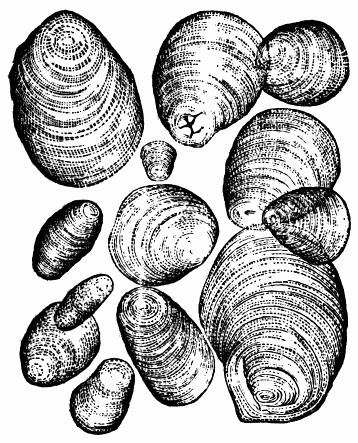
Microscopic appearance of Tous-les-mois.
TOXICOL′OGY. See Poison.
TRAG′ACANTH. See Gum.
TRANSPA′′RENCIES. Water-colour pictures on paper, linen, or calico, if executed in non-opaque or glazing colours, may be converted into transparencies by simply brushing over their backs with Canada balsam, thinned down, when necessary, with a little oil of turpentine. For coarse work, boiled oil may be employed.
TRAPS, HOUSE. With few exceptions, the endless varieties of traps advertised for house-drains are all modifications of the older forms of the syphon, the midfeather and the ball-trap. The syphon trap consists of a bent tube with a deep curve, in which the water lies and acts as an hydraulic valve.
The following conditions are essential for its proper action. The curve must be of such a depth as to ensure a height of not less than 3⁄4 inch of water always standing above the highest level of the water in the curve. The
The midfeather trap consists of a round or square box or receptacle, into the upper part of which, on one side, an inlet pipe discharges, whilst at a corresponding height on the opposite side there is an outlet pipe. The upper part of the box is divided by a partition, which dips at least 3⁄4 inch below the surface of the water, always standing in the receptacle, at the level of the outlet pipe. The principle, therefore, of the midfeather is similar to the syphon trap. The receptacle is so arranged that any heavy substances collected at the bottom can from time to time be removed. A useful variety of the midfeather is ‘Dean’s patent drain-trap,’ manufactured by Edwards, of Ruabon.
The ball-trap is not in very general use. By this arrangement the drain is trapped by means of a hollow ball, which rises with the water in the drain until it is carried against and closes an orifice.
The common ball-trap is stated to be inefficient and unsatisfactory. The facility with which it can be removed or placed out of gear often leads, in the hands of careless servants, to the untrapping of the drain altogether. A good description of common sink trap is Antel and Lock’s, shown in the accompanying engraving, which explains itself.
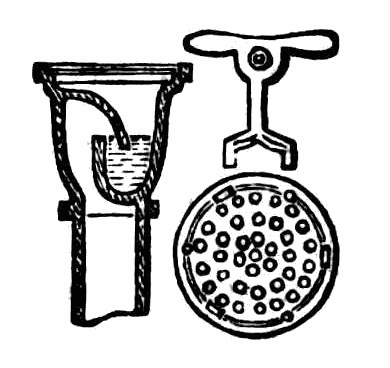
Amongst the circumstances that impair the efficiency of house-traps may be included the neglect to allow the passage of water through them sufficiently often, and with force enough to flush and cleanse the trap, and renew the water in it. The results are, that the water becomes saturated with sewage exhalations, which escape into and contaminate the air in the house; and that the trap becomes either dry or choked up.
Another contingency to which house-traps are exposed when the drains are made to form a continuous and disconnected system with the sewers, is that of the water being sucked out of the trap, owing to the combined effect of the pressure of sewer air and the aspirating power of the house, into which the sewer-gas would then pass unchecked.
In our articles Drainage and Sinks, we have pointed out the peril attaching to the intimate connection between the house-drains and sewers, and given in the former practical directions for its avoidance.
To rest in the belief that the danger can be removed (although the risk may be slightly diminished) by the use of traps alone, is to entertain a very false sense of security.
TRAUMAT′IC BALSAM. Compound tincture of benzoin is known by this name. See Tincture.
TRAUMAT′ICINE. This article, as manufactured by the Gutta Percha Company, is simply a solution of white and dry unmanufactured gutta percha in bisulphuret of carbon. A small portion dropped on a wound, or raw surface, almost instantly forms a pliable, waterproof, and air-tight defensive covering to the part. The only objection to the preparation is the fetid odour of the menstruum, which, however, is lost in a few seconds, or may be obviated by employing chloroform as the solvent.
TREA′CLE. Syn. Molasses; Theriaca (B. P.), Theriaca, Sacchari fæx (Ph. L. & E.), L. The viscid, brown, uncrystallisable syrup which drains from moist sugar during its formation (molasses), and from the sugar-refining moulds (sugar-house molasses). The last, according to Dr Ure, has generally the sp. gr. 1·4, and contains about 75% of solid matter.
Treacle is more laxative than sugar, and always contains more or less free acid. It is used as the vehiculum in some of the pill-masses of the Ph. L. See Sugar.
Treacle, German. Syn. Theriaca Germaniæ, L. An evaporated infusion or decoction of juniper berries. It is sweet-tasted, aromatic, and diuretic.
Treacle, Venice. Syn. London treacle; Theriaca, T. androchi, L. The theriaca of the Ph. L. 1746 consists of 61 ingredients, and contains 1 gr. of opium in 75 gr.; that of the Paris Codex consists of 72 ingredients, and contains 1 gr. of opium in 72 gr.; that of the Ph. E. 1744 consists of 10 ingredients, and contains 1 gr. of opium in every 100 gr. It is prepared as follows:—Take of serpentary root, 6 oz.; valerian and contrayerva roots, of each 4 oz.; aromatic powder, 3 oz.; guaiacum resin, castor, and nutmeg, of each 2 oz.; saffron and opium (dissolved in a little wine), of each 1 oz.; clarified honey, 75 oz.; reduce all the dry ingredients to fine powder, then mix them. The confections or electuaries of catechu and opium are the representatives of the above polypharmic compounds in the modern British Pharmacopœias.
TRI-, TRIS-. See Nomenclature.
TRIBASIC PHOSPHATE OF LIME. Syn. Tricalcic phosphate. (Ca3(PO4)2.) Tricalcic phosphate occurs nearly pure in the mineral known as osleolite. See Calcium phosphate for its artificial preparation.
TRIMETHYLAMINE. Syn. Trimethylia.
C3H9N, or { CH3 } n.
{ CH3 }
{ CH3 }
An ammonia found in large quantities in the roe of the herring. It also occurs in putrefying flour and urine, and is the ingredient which gives to the Chenopodium vulvaria its peculiar and disagreeable odour. It may also be obtained by distilling ergot of rye with caustic potash. Trimethylia is a volatile fluid, with a very pungent and unpleasant fishy smell. It boils at about 41° F. It is metameric with propylamine.
TRIPE. This is the paunch, or first portion of the ruminant stomach of the ox. It is nutritious and easy of digestion, except when very fat. Letheby gives the following as its composition:
Nitrogenous matter 13·2
Fat 16·4
Saline matter 2·4
Water 68·0
———
100·0
Tripe, Fried in Batter. “Tripe is cut into pieces about three inches square, and dipped into a batter made of six ounces of flour, one tablespoonful of oil, or one ounce of butter, and half a pint of tepid water. Mix the oil with the flour, add the water by degrees, whip the whites of two eggs to a stiff froth, stir into the batter, dip the tripe in, throw it into a saucepan of boiling fat, let it fry three or four minutes, take it out, and drain.”[240]
TRIP′OLI. Syn. Rotten stone; Alana, Terra cariosa, L. A mineral employed as a polishing powder, originally imported from Tripoli, in Barbary. It consists almost entirely of silica, and is composed of the skeletons of minute infusoria, the precise character of which is readily distinguishable under the microscope.
TRIS′MUS. See Tetanus.
TRITURA′TION. Syn. Tritura, Trituratio, L. The act of rubbing a solid body to powder. See Pulverisation.
TRO′CHES. See Lozenges.
TRO′NA. A native carbonate of soda, found on the banks of the soda-lakes of Sokena, in Africa.
TROPH′AZOME. A concentrated infusion of minced lean meat mixed with the fluid obtained from the residuum after being heated for 20 minutes in a water bath, and flavoured with salt and spices, the whole being, lastly, simmered for a few minutes. Excellent for convalescents.
TROUT. The Salmo furio of Linnæus, a highly-esteemed fish, found in most of the rivers and lakes of this country. Other members of the genus salmo are also so called, as, S. eriox, the bull or grey trout; S. ferox, the great grey or lake trout; S. trutta, the salmon trout, &c. All of these varieties are in the finest condition from the end of May to late in September.
The trout contains about 6 per cent. of fat. It is desirable to cook this fish as soon as convenient after taking it.
TRUSSING. This is a well-known operation performed on poultry or game previous to their being roasted or boiled. It simply consists in drawing or removing the intestines and other objectionable parts. In doing this, care must be taken to avoid rupturing the gall-vessel, which, if broken, would impart a very bitter flavour to the poultry, &c., extremely difficult of removal.
The cook should never take for granted that poultry or game, when it comes from the dealer, has been thoroughly cleansed inside, out, in order to be safe in this matter, should always make a point of cleansing it herself.
TULUOLE. Syn. Tuluol; Benzoene (C7H8.) One of the hydrocarbons homologous with benzol, with which it occurs associated with xylol and isocumole, in the light oil obtained from the distillation of coal tar. It is also one of the products of distillation of balsam of Tolu, and would seem to be identical with the retinaptha obtained by Pelletier and Walter from the distillation of rosin. If oxidised by means of chromic acid it yields benzoic acid. Its boiling point is 230° F., and its sp. gr. 0·87.
TUMOURS. Tumours, of which there are a great variety, are abnormal growths, occurring in different parts of the body. Sir Jas. Paget describes them as belonging to the class of overgrowths or hypertrophies, their most constant distinctive characters being—1. Their deviations, both in respect to size and shape, from the normal type of the body in which they are found. 2. Their apparently inherent power and method of growth. 3. Their development and growth being independent of those of the rest of the body, and continuing with no evident purpose, when the rest of the body is only being maintained in its normal type.
Tumours are divided by pathologists into malignant and innocent or benign.
In the former division is included cancer. The most common varieties belonging to the second division are cutaneous cysts, fatty tumours, and fibro-cellular tumours. Cutaneous cysts, which may occur under any part of the skin, are most frequently met with in the scalp. They mostly arise from “the morbid growth of natural ducts or follicles, or by the enormous growth of elementary structures, which increase from the form of cells or nuclei, and become closed sacs with organised walls capable of producing other growths.”[241]
The most commonly occurring tumour is the fatty one. It usually develops itself on the bodies of persons of from forty to fifty years of age. It seldom occasions inconvenience, and appears to be in no way prejudicial to health; occasionally, however, these tumours are very unsightly and unpleasant to look upon. The fat of which they are composed
A pseudo tumour is occasionally met within surgical practice, which may often be mistaken for a real one, by the unwary or inexperienced practitioner. This, which is known as a phantom tumour, appears to be caused by muscular contraction. Sir Jas. Paget, writing on this subject, says: “The abdominal muscles of hysterical women are most often affected, sometimes with intentional fraud. The imitation of a tumour may be so close as to require great tact for its detection; but chloroform, by relaxing the muscles, dissipates the swelling. Occasionally the apparent tumours move.
TUNG′STEN. W. Syn. Tungstenum. Wolframium, L. A heavy, grey, brittle metal, discovered by Delhuyart.
The word tungsten, in Swedish, signifies ‘heavy stone’ (tung-sten), the name being applied to the element because the source from which it is obtained is a heavy mineral called Wolfram. Wolfram may be regarded as a variable double tungstate of iron and manganese, and the tungsten occurs in this. A native tungstate of copper has been discovered in Chili. Tungsten is also found in the mineral scheelite, a tungstate of lime. From this latter compound it may be procured by digesting finely-powdered scheelite in hydrochloric acid. Chloride of calcium is formed, together with insoluble tungstic acid. Upon heating the acid to bright redness in a stream of hydrogen gas, the metal is left behind. When thus procured it is of a dark-grey colour, but under the burnisher it may be made to assume a metallic lustre. Metallic tungsten may also be obtained by the reduction of tungstic acid, by means of charcoal at a white heat. When procured by this method it is unaffected by hydrochloric or diluted sulphuric acid, although it becomes reconverted into tungstic by the action of nitric acid.
When tungsten occurs in the pulverulent form, it burns easily into tungstic anhydride, when heated in the air; and is oxidised and dissolved when boiled with the caustic alkalies or their carbonates in solution. An alloy, possessed of extreme hardness, may be procured when tungsten is combined with steel, in the proportion of 1 part of tungsten to 10 parts of steel.
There are two known oxides of tungsten, viz. a dioxide (WO2) and a trioxide (WO3). According to Wöhler there is a third oxide, having the composition (WO2WO3).
Dioxide, or Binoxide of Tungsten. (WO2.) This is an indifferent oxide, and is obtained by treating tungstic acid with hydrogen at a low red heat. It occurs as a brown powder, which absorbs oxygen greedily from the air, and is dissolved by boiling with solution of caustic potash, hydrogen being evolved and potassium tungstate being formed.
Trioxide of Tungsten. (WO3.) Syn. Tungstic anhydride. This may be obtained by decomposing wolfram with aqua regia, and evaporating to dryness. The resulting tungstic acid is dissolved in ammonia, and the ammonic tungstate purified by crystallisation. When this ammonic tungstate is heated in the air, it loses ammonia and water, pure tungstic trioxide being left behind.
Tungstic Acid. (H2WO4.) This compound may be procured by adding an excess of hydrochloric acid to a boiling solution of the trioxide in any of the alkalies. It occurs as a yellow powder.
Tungstic Chloride. (WCl6.) This may be obtained by heating tungsten in chlorine, when it sublimes in bronze-coloured needles, which are decomposed by water. When gently heated in hydrogen, this chloride becomes converted into tetrachloride (WCl4).