A CYCLOPÆDIA OF PRACTICAL RECEIPTS, &c. VOLUME II (continued 37)
Reading edition
Concluding Remarks. Refined sugar (Saccharum—Ph. L., S. PURUM—Ph. E., S. PURIFICATUM—Ph. D.), raw sugar (S. COMMUNE—Ph. E.), and molasses or treacle (SACCHARI FÆX—Ph. L. & E.), were officinal.
The relative sweetening power of cane sugar is estimated at 100; that of pure grape sugar, at 60; that of fecula or starch sugar, at 30 to 40.
According to Messrs Oxland’s method (patented 1849) of defecating and bleaching the juice of beet-root, cane, &c., acetate of aluminium, formed by dissolving 4 lbs. of that earth in acetic acid, is boiled with each ton of sugar, and as soon as the acetic acid is nearly all driven off, a solution of tannin, formed from 1 lb. of bruised valonia and 2 galls. of hot water, is added to the boiling syrup; the excess of aluminium is afterwards separated by lime, and the usual method of further procedure adopted. By their second patent (1851), superphosphate of aluminium or of calcium is substituted for acetate of aluminium, in the proportion of about 6 lbs. of aluminium, dissolved in phosphoric acid, for each ton of sugar.
The presence of certain saline bodies in a solution of cane sugar, exercises a very prejudicial effect upon it, since these, by combining with the sugar, give rise to compounds which contribute to the more or less reduction of the sugar to the uncrystallisable condition, and to a consequent increase of the molasses.
Of one of the chief constituents of the sugar-cane that possesses this objectionable property is potash in combination with acids, both organic and inorganic. Last year a patent for the removal of these potash salts was taken out by the Messrs Newlands. The patentees proceed upon the facts that the solubility of alum in water is very trifling, and that it contains only 1⁄10th part of its weight of potash. They add to a concentrated syrup a strong solution of sulphate of alumina (having by a previous examination of the syrup determined the quantity required). Sulphate of potash is thereby formed, and this, uniting with the sulphate of alumina, the resulting alum after a time deposits in a crystalline form at the bottom of the vessel containing the sugar solution. This being run off into another receptacle, the free acid, of which it now contains a large quantity, is neutralised with lime or chalk, boiled, filtered, and passed through charcoal.
The addition of the lime has also thrown down the alumina liberated by the reaction, which has carried with it and removed certain injurious nitrogenous principles previously present in the saccharine liquid.
Some few years back Messrs Dubrunfaut and Péligot being cognisant of the fact of the insolubility, in boiling water, of the compounds of sugar with lime, based upon it a method of separating crystallisable sugar from treacle. Péligot has obtained from common treacle one fourth of its weight of crystallised sugar, by dissolving the precipitated sugar lime in water, and separating the lime by passing into the mixture a stream of carbonic acid.
Sugar may be obtained from nearly all sweet vegetable substances, by a process essentially similar to that described above.
Table showing the Specific Weight of Sugar Solutions with the corresponding percentage of Cane Sugar at 17·5° C.—Gerlach.
Percentage, Cane Sugar. Specific Weight of Sol. Percentage, Cane Sugar. Specific Weight of Sol. Percentage, Cane Sugar. Specific Weight of Sol.
75 1·383,342 49 1·227,241 24 1·101,377
74 1·376,822 48 1·221,771 23 1·096,792
73 1·370,345 47 1·216,339 22 1·092,240
72 1·363,910 46 1·210,945 21 1·087,721
71 1·357,518 45 1·205,589 20 1·083,234
70 1·351,168 44 1·200,269 19 1·078,779
69 1·344,860 43 1·194,986 18 1·074,356
68 1·338,594 42 1·189,740 17 1·069,965
67 1·332,370 41 1·184,531 16 1·065,606
66 1·326,188 40 1·179,358 15 1·061,278
65 1·320,046 39 1·174,221 14 1·056,982
64 1·313,946 38 1·169,121 13 1·052,716
63 1·307,887 37 1·164,056 12 1·048,482
62 1·301,868 36 1·159,026 11 1·044,278
61 1·295,890 35 1·154,032 10 1·040,104
60 1·289,952 34 1·149,073 9 1·035,961
59 1·284,054 33 1·144,150 8 1·031,848
58 1·278,197 32 1·139,261 7 1·027,764
57 1·272,379 31 1·134,406 6 1·023,710
56 1·266,600 30 1·129,586 5 1·019,686
55 1·260,861 29 1·124,800 4 1·015,691
54 1·255,161 28 1·120,048 3 1·011,725
53 1·249,500 27 1·115,330 2 1·007,788
52 1·243,877 26 1·110,646 1 1·003,880
51 1·238,293 25 1·105,995 0 1·000,000
50 1·232,748
Sugar, Al′um. Syn. Saccharum aluminatum, Alumen saccharinum, L. From alum and white sugar, in fine powder, equal parts, formed into minute sugar-loaf shaped lumps with mucilage of gum Arabic made with rose water. Used to make astringent lotions and eye-waters.
Sugar. Bar′ley. Syn. Saccharum hordeatum, Penidium, Saccharum penidium, L. Prep. Take of saffron, 12 gr.; hot water, q. s.; sugar, 1 lb.; boil to a full ‘candy height,’ or that state called ‘crack,’ or ‘crackled sugar,’ when 2 or 3 drops of clear lemon juice or white vinegar must be added, and the pan removed from the fire and set for a single minute in cold water, to prevent its burning; the sugar must be then at once poured out on an oiled marble slab, and either cut into pieces or rolled into cylinders and twisted in the usual manner. One drop of oil of citron, orange, or lemon, will flavour a considerable quantity. White barley sugar is made with a strained decoction of barley instead of water, or starch is added to whiten it.
Sugar, Beet-root. Syn. Saccharum betæ, L. Sugar obtained from the white beet.
In the following table the names of the countries in which this plant is cultivated are given, together with the amount of sugar annually produced in each:
France 280,000 tons.[207]
Germany 260,000 ”
Austria and Hungary 180,000 ”
Russia and Poland 130,000 ”
Belgium 50,000 ”
Holland and other countries 17,000 ”
The white beet is used in preference to the red varieties, not only because of the colour of its juice, but also in consequence of its being richer in sugar. The roots vary in their yield of sugar according to quality and the season of the year. They are generally in best condition in October. The root is made up of a series of small cells, which are filled with the saccharine fluid. According to Wagner the constituents of the sugar-beet are as follows:
Water 82·7
Sugar 11·3
Cellulose 0·8
Albumen, casein, and other bodies 1·5
Fatty matter 0·1
Organic substances, citric acid, pectin, and pectic acid. Asparagin, aspartic acid, and betain, a substance having, according to Schiebler, the formula C15H33N3O6 3·7
Organic salts, oxalate and pectate of calcium, oxalate and pectate of potassium and sodium
Inorganic salts, nitrate and sulphate of potash, phosphate of lime and magnesia
Twelve and a half hundred weight of beet yield on an average 1 cwt. of raw sugar, or 8 per cent.
The first operation in the manufacture of beet-root sugar after washing and cleansing the roots (an operation which sometimes reduces their weight 10 or 20 per cent.) is the extraction from them of the juice. This may be effected either by:
1. Pressure.
2. Centrifugal power.
3. Dialysis.
1. Pressure. The roots being put into a proper crushing machine are soon reduced to an uniform pulp, which in some manufactories is subjected to pressure wrapped in linen cloths under stone or iron rollers, and in others is placed in bags and placed under the Bramah or hydraulic press, the resulting juice being collected in proper receptacles.
2. Centrifugal power. This method is that generally employed for separating the juice from the pulp, which thus yields between 50 or 60 per cent. of juice. A weak saccharine solution, also used in sugar manufacture, is afterwards obtained by mixing the residue of the pulp with water, and subjecting it to the same process.
3. Dialysis. The application of the principle of diffusion for the extraction of the sugar from the beet-root originated with M. Robert. The fresh roots, cut into thin slices, are immersed in a little more than their own weight of water heated to about 120° F. The crystalloid sugar thus diffuses out through the cell membrane which encloses it into the surrounding water, leaving the pectous and colloid matters, such as albumen, gum, &c., behind. The operation which is so managed as to bring the same water into contact with successive quantities of root, yields a saccharine solution of nearly the same strength as the natural juice. The solution so obtained is, after concentration and the usual methods, converted into sugar. The same process is said to have been tried with cane sugar, and with equally satisfactory results.
The succeeding stages of the manufacture of beet sugar, such as refining, liming, decolorising, &c., are the same as those already described under cane sugar.
Beet sugar is in every respect identical with cane. It was discovered in 1747 by Marggraf, of Berlin, but it did not come into use until about the beginning of the present
The engraving represents a vacuum pan much used in the French sugar refineries.
Fig. 1 gives a perspective, and fig. 2 a sectional view of this evaporating pan.
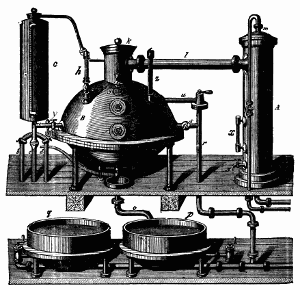
Fig. 1.
Right click:
Larger.
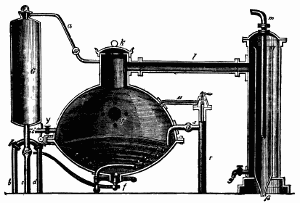
Fig. 2.
Right click:
Larger.
The boiling-pan (B) consists of two air-tight hemispheres, surmounted by a funnel, connected by the tube (l) with the condenser (A). The apparatus is supplied by steam by (r s), the steam circulating in the boiling-pan by means of the pipes (g), fig. 2. By opening the lever valves (f) the juice can be run by means of the pipe (o) into the pan (p). When the pan, after continued boiling, requires to be refitted, the pipes (l and w) are connected to an air-pump. The manometer (h) shows the state of the air pressure, which can be regulated by opening the pipes connected to the vacuum chamber. By means of the gauge cylinder (G) the quantity of syrup in the boiling-pan can be ascertained, the gauge cylinder being connected to the boiling-pan by the pipes (a and i), and the height read off from the gauge tube (n). The syrup can be removed, for the purpose of ascertaining its consistency, from the gauge cylinder by means of either of the three pipes (b, c, d). By u steam can be admitted to the boiling-pan and condenser. e is generally of stout glass, and enables the state of the juice to be seen. g is the grease cock, f the manhole. The condenser consists of the jacket (B), arranged to prevent the mixing of the juice with the water used for condensation. x is the gauge. The pipe (m) conveying water to the condenser terminates in a rose. z is a thermometer showing the interior temperature of the boiling-pan.
The air-pump being set in operation the tube (c) is opened, and the gauge cylinder filled by the juice rising from q. By closing m and opening y the juice is admitted to the boiling-pan. When this is half full the steam pipe (s) is opened, the steam quickly heating the contents of the pan to the boiling point. The condenser is then placed in working; by opening the pipe (l) the steam of the juice passes into the condenser, where it is speedily condensed, passing with the water through β.
Sugar, Diabet′ic. Grape sugar found in the urine of persons labouring under diabetes. In diabetes insipidus, a substance having the general properties of a sugar, but destitute of a sweet taste, appears to be produced (Thénard.)
Sugar, Gel′atin. See Glycocine.
Sugar, Grape, C6H12O6.H2O. Syn. Glucose, Fruit sugar; Saccharum uvæ, S. fructus, L. This substance is found in the juice of grapes and other fruit, in the urine of diabetic patients, and in the liquid formed by acting on starch and woody fibre with dilute sulphuric acid.
Prep. 1. From the juice of ripe grapes or an infusion of the ripe fruit (raisins), by saturating the acid with chalk, decanting the clear liquid, evaporating to a syrup, clarifying with white of egg or bullock’s blood, and then carefully evaporating to dryness; it may be purified for chemical purposes by solution and crystallisation in either water or boiling alcohol. Like other sugar, it may be decoloured by animal charcoal.
2. From honey, by washing with cold alcohol, which dissolves the fluid syrup and leaves the solid crystallisable portion.
Prop. It is less sweet and less soluble than cane sugar, requiring 11⁄2 part of cold water for its solution; instead of bold crystals, it forms granular warty masses, without distinct crystalline faces; it does not easily combine with either oxide of calcium or oxide of lead; with heat, caustic alkaline solutions turn it brown or black, but it dissolves in oil of vitriol without blackening, the reverse being the case with cane sugar; with chloride of sodium it forms a soluble salt, which yields large, regular, and beautiful crystals. Sp. gr. 1·400.
The various fruits contain grape sugar in the following proportions:
Per Cent.
Peach 1·57
Apricot 1·80
Plum 2·12
Raspberry 4·00
Blackberry 4·44
Strawberry 5·73
Bilberry 5·78
Currant 6·10
Plum 6·26
Gooseberry 7·16
Cranberry 7·45 (according to Fresenius).
Pear 8·02 to 10·8 (E. Wolff).
Apple 8·37 (Fresenius).
” 7·28 to 8·04 (E. Wolff).
Sour cherry 8·77
Mulberry 9·19
Sweet cherry 10·79
Grape 14·93
Obs. Cane sugar is converted into grape sugar during the process of fermentation, and by the action of acids. See Sugar, and Sugar, starch (below).
Sugar, Maple. Syn. Saccharum acerinum, L. From the juice of the sugar maple. It is identical with cane sugar.
In the United States and the British Colonies of North America considerable quantities of this sugar are made. The juice is obtained by boring through the bark of the tree to a depth of about a quarter or half an inch. Each tree has generally two perforations made in it, and they are always made on that side of the tree which faces towards the south, and at a distance of about 20 inches from the ground. The juice flows into suitable vessels, into which it is conducted by reeds placed under the perforations. The period chosen for tapping the trees is that during which it is known the sap is ascending, from March to May. Sometimes the tree undergoes a second tapping in the autumn, but this is not generally practised, inasmuch as it is injurious to the tree. A daily yield of 6 galls, of juice from each incision is looked upon as a ‘good run,’ and if this 6 gall. be the produce of an old tree or ‘old bush’ they will yield 1 lb. of sugar. In a young tree or ‘young bush’ the yield of sugar from the same quantity of sap is only half. By proper care the same tree may be tapped 20 or 30 years following. Unlike the sugar-cane the juice in the maple is the richest in sugar the higher it is found from the ground. The concentrated saccharine liquid is concentrated every 24 hours. The raw crystallised sugar undergoes no refining, and being made into blocks is then sent to market.
Sugar, Milk. C12H22O11.H2O. Syn. Sugar of milk, Lactin; Saccharum lactis (Ph. D.), L. Prep. Gently evaporate clarified whey until it crystallises on cooling, and purify the crystals by digestion with animal charcoal and repeated crystallisations.
Prop., &c. White, translucent, very hard cylindrical masses or four-sided prisms; soluble in about 6 parts of cold and in 2 parts of boiling water; nearly insoluble in alcohol and ether; ammoniacal plumbic acetate precipitates it from its solutions. When an alkaline solution of grape sugar is boiled with the salts of copper, silver, or mercury, it reduces them; it produces right-handed rotation of a ray of polarised light; by boiling with dilute acid it is converted into galactose (C6H12O6); treated with nitric acid it yields mucic acid, with small quantities of saccharic, oxalic, and tartaric acid. Milk sugar is unsusceptible of the vinous fermentation, except under the action of dilute acids, which convert it into grape sugar; in solution, it is converted into lactic or butyric acid by the action of caseine and albuminous matter. Milk contains about 5% of it. (Boussingault.)
Obs. Sugar of milk is chiefly imported from Switzerland. In this country it is chiefly used as a vehicle for more active medicines, especially among the homœopathists.
Sugar, Starch. Syn. Potato sugar, Fæcula s. This is grape sugar obtained by the action of diastase on starch, in the manner noticed under Gum (British), or by the action of dilute sulphuric acid on starch, or of the strong acid on lignin, or on substances containing it.
Prep. 1. From corn. The corn is first steeped in soda lye; it is then ground wet and passed through revolving sieves to separate the husks and gluten. The starch is carried through long troughs, in which are placed transverse pieces of wood, against which the solid particles of starch lodge, and are thus separated from the washing waters. These wash waters run into a large cistern, where it undergoes fermentation into weak vinegar. The starch in the wet state is then put into a mash tub and treated for from 3 to 8 hours with 1 per cent. of sulphuric acid. The acid liquor is neutralised with chalk and evaporated in vacuum pans; and after being separated from the sulphate of lime it is run into barrels and allowed to crystallise. The grape sugar is sometimes manufactured in blocks 6 inches square, and dried on plaster plates in a current of dry air, as hot air would decolorise it. Large quantities of grape sugar manufactured as above are now produced in the United States, particularly in New Orleans, Buffalo, and Brooklyn. A considerable amount from the same source reaches this country from the Continent, and is employed in our breweries. When specially prepared for the use of the latter the blocks are crushed into small pieces about the size of malt grains. Our excise authorities prohibit the entrance of glucose into a brewer’s premises in the liquid state. In the brewing of pale sparkling ales grape is esteemed more than either cane sugar or malt, and is said to yield a more sound and wholesome liquor, and one free from the acidity, impurity, and treacly sweetness frequently found in beers brewed from raw or inferior sugars. Glucose may also be obtained from cellulose, but the process is too expensive to admit of being practically worked.
2. Potato starch, 100 parts; water, 00 parts; sulphuric acid, 6 parts; mix, boil for 35 or 40 hours, adding water, to make up for evaporation; then saturate the acid with lime or chalk, decant or filter, and evaporate the clear liquor. Under pressure the conversion is more rapid. Prod. 105%.
3. “The starch of potatoes can be converted into glucose by digestion for a few hours with parings of the potato. This operation is largely practised by German farmers in the preparation of food for fattening hogs. An excellent starch sugar can be prepared from Indian corn, which will yield alcohol one eighth cheaper, and quite as pure as that from cane sugar.”[208]
4. Shreds of linen or paper, 12 parts; strong sulphuric acid, 17 parts (Braconnot; 5 of acid, and 1 of water—Vogel); mix in the cold; in 24 hours dilute with water, and boil it for 10 hours; then neutralise with chalk, filter, evaporate to a syrup, and set the vessel aside to crystallise. Prod. 114%. Sawdust, glue, &c., also yield grape sugar by like treatment. See Lignin.
Sugar from other Sources. Considerable quantities of East Indian cane sugar are yielded by certain Indian palms, the principal of which are the Arenga saccharifera and the Phœnix sylvestris or wild date. Another source whence large quantities of cane sugar are procured is the Sorghum saccharatum or sugar grass. This plant is exclusively grown in Ohio, and yields annually more than 15,000,000 gall. of juice, which is made into sugar.
Melezitose (C12H22O11). From larch manna.
Mycose or trehalose (C12H22O11). From Turkish manna.
Melitose (C12H24O12). From the eucalyptus.
Maltose (C12H24O12). From malt.
Eucalen (C6H12O6). By fermentation of melitose.
Sorbin (C6H12O6). From the berries of the service tree.
Effects of the varieties of Sugar on Polarised Light. Both sucrose, or cane sugar, and dextrose produce rotation upon a ray of polarised light. The plane of rotation is rotated to the right by sucrose rather more powerfully than by dextrose. It is remarkable that the uncrystallisable sugar of fruits produces an opposite rotation, viz. to the left. Since the degree of rotation is proportionate in columns of equal length to the quantity of sugar present, it has been proposed to employ this property in order to determine the quantity of sugar present in syrups.[209] The following, according to Berthelot, are the rotatory powers of the different varieties of sugar, if equal weights of each are dissolved in an equal bulk of water; the quantities of each sugar are calculated for the formulæ annexed:
Variety. Formula. Rotation. Temperature.
° Fahr. ° Cent.
Sucrose (cane sugar) (C12H22O11) Right 73·8°
Melezitose (C12H22O11) ” 94·1°
Mycose (C12H22O11) ” 193°
Melitose (C12H24O12) ” 102°
Dextrose (grape sugar) (C6H12O6) ” 57·4°
Malt sugar (C6H12O6) ” 172°
Lœvulose (fruit sugar) (C6H12O6) Left 106° 56 13·3
Eucalin (C6H12O6) Right 50°
Sorbin (C6H12O6) Left 46·9°
Lactose (milk sugar) (C6H12O6) Right 56·4°
Glucose of ditto (galactose) (C6H12O6) ” 83·3°
Inverted cane sugar (C6H12O6) Left 28° 57 13·9
SUGAR-BOILING. The art or business of the confectioner or sugar-baker; the candying of sugar. The stages are as follow:—Well clarified and perfectly transparent syrup is boiled until a ‘skimmer’ dipped into it, and a portion ‘touched’ between the forefinger and thumb, on opening them, is drawn into a small thread, which crystallises and breaks. This is called a ‘weak candy height.’ If boiled again, it will draw into a larger string, and if bladders may be blown through the ‘drippings’ from the ladle, with the mouth, it has acquired the second degree, and is now called ‘bloom sugar.’ After still further boiling, it arrives at the state called ‘feathered sugar.’ To determine this re-dip the skimmer, and shake it over the pan, then give it a sudden flirt behind, and the sugar will fly off like feathers. The next degree is that of ‘crackled sugar,’ in which state the sugar that hangs to a stick dipped into it, and put directly into a pan of cold water, is not dissolved off, but turns hard and snaps. The last stage of refining this article reduces it to what is called ‘carmel sugar,’ proved by dipping a stick first into the sugar, and then into cold water, when, on the moment it touches the latter, it will, if matured, snap like glass. It has now arrived at a ‘full candy height.’ Care must be taken throughout that the fire is not too fierce, as, by flaming up against the sides of the pan, it will burn and discolour the sugar; hence the boiling is best conducted by steam heat.
Any flavour or colour may be given to the candy by adding the colouring matter to the syrup before boiling it, or the flavouring essences when the process is nearly complete. See Stains, &c.
SUGAR CAN′DY. Syn. Saccharum candidum, S. crystallinum, S. crystallizatum, L. Sugar crystallised by leaving the saturated syrup in a warm place (90 to 100° Fahr.), the shooting being promoted by placing sticks, or threads, at small distances from each other in the liquor; it is also deposited from compound syrups, and does not seem to retain
Sugar candy is chiefly used as a sweetmeat; and, being longer in dissolving than sugar, in coughs, to keep the throat moist; reduced to powder, it is also blown into the eye, as a mild escharotic in films or dimness of that organ.
SUGAR OF LEAD. Acetate of lead.
SUGAR PLUMS. Syn. Bon-bons, Dragées, Fr. These are made by various methods, among which are those noticed under Drops (Confectionery), Lozenges, and Pastils, to which may be added the following:—Take a quantity of sugar syrup, in the proportion to their size, in that state called a ‘blow’ (which may be known by dipping the skimmer into the sugar, shaking it, and blowing through the holes, when parts of light may be seen), and add a drop or two of any esteemed flavouring essence. If the ‘bon-bons’ are preferred white, when the sugar has cooled a little, stir it round the pan till it grains and shines on the surface. When all is ready, pour it through a funnel into little clean, bright, leaden moulds, which must be of various shapes, and be previously slightly moistened with oil of sweet almonds; it will then take a proper form and harden. As soon as the plums are cold, take them from the moulds; dry them for two or three days in the air, and put them upon paper. If the bon-bons are required to be coloured, add the colour just as the sugar is ready to be taken off the fire.
Crystallised bon-bons are prepared by dusting them with powdered double-refined lump sugar before drying them.
Liqueur bon-bons, now so beautifully got up by the Parisian confectioners, are obtained by pressing pieces of polished bone or metal into finely powdered sugar, filling the hollow spaces so formed with saturated solutions of sugar in the respective liqueurs, and then spreading over the whole an ample layer of powdered sugar. In the course of three or four days the bon-bons may be removed, and tinted by the artist at will. Instead of white powdered sugar ordered above, coloured sugar may be used. These bon-bons are found to be hollow spheres, containing a small quantity of the spirit or liqueur employed, and will bear keeping for many months. See Sweetmeats, &c.
SUGARS (Medicated). Syn. Saccharides; Sacchara medicata, L.; Saccharolés, Saccharures, Fr. Some of these are prepared by moistening white sugar with the medicinal substance, then gently drying it, and rubbing it to powder; in other cases they are obtained in the manner noticed under Pulverulent Extracts, or Oleosaccharum. The most valuable preparation of this class in British pharmacy is the saccharated carbonate of iron (FERRI CARBONAS CUM SACCHARO—Ph. L.).
SUINT, Gas from. By this is understood a gas prepared from the fatty materials present in the soap-suds used in washing raw wool and spun yarns. The water containing the suint and soap-suds is run into cisterns, and is there mixed with milk of lime, and left to stand for twelve hours. A thin precipitate is formed, which, after the supernatant clear liquor has been run off, is put upon coarse canvas for the purpose of draining off any impurities, sand, hair, &c., while the mass which runs through the filter is put into a tank, in which it forms, after six or eight days, a pasty mass, which, having been dug out and moulded into bricks, is dried in open air. At Rheims the first wash-water of the wool is used for making both gas and potash, because the water contains no soap and only suintate of potash. Havrez, at Verviers, has recently proposed to employ suint—which, by-the-bye, is very rich in nitrogen—for the purpose of making ferrocyanide of potassium.
The dried brick-shaped lumps are submitted to distillation, yielding a gas which does not require purification, and which possesses an illuminating power three times that of good coal gas. The wash-water of a wool-spinning mill with 20,000 spindles yields daily, when treated as described, about 500 kilos of dried suinter, as the substance is technically called. One kilo of this substance yields 210 litres of gas. Annually about 150,000 kilos of suinter are obtained, and this quantity will yield 31,500,000 litres = 1,112,485 cubic feet of gas. Every burner consuming 35 litres of gas per hour, and taking the time of burning at 1200 hours, the quantity of gas will suffice for 750 burners, and as a spinning mill of 20,000 spindles only requires 500 burners, there is an excess of gas supply available for 250 other burners, or the owner may dispose of 5000 kilos of suinter, which is valued at Augsburgh[210]
SUL′PHATE. Syn. Sulphas, L. A salt of sulphuric acid.
SUL′PHIDE. A salt consisting of sulphur and a metal or other basic radical. See Sulphuretted hydrogen.
SULPHINDYL′IC ACID. Syn. Sulphindigotic acid. An intensely blue pasty mass, formed by dissolving 1 part of indigo in about 15 parts of concentrated sulphuric acid. See Sulphate of Indigo.
SUL′PHITE. A salt of sulphurous acid.
SULPHOCARBOLIC ACID. (Sulphocarbolates.) Carbolic acid, when acted upon by bases, yields a class of salts termed carbolates. These compounds are very unstable; they readily absorb water from the air, which sets free carbolic acid; they usually have the powerful odour of the latter. When, however, equivalent weights of carbolic and sulphuric acids are mixed, union takes place, a definite double acid (sulphocarbolic) results, and the salts formed by this double acid with the various bases are entirely different from the simple salts of carbolic acid. They are very stable, very soluble, possess neither odour nor taste of carbolic acid, and are singularly beautiful in crystalline form.
Sulphocarbolic Acid (HC6H3SO4) is obtained by the crystallisation in long colourless needles; unlike carbolic acid, it is soluble in water, alcohol, and ether, in any proportions.
Sulphocarbolate of Calcium [Ca(C6H5SO4)2 + Aq.] is obtained in very long, fine, densely interlacing crystals, which form in bulk, by their interlacement, a porous mass. Unlike the usual lime-salts, this is exceedingly soluble. This fact overcomes the great difficulty of treatment when in disease there is a deficiency of lime in the body, especially in rickets, in which disease the want of lime in the bones gives rise to distortions. The sulphocarbolate of magnesium crystallises in large, clear, rhombic prisms, easily soluble in water.
Sulphocarbolate of Copper [Cu(C6H5SO4)2] forms fine prismatic crystals of a blue colour. It is used as the zinc sulphocarbolate, chiefly as a lotion and dressing, in the proportion of 3 to 10 grains to the ounce of distilled water.
Sulphocarbolate of Iron [Fe(C6H5SO4)2] is in colourless or pale green rhombic plates. It is readily administered, and seems in some instances to be preferred to other salts of iron. It seems to have been of especial use in the skin diseases of children, wherein there is much formation of matter.
Sulphocarbolate of Sodium [Na(C6H5)SO4.Aq] is in brilliant, clear, rhombic prisms. The salt is very soluble in water. This salt can be administered as a medicine in doses of 20 to 60 gr.; it is slowly decomposed in the textures, carbolic acid being evolved. It thus becomes a very simple means of obtaining the beneficial effects of the administration of this antiseptic without the difficulties and dangers which attend it in its uncombined irritant and caustic form. It has proved of great service in the treatment of infectious diseases. Administered in the severest cases of diphtheria, malignant scarlet fever, typhoid, erysipelas, &c., the remedy has proved of extreme value.
Sulphocarbolate of Zinc [Zn(C6H5SO4)2] is chiefly employed in solution as a lotion. By high surgical authorities it is considered to answer all the purposes of the antiseptic dressing of carbolic acid. It is inodorous, and has very slight irritating action.
The Sulphocarbolates of Potassium [KC6H5SO4] and Ammonium [NH4C6H5SO4] are also brilliant crystals; they are freely soluble, administered with the greatest ease, and have been used with success as remedial agents.
SULPHOCYAN′OGEN. A well-defined salt radical, containing sulphur united to the elements of cyanogen. Its compounds are the sulphocyanides, most of which may be formed by directly saturating hydrosulphocyanic acid with the oxide or hydrate of the base; or, from the sulphocyanide of potassium and a soluble salt of the base, by double decomposition.
SULPHOFORM. Syn. Sulpoformum. An oily liquid obtained by distilling one part of iodoform with three of sulphide of mercury.
SULPHOPHE′NIC ACID. A synonym of sulphocarbolic acid. See Sulphocarbolates.
SULPHOVIN′IC ACID. C2H5HSO4. Syn. Sulphethylic acid; Acidum sulphovinicum, L. This substance is formed by the action of heat on a mixture of alcohol and sulphuric acid; it is the intermediate product which is developed in the preparation of ether. The salts are called sulphovinates or sulphothylates.
SUL′PHUR. [Eng., L.] Syn. Brimstone; Soufre, Fr. An elementary substance. That of commerce is chiefly imported from Sicily and Italy, and is a volcanic production.
Var. The principal of these are:
Amorphous sulphur, Brown s.; Sulphur amorphum, S. fuscum, S. informe, S. rubrum, L. Prepared from sublimed sulphur, by melting it, increasing the heat to from 320° to 350° Fahr., and continuing it at that temperature for about half an hour, or until it becomes brown and viscid, and then pouring it into water. In this state it is ductile, like wax, may be easily moulded in any form, is much heavier than usual, and when it has cooled does not again become fluid until heated to above 600° Fahr. The same effect is produced more rapidly by at once raising the temperature of the melted mass to from 430° to 480° Fahr.
Precipitated sulphur, Hydrate of sulphur, Milk of s.; Sulphuris hydras, Lac sulphuris, Sulphur præcipitatum (Ph. L.). Prep. 1. From sublimed sulphur, 1 part; dry and recently slaked lime, 2 parts; water, 25 parts, or q. s.; boil for 2 or 3 hours, dilute with 25 parts more of water, filter, and precipitate with dilute hydrochloric acid; drain, and well wash the precipitate, and dry it by a gentle heat. Resembles sublimed sulphur in its general properties, but is much paler, and in a finer state of division.
2. (B. Ph.) Sublimed sulphur, 5 oz.; slaked lime, 3 oz.; hydrochloric acid, 3 fl. oz., or q. s.; distilled water, q. s. Heat the sulphur and lime, previously well mixed, in 1 pint of water, stirring diligently with a wooden spatula, boil for 15 minutes and filter. Boil the residue again in 1⁄2 pint of water and filter. Let the united filtrates cool, dilute with 2 pints of water, and in an open place, or under a chimney, add in successive quantities the hydrochloric acid previously diluted with 1 pint of water until effervescence ceases, and the mixture acquires an acid reaction. Allow the precipitate to settle, decant off the supernatant liquid, pour on fresh distilled water, and continue the purification by affusion of distilled water and subsidence, until the fluid ceases to have an acid reaction, and to precipitate with oxalate of ammonia. Collect the precipitated sulphur on a calico filter, wash it once with distilled water, and dry it at a temperature not exceeding 120° Fahr.
Prop. A greyish-yellow powder free from grittiness, and with no smell of sulphuretted hydrogen.
Obs. Many pharmacists regard Lac sulphuris and Sulphur precipitatum as distinct substances, and assume that by milk of sulphur is intended a preparation made by an old pharmacopœial process, in which sulphuric acid being employed, the sulphur so precipitated contains from 50 to 75 per cent. of sulphate of lime. Pareira, Royle, Atfield, and some other authorities, hold that Lac sulphuris and Sulphur precipitatum are synonymous; whilst others, including Professor Redwood (one of the compilers of the B. P.) entertain a contrary opinion.
Roll sulphur, Cane s., Stick s.; Sulphur in bacculis, S. in rotulis, S. rotundum, L. This is crude sulphur, purified by melting and skimming it, and then pouring it into moulds. That obtained during the roasting of copper pyrites, and which forms the common roll sulphur of England, frequently contains from 3 to 7% of yellow arsenic.
Sublimed sulphur, Flowers of sulphur; Flores sulphuris, Sulphur (Ph. L.), Sulphur sublimatum (B. P., Ph. E. & D.), L. Prepared by subliming sulphur in iron vessels. For medical purposes, it is ordered to be well washed with water, and dried by a gentle heat. “A slightly gritty powder, of a fine greenish-yellow colour, without taste and without odour till heated.” (B. P.)
Sulphur vivum, Black sulphur, Crude s., Horse brimstone; Sulphur nigrum, S. caballinum, S. Griseum, L. This is crude native sulphur. It is a grey or mouse-coloured powder. The residuum in the subliming pots from the preparation of flowers of sulphur is now commonly substituted for it. It generally contains much arsenic, and is consequently very poisonous.
Pur. The sublimed sulphur of the shops is now, in general, of respectable quality, but the precipitated sulphur frequently contains about 2⁄3 of its weight of sulphate of lime (plaster of Paris), owing to the substitution of sulphuric acid for hydrochloric acid in its manufacture.[211] This is readily detected by strongly heating a little of the suspected sample in an iron spoon or shovel, when the sulphur is burnt or volatilised, and leaves behind the sulphate of lime as a white ash; this, when mixed with water, and gently dried, gives the amount of the adulteration. A still simpler plan is to dissolve out the sulphur in the sample with a little hot oil of turpentine or liquor of potassa; the undissolved portion is foreign matter.
Prop. Sulphur melts to a clear thin fluid, and volatilises at about 232° Fahr., and in open vessels rapidly takes fire, burning with a bluish flame. It is insoluble in both water and alcohol; it is soluble in oil of turpentine and the fatty oils, and freely so in bisulphide of carbon and hot liquor of potassa. With oxygen it unites to form sulphurous anhydride, and with the metals to form sulphides. Sp. gr. 1·982 to 2·015.
Estim. The determination of the quantity of sulphur, phosphorus, and chlorine, in a state of combination, especially in organic mixtures, is often rather troublesome. The proportion of sulphur is best determined by oxidising a known weight of the substances by strong nitric acid, or by fusing it in a silver vessel with 10 or 12 times its weight of pure hydrate of potassa and about half as much nitre. The sulphur is thus converted into sulphuric acid, the quantity of which can be determined by dissolving the fused mass in water, acidulating the solution with nitric acid, adding a salt of baryta, and weighing the resulting sulphate. Phosphorus is, in like manner, oxidised to phosphoric acid, the quantity of which is determined by precipitation in combination with sesquioxide of iron, or otherwise. The chlorine is correctly determined by placing a small weighed portion in a combustion-tube, which is afterwards filled with fragments of pure quicklime. The lime is then brought to a red heat, and the vapour of the liquid driven over it, when chloride of calcium is formed. The contents of the tube, when cold, are dissolved in dilute nitric acid, filtered, the chlorine precipitated by nitrate of silver, and theOrganic substances.
Uses, &c. Sulphur is extensively used in the manufacture of gunpowder, in bleaching, &c., &c. When swallowed, it acts as a mild laxative and stimulating diaphoretic; and has hence been long taken in various chronic skin diseases, in pulmonary, rheumatic, and gouty affections, and as a mild purgative in piles, prolapsus ani, &c. Externally, it is extensively used in skin diseases, especially the itch, for which it appears to be a specific.—Dose, 20 to 63 gr., in sugar, honey, treacle, or milk.
Sulphur, Chlo′′rides of. Several of these compounds exist but the following are the most important. 1. (Dichloride, S2Cl2.) Prepared by passing dry chlorine gas over the surface of sulphur melted in a bulbed-tube or small retort connected with a well-cooled receiver. The product is a deep orange-yellow and very mobile liquid, which possesses a disagreeable odour, and boils at 280° Fahr. It is soluble in bisulphide of carbon, and in benzol, without decomposing. It dissolves sulphur in large quantities, especially when heated. A solution of the dichloride with excess of sulphur in crude benzol is used for vulcanising caoutchouc.
2. (Chloride, Hypochloride, or Hypochlorite of the shops; Sulphuris chloridum, S. hypochloridum, S. hypochloritis, L.) This is prepared by spreading washed sulphur thinly on the bottom of a wooden box, or other chamber, and passing chlorine gas slowly over until it ceases to be absorbed.
Obs. This last compound is of variable and undetermined constitution. It has been recommended for internal use, by Derksengi, in old gouty affections, combined with pains in the stomach, and in severe nervous fever.—Dose, 1⁄2 to 2 gr.; dissolved in ether, and taken with old Hungary wine. It is also used externally in psoriasis inveterata, and other skin diseases.
Sulphur, I′odide of. S2I2. Syn. Biniodide of sulphur; Sulphuris iodidum (Ph. L.), Sulphur iodatum (Ph. D.), L. Prep. Into a glass flask put 1 part of sublimed sulphur, and over it place 4 parts of iodine; insert the cork loosely, and place the flask in a water bath; as soon as its contents melt, stir them with a glass rod, replace the cork, remove the bath from the fire, and let the whole cool together. When cold, break the iodide into pieces, and place it in a wide-mouthed stoppered bottle. In this way a beautiful semi-crystalline, dark grey mass, resembling antimony, is obtained. The formulæ of the B. P., Ph. L., E., & D., Ph. U. S., & P. Cod., are essentially similar. The Ph. D. orders the two substances to be powdered and mixed before heating them.
Uses, &c. It is stimulant and alterative. An ointment made of it has been recommended by Biett and others in tuberculous affections of the skin, in lepra, psoriasis, lupus, porrigo, &c.
Iodide of sulphur stains the skin like iodine, and is readily decomposed by contact with organic substances.
SULPHURA′TION. The process by which silk, cotton, and woollen goods, straw plait, &c., are subjected to the fumes of burning sulphur, or sulphurous acid, for the purpose of bleaching or decolouring them. On the large scale, this is effected in closed apartments, called ‘sulphuring rooms,’ to which sufficient air only is admitted to keep up the slow combustion of the sulphur. On the small scale, as for straw hats, bonnets, &c., a large wooden chest is frequently employed in the same way.
SUL′PHURET. Syn. Sulphide; Sulphuretum, Sulphidum, L. See Sulphide.
SULPHURET′TED HY′DROGEN (H2S). Syn. Hydrogen sulphide, Dihydric sulphide, Hydric sulphide; Hydrosulphuric acid. Sulphuretted hydrogen occurs in nature amongst the gaseous products given off by volcanoes, as well as in many mineral waters, amongst which may be instanced those of Harrogate, in England, of Moffat, in Scotland, and of Barèges, Eaux Bonnes, St. Sauveur, &c., in the Pyrenees. It is also evolved from decaying animal matter containing albumen, such as white-of-egg, as well as from putrisable animal and vegetable substances, when in contact with a soluble sulphate, and is always one of the gases present in the air of drains and sewers. Sulphuretted hydrogen may be procured by the direct union of hydrogen and sulphur, as by passing hydrogen into boiling sulphur. But this method of procuring it is rarely, if ever, adopted. The much readier process of acting upon a metallic sulphide by an acid constitutes the means by which the chemist almost invariably obtains this gas.
The details of the process are as follows:
1. About an ounce of ferrous sulphide, previously reduced to small pieces, is placed in a bottle, and then there is poured on to it a fluid ounce of sulphuric acid diluted with 8 times its bulk of water, when the following reaction ensues:—FeS + H2SO4 = H2S + FeSO4.
The gas which is immediately and copiously given off may be collected in an apparatus, a drawing and description of which are given below.
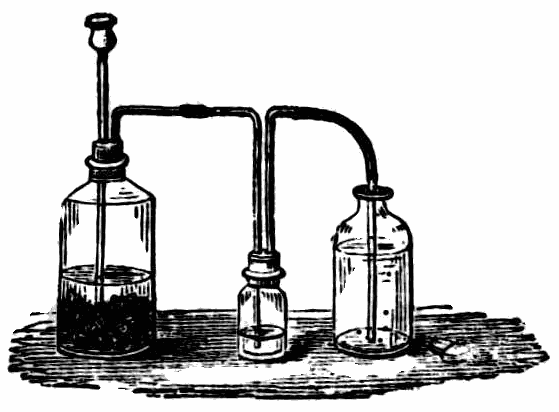
The diluted acid, having become cool, is poured through the bulb-shaped aperture down the glass tube upon the ferrous sulphide, and the evolved gas passing through the small intermediate wash-bottle into the bottle at the reader’s right hand, is absorbed by the water therein contained, the operation being continued until the water has become saturated with the gas. The glass tubes are connected with vulcanised india rubber, as shown in the above plate. Diluted hydrochloric acid is frequently substituted for sulphuric.
2. In the above process, the gas obtained, owing to the contamination of the iron sulphide, is more or less impure. When sulphuretted hydrogen is required in a state of purity, 1 oz. of antimonious sulphide must be employed instead of the iron sulphide, and instead of sulphuric 3 or 4 parts of hydrochloric acid. As heat must be applied to the mixture, it will be necessary to substitute a flask for the larger bottle, and to support it on a retort stand. In other respects the apparatus needs no alteration.
3. Sulphuretted hydrogen is also obtainable when paraffin is heated at a moderately elevated temperature with sulphur, the reaction being attended with an abundant evolution of the gas, and a simultaneous separation of carbon.
⁂ The solution of sulphuretted hydrogen, which is so indispensable to the chemist, and consequently in such constant requisition in the laboratory, unfortunately very quickly decomposes into water, and sulphur, which deposits at the bottom of the vessel containing it. To diminish as much as possible the tendency to deterioration, the solution should be made either with boiled water, or with the clear spoilt solution.
Qualities, &c. Sulphuretted hydrogen is a colourless inflammable gas, somewhat heavier than air, its specific gravity being 1·174. When ignited, it burns with a bluish flame, to water and sulphurous anhydride if the combustion take place in a sufficient quantity of air, but if the supply of air be too limited, sulphur is deposited. Under a pressure of 17 atmospheres it is condensed to a colourless and very mobile fluid, which boils at 79·6° F., and freezes at 72·8° F. to a transparent solid. Both the gas and its aqueous solution exercise a feebly acid reaction on litmus.
Sulphuretted hydrogen is highly poisonous; when inhaled in any quantity it causes fainting; and in smaller quantities, even when considerably diluted by air, if breathed for any length of time, it acts as a dangerous depressant and insiduous poison. Upon the lower animals it acts with fatal rapidity, even if diluted with 800 or 1000 parts of atmospheric air. Transmitted through tubes heated to redness, sulphuretted hydrogen becomes partially decomposed into its elements, hydrogen and sulphur. Water at 32° F. takes up 4·37 times its bulk of this gas, and at 59, 3·23 times its hulk, hence the importance of collecting it, over warm water, if required in the gaseous form.
In the presence of moisture, sulphurous anhydride and sulphuretted hydrogen, if equivalent quantities of each react upon each other, become decomposed into sulphur, water, and pentathronic acid; hence the value of sulphurous acid as a disinfectant. The deposited sulphur is found always to occur in the electro-positive condition. Chlorine, bromine, and iodine, also decompose sulphuretted hydrogen with deposition of sulphur, and formation of hydrochloric, hydrobromic, and hydriodic acids.
Hydrosulphates or Sulphides. Sulphuretted hydrogen or hydrosulphuric acid, as it is sometimes called, when brought into contact with bases in solution, gives rise to compounds, which by some chemists are regarded as hydrosulphates, or combinations of the base with hydrosulphuric acid; and by others as sulphides or combinations of the metal with sulphur, the latter reaction being attended with the elimination of water, as when a base is acted upon by hydrochloric acid. By those who hold the former view the reaction would be as follows:
K2O + H2S = K2O1H2S.
In the latter case it would be thus represented:
K2O + H2S = K2S + H2O.
The latter is the more general opinion, and it receives support from the fact that when sulphuretted hydrogen is passed into the solution of a metallic salt, an insoluble precipitate of a sulphide of the metal is thrown down. Thus, when the gas is passed into a solution of cupric sulphate, the precipitate consists of hydrated cupric sulphide, the liberated sulphuric acid renders the liquid which was before neutral, acid. The larger number of sulphides so formed, combining with water at the instance of their precipitation, occur as hydrates.
There is also a class of sulphides known as hydrosulphides, sulphydrates, or double sulphides, in which an equivalent of the metal is replaced by an equivalent of hydrogen. Examples of these are the potassic hydrosulphide (KHS), sodic hydrosulphide (NaHS), and ammonic hydrosulphide (H4NHS). No such combinations occur with hydrogen and the metals of the earth proper, and of the iron group.
Tests. Many of the hydrosulphates or sulphides may be detected, by dropping on them some hydrochloric acid, when the characteristic smell of sulphuretted hydrogen will be immediately evolved from them. Very small quantities of a sulphide may be detected as follows:—Place the suspected sulphide in a small test tube, on the upper part of which is inserted a piece of blotting paper moistened with a solution of plumbic acetate, then carefully pour some hydrochloric acid on to the substance, when, if it be a sulphide, the
Many small quantities of the soluble sulphides are revealed in neutral or alkaline solutions by the rich purple colour which they form on the addition of a solution of sodic nitro-prusside. Most of them, when heated before the blow-pipe, give off the smell of sulphurous acid.
The quantitative determination of free sulphuretted hydrogen, or of a soluble sulphide in any solution, is conducted as follows:—The liquid to be tested is mixed with a small quantity of a cold solution of starch, made slightly acid with acetic acid. A solution of iodine of known strength, dissolved in potassic iodide is then added, until the liquid just begins to turn blue from the action of the excess of iodine on the starch. In this process the sulphuretted hydrogen converts the iodine into hydriodic acid, whilst sulphur is liberated.
Of course the quantity of sulphuretted hydrogen is calculated from the quantity of iodine employed. The reaction is—
2H2S + 2I2 = 4HI + S2.
The value of sulphuretted hydrogen as a reagent has already been alluded to. It throws down most of the metals from solutions of their salts in the form of insoluble sulphides; and each of the sulphides so produced in many cases being distinguished from the others by a special and characteristic colour. The sulphuretted hydrogen thus presents the metal in a form in which it can, in many instances, be easily and with certainty recognised. Thus sulphide of lead is black, of arsenic yellow, of antimony orange, of manganese salmon colour, and of zinc white. By means of sulphuretted hydrogen, also, the chemist is enabled to separate the metals into groups.
For instance, from solutions containing certain metallic salts, sulphuretted hydrogen throws down the metals as sulphides, provided the solution has been previously made slightly acid. Copper, arsenic, tin, and cadmium, are some of the metals thrown down under these conditions.
The salts of iron, nickel, cobalt, and certain others, although they do not yield precipitates under like circumstances, are found to do so if their solutions are made alkaline instead of acid. Again, there are other salts, those of the alkalies and alkaline earths, which, when sulphuretted hydrogen is passed through these solutions, give no precipitates either in acid or alkaline solutions. The chemist, therefore, in the course of an analysis, frequently avails himself of a knowledge of these facts to separate certain metals from each other.
Hydrogen, Persulphide of. Syn. Hydric persulphide, Hydrogen disulphide. To procure this substance, calcium disulphide (CaS2) in solution is poured into hydrochloric acid diluted with twice its bulk of water. The solution being gently warmed, the persulphide subsides at the bottom as an oily fluid. Hydric persulphide has a great resemblance to hydric peroxide in qualities. It bleaches, and is decomposed, with violence, when brought into contact with the oxides of manganese and silver. It easily decomposes into sulphur and sulphuretted hydrogen.
SULPHU′RIC ACID. H2SO4. Syn. Oil of vitriol, British o. of v., Vitriolic acid†; Acidum sulphuricum (B. P., Ph. L. & E.), Acidum sulphuricum venale (Ph. D.), Acidum vitriolicum†, L. This acid, in a concentrated form, was discovered by Basil Valentine towards the end of the 15th century. At first it was obtained by the distillation of green vitriol, but is now made by the oxidation of sulphurous anhydride, obtained by the combustion either of sulphur or of certain sulphides. In consequence of the growing demand for sulphur in the manufacture of gunpowder, ultramarine, and for the destruction of the vine parasites in the vineyards of France, Italy, and Spain, sulphuric acid is now seldom made by burning sulphur, but, with few exceptions, by roasting iron pyrites, or bisulphide of iron.
The following table will convey an idea of the enormous consumption of this mineral in vitriol making in England alone. The quantities given represent tons.
Date. Pyrites from[212] Sum Total.
Norway. Germany. Belgium. Portugal. Spain. Italy. Sundry Places.
1862 4,975 6,817 9,860 53,296 33,717 ... 2,187 110,852
1863 6,736 15,409 12,059 109,180 33,213 ... 2,628 179,225
1864 16,087 12,751 7,069 118,489 15,529 ... 1,065 170,990
1865 22,229 14,727 2,121 137,787 16,393 ... 369 193,626
1866 38,262 21,574 4,006 165,993 11,910 ... 1,625 244,596
1867 77,895 34,592 2,299 105,556 50,222 ... 2,134 272,698
1868 63,007 41,559 ... 75,883 47,458 794 1,019 229,720
1869 63,091 13,983 ... 140,805 99,648 ... 2,420 319,947
1870 67,464 14,914 ... 174,459 150,990 ... 3,676 411,512
1871 74,416 12,809 ... 120,573 242,163 ... 4,581 454,542
1872 71,665 5,682 ... 180,329 257,429 ... 2,521 517,626
Of the other sulphides employed in vitriol making may be mentioned galena, or native sulphide of lead, which, when roasted, is made to give up half its sulphur. The chief consumption of this mineral is in the Harz. Copper pyrites is also used in the Harz, as well as in Swansea and Glasgow. Blende, or native sulphide of zinc, is also occasionally had recourse to.
In addition to the above sulphides, the vitriol maker in England, France, and Germany has lately largely availed himself of a compound known as ‘Laming’s mixture,’ which is an impure oxide of iron that has been used in gas manufacture for the removal from the gas of the sulphur. Laming’s mixture is consequently rich in this last element.
Associated with the pyrites in small quantities are various substances, some of which, becoming volatilised when the ore is burnt, enter the chambers with the mixed gases, and thus find their entrance into the acid, whilst others remain behind in the iron residue of impure ferric oxide, left on the hearth of the furnace after roasting. The former of these foreign bodies, which are found in most commercial acids, are described below under the section “Purification.” Amongst the solid non-volatile matters, the extraction of which
At Wolcrum, in Germany, the zinc which exists in the residue in the form of sulphate is extracted by lixiviation, and then treated with common salt, the reaction giving rise to the production of sulphate of soda and chloride of zinc. The soda obtained is sufficient to pay for the working of the operation, whilst a good profit is made by the sale of the large quantities of chloride of zinc which are thus yielded.[213]
The copper, which in some residues is met with to the amount of 4 per cent., also pays for extraction, and is sold to the smelter. It is first converted into chloride, and then precipitated by iron. The silver is recovered by Claudet’s process, which consists in precipitating it from a saline solution in which it is in the state of a soluble chloride, by iodide of potassium.
In the Widnes Copper Works the silver so extracted yields an annual profit of £3000.[214]
Thallium is found in the fine dust caused by the combustion of the pyrites, which dust deposits in the flues between the furnace and the chambers. The metal is extracted from the dust by treating this latter with dilute sulphuric acid. The resulting sulphate is converted into chloride, and again reconverted alternately into sulphate and chloride several times, the sulphate last obtained being reduced by metallic zinc.[215]
Selenium is also a frequent constituent in the flue dust. Some ores, after being subjected to roasting, yield iron capable of being worked. This is more particularly the case with the Spanish and Portuguese pyrites.
The following is an outline of the process by which sulphuric acid is obtained, and of the chemical changes which occur during its manufacture:
The sulphur or sulphide being placed on the hearth of the furnace, shown at A in the accompanying cut, when heated from below, soon takes fire, and combining with the oxygen of the atmospheric air, the admission of which into the furnace is regulated by an experienced workman, by the door shown in the plate, forms sulphurous anhydride. An iron pot, standing on the hearth of the furnace, contains a mixture of nitrate of soda and oil of vitriol, and this becoming heated by the burning sulphur, decomposition of the salt ensues, and fumes of nitric acid are given off. The sulphurous anhydride and nitric acid gases thus formed together with air are carried into large leaden chambers, standing on, and supported by, massive frameworks of stout timber. Steam is admitted continuously by several jets (see plate) into these chambers, which are covered at the bottom with water to a depth of about three inches.
As soon as the mixed gases enter the chamber and come into contact with the steam, the sulphurous anhydride acts on the nitric acid, forming sulphuric acid, which falls into and is absorbed by the water on the floor of the chamber, and nitric oxide, which is liberated in the chamber.
The following equation will illustrate the reaction:
2HNO3 + 3SO2 + 2H2O = 3H2SO4 + 2NO.
170 parts by weight of nitrate of soda are required to oxidise to sulphuric acid 96 parts of sulphur, whereas rarely more, and frequently less, than 5 parts of soda are required by the vitriol maker. This saving of material is effected by the function performed in the chamber by the nitric oxide resulting from the decomposition of the nitric acid.
The nitric oxide reacting upon the air in the chamber abstracts oxygen from it and becomes converted into nitric peroxide, thus:
2NO + O2 = 2NO2.
Nitric peroxide is a very unstable compound, and directly it comes into contact with the fresh sulphurous anhydride entering the chamber, it oxidises it in the presence of water to sulphuric acid, thus:
2NO2 + 2SO2 + 2H2O = 2H2SO4 + 2NO.
This deportment of the nitric oxide being
As soon as the water, or rather liquid acid on the floor of the leaden chambers, has acquired the sp. gr. of 1·35 to 1·50, it is drawn off, and concentrated by boiling in shallow leaden pans to the density of about 1·72, after which it is further concentrated in green-glass or platinum retorts, until the sp. gr. reaches 1·842 to 1·846. When of sp. gr. from 1·35 to 1·50 it is called chamber acid, and when of the last strength, is used in the manufacture of salt-cake, sulphate of ammonia, some kinds of manure, and nitric acid. Sulphuric acid of sp. gr. 1·720 is mostly employed in the preparation of superphosphate of lime. After concentration to 1·842 or 1·846, the clear acid is put into large globular bottles of green glass (carboys), surrounded with straw and basket-work, and is sent into the market under the name of ‘oil of vitriol.’
The leaden chambers in which the chemical changes take place, that result in the formation of the acid, vary greatly in dimensions in different works, being sometimes as much as 12 or 15 feet high, 15 or 20 wide, and from 150 to 300 feet long. They are mostly partially divided by incomplete leaden partitions, known as curtains, so arranged on the roof and the floor as to cause the currents of mixed gases to come into collision, and thus cause their admixture. Where there are a number of small separate chambers they are connected by means of leaden tubes. A chamber having a capacity of 25,000 cubic feet will yield 10 tons of acid weekly.
The sheets of lead used in the construction of the chambers are united by fusion, or melting together of their edges. If cement were used it would be speedily attacked and destroyed by the acid and gaseous products.
The process for the manufacture of sulphuric acid above described, was devised in 1774 by a calico printer of Rouen, and improved by Chaptal.
In 1776 the first vitriol factory was set up at Prestonpans, by Dr Roebuck, of Birmingham, with whom originated the idea of the leaden chambers.
Various attempts have been at different times unsuccessfully made to supersede the old process. Of these we may mention:
1. The proposal to oxidise sulphurous acid by means of chlorine in the presence of steam.
2. Persoz’s method to oxidise sulphurous acid by means of nitric acid, and to regenerate the nitric oxide resulting from the reduction of the acid by the oxygen of the air in the presence of steam.
3. a, by the decomposition of gypsum by superheated steam at a red heat; or b, by decomposing the gypsum by chloride of lead.
The failure of the above and other efforts has led to the chemist turning his attention to the elaboration and perfection of the old process, in the working of which considerable improvements have been introduced within the last ten or fifteen years; improvements resulting not only in a diminished cost of production, but in the manufacture of a purer, and therefore better acid.
The proper construction of the furnaces, ovens, and grates on which the firing of the sulphur or pyrites takes place, together with the flues, is an important condition in the manufacture of the acid; and to this end a great deal of scientific knowledge and experience have lately been applied with excellent effect. Of the many improvements in this direction for burning poor ores of pyrites is a contrivance much used in Germany, where the furnace on which it is carried out is known as Gerstenhöfer’s oven. It is shown in the accompanying drawing.
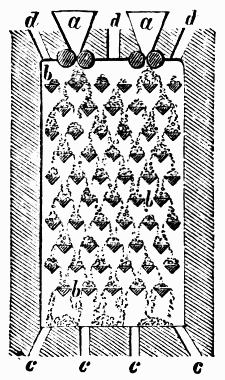
The furnace is fitted inside with a number of little fire-clay projections, arranged as shown in the plate, in banks or terraces, the function of which is to prolong the exposure of the pyrites to heat. The furnace having been previously raised to a red heat, by means of a coal or wood fire (which is then extinguished), the pyrites are admitted into it through the hoppers (a). At the base of the hoppers are grooved iron rollers, which crush the lumps of ore as they enter the chambers, and by thus reducing their size, expose a larger amount of surface to the action of heat. The greater part of the sulphur of the pyrites is thus burnt off, as the lumps pass from terrace to terrace, the heat at the same time generated by their combustion being sufficient to keep up that of the furnace. A moderate blast of air is admitted at c, whilst the sulphurous acid formed ascends through d intoc.
Another improved furnace is Perret’s, which is largely used in France. In this, small lumps of pyrites are placed on horizontal plates, and exposed to the hot gases generated in kilns below. The gases, on their way to the chambers, sweep over the pyrites and rob them of their sulphur.
The most important and noticeable improvement, however, of late years in sulphuric acid manufacture is that resulting from the addition to the plant of a contrivance of Gay-Lussac. Previous to this invention, the sulphuric acid of commerce, amongst other impurities, always contained appreciable quantities of certain oxides of nitrogen, the results of which were not only the contamination of the acid, but a waste of substances, which, properly utilised, are essential for the conversion of the sulphurous and sulphuric acid, and the loss of which leads to an increased consumption of nitrate of soda. Under the old method, these valuable oxides of nitrogen, which, with a large amount of nitrogen and a small quantity of oxygen, constituted the spent air of the last leaden chamber, were carried off into the air, and consequently lost. Now, instead of being allowed to diffuse into the atmosphere, they are made to pass through a tower or chamber (shown at C in the plate below) filled with coke, through which a thin stream of sulphuric acid is made to trickle. In passing through the coke, therefore, the expiring spent gases come into contact with the sulphuric acid, to which they give up their oxides of nitrogen. From the tower (C) the acid flows into a cistern (D), whence it is pumped up to the top of another tower (E), either filled with coke, or arranged with inclined shelves, as shown in the plate. In this tower the acid meets with a current of hot sulphurous acid and air coming up from the furnace, which deprive it of the oxides of nitrogen, and the gaseous mixture enters the chambers, whilst the denitrafied acid flows off into a suitable reservoir.
Right click: Larger.
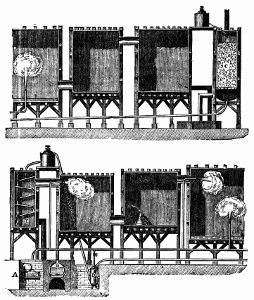
Since the introduction of the above, the consumption of nitrate of soda is sometimes lessened by more than half.
Another very recent improvement, the invention of a German chemist named Sprengel, is the substitution of water spray, blown in by steam, for steam jets, in the leaden chambers. By this method a saving of coal to the extent of one third is said to be effected.
In theory, 1 molecule of sulphur requires only 3 molecules of oxygen to convert it into sulphuric acid, viz. 2 to form sulphurous anhydride, and 1 to convert the latter into sulphuric anhydride, which combines with 1 molecule of water to form the acid. Thus, 1 kilogram of sulphur requires 1500 grams or 1055 litres of oxygen, which is equivalent to 5275 litres of air containing 4220 litres of nitrogen; when pyrites is used, a far larger quantity of air is required, for the obvious reason that the pyrites becomes converted into ferric peroxide. 1 kilogram of pyrites requires for its combustion nearly 6600 litres of air.
In well-regulated works the spent and escaping gases should not contain more than 2 per cent. of oxygen. If from 100 kilograms
Purif. Commercial sulphuric acid frequently contains nitrous acid and other oxides of nitrogen, arsenic, lead, and saline matter. The nitrous acid may be removed by adding a little sulphate of ammonia, and heating the acid to ebullition for a few minutes. Both nitric and nitrous acid are thus entirely decomposed into water and nitrogen gas. The arsenic may be got rid of by adding a little sulphide of barium to the acid, agitating the mixture well, and, after repose, decanting and distilling it. Lead, which exists as sulphate, may be separated as a white precipitate by simply diluting the acid with water. Saline matter may be removed by simple rectification. A good way of purifying oil of vitriol is to heat it nearly to the boiling point, and pass a current of hydrochloric acid through it; the arsenic is thus carried over as the volatile chloride of arsenic, while the nitrous and nitric acids are expelled almost completely. To obtain a perfectly pure acid, it should be distilled after the removal of the nitrous acid and arsenic by the methods indicated above. “The distillation is most conveniently conducted, on the small scale, in a glass retort, containing a few platinum chips, and heated by a sand bath or gas-flame, rejecting the first 1⁄2 fl. oz. that comes over.” (Ph. E.) In the Ph. D. the first tenth of the distillate is ordered to be rejected, and the process to be stopped when no more than about 1 fl. oz. is left in the retort.
According to Dr Ure, the capacity of the retort should be from 4 to 8 times as great as the volume of the acid, and connected with a large tubular receiver by a loosely fitting glass tube, 4 feet long and 1 to 2 inches in diameter. “The receiver should not be surrounded with cold water.” We find that fragments of glass, or of rock crystals, may be advantageously substituted for platinum foil, to lessen the explosive violence of the ebullition. Sulphuric acid which has become brown by exposure may be decolorised by heating it gently, the carbon of the organic substances being thus converted into carbonic acid.
Prop. Commercial sulphuric acid (oil of vitriol) is a colourless, odourless, and highly corrosive liquid, the general properties of which are well known. Its sp. gr. at 60° should never be greater than 1·848, or less than 1·840. (Miller and Odling give the sp. gr. of the pure and concentrated acid as 1·842; Abel and Bloxam, as 1·848; Apjohn gives it as 1·846, and Hardwich about 1·845.) It is immediately coloured by contact with organic matter. It attracts water so rapidly from the atmosphere when freely exposed to it, as to absorb 1-3rd of its weight in 24 hours, and 6 times its weight in a few months. When 3 volumes are suddenly mixed with 2 of water, the temperature of the mixture rises more than 180° Fahr. Its freezing point appears to be about 60° below that of water (Miller and Odling give that of the rectified acid as -30° Fahr.; Apjohn and Abel and Bloxam, -29°). It boils at about 620° Fahr. (620·6°, Odling; 620°, Hardwich and Fownes; 617°, Apjohn; 590·6°, Abel and Bloxam). It exhibits all the properties of the acids in an exalted degree. Its salts are called sulphates.
In the following table is given the quantity of anhydrous sulphuric acid contained in sulphuric acid at 60°F. (15·5°C.).
Hydrated Sulphuric Acid. Sp. Gr. Anhydrous Acid. Hydrated Sulphuric Acid. Sp. Gr. Anhydrous Acid.
100 1·8485 81·54 76 1·6630 61·97
99 1·8475 80·72 75 1·6520 61·15
98 1·8460 79·90 74 1·6415 60·34
97 1·8439 79·09 73 1·6321 59·55
96 1·8410 78·28 72 1·6204 58·71
95 1·8376 77·40 71 1·6090 57·89
94 1·8336 76·65 70 1·5975 57·08
93 1·8290 75·83 69 1·5868 56·26
92 1·8233 75·02 68 1·5760 55·45
91 1·8179 74·20 67 1·5648 54·63
90 1·8115 73·39 66 1·5503 53·82
89 1·8043 72·57 65 1·5390 53·00
88 1·7962 71·75 64 1·5280 52·18
87 1·7870 70·94 63 1·5170 51·37
86 1·7774 70·12 62 1·5066 50·55
85 1·7673 69·31 61 1·4960 49·74
84 1·7570 68·49 60 1·4860 48·92
83 1·7465 67·68 59 1·4760 48·11
82 1·7360 66·86 58 1·4660 47·29
81 1·7245 66·05 57 1·4560 46·58
80 1·7120 65·23 56 1·4460 45·68
79 1·6993 64·42 55 1·4360 44·85
78 1·6870 63·60 54 1·4265 45·03
77 1·6750 62·78 53 1·4170 43·22
Pur. “Free from colour and odour. Sp. gr. 1·843. 100 gr. are saturated by 285 gr. of crystallised carbonate of soda.” (Ph. L.) “What remains after the acid is distilled to dryness does not exceed 1⁄400th part of its weight. Diluted sulphuric acid is not discoloured by sulphuretted hydrogen.” (Ph. L. 1836.) “Diluted with its own volume of water, only a scanty muddiness arises, and no orange fumes escape. Sp. gr. 1·840.” (Ph. E.) “The rectified acid (ACIDUM SULPHURICUM PURUM—Ph. E. & D.) is colourless; dilution causes no muddiness; solution of sulphate of iron shows no reddening at the line of contact when poured over it. Sp. gr. 1·845.” (Ph. E.) Sp. gr. 1·846—Ph. D.; 1·843—B. P.; 1·842—Ure.
Tests.—See Sulphate.
Uses, &c. “The uses of sulphuric acid are so numerous that it would be impossible to mention all of them, sulphuric acid being to chemical industry what iron is to the mechanical. Sulphuric acid is employed in preparing a great many other acids—among them, nitric, hydrochloric, sulphurous, carbonic, tartaric, citric, phosphoric, stearic, oleic, and palmitic. Further, sulphuric acid is used in making superphosphates, soda, sulphate of ammonia, alum, sulphates of copper and iron, in paraffin and petroleum refining, silver refining, manufacture of garacine, garanceux, and other madder preparations, manufacture of glucose from starch, to dissolve indigo, &c.[216] In the diluted state it is used in medicine. When swallowed, it acts as a violent corrosive poison. The antidotes are chalk, whiting, magnesia, carbonate of soda, or carbonate of potash, mixed with water, or any bland diluent, and taken freely, an emetic being also administered.
Estim. The strength of sulphuric acid is most correctly ascertained by its power of saturating bases. In commerce, it is usually determined from its sp. gr. The quantity of sulphuric acid present in a compound may be determined by weighing it under the form of sulphate, as explained in a former part of this volume. See Acidimetry.
Concluding Remarks. According to most of our standard works on chemistry, British oil of vitriol, when purified and brought to its maximum strength by distillation, is a definite chemical compound, having the formula H2SO4, and designated normal sulphuric acid by Odling. Marignac, however, asserts that the distilled acid always contains an excess of water, and that the true monohydrate can only be obtained by submitting fuming sulphuric acid (‘Nordhausen s. a,’) to congelation. According to this chemist, the true monohydrate readily freezes in cold weather, and remains solid up to 51° Fahr. Two other definite hydrates of sulphuric acid are generally recognised by chemists, viz.—Bihydrated sulphuric acid (‘glacial s. a,’), having a sp. gr. of 1·78; freezing at about 40° Fahr. (47°, Miller); and boiling at about 435° (Apjohn; 401° to 410°, Odling): Terhydrated sulphuric acid, having a sp. gr. of 1·632, and the boiling-point 348° Fahr. See also Sulphuric acid, Nordhausen (below).
Sulphuric Acid, Al′coholised. Syn. Acidum sulphuricum alcoholisatum, L.; Eau de rabel, Fr. Prep. (P. Cod.) To rectified spirit, 3 parts, add, very gradually, sulphuric acid, 1 part. It is generally coloured by letting it stand over a little cochineal. Refrigerent, and, externally, escharotic.—Dose, 1⁄2 fl. dr. to water, 1 pint; as a cooling drink in fevers, &c.
Sulphuric Acid, Anhy′drous. SO3. Syn. Sulphuric anhydride, Dry sulphuric acid; Acidum sulphuricum sine aquâ, L. Prep. 1. By heating Nordhausen acid to about 100° Fahr. in a glass retort connected with a well-cooled receiver.
2. By distilling anhydrous bisulphate of soda, which has previously been raised to a low red heat in an earthen retort, to which a receiver is fitted without the aid of corks.
3. (Barreswill.) 2 parts of the strongest oil of vitriol are gradually added to 3 parts of anhydrous phosphoric acid, contained in a retort surrounded by a freezing mixture; when the compound has assumed a brown colour, the retort is removed from the bath, and connected with a receiver which is set there in its place; a gentle heat is now applied to it, when white vapours pass over into the receiver, and condense there under the form of beautiful silky crystals. The product equals in weight that of the phosphorus originally employed. “If a few drops of water be added, a dangerous explosion ensues.”
Prop. White, silky, asbestos-like crystals,
Sulphuric Acid, Aromat′ic. Syn. Elixir of vitriol, Acid e. of v.; Acidum sulphuricum aromaticum (B. P., Ph. E. & D.), L. Prep. 1. (Ph. E. & D.) Oil of vitriol, 31⁄2 fl. oz.; rectified spirit, 11⁄2 pint; mix, add of powdered cinnamon, 11⁄2 oz.; powdered ginger, 1 oz.; digest for 6 days (7 days—Ph. D.), and filter. Sp. gr. ·974—Ph. D.
2. (Wholesale.) From compound tincture of cinnamon, 1 gall.; oil of vitriol, 1 lb.; mix, and in a week filter—Dose, 10 to 30 drops, in the same case as the dilute acid.
3. (B. P.) Sulphuric acid, 3; rectified spirit, 40; cinnamon, in powder, 2; ginger, in powder, 11⁄4; mix the acid gradually with the spirit, add the powders, macerate for 7 days, and filter.—Dose, 5 to 30 minims.
Sulphuric Acid, Dilute′. Syn. Spirit of vitriol; Acidum sulphuricum dilutum (B. P., Ph. L., E., & D.), L. Prep. 1. (Ph. L.) Take of sulphuric acid, 15 fl. dr., and dilute it gradually with distilled water, q. s. to make the whole exactly measure a pint. Sp. gr. 1·103. “1 fl. oz. of this acid is exactly saturated by 216 gr. of crystallised carbonate of soda.”
2. (Ph. E.) Sulphuric acid, 1 fl. oz.; water, 13 fl. oz. Sp. gr. 1·090.
3. (Ph. D.) Pure sulphuric acid, 1 fl. oz.; distilled water, 13 oz. Sp. gr. 1·084.
4. (B. P.) Sulphuric acid, 3; distilled water, q. s. to measure 353⁄4; mix by adding the acid gradually to the water.—Dose, 4 to 20 minims.
Prop., &c. Antiseptic, tonic, and refrigerant.—Dose, 10 to 30 drops, largely diluted with water, several times daily; in low typhoid fevers, passive hæmorrhages, profuse perspiration, in various skin diseases to relieve the itching, in dyspepsia, &c. It is also used externally.
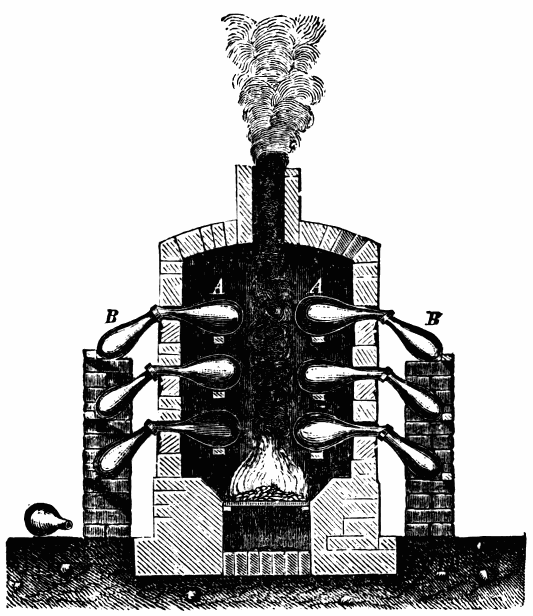
Sulphuric Acid, Nordhausen. Syn. Fuming sulphuric acid; Acidum sulphuricum fumans, L. Prep. By distilling calcined ferrous sulphate (‘green vitriol’) in earthen retorts. The retorts, which are shown at A in the plate after the ‘green vitriol’ has been put into them, are placed in a galley-furnace, as shown below, the necks passing through the wall of the furnace, and being properly secured to the necks of the receivers (B B.). Into each of the flasks 21⁄2 lbs. of green vitriol are put; on the first application of heat only sulphurous acid and weak hydrated sulphuric acid come over, and are usually allowed to escape, the receivers not being securely luted until white vapours of anhydrous sulphuric acid are seen. Into each of the receiving flasks 30 grams of water are poured, and the distillation continued for 24 to 36 hours. The retort flasks are then again filled with raw material, and the operation repeated four times before the oil of vitriol is deemed strong enough. The residue in the retorts is red (peroxide) of iron, still retaining some sulphuric acid. The product is a brown oily liquid, which fumes in the air, is intensely corrosive, and has a sp. gr. about 1·900. When heated to about 100° Fahr. the anhydrous acid is given off, and ordinary oil of vitriol is left. According to Marignac, crystals of normal sulphuric acid (H2SO4) are formed in this acid when it is submitted to a low temperature. Nordhausen acid is so called from the place of its manufacture in Saxony. It may be regarded as a mixture or compound of H2SO4 and SO2. It is chiefly used for dissolving indigo.
SULPHURIC ANHYDRIDE. See Sulphuric acid, Anhydrous.
SULPHURIC E′THER. See Ether.
SUL′PHUROUS ACID. SO2. Syn. Sulphurus anhydride; Acidum sulphurosum, B. P. This compound is freely evolved in the gaseous form when sulphur is burnt in air or oxygen, and when the metals are digested in hot sulphuric acid; and, mixed with carbonic acid, when charcoal, chips of wood, cork, and sawdust, are treated in the same way.
Prep. 1. By heating together sulphur and strong sulphuric acid.
2. By the action of sulphuric acid on chippings of copper or mercury at a gentle heat. Pure.
3. (Berthier.) By heating, in a glass retort, a mixture of black oxide of manganese, 100 parts, and sulphur, 12 or 14 parts. Pure. The
4. (Redwood.) Pounded charcoal, 1⁄2 oz.; oil of vitriol, 4 fl. oz.; mix in a retort, apply the heat of a spirit lamp, and conduct the evolved gases by means of a bent tube into a bottle containing water. The sulphurous acid is absorbed, whilst the carbonic acid gas passes off.
5. (B. P.) Distilled water, saturated with sulphurous anhydride. It is colourless and emits a pungent odour. Used as a deoxidiser, disinfectant, and antiseptic. Diluted with from 1 to 2 parts of water it is employed as a lotion for wounds, cuts, ulcers, bed-sores, scalds, and burns; with from 1 to 5 of water it is used as a gargle, also as a lotion in parasitic skin diseases; from 1⁄2 to 1 dr., in a wine-glassful of water, 3 times a day, relieves constant sickness.
Prop., &c. Water absorbs 30 times its volume of this gas. Pure liquid sulphurous acid can only be obtained by passing the pure dry gas through a glass tube surrounded by a powerful freezing mixture. Its sp. gr. is 1·45; boiling point, 14° Fahr.; it causes intense cold by its evaporation. Sulphurous acid forms salts called sulphites.
Uses. To bleach silks, woollens, straw, &c., and to remove vegetable stains and iron-moulds from linen. For these purposes it is prepared from sawdust or any other refuse carbonaceous matter.
Several preparations containing sulphurous acid have recently been invented by the Editor and introduced to the public as agents in sanitation under the name of Sporokton (germ-killer). To understand the nature and merits of these preparations it is desirable to explain the true and individual meanings of ‘Deodoriser,’ ‘Antiseptic,’ and ‘Disinfectant,’—words which are too often improperly employed as if they had the same signification, and as if, in fact, they were convertible terms.
A deodoriser is a substance which will absorb or destroy bad smells; an antiseptic is an agent which will prevent or retard putrefaction; and a disinfectant is an agent which will render harmless the virus of smallpox, scarlet fever, measles, diphtheria, influenza, pleuro-pneumonia, cattle plague, glanders, distemper in dogs, and other infectious or contagious diseases.
Now, medical authorities and sanitarians are of opinion that the most potent disinfectant with which we are acquainted is sulphurous acid, a gas which has been used for ages, as a fumigator. Sulphurous acid has not, however, been so generally employed for disinfecting purposes as one might from these circumstances have expected, on account of the difficulties and inconveniences which formerly attended its generation.
To remove these drawbacks, and to render sulphurous acid, both as a gas and in solution, easily and cheaply available for the above-named and many other applications, sporokton has been invented. Several varieties are made; they are as follows:
Liquid No. 1.—This preparation consists of a colourless solution of a non-volatile antiseptic, usually a salt of zinc, impregnated with eighty times its bulk of sulphurous acid gas; in other words, one pint of the liquid contains ten gallons of gas. Liquid sporokton is, in fact, a combination of one of the most powerful antiseptics with the disinfectant; the former ingredient will effectually prevent the putrefaction of any solid or liquid animal or vegetable matter with which it may come in contact, while the sulphurous acid will rapidly pass off in the gaseous state into the surrounding air and act as an energetic destroyer of noxious atmospheric impurities.
Liquid sporokton absorbs ammonia and sulphuretted hydrogen, destroys bad smells, and prevents the spread of infectious diseases; it is, consequently, a valuable agent for the deodorisation and disinfection of wards of hospitals, sick rooms, dairies, larders, ship, stables, cow-houses, kennels, piggeries, slaughter-houses, urinals, water-closets, privies, cesspools, sewers, drains, and other similar buildings and places.
After it has parted with the whole of its sulphurous acid gas, liquid sporokton leaves an odourless, non-volatile antiseptic and absorber of ammonia and sulphuretted hydrogen.
Liquid sporokton evolves its sulphurous acid by simple exposure to air, without the aid of heat, so that no risk of fire attends its use, as is the case when rooms, buildings, holds of ships, &c., are fumigated with this gas by the old plan; it will not stain or in any other way injure undyed woollen, linen, or cotton goods. It is consequently well adapted for the disinfection of underclothing, sheets, blankets, bed-furniture, &c.
Liquid sporokton may be employed for the instantaneous preparation of a bath or lotion of sulphurous acid, to be used, under medical direction, in the treatment of itch, ringworm, chronic eczema, lepra, psoriasis, impetigo, pityriasis, &c., in man, as well as mange, scab, and other skin affections in the lower animals.
Liquid sporokton is clean, it requires no skill in using it, and its action is perfectly controllable.
Liquid, No. 2.—This preparation is specially made for the disinfection and purification of old beer barrels, wine casks, and the like. It is similar in composition to, and may be used for the same purpose as No. 1; except, however, that as No. 2, unlike No. 1, is liable,
Solid.—This is a powder, usually a mixture of calcium sulphite and ferric chloride, which, by simple expose to air, will slowly and steadily, or when sprinkled with water, rapidly give out 25 per cent. of its weight of sulphurous acid and leave no unpleasant smell behind it.
Sulphurous acid gas, unlike non-volatile disinfectants, quickly mingles with the air, and seeks out, as it were, the noxious atmospheric impurities it is capable of destroying.
Solid sporokton, in addition to evolving sulphurous acid, contains an excess of ferric chloride which, together with this gas, renders it a most useful and efficient antiseptic.
Sulphurous Anhydride. See Sulphurous acid.
SU′MACH. This dye stuff is chiefly used as a substitute for galls. With a mordant of acetate of iron, it gives grey or black; with tin or acetate of alumina, yellow; and with sulphate of zinc, a yellowish-brown; alone, it gives a greenish-fawn colour.
SUM′BUL. Syn. Musk root, Jatamansi, Sumbul root; Sumbul radix (B. P.). A substance introduced to British medicine by Dr A. B. Granville, in 1850. It occurs in circular pieces, varying from 1 to 3 or 4 inches in diameter; has a musk-like odour, and a sweet balsamic taste. It acts as a powerful stimulant, especially of the nervous system. In India and Persia it has long been used as a medicine, a perfume, and as incense.—Dose, 15 gr. to 1 dr., either masticated, or made into an infusion, electuary, or tincture; in cholera, hysteria, neuralgia, epilepsy, low fevers, and various other spasmodic and nervous disorders.
SUMMER DRINKS. See Lemonade, Sherbet, &c.
SU′PER-. See Nomenclature.
SUP′PER. The evening meal; the last meal of the day. Supper is generally an unnecessary meal, and, when either heavy, or taken at a period not long before that of retiring to rest, proves nearly always injurious, preventing sound and refreshing sleep, and occasioning unpleasant dreams, nightmare, biliousness, and all the worst symptoms of imperfect digestion. The last meal of the day should be taken at least three hours before bedtime. Even when it consists of some ‘trifle,’ as a sandwich or biscuit, an interval of at least an hour should elapse before retiring to rest. In this way restlessness and unpleasant dreams will become rare.
SUPPOS′ITORY. Syn. Suppositorium, L. A medicine placed in the rectum for the purpose of affecting the lower intestine, or, by absorption, the system generally. Suppositories are rounded, usually elongated masses, having the active medicine combined with some substance which will retain the proper shape, as soap, spermaceti cerate, or cacao-butter. The latter substance is, perhaps, the best vehicle for remedies prescribed in this form. It is, however, rather too soft to be used without admixture. According to Dorvault, the addition of one eighth part by weight of wax imparts the proper hardness.
All difficulty of removing suppositories from the mould may be obviated by having the moulds previously dusted with lycopodium.
The mode of proportioning the doses of active ingredients has been noticed in the article Enema.
Suppository, Astringent. Syn. Suppositorium astringens (Reuss). Prep. Powdered oak bark, 2 dr.; tormentil, 2 dr.; honey, q. s. For 8 suppositories.
Suppository of Carbolic Acid. Syn. Suppositorium acidi carbolici (Ph. U. S.). Prep. Carbolic acid, 12 gr.; oil of theobroma, 348 gr.; water, q. s. Dissolve the acid in a few drops of water, and mix it with 1 dr. of oil of theobroma; then add it to the remainder of the theobroma previously melted, and cooled to the temperature of 95° F., and pour the whole immediately into moulds of 30 gr. each, standing in iced water.
Suppository of Copaiba. Syn. Suppositorium copaiba (Colombat). Prep. Solidified copaiba, 1 dr.; butter of cacao, 1 dr.; extract of opium, 1⁄2 gr.
Suppository of Elaterium. Syn. Suppositorium elaterii (St B. H.). Prep. Extract of elaterium, 2 gr.; hard soap, 10 gr.; water, q. s. Mix.
Suppository, Emollient. Syn. Suppositorium emolliens. Prep. Butter of cacao and spermaceti in equal parts; melted together.
Suppository of Iodide of Potassium. Syn. Suppositorium potassii iodidii (Mr Stafford). Prep. Iodide of potassium, 1 gr. to 4 gr.; extract of henbane, 6 gr.; extract of hemlock, 6 gr. In enlarged prostate.
Suppository, Irritant. Syn. Suppositorium irritans (Richard). Prep. Butter of cacao, 2 dr.; aloes, 4 gr.; tartarised antimony, 1 gr. To restore the hæmorrhoidal flux.
Suppository of Lead (Compound). Syn. Suppositorium plumbi compositum (B. P.). Prep. Acetate of lead, in powder, 36; opium, in powder, 12; benzoated lard, 42; white wax, 10; oil of theobroma, 80; melt the wax and oil of theobroma with a gentle heat, then add the other ingredients, previously rubbed together in a mortar, and, having mixed them thoroughly, pour the mixture while it is fluid into suitable moulds of the capacity of 15 gr. The above makes 12 suppositories.
Suppository of Mercury. Syn. Suppositorium hydrargyri (B. P.). Prep. Ointment of mercury, 60 gr.; benzoated lard, 20 gr.; white wax, 20 gr.; oil of theobroma, 80 gr.; melt all but the mercurial ointment together, then add the ointment of mercury, stir till well mixed, and immediately pour into moulds of the capacity of 15 gr. The above makes 12 suppositories.
Suppository of Morphia. Syn. Suppositorium morphiæ (B. P.). Prep. Hydrochlorate of morphia, 6 gr.; oil of theobroma, 90 gr.; benzoated lard, 64 gr.; white wax, 20 gr.; melt the wax and oil of theobroma with a gentle heat, then add the hydrochlorate of morphia and benzoated lard, previously rubbed together in a mortar, and mix all the ingredients thoroughly; pour the mixture, while it is fluid, into suitable moulds of the capacity of 15 gr., or the fluid mixture may be allowed to cool, and then be divided into 12 equal parts, each of which should be made into a conical form.
Suppository of Opium. Syn. Suppositorium opii (Ph. U. S.). Prep. Extract of opium, 12 gr.; oil of theobroma, 348 gr.; water, q. s. Proceed as for carbolic acid suppository.
Suppository for Piles. Syn. Suppositorium hæmorrhoidale, S. sedativum, L. Prep. 1. Powdered opium, 2 gr.; finely powdered galls, 10 gr.; spermaceti cerate, 1 dr.
2. (Ellis.) Powdered opium, 2 gr.; soap, 10 gr.; mix.
3. (Richard.) Extracts of opium and stramonium, of each 1 gr.; cacao-butter, 2 dr. Used when the piles are very painful.
Suppository, Pur′gative. Syn. Suppositorium catharticum, L. Prep. 1. Soap, 1 dr.; elaterium, 1 to 2 gr.; mix. As a strong purge.
2. (Niemann.) Soap, 2 dr.; common salt, 1 dr.; honey, q. s.; mix. As a mild cathartic.
Suppository of Quinine. Syn. Suppositorium quinæ (Boudin). Prep. Sulphate of quinine, 15 gr.; butter of cacao, 11⁄2 dr. Mix.
Suppository, Resol′vent. Syn. Suppositorium resolvens, L. Prep. (Stafford.) Iodide of potassium, 3 to 4 gr.; extracts of henbane and hemlock, of each 6 gr. In enlargement or induration of the prostate gland.
Suppository of Rhatany. Syn. Suppositorium rhataniæ (P. Cod). Prep. Butter of cacao, 1 dr.; extract of rhatany, 15 gr., for 1 suppository.
Suppository, Sed′ative. See above.
Suppository of Sulphate of Soda. Syn. Suppositorium sodæ sulphatis (Phœbus). Prep. Dried sulphate of soda, 2 dr.; powdered soap, 4 dr.; honey, q. s. For 4 suppositories. To be smeared over with oil when applied.
Suppository of Tannic Acid. Syn. Suppositorium acidi tannici (B. P.). Prep. Tannic acid, 36 gr.; benzoated lard, 44 gr.; white wax, 10 gr.; oil of theobroma, 90 gr.; melt the wax and oil with a gentle heat, then add the tannic acid and benzoated lard, previously rubbed together, and mix thoroughly. Pour the mixture while it is fluid into suitable moulds of the capacity of 15 gr. The above makes 12 suppositories.
Suppository, Ver′mifuge. Syn. Suppositorium anthelminticum, S. vermifugum, L. Prep. (Swediaur.) Aloes, 4 dr.; common salt, 3 dr.; flour, 2 dr.; honey, q. s. to make a stiff mass; divide into proper-shaped pieces, weighing about 15 gr. each. One to be used after each motion.
Suppositories of Aloes. Syn. Suppositoria aloes (B. P.). Prep. Aloes in fine powder. 1 dr.; oil of theobroma, 300 gr. Proceed as for carbolic acid suppository, omitting the water.
Suppositories of Assafœtida. Syn. Suppositoria assafœtidæ (Ph. U. S.). Prep. Tincture of assafœtida, 1 oz.; oil of theobroma, 320 gr. Let the tincture evaporate by exposure to the air until of the consistence of a thick syrup, and proceed as for suppositories of carbolic acid.
Suppositories of Belladonna. Syn. Suppositoria belladonnæ (Ph. U. S.). Prep. Alcoholic extract of belladonna, 6 gr.; oil of theobroma, 354 gr. Proceed as for carbolic acid suppositories.
Suppositories of Carbolic Acid with Soap. Syn. Suppositoria acidi carbolici cum sapone (B. P.). Prep. Carbolic acid, 12 gr.; curd soap, in powder, 180 gr.; starch, q. s.; mix the carbolic acid with the soap, and add starch, q. s., to make of a suitable consistency; divide into 12 equal parts, and make each suppository into a conical or other convenient form.
Suppositories of Colocynth. Syn. Suppositoria colocynthidis (Sp. Ph.). Prep. Colocynth, 30 gr.; salt, 1 dr. Evaporate to a due consistence.
Suppositories of Morphia with Soap. Syn. Suppositoria morphiæ cum sapone (B. P.). Prep. Hydrochlorate of morphia, 6 gr.; glycerin of starch, 50 gr.; curd soap in powder, 100 gr.; starch, q. s. Mix the hydrochlorate with the glycerin of starch and soap, and add starch q. s. to form a paste of suitable consistence. Divide into 12 equal parts, each of which is to be made into a conical or other convenient form of suppository.
Suppositories of Tannic Acid with Soap. Syn. Suppositoria acidi tannici cum sapone (B. P.). Prep. Tannic acid, 36 gr.; glycerin of starch, 50 gr.; curd soap in powder, 100 gr.; starch, q. s. Mix the tannic acid with the glycerin of starch and soap, and add starch q. s. to form a paste of suitable consistence, divide into 12 equal parts, each of
Suppositories, Vaginal. Syn. Suppositoria vaginale (Guadrist). Prep. Liquid chloride of zinc, 5 minims; sulphate of morphia, 1⁄2 gr.; mix with 2 dr. of the following paste:—Thick mucilage of tragacanth, 6 parts; white sugar, 3 parts; starch, 9 parts. Mr Druitt prescribes in leucorrhœa:—Tannin, 10 gr., with mucilage of tragacanth, q. s.
SURGERY. “This word,” says Brande, “in its modern acceptation, may be defined as the practical application of science, in the use of all mechanical and instrumental means, for the removal of diseases and the relief of human suffering.”
One of the earliest professors of the ancient art of surgery, of whom history affords a reliable record, was Hippocrates, a Greek, who lived in the fifth century of our era, and who seems to have been a man of considerable skill for the period in which he flourished, since he could set fractures, reduce dislocations, and perform other important operations. About two centuries after Hippocrates the studies of surgery, anatomy, and medicine were prosecuted with evident success at Alexandria. The Alexandrian school produced some able surgeons, one of whom, Ammianus, invented an instrument for crushing the stone in the bladder, and was thus the first to practise the now important surgical operation known as lithotrity. At the beginning of the Christian era Celsus practised the art of surgery in Rome; he appears to have been the first to operate for cataract, and to apply ligatures to arteries after operations. It is curious to note that so practical a people as the Romans held the art of surgery in comparative contempt, and banished its professors, whose services they discarded, for the practice of spells, incantations, and charms.
In the sixth century lived Œtius, who conceived the idea of dissolving urinary calculi by the administration of internal remedies; and in the tenth, Avicenna, who, it has been conjectured, invented the flexible catheter, and was the inventor of the instrument now known as Hey’s saw. In 1271 the Paris College of Surgeons was founded, and the College of Surgeons of London in 1460, and the Edinburgh College in 1505.
The most prominent figure in the annals of surgery of the 16th century was Paré, a man of great originality of thought, whose works exercised a considerable influence over his own contemporaries, and for many years subsequently. Towards the end of the 17th century lived Wiseman, serjeant surgeon to Charles II. Wiseman was a man of considerable ability, and was the first to demonstrate that gun-shot wounds were not of a poisonous nature; and that therefore the old practice of applying painful and caustic dressings to them might most advantageously be abandoned. A contemporary of Wiseman was Young, of Plymouth, who merits notice as being the first who performed the flap-operation in amputation.