A CYCLOPÆDIA OF PRACTICAL RECEIPTS, &c. VOLUME II (continued 36)
Reading edition
The arrangements for preparing sulphurous acids are retorts, into which are put sulphuric acid and pieces of wood; upon the application of heat the sulphurous acid passes off, and is conveyed by leaden pipes into the vessels containing the tallow. The lime soap formed is then moistened with 12 cwt. of sulphuric acid, at 150° Fahr., diluted with 50 gall. of water. The whole is thoroughly agitated and the steam cautiously admitted, so as not to dilute the acid too much until the decomposition is general at all points. This occupies about 3 hours, and in 2 or 3 hours more the sulphate of lime has collected at the bottom, while the fatty acids are floating on the surface of the solution of the bisulphate of lime. Several processes of washing with steam and water are necessary to ensure the removal of the sulphate of lime, &c., and after settling for 4 hours the fatty acids are forced through a fixed siphon, into a vat, where they are again washed with water; they are then siphoned at last into a trough lined with lead, on the bottom of which are placed leaden gutters, pierced below by long pegs of wood. The fatty acids are then placed in clothes and subjected to pressure in the stearin cold press.
In 1871 Professor Boek of Copenhagen, after a careful microscopic and chemical investigation, discovered that the neutral fats were composed of a congeries of little globules enclosed in albuminous envelopes. To the presence of these latter substances in the fat
The inconveniences arising from the above processes are, in the case of the excess of the sulphuric acid, a considerable destruction of the fatty acid, as well as the necessity of its distillation, and the consequent danger of conflagration; whilst in the case of the alkali, this must either be used in quantities much greater than theory requires, or else be heated under great pressure, at the risk of giving rise to an explosion.
In Professor Boek’s process these dangers, together with the waste of material, are avoided. By submitting the fat for a limited time and at a given temperature to the action of a small quantity of sulphuric acid, the albuminous envelopes are broken and partly destroyed. The neutral fat thus liberated is then placed in open tanks in water, by which, after the expiration of several hours, it becomes decomposed. When this is completely effected the glycerin, dissolved in the water used for the decomposition, is removed; the fatty acids which remain behind, and which amount to 94 per cent. of the original fat, being at this stage of the operation dark brown or blackish in colour.
In this condition they are placed in open tanks, and dilute solutions of certain agents are poured upon them, whereby the albuminous débris as well as the colouring matters with which they are associated become oxidised, whilst the specific gravity of these latter is in consequence so increased as to cause them to subside to the bottom of the tank, leaving the fatty acids, now greatly whitened, on the upper part of the liquid.
The acids after being washed 2 or 3 times with dilute acid and water are then cooled, and hot-pressed in the usual manner, and the stearic acid thus obtained is said to have a higher melting point, and to be larger in yield than that obtained by any other method, an oleic acid of excellent quality being at the same time produced.
In 1874 a French patent was taken out for an improvement in the manufacture of stearic acid. The patentee employs carbon disulphide to increase the fluidity of the oleic acid, so that the warm pressure of the crude stearic acid is avoided. The addition of the carbon disulphide may be made either before or after the cold pressing of the stearic acid. The crude fat acid is melted in a special apparatus, and 20 per cent. of the disulphide is mixed with it whilst in the fluid state. It is then left to cool and subjected to cold pressure. The stearic acid thus obtained should be free from oleic acid.
Prop., &c. Pure stearic acid crystallises in milk-white needles, which are soluble in ether and in cold alcohol, and forms salts with the bases, called stearates. The commercial acid is made into candles. See Candles, Fat, Oils (Fixed), and Tallow.
STE′ARIN. C57H110O6. The solid portion of fats which is insoluble in cold alcohol.
Prep. Pure strained mutton suet is melted in a glass flask along with 7 or 8 times its weight of ether, and the solution allowed to cool; the soft, pasty, semi-crystalline mass is then transferred to a cloth and is strongly pressed as rapidly as possible, in order to avoid unnecessary evaporation; the solid portion is then redissolved in ether, and the solution allowed to crystallise, as before. The product is nearly pure.
Prop., &c. White; semi-crystalline; insoluble in water and cold alcohol; soluble in 225 parts of cold ether, and freely so in boiling ether. It melts at 130° Fahr. The stearin of commerce is stearic acid.
STEAROP′TEN. The name given by Herberger to the concrete portion or camphor of volatile oils. Bizio calls it stereusin.
STEEL. This important material may be defined as iron chemically combined with sufficient carbon to give it extreme toughness and hardness without brittleness. According to one of our greatest authorities on metallurgy, steel should contain from ·833% to 1·67% of carbon, these numbers referring respectively to the softest and the hardest varieties.
By some authorities silicon in small quantities is supposed to be a useful ingredient in steel, and to increase its capacity for being hardened; an opinion dissented from by others, who hold that its presence has a tendency to interfere with the welding of the metal. Faraday and Stodart believed that the addition of small quantities of chromium and iridium to steel served to improve its quality, and the same has been asserted of tungsten and titanium; but on these points there is still a divergence of opinion, and no satisfactory decision has yet been arrived at concerning them.
Manganese has also been credited with the property of improving steel, but as it has been found that only a very minute quantity of the manganese is taken up by the steel, an indirect influence may possibly be exercised by it, viz. its power of uniting with the stage, and of carrying away any prejudicial excess of sulphur and phosphorus with it; and in this manner it may contribute to the increased purity of the metal. The addition of manganese to cast steel constitutes Mr Heath’s patent, the chief advantage of which is that blistered steel made from British bar iron can be substituted for the much more expensive Swedish and Russian iron, in certain branches of iron manufacture.
“Among the various substances which are frequently present in malleable iron and in cast iron, those which are more prejudicial to[195]
Within the last few years great attention has been paid to the investigation of the chemistry of steel. The researches of Despretz and Fremy tend to the conclusion that nitrogen exercises a very important influence over the phenomena of ‘steeling,’ and that carbon plays a less necessary part; while those of Caron and Deville still refer the formation of steel to the chemical combination of iron with carbon. There is no test of the value of steel beyond its elasticity and temper, and the fineness, equality, and smoothness of its grain.
Cast iron, wrought iron, and steel are all combinations of iron and carbon, differing in the amount they contain of the latter element. As cast iron contains a larger and wrought iron a smaller proportion of carbon than steel, it follows that to convert the cast iron into steel, its excess of carbon must be removed; whilst conversely, to make the wrought iron into steel, the requisite amount of carbon must be added to it.
Thus it is that the various processes for the manufacture of steel (with the exception of those which propose to obtain it direct from the ores) are directed to one or other of these ends, viz. the decarburation of cast or pig iron, and the carburation of wrought or malleable iron.
1. In the first, or decarburation method, the oxygen of the air plays an important part. Best carbon is heated with coal or charcoal, in some works on the refining hearth, in others upon the bed of the puddling furnace. The oxygen burnt off the excess of carbon from the iron and steel is left. Payen says that when the iron contains slag, the ferrous silicate present in this takes part in the reaction.
The steel obtained by this method is called natural steel. It is afterwards subjected to forging, and being of inferior quality is employed in the manufacture of springs for machinery, railway carriages, wheel tyres, ploughs, and other farming implements.
The following Table, from ‘Payen’s Industrial Chemistry’ gives the Composition of several kinds of Steel.
Carbon.
Kind of Steel. Locality. Fe. Mn. Cu. Combined. Graphitic.
Natural Steel Siegen ... ... ·379 1·698 ...
Ditto Solingen ... ... ... 1·570 ...
Puddled Steel Hartz ... 0·12 ... 1·380 ...
Cement Steel English ... ... ... 1·807 ...
Ditto German ... ... ... ·416 ·080
Cast Steel Sheffield ... ... ... ·950 ·220
Ditto Ditto ... ... ... 1·758
Ditto French ... ... ... ·65
Sword Steel Damascus ... ·070 ... 1·089
Ditto Ditto ... trace ... ·775
Wootz Indian ... ... ... 1·500
Ditto Ditto 98·092 ... ... 1·333 ·312
Cast Steel German ... trace ·300 1·180
Ditto English ... ·024 ·066 1·275
Bessemer Steel Dowlais ... ·576 ·025 ·490
Ditto Sweden ... trace ... ·085
Ditto ... ... ·179 ... ·300
Ditto ... ... ·256 ... ·700
Ditto ... ... ·468 ... ·950
Ditto ... ... ·355 ... 1·050
Wired Barrow-in-Furness ... ·214 ... ·200
Rail Heads German ... ·386 ... ·138
Rails ... ... ·264 ... ·150
Ditto ... ... ·638 ... ·046
Boiler Plates ... ... ·136 ... ·250
Ditto ... ... ·273 ... ·300
Kind of Steel. Si. S. P. Authority.
Natural Steel ·038 ... ... Karsten.
Ditto ·020 ... ... Lampadius.
Puddled Steel ·006 (at·12) trace Brauns.
Cement Steel ·100 ... ... Berthier.
Ditto ... ... ... Bromeis.
Cast Steel ... ... ... Ditto.
Ditto ... ... ... Karsten.
Ditto ·040 ... ... ...
Sword Steel ... (Ni·07 Wo·01) ...
Ditto ... (Ni·21 Co trace Wo trace) ...
Wootz ·600 ... ... ...
Ditto ·045 (as 037) ... Henry.
Cast Steel ·330 (Ni ·12) ·020 ...
Ditto ·213 (as·007) ... ...
Bessemer Steel ·009 ·003 ·036 ...
Ditto ·008 trace ·025 Brusewitz.
Ditto ·044 do. ·033 Ditto.
Ditto ·032 do. ... Ditto.
Ditto ·047 do. ·032 Ditto.
Ditto ·067 do. ... Ditto.
Wired ·179 ·030 ·026 Ditto.
Rail Heads ·306 ·040 ·034 Ditto.
Rails ·091 ·025 ·032 Ditto.
Ditto ·634 ·045 ·093 Ditto.
Boiler Plates ·016 ·010 ... Ditto.
Ditto ·056 ·040 ·041 Ditto.
Krupp’s cast steel, manufactured at Essen, near Cologne, is a natural steel, being made on the bed of a puddling furnace. It is obtained from hæmatite and spathic ore, coke being used for the smelting. The proportion of carbon in Krupp’s steel is about 1·2 per cent. When required for ordnance it is fused
It is very essential that castings of such magnitude should be allowed to cool very gradually. They are therefore enveloped in hot cinders for two or three months, after which they are ready for the forging.
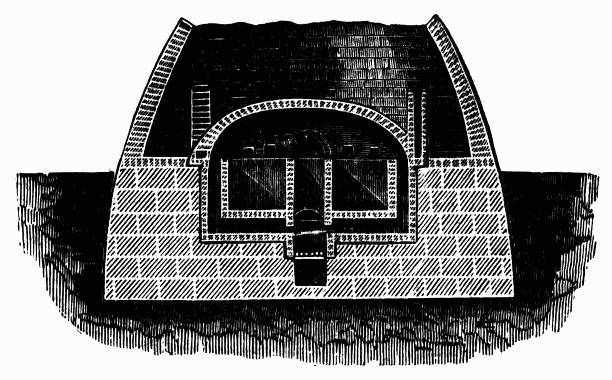
2. The carburation method. This is generally effected by the process known as ‘cementation,’ which is carried out as follows:—Two chests, made of fire-brick or stone, one narrow end of each of which is shown in the accompanying plate, are so fixed in a dome-shaped furnace, so that the flames from the hearth beneath can effectually play around them.
The process renders it necessary that the temperature of the furnace should be steadily maintained for some days; and this is achieved by surrounding the furnace with a conical wall of brick-work, as shown in the cut. The chests are usually about 10 or 12 feet in length, 3 feet in height, and 3 feet in depth. A layer of charcoal of a fineness to pass through a sieve of a 1⁄4 inch mesh, or of soot, is placed on the bottom of each chest, and upon3⁄4 of an inch thick. When arranged regularly a little distance apart, the interstices between them are filled up with charcoal, with which they are then covered to a depth of about an inch. Similar layers of bars, similarly arranged, succeed to this first one, until the chests are filled.
They are then covered in to a depth of 6 inches with a luting of damp clay or sand. Each chest when thus filled contains from 5 to 6 tons of iron. One of the bars projects through an opening at the end of the chest, to facilitate an inspection of it from time to time by a workman, so that he may be enabled to judge of the progress of the operation. The materials of which the chests are composed render it important that the temperature of the furnace should be carefully and gradually increased, as a too sudden accession of heat would lead to the splitting of the chests. The temperature necessary to effect the carburation of the iron has been found to be that required for the melting of copper, viz. 1996° Fahr. When this temperature is reached it is maintained for eight or ten days, or even longer, the period depending upon the thickness of the iron, and the degree of hardness it is desired it shall possess. Six or eight days are sufficient to yield steel of a moderate degree of hardness. At the end of the requisite time the fire is gradually put out, and the chests as gradually cooled, a process which occupies about another ten days.
The effect of the treatment to which the iron bars have been subjected has been, in the first place, to entirely alter their interior structure; for if they are broken asunder at any
Two suggestions have been offered in explanation of the blistered surface presented by the steel. One of these, the theory of Mr T. H. Henry, is that part of the carbon in penetrating into the body of the bar iron had combined with the small quantity of sulphur present in the iron, and that the bisulphide of carbon thus formed becoming vaporised by the elevated temperature, in escaping through the soft surface of the metal, has caused its blistered condition. The second conjecture is that the blebs have arisen from the extrication of carbonic oxide, which had been formed in the bar by the union of the carbon with the small quantity of oxide of iron or slag accidentally remaining in it.
Graham has shown that soft iron has the power of absorbing or occluding at a low red heat 4·15 times its volume of carbolic oxide, which the metal, when it becomes cold, retains, but which it parts with when subjected to a temperature such as that which prevailed in the cementation box. This fact seems to offer a reasonable confirmation of the reaction it has been surmised takes place during the cementation process, and which is supposed to be as follows:
The small quantity of atmospheric oxygen remaining in the chest unites with the carbon
The above reaction may not improbably occur throughout the substance of the bar. By some chemists, cyanogen compounds are supposed to be present in the cementation powder, and the cyanogen contained in these is supposed to be the carrier of the carbon to the iron.
“The blistered steel obtained by this process is, as would be expected, far from uniform, either in composition or texture; some portions of the bar contain more carbon than others, and the interior contains numerous cavities. In order to improve its quality it is subjected to a process of fagotting similar to that employed in the case of bar iron; the bars of blistered steel, being cut into short lengths are made up into bundles, which are raised to a welding heat, and placed under a tilt hammer weighing about 2 cwt., which strikes 200 or 300 blows in a minute; in this way, the several bars are consolidated into one compound bar, which is then extended under the hammer till of the required dimensions.
“The bars, before being hammered, are sprinkled with sand, which combines with the oxide of iron upon the surface, and forms a vitreous layer which protects the bar from oxidation. The steel which has been thus hammered is much denser and more uniform in composition; its tenacity, malleability, and ductibility are greatly increased, and it is fitted for the manufacture of shears, files, and other tools. It is commonly known as shear steel. Double shear steel is obtained by breaking the tilted bars in two, and welding these into a compound bar. The best variety of steel, however, which is perfectly homogeneous in composition, is that known as cast steel, to obtain which about 30 lbs. of blistered steel are broken into fragments, and fused in a fire-clay or plumbago crucible, heated in a wind furnace, the surface of the metal being protected from oxidation by a little glass melted upon it. The fused steel is cast into ingots, several crucibles being emptied simultaneously into the same mould. Cast steel is far superior in density and hardness to shear steel, but, since it is exceedingly brittle at a red heat, great care is necessary in forging it. It has been found that, in addition to 100 parts of the cast steel, of one part of a mixture of charcoal and oxide of manganese, produces a very fine grained steel, which admits of being cast on to a bar of wrought iron in the ingot mould, so that the tenacity of the latter may compensate for the brittleness of the steel; when the compound bar is forged, the wrought iron forming the back of the implement, and the steel its cutting edge.”[196]
Another distinct method from the cementation one, by which the carburation of iron is affected, is that in which scrap or malleable iron is mixed with pig or cast iron, this latter being fused with the scrap iron in quantity sufficient to afford such an amount of carbon as is necessary to convert the mixture into steel. Steel made by this operation is entirely homogeneous, the tilting process which precedes the casting of the steel obtained by cementation is therefore unnecessary. The pig iron is placed on the bed (made of refractory sand) of one of Siemens’ regenerative furnaces, heated by gaseous fuel. The temperature in this furnace is so intense that the pig iron becomes perfectly liquid, and, when in this condition, the scrap iron, which has been previously heated to redness in an adjoining refractory furnace, is added, it becomes dissolved by it. Iron may also be carburetted by heating wrought iron bars in carburetted hydrogen. This process, however, is seldom had recourse to.
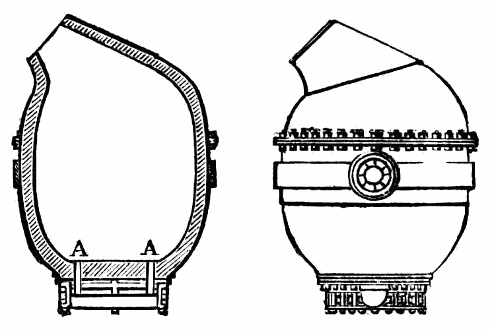
In the manufacture of Bessemer steel both the carburation and decarburation processes are practised. From 1 to 5 tons of pig or cast iron in a molten state are run from a contiguous blast, cupola, or reverberatory furnace, with an apparatus known as a converter, which is previously heated up to redness by means of coke. The converter is figured under two aspects in the annexed engraving.
This vessel, which is generally made of boiler plates of sheet iron, has an inside lining, consisting of a siliceous fireproof material, and is perforated at the bottom with a number of concentric little openings, which are the orifices of as many little tubes or tuyeres, that lead into
The removal of the carbon (which is known by the discontinuance of the carbonic oxide flame) being thus accomplished, the iron has next to be submitted to the carburetting operation. This is performed by running into the liquid iron in the converter such a quantity of molten pig or cast iron as contains the required proportion of carbon.
The pig iron used for this purpose generally contains, in addition to a large amount of carbon, a very perceptible quantity of manganese. The converter (as shown in the plate) is then by means of the trunnion tilted, so that its contents can be run into a ladle and transferred to the necessary moulds. The time of conversion occupies from ten to twenty minutes.
By Bessemer’s process the sulphur present in the pig iron is almost entirely eliminated; the greater part of the silicon is also separated, together with the carbon, and almost in the same proportion; but the phosphorus is not removed, and, owing to the oxidation of some iron, the amount is actually greater in the finished steel than in the pig iron.[197]
Bessemer’s steel is in large demand, and is excellently suited for rails for railroads, cannon, boiler plates, armour plates, and similar heavy material, for the manufacture of which it has largely supplanted wrought iron, but not at all adapted for the manufacture of knives, razors, lancets, or similar instruments, in which a sharp or keen edge is desirable.
The Bessemer process, which is largely adopted by the manufacturers of steel throughout Europe and America, has proved a source of princely income to its inventor, who obtains a bounty of a shilling on every ton of steel made by it. In Europe alone in 1859 51⁄2 million cwts. Seventy per cent. of this quantity was the produce of British industry.
Latterly, attempts have been made to obtain steel direct from the ores. The efforts made in this direction have been greatly stimulated by the invention of the regenerating furnace of Siemens. In these furnaces, in which an intense temperature is obtained by means of the combustion of inflammable gases (chiefly consisting of carbonic oxide, hydrogen, and carburetted hydrogen), the ore after (in one process) being melted in hoppers by means of the burning gases, runs down, and is gradually dissolved in some melted pig iron placed on the hearth of the furnace. When this latter has been sufficiently diluted with the decarbonised iron the operation is complete.
Properties of Steel. The effects of temperature upon steel are remarkable, and a knowledge of them has proved of great practical utility in the manufacture of the various steel-ware articles that are so indispensable to our every-day wants and needs. If forged and soft steel is heated, and then suddenly cooled, it becomes hard, the hardness varying with the temperature and the rapidity with which this has been reduced. The higher the temperature and the more rapidly it is cooled, the greater will be its hardness. Steel, which has been heated until white-hot, and then suddenly plunged into a bath of cold mercury, acquires a hardness nearly equalling that of the diamond. That, however, which the steel gains in hardness, it loses in pliancy and elasticity, besides becoming so brittle as to be of no possible use.
Soft steel, which has been made hard by heating it to redness, and by subsequent sudden immersion in cold water, may be reconverted into soft steel by again heating it to redness and allowing it to cool suddenly.
Hence steel articles, varying as much in the qualities of hardness and elasticity as a lancet and watch-spring, are made either by ‘heating down’ hard steel to requisite temperature and allowing it to cool, or by ‘heating up’ soft steel to the necessary point and also letting it gradually cool. When steel is so treated it is said to be tempered or annealed. If polished steel be heated over a flame to a temperature of 430° F. its surface becomes of a very pale yellow colour; the colour passes through different shades of yellow and blue with each successive increase of temperature, until when raised to 600° F. it becomes blackish blue.
These effects are due to the formation on the surface of the steel of films of oxide of different degrees of thickness, and to the action of the light on these. They are precisely analogous to those which are caused when a ray of reflected light falls upon any other body, the surface of which is composed of thin layers, which are continually changing in thickness, such as a soap-bubble, or a thin coating of tar or oil swimming on water, and which are exemplified in Newton’s rings.
As each shade of colour is an index of the temperature of the steel, and as this determines its adaptability for various purposes, all that the workman has to do, when he requires it for any special object, is to heat it by the proper methods (such as a bath of oil, or tallow, or melted metal) until it acquires the desired colour, and then to allow it to gradually cool.
The following table, exhibiting the different melting points of steel when employed in the manufacture of different kinds of works, together with the corresponding colours, the composition of the metallic baths, &c., is from Dr Wagner’s ‘Handbook of Chemical Technology,’ edited by W. Crookes, Esq., F.R.S.
Composition of Metallic Mixture.
Lead. Tin. Melting Point. Temperature.
Lancets 7 4 220° C Hardly pale yellow.
Razors 8 4 228° ” Pale yellow to straw yellow.
Penknives 81⁄2 4 232° ” Straw yellow.
Pairs of scissors 14 4 254° ” Brown.
Clasp-knives, joiners’ and carpenters’ tools 19 4 265° ” Purplish colour.
Swords, cutlasses, watch-springs 48 4 288° ” Bright blue.
Stilettos, boring tools, and fine saws 50 2 292° ” Deep blue.
Ordinary saws in boiling linseed oil 316° ” Blackish blue.
Steel is of a greyish-white colour, and has a sp. gr. varying from 7·66 to 7·93. During hardening the sp. gr. becomes reduced from 7·93 to 7·66, whilst it experiences a slight increase of volume. The property (already pointed out) that steel possesses of becoming hard after being heated to redness, and suddenly chilled, does not belong to pure iron, such as may be obtained by electrolysis. Unlike pure iron, too, steel presents a granular instead of a fibrous structure when broken; the best samples closely resembling silver in this respect. The chemical difference between hard and soft steel appears to consist in the much more intimate combination of the carbon with the iron in the hard variety than in the soft. In this latter kind the carbon seems to be only mechanically mixed, for if it be immersed in hydrochloric acid the iron is dissolved, and leaves the carbon behind. Steel is the most tenacious of all the metals, being greater than that of either cast or malleable iron.
What is termed case-hardening (which see) is a process by which small articles of iron, such as keys, gun-locks, &c., are superficially converted into steel. It is performed by heating the articles in contact with iron filings or powdered charcoal. Another method is to make the iron substance red hot, and then to sprinkle powdered potassic ferrocyanide all over it.
STEREOCHROMY. This is a branch of the pictorial art confined to the embellishment of walls and monuments. In the operations by which it is accomplished it will be seen that the soluble silicates (water glass) play an important part.
The foundation for the future picture or coloured design must be of some durable stone or imperishable cement. Over this is first placed a layer of lime mortar, to which is applied when it is dry and has become sufficiently hard, a solution of water glass, by which all the interstices of the mortar are filled up. Another coating of mortar made of sharp sand and a lye of chalk is next laid on, and this, after it has been carefully smoothed, properly levelled on the surface, and become quite dry, is washed over and thoroughly impregnated with water-glass solution. When this last layer has become dry it is ready to receive the painting, which must be executed in water colours. After laying on these colours may be permanently fixed by covering them with water glass. The following are the colours used:—Zinc white, chrome green, chrome oxide, cobalt green, chrome red, zinc yellow, oxide of iron, sulphide of cadmium, ultramarine, ochre, &c. Vermillion is inadmissible, since, in fixing, it turns from red to brown. Cobalt ultramarine, on the contrary, increases greatly in brilliancy upon the application of the fixing solution. Stereochromatic paintings are found to be very durable, and impervious to damp, smoke, or variations of temperature.
STE′REOTYPE METAL. See Type metal.
STER′LING. The truth of the old proverb, that “all is not gold which glitters,” is often
Sterling value of Gold of different degrees of ‘Fineness,’
Carats. Fine. Value per oz. Troy.
£ s. d.
24 carats 4 4 111⁄2
23 ” 4 1 5
22 ” 3 17 101⁄2 (British standard)
21 ” 3 14 4
20 ” 3 10 91⁄2
19 ” 3 7 3
18 ” 3 3 81⁄2 (lowest Hall-mark)
17 ” 3 0 2
16 ” 2 16 71⁄2
15 ” 2 13 1
14 ” 2 9 61⁄2
13 ” 2 6 0
12 ” 2 2 51⁄2
11 ” 1 18 11
10 ” 1 15 41⁄2
9 ” 1 11 10
8 ” 1 8 31⁄2
7 ” 1 4 9
6 ” 1 1 21⁄2
5 ” 0 17 8
4 ” 0 14 2
3 ” 0 10 71⁄2
2 ” 0 7 1
1 ” 0 3 6
STEREO-METAL. A remarkable alloy recently invented by Baron de Rosthorn, of Vienna, and used in place of ordinary gun-metal. It consists of copper and spelter, with small proportions of iron and tin, and to these latter its peculiar hardness, tensile strength, and elasticity, are attributed.
STETH′OSCOPE. An instrument employed in auscultation. It consists of a tube (usually made of wood, sometimes of gutta percha) widening considerably at one end, and but slightly at the other. The wide end is applied to the chest or other part of the patient, the physician putting his ear at the other end; and from the sounds emitted by the heart, lungs, &c., the state of these parts is ascertained.
STEW′ING. A method of cooking food intermediate to frying and boiling, performed by simmering it in a saucepan or stewpan, with merely sufficient water to prevent burning, and to effect the object in view; the whole being served up to form the ‘dish.’ It is undoubtedly the most simple and economical, and, when skilfully conducted, one of those best calculated to develop the flavour and nutritious qualities of animal food. The following is one of the most popular stews:—
Stew, Irish. Prep. (Soyer.) Take about 2 lbs. of scrag or neck of mutton; divide it into ten or twelve pieces, and lay them in the pan; add 8 large potatoes and 4 onions cut into slices, season with 11⁄2 teaspoonful of pepper, and 3 do. of salt; cover all with water, put it into a slow oven, or on a stove, for two hours, then stir it all up well, and serve it up in deep dishes. If a little more water is added at the commencement, you can take out, when half done, a nice cup of broth.
STILL. A vessel or apparatus employed for the distillation of liquids on the large scale. The forms of stills, and the materials of which they are made, vary according to the purposes for which they are intended, some being exceedingly simple, whilst others are equally elaborate and complicated. The engr. represents the most common and useful apparatus of this kind, and the one almost exclusively employed in the laboratory. It is used as follows:—After the fluid and other matters (if any) are put into the still, the head is placed on and connected with the worm-tub or refrigerator, and the joints are all securely luted. For ordinary liquids, a stiff paste made with linseed meal and water, to which a little chalk may be added, answers well for this purpose. For corrosive liquids, nothing is better than elastic bands or rings interposed between the joints, which are then ‘brought home,’ as it is called, with screws or clamps. Heat is next applied, and the worm-tub is supplied with cold water in sufficient quantity to preserve its contents at a proper temperature; the application of the heat being so regulated that the liquid may drop from the end of the refrigerator quite cold and unaccompanied with vapour. For highly volatile liquids a closed receiver should be provided.
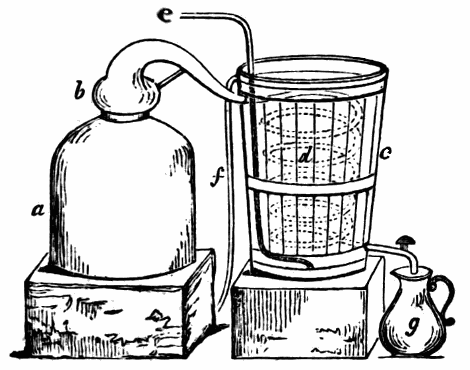
a. Body of still, which may be either placed in a steam jacket or in a brick furnace. b. Still head or capital. c. Worm-tub. d. Pewter-worm or refrigerator. e. Cold-water pipe. f. Waste-pipe. g. Receiver.
Of the various forms of distillatory apparatus that patented by Coffey in 1832 is the one almost universally employed in this country. It yields the strongest spirits obtainable on a large scale. Coffey’s still (of which a drawing is given on the next page) effects a great economy in the expenditure of heat, by causing the liquid to be exposed
Coffey’s Still.
Right click:
Larger.
The wash is pumped from the ‘wash charger’ into the worm-tub, which passes from top to bottom of the rectifier. In circulating through this tube it experiences a slight elevation of temperature. Arrived at the last convolution of the tube in the rectifier, the wash passes by the tube M in at the top of the ‘analyser.’ It falls, and collects on the top shelf till this overflows, whence it falls on the second shelf, and so on to the bottom. All the time this operation is going on steam is passed up from the steam boiler through fine holes in the shelves, and through valves opening upwards. As the wash gradually descends in the analyser it becomes rapidly weaker in alcohol, partly from condensation of steam which is passed into it, and partly from loss of alcohol, either evaporated or expelled by the steam, till when it arrives at the bottom it has parted with the last traces of spirits.
At the same time the vapour, as it rises through each shelf of the analyser, becomes constantly richer in alcohol, and contains less and less water because of its condensation; it then passes from the top of the analyser in at the bottom of the lower compartment of the rectifier. Here it ascends in a similar way, bubbling through the descending wash, until it arrives at F, above which it merely circulates round the earlier windings of the wash pipe; the low temperature of which condenses the spirits; which, collecting on the shelf at F, flows off by the tube into the finished spirit condenser.
To still further effect a saving of heat, the water for supplying the boiler is made to pass through a long coil of pipe, immersed in boiling spent wash, by which means its temperature is raised before it enters the boiler.
Another variety of distillatory apparatus is that of Siemens’ (see page 1566), much employed in the distillation of brandy.
It consists of two mash stills set in a boiler, and capable of being alternately used by means of the three cocks (a, b, and c). L is the boiler; P one of the mash retorts; K is the low wine receiver; R the fore warmer, a reservoir in which the condensed water intended as feed water of the boiler is collected; C is the dephlegmator; B a reservoir for the vapours condensed in C.
From the dephlegmator the vapour passes to a condenser, not shown in the engraving.
The mash warmer consists of a cylindrical portion (i i), the lower part of which has an indentation (c). In the cylinder is placed a narrower portion (o o) of the real mash, containing a vessel, fitted with the heading tube (f n). The upper part of the fore warmer is fitted to the lower part by means of the flange (h h); r is a stirring apparatus, which is frequently set in operation during the process of distillation. The vapours from the second still are carried into the depression (c) under the fore warmer, which, in order that the vapours may come into contact with the phlegma, is covered with a sieve.
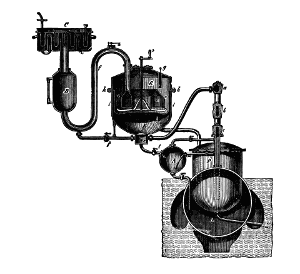
Siemens’ Distillatory Apparatus.
Right click:
Larger.
The vapours surround the under part of the mash reservoir, and enter into the tube (f), through which they pass to the lower cylinder of the dephlegmator. The condensed water of the dephlegmator is conducted into the reservoir (A). The upper and under part of the fore warmer are made of cast iron, but the interior bottom and heating surfaces are made of copper. This kind of fore warmer has the advantage of uniformly distributing the heat, while it can be easily cleansed.
The dephlegmator (C) is so contrived that the rectified vapour can be conveyed to the condenser by two separate pipes placed in an opposite direction to each other, which are joined again in close proximity to the condenser.
The remainder of the details will be seen by studying the engraving.
Another distilling apparatus is that known as Derosne’s, which is an improvement upon one invented by Cellier-Blumenthal. This apparatus is only designed for the distillation of wine, and not, like the previous ones, of mash.
The engraving on page 1568 gives a representation of it.
It consists of two stills (A and A′); the first rectifier (B); the second rectificator (C); the wine warmer and dephlegmator (D); the condenser (F); the regulator (E); a contrivance for regulating the flow of the fluid wine from the cistern (G).
The still A′, which, as well as the still A, is filled with wine, acts as a steam boiler. The low wine vapours evolved come, when they have arrived in the rectifiers, in contact with an uninterrupted stream of wine, whereby dephlegmation is effected; the vapour, thus enriched in alcohol, becomes stronger in the vessel (D), and thus arrives at the cooling apparatus (F). In order that a real rectification should take place in the rectificators the stream of wine should be heated to a certain temperature, which is imparted to it by the heating of the condensed water. The steam from the still A′ is carried by means of the pipe (Z) to the bottom of the still A.
Both stills are heated by the fire of the same furnace. By means of the tube B′ the liquid contained in the still A can be run into the still A′. The first rectificator (B) containing a number of semicircular discs of unequal size, placed one above the other, and which are so fastened to a vertical centre rod that they can be easily removed and cleansed. The larger discs, perforated in the manner of sieves, are placed with their concave surfaces upwards.
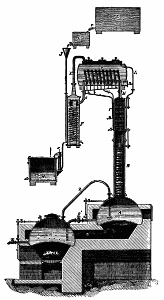
Derosne’s Distillatory Apparatus.
Right click:
Larger.
In consequence of this arrangement the vapours ascending from the stills meet with large surfaces moistened with wine, which, moreover, trickles downward in the manner of a cascade from the discs, and comes, therefore, into very intimate contact with the vapours. The second rectificator (C) is fitted with six compartments; in the centre of each of the partition walls (iron or copper plates) a hole is cut, and over this hole, by means of a vertical bar, is fastened an inverted cup, which nearly reaches to the bottom of the compartment wherein it is placed. As a portion of the vapours are condensed in these compartments, the vapours are necessarily forced through a layer of low wine, and have to overcome a pressure of a column of liquid two centimètres high. The fore warmer and dephlegmator (D) is a horizontal cylinder made of copper fitted with a worm, the convolutions of which are placed vertically. The tube (M) communicates with this worm, the other end of which passes to O. A phlegma collects in the convolutions of this tube, which is richer in alcohol in the formost windings, and weaker in those more remote; this fluid, collecting in the lower part of the spirals, may be drawn off by means of small tubes, thence to be transferred, at the operator’s pleasure, either all or in part, by the aid of another tube and stopcocks, to the tube (O), or into the rectificator.
By means of the tube (L) the previously warmed wine of the dephlegmator can be run into the rectificator. The condensor (F) is a cylindrical vessel closed on all sides, and containing a worm communicating with the tube (O).
The other end of the condensing tube carries the distillate away. On the top of this portion of the apparatus the tube (K) is placed, by means of which wine is run into the dephlegmator. The cold wine flows into the cooling vessel by the tube (I).
Another variety of distillatory apparatus, invented by Langier, is that represented in the accompanying cut.
Right click: Larger.
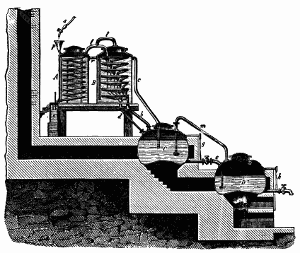
The fluid intended for distillation flows from the tube (s) into the funnel (p), thence into the vessel (A), entering its lower part, and serving to condense the alcoholic vapour. From this vessel the warmed fluid passes by means of the tube (r) into the lower part of the second vessel (B), where dephlegmation takes place by means of a condensing tube. From B the fluid flows through the tube (c) into the second still (C), which is heated by the hot gases evolved from the fire, kept burning under the first still (D); in the still (C) the fluid undergoes a rectification, and the vinasse flows by the tube (e) into the still (D); m is the pipe for conveying the hot vapour from D into C; the tube (b) carries the alcoholic vapours into the dephlegmator. The tube (d) conveys the phlegma into the still (C); g and h are glass gauging-tubes for indicating the height of the fluid in the interior of the stills; the tube (l) conveys the uncondensed vapours from the dephlegmator into the condensing apparatus, while i carries the vapours formed in the vessel (B) into the condensing apparatus.
The alcohol condensed in the cooling apparatus flows, as shown in the cut, into the vessel (o), provided with a hydrometer, which shows the strength of the liquid. The cooling apparatus of the vessel (B) consists of seven compartments or sections formed by wide spirals, to each of which, at its lower level, is attached a narrow tube, all of which tubes are connected to the tube (d), which latter conveys the condensed fluids back into the still.
A very simple form of apparatus in use is that figured below.
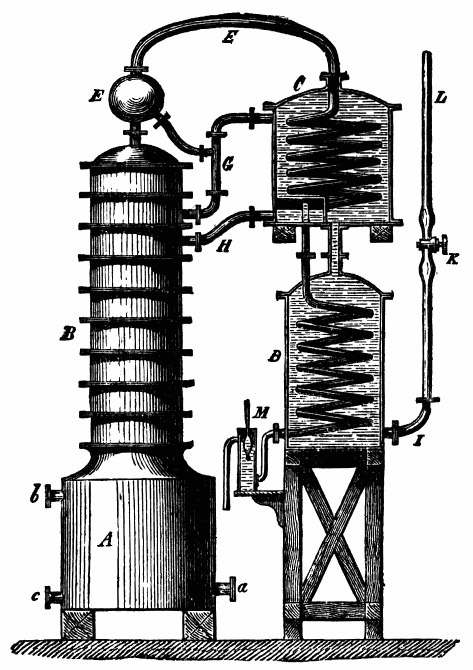
A is a cylinder made of cast iron or copper, in which the fluid to be distilled is heated by a spiral tube made of copper. The inlet of this tube is shown at b and the outlet at a.; c serves to carry off the vinasse; B is the dephlegmator, through which the fluid to be distilled continually flows in a downward direction, while the vapour of the low wine evolved in A ascends uninterruptedly.
The dephlegmator is so constructed as to have as large a surface and as many points of contact as possible. The vapour ascends to the reservoir (E), and passes into the rectifier (C) by the tube (F). The condensed portion returns through the tube (H) to the dephlegmator, whilst the uncondensed vapour passes on to the condenser of the vessel (D), where it becomes condensed, and is carried off through M. The liquid intended for distillation is kept in a tank (not shown in the engraving), placed above the apparatus, and is conveyed to the latter by the tube (L I), fitted with the stop-cock (K), so that the liquid arrives first in D, is next conveyed to C, thence through G into the dephlegmator, and finally into the cylinder.
Divers adaptations for heating by steam have been arranged, in a very convenient form, by Mr Coffey. His so-called Esculapian still affords the pharmaceutical chemist the means of conducting the processes of ebullition, distillation, evaporation, desiccation, &c., on the small scale. The following cut represents his apparatus.
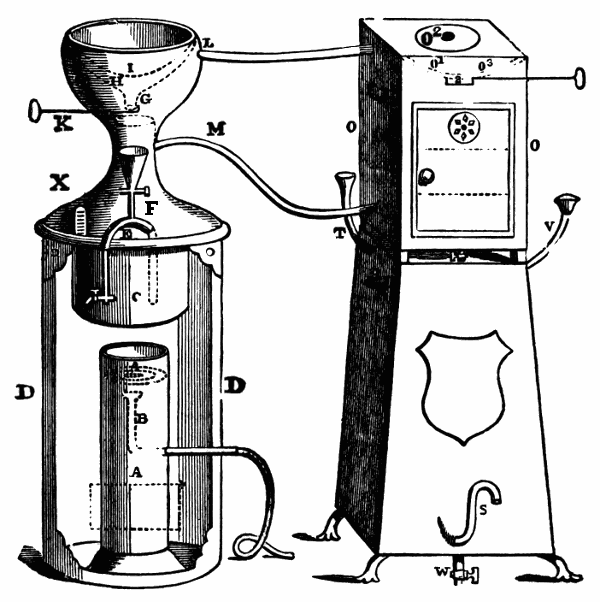
B, a burner supplied with gas by a flexible tube; C. the boiler or still; I, an evaporating pan fixed over the boiler, and forming the top of the still head; K, a valve for shutting off the steam from I, when it passes through the tube (M), otherwise it would pass through L, and communicate heat to the drying closet (O O), and from thence to the condenser (T T). o is a second evaporating pan over the drying closet.
For further information on the subject of stills consult ‘Ure’s Dictionary,’ ‘Illustrated Chemistry,’ and Wagner’s ‘Chemical Technology.’
STIM′ULANTS. Syn. Stimulantia, L. Medicines or agents which possess the power of exciting vital action. They are divided in general stimulants, or those which affect the whole system, as mercury or bark; and local or topical stimulants, or those which affect a particular organ or part only, as mustard applied as a poultice. Diffusible stimulants are general stimulants the effects of which are rapid but fugacious, as ether or alcohol. “Much discrimination and caution are required in the administration of articles of this class, because, if given when inflammation is present, they are liable to create more mischief than benefit; but they are called for when, on the decline of that condition of an organ or organs, a state of relaxation or torpidity exists. In this state of things a gentle stimulation materially assists the functions, and is productive of much benefit.”
STINGS. See Bites.
STIR-ABOUT. Thick gruel formed of oatmeal and water boiled together. When eaten with cold milk, it forms the porridge of the Scotch; and when mixed with the liquor in which meat or vegetables have been boiled, it is called beef brose, kale brose, &c.
STOCK. Among cooks, is condensed soup or jelly, used to make extemporaneous soup, broth, &c.
STOM′ACH AFFEC′TIONS. Those of a character to admit of being usefully noticed in a popular work are referred to under the heads Appetite, Dyspepsia, Sickness, &c.
Dr Budd recommends small doses of ipecacuanha as a remedy for those cases of indigestion in which digestion is slow, and the food lies heavily on the stomach, and there is an inability for mental or bodily exertion for some time after meals. He says it should be given in the morning, fasting, and in quantity barely sufficient to occasion a slight feeling of vermiculating motion in the stomach, but without causing any sensation of pain or nausea. The dose to produce this effect varies from 1⁄4 to 2 gr. He thinks there is no other medicine which appears so effectual in removing the affections in question. Small doses of rhubarb, ginger, and cayenne pepper, have a similar kind of action, and may be given singly or together for the same purpose. “I generally prescribe from 1⁄2 to 1 gr. of ipecacuanha, in a pill, with 3 or 4 gr. of rhubarb. With many, a favourite remedy for the discomfort1⁄2 an hour) “before any meal after which a sense of oppression is usually felt.”
STOPP′ERS, when obstinately immoveable in bottles, are the most safely treated by patiently hitting them upwards alternately on opposite sides with a piece of wood. When this fails the part may be dipped into hot water.
“Another method of removing a bottle-stopper is to insert its head into a chink, and then endeavouring to turn the bottle with both hands. If the neck of the stopper break, the hand is out of the way of danger. An upright board, such an one as supports the ends of a set of shelves, should be selected in a convenient situation in the laboratory, and a vertical slit cut through it about a foot in length, an inch in width above, but gradually decreasing in size, so as to be about one third of an inch at the bottom. The top of the hole may be about the height of the breast. This aperture will in one part or another receive and retain the head of almost any stopper, and prevent its turning with the bottle. Then by wrapping a cloth about the bottle and grasping it with both hands, the attempt to turn it round so as to move the stopper may be made with any degree of force which it may be thought safe to exert. The force employed should never be carried so far as to cause fracture anywhere, but the attempts, if unavailing with the application of a moderate degree, should be desisted. Another and very successful method of removing a stopper is to turn the bottle round when held horizontally over the small flame of a spirit lamp or candle applied to the neck. The heat should be applied only to the part round the plug of the stopper, and in a few moments, when that has become warm, the stopper should be tapped with the piece of wood as before stated. As soon as the stopper moves by tapping it is to be taken out, and must not be replaced till the glass is cold.
“The application of heat in this manner must be short and the operation altogether, to be successful, must be a quick one. If the contents of the bottle are fluid, it should be so inclined that they must not become heated; if they are volatile this method should be tried very carefully, lest the vapour formed within should burst the bottle.
“It is often advantageous to put a little olive oil round the edge of the stopper at its insertion, allowing it to soak in for a day or two. If this be done before the heat be applied, it frequently penetrates by increased facility; by oil, heat, and tapping very obstinate stoppers may be removed.
“When a stopper has been fixed by crystallisation from solution, water will sometimes set it free, and it is more efficacious in such cases than oil, because it dissolves the cement. When the cementing matter is a metallic oxide or sub-salt, a little muriatic acid may be useful if there be no objection to its application arising from the nature of the substance within.”[198]
A writes in ‘New Remedies’ suggests that, in attempting to extricate the fixed stopper by means of knocking with a piece of wood, the motion given to it when putting it in should be reversed, that is, the stopper should be knocked from right to left.
STORM-GLASS. A philosophical toy, consisting of a thin glass tube about 12 inches long and 3⁄4 inch in diameter, about three fourths filled with the following liquid, and covered with a brass car having an almost capillary hole through it, or else tied over with bladder.
The solution. Take of camphor, 2 dr.; nitre 11⁄2 dr.; sal ammoniac, 1 dr.; proof spirit 21⁄4 fl. oz.; dissolve, and place it in the tube above referred to. Used to foretell changes of the weather.
STOVES. In England the open grate or fireplace, because of its cheerful appearance and the sense of comfort it suggests when filled with glowing coal, is the favorite and general receptacle for the fuel with which we warm our apartments. The cozy appearance, however, of our old-fashioned English grate, constitutes its chief, if not its only merit; for it not only fails in uniformly warming and effectively ventilating our apartments, but it more or less sets into circulation a number of draughts of cold air, and besides occasionally filling our rooms with smoke and spoiling our furniture by the deposition of soot and dust, wastes our fuel, by allowing it to escape unconsumed in the shape of smoke, and thus pollutes the atmosphere of our cities and towns.
In France, Germany, Belgium, Russia, and other European countries, as well as in America and Canada, the stove or closed fireplace is used. The domestic stove of these countries is made either of sheet or cast-iron, or fire-clay. The iron stoves, being mostly composed of thin plates, soon absorb and radiate the heat; and although this property enables them to rapidly warm an apartment, it has the disadvantage, if the stove becomes red-hot, of allowing the escape through the heated metal into the surrounding air of the carbonic acid generated in the stove; and furthermore, in its immediate vicinity converts a portion of it into carbonic oxide. Such stoves must necessarily be unsafe unless used in well-ventilated apartments.[199] Another effect of the over heating of the stove is to desiccate or parch the air, and to render it irritating when breathed. The fire-clay stoves are free from these drawbacks, and continue to radiate from their surfaces a large amount of heat, even
“Stove literature,” if such a term may be applied to the various treatises descriptive of the multitude of patterns in use, which have emanated alike from inventors and their critics, is so voluminous that it is impossible for us to attempt to give even a list of the numberless stoves in use, to say nothing of a commentary on their relative value. Of close stoves suitable for heating spaces other than dwelling or sleeping-rooms, mention may be made of Arnott’s stove, and one known as “The Belfast.” These stoves are serviceable when it is desirable to keep up a fire for some time, as in heating a lobby. They have the advantage of requiring little, if any, attention after the fuel has been placed in them and ignited.
Of late years, gas-stoves, both for heating and cooking purposes, have come largely into use. One of those for the former purpose is called the “Pyropneumatic.” The inner part of this apparatus is formed of lumps of fire-clay traversed by vertical air-passages which communicate with the external air by a special channel. The air becomes heated as it passes through the lumps of fire-clay, and rising to the top of the stove, escapes therefrom by an outlet into the room. Another so-called “ventilating” warming gas-stove is Mr George’s “Culirogen.” It consists of a stove made of thin-rolled iron, inside of which is a coil of wrought-iron tubing open at the top of the stove. The lower end of this tubing is in connection with an iron pipe which is carried through the wall of the apartment, and fed with air from without. Gas is the fuel generally used to heat the inside of the stove. The continuous current of air as it rushes into the iron pipe from without, thus becomes warmed as it ascends into the coil, which it leaves to become diffused into the surrounding apartment, whilst the products of combustion of the gas used as fuel are, by means of a pipe attached to the stove, carried into the chimney, as with coal fire.
A gas-cooking apparatus possesses many advantages over an ordinary coal fire. In the first place, it is more cleanly; in the second, it affords a much more uniform and equable temperature; in the third, it forms no smoke, and in the fourth it is more economical as well as expeditious.
Mr Eassie gives the following practical suggestions to intending purchasers of gas-stoves:—
“It is not necessary here to enter into a description of any of the numberless common patterns extant, but it might be well to record the opinion of the best engineers, that the simplest gas-stove is the best. They should not be surrounded by a non-conducting material, as that affords no advantage, but the contrary. An Argand or fish-tail burner should also be used instead of rings pierced for so many separate jets, and where practicable, the Bunsen-burner should be employed, as the mixture of common air with the gas not only prevents the formation of soot, but also intensifies the heat.”
STRABIS′MUS. Syn. Squinting. This need not be described. When one eye only is affected, an excellent plan is to blindfold the sound eye during several hours each day, until the affection be removed. When both eyes are affected, a projecting piece of pasteboard, in the line of the nose, may be worn as much as possible with the same object. In bad cases of squinting inwards, as it is called, the division of the internal rectus muscle of the eyeball by a skilful surgeon, is said to often relieve the deformity.
STRANGULATION. See Hanging.
STRAP′PING. Spread adhesive plaster. Used to dress wounds, &c.
STRASS. See Enamel.
STRAW′BERRY. Syn. Fragaria, L. The fruit of Fragaria vesca (Linn.), or strawberry plant. Strawberries are, perhaps, the mildest of all the cultivated fruits; they are cooling, and slightly laxative and diuretic; rubbed on the teeth, they dissolve the tartar, and whiten them. They were formerly in repute in gout, stone, and consumption. The root of the plant is aperient.
Strawberry essence, factitious. Nitric ether, 1 part; acetate of ethyl, 5 parts; forminate of ethyl, 5 parts; butyrate of ethyl, 5 parts; salicylate of methyl, 1 part; acetate of amyl, 3 parts; butyrate of amyl, 2 parts; glycerin, 2 parts; alcohol, 100 parts.[200]
STRAW PLAIT, and the articles made of it, are bleached by exposing them to the fumes of burning sulphur in a close chest or box; or, by immersing them in a weak solution of chloride of lime, and afterwards well washing them in water. Water acidulated with oil of vitriol or oxalic acid is also used for the same purpose. Straw plait may be dyed with any of the simple liquid dyes.
STRINGHALT. The same as Chorea, which see.
STRON′TIUM. Sr. The metallic base of the earth strontia. It was discovered by Sir H. Davy, in 1808. It closely resembles barium, but is less lustrous. With chlorine it combines to form a chloride of strontium, a somewhat deliquescent salt, soluble in 2 parts of cold and in less of boiling water, and freely soluble in alcohol. With oxygen it forms an oxide.
Test. Strontium salts are precipitated by sulphuric acid and alkaline carbonates and sulphate. They are distinguished from barium by not giving such a decided precipitate with sulphates, and by not being precipitated by bichromate of potassium. From calcium, by
Strontium, Oxide of. SrO. Syn. Protoxide of strontium, Strontia. Prep. Quite pure crystalline nitrate of strontium. Prop. Greyish-white powder, uniting with water to form a white, somewhat soluble substance, the hydrate of strontium, Sr(HO)2.
With acids it forms various salts, of which the carbonate is a white insoluble powder, and the nitrate a white crystalline salt, soluble in 5 parts of cold water, and in alcohol; communicating a brilliant red colour to flame.
STROPH′ULUS. A papular eruption peculiar to infants. There are several varieties:—In strophulus intertinctus, red gum, or red gown, the pimples rise sensibly above the level of the cuticle, possess a vivid red colour, and are usually distinct from each other; they commonly attack the cheeks, forearm, and back of the hand, and, occasionally, other parts of the body.—In strophulus albidus, or white gum, there are a number of minute whitish specks, which are, sometimes, surrounded by a slight redness. The two preceding varieties commonly occur during the first two or three months of lactation.—In strophulus confertus, rank red gum, or tooth rash, which usually appears about the fourth or fifth month, the pimples usually occur on the cheeks and sides of the nose, sometimes on the forehead and arms, and still less frequently on the loins. They are smaller, set closer together, and less vivid, but more permanent than in the common red gum.—In strophulus volaticus small circular patches or clusters of pimples, each containing from 6 to 12, appear successively on different parts of the body, accompanied with redness; and as one patch declines another springs up near it, by which the efflorescence often spreads gradually over the whole face and body.—In strophulus candidus the pimples are larger than in the preceding, and are pale, smooth and shining; it principally attacks the upper parts of the arms, the shoulders, and the loins. The last two varieties commonly appear between the third and ninth month.
The treatment of the above affections consists chiefly in removing acidity and indigestion and duly regulating the bowels by an occasional dose of magnesia or rhubarb, or both combined. Diarrhœa may be met by the warm bath and the daily use of arrowroot (genuine), to which a teaspoonful or two of pure port wine has been added; and itching and irritation may be alleviated by the use of a lotion consisting of water, to which a little milk, lemon juice, borax, or glycerin, has been added.
STRYCH′NINE. C21H22N2O2. Syn. Strychnina, Strychnia (B. P., Ph. L., E., & D.), L. Prep. 1. Dissolve hydrochlorate or sulphate of strychnine in distilled water, and throw down the alkaloid with ammonia, carefully avoiding excess; redissolve the precipitate in hot rectified spirit, and collect the crystals which form as the liquid cools.
2. (Ph. D.) Nux vomica (in powder), 1 lb., is digested for 24 hours in 1⁄2 gall. of water acidulated with 2 fl. dr. of sulphuric acid, after which it is boiled for half an hour, and the decoction decanted; the residuum is boiled a second and a third time with a fresh 1⁄2 gall. of water acidulated with 1 fl. dr. of the acid, and the undissolved matter is finally submitted to strong expression; the decoctions are next filtered and concentrated to the consistence of a syrup, which is boiled with rectified spirit, 3 pints, for about 20 minutes, hydrate of calcium, 1 oz., or q. s., being added in successive portions during the ebullition, until the solution becomes distinctly alkaline; the liquid is then filtered, the spirit distilled off, and the residuum dissolved in diluted sulphuric acid, q. s.; ammonia, in slight excess, is added to the filtered solution, and the precipitate which falls is collected upon a paper filter, and dried; it is next redissolved in a minimum of boiling rectified spirit, and digested with 1⁄2 oz. of animal charcoal for 20 minutes; the filtered liquid, as it cools, deposits strychnine, in crystals.
3. (Ph. B.) Nux vomica 1 lb., acetate of lead 180 gr., solution of ammonia q. s., rectified spirit q. s., distilled water q. s. Subject the nux vomica for two hours to steam in any convenient vessel; chop or slice it; dry it in a water bath or hot-air chamber, and immediately grind it in a coffee mill. Digest the powder at a gentle heat for 12 hours with two pints of the spirit and 1 pint of the water, strain through linen, express strongly, and repeat the process twice. Distil off the spirit from the mixed fluid, evaporate the watery residue to about 16 oz., and filter when cold. Add now the acetate of lead, previously dissolved in distilled water, so long as it occasions any precipitate; filter; wash the precipitate with 10 oz. of cold water, adding the washings to the filtrate; evaporate the clear fluid to 8 oz., and when it has cooled add the ammonia in slight excess, stirring thoroughly. Let the mixture stand at the ordinary temperature for 12 hours; collect the precipitate on a filter, wash it once with a few ounces of cold distilled water, dry it in a water-bath or hot-air chamber, and boil it with successive portions of rectified spirit, till the fluid scarcely tastes bitter. Distil off most of the spirit, evaporate the residue to the bulk of about 1⁄2 oz., and set it aside to cool. Cautiously pour off the yellowish mother-liquor (which contains the brucia of the seeds) from the white crust of strychnia which adheres to the vessel. Throw the crust on a paper filter, wash it with a mixture of two parts of rectified spirit and one of water, till the washings cease to become red on the addition of nitric acid; finally, dissolve it, by boiling it with 1 oz. of rectified spirit,1⁄30th to 1⁄12th of a grain, to be very slowly increased, carefully watching its effects. Magendie says the salts are more active than their base.
Prop. A white, inodorous, infusible powder; or small, but exceedingly brilliant, transparent, colourless, octahedral crystals; soluble in about 7000 parts of water at 60°, and in 2500 parts at 212° Fahr.; freebly soluble in hot rectified spirit; insoluble in absolute alcohol, ether, and solutions of the caustic alkalies; imparts a distinctly bitter taste to 600,000 times its weight of water (1 part in 1,000,000 parts of water is still perceptible—Fownes); exhibits an alkaline reaction; and forms salts with the acids, which are easily prepared, are crystallisable, and well defined.
Tests.—1. Potassium hydrate and the carbonate produce, in solutions of the salts of strychnia, white precipitates, which are insoluble in excess of the precipitant, and which, when viewed through a lens magnifying 100 times, appear as aggregates of small crystalline needles. In weak solutions the precipitate only separates after some time, in the form of crystalline needles, which are, however, in this case, perfectly visible to the naked eye.—2. Ammonia gives a similar precipitate, which is soluble in excess of the precipitant.—3. Bicarbonate of sodium produces, in neutral solutions, a like white precipitate, which is insoluble in excess, but which redissolves on the addition of a single drop of acid; in acid solutions no precipitate occurs for some time in the cold, but immediately on boiling the liquid.—4. Nitric acid dissolves pure strychnia and its salts to colourless fluids, which become yellow when heated. Commercial strychnine, from containing a little brucine, is reddened by this test.—5. A minute quantity of strychnine being mixed with a small drop of concentrated sulphuric acid, placed on a white capsule or slip of glass, forms a colourless solution, but yields, on the addition of a very small crystal of bichromate of potassium, or a very minute portion of chromic acid, a rich violet colour, which gradually changes to red and yellow, and disappears after some time. The 1⁄1000th of a grain yields very distinct indications.—6. Pure oxide or peroxide of lead produces a similar reaction to the last, provided the sulphuric acid contain about 1% of nitric acid.
Pois. The characteristic symptom is the special influence exerted upon the nervous system, which is manifested by a general contraction of all the muscles of the body, with rigidity of the spinal column. A profound calm soon succeeds, which is followed by a new tetanic seizure, longer than the first, during which the respiration is suspended. These symptoms then cease, the breathing becomes easy, and there is stupor, followed by another general contraction. In fatal cases these attacks are renewed, at intervals, with increasing violence, until death ensues. One phenomenon which is only found in poisonings by substances containing strychnine is, that touching any part of the body, or even threatening to do so, instantly produces the tetanic spasm.
Treat. The stomach should be immediately cleared by means of an emetic, tickling the fauces, &c. To counteract the asphyxia from tetanus, &c., artificial respiration should be practised with diligence and care. “If the poison has been applied externally, we ought immediately to cauterise the part, and apply a ligature tightly above the wound. If the poison has been swallowed for some time, we should give a purgative clyster, and administer draughts containing sulphuric ether or oil of turpentine, which in most cases produce a salutary effect. Lastly, injections of chlorine and decoction of tannin are of value.”
According to Ch. Gunther, the greatest reliance may be placed on full doses of opium, assisted by venesection, in cases of poisoning by strychnia or nux vomica. His plan is to administer this drug in the form of solution or mixture, in combination with a saline aperient.
Uses, &c. It is a most frightful poison, producing tetanus and death in very small doses. Even 1⁄24 gr. will sometimes occasion tetanic twitchings in persons of delicate temperament. 1⁄4 gr. blown into the throat of a small dog produced death in 6 minutes. In very minute doses it acts as a useful tonic in various nervous diseases, chronic diarrhœa, leucorrhœa, &c.; in slightly larger ones, it has been advantageously employed in certain forms of paralysis, in tic douloureux, impotence, &c.—Dose, 1⁄24 to 1⁄16 gr. (dissolved in water by means of a drop of acetic or hydrochloric acid), gradually and cautiously increased until it slightly affects the muscular system. Externally, 1⁄8 to 1⁄4 gr. at a time.
The Edinburgh College ordered the nux vomica to be exposed for two hours to steam, to soften it, then to chop or slice it, next to dry it by the heat of a vapour bath or hot air, and, lastly, to grind it in a coffee-mill. In the process of the Ph. L. 1836 magnesia was employed to effect the precipitation. In the last Ph. L. strychnine appears in the Materia Medica. Most of that of commerce is now obtained from St Ignatius’s bean, which, according to Geiseler, yields 11⁄4% of it; whereas 3 lbs. of nux vomica produce little more than 1 dr. Commercial strychnine may be freed from brucine by digesting the powder in dilute alcohol.
The salts of strychnine, which are occasionally asked for in trade, are the acetate (strychniæ acetas), hydrochlorate or muriate (s. murias—Ph. D.), hydriodate (s. hydriodas),
STRYCHNOS. See Nux vomica and Bean, St Ignatius’s.
STUC′CO. The name of several calcareous cements or mortars. Fine stucco is the third or last coat of three-coat plaster, and consists of a mixture of fine lime and quartzose sand, which, in application, is “twice hand floated and well trowelled.” See Cements.
STUFFING. Seasoning, placed in meat, poultry, game, &c., before dressing them, to give them an increased relish. The same materials formed into balls, are added to soups, gravies, &c., under the name of Forcemeat.
Prep. 1. (For fowls, &c.) Shred a little ham or gammon, some cold veal or fowl, some beef suet, a small quantity of onion, some parsley, a very little lemon peel, salt, nutmeg, or pounded mace, and either white pepper or cayenne, and bread crumbs, pound them in a mortar, and bind it with 1 or 2 eggs.
2. (For hare, or anything in imitation of it.—Mrs Rundell.) The scalded liver, an anchovy, some fat bacon, a little suet, some parsley, thyme, knotted marjoram, a little shalot, and either onion or chives, all chopped fine, with some crumbs of bread, pepper, and nutmeg, beaten in a mortar with an egg.
3. (For goose.) From sage, onion, suet, and crumb of bread. Geese are now, however, more commonly stuffed with veal stuffing.
4. (For veal—Soyer.) Chop 1⁄2 lb. of suet, put it into a basin with 3⁄4 lb. of bread crumbs, a teaspoonful of salt, a 1⁄4 do. of pepper, a little thyme or lemon peel chopped, and 3 whole eggs; mix well.
Obs. 1 lb. of bread crumbs and one more egg may be used; they will make it cut firmer. This, as well as No. 1, is now commonly employed for poultry and meat. Ude, a great authority in these matters, observes that “it would not be amiss to add a piece of butter, and to pound the whole in a mortar.” “Grated ham or tongue may be added to this stuffing.” (Rundell.) This is also used for turkeys, and for ‘forcemeat patties.’
STUFFING (Birds, &c.). The skins are commonly dusted over with a mixture of camphor, alum, and sulphur, in about equal quantities; or, they are smeared with Bécœur’s arsenical soap, noticed under Soap. According to Crace Calvert, carbolic acid, which is worth only about 2s. per gall., is superior to all other substances for preserving the skins of birds and animals, as well as corpses. See Taxidermy, Practical.
STURDY. This disease, known also by the name of Gad, which attacks cattle and sheep, but more particularly the latter, is caused by the presence in the brain of the animal, of a hydatid—a creature enclosed in a sac of serous fluid. This hydatid develops from the ova of the tape worm, in the animal’s body, whence it has gained an entrance, with the grass which constitutes the cattle or sheep’s food upon which it has been voided by dogs and other animals.
It is most common in sheep of from 6 to 8 months old, and, as might be expected, with those which feed in damp meadows. The animals attacked by it turn round and round in one position, lose their gregarious habits, seem dazed, and refuse their food; which latter circumstance frequently causes death by inducing starvation.
As regards the treatment of this disease Mr Finlay Dun writes: “A stout stocking wire thrust up the nostrils has long been used with occasional success, to get rid of the hydatid; but the use of the trocar and canula now sold by most surgical instrument makers is much safer and better. The sheep is placed with its feet tied upon a table or bench, and the head carefully examined, when a soft place may often be detected, indicating that the hydatid lies underneath. A portion of the skin is dissected back and the trocar and canula introduced, when the hydatid will often come away as the trocar is withdrawn.” Mr Dun says “that, should the trocar fail to extract it, it must be drawn to the surface by a small syringe made for the purpose. Furthermore, the wound, after the removal of the hydatid, must be treated with a cold water dressing.”
All cattle similarly affected should be treated as above.
STUR′GEON. Several species of Acipenser pass under this name. The common sturgeon is the Acipenser sturio (Linn.). The roe is made into ‘caviare,’ the swimming-bladder into ‘isinglass.’
STY. Syn. Stye, Stian; Hordeolum, L. A small inflamed tumour, or boil, at the edge of the eyelid, somewhat resembling a barleycorn. It is usually recommended to promote its maturation by warm applications, since “the stye, like other furunculous inflammations, forms an exception to the general rule, that the best mode in which inflammatory swellings can end is resolution.”
STYP′TICS. Syn. Styptica, L. Substances which arrest local bleeding. Creasote, tannic acid, alcohol, alum, and most of the astringent salts, belong to this class.
Styptic, Brocchieri’s. A nostrum consisting of the water distilled from pine tops.
Styptic, Eaton’s. A solution of sulphate disguised by the addition of some unimportant substances. “Helvetius’s styptic was for a long time employed under this title.” (Paris.)
Styptic Helvetius’s. Syn. Stypticum helvetii, L. Iron filings (fine), and cream ofPowder, Helvetius’s.
STY′RAX. Syn. Storax, Storax balsam; Styrax (Ph. L., & E.), L. “The liquid balsam of an uncertain plant.” (Ph. L.) The “balsamic exudation of Styrax officinale, Linn.” (Ph. E.), or cane storax tree. Two or three varieties are known in commerce:—Liquid storax (styrax liquida), lump of red storax (s. in massis), which is generally very impure; storax in tears (s. in lachrymis), and storax in reeds (s. calamita). The last are now seldom met with in trade.
Prepared Storax (styrax colata; s. præparata, B. P., Ph. L.) is obtained by dissolving storax, 1 lb., in rectified spirit, 4 pints, by a gentle heat, straining the solution through linen, distilling off greater part of the spirit, and evaporating what is left to a proper consistence by the heat of a water bath. It is less fragrant than the raw drug.
Storax is stimulant, expectorant, and nervine. It was formerly much used in menstrual obstructions, phthisis, coughs, asthmas, and other breath diseases. It is now chiefly used as a perfume.—Dose, 6 to 20 or 30 gr. (10 to 20 gr. twice a day, B. P.).
A factitious strained Storax is made as follows:—1. Balsam of Peru, 1 lb.; balsam of tolu, 4 lbs.; mix.
2. Gum benzoin, 8 lbs.; liquid storax, 6 lbs.; balsam of tolu and Socotrine aloes, of each 3 lbs.; balsam of Peru, 2 lbs.; N.S.W. yellow gum, 7 lbs.; rectified spirit, 7 gall.; digest, with frequent agitation, for a fortnight, strain and distil off the spirit (about 51⁄2 galls.) until the residuum has a proper consistence. Prod. 28 lbs.
3. Liquid storax, 1 oz.; Socotrine aloes, 1⁄4 lb.; balsam of tolu, 2 lbs.; rectified spirit, q. s.
SUB-. See Nomenclature and Salts.
SU′BERIC ACID. Obtained by boiling rasped cork for some time in nitric acid.
SUBLIMA′TION. The process by which volatile substances are reduced to the state of vapour by heat, and again condensed in the solid form. It differs from ordinary distillation in being confined to dry solid substances, and in the heat employed being, in general, much greater.
SUB′STANTIVE COLOURS, in the art of dyeing, are such as impart their tints to cloth and yarns without the intervention of a mordant; in contradistinction to adjective colours, which require to be fixed by certain ‘intermedes,’ or substances which have a joint affinity for the colouring matter and the material to be dyed.
SUCCIN′IC ACID. C4H4O4H2. Syn. Acidum succinicum. Prep. From amber, in coarse powder, mixed with an equal weight of sand, and distilled by a gradually increased heat; or from the impure acid obtained during the distillation of oil of amber; the product in both cases being purified by wrapping it in bibulous paper, and submitting it to strong pressure, to remove the oil, and then resubliming it.
From malic acid, by fermentation, or by digestion with hydriodic acid in sealed tubes.
Prop., &c. Colourless; inodorous (when pure); crystallises in oblique rhombic prisms; soluble in 5 parts of cold and in 21⁄2 parts of boiling water; fusible and volatile, without decomposition. Its salts are called ‘succinates,’ most of which are soluble. Succinate of ammonium is used as a test for iron. Succinic acid is distinguished from benzoic acid by its greater solubility, and by giving a brownish or pale red bulky precipitate with ferric chloride in neutral solutions; whereas that with benzoic acid is paler and yellower.
Uses, &c. Succinic acid is antispasmodic, stimulant, and diuretic, but is now seldom used.—Dose, 5 to 15 gr.
SUC′CORY. Chicory, or wild endive. (See Chicory.)
SUDORIF′ICS. See Diaphoretics.
SU′ET. Syn. Sevum, Sebum, L. This is prepared from the fat of the loins of the sheep or bullock by melting it by a gentle heat, and straining the liquid fat. In this state it forms the ADEPS OVILLUS (Ph. D.), SEVUM (Ph. L. & E.), SEVUM OVILLUM, or SEVUM PRÆPARATUM, employed in medicine and perfumery, as the basis of ointments, cerates, plasters, pommades, &c.
Suet, Mel′ilot. Syn. Sevum meliloti, L. Prep. From suet, 8 lb.; melilot leaves, 2 lb.; boil until the leaves are crisp, strain, and allow it to cool very slowly, so that it may ‘grain well.’ Used by farriers, and to make melilot plaster.
SUFFOCA′TION. The treatment varies with the cause. See Asphyxia, Charcoal, Drowning, Hanging, Sulphuretted Hydrogen, &c.
SUG′AR. C12H22O11. Syn. Cane sugar; Saccharum, L.; Sucre, Fr. This well-known and most useful substance is found in the juice of many of the canes or grasses, in the sap of several forest trees, and in the roots of various plants. In tropical climates it is extracted from the sugar-cane (Saccharum officinarum), in China from the sweet sorgho (Sorghum saccharatum), in North America from the sugar-maple (Acer saccharinum), and in France, Germany, Russia, and Belgium, from white beet-root (Beta vulgaris, var. alba).
Until of late years the ordinary sugar consumed in this country was that chiefly sent from the West Indian Islands, South America, the Mauritius, &c., and was the produce of the sugar cane; recently, however, large and increasing quantities of beet-root sugar have found their way into the English markets from the Continental factories.
The Saccharum officinarum, of which there are several varieties, the sugar-cane ranges in height from 6 to 15 feet, and in diameter from 1 to 2 inches. In order to obtain the saccharine juice contained in it, the cane, stripped of its leaves, is cut just before the commencement of inflorescence, the period in which it is richest in juice. As this sap or juice is found to abound most in sugar, when taken from the lower part of the stem, the cane is cut off nearly close to the ground.
The stump which remains develops into a fresh plant, and one plant thus treated will last several years, not, however, without a gradual diminution in the size of the successive crops.
In South America and the West Indies a variety known as the Otaheita cane is extensively cultivated, since it is very productive and yields a large amount of juice.
The annual average produce in raw sugar for a hectare (about 21⁄4 English statute acres) of land is in
Martinique 2000 kilos.[201]
Guadaloupe 3400 ”
Mauritius 4000 ”
Brazil 6000 ”
Sugar-cane growing in the below-mentioned places has, according to the analysis of the three chemists whose names are appended, the following composition:—
(a.) (b.) (c.)
Péligot. Dupuy. Icery.
Sugar 18·0 17·8 20·0
Water 72·1 72·0 69·0
Cellulose 9·9 9·8 10·0
Salts — 0·4 0·7-1·2
The cane, therefore, may be said to yield 90 per cent. of juice, which latter contains from 18 to 20 parts of pure sugar. However, the actual quantity obtained is rarely if ever more than 1 lb. of sugar to a gallon of juice, or 10 per cent.; and much more frequently only 8 per cent.
A large part of this loss is due to the prolonged exposure of the cane juice during its repeated boilings to heat, whereby a large proportion of its crystallisable sugar is converted into the uncrystallisable variety which passes away in the form of molasses and treacle. Another important cause of loss is the retention of a large amount of juice by the cane.
The following figures will convey an idea of the enormous quantities of cane sugar produced and consumed yearly throughout the globe. It is taken from ‘British Manufacturing Industries,’ one of a series of excellent industrial manuals published by Mr Sandford, of Charing Cross:—
Cuba 600,000 tons.
The other West Indian colonies 250,000 ”
Java and Sumatra 170,000 ”
China 140,000 ”
French colonies in America and Africa 120,000 ”
Brazil 100,000 ”
Mauritius 80,000 ”
British Guiana 80,000 ”
Porto Rico 90,000 ”
Manilla 60,000 ”
Mexico 35,000 ”
Egypt Large and growing.
The late Dr Edward Smith found that 98 per cent. of indoor operatives partook of 71⁄2 oz. of sugar per adult weekly; that 96 per cent. of Scotch labourers use it; and 80 per cent. of Irish. He further states that in Wales sugar is commonly used to an average extent of 6 oz. per adult weekly; but that there is a marked difference in the rate of consumption in the northern and southern portions of the principality. In North Wales, for example, the average amount per head is 111⁄4 oz.; whereas in South Wales it is only 3 oz.
The manufacture of sugar is exclusively conducted on the large scale. The recent canes are crushed between rollers, and the expressed juice is suffered to flow into a suitable vessel, where it is slowly heated to nearly the boiling-point, to coagulate albuminous matter. The crushed canes generally supply the fuel needed for this purpose. The ashes left after the combustion of the canes are carefully collected and used as a manure for future crops of sugar cane.
The cut below represents a press for the extraction of the juice from the canes. By means of the screws (i i), the rollers are adjusted to the proper distance apart; the upperd d) to the rollers (a c), which press them a little; and from thence they are carried over the arched plate (n) to the rollers (c b). The pressed sugar-canes fall over the gutter (f), the expressed juice collecting in g g, and running off through h. A small quantity of milk of lime is then added to the juice to remove mechanical impurities, and the skimmed and clarified juice, after being sufficiently concentrated by rapid evaporation in open pans, is transferred to coolers, and thence into upright casks perforated at the bottom, and so placed that the syrup, or uncrystallisable portion, may drain off into a tank or cistern from the newly formed sugar. During the period of crystallisation it is frequently agitated, in order to hasten the change, and to prevent the formation of large crystals. The solid portion of the product forms moist, raw, or muscovado sugar; the uncrystallisable syrup, molasses or treacle.[202]
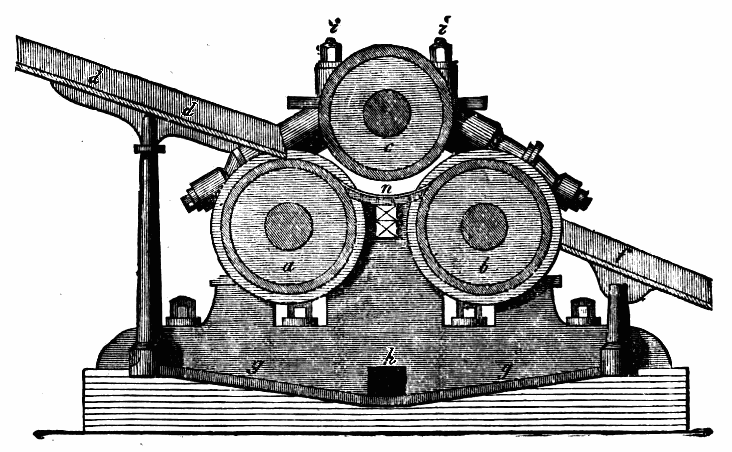
Raw sugar is refined by redissolving it in water, adding to the solution albumen, under the form of serum of blood or white of egg, and, sometimes, a little lime-water, and heating the whole to the boiling-point; the impurities are then removed by careful skimming, and the syrup is decoloured by filtration through recently burnt animal charcoal; the clear decolorised syrup is next evaporated to the crystallising-point in vacuo, and at once transferred into conical earthern moulds, where it solidifies, after some time, to a confusedly crystallised mass; this, when drained, washed with a little clean syrup, and dried in a stove, constitutes ordinary loaf, lump, or refined sugar. Sometimes in washing the crystallised mass for the purpose of removing the coloured syrup which is mingled with it, the process known as ‘claying’ is followed.
In this case, instead of white syrup being used, a layer of thin mud or a paste of thin pipe-clay is poured into the mould on to the base of the inverted sugar cone, through which the water escaping from the mud or pipe-clay permeates, and carries with it the coloured syrup. Neither the mud nor the pipe-clay mix with the sugar, but remaining on the top soon become hard, when they are removed. As the syrup running from the moulds still contains a large quantity of crystalline cane sugar, this is recovered as follows:
The syrup, after being sufficiently concentrated by boiling in the vacuum pan, is removed and allowed to cool, when it assumes the appearance of a crystalline magma known as ‘crushed sugar.’
Crushed sugar is a mixture of a large quantity of sugar crystals with uncrystallisable syrup. To get rid of this latter from the crystals, the mass is placed in quantities of 3 or 4 cwts. at a time in a ‘centrifugal machine.’ This, of which an engraving is given below, consists, as will be seen, of a drum fixed on a vertical axis. The walls of the drum are made of perforated metal, or are formed of meshed wire work, and the drum itself enclosed in an outer metal cylinder, which is fixed, and, of course, unperforated. When the drum is made to revolve on its axis at the rate of 1000 or 1200 revolutions in a minute, the syrup flying off by centrifugal
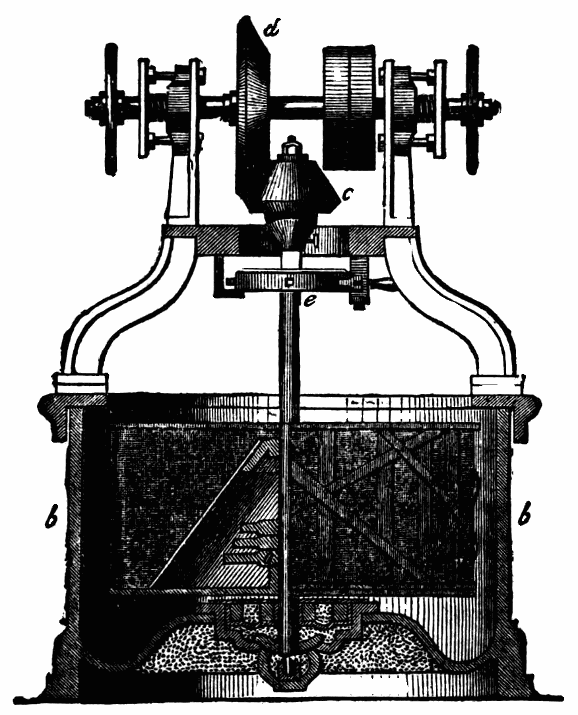
a is an open drum of fine meshed wirework, caused to revolve in the cast-iron vessel (b b), by means of the bevel wheels (c d), gearing with a motive power. The motion of the drum can be stopped by means of the brake (e), and regulated by the weights placed at o.
When the crystallisation of sugar is allowed to take place quietly and slowly, the product is sugar candy. The evaporation at a low temperature in vacuum pans has the effect of diminishing the yield of treacle.
Prop. Sugar requires for its solution only 1⁄3rd of its weight of cold and still less of boiling water; it is slowly dissolved by cold rectified spirit; it dissolves in 4 parts of boiling rectified spirit and in 80 parts of boiling absolute alcohol; it melts by heat, and cools to a glassy amorphous mass (barley sugar); at about 400° Fahr. it suffers rapid decomposition, and fuses to a brown, uncrystallisable mass (caramel); long boiling with water increases its colour, and lessens its tendency to crystallise; its aqueous solution dissolves alkalies, earths, and many metallic oxides, with facility. The presence of cane sugar in solutions containing certain metallic salts prevents the precipitation of their oxides by alkalies. The oxides of copper and iron are amongst those thus kept in solution. Sugar also possesses the power of effecting the partial or complete reduction of many metallic oxides, if boiled with their salts; the first results is exemplified in the case of the chromates; for if a chromate be added to a solution of sugar, and to the mixture a few drops of free acid, the chromic acid suffers reduction to chromic oxide, which, dissolving in the excess of acid, imparts a green colour to the liquid. Mercuric salts become reduced to mercurous, whilst the salts of gold throw down a precipitate of the metal in fine powder. The action of strong oil of vitriol on cane sugar is very energetic. The sugar is instantly reduced to a black charred mass, whilst carbonic and formic acids are given off. The same effects are produced by exposing it to dry chlorine at a temperature of 212° F. By nitric acid of sp. gr. 1·25, cane sugar is converted into saccharic acid; if a stronger acid be employed, oxalic acid is produced. When a mixture of concentrated nitric and sulphuric acids is poured on to cane sugar, an explosive compound, resembling gun cotton, is produced. This body is known as ‘nitro-sugar.’ Weak syrups take up about half as much hydrate of calcium as they contain sugar; when slowly crystallised, it assumes the form of oblique 4-sided prisms, terminated by 2-sided summits. Sp. gr. 1·60 (1·577—Ure).
Pur. Moist or muscovado sugar and crushed lump sugar are occasionally adulterated with chalk, plaster, sand, potato-flour, and other fecula; but frequently, and in certain neighbourhoods constantly, with starch sugar or potato-sugar.[203] These frauds may be detected as follows:
Tests.—1. Pure cane sugar dissolves freely and entirely in both water and proof spirit, forming transparent colourless solutions, which are unaffected by either sulphuretted hydrogen or dilute sulphuric acid.—2. Its solution bends the luminous rays in circumpolarisation to the right, whereas grape and fecula sugars bend it to the left.[204]—3. (Chevallier.) Boiled for a short time in water containing 2 or 3% of caustic potassa, the liquid remains colourless; but it turns brown, which is more or less intense, according to the quantity, if starch sugar is present. Even 2 or 3% of starch sugar may be thus detected.—4. (E. Krantz.) A filtered solution of 33 gr. of cane or beet sugar1⁄2 gr. of sulphate of copper in an air-tight bottle, remains clear, even after the lapse of several days; but if starch sugar be present, a red precipitate is formed after some time; and if it is present in considerable quantity, the copper will be wholly converted into oxide within 24 hours, the solution turning first blue or green, and then entirely losing its colour.—5. (Trommer’s test.) A solution of cane sugar is mixed with a solution of sulphate of copper, and hydrate of potassium added in excess; a blue liquid is obtained, which, on being heated, is at first but little altered; a small quantity of red powder falls after a time, but the liquid long retains its blue tint. When grape sugar or fecula sugar is thus treated, the first application of heat throws down a copious greenish precipitate, which rapidly changes to scarlet, and eventually to dark red, leaving a nearly colourless solution. This is an excellent test for distinguishing the two varieties of sugar, or discovering an admixture of grape sugar with cane sugar. The 1⁄1000th part of grape sugar may be thus detected. The proportion of oxide of copper produced affords a good criterion, not only of the purity of the sugar, but also of the extent of the adulteration.—6. (Ure.) Dissolve a little sulphate of copper (say 20 gr.) in a measured quantity of water, and add to it, in the cold, a solution of hydrate of potassium, until, by testing with turmeric paper, the liquid appears faintly alkaline, shown by the paper becoming slightly brown. If a small quantity of this test-liquor (previously well shaken) be added to an aqueous solution of the sugar, and the whole boiled, the solution becomes at first green, and then olive-green, if dextrin is present; but if it contain grape sugar, the salt of copper is immediately reduced into the state of orange and oxide; whilst a solution of pure sugar undergoes no change, or is scarcely altered.—7. M. Riffard,[205] taking advantage of the fact that sugar, like tartaric, malic, citric acid, and albumen, prevents the precipitation of iron by ammonia, employs iron as a means for estimating sugar. A solution containing sugar and iron in a certain proportion, when saturated with ammonia, will form a compound of a fine red colour, which remains clear if no alkaline earthy metals are present. M. Riffard has applied to sugar the method proposed by M. Juette for the estimation of tartaric acid. He observed that a neutral or acid solution of crystallised perchloride of iron, when heated for a considerable time to 100° C, requires 2·710 grams of sugar, if 100 milligrams of iron are to remain in solution in the presence of ammonia. If, on the other hand, the solution is prepared simply by dissolving crystallised perchloride of iron in pure water, without the addition of an acid, 100 milligrams of iron only require 2·587 grammes of sugar to remain dissolved. In this case the liquid is perfectly clear, and remains so; but if a smaller quantity of sugar be added, it is turbid, and deposits peroxide of iron. To estimate the sugar by this process, 25·870 grammes of the substance to be tested are dissolved, the solution mixed with a few drops of oxalate of ammonia to precipitate the lime, filtered and made up with water to 250 c.c., 25 c.c. of this mixture require the addition of as many milligrams of iron as there are per cents. of pure sugar in the sample under examination, and by two tests the following results will be arrived at:—With n milligrams of iron the solution is clear. With n + 1 milligrams of iron the solution is precipitated. n representing the number of per cents. of sugar contained in the sample.—8. M. Perrot’s method for the determination of sugars by means of normal solutions is as follows:—He prepares a standard solution of copper by dissolving 39·275 grams of sulphate of copper, very pure, and dried between several folds of filtering paper, and makes it up with distilled water to 1000 c.c. Each c.c. of this solution contains 0·01 grams of copper. On the other hand, he dissolves about 25· grams of pure cyanide of potassium in 1 litre of distilled water. Of this solution 10 c.c. are taken and put in a flask, to which about 20 c.c. of ammonia are added, and the liquid is kept at a temperature of 60° or 70°. He pours in the copper solution drop by drop by means of a burette graduated into tenths of a c.c., until there appears the blue tint characteristic of salts of copper in an ammoniacal solution. The number of degrees of the burette are then read off, and indicate the quantity of copper which has been required to produce the reaction. The solution of the sugar in question (previously inverted if it is required to determine crystalline sugar) is then placed in contact with an excess of Fehling’s liquor, and reduced in the water-bath. The whole is filtered in order to collect the precipitate of suboxide, which is first well washed with hot water, and dissolved in nitric acid, diluted with an equal volume of water, and a few fragments of chlorate of potassa are added. This solution is effected on the filter, which is then carefully washed in acidulated water. The filtrate to which the washings are added is then mixed with water enough to make up 100 or 150 c.c., and is then poured by means of the burette into 10 c.c. of cyanide, mixed with 20 c.c. of ammonia as above, stopping when the blue colour appears, and reading off the quantity of copper employed. From the former experiment it is known how much copper 10 c.c. of the cyanide solution require. Hence it is easy to calculate the total amount of copper which has been present as suboxide. The amount of sugar is then found from the data that 9298 parts of copper equal 5000 of crystalline sugar, or 5263 of[206]—9. The specific gravities and crystalline forms offer other means of distinguishing the varieties of sugar.