A CYCLOPÆDIA OF PRACTICAL RECEIPTS, &c. VOLUME II (continued 32)
Reading edition
SHAD′DOCK. A large species of orange, the fruit of Citrus Decumana (Linn.).
SHAGREEN′. This is prepared from the skins of the horse, wild ass, and camel, as follows:—The skin, freed from epidermis and hair by soaking in water, and, after dressing with the currier’s fleshing-knife, is sprinkled over, whilst still wet and stretched, with the seeds of a species of chenopodium, which are imbedded in it by strong pressure, and in this state it is dried; the seeds are then shaken off, and the surface rubbed or shaved down, nearly to the bottom of the seed-pits or indentations; it is next soaked in water, by which the skin swells, and the recently depressed surface rises into a number of minute prominences; it is, lastly, dyed and smoothed off. Black is given to it with galls and copperas; blue, with a solution of indigo; green, with copper filings and sal ammoniac; and red, with cochineal and alum. Shagreen was formerly very extensively used for covering the cases of watches, spectacles, surgical instruments, &c.
SHALLOT′. Syn. Eschalot. The Allium ascalonicum (Linn.), a plant allied to the onion, the bulb of which is much used as a sauce or pot-herb.
SHAMPOO′ING. A practice common in the East, having for its object the increase or restoration of the tone and vigour of the body, or the mitigation of pain. It is applied either in the bath or immediately after quitting it, generally the latter, and consists in pressing and kneading the flesh, stretching and relaxing the knee-joints, and laboriously brushing and scrubbing the skin.
SHARPS. See Flour.
SHA′VING. The following are Mr Mechi’s instructions for this, to many persons, troublesome operation:—Never fail to well wash your beard with soap and cold water, and to rub it dry, immediately before you apply the lather, of which the more you use the easier you will shave. Never use warm water, which makes a tender face. Place the razor (closed, of course) in your pocket, or under your arm, to warm it. The moment you leave your bed is the best time to shave. Always put your shaving-brush away with the lather on it.
The razor (being only a very fine saw) should be moved in a sloping or sawing direction, holding it nearly flat to your face, care being taken to draw the skin as tight as possible with the left hand, so as to present an even surface and throw out the beard. The practice of pressing on the edge of a razor in stropping generally rounds it; the pressure should be directed to the back, which must never be raised from the strop. If you shave from heel to point of the razor, strop it from point to heel; but if you begin with the point, then strop from heel to point. If you only once put away your razor without stropping or otherwise cleaning the edge, you must no longer expect to shave well, the soap and damp so soon rust the fine teeth or edge. A piece of plate leather should always be kept with the razors.
SHAVING FLUID. See Essence of Soap.
SHAWLS, To Scour. Scrape one pound of soap into thin shavings, and let it be boiled with as much water as will convert into a thin jelly. When cold, beat it with the hand, and mix with it three tablespoonfuls of oil of turpentine, and one of hartshorn. Let the shawl be well washed in this mixture, and afterwards rinsed in cold water, so as to get rid of all the soap.
Next let the shawl be rinsed in salt and water, then wring out the water from it, and fold it between two sheets, being careful not to allow two folds of the shawl to lie together; finally mangle, and iron with a cool iron.
SHEEP. Syn. Ovis, L. The Ovis aries, an animal domesticated almost everywhere. Its flesh supplies us with food, its skin with leather, its fleece with wool, and its intestines with catgut. Its fat (sevum) is officinal. See Mutton, Suet, &c.
Sheep Washes. 1. Arsenious acid in powder, carbonate of potash, of each 6 oz.; water, 14 gall. Boil together for half an hour.
2. Arsenious acid in powder, soft soap, and carbonate of potash, of each 6 oz.; sulphur, 4 oz.; bruised hellebore root, 2 oz.; water, 14 gall. Boil the ingredients in a portion of the water for half an hour, or until the arsenic is dissolved, then add the remainder of the water, and strain through a coarse sieve. Mr Youatt says:—“More care than is usually taken should be exercised in order that the fluid may penetrate to every part of the skin, and which should be ensured by a previous washing in soap and water. The arsenic that necessarily remains about the wool when the water has dried away would probably destroy the acari as fast as they are produced. When a greater quantity of arsenic has been used, or the sheep has been kept too long in the water, fatal consequences have occasionally ensued.”
3. A sheep-dipping composition employed on the Continent is:—Arsenious acid, 1 lb.; sulphate of zinc, 10 lbs.; dissolved in 25 gallons of water.
4. The Australian sheep farmers use a weak solution of bichloride of mercury (1 oz. of the bichloride to 4 gall. of water).
5. Water, 40 parts, at the temperature of 50° to 57° C.; to this add 1 part of soluble glass (the soluble silicates). This is recommended as a very efficient and perfectly safe sheep wash by Messrs Baerle and Co., of Worms. In washing the sheep with this preparation care should be taken to cover the eyes of the animal with a bandage, to perform the washing with the solution instantaneously, and to remove the surplus with tepid water.
“Yards into which newly clipped sheep are to be turned should be previously cleared of all green food, hay, and even fresh water; if perfectly empty they are still safer. When the dipping is finished they should be cleaned, washed, and swept, and any of the unused dipping solution at once poured down the drains. Dipped sheep should remain, if possible, in an open exposed place, as on a dry road, or in a large open yard. Over-crowding should be avoided, and every facility given for rapid drying, which is greatly expedited by selecting for the operation fine, clear, drying weather. On no account should sheep be returned to their grazings until they are dry, and all risk of dripping over.[160]
SHELL-FISH. The common name for the Crustacean and Molluscous animals that are used for food. ‘Shell-fish’ are extremely liable to disturb the functions of the stomach and bowels. The oyster (Ostrea edulis), and the cockle (Cardium edule), are, perhaps, the least objectionable. The crab (Cancer pagurus), the crayfish (Astacus fluvialis), the lobster (Homarus vulgaris), the mussel (Mytilus edulis), the prawn (Palæmon serratus), the periwinkle (Littorina littorea), and the shrimp (Crangon vulgaris), with the exception of the claws of the first three, are always suspicious, particularly in hot weather, and often absolutely poisonous. We have seen the most alarming, nay, fatal symptoms, follow the use of mussels, even amongst those habitually accustomed to take them; whilst it is a well known fact that the luscious bodies of the crab and lobster have too often formed the last supper of the epicure. See Oyster, &c.
SHEL-LAC. See Lac.
SHELLS (Prepared). Syn. Testæ præparatæ (Ph. L. 1836), L. Prep. (Ph. L. 1836.) Wash oyster-shells (OSTRÆ—Ph. L.) with boiling water, having previously freed them from extraneous matters; then prepare them in the manner directed for chalk. The product is similar in constitution and properties to prepared chalk.
Shells, To Polish. 1. The surface of the shell should be first cleaned by rubbing it over with a rag dipped in hydrochloric acid, till the outer dull skin is removed. It must be then washed in warm water, dried in hot sawdust, and polished with chamois leather. Those shells which are destitute of a natural polished surface, may be either varnished or rubbed with a mixture of tripoli powder and turpentine applied by means of a wash-leather, after which fine tripoli alone should be used, and, finally, a little olive oil, the surface being brought up with the chamois leather as before.
2. “The shells are first boiled in a strong solution of potash, then wound on wheels, sometimes through one strata to show an underlying one, then polished with hydrochloric acid and putty powder. In this operation the hands are in great danger. Shell grinders are generally almost all cripples in their hands. (Spon.)
SHER′BET. [Pers.] A cooling drink, used in the East, prepared with the juices of fruit, and water, variously sweetened and flavoured. The word has been, of late years, commonly employed in these countries in a similar manner. See Lemonade, Orangeade, and Powders.
SHER′RY. Syn. Sherry wine, Sherris; Vinum Xericum (Ph. L.), Vinum album (Ph. E.), Vinum album Hispanicum (Ph. D.), L. This is the only wine ordered in the British Pharmacopœias. See Wines.
SHERRY-COBBLER. Prep. (Redwood.) Half fill a tumbler with clean pounded ice; add a table-spoonful of powdered white sugar, a few thin slices of lemon with the peel (or some strawberries or other similar fruit, bruised), and a wine-glassful or more of sherry wine; mix them together (lightly), and as the
Obs. A favourite American drink; very refreshing in hot weather.
SHIN′′GLES. Syn. Zoster, Herpes zoster, Herpes zona, L. A local variety of herpes or tetter, remarkable for forming a kind of belt round or partly round some part of the trunk of the body, chiefly the waist or abdomen. See Tetters.
SHODDY. The epithet (we believe of American origin) is applied to the old, used-up wool and cloth, fraudulently mixed with fresh woollen fabrics. A plan for the examination of a fabric suspected of containing shoddy has been given by a German chemist, Herr Schlesinger, and is as follows:—Examine it with the microscope and note if it contains cotton, silk, or linen, as well as wool. If so dissolve them by ammoniacal solution of copper. A qualitative examination is thus obtained. Then direct attention to the wool. In shoddy both coloured and colourless fibres are often seen, the fibres having been derived from different cloths which have been partially bleached; the colouring matter, if any, instead of consisting of one pigment, will be composed of two or three different kinds, such as indigo, purpurin, or madder. Again, the diameter of the wool is never so regular as in fresh wool, but is seen to vary suddenly or gradually in diameter, and suddenly widens again with a little swelling, and tapers off again, besides which the cross markings or scales are almost always absent. When shoddy-wool is placed in liquor potassæ it is much more speedily attacked than new wool.
SHOT METAL. Prep. From lead, 1000 parts; arsenic, 3 parts. When the lead is coarse, 6 to 8 parts of metallic arsenic are required to fit it for this purpose.
SHOW BOTTLES. The large ornamental carboys and jars filled with coloured liquids, and displayed in the shop-windows of druggists, may be noticed under this head. They are striking objects when the solutions they contain are bright and of a deep pure tint, especially at night, when they are seen by transmitted light. The following formulæ for the solutions have been recommended by different persons:—
Amber. From dragon’s blood (in coarse powder), 1 part; oil of vitriol, 4 parts; digest, and, when the solution is complete, dilute the mixture with distilled or soft water, q. s.
Blue.—a. From blue vitriol, 2 oz.; oil of vitriol, 1⁄2 oz.; water, 1 pint.—b. A solution of indigo in sulphuric acid, diluted with water, q. s.—c. A solution of soluble Prussian blue in either oxalic or hydrochloric acid, slightly diluted, and afterwards further diluted with water to the proper shade of colour.
Crimson.—a. From alkanet root, 1 oz.; oil of turpentine, 1 pint. Used chiefly for the bull’s eyes of lamps.—b. As PINK (b), below.
Green.—a. From sulphate of copper, 2 oz.; bichromate of potash, 1 dr., or q. s.; water, 1 pint.—b. A solution of sulphate of copper, 2 oz.; chloride of sodium, 4 oz.; water, 1 pint, or q. s.—c. A solution of distilled verdigris in acetic acid, diluted with water, q. s.—d. Dissolve blue vitriol in water, and add nitric acid until it turns green.
Lilac.—a. Dissolve crude oxide of cobalt (zaffre) in nitric or hydrochloric acid, add sesquicarbonate of ammonia, in excess, and afterwards sufficient ammonio-sulphate of copper to strike the colour.—b. As the purple, but more diluted.
Magenta. Acetate of rosaniline, dissolved in water, q. s.
Olive. Dissolve sulphate of iron and oil of vitriol, equal weights, in water, and add of nitrate of copper, q. s. to strike the colour.
Orange.—a. A solution of bichromate of potash in water, either with or without the addition of some hydrochloric or sulphuric acid.—b. Dissolve gamboge or annotta in liquor of potassa; dilute with water, and add a little spirit.
Pink.—a. To a solution of chloride or nitrate of cobalt, in water, add sesquicarbonate of ammonia, q. s. to dissolve the precipitate at first formed.—b. From madder (washed with cold water), 1 oz.; sesquicarbonate of ammonia, 4 oz.; water, 3 pints; digest, with agitation, for 24 hours, then dilute with more water, and filter.
Purple.—a. A solution of sulphate of copper, 1 oz., in water, 1 quart, or q. s., with the addition of sesquicarbonate of ammonia, 11⁄2 oz.—b. To the last add a sufficient quantity of the first pink (above) to turn the colour.—c. To an infusion of logwood, add carbonate of ammonia or of potassa, q. s.—d. Sugar of lead, 3 oz.; powdered cochineal, 1 dr.; water, q. s.—e. Add sulphate of indigo, nearly neutralised with chalk, to an infusion of cochineal, till it turns purple.
Red.—a. Dissolve carmine in liquor of ammonia, and dilute with water.—b. Digest powdered cochineal in a weak solution of ammonia or of sal ammoniac, and afterwards dilute with water.—c. Add oil of vitriol, 4 oz., to water, 1 gall., and digest dried red rose leaves, 8 oz., in the mixture for 24 hours.—d. Dissolve madder lake in a solution of sesquicarbonate of ammonia, and dilute the solution with water.
Violet. To a solution of nitrate of cobalt in a solution of sesquicarbonate of ammonia, add solution of ammonio-sulphate of copper, q. s. to strike the colour.
Yellow.—a. A solution of sesquioxide or rust of iron, 1⁄2 lb., in hydrochloric acid, 1 quart, diluted with water.—b. To a strong decoction of French berries add a little alum.—c. A simple solution of chromate or bichromate of potash in distilled water.—d. A solution of equal parts of nitre and either chromate or bichromate of potash, in water.
Obs. Most of the above require filtering, which should be done through powdered glass,
SHRIMP. See Shell-fish.
SHRUB. A species of concentrated cold punch, prepared with lemon juice, spirit, sugar, and water. When the word is used in its unqualified form, RUM SHRUB is alluded to.
Shrub, Brandy. Prep. 1. Take of brandy, 1 gall.; orange and lemon juice, of each 1 pint; peels of 2 oranges; do. of 1 lemon; digest for 24 hours, strain, and add of white sugar, 4 lbs., dissolved in water, 5 pints; in a fortnight decant the clear liquid for use.
2. As RUM SHRUB (below), but using brandy.
Shrub, Lemon. Syn. Lemonade shrub. Concentrated lemonade, either with or without the addition of a little spirit. Used to make lemonade or lemon sherbet.
Shrub, Punch. Concentrated punch, made with equal parts of spirit and water. Used to make punch.
Shrub, Rum. Prep. 1. As BRANDY SHRUB, but substituting rum for brandy.
2. Take of rum, at proof, 34 gall. (or, if of any other strength, an equivalent quantity); essential oils of orange and lemon, of each 2 oz., dissolved in rectified spirit, 1 quart; good lump sugar, 300 lbs.; dissolved in water, 20 galls.; mix well by ‘rummaging,’ and gradually and cautiously add of Seville orange juice, or of a solution of tartaric acid in water, q. s. to produce a pleasant but scarcely perceptible acidity; next ‘rummage’ well for 15 minutes, then add sufficient water to make the whole measure exactly 100 galls., and again ‘rummage’ well for at least half an hour; lastly, bung the cask down loosely, and allow it to repose for some days. In a fortnight, or less, it will usually be sufficiently ‘brilliant’ to be racked. The product is 100 galls., at 66 u. p.
Obs. Rum shrub is the kind in the greatest demand, and that having a slight preponderance of the orange flavour is the most esteemed. If wholly flavoured with lemon it is apt to acquire a kind of ‘dead’ or ‘musty’ flavour by long keeping. The substitution of a few gallons of brandy for a portion of the rum, or the addition, after racking, of about 1 oz. each of bruised bitter almonds, cloves, and cassia, the peels of about 2 dozen oranges, and a ‘thread’ of the essences of ambergris and vanilla, render it delicious.
SIAL′OGOGUES. Medicines which increase the flow of saliva. Mercurials and pellitory of Spain belong to this class.
SICK′NESS. Nausea and vomiting frequently arise from the use of improper food, and other articles which offend the stomach; at other times it is symptomatic of some disease, as colic, cholera, dyspepsia, head affections, incipient fever, &c.; in which case the primary affection should be attended to. Nausea lowers the pulse, contracts the small vessels, occasions cold perspiration, severe rigors, and trembling; and diminishes, as long as it lasts, the actions, and even the general powers, of life. The act of retching, and vomiting more especially, on the contrary, rouses rather than depresses, puts to flight all the preceding symptoms, and often restores the system to itself.
The best remedies or palliatives in these affections are effervescing saline draughts, either with or without the addition of a few drops of tincture of henbane, or tincture of opium. A glass of genuine lemonade, iced, or a spoonful of crushed ice in a wine-glassful of mint water, is also very serviceable. Pepsin (Bullock and Reynolds) and oxalate of cerium are said to be most valuable remedies in the sickness of pregnancy. See Draughts, Pregnancy, Sea sickness, &c.
SIFT′ING is to pulverulent substances what filtration is to liquids; but in this case the medium through which the substance passes is, usually, of a simpler and coarser description. Sieves are commonly employed for the purpose, which are fitted with silk or brass-wire gauze for fine purposes, and horsehair cloth, or wire netting, for coarser ones. Drum sieves are such as are furnished with covers and an enclosed space to receive the fine powder that passes through, by which dust and loss are prevented.
SIGHT. See Vision.
Sight, Effect of Gaslight on. The German Minister of Instruction has recently issued a report on the influence of gaslight on the eye. The conclusion arrived at in this report—the result of frequent conference with well-known physicians—is that no evil results follow a moderate use of gas, if the direct action of the yellow flame on the eye is prevented. For this purpose screens or shades are employed. Very great objections, however, exist to the use of zinc or lead shades, most evils affecting the eye being traceable to them. Their use, it is said, inevitably tends to blindness or inflammation, and other harmful effects. The milky-white glass shade is the best, as it distributes the light and has a grateful effect on the eyes. The burner should not be too close to the head, as congestions of the forehead and headaches result from the radiated heat. The glass plate below the gas, employed in some places, is especially useful for the purpose, as it causes an equal distribution of the light—necessary where a number are working at one burner—prevents the radiation of heat, and tends to a steady illumination by shielding the flames from currents of air. In cases of highly-inflamed eyes, dark-blue globes can be very beneficially employed. With precautions of this kind no evil effects from the burning of gas need be feared.
SIG′NATURES (Fac-similes of). These may be readily obtained as follows:—
1. Let the name be written on a piece of paper, and, while the ink is still wet, sprinkle over it some finely-powdered gum Arabic, then make a rim round it, and pour on it some fusible alloy in a liquid state. Impressions may be taken from the plates formed in this way, by means of printing ink and the copper-plate press.
2. By the use of transfer ink and lithography.
SILBER LIGHT. This light is thus described in ‘Dingler’s Polytechnic Journal,’[161]—This mode of illumination is recommended where gas cannot be had.
The material used is oil, which is converted into gas before combustion takes place, whereby the combustion of the wick is greatly lessened (one wick may last a year); the accumulation of impurity is obviated, and the prevention of smell completely effected. The light is regular and uniform, and of a white colour. The light, with a burner 11⁄4 inch wide, is equal to that of 28 sperm candles, each consuming 120 gr. per hour, and with one 13⁄4 inch wide a light is obtained equal to 50 such candles.
The burning apparatus consists of a row of concentrically enclosed double cylinders, perpendicularly arranged at definite intervals. The innermost cylinder contains the wick between its two walls, the hollow space in the interior serving to convey fresh air to the interior of the flame. The second cylinder conveys air to the outer side of the wick, and the third contains oil, and is in direct communication with both wick and reservoir. The mouths of all these chambers have a dome-shaped head, and form a suitable opening in this; the gas streams forth in such a manner that it comes in contact with a current of air, and thus a complete combustion is attained.
According to the nature of the oil burnt the construction is somewhat varied in its minor details. Rape oil or light hydrocarbon oils are mentioned.
SIL′ICA. SiO2. Syn. Silicic anhydride, Silicic acid, Silex, Siliceous earth†, Earth of flints†. This exists in quartz and rock crystal in a nearly pure state. The sands of rivers and the sea-shore, flint, and almost all the scintillating stones, chiefly consist of it.
Silica occurs under two conditions—the crystalline and the amorphous. The former variety has a sp. gr. of 2·642; the amorphous of 2·2-2·3. Some of our well-known native gems and precious stones consist almost wholly of one of the above forms of silica. In agate and calcedony the two varieties are combined. Amethyst is silica, coloured purple by ferric oxide. Onyx is formed of calcedony arranged in layers of different colours. Cornelian is a red or brown variety of silica coloured with ferric oxide, whilst opal is amorphous silica combined with varying quantities of water. Silica is present in the stems of certain plants, such as wheat, many grasses, to which the shining appearance of the stems is due, &c. The Italians polish marble with the ashes of burnt straw, the usefulness of which for such a purpose depends upon the silica contained in the straw; for similar reasons the Dutch rush is thus employed. Silica also occurs in solution in many natural waters. In the geysers, or boiling springs of Iceland, it exists in large quantity.
It may be obtained in a state of absolute purity by passing gaseous fluoride of silicon into water, collecting the resulting gelatinous precipitate on a calico filter, washing it with distilled water, drying it, and heating it to redness. Another method is to precipitate a solution of silicate of soda or potassa (soluble glass) with dilute hydrochloric acid, and to treat the precipitate as before.
Nearly pure silica may also be procured by heating colourless quartz to redness, and plunging it into cold water, by which treatment the quartz is rendered so friable as to be easily reducible to fine powder. Ordinary flints, subjected to this method, are found to yield silica in a condition approaching to purity. Amorphous silica is much more easily attacked by solvents than the crystalline variety. The artificial forms of silica are all amorphous.
The test for a silicate consists in fusing the suspected body with sodic or potassic carbonate, heating the residue with acid, and evaporating to dryness. If the residue be then treated with hot water the silica remains undissolved in the form of a white powder, which will yield a colourless bead when fused with sodic carbonate upon a piece of platinum foil before the blowpipe flame. If silica be fused with borax it becomes slowly dissolved, forming a clear, colourless bead.
Chapman contests Plattner’s opinion that, when silicates are fused with phosphor salt, the ‘silica skeleton’ that results is especially due to the presence of alkalies or earthy bases.
Chapman says: “It is true enough that silicates in which these bases are present exhibit the reaction; but as other silicates—practically all, indeed—exhibit the reaction also, the inference implied in the above statement is quite erroneous.
“The opalescence of the glass arises entirely from precipitated silica.
“If some pure silica (or a silicate of any kind), in a powdered condition, be dissolved before the blowpipe flame in borax until the glass be saturated, and some phosphor salt be then added, and the blowing be continued for an instant, a precipitate of silicate will immediately take place, the bead becoming milky white (or, in the case of many silicates, opaque) on cooling. This test may be resorted[162]
Prop., &c. A fine, white, tasteless, infusible powder, insoluble in all acids, after being heated, except the hydrofluoric; requires the heat of the oxyhydrogen blowpipe for its fusion; approaches the precious stones in hardness; soluble in strong alkaline solutions; its salts are called SILICATES. Sp. gr. 2·66. See Glass, Glass, Soluble, &c.
Silica, Hydrates of. By pouring a dilute solution of sodium silicate into a considerable excess of hydrochloric acid the whole of the silica is retained in solution, together with the chloride of sodium formed by the action of the hydrochloric acid upon the soda. By subjecting this solution to dialysis (see DIALYSIS) the hydrochloric acid and chloride of sodium are removed, whilst the hydrate of silica is left behind, in solution, in the dialyser. Graham recommends a stratum of the liquid four tenths of an inch in depth, to be subjected for four or five days to dialysis, the water in the outer vessel to be changed every twenty-four hours.
If the solution so obtained be carefully evaporated down in a flask, and any drying of the silicic acid at the edges of the liquid being prevented, a solution may be obtained containing 14 per cent. of silica.
The solution has a very feebly acid reaction, and is without taste or colour. It cannot be preserved in the liquid state for more than a very few days, even in well-closed vessels, but becomes converted into a transparent gelatinous mass, which separates from the water. Hydrochloric acid, as well as small quantities of caustic potash or soda, retard the coagulation.
When the solution is evaporated in vacuo at 59° F. over sulphuric acid, a lustrous transparent glass is left behind, which consists of 22 per cent. of water, which closely accords with the formula SiO2H2O.
By the action of moist air upon silicic ether a transparent glassy hydrate was obtained by Ebelmen, to which this chemist assigned the formula 2SiO2,3H2O. Two hydrates of silica were obtained by Fuchs, one having the formula 3SiO2,H2O, the other, 4SiO2,H2O.
Silicic Chloride. Syn. Silicic tetrachloride. (SiCl4.) This compound is rarely, if ever, obtained by the direct method, viz. by heating silicon in chlorine, but by the following indirect process:—A paste is made of finely divided silica, oil, and charcoal, and heated in a covered crucible. The fragments of the charred substance (consisting of silica and carbon) are then placed in a porcelain tube, which is raised to a red heat in a furnace, and during the ignition of the fragments a current of dry chlorine is passed into and over them; the silicic chloride which is thus formed being made to distil over into a bent tube surrounded by a freezing mixture of ice and salt, whereby it becomes condensed.
Silicic chloride is a very voluble and strongly fuming gas, transparent and colourless, with an irritating and pungent smell. It is immediately decomposed by water into hydrochloric acid and hydrated silica, which deposits in the vessel.
Silicic Fluoride. Syn. Silicic tetrafluoride. (SiF4.) This gas is best prepared by heating in a capacious flask or retort equal parts of finely powdered fluorspar and white sand, or glass with ten or twelve times their weight of strong sulphuric acid. This gas must be collected over mercury, and in jars that are free from the least trace of moisture.
Silicic fluoride is a colourless gas, with a very pungent odour, fuming strongly in the air, and neither burning nor supporting combustion. Faraday succeeded in liquefying it under great pressure, and Natterer states that at a temperature of -220° F. it may be solidified. By water it is partially decomposed and partially dissolved, yielding silicic acid and hydrofluosilic acid.
With twice its volume of ammoniacal gas silicic fluoride combines to form a crystalline volatile. Silicic hydride has an acid reaction.
Silicic Hydride. (H4Si?) To procure this gas silicide of magnesium is decomposed with cold diluted hydrochloric acid.
The silicide of magnesium may be prepared as follows:—Mix intimately 40 parts of fused magnesic chloride, 35 of dried sodic silico-fluoride, and 10 of fused sodic chloride; these are mixed in a warm, dry tube, with 20 parts of sodium in small fragments, and thrown into a red-hot Hessian crucible, which is immediately covered, the operation being finished when the vapours of sodium cease to burn.
Silicic hydride becomes spontaneously ignited in the air, and in doing so gives off white fumes, which consist of amorphous silica (SiO2). A cold body, such as a piece of porcelain or glass, introduced into the flame, becomes covered with a brown deposit of reduced silicon. Passed into solutions of cupric sulphate, argentic nitrate, and palladium chloride, this gas throws down the metals, in most cases combined with silicon.
SILICOFLUORIC ACID. See Fluosilicic acid.
SIL′ICON. Si. Syn. Silicium. An elementary substance forming the base of silica.
This element was first obtained by Sir Humphry Davy, by acting upon silica with potassium. It is now procured much more easily by the decomposition of silico-fluoride of potassium, at an elevated temperature, with potassium or sodium. By heating a mixture of fluorspar and ground flints with sulphuric acid a gaseous tetra-fluoride of silicon is formed, which, being partially soluble in water, yields an acid solution of the tetra-fluoride. Caustic potash is then added to the acid solution
2KF,SiF4 + 2K2 = Si + 6KF.
The resulting mass, consisting of potassic fluoride, and reduced silicon in partial combination with the excess of potassium, is treated with cold water, when a copious evolution of hydrogen gas ensues, owing to the decomposition of the water by the excess of potassium. The potassic fluoride is got rid of by washing with cold water, its entire removal being indicated by the water ceasing to have an alkaline reaction on test paper, whilst amorphous silicon is left behind in the form of a brown powder.
Another method by which silicon may also be procured is by passing the vapour of silicic chloride over heated potassium or sodium, placed on a porcelain tray in a glass tube. In this operation it is advisable to protect the lining of the tube with thin plates of mica.
The silicon obtained by the above processes is known as amorphous silicon, and, as already stated, occurs as a brown powder. It is dull in colour, and, being heavier than water, as well as insoluble in it, sinks in that fluid. It is a non-conductor of electricity, is unaffected by nitric or sulphuric acid, but dissolves readily in hydrofluoric acid, and in a warm solution of caustic potash. It burns with great brilliancy when heated in air or oxygen, and becomes converted into silica, which, owing to the great heat of combustion, fuses, and thus forms a superficial crust over the unburnt silicon. A crystalline variety of silicon may also be procured by heating the brown amorphous silicon, already described, intensely in a platinum crucible, with exclusion of air. This crystalline silicon so obtained is much darker in colour than the amorphous, and also considerably denser; besides which it differs widely in properties from the latter. It will not take fire if heated strongly in the air or oxygen, even if before the blowpipe flame. Its density is such that it sinks in strong sulphuric acid, and hydrofluoric acid fails to dissolve it, although it is soluble in a mixture of hydrofluoric and nitric acids. It does not become oxidised, even if fused with potassic nitrate or chlorate, unless a white heat is obtained, when it burns brilliantly, giving rise, on so doing, to the formation of silica.
In addition to the above, a graphitoid form of silicon, occurring in plates, has been described by Deville and Wöhler. These chemists obtained this last modification from an alloy of silicon and aluminium, which was treated in succession with boiling hydrochloric and hydrofluoric acids. The plates of silicon which are left have a metallic lustre, and a sp. gr. of 2·49. The graphitoid bears a great resemblance in properties to the crystalline silicon. It is a conductor of electricity. Like the crystalline variety, it dissolves in a mixture of hydrofluoric and nitric acids, although slowly, but, unlike the crystalline, it undergoes no change when heated to whiteness in a current of oxygen.
Deville states that silicon requires a temperature between the melting points of iron and steel to fuse it. He effected its fusion in a platinum crucible lined with lime, the platinum crucible being then placed in a clay crucible, which was then exposed to intense heat in a wind furnace.
By passing the vapour of silicic chloride over pure aluminium, placed on a porcelain tray, and raised to an intense heat, the aluminium becomes volatilised as aluminic chloride, whilst the silicon remains behind in crystals possessing a reddish lustre. These crystals occur in regular six-sided prisms, terminated by three-sided pyramids, derived from the octohedra, and are so hard that glass may be cut by them, in the same way as by the diamond.
With oxygen silicon forms only one oxide, silica, described above.
SILK. As an article of clothing, as far as “roundness of fibre, softness of texture, absence of attraction for moisture, and power of communicating warmth, are concerned, silk is greatly superior to both linen and cotton; moreover, it gives the sensation of freshness to the touch which is so agreeable in linen. But, with all these advantages, silk (when worn next the body) has its defects; on the slightest friction it disturbs the electricity of the skin, and thus becomes a source of irritation. Sometimes, it is true, this irritation is advantageous,
Silk is characterised by its fibres appearing perfectly smooth and cylindrical, without depressions, even under a magnifying power of 160. Its fibres (even when dyed) acquire a permanent straw-yellow colour when steeped in nitric acid of the sp. gr. 1·20 to 1·30. The fibres of white or light-coloured silk are similarly stained by a solution of picric acid. A thread of silk, when inflamed, shrivels and burns with difficulty, evolves a peculiar odour, and leaves a bulky charcoal. By these properties silk is distinguished from cotton and linen.
Cotton, wool, and silk may be easily distinguished from each other by means of the microscope.
The cotton fibre will be seen to consist of only one cell; wool (as well as hair and alpaca) is made up of numerous cells in juxtaposition; whilst silk fibre is similar to the secreted matter of spiders and caterpillars.
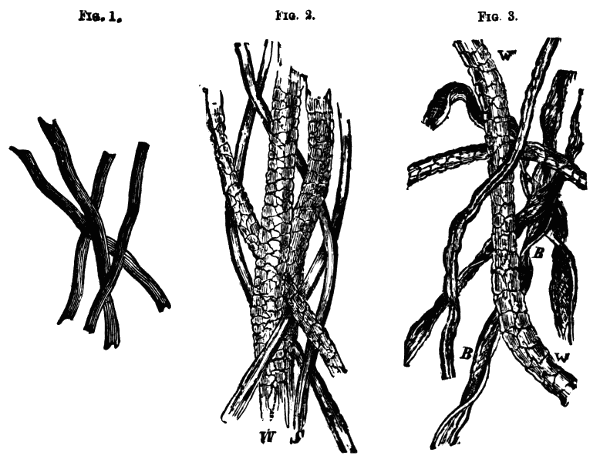
Fig. 1-3.
The silk fibre (fig. 1) is smooth, cylindrical, devoid of structure, not hollow inside, and equally broad. The surface is glossy, and only seldom are any irregularities seen on it. If it is desired to detect in a woven fabric the genuineness of the silk, it is best to cut a sample to pieces, place it under water under the object-glass of a microscope, magnifying 120 to 200 times, covering it with a thin piece of glass. The round, glazed, equally proportioned silk fibre (fig. 1), is easily distinguished from the unequalled and scaled wool fibre (W in fig. 2), and from the flat, band-like, and spiral cotton fibre (B, fig. 3). Under the microscope also the mixture of inferior with superior fibres of silk can be easily detected.
Black silk, the weight of which has been augmented by extensive sophistication, is not uncommon in English, French, and German markets. It is known as ‘weighted’ or ‘shotted’ silk, and very frequently contains no more—and frequently less—than one third of its weight of silk, the remaining two thirds consisting, according to Persoz, of a combination of iron salts, with some astringent substance, salts of tin, and cyanides. It is easily distinguishable from genuine silk by its want of elasticity and tenacity, and its much greater combustibility. Persoz found a specimen of this adulterated silk to yield, upon incineration, more than 8 per cent. of ferric oxide.
The cleaning and renovation of articles of wearing apparel made of silk are matters requiring some care. No silk goods look well after being washed, however carefully it may be done; and this method should, therefore, never be resorted to but from absolute necessity. It is recommended to sponge faded silks with warm water and curd soap, then to rub them with a dry cloth on a flat board, and afterwards to iron them on the wrong side with an ordinary smoothing iron. Sponging with spirit, benzol, or pure oil of turpentine, also greatly improves old silk, and is often preferable to any other method. The odour of the benzol passes off very quickly, that of the turpentine after exposure for a few days. When the ironing is done on the right side thin paper should be spread over the surface to prevent ‘glazing.’ See Dyeing, Gilding, &c.
Silk Material, a New. The ‘Textile Manufacturer’ contains the following:—The utilisation of new substances as raw material for manufactures is a distinguishing feature of the scientific investigations of the nineteenth century. One of the most recent suggestions is the result of the researches of Herr Tycho Tulburg, an eminent German naturalist, on the products of the mussel. It will be remembered it was from one of the mussel species the famous purple dye was in past ages obtained, and this colour gained an imperishable renown from its being adopted by the Roman emperors, and the imperial purple became the symbol of sovereignty. In these latter days animal products have been displaced by aniline dyes, and there is no likelihood of their regaining their former celebrity. The researches of Tulburg have not, however, been in the direction of dyes, but in the adaptation of animal products other than the silkworm for silk yarns. The mussel (Mytilus edulis) fastens itself to the rocks by strong threads, called by naturalists byssus, and it is this substancePinna, one of the mussel tribe, has been already manufactured into fabrics, although it is not of general use, nor at present of much commercial value, and the same obstacles to the use of the byssus of the common mussel are apparent. Notwithstanding the abundant supply of this popular shell fish, it is difficult to see how a sufficient quantity of byssus can be collected to enable manufacturers to purchase the raw material at rates low enough for a marketable remuneration on the manufactured article. But the records of industrial progress testify to greater difficulties than these having been successfully overcome; and should the commercial value of the new material be satisfactorily demonstrated, there is no doubt some agency will be developed whereby the requisite supply may be obtained.
At present it is sufficient to notice the discovery that has been made, and to welcome another instance of the results of scientific labour being for the advantage of manufacturers.
SILK′WORM, Diseases of. Silkworms are liable to a disease known as pébrine, which Pasteur has shown to be due to the presence, on the body, the egg, and in the blood of the insect, of peculiar parasitic corpuscles.
Pasteur states that the black specks which constitute these bodies are very easily distinguishable in the moth of the silkworm, but that in the earlier stages of its development, such as in the egg and worm condition, the detection of them becomes difficult, if not impossible. Pasteur further adds that sound moths produce sound eggs, and unsound moths the reverse, and that although the unsound eggs show no sign of disease, they never give rise to healthy worms.
Pasteur advises the silk cultivator, therefore, to ensure breeding from healthy moths at starting, and to abandon the old and useless precaution of hatching apparently healthy eggs.
The loss resulting from the silkworm disease in Italy may be seen from the following tables, which are calculated for bales of 102 lbs. weight:[163]—
Average production prior to disease, 81,600.
1863 Bales, 50,600 Deficit, 38 per cent.
1864 ” 38,000 ” 53 ”
1865 ” 38,700 ” 52 ”
1866 ” 39,600 ” 51 ”
1867 ” 44,000 ” 46 ”
1868 ” 41,000 ” 49 ”
1869 ” 47,300 ” 42 ”
1870 ” 69,900 ” 14 ”
1871 ” 76,300 ” 6 ”
1872 ” 68,000 ” 16 ”
The value of the cocoons grown in the whole world in 1870 was said to be as follows:—France, £4,334,000; Italy, £11,260,000; Spain and other European countries, £984,000; giving a total for Europe of £16,588,000. China, £17,000,000; India, £4,800,000; Japan, £3,200,000; Persia, £920,000; other Asiatic states, £2,192,000; giving a total for Asia of £28,112,000. Africa, £68,000. America, £20,000. Making a general total of £44,788,000.
Silkworm Gut. See Gut.
SIL′LABUB. Prep. Grate off the yellow peel of a lemon with lump sugar, and dissolve the sugar in 3⁄4 pint of wine; add the juice of 1⁄3 a lemon, and a 1⁄4 pint of cream; beat the whole together until of a proper thickness, and then put it into glasses.
Obs. 3⁄4 to 1 pint of new milk is often substituted for the cream, and strong cider or perry for the wine. Grated nutmeg is often added. When ‘whipped’ to a froth it is called ‘WHIPPED SILLABUB,’ See Cream (Whipped).
SILVER. Ag. Syn. Argentum, L. This metal, like gold, appears to have been as much valued in the remotest ages of antiquity of which we have any record, as at the present time. It is found in nature, both in the metallic state and mineralised, in the state of alloy, and combined with sulphur, chlorine, and other metallic sulphurets. In Great Britain it is found in combination chiefly with lead. It is extracted from its ores principally by the process of amalgamation, founded on its easy solubility in mercury, and by subsequent cupellation. It is only prepared on the large scale.
Chemically pure silver may be obtained by the methods noticed subsequently.
Prop. Pure silver has a very white colour, a high degree of lustre, is exceedingly malleable and ductile, and is the best conductor of heat and electricity known. Its hardness is between that of copper and gold; its sp. gr. is 10·475 to 10·500; it melts at about 1873° Fahr.; or bright redness (Daniell); is freely soluble in nitric acid, and dissolves in sulphuric acid by the aid of heat; it refuses to oxidise alone at any temperature, but, when strongly heated in open vessels, it absorbs many times its bulk of oxygen, which is again disengaged at the moment of solidification; its surface is rapidly tarnished by sulphuretted hydrogen and by the fumes of sulphur.
Pur. “Entirely soluble in diluted nitric acid. This solution, treated with an excess of muriate of soda, gives a white precipitate entirely soluble in ammonia water, and a fluid which is not affected by sulphuretted hydrogen.” (Ph. E.)
Tests. 1. The compounds of silver, mixed with carbonate of soda, and exposed on a charcoal support to the inner flame of the blowpipe, afford white, brilliant, and ductile metallic globules, without any incrustation of the charcoal.—2. The salts of silver are non-volatile
The soluble salts of silver give—1. A white curdy precipitate (chloride of silver) with hydrochloric acid and the soluble metallic chlorides, which is soluble in ammonia and insoluble in nitric acid, and blackened by exposure to light;—2. White precipitates with solutions of the alkaline carbonates, oxalates, and ferrocyanides;—3. Yellow precipitates with the alkaline arsenites and phosphates;—4. With the arseniates, red precipitates;—5. With the fixed alkalies, brown precipitates;—6. With sulphuretted hydrogen and hydrosulphuret of ammonia, a black powder, which is insoluble in dilute acids, alkalies, alkaline sulphurets, and cyanide of potassium, but readily soluble, with separation of sulphur, in boiling nitric acid; and—7. With phosphorus, and with metallic copper or zinc, pure silver.
Assay. 1. The method of assaying silver by cupellation has been explained under Assay and Cupellation; and that method is alone applicable when the alloy contains a very small quantity of silver, as a few ounces only per ton. When the reverse is the case, as with the silver of commerce, the following is a much more accurate method:—
2. Humid assay of silver.—a. Dissolve 10 gr. of the silver for assay in 100 gr. of nitric acid, sp. gr. 1·28, by the aid of heat, the solution being made in a tall stoppered glass tube, furnished with a foot; then place it in a very delicate balance, bring it into an exact state of equilibrium, and add the test solution (see below), gradually and cautiously, until the whole of the silver be thrown down, the number of grains now required to restore the equilibrium of the balance or scales gives the exact quantity of pure silver in 1000 parts of the sample.—Obs. To ensure accuracy, after each addition the stopper should be placed in the tube, and the latter violently agitated for a short time, when the liquor will rapidly clear and enable us to see when the operation is concluded. We must then, as a check, add a small quantity of a solution of nitrate of silver to the liquor in the tube, after having first carefully taken the weight. If too much of the test liquor has been added, this will produce a fresh precipitate, and the assay cannot then be depended on.—Instead of weighing the quantity of test liquor used, a tube graduated into 100 parts, and holding 1000 gr., may be employed, every division of which, required to throw down the silver, will represent the 1⁄10th of a grain. See Alkalimetry and Acidimetry.
b. The precipitate of chloride of silver may be collected in a paper filter, and be dried, washed, fused, and weighed. The previous weight of the paper, deducted from the gross weight of the filter and its contents, gives the quantity of chloride of silver present, which multiplied by 0·75278, gives the weight of the pure silver in the sample.
Test liquor. Dissolve 54·27 (541⁄4) gr. of pure sea salt in 9945·73 gr. (or 22 oz. and 3203⁄4 gr. avoirdupois) of distilled water; filter, and keep the liquor in a stoppered bottle for use. Pure sea salt is obtained by boiling together, for a few minutes, in a glass vessel, a solution of common salt with a little pure bicarbonate of soda; then adding to the filtered liquor sufficient hydrochloric acid to render it neutral to litmus and turmeric paper, and, lastly, evaporating and crystallising.
Obs. The presence of mercury, lead, or sulphuret of silver, interferes with the accuracy of the above assay. When mercury is present, the precipitate blackens less readily by exposure to light; and when it contains 4⁄1000 or 5⁄1000 of chloride of mercury, it remains of a dead white; with 3⁄1000 it is not sensibly discoloured by the diffused light of a room, with 2⁄1000 only slightly darkened, with 1⁄1000 more so, but with pure chloride of silver, the effect is very rapid and intense. When this metal is present, which is, however, seldom the case, the assay sample must be placed in a small crucible, and exposed to a full red heat, before solution in the acid. Another method, proposed by M. Levol, and modified by M. Gay-Lussac, is to add to the nitric solution of the silver sufficient acetate of ammonia or crystallised acetate of soda to saturate all the nitric acid existing in the liquor, either in the free state or combined with the silver. When the alloy contains lead, shown by the precipitated chloride being partly soluble in water, it may either be laminated and subjected to the action of acetic acid before solution in the nitric acid; or, the test solution of chloride of soda should be replaced by one of chloride of lead; (139·355 gr. of the latter are equiv. to 58·732 gr. of the former). The presence of sulphuret of silver is detected whilst dissolving the sample in nitric acid, by the black flakes which may be observed floating about in the liquor in an insoluble state. These flakes may be dissolved by fuming nitric acid, or by adding pure concentrated sulphuric acid to the solution, which should be then heated for about a 1⁄4 hour in a steam-bath. When thus treated, the precipitate produced by the test liquor represents the whole of the silver contained in the alloy.
Dr Gräger[164] gives the following process of the preparation of pure metallic silver:—He dissolved the alloy of silver in nitric acid, taking care to use as small a quantity of the acid as possible. The solution is then transferred to a large-sized porcelain basin, and gradually neutralised with previously lixiviated chalk free from chlorine. The neutralised liquid is next boiled, and chalk again added
Krüger says:—In frequently experimenting with silver salts, a mixture of solution of precipitates is obtained, in which silver exists in all kinds of combination. When such mixtures are shaken up with an ethereal solution of phosphorus, the solution and the precipitate soon separate, the former being more or less yellow, the latter intensely black. If light-coloured particles are perceived in the precipitate, the quantity of phosphorus solution employed is not sufficient, and more must be added till the precipitate is uniformly black. The precipitate is next filtered, washed, and dried, or placed while still damp, in a porcelain dish and boiled with potash solution. Pure metallic silver is thus obtained. If a solid fused mass is required, pure potassium hydrate is fused in a crucible, and to this the dried precipitate is added in small portions.
Uses, &c. Metallic silver, unless in a state of very minute division, has no action on the human body. A plate of silver is ordered, in the Ph. L., as a test of the presence of nitric acid in the acetic and phosphoric acids; and metallic silver (preferably granulated) is employed by the other colleges in the preparation of the nitrate. Its numerous applications in the arts are well known. The standard silver of England contains 111 parts of silver and 9 parts of copper.
Concluding Remarks. The researches of Tillet, D’Arcet, and Gay-Lussac have clearly shown that the percentage of silver in an alloy, as indicated by cupellation, is always below its real richness in that metal, owing to loss in the process; and, that the cupelled button always retains a trace of lead and copper, the precise quantity of which is variable. The following table exhibits the additions to be made on this score, when the quantity assayed (assay pound) is 20 gr.:—
Weight after cupellation. Actual richness in pure silver. Percentage of richness in pure silver.
19·979 20 100
18·95 19 95
17·92 18 90
16·917 17 85
15·914 16 80
14·91 15 75
13·905 14 70
12·905 13 65
11·906 12 60
10·906 11 55
9·906 10 50
7·921 8 40
5·948 6 30
3·949 4 20
1·982 2 10
In assaying lead ores very poor in silver the best quantity to be taken for cupellation is 500 gr.; and from that quantity 0·0148 of silver, including compensation for loss, represents one ounce of silver to the ton. A cupel may absorb its own weight of lead. If the quantity of lead to be absorbed is more considerable, another cupel may be turned topsy-turvy, and the cupel in which the assay is to be made may be placed upon it. See Assay, and M. Gay-Lussac’s elaborate memoir on the ‘Humid Assay of Silver,’
For the recovery or reduction of silver from the chloride and its other compounds, several methods are employed:—
a. The washed chloride is placed in a zinc or iron cup, along with a little water strongly acidulated with sulphuric acid; or in a glass or porcelain cup along with a zinc plate; the whole may then be left to itself for some hours; or, to hasten the reduction, gently heated, or even boiled; the precipitated silver is washed with pure water, and dried.
b. (Hornung.) Digest the chloride with some ammonia and pure copper filings, for 24 hours, then wash and dry the powder.
c. (M. Levol.) The washed chloride is mixed with an equal weight of sugar, and the mixture is digested in an excess of a moderately strong solution of caustic potassa, with occasional agitation for 24 hours; or the whole is boiled for some time; the reduced silver is washed with distilled water.
d. (Mohr.) The dry chloride is mixed with 1-3rd of its weight of powdered black resin, and moderately heated in a crucible until the flame ceases to have a greenish-blue colour; the heat is then suddenly increased so as to melt the metal into a button or ingot.
e. (M. Gay-Lussac.) If the chloride, dry it, and throw it, in successive portions, into twice its weight of carbonate of potassa fused in a red-hot Hessian crucible; effervescence
Silver, Acetate of. Syn. Argenti acetas, L. Prep. By adding a solution of acetate of potassa to a like solution of nitrate of silver, washing the precipitate with cold water, redissolving it in a little hot water, and setting the solution aside to crystallise. Small colourless needles.
Silver, Ammoniuret of. See Fulminating silver (Berthollet’s, Nos. 1 and 2, page 768).
Silver, Ammonio-chloride of. Syn. Argentochloride of ammonia; Argenti ammonio-chloridum, L. Prep. Add, gradually, chloride of silver (recently precipitated and well washed) to concentrated liquor of ammonia, as long as it is dissolved on agitation, applying a gentle heat towards the end; then heat the solution to the boiling-point, concentrate a little, and allow it to cool very slowly; collect the crystals which form, dry them by pressure (with care) between folds of bibulous paper, and at once preserve them from the light and air.—Dose, 1⁄16 to 1⁄8 gr.
Silver, Ben′zoate of. AgC7H5O2. Thin transparent plates, which are blackened by exposure to the light. See Benzoate.
Silver, Bro′mide of. AgBr. Resembles the chloride.
Silver, Car′bonate of. Ag2CO3. Syn. Argenti carbonas, L. A white insoluble powder, obtained by precipitating a cold solution of nitrate of silver with another of carbonate of sodium. It is decomposed by heat.
Silver, Chlo′′ride of. AgCl. Syn. Argentic chloride. Prep. Precipitate a solution of nitrate of silver by dilute hydrochloric acid or a solution of common salt; wash the precipitate, and dry it in the shade.—Dose, 1⁄4 to 3 gr., thrice daily; in epilepsy, chronic dysentery, cholera, diarrhœa, &c. Dr Perry regards it as preferable to the nitrate. When fused, chloride of silver forms horn silver, the ‘luna cornea’ of the older writers.
Silver, Cy′anide of. AgCN. Syn. Argentic cyanide, Hydrocyanate of silver. Prep. Add dilute hydrocyanic acid to a solution of nitrate of silver, as long as a precipitate falls; wash this with distilled water, and dry it.
Prop., &c. Cyanide of silver is a white powder, soluble in ammonia, and decomposed by contact with vegetable substances; light turns it violet-coloured.—Dose, 1⁄16 to 1⁄8 gr.; in syphilis, &c. It has been proposed as a source of hydrocyanic acid. (Everitt.)
Silver Hyposul′phite of. Ag2S2O3. Syn. Argenti hyposulphis, L. A white substance, insoluble in water, and very prone to decomposition. It is very soluble in the alkaline hyposulphites, forming compounds possessing an intensely sweet taste. See Hyposulphurous Acid.
Silver, I′odide of. AgI. Syn. Argentic iodide; Argenti iodidum, L. Prep. Precipitate a solution of nitrate of silver with another of iodide of potassium; wash the precipitate with distilled water, and dry it in the shade. Pale greenish-yellow; insoluble in water and in liquor of ammonia; soluble in a solution of hyposulphite of soda. Used in some of the French hospitals in the stomach affections of scrofulous subjects: also in epilepsy.—Dose, 1⁄12 to 1 gr.
Silver, Ni′trate of. AgNO3. Syn. Argenti nitras, L. This article is found in commerce under two forms:—
1. Crystallised. Prep. By dissolving grain silver in nitric acid diluted with about twice its weight of water, evaporating the solution until it is strong enough to crystallise on cooling, and then allowing it to cool very slowly. Colourless; transparent, anhydrous rhombic prisms or tables; soluble in an equal weight of cold and in half their weight of boiling water; soluble in alcohol; fuse when heated, and at a higher temperature suffer decomposition; blackened by light, and by contact with organic substances. Its solution in distilled water is not sensibly darkened by light, in the absence of organic matter. Used for solutions, and in photography.
2. Fused (Lunar caustic; Argenti nitras—B. P., Ph. L. & E., A. n. fusum—Ph. D.). Prep. (Ph. D.) Refined silver, 3 oz.; pure nitric acid, 4 fl. oz.; distilled water, 5 fl. oz.; mix in a glass flask, and apply in a gentle heat until the metal is dissolved; transfer the solution to a porcelain capsule (or a large porcelain crucible), decanting it off a heavy black powder which appears at the bottom of the flask, and, having evaporated it to dryness, raise the heat (in a dark room) until the mass liquefies; then pour it into a brass mould (iron moulds—Ph. E. & Ph. L. 1836), furnished with cylindrical cavities of the size of a goose-quill, and which then admits of being opened by a hinge; preserve the concreted salt in well-stopped bottles, impervious to the light. The formulæ of the Ph. E. & Ph. L. 1836 are similar.
Obs. In preparing this salt care should be had that the silver is free from copper. Pure nitrate of silver may, however, be prepared from silver containing copper, by evaporating the nitric solution to dryness, and cautiously heating the mixed nitrates to fusion. A small portion of the melted mass is examined from time to time, until a little dissolved in water, and treated with ammonia in excess, ceases to strike a blue colour. When this point is arrived at, the fused nitrate is allowed to cool, when it is redissolved in water, filtered or decanted from the insoluble black oxide of copper, and evaporated in the usual way.
The heat employed in preparing the fused nitrate should not exceed 420° Fahr., and the
Pur., &c. Pure nitrate of silver, whether crystallised or fused, is entirely soluble in water, yielding a colourless solution, from which metallic silver is precipitated by a piece of bright copper; both are originally white, but are darkened by exposure to light and contact with organic matter.
Uses, &c. Nitrate of silver is a powerful tonic, antispasmodic, astringent and escharotic.—Dose, 1⁄8 to 1 gr., gradually increased, twice or thrice a day, made into a pill with crum of bread; in cholera, epilepsy, &c., preceded by purgatives. It has been highly extolled by Mr Ross as a remedy in cholera. Its continued use permanently colours the skin. It is also extensively employed externally as a caustic. It is powerfully poisonous. A solution of common salt, emetics, and demulcents, constitute the treatment in such cases. Nitrate of silver is much employed in the manufacture of ‘indelible ink’ for linen, and hair dyes.
Silver, Di′oxide of. Ag2O2. Syn. Argenti suboxydum, L. Prep. From dry citrate of silver heated to 212° Fahr., in a stream of hydrogen gas, until it turns dark brown, when it is dissolved in water; the solution is next treated with potassa, and the precipitate is carefully washed and dried. A black powder, easily decomposed, and soluble in ammonia.
Silver, Oxide of. Ag2O. Syn. Protoxide of silver; ARGENTI OXYDUM, A. PROTOXYDUM, L. Prep. 1. (Lane.) Nitrate of silver, 2 parts; hydrate of potassa, 1 part; dissolve each separately in distilled water, mix the solutions, and, after frequent agitation during an hour, collect and wash the precipitate, and dry it by a gentle heat in the shade. A pale brown powder.
2. Recently precipitated chloride of silver is boiled in a solution of hydrate of potassium of the sp. gr. 1·25, with frequent stirring and trituration, until, on testing a little of it, it is found to be entirely soluble in dilute nitric acid, when it is washed and dried, as before. A black and very dense powder. Chemically pure.
3. Nitrate of silver, 1⁄2 oz.; water, 4 fl. oz., dissolve, and pour the solution into a bottle containing lime water, 2 quarts, or q. s.; agitate the mixture well, collect and wash the sediment, and dry it at a heat not exceeding 212° Fahr. A dark olive-brown powder. Pure.
Prop., &c. Very soluble in solutions of ammonia and of the alkaline hyposulphites; slightly soluble in water; reaction alkaline; decomposed by light.—Dose, 1⁄2 to 2 gr.; in epilepsy, gastralgic irritations, &c. It is much used in France, and has been highly extolled in menorrhagia. By some, however, it is not considered superior to the nitrate.
Silver Pencils, Nitrate of. According to A. Huber, very thin pencils of nitrate of silver, such as are sometimes required for intra-uterine applications may be prepared in the following manner:—Silver nitrate is fused in a capsule, and the liquid drawn up by slow and cautious suction into a glass tube, the calibre of which is a trifle larger than the required diameter of the pencil. Especial care is to be taken that no cavities filled with air-bubbles are produced in the contents of the tube. When entirely cold the tube is warmed by turning over a spirit-lamp until the outer surface of the stick has become soft, when it may be easily pushed out by means of a knitting needle. With a little practice very handsome pencils of considerable length may be obtained in this manner.
Silver, Perox′ide of. Syn. Argenti peroxydum, L. A black crystalline substance which forms on the positive electrode of a voltaic arrangement employed to decompose solution of nitrate of silver.
Silver, Sul′phate of. Ag2SO4. Syn. Argenti-sulphas, L. Prep. By boiling silver in sulphuric acid; or, by precipitating a solution of the nitrate by another of sulphate of sodium. It dissolves in 80 parts of hot water, and falls in small colourless needles as the solution cools.
Silver, Sul′phide of. Ag2S. Syn. Sulphuret of silver; Argenti sulphuretum, L. Prepared by passing sulphuretted hydrogen through a solution of nitrate of silver; or, by melting its constituents together. It possesses a greyish-black colour, and is a strong sulphur-base.
Silver, Ox′idised. The high appreciation in which ornamental articles in oxidised silver are now held, renders a notice of the process followed interesting. There are two distinct shades in use, one produced by chlorine, which has a brownish tint, and the other by sulphur, which has a bluish-black tint. To produce the former, it is only necessary to wash the article with a solution of sal ammoniac. A much more beautiful tint may, however, be obtained by employing a solution composed of equal parts of sulphate of copper and sal ammoniac dissolved in vinegar. A fine black tint may be produced by a slightly warm solution of sulphide of potassium or of sodium. (‘Chem. Techn.’)
SILVER DUST. Syn. Silver powder; Argenti crocus, A. pulvis, L. Prep. 1. Pure pulverulent silver, obtained by any of the
2. Heat oxide of silver to dull redness in a porcelain crucible, cool, triturate the powder in an agate mortar, and pass it through a fine sieve. Used at the hospital of Montpellier.
SILVER SHELLS. These are prepared and used like gold shells.
SIL′VERING. The art of covering the surfaces of bodies with a thin coating of silver. Leather, paper, wood, &c., are silvered by covering them with silver leaf, by a similar process to that employed for gilding them.
Silvering of Glass. Two distinct methods are adopted for this purpose—one of which consists in employing a layer of tin-foil and mercury, falsely called ‘silvering,’ the other in using a coating of real silver precipitated from a solution of that metal.
1. Plane surfaces, as those of mirrors, &c., are commonly silvered as follows:—A sheet of tin-foil corresponding to the size of the plate of glass is evenly spread on a perfectly smooth and solid marble table, and every wrinkle on its surface is carefully rubbed down with a brush; a portion of mercury is then poured on, and rubbed over the foil with a clean piece of very soft woollen stuff, or a hare’s foot, after which two rules are applied to the edges, and mercury poured on to the depth of a crown-piece, when any oxide on the surface is carefully removed, and the sheet of glass, made perfectly clean and dry, is slid along over the surface of the liquid metal, so that no air, dirt, or oxide can possibly either remain or get between them. When the glass has arrived at its proper position, gentle pressure is applied, and the table sloped a little to carry off the waste mercury, after which it is covered with flannel and loaded with heavy weights; in 24 hours it is removed to a wooden table and further slanted, and this position is progressively increased during a month, until it becomes perpendicular.
For silvering convex or concave surfaces a mould of plaster of Paris is employed, so that the amalgamated foil may be accurately fitted to the surface.
Globes and other hollow vessels are commonly silvered by the application of one of the silvering amalgams noticed at page 117.
2. In the HUMID WAY.—a. (Drayton.) A mixture is first made of nitrate of silver (in coarse powder), 1 oz., ammonia, 1⁄2 oz., and water, 2 oz., which, after standing for 24 hours, is filtered (the deposit upon the filter, which is silver, being preserved), and an addition is made thereto of spirit (by preference, rectified spirit at 60% o. p.), or naphtha, 3 oz.; from 20 to 30 drops of oil of cassia are then added; and, after remaining for about 6 hours longer, the solution is ready for use. The glass to be silvered (first well cleaned and polished) is placed in a horizontal position, and a wall of putty, or other suitable material, formed around it; the above solution is then poured over it to the depth of from 1⁄8 to 1⁄4 inch; from 6 to 12 drops of a mixture of oil of cloves and spirit of wine (in the proportion of 1 part, by measure, of oil of cloves, to 3 of spirit of wine) are next dropped into it, at different places; or the diluted oil of cloves may be mixed with the solution before it is poured upon the glass, a larger quantity, in both cases, increasing the rate of the deposit. When the glass is sufficiently silvered, the solution is poured off; and as soon as the silver on the glass is perfectly dry, it is varnished with a composition formed by melting together equal quantities of beeswax and tallow. The solution, after being poured off, is allowed to stand for 3 or 4 days, in a close vessel; as it still contains silver, and may be again employed after filtration, and the addition of a sufficient quantity of fresh ingredients to supply the place of those which have been used. 18 gr. of nitrate of silver are sufficient for one square foot of glass. Hollow vessels may he silvered by pouring the solution into them. By the addition of a small quantity of oil of caraway, oil of cloves, or oil of thyme, the colour of the silver may be varied. (‘Patent Journ.’)
b. (Thomson & Mellish.) Nitrate of silver, 2 oz.; water and rectified spirit, of each 3 fl. oz.; dissolve, add of spirit of hartshorn or liquor of ammonia, 1 fl. oz., mix, and after a short time filter the solution; to each ounce of this add of grape sugar, 1⁄4 oz., previously dissolved in a mixture of rectified spirit and water, of each 1⁄2 pint; after 3 or 4 hours’ repose it is fit for use. This solution is applied to the glass, heated to about 160° Fahr., in a similar manner to the last. Patented.
c. The best plan of silvering plain or slightly curved surfaces is, however, the method employed for coating the specula of the silvered-glass Newtonian telescopes. This method is very easy, and has the advantages of giving a brilliant and durable surface on both sides, and the film is sufficiently firm to admit of being polished with rouge and fine wash-leather.
One half ounce of pure nitrate of silver is dissolved in 4 oz. of distilled water, and divided into two equal portions. One is treated with dilute ammonia until the brownish precipitate is entirely redissolved; and to this clear solution, 1⁄2 oz. of pure hydrate of potassium dissolved in 8 oz. of water added; and the brown precipitate, and grey sediment that remains after the brown precipitate disappears, dissolved by the cautious addition of ammonia, stirring well all the time. The remaining nitrate of silver solution is now added, stirring well until it gives a greyish precipitate that does not disappear after well stirring. The bulk of the solution is next made up to 100 oz., and allowed to settle, when the clear solution is poured off for use.
The reducing solution is prepared by dissolving1⁄2 oz. of pure milk sugar in 10 oz. of hot water, and adding 10 minims of pure alcohol.
This quantity of silvering solution will coat over two square feet of glass surface with a brilliant film of pure silver. The glass must be perfectly clean, and is to be suspended face downwards on the surface of the solution and allowed to stand one hour; the temperature of the solution being best about 80° Fahr.
d. (R. Siemens.) As a reducing agent, acetic aldehyde is used in the form of aldehyde ammonia, prepared by passing dry ammoniacal gas into aldehyde. Four grams of silver nitrate and 21⁄2 grams of aldehyde ammonia are separately dissolved in a litre of distilled water, and the solutions mixed and filtered. The article to be silvered, after washing out with potassium carbonate, and then with spirits of wine and distilled water, to remove every trace of grease, is filled with this solution (as far as it is desired to silver), and then hung up in the water bath.
It is now gradually heated, and as soon as the temperature reaches 50° C. the separation of the silver mirror begins, and soon spreads over the whole inner glass surface. Its formation is soon finished, usually between 55° or 60°. When the beauty of the silver surface reaches a maximum it is time to withdraw the article from the water bath, and pour off the contents, or the brilliancy of the mirror will be impaired. The article is finally rinsed in distilled water.
e. (Martin.) M. Martin makes use of four liquids, viz., first, a 10 per cent. solution of nitrate of silver; second, liquor ammoniæ, sp. gr. ·970; third, a 4 per cent. solution of caustic soda; and fourth, a 121⁄2 per cent, solution of white sugar, to which he adds 21⁄2 per cent. of nitric acid, and after twenty minutes’ boiling he adds to it 25 parts of alcohol and water, to make up the bulk to 250. The silvering solution is made by mixing together 12 parts of solution No. 1, 8 parts of No. 2, 20 parts of No. 3, and 60 parts of distilled water, and finally, in twenty-four hours, 10 parts of No. 4. The object to be silvered is then immersed, when it will be covered with a film of reduced silver, which in ten minutes’ time will be sufficiently thick for use. After having been washed with distilled water and dried the surface may be polished with chamois leather and rouge.
Silvering of Metals. 1. (Leaf silvering.) This is performed with leaf silvering in the way described under Gilding for the gilding of polished metals.
3. (Cold silvering.) Mix chloride of silver, 1 part, with pearlash, 3 parts, common salt, 11⁄2 part, and whiting, 1 part; and well rub the mixture on the surface of the brass or copper (previously well cleaned), by means of a piece of soft leather, or a cork moistened with water and dipped into the powder. When properly silvered the metal should be well washed in hot water slightly alkalised, and then wiped dry.
3. (Electeo-silvering.) This is described under Electrotype.
Silver, A New Imitation of. A patent for an alloy has been taken out by M. Lemarquand, which is said to bear a close resemblance to silver in appearance, and to be unaffected by atmospheric influences. It has the following composition:—
Pure copper 750 parts.
Nickel 140 ”
Black oxide of cobalt 20 ”
Tin, in sticks 18 ”
Zinc 72 ”
SIMAROU′BA. Syn. Simaruba (Ph. E. & D.), L. The root-bark of Simaruba amara or officinalis, the mountain damson. Tonic, bitter, and astringent.—Dose, 20 to 30 gr.; in intermittents, obstinate diarrhœa, dysentery, and dyspepsia.
SIN′AMINE. C4H6N2. A basic substance formed, along with sulphide of lead, when thiosinamine is treated with oxide of lead. It is very bitter tasted, has a powerful alkaline reaction, and, when slowly obtained from its concentrated aqueous solution, forms brilliant colourless crystals.
SIN′APISM. Syn. Sinapismus, L. A mustard poultice.
SIN′APOLINE. C7H12N2O. A basic substance, formed, along with carbonic acid, when the volatile oil of mustard, or sulphocyanide of allyl, is treated with oxide of lead. It is soluble in water and alcohol, has an alkaline reaction, and crystallises in colourless plates.
SINKS. “In no case,” says Mr Eassie,[165] “should the waste pipe of sink, laboratory, or bath lead direct into the drains; yet how frequently is this the case, and a special card sent out to disease and death.
“It must also be remembered it is every whit as dangerous if these waste conduits lead into the soil pipe of a closet. Waste pipes from the above-named places should be led down to within 12 or 18 inches from the ground, and should deliver on to the grating of a gully or yard trap.”
This subject has been already treated in the article on “Sanitation, Domestic,” wherein we have embodied the practical suggestions of Mr Collins, another sanitary house reformer, as well as in our article on “Drainage,” in which will be found details for carrying out the system recommended by Messrs Eassie and Symonds, and thus preventing the admission into our dwelling-houses of the poisonous sewer gas.
The matter has so important a bearing upon health, that we shall make no apology for having thus reiterated and emphasised it by quoting Mr Eassie’s words of warning. See Traps.
SIT′FASTS. These hard tumours, possessing but little sensibility, are situated in those superficial parts of the horse’s body which have been exposed to the unequal pressure of the collar, the saddle, or the harness. The tumour should be removed by the veterinary surgeon, if the previous application of either blisters, biniodide of mercury ointment, or a seton have been tried and failed to disperse it. The precursor of the sitfast is always a swelling filled with serum and lymph, caused, as before stated, by badly-fitting harness. Hence the soundest treatment is to prevent its development into the hard form, by proper means, directly it shows itself, the best remedies being the application of salt and water or Goulard water, and correcting the defects of the harness.
SIZE. Obtained, like glue, from the skins of animals, but is evaporated less, and kept in the soft state. See Gold and Gold size.
Size, Oil. This may be made by grinding yellow ochre or burnt red ochre with boiled linseed oil, and thinning it with oil of turpentine.
SKATE. The Raia batis (Linn.). Other varieties of Raia also pass under the name. It is a coarse fish, and is principally salted and dried for exportation.
SKIN (The). Syn. Cutis, Dermis, Pellis, L. Every person must be familiar with the external appearance and general properties of the skin; but there are many of our readers who may not be aware of its peculiar compound character. The skin, then, although apparently a single membrane, is composed of three distinct layers or membranes, each of which performs its special duties:—1. The exterior of these is called the cuticle, epidermis, or scarf-skin. It is an albuminous tissue, possessing no sensibility, and is found thickest on those parts of the body most exposed to friction or injury.—2. The mucous net, or rete mucosum, which is a thin layer of soft pulpy matter, which lies immediately under the cuticle, and is supposed to be the seat of the colour of the skin.—3. The derma, cutis vera, or true skin, is a highly sensitive, vascular, gelatinous texture, the third, and last in succession from the surface of the body. It is this which, when the scarf-skin and hair have been removed, is converted by the process of tanning or tawing into leather.
The skin, because of its tough, elastic, flexible nature and its underlying layer of fat, is admirably adapted for covering the various internal parts and organs, as well as for bodily movement and exertion. Besides this, it exercises, in common with the lungs, the liver, and the kidneys, the important function of a depurator, and may, with the organs above specified, be regarded as one of the main outlets for the waste products of the body; the effete and noxious matters of which, when in a healthy condition, it effects the removal, are those contained in the perspiration, and in addition carbonic acid, and, in the case of unhealthy subjects, nitrogen. The importance of the removal of these substances from the organism will be realised when it is stated that, when this excretory function of the skin has, in the course of experiments upon animals, been prevented by covering their bodies over with a coat of varnish or some other impermeable agent, the animal has quickly perished.
The perspiration is variable in amount, owing to various causes, such as temperature, the amount of exercise taken, the more or less hygroscopic condition of the surrounding atmospheres, the quantity of fluid swallowed, the season of the year, &c., with the exception of that which occurs under the armpits and upon the soles of the feet, it has generally an acid reaction, due to the presence in it of uncombined formic and lactic acids. Under ordinary conditions of life it averages daily about 2 lbs. in quantity, being, as might be expected, more abundant than the urine in summer, and less in winter. The perspiration is of very complex composition, and contains lactates, butyrates, and acetates of sodium and ammonium, sodic chloride, phosphate of calcium, and sulphates—these latter, however, occurring in but small quantities. It also contains a peculiar nitrogenous substance that very quickly decomposes, and a peculiar odorous principle. According to Anselmino the proportion of solid matter in the perspiration varies from 5 to 12·5 parts in 1000.
Various observers have arrived at different conclusions respecting the amount of carbonic acid exhaled from the skin. Professor Scharling believed it to be from a fortieth to a sixtieth the amount given off by the lungs. Recent observations seem, however, to have shown that this estimate was too high. Dr Edward Smith, operating upon himself by placing every part of his body except the head in a caoutchouc bag, and subsequently collecting the evolved carbonic acid (the experiment being performed in the summer time), found the quantity evolved to be 6 grains per hour, or about a hundredth part of that passing off from the lungs.
Aubert’s experiments led him to the conclusion that it was about half the amount given by Smith; whilst Reinhart estimated it at 34 or 35 grains a day.
These excretory processes of the skin are effected by means of very minute vessels called the sudoriparous or sweat-glands. These glands abound in almost every part of the human skin. They are of largest size under the axillæ or arm-pits, where perspiration is most profuse. They are also very abundant upon the palms of the hand. Professor Erasmus Wilson says that as many as 3528 of these sweat-glands exist in a square inch of surface on the palm of the hand; and as every tube, when straightened out, is about a1⁄2 feet. These glands, as we have seen, vary in number for different parts of the human body; but if we take Professor Wilson’s average for the superficial area of a man of ordinary stature, viz., 2800 of them to the square inch, it follows “the total number of pores on such a man’s skin would be about seven millions, and the length of perspiratory tubing would then be 1,750,000 inches, or 145,833 feet, or 48,611 yards, or nearly 28 miles.”[166]
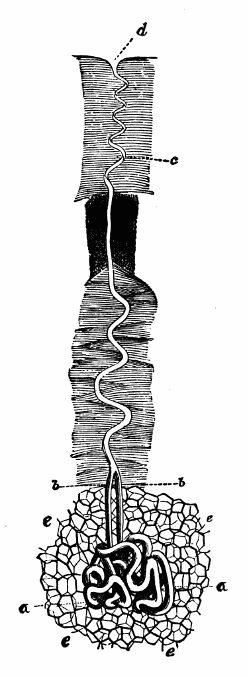
Sudoriferous Gland from the palm of the hand magnified 40 diam.:—a, a, contorted tubes, composing the gland, and uniting in two excretory ducts; b, b, which unite into one spiral canal that perforates the epidermis at c, and opens on its surface at d; the gland is imbedded in fat-vesicles, which are seen at e, e.
In addition to the sudoriparous, the skin also possesses sebaceous glands which stud almost every part of its surface except the palms of the hands and the soles of the feet. The sebaceous glands secrete a semi-fluid, greasy kind of substance, the office of which is probably to aid in rendering the skin soft and supple, and to prevent the too rapid evaporation of moisture from it. The sebaceous glands are more particularly found on the scalp, the anus, and the nose, their locality in the skin of this last feature being sometimes marked by small black specs, which when squeezed yield a little white mass resembling a maggot in appearance. This is merely the solidified secretion from the sebaceous gland. A parasite known as the Acarus folliculorum infests the sebaceous glands. In the cartilaginous part of the external passage of the ear are other glands, the ceruminous, which secrete the wax that forms a protective film for the membrane of the tympanum or drum, and guards it against dust, insects, &c. See Exercise, Perspiration.
SKIN BALSAM, Glycerin—Glycerin Haut, Balsam. A mixture of 1000 parts glycerin, 120 parts orange-flower water, 1 part each oils of neroli and bitter almonds. (Hager.)
SKIN COSMET′ICS. The simplest, cheapest, and most generally employed cutaneous cosmetics are soap and water, which at once cleanse and soften the skin. Soap containing a full proportion of alkali exercises a solvent power upon the cuticle, a minute portion of which it dissolves; but when it contains a small preponderance of oily matter, as the principal part of the milder toilet soaps now do, it mechanically softens the skin and promotes its smoothness. Almond, Naples, and Castile soaps are esteemed for these properties, and milk of roses, cold cream, and almond powder (paste), are also used for a similar purpose. To produce an opposite effect, and to harden the cuticle, spirits, astringents, acids, and astringent salts, are commonly employed. The frequent use of hard water has a similar effect. The application of these articles is generally for the purpose of strengthening or preserving some particular part against the action of cold, moisture, &c.; as the lips, or mammæ, from chapping, or the hands from contracting chilblains; but in this respect oils, pommades, and other oleaginous bodies, are generally regarded as preferable.
Another class of cutaneous cosmetics are employed to remove freckles and eruptions. Among the most innocent and valuable of these is Gowland’s lotion, which has long been a popular article, and deservedly so, for it not only tends to impart a delightful softness to the skin, but is a most valuable remedy for many obstinate eruptive diseases which frequently resist the usual methods of treatment.
Hermann prescribes the following lotion:—Blanched almonds, 2 oz.; rose water, 8 oz.; orange-flower water, 2 oz. Make an emulsion, strain, and add sal ammoniac, 1 dr.; simple tincture of benzoin, 2 dr.
Skin paints and skin stains are employed to give an artificial bloom or delicacy to the skin. Rouge and carmine are the articles most generally used to communicate a red colour. The first is the only cosmetic that can be employed, without injury, to brighten a lady’s complexion. The other, though possessing unrivalled beauty, is apt to impart a sallowness to the skin by frequent use. Starch powder is employed to impart a white tint, and generally proves perfectly harmless. The American ladies, who are very fond of painting their necks white, use finely-powdered magnesia, another very innocent substance. Several metallic compounds, as the trisnitrate, chloride, and oxide of bismuth (pearl white, Fard’s white, &c), carbonate of lead (flake white), white precipitate, &c., are frequently used to revive faded complexions; but they are not only injurious to the skin, but act as poisons if taken up by the absorbents. Trisnitrate of bismuth (pearl white), probably the least injurious of these articles, has been known to cause spasmodic tremblings of the muscles of the face, ending in paralysis. (‘Voght. Pharm.’) The employment of liquid preparations containing sugar of lead, which are commonly sold under the name of milk of roses, cream of roses, &c., is equally injurious. Another disadvantage of these metallic preparations is, that they readily turn black when exposed to the action of sulphuretted hydrogen gas, or the vapours of sulphur, such as frequently escape into the apartment from coal fires. There are many instances recorded of a whole company being suddenly alarmed by the pearly complexion of one of its belles being thus transformed into a sickly grey or black colour.
In conclusion, it may be remarked that the best purifiers of the skin are soap and water, followed by the use of a coarse but not a stiff cloth, in opposition to the costly and smooth diapers that are commonly employed; and the best beautifiers are health, exercise, and good temper.
Skin, Goldbeat′er’s. See Goldbeater’s skin.
SKINS (of Animals). The preparation and preservation of fur skins are noticed under Peltry; the preparation and uses of the skins of the larger animals under Leather, Tanning, Tawing, &c.
SLACK. Small coal, such as is used for kilns.
SLAG. The semi-vitrified compounds, produced, on the large scale, during the reduction of metallic ores by fluxes. Those from iron and copper works are often used for building materials, mending roads, &c.
According to Egleston[167] the following are some of the industrial applications to which the slag from blast furnaces is put.
When required for building stones the slag is run from the blast furnace into a semicircular vessel on moving wheels, and having its bottom covered three centimetres deep with sand and coke dust. By means of a bent iron instrument the slag is mixed with sand and coke dust till the escape of gases has nearly ceased and the mass is sufficiently tough. With the same tool it is next pressed into a mould furnished with a lid, which is forced down as soon as the escape of gas ceases. The red-hot stone is then placed in the cooling oven, covered with coke dust, and allowed to remain three or four days to cool completely. These stones are impervious to damp, and make good foundations. According to another method the slag, which should contain from 38 to 44 per cent. of silica, is run down a shoot into a large cavity, and then covered over with sand and ashes, and left to cool from five to ten days, when it is distributed in moulds, and there hardens. In certain parts of Belgium slag is poured upon iron plates and cooled by water, and thus a kind of glass is manufactured.
In other districts the slag is granulated as it flows from the blast furnace by means of a stream of water. The granulated slag is preferred by the puddlers to the sand for the moulds of pig iron. The slag gravel may be advantageously substituted for sand in mortar making, a more rapid hardening being thus secured, a matter of great moment in building foundation walls.
Artificial stone is also manufactured from the granulated slag, and used for building purposes, furnishing warm dry houses of handsome appearance.
When stones for building with enamelled surfaces are required they are obtained in some parts of Europe as follows:—The unburnt bricks are covered with granulated slag, and after drying are burnt in a furnace where they do not come in contact with carbon. The stones are completely glazed, and according to the different kinds of slag used are tinted of different colours. This operation is also employed advantageously with tiles, pipes, and earthenware.
If, in the preparation of fire-proof bricks, a certain proportion of mixture of clay and granulated slag be added to the mixture, very hard and durable fire bricks are obtained. These have been tested in a brass furnace, and experiments are being tried as to their
Mr Britten in 1876 patented a process for the manufacture of glass from blast furnace slag. Large works for the purpose of carrying out this invention, under the title of ‘Britten’s Patent Glass Company,’ have been erected at Finedon in Northamptonshire, and are, we believe, successfully worked in manufacturing glass bottles.
The method consists in removing molten slag in a ladle from the blast furnace, and pouring into a Siemen’s furnace, when certain amounts of carbonate of sodium and silica are added, depending upon the quality of the slag used, and of the glass required.
SLATE. The excellence of this material for water cisterns deserves a passing notice here.
Irish slate (Lapis Hibernicus) is an argillaceous mineral, said to contain iron and sulphur, found in different parts of Ireland. It is a common remedy, among the vulgar, for internal bruises, taken in a glass of gin.
SLEEP. During the period of our waking hours the exercise of the animal functions entails a waste or destruction of tissue in the organs performing them, which, unless duly repaired, would soon lead to the enfeeblement and consequent failure of the powers of the organs themselves. For the animal economy therefore to be maintained in a state of efficiency the repair of the reduced tissues is a necessity; and this essential condition is effected by the agency of sleep, during which respiration, circulation, digestion, &c., continue to be carried on simultaneously with assimilative processes which end in the regeneration of the impaired tissue.
A proper amount of sleep is therefore as great or even a greater necessity than a proper supply of food; and any one failing to obtain it soon perishes of exhaustion. Thus it is that any great mental emotion—such as intense remorse, grief, anxiety, or the depressing effect of a reverse of fortune—so frequently expedites death. Like Macbeth “it murders sleep,” one of the great needs of man’s existence.
Infants and children it is well known require much more sleep than adults. In these latter the organism, being already matured, demands only so much sleep as will enable it to make up for the daily waste of the body, which waste falls very far below the amount of nutrition required by the growing infant. In a still earlier state of development, viz., the fœtal one, life may be said to be passed entirely in slumber; whilst children prematurely born scarcely ever wake except for food. We may assume that, as a general rule, infants take treble the amount of sleep that adults do, and that very young infants thrive the better the larger the amount of sleep they get, is borne out by the experience of medical practitioners, who affirm that they have known many children who were born small and weakly, but who slept the greatest part of their early existence, afterwards became strong and healthy; whilst those children on the contrary who, being born large and strong, were not good sleepers, became subsequently enfeebled and unhealthy. As regards the sleep of adults, if the slumber has been of average length, or the subject of it awakes fully refreshed therefrom, a second sleep instead of being conducive is prejudicial to health, and should never be encouraged.
During sickness a patient, if in a very helpless and enfeebled state, may often be exposed whilst asleep to great peril, unless the nurse who attends him exercises intelligence and a proper amount of vigilance. In his work on ‘Household Medicine’ Dr Gardner has pointed out the dangers that beset the sleeping patient, and the means by which they may be avoided. “Having disposed,” he says, “of the patient in bed in the best manner, be careful that no part of the pillow can project over the mouth or nose, and that the bedclothes do not cover the mouth.
“The attendant should be particularly attentive to these points, when a narcotic has been taken, when the disease is paralysis, fever, head diseases, bronchitis, or any pulmonary complaint. The patient should be watched until he sleeps, and during his sleep, if a nurse is not constantly present, should be visited frequently, to observe whether the mouth and nostrils are free, and nothing obstructs the breathing.
“Very little suffices for an obstruction in such cases, which may extinguish life. Hundreds, perhaps we may say thousands of persons die prematurely from suffocation during sleep, in a low condition of the vital energies.
“How often does it happen that a patient left in a calm sleep is found dead upon being visited an hour or two after. Soft yielding pillows, in which the head and face get buried, are the instruments of suffocation to weakly persons, very, very often.”
The larger amount of sleep indulged in by the very old, over adults, is referable to the incapacity of the aged for exercise, and to their enfeebled powers of nutrition. Besides age, temperament, habit, and surrounding circumstances exercise considerable influence on the amount of sleep necessary for man. Persons of lymphatic temperament are generally great sleepers; whilst those of a nervous and active nature are mostly the reverse. The late Earl Russell was we believe in the years of his active
Several well-attested cases of excessive slumber are on record in which the sleep lasted in some cases for weeks, and in others even for months.
In the ‘Comptes Rendus’ for 1864 Dr Blanchet records the case of one of his patients, a lady of 24 years of age, who had slept for 40 days when she was 18 years of age. Two years later she had a sleep lasting 50 days. Upon a subsequent occasion she fell asleep on Easter Sunday, 1862, and did not wake till March, 1863. She was fed during this period with milk and soup. She continued motionless and insensible, the pulse was low, the breathing scarcely perceptible, there were no evacuations, and she betrayed no signs of wasting away, whilst her complexion is described as florid and healthy.