A CYCLOPÆDIA OF PRACTICAL RECEIPTS, &c. VOLUME II (continued 29)
Reading edition
RANCID′ITY. The strong, sour flavour and odour which oleaginous bodies acquire by age and exposure to the air. For its prevention, see Fats, Oils (Fixed), &c.
RAPE OIL. See Oils (Fixed).
RASH. Erasmus Wilson notices four different affections, as included under this head:—
1. St Anthony’s fire, or ERYSIPELAS, the severest of them all, already referred to.
2. Nettle-rash, or URTICARIA, characterised by its tingling and pricking pain, and its little white elevations on a reddish ground, like the wheals caused by the sting of a nettle. This efflorescence seldom stays many hours, and, sometimes, not even many minutes, in the same place, and is multiplied or reproduced whenever any part of the skin is scratched or even touched. No part of the body is exempt from it, and when many of them occur together, and continue for an hour or two, the parts are often considerably swelled, and the features temporarily disfigured. In many cases these eruptions continue to infest the skin, sometimes in one place, and sometimes in another, for one or two hours together, two or three times a day, or perhaps, for the greatest part of the twenty-four hours. In some constitutions this lasts only a few days; in others several months.
There are several varieties of nettle-rash or urticaria noticed by medical writers, among which URTICARIA FEBRILIS, PERSISTANS, and EVANIDA, are the principal.
The common cause of nettle-rash is some derangement of the digestive functions, arising either from the use of improper food or a disordered state of the nervous or other systems of the body. Lobsters, crabs, mussels, shrimps, dried fish, pork, cucumbers, mushrooms, and adulterated beer or porter, bear the character of frequently causing this affection. In childhood it commonly arises from teething. Occasionally, in persons of peculiar idiosyncrasy, the most simple article of food, as almonds, nuts, and even milk, rice, and eggs, will produce this affection.
The treatment may consist of the administration of gentle saline aperients, and in severer cases a gentle emetic, followed by the copious use of acidulated diluent drinks, as weak lemon-juice-and-water, effervescing potassa-draughts, &c., and, when required, diaphoretics. The clothing should be light, but warm, and the itching, when severe, may be allayed by
3. Red-rash, RED-BLOTCH, or FIERY SPOT, is commonly the consequence of disordered general health, of dyspepsia, and particularly, of females, of tight lacing. Sometimes it is slight and evanescent; at others it approaches in severity to the milder forms of erysipelas, there being much swelling and inflammation. Chaps, galls, excoriations, and chilblains are varieties of this disease produced by cold, excessive moisture, or friction. The treatment is similar to that of nettle-rash.
4. Rose-rash, FALSE MEASLES, or ROSEOLA, is an efflorescence, or rather a discoloration of a rose-red tint, in small irregular patches, without wheals or papulæ, which spread over the surface of the body, and are ushered in by slight febrile symptoms. There are several varieties. The causes are the same as those which produce the preceding affections, and the treatment may be similar. In all of them strict attention to the diet, and a careful avoidance of cold applications, or exposure to cold, so as to cause a retrocession, are matters of the first moment.
RASP′BERRY. Syn. Hindberry. The fruit of Rubus Idæus (Linn.), a small shrub of the natural order Rosaceæ. It is cooling, antiscorbutic, and mildly aperitive. It is frequently used to communicate a fine flavour to liqueurs, confectionery, wine, &c. See Fruits and Vegetables.
Fresenius gives the following as the composition of raspberries:
Cultivated.
Wild Red. Red. White.
Soluble Matter—
Sugar 3·597 4·708 3·703
Free acid (reduced to equivalent in malic acid) 1·980 1·356 1·115
Albuminous substances 0·546 0·544 0·665
Pectous substances, &c. 1·107 1·746 1·397
Ash 0·270 0·481 0·318
Insoluble Matter—
Seeds, Skins, &c. 8·460 4·106 4·520
Pectose 0·180 0·502 0·040
[Ash from insoluble matter included in weights given] [0·134] [0·296] [0·081]
Water 86·860 86·557 88·180
———— ———— ————
100·000 100·000 100·000
RATAFI′A. Originally a liquor drank at the ratification of an agreement or treaty. It is now the common generic name in France of liqueurs compounded of spirit, sugar, and the odoriferous and flavouring principles of vegetables, more particularly of those containing the juices of recent fruits, or the kernels of apricots, cherries, or peaches. In its unqualified sense this name is commonly understood as referring to cherry-brandy or peach-brandy.
Ratafias are prepared by distillation, maceration, or extemporaneous admixture, in the manner explained under the head LIQUEUR. The following list includes those which are commonly prepared by the French liquoristes:—
Ratafia d’Angelique. From angelica seeds, 1 dr.; angelica stalks, 4 oz.; blanched bitter almonds, bruised, 1 oz.; proof spirit or brandy, 6 quarts; digest for 10 days, filter; add, of water, 1 quart; white sugar, 31⁄2 lbs.; mix well, and in a fortnight decant the clear portion through a piece of clean flannel.
Ratafia d’Anis. See (Liqueur) Cordial, Aniseed.
Ratafia de Baume de Tolu. From balsam of Tolu, 1 oz.; rectified spirit, 1 quart; dissolve, add water, 3 pints; filter, and further add of white sugar, 11⁄2 lb. Pectoral and traumatic.
Ratafia de Brou de Noix. From young walnuts with soft shells (pricked or pierced), 60 in no.; brandy, 2 quarts; mace, cinnamon, and cloves, of each 15 gr.; digest for 8 weeks; press, filter, add of white sugar, 1 lb.; and keeping it for some months before decanting it for use. Stomachic.
Ratafia de Cacao. Syn. R. DE CHOCOLAT. From Caracca cacao-nuts, 1 lb.; West Indian do., 1⁄2 lb.; (both roasted and bruised;) proof spirit, 1 gall.; digest for 14 days, filter, and add, of white sugar, 21⁄2 lbs.; tincture of vanilla, 1⁄2 dr. (or shred of vanilla may be infused with the nuts in the spirit instead); lastly, decant in a month, and bottle it.
Ratafia de Café. From coffee, ground and roasted, 1 lb.; brandy or proof spirit, 1 gall.; sugar, 2 lbs. (dissolved in); water, 1 quart; as last.
Ratafia de Cassis. From black currant juice, 1 quart; cinnamon, 1 dr.; cloves and peach kernels, of each 1⁄2 dr.; brandy, 1 gall.; white sugar, 3 lbs.; digest for a fortnight, and strain through flannel.
Ratafia de Cerise. From Morello cherries, with their kernels bruised, 8 lbs.; brandy or proof spirit, 1 gall.; white sugar, 2 lbs.; as last.
Ratafia de Chocolat. Ratafia de cacao (see above).
Ratafia de Coings. From quince juice, 3 quarts; bitter almonds, 3 dr.; cinnamon and coriander seeds, of each 2 dr.; mace, 1⁄2 dr.; cloves, 15 gr. (all bruised); rectified spirit, (quite flavourless), 1⁄2 gall.; digest for a week, filter, and add of white sugar, 31⁄2 lbs.
Ratafia de Crème. From crème de noyeau1⁄4 pint; capillaire, 1⁄2 pint; fresh cream, 1 pint; beaten together.
Ratafia de Curaçoa. Curaçoa.
Ratafia de Framboises. Raspberry cordial.
Ratafia de Genièvre. From juniper berries (each pricked with a fork), 1⁄4 lb.; caraway and coriander seed, of each 40 gr.; finest malt spirit (22 u. p.), 1 gall.; white sugar 2 lbs.; digest a week, and strain with expression.
Ratafia de Grenoble. From the small wild black cherry (with the kernels bruised), 2 lbs.; proof spirit, 1 gall.; white sugar, 3 lbs.; citron peels, a few grains; as before.
Ratafia de Grenoble, de Teyssère. From cherries (bruised with the stones), 1 quart; rectified spirit, 2 quarts; mix, digest for 48 hours, then express the liquor, and heat it to boiling in a close vessel; when cold, add of sugar or capillaire, q. s., together with some noyeau, to flavour, and a little syrup of the bay laurel, and of galangal; in 3 months decant, and bottle it.
Ratafia de Noyeau. From peach or apricot kernels (bruised), 120 in no.; proof spirit or brandy, 2 quarts; white sugar, 1 lb.; digest for a week, press, and filter.
Ratafia de Œillets. From clove-pinks (without the white buds), 4 lbs.; cinnamon and cloves, of each 15 gr.; proof spirit, 1 gall.; macerate for 10 days, express the tincture, filter, and add of white sugar, 21⁄2 lbs.
Ratafia d’Ecorce d’Orange. Crème d’Orange.
Ratafia de Fleurs d’Oranger. From fresh orange petals, 2 lbs.; proof spirit, 1 gall.; white sugar, 21⁄2 lbs.; as last. Instead of orange flowers, neroli, 1 dr., may be used.
Ratafia à la Provençale. From striped pinks, 1 lb.; brandy or proof spirit, 1 quart; white sugar, 3⁄4 lb.; juice of strawberries, 3⁄4 pint; saffron, 20 gr.; as before.
Ratafia des Quatre Fruits. From cherries, 30 lbs.; gooseberries, 15 lbs.; raspberries, 8 lbs.; black currants, 7 lbs.; express the juice, and to each pint add, of white sugar, 6 oz.; cinnamon, 6 gr.; cloves and mace, of each 3 gr.
Ratafia Rouge. From the juice of black cherries, 3 quarts; juices of strawberries and raspberries, of each 1 quart; cinnamon, 1 dr.; mace and cloves, of each 15 gr.; proof spirit or brandy, 2 galls.; white sugar, 7 lbs.; macerate, &c., as before.
Ratafia Sec. Take of the juice of gooseberries, 5 pints; juices of cherries, strawberries, and raspberries, of each 1 pint; proof spirit, 6 quarts; sugar, 7 lbs.; as before.
Ratafia à la Violette. From orris powder, 3 oz.; litmus, 4 oz.; rectified spirit, 2 galls.; digest for 10 days, strain, and add of white sugar, 12 lbs.; dissolved in soft water, 1 gall.
RATS. The common or brown rat is the Mus Decumanus (Linn.), one of the most prolific and destructive species of the Rodentia. It was introduced to these Islands from Asia; and has since spread over the whole country, and multiplied at the expense of the black rat (Mus Rattus—Linn.), which is the old British species of this animal, until its inroads on our granaries, our stores, and dwelling-houses have increased to such an extent, that its extirpation has become a matter of serious, if not of national, importance.
For the destruction of these noxious animals two methods are adopted:—
1. Trapping. To render the bait more attractive, it is commonly sprinkled with a little of one of the rat scents noticed below. The trap is also occasionally so treated.
2. Poisoning. The following are reputed the most effective mixtures for this purpose:—
Arsenical Paste. From oatmeal or wheaten flour, 3 lbs.; powdered indigo, 1⁄2 oz.; finely powdered white arsenic, 1⁄4 lb.; oil of aniseed, 1⁄2 dr.; mix, add of melted suet, 21⁄2 lbs.; and beat the whole into a paste. A similar compound has the sanction of the French Government.
Arsenical Powder. From oatmeal, 1 lb.; moist sugar, 1⁄4 lb.; white arsenic and rotten cheese, of each 1 oz.; rat-scent, a few drops.
Millers’ Rat Powder. From fresh oatmeal, 1 lb.; nux vomica (in very fine powder), 1 oz.; rat-scent, 5 or 6 drops. This is highly spoken of by those who have used it.
Mineral Rat-poison. From carbonate of baryta, 1⁄4 lb.; sugar and oatmeal, of each 6 oz.; oils of aniseed and caraway, of each a few drops.
Philantrope Muophobon. A French preparation, which, according to Mr Beasley, consists of tartar emetic, 1 part, with farinaceous matter, 4 parts, and some other (unimportant) ingredients.
Phosphor Paste.
Rat-scents. The following are said to be the most attractive:
a. Powdered cantharides steeped in French brandy. For traps. It is said that rats are so fond of this, that if a little be rubbed about the hands they may be handled with impunity.
b. From powdered assafœtida, 8 gr.; oil of rhodium, 2 dr.; oil of aniseed, 1 dr.; oil of lavender, 1⁄2 dr.; mix by agitation.
c. From oil of aniseed, 1⁄2 oz.; tincture of assafœtida, 1⁄4 oz.
d. From oil of aniseed, 1⁄4 oz.; nitrous acid, 2 to 3 drops; musk, triturated with a little powdered sugar, 1 gr.
RA′ZORS. See Papers, Paste, and Shaving.
REA′GENTS. See Tests.
REAL′GAR. This valuable red pigment is the bisulphide of arsenic. It is found native in some volcanic districts; but that of commerce is prepared by distilling, in an earthen retort, arsenical pyrites, or a mixture of sulphur and arsenic, of orpiment and sulphur, or of arsenious acid, sulphur, and charcoal, in the proper proportions. See Disulphide of Arsenic.
RECOMMENDATIONS TO FARMERS. A series of valuable suggestions, intended for the guidance of farmers in the purchase of manures and cattle-feeding materials have lately been
The following advice is given to farmers about to purchase manures:—Raw bones or bone dust should be purchased ‘as pure,’ whilst they should be guaranteed to contain not less than 45 per cent. of tribasic phosphate of lime, and 4 per cent. of ammonia. ‘Boiled bones’ should be purchased as ‘pure’ boiled bones, guaranteed to contain not less than 48 per cent. of tribasic phosphate of lime, and 13⁄4 per cent. of ammonia. Dissolved bones vary so greatly that the buyer should insist on a guarantee of quality under the heads of ‘soluble phosphate of lime,’ ‘insoluble phosphate of lime,’ and ‘nitrogen’ or ‘ammonia,’ also for an allowance at current rates for each unit per cent. if the bones should prove on analysis to contain less than the guaranteed per-centages, &c. It should be insisted that mineral superphosphates are delivered dry and in good condition, and be guaranteed to contain a certain per-centage of soluble phosphates at a certain price per unit per cent. No value is to be attached to ‘insoluble phosphates.’ Compound artificial manures, which are rarely used, should be purchased on exactly the same terms. Nitrate of soda should be purchased on exactly the same terms. Nitrate of soda should be guaranteed to contain 94 to 95 per cent. of pure nitrate. Sulphate of ammonia should yield 35 per cent. of ammonia. Peruvian guano should be sold under that name, and guaranteed to be in a dry, friable condition, and to contain a certain per-centage of ammonia.
In buying artificial manures the purchaser is recommended to obtain a guarantee that they shall be delivered in a sufficiently dry and powdery condition to allow of sowing by the drill.
Samples, taken out of three or four bags, should be well mixed together, and they should be analysed not later than three days after delivery. Two tins, holding about half a pound each, should be filled in the presence of a witness, sealed up, one sent to the analyst, and the other retained for future reference.
RECTIFCA′TION. The redistillation, &c., of a fluid, for the purpose of rendering it purer.
RED. A term denoting a bright colour, resembling blood. Red is a simple or primary colour, but of several different shades or hues, as scarlet, crimson, vermilion, orange-red, &c.
RED, AN′ILINE. Syn. Rosaniline. This artificial base is prepared by the action of bichloride of tin, mercurial salts, arsenic acid, and many other oxidising agents, upon aniline. The aniline reps of commerce, now so largely used for dyeing, are saline compounds, more or less pure, of rosaline, with 1 equiv. of acid. These compounds are known under the names of ‘magenta,’ ‘fuchsine,’ ‘roseine,’ ‘azaleine,’ &c. In England the aniline red commonly employed is the acetate of rosaniline, which has been prepared by Mr Nicholson in splendid crystals of very considerable dimensions. In France the hydrochlorate of rosaniline is chiefly employed. The free base presents itself in colourless crystalline plates, but its compounds with 1 equiv. of acid have, when dry, a beautiful green colour, with golden lustre, and furnish with water an intensely coloured red solution. See Purple (Aniline) and Red dye, also Tar colours.
RED DYE. The substances principally employed for dyeing reds are cochineal, lac-dye, and madder, which, under proper treatment, yield permanent colours of considerable brilliancy, the first and third more particularly so. Extremely beautiful but fugitive colours are also obtained from Brazil wood, safflower, archil, and some other substances. For purple-red or crimsons (magenta, fuchsine, &c.), on silk or wool, the aniline reds (salts of rosaniline) are now extensively used. (See Tar-colours.) The mode of applying them is noticed under Purple dye. Silk is usually dyed of a permanent red or scarlet with cochineal, safflower, or lac dye; wool, with cochineal and, still more frequently, with madder; and cotton, with madder (chiefly), Brazil wood, &c. The leading properties of these substances are given under their respective names, and the methods of employing them are generally referred to in the articles Dyeing, Mordants, &c., and, therefore, need not be repeated here. The following may, however, be useful to the reader:—
1. First, give the ‘goods’ a mordant of alum, or of alum-and-tartar, rinse, dry, and boil them in a bath of madder. If acetate of iron be used instead of alum, the colour will be purple, and by combining the two, as mordants, any intermediate shade may be produced.
2. The yarn or cloth is put into a very weak alkaline bath at the boiling temperature, then washed, dried, and ‘galled’ (or, when the calico is to be printed, for this bath may be substituted one of cow-dung, subsequent exposure to the air for a day or two, and immersion in very dilute sulphuric acid. In this way the stuff gets opened, and takes and retains the colour better). After the ‘galling’ the goods are dried, and alumed twice; then dried, rinsed, and passed through a madder bath, composed of 3⁄4 lb. of good madder for every lb. weight of the goods; this bath is slowly raised to the boiling point in the course of 50 or 60 minutes, more or less, according
3. (Adrianople red, Turkey r.) This commences with cleansing or scouring the goods by alkaline baths, after which they are steeped in oily liquors brought to a creamy state by a little carbonate of soda; a bath of sheep’s dung is next often used as an intermediate or secondary steep; the oleaginous bath, and the operation of removing the superfluous or loosely adhering oil with an alkaline bath, is repeated two or three times, due care being taken to dry the goods thoroughly after each distinct process; then follow the distinct operations of galling, aluming, maddering, and brightening, the last for removing the dun-coloured principle, by boiling at an elevated temperature with alkaline liquids and soap; the whole is generally concluded with treatment by spirit of tin. In this way are given the most brilliant reds on cotton.
Obs. Wool takes from half its weight of madder to an equal weight to dye it red; cotton and linen take rather less. On account of the comparative insolubility of the colouring matter of madder, this dye-stuff must be boiled along with the goods to be dyed, and not removed from the decoction, as is the practice in using many other articles. Other dye-stuffs are frequently added to the madder bath, to vary the shades of colour. Decoction of fustic, weld, logwood, quercitron, &c., are often thus employed, the mordants being modified accordingly. By adding bran to the madder bath the colour is said to be rendered much lighter, and of a more agreeable tint.
RED GUM. A slight eruptive disease of infancy, occasioned by teething, and, less frequently, by irritation from rough flannel worn next to the skin. See Strophulus.
RED LAV′ENDER. See Tincture of Lavender (Compound).
RED LIQ′UOR. The crude solution of acetate or sulpho-acetate of alumina employed in calico printing. It is generally prepared by mixing crude sulphate of alumina with about an equal weight of crude pyrolignite of lime, both being in the state of solution.
RED PIG′MENTS. The preparation of the principal red pigments are described under their respective names. The following list includes most of the reds in use:—
Arme′nian Bole. Syn. Bole Armenian; Bolus Armeniæ, L. Formerly imported from Armenia, Portugal, Tuscany, &c.; now generally made by grinding together a mixture of whiting, red oxide of iron, and red ochre, in nearly equal proportions.
Red, Brown. A factitious mixture of red oxide of iron and red ochre, in variable proportions.
Car′mine.
Carmina′ted Lake.
Red Chrome. Syn. Dichromate of lead, Red chromate of l.; Plumbi dichromas, P. chromus rubrum, L. Prep. 1. Boil pure carbonate of lead with chromate of potassa, in excess, until it assumes a proper colour; then wash it well with pure water, and dry it in the shade.
2. Boil neutral chromate of lead with a little water of ammonia or lime water.
3. (Liebig and Wöhler.) Fuse saltpetre at a low red heat in a Hessian crucible, and throw in chromate of lead (pure chrome yellow), by small portions at a time, as long as a strong ebullition follows upon each addition of the pigment, observing to stir the mixture frequently with a glass rod; after repose for a minute or two, pour off the fluid part, and, as soon as the solid residuum is cold, wash it with water, and dry it by a gentle heat.
Obs. Great care must be taken, in conducting the last process, not to employ too much heat, nor to allow the saline matter to stand long over the newly formed chrome-red, as the colour is thus apt to change to a brown or orange. When well managed the product has a crystalline texture, and so beautiful a red colour that it vies with native cinnabar. The liquid poured from the crucible is reserved for manufacturing chrome yellow.
Red, In′dian. Syn. Purple ochre; Ochra purpurea Persica, Terra Persica, L. This is a native production, brought from Ormus. A factitious article is prepared by calcining a mixture of colcothar and red ochre.
Lakes (Various).
Red, Light. From yellow ochre, by careful calcination. It works well with both oil and water, and produces an admirable flesh-colour by admixture with pure white. All the ochres, both red and yellow, are darkened by heat.
Red Or′ange. Syn. Sandix. Obtained from white lead by calcination. Very bright.
Real′gar. Bisulphide of arsenic.
Red Bole. See Armenian and Venetian bole. (Ochres.)
Red Chalk. A clay iron ore, much used for pencils and crayons, and, when ground, also for paints.
Red Lead. Syn. Minium. The finest red lead is prepared by exposing ground and elutriated massicott, or dross of lend, in shallow iron trays (about 12 inches square, and about 4 or 5 inches deep), piled up on the hearth of a reverberatory furnace, to a heat of about 600 to 650° Fahr., with occasional stirring, until it acquires the proper colour. The furnace employed for the preparation of massicot during the day usually possesses sufficient residuary heat during the night for this process, by which fuel is saved. Lead for the above purpose should be quite free from copper and iron.
Red O′chre. A natural product abounding on the Mendip hills.
Red Or′piment. Syn. Red arsenic. Tersulphide of arsenic.
Red Vene′tian. Syn. Bolus Veneta, L. A species of ochre, brought from Italy.
Rose Pink. This is whiting coloured with a decoction of Brazil wood to which a little pearlash has been added. A very pretty colour, but it does not stand. It is always kept in a damp state. The colour may be varied by substituting alum for pearlash, or by the addition of a little spirits of tin.
Vermil′ion. (See under that word.)
REDUC′TION. Syn. Revivification. A term in its fullest sense applied to any operation by which a substance is restored to its neutral state; but now generally restricted, in chemistry, to the abstraction of oxygen, and hence frequently termed deoxidation or deoxidisement. This change is operated by either heating the substance in contact with carbon or hydrogen, or in exposing it to the action of some other body having a powerful affinity for oxygen. See Potassium, &c.
REFI′′NING. A term employed in commercial chemistry and metallurgy synonymously with purification. The separation of the precious metals from those of less value, as in the operation of parting, constitutes the business of the ‘refiner.’ See Gold, Silver, &c.
REFRAC′TION (of Light). The deviation of a ray of light from its original path on entering a medium of a different density or power. For the practical application of this property, see Gems.
REFRI′′GERANTS. Medicines or agents which tend to lessen the animal temperature without causing any marked diminution of sensibility or nervous energy. Among internal refrigerants cold water, weak acidulous drinks, and saline aperients, are those which are probably the best known and the most useful. Among external refrigerants are cold water, evaporating lotions, weak solutions of subacetate of lead, &c.
REFRIGERA′TION. The abatement of heat; the act or operation of cooling.
Among the purposes to which refrigeratory processes are applied in the arts, the principal are—the condensation of vapours—the cooling of liquids—the congelation of water, and—the production of extreme degrees of cold in chemical operations. The first of these is referred to under the heads Distillation, Still, &c., and the second under Wort. It is, therefore, only necessary to notice here the third and fourth applications of cold, artificially produced, above referred to.
The refrigeratory processes at present employed depend upon the greater capacity for heat which the same body possesses as its density lessens, or its attenuation increases; as exhibited in the sudden liquefaction of solids, the rapid evaporation of liquids, and the almost instantaneous return of atmospheric air, or other gaseous body, from a highly condensed state to its normal condition. The loss of sensible heat in the first example is the basis of the various processes of producing cold by what are commonly called ‘FREEZING-’ or ‘FRIGORIFIC-MIXTURES,’ all of which act upon the principle of liquefying solid substances without supplying heat. The caloric of liquidity being in these cases derived from that previously existing in the solid itself in a sensible state, the temperature must necessarily fall. The degree of cold produced depends upon the quantity of heat which is thus diffused through a larger mass, or which, as it were, disappears; and this is dependent on the quantity of solid matter liquefied, and the rapidity of the liquefaction. Saline compounds are the substances most frequently employed for this purpose, and those which have the greatest affinity for water, and thus liquefy the most rapidly, produce the greatest degree of cold. Similar changes occur during the evaporation of liquids. When heat passes from the sensible to the insensible state, as in the formation of vapour, cold is generated. This may be shown by pouring a few drops of ether or rectified spirit on the palm of the hand, when a strong sensation of cold is experienced. A still more familiar illustration of this fact is exhibited in the rapidity with which the animal body loses heat when enveloped in damp or wet clothing. The evaporation of water produces a degree of cold which is greater than that of other liquids, in exact proportion as the insensible or latent heat of its vapour exceeds theirs. In the attenuation or rarefaction of gases similar phenomena occur.
It has been found that evaporation proceeds much more rapidly from the surface of fluids in a vacuum than in the atmosphere. Water may be easily frozen by introducing a surface of sulphuric acid under the receiver of an air-pump, over which is placed a capsule filled with water, so that the vapour arising from the latter may be immediately absorbed by the former. After a few strokes of the piston the water is converted into a solid cake of ice. The acid operates by absorbing the aqueous vapours as soon as generated, and thus maintaining the integrity of the vacuum. Professor Leslie found that, when air is thus rarified 250 times, the surface of evaporation was cooled down 120° in winter; and when only 50 times, a depression of 80° or even 100° took place. “Sulphuric acid is capable of congealing more than 20 times its weight of water before it has imbibed nearly its own bulk of that liquid, or has lost about 1⁄8th of its refrigerating power.” (Ure.) Sulphuric acid, which has become diluted in this way, may be reconcentrated by heat. Any substance having a great tendency to absorb moisture may be substituted for the sulphuric acid. Fused
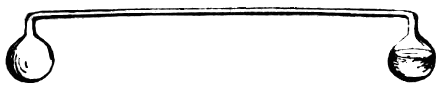
A pleasing philosophical toy, illustrative of the evaporative power of a vacuum, is the ‘CRYOPHORUS,’ or ‘FROST-BEARER,’ of Dr Wollaston. This instrument consists of two small glass globes, united by a tube, one of which is partly filled with water. The whole apparatus is perfectly free from air, and is, consequently, filled with attenuated aqueous vapours. No sooner is the pressure removed as by plunging the empty ball into a freezing mixture (which condenses the vapour), than rapid evaporation commences, and the water in the other ball is frozen in two or three minutes.
Even in hot climates ice may be produced under favorable circumstances by evaporation. On the open plains, near Calcutta, this is effected by exposing a thin stratum of water to the atmosphere, during the fine clear nights of December, January, and February. The pans are made of porous earthenware, and water is poured in to the depth of about 11⁄2 inch. A large number of these vessels are arranged in an excavation in the ground, 30 or 40 feet square and 2 feet deep, the bottom of which is covered, to the depth of 10 or 12 inches, with sugar canes or the stalks of Indian corn. At sunrise the pans are visited, the ice separated from the water, and packed as tight as possible in a deep cavity or pit, well screened from the heat.
Several machines have recently been invented by which water is frozen in large quantities by exposure to condensed air in the act of its subsequent expansion. They are worked by either hand or steam power. The refrigerating apparatus invented by Mr Kirk, of the Bathgate Paraffin Works, acts on this principle; and it does its work so efficiently that it produces a cooling effect equivalent to two tons of ice every twenty-four hours, at a very small expenditure of fuel. A small model worked by hand will readily freeze mercury. Kirk’s apparatus is used at Bathgate to cause the crystallisation of solid paraffin from the heavy paraffin oils. Formerly, a machine, acting by the evaporation of ether, was employed for the same purpose.
For the production of an extremely low temperature, such as is required for the liquefaction of some gases, Faraday employed solid carbonic acid mixed with a little ether.
In the production of ice or an extreme degree of cold, by saline mixtures, the salts should be in the crystallised state, and as rich as possible in water, but without being in the least damp. They should also be coarsely pulverised at the time of using them, and should not be mixed until immediately before throwing them into the liquid ingredients. The mixture should be made in a thick vessel, well clothed, to prevent the accession of external heat; and the substance to be acted on should be contained in a very thin vessel, so as to expose it more fully to the action of the mixture. On the large scale, a vessel called a ‘FREEZING POT’ or ‘SABOTIÈRE’ is commonly employed. The following table, though founded on experiments made more than 50 years ago by Mr Walker, gives full and accurate information on the subject of freezing mixtures:
Table exhibiting a few of the most useful Frigorific Mixtures. Drawn up from actual experiments performed by Mr Walker.
Ingredients. Thermometer sinks. Deg. of cold produced.
Snow or pounded ice 2 parts From any temperature to -5° —
Chloride of sodium 1 ”
Snow or pounded ice 5 ” From any temperature to -12° —
Chloride of sodium 2 ”
Sal ammoniac 1 ”
Snow or pounded ice 12 ” From any temperature to -25° —
Chloride of sodium 5 ”
Nitrate of ammonia 5 ”
Snow 8 ” From +32° to -27° 59°
Hydrochloric acid (concentrated) 5 ”
Snow 2 ” From +32° to -50° 82°
Crystallised chloride of calcium 3 ”
Sal ammoniac 5 ” From +50° to +10° 40°
Nitrate of potassa 5 ”
Water 16 ”
Nitrate of ammonia 1 ” From +50° to +4° 46°
Water 1 ”
Nitrate of ammonia 1 ” From +50° to +7° 57°
Carbonate of soda 1 ”
Water 1 ”
Phosphate of soda 9 ” From +50° to -21° 71°
Nitrate of ammonia 6 ”
Diluted nitrous acid[135] 4 ”
Sulphate of soda 8 ” From +50° to 0° 50°
Hydrochloric acid 5 ”
Snow 3 ” From 0° to -46° 46°
Diluted nitrous acid[135] 2 ”
Snow 2 ” From -20° to -60° 40°
Sulphuric acid[136] 1 ”
Water 1 ”
Snow 1 ” From 0° to -66° 66°
Crystallised chloride of calcium 2 ”
Snow 1 ” From -40° to -73° 33°
Crystallised chloride of calcium 3 ”
Snow 8 ” From -68° to -91° 23°
Sulphuric acid 5 ”
Water 5 ”
Obs. The materials in the first column are to be cooled, previously to mixing, to the temperature required in the second, by the use of other mixtures.
REG′ULUS. A term applied by the alchemists to various metallic matters obtained by fusion; as REGULUS OF ANTIMONY, ARSENIC, &c. It is now obsolete.
REL′ISHES. See Sauces.
REMEDIES, FERRUGINOUS. Rob. Freygang:—
Steel brandy is an ordinary clear brownish brandy, containing a very little bitter matter, like the stomachic bitters of the apothecaries, and mixed with about 1 per cent. of sugar. 10,000 parts contain about 11⁄2 part oxide of iron.
Steel stomachic bitters. This is more aromatic, but otherwise similar to the steel brandy; 10,000 parts contain 2⁄3 part iron oxide.
Steel liqueur is a clear, agreeably-tasting liqueur, of the colour and containing much of the juice of raspberries. 10,000 parts contain nearly 1,200 of sugar and only 1 of iron oxide.
Steel Syrup—Syrop ferrugineux de Quinquina. A clear slightly violet-coloured, thin, sweet fluid, containing spirit and sugar, of which cinchona bark may be an ingredient, though it is appreciable by neither taste nor tests. It contains 11⁄4 part iron in 10,000 parts.
Steel bonbons contain a trace of iron oxide.
The iron present in the above preparations is in the form of citrate. (Hager.)
REMIT′TENT. A term applied to fevers, and other diseases, which exhibit a decided remission in violence during the twenty-four hours, but without entirely leaving the patient, in which they differ from intermittents or agues.
REN′NET. Syn. Runnet, Prepared calf’s maw. The fourth or true digesting stomach of the calf, freed from the outer skin, fat, and useless membrane, washed, treated with either brine or dry salt for a few hours, and then hung up to dry. When well prepared, the dried ‘vells’ somewhat resemble parchment in appearance.
Uses, &c. Rennet is employed to curdle milk. A piece of the requisite size is cut off, and soaked for some hours in whey or water, after which the whole is added to the milk for curdling, slightly warmed, and the mixture is slowly heated, if necessary, to about 122° Fahr. In a short time after this temperature has been attained the milk separates into a solid white coagulum (curd), and into a yellowish, translucent liquid (whey). Two square inches from the bottom of a good ‘vell’ are sufficient for a cheese of 60 lbs. It is the gastric juice of the stomach that operates these changes. The stomachs of all sucking quadrupeds possess the same properties. See Cheese.
Rennet, Liquid. Syn. Essence of rennet. Prep. From fresh rennet (cut small), 12 oz.; common salt, 3 oz.; knead them together, and leave the mixture at rest, in a cool place, for 5 or 6 weeks; then add of water 18 oz.; good rum or proof spirit, 2 oz.; lastly, digest for 24 hours, filter, and colour the liquid with a little burnt sugar.
Rennet, Liquid. Syn. Essence of rennet. Fresh rennet, 12 oz.; salt, 2 oz.; proof spirit, 2 oz.; white wine, a quart; digest for 24 hours and strain. A quart of milk requires 2 or 3 teaspoonfuls. Wislin directs 10 parts of a calf’s stomach; salt, 3 parts. The membrane of the stomach is to be cut with scissors and kneaded with the salt, and with the rennet found in the interior of that organ; the whole left in a cool place in an earthen pot till the cheesy odour is replaced by the proper odour of rennet, which will be in one or two months. Then add 16 parts of water and 1 of spirit. Filter and colour with burnt sugar.
The German Pharmacopœia gives the following formula for liquid rennet:—3 parts of the mucous membrane of fresh calf’s rennet, macerated for three days in 26 parts of white wine, 1 part of table salt being added.
Obs. 2 or 3 teaspoonfuls will curdle a quart of milk. Some persons use white wine instead
RES′IN. Syn. RESINA, L. This name is applied to many vegetable principles composed of the elements carbon, hydrogen, and oxygen. The resins (RESINÆ) cannot be very accurately defined, but we may in a general way describe them as substances which are solid at ordinary temperatures, more or less transparent, inflammable, readily fusible, do not volatilise unchanged, become negatively electrified by rubbing; are insoluble in water, but soluble in alcohol; mostly inodorous, and readily incorporated with fatty bodies by fusion. Their sp. gr. varies from ·9 to 1·2. According to Liebig, they are oxidised essential oils. Common resin, rosin, or colophony, and the shellac of which sealing-wax is made, are familiar examples of these substances. (See below.)
Resin, Black. Syn. Rosin‡, Black r.‡, Colophony; Resina nigra, Colophonia, L. What remains of turpentine after the oil has been distilled. When this substance, whilst still fluid, is agitated with about 1-8th part of water, it forms the yellow resin of pharmacy. Used for violin bows, dark-coloured ointments, varnishes, &c.
Resin, Yel′low. Syn. Yellow rosin‡, White r.‡; Resina flava, Resina (Ph. L.), La. Detergent. Used in ointments, plasters, &c. (See above.)
RES′INOIDS. Syn. Resinous extracts, Concentrated e.; Extracta resina, L. Under this head, the so-called ‘Eclectics,’ who form a numerous class among American physicians, place their most important ‘concentrated remedies.’ “Viewed as pharmaceutical preparations eligible for use in medicine, though not purified so as to rank as distinctive proximate principles, these are very appropriately named ‘resinous extracts,’ or ‘resins.’ The term ‘resinoid,’ so commonly used, is less appropriate to the class, implying, as it does, a resemblance to resins, while all of these are either resins, oleo-resins, or more or less mixed proximate principles possessing no real resemblance to the class of resins.” (Parrish.) Most of them are prepared from plants indigenous to North America, by precipitating a strong alcoholic tincture with water. They are all brought to the condition of powder, those which are naturally soft and oily being mixed with a sufficient quantity of sugar of milk, or other dry material. One of these eclectic remedies has been introduced into regular practice. See Podophyllin.
RESIN, or ROSIN OIL. This is a product of the dry distillation of resin. The apparatus used consists of an iron pot, a head piece, a condensing arrangement, and a receiver.
In distilling the resin, a bright oil first comes over with water. As soon as a cessation in the flow of the distillate occurs the receiver is changed, and the heat is further raised, when a red-coloured and heavy rosin oil comes over. The black residue remaining in the pot is used as pitch. The light oil, called ‘pinoline,’ is rectified, and the acetic acid water passing over with it is saturated with calcium hydrate, filtered and evaporated to dryness; and the calcium acetate obtained is employed in the manufacture of acetic acid. The rosin oil, obtained after the light oil has passed over, has a dark violet-blue colour, and is called ‘blue rosin oil.’ The red oil is boiled for a day with water, the evaporated water being returned to the vessel; next day the water is drawn off, and the remaining rosin oil is saponified with caustic soda lye of 36° Baumé, and the resulting solid mass is distilled so long as oil passes over.
The product obtained is ‘rectified rosin oil,’ which is allowed to stand in iron vessels, protected by a thin layer of gypsum, whereby after a few weeks a perfectly clear oil is obtained free from water. The oil of first quality is obtained by a repetition of the foregoing operation upon the once rectified oil. The residues of both operations are melted up with the pitch.[137]
Rosin oil is employed in the manufacture of axle grease, the oil being previously converted into a soap by heating with slaked lime.
RESOLV′ENTS. Syn. Discutients; Resolventia, L. Substances or agents which discuss or resolve inflammatory and other tumours. See Digestives.
RESPIRA′TION. The peculiar function by which the blood is submitted to the action of the air, for the purpose of removing carbonic acid, and restoring its vitality by the absorption of atmospheric oxygen.
The air expired from the lungs is found to have undergone a most remarkable change. It is now loaded with aqueous vapour, whilst a considerable portion of its oxygen has disappeared, and its place is supplied by about a like volume of carbonic acid. It is no longer capable of supporting animal life, and even a lighted taper plunged into it is immediately extinguished. In the mean time the ‘venous blood’ which entered the lungs from the right chambers of the heart has lost its dingy hue, and has acquired the rich florid colour which is characteristic of ‘arterial blood.’ In this state it is returned to the left chambers of the heart, and is propelled by that organ to every part of the body, from which it passes by the capillaries to the veins, and by these again to the heart and lungs, to undergo the same changes and circulation as before. The carbon and hydrogen of the blood, ultimately derived from the food, are, in this course, gradually converted into carbonic acid and water by a species of slow combustion; but how these changes are effected is not definitely ascertained.
The lungs, as is well known, receive the atmospheric air through the trachea or windpipe. At the root of the neck this dividesFood, Nutrition, &c.
Respiration, Artificial. Various means have been adopted for this purpose, among which blowing air into the lungs is, perhaps, that generally adopted. A better, and, in general, a much more efficient method, is as follows:—Powerful but not violent pressure is made upon the sides of the chest and upon the abdomen at the same time, by which the cavity of the thorax is diminished, and the air contained in the lungs is expelled; the compression is then suddenly withdrawn, when the elasticity of the ribs causes them to resume their old expanded positions; the chest is again enlarged, a partial vacuum is formed, and air rushes into the lungs, to be again expelled by pressure upon the ribs and abdomen as before. By this means artificial respiration may be kept up for a great length of time, without the use of bellows, or any other apparatus. The chief principle of Dr Marshall Hall’s so-called ‘ready method’ is the postural performance of artificial respiration. The patient is first placed gently on the face, and then turned on the side; then on the face again, alternately; these measures being repeated deliberately, efficiently, and perseveringly, fifteen times in the minute. When the prone position is resumed, equable, but efficient, pressure is applied along the spine; this pressure is removed immediately before rotation on the side.
The ‘Silvester method,’ invented by Dr Henry Silvester, is now acknowledged to be far more effective than Dr Hall’s method, and is adopted by the Royal Humane Society for the restoration of the apparently drowned. It consists in laying the patient on the back, slightly raising the head and shoulders, drawing the tongue forwards, and keeping it so by passing an elastic band over it and under the chin. The arms are then grasped just above the elbows, and drawn gently upwards until they meet above the head (this is for the purpose of drawing air into the lungs), keeping the arms in that position for two seconds. The patient’s arms are then turned down, and pressed gently and firmly for two seconds against the sides of the chest (this is for the purpose of pressing the air out of the lungs). Artificial breathing is thus carried on. These efforts are repeated fifteen times in a minute, until a spontaneous effort to respire is perceived. During the employment of these means the nostrils are excited with snuff or smelling salts, or the throat is tickled with a feather. After natural breathing has been restored, warmth and circulation are induced by wrapping the body in hot blankets, applying bottles or bladders of hot water, heated bricks, &c., to the pit of the stomach, the armpits, between the thighs, and to the soles of the feet, and by rubbing the limbs upwards firmly and energetically.
In the ‘Landw. Versuchs Stat.’ (xviii, 81-169)[138] Rudolph Pott has recorded a series of interesting experiments instituted with the object of determining the comparative quantities of carbonic acid excreted by respiration and perspiration in different species of animals in equal intervals of time; together with some experiments on the excretion of carbonic acid by the same animals under different physiological conditions.
The author states that in his researches he used an air tight box, with glass sides, in which the animal is placed, and through which the air can be drawn at any rate required by means of an aspirator.
The air before entering the glass chamber passes over caustic potash and through baryta water; after leaving the chamber it passes through three flasks containing known quantities of baryta water.
In the first part of this paper the author estimates the amount of carbonic acid excreted by different animals during the space of six hours, and under otherwise similar circumstances. The following are the most important conclusions he arrives at:—
1. The greatest quantity of carbonic acid in proportion to their weight is given off by birds. Mammals are the next in order. Insects exhale less than either of these.
2. Worms, amphibia, fishes, and snails form another group which excrete much less carbonic acid. Of these worms exhale the most and snails the least.
3. Those animals of the second group, which live in water, give off the greatest part of their carbonic acid to the air, and only a much smaller portion to the surrounding water.
4. Young animals excrete more carbonic acid than old ones; this is most marked in amphibia. For example 100 grams of an old frog (Rana temporaria) exhaled in six hours ·213 grm., whereas 100 grams of a young frog gave off in the same time ·765 grm.
5. The larvæ of insects exhale less carbonic acid than the insects themselves.
6. Different individuals of the same species exhale in the same time nearly the same quantity of carbonic acid in proportion to their body-weight.
In the second part of this paper the author
He concludes that—
1. The excretion of carbonic acid is less in ordinary daylight than in coloured light.
2. The violet and red rays exercise the least influence on the excretion of carbonic acid, the green and yellow are the most active; and the milk-white and blue rays occupy an intermediate position. The relation of these different actions may be expressed by the following figures:—
Violet. 86·89 Red. 93·38 Milk-white. 100
Blue. 122·63 Green. 128·52 Yellow. 174·79
Finally, the author experimented with a mouse during the night, and found then the excretion of carbonic acid at that time is considerably less than during the day.
REVALEN′TA ARABICA. A mixture of the red Arabian or Egyptian lentil with barley flour, and a little sugar or salt. (‘Lancet.’) See Lentil and Revalenta.
REVERB′ERATORY FURNACE. See Furnace.
REVI′′VER. Prep. 1. (Black reviver, Paris’s anticardium.)—a. Blue galls (bruised), 4 oz.; logwood and sumach, of each 1 oz.; vinegar, 1 quart; macerate in a closed vessel, at a gentle heat, for 24 hours, then strain off the clear, add iron filings and green copperas, of each 1 oz., shake it occasionally for a week, and preserve it in a corked bottle.
b. Galls, 1 lb.; logwood, 2 lb.; boil for 2 hours in water, 5 quarts, until reduced to a gallon, then strain, and add of green copperas 1⁄2 lb. Used to restore the colour of faded black cloth.
2. (Blue reviver.) From soluble Prussian blue, 1 oz.; dissolved in distilled water, 1 quart. Used for either black or blue cloth.
RHAM′NIN. Prep. Express the juice from buckthorn berries scarcely ripe, which is to be rejected; boil the cake or residue with water, strain with pressure, and filter the liquid whilst hot; crude rhamnin will be deposited as the liquid cools, which, by solution in boiling alcohol and filtration, may be procured in crystals.
Obs. Buckthorn juice (succus rhamni), “the juice of the fruit of Rhamnus catharticus (Linn.),” is officinal in the Ph. L.
RHAT′ANY. Syn. Rhatany root; Krameriæ radix (B. P.); Krameria (Ph. L. E. & D.), Rhataniæ radix, L. “The root of Krameria triandria.” (Ph. L.) It is stomachic, and powerfully astringent and styptic.—Dose, 20 to 60 gr., either in powder or made into a decoction or infusion. It is much employed in tooth powders, to fix the teeth when they become loosened by the recession of the gums, and also for improving the natural red colour of the lips and gums. A saturated tincture or fluid extract, made with brandy, forms the ‘wine-colouring’ used by the Portuguese to give roughness, colour, and tone to their port wine. Hard extract of rhatany is also much employed for the same purpose.
RHE′IN. Syn. Chrysophanic acid. The yellow colouring principle of rhubarb.
RHEUMATIC and GOUT PILLS. (W. Gross Cardiff). Pills weighing 2 grammes rolled in lycopodium, the essential ingredients of which are quinine sulphate, gamboge, jalap, resin, and a little rhubarb. (Hager.)
RHEU′MATISM. Syn. Rheumatismus, L. An affection of the joints, and of the external muscular, tendinous, and fibrous textures of the body, attended with swelling, stiffness, and great pain. Acute rheumatism or rheumatic fever,—arthritis, inflammation of the synovial membrane, or rheumatic gout,—sciatica, or rheumatism of the cellular envelope of the great sciatic nerve, affecting the hip,—and lumbago, or rheumatism of the loins, are varieties of this disease.
The treatment of rheumatism consists in the administration of purgatives and diaphoretics or sudorifics, accompanied by tonics, as bark, quinine, &c. Calomel with opium, and iodide of potassium, have also been frequently and successfully employed in this complaint. Of late years the administration of the bicarbonate, citrate, or nitrate of potassa, in rather large doses, has been strongly recommended, and in numerous cases adopted with success. Lemon juice, liberally taken, has also proved useful in suddenly cutting short severe attacks of certain forms of rheumatism. The compound powder of ipecacuanha, taken at night, will generally promote the ease and sleep of the patient, and, by its sudorific action, tend considerably to hasten a cure. Where possible, a dry atmosphere and a regular temperature should be sought, since a damp atmosphere, and, indeed, exposure to damp under any form, are the principal causes of rheumatism. Stimulating embrocations, blisters, frictions, and, above all, the hot or vapour bath, are also frequently serviceable in rheumatism, especially in lumbago and casual attacks arising from cold. The daily use of oranges, or of lemon juice diluted with water, has been found, in the majority of cases, to lessen the susceptibility of those who employ them to attacks of rheumatism and rheumatic gout arising from a damp situation or exposure to the weather. See Lemon juice.
RHO′DIUM. A whitish metal discovered by Wollaston, in 1803, associated with palladium in the ore of platinum.
It is chiefly employed for tipping the nibs of metallic pens (‘rhodium’ or ‘everlasting pens’). A very small quantity added to steel
RHU′BARB. Syn. Rhei radix (B. P.); Rheum (Ph. E. & D.), Rheum—Sinense (Ph. L.), Rhabarbarum†, Rhœm†, L. “The root of uncertain species of Rheum.” (Ph. L.) According to Dr F. Farre, the term ‘sinense’ (Chinese), employed by the London College, “was placed after ‘rheum,’ to include the so-called Russian and East Indian rhubarbs, which are considered to be the produce of China and Chinese Tartary, and to exclude European, Himalayan, &c.”
Three principal varieties of rhubarb are known in this country:—
Russian or Turkey rhubarb is the produce of six-year-old plants of the mountain declivities of Chinese Tartary; and its principal excellence depends on its more careful preparation, and subsequent garbling, both before its selection for the Russian market, and after its arrival at Kiachta, and again at St Petersburg. At Kiachta all pieces of a porous, grey, or pale colour are rejected, the whole being pared and perforated, the better to determine the quality of the interior portion. At St Petersburg the pieces are again carefully examined and garbled, and are, finally, packed in close cases or chests, which are rendered air-tight by the application of pitch on the outside.
East India or Chinese rhubarb is the produce of the locality just referred to, as well as of other parts of China. It is obtained from younger plants, and its preparation and subsequent selection or garbling is conducted with less care.
English rhubarb is principally produced at Banbury, Oxfordshire, from the Rheum rhaponticum. It is cut and dressed up after the manner of Turkey rhubarb, for which it is sold by itinerant vendors, habited as Turks.
Adult. Dr Maisch[139] says the presence of turmeric may be detected in powdered rhubarb by the following method:—A small quantity of the suspected rhubarb is agitated for a minute or two with strong alcohol, and then filtered, chrysophanic acid being sparingly soluble in this menstruum. The brown yellow colour of the filtrate is due to the resinous principles of rhubarb mainly; if adulterated with turmeric, the tincture will be of a brighter yellow shade; a strong solution of borax produces in both tinctures a deep red-brown colour.
If now pure hydrochloric acid be added in large excess, the tincture of pure rhubarb will instantly assume a light yellow colour, while the tincture of the adulterated powder will change merely to a lighter shade of brown-red.
The test is a very delicate one, and is based on the liberation of boracic acid, which imparts to curcumine a colour similar to that produced by alkalies, while all the principles of rhubarb soluble in strong alcohol yield pale yellow solutions in acid liquids.
Qual. Russian or Turkey rhubarb occurs in irregular plano-convex or roundish lumps, perforated with a circular hole; it possesses a yellow colour outside; when recently broken, the inside presents a rich mottled appearance, and evolves a peculiar and somewhat aromatic odour. It is firm, compact, heavy, perfectly free from moisture, and easily grated. Its taste is bitter, slightly astringent, and sub-acid; and when chewed it feels gritty, and tinges the saliva of a beautiful yellow colour. It breaks with a rough, hackly fracture, is easily pulverised, and its powder is of a bright buff-yellow colour.
East India, Canton, or Chinese rhubarb is in flat pieces, seldom perforated, and its taste and odour are stronger than the other. It is also heavier, tinges the saliva of an orange-red hue, and when pulverised the powder is redder than that of Russian rhubarb.
English rhubarb possesses all the preceding qualities in a greatly less degree. It is light and spongy, does not feel gritty between the teeth, its taste is mucilaginous, and its powder has a peculiar pinkish hue not present in either of the other varieties of rhubarb. As a medicine it possesses little value, and is chiefly employed to adulterate East India and Turkey rhubarb.
Prop., &c. Rhubarb is astringent, stomachic, and purgative. In small doses its operation is principally or wholly confined to the digestive organs; in larger ones, it first acts as a mild aperient, and, afterwards, as an astringent; hence its value in diarrhœa. It has also been used externally to promote the healing of indolent sores.—Dose. As a stomachic, 1 to 5 gr.; as a purgative, 10 to 20 gr. It is most effective when chewed, or in the form of powder produced by grating it.
Rhubarb, Roast′ed. Syn. Burnt rhubarb; Rheum ustum, L. Prep. 1. Rhubarb, in coarse powder, is carefully and regularly heated in a smooth shallow iron disc, with constant stirring, until its colour has changed to a moderately dark brown, when it is allowed to cool out of contact with the air; when cold, it is reduced to powder, and at once put into a well-closed bottle.
2. (Hoblyn.) Roast powdered rhubarb, in an iron vessel, constantly stirring, until it becomes almost black; then smother it in a covered jar.—Dose, 5 to 10 gr.; as an astringent in diarrhœa, and a tonic in dyspepsia, &c. Prof. Procter, the well-known American Pharmaceutist, recommends the rhubarb to be only roasted to a ‘light brown.’
RICE. Syn. Oryza, L. The seed of Oryza sativa, a plant of the natural order Graminaceæ. Several varieties are known in commerce, distinguished by the name of the country or district which produces them. The finest is that imported from Carolina. It
As an article of diet, rice is highly nutritious and wholesome when combined with fresh animal or other nitrogenised food; but, owing to the very small quantity of ‘flesh-formers’ which it contains, and its comparative destitution in saline matter, it is totally unfit to form the principal portion of the diet of the working classes, or the poorly fed, at least in this climate. “It does not appear so well calculated for European constitutions as the potato, for we find the poor constantly reject it when potatoes can be had.” This preference evidently depends on something more than mere whim or taste, for some years ago, when rice was substituted for potatoes in some of our union workhouses, the most serious consequences followed. In one of these, nine or ten deaths from scurvy and allied diseases occurred in a single fortnight. Large quantities of rice are annually imported into Britain, and used by distillers in the manufacture of spirits.
Letheby gives the following as the composition of rice:—
Nitrogenous matter 6·3
Carbo-hydrates 79·5
Fatty matter 0·7
Saline matter 0·5
Water 13·0
———
100·0
Payen gives the following as the composition of dried rice:—
Nitrogenous matter 7·55
Starch 88·65
Dextrin, &c. 1·00
Fatty matter 0·80
Cellulose 1·10
Mineral water 0·90
———
100·00
Ash of rice:—
Potash 18·48
Soda 10·67
Lime 1·27
Magnesia 11·69
Oxide of iron 0·45
Phosphoric acid 53·36
Chlorine 0·27
Silica 3·35
———
99·54
Rice, To Cook. If rice is boiled it should be subjected to a low temperature. The best way of cooking rice, however, is by thoroughly steaming it. By this method, it is said, the loss of nitrogenous matter is prevented, and the grain consequently suffers no diminution of nutritive power, as in the case of boiling.
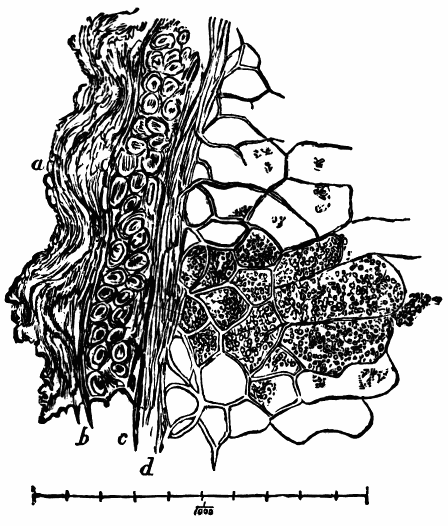
Fig. 1.
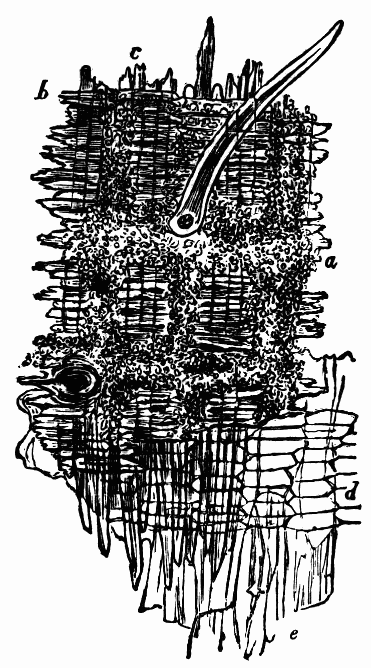
Fig. 2.
Microscopic appearance of Rice.
Fig. 1—Transverse section of the husk of rice.
Fig. 2.—Appearance of husk as seen in a transparent medium of glycerin and gum: a, Siliceous granules arranged in longitudinal and transverse ridges, perforated by openings—stomata, some having hairs over them. b c, Transverse and longitudinal, brittle, rough-edged fibres, d, A fine membrane of transverse angular cells; these overlie a very delicate membrane of large cells, e.
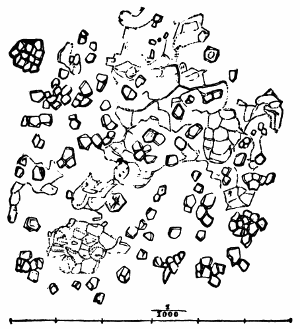
Microscopic appearance of ground rice-flour.
RICINO′LEIC ACID. A variety of oleic acid discovered in saponified castor oil.
RICK′ETS. Syn. Rachitis, L. A disease, generally confined to childhood, characterised by a large head, prominent forehead, protruded breast bone, flattened ribs, tumid belly, emaciated limbs, and great general debility. The bones, more particularly those of the spine and legs, become distorted, and exhibit a deficiency of earthy matter; the stools are frequent and loose, a slow fever succeeds, with cough, painful and difficult respiration, and, unless the child rallies, atrophy is confirmed, and death ensues. When recovery takes place there is always more or less deformity left.
The common causes of rickets are bad nursing, exposure to damp and cold, and insufficient nutrition, arising from the use of white bread containing alum, or any of the pernicious compounds vended under the names of ‘FARINACEOUS FOOD,’ ‘INFANTS’ F.,’ ‘PATENT F.,’ &c. Rickets, like caries of the bones, is a disease which is scarcely known amongst infants whose pap is made of pure wheaten bread, and whose mothers or nurses consume the same themselves.
The treatment of rickets depends more on proper domestic management than on direct medication. Careful nursing, warm dry clothing, thorough ventilation, moderate exercise, and, above all, a light nutritious mixed diet abounding in nitrogenous matter and the phosphates, will do much to effect a cure. To these may be added the administration of the milder chalybeate tonics, bark, or quinine, with occasional doses of some mild aperient, as phosphate of soda, or, when there is diarrhœa, of rhubarb or some other tonic purge. The administration of small doses of phosphate of lime or of dilute phosphoric acid, frequently repeated, or, still better, the daily use of jelly made of pure ivory or bone shavings, will often effect wonders in those cases in which the bones are implicated from an apparent deficiency of earthy matter. See Bread, Farina, Nursing, &c.
RING′WORM. Syn. Scald-head; Porrigo, L. The common ringworm, the PORRIGO SCUTULATA of medical writers, is a disease that appears in circular patches of little pustules, which afterwards form scabs, leaving a red pimply surface, and destroying the bulbs of the hair in its progress. It spreads rapidly, and is very infectious, often running through a whole school. It chiefly affects the neck, forehead, and scalp of weakly children, and frequently arises without any apparent cause, but, in general, may be traced to uncleanness, or contact with parties suffering from the disease.
The treatment of ringworm consists in shaving the part, and keeping it clean with soap and water, at the same time that an occasional mild saline aperient is administered, and a light, nutritious diet, of which the red meat and ripe fruits should form a portion, be rigorously adhered to. When the scabbing commences, dressings of tar ointment, or of the ointment of nitrate or red oxide of mercury, or a mixture of equal parts of the first and either the second or third, should be applied, in each case diluting the mixture with sufficient
RI′′PENING. See Brewing, Malt liquors, Wine, &c.
ROAST′ING. Alexis Soyer recommends, “as an invariable rule,” that “all dark meats, such as beef and mutton, should be put down to a sharp fire for at least fifteen minutes, until the outside has acquired a coating of osmazome, or condensed gravy, and then removed back, and allowed to cook gently. Lamb, veal, and pork, if young and tender, should be done at a moderate fire. Veal should even be covered with paper.
“Very rich meat, if covered with paper, does not require basting. Fowls, &c., should be placed close to the fire, to set the skin, and in about ten minutes rubbed over with a small piece of butter, pressed in a spoon. Meats, whilst roasting, should be dredged with flour, just at the time when the gravy begins to appear; the flour absorbs it, and forms a coating which prevents any more coming out. Hares and small game should be treated in the same manner.”
Under ordinary circumstances as to the fire, and the distance between it and the joint, beef, mutton, and veal, take about 1⁄4 hour per lb. in roasting. Lamb, poultry, and small game, require only 12 to 14 minutes per lb.; whilst veal takes fully 15 minutes, and pork takes from 1⁄4 hour to 20 minutes, as they must always be well done. The flesh of old animals requires more cooking than the flesh of young ones; and inferior, tough, and bony parts than the prime joints and pieces.
Roasting is not an economical method of cooking pieces of meat abounding in bone or tendinous matter, since the nutritious portion of these is either destroyed or rendered insoluble by the heat employed. Thus, the raw bones from a joint are capable of affording a rich and excellent basin of soup, highly nutritious; whilst the bones from a corresponding joint which has been roasted are nearly worthless when so treated. The same applies with even greater force to the gristly and tendinous portions. A dry heat either destroys them or converts them into a horny substance, unfit for food; whilst by boiling they are transformed into a highly succulent and nutritious article of food, besides affording excellent soup or jelly. Hence the policy of ‘boning’ meat before roasting or baking it; or, at all events, of removing the bony portion which would be most exposed to the action of the fire. See Bone and Jelly.
ROB. Syn. Roob. A term, derived from the Arabic, formerly applied to the inspissated juice of ripe fruit, mixed with honey or sugar to the consistence of a conserve of thin extract. Rob of elder-berries (ELDER ROB; ROOB SAMBUCI), juniper berries (JUNIPER ROB; ROOB JUNIPERI), mulberries (MULBERRY ROB; ROOB DIAMORUM), and walnuts (WALNUT ROB; ROOB DYACARYON), with a few others, are still found in some of the foreign Pharmacopœias.
ROCK. The popular name of a sweetmeat formed of sugar boiled to a candy, and then poured upon an oiled slab, and allowed to cool in the lump. It is variously flavoured.
ROCK CRYS′TAL. Native crystallised silica. See Quartz.
ROCK OIL. See Petroleum.
ROCK SOAP. A native silicate of alumina; used for crayons, and for washing cloth.
ROC′KETS. (In pyrotechny.) Prep. The CASES.—These are made of stout cartridge paper, rolled on a mould and pasted, and then throttled a little below the mouth, like the neck of a phial. The diameter should be exactly equal to that of a leaden ball of the same weight, and the length should be equal to 31⁄2 times the external diameter. Above the spindle there must be one interior diameter of composition driven solid. They are filled with the following mixtures, tightly driven in, and when intended for flight (SKY-ROCKETS), they are ‘garnished,’ and affixed to willow rods to direct their course.
The COMPOSITION.—1. (Marsh.)—a. For 2-oz. rockets. From nitre, 541⁄2 parts; sulphur, 18 parts; charcoal, 271⁄4 parts; all in fine powder, and passed through lawn.
b. For 4-oz. do. From nitre, 64 parts; sulphur, 16 parts; charcoal, 20 parts; as the last.
c. For 1⁄2-lb. to 1-lb. do. From nitre, 623⁄4 parts; sulphur, 153⁄4 parts; charcoal, 211⁄2 parts.
2. (Ruggieri.)—a. For rockets of 3⁄4-inch diameter. From nitre, 16 parts; charcoal, 7 parts; sulphur, 4 parts.
b. For 3⁄4- to 11⁄2-inch rockets, use 1 part more of nitre.
c. For 13⁄4-inch rockets, use 2 parts more of nitre.
d. By using 1 part less of charcoal and adding respectively 3, 4, and 5 parts of fine steel filings, the above are converted into ‘Brilliant fires,’
e. By the substitution of coarse cast-iron borings for filings, and a further omission of 2 parts of charcoal from each, the latter are converted into ‘Chinese fire,’
Hand-rockets and GROUND-ROCKETS are usually loaded with nothing but very fine meal gunpowder and iron or zinc filings or borings.
After SKY-ROCKETS and WATER-ROCKETS are charged, a piece of clay is driven in, through which a hole is pierced, and the ‘head’ or ‘garniture’ filled with stars, and a little corn-powder is then applied. See Fires, Stars, and Pyrotechny.
ROLLS. A variety of fancy bread, generally in the form of small semi-cylindrical cakes,
ROLL (Wine). Prep. Soak a French roll or sponge-biscuit in raisin, marsala, or sherry wine, surround it by a custard or cream thickened with eggs, and add some spice and ornaments.
ROOT. Syn. Radix, L. That part of a plant which imbibes its nourishment from the soil or medium in which it grows. In popular language, bulbs, corms, tubers, &c., are improperly included under this term.
RO′′PINESS. See Malt liquors and Wines.
RHYPOPH′AGON. Prep. From yellow soap, sliced, 1 oz.; soft soap (finest), 3 oz.; melt them by the heat of hot water, then allow them to cool a little, and stir in of oil of cloves, 1⁄2 dr.; essence of ambergris, 10 drops. It is kept a month before sale. Used for shaving.
ROSE. Syn. Rosa, L. The typical genus of the natural order Rosaceæ. It includes numerous species greatly prized as garden plants.
Rose, Cabbage. Syn. Hundred-leaved rose; Rosæ centilfoliæ petala (B. P.), Rosa centifolia (Ph. L. & E.), L. “The fresh petals” (Ph. L.) of this species are used in medicine. Odorous and slightly astringent and laxative. See Waters and Syrup.
Rose, Dog. The Rosa canina, or wild briar. See Hips.
Rose, French. Syn. Red rose; Rosæ gallicæ petala (B. P.), Rosa Gallica (Ph. L. E. & D.), L. “The fresh and dried unexpanded petals” (Ph. L.) of this species are officinal. The white claws of the petals are removed before drying them.
Uses, &c. The red rose is an elegant astringent and tonic, and, as such, is used as the basis of several pharmaceutical preparations. See Confection, Honeys, Infusion, and Syrup.
ROSE′MARY. Syn. Rosmarinus (Ph. L. E. & D.) The flowering tops of Rosmarinus officinalis (Linn.), or the common rosemary of our gardens, are officinal in the Ph. E. & D.; as is also the oil (oleum rosmarini) in the B. P. and Ph. L. The odour of both is refreshing, and they are reputed carminative, emmenagogue, and neurotic. The dried leaves are occasionally used by the hysterical and hypochondriacal as a substitute for China tea. The oil is an ingredient in Hungary water, and is much used in various cosmetic compounds, under the presumption of its encouraging the growth of hair and improving its quality.
ROSE PINK. See Red pigments.
RO′SIN. See Resin.
ROSY-DROP. See Acne.
ROT. Syn. Greatrot, Hydrophic r.,
Sheep r., Wet r. A disease peculiar to sheep, produced by the presence in the liver of the Distoma hepatica, a parasite commonly known under the name of “a fluke.” Rot prevails during very wet or rainy seasons. The leading symptoms are loss of flesh and vivacity; the lips and tongue look vivid, and the eyes sad and glassy; the pelt comes off on the slightest pull; the breath is fetid, and the urine highly coloured and scanty; and there is either black purging or obstinate costiveness. The treatment consists in a change to a dry warm elevated situation, and a dry diet, consisting of oats, barley meal, tail-wheat, &c., to which some turnips, carrots, or mangel wurzel may be added, with a liberal supply of common salt, and a few grains of sulphur, daily. These last two substances form the active ingredients in Flesh’s ‘Patent Restorative.’ See Meat, Disease of.
ROT (in Timber). See Dry rot.
ROTA′TION (of Crops). The rotation or succession of crops is absolutely necessary for the successful and economical cultivation of the soils. Crops have been divided by agriculturists into exhausting crops, restoring crops, and cleaning crops. The most exhausting crops are usually considered to be those of corn, but all those that are allowed to ripen their seed and which are carried off the ground are also exhausting, but in different degrees. Even clover, tares, and grass cut green are considered as exhausting, but in a less degree than those that are allowed to ripen. Restoring crops are such as are allowed to decay upon the ground, or are consumed upon it by domestic animals. Cleaning crops are such as are grown in drills, and undergo the usual operations of weeding, hoeing, &c.; the majority of these may also be regarded as exhausting crops. An exhausting crop should always be followed by a restoring or a cleaning crop; or, where possible, by both combined. Crops should also succeed each other in such a way that the soil may not be exhausted of any one particular kind of nutriment. This is best effected by so rotating the crops that plants which are nearly allied should not succeed each other on the same soil, or, at all events, not more than once. See Agriculture, Soils, &c.
ROT′TEN STONE. See Tripoli.
ROUGE. Syn. Toilet rouge; Rouge vegetal, Rouge d’Espagne, Fr. Prep. Wash safflower (any quantity) until the water comes off colourless; dry and pulverise it, and digest the powder in a weak solution of crystallised carbonate of soda; then place some fine cotton-wool at the bottom of a porcelain or glass vessel, pour the filtered tinctorial solution on this, and throw down the colouring matter, by gradually adding lemon juice or white-wine vinegar, until it ceases to produce a precipitate; next wash the prepared cotton in pure cold water, and dissolve out the colour with a fresh solution of soda; to the new
Obs. According to the best authorities, this is the only article which will brighten a lady’s complexion without injuring the skin. The relative fineness and proportion of talc employed determines the quality of the rouge. It is applied by means of a camel-hair pencil, a small ‘powder puff,’ or a hare’s foot. It is also employed under the form of ‘pommade’ and ‘crepons.’ The last of these consist of pieces of white woollen crape, upon which the colouring matter of the carthamus has been precipitated, instead of upon the talc, noticed above.
The following articles also pass under the name of rouge, and are used for the purposes named after each:—
Rouge, Brown-red. Jeweller’s rouge.
Rouge, Chinese Card. This is said to be a ‘carthamate of soda,’ it is colourless when applied, but, being decomposed by the acid secretions of the skin, acquires a most beautiful rose-like tint. (O’Shaughnessy.)
Rouge, Jeweller’s. Sesquioxide of iron prepared by calcination. Used to polish gold, &c.
Rouge, Liquid. The red liquid left from the preparation of carmine; or a solution of carmine in weak carbonate of potash water, or of pure rouge in alcohol acidulated with acetic acid.
Rouge, Indienne. The terra persica, or Indian red; imported from Ormuz.
Rouge de Prusse. Light red or burnt yellow ochre. See Red pigments.
Rouge, Spanish Lady’s. This is cotton wool which has been repeatedly wetted with an ammoniacal solution of carmine, and dried. It is applied like ‘rouge crepons.’
Rouge d’Athenes, Vert. Syn. Pure rouge. See Carthamine.
ROUGH′ENING. See Wines.
RUBEFA′′CIENTS. Syn. Rubefacientia, L. Substances or agents which, when applied for a certain time to the skin, occasion a redness and increase of heat, without blistering. They act as counter-irritants. Mustard, powdered ginger (both made into a paste with water), hartshorn and oil, and ether and spirit of wine (when their evaporation is prevented), are familiar examples of this class of remedies.
RUBE′OLA. See Measles.
RUBIA′CIN. An orange-coloured substance, obtained from madder.
RUBID′IUM. [Eng., L.] A metal belonging to the alkaline group discovered by Bunsen and Kirchhoff by means of spectrum analysis. It is found in many mineral waters associated with cæsium.
RU′BY. See Gems and Pastes.
RUE. Syn. Rutæ folia, Ruta (Ph. L. & E.), L. “The leaf Ruta graveolens.” (Ph. L.) A powerful antispasmodic, diuretic, and stimulant. It is also reputed nervine and emmenagogue. The fresh leaves are powerfully acrid, and even vesicant; but they become milder in drying.—Dose. Of the powder, 15 to 30 gr., twice or thrice daily; in hysteria, flatulent colic, &c. See Infusion and Oils (Volatile).
RUM. Syn. Spiritus Jamaciensis, Spiritus sacchari, L. An ardent spirit obtained by distillation from the fermented skimmings of the sugar-boilers (syrup scum), the drainings of the sugar-pots and hogsheads (molasses), the washings of the boilers and other vessels, together with sufficient recent cane juice or wort, prepared by mashing the crushed cane, to impart the necessary flavour. The sweet liquor before fermentation commonly contains from 12 to 16% of saccharine, and every ten gallons yield from one to two gallons of rum.
The average strength of rum, as imported into this country, is about 20 O.P. Like all other spirits, it is colourless when it issues from the still, but owing to the taste of the consumer the distiller is compelled to colour it before it leaves his premises.
Obs. Rum is imported from the West Indies. The best comes from Jamaica, and is hence distinguished by that name. Leeward Island rum is less esteemed. The duty on rum is 10s. 2d. per proof-gallon if imported direct from any of the British Colonies (Colonial rum), but 10s. 5d. if from any other part of the world (foreign rum). The consumption of rum has long been declining in England; its place being chiefly supplied by gin. Rum owes its flavour to a volatile oil and butyric acid, a fact which the wary chemist has availed himself of in the manufacture of a butyric compound (essence of rum) for the especial purpose of enabling the spirit dealer to manufacture a factitious rum from malt or molasses spirit. In Jamaica it is usual to put sliced pine apples into the puncheons containing the finer qualities of rum, which is then termed pine-apple rum. See Alcohol, Spirit, &c.
RUM, BAY, R. Rother’s Formula for. According to an American authority, true bay rum is made from Pimenta acris (Myrica acris, Schwartz; Myrtus acris, Willd.), and not from Laurus nobilis, as commonly supposed; the method of its distillation not being known outside the West Indies, it has been customary to make it extemporaneously with the oil of bay distilled from the leaves of the former plant. This preparation is inferior in fragrance, however, to the genuine article. The following formula of R. Rother is said to give very good results. Take of oil of bayberry, 1 fl. oz.; Jamaica rum, 1 pint; strong alcohol, 4 pints; water, 3
RUPERT’S DROPS. These are made by letting drops of melted glass fall into cold water. By this means they assume an oval form, with a tail or neck resembling a retort. They possess this singular property that, if a small portion of the tail is broken off, the whole bursts into powder with an explosion, and a considerable shock is communicated to the hand.
RUPIA. This is an affection of the skin attended by the formation on it of vesicles, that develop into ulcers which copiously discharge a foul, unhealthy, and reddish matter. After a time this matter hardens and forms a thick incrustation over the sores.
The best treatment is to put the patient upon a generous diet, including wine, and to administer iodide of potassium with sarsaparilla or quinine. The scabs should be poulticed.
RUP′TURE. See Surgery.
RUSKS. Prep. From 4 eggs; new milk and warm water, of each 1⁄2 pint; melted butter and sugar, of each 1⁄4 lb.; yeast, 3 table-spoonfuls; beat well together with as much flour, added gradually, as will make a very light paste; let it rise before the fire for half an hour, then add a little more flour, form into small loaves or cakes 5 or 6 inches wide, and flatten them; bake these moderately, and, when cold, cut them into slices of the size of rusks, and put them into the oven to brown a little. A nice tea-cake when hot, or with caraways, to eat cold. Plain rusks are made by simply cutting loaves of bread into slices, and baking them in a slow oven to the proper colour.
RUS′MA. An arsenical iron pyrites, found in Galatia, which, when reduced to powder, and mixed with half its weight of quicklime, is used by the Turkish ladies to make their ‘PSILOTHRONS,’ or compounds to remove superfluous hair. See Depilatory.
RUST. Syn. Rubigo, L. The coating or film of oxide or carbonate which forms on the surface of several of the metals when exposed to a moist atmosphere; more particularly, that which forms on iron or steel (FERRI HYDRATE; HYDRATED SESQUIOXIDE OF IRON; FERRUGO, FERRI RUBIGO).
To prevent iron or steel goods rusting, it is merely necessary to preserve them from damp or moisture. In the shops, small articles in steel are, commonly, either varnished or enclosed in quick-lime finely pulverised; large articles are generally protected with a coating of plumbago, or of boiled oil, or some cheap varnish, applied to them, previously gently heated. Surgical instruments are frequently slightly smeared with a little strong mercurial ointment, with the same intention.
Spots of rust may be removed from the surface of polished iron or steel by rubbing them with a little tripoli or very fine emery made into a paste with sweet oil; or, chemically, by a mixture of polisher’s putty-powder with a little oxalic acid, applied with water. When the last is employed, the articles should be afterwards well rinsed in pure water, then wiped dry, and finished off with a warm and dry rubber, in order to remove every trace of acid.
RUTHENIC ACID. Syn. Ruthenic anhydride (RuO3). This may be procured by heating any of the preceding oxides with potassic nitrate. Ruthenic acid is insoluble in water.
Ruthenic Sesquioxide (Ru2O3); occurs in the anhydrous form when the metal is ignited in a current of air. It is the most stable of the basic oxides of the metal. Alkalies fail to dissolve it. With acids it forms soluble salts of a yellow colour; when, to a solution of these, an alkali is added, a bulky blackish-brown precipitate of the hydrated oxide, having the composition Ru2O3,8H2O, is thrown down.
There are three chlorides of ruthenium:—RuCl2; RuCl3; and RuCl4.
RUTHEN′IUM. (Ru. = 104·2.) A metal discovered by Claus, associated with iridium, in the residue from crude platinum, which is insoluble in aqua regia. It forms small angular masses, with a metallic lustre; is very brittle and infusible; resists the action of acids, but readily oxidises when heated in the air. Sp. gr. 11 to 11·4.
In Fremy’s process for separating osmium from the residues of platinum ore, ruthenium occurs in a dioxide. By heating this dioxide in a current of oxygen, the metal may be obtained in the form of a powder of dark grey colour.
With oxygen, ruthenium forms four compounds:—RuO; Ru2O3; RuO2; and RuO3.
Ruthenium Trichloride (RuCl3), which is the most important of the chlorides, may be procured by dissolving the sesquioxide in hydrochloric acid. The solution being evaporated, the trichloride occurs as a greenish-blue deliquescent mass, which is soluble in alcohol.
Tests. In solutions of the trichloride, hydrogen sulphide gives a brown precipitate of ruthenic sesquisulphide, the supernatant liquid being of a bright blue colour. This reaction is a very delicate as well as a very characteristic one.
Metallic zinc reduces the yellow trichloride to the blue dichloride, the metal being afterwards precipitated as a black powder. Plumbic acetate gives a purplish-red precipitate, mercuric cyanide a blue one, the supernatant liquid being also blue. The caustic and carbonated alkalies throw down a black precipitate of sesquioxide of ruthenium, which is insoluble in excess of the precipitant. If the salts of ruthenium are boiled with sodic formiate or oxalate the solution becomes colourless, but no precipitate of reduced metal takes place.
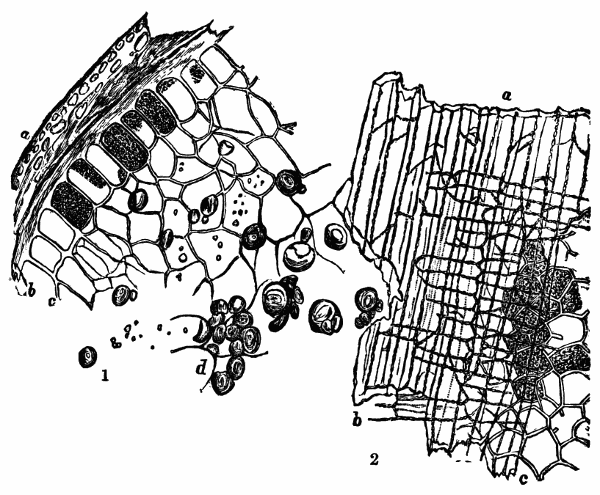
Fig. 1.—Transverse section of testa, &c. × 108.
Fig. 2.—Coats in situ from without, × 170. a, External; b, Middle; c, Internal coat; d, Starch grains, × 108.
RYE. Syn. Secale, L. The seed of Secale cereale, a gramineous plant, the native country of which is undetermined. It is a more certain crop and requires less culture and manure than wheat, and is hence largely cultivated in Germany, Russia, and in the northern parts of Europe, where it is extensively employed for bread. When roasted it is occasionally used as a substitute for coffee. It furnishes an excellent malt for the distillation of spirit, and is much used in the making of Hollands.
Rye bread is very likely to cause diarrhœa in those unaccustomed to partake of it. By continued use, however, this inconvenience disappears. Rye bread is acid and dark in colour. It is about equal in nutritive power to wheat. It is less abundant than wheat in fibrin, but richer in casein and albumen.
The foregoing plate represents the microscopic appearance of rye.
Sommer recommends the microscopic examination of rye flour to be conducted as follows:—The flour is placed on a glass slide, and moistened with water; a single drop of oil of vitriol is added, and a small disc is laid upon it. If, now, it be viewed with a magnifying power of 200, the starch grains of wheat and rye are seen to dissolve in a uniform manner, but the grains of barley starch, after losing their external coat, break up into a number of polyhedrons before their solution is completed.
Rye, Spurred. See Ergot.
SABADIL′LA. Syn. Cebadilla, Cevadilla, Sabadilla (B. P., Ph. E.), L. The dried fruit (Asagræa officinalis). A drastic and dangerous cathartic, occasionally used in tapeworm; and, externally, to destroy pediculi, but, even for this purpose, when the scalp has been denuded or ulcerated, it has sometimes caused death. It is now used chiefly as a source of VERATRINE.
SA′BLE. The Mustella Zibellina (Linn.), a small quadruped of the martin-cat family, found in Northern Asia. Its fur is remarkable for its fine quality and rich colour, and for the hairs turning with equal ease in every direction. The skins of the rabbit, cat, &c., dressed, painted, and lustred, are sold under the name of COMMON or MOCK SABLE.
SABOTIÈRE. [Fr.] An apparatus of peculiar construction, employed by the French confectioners for making ices. It consists of a pail to contain a freezing mixture, and an inner vessel for the creams to be iced. It may be used with a mixture of pounded ice and salt, or any other freezing mixture. The pail and cream vessels being loaded, and closely covered, an alternate rotatory motion is given to the apparatus by means of the handle, for 10 or 15 minutes, care being taken to occasionally scrape down the frozen portion of the cream from the sides, by means of a wooden spoon. See Ices and Refrigeration.
SACCHAR′IC ACID. Syn. Oxalhydric ACID†. A compound, resulting from the action of dilate nitric acid on sugar.
SAC′CHARINE. The technical name of the uncrystallisable sugar found in malt-wort.
SACCHARINE FERMENTATION. This occurs during the germination and kiln-drying of grain in the operation of malting, and in the mashing of malt in brewing. The sweetening of bread during its exposure to heat in the oven is also included under this head by many writers.
The substance which most powerfully excites the sugar fermentation was first shown by Payen and Persoz to be a peculiar principle to which they have given the name of ‘DIASTASE,’ This is always present in good malt, and possesses the singular property of converting STARCH successively into gum (dextrin) and sugar, at a temperature ranging between 149° and 168° Fahr. During the action of this substance on starch it is itself decomposed; and when the sugar fermentation ceases it is found to have entirely disappeared. It is the presence of diastase in malt which alone converts the starch of the grain into sugar during the operation of mashing with hot water; and hence the absolute necessity of employing water at the proper temperature, as on this depends the strength and sweetness of the wort, and consequently its fitness for undergoing the vinous fermentation, and for making beer. Vegetable albumen and gluten also possess the property of exciting the saccharine fermentation, but in a considerably inferior degree to diastase.
The sugar formed during the germination of seeds containing starch results from the action of diastase, and disappears as soon as the woody fibre (lignin), which has a similar constitution, is developed, forming the skeleton of the young plant. (Liebig.) See Brewing, Diastase, Dextrin, &c.
SACCHAROM′ETER. An instrument similar in principle to the common spirit hydrometer, but so weighted and graduated as to adapt it for the indication of the richness of malt-worts in sugar, or saccharine, expressed in pounds per barrel, or the excess of gravity over that of water, the last being taken at 1000. See Brewing, Syrup, Wort, &c.
SACH′ET. Syn. Sacculus, L. Sachets (SACCULI) are little bags containing dry substances, used for the external medication of parts, or for communicating agreeable perfumes to wearing apparel, drawers, furniture, &c. Those belonging to perfumery are commonly filled with mixtures of fragrant vegetable substances, reduced to coarse powder, and differ from those employed for pot pourri chiefly in being used in the dry state. Sacculi are now seldom employed in this country in legitimate medicine. See Powders (Scented), &c.
Sachet, Ammoniacal. Syn. Sacculus ammoniacalis. Prep. Equal parts of sal ammoniac and quicklime are mixed, and sprinkled between cotton wadding, which is to be quilted in muslin.
Sachet, Anodyne. (Quincy.) Syn. Sacculus anodynus. Prep. Chamomiles, 1 oz.; bay berries, 1 oz.; lavender flower, 1⁄2 oz.; henbane seed, 1 dr.; opium, 1 dr. To be dipped in hot spirits.
Sachet, Anti-phthisic. Syn. Sacculus anti-phthisicus, L. Prep. Dissolve of aloes, 1 oz., in strong decoction of fresh rue, 1⁄2 pint; next fold a piece of soft muslin in eight folds large enough to cover the chest and part of the stomach; steep this in the decoction, and dry it in the shade; lastly, place in a small bag, one side of which is formed of scarlet silk or wool, and the other, intended to be worn next the skin, of the finest net or gauze. A celebrated domestic remedy for consumption and asthma. It is intended to be constantly worn on the chest.
Sachet, Resolv′ent. Syn. Melting bag; Sacculus resolvens, L. Prep. 1. (Dr Breslau.) Iodide of potassium, 1 part; sal ammoniac, 8 parts; dry, and reduce each separately to fine powder; mix them, and enclose 1⁄2 oz. to 1 oz. of the mixed powder in a small bag of linen or silk. Used as a resolvent to indolent tumours, especially goitres and scrofulous indurations. It should be worn on the part night and day for some time. The part next the skin should be well pricked with a needle, and the powder shaken up and readjusted every 2 or 3 days; and it should be renewed about once a fortnight.
2. (Trousseau & Reveil.) Iodide of potassium, 1 part; burnt sponge, 4 parts; fine sawdust, 5 parts; as before.
Sachet, Sponge. Syn. Sacculus spongii, Collier de Morand. Prep. Muriate of ammonia, chloride of sodium, burnt sponge, of each 1 oz.; mix, sprinkle the powder on a piece of cotton wool, and quilt between muslin, in the form of a cravat. To be worn constantly in goitre or bronchocele, renewing it every month.
Sachet, Stomachic. (Fuller.) Syn. Sacculus. Prep. Mint, 4 drm.; wormwood, thyme, red roses, each 2 drm.; balastines, angelica root, caraway seed, nutmeg, mace, cloves, of each 1 drm. Coarsely powder the ingredients, and put them into a bag, to be moistened with hot red wine when applied for flatulence.
SACK. (From SEC, Fr., dry.) A wine used by our ancestors, supposed by some to have been Rhenish or Canary; but, with more probability, by others, to have been dry mountain—vin d’Espagne; vin sec—(Howell, ‘Fr. and Eng. Dict.,’ 1650). Falstaff[140] calls it ‘sherris sack’ (sherry sack), from Xeres, a sea town of Corduba, where that kind of sack (wine) is made. (Blount.) At a later
SAF′FLOWER. Syn. Bastard saffron, Dyer’s s.; Carthamus, L. The florets of Carthamus tinctorius, a plant cultivated in Spain, Egypt, and the Levant. It contains two colouring principles—the one yellow, and the other red. The first is removed by water, and is rejected. The second is easily dissolved out by weak solutions of the carbonated alkalies, and is again precipitated on the addition of an acid. This property is taken advantage of in the manufacture of rouge, and in dyeing silk and cotton.
The most lively tints of cherry, flame, flesh, orange-red, poppy, and rose colour, are imparted to silk by the following process, modified to suit the particular shade required:—The safflower (previously deprived of its yellow colouring matter by water) is exhausted with water containing either carbonate of soda or of potassa, in the proportion of about 5% of the weight of the prepared dye-stuff acted on; the resulting liquid is next treated with pure lemon juice until it acquires a distinct and rich red colour; the silk is then introduced and turned about as long as it is perceived to take up colour, a little more lemon juice being added as may appear necessary; for deep shades this is repeated with one or more fresh baths, the silk being dried and rinsed between each immersion; it is, lastly, brightened by turning it for a few minutes through a bath of warm water, to which a little lemon juice has been previously added. For flame colour the silk should receive a slight shade with annotta before putting it into the safflower bath. For the deeper shades, when expense is an object, a little archil is commonly added to the first and second bath. See Catharmin.
SAF′FRON. The prepared stigmata or stigmas of the Crocus sativus, or saffron crocus. There are two principal varieties known in commerce:—
1. (Saffron, Hay’s.; Crocus in fœno, C. Hispaniolus, Crocistigmata; Crocus—B. P., Ph. L., E., & D.) This consisted of the stigmas, with part of the styles, carefully picked from the other parts of the flowers, and then dried on paper by a very gentle heat, generally in a portable oven constructed for the purpose.
2. (Cake saffron; Crocus in placentâ.) This, professedly, merely varies from the last, it being compressed into a cake after it has become softened by the fire, and being then dried in that condition. The ‘cake saffron’ of commerce is now, however, mostly, if not entirely, composed of safflower made into a paste with some sugar and gum water, rolled out on paper into oval cakes 10 to 12 inches long, 9 or 10 broad, and about 1⁄8th of an inch thick, and then dried. “I can detect neither saffron nor marigold in them.” (Dr Pereira.)
Pur. Saffron, of all the articles of commerce, except French brandy, is, perhaps, the one most largely and constantly adulterated. Abroad it is frequently mixed with safflower, and in England with ‘prepared marigolds,’ or ‘French (mock) saffron.’ These frauds may be detected by the inferiority of the colour, and by soaking the leaves in water, when the stigmas of the Crocus sativus may be readily distinguished from the florets of safflower and the petals of marigolds. Winckler and Grüner proposed to detect these substances by means of a solution of nitrate of silver or of sesquichloride of iron. The infusion of true saffron is not altered by those reagents, but that of either of the above-mentioned adulterants is rendered opaque, and is at length precipitated. “It consists of tripartite filaments, of an orange-red colour, with the small filaments towards the apex dilated.” (Ph. E.) In the wholesale drug trade prepared marigolds are not only employed to mix with genuine saffron, but are extensively sold to the country dealers for that purpose. Old and dry saffron is ‘freshened up’ by rubbing it between the hands slightly oiled, and then repicking it.
The late Mr D. Hanbury, F.R.S., found that the article known in commerce as alicante saffron was largely sophisticated with carbonate of lime, which he says had been made to adhere to the thread-like saffron without in the least altering its general appearance. To ascertain the amount of earthy matter thus fraudulently added, he subjected several specimens of saffron to incineration, each having in the first instance been dried in warm air until it caused it to lose its weight. The result indicated that while good Valentia saffron yields from 4 to 6 per cent. of ash, the alicante furnishes from 12 to 28 per cent. The method of taking a sample of saffron for earthy adulteration which Mr Hanbury recommends is this:—Place in a watch glass a small quantity (say 1 grain) of the saffron, and drop upon it 8 or 10 drops of water; lightly touch the saffron with the tip of the finger, so as to cause the water to wet it. If the drug is free from earthy matter, a clear bright-yellow solution will be immediately obtained; if adulterated, a white powder will instantly separate, causing the water to appear turbid; and if a drop of hydrochloric acid be now added, a brisk effervescence will take place.