A CYCLOPÆDIA OF PRACTICAL RECEIPTS, &c. VOLUME II (continued 21)
Reading edition
Phosphorus, Suboxide of. P4O. (Odling.) A reddish-brown powder, formed when a stream of oxygen is forced upon phosphorus, melted beneath the surface of hot water. To purify it from phosphoric acid and free phosphorus, it is washed on a filter with water, then dried by bibulous paper, and finally digested with bisulphide of carbon.
Hypophosphorous Acid. H3PO2. By cautiously decomposing a solution of hypophosphite of barium with sulphuric acid, filtering from the precipitate (sulphate of baryta), and evaporating. Dissolve hypophosphite of calcium, 480 gr. in distilled water, 6 fl. oz.; dissolve crystallised oxalic acid, 350 gr., in another portion of distilled water, 3 fl. oz.; mix the solutions and filter the mixture through white filtering paper. Add distilled water carefully to the filtrate till it measures 10 fl. oz., and evaporate this to 81⁄2 fl. oz. The solution thus prepared contains about 10% of terhydrated hypophosphorous acid.
Prop. A viscid, uncrystallisable liquid having a strongly acid reaction. It is a powerful drying agent, and forms salts called hypophosphites.
Ammonium, Hypophosphite of. (NH4)3PO2. Prep. Dissolve hypophosphite of calcium, 6 oz., in water, 4 pints; and dissolve translucent sesquicarbonate of ammonium, 7·23 oz. (barely 71⁄4), in water, 2 pints; mix the solutions; filter, washing out the solution retained by the carbonate of lime with water, q. s.; evaporate the filtrate to dryness with great care; dissolve it in alcohol, q. s.; filter, evaporate, and crystallise. Very soluble in both alcohol and water.
Barium, Hyperphosphite of. Ba3(PO4)2. Prep. Boil phosphorus in a solution of hydrate of barium (baryta water) till all the phosphorus disappears and the vapours have no longer a garlic odour. Filter, evaporate, and set aside to crystallise.
Calcium, Hypophosphite of. Ca3(PO2)2.
Prep. Slack recently burnt lime, 4 lbs., with water, 1 gall., and mix it with water, 4 galls., just brought to the boiling temperature in a deep open boiler, stirring until a uniform milk of lime is formed; then add phosphorus, 1 lb., and keep up the boiling constantly, adding hot water from time to time, so as to preserve the measure as nearly as may be until all the phosphorus is oxidised and combined, and the strong odour of the gas has disappeared; then filter the solution through muslin, wash out that portion retained by the calcareous residue with water, and evaporate the filtrate till reduced to 6 pints; re-filter, to remove a portion of carbonate of calcium resulting from the action of the air upon the solution; evaporate again until a pellicle forms, and set aside to crystallise—or continue the heat with constant stirring until the salt granulates.
Obs. As spontaneously inflammable phosphuretted hydrogen is given off during the boiling, the process must be conducted under
Prop. Hypophosphite of calcium is a white salt, with pearly lustre, crystallising in flattened prisms; soluble in 6 parts of cold water, and slightly soluble in dilute alcohol. It is the most important of these compounds, and when introduced into the stomach it is supposed to be converted into phosphate of calcium. It has been termed ‘chemical food.’ By decomposition it readily furnishes the other hypophosphites.
Ferric, Hyperphosphite of. FePO2. Prep. By precipitating a solution of hypophosphite of sodium or ammonium, with solution of ferric sulphate, washing the gelatinous precipitate with care (it being somewhat soluble); and, finally, drying it into an amorphous white powder. This is freely soluble in hydrochloric and hypophosphorous acids.
Potassium, Hypophosphite of. K3PO2. Prep. From hypophosphite of calcium, 6 oz., dissolved in water, 4 pints; and granulated carbonate of potassium, 53⁄4 oz., dissolved in water, 1⁄2 pint. Mix, filter, and wash the precipitate till the filtrate measures 5 pints. Evaporate till a pellicle forms, then stir constantly, continuing the heat till the salt granulates. A white, opaque, deliquescent body, very soluble in water and alcohol.
Quinine, Hypophosphite of. Dissolve sulphate of quinine, 1 oz., in water, by the aid of diluted sulphuric acid; precipitate the alkaloid with ammonia; wash the precipitated quinine and digest it in hypophosphorous acid with heat (the quinine being in excess); after filtering the solution, allow it to evaporate spontaneously till the required salt crystallises. It forms elegant tufts of soft, feathery crystals, which are soluble in 60 parts of water.
Sodium, Hypophosphite of. Na3PO2. Prep. From hypophosphite of calcium, 6 oz., dissolved in water, 4 pints; and crystallised carbonate of sodium, 10 oz., dissolved in water, 11⁄2 pint. Proceed as in making hypophosphite of potassium, but allowing 6 pints as the measure of the filtrate. If required in crystals, the granulated salt may be dissolved in alcohol sp. gr. ·835, evaporated till syrupy, and set by in a warm place. Crystallises in rectangular tables, with a pearly lustre; is very soluble in water and ordinary alcohol, and deliquesces when exposed to the air.
Phosphorus, Trioxide of. P2O3. Syn. Phosphorous anhydride; Anhydrous phosphoric acid.
Prep. By burning phosphorus in a limited supply of air. White flaky powder, with an odour of garlic, and rapidly absorbing water to form phosphorous acid.
Phosphorous Acid. H3PO3. Syn. Hydrated phosphorous acid. Pure phosphorus is volatilised through a layer of powdered mercuric chloride, contained in a glass tube; terchloride of phosphorus comes over, which, on being mixed with water, is resolved into hydrochloric acid and phosphorous acid; by evaporating the mixed liquid to the consistence of a syrup, the first is expelled, and the residuum forms a crystalline mass of hydrated phosphorous acid on cooling.
Prop., &c. It is a powerful deoxidising agent. Heated in a closed vessel, it is resolved into hydrated phosphoric acid and pure phosphuretted hydrogen gas. With the bases it forms salts, called phosphites, which possess little practical importance.
Phosphorous Pentoxide Acid. P2O5. Syn. Anhydrous phosphoric acid; Phosphoric anhydride; Phosphoric oxide. By the vivid combustion of phosphorus in a stream of dry atmospheric air, or under a bell-jar, copiously supplied with dry air. The product is pure anhydrous phosphoric acid under the form of snow-like flakes. It must be immediately collected and put into a warm, dry, well-stoppered bottle. In this state it exhibits an intense attraction for water, and when thrown into it combines with explosive violence; exposed to moist air for only a few seconds, it deliquesces to a syrupy-looking liquid.
Phosphoric Acid. There are three distinct acids usually grouped under this head, namely, Metaphosphoric acid, HPO3; Pyrophosphoric acid, H4P4O7; and Orthophosphoric acid, H3PO4.
Metaphosphoric Acid. HPO3. Syn. Monobasic phosphoric acid; Glacial phosphoric acid.
Prep. Bones (calcined to whiteness and powdered), 3 parts, are digested for several days in oil of vitriol, 2 parts, previously diluted with water, 6 parts, the mixture being frequently stirred during the time; a large quantity of water is next added, the whole thrown in a strainer, and the residual matter washed with some hot water; the mixed liquors are then precipitated with a solution of carbonate of ammonium, in slight excess, filtered from the insoluble, finally ignited in a platinum crucible.
By acting upon the anhydride with cold water.
When phosphoric acid is added to a strong solution of phosphate of zirconium, and the mixture, after concentration, is exposed to a low temperature, prismatic crystals are deposited. These, after being strongly heated to expel their basic water, are pure metaphosphate of sodium. From the solution of this salt in cold water, a solution of pure metaphosphoric acid may be obtained, as above, by means of nitrate or acetate of lead and sulphuretted hydrogen.
Obs. This acid precipitates the salts of silver white, and is distinguished from the other modifications of phosphoric acid by the property which its solution possesses of coagulating albumen.
Pyrophosphoric Acid. H4P2O7. Syn. Dibasic phosphoric acid. By strongly heating common orthophosphate of sodium. The water of crystallisation only is at first expelled, and the salt becomes anhydrous; but as the temperature reaches that of redness the salt loses water and is decomposed. By solution of the altered salt in water, crystals of pyrophosphate of sodium may be obtained. A solution of this last compound, treated with nitrate of lead, and the resulting precipitate, suspended in cold water, and decomposed by sulphuretted hydrogen, yields a solution of pure pyrophosphoric acid.
Obs. Heat resolves this into a solution of the ordinary acid. Pyrophosphoric acid precipitates the salts of silver of a white colour. The salts of this acid are called pyrophosphates.
Orthophosphoric Acid. H3PO4. Syn. Trihydric phosphate, Tribasic phosphoric acid. Ordinary nitric acid is heated in a tubulated retort connected with a receiver, and small fragments of phosphorus are dropped into it, singly and at intervals; as soon as the oxygenation of the phosphorus is complete, the heat is increased, the undecomposed acid distilled off, and the residuum evaporated to the consistence of a syrup. In this state it forms the phosphoric acid of the shops. Commercial phosphate of sodium is dissolved in water and the solution precipitated with another of acetate of lead; an abundant white precipitate (phosphate of lead) falls; this is collected on a filter, well washed, and, whilst still moist, is suspended in distilled water, and sulphuretted hydrogen gas passed into it, in excess; a black insoluble precipitate forms, while pure tribasic phosphoric acid remains in solution, and is easily deprived of the residual sulphuretted hydrogen by a gentle heat. By concentration in vacuo over sulphuric acid, it may be obtained in thin crystalline plates.
The solution of this acid may be boiled without change, but when concentrated and heated to about 400° Fahr. it is converted into pyrophosphoric acid, and at a red heat into metaphosphoric acid. Its salts are the ordinary phosphates, or orthophosphates, and they give a yellow precipitate with nitrate of silver.
Tests. The following reactions characterise the ordinary or other phosphates:—1. Chloride of barium produces in aqueous solutions of the neutral and basic phosphates a white precipitate, which is insoluble in either hydrochloric or nitric acid, and with difficulty soluble in a solution of chloride of ammonium.—2. Solution of sulphate of calcium produces in neutral and alkaline solutions of the phosphates a white precipitate, freely soluble in acids, even the acetic.—3. Sulphate of magnesium produces in solutions of the phosphates, to which some chloride of ammonium and free ammonia has been added, a white, crystalline, and quickly subsiding precipitate of the phosphate of ammonium and magnesium, which is insoluble in a solution of either ammonia or chloride of ammonium, but readily soluble in acids, even the acetic.—4. Nitrate of silver, with neutral and basic alkaline phosphates, gives a light yellow precipitate. If the fluid in which the precipitate is suspended contained a basic phosphate, it does not affect test paper; if it contained a neutral phosphate, the reaction will be acid. If the phosphate examined has been heated to redness before solution, it then, as a metaphosphate, gives a white precipitate with nitrate of silver.—5. Hydrochloric acid is added to the solution to acid reaction, and afterwards 1 or 2 drops of a concentrated solution of ferric chloride; a solution of acetate of potassium is next added in excess, when a flocculent, gelatinous, white precipitate will be formed if phosphoric acid or any phosphate was present in any form or combination in the original liquor. This test is highly characteristic, and of general applicability.
Obs. The insoluble phosphates must be first treated with diluted hydrochloric or sulphuric acid, and the resulting solution filtered and neutralised with an alkali, before applying the reagents. When the substance under examination consists of a very small quantity of phosphoric acid or phosphate, with a large quantity of sesquioxide of iron, it should be fused with some carbonate of sodium, the residuum of the ignition exhausted with water, and the tests applied to the filtered solution. Arsenious acid, if present, should be removed by sulphuretted hydrogen before applying the tests. When phosphate of aluminum, the solution in hydrochloric acid is neutralised with carbonate of sodium; carbonate of barium is next added in excess, followed by the addition of hydrate potassium, also in excess, after which the whole is boiled. An insoluble phosphate of barium is formed, which may be decomposed by sulphuric acid, as before. See Molybdate of Ammonium.
Estim. Pure solutions of phosphoric acid may be tested by the common methods of acidimetry. When in a state of combination, it may be separated and weighed in either of the forms noticed under Guano.
Uses, &c. This acid is the common form, and is the compound alluded to when ‘phosphoric acid’ is spoken of. It is extensively employed by the bleacher, dyer, calico-printer, and enameller. Unlike sulphuric acid and the other strong acids, it does not coagulate albumen nor injure vegetable fibre, and is not decomposed by contact with organic matter. In combination with alumina and a large boracic acid, it is said to be capable of producing a glaze for earthenware of extreme beauty and durability, and perfectly innocuous. It is also used in medicine.
Phosphoric acid, diluted. (B. Ph.) Put
Transfer the contents of the retort to a porcelain capsule and evaporate the liquid until it is reduced to 4 fl. oz. Transfer to a platinum vessel and evaporate to about 2 fl. oz., and until orange vapours cease to form. Mix when cool in such an amount of distilled water that the volume shall become one pint. (It contains 10 per cent. by weight of anhydrous acid. Sp. gr. 1·08.)—Dose, 10 to 30 minims properly diluted.
PHOSPHORUS, BALDWIN′S. Recently fused nitrate of calcium. For this purpose it must be broken into fragments whilst still warm, and at once placed in dry and well-stopped phials. After exposure for some time to the direct rays of the sun it emits sufficient light in the dark to render visible the figures on the dial-plate of a watch.
PHOSPHORUS, BOLOGNIAN. Syn. Kercher’s phosphorus, Bolognian stone. This substance was accidentally discovered by a shoemaker of Bologna, and excited much interest about the middle of the 17th century. The following is said to have been the formula employed by the Logani family, who were particularly successful in its preparation, and acquired wealth by its sale to the curious throughout Europe.
Prep. Reduce recently calcined native sulphate of barium to powder, make it into a paste with mucilage of gum tragacanth, and roll the mass into pieces about 1⁄4 inch thick and 1 to 2 inches long; dry these slowly by a moderate heat, and then expose them to ignition in a wind furnace, by placing them loosely among the charcoal; lastly, allow them to cool slowly, and at once place the pieces in well-stopped phials. Like the preceding substance, it phosphoresces in the dark after exposure to the sun’s rays.
PHOSPHORUS, CANTON′S. Prep. From calcined oyster shells, 3 parts; flowers of sulphur, 1 part; placed in alternate layers in a covered crucible, and exposed to a strong heat for about an hour. It is preserved and used like the above.
PHOSPHORUS, HOMBERG′S. Recently ignited chloride of calcium.
PHOSPHORUS BOTTLES. Prep. 1. Phosphorus, 12 gr.; olive oil, 1⁄2 oz.; mix in an oz. phial, and place the latter, loosely corked, in a basin of hot water; as soon as the phosphorus is melted, remove the phial, cork it securely, and agitate it until nearly cold. On being uncorked it emits sufficient light in the dark to see the time by a watch, and will retain this property for some years if not too frequently employed. These are frequently called ‘luminous phials.’
2. (Briquets phosphoriques.)—a. From phosphorus, 3 parts; white wax, 1 part; cautiously melted together by the heat of hot water; as the mixture begins to cool, the bottles are turned round, so that it may adhere to the sides.
b. (Bendix.) Cork (rasped small, and dry) and yellow wax, of each 1 part; phosphorus, 4 parts; petroleum, 8 parts; mixed, by fusion, as the last.
Used as instantaneous-light bottles. A sulphur match rubbed against the composition immediately inflames on exposure to the air. They should be only unstoppered at the instant of introducing the match, and should be handled with caution.
PHOSPHORUS MATCHES. See Matches, and above.
PHOSPHORUS PASTE. Syn. Anti-arsenical rat-poison, Phosphor-paste. Prep. 1. Phosphorus, 1 oz.; warm water, 1 pint; place them in a bottle, cork it, and agitate them well together, until the phosphorus is reduced to a minute state of division, adding towards the end moist sugar, 1⁄2 lb.; next add of lard (melted by a gentle heat), 1 lb., and repeat the agitation until the whole is nearly cold; when cold, form it into a stiff dough with oatmeal or barley meal, and make this into small balls or cakes; lastly, dry these in the air, without artificial heat.
2. (Simon.) Phosphorus, 8 parts; water (lukewarm), 180 parts; mix in a mortar, and add of rye meal, 180 parts; when cold, further add of butter or lard, 180 parts; sugar, 125 parts; and mix the whole thoroughly together. This is the formula authorised by an ordinance of the Prussian Government, dated April 27th, 1843.
Obs. Rats, mice, &c., eat the above composition with avidity, after which they soon die. It is said that the best method of using it is to place small pieces of it in and about the holes, with some water in a shallow vessel for them to drink. It has the advantage of retaining its efficacy for many years, and is less dangerous to human beings than compositions containing arsenic, whilst it is even more effective for the purpose for which it is employed. Some persons recommend the addition of a little oil of rhodium or oil of aniseed. See Rats, &c.
PHOS′PHURET. Syn. Phosphide; Phosphoretum, Phosphidum, L. A compound of phosphorus with a metal or other basic radical. See the respective Metals, &c.
PHOSPHURETTED HY′DROGEN. Syn. Phosphoretted Hydrogen. See Hydrogen.
PHOSPHATIC DIATHESIS. Syn. White Gravel. A morbid condition of the system, characterised by the deposition in the urine of certain salts of phosphoric acid or phosphates. In this affection the urine, contrary to its
In mild attacks the best treatment consists in living rather generously, and in the administration of vegetable tonics combined with proper doses of the mineral acids.
PHOTOG′RAPHY. Syn. Heliography. The art of producing images on prepared surfaces by means of the actinic or chemical rays of the sun’s light. The principal photographic processes now in use are the positive-, negative-, and dry-collodion processes, in each of which a thin film or skin of iodised collodion forms the sensitive surface, a plate of glass being generally used as the foundation of the film. In a positive picture the ‘lights’ are silvery white by reflected light, and the ‘shades’ are produced by a ‘backing’ of black varnish or velvet, showing through the glass plate. In a negative picture the ‘lights’ are of a dirty yellow or brown by reflection, and being formed by opaque deposits, appear dense black by transmitted light. Negatives are used in the various paper-printing processes; they are placed upon prepared paper and exposed to direct light, which darkens those parts of the paper not protected by the opaque ‘lights,’ and thus produces positive prints with natural lights and shades. In this way the portrait ‘cartes de visite’ and other paper photographs are formed.
Of late years there have been devised a great variety of new photographic processes, some of which are given below, together with modern formulæ for the principal solutions, &c., in general request by the photographer.
The Daguerreotype process, discovered by M. Daguerre in 1839, has been entirely superseded by the easier, healthier, and less expensive collodion processes described further on. It consists in submitting a plate of silver or silvered copper to the vapour of iodine and bromine in the dark. A sensitive film of iodide and bromide of silver is thus formed on the plate, which is immediately exposed to the image of an object in the camera obscura. The latent image impressed on the plate is brought out or developed by exposing the plate to the action of the vapour of mercury.
It is to be noted that in all English photographic formulæ the solid and fluid measures of apothecaries weight are used; but in buying or selling chemical articles, the avoirdupois weight is employed.
Nitrate of Silver Bath (for Positives). Recrystallised nitrate of silver, 5 dr., dissolved in 10 oz. of distilled water. Filter the solution until it is quite clear, then add 3 drops of nitric acid and 10 drops of collodion. Shake well together and filter. Blue litmus paper should slightly redden in this bath; should it turn very red, add a little ammonia, or oxide of silver; should it not redden at all, add a little acid carefully drop by drop. It is preferable to have a slight excess of acid.
Developing Solution (for Positives). Protosulphate of iron, 2 dr., dissolved in 8 oz. of distilled water; add 21⁄2 dr. of glacial acetic acid, 21⁄2 dr. of alcohol, and 5 minims of nitric acid, filter, and pour into a well-stoppered bottle; do not expose to the air.
Fixing Solution (for Positives). 50 gr. of cyanide of potassium dissolved in 5 oz. of distilled water; that is to say, for every fluid ounce of solution required, mix 10 gr. of cyanide of potassium in 1 oz. of distilled water. Filter and keep in a well-stoppered bottle, and label “Poison.”
Positive Paper. Plain paper requires preparing or salting before it is ready for use, or it may be purchased already salted.
Procure some sheets of plain Saxe paper, and immerse them for five minutes (removing air-bubbles) in the following solution:—
Chloride of ammonium 100 gr.
Chloride of barium 100 gr.
Citrate of soda 20 gr.
Water 20 oz.
Hang the sheets up to dry. For portraits and most other uses the paper is albuminised on one side. When photographs are printed to be afterwards coloured, unalbuminised paper is used.
Albuminised Paper. There are several well-known papers sold; Rive’s, which is a French paper, has a high glaze and fine surface; the Saxe, which is more uniform in its texture, is made in Germany. Another maker is Towgood. Positive paper is albuminised by placing it in a mixture composed of white of eggs and salt. To the white of each moderate-sized egg use 15 gr. of common salt reduced to a fine powder; whisk until the albumen is all white froth. Leave this froth in a glazed earthen pan for about 12 hours, by which time most of it has settled into clear albumen; pour the clear portion into a flat porcelain tray. This tray should be somewhat larger than the sheets of paper to be albuminised. Lift the paper up by the ends and lay it carefully on the albumen, keeping the side marked as “inferior” uppermost and dry.
The paper should be slightly damp before it is thus treated, as it then takes the albumen more regularly, and is not so liable to air-bubbles. The paper must be lifted at each end, and should any air-bubbles appear, brush1⁄4 to 1⁄3 its bulk of water. It should be kept in tin or zinc cases.
Plain Paper. Albuminised paper may be used as plain paper if, instead of sensitising the glazed side, the plain side is placed in the sensitising solution.
Nitrate of Silver Bath (for Negatives). Recrystallised nitrate of silver, 1⁄2 oz.; distilled water, 7 oz.; collodion, 7 drops. Shake well together until the crystals have dissolved, then filter.
The purity of the negative bath is a matter of great importance, hence the necessity of employing the very best nitrate of silver, and also of excluding all foreign matters of every kind. When the bath gets out of order, it should be diluted with an equal bulk of distilled water, and exposed to the sun for a few days, in a white glass bottle, then filtered, and sufficient nitrate of silver added to restore the strength to 35 grains an ounce, as indicated by the argentometer.
The Argentometer. This instrument is for ascertaining the strength of the nitrate of silver solution, which becomes weakened to a certain extent, after the immersion of every plate.
Developing Solution (for Negatives). Protosulphate of iron, 75 gr.; glacial acetic acid, 2 dr.; alcohol, 2 dr.; distilled water, 5 oz. Dissolve the crystals in the water, then add the acid and alcohol, and filter. In hot weather a little more acetic acid may be added, and if it does not flow readily, the alcohol may be increased.
Intensifying Solution, No. 1 (Negatives). Pyrogallic acid, 10 gr.; citric acid, 10 gr.; distilled water, 5 oz. When it becomes brown it is useless. No. 2. Recrystallised nitrate of silver, 40 gr.; distilled water, 1 oz.; dissolve and filter. This latter will keep for any length of time in the dark.
Another Intensifying Bath (Negatives). A saturated solution of bichloride of mercury in water. Place the negative plate in a bath of the solution, remove when the film assumes a milky-white appearance, wash, and then plunge into a solution of 1 oz. of liquid ammonia to 10 oz. of water. Remove the plate, wash, and place to dry. This mode of intensifying may be regulated by leaving the plate in the bichloride of mercury a shorter time, when it will require a weaker ammonia bath than that above given.
Fixing Solution (for Negatives). Hyposulphite of soda, 5 oz.; distilled water, 5 oz.; dissolve and filter.
Sensitising Solution (for Paper). Nitrate of silver, 5 dr.; distilled water, 5 oz.; nitric acid, 2 drops; kaolin, 1 oz. Dissolve the nitrate of silver in the water, and then add the acid and kaolin; the kaolin will not dissolve, its use being to prevent the solution becoming discoloured after using. This solution will not require filtering; it must be allowed to become quite clear, and when required for use must be carefully decanted. This solution should be occasionally tested with the argentometer, and sufficient nitrate of silver added to restore it to its original strength.
Another Negative Collodion. Ether, 1⁄2 oz.; gun-cotton, 7 gr.; bromide of cadmium, 1⁄2 gr.; bromide of ammonium, 11⁄2 gr.; iodide of calcium, 1 gr.; iodide of potassium, 1 gr.; iodide of ammonium, 1 gr. For intensifying, flood with chloride of gold, 1 gr.; water, 15 oz.; then wash, and flood with pyrogallic acid, 2 gr.; water, 3 oz.
Toning Baths. 1. Chloride of gold, 4 gr.; acetate of soda, 1⁄4 oz.; distilled water, 10 oz.; dissolve and filter. 2. To produce black to bright sepia tones, according to length of immersion. Take carbonate of soda sufficient to cover a threepenny piece, dissolve it in a teaspoonful of cold water in a cup, add 2 gr. of chloride of gold, then add 3 oz. of boiling water; use in 15 minutes. This will suit Hart’s albuminised paper.
Fixing Solution (for Paper Prints). Hyposulphite of soda, 8 oz.; distilled water, 1 pint. This solution must only be used once.
Stopping-out Negatives. Small, round, transparent spots are frequently found on glass negatives, which, if not stopped, occasion corresponding black spots on the print. Lay the plate on a slab of glass, having either direct or reflected light shining up through it. Then cover the spots with a mixture composed of 10 parts of ivory black, 2 parts of saturated solution of gum Arabic, 2 parts of white honey, 1 part of sugar-candy; well mix and apply with a fine camel-hair brush. Should the spots on the negative be black or opaque, white spots will be formed on the print; these are easily tinted with a little water colour, to match the other portions of the print; it is seldom necessary, therefore, to alter the negative on this account.
Ferrotypes. In these, instead of a glass plate being used to receive the picture, as in a positive glass photograph, a thin plate of black varnished iron is employed. Of course no black backing is required; with this exception the photograph is produced in every particular by the same means and in the same manner as the glass positive is.
To Clean Glass Plates. (Mr Hughes.) The description of glass known as “flatted crown” is well suited for positives, but before using it requires careful cleaning. The sharp edges should be first removed with a “corundum” file, or by drawing the sharp edge of one
The following preparation makes a good plate-cleaning solution for glasses that require mechanical friction to make them clean:—Ordinary water, 5 oz.; alcohol, 5 oz.; iodide of potassium, 15 gr.; iodine, 3 gr. When dissolved, add tripoli, prepared chalk, whiting, or rotten-stone, in sufficient quantity to make a creamy paste.
This thin pasty solution is to be rubbed on the plates on both surfaces and polished off as already described. This amount of cleaning will generally be sufficient for new glasses, but when they have been used they require more labour.
They must then be well washed under the tap, to get rid of all collodion and chemicals, and be wiped on cloths kept expressly for the purpose. Should the plates have been varnished they must be soaked for some hours in a saturated solution of washing soda till the varnish and film come freely off. The glasses must then be immersed for a few minutes in a solution composed of common nitric acid, 2 oz., water, 10 oz., and be well washed and treated as already described. It is a good plan when working to have a dish of water at hand, and to place the spoilt pictures in it at once while they are wet, and at the end of the day to wash the glasses and put them away clean. By thus not allowing the films to dry on the glasses they are much easier cleaned, and fewer failures will arise from dirty glasses.
Collodion is a good material for cleaning glasses when they are not very dirty. Pour a few drops on the glass and well rub it with a clean cloth, and you will entirely remove all grease; a hint may thus be taken how to use up waste collodion.
Various Solutions used in the Dry Process. These are employed in cases where bromo-iodised collodion and the nitrate bath are used.
In all processes in which the bromo-iodised collodion is employed 2 grains of bromide of cadmium should be added to each ounce of the collodion.
Mr Bartholomew advises diluted alcohol to be poured over the plate previous to developing.
Acid Pyro Developer. This developer is formed as follows:
Pyrogallic acid 1 gr.
Glacial acetic acid 30 minims.
Water 1 oz.
The plate, after being wetted with dilute alcohol and washed, has this solution flowed over it, to which has been added 2 or 3 drops of a 10-grain nitrate of silver solution.
Plain Pyro Developer. The strength of this may vary from 1 to 5 gr. in an ounce of water. Two grains may be taken as a medium. The dry plate being flooded with alcohol and water, and washed so as to well wet the film, this solution is floated over it.
Alkaline Pyro Developer.
No. 1.— Pyrogallic acid 96 gr.
Absolute alcohol 1 oz.
No. 2.— Carbonate of ammonia 96 gr.
Water 1 oz.
No. 3.— Bromide of potassium 10 gr.
Water 1 oz.
At the time of using, make up the following solution:
Water 1 oz.
Solution No. 1 10 minims.
Solution No. 3 5 ”
Pour this over the wetted plate, allow it to remain on a few seconds only, and then pour back into the developing cup, and add to it 5 minims of solution No. 2, and apply again.
The Collodio-Albumen Dry Process. (Mr Mudd.) In this process the ordinary bromo-iodised collodion is employed. The plate being sensitised is washed well first with distilled, then with common water, and placed in a dish half filled with solution of iodide of potassium (3 gr. to the oz.), and allowed to remain while the next plate is being prepared. It is then removed from the solution and well washed with clean water, after which the following solution is poured over its surface:
Distilled water 21⁄2 oz.
White of eggs 10 oz.
Iodide of potassium 50 gr.
Bromide of ammonium 10 gr.
Strongest solution of ammonia 120 minims.
Introduce these materials with some pieces of broken glass into a bottle capable of holding twice the quantity, and agitate till the whole forms a froth, and then, when settled, it is ready. A piece of camphor placed in the solution will help to preserve it. It must be filtered before using. After the plate has been coated with the above it is finished by drying before the fire.
In this process all the above operations may be performed in ordinary white light. To render the plate sensitive, heat it as hot as the hand will bear, and when cool immerse it again in the following aceto-nitrate of silver bath for one minute, using only a yellow light, then wash thoroughly in clean water, and dry in the dark.
Nitrate of silver 30 gr.
Distilled water 1 oz.
Glacial acetic acid 1⁄2 dram.
The development may be commenced by either plain or alkaline pyro; Mr Mudd gives the preference to the plain, and intensifying after with acid silver.
Dr Ryley’s Modified Collodio-albumen Dry Process. In this method the plate has to be sensitised as usual, and washed thoroughly. When the plate has been well drained, and while still wet, it is coated with the following solution:
Albumen 1 oz.
Water 2 oz.
Ammonia 30 minims.
The solution is beaten to a froth, allowed to settle, and filtered before using. Pour sufficient over the plate to cover it, letting it flow backwards and forwards so as to soak into the film. Pour the albuminous solution away and thoroughly wash the plate, the last rinsing being with distilled water. Let the plate dry; when perfectly dry, moisten the plate with distilled water, and pour over the following solution:
Gallic acid 2 gr.
Water 1 oz.
Filter the solution before using. Pour it on and off the plate to well permeate the film, then set the plate up to drain, and dry without washing off the gallic acid solution. When the surface is dry finish by the heat of a dull fire.
Bromide of Silver, Wet Process. To every ounce of good collodion add 8 gr. of bromide of cadmium. The nitrate bath must be made 80 gr. to the oz., and slightly acidulated with nitric acid. The plate must remain in the bath the full time it requires to form a dense opaque film. When the plate is ready (it must not be removed from the bath until the film is much denser than in the ordinary wet process) it must be washed thoroughly to remove all silver. It must then have poured over it a 3-grain solution of gelatin made slightly alkaline with carbonate of soda, or diluted albumen (albumen, 1 oz.; water, 4 oz., well beaten together). When the plate is in this condition it may be exposed wet, or it may be allowed to dry. Prior to development it must be well washed, and the alkaline method must always be adopted. If the plates are used dry, a preliminary coating of dilute albumen is necessary, but if used wet, this is not necessary.
Bromide of Silver, Emulsion Process. By this method the nitrate bath is not necessary, as the sensitive material is contained in the collodion. The purchase of the material ready-made for working this process is recommended in preference to its direct manufacture, as its preparation demands the use of considerable technical skill, together with the employment of a gun cotton not usually attainable. Mr Hughes says the ‘Liverpool Dry Plate Company’ supply an excellent emulsion. It is only necessary to pour the emulsion on to a plate and to allow it to dry, when the plate is ready for use. The development is by the alkaline process.
Gelatino-bromide of Silver, Emulsion Process. In this process the use both of the nitrate bath and of collodion are abolished.
The material employed is very troublesome to prepare, and on this account, as well as because of the risk of failure attending the use of home-made articles, it is far preferable it should be purchased. It may be obtained under the name of ‘Kennett’s Sensitised Pellicle.’
This pellicle consists of shreds of dry gelatin containing the sensitive salts.
Fresh directions accompany each packet of the “Sensitised Pellicle.”
The Honey Process. Let the plate be cleaned, coated, and sensitised in the usual manner; then place it in a bath of distilled water, washing it more or less, as it may be required to be kept for a longer or shorter time. Pour on the plate a solution made of equal parts of honey and distilled water in the same manner as when using collodion; throw away the first portion, and repeat the operation, letting the solution soak in for one or two minutes; pour back the honey solution into its bottle; drain the plate on blotting paper, and keep it in the dark free from dust. The time required for exposure of the plate is about double as long as in the ordinary wet process.
The plate should be soaked in distilled water previous to being developed, in order to soften or remove the film of honey; the older the plate the longer it will require to be soaked, afterwards dip the plate in the silver bath, and develop in the usual manner.
The Carbon Process. In this process, the adoption of which is daily increasing, the material employed consists of a layer of gelatin containing carbon, or some other permanent pigment, spread on paper.
In this condition the paper is not sensitive to light, but if it be treated with a solution of bichromate of potash, dried in the dark, and afterwards exposed to sunlight under a negative, those portions of the paper which have been acted upon by the light will become insoluble, whilst those parts that have been protected from it will be soluble. When, therefore, after sufficient exposure, the prepared paper is removed from the negative, a picture the reverse of the negative will have been formed, in which the pigmented gelatin alone remains, and performs the part of the reduced silver in the ordinary photograph.
If the film, after exposure to light under a negative, is soaked in warm water, all the parts which have been protected from the action of the light can be dissolved, and a relief is formed which, when dry, is sufficiently hard to transmit its shape to lead. From
Photographic Varnish. See Varnishes.
Miscellaneous recipes:
To Clean Glass Plates. (Mr Mayall.) Shake up together alcohol, 30 parts; strong liquid ammonia, 10; water, 40; and fine tripoli, 30 parts. The plates are to be rubbed hard and evenly with balls of cotton wool dipped in this mixture. Rub again, when dry, with a clean ball of cotton; lastly, dust the back and edges with a clean hog-hair brush.
To Clean off Collodion Pictures. This may be done whether they have been varnished or not, by means of a tuft of cotton wool dipped in wood spirit.
To Colour Photographic Prints. This may be done variously in water and oils. A simple way is to rub in slowly with a small camel-hair brush a minute piece of dry colour laid upon the part, as of flesh tint for the face, &c. When properly distributed, the paper may be breathed upon, and the tint will not easily be rubbed off. Or it may be carefully coated with gelatin.
M. Minotto has described a plan of colouring on the back of the paper. The picture, being held up to the light, is first faintly outlined, on the reverse side; colours are then laid on, of water or oil, as preferred, on this side. When dry the paper is rendered transparent by a varnish, and the colours will then appear through it with all the delicacy and effect of a miniature on ivory. Good strong writing paper is best for this purpose; the colours must be vivid; and the varnish may consist of Canada balsam dissolved in turpentine, or a mastic varnish may be used, or turpentine and wax, or oil.
To Remove Stains from the Hands. The powerfully poisonous character of cyanide of potassium renders its employment for the above purpose an operation attended with considerable danger. Iodide of potassium and iodine may both be substituted, but the first is expensive, and the second requires considerable nicety in its application, lest a coloured stain be left on the skin. Instead of the above substances, M. Fortin recommends to wash the hands with a concentrated solution of either sulphate or chloride of zinc, to which some acid is added at the same time. He advises the deepest and blackest stains being touched with metallic zinc, whereby the reduction of the oxide of silver or that of the gallate of iron is promoted, and all metallic stains adhering to or penetrating into the skin removed. Since most of the salts of zinc are colourless, and soluble in water, the hands soon become quite clean. They should then be washed, first with pure water, and next with soap and water.
The reader desirous of further information on the subject of photography cannot do better than consult Mr Ernest Spon’s valuable manual, entitled ‘Workshop Receipts,’ and Mr Hughes’ ‘Principles and Practice of Photography,’ to both of which we are largely indebted. Captain Abney’s work on ‘Photography,’ cannot be too highly commended. See Collodion, Photographic.
Photographic Waste Products, Recovery of. We extract the following from the ‘American Chemist’ for February, 1876. The contributor, Mr. C. A. Pitkin, A. B., states that the methods given have been collected from the ‘Philadelphia Photographer,’ the ‘British Photographic Journal,’ Hardwick’s ‘Photograph Chemistry,’ &c., &c.; also that they include suggestions by Professor Hill.
1. Nitrate bath, α, recovered; β, renovated.
2. Hyposulphite bath.
3. Reduction of silver chloride, oxide, or sulphide.
4. Gold waste, α, recovered; β, separated from silver,
5. Paper waste and washings from positive prints.
6. Cyanide solution.
7. Developer.
I. Nitrate Bath,
α, Recovered.
1. Add solution of caustic potash or lime, as long as there is a brown precipitate. Allow to settle, pour off liquid, and collect silver oxide for reduction; vide III, below.
2. For 1 lb. of silver, add 1 oz. sulphuric acid and 1⁄2 lb. zinc, and allow to stand two days. Precipitate as chloride, wash eight or ten times by decantation, and dissolve gradually in nitric acid.
Notes.—Test complete washing by hydrochloric acid. Wash with water till zinc nitrate is removed. If zinc clings to silver wash with hydrochloric acid.
3. Suspend sheet of copper in bath for two or three days.
4. Acidify as nitric acid, precipitate as silver chloride by sodium chloride or hydrochloric acid, and reduce as vide III, below.
5. Immerse in bath two strips of copper attached to the poles of a Daniell’s or Smee’s cell. Silver deposited on the copper as in 3, above.
6. Add sodium bicarbonate or sodium hydrate. Reduce as 3 below, or if pure enough, dissolve precipitate at once in nitric acid.
7. Concentrate bath, make alkaline by sodium carbonate, and add aqueous solution of oxalic acid neutralised with sodium carbonate. Filter, dry, and fuse with equal weight of sodium bicarbonate.
8. Deposit, either with or without battery, on iron. (Iron can be obtained purer than zinc or copper, and possesses the additional advantage that the iron salts, as iodides, &c., are
β. Renovated.
1. Dilute with three volumes of distilled water, expose to sunlight, filter, add sodium carbonate till slightly turbid. Expose to sunlight six hours more, filter, add sodium carbonate till silver all thrown down. Wash, precipitate by decantation, and dissolve in nitric acid. Filter again, make up to 35 grammes; neutralise, expose to sun a week, and bath is ready for use.
2. Neutralise with ammonia till just alkaline; boil till black; let cool, filter, acidify with pure nitric acid, and evaporate to crystallisation, then fuse. When cool, add distilled water, shake and let stand exposed to light. Filter and add drained crystals. Dissolve and make solution acid with pure nitric acid. Expose again to sunlight, filter, and bath is ready for use.
3. Add potassium permanganate, expose to sunlight, filter, acidify, put in clean bottles four-fifths full, cork, and freeze in a tray; thaw gradually till ball of ice one-eighth size of bottle remains. This contains impurities to be reduced as III, below. Use rest for new bath at once.
II. Hyposulphite Bath.
1. Precipitate as silver sulphide by potassium sulphide. Reduce as III, below, or dissolve in nitric acid.
2. Precipitate by hydrosulphuric acid, and reduce as III.
3. Decompose hyposulphite by waste nitro-sulphuric acid from manufacture of gun-cotton for collodion. Have silver sulphide and sulphur, with sodium nitrate and sulphate in solution. Suspend zinc in solution, then boil two or three hours; wash on filter, dry, fuse with borax and sodium carbonate.
4. Suspend sheet copper in bath.
5. Add hydrochloric acid, which sets free sulphur and precipitates silver chloride. Oxidise sulphur by aqua regia, and reduce silver chloride as in III.
6. Add sodium hypochlorite to the alkaline solution. Wash, precipitate, and fuse with mixed carbonates. This gives sodium bisulphate and chloride as by-products, no sulphur, no fumes.
III. Reduction of Silver Chloride, Oxide, or Sulphide.
1. Mix with one third weight of colophony. Heat moderately in crucible till greenish-blue flame ceases, then suddenly increase heat, and obtain a button of metal.
2. Melt with alkaline carbonates enough to cover surface from air; then mix with 75 per cent. of chalk and 4 per cent. of charcoal, and heat.
3. Ignite with nitre on red-hot plate carefully, and in small quantities to avoid explosion, run down to button with borax and sodic carbonate.
4. If chloride, reduce to oxide by boiling with strong potash, then reduce by glucose; or boil the chloride with glucose and sodium carbonate.
5. Add silver chloride dissolved in ammonia to a boiling solution of one part glucose and three parts sodium carbonate in 40 per cent. of water, keeping up the boiling all the time.
6. Add to silver chloride sodium hydrate in solution and grape sugar, and expose to sunlight in open dish with occasional stirring. Reduce to dark brown oxide of silver, soluble in nitric acid.
7. Mix with five times weight of sodium carbonate. Fill hessian crucible half full, and sprinkle sodium chloride over the top. Heat slowly in anthracite fire. After half an hour increase heat till crucible is white-hot. When complete fusion has taken place, allow to cool, and break out button of silver.
8. Fuse with two parts mixed carbonates (sodium and potassium).
9. Add pure zinc and dilute sulphuric acid, and let stand two days. Wash silver off with water acidulated with sulphuric acid, to remove all zinc; finally fuse to a button.
10. Mix with half weight dry sodium carbonate and one-fourth weight of clean dry sand, and ignite.
IV. Gold Waste, α, Recovered.
1. Make just acid with hydrochloric acid, add solution containing 2 oz. pyrogallic acid, shake, let stand 24 hours; filter. Dissolve in aqua regia, and product after evaporation will be found better for toning than that precipitated by iron.
2. Acidify toning bath, and add sulphate of iron (2 grammes to 1 gramme chloride of gold.)
β. Separated from Silver.
1. Treat button obtained by fusing waste from hypo-toning and fixing baths with dilute nitric acid. Wash insoluble part with ammonia to remove silver chloride, if present, and dissolve in aqua regia.
2. Digest 20 grammes in flask with 1 fl. dr. hydrochloric acid, 15 m.m. of nitric acid, and 2 dr. of water. After quarter of an hour boil, add 2 oz. water; filter. Silver chloride with organic matter, &c. left undissolved. Reduced as III, above.
3. Add excess of pure potassium hydrate, and then boil in flask with excess of solid oxalic acid.
V. Paper Waste.
1. Soak paper in strong solution of saltpetre, and burn.
2. Treat with nitric acid, precipitate with sodium chloride or potassium hydrate, then put with III, above, for reduction.
Washings from Positive Prints.
Precipitate by sodium chloride, potassium
VI. Cyanide Solution.
1. Dilute with water, precipitate by (1) potassium sulphide, (2) sodium chloride, and reduce as 3.
2. Decant bath into iron kettle, warm, add ferrous sulphate slowly till slight precipitate of oxide. Make alkaline, and add solution of grape sugar till brownish-yellow colour. Allow to settle, syphon off liquid. Wash sediment on filter, and ignite to recover silver.
Note.—Ferrous sulphate forms ferrocyanide, therefore no free alkaline cyanide should be present.
VII. Developer.
1. Vide II. (3, 4, 5, 6), with hypo bath; (1) and (2) not applicable, for sulphide of iron would be formed.
2. Reduced by its own iron (if ferrous sulphate).
PHOTOM′ETRY. The art of determining the relative intensities of different lights. Various methods have been adopted, at different times, for this purpose, among which, however, a few only are sufficiently simple for general application. The principle adopted by Bouguer and Lambert depends on the fact that, though the eye cannot judge correctly of the proportional force of different lights, it can generally distinguish with great precision when two similar surfaces or objects presented together are equally illuminated, or when the shadows of an opaque object produced by different lights are equally dark. Now, as light travels in straight lines, and is equally diffused, it is evident that its intensity will progressively lessen as the distance of its source increases. This diminution is found to be in the duplicate ratio of the distance. To apply this principle to candles, lamps, gaslights, &c., we have only to arrange two of them so that the light or shadow resulting from both shall be of equal intensity, after which we must carefully measure the distance of each of them from the surface on which the light or shadow falls. The squares of these distances give their relative intensity. In general, some known light, as that from a wax candle (4 to the lb.), is taken as the standard of comparison.
Dr Ritchie’s ‘photometer’ consists of a rectangular box, about 2 inches square, open at both ends, and blackened inside to absorb extraneous light. In this, inclined at angles of 45° to its axis, are placed two precisely similar rectangular plates of plain silvered glass, and fastened so as to meet at the top, in the middle of a narrow slit about an inch long and the eighth of an inch broad, and which is covered with a strip of tissue or oiled paper. In employing this instrument, the “lights must be placed at such a distance from each other, and from the instrument between them, that the light from each shall fall on the reflector next it, and be reflected to the corresponding portion of the oiled paper. The photometer is then to be moved nearer to the one or the other, until the two portions of the oiled paper corresponding to the two mirrors are equally illuminated, of which the eye can judge with considerable accuracy.”
In Prof Wheatstone’s ‘PHOTOMETER’ the relative intensity of the two lights is determined by the relative brightness of the opposite sides of a revolving silvered ball illuminated by them.
In the method of photometry usually, but erroneously, ascribed to Count Rumford, the shadows of an opaque object formed by different lights, and allowed to fall on a white wall or paper screen, are contrasted. A wire about 3⁄16ths of an inch thick, and about a foot in length, with the one end bent so as to form a handle, is commonly used to form the shadows. The method of proceeding is similar to that first above noticed.
It is generally supposed that the equality of two shadows can be appreciated with greater certainty than that of two lights.
PHTHIS′IC. A popular name for difficulty of breathing, from its supposed resemblance to phthisis. See Bronchitis, and below.
PHTHISIS. (A wasting away.) This is the formidable disease ordinarily or popularly known as “consumption,” although, strictly speaking, there are points of difference between consumption and phthisis, as well as between these and another variety of the malady known as tuberculosis. The statistics which follow, however, apply to all those diseases of the lungs accompanied by wasting, and as such include the mortality from phthisis, tuberculosis, and consumption.
In the Registrar-General’s returns for many years past, under the heads ‘phthisis,’ or ‘tubercular disease,’ have been included chronic bronchitis, emphysema, fibroid changes[99]
The following table, taken from the Registrar-General’s returns for 1848-75, shows the annual number of deaths in England from phthisis, during a period of 28 years:—
1848 51,663
1849 50,299
1850 46,618
1851 49,166
1852 50,594
1853 54,918
1854 51,284
1855 52,290
1856 48,950
1857 50,106
1858 50,442
1859 50,149
1860 51,024
1861 51,930
1862 50,962
1863 51,072
1864 53,046
1865 53,734
1866 55,714
1867 55,042
1868 51,423
1869 52,270
1870 54,231
1871 53,376
1872 52,589
1873 51,355
1874 49,379
1875 52,943
Dr Farr in his letter to the Registrar-General on the causes of death in England in 1875, writes, “Phthisis is a most fatal disease, although it has declined within the last twenty-five years.”
According to the same authority, the mean rate of mortality from this disease was 2·811 per 1000 in the five years from 1850 to 1854, and 2·283 in the five years from 1870 to 1874.
One of the most prominent facts revealed even by a cursory study of the statistics of phthisis, is the large share which the breathing of impure or tainted air has in the origin and dissemination of the disease.
Hence it follows that thickly populated and overcrowded localities suffer much more from its ravages than those which are less densely inhabited. This is exemplified in the following table:
Density of Persons to a Sq. Mile. Proximity or nearness of Person to Person. Average Annual Mortality to 100,000 living.
Phthisis. Other diseases of the Respiratory Organs.
Yards. 15 to 25 25 to 35 35 to 45 15 to 25 25 to 35 35 to 45
Healthy districts 135 163 336 398 330 34 45 67
London 19,470 14 264 395 493 45 69 148
Lancashire 1,008 60 419 475 484 46 86 195
England and Wales 308 108 362 438 407 38 61 113
In the very badly ventilated Leopoldstadt, in Vienna, 378 prisoners out of 4280 died between the years 1834 to 1847, or at the rate of 86 per 1000; and out of these as many as 220, or 51·4 per 1000, died from phthisis. Contrasting with this the rate of mortality from the same disease in the well-ventilated House of Correction in the same city, we learn that out of 3037 there died in five years (from 1850-1854) 43, or 14 per 1000, and of these 24, or only 7·9 per 1000, died from the same disease.
The great prevalence of phthisis that used to prevail, not only in our army, but in the principal European ones, has been clearly shown to have been referable to the overcrowding and defective ventilation of the barracks. And this applied equally to the barracks of military stations possessing such mild and genial climates as Gibraltar, Malta, Ionia, Jamaica, Trinidad, Bermuda, &c.[100]
The sanitary Commissioners appointed some years back to inquire into the prevalence of consumption amongst our soldiers, came to the conclusion that the foul atmosphere of the barracks was the cause of it. The correctness of our decision has been corroborated by the greatly diminished number of deaths which have followed the improved ventilation in our barracks, recommended by the Commissioners. At the present time, owing to those hygienic improvements, the mortality from phthisis is not more than half what it was in our army prior to 1867. The same satisfactory results have been obtained by the introduction into the French barracks of similar sanitary improvements.
Animals are affected in precisely the same manner as human beings. Thus, it is that phthisis attacks monkeys when shut up in badly ventilated buildings, and cows confined in close sheds.
After these statements we shall be prepared to find that indoor trades and occupations swell the bills of mortality from phthisis much more than those carried on in the open air. That this is the case is shown by the following table:
Deaths from Phthisis at Victoria Park Hospital, showing the influence of Occupation.
Cause of Death. Ages under Totals.
20. 25. 30. 35. 40. 45. 50. 55. 60. 65. Not stated.
Female lives 45 41 25 15 12 3 1 1 ... ... ... 143
Indoor occupation 32 31 30 24 15 9 5 ... ... ... 4 150
Males Mixed occupation 10 7 7 5 4 3 4 ... ... ... 1 41
Males Outdoor occupation 9 21 21 13 12 11 8 2 1 ... 2 100
—— —— —— —— —— —— —— —— —— —— —— ———
96 100 83 57 43 26 18 3 1 ... 7 434
The same reduced to a per centage.
Female lives 32 28 18 10 8 2 1 1 ... ... ... 100
Indoor occupation 21 21 20 16 10 7 3 ... ... ... 2 100
Males Mixed occupation 24 17 17 12 10 7 10 ... ... ... 3 100
Males Outdoor occupation 9 21 21 13 12 11 8 2 1 ... 2 100
—— —— —— —— —— —— —— —— —— —— —— ———
86 87 76 51 40 27 22 3 1 ... 7 400
The influence of occupation in developing phthisis is forcibly illustrated in the following table:—
District. Nature of principal Industry in the District. Death-rate by Phthisis and other Lung Diseases at between 15 and 25 years of age, per 100,000 of each class referred to.
Male. Female.
Berkhampstead Leighton Buzzard Extensive female employment in straw-plaiting 219 319 578 554
Newport Pagnell Towcester Extensive female employment in lace-making 301 239 615 577
Yeovil Extensive female (with some males) employment in glove-making 280 409
Leek Congleton Macclesfield Extensive employment (more female than male) in silk work 437 566 593 856 790 890
Standard Northern District Agriculture 531 333
The above figures may be supplemented by the others, which show the difference between the deaths from phthisis and other lung diseases occurring amongst the agricultural and the manufacturing populations, and are another illustration of the nature of the toiler’s occupation upon his liability to consumption. Thus, for every 100 deaths by phthisis and other lung diseases that take place amongst the men in various agricultural districts of England between the ages of fifteen to fifty-five, there are in Coventry 163 deaths; in Blackburn and Skipton, 167; in Congleton and Bradford, 168; in Leek, 182; in Macclesfield, 184; in Bolton, 190; in Nottingham, 192; in Rochdale, 193; in Derby, 198; in Salford and Ashton-under-Lyne, 203; in Leeds, 218; in Preston, 220; and in Manchester, 263.[101]
As bearing directly upon the above portion of our subject, we may quote the sixth report of the medical officer of the Privy Council, who therein states—“In proportion as the people of a district are attracted to any collective indoor occupation, in such proportion, other things being equal, the district death-rate by lung diseases will be increased.”
The much larger number of cases of lung disease amongst those who pursue indoor callings than amongst others whose occupations are carried on out of doors, arises principally from the defective ventilation of the workshops or rooms in which the labour is carried on.
When indoor occupations are practised in large and efficiently ventilated apartments, or existence is passed in healthy houses, as in the dwellings of the rich and upper classes, who have also the additional advantages of good food and warm clothing, the liability to phthisis becomes immensely diminished.
The much greater immunity from the disease which the richer enjoy over the poorer classes has been carefully pointed out by Dr Guy, who, writing on this subject in the ‘Journal of the Statistical Society,’ says—“The ratio of deaths from consumption follows the same order as the average age at death, being lowest where the average age is highest, and the reverse. Thus the average age at death of the class of gentlemen is 58·61, and the ratio of deaths from consumption 1 to 2·60; while in the class of artisans the average age is 48·06, and the proportion from consumption is 1 to 2·29.
Number of Deaths
Condition. 15 to 20. 20 to 30. 30 to 40. 40 to 50. 50 to 60. 60 to 70. 70 to 80. Under 30. Under 40. Average age at Death. Ratio. Consumption. Other Diseases.
Gentlemen, &c. 10·84 18·67 27·11 19·27 15·06 6·03 3·01 29·51 56·62 39 1 to 5·00 166 835
Tradesmen 8·46 24·34 26·98 20·11 12·70 6·35 1·06 32·80 59·78 38 1 to 2·60 189 491
Artisans 7·25 23·69 26·24 22·79 13·34 6·26 0·43 30·94 57·18 381⁄2 1 to 2·29 2318 5308
“Again, the class of gentry presents a
... Another point attracts attention, viz. the great proportion of deaths from consumption occurring in the class of gentry from fifteen to twenty years of age. Does not this show that the liability to the disease is greater in this class than in the two others, and does it not tend to strengthen the position that the excess of the deaths from consumption in the other classes is due to the unfavorable circumstances in which they are placed?
“The ratio of deaths from consumption in the class of gentry, low as it is, would have been still lower if the medical men, who are included in it, were omitted. The number of cases of pulmonary consumption occurring in members of that profession is very remarkable, and it is a subject of regret with the author that they were not made a separate class.”
Much less clearly and satisfactorily established is the question as to whether consumption is or is not contagious. The instances which have occurred of its extensive and rapid spread in overcrowded barracks, prisons, men-of-war, merchant vessels, large workshops, &c., not unreasonably seem to lend weight to the opinion that the germs of the disease might have been conveyed by the atmosphere charged with them from an unhealthy to a healthy subject, on whom they might develop the malady.
“But,” as Dr Blyth writes, “it must be remembered that, in all crowded localities, there is direct vitiation of air, and it is difficult to say whether the foul air or actual contagion have most to do with the propagation of the malady.” He adds “that consumption, under ordinary conditions, is certainly not contagious; but, under special insanitary influences, certain forms of consumption may be contagious, although it is still a matter not proven.” Dr Guy bases his objection to the doctrine of the generally contagious nature of consumption upon the fact of the small fluctuations in the annual number of deaths caused by it.
The lowest rate of mortality for phthisis for a million of inhabitants in London was, he states, for any one of the fifteen years from 1840 to 1854 inclusive, 2645, and the fluctuation was very slight. The figures in three consecutive years were—1849, 2777; 1850, 2645; 1851, 2970. “If, then,” Dr Guy says, “any one were to assert that this disease is contagious, which is tantamount to saying that it may be epidemic, the figures I have quoted would in themselves furnish an answer in the negative. They are suggestive of a domestic disease, influenced, as is bronchitis, by the seasons and the weather.”
The statistics before quoted as to the correlation between the prevalence of consumption and unhealthy surroundings, lead to the belief, that before this connection between the two was so well defined, cases of phthisis were often erroneously referred to hereditary taint, when they may simply have arisen from the patient having been environed with the same unfavorable hygienic conditions as his parents; these unfavorable conditions, including not only polluted air, but bad food, deficient apparel, and want of exercise. Hence it is that most of the later pathologists, without denying the existence of the transmitted form of the disease,
“As regards the origin of tubercle,” writes Dr Douglas Powell, “opinions are extremely various, and indeed irreconcileable; but the tendency of modern research—the experiments of inoculation in animals, and the very powerful advocacy of Prof. Niemeyer, is certainly to show that tubercles is much more commonly a secondary disease than has until lately been suspected—that people are, in fact, only exceptionally, if ever, born to die of tuberculosis.
“A due appreciation of this doctrine, so different from that even now accepted by many, is of almost national importance in giving encouragement to those hygienic and other measures of prevention, the neglect of which has too often been sanctioned by a foregone conclusion.
“It would I think be extremely injudicious to deny hereditary predisposition to tubercles altogether. Moreover, when we come to the question of hereditary predisposition to the forms of consumption which originate in catarrhal pneumonia, it is freely admitted that the offspring of consumptive parents have a tendency to this form of pulmonary phthisis, that the scrofulous have a like tendency (Niemeyer), and that scrofulosis is sometimes hereditary.”
As allied to this portion of the question may be mentioned the opinion of some pathologist, that phthisis may be either caused or promoted by habitual drunkenness; and that a drunkard may transmit it to his offspring.
The proneness to consumption is greatly modified by sex and age, the influences of which upon the disease are very defined and unmistakable. Thus, women are more liable to its attacks than men, and young and middle aged persons of both sexes than old ones.
“In Edinburgh the ratio of deaths from phthisis was found to decline from ·285 at twenty years to ·052 above sixty years; at Nottingham, from ·416 to ·017 in the same period of time; at Chester, from ·245 to ·054; at Carlisle, from ·290 to ·097; and in Paris, according to Louis, from ·325 to ·042; while the general average decline was from ·285, or 28·5 per cent., at twenty to thirty, to ·078, or 7·80 per cent., above 60.”[102]
Amongst other conditions unfavorable to the consumptive patient, in addition to the breathing of a polluted atmosphere, may be named insufficiency of nourishing food and apparel, variable weather, and a damp soil. This latter is particularly inimical to phthisical sufferers. Indeed so closely is dampness of soil associated with the spread of phthisis, that the disease has been conclusively shown to have diminished in localities in proportion as these have been properly drained. Dr Andrews, of Chicago, says that consumption is most prevalent near the sea, and that it diminishes in proportion to the distance of the inland locality from the ocean. A damp atmosphere also provokes the disease.
Phthisis seems to be a malady peculiar to temperate climates. As to the influence of the season upon the disease, Dr Haviland says, “In England we learn from the statistical returns that the spring is the most fatal to consumptive patients, whether male or female, but with regard to the other seasons there is considerable variability. For instance, suppose we take the seasons of 1838 in the order of their fatality to males, they would stand thus—spring, 1137; winter, 1048; summer, 968; autumn, 904. To females—spring, 972; summer, 937; winter, 896; autumn, 825. Then again, although the spring invariably takes the lead, the other seasons change places with each other from year to year; and what is remarkable, this inconsistency does not seem to be dependent upon the temperature, as we shall presently see. In the returns for 1853, the following statistics in deaths from consumption appear:—Winter, 1872; spring, 1971; summer, 1745; autumn, 1914. The order of fatality in the years above quoted would therefore be:—
1838.—Males.
1. Spring. 2. Winter. 3. Summer. 4. Autumn.
1838.—Females.
1. Spring. 2. Summer. 3. Winter. 4. Autumn.
1840.—Total.
1. Spring. 2. Winter. 3. Summer. 4. Autumn.
1853.—Total.
1. Spring. 2. Autumn. 3. Winter. 4. Summer.
“So far, therefore, as seasons are concerned, the above table proves that spring, i.e. April, May, June, is the most inimical quarter to phthisical patients, and probably Autumn—October, November, December, the least so. In London at least, if not throughout England generally, the spring is undoubtedly the most obnoxious to consumptive cases; and this statement is in accordance with the experience of those physicians who have opportunities of seeing the rise, progress, and end of many hundreds of phthisical patients during the year. Dr Richard Quain observes that the cold easterly wind of spring completes the work, which the winter had left undone.”[103]
That greater or less destruction of the lungs, which is characteristic of pulmonary phthisis, originates in the presence in them of a diseased growth, consisting of very minute masses or grains, which are sometimes grey, and at others yellow or cheeselike in appearance.
These little bodies are either diffused uniformly through the substance of the lungs, or are collected together in them in larger or smaller masses. In the latter case, each little mass generally sets up in the surrounding tissue of the lungs, inflammation and suppuration, which, although only processes by which nature endeavours to expel the alien substance from the lung, may, by constant repetition, cause the destruction of the greater part of the respiratory organs.
PHYLLOXERA VASTATRIX. In 1866 M. Delorme, of Arles, in the South of France, was the first to suggest that a peculiar disease which had manifested itself the previous year amongst the vines growing in the plateau of Pujaut on the west bank of the river Rhone, in the Department of the Gard, was of a new and specific character.
Shortly afterwards a commission appointed by the Herault Agricultural Society visited one of the infested localities, and one of its members, M. Planchon, confirmed M. Delorme’s conjectures, by discovering the cause of the vine malady. This he conclusively showed was due to the presence of a peculiar and hitherto unknown description of Aphis, belonging to the genus Phylloxera, which, as illustrative of its devastating qualities, he named P. vastatrix.
A full-grown Phylloxera vastatrix does not exceed more than the 33rd or 40th of an inch in length. Examined under a microscope, in addition to short pointed legs, it is seen to be furnished with a proboscis nearly half as long as its body. Upon examination this proboscis seems to be composed of three tongues, of which the centre one is the longest, and these are united at their base into a kind of flat, sharp-pointed blade, which is the boring or puncturing apparatus, by the aid of which the insect pierces into the roots, from which it sucks the juices that constitutes its food. About half the proboscis or sucker is inserted into the bark of the root, and the creature can not only attach itself to the root by means of it, but can also turn on it, as on a pivot, when engaged in the depredations.
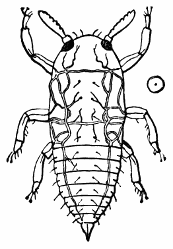
Male Phylloxera; dot in circle showing natural size.
These are continued from April to October, by which month the insect has lost the yellow colour that distinguishes it in the summer months, and assumed a copper brown shade.
From October to April the Phylloxera hybernate, or rather, such of them do as have laid no eggs during the period of their active existence, for the egg-laying females die, and young phylloxeræ only are preserved during the winter months.
With the return of April they awake from their winter sleep, and recommence their devastating career. They then increase rapidly in size and begin to lay unimpregnated eggs, for there are at that time no males. “These bring forth females which in their turn develop and lay unimpregnated eggs, and the virginal reproduction continues for five or six generations, the development increasing in rapidity with the heat, but the prolificacy or the number of the eggs decreases.
“In July some of the individuals show little wing-pads at the sides, and begin to issue from the ground and acquire wings. These winged individuals become very numerous in August, and continue to appear in diminishing numbers thereafter till the leaves have all fallen. They are all females and carry in their abdomen from three to eight eggs of two sizes, the larger ones about 2⁄100ths of an inch long and half as wide; the smaller 3⁄4th as long. These eggs are also unimpregnated and are laid by preference on the under side of the more tender leaves, attached by one end, amid the natural down. They increase somewhat in size, and give birth in about ten days to the true sexual individuals, the larger producing females, the smaller, males.
“Anomalous as it may seem these creatures are born perfect, though without mouth, and with no other than the reproductive function.
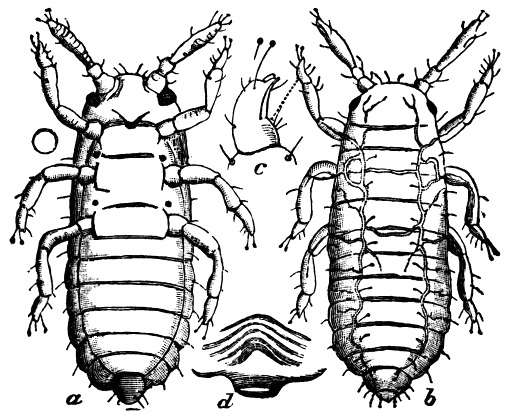
True female Phylloxera; a, ventral view, showing obsolete mouth and solitary egg, occupying nearly the entire body; b, dorsal view; c, tarsus; d, contracted anal joints after the egg is laid; dot in circle showing natural size.
“A most remarkable fact, discovered by[104]
The parts of the vine attacked by the Phylloxera are the rootlets, which in a diseased plant, may be seen more or less covered with what appears to the naked eye, a yellowish powder, but upon a microscopic examination reveals itself as a mixture of phylloxeræ of different sizes, and of their eggs.
During August and September, the phylloxeræ invest the rootlets in countless numbers,
The effect of the attacks of the parasite upon the rootlets is to give rise in it to the formation of a number of little tumefactions or enlargements. These in course of time decay, and their destruction results in the death of the plant.
Exposure to air and sunlight acts fatally to the Phylloxera, shrivelling and drying it up. Hence its instinct of self-preservation, no less than its search after its food, leads it to bury itself beneath the surface of the soil. But, as the insect does not possess an organisation that fits it for burrowing, the character of the soil has a great deal to do in affording facilities or the reverse favorable to its existence.
If the soil be of such a nature, that it splits easily into fissures or cracks, which better lead to or serve to expose the vine roots, it will of course afford a much more easy means of access to the parasite than if it be compact or close.
Hence it is that clayey and chalk soils, from their liability to split up on the surface, afford much more congenial habitats for the Phylloxera than sandy ones, which, being dry and closely-knit, afford a much more impenetrable barrier to the entrance of the insect, or to its subterranean movements.
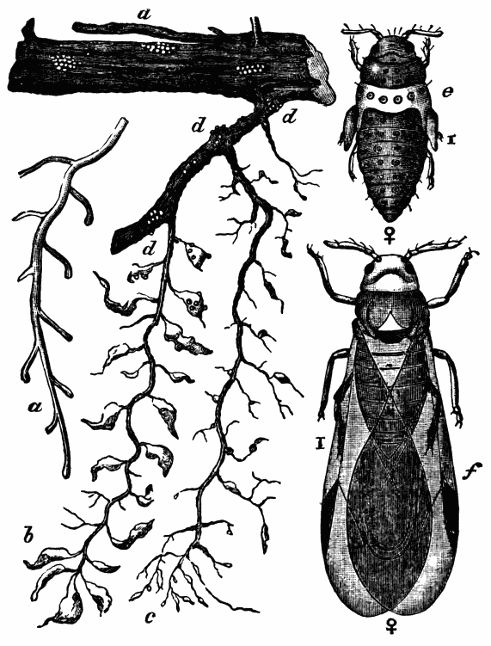
a, healthy root; b, root on which the lice are working, showing the knots and swellings caused by their punctures; c, root deserted by them, on which the rootlets have begun to decay; d, d, d, lice on the larger roots, natural size; e, female pupa, dorsal view; f, winged female, dorsal view, greatly enlarged.
These statements are borne out by the fact that where the disease has shown itself it has been found to vary in extent and intensity in proportion as the soil of the vineyard is more or less clayey; and many instances are known
A forcible illustration of this malign influence of clay in the soil is afforded by the following analyses of two specimens of earth taken from the same vineyard. The specimen marked “healthy” was from a small plot of ground in which the vines were perfectly sound; that distinguished as “unhealthy” formed by far the greater portion of the soil of the vineyard, the plants growing in which were all suffering from the ravages of the parasite:—
Healthy. Unhealthy.
Water 2·25 3·20
Nitrogen 0·11 0·12
Sulphate of calcium 0·62 0·42
Chloride of sodium 1·15 0·18
Carbonate of calcium 49·00 42·00
Siliceous sand 23·50 10·20
Clay 17·75 37·50
Organic substances and error of analysis. 5·62 6·38
———— ————
100·00 100·00
From the locality already indicated, where it had first developed itself in 1865, the vine disease gradually extended until, in the year 1873, it was ravaging the vineyards of the Gard, Vaucluse, Isère, Herault, Drôme, Bouches du Rhone, Ardèche, Basses-Alpes, Var, the Gironde, and the Charentes, since which time it has gradually continued to spread into the adjacent districts.
“We may gain a more precise idea than can be afforded by a mere observation of the geographical extension of the disease, of the disastrous nature of the ravages of the Phylloxera, by the examination of some of the statistics of the grape-crop in successive years, in some of the departments attacked. Thus, in the Department of Vaucluse, where the disease showed itself in 1866, there were in 1866, according to the results obtained by the departmental commission instituted at Avignon to observe on the new vine-disease, 6000 hectares absolutely dead or dying, and a much larger number already attacked, which have since succumbed to the parasite. Out of the 30,000 hectares of vineyards comprised in this department, 25,000, or five sixths of the total area, have been destroyed. In the Gard, where the vine flourishes better than in the above-mentioned department, the ravages of the disease are yet most terrible; for in 1871, in the Arrondissement of Uzes, but one half of the average crop was produced, and in the Arrondissement of Nismes a tenth part of the crop was destroyed. These proportions, moreover, have increased since that year.
“If we examine the mischief done in the less extended areas of the communes, we shall obtain a still clearer idea of the rapid spread of the disease:—
“Commune of Graveson.
1865-66-67 mean crop 10,000 hectolitres.
1868 ” 5,500 ”
1869 ” 2,200 ”
1870 ” 400 ”
1871 ” 205 ”
1872 ” 100 ”
1873 ” 50 ”
“In the Commune of Maillanne the crop in 1868 was only 40 per cent. of the average of the three preceding years, while in 1869 it was only 10 per cent. In the Commune of Eyragues the crop in 1868 was about 33 per cent. of the average of the three preceding years, and in 1869 there was a further falling off of about 10 per cent. In 1870 the crop in the three above-named communes was almost entirely destroyed. From instances such as these, fairly selected from many others equally tragic in their stern figures, we may form some idea of the magnitude of the disaster. Indeed, it is difficult to see, so rapid is the extension of the disease, how, unless some potent and effective remedy can be soon applied, any vine-bearing district in France can escape the visitation of the Phylloxera.”[105]
The French Government, fully alive to the peril threatening the staple product of their country, shortly after the appearance of the Phylloxera in the vineyards of France, offered through their Minister of Commerce and Agriculture a reward of 300,000 francs for the discovery of a means of arresting and stopping its ravages; and in 1871 the Academy of Sciences, at Paris appointed a commission, presided over by the celebrated chemist M. Dumas, to investigate the biology, habits, &c., of the parasite, together with the nature of the injuries it inflicted upon the vine, the area of its depredations, &c. From amongst the members of this commission three gentlemen were chosen to visit the infected districts, so as to be afforded an opportunity of studying the Phylloxera at its destructive work, and its environments of soil, situation, temperature, &c.
The delegates selected by the Commission were MM. Balbiani, Cornu, and Duclaux, respectively amongst the most distinguished living representatives of zoology, botany, and chemistry in France, and the results of their
The vines of other countries besides those of France have also suffered from the attacks of the Phylloxera. Thus it has made its appearance in the vineyards of Algiers, Italy, Germany, Spain, Portugal, Switzerland, Australia, and North America, on all of which it has been productive of more or less serious injury to the vintage.
Amongst the numberless remedies that have been suggested and tried, with varying but by no means uniform or satisfactory results, for the destruction of the Phylloxera, may be mentioned sulphur, the sulphites, tobacco, caustic soda, and potash, bisulphide of carbon, coal-tar, soft soap, lime, the immersion of the vine in sulpho-carbonate of potassium, and the application around the roots of sand.
A certain amount of success, it has been said, has attended the employment of the sulpho-carbonate of potassium and sand.
An American botanist, Mr Riley, recommends the importation into French vineyards of the American vines, which he suggests should be employed as stocks on which to graft the French ones.
The American plant being of a hardy nature, he believes its incorporation with the more susceptible French ones, would give rise to a vine sufficiently vigorous to resist, or at any rate not to be injured by the ravages of the parasite.
PHYSIC BALLS. See Veterinary medicines.
PHYSOSTIGMATIS FABA. See Calabar bean.
PI′CA. Depraved appetite.
PIC′AMAR. One of the peculiar principles discovered by Reichenbach in beech-tar, and described by him as a viscid, colourless, oily liquid, only feebly odorous, but intensely bitter; insoluble in water; freely soluble in alcohol, ether, and oils; boiling point 520° Fahr.; sp. gr. 1·095. See Kreasote.
PICCALIL′LI. See Pickles.
PICK′LE. The liquor in which substances used as food are preserved. That for flesh is commonly brine; that for vegetables, vinegar; both of which are commonly flavoured with spices, &c.
Prep. 1. (For meat.)—a. From bay salt, 3 lbs.; saltpetre, 21⁄2 oz.; moist sugar, 1 lb.; allspice and black pepper, of each (bruised) 1 oz.; water, 9 pints; simmer them together in a clean covered iron or enamelled vessel for 7 or 8 minutes; when the whole has cooled, remove the scum, and pour it over the articles to be preserved. Used for hams, tongues, beef, &c., to which it imparts a fine red colour and a superior flavour.
b. From bay salt and common salt, of each 2 lbs.; moist sugar, 1 lb.; saltpetre, 1⁄2 lb.; allspice (bruised), 1⁄2 oz.; water, 1 gall,; as before. Used chiefly for pork and hams. Common salt may be substituted for bay salt, but it is less powerfully antiseptic, and the flavour is less grateful.
2. (For VEGETABLES.)—a. Strong distilled vinegar, to each quart of which 11⁄2 oz. of good salt has been added.
b. Good distilled vinegar, 4 pints; common salt, 21⁄2 oz.; black pepper, 1⁄2 oz.; unbleached Jamaica ginger, 21⁄2 oz. (the last two bruised, but not dusty); mace (shredded), 1⁄4 oz.; simmer in an enamelled iron or stoneware vessel, as above, and strain through flannel. Sometimes a little capsicum is added. Used either hot or cold, according to the vegetable it is intended to preserve.
Pickle, Lemon. See Sauces.
PICKLES. These well-known articles are easily prepared of the finest quality. The vegetables and fruit, selected of the proper quality and at the proper season, after being well cleansed with cold spring water, are steeped for some time in strong brine; they are then drained and dried, and transferred to bottles or jars; the spice (if any) is then added, the bottles filled up with hot, strong, pickling vinegar, and at once securely corked down and tied over with bladder. As soon as the bottles are cold the corks are dipped into melted wax, the more surely to preserve them air-tight. Good wood or distilled vinegar is commonly used for this purpose; but the best malt or white wine vinegar of the strength known as No. 22 or 24 is exclusively employed for the finer pickles which are not spiced. In those for early use the ‘steep’ may be made in hot or boiling brine, by which the product will be ready for the table in a much shorter period; but with substances of a succulent and flabby nature, as cabbage, cauliflower, some fruit, &c., or in which crispness is esteemed a mark of excellence, this is inadmissible. To such articles the vinegar should also be added cold, or, at furthest, should be only slightly warmed. As a general rule, the softer and more delicate articles do not require so long soaking in brine as the harder and coarser kinds; and they may be often advantageously pickled by simply pouring very strong pickling vinegar over them without applying heat. It must also be observed that beetroot, and other like substances which are sliced, as well as certain delicate fruits, must not be steeped at all. The spice is commonly added whole to the bottles; but a more economical plan is to steep it (bruised) for some time, or to simmer it in the vinegar before using the latter, as in the forms given under Pickle (above).
The spices and flavouring ingredients employed for pickles are—allspice, black and white pepper, capsicums or red pods, cloves, garlic, ginger, horseradish, lemon peel, mace, mustard, shallots, and turmeric. These are chosen with reference to the particular variety of the pickle, or the taste of the consumer.
A good SPICED VINEGAR for pickles generally is the following:—Bruise in a mortar 2 oz. of black pepper, 1 oz. of ginger, 1⁄2 oz. of allspice, and 1 oz. of salt. If a hotter pickle is desired, add 1⁄2 dr. of cayenne, or a few capsicums. For walnuts, add also 1 oz. of shallots. Put these into a stone jar, with a quart of vinegar, and cover them with a bladder wetted with the pickle, and over this place a piece of leather. Set the jar on a trivet near the fire for 3 days, shaking it 3 times a day, then pour it on the walnuts or other vegetables. For walnuts it is used hot, but for cabbage, &c., cold. To save time it is usual to simmer the vinegar gently with the spices; which is best done in an enamelled saucepan.
In the preparation of pickles it is highly necessary to avoid the use of metallic vessels, as both vinegar and brine rapidly corrode brass, copper, lead, &c., and thus become poisonous. These liquids may be best heated or boiled in a stoneware jar by the heat of a water bath or a stove. Common glazed earthenware should be avoided, either for making or keeping the pickles in, as the glazing usually contains lead. Pickles should also be kept from the air as much as possible, and should only be touched with wooden or bone spoons. They are also better prepared in small jars, or bottles, than in large ones, as the more frequent opening of the latter exposes them too much. Copper or verdigris is frequently added to pickles to impart a green colour, or the vinegar is boiled in a copper vessel until sufficiently ‘greened’ before pouring it on the vegetables. This poisonous addition may be readily detected by any of the tests mentioned under Copper. If a green colour be desired, it may be imparted to the vinegar, and ultimately to the pickles, by steeping vine leaves, or the leaves of parsley or spinach, in it. A teaspoonful of olive oil may be advantageously added to each bottle to keep the pickles white, and to promote their preservation.
⁂ The following list includes the leading pickles of the shops, and some others:—
Barberries. From the ripe fruit, without heat.
Beans. From the young green pods of the scarlet bean, and the French or kidney bean, with heat.
Beetroot. From the sliced root, without steeping in brine, and with cold spiced vinegar. When wanted for immediate use the vinegar may be used boiling hot.
Broccoli. As CAULIFLOWERS.
Cabbage. This, either red or white, is cut into thin slices, and steeped in strong brine or sprinkled with common salt, and allowed to lie for 1 or 2 days; after which it is drained for 10 or 12 hours in a warm room, and then put into jars or bottles, with or without a little mace and white peppercorns, and at once covered with cold, strong, white vinegar.—Another plan is to steep the sliced cabbage in alum water for 10 or 12 hours, and, after draining and drying it, to pour the vinegar upon it as before. The product of the last formula eats very fresh and crisp, but takes longer to mature than that of the other. Some persons add a little salt with the vinegar; and others mix slices of red beet with the cabbage.
Capsicums. As GHERKINS.
Cauliflowers. As CABBAGE (nearly). Or, they may be steeped in hot brine for 1 or 2 hours before pouring the vinegar over them.
Cherries. From the scarcely ripe fruit, bottled, and covered with strong and colourless pickling vinegar.
Codlins. As BEANS.
Cucumbers. As GHERKINS.
Elderflowers. From the clusters, just before they open, as RED CABBAGE. A beautiful pickle.
English Bamboo. From the young shoots of elder, denuded of the outer skin, pickled in brine for 12 or 14 hours; then bottled with a little white pepper, ginger, mace, and allspice, and pickled with boiling vinegar. Excellent with boiled mutton.
Eschalots. With boiling spiced vinegar, or spices added to each bottle.
French Beans. See above.
Garlic. As ESCHALOTS.
Gherkins. From small cucumbers (not too young), steeped for a week in very strong brine; this last is then poured off, heated to the boiling point, and again poured on the fruit; the next day the gherkins are drained on a sieve, wiped dry, put into bottles or jars with some spice (ginger, pepper, or cayenne), and at once covered with strong pickling vinegar, boiling hot. Several other pickles may be prepared in the same way.
Gooseberries. From the green fruit, as either CABBAGE or CAULIFLOWERS.
Indian Mango. From green peaches. (See below.)
Indian Pickle. Syn. Piccalilli. This is a mixed pickle which is characterised by being highly flavoured with curry-powder, or turmeric, mustard, and garlic. The following form is commonly used:—Take 1 hard white cabbage (sliced), 2 cauliflowers (pulled to pieces), some French beans, 1 stick of horseradish (sliced), about 2 dozen small white onions, and 1 dozen gherkins; cover them with boiling brine; the next day drain the whole on a sieve, put into a jar, and add, of curry-powder or turmeric, 2 oz.; garlic, ginger, and mustard seed, of each 1 oz.; capsicums, 1⁄2 oz.; fill up the vessel with hot pickling vinegar, bung it up close, and let it stand for a month, with occasional agitation. See Mixed pickles (below).
Lemons. From the fruit, slit half way down into quarters, and cored, put into a dish, and sprinkled with a little salt; in about a week the whole is placed in jars or bottles with a
Limes. As the last.
Mangoes. As LEMONS, adding mustard seed and a little garlic, with spices at will. English mangoes are made from cucumbers or small melons, split and deprived of their seeds.
Melons. As LEMONS (nearly).
Mixed Pickles. From white cabbage, cauliflowers, French beans, cucumbers, onions, or any other of the ordinary pickling vegetables, at will (except red cabbage or walnuts) treated as GHERKINS; with raw ginger, capsicum, mustard seed, and long pepper, for spice, added to each bottle. A little coarsely bruised turmeric improves both the colour and flavour.
Mushrooms. From the small button mushrooms, cleansed with cold spring water, and gently wiped dry with a towel, then placed in bottles, with a blade or two of mace, and covered with the strongest white pickling vinegar, boiling hot.
Myrobalans. The yellow myrobalan preserved in strong brine. Gently aperient.
Nasturtiums. From the unripe or scarcely ripe fruit, simply covered with cold strong vinegar; or, as CABBAGE or GHERKINS.
Onions. From the small button or filbert onion, deprived of the outer coloured skin, and either at once put into bottles and covered with strong white pickling vinegar, or previously steeped for a day or two in strong brine or alum water. When required for early use, the vinegar should be poured on boiling hot.
Peaches. From the scarcely ripe fruit, as GHERKINS.
Peas. As BEANS or CAULIFLOWERS.
Piccalilli. See Indian pickle.
Radish Pods. As BEANS or GHERKINS.
Samphire. From the perennial samphire (Erythmum maritimum), covered with strong vinegar, to each pint of which 3⁄4 oz. of salt has been added, and poured on boiling hot. Said to excite the appetite.
Tomatoes. From the common tomato or love apple, as GHERKINS.
Walnuts. From the young fruit of Juglans regia, or common walnut:—1. Steep them in strong brine for a week, then bottle them, add spice, and pour on the vinegar boiling hot.
2. On each pint of the nuts, spread on a dish, sprinkle 1 oz. of common salt; expose them to the sun or a full light for 10 or 12 days, frequently basting them with their own liquor; lastly, bottle them, and pour on the vinegar, boiling hot.
3. (Dr Kitchener.) Gently simmer the fruit in brine, then expose it on a cloth for a day or two, or until it turns black; next put it into bottles or jars, pour hot spiced vinegar over it, and cork down immediately. In this way the pickle becomes sufficiently mature for the table in half the time required for that prepared by the common method. Dr Kitchener also recommends this parboiling process for several other pickles. Some persons pierce the fruit with an awl or stocking-needle, in several places, in order to induce early maturation. The spices usually employed are mustard seed, allspice, and ginger, with a little mace and garlic.
PIC′OLINE. An oily substance, discovered by Dr Anderson, associated with aniline, chinoline, and some other volatile bases, in certain varieties of coal-tar naphtha.
PIC′RIC ACID. HC6H2(NO2)3O. Syn. Carbazotic acid, Nitrophenisic acid, Trinitrophenisic acid. A peculiar compound formed by the action of strong nitric acid on indigo, aloes, wool, and several other substances.
Prep. 1. Add, cautiously and gradually, 1 part of powdered indigo to 10 or 12 parts of hot nitric acid of the sp. gr. 1·43; when the reaction has moderated and the scum has fallen, add an additional quantity of nitric acid, and boil the whole until red fumes are no longer evolved; redissolve the crystals of impure picric acid deposited in boiling distilled water, and remove any oily matter found floating on the surface of the solution by means of bibulous paper; a second time redissolve in boiling water the crystals which form as the liquid cools, saturate the new solution with carbonate of potassa, and set it aside to crystallise; the crystals of picrate of potassium thus obtained must be purified by several re-solutions and re-crystallisations, and next decomposed by nitric acid; the crystals deposited as the liquid cools yield pure picric acid by again dissolving them in boiling water, and re-crystallisation.
2. Dissolve the yellow resin of Xanthorrhœa hastilis (Botany Bay Gum) in a sufficiency of strong nitric acid. Red vapours are evolved, accompanied by violent frothing, and a deep red solution is produced, which turns yellow after boiling. Evaporate this solution over a water bath. A yellow crystalline mass is deposited, which consists of picric acid with small quantities of oxalic and nitrobenzoic acids. The picric acid is purified by neutralising the yellow mass with potassa, and crystallising twice out of water. The pure picrate of potassium thus obtained is decomposed by hydrochloric acid, and the liberated picric acid is purified by two crystallisations. This process, devised by Stenhouse, is one of the best, and yields a quantity of the acid amounting to 50% of the resin employed.
Prop., &c. Brilliant yellow scales, scarcely soluble in cold water, but very soluble in boiling water, and in alcohol and ether; fusible; volatile; taste insupportably bitter, and very permanent. It forms salts with the bases (picrates, carbazotates), mostly possessing a yellow colour, and exploding when heated. The picrate of lead has been proposed as a fulminating powder for percussion caps. The picrate of potassium has been given with