A CYCLOPÆDIA OF PRACTICAL RECEIPTS, &c. VOLUME II (continued 20)
Reading edition
PEARL BARLEY. See Barley.
PEARL FLAVOUR. See Essence.
PEARL WHITE. This is a subchloride of bismuth; but the name is now commonly applied to trisnitrate of bismuth, which is sold for it.
PEARLS (Rose). Syn. Rose beads. The petals of red roses beaten in an iron mortar for some hours, until they form a smooth, black paste, then rolled into beads and dried. Hard; very fragrant; take a fine polish.
Pearls, to Polish. Take very finely pulverised rotten stone, and make it into a thick paste
This is to be applied on a velvet cork, rub quickly, and as soon as the pearl takes the polish wash it. This mixture when properly applied will give to pearl a brilliant polish.
PEAS. Syn. Garden peas, Motor p.; Pisa, L. The seed of Pisum sativum (Linn.). Poggiale found in 100 parts of common green peas, dried and shelled, 57 of starch, 21·7 of a nitrogenous substance (legumin), 1·9 of fatty matter, 3·2 of cellulose, 2·8 of ash, and 12·7 of water. In the fresh state (GREEN PEAS) they are nutritive, and, with the pods which contain them, are highly serviceable in scurvy. The last have been used for making beer. The dried seeds are still more nutritious, but are heavy and flatulent unless well cooked. For kitchen use ‘SPLIT PEAS’ should be chosen, and after having washed them in a little clean soft water, and allowed them to drain, they should be left to soak in cold soft water for at least 12 hours before applying heat to them, and should then be dressed in the same water in which they have been soaked, and be only gently simmered until they are reduced to a pulp. Additions of meat, vegetables, &c., should not be made until they have nearly arrived at this condition. ‘Whole peas’ require soaking for at least 18 or 20 hours.
A substitute for green peas in winter may be obtained by placing the dried seed on a flat dish, sprinkling them with water, and keeping them in a warm situation. In a few days germination commences, and, after it has proceeded sufficiently far, the whole is dressed in the usual manner. An easier and simpler plan is to preserve the green peas, when they are in season, by the common method adopted for gooseberries and other like fruit.
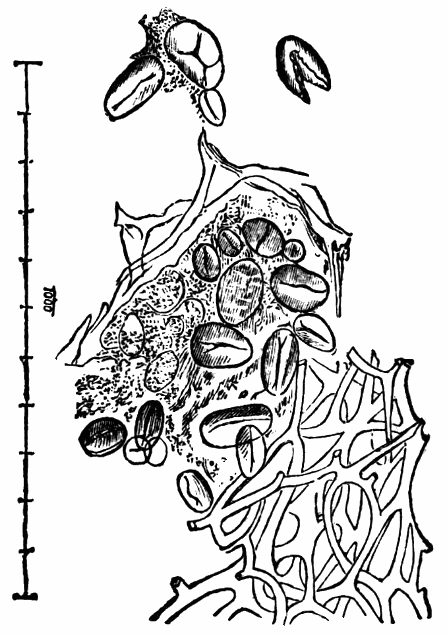
Pea flour is sometimes used to adulterate ordinary flour. It is never added to this latter to a greater extent than 4 per cent., as, if this quantity be exceeded, it makes the bread heavy and dark.
It is also used as a sophisticant for other substances, particularly for butter.
Peas, Is′sue. Syn. Pisa pro fonticulis, L. Orange berries, or the small unripe fruit of the orange tree, dried, and smoothed in a lathe. See Issue.
PEB′BLE. The trade name for the transparent colourless variety of rock crystal or quartz used for the lenses of spectacles instead of glass, over which, from its extreme hardness, it has the advantage of being little apt to be scratched.
PEC′TIC ACID. The name given by Braconnot to an acid which is found very generally diffused throughout the vegetable kingdom.
Prep. From carrot roots, from which the juice has been pressed out, by boiling them with 1⁄25th part of their weight of carbonate of potassium, and about 6 times their weight of water, until the liquid becomes gelatinous when neutralised with an acid. A pectate of potassium is formed, from which the acid may be obtained by neutralising the alkali with a stronger acid, or by carefully adding a solution of chloride of calcium as long as a gelatinous precipitate (pectate of calcium) falls, and, after washing this with water, decomposing it with dilute hydrochloric acid.
Prop., &c. A colourless jelly, having an acid reaction; scarcely soluble in cold water, more so in hot water; and precipitated by acids, alkalies, alcohol, salts, and even sugar. Its compounds with the bases are called pectates. By long boiling with solution of caustic alkali it is converted into metapectic acid, which does not gelatinise. (See below.)
PEC′TIN. Syn. Vegetable jelly. Obtained by adding alcohol to the juice of ripe currants or other fruit, until a gelatinous precipitate forms, which must be drained, washed with a little weak alcohol, and dried.
Prop., &c. In the moist state it forms a neutral, tasteless, soluble, transparent jelly; when dried, a translucent mass, closely resembling isinglass; boiled with water, or with dilute acids, it is converted into parapectin and metapectin; in the presence of alkalies, these, as well as pectin, are changed into pectic acid, and by continuing the ebullition for some time longer, into metapectic acid, which is not gelatinous. See Pectic acid.
PECTORAL BALSAM. The same as Balsam of Honey, which see. The reference to ‘Pectoral balsam,’ which occurs at the end of the article ‘Balsam of Honey,’ conveys the impression that it is a different medicine. This is an error.
PEC′TORALS. Under this head are popularly included all the various remedies employed in breath or chest diseases.
PEDIC′ULI. See Louse.
PEL′LICLE. See Crystallisation.
PEL′LITORY. Syn. Pellitory of Spain;Pellitory root; Pyrethri radix, B. P.); Pyrethrum (Ph. L. & E.), L. The root of Anacyclus Pyrethrum. It is a powerful topical excitant. It is chiefly employed as a masticatory in headache, toothache, palsy of the tongue, and facial neuralgia and rheumatism; and made into a tincture with rectified spirit, it is a common remedy among dentists for the toothache. Internally, it has been given as a gastric stimulant, and in intermittents, &c. Half to 1 dr. may be chewed at a time.
PEL′TRY. The name applied to fur skins in the state in which they are received from the hunters. To prepare them as furs, the inside of them is generally first ‘tawed’ by the application of a solution of alum. They are next well dusted over and rubbed with hot plaster of Paris or whiting, and are, lastly, thoroughly dried and brushed clean. When it is desired to change or modify their colour, the grease being removed by lime water or a weak soda lye, they are stretched out on a table or board, and the ordinary liquid mordants and dyes are applied to them hot by means of a painter’s brush.
The furs of the rabbit and hare are rendered fit for the purposes of the felt and hat manufacturers by a process called by the French ‘sécretage,’ This consists in thoroughly moistening the hair with a solution of quicksilver, 1 part, in aquafortis, 16 parts, diluted with half to an equal bulk of water. This is applied with a brush, and the moistened skins being laid together, face to face, are dried as rapidly as possible in a stove room. See Furs.
PEMPHIGUS. A disease of the skin, in which large vesicles or blisters filled with a serous fluid, develop themselves. In the mild form of the disorder the blisters vary in size from a pea to a chestnut. They chiefly attack the extremities, and break after three or four days, when they then give rise to a thin scab, which soon heals and disappears without causing any bodily derangement.
In the acute form, however, there is a considerable constitutional disturbance, which shows itself in the shape of more or less fever and inflammation; the blisters too are larger, and the scabs very irritable and obstinate. Children during teething, or owing to injudicious diet, are frequently subject to this kind of pemphigus. There is also a chronic variety of the disease, which varies but slightly from the acute form, except that it continues longer. Old people are those who principally suffer from this chronic pemphigus.
A mild attack seldom calls for any treatment; the best course to pursue in the case of an acute one is to administer some saline aperient, to adopt a moderately low diet, and to protect the exposed parts caused by the breaking of the blister by applying to them some simple dressing, such as spermaceti ointment.
When the case becomes chronic it will be advisable to consult the medical practitioner.
PENALTIES. The following sections of the Public Health Act of 1875 refer to various offences for which penalties may be inflicted under the statute:—
Building or re-erecting a house in an urban district without proper drains, &c., £50 (s. 25). For building or re-erecting a house in any district without proper sanitary conveniences (privies, &c.), £20, or less (s. 35).
Unauthorised building over sewers or under streets in an urban district, £5 penalty, and 40s. per day during continuance of offence (s. 26).
Burial. For obstructing a justice’s order with regard to the burial of a person who has died from an infectious disease, &c., £5, or less (s. 142).
Bye-laws. Penalties may be imposed by local authorities for the contravention of bye-laws; such penalties are not to exceed £5, and for continuing offences further penalties of sums not exceeding 40s. a day (s. 183). Penalty for injury or defacement of any board, &c., on which a notice or bye-law of any authority is inscribed by the authority of the Government Local Board, or of the local authority, £5, or less (s. 306).
Cellars, Unauthorised occupation of, 20s. per day (s. 73).
Cleansing and Whitewashing, &c., Failure to comply with notice to cleanse and whitewash a house, 10s. per day (s. 46).
Contracts. All contracts are to specify some pecuniary penalty (s. 174). Officers or servants being concerned or interested in contracts, accepting fees, are liable to a penalty of £50, recoverable with full costs of suit.
Disinfection. Failure to comply with notice to disinfect and cleanse articles and premises, not less than 1s. and not more than 10s. per day. Expenses of local authority doing the work may also be recovered (s. 120). Failure to disinfect public conveyances after conveying infected persons, £5, or less (s. 127). For letting infected houses without proper disinfection, £20, or less (s. 128).
Drains, &c. Unauthorised connection of a drain with a sewer, £20, or less (s. 21). For neglecting to comply with notice for the construction of privies, &c., for factories, £20, or less, and 40s. per day. For non-compliance with notice for the construction of drains, privies, &c., 10s. per day (s. 41).
Epidemic Diseases. For violation or obstruction of the regulations of the Local Government Board with regard to epidemic diseases, £5, or less (s. 140).
Exposure of infected persons or things, £5, or less (s. 126).
Houses or Rooms. Making false statements with regard to infectious diseases for the purpose of letting, £20, or less, or imprisonment
Lodging-houses. Receiving lodgers in unregistered houses, failure to make a report, failure to give notice of infectious diseases, £5, or less, and 40s. per day during continuance of offence. Refusal or neglect to affix or renew notice of regulation in common lodging-houses, £5, or less, and 10s. a day during continuance of offence after conviction (s. 79). For neglecting the limewashing and cleansing of lodging-houses according to the Act 40s., or less (s. 82).
Manure. Failure to comply with a notice of urban authority to periodically remove manure, &c., 20s. a day (s. 50).
Meat. For exposing for sale or having in possession unsound meat and other articles of food specified in the Act, £20, or less, for each carcase or piece of meat, or fish, &c., or three months imprisonment with or without the option of a fine (s. 117). For obstruction of officer inspecting the food, £5, or less (s. 118).
Mortgage of Rate. Refusal of custodian of register to permit inspection, £50, or less. Neglect or refusal of clerk to register transfer of mortgage, £20, or less.
Nuisance. The court may impose a penalty of £5, or less, with regard to nuisances generally (s. 98). For want of diligence in carrying out the order to abate nuisance, 10s. per day; for contravention of order, if wilful, 20s. per day during such contrary action, besides the expenses of the local authority in abating the nuisance (s. 98).
For nuisance of pigs, pigsties, and the contents of cesspools, &c., overflowing, 40s., or less, and 5s. per day during continuance of offences (s. 47).
Obstruction. For wilful obstruction of member of, or person authorised by local authority, £5, or less (s. 306).
Obstruction of owner by occupier in carrying out any of the provisions of the Act, £5 per day, commencing twenty-four hours after non-compliance with the justice’s order (s. 306).
Offices. Certain offices are not to be held by the same person. Penalty for offence, £100, recoverable with full costs of suit (s. 192).
Order of Justices. Refusal to obey order for admission of local authority, £5, or less (s. 103).
Rates. Refusal of officers in custody of rate-books, valuation lists for the relief of the poor, &c., to permit inspection, £5, or less (s. 212).
Refusal of person to permit inspection of rate, £5, or less (s. 219).
Scavenging. Obstruction of the contractor or local authority in scavenging the streets or in removal of refuse, £5, or less (s. 42). Neglect of local authority to scavenge after undertaking to do so, 5s. per day (s. 43).
Streets. Wilful unauthorised displacement or injury of pavement stones, injury to fences, &c., of streets vested in urban authority, £5, or less, and a further penalty of 5s. or less for every square foot of pavement injured, &c. Compensation may also be awarded by the court for injury to trees (s. 149).
For building or bringing forward buildings beyond the general line of the houses in the street in an urban district, 40s. per day after written notice (s. 156).
Trade, Offensive. Unauthorised establishment of in an urban district, £50, and 40s. per day during continuance of offence (s. 112). Nuisance arising from offensive trade is punishable by penalty—for first offence not less than 40s., and not exceeding £5; for second or any subsequent offence, double the amount of the last penalty which has been imposed, but in no case to exceed £200 (s. 114).
Water. Pollution of by gas, £280; and when offence is continued at the end of twenty-four hours’ notice, £20 per day (s. 68).
For injuring water-meters, 40s., or less, and the damage sustained may also be recovered (s. 60).
Works. For wilful damage of works or property belonging to a local authority, in cases where no other penalty is provided, £5, or less (s. 307).
⁂ All penalties, forfeitures, costs, and expenses, directed to be recovered in a summary manner, or not otherwise provided for, may be prosecuted and recovered under the “Summary Jurisdiction Acts” before a court of summary jurisdiction (P. H. S. 251); but proceedings for the recovery of penalties are only to be taken by the person aggrieved, or by the local authority of the district, except the consent in writing of the Attorney-General be obtained. But this restriction does not apply to the proceedings of a local authority with regard to nuisances, offensive trades, houses, &c., without their district, in cases in which the local authority are authorised to take proceedings with respect to any act or default (s. 253).
Unless otherwise provided for the penalty is thus applied: One half goes to the informer, and the remainder to the local authority of the district in which the offence was committed; but if the local authority be the informer, they are entitled to the whole of the penalty recovered.
All penalties and sums recovered by a local authority are paid to the treasurer, and carried to the account of the fund applicable to the general purposes of the Public Health Act.
(The justices or court have power to reduce penalties imposed by 6 Geo. IV, c. 78. P. H. Part III.)
PEN′CILS. This name is applied to the small brushes made of camel’s hair used by artists, as well as to the plumbago crayons familiarly known as black-lead pencils. The last are prepared by one or other of the following methods:—
1. The blocks of plumbago are exposed to a
2. The plumbago, in powder, is calcined as before, and then mixed with an equal, or any other desired proportion of pure washed clay, also in powder, after which the mixture is reduced to a plastic state with water, and pressed into grooves cut on the face of a smooth board, or into well-greased wooden moulds, in which state it is left to dry. When dry, the pieces are tempered to any degree of hardness by exposing them, surrounded by sand or powdered charcoal, in a closely covered crucible to various degrees of heat. The crucible is not opened until the whole has become cold, when the prepared ‘slips’ are removed and mounted as before. This method was invented by M. Conté in 1795.
3. The dough or paste, prepared as last, is reduced to the required form by forcing it through a perforated plate (in a similar manner to that adopted for coloured crayons), or into minute metallic cylinders, from which it may be readily shaken after it has become partially dry.
Obs. The leads for some varieties of drawing-pencils are immersed for a minute in very hot melted wax or suet before mounting them. To the composition for others a little lampblack is added, to increase and vary the degree of blackness. The pencils for asses’ skin books and prepared paper are tipped with ‘fusible metal.’ Numerous improvements in pencil cases and pencil mounts have been patented of late years by Stevens and others.
PENNYROY′AL. Syn. Pulegium (Ph. L. & E.), Mentha p. (Ph. D.), L. “The recent and dried flowering herb of Mentha pulegium, Linn.” (Ph. L.) Pennyroyal tea is a popular emmenagogue, expectorant, and diaphoretic, and is in common use in asthma, bronchitis, hooping-cough, hysteria, suppressions, &c. Water, essence, oil, and spirit of pennyroyal are officinal. They are now chiefly used as mere adjuncts or vehicles.
PENTASTOMATA. There are two varieties of this entozoon—the Pentastoma denticulatum, which Leuckart has shown to be the larvæ of the Pentastoma tænoides, and the Pentastoma constrictum. The P. denticulatum infests the human liver and small intestines. The P. constrictum does not appear to be known in this country. The latter appears to have caused death by setting up peritonitis. According to Dr Aitken these parasites are provided with two pairs of hooks or claws, placed on each side of a pit or mouth, on a flattened head. He says: “These claws appear to be implanted in socket-like hollows or depressions, surrounded by much loose integument. These socket-like hollows appear to be elevated on the summit of the mass of tissues which lies underneath the folds of integuments surrounding the base of the hooks. These parts are regarded as the feet of the parasite, and the hooks are the fore claws. The pit or mouth is of an oval shape, the long axis of the oval lying in the direction of the length of the worm.
“The less or outer margin of the pit is marked by a well-defined, thin line. There are no spines nor hooks on the integument of the elongated body.”
PEPPER (Black). Syn. Pepper; Piper, B. P.; Nigri baccæ, Piper nigrum (Ph. L., E., & D.), L. “The immature fruit (berry) of Piper nigrum, Linn., or the black pepper vine.” (Ph. L.)
Pur. The ground black pepper of the shops is universally adulterated; in fact, the public taste and judgment are so vitiated that the pure spice is unsaleable. A most respectable London firm, on commencing business, supplied their customers with unadulterated ground pepper, but in 3 cases out of every 4 it was returned on their hands and objected to, on account of its dark colour and rich pungency, which had induced the belief that it was sophisticated. The house alluded to was therefore compelled by the customers to supply them with an inferior, but milder and paler, article. The substances employed to lower black pepper are known in the trade as—‘P. D.,’ ‘H. P. D.,’ and ‘W. P. D,’—abbreviations of pepper dust, hot pepper dust, white pepper dust. The first is composed of the faded leaves of autumn, dried and powdered; the second, the ground husks (hulls) of black mustard, obtained from the mustard mills; and the third is common rice, finely powdered. Equal parts of black peppercorns, H. P. D., and W. P. D., form the very best ground pepper sold. The ordinary pepper of the shops does not contain more than 1⁄8th to 1⁄6th of genuine pepper, or 2 to 21⁄2 oz. in the lb. Very recently, ground oil-cake or linseed meal has been chiefly employed as the adulterant, instead of the old ‘P. D,’
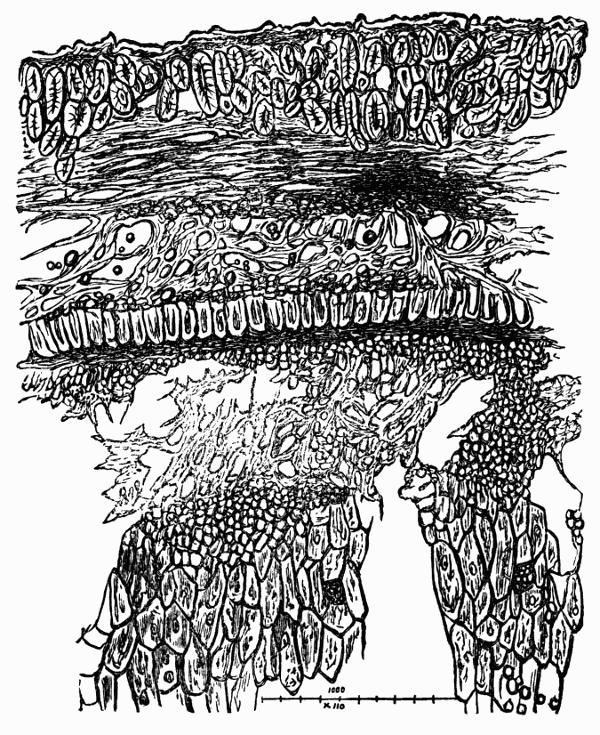
Dr Parkes[92] says: “The microscopic characters of pepper are rather complicated. There is a husk composed of four or five layers of cells and a central part. The cortex has externally elongated cells, placed vertically, and interior become smaller and of a deep red colour; they contain most of the essential oil of the pepper. The central part of the berry is composed of large angular cells, about twice as long as broad. Steeped in water, some of these cells become yellow; others remain colourless. It has been supposed that these yellow cells contain piperine, as they give the same reaction as piperine does; namely, the tint is deepened by alcohol and nitric acid, and sulphuric acid applied to a dry section causes a reddish hue.” (Hassal.)
Uses, &c. Black pepper is a powerful stimulant, carminative, and rubefacient. Its use in moderation, as a condiment, is peculiarly serviceable to persons who are of cold habit, or who suffer from weak digestion; but in inflammatory habits, and in affections of the mucous membranes, it is generally highly injurious. As a medicine it is often serviceable in nausea, vomiting, chronic diarrhœa, and agues. In North America a common remedy for the last is 1⁄2 oz. of ground pepper stirred up with a glassful of warm beer; or a like quantity made into a tincture by steeping it in 5 or 6 times its weight of gin, rum, or whisky, for a few days.
Prepared black pepper is made by steeping the berries for 3 days in 3 times their weight of vinegar, and then drying and grinding them. It is milder than common pepper. See Confections, Piperine, &c.
Pepper, Cayenne. Syn. Bird pepper, Chili p., Guinea p., Indian p., Red p.; Piper capsici, P. cayenne, L. This is prepared from chillies, or the pods of Capsicum frutescens, or from Capsicum baccatum, or bird pepper, but generally from the first, on account of its greater pungency and acrimony; and, occasionally, from Capsicum annuum or medicinal capsicum.
Prep. 1. From the dried pods (powdered), 1 lb.; and wheaten bread or captain’s biscuits (heated until they are perfectly dry and brittle, and begin to acquire a yellow colour throughout, and then powdered), 7 lbs.; mixed and ground together. Colouring matter and common salt are frequently added, but are unnecessary.
2. As the last, but making the mixture into a dough with water, then forming it into small cakes, drying these as rapidly as possible at a gentle heat, and then grinding them.
3. (Loudon.) The ripe pods, dried in the sun, are stratified with wheaten flour in a dish or tray, and exposed in a stove-room or a half-cold oven until they are quite dry; they are then removed from the flour, and ground to fine powder; to every oz. of this powder 1 lb. (say 15 oz.) of wheaten flour (including that already used) are added, and the mixture is made into a dough with a little tepid water and a teaspoonful of yeast; after fermentation is well set up, the dough is cut into small pieces, and baked in a slow oven until it is
Pure cayenne pepper, when burnt, leaves a scarcely perceptible quantity of white ash; a red-coloured ash indicates the presence of red ochre, brick-dust, Armenian bole, or other earthy colouring matter. If red lead is present, it will be left behind under the form of a dark-coloured powder, or a small metallic globule.
Pur. The ‘cayenne pepper’ of the shops is often a spurious article, made by grinding a mixture of any of the reddish woods or sawdust with enough red pods or chillies to render the mixture sufficiently acrid and pungent. Common salt, colcothar, red bole, brick-dust, vermilion, and even red lead, are also common additions.
Uses, &c. The capsicums resemble the peppers, except in their greater energy and their pungency being unmodified by the presence of essential oil. As a condiment, under the form of cayenne pepper, and in all diseases in which the employment of a powerful stimulant or rubefacient is indicated, their uses are well known. In medicine the fruit of Capsicum annuum (Linn.—Ph. E. & D.; C. fastigiatum, Blume—B. P., Ph. L.), or annual capsicum is ordered (Capsicum—Ph. L., E., & D.). The London College directs the fruit to be that of ‘Guinea,’ less than one inch long, oblong, cylindrical, and straight. See Essence of Cayenne.
Pepper, Prepared Cayenne, is the residuum of cayenne—vinegar, essence, or tincture, dried and ground (see below).
Pepper (Soluble) Cayenne. Syn. Crystallised soluble cayenne. Prep. 1. Capsicum pods (recent, ground in a pepper mill), 1 lb.; rectified spirit, 21⁄2 pints; proceed by percolation so as to obtain 21⁄2 pints; from this distil one half of the spirit by the heat of a water bath; to the residuum add of fine dry salt, 5 lbs.; mix them well together, and dry the mixture at a very gentle heat, frequently stirring; lastly rub it through a sieve, and put it into warm dry bottles. It is usually coloured with a little vermilion or rouge (sesquioxide of iron), but it possesses an agreeable colour without it,
2. Essence of cayenne (No. 1, page 652), 6 pints; distil off 3 pints, add to the residual liquor of dry salt 12 lbs.; mix well, dry by a gentle heat, and otherwise proceed as before.
3. Capsicums (ground), 3 lbs.; red sanders or Brazil wood (sliced or rasped), 10 oz.; rectified spirit, 1 gall.; macerate for 14 days, then express the tincture, filter, distil off one half, add of dry salt, 15 lbs., and proceed as before.
4. As the first formula, with the addition of a strong decoction of saffron, q. s. It gives a beautiful colour to soups, &c.
Obs. The above formulæ are those actually employed by the houses most celebrated for their ‘soluble cayenne.’ The products are of the very finest quality, and are perfectly wholesome. We speak from an extensive experience in the manufacture. The spirit distilled from the essence forms a most suitable menstruum for making fresh essence or tincture of cayenne.
Pepper, Cu′beb. See Cubebs.
Pepper, Jamai′ca. See Pimento.
Pepper, Kit′chen. See Spice.
Pepper, Long. Syn. Piperis longi fructus, Piper longum (Ph. L. & E.), L. “The immature fruit (dried female spikes) of Piper longum, Linn.” (Ph. L.), or long-pepper vine. The spikes are about 11⁄2 inch in length, with an indented surface, and are of a dark-grey colour. In its general properties it resembles black pepper, but it is less aromatic, though equally pungent. Elephant pepper is merely a larger variety of this species. (Gray.) The root and stems, sliced and dried, form the ‘pippula moola’ of the East Indies. (Roxburgh.)
Pepper, Red. See Cayenne.
Pepper, White. Syn. Piper album, L. This is made by either soaking ordinary black pepper in a solution of common salt, until the outside skins are soft, and then rubbing them off in the hands, or by merely rubbing off the skins of the over-ripe berries that fall from the vines. An inferior quality is made by bleaching black pepper with chlorine.
Obs. The use of white pepper instead of black is an instance of the sacrifices made to please the eye. Pure white pepper has only about 1-4th of the strength of pure black pepper, whilst it is nearly destitute of the fine aroma of the latter. It also contains a mere trace of piperina or piperine, one of the most valuable constituents of black pepper.
PEP′PER PODS. Capsicums. See Cayenne pepper.
PEP′PERMINT. Syn. Mentha piperita (Ph. L., E., & D.), L. “The recent and dried flowering herb of Mentha piperita” (Ph. L.), or garden peppermint. The flavour and odour of this herb are well known. It is the most pleasant and powerful of all the mints. Peppermint water and the essential oil have long been employed in nausea, griping, flatulent colic, hysteric, diarrhœa, &c.; but in regular practice chiefly to cover the taste of nauseous medicines, or as an adjunct or vehicle for more active remedies. See Oils (Volatile), Waters, &c.
PEP′SIN. Syn. Gasterace, Chymosin. A peculiar principle found in the gastric juice, and which, in conjunction with hydrochloric acid, also present in the stomach, confers upon it the power of digesting certain portions of the food, and of dissolving, as Tuson has shown, calomel and other mineral substances.
Prep. 1. (Beale, ‘Med. Times & Gaz.,’ February 10th, 1872, p. 152.) “The mucousin vacuo over sulphuric acid. Care must be taken that the temperature does not rise much above 100 F°., because the action of the solvent would be completely destroyed. When dry the mucus is scraped from the glass, powdered in a mortar, and transferred to a well-stoppered bottle. With this powder a good digestive fluid may be made as follows:
Of the powder 5 grains.
Strong hydrochloric acid 18 drops.
Water 6 ounces.
Macerate it at a temperature of 100° for an hour. The mixture may be filtered easily, and forms a perfectly clear solution very convenient for experiment.
“If the powder is to be taken as a medicine, from two to five grains may be given for a dose, a little diluted hydrochloric acid in water being taken at the same time. The pepsin powder may be mixed with the salt at a meal. It is devoid of smell, and has only a slightly salt taste. It undergoes no change if kept perfectly dry, and contains the active principle of the gastric juice almost unaltered.
“The method of preparing this pepsin was communicated to Mr Bullock, of the firm of Messrs Bullock and Company, 3, Hanover Street, Hanover Square, who at once adopted it for the preparation of medicinal pepsin, and soon improved upon it in some particulars. The dose is from 2 to 4 or 5 grains.—Test. 4⁄5ths of a grain of this pepsin, with 10 drops dilute hydrochloric acid and an ounce of distilled water, dissolve 100 grains of hard-boiled white of egg in from twelve to twenty-four hours. In the body probably twice this quantity of white of egg or even more would be dissolved in a comparatively short space of time. The digestive powder prepared from the pig’s stomach retains its activity for any length of time if kept dry. I had some which had been kept in a bottle for upwards of five years, and still retained its active power unimpaired. The solution made with this pepsin and hydrochloric acid was nearly tasteless and inodorous. One pig’s stomach, which costs sixpence, will yield about 45 grains of the powder prepared as above described.
“Gradually the usefulness of this preparation of pepsin of the pig was found out, and it had to be prepared in increasing quantities. I should be afraid to say how many pigs’ stomachs have been used of late years during the winter season.
“In 1857 Dr. Pavy carefully examined the pepsin prepared and sold by many different firms, and found that this dried mucus of the pig’s stomach was the most active of them all (‘Medical Times and Gazette,’ 1857, vol. i, p. 336). In 1870 Professor Tuson instituted a still more careful comparative examination, and with a similar result (‘Lancet,’ August 13th, 1870); for he found that this preparation was twenty-five times stronger than some others that he obtained for examination.”
2. (Scheffer, ‘Pharm. Journ.,’ March 23rd, 1872, p. 761.) “Of the well-cleaned fresh hog stomach the mucous membrane is dissected off, chopped finely and macerated in water acidulated with muriatic acid for several days, during which time the mass is frequently well stirred. The resulting liquid, after being strained, is, if not clear, set aside for at least twenty-four hours in order to allow the mucus to settle. To the clarified liquid the same bulk of a saturated solution of sodium chloride is added, and the whole thoroughly mixed. After several hours the pepsin, which, by the addition of chloride of sodium, has separated from its solution, is found floating on the surface, from whence it is removed with a spoon and put upon cotton cloth to drain; finally it is submitted to strong pressure, to free it as much as possible from the salt solution.
“The pepsin, when taken from the press and allowed to become air-dry, is a very tough substance, and presents, according to thickness, a different appearance, resembling in thin sheets parchment paper, and in thick layers sole leather; its colour varies from a dim straw yellow to a brownish yellow. Besides a little mucus, it contains small quantities of phosphate of lime and chloride of sodium, which, however, do not interfere with its digestive properties, as they are found also in normal gastric juice.
“In order to get a purer article I redissolve the pepsin, as obtained after expression, in acidulated water, filter the solution through paper and precipitate again with a solution of sodium chloride; the precipitate, after draining and pressing, is now free of phosphate of lime and mucus, but still contains salt. In the freshly precipitated state the pepsin is very readily soluble in water, and cannot therefore be freed from adhering salt by washing.
“By allowing the pressed sheet of pepsin to get perfectly air-dry—whereby it becomes coated with a white film and small crystals of chloride of sodium—and by immersing it then in pure water for a short time, the greater part of sodium chloride can be extracted, but it has to be done very rapidly, as the pepsin swells up considerably and loses its tenacity.
3. (B. Ph.) A preparation of the mucous lining of a fresh and healthy stomach of the pig, sheep, or calf. The stomach of one of these animals, recently killed, having been cut open and laid on a board with the inner surface upwards, any adhering portions of food, dirt, and other impurity, are to be removed and the exposed surface slightly washed with cold water; the cleansed mucous membrane is then to be scraped with a blunt knife or other suitable instrument, and the viscid parts thus obtained is to be immediately spread over the surface of glass or glazed earthenware, and quickly dried at a temperature not exceeding 100° F. the dried residue is to be reduced to powder, and preserved in a stoppered bottle.—Dose, 2 to 5 grains.
Pepsin, Saccharated. To work it into saccharated pepsin (‘American Journal of Pharmacy,’ January, 1871) the damp pepsin, as it is taken from the press, is triturated with a weighed quantity of sugar of milk to a fine powder, which, when it has become air-dry, is weighed again, the quantity of milk sugar subtracted, and so the amount of pepsin found. The strength of this dry pepsin is now ascertained by finding how much coagulated albumen it will dissolve at a temperature of 100° F. in five or six hours, and after this sufficient milk sugar is added to result in a preparation of which ten grains will dissolve one hundred and twenty grains of coagulated albumen, and this preparation I have called saccharated pepsin.
Pepsin with Starch. Pepsin mixed with starch is the medicinal Pepsine of M. Boudault; the Poudre nutrimentive of M. Corvisart.
PERCENTAGE. Literally, “by the hundred.” In commerce the term is applied to an allowance duty or commission on a hundred. (Webster.)
PERCHLO′′RATE, Syn. Perchloras, L. A salt of perchloric acid.
The perchlorates are distinguished from the chlorates by their great stability, and by not turning yellow when treated with hydrochloric acid. Like the chlorates, they give off oxygen when heated to redness. They may be prepared by directly neutralising a solution of the acid with a solution of the base. See Potassium (Perchlorate of), and Chlorine.
PERCHLO′′RIC ACID. See Chlorine.
PERCOLA′TION Syn. Method of displacement. A method of extracting the soluble portion of any substance in a divided state, by causing the menstruum to filter or strain through it. The ‘sparging’ of the Scotch brewers is an example of the application of this principle on the large scale. In pharmacy, the ‘method of displacement’ is frequently adopted for the preparation of tinctures, infusions, &c., and is, in some respects, superior to digestion or maceration. “The solid materials, usually in coarse or moderately fine powder, are moistened with a sufficiency of the solvent to form a thick pulp. In twelve hours, or frequently without delay, the mass is put into a cylinder of glass, porcelain, or tinned iron, open at both ends, but obstructed at the lower end by a piece of calico or linen, tied lightly over it as a filter; and the pulp being backed by pressure, ranging as to degree with different articles, the remainder of the solvent is poured into the upper portion of the cylinder, and allowed gradually to percolate. In order to obtain the portion of the fluid which is absorbed by the residuum, an additional quantity of the solvent is poured into the cylinder, until the tincture which has passed through equals in amount the spirit originally prescribed. The spirit employed for this purpose is then recovered, for the most part, by pouring over the residuum as much water as there is spirit retained in it, which may be easily known by an obvious calculation in each case. The method of percolation is now preferred by all who have made sufficient trial of it to apply it correctly.” (Ph. E.)
The first portion of liquid obtained by the method of displacement is always in a state of high concentration. In general it is a simple solution of the soluble ingredients of the crude drug in the fluid employed. But sometimes the solvent, if compound, is resolved into its component parts, and the fluid which passes through at any given time is only one of these, holding the soluble parts of the drug in solution. Thus if diluted alcohol be poured over powder of myrrh, in the cylinder of the percolator, the fluid which first drops into the receiver is a solution of an oily consistence, chiefly composed of resin and volatile oil, dissolved in alcohol. In like manner, when the powder of gall-nuts is treated in the same way by hydrated sulphuric ether, two layers of fluid are obtained, one of which is a highly concentrated solution of tannin in the water of the ether, and the other a weak solution of the same principle in pure ether. In all cases, therefore, in which it is not otherwise directed it is absolutely necessary to agitate the several portions of the liquid obtained by percolation together, in order to ensure a product of uniform strength or activity.
Several forms of displacement apparatus are employed by different operators. A simple and useful one is that figured in the margin. It has also the advantage of being inexpensive, and may be made by any worker in tin plate.
In operating on some substances it is found advantageous to hasten the process by pressure. This may be effected by any of the methods adopted for that purpose, and already described under Filtration. An ingenious littleengr. By pouring mercury or water through (e), into the bottle (c), the air in the latter suffers compression, and acts in a corresponding manner on the percolating liquor in (a). The whole of the joints must be made air-tight.
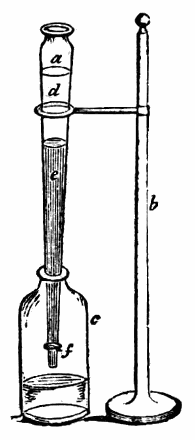
a. Percolator.
b. Stand.
c. Receiver.
d. Menstruum.
e. Substance operated on.
f. Calico strainer.
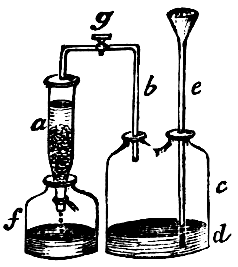
a. Percolator.
b. Tube connecting; it with—
c. A double-necked bottle containing—
d. Mercury.
e. Feeding-tube.
f. Receiver.
g. Stop-cock to regulate or arrest the pressure of air on the contents of the cylinder (a).
The method of displacement, although apparently simple, requires for its successful application no inconsiderable amount of experience and skill in manipulation. The principal points to be attended to are—the reduction of the substance to the proper state of comminution (neither too coarse nor too fine),—the due regulation of the period of maceration according to the hardness, density, and texture of the substance; and, more important still,—the proper packing of the ingredients in the cylinder. On the correct performance of the last the success of the process mainly depends. Some substances require considerable pressure to be used, whilst others, when even lightly packed, scarcely permit the fluid to pass through them. When the material is too loosely packed, the menstruum passes through quickly, but without exerting its proper solvent action; when too great pressure is employed, percolation either progresses very slowly or not at all. On the whole, the firmness of the packing should be inversely as the solvent and softening power of the menstruum upon the solids exposed to its action; but to this rule there are many exceptions, and each substance may be said to require special treatment. An excellent plan, applicable to all substances, and especially to those of a glutinous or mucilaginous nature, is to mix the powder with an equal bulk of well-washed siliceous sand before rubbing it up with the menstruum. In reference to the coarseness of the powder it must be observed that substances which readily become soft and pappy when wetted by the menstruum, should not be used so fine as those that are more woody and fibrous, and not of a glutinous or resinous nature.
The ‘method of displacement’ has the advantage of expedition, economy, and yielding products possessing considerable uniformity of strength; but the difficulties attending its application by the inexperienced are serious obstacles to its general adoption in the laboratory. It answers admirably for the preparation of all tinctures that are not of a resinous nature, and for most infusions of a woody and fibrous substances, as roots, woods, barks, leaves, seeds, insects, &c., and particularly when cold or tepid water is taken as the solvent. It is also especially adapted for the preparation of concentrated infusions and essences, as they may thus be obtained of any required strength without loss, or requiring concentration by heat, which is so destructive to their virtues.
“When (ordinary) tinctures are made in large quantities, displacement is never likely to supersede maceration, on account of any practical advantages it may possess. If the prescribed directions be duly attended to, the process of maceration is unexceptionable. The process is more simple than the other; the mode of operating is more uniform, it is, in fact, always the same; it requires less of skill and dexterity in conducting it; it requires less constant attention during its progress which, in operating on large quantities is a consideration; and, finally, the apparatus required is less complicated. When, however, only small quantities of tincture are made at a time, and kept in stock, the adoption of the process of displacement will often be found convenient and advantageous. It offers the means of making a tincture in two or three hours, which, by the other process, would require as many weeks.” (Mohr and Redwood.)
Another useful application of the method of displacement is to the manufacture of extracts on the large scale. Here it is superior to any other plan. By the simple and inexpensive forms of apparatus in block-tin, stoneware, or glass, which have recently been designed for the purpose, not merely a first-class product is ensured, but a great saving in fuel and labour is at the same time effected. The reader is referred to the last edition of the ‘United States Pharmacopœia,’ and to papers by Messrs Saunders and Schweitzer in the ‘Pharmaceutical Year Book for 1873,’ and by Mr Campbell in the same publication for 1874, for additional information in the subject of “Percolation.” See Brewing, Extract, Tincture, &c.
PERCUS′SION. Syn. Percussio, L. In medicine, the act of striking any part of
PERCUS′SION CAPS. The composition employed to prime these articles is noticed under Fulminating mercury.
PER′FECT LOVE. See Liqueur (Parfait amour).
PER′FUME. A substance that emits or casts off volatile particles which, when diffused through the atmosphere, agreeably affect the organs of smelling. The term is also applied to the volatile effluvia so perceived. The principal source of perfumes is the Vegetable Kingdom. Its flowers, seeds, woods, and barks furnish a rich variety, from which the most fastidious connoisseur may select his favourite bouquet. A few perfumes, as musk, ambergris, and civet, are derived from the Animal Kingdom; but none of these evolve an aroma comparable in freshness to that of the rose, or in delicacy to that of the orange-blossom, or even the unpretending jasmine. The Inorganic Kingdom yields not a single perfume, so called; nor has the science of chemistry yet been able to produce a single odoriferous compound from matter absolutely inorganic.
PERFU′′MERY. Perfumes in general; also the art of perfuming them. In its commercial application, this word embraces not merely perfumes, but also cosmetics, and other articles of a closely allied character employed at the toilet, the manufacture and sale of which constitute the trade of the modern perfumer. Formulæ for the preparation of all the more valuable perfumes, as well as of others met with in trade, both simple and compound, will be found under the heads Cosmetics, Depilatory, Essence, Hair dyes, Oils, Pastes, Pastils, Pomade, Spirit, Waters, &c., to which we refer the reader.
PERFUMES, ACE′TIC. See Vinegar.
Perfumes, Ammo′′niated. These may be prepared by simply adding a sufficient quantity of ammonia to the liquid perfumes. When the articles are to be distilled, a cheaper plan is to add about 5 dr. of sal ammoniac and 8 dr. of carbonate of potassa to each pint of the article just before distillation. Ammoniated Cologne water is now a fashionable substance for spirit of sal volatile.
PERIODIC ACID. Syn. Hydric periodate. (HIO4.) 1. By passing a current of chlorine gas through a solution of sodic iodate, containing caustic soda, in the proportion of 3 atoms of the latter to one atom of sodic iodate. The hydrated basic sodic periodate, which crystallises out, is dissolved in diluted nitric acid, and precipitated by the addition of argentic nitrate; a normal argentic periodate crystallises as the liquid cools, and this salt being treated with water, is decomposed into a basic argentic periodate, which is insoluble, and periodic acid, which is dissolved. By evaporating the solution, the periodic acid may be obtained in deliquescent, oblique, rhombic prisms, which are somewhat soluble in alcohol and in ether.
2. From perchloric acid by the action of iodine. See Iodine.
PERISTAL′TIC PERSUA′DERS. See Pills (Kitchener’s).
PER′MANENT WHITE. See Barium (Sulphate) and White pigments.
PERNAMBU′CO WOOD. Syn. Peach wood. The wood of Cæsalpinia echinata. It constitutes the paler variety of Brazil wood used by the dyers.
PER′RY. Syn. Pyraceum, L. A fermented liquor prepared from pears in the same way as cider is from apples. The red rough-tasted sorts are principally used for this purpose. The best perry contains about 9% of absolute alcohol; ordinary perry from 5 to 7%.
Perry is a very pleasant-tasted and wholesome liquor. When bottled ‘champagne fashion,’ we have seen it frequently passed off for champagne without the fraud being suspected.
PER′SIAN BER′RIES. See French berries.
PERSPIRA′TION. The liquid or vapour secreted by the ramifications of the cuticular arteries over the surface of the body. The perspiratory apparatus consists of a gland deeply seated in the corium, communicating by means of tubules (pores) with the surface of the scarf-skin.
The uses of the perspiratory functions appear to be to preserve the suppleness and sensibility of the skin, to maintain the temperature of the body at a uniform standard, and to remove from the system a number of compounds noxious to animal life. The perspiration “is a fluid whose regularity and continuance of exhalation are not merely conducive, but absolutely necessary, to health; without such regularity the animal temperature would run riot, and substances of an injurious quality would be allowed to permeate the finest and most delicate of the tissues of the body.” (Eras. Wilson.) “From the constriction or constipation of the cutaneous pores by the ambient air, especially when the body, beforehand put into a heat, is suddenly exposed thereunto, the serous particles which used to fly off continually in vapour, being now pent in, excite an intense and feverish effervescence; till, finding some other passage, either by the kidneys or by the glandules of the nose and windpipe, they are discharged by way of a catarrh; or, missing this separation, still keep up the ebullition, very often to the hazard of life, by suffocating the vital flame. And this is the natural consequence of obstructed insensible perspiration, which, in the vulgar phrase, is the same with what they mean by catching cold, and of which, give me leave to remark, that as fevers make two thirds of diseases infesting mankind, according to the computation of the
PERU′VIAN BALSAM. See Balsam of Peru.
PERU′VIAN BARK. See Cinchona.
PES′SARY. Syn. Pessum, Pessarium, L. An instrument made of caoutchouc, gutta percha, box-wood, or ivory, inserted into the vagina to support the mouth and neck of the uterus. They are variously formed, to meet the prejudices of the party or the necessities of the case. The cup, conical, globe, and ring pessaries (pessi) are those best known.
Medicated pessaries are prepared by adding the active ingredients to a hard cerate, and pressing the mixture into the desired form. Astringents (various), belladonna, acetate of lead, mercury, &c., have been thus applied by Dr Simpson and others.
The different formulæ are given below:—
Pessary, Alum. Syn. Pessus aluminis. Alum, catechu, wax, of each 1 dr.; lard, 51⁄2 dr.
Pessary, Belladonna. Syn. Pessus belladonnæ. Extract of belladonna, 10 gr.; wax, 221⁄2 gr.; lard, 11⁄2 dr.; in each pessary.
Pessary, Mercurial. Syn. Pessus hydrargyri. Strong mercurial ointment, 1⁄2 dr.; wax, 1⁄2 dr.; lard, 1 dr. Mix.
Pessary, Lead. Syn. Pessus plumbi. Acetate of lead, 71⁄2 gr.; white wax, 221⁄2 gr.; lard, 11⁄2 dr.
Pessary, Iodide of Lead. Syn. Pessus plumbi iodidi. Iodide of lead, 5 gr.; wax, 25 gr.; lard, 11⁄2 dr.
Pessary, Tannin. Syn. Pessus tannini. Tannin, 10 gr.; wax, 25 gr.; lard, 11⁄2 dr.
Pessary, Zinc. Syn. Pessus zinci. Oxide of zinc, 15 gr.; white wax, 221⁄2 gr.; lard, 11⁄2 dr.
PEST′ILENCE. See Plague.
PESTILEN′TIAL DISEASES. All those diseases which are epidemic and malignant and assume the character of a plague. See Cholera, &c.
PETONG′. Same as packfong.
PET′ROLENE. The pure liquid portion of mineral tar. It has a pale yellow colour, a penetrating odour, and a high boiling point; is lighter than water, and is isomeric with the oils of turpentine and lemons. In its general proportions it resembles rectified mineral naphtha.
PETRO′LEUM. Syn. Rock oil, Liquid bitumen, Oil of petre; Oleum petræ, Bitumen liquidum, L. Petroleum is an oil found oozing from the ground or obtained on sinking wells in the soil. To a limited extent it is met with in most countries of Europe and in the West India islands, but occurs in abundance in Pennsylvania and other parts of the United States and in Canada. It varies in colour from slight yellow to brownish black, in consistence from a thin mobile liquid to a fluid as thick as treacle, in specific gravity from 800 to 1100 (water being 1000) and is either clear and transparent or turbid and opaque. Petroleum is essentially a volatile oil, and when submitted to distillation yields gases homologous with light carburetted hydrogen of marsh-gas (Ronalds obtained three), liquids of similar constitution (Pelouze and Cahours isolated twelve), and solid paraffin-like bodies. Commercially petroleum is distilled so as to yield petroleum-spirit or mineral naphtha used as a substitute for turpentine and for burning in sponge-lamps and costermongers’ barrow-lamps; petroleum oil used all over the world as mineral lamp oil for illuminating purposes; and a heavy oil employed for lubricating machinery. The value of a sample of rock-oil is determined by thus distilling a weighed quantity in a small glass retort and weighing the products. The petroleum or middle product must be of such a character as to have a specific gravity not higher than 810 or 820 and to contain so little petroleum spirit that it only evolves inflammable vapour when heated to 100° Fahr. in the manner prescribed in the Petroleum Act, 1871 (see below). Any petroleum product or mineral oil which will not stand this test, and which is kept in larger bottles than one pint, and in larger total quantity than three gallons, cannot be stored or sold except by licence of the local authorities.
Directions for Testing Petroleum to ascertain the temperature at which it gives off inflammable vapour.
The vessel which is to hold the oil shall be of thin sheet iron; it shall be two inches deep and two inches wide at the opening, tapering slightly towards the bottom; it shall have a flat rim, with a raised edge one quarter of an inch round the top; it shall be supported by this rim in a tin vessel four inches and a half deep and four and a half inches in diameter; it shall also have a thin wire stretched across the opening, which wire shall be so fixed to the edge of the vessel that it shall be a quarter of an inch above the surface of the flat rim. The thermometer to be used shall have a round bulb about half an inch in diameter, and is to be graduated upon the scale of Fahrenheit, every ten degrees occupying not less than half an inch upon the scale.
The inner vessel shall be filled with the petroleum to be tested, but care must be taken that the liquid does not cover the flat rim. The outer vessel shall be filled with cold, or nearly cold water; a small flame shall be applied to the bottom of the outer vessel, and the thermometer shall be inserted into the oil so that the bulb shall be immersed about one and a half inches beneath the surface. A screen of pasteboard or wood shall be placed round the apparatus, and shall be of such dimensions
When heat has been applied to the water until the thermometer has risen to about 90° Fahr., a very small flame shall be quickly passed across the surface of the oil on a level with the wire. If no pale blue flicker or flash is produced, the application of the flame is to be repeated for every rise of two or three degrees in the thermometer. When the flashing-point has been noted, the test shall be repeated with a fresh sample of the oil, using cold, or nearly cold water as before; withdrawing the source of heat from the outer vessel when the temperature approaches that noted in the first experiment, and applying the flame test at every rise of two degrees in the thermometer. See Naphtha, Oils (Mineral), &c.
PEW′TER. This is an alloy of tin and lead, or of tin with antimony and copper. The first only is properly called pewter. Three varieties are known in trade:—
Prep. 1. (Plate pewter.) From tin, 79%; antimony, 7%; bismuth and copper, of each 2%; fused together. Used to make plates, teapots, &c. Takes a fine polish.
2. (Triple pewter.) From tin, 79%; antimon, 15%; lead, 6%; as the last. Used for minor articles, syringes, toys, &c.
3. (Ley pewter.) From tin, 80%; lead, 20%. Used for measures, inkstands, &c.
Obs. According to the report of the French commission, pewter containing more than 18 parts of lead to 82 parts of tin is unsafe for measures for wine, and similar liquors and, indeed, for any other utensils exposed to contact with our food or beverages. The legal sp. gr. of pewter in France is 7·764; if it be greater, it contains an excess of lead, and is liable to prove poisonous. The proportions of these metals may be approximately determined from the sp. gr.; but correctly only by an assay for the purpose. See Brass, German silver, Lead, and Tin.
PHARAOH’S SERPENTS. 1. The chemical toy sold under this name consists of the powder of sulphocyanide of mercury made up in a capsule of tin foil in a conical mass of about an inch in height.
Ignited at the apex an ash is protruded, long and serpentine in shape. The fumes evolved are very poisonous.
2. (Non-poisonous.) Bichromate of potassium, 2 parts; nitrate of potassa, 1 part; and white sugar, 3 parts. Pulverise each of the ingredients separately, and then mix them thoroughly. Make small paper cones of the desired size, and press the mixture into them. They will then be ready for use, but must be kept from light and moisture.
PHARMACY ACT. The following are the principal clauses of the Pharmacy Act of 1860 (31 and 32 Victoria, cap. cxxi). We have separated and placed last, those provisions of the Act which relate to the sale of poisons:—
Whereas it is expedient for the safety of the public that persons keeping open shop for the retailing, dispensing, or compounding of poisons, and persons known as chemists and druggists should possess a competent practical knowledge of their business, and to that end, that from and after the day herein named all persons not already engaged in such business should, before commencing such business, be duly examined as to their practical knowledge, and that a register should be kept as herein provided, and also that the Act passed in the 15th and 16th years of the reign of her present Majesty, intituled ‘An Act for Regulating the Qualification of Pharmaceutical Chemists,’ hereinafter described as the Pharmacy Act, should be amended: Be it enacted, by the Queen’s most excellent Majesty, by and with the advice and consent of the Lords Spiritual and Temporal and Commons in this present Parliament assembled, and by authority of the same, as follows:—
From and after the 31st day of December, 1868, it shall be unlawful for any person to sell or keep open shop for retailing, dispensing, or compounding poisons, or to assume or use the title ‘Chemist and Druggist,’ or chemist or druggist, or pharmacist, or dispensing chemist, or druggist, in any part of Great Britain, unless such person shall be a pharmaceutical chemist, or a chemist and druggist, within the meaning of this Act, and be registered under this Act, and conform to such regulations as to the keeping, dispensing, and selling of such poisons as may from time to time be prescribed by the Pharmaceutical Society with the consent of the Privy Council (Clause 1).
Chemists and druggists within the meaning of this Act shall consist of all persons who at any time before the passing of this Act have carried on in Great Britain the business of a chemist and druggist in the keeping of open shop for the compounding of the prescriptions of duly qualified medical practitioners, also of all assistants and associates, who before the passing of the Act shall have been duly registered under or according to the provisions of the Pharmacy Act, and also of all such persons as may be duly registered under this Act (Clause 3).
All such persons as shall from time to time have been appointed to conduct examinations under the Pharmacy Act shall be, and are hereby declared to be, examiners for the purposes of this Act, and are hereby empowered and required to examine all such persons as shall tender themselves for examination under the provisions of this Act,[93] and every person who shall have been examined by such examiners, and shall have obtained from them a certificate of competent skill, and knowledge, and qualification, shall be entitled to be registered as a chemist and druggist under this Act, and the examination aforesaid shall be
No name shall be entered in the register, except of persons authorised by this Act to be registered, nor unless the registrar be satisfied by the proper evidence that the person claiming is entitled to be registered; and any appeal from the decision of the registrar may be decided by the council of the Pharmaceutical Society; and any entry which shall be proved to the satisfaction of such council to have been fraudulently or incorrectly made may be erased from or amended in the register, by order in writing of such council (Clause 12).
“The registrar shall, in the month of January in every year, cause to be printed, published, and sold, a correct register of the names of all pharmaceutical chemists, and a correct register of all persons registered as chemists and druggists, and in such registers, respectively the names shall be in alphabetical order, according to the surnames, with the respective residences, in the form set forth in schedule (B) to this Act, or to the like effect, of all persons appearing on the register of pharmaceutical chemists, and on the register of chemists and druggists, on the 31st day of December last preceding, and such printed registers shall be called ‘The Registers of Pharmaceutical Chemists and Chemists and Druggists,’ and a printed copy of such registers for the time being, purporting to be so printed and published as aforesaid, or any certificate under the hand of the said registrar, and countersigned by the president or two members of the council of the Pharmaceutical Society, shall be evidence in all courts and before all justices of the peace and others, that the persons therein specified are registered according to the provisions of the Pharmacy Act or of this Act, as the case may be, and the absence of the name of any person from such printed register shall be evidence, until the contrary shall be made to appear, that such person is not registered according to the provisions of the Pharmacy Act or of this Act (Clause 13).
From and after the 31st day of December, 1868, any person who shall sell or keep an open shop for the retailing, dispensing, or compounding poisons, or who shall take, use, or exhibit the name or title of chemist and druggist, or chemist or druggist, not being a duly registered pharmaceutical chemist, or chemist and druggist, or who shall take, use, or exhibit the name or title pharmaceutical chemist, pharmaceutist, or pharmacist, not being a pharmaceutical chemist, or shall fail to conform with any regulation as to the keeping or selling of poisons, made in pursuance of this Act, or who shall compound any medicines of the British Pharmacopœia, except according to the formularies of the said Pharmacopœia, shall for every such offence be liable to pay a penalty or sum of £5, and the same may be sued for, recovered, and dealt with in the manner provided by the Pharmacy Act for the recovery of penalties under that Act; but nothing in this Act contained shall prevent any person from being liable to any other penalty, damages, or punishment to which he would have been subject if this Act had not been passed (Clause 15).
Clauses of the Pharmacy Act relating to the sale of Poisons.
It shall be unlawful to sell any poison either by wholesale or retail, unless the box, bottle, vessel, wrapper, or cover in which such poison is contained be distinctly labelled with the name of the article and the word poison, and with the name and address of the seller of the poison; and it shall be unlawful to sell any poison of those which are in the first part of schedule (A) to this Act, or may hereafter be added thereto under section II of this Act, to any person unknown to the seller, unless introduced by some person known to the seller; and on every sale of any such article the seller shall, before delivery, make or cause to be made an entry in a book to be kept for that purpose, stating, in the form set forth in schedule (F) to this Act, the date of the sale, the name and address of the purchaser, the name and quantity of the article sold, and the purpose for which it is stated by the purchaser to be required, to which entry the signature of the purchaser and of the person, if any, who introduced him, shall be affixed; and any person selling poison otherwise than is herein provided, shall, upon a summary conviction before two justices of the peace in England or the sheriff in Scotland, be liable to a penalty not exceeding £5 for the first offence, and to a penalty not exceeding £10 for the second or any subsequent offence; and for the purposes of this section the person on whose behalf any sale is made by any apprentice or servant shall be deemed to be the seller, but the provisions of this section, which are solely applicable to poisons in the first part of the schedule (A) to this Act, or which require that the label shall contain the name and address of the seller, shall not apply to articles to be exported from Great Britain by wholesale dealers, nor to sales by wholesale to retail dealers in the ordinary course of wholesale dealing, nor shall any of the provisions of this section apply to any medicine supplied by a legally qualified apothecary to his patient, nor apply to any article when forming part of the ingredients of any medicine dispensed by a person registered under this Act provided such medicine be labelled in the manner aforesaid with the name and address
Schedule (A).
Part 1.
Arsenic and its preparations.
Prussic acid.
Cyanide of potassium and all metallic cyanides.
Strychnine and all poisonous vegetable alkaloids and their salts.
Aconite and its preparations.
Emetic tartar.
Corrosive sublimate.
Cantharides.
Savin and its oil.
Ergot of rye and its preparations.
Part 2.
Oxalic acid.
Chloroform.
Belladonna and its preparations.
Essential oil of almonds, unless deprived of its prussic acid.
Opium and all preparations of opium or of poppies.
By virtue and in exercise of the powers vested in the council of the Pharmaceutical Society of Great Britain, the said council do hereby resolve and declare that each of the following articles, viz.—
Preparations of prussic acid,
Preparations of cyanide of potassium and of all metallic cyanides,
Preparations of strychnine,
Preparations of atropine,
Preparations of corrosive sublimate,
Preparations of morphine,
Red oxide of mercury (commonly known as red precipitate of mercury),
Ammoniated mercury (commonly known as white precipitate of mercury),
Every compound containing any poison within the meaning of ‘The Pharmacy Act, 1868,’ when prepared or sold for the destruction of vermin,
The tincture and all vesicating liquid preparations of cantharides,
—ought to be deemed a poison within the meaning of the ‘Pharmacy Act, 1868,’ and also that of the same each of the following articles, viz.—
Preparations of prussic acid,
Preparations of cyanide of potassium and of all metallic cyanides,
Preparations of strychnine,
Preparations of atropine,
—ought to be deemed a poison in the first part of the schedule (A) to the said ‘Pharmacy Act, 1868,’
And notice is hereby also given, that the said Society have submitted the said resolution for the approval of the Lords of Her Majesty’s Council, and that such approval has been given.
By order, Elias Bremridge, Secretary and Registrar of the Pharmaceutical Society of Great Britain.
And whereas the council of the Pharmaceutical Society of Great Britain did, on the 17th day of November, 1877, resolve and declare in the words following:—
“That by virtue and in exercise of the powers vested in the council of the Pharmaceutical Society of Great Britain, the said council does hereby resolve and declare that Chloral Hydrate and its preparations ought to be deemed poisons within the meaning of the ‘Pharmacy Act, 1868,’ and ought to be deemed poisons in the second part of the schedule (A) of the said ‘Pharmacy Act, 1868.’”
And whereas the said Society have submitted the said resolution for the approval of the Privy Council, and the Lords of the Privy Council are of opinion that the said resolution should be approved.
Now, therefore, their Lordships are hereby pleased to signify their approval of the said resolution.
C. L. Peel.
Tardieu states that of late years the criminal administration of phosphorus has increased considerably in France. For example, from 1851 to 1872, in 793 cases of poisoning, 287 or 36·2 per cent. were due to arsenic, and 267 or 31·1 per cent. to phosphorus; whilst in the years 1872 and 1874, in 141 criminal poisonings by arsenic and phosphorus, only 74 were due to arsenic. The explanation of these facts may reasonably be ascribed to the much greater facility with which phosphorus, in the form of matches or vermin pastes, can be procured than arsenic.
PHE′NOL. C6H6O. See Carbolic acid.
PHE′NYL. C6H5. The hypothetical compound radical of the phenyl-series. Carbolic acid is said to be its hydrate.
PHENYL′AMINE. C6H5H2N. Aniline is sometimes so named on account of its relation to the phenyl series.
PHIALS. The ordinary green moulded phials used by the pharmaceutist are made of a glass obtained from common river sand and soapboilers’ waste. In the manufacture of the glass for the white phials purer materials (and these as free from iron and alumina as possible) are used. Decolourising agents are also employed. The following is given as the composition of a white glass for apothecaries’ phials in ‘Chemistry: Theoretical, Practical, and Analytical,’[94]
100 lbs. white sand.
30-26 ” potash, impure.
17 ” lime.
110-120 ” ashes.
·25 to ·5 lbs. binoxide of manganese-cullet.
Phials, Bologna. Small flasks or phials of unannealed glass, which fly to pieces when their surface is scratched by a hard body. Thus, if a small piece of flint be dropped into them they are shivered; whereas if a bullet be used they remain uninjured.
PHILO′NIUM. The ancient name of an aromatic opiate, reputed to possess many virtues, invented by Philo. See Confection of Opium.
PHILOS′OPHER’S STONE. Syn. Lapis philosophorum, L. A wonderful substance, the discovery of which formed the day dreams of the alchemists. It was supposed to be capable of converting all the baser metals into gold, and of curing all diseases. Some of the alchemists appear to have laboured under the delusion that they had actually discovered it. The last of these enthusiasts was the talented and unfortunate Dr Price, of Guildford. Speaking of the age of alchemy, Liebig says:—“The idea of the transmutability of metals stood in the most perfect harmony with all the observations and all the knowledge of that age, and in contradiction to none of these. In the first stage of the development of science, the alchemists could not possibly have any other notions of the nature of metals than those which they actually held.... We hear it said that the idea of the philosopher’s stone was an error; but all our views have been developed from errors, and that which today we regard as truth in chemistry may, perhaps, before to-morrow, be regarded as a fallacy.”
PHILOSOPH′IC CANDLE. An inflamed jet of hydrogen gas.
PHILOSOPHIC WOOL. Flowers of zinc.
PHIL′TRE. Syn. Philtrum, L. A charm or potion to excite love. The ancients had great faith in such remedies. Nothing certain is now known respecting their composition; but there is sufficient evidence that recourse was frequently had to them by the ancients, and that “their operation was so violent that many persons lost their lives and their reason by their means.” The Thessalian philtres were those most celebrated. (Juv., vi, 610, &c.) At the present day the administration of preparations of the kind is interdicted by law.
PHLORE′TIN. C15H14O5. A crystallisable, sweet substance, formed along with grape sugar, when phloridzin is acted on by dilute acids.
PHLORID′ZIN. C21H24O10. Syn. Phlorizine; Phloridzinum, L. Prep. By acting on the fresh root-bark of the apple, pear, or plum tree, with boiling rectified spirit; the spirit is distilled off, and the phloridzin crystallises out of the residual liquor as it cools.
Prop., &c. Fine, colourless, silky needles, freely soluble in rectified spirit and in hot water, but requiring 1000 parts of cold water for its solution; its taste is bitter and astringent. When its solution is boiled with a little dilute sulphuric acid or hydrochloric acid, it is changed into grape sugar and phloretin.
Phloridzin bears a great likeness to salicin. It is said to be a powerful febrifuge.—Dose, 3 to 15 gr.
PHOCE′NIC ACID. See Delphinic acid.
PHŒNIC′INE. See Indigo purple.
PHO′NOGRAPH. Some years back Prof. Faber, of Vienna, constructed and exhibited in the chief cities of Europe ‘a talking machine,’ which was able to articulate simple words and sentences with considerable distinctness. The complex mechanism by which this was effected was contrived upon the principles of the human organs of speech, as the machine possessed an india-rubber tongue and lips, and an artificial larynx, made out of a thin vibrating tube of ivory. Faber’s automaton, although of much greater scientific interest than the automatic flute and flageolet players of Vancanson, the trumpeter of Droz, and similar exhibitions of curious workmanship, was, like these, only a mechanical curiosity, without any promise of a useful application.
Entirely distinct from Faber’s machine, not only structurally and in the method by which it produces its effects, but also in the end
The first impression that will occur to those who having heard Mr Edison’s instrument speak have subsequently made themselves acquainted with its construction, will probably be one of surprise that an effect so apparently startling as that which it has been able to produce should be accomplished by means so simple.
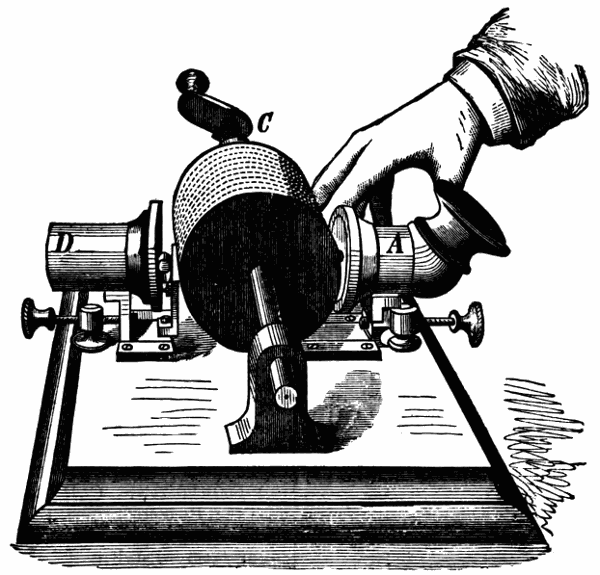
B is a brass cylinder, through whose centre passes a metal shaft, the arms of which rest on upright supports, one of which is shown in the engraving. The arm of the shaft, obscured from view, corresponding in length with the part of it which is visible, is screw-turned, and it works in a nut bored out of the support. Attached to the screw-end of the shaft or axle is a crank C, by turning which a double movement, viz. a rotatory and a horizontal one, may be simultaneously imparted to the cylinder. Round the surface of the cylinder is cut a spiral groove corresponding in dimensions with the threads of the screw part of the shaft. Covering the whole of the cylinder is a sheet of tin-foil, which is secured to its edges by means of shell-lac varnish. In front of the cylinder, resting on a proper support, is a mouth-piece, A, at the bottom of which (the end nearest the cylinder) is a very thin plate or diaphragm of metal, and to this diaphragm is attached a round steel point, which when not in use does not touch the foil. Previously to using the apparatus this steel point has to be accurately adjusted opposite to that part of the foil lying over the spiral groove. If now the lips be applied to the mouth-piece, and any sentence be spoken, the crank being at the same time turned, the vibrations imparted to the metal plate by the voice will cause the steel point to come into contact with that part of the foil overlying the groove in the cylinder, and to make on the foil a number of indentations, as it revolves, and is carried forward laterally before the mouth-piece. Furthermore these indentations will be found to vary in depth and sectional outline according to the nature of the vibrations which have produced them; and as experiment proves, are the specific and infallible caligraphy of those vibrations.
“It might be said that at this point the machine has already become a complete phonograph or sound writer, but it yet remains to translate the remarks made. Now, there is no doubt that by practice and the aid of a magnifier it would be possible to read phonetically Mr Edison’s record of dots and dashes,[95] but he saves us that trouble by literally making it read itself. The distinction is the same, as if, instead of perusing a book ourselves, we drop it into a machine, set the latter in motion, and behold! the voice of the author is heard repeating his own composition. The reading mechanism is nothing but another diaphragm, held in the tube D, on the opposite side of the machine, and a point of metal, which is held against the tin-foil on the cylinder by a delicate spring.
“It makes no difference as to the vibrations produced, whether a nail moves over a file or a file moves over a nail, and in the present instance it is the foil or indented foil-strip which moves, and the metal point is caused to vibrate as it is affected by the passage of the indentations. The vibrations, however, of this point must be precisely the same as those of the other points which made the indentations, and these vibrations transmitted to a second membrane, must cause the latter to vibrate similar to the first membrane, and the result is a synthesis of the sounds, which in the beginning we saw, as it were, analysed.”[96]
In some of the later instruments, that section of the apparatus shown at D is dispensed with, and the reproduction of the spoken words or sentences is effected by bringing the cylinder back to its original starting point, opposite to the little steel projection attached to the metal disc at the end of the mouth-piece A. The steel point is then brought by means of a screw into contact with the foil,D. For the diaphragm, more particularly when employed as a resonator or reproducer of the words which have been spoken into the mouth-piece, other substances than metal have been tried, with, it is said, more satisfactory results. One of these is paper, the sounds given off by which are stated to be more distinct than those from iron.
Dr Clarence Holt, of Boston, in a communication to Mr W. H. Preece, writes that he has “constructed a diaphragm upon the principle of the membrane of the human drum of the ear, to be used as a reproducing disc.” Dr Holt continues “that his object was to employ a membrane which from its structure and shape would reproduce the lighter over-tones representing the quality of the voice, and at the same time cut off the sharper exaggerated over-tones embossed as such by the metal disc upon the tinfoil. He says the results of his experiments with such a membrane were very gratifying, and that the material of which it may be made should be either stout felted paper (to be varnished on the outer surface when used for speaking) or drum head moistened and pressed into a concave form before using.”[97]
The crank (shown in the figure) by which the cylinder is turned is very frequently supplanted by an apparatus consisting of weights and wheels, or else by clockwork, whereby the cylinder is put in motion. The advantage of the working of these arrangements over that of the crank are, that instead of an inequality a regularity of movement of the cylinder is ensured, and it is thus made to advance at the same rate whilst the words are being reproduced as when they are being spoken.
One of the effects of this uniformity of the rotation of the cylinder under its two modes of action is to reproduce the exact pitch or tone of the voice of the speaker, although a departure from it would in no way affect the delivery of the exact words.
Accordingly, therefore, to the difference in the rate of movement of the cylinder during the reception and reproduction of speech, will be the divergence in tone between the original and the reproduced voice. If the cylinder were moved more quickly in redelivering the words the result would be that they would be in a higher, and, in the opposite case, in a lower key. Probably, as one writer has suggested, the curious effect might be produced of a child’s voice being converted into a man’s deep base, or vice versâ.
In view of the results of previous scientific discoveries, we should not be justified in refusing to admit the possibility, at any rate, of the realisation of some of the applications to which its inventor believes the phonograph will, in the course of time, be put.
It must be admitted that these predictions as to its ultimate capabilities are sufficiently wondrous. They are that—the phonograph will be able to record and reproduce at a future time any air sung to it, so that the vocal triumphs of some of our most accomplished singers may be preserved and resung after their death; that by its means may also be conserved and respoken, likewise after death, a speech delivered by a great statesman or orator; that a dying testator by breathing into it his last wishes may have these securely registered, to be expressed after his demise, if need be, in a court of justice; and that the contents of a book or novel may be read to us in the very accents of its author, long after he has passed away.
Although we have no testimony that anything like an approach to the above results has been obtained by this instrument, such statements as we possess of its action are not a little surprising.
“Mr Thomas Edison,” says the ‘Scientific American,’ describing this contrivance, “recently came into our office, placed a little machine on our desk, turned a crank, and the machine inquired as to our health, asked how we liked the phonograph, informed us that it was well, and bid us a cordial good night. These remarks were not only perfectly audible to ourselves, but to a dozen or more persons gathered round.”
At a meeting of the Physical Society of London, held on the 2nd of March, 1878, when the phonograph was exhibited, the sounds it gave out are said to have been remarkably distinct; and when “God Save the Queen” was sung as a duet through a double mouth-piece, the two voices could be clearly distinguished on the air being reproduced.
The writer was at the Royal institution in Albemarle Street a short time previous to the above date, and although sitting in the top gallery, heard it emit very distinctly the line “Come into the garden, Maud,” spoken by Professor Tyndall in compliment to the Laureate, who was present as well as various other vocal reproductions. The secondary sound, however, was less powerful than the original one. The difference between the two is aptly described by a writer in ‘Nature,’ as causing a feeling like that of looking upon a worn print and an early wood engraving.
“The main utility of the phonograph,” says Mr Edison, “being for the purpose of letter-writing, and other forms of dictation, the design is made, with a view to its utility for that purpose.
“The general principles of construction are a flat plate or disc, with spiral groove on the face, operated by clockwork underneath the
“The practical application of this form of phonograph for communications is very simple. A sheet of foil is placed in the phonograph, the clockwork set in motion, and the matter dictated in the mouth-piece, without other effort than when dictating to a stenographer. It is then removed, placed in a suitable form of envelope, and sent through the ordinary channels to the correspondent for whom designed. He, placing it upon his phonograph, starts his clockwork, and listens to what his correspondent has to say. Inasmuch as it gives the tone of voice of his correspondent it is identified. As it may be filed away as other letters and at any subsequent time reproduced, it is a perfect record. As two sheets of foil have been indented with the same facility as a single sheet, ‘the writer’ may thus keep a duplicate of his communication.
“The phonograph letters maybe dictated at home or in the office of a friend, the presence of a stenographer not being required. The dictation may be as rapid as the thoughts can be formed, or the lips utter them. The recipient may listen to his letters being read at the rate of 150 to 200 words per minute, and at the same time busy himself about other matters. Interjections, explanations, emphasis, exclamations, &c., may be thrown into such letters ad libitum.
“The advantages of such an innovation upon the present slow, tedious, and costly methods are too numerous, and too readily suggest themselves, to warrant their enumeration; while there are no disadvantages which will not disappear coincident with the general introduction of the new method.”[98]
PHOS′GENE GAS. See Chlorocarbonic acid.
PHOS′PHATE. Syn. Phosphas, L. A salt of phosphoric acid. See Phosphoric acid and the respective metals.
PHOS′PHIDE. See Phosphuret.
PHOS′PHITE. Syn. Phosphis, L. A salt of phosphorous acid. See Phosphorous acid.
PHOS′PHORUS. P.
Prep. This is now only conducted on the large scale:—Bone-ash (in powder), 12 parts, and water 24 parts, are stirred together in a large tub until the mixture is reduced to a perfectly smooth ‘pap,’ oil of vitriol, 8 parts, is then added in a slender stream, active stirring being employed during the whole time, and afterwards until the combination appears complete; the next day the mass is thinned with cold water, and, if convenient, heated in a leaden pan or boiler until it has entirely lost its granular character; it is now transferred to one or a series of tall casks (according to the extent of the batch), and further diluted with a large quantity of water; after repose, the clear liquid is decanted, the sediment washed with water, and the ‘washings’ and ‘decanted liquor’ evaporated in a leaden or copper boiler until the white calcareous deposit (gypsum) becomes considerable; the whole is then allowed to cool, the clear portion decanted, and the sediment thoroughly drained on a filter; the liquid thus obtained is evaporated in an iron pot to the consistence of a thick syrup (say 4 parts), when dry charcoal (in powder), 1 part, is added, and the desiccation continued until the bottom of the pot becomes nearly red hot, after which it is covered over and allowed to cool; the dry mixture, when cold, is put into one or more earthen retorts well covered with ‘luting’ and properly dried, and heat is applied (sideways rather than at the bottom) by means of a good air-furnace; after a short time the beak of the retort is connected with a copper tube, the other end of which is made to dip about one fourth of an inch beneath the surface of some lukewarm water placed in a trough or wide-mouthed bottle.
The distilled product is purified by squeezing it through chamois leather under warm water, and is then moulded for sale by melting it under water heated to about 145° Fahr., and sucking it up to any desired height in slightly tapering, but perfectly straight, glass tubes, previously warmed and wetted. The bottom of the tube being now closed with the finger, it is withdrawn, and transferred to a pan of cold water to congeal the phosphorus, which will then commonly fall out, or may be easily expelled by pressure with a piece of wire.
Prop. &c. Phosphorus in its normal condition is a pale yellow, semi-transparent, and highly combustible solid; soft and flexible at common temperatures; it becomes waxy at about 75° Fahr.; melts at about 111°, and boils at 550° Fahr.; it takes fire in the air at 165°, and oxidates at all temperatures above 32°. Exposed to the air below 60°, its surface is slowly converted into phosphorus acid. It is apparently insoluble in water, but it conveys its peculiar flavour and odour to that fluid when agitated with it; it is slightly soluble in ether, naphtha, and the fixed and volatile oils, and more freely so in bisulphide of carbon. It unites with oxygen, forming oxides, and with oxygen and hydrogen, forming acids, and with the metals, forming phosphides.
Phosphorus is remarkable for assuming several allotropic forms. In one of these forms (amorphous phosphorus) its properties are so altered that they might be those of a distinct element.
Uses. The principal consumption of phosphorus is in the manufacture of lucifer matches.
Concluding Remarks. From the great inflammability of phosphorus it can only be safely preserved under water. In commerce, it is always packed in tin cylinders filled with water, and soldered up air-tight. The leading points to be observed to ensure success in this manufacture are chiefly connected with the firing. The heat of the furnace should be most slowly raised at first, but afterwards equably maintained in a state of bright ignition. After 3 or 4 hours of steady firing, carbonic and sulphurous anhydride are evolved in considerable abundance, provided the materials had not been well dried in the iron pot; then sulphuretted hydrogen makes its appearance, and next phosphuretted hydrogen, which last should continue during the whole of the distillation. The firing should be regulated by the escape of this remarkable gas, which ought to be at the rate of about two bubbles per second. If the discharge comes to be intercepted, it is to be ascribed either to the temperature being too low, or to the retort getting cracked; and if, upon raising the heat sufficiently, no bubbles appear, it is a proof that the apparatus has become defective, and that it is needless to continue the operation. We may infer that the process approaches its conclusion by the increasing slowness with which the gas is disengaged under a powerful heat; and when it ceases to come over we may cease firing, taking care to prevent reflux of water into the retort (and consequent explosion), from condensation of its gaseous contents, by admitting air into it through a recurved glass tube, or through the tube of the copper adapter. The usual period of the operation, upon the great scale, is from 24 to 30 hours.
Phosphorus, Amor′phous. Syn. Red phosphorus, Allotropic phosphorus; Phosphorus fuscus, P. ruber. L. This is phosphorus in that peculiar condition to which Berzelius has applied the term “allotropic.” The honour of its discovery is due to Dr Shrötter, of Vienna.
Prep. The ordinary phosphorus of commerce, rendered as dry as possible, is placed in a shallow vessel of hard and well-annealed Bohemian glass, fitted with a safety tube just dipping beneath the surface of a little hot water contained in an adjacent vessel; heat is then applied by means of a metallic bath (a mixture of lead and tin), the temperature of which is gradually raised until it ranges between 464 and 482° Fahr., and bubbles of gas escape from the end of the safety tube and catch fire as they come in contact with the air; this temperature is maintained until the amorphous condition is produced, the length of the exposure being regulated by a miniature operation with tubes conducted in the same bath; as soon as this point is reached, the apparatus is allowed to cool, and the amorphous phosphorus, which still contains some unconverted phosphorus, detached from the glass; it is then reduced to powder by careful trituration under water, drained on a calico filter, and, whilst still moist, spread thinly on shallow trays of iron or lead; in this state it is exposed, with frequent stirring, to heat in a chloride of calcium bath, at first gentle, and then gradually increased to its highest limit, and the heat continued until no more luminous vapour escapes; the residuum on the trays is then cooled, washed with water until this last ceases to affect test paper, and is, lastly, drained and dried. To render it absolutely free from unaltered phosphorus, it may be washed with bisulphide of carbon.
On the small scale, common phosphorus may be converted into amorphous phosphorus by simply exposing it for 50 or 60 hours to a temperature of about 473° Fahr., in any suitable vessel from which the air is kept excluded by a stream of carbonic acid, or any other gas which is unable to act chemically on the phosphorus.
By keeping common phosphorus fused at a high temperature, under the above conditions, for fully 8 days, compact masses of amorphous phosphorus may be obtained.
Prop., &c. A reddish brown, infusible, inodorous, solid substance, which is reconverted into ordinary phosphorus by simply exposing it to a heat a little above 500° Fahr. It is unaltered by atmospheric air; is insoluble in bisulphide of carbon, alcohol, ether, or naphtha; is non-luminous in the dark below about 390° Fahr.; and does not take fire at a lower temperature than that necessary for its reconversion into the common or crystalline form. The sp. gr. ranges between 2·089 to 2·017, according to the method of preparing it. Its properties render it an admirable substitute for the common phosphorus in the composition for tipping matches, both as regards security from spontaneous ignition and the health of the manufacturers, who when exposed to the fumes of ordinary phosphorus, were very liable to be attacked with caries of the lower jaw.
Phosphorus, Trichloride of. PCl3. Syn. Phosphorus terchloride, Phosphorus chloride. By gently heating phosphorus, in excess, in dry chlorine gas; or by passing the vapour of phosphorus through a stratum of
Phosphorus, Pentachloride of. PCl5. Syn. Phosphoric chloride, Perchloride Of Phosphorus.
Prep. By the spontaneous combustion of phosphorus in an excess of dry chlorine; or by passing a stream of dry chlorine into the liquid terchloride. By the first method it is obtained as a white crystalline sublimate; by the second, as a solid crystalline mass. It is volatile; water resolves it into phosphoric acid and hydrochloric acid.
Phosphorus, Oxychloride of. PCl3O. Syn. Phosphoric oxychloride, Phosphoric monoxychloride.
Prep. By heating pentachloride of phosphorus with a quantity of water insufficient to convert it into phosphoric acid. It is a colourless, fuming liquid, having the sp. gr. 1·7.
Phosphorus, Hydride of. PH3. Syn. Phosphoretted hydrogen, Phosphuretted hydrogen.
Prep. 1. Phosphorus acid is gently heated in a retort, and the first portion of the gas collected.
2. From phosphorus (in small lumps) boiled in a solution of hydrate of potassium or milk of lime, contained in a small retort, as before. Take a very small thin retort, capable of holding not more than 1 oz. or 11⁄2 oz. of water; place in this 3 or 4 fragments of the sticks of fused hydrate of potassium, each being about 1⁄2 inch in length; add as much water as will barely cover them, and then drop in a small fragment of phosphorus, about the size of a horse-bean; apply a very gentle heat with the small flame of a spirit lamp, agitating the retort continually. A pale lambent flame will first appear in the interior, and when this reaches the orifice, and burns in the open air, the retort should be placed on the stand with its beak about an inch under water. Care must be taken not to withdraw the flame of the lamp. When the bubbles of the gas rise to the surface they spontaneously inflame.
3. From phosphide of calcium and dilute hydrochloric acid, as above; or simply from the phosphide thrown into the water.
Obs. The gas obtained by methods 2 and 3 is contaminated with the vapour of a liquid phosphide of hydrogen, PH2, which gives to it the property of spontaneous inflammability.
Prop., &c. Colourless; very fetid; slightly soluble in water; burns with a white flame; decomposed by light, heat, and strong acids; as commonly prepared, inflames on contact with air, at ordinary temperatures, but when pure, only at the heat of boiling water. Sp. gr. 1·24. It is rendered quite dry by standing over fused chloride of calcium.