A CYCLOPÆDIA OF PRACTICAL RECEIPTS, &c. VOLUME II (continued 2)
Reading edition
Ferrous Arsenite. Fe(AsO2)2. Syn. Ferri arsenis, L. From the potassium arsenite, and ferrous sulphate, as the last. A yellowish-brown powder, occasionally used in medicine as a tonic, alterative, and febrifuge.—Dose, 1⁄16 to 1⁄12 gr.
Ferrous Bromide. FeBr2. Syn. Ferri bromidum, L. Prep. (Moir.) Bromine and iron filings, of each 1 part; water, 3 parts; mix in a stoppered phial, set it aside, occasionally shaking it, for 2 or 3 days, and when the colour of the bromine has disappeared, and the liquid becomes greenish, filter and evaporate to dryness.—Dose, 1 to 6 gr., as a tonic, diuretic, and resolvent, in similar cases to those in which iodide of iron is given.
Ferrous Carbonate. Fe(CO3). Syn. Protocarbonate of iron; Ferri carbonas, F. subcarbonas, L. This occurs in nature as SPATHOSE ORE, the chief constituent as of CLAY IRONSTONE, and in many CHALYBEATE WATERS.
Prep. (B. P.) Ferrous sulphate (sulphate of iron), 2; ammonium carbonate, 11⁄4; boiling distilled water, 320; refined sugar, 1. Dissolve the sulphate and ammonium carbonate each in 1⁄4 of the water, and mix; allow to stand for 24 hours and decant, of the clear solution, add the remainder of the water to the precipitate, stir well, allow to settle, and decant off. Collect the deposit in a calico filter, press, rub in the sugar in a porcelain mortar, and dry at a temperature not exceeding 212° Fahr. Small coherent grey lumps. Precipitate a solution of ferrous sulphate with a solution of sodium carbonate, well wash the green powder with water which has been boiled, and dry it out of contact with the air. On the slightest exposure to air it is converted into ferrous hydrate or oxide. This change is for the most part prevented by combining it with sugar, as in the following preparation.
With sugar: Ferri carbonas saccharata, B. P.; SACCHARINE C. OF I.; FERRUM CARBONICUM SACCHARATUM, FERRI CARBONAS CUM SACCHARO—Ph. L., FERRI CARBONAS SACCHARATUM—Ph. E. & D. L.—(Ph. L.) Ferrous sulphate, 4 oz.; sodium carbonate, 41⁄4 oz.; dissolve each separately in quart of boiling water, and mix the solutions whilst hot; after a time collect the precipitate, wash it frequently with water, and add of sugar, 2 oz., previously dissolved in water, 2 fl. oz.; lastly, evaporate the mixture over a water bath to dryness, and keep it in a well-closed bottle.
Prop., &c. A sweet-tasted greenish mass or powder, consisting chiefly of carbonate of iron. It is one of the best of the chalybeates.—Dose, 5 to 10 gr. When pure, it should be easily soluble in hydrochloric acid with brisk effervescence.
Ferrous Chloride. FeCl2. Syn. Protochloride of iron; Muriate of iron; Ferri chloridum, L. Prep. 1. (Anhydrous.) By passing dry hydrochloric acid gas over ignited metallic iron. The chloride sublimes in yellowish crystals.
2. (Hydrated.) Dissolve iron filings or scale in hydrochloric acid, evaporate and crystallise. Soluble green crystals.
Ferrous Citrate. Fe3(C6H5O7)2. Syn. Protocitrate of iron, Citrate of protoxide of iron. This salt is easily formed by digesting iron filings or wire with citric acid, and evaporating the solution as quickly as possible out of contact with the air. It presents the appearance of a white powder, nearly insoluble in water, and rapidly passing to a higher state of oxidation by exposure to the air. Its taste is very metallic. It is exhibited under the form of pills, mixed with gum or syrup, to prevent it from being prematurely decomposed.
Ferrous Ferricy′anide. Syn. Ferridcyanide of iron. Prep. By adding a solution of potassium ferricyanide (‘red prussiate of potash’) to a solution of ferrous sulphate (or any other soluble ferrous salt), and collecting and drying and precipitate. A bright-blue powder. (See Turnbull’s blue.)
Ferrous Hydrate. Fe2(HO)2. See under Ferrous oxide.
Ferrous Hydrate. Fe(HO)2. May be precipitated from ferrous solutions as a white powder, by alkaline hydrates. It rapidly absorbs oxygen, and turns first green, and
Ferrous Hypophosphite. Syn. Ferri hypophosphis. From the double decomposition of hypophosphite of lime and sulphate of iron, as hypophosphite of potash.
Ferrous Iodide. FeI2. Syn. Protoiodide of iron, Iodide of iron; F. iodidum, Ferri hydriodas, F. ioduretum, L. Prep. (B. P.) Fine iron wire, 1; iodine, 2; distilled water, 10. Introduce the iron, iodine, and 8 of water into a flask, heat it about ten minutes, and boil until all the red colour is gone. Filter through paper into a polished iron dish, washing with the rest of the water, and boil until a drop of the solution taken out on iron wire solidifies on cooling. Pour on porcelain and cool. (Ph. L. 1836.) Iodine, 6 oz.; iron filings, 2 oz.; water, 41⁄2 pints; mix, boil in a sand bath until the liquid turns to a pale green, filter, wash the residuum with a little water, evaporate the mixed liquors in an iron vessel at 212° Fahr. to dryness, and immediately put the iodide into well-stoppered bottles.
Iodine, 1 oz., and clean iron filings or turnings, 1⁄2 oz., are put into a Florence flask with distilled water, 4 fl. oz., and having applied a gentle heat for 10 minutes, the liquid is boiled until it loses its red colour; it is then at once filtered into a second flask, the filter washed with water, 1 fl. oz., and the mixed liquid is boiled down, until it solidifies on cooling.
With sugar: Saccharine iodide of iron, Saccharum ferri iodidi, Ferri iodidum saccharatum, L. Iron (in powder), 1 dr.; water, 5 dr.; iodine, 4 dr.; obtain a solution of iodide of iron, as above, and add to it of sugar of milk (in powder), 11⁄4 oz.; evaporate at a temperature not exceeding 122° Fahr., until the mass has a tenacious consistence, then further add of sugar of milk, 1 oz., reduce the mixture to powder, and preserve it in a well-stoppered bottle. Every 6 gr. contains 1 gr. of iodide of iron.
From “syrup of iodide of iron” exposed in a shallow vessel, in a warm place, until it crystallises; the crystals are collected, dried, and powdered. A simpler plan is to gently evaporate the whole to dryness, and to powder the residuum. The saccharine iodide may be kept for some time in a corked bottle without undergoing decomposition.
Obs. The preparation of the above compound, like that of the citrates, has formed a fertile subject during some years for pharmaceutical amateurs to dilate upon. There is in reality not the least difficulty in the process. As soon as iodine and iron are mixed together under water much heat is evolved, and if too much water be not used the combination is soon complete, and the liquor merely requires to be evaporated to dryness, out of contact with the air, at a heat not exceeding 212° Fahr. This is most cheaply and easily performed by employing a glass flask, with a thin broad bottom and a narrow mouth, by which means the evolved steam excludes air from the vessel. The whole of the uncombined water may be known to be evaporated when vapour ceases to condense on a piece of cold glass held over the mouth of the flask. A piece of moistened starch paper occasionally applied in the same way will indicate whether free iodine is evolved; should such be the case, the heat should be immediately lessened. When the evaporation is completed, the mouth of the flask should be stopped up by laying a piece of sheet india rubber on it, and over that a flat weight; the flask must be then removed, and when cold broken to pieces, the iodide weighed, and put into dry and warm stoppered wide-mouth glass phials, which must be immediately closed, tied over with bladder, and the stoppers dipped into melted wax.
Prop., &c. Ferrous iodide evolves violet vapours by heat, and ferric oxide remains. When freshly made it is totally soluble in water, and from this solution, when kept in a badly stoppered vessel, ferric hydrate is very soon precipitated; but with iron wire immersed in it, it may be kept clear in a well-stoppered bottle.—Dose, 1 to 3 gr., or more, as a tonic, stimulant, and resolvent. It has been given with advantage in anæmia, chlorosis, debility, scrofula, and various glandular affections.
Ferrous Lactate. Fe(C3H5O3)2. Syn. Protolactate of iron; Ferri lactas, Ferrum lacticum, L. Prep. Boil iron filings in lactic acid diluted with water, until gas ceases to be evolved, and filter whilst hot into a suitable vessel, which must be at once closely stopped; as the solution cools, crystals will be deposited, which after being washed, first with a little cold water, and then with alcohol, are to be carefully dried. The mother liquor, on being digested, as before, with fresh iron, will yield more crystals.
Into sour whey, 2 lbs., sprinkle sugar of milk and iron filings, of each, in fine powder, 1 oz.; digest at about 100° Fahr., until the sugar of milk is dissolved, then add a second portion, and as soon as a white crystalline powder begins to form, boil the whole gently, and filter into a clean vessel; lastly, collect, wash, and dry the crystals as before.
Prop., &c. Ferrous lactate is a greenish-white salt; and when pure, forms small acicular or prismatic crystals, which have a sweetish ferruginous taste, and are soluble in about 48 parts of cold and in 12 parts of boiling water. It has been regarded by many high authorities as superior to every other preparation of iron for internal use, as being at once miscible with the lactic acid of the gastric juice, instead of having to be converted into a lactate at the expense of that fluid, as it is asserted is the case with the other preparations of iron.—Dose,
Ferrous Ma′late (Impure). Syn. Ferri malas impurus, L. Prep. (P. Cod., 1839.) Porphyrised iron filings, 1 part; juice of sour apples, 8 parts; digest for 3 days in an iron vessel, evaporate to one half, strain through linen whilst hot, further evaporate to the consistence of an extract, and preserve it from the air.—Dose, 5 to 20 gr., where the use of iron is indicated.
Ferrous Nitrate. (FeNO3)2. Syn. Protonitrate of iron, Nitrate of protoxide of iron; Ferri nitras, L. By dissolving ferrous sulphide in dilute sulphuric acid, in the cold, and evaporating the solution in vacuo. Small green crystals, very soluble, and prone to oxidation.
Ferrous Oxalate. (U. S.) Syn. Ferri oxalas. Prep. Sulphate of iron, 2 oz.; oxalic acid, 396 gr.; distilled water, q. s. Dissolve the sulphate in 30 oz. (old measure), and the acid in 15 oz. (old measure) of distilled water. Filter the solutions, mix them, shake together, and set aside until the precipitate is formed. Decant the clear liquid, wash the precipitate thoroughly, and dry it with a gentle heat.
Ferrous Oxide. FeO. Syn. Protoxide of iron, Ferri protoxydum, L. This substance is almost unknown in a pure state, from its extreme proneness to absorb oxygen and pass into the sesquioxide.
Ferrous Phosphate. Syn. Phosphate of iron, Neutral p. of protoxide of iron, Bimetallic ferrous orthophosphate (Odling); Ferri phosphas (Ph. U. S.), L. A salt formed from ordinary or tribasic phosphoric acid.
Prep. (B. P.) Ferrous sulphate, 3; sodium phosphate, 21⁄2; sodium acetate, 1; boiling distilled water, 80; dissolve the sulphate and sodium salts, each in half the water, mix, and stir carefully, filter through calico, wash with hot distilled water until it ceases to give a precipitate with barium chloride, dry at a heat not exceeding 120° Fahr. (Ph. U. S.) Ferrous sulphate, 5 oz.; sodium phosphate, 6 oz.; dissolve each separate in 2 quarts of water, mix the solutions, and after repose for a short time wash and dry the precipitate.
Prop., &c. A slate-coloured powder; insoluble in water; soluble in dilute nitric and hydrochloric acid.—Dose, 5 to 10 gr.; in amenorrhœa, diabetes, dyspepsia, scrofula, &c.; and externally, as an application to cancerous ulcers.
Ferrous Sulphate. FeSO4.7Aq. Syn. Protosulphate of iron, Sulphate of iron, Copperas, Green vitriol, Shoemaker’s black; Ferri sulphas (B. P., Ph. L. E. & D.), Vitriolum ferri. The crude sulphate of iron or green vitriol of commerce (FERRI SULPHAS VENALIS, Ph. L.) is prepared by exposing heaps of moistened iron pyrites or native bisulphuret of iron to the air for several months, either in its unprepared state or after it has been roasted. When decomposition is sufficiently advanced, the newly formed salt is dissolved out with water, and the solution crystallised by evaporation. In this state it is very impure. The ferrous sulphate or sulphate of iron employed in medicine is prepared as follows:—
Prep. (B. P.) Iron wire, 4; sulphuric acid, 4; distilled water, 30. Pour the water on the iron, add the acid, and when the disengagement of gas has nearly ceased, boil for ten minutes. Filter through paper. Allow to stand twenty-four hours, and collect the crystals. Sulphuric acid, 1 fl. oz.; water, 4 pints; mix, and add of commercial sulphate of iron, 4 lbs.; iron wire, 1 oz.; digest with heat and occasional agitation until the sulphate is dissolved, strain whilst hot, and set aside the liquor that crystals may form; evaporate the mother-liquor for more crystals, and dry the whole.
Dissolve the transparent green crystals of the impure sulphate of iron in their own weight of water, acidulated with sulphuric acid, and re-crystallise.
The formula of the Ph. U. S. is similar.
Dried; Ferri sulphas exsiccata, B. P.; Ferri sulphas exsiccatum—Ph. E., F. s. siccatum—Ph. D. From ferrous sulphate, heated in a shallow porcelain or earthen vessel, not glazed with lead, till it becomes a greenish-grey mass, and then reduced to powder. The heat should be that of an oven, or not exceeding 400° Fahr. Five parts of the crystallised sulphate lose very nearly 2 parts by drying.
Granulated; Ferri sulphas granulata, L. (B. P.) A solution of iron wire, 4 oz., in sulphuric acid, 4 fl. oz., diluted with water, 11⁄2 pint, after being boiled for a few minutes, is filtered into a vessel containing rectified spirit, 8 fl. oz., and the whole stirred until cold, when the granular crystals are collected on a filter, washed with rectified spirit, 2 fl. oz., and dried, first by pressure between bibulous paper, and next beneath a bell-glass over sulphuric acid, after which they are put into a stoppered bottle, to preserve them from the air.
Prop., &c. Ferrous sulphate forms pale bluish-green rhombic prisms, having an acid, styptic taste, and acid reaction; it dissolves in two parts of cold and less than one part of boiling water; at a dull-red heat it suffers decomposition; sp. gr. 1·82. It is perfectly soluble in water; a piece of iron put into the solution should not be covered with metallic copper. By exposure to the air it effloresces slightly, and is partly converted into a basic ferric sulphate.—Dose, 1⁄2 to 4 gr., in pills or solution; externally, as an astringent or styptic. In the arts, as sulphate of iron (copperas), it is extensively used in dyeing, and for various other purposes. The dried sulphate (ferri sulphus exsiccatum) is chiefly used to make pills.
Crude sulphate of iron is frequently contaminated with the sulphates of copper, zinc,
In commerce there are four varieties of crude sulphate of iron or copperas known,—greenish-blue, obtained from acid liquors,—pale green, from neutral liquors,—emerald green, from liquors containing ferric sulphate,—and ochrey brown, which arises from age and exposure of the other varieties to the air. Even the first two of these contain traces of ferric sulphate, and hence give a bluish precipitate with ferrocyanide of potassium; whereas the pure sulphate gives one which is at first nearly white.
Ferrous Sulphide. FeS. Syn. Sulphuret of iron, Sulphide of i., Protosulphide of i.; Ferri sulphuretum (Ph. E. & D.), L. Prep. (Ph. E. & D.) Expose a bar of iron to a full white heat, and instantly apply a solid mass of sulphur to it, observing to let the melted product fall into water; afterwards separate the sulphide from the sulphur, dry, and preserve it in a closed vessel.
From sublimed sulphur, 4 parts; iron filings, 7 parts; mixed together and heated in a common fire till the mixture begins to glow, and then removing the crucible from the heat, and covering it up, until the reaction is at an end, and the whole has become cold.
Hydrated; Ferri protosulphuretum hydratum, L. By adding a solution of ammonium sulphide or of potassium sulphide to a neutral solution of ferrous sulphate made with recently distilled or boiled water; the precipitate is collected on a filter, washed as quickly as possible with recently boiled water, squeezed in a linen cloth, and preserved in the pasty state, under water, as directed under ferric hydrate.
Prop., &c. The sulphide prepared in the dry way is a blackish brittle substance, attracted by the magnet. It is largely used in the laboratory as a source of sulphuretted hydrogen. The hydrated sulphide is a black, insoluble substance, rapidly decomposed by exposure to the air. Proposed by Mialhe as an antidote to the salts of arsenic, antimony, bismuth, lead, mercury, silver, and tin, and to arsenious acid; more especially to white arsenic and corrosive sublimate. A gargle containing a little hydrated sulphide of iron will instantly remove the metallic taste caused by putting a little corrosive sublimate into the mouth. (Mialhe.) On contact with the latter substance it is instantly converted into ferrous chloride and mercurous sulphide, two comparatively inert substances. It is administered in the same way as ferrous hydrate. When taken immediately after the ingestion of corrosive sublimate, it instantly renders it innocuous; but when the administration is delayed until 15 or 20 minutes after the poison has been swallowed, it is almost useless.
Ferrous Tar′trate. Syn. Ferri tartras, Ferri prototartras, L. Prep. 1. From iron filings, 2 parts; tartaric acid, 1 part; hot water, q. s.; digest together until reaction ceases, agitate the liquid, pour off the turbid solution, and collect, wash, and dry the powder as quickly as possible, and keep it out of contact with the air.
2. Crystallised potassium tartrate, 132 parts; ferrous sulphate, 139 parts; dissolve each separately, mix the solutions, and collect the precipitate as before. A nearly insoluble powder; seldom used.
Obs. By dissolving the corresponding hydrates in a solution of tartaric acid, employing the former in slight excess, and evaporating, both the ferrous and ferric tartrate are easily obtained.
IRON AL′UM. See Alums.
IRON CEMENT′. See Cements.
IRON, DIALYSED. (Paris Pharmaceutical Society.) Syn. Ferrum dialysatum. Oxide de fer dialysé. Prep. Solution of ferric chloride (sp. gr. 1·245), 100 grams; solution of ammonia (sp. gr. 1·169), 35 grams; add the ammonia in small quantities to the ferric chloride; at first the precipitate formed is redissolved very rapidly, but afterwards disappears more slowly. When the liquor has again become transparent, it is introduced into the dialyser; the distilled water in which the vessel containing the ferruginous solution is placed, must be frequently renewed. After a time the highly coloured solution is no longer precipitated by silver nitrate, and gives no acid reaction. It is then absolutely free from the disagreeable taste of certain ferruginous preparations. A small quantity of hydrochloric acid always remains in the liquor, which may be shown by precipitating the oxide of iron by a slight excess of ammonia, filtering, adding an excess of nitric acid, and then silver nitrate. Ten c.c. are evaporated, and from the residue must be calculated how much distilled water is required to be added to produce a 10 per cent. solution.
2. (‘American Journal of Pharmacy.’) Take 10 parts of liq. ferri perchlor. (B. P.), precipitate by liquor ammoniæ, and wash the precipitate thoroughly. Mix this with 12 parts of liq. ferri perchlor. (B. P.), and place in a dialyser. The dialyser is placed in a suitable vessel with distilled water, the water under it renewed every 24 hours. The operation is continued until no trace of chlorine exists, at which time the preparation is found to be neutral. It usually takes from twelve to fifteen days to complete the process.
The resulting preparation, which should be of a deep dark red colour, contains about 5 per cent. of the oxide of iron. If the solution after completion of the operation should contain more than 5 per cent. of iron, it may be
The above formula is said to furnish an article precisely similar to the original Bravais’ dialysed iron.
3. (E. B. Shuttleworth.) Add ammonia to a solution of perchloride of iron as long as the precipitate formed is redissolved. A solution is produced which contains ferric hydrate dissolved in ferric chloride, with free chloride of ammonium. Either the liquor ferri perchlor. fort. (B. P.), or the liquor ferri chloridi (U. S.), may be conveniently used, and the liquor ammoniæ, sp. gr. ·959 or ·960, of either Pharmacopœia will be found a convenient strength. If the ammonia be added to the strong solution of iron, considerable heat is evolved, and, on cooling, the preparation becomes gelatinised—often so much so that the vessel containing it may be inverted. It is better to avoid this result, and to such end the solution of perchloride must be diluted until of a sp. gr. of about 1·300. This degree may be nearly enough approached by diluting two measures of the B. P. liquor with one of water; or adding one measure of water to five of the U. S. preparation. This solution will generally remain permanently bright and fluid. The amount of liquor ammoniæ required will of course vary with the acidity of the perchloride. The liquor ferri B. P. will sometimes bear as much as an equal volume. A gelatinised solution, even when made from the undiluted liquor, will often become fluid when put upon the dialyser, but, as I have said before, it is better to work with bright solutions.
4. (Dr Pile.) Dr Pile, noticing the fact that chloride of sodium is one of the most rapid crystalloids to dialyse, used a solution of carbonate of sodium to add to the solution of ferric chloride in place of the ammonia so generally recommended, and with great success. The solution of ferric chloride (U. S.) which has been neutralised by a cold solution of carbonate of sodium is poured into a floating dialyser. Starting with 1 pint of solution of ferric chloride, which on being treated with the sodium solution and ready to dialyse, had a sp. gr. of 1·175, it had in 5 days increased to 5 pints. The water in which the dialyser floated was changed daily. At the end of five days it had passed through the membrane all the crystalloids, was free from taste of foreign substances, and owing to increase of bulk had now the sp. gr. of 1·0295, and on evaporation yielded 5 per cent. dry oxide of iron. Too long dialysation will cause the solution of iron to become gelatinous.
Mr Shuttleworth[3] says that an efficient dialyser may be made out of one of the flat hoops of an ordinary flour barrel, a bell jar, or even an inverted glass funnel. He gives the preference to the former, and limits its diameter to ten or twelve inches; if it exceeds this, the septum is liable to bulge in the centre, and to make the layer of liquid too deep at that point.
The parchment paper employed for the septum must be entirely free from holes; this is an essential condition, and if any should be discovered—by the simple process of sponging the upper surface of the paper with water, and then carefully examining the under surface,—they must be stopped by means of a little white of egg, applied and coagulated by heat, or by a drop of collodion.
The parchment paper is not the kind ordinarily known under that name, but a less porous description, which has been made by previous immersion in dilute sulphuric acid.
Well-washed bladder, deprived of its outer coat, also makes a good septum.
The septum should be tied around the hoop with twine, but not too tightly, and should be so arranged that its edges shall be left standing up around the hoop, so as to absorb any liquid escaping from the hoop at its junction with the septum. The dialyser being ready for use, the liquid intended for dialysis is poured into it to a depth of not more than half an inch, and the dialyser with its contents is then floated on the surface of some distilled water, contained in a suitable receptacle.
The hoop must only be allowed to sink just below the level of the water; if it gets below this point, it will be necessary to keep it up by some support or the other.
It is necessary to change the water in the outer vessel daily. For the first two or three days distilled water should always be used. When this is not obtainable rain water should be employed. When the water shows the absence of chlorides, and the preparation ceases to have a ferruginous taste, the operation may be regarded as finished. The process generally occupies one or two weeks.
“A pig’s bladder, completely filled with the iron solution, securely tied, and immersed in water frequently changed, answers well for making this preparation. The process requires a longer time than with a carefully regulated and properly conducted dialysis, but it entails considerably less trouble. I consider it an advantage to procure the bladder perfectly fresh, as it is then easily cleaned by pure water, and alkaline ley need not be used. Great care is necessary in tying the neck carefully. This can be best accomplished by a few turns of iron wire. Above this may be secured a piece of twine, to suspend the bladder, by means of a stick, or rod, placed on the edge of the vessel containing the water. The bladder should be perfectly full, and immersed altogether in water. The attraction of the solution for the water is so great, that considerable pressure is manifested, and should any parts or holes be in the bladder, the liquid will be forced out, water will take its place, and failure result.”[4]
Pretty general consent appears to have fixed
There seems little doubt that the so-called “dialysed iron” is an oxychloride of the metal. Prof. Maisch[5] believes it to be a very basic oxychloride of iron. On the supposition that the oxychloride and chloride of iron are both present in the liquid put into the dialyser, the origin of the oxychloride admits of easy explanation:—The chloride being a crystalloid, diffuses through the septum into the outer water, and thus becomes separated from the oxychloride, which being a colloid, and incapable of a passage through the membrane, remains in solution in the dialyser.
The comparative freedom from taste and easy assimilation of the oxychloride of iron render it a valuable therapeutic agent. The dose of the five per cent. solution is 15 to 50 drops daily, in divided doses. Syrup forms a pleasant vehicle for its administration.
Dialysed iron has been successfully employed in a case of arsenical poisoning. The ‘American Journal of Pharmacy’ for January, 1878, contains an interesting paper by Dr Mattison detailing a series of experiments, which conclusively prove its value as an antidote to arsenic. Dr Mattison recommends the administration of the iron to be immediately followed by a teaspoonful or more of common salt.
IRON FI′′LINGS. Syn. Ferri ramenta (Ph. L. 1836). Ferri limatura (Ph. E.), Ferri scobs (Ph. D.). The usual method of preparing iron filings for medical purposes has been already noticed; the only way, however, to obtain them pure, is to act on a piece of soft iron with a clean file. The Fr. Cod. orders them to be forcibly beaten in an iron mortar, and to be separated from oxide and dust by means of a fine sieve, and from the grosser parts by means of a coarse hair-sieve.—Dose, 10 to 30 gr., in sugar or honey, as a chalybeate; in larger doses it is an excellent vermifuge, especially for ascarides or the small thread-worm.
IRON LIQ′UOR. Syn. Pyrolignite of iron, Dyer’s acetate of i., Black liquor, Tar iron L.; Ferri acetas venalis, L. This article, so extensively used in dyeing, is a crude mixed acetate of the protoxide and sesquioxide of iron. It is usually prepared by one or other of the following methods:—
1. Old scraps of iron (hoops, worn-out tin-plate, &c.) are left in a cask of pyroligneous acid, occasional agitation being had recourse to, until a sufficiently strong solution is obtained. By keeping the acid moderately warm in suitable vessels it will become saturated with the iron in a few days. With cold acid, on a large scale, forty days or more are required to complete the process.
2. A solution of pyrolignite or crude acetate of lime, is added to another of green copperas, as long as a precipitate is formed; after repose, the clear liquor is decanted.
IRON, REDUCED. Syn. Quevenne iron; Ferrum redactum (B. P.), Ferri pulvis, L.; Fer reduit, F. Prep. This preparation, which consists of metallic iron in a fine state of division mixed with a variable amount of magnetic oxide of iron, is made by passing perfectly dry hydrogen over peroxide of iron heated to redness in a gun-barrel.
Prop. A greyish-black powder, attracted by the magnet, and exhibiting metallic streaks when rubbed with firm pressure in a mortar. Rapidly absorbs oxygen, and must, therefore, be preserved from the air in well-stoppered bottles. It dissolves in hydrochloric acid with the evolution of hydrogen. 10 grains added to an aqueous solution of 50 grains of iodine and 50 grains of iodide of potassium, and digested with them in a small flask at a gentle heat, should leave not more than 5 grains undissolved, which should be entirely soluble in hydrochloric acid.
Uses. In medicine it is chiefly given to restore the condition of the blood in all anæmic states of the system. There is no pulverulent state of iron so convenient as this for children, as it has no taste, and only a very small dose is required.—Dose, 1 to 5 grains (children, 1⁄4 to 1 grain), in powder, pill, or between bread and butter.
Iron reduced by Electricity. See Electricity, Iron reduced by.
Iron, to remove Rust from Polished. Rust of iron may be removed from a polished grate by means of emery paper, or by scraping some Bath-brick to a fine powder, mixing it with a little oil and rubbing the spots well with a piece of flannel dipped in this mixture; after which some whiting should be applied by diligent friction. This operation requires daily repetition until the rust has disappeared. Steel fire-irons, fenders, &c., when put aside in the summer, should be previously smeared thinly over with a species of paraffin, known to druggists by the name of ‘vaseline’ or ‘cosmoline,’ or with grease, mercurial ointment, &c.
Iron, to remove the Stains of, from Marble. Rub on very cautiously (confining it to the surface only occupied by the spot) some strong hydrochloric acid, removing it directly the spot disappears. Should this cause any diminution in the polish, this may be restored by means of emery paper.
IRON WIRE. Syn. Ferrum in fila tractum (Ph. L.), Ferri filum (Ph. E.), Ferri fila (Ph. D.), L. This is the only
ISATINE. C16H10N2O4. A yellow crystalline body obtained by the oxidation of indigo. When acted upon by potash it becomes converted into aniline. Isatine may be formed by heating indigo in a dilute solution of dichromate of potash and sulphuric acid, or by treating indigo under proper conditions with nitric acid.
ISCHU′RIA. In pathology, retention, stoppage, or suppression of the urine.
I′′SINGLASS. Syn. Ichthyocolla, L. The finest kinds of isinglass are obtained from various species of the genus Acipenser, or sturgeon, that from the great sturgeon being perhaps the most esteemed. It is the air-bag, swimming bladder, or sound, dried without any other preparation than opening, folding, or twisting it. The picked or cut isinglass of the shops consists of the lamps of staple isinglass picked in shreds by women and children, or cut by machines.
Prop., &c. Good isinglass is the purest natural gelatin known. Its quality is determined by its whiteness, absence of the least fishy odour, and ready and almost entire solubility in boiling water; the solution forming a nearly white, scentless, semi-transparent, solid jelly, when cold. It is soluble in weak acids, and this solution is precipitated by alkalies. The aqueous solution is not precipitated by spirit of the common strengths. 1 part of good isinglass dissolved in 25 parts of hot water forms a rich, tremulous jelly. It is very commonly adulterated. Of the different varieties of isinglass, the Russian is the best and most soluble. See Gelatin.
ISOM′ERISM. In chemistry, identity of composition, with dissimilarity of properties. Isomeric compounds (isomerides) are such as contain the same elements in the same proportions, but which differ from each other in their chemical properties; thus, formate of ethyl and acetate of methyl are isomeric, having precisely the same ultimate composition, though differing in the arrangement of their elements.
ISOMOR′PHISM. In chemistry, the quality possessed by bodies differently composed of assuming the same crystalline form. Isomorphous substances are found to be closely allied in their chemical nature; and the fact of two bodies crystallising in the same form has often led to the discovery of other points of similarity between them. The alums, for instance, no matter what their components, all crystallise in octahedra, and a crystal of potassium-alum, if transferred to a solution of chrome-alum, will continue to increase with perfect regularity from the deposition of the latter salt.
IS′SUE. Syn. Foniculus, L. In surgery, a small artificial ulcer formed on any part of the body by means of caustic or the lancet, and kept open by daily introducing an ISSUE PEA covered with some digestive or stimulating ointment; the whole being duly secured by an appropriate bandage.
ISSUE PEAS. Syn. Pisæ pro fonticulis, L. Those of the shops are the immature fruit of the orange tree (ORANGE BERRIES). They are usually smoothed in a lathe. Issue peas are also ‘turned’ from orris root. The following compound issue peas are occasionally employed:—
1. Orris root (in powder) and Venice turpentine, of each 1 part; turmeric, 2 parts; beeswax, 3 parts; melted together and made into peas whilst warm.
2. Beeswax, 3 parts; melt, add of Venice turpentine, 1 part; mix, and further add, of turmeric, 2 parts; orris root (in powder), 1 part; mix well, and form the mass into peas whilst warm. More irritating than the common pea.
3. (Dr Gray.) Beeswax, 12 parts; verdigris and white hellebore, of each 4 parts; orris root, 3 parts; cantharides, 2 parts; Venice turpentine, q. s. Used to open issues instead of caustic, but their employment requires care.
ISSUE PLAS′TERS. See Plasters.
ITCH. Syn. Youk‡, Scotch Fiddle‡; Psora, Scabies, L.; Gale, Fr. In pathology, a cutaneous disease, caused by a minute insect lodging under the skin, and readily communicated by contact. There are four varieties of itch, distinguished by nosologists by the names—scabies papuliformis, or rank itch;—scabies lymphatica, or watery itch; scabies purulenta, or pocky itch; scabies cachectica, a species exhibiting appearances resembling each of the previous varieties. Our space will not permit more than a general notice of the common symptoms, and the mode of cure which is equally applicable to each species, and will not prove injurious to other skin diseases simulating the itch.
The common itch consists of an eruption of minute vesicles, principally between the fingers, bend of the wrist, &c., accompanied by intense itching of the parts, which is only aggravated by scratching. The usual treatment is repeated applications of sulphur ointment (simple or compound), well rubbed in once or twice a day, until a cure is effected; accompanying its use by the internal exhibition of a spoonful or more of flowers of sulphur, mixed with treacle or milk night and morning. Where the use of sulphur ointment is objectionable, a sulphur bath, or a lotion or bath of sulphurated potash, or of chloride of lime, may be employed instead.
In the ‘Canadian Pharmaceutical Journal’ for 1872 is a paper by Professor Rothmund recommending the employment of balsam of Peru in this objectionable disease. The writer states that one application generally effects a cure, and that its use does away with the necessity of baths. He recommends the balsam being rubbed all over the naked body.
It is further recommended to continue this treatment 8 or 10 days after the cure, in order to kill any acari or their eggs that may have lurked among the clothes or bed-linen. See Bath, Lotion (Itch), Ointment, Psoriasis, &c.
I′VORY. The osseous portion of the tusks and teeth of the male elephant, the hippopotamus, wild boar, &c. That of the narwhal or seahorse is the most esteemed, on account of its superior hardness, toughness, translucency, and whiteness. The dust or shavings (IVORY DUST, IVORY SHAVINGS) of the turner form a beautiful size or jelly when boiled in water. Vegetable ivory is the hard albumen of the seed of the Phytelephas macrocarpa, one of the Palm family.
Ivory may be dyed or stained by any of the ordinary methods employed for woollen, after being freed from dirt and grease; but more quickly as follows:—
1. Black. The ivory, well washed in an alkaline lye, is steeped in a weak neutral solution of nitrate of silver, and then exposed to the light, or dried and dipped into a weak solution of sulphide of ammonium.
2. Blue. Steep it in a weak solution of sulphate of indigo which has been nearly neutralised with salt of tartar, or in a solution of soluble Prussian blue. A still better plan is to steep it in the dyer’s green indigo-vat.
3. Brown. As for black, but using a weaker solution of silver.
4. Green. Dissolve verdigris in vinegar, and steep the pieces therein for a short time, observing to use a glass or stoneware vessel; or, in a solution of verdigris, 2 parts; and sal ammoniac, 1 part, in soft water.
5. Purple. Steep it in a weak neutral solution of terchloride of gold, and then expose it to the light.
6. Red. Make an infusion of cochineal in liquor of ammonia, then immerse the pieces therein, having previously soaked them for a few minutes in water very slightly acidulated with aquafortis.
7. Yellow. a. Steep the pieces for some hours in a solution of sugar of lead, then take them out, and when dry, immerse them in a solution of chromate of potassa.
b. Dissolve as much of the best orpiment in solution of ammonia as it will take up, then steep the pieces therein for some hours; lastly, take them out and dry them in a warm place, when they will turn yellow.
Ivory is etched or engraved by covering it with an etching ground or wax, and employing oil of vitriol as the etching fluid.
Ivory is rendered flexible by immersion in a solution of pure phosphoric acid (sp. gr. 1·13), until it loses, or partially loses, its opacity, when it is washed in clean cold soft water, and dried. In this state it is as flexible as leather, but gradually hardens by exposure to dry air. Immersion in hot water, however, restores its softness and pliancy. According to Dr Ure, the necks of some descriptions of INFANTS’ FEEDING BOTTLES are thus made.
Ivory is whitened or bleached by rubbing it with finely powdered pumice-stone and water, and exposing it to the sun whilst still moist, under a glass shade, to prevent desiccation and the occurrence of fissures; observing to repeat the process until a proper effect is produced. Ivory may also be bleached by immersion for a short time in water holding a little sulphurous acid, chloride of lime, or chlorine, in solution; or by exposure in the moist state to the fumes of burning sulphur, largely diluted with air. Cloez recommends the ivory or bones to be immersed in turpentine and exposed for three or four days to sunlight. The object to be bleached should be kept an eighth or a fourth of an inch above the bottom of the bath by means of zinc supports. For the preparation of ivory intended for miniature painting Mr Ernest Spon in his useful work, ‘Workshop Receipts,’ says: “The bleaching of ivory may be more expeditiously performed by placing the ivory before a good fire, which will dispel the wavy lines if they are not very strongly marked, that frequently destroy the uniformity of surface.”
Ivory may be gilded by immersing it in a fresh solution of proto-sulphate of iron, and afterwards in solution of chloride of gold.
Ivory is wrought, turned, and fashioned in a similar manner and with similar tools to those used for bone and soft brass.
Obs. Bone for ornamental purposes is treated in a similar way to ivory, but less carefully, owing to its inferior value. The bones of living animals may be dyed by mixing madder with their food. The bones of young pigeons may thus be tinged of a rose colour in 24 hours, and of a deep scarlet in 3 or 4 days; but the bones of adult animals take fully a fortnight to acquire a rose colour. The bones nearest the heart become tinged the soonest. In the same way logwood and extract of logwood will tinge the bones of young pigeons purple. (Gibson.)
1. Ivory, Artificial. Let a paste be made of isinglass, egg-shell in very fine powder, and brandy. Give it the desired colour, and pour it while warm into oiled moulds. Leave the paste in the moulds until it becomes hard.
2. (L’Union Pharmaceutique.) Two parts of caoutchouc are dissolved in 36 parts of
IVORY BLACK. See Black pigments.
JABORANDI. Syn. Iaborandi, Jamborandi. The above names are given by the natives of Brazil, Paraguay, and other parts of South America to any indigenous plants possessing strongly stimulant, diaphoretic, and sialagogue properties, which are principally employed in those countries as antidotes for the bites and stings of venomous snakes and insects.
As far as they have been examined, all the plants known under the generic name ‘jaborandi’ have been traced to the two natural orders, Rutaceæ and Piperaceæ. Those exercising the most marked physiological effects appear to belong to the former or the rutaceous division, and are very probably different species of Pilocarpus. The drug was first introduced into Europe by Dr Coutinho, of Pernambuco, who some four years since sent a sample of it to Dr Gubler, of Paris, by whom it was administered to some of the patients of the Beaujon Hospital there. The jaborandi with which these experiments were made was identified by Professor Baillon, of Paris, as belonging to the Pilocarpus pinnatus (pinnatifolius). Four to six grams of the bruised leaves and twigs were infused in a cup of water, and the patient being put to bed, in ten minutes after taking the draught, finds himself bathed in a perspiration lasting for four or five hours, this being so profuse as to render several changes of linen necessary during the time. Accompanying the diaphoresis are great salivary and bronchial secretions, which sometimes will not permit the patient to speak without his mouth becoming filled with water.
The quantity of saliva is stated to have sometimes equalled a litre in measure. These experiments have been repeated in this country with analogous effects; in one case reported with jaborandi obtained from the Beaujon Hospital, and in another from London; results the similarity of which strongly point to a corresponding composition in the two specimens of the plant used, if, as seems not improbable, they may have belonged to different species. A case of impaired vision following the administration of jaborandi is also recorded; but this seems evidently to have been the effect of an overdose of the drug.[6]
When jaborandi is administered in divided doses instead of producing salivation or sweating, it acts as an active diuretic only, increasing the flow of urine to nearly double the usual amount. M. Albert Robins says:—“The effect of jaborandi on animals is very marked; guinea-pigs are seized with salivation, weeping and diarrhœa, true ecchymoses being found in the intestines, and dogs become instantly salivated, their gastric secretion being also much increased.”[7]
Drs Coutinho and Gubler affirm they have employed jaborandi in dropsy, bronchitis, diabetes, and various other diseases, and that they have found it fully answer their expectations; and in one case of albuminuria it is narrated that a permanent diminution of albumen from 14·40 to 12 grammes followed its use.
An alkaloid has been obtained from the piperaceous jaborandi by Parodi, and named by him jaborandine. Some short time afterwards Mr A. W. Gerrard succeeded in separating the alkaloid from the rutaceous jaborandi, to which, in accordance with Mr Holmes’ suggestion, and because Parodi had anticipated him in the adoption of the previous title, he gave the name pilocarpine.
Mr Gerrard recommends the following process for the preparation of pilocarpine:—“Prepare a soft extract either with leaf or bark, with 50 per cent. alcohol. Digest this with water, filter and wash. Evaporate the filtrate to a short extract, cautiously add ammonia in slight excess, shake well with chloroform, separate the chloroform solution, and allow it to evaporate; the residue is the alkaloidal pilocarpine with probably a small amount of impurity.” Mr Gerrard has also succeeded in preparing a crystalline nitrate and hydrochlorate of the alkaloid, both of which possess the medicinal powers of the jaborandi.
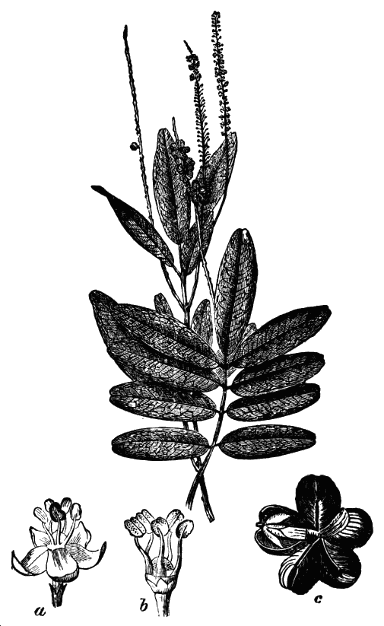
Pilocarpus pinnatifolius. a, flower; b, flower with the petals removed; c, carpels.
The abridged description of a sample of jaborandi from Pernambuco is from Mr Holmes’ paper in the ‘Pharmaceutical Journal.’[8] The cut is from the last edition of Royle’s ‘Materia Medica.’ “The specimens of the plant examined3⁄4 inch in diameter for the first 12 inches, and very sparingly branched. Bark of root of a pale yellowish brown, about a line in thickness, and has a short fracture. The root has an odour like a mixture of bruised pea-pods and orange-peel. Its taste is first like that of green peas; this soon disappears, and gives rise to a tingling sensation. The stem is 1⁄2 inch in diameter near the root, narrowing to 1⁄4 inch in the upper branches. The bark is thin, greyish-brown, longitudinally striated, and in some specimens sprinkled over with a number of white dots. The wood of the stem is yellowish-white and remarkably fibrous. The leaves (one of which is represented in the drawing) are imparipinnate, about 9 inches long, with from 3 to 5 pairs of opposite leaflets, which are articulated to the rachis, and have very short, slightly swollen petiolates. The rachis of the leaf is swollen at the base.
The pairs of leaflets are usually about 11⁄4 inch apart, the lowest pair being about 4 inches from the base of the rachis. The leaflets are very variable in size, even on the same leaf. Their general outline is oblong-lanceolate. They are entire, with an emarginate or even retuse apex and an unequal base, and texture coriaceous. The veins are prominent on both sides of the leaf, and branch from the midrib at an obtuse angle in a pinnate manner. When held up to the light the leaflets are seen to be densely pellucidly punctate. These pellucid dots, which are receptacles of secretion, are not arranged, as in another kind of jaborandi, in lines along the veinlets, but are irregularly scattered all over the leaf, and appear equally numerous in every part. The whole plant is glabrous.”
Mr Holmes says there appear to be two varieties, if not species, of this Pilocarpus, the one being perfectly smooth in every part, as above described, and the other having the stems, petioles, and under surface of the leaves covered with a dense velvety pubescence composed of simple hairs.
JAG′GERY. Syn. Palm sugar. A coarse brown sugar made in India by the evaporation of the juice of several species of palms. The following are the principal varieties of this product:—
1. Cocoa jaggery. From the juice of the Cocoa-nut palm (Cocos nucifera).
2. Malabar jaggery. From the juice of the Gummuti palm (Saguerus saccherifer).
3. Mysore jaggery. From the juice of the wild Date-palm (Phœnix sylvestris); 17 galls. yields 46 lbs.
4. Palmyra jaggery. From the juice of the Palmyra palm (Borassus flabelliformis); 6 pints yield 1 lb.
JA′LAP. Syn. Jalapæ radix, Jalapa, B. P. (Ph. L. & D.) Convolvuli jalapæ radix (Ph. E.), L. The dried tubercles of the Exogonium purga, I. jalapa—(Royle.) Jalap is a powerful stimulant and drastic purgative, producing copious liquid stools; but when judiciously administered, both safe and efficacious. It appears to be intermediate in its action between aloes and scammony.—Dose, 10 to 30 gr., in powder; in constipation, cerebral affections, dropsies, obstructed menstruation,
Jalap Biscuits. 1. An ounce of jalap mixed with 16 ounces of the materials for gingerbread or other kind of cake.
2. Pure resin of jalap, 56 grams, powdered sugar and flour, 1000 grams; tincture of vanilla, 10 grams, white of egg, No. 20, yolk of egg, No. 40.
Let the resin be emulsified with the yolks of the egg, add successively the sugar, tincture, and flour, and mix thoroughly into a paste, with which thoroughly incorporate the whites of eggs, previously beaten up. Let the mass be divided into 144 biscuits, and bake.
Jalap, Res′in of. Syn. Resina jalapæ, L. Prep. 1. (Ph. E.) See Extract of Jalap.
2. (Nativelle.) Jalap root is digested in boiling water for 24 hours, and after being reduced to thin slices more water is added, and the whole boiled for 10 minutes, with occasional agitation; the liquid is then expressed in a tincture press, and the boiling and pressing repeated a second and third time (these decoctions by evaporation yield AQUEOUS EXTRACT OF JALAP); the pressed root is next treated with rectified spirit, q. s., and boiled for 10 minutes, and then allowed to cool; the tincture is then pressed out, and the boiling with fresh alcohol and expression is repeated twice; a little animal charcoal is added to the mixed tinctures, and, after thorough agitation, the latter are filtered; the liquid is now distilled until nothing passes over, the supernatant fluid is poured off the fluid resin, and the latter dried by spreading it over the surface of the capsule, and continuing the heat. The product is a friable and nearly colourless resin, which forms a white powder resembling starch. Prod. Fully 10% of pure resin.
3. (Planche.) Resinous extract of jalap is dissolved in rectified spirit, the tincture agitated with animal charcoal, and after filtration gently evaporated to dryness.
Pur. The jalap resin of commerce is generally adulterated with scammony, gum, guaiacum or resin. When in a state of purity, it does not form an emulsion with milk, like scammony resin, but runs into a solid mass. It is insoluble in fixed oils and turpentine, whilst the common resins are freely soluble in those menstrua. Its alcoholic solution, dropped on a piece of absorbent white paper, and exposed to the action of nitrous gas, does not acquire a green or blue colour; if it does, guaiacum resin is present. 2% of this adulteration may be thus detected. (Gobley.) It is insoluble in ether; but guaiacum resin, common resin, and some others, are so; the decanted ether should not become opalescent when mixed with water, and should evaporate without leaving any residuum. Powdered jalap resin placed in cold water does not dissolve, but forms a semi-fluid, transparent mass, as if it had been melted. Dissolved in a watch-glass with a little oil of vitriol, a rich crimson-coloured solution is obtained, from which, in a few hours, a brown viscid resin separates. These last two characteristics distinguish it from other resins.
Obs. Earthenware or well-tinned copper vessels must alone be used in the above processes, as contact with copper or iron turns the resin black, and this tinge can only be removed by redissolving the resin in alcohol, the addition of animal charcoal, and re-evaporation.
Jalap resin is an energetic cathartic.—Dose, 1 to 5 gr. See Jalapin.
Jalap, Factitious Resin of. Syn. Resinæ jalapæ factitia, L. A substance frequently sold for jalap resin is made by fusing a mixture of pale yellow resin and scammony resin, and adding, when it has cooled a little, but still semi-fluid, a few drops of balsam of Peru or tolu; the mixture is then poured into small paper capsules or tin moulds. Its effects resemble those of jalap resin, but it inflames less. (Landerer.)
Jalap, Soap of. Syn. Sapo jalapæ, Sapo jalapinus, L. Prep. (Ph. Bor.) Resin of jalap and Castile soap, of each 1 part; rectified spirit, 2 parts, or q. s. to dissolve the ingredients softened by a gentle heat; subsequently evaporate the mixture by the heat of a water bath until reduced to 41⁄2 oz., or it has acquired the consistence of a pill-mass.
Prop., &c. A greyish-brown mass, soluble in rectified spirit. Said to be milder in its action than the resin alone.—Dose, 5 to 15 oz.
JALAP′IC ACID. Syn. Odorous principle of jalap.—Pereira. Prep. Add an alcoholic solution of acetate of lead to a similar solution of jalap resin, collect the precipitate (jalapate of lead), and throw down the lead by means of sulphuretted hydrogen. (See Absinthic acid.) A brownish, soft, greasy substance, smelling strongly of jalap, soluble in alcohol and alkali, and slightly so in ether. Jalap resin contains about 13% of this substance.
JAL′APIN. C34H56O16. Syn. Jalapina. Jalap resin is commonly sold under this name, but pure jalapin is prepared by one or other of the following formulæ:—
Prep. 1. The liquid filtered from the jalapate of lead in preparing jalapic acid is a solution of acetate of jalapin, which, after any trace of lead is removed, by adding a few drops of dilute sulphuric acid, and filtration, yields the whole of its jalapin, as a precipitate, on the addition of 5 or 6 times its volume of water; this is collected, washed with a little cold distilled water, and dried by exposure to a current of warm dry air.
2. (Hume.) Coarsely powdered jalap is digested in strong acetic acid for 14 days, the tincture filtered ammonia added in excess, and the whole agitated strongly; the mixture is then filtered, the deposit washed in cold water, redissolved in acetic acid, reprecipitated by ammonia, and again washed and dried.
3. (Kayser.) Pure jalap resin, in powder, is digested for some time in boiling ether, by which means the jalapic acid is removed, and pure jalapin remains undissolved.
Prop., &c. A transparent, colourless, scentless, insipid resin, very soluble in alcohol, but insoluble in ether. It is the active purgative principle of crude jalap resin.
JAMAI′CINE. Syn. Jamaicina. A peculiar alkaloid obtained by Huttenschmidt from the bark of the Cabbage-tree (Andira inermis).
Prep. The aqueous solution of cabbage-tree bark, treated with sulphuretted hydrogen and evaporated.
Prop. Yellow crystals soluble in water and, to a limited extent, in alcohol; fusible, and very bitter tasted. It forms salts with the acids, which, in small doses, produce restlessness and trembling; and in larger ones, purging. It is said to be vermifuge.
JAMES’S POWDER. See Powders.
JAMS. Syn. Preserves. Conserves of fruit with sugar, prepared by boiling. In the latter respect they differ from the conserves of the apothecary.
Prep. The pulped or bruised fruit is boiled along with 1⁄2 to 2⁄3 of its weight of loaf sugar, until the mixture jellies, when a little is placed on a cold plate; the semi-fluid mass is then passed through a coarse hair sieve whilst hot, to remove the stones and skins of the fruit, and as soon as it has cooled a little is poured into pots or glasses. It is usual to tie these over, when cold, with paper which has been dipped in brandy. The pots must then be placed aside in a dry and rather cold situation.
The following fruits are those from which jams are commonly prepared:—Apricots, cherries (various), cranberries, currants (black, red, and white), gooseberries (ripe and green), mulberries, Orleans plums, raspberries, and strawberries. Red currants are commonly added to the last, to remove insipidity.
JAPAN′. See Varnish, and below.
JAPAN′NING. The art of covering paper, wood, or metal, with a coating of hard, brilliant, and durable varnish. The varnishes or lacquers employed for this purpose in Japan, China, and the Indian Archipelago, are resinous juices derived from various trees belonging to the natural order Anacardiaceæ, especially Stagmaria verniciflua, Holigarna longifolia, Semecarpus Anacardium, and species of Rus (Sumach). For use, they are purified by a defecation and straining, and are afterwards mixed with a little oil, and with colouring matter, as required. In this country varnishes of amber, asphaltum, or copal, or mixtures of them, pass under the names of ‘JAPAN’ and ‘JAPAN VARNISH,’
Proc. The surface is coloured or painted with devices, &c., as desired, next covered with a highly transparent varnish (amber or copal), then dried at a high temperature (135° to 165° Fahr.), and, lastly, polished. Wood and paper are first sized, polished, and varnished. For plain surfaces, asphaltum, varnish or japan is used. See Varnishing.
JAPON′IC ACID. C12H10O5. When catechu is exposed to the air in contact with caustic alkalies, black solutions (alkaline japonates) are formed; with carbonated alkalies, red solutions (alkaline rubates); the acid of the former may be separated. It is a black powder, insoluble in water, soluble in alkalies, and precipitated by acids. Buric acid forms red insoluble compounds with the earths and some other metallic oxides.
JARAVE. The Spanish name for SARSAPARILLA BEER. See Beers (in pharmacy).
JASPER. Syn. Iaspis, L. A mineral of the quartz family, occurring in rocky masses. It takes various shades of red, yellow, brown, and green, and is occasionally banded, spotted, or variegated. It was formerly used as an amulet against hæmorrhages and fluxes. It is now extensively worked up into rings, seals, snuff-boxes, vases, &c., for which it is well calculated from its extreme hardness and susceptibility of receiving a fine polish.
JATRO′PHIC ACID. Syn. Crotonic acid, Iatrophic a. A peculiar fatty acid discovered by Pelletier and Caventon, and originally regarded by them as the cathartic principle of croton oil and croton seeds, but since shown by Redwood and Pereira to be nearly inert.
Prep. The oil is saponified by caustic potassa, and the resulting soap is decomposed by tartaric acid; the fatty matter which floats on the surface of the liquid is then skimmed off the aqueous portion, and the latter submitted to distillation; the liquid in the receiver is a solution of jatrophic acid.
Prop., &c. Volatile; very acid; has a nauseous odour; is solid at 23°, and vaporizes at 35° Fahr. It forms salts with the bases, none of which possess any practical importance.
JAU′MANGE. Prep. From isinglass, 1 oz.; boiling water, 12 oz.; dissolve, add of any sweet white wine, 1⁄2 pint; the yolks of 2 eggs beaten to a froth, and the grated yellow peel of two lemons; mix well, and heat the whole over the fire until sufficiently thickened, stirring all the time; lastly, serve it up or pour it into moulds.
JAUN′DICE. Syn. Icterus, Morbus luteolus, L. A disease characterised by a yellow colour of the eyes and skin, deep-coloured urine, and pale alvine evacuations. It appears to arise from a disordered action of the biliary organs. The treatment consists of the administration
Animals.—Jaundice affects cattle, giving rise to a tawny hue of the skin and membranes. Pleuro-pneumonia is frequently followed by jaundice. The best remedies are large doses of Epsom salts combined with ginger; and if these fail to remove the costiveness, a drachm of calomel should be added. If necessary, the above purge must be repeated next day, the action being assisted by giving the animal warm fluids.
Tonics and stimulants are also sometimes superadded to the above treatment.
JEL′LY. Syn. Gelatina, L. A term now very loosely applied to various substances which are liquid or semi-liquid whilst warm, and become gelatinous on cooling.
Jellies are coloured by the addition of the usual stains used by confectioners, and are rendered transparent by clarification with white of egg.
Jelly, Almond. Syn. Gelatina amygdalarum, L. Prep. From rich almond milk, 1⁄4 pint; thick hartshorn jelly, 1⁄2 pint; sugar, 2 oz.; with 2 or 3 bitter almonds and a little lemon peel, to flavour, heated together, strained, and moulded.
Jelly, Ar′row-root. Syn. Gelatina marantæ, L. From arrow-root, 11⁄2 oz., to water, 1 pint. Tous les mois jelly is made in the same way.
Jelly, Bis′cuit. Prep. From white biscuit (crushed beneath the rolling-pin), 4 oz.; cold water, 2 quarts; soak for some hours, boil to one half, strain, evaporate to 1 pint, and add, of white sugar, 3⁄4 lb., red wine, 4 oz., and cinnamon, 1 teaspoonful. In weakness of the stomach, and in dysentery and diarrhœa, and in convalescence combined with rich beef gravy or soup.
Jelly, Bladder-wrack. (Dr Russell.) Syn. Gelatina fuci. Prep. Bladder-wrack (Fucus vesiculosus), 2 lbs.; sea water, 2 lbs.; macerate for 15 days. Applied to glandular tumours.
Jelly, Bread. Syn. Panada; Gelatina panis, L. Prep. Cut a French roll into slices, toast them on each side, and boil in water, 1 quart, until the whole forms a jelly, adding more water if required; strain, and add sugar, milk, &c., to palate. It may be made with broth from which the fat has been skimmed, instead of water. Used as the last.
Jelly, Broth. Syn. Soup-jelly. From broth or soup from which the fat has been skimmed, evaporated until it becomes gelatinous on cooling. A few shreds of isinglass are commonly added. See Soup (Portable).
Jelly, Calves’ Feet. Prep. For each foot take of water 3 pints, and boil to one half; cool, skim off the fat, and again boil for 2 or 3 minutes with the peel of a lemon and a little spice; remove it from the fire, strain through a jelly bag (see Filtration), add the juice of a lemon and a glass of wine, and when it has cooled a little put it into glasses or ‘forms.’
Obs. If this jelly is required to be very transparent it must be treated as follows:—After the fat is removed it should be gently warmed, just enough to melt it, next well beaten with the white of an egg and the seasoning, and then brought to a boil for a minute or two, when it will be ready for straining, &c. The calves’ feet should not be bought ready boiled, but only scalded. Cows’ feet (‘COW HEELS’) make nearly as good jelly as that from calves’ feet, and are much more economical.
Jelly, Ceylon Moss. Syn. Gelatina gracilariæ, L. Prep. (Dr Sigmond.) Boil Ceylon moss (Granularia lichenoides), 1⁄2 oz. in water, 1 quart, for 25 minutes, or till the liquid jellies on cooling; strain and flavour. Very nutritious; recommended in irritation of the mucous membranes and phthisis.
Jelly, Copaiba. (M. Caillot.) Syn. Gelatina copaiba. Prep. Isinglass, 4 parts; water, 40 parts; dissolve in a water bath, and add 20 parts of sugar; pour the clear liquid jelly into a warm mortar, and add copaiba, 60 parts; triturate, and pour in a vessel to jelly. Flavour with some aromatic essential oil or balsam of tolu.
Jelly, Cor′sican Moss. Syn. Gelatina helminthocorti, L. Prep. (P. Cod.) Corsican moss (Gracilaria Helminthocorton), 1 oz.; water, q. s.; boil 1 hour, and strain 8 fl. oz.; to this add of isinglass (previously soaked in a little water), 1 dr.; refined sugar, 2 oz.; white wine, a wine-glassful. Vermifuge. See Decoction.
Jelly, Fruit. Under this head we include those jellies made from the juices of fruits.
Prep. The strained juice mixed with 1⁄3 to 1⁄2 its weight of refined sugar, until it ‘jellies’ on cooling, observing to carefully remove the scum as it rises. The process should be conducted by a gentle heat, and it is preferable not to add the sugar until the juice is somewhat concentrated, as by lengthened boiling the quality of the sugar is injured.
Obs. Jellies are sold in pots or glasses, like JAMS. Both jams and fruit jellies are refrigerant and laxative; they are, however, mostly employed as relishes, especially during fevers and convalescences. The principal fruit jellies are:—Apple, BARBERRY, CHERRY (from either Cornelian or Kentish cherries), CURRANT (black, white, and red), ELDERBERRY, GOOSEBERRY, PLUM, QUINCE, RASPBERRY. See Lemon and Orange jelly.
Jelly, Glycerin. Syn. Gelatina glycerini. Mix glycerin to the required consistence1⁄2 oz.; syrup, 4 oz. (3 oz. of sugar to 1 oz. of water); the yolks of 3 eggs; olive oil, 4 oz.; glycerin, 2 oz. Rub the gum and syrup well together, add the yolks, and when mixed add the oil and glycerine, previously triturated together. Applied to chapped hands, abrasions, &c. See Glycerin of Starch.
Jelly, Gra′′vy. By evaporating meat gravies.
Jelly, Harts′horn. Syn. Gelatina cornu cervi, L. Prep. (P. Cod.) Hartshorn shavings, 8 oz.; wash it in water, then boil in clean water, 3 pints, till reduced to one half; strain, press, add of sugar, 4 oz., the juice of one lemon, and the white of an egg beaten up with a little cold water; mix well, clarify by heat, evaporate till it jellies on cooling, then add the peel of the lemon, and set it in a cool place. It may be flavoured with wine, spices, &c. Very nutritious.
Jelly, Ice′land Moss. Syn. Gelatina lichenis, L. Prep. (P. Cod.) Iceland moss, 2 oz.; soak for 1 or 2 days in cold water, then boil for 1 hour in water, q. s. to yield a strong solution; strain, decant the clear after repose, apply heat, and dissolve therein of isinglass, 1 dr.; evaporate the whole to a proper consistence, put it into pots, and set them in a cool place. Nutritious. Recommended in phthisis. The jelly of Iceland moss and cinchona (GELATINA LICHENIS CUM CINCHONA—P. Cod.) is made by adding to the above syrup of cinchona, 6 fl. oz.
Jelly, Iceland Moss (Sweetened). (P. C.) Syn. Gelatina lichenis saccharata. Prep. Saccharated Iceland moss (see Iceland moss, Saccharated), 71⁄2 oz.; sugar, 71⁄2 oz.; water, 15 oz.; orange-flower water, 1 oz. Boil the first three substances and remove the scum which forms, and then let the jelly flow into a vessel which contains the orange-flower water.
Jelly, I′′rish Moss. Syn. Gelatina chondri, L. Prep. From Irish or carrageen moss. See Decoction.
Jelly, I′′singlass. Syn. Confectioners’ jelly; Gelatina ichthyocollæ, L. Prep. From isinglass dissolved in water by boiling, and evaporated till it ‘jellies’ on cooling, adding flavouring, as desired. 11⁄2 oz. of good isinglass makes fully a pint of very strong jelly. See Blancmange, Isinglass, Calves-feet Jelly, &c.
Jelly, Lem′on. From isinglass, 2 oz.; water, 1 quart; boil, add of sugar 1 lb., clarify, and when nearly cold add the juice of 5 lemons, and the grated yellow rinds of 2 oranges and of 2 lemons; mix well, strain off the peel, and put it into glasses.
Jelly No′yeau. As Punch jelly, but strongly flavoured with bitter almonds.
Jelly, Or′ange. From orange juice, 1 pint; let it stand over the grated yellow rind of 3 or 4 of the oranges for a few hours, then strain, and add, of loaf sugar, 1⁄2 lb., or more, isinglass 1⁄2 oz., dissolved in water, 1 pint; mix, and put it into glasses before it cools.
Jelly, Punch. From isinglass, 2 oz.; sugar, 13⁄4 lb.; water, 1 pint; dissolve, add of lemon juice, 1⁄2 pint; the peels of 2 lemons and of 2 oranges; rum and brandy, of each 1⁄4 pint; keep it in a covered vessel until cold, then liquefy it by a very gentle heat, strain, and pour it into moulds. A pleasant and deceptive way of swallowing alcohol.
Jelly, Quince. (E. P., 1744.) Syn. Gelatina cydoniorum. Prep. Juice of quinces, 3 lbs.; sugar, 1 lb.; boil to a jelly.
Jelly, Rice. Syn. Crême de Riz. From rice boiled in water, sweetened, and flavoured.
Jelly, Sago. Prep. Soak sago in cold water for 1 hour, strain, and boil in fresh soft water until it becomes transparent; then add wine, sugar, clear broth, milk, or spices, to flavour. 1 oz. of sugar makes a pint of good jelly.
Jelly, Salep. (Soubeiran). Syn. Gelatina salepæ. Prep. Ground salep, 4 dr.; sugar, 4 oz.; water, a sufficient quantity. Boil to 12 oz., and flavour to the taste.
Jelly, Ta′pioca. As Sago jelly, but using tapioca in lieu of sago.
JERVINE. C60H5N2O5 An alkaloid discovered in 1837, by Simon, in the root of the Veratrum album, and by Mitchell, in 1874, in the root of the Veratrum viride. Dr H. C. Wood, jun., describing the physiological effects of jervine, says they consist “in general weakness, lowering of arterial pressure, a slow pulse, profuse salivation, and finally convulsions.” Jervine was analysed by Will, who ascribed to it the above composition.
JES′UIT’S BARK. See Cinchona.
JESUIT’S DROPS. See Drops.
JESUIT’S POWDER. Powdered cinchona bark.
JET. A variety of mineral bituminous carbon, very hard, and susceptible of a fine polish.
JEW′ELS. See Diamond, Emerald, Gems, &c.
JEWEL′RY. The gold in articles of jewelry, whether solid or plated, which are not intended to be exposed to very rough usage, is generally ‘coloured,’ as it is called in the trade. This is done as follows:—
1. (Red gold colour.) The article, after being coated with the amalgam, is gently heated, and, whilst hot, is covered with gilder’s wax; it is then ‘flamed’ over a wood fire, and strongly heated, during which time it is kept in a state of continual motion, to equalise the action of the fire on the surface. When all the composition has burned away, the piece is plunged into water, cleansed with the ‘scratch-brush’ and vinegar, and then washed and burnished. To bring up the beauty of the colour, the piece is sometimes washed with a strong solution of verdigris in vinegar, next gently heated, plunged whilst hot into water, and then washed, first in vinegar, or water soured with nitric acid, and then in pure water; it
2. (Or-molu colour.) This is given by covering the parts with a mixture of powdered hematite, alum, common salt, and vinegar, and applying heat until the coating blackens, when the piece is plunged into cold water, rubbed with a brush dipped in vinegar, or in water strongly soured with nitric acid, again washed in pure water, and dried. During this process, the parts not to be dried in ‘or-molu colour’ should be carefully protected.
The frauds practised in reference to the ‘fineness’ of the metal used in jewelry is noticed under Gold (Jeweller’s). See also Assaying, Diamond, Gems, Gilding liquor, Gilding wax, &c.
JEW’S PITCH. See Asphaltum.
JOURNAL BOXES, Alloy for. Copper, 24 parts; tin 24 parts; antimony, 8 parts. First melt the copper, then add the tin, and lastly the antimony.
JUICE (Spanish). See Extract and Liquorice.
JU′JUBE. A fruit resembling a small plum, produced by various species of Zizyphus. Combined with sugar, it forms the JUJUBE PASTE of the shops, when genuine; but that now almost always sold under the name is a mixture of gum and sugar, slightly coloured and flavoured.
JU′LEP. Syn. Julap; Julepum, Julepus, Julapium, L. A term usually regarded as synonymous with ‘MIXTURE’; but according to the best authorities, implying a medicine which is used as a vehicle for other forms of medicine. The word comes through the French, from a Persian expression, which signifies ‘sweet drink.’ A julep, according to Continental writers, is a drink of little activity, generally composed of distilled waters, infusions, and syrups, to which mucilages and acids are sometimes added; “but never powders or oily substances, which could interfere with its transparency.” In England the juleps of old pharmacy are now classed under ‘MIXTURES,’
JU′′NIPER BERRIES. Syn. Juniperi baccæ, J. communis baccæ (Ph. E.), JUNIPERUS (Ph. L.), L. The fruit of the Juniperus communis, or common juniper tree. In the old Ph. L. & D. both the tops and berries (JUNIPERI FRUCTUS ET CACUMINA—Ph. L. 1836; JUNIPERUS—BACCÆ, CACUMINA—Ph. D. 1862) were ordered. The berries are stomachic and diuretic, and have been long employed in dropsies, either alone or combined with foxglove and squills. The tops (SUMMITATES) have been highly praised in scurvy and certain cutaneous affections.—Dose, 1 to 2 dr., made into a conserve with sugar, or in the form of infusion or tea.
Douath found 100 parts of the berries to contain—
Water 29·44
Volatile oil ·91
Formic acid 1·86
Acetic acid ·94
Malic acid (combined) ·21
Oxalic acid traces
Wax-like fatty matter ·64
Green resin (from ethereal solution) 8·46
Hard brown resin (from alcoholic solution) 1·29
Bitter principle (called juniperin) ·37
Pectin ·73
Albuminous substances 4·45
Sugar 29·65
Cellulose 15·83
Mineral substances 2·33
———
97·11
JUN′KET. Syn. Devonshire junket, Curd jelly. From warm milk put into a bowl, and then turned with a little rennet; some scalded cream and sugar are next added with a sprinkling of cinnamon on the top, without breaking the curd. Much esteemed by holiday folk in the western counties during the hot weather of summer. Sometimes, very strangely, a little brandy finds its way into these trifles.
JUTE. This is the fibre yielded by the Corchorus capsularis, a lime tree growing in India and China. It is the material of which sacks, gunny bags, and coarse thread are made. It mixes even with linen or cotton, and hence may not improbably be employed as a sophisticant of these substances.
The plates on page 930 exhibit the different microscopic appearances of the three substances.
KALEIDOSCOPE. Syn. Flower-glass. A pleasing philosophical toy invented by Sir David Brewster, which presents to the eye a series of symmetrical changing views. It is formed as follows:—Two slips of silvered glass, from 6 to 10 inches long, and from 1 to 11⁄2 inch wide, and rather narrower at one end than the other, are joined together lengthwise, by one of their edges, by means of a piece of silk or cloth glued on their backs; they are then placed in a tube of tin or pasteboard, blackened inside, and a little longer than is necessary to contain them, and are fixed by means of small pieces of cork, with their faces at an angle to each other that is an even aliquot part of 4 right angles (as the 1⁄6, 1⁄8, 1⁄10, &c.). The other end of the tube is then closed with an opaque screen or cover, through which a small eyehole is made in the centre; and the other end is fitted, first with a plate of common glass, and at the distance of about 1⁄8th of an inch, with a plain piece of slightly ground glass, parallel to the former; in the intermediate place or cell are placed the objects to form the images. These consist of coloured pieces of glass, glass beads, or any other coloured diaphanous bodies, sufficiently small to move
KA′LI. The name formerly applied to a species of Salsola employed for making BARILLA. It is sometimes used as a designation for the crude alkalies, and is the German synonym for ‘potassa.’
Kali, Acid′ulated. Syn. Lemon and kali, Lemonated k. A common preparation of the shops for making a pleasant effervescing draught. It is sometimes incorrectly styled ‘citrate of potash.’ Prep. 1. Carbonate of soda and tartaric acid, of each 5 oz.; lump sugar, 1 lb.; all in the state of fine powder, and separately dried by a very gentle heat, after which they are mixed together, flavoured with essence of lemon, 1 dr., rubbed through a gauze sieve in a warm dry situation, put into bottles, and corked down immediately.
2. Finely powdered white sugar, 16 lbs.; tartaric acid, 41⁄4 lbs.; carbonate of soda, 4 lbs.; essence of lemon, 1 oz.; as the last. Keeps well. A dessert-spoonful of either thrown into a glassful of water makes a pleasant effervescing draught.
KA′LIUM. [L.] Potassium.
KAL′YDOR. A cosmetic lotion; it resembles ‘Gowland’s Lotion,’ but is got up in a rather more pleasing style. See Lotion.
KAMALA. A powder consisting of the minute glands obtained from the capsules of the Rottlera tinctoria, a plant belonging to the nat. ord. Euphorbiaceæ. Kamala is imported from India, where it is known under the name of kameela. The rottlera, from which it is obtained, is a tree from 15 to 20 feet in height, indigenous to India and to many of the East Indian Islands.
Kamala has long been employed in India as a remedy for tapeworm, and within the last few years has been given for the same purpose in this country with very general success. It may be administered in doses of from thirty grains to three drachms, suspended in water, rubbed up with mucilage, or mixed with syrup. In large doses, such as three drachms, it sometimes purges violently. After the third or fourth motion the worm is generally evacuated dead. A second dose may be taken in about four hours should the first fail to act; or instead of a second dose, some castor oil may be given. Kamala is also used externally by the natives of India in various skin complaints, particularly in scabies. It is also said to have proved useful in herpetic ringworm.
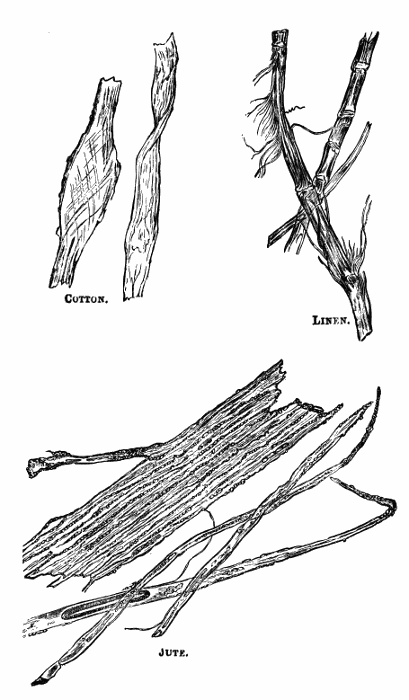
Cotton, Linen and Jute.
Dr Anderson obtained from the resinous colouring matter, which is the principal constituent of kamala, a yellow crystalline substance, to which he gave the name rottlerin. The existence of rottlerin has since been confirmed by Mr Groves, who found that it becomes changed by exposure, a circumstance to which he attributes its non-detection in old specimens of the drug, and to which may very reasonably be attributed Leube’s failure to find it.
The ‘British Pharmacopœia’ ascribes the following ‘characters’ to kamala:—“A fine granular mobile powder, of a brick-red colour; it is with difficulty mixed with water, but when boiled with alcohol the greater part is dissolved, forming a red solution. Ether dissolves most of it, the residue consisting principally of tufted hairs. It should be free from sand or earthy impurities.”
Kamala forms a very considerable article of export from India, it being a valuable dye.
KA′OLIN. Syn. China clay, Porcelain c. A fine white clay, derived from the decomposition of the felspar of granitic rocks. The potteries and porcelain works of this country are chiefly supplied with this substance from extensive tracts of it which occur near St Austie, Cornwall. See Clay.
Elsner[9] gives the following process for distinguishing kaolin from ordinary clay:—He agitates it in a test-tube with pure strong sulphuric acid till a uniform mixture is produced, decants the acid after subsidence, dilutes it carefully with six volumes of water, and supersaturates the cooled solution with ammonia.
Kaolin thus treated separates but slowly from the strong acid, and the diluted acid solution gives an immediate white precipitate with ammonia, whereas ordinary clay is but slightly attacked by the acid, separates quickly from it, and the acid after dilution gives but an insignificant precipitate with ammonia.
KAP′NOMOR. Syn. Capnomor. A colourless oil obtained from crude kreasote by distillation with potassa. It boils at 360° Fahr., has a peculiar odour, and is insoluble in water, but readily soluble in an alkaline solution of kreasote.
KATAL′YSIS. Syn. Catalysis, Contact action. Terms applied to a class of chemical actions in which the decompositions, and the recombination of the elements of compound bodies, is apparently excited by the mere presence of, or contact with, other bodies, which do not themselves suffer such a change.
KAVA-KAVA. See Ava.
KELP. The alkaline ashes obtained by burning various species of sea-weed, formerly much used for the preparation of carbonate of soda. The weeds most valued for the purpose are the Fucus vesiculosus, nodosus, and serratus, and the Laminaria bulbosa and digitata.
Of late years the manufacture of kelp, like that of barilla, has been almost abandoned except as a source of iodine. Mr E. C. C. Stanford, by carefully collecting and compressing the weed, and afterwards submitting it to dry distillation, doubles the yield of iodine and bromine, and obtains in addition various valuable hydrocarbons. See Barilla, Iodine, Soda, &c.
KER′MES. Syn. Kermes-grains, Alkermes; Granum tinctorium, L. The dried bodies of the female Coccus Ilicis of Linnæus, a small insect of the order Hemiptera, which flourishes on the Ilex oak. It has been used as a red and scarlet dye-stuff ever since the time of Moses; but is now superseded in this country by cochineal, which gives colours of much greater brilliancy.
KER′MES MIN′ERAL. Syn. Kermes minerale, K. mineralis, L. An amorphous tersulphide of antimony, containing a small admixture of teroxide of antimony and sulphuride of potassium. Prep. 1. In the humid way.—a. (P. Cod.) Carbonate of soda (cryst.), 128 parts (say 21 parts), is dissolved in water, 1280 parts (say 210 parts), contained in a cast-iron pan; tersulphide of antimony (in fine powder), 6 parts (say 1 part), is next added, and the whole boiled for an hour, with constant agitation with a wooden spatula; the boiling liquid is then filtered into a heated earthen pan containing a small quantity of very hot water, and the solution is allowed to cool as slowly as possible; the red powder which is deposited is collected on a cloth, on which it is well washed with cold water, and the superfluous water being removed by pressure, the powder is dried by a gentle heat, and is, lastly, passed through a fine silk-gauze sieve, and preserved from light and air.
b. (Wholesale.) From black sulphuride of antimony, 4 lbs.; carbonate of potassa, 1 lb.; boil in water, 2 galls., for half an hour, filter, &c., as before. The undissolved portion of sesquisulphuret of antimony may be boiled again several times with fresh potassa and water, until the whole is dissolved. Inferior to the last.
c. (Cluzell’s kermes.) From tersulphide of antimony, 4 parts; crystallised carbonate of soda, 90 parts; water, 1000 parts; boil, &c., as in 1, a, and dry the powder, folded up in paper, at a heat not exceeding 90° Fahr.
2. In the dry way.—a. (P. Cod.) Carbonate of potassa, 100 parts; tersulphide of antimony, 50 parts; sulphur, 3 parts; mix, fuse in a Hessian crucible, pour the melted mass into an iron mortar, and when cold reduce it to powder; next boil it in water, 1000 parts, contained in an iron vessel, filter the solution, and otherwise proceed as before. Product: large, but of inferior quality.
b. (Fownes.) From tersulphide of antimony, 5 parts; carbonate of soda (dry), 3 parts; water, 80 parts; fuse, &c., as before. Nearly equal to 1, a.
c. (Berzelius.) Carbonate of potassa (pure), 3 parts, tersulphide of antimony, 8 parts; water, q. s. Resembles the last.
Prop., &c. An odourless, tasteless powder, insoluble in both water and alcohol, and, when pure and carefully prepared, entirely soluble in hydrosulphate of ammonia. As prepared by the formulæ 1, a, and 1, c, it is a very dark crimson powder, of a velvety smoothness; but that from the other formulæ has a brownish-red colour, more or less deep. The secret of preparing this compound of a fine and velvety quality, like that imported from the Continent, consists simply in filtering the solution whilst boiling hot, and allowing it to cool very slowly, by placing the vessel in an appropriate situation for that purpose. Another important point, according to Rose, is to employ sufficient alkali to keep the whole of the teroxide of antimony in solution as the liquid cools, instead of allowing a part of it to be deposited with the kermes. This is the reason of the superior quality and mildness of that prepared according to the directions of the French Codex. The liquor decanted from the ‘kermes mineral’ yields the golden sulphide of antimony on the addition of an acid, for which purpose the acetic is generally employed.
Dose, 1⁄2 gr. to 3 or 4 gr., as a diaphoretic, cathartic, or emetic. It occupies in foreign practice the place of our James’s Powder.
KETCH′UP. Syn. Catchup, Catsup, Katchup. The juice of certain vegetables strongly salted and spiced, so as to be used as sauce; or a simple sauce made without the natural juice as a substitute for the true ketchup. The following are the principal varieties:—
Ketchup, Camp. Prep. Take of good old beer, 2 quarts; white wine, 1 quart; anchovies, 4 oz.; mix, heat it to the boiling-point, remove it from the fire, and add of peeled shalots, 3 oz.; mace, nutmegs, ginger, and black pepper, of each, bruised, 1⁄2 oz.; macerate for 14 days, with frequent agitation, then allow it to settle, and decant and bottle the clear portion.
Ketchup, Cu′cumber. Prep. From ripe cucumbers, in the same way as mushroom ketchup. Very luscious. Mixed with cream, or melted butter, it forms an excellent white sauce for fowls, &c.
Ketchup, Marine′. Prep. Take of strong old beer, 1 gall.; anchovies, 11⁄2 lb.; peeled shalots (crushed), 1 lb.; bruised mace, mustard seed, and cloves, of each 1⁄2 oz.; bruised pepper and ginger, of each 1⁄4 oz.; mushroom ketchup and vinegar, of each 1 quart; beat the mixture to the boiling point, put it into a bottle, and macerate for 14 days, frequently shaking; then strain through flannel, and bottle it for use. Excellent with anything; like the last, it makes good white sauce, and keeps well.
Ketchup, Mush′room. Prep. 1. Sprinkle mushroom flaps, gathered in September, with common salt, stir them occasionally for 2 or 3 days, then lightly squeeze out the juice, and add to each gallon cloves and mustard seed,1⁄2 oz.; allspice, black pepper, and ginger, of each, bruised, 1 oz.; gently heat to the boiling-point in a covered vessel, macerate for 14 days, and decant or strain. Should it exhibit any indications of change in a few weeks, bring it again to the boiling-point, with a little more spice, and a table-spoonful more salt.
2. Take of mushroom juice, 2 galls.; pimento, 2 oz.; cloves, black pepper, mustard seed, and ginger, of each, bruised, 1 oz.; salt, 1 lb. (or to taste); shalots, 3 oz.; gently simmer for 1 hour in a covered vessel, cool, strain, and bottle.
3. Take of mushroom juice, 100 galls.; black pepper, 9 lbs.; allspice, 7 lbs.; ginger, 5 lbs.; cloves, 1 lb. (all bruised); salt, q. s.; gently simmer in a covered tin boiler for 1 hour.
Ketchup, Oys′ter. Prep. Pulp the oysters, and to each pint add, of sherry wine, or very strong old ale, 1 pint; salt, 1 oz.; mace, 1⁄4 oz.; black pepper, 1 dr.; simmer very gently for 10 minutes, strain, cool, bottle, and to each bottle add a spoonful or two of brandy, and keep them in a cool situation. Cockle ketchup and MUSSEL KETCHUP are made in the same way. Used to flavour sauces when the fish are out of season; excellent with rump steak, &c.
Ketchup, Pon′tac. Prep. Take of the juice of elderberries and strong vinegar, of each 1 pint; anchovies, 1⁄2 lb.; shalots and spice, q. s. to flavour; boil for 5 minutes, cool, strain, and bottle. Used to make fish sauces.
Ketchup, Toma′to. Prep. Prepared from tomatoes or love apples, like mushroom ketchup, except that a little very strong Chili vinegar is commonly added. An admirable relish for ‘high’ or rich flavoured viands.
Ketchup, Wal′nut. Prep. 1. Take of the expressed juice of young walnuts, when tender, 1 gall.; boil 10 minutes, skim, add of anchovies, 2 lbs.; shalots, 1 lb.; cloves and mace, of each 1 oz.; 1 clove of garlic, sliced; simmer in a covered vessel for 15 minutes, strain, cool, and bottle, adding a little fresh spice to each bottle, and salt, q. s. Will keep good in a cool place for 20 years.
2. Take of green walnut shells, 16 galls.; salt, 5 lbs.; mix and beat together for a week, press out the liquor, and to every gallon add, of allspice, 4 oz.; ginger, 3 oz.; pepper and cloves, of each 2 oz.; all bruised; simmer for half an hour, and set aside in a closed vessel and in a cool situation until sufficiently clear.
3. Take of walnut juice, 1 gall.; vinegar, 1 quart; British anchovies (sprats), 3 or 4 lbs.; pimento, 3 oz.; ginger, 1⁄4 oz.; long pepper, 1⁄2 oz.; cloves, 1 oz.; shalots, 2 oz.; boil and bottle, as before.
4. From the juice of walnut shells, 30 galls.; salt, 1 bushel; allspice and shalots, of each 6 lbs.; ginger, garlic, and horse-radish, of each 3 lbs.; essence of anchovies, 3 galls.; as before.
Ketchup, Wine. Prep. Take of mushroom or walnut ketchup, 1 quart; chopped anchovies, 1⁄2 lb.; 20 shalots; scraped horse-radish, 2 oz.; spice, q. s.; simmer for 15 minutes, cool, and add of white and red wine, of each 1 pint; macerate for 1 week, strain, and bottle.
General Remarks. In preparing the above articles, vessels of glazed earthenware, or stoneware, or well-tinned copper pans, should alone be used to contain them whilst being boiled or heated, as salt and vegetable juices rapidly corrode copper, and render the ketchup poisonous. Nothing in the shape of copper, lead or pewter should be allowed to touch them. Even a plated copper spoon left in a bottle of ketchup for some time will render its contents poisonous. Unpleasant and even dangerous fits of vomiting, colic, and diarrhœa have resulted from the neglect of this precaution. See Sauce, &c.
KIBES. The vulgar name for ulcerated chilblains.
KID′NEYS. Syn. Renes, L. (In anatomy.) The kidneys, as almost every one knows, are abdominal viscera which secrete the urine, and form the great channels by which the effete nitrogenous matter is removed from the blood. They are subject to various affections, both functional and organic, chronic and acute, of which some are imperfectly understood, and others only admit of alleviation, but not of being cured. See Urine and Urinary affections.
Kidneys. (In cookery.) Soyer recommends kidneys to be dressed by gently broiling them, having previously split them, “so as nearly to divide them, leaving the fat in the middle,” and “run a skewer through them, that they may remain open.” After being rubbed with a little butter, and seasoned with salt and pepper, “they may be served on toast, or with any sauce.” “You may also egg and bread-crumb them.” “Five minutes suffice for a sheep or lamb’s kidney of common size.” (Soyer.) One or two lamb’s kidneys, plainly broiled and served up with the gravy in them, eaten along with a little dry-toasted bread, form a most excellent and appropriate luncheon or dinner for a dyspeptic or convalescent.
KIESERITE. A sulphate of magnesia found in the refuse salt (abraumsalz) of Stassfurth, near Magdeburg. It forms about 12% of the abraumsalz. It is employed for washing wool and for the manufacture of ‘permanent white’ by treatment with chloride of barium; also for the preparation of Glauber salts, and of hypochlorite of magnesia for bleaching linen. See Linen.
KING’S CUP. Prep. Yellow peel of 1 lemon; lump sugar, 11⁄2 oz.; cold water, 1 pint; infuse 8 or 10 hours, and strain. The addition of a teaspoonful of orange-flower water is a great improvement. Used as a diluent in cases where acid liquors are inadmissible. See Lemonade.
KING’S EVIL. See Scrofula.
KING’S YELLOW. See Yellow pigments.
KI′NIC ACID. HC7H11O6. Syn. Quinic acid, Cinchonic acid. A peculiar monobasic acid occurring in the cinchona barks, in which it exists associated with the alkaloids.
Kinic acid is somewhat extensively diffused throughout the vegetable kingdom, being found in the bark of every species of the true cinchonas, as well as in the leaves of the oak, the elm, the ash, the ivy, the privet, and the coffee plant and berries. It occurs in the cinchona barks most probably combined with the alkaloids, which therefore exist in the plant as kinates.
It is readily obtained from kinate of lime by the action of dilute sulphuric acid; the filtered solution evaporated to the consistence of a syrup, gradually deposits large crystals resembling those of tartaric acid.
Henry and Plisson give the following directions for the preparation of kinic acid:—Make a decoction of cinchona bark with water containing some sulphuric acid, and filter whilst hot, and to the filtrate add gradually freshly precipitated oxide of lead, until the liquid becomes neutral, and changes from a red to a pale yellow colour; care must be taken to add sufficient oxide. The filtrate is freed from lead by passing sulphuretted hydrogen through it, and filtered milk of lime is then added to precipitate the quinine and cinchonine; and the filtered liquid is evaporated to a syrup, which yields on cooling crystalline calcic kinate. To separate the acid from the calcic salt, Berzelius directs an aqueous solution of the salt to be made and to be precipitated by basic acetate of lead; the washed precipitate, suspended in water, is then decomposed by sulphuretted hydrogen, and the solution filtered and evaporated. Or the calcium kinate may be decomposed by an aqueous or alcoholic solution of sulphuric acid.[10]
Kinic acid is, in the form of large tubular crystals, fusible at 161° C. These crystals dissolve in two parts of water; they are also soluble in spirits of wine, but scarcely, if at all, in ether.
It forms salts called kinates. Kinate of calcium is obtained from an acidulated infusion of cinchona bark, by adding an excess of lime, filtering, evaporating to a syrup, and setting the liquid aside to crystallise. These crystals are purified by re-dissolving them, treating the solution with a little animal charcoal, and crystallising the salt as before. The liquid from which the bark-alkaloids have been precipitated by hydrate of lime affords an almost inexhaustible supply of this salt. See Kinone.
KI′NO. Syn. Gum kino; Kino (B. P., Ph. L. E. & D.) The juice flowing from the incised bark of the Pterocarpus Marsupium or Indian, hardened in the sun.—Dose, 10 to 30 gr., in powder; as an astringent in chronic diarrhœa, &c.
Kino, Factitious, met with in the shops, is made as follows:—Logwood, 48 lbs.; tormentil root, 16 lbs.; madder root, 12 lbs.; exhaust by coction with water, q. s.; to the liquor add of catechu, 16 lbs.; dissolve, strain, and evaporate to dryness. Prod. 24 lbs. Extract of mahogany is also commonly sold for kino.
KIRSCH′WASSER (-văs ser) [Ger.]. Syn. Kirschenwasser. A spirituous liquor distilled in Germany and Switzerland from bruised cherries. From the rude manner in which it is obtained, and from the distillation of the cherry-stones (which contain prussic acid) with the liquor, it has often a nauseous taste, and is frequently poisonous. When properly made and sweetened, it resembles noyeau.
KISH. An artificial graphite occasionally produced in iron-smelting furnaces. It occurs in brilliant scales, and is said to possess peculiar efficacy in certain forms of anæmia and chlorosis.
KITCH′EN. The late Alexis Soyer set down as one of the crying faults of our countrymen the employment of an apartment for the kitchen which is either too small or inconveniently situated, and which, in general, is not sufficiently provided with ‘kitchen requisites.’ “As a workman cannot work properly without the requisite tools, or the painter produce the proper shade without the necessary colours, in like manner does every person wishing to economise his food and to cook it properly require the proper furniture wherewith to do it.” The neglect of these matters, which is so general, is, undoubtedly, a mischievous and deceptive economy.
KNIVES, to Clean. After being used all knives should be wiped on a coarse cloth, so as to ensure their freedom from grease previous to being cleaned. The practice of dipping the blades in hot water not only fails to remove any grease that may be on them, but is almost sure to loosen the handles. It is very essential to remove any grease from them, since if this remain it will spoil the knife-board.