Volume 2 / Part 2 — Brāhman1
Reading edition
Brāhman1
List of Paragraphs
1. Origin and development of the caste.
2. Their monopoly of literature.
3. Absence of central authority.
4. Mixed elements in the caste.
5. Caste subdivisions.
6. Miscellaneous groups.
7. Sectarian divisions.
8. Exogamy.
9. Restrictions on marriage.
10. Hypergamy.
11. Marriage customs.
12. Polygamy, divorce and treatment of widows.
13. Sati or burning of widows.
14. Funeral rites and mourning.
15. Religion.
16. Daily ritual.
17. The sacred thread.
18. Social position.
19. Titles.
20. Caste panchāyat and offences.
21. Rules about food.
22. Dress.
23. Tattooing.
24. Occupation.
25. Character of Brāhmans.
List of Subordinate Articles on Subcastes
1. Origin and development of the caste.
2. Their monopoly of literature.
3. Absence of central authority.
4. Mixed elements in the caste.
5. Caste subdivisions.
6. Miscellaneous groups.
7. Sectarian divisions.
8. Exogamy.
9. Restrictions on marriage.
10. Hypergamy.
11. Marriage customs.
12. Polygamy, divorce and treatment of widows.
13. Sati or burning of widows.
14. Funeral rites and mourning.
15. Religion.
16. Daily ritual.
17. The sacred thread.
18. Social position.
19. Titles.
20. Caste panchāyat and offences.
21. Rules about food.
22. Dress.
23. Tattooing.
24. Occupation.
25. Character of Brāhmans.
1. Origin and development of the caste.
Brāhman, Bāman.—The well-known priestly caste of India and the first of the four traditional castes of the Hindu scriptures. In 1911 the Brāhmans numbered about 450,000 persons in the Central Provinces and Berār, or nearly 3 per cent of the population. This is less than the average strength for India as a whole, which is about 4½ per cent. The caste is spread over the whole Province, but is in greatest numbers in proportion to the population in Saugor and Jubbulpore, and weakest in the Feudatory States.
2. Their monopoly of literature.
But the Brāhmans had the monopoly not only of the sacred Sanskrit literature, but practically of any kind of literacy or education. They were for long the only literate section of the people. Subsequently two other castes learnt to read and write in response to an economic demand, the Kāyasths and the Banias. The Kāyasths, it has been suggested in the article on that caste, were to a large extent the offspring and inmates of the households of Brāhmans, and were no doubt taught by them, but only to read and write the vernacular for the purpose of keeping the village records and accounts of rent. They were excluded from any knowledge of Sanskrit, and the Kāyasths subsequently became an educated caste in spite of their Brāhman preceptors, by learning Persian under their Muhammadan, and English under their European employers. The Banias never desired nor were encouraged to attain to any higher degree of literacy than that necessary for keeping accounts of sale and loan transactions. The Brāhmans thus remained the only class with any real education, and acquired a monopoly not only of intellectual and religious leadership, but largely of public administration under the Hindu kings. No literature existed outside their own, which was mainly of a sacerdotal character; and India had no heritage such as that bequeathed by Greece and Rome to mediaeval Europe which could produce a Renaissance or revival of literacy, leading to the Reformation of religion and the breaking of the fetters in which the Roman priesthood had bound the human mind. The Brāhmans thus established, not only a complete religious, but also a social ascendancy which is only now beginning to break down since the British Government has made education available to all.
3. Absence of central authority.
The Brāhman body, however, lacked one very important element of strength. They were apparently never organised nor controlled by any central authority such as that which made the Roman church so powerful and cohesive. Colleges and seats of learning existed at Benāres and other places, at which their youth were trained in the knowledge of religion and of the measure of their own pretensions, and the means by which these were to be sustained. But probably only a small minority can have attended them, and even these when they returned home must have been left practically to themselves, spread as the Brāhmans were over the whole of India with no means of postal communication or rapid transit. And by this fact the chaotic character of the Hindu religion, its freedom of belief and worship, its innumerable deities, and the almost complete absence of dogmas may probably be to a great extent explained. And further the Brāhman caste itself cannot have been so strictly organised that outsiders and the priests of the lower alien religions never obtained entrance to it. As shown by Mr. Crooke, many foreign elements, both individuals and groups, have at various times been admitted into the caste.
4. Mixed elements in the caste.
Similarly such groups as the Oswāl, Srimāl and Palliwāl Brāhmans of Rājputāna, who are priests of the subcastes of Banias of the same name, may originally have been caste priests and become Brāhmans. The Nāramdeo Brāhmans, or those living on the Nerbudda River, are said to be descendants of a Brāhman father by a woman of the Naoda or Dhīmar caste; and the Golapūrab Brāhmans similarly of a Brāhman father and Ahīr mother. In many cases, such as the island of Onkar Mandhāta in the Nerbudda in Nimār, and the Mahādeo caves at Pachmarhi, the places of worship of the non-Aryan tribes have been adopted by Hinduism and the old mountain or river gods transformed into Hindu deities. At the same time it is not improbable that the tribal priests of the old shrines have been admitted into the Brāhman caste.
5. Caste subdivisions.
The Brāhman caste has ten main territorial divisions, forming two groups, the Pānch-Gaur or five northern, and the Pānch-Drāvida or five southern. The boundary line between the two groups is supposed to be the Nerbudda River, which is also the boundary between Hindustān and the Deccan. But the Gujarāti Brāhmans belong to the southern group, though Gujarāt is north of the Nerbudda. The five northern divisions are:
(a) Sāraswat.—These belong to the Punjab and are named after the Sāraswati river of the classical period, on whose banks they are supposed to have lived.
(c) Kānkubja or Kanaujia.—These are named after the old town of Kanauj on the Ganges near Cawnpore, once the capital of India. The Kanaujia are the most important of the northern groups and extend from the west of Oudh to beyond Benāres and into the northern Districts of the Central Provinces. Here they are subdivided into four principal groups—the Kanaujia, Jijhotia, Sarwaria and Sanādhya, which are treated in annexed subordinate articles.
(d) Maithil.—They take their name from Mithila, the old term for Bihār or Tirhūt, and belong to this tract.
(e) Utkal.—These are the Brāhmans of Orissa.
The five groups of the Pānch-Drāvida are as follows:
(b) Tailanga or Andhra.—The Brāhmans of the Telugu country, Hyderābād and the northern part of Madras. This territory was known as Andhra and governed by an important dynasty of the same name in early times.
(c) Drāvida.—The Brāhmans of the Tamil country or the south of Madras.
(d) Karnāta.—The Brāhmans of the Carnatic, or the Canarese country. The Canarese area comprises the Mysore State, and the British Districts of Canara, Dharwar and Belgaum.
(e) Gurjara.—The Brāhmans of Gujarāt, of whom two subcastes are found in the Central Provinces. The first consists of the Khedāwāls, named after Kheda, a village in Gujarāt, who are a strictly orthodox class holding a good position in the caste. And the second are the Nāgar Brāhmans, who have been long settled in Nimār and the adjacent tracts, and act as village priests and astrologers. Their social status is somewhat lower.
6. Miscellaneous groups.
Another class of local subdivisions consists of those Brāhmans who live on the banks of the various sacred rivers or at famous shrines, and earn their livelihood by conducting pilgrims through the series of ceremonies and acts of worship which are performed on a visit to such places; they receive presents from the pilgrims and the offerings made at the shrines. The most prominent among these are the Gayawāls of Gaya, the Prayāgwāls of Allahābād (Prayāg), the Chaubes of Mathura, the Gangapūtras (Sons of the Ganges) of Benāres, the Pandarāms of southern India and the Nāramdeo Brāhmans who hold charge of the many temples on the Nerbudda. As such men accept gifts from pilgrims they are generally looked down on by good Brāhmans and marry among themselves. Many of them have a character for extortion and for fleecing their clients, a propensity commonly developed in a profession of this kind. Such a reputation particularly attaches to the Chaubes of Mathura and Brindāban, the holy places of the god Krishna. They are strong and finely built men, but gluttonous, idle and dissolute. Some of the Benāres Brāhmans are known as Sawalākhi, or having one and a quarter lakhs, apparently on account of the wealth they amass from pilgrims. A much lower group are the Mahā-Brāhmans (great Brāhmans), who are also known as Patīt (degraded) or Katia. These accept the gifts offered by the relatives after a death for the use of the dead man in the next world during the period of mourning; they also eat food which it is supposed will benefit the dead man, and are considered to represent him. Probably on this account they share in the impurity attaching to the dead, and are despised by all castes and sometimes not permitted to live in the village. Other Brāhmans are degraded on account of their having partly adopted Muhammadan practices. The Husaini Brāhmans of western India are so called as they combine Muhammadan with Hindu rites. They are principally beggars. And the Kalanki Brāhmans of Wardha and other Districts are looked down upon because, it is said, that at the bidding of a Muhammadan governor they make a figure of a cow from sugar and eat it up. Probably they may have really acted as priests to Muhammadans who were inclined to adopt certain Hindu rites on the principle of imitation, and with a view to please their disciples conformed to some extent to Islām.
7. Sectarian divisions.
Brāhmans have also sectarian divisions according to the different Vedas, which they especially study. It is held that the ancient Rishis or saints, like the Jewish patriarchs, lived far beyond the ordinary span of existence, and hence had time to learn all the Vedas and their commentaries. But this was impossible for their shorter-lived descendants, and hence each Veda has been divided into a number of Shākhas or branches, and the ordinary Brāhman only learns one Shākha of one Veda. Most Brāhmans of the Central Provinces are either Rigvedis or Yajurvedis, and these commonly marry only followers of their own Veda, thus forming a sort of cross set of endogamous divisions. The restriction on marriage may also extend to the Shākha, so that a man can only marry in a family of the same Shākha as himself. This applies in the Central Provinces mainly to the Yajurvedis, who have three well-known Shākhas or branches called Kānnava, Apastambha and Mādhyandina. These are derived from the Shukla or White Yajurveda, which can be understood, while the Black Yajurveda is obscure and unintelligible. The Rigvedis and Yajurvedis have some differences in their methods of recitation. The Rigvedis are said to move the head up and down when they recite and not to use the hands; while the Yajurvedis swing the hands and body from side to side. It is said that a Mādhyandina cannot say his prayers nor take his food before midday, and hence the name, which means half the day. These points of distinction are given as stated by the local Brāhmans, and it is not known whether they would be endorsed by the Pandits. The Marātha Brāhmans of the Central Provinces are usually Rigvedis and the Kanaujia Brāhmans Yajurvedis. Followers of the other two Vedas are practically not found. Among Kanaujia Brāhmans it is also customary to ask the head of a family with which a marriage is proposed whether he ties a knot in the right or left half of his Shikha or scalp-lock during his prayers and whether he washes his right or left foot first in the performance of a religious ceremony.
8. Exogamy.
The exogamous arrangements of the Brāhmans are also very complex. It is said that the Brāhmans are descended from the seven sons of the god Brahma, who were Bhrigu, Angirasa, Marichi, Atri, Pulaha, Pulastya and Vasishtha. But Pulaha only begot demons and Pulastya giants, while Vasishtha died and was born again as a descendant of Marichi. Consequently the four ancestors of the Brāhmans were Bhrigu, Angirasa, Marichi and Atri. But according to another account the ancestors of the Brāhmans were the seven Rishis or saints who form the constellation of the Great Bear. These were Jamadagni, Bhāradwāj, Gautam, Kashyap, Vasishtha, Agastya, Atri and Visvāmitra, who makes the eighth and is held to be descended from Atri. These latter saints are also said to be the descendants of the four original ones, Atri appearing in both lists. But the two lists taken together make up eleven great saints, who were the eponymous ancestors of the Brāhmans. All the different subcastes have as a rule exogamous classes tracing their descent from these saints. But each group, such as that of Bhrigu or Angirasa, contains a large number of exogamous sections usually named after other more recent saints, and intermarriage is sometimes prohibited among the different sections, which are descended from the same son of Brahma or star of the Great Bear. The arrangement thus bears a certain resemblance to the classification system of exogamy found among primitive races, only that the number of groups is now fairly large; but it is said that originally there were only four, from the four sons of Brahma who gave birth to Brāhmans. The names of other important saints, after whom exogamous sections are most commonly called, are Garg, Sandilya, Kaushik, Vatsya and Bhārgava. These five appear sometimes to be held as original ancestors in addition to the eleven already mentioned. It may be noted that some of the above names of saints have a totemistic character; for instance, Bhāradwāj means a lark; Kashyap resembles Kachhap, the name for a tortoise; Kaushik may come from the kusha grass; Agastya from the agasti flower, and so on. Within the main group exogamy sometimes also goes by titles or family names. Thus the principal titles of the Kanaujias are: Pānde, a wise man; Dube, learned in two Vedas; Tiwāri, learned in three Vedas; Chaube, learned in four Vedas; Sukul, white or pure; Upādhya, a teacher; Agnihotri, the priest who performs the fire-sacrifice; Dikshit, the initiator, and so on. Marriage between persons bearing the same family name tends to be prohibited, as they are considered to be relations.
9. Restrictions on marriage.
The prohibition of marriage within the gotra or exogamous section bars the union of persons related solely through males. In addition to this, according to Hindu law a Brāhman must not marry a girl of his mother’s or maternal grandfather’s gotra, or one who is a sapinda of his father or maternal grandfather. Mr. Joshi states that sapindas are persons related through being particles of the same body. It is also understood that two persons are said to be sapindas when they can offer pindas or funeral cakes to the same ancestor. The rule barring the marriage of sapindas is that two persons cannot marry if they are both as near as fourth in descent from a common ancestor, and the relationship is derived through the father of either party. If either is more remote than fourth in descent they apparently could marry. If the relationship of the couple is through their mothers in each case, then they cannot marry if they are third in descent from the same ancestor, but may do so in the fourth or subsequent generations. It is of no importance whether the intervening links between the common ancestor and the proposed couple are male or female; descent is considered to be male if through the father, and female if through the mother. In practice, marriages are held to be valid between persons fourth in descent from a common ancestor in the case of male relationship, and third in the case of female relationship, that is, persons having a common greatgrandparent in the male line or a common grandparent in the female line can marry.
Other rules are that girls must not be exchanged in marriage between two families, and a man may not marry two sisters, though he can marry his deceased wife’s sister. The bride should be both younger in age and shorter in stature than the bridegroom. A younger sister should not be married while her elder sister is single.
10. Hypergamy.
11. Marriage customs.
12. Polygamy, divorce and treatment of widows.
Polygamy conveys no stigma among Brāhmans, but is uncommon. Divorce is not recognised, a woman who is put away by her husband being turned out of the caste. The remarriage of widows is strictly prohibited. It is said that marriage is the only sacrament (Sanskār) for a woman, and she can only go through it once. The holy nuptial texts may not be repeated except for a virgin. The prohibition of the remarriage of widows has become a most firmly rooted prejudice among the higher classes of Hindus, and is the last to give way before the inroads of liberal reform. Only a small minority of the most advanced Brāhmans have recognised widow-remarriage, and these are generally held to be excluded from the caste, though breaches of the rules against the consumption of prohibited kinds of meat, and the drinking of aerated waters and even alcoholic liquor, are now winked at and not visited with the proper penalty. Nevertheless, many classes of Brāhmans, who live in the country and have taken to cultivation, allow widows to live with men without putting the family out of caste. Where this is not permitted, surreptitious intercourse may occasionally take place with members of the family. The treatment of widows is also becoming more humane. Only Marātha and Khedawāl Brāhmans in the Central Provinces still force them to shave their heads, and these will permit a child-widow to retain her hair until she grows up, though they regard her as impure while she has it. A widow is usually forbidden to have a cot or bed, and must sleep on the ground or on a plank. She may not chew betel-leaves, should eat only once a day, and must rigorously observe all the prescribed fasts. She wears white clothes only, no glass bangles, and no ornaments on her feet. She is subject to other restrictions and is a general drudge in the family. It is probable that the original reason for such treatment of a widow was that she was considered impure through being perpetually haunted by her husband’s ghost. Hindus say that a widow is half-dead. She should not be allowed to cook the household food, because while cooking it she will remember her husband and the food will become like a corpse. The smell of such food will offend the gods, and it cannot be offered to them. A widow is not permitted to worship the household god or the ancestors of the family. It was no doubt an advantage under the joint family system that a widow should not claim any life-interest in her husband’s property. The modern tendency of widows, who are left in possession, to try and alienate the property from the husband’s relatives has been a fruitful cause of litigation and the ruin of many old landed families. The severe treatment of widows was further calculated to suppress any tendency on the part of wives to poison their husbands. These secondary grounds may have contributed something to the preservation and enforcement of an idea based originally on superstitious motives.
13. Sati or burning of widows.
“When the husband’s life is despaired of and he is carried to the bank of the Ganges, the wife declares her resolution to be burnt with him. In this case she is treated with great respect by her neighbours, who bring her delicate food, and when her husband is dead she again declares her resolve to be burnt with his body. Having broken a small branch from a mango tree she takes it with her and proceeds to the body, where she sits down. The barber then paints the sides of her feet red, after which she bathes and puts on new clothes. During these preparations the drum beats a certain sound by which it is known that a widow is about to be burnt with the corpse of her husband. A hole is dug in the ground round which posts are driven into the earth, and thick green stakes laid across to form a kind of bed; and upon these are laid in abundance dry faggots, hemp, clarified butter and pitch. The officiating Brāhman now causes the widow to repeat the prayer that as long as fourteen Indras reign, or as many years as there are hairs on her head, she may abide in heaven with her husband; that during this time the heavenly dancers may wait on her and her husband; and that by this act of merit all the ancestors of her mother and husband may ascend to heaven. She now presents her ornaments to her friends, ties some red cotton on both wrists, puts two new combs in her hair, paints her forehead, and takes into the end of the cloth that she wears some parched rice and cowries. The dead body is bathed, anointed with butter, and dressed in new clothes. The son takes a handful of boiled rice and offers it in the name of his deceased father. Ropes and another piece of cloth are spread on the wood, and the dead body is laid upon the pile. The widow next walks round the pyre seven times, as she did round the marriage-post at her wedding, strewing parched rice and cowries as she goes, which the spectators catch and keep under the belief that they will cure diseases. The widow then lies down on the fatal pile by the side of the dead body. The bodies are bound together with ropes and the faggots placed over them. The son, averting his head, puts fire to the face of his father, and at the same moment several persons light the pile at different sides, when the women and mourners set up cries. More faggots are hastily brought and thrown over the pile, and two bamboo levers are pressed over them to hold down the bodies and the pile. Several persons are employed in holding down these levers. More clarified butter, pitch and faggots are thrown on to the pile till the bodies are consumed. This may take about two hours, but I conceive the woman must be dead in a few minutes after the fire has been kindled.”
As showing the tenacity with which women sometimes adhered to their resolve to be burned with their husbands, and thus, as they believed, resume their conjugal life in heaven, the following account by Sir William Sleeman, in his Rambles and Recollections, of a sati at Jubbulpore may be given:
“At Gopālpur on the Nerbudda are some very pretty temples built for the most part to the memory of women who have burned themselves with the remains of their husbands, and on the very spot where the cremation occurred. Among them was one recently raised over the ashes of one of the most extraordinary old bodies I had ever seen, who burned herself in my presence in 1829. In March 1828 I had issued a proclamation prohibiting any one from aiding or assisting in sati, and distinctly stating that to bring one ounce of wood for the purpose would be considered as so doing. Subsequently, on Tuesday, 24th November, I had an application from the heads of the most respectable and most extensive family of Brāhmans in the District, to suffer this old woman to burn herself with the remains of her husband, Umeid Singh Upādhya, who had that morning died upon the banks of the Nerbudda. I threatened to enforce my order and punish severely any man who assisted; and placed a police guard for the purpose of seeing that no one did so. The old woman remained by the edge of the water without eating or drinking. Next day the body of her husband was burned in the presence of several thousand spectators, who had assembled to see the sati. The sons and grandsons of the old woman remained with her, urging her to desist from her resolve, while her other relatives surrounded my house urging me to allow her to burn. All the day she remained sitting upon a bare rock in the bed of the Nerbudda, refusing every kind of sustenance, and exposed to the intense heat of the sun by day and the severe cold of the night, with only a thin sheet thrown over her shoulders. On the next day, Thursday, to cut off all hope of her being moved from her purpose, she put on the dhujja or coarse red turban and broke her bracelets in pieces, by which she became dead in law and for ever excluded from caste. Should she choose to live after this she could never return to her family. On the morning of Saturday, the fourth day after the death, I rode out ten miles to the spot, and found the poor old widow sitting with the dhujja round her head, a brass plate before her with undressed rice and flowers, and a cocoanut in each hand. She talked very collectedly, telling me that she had determined to mix her ashes with those of her departed husband, and should patiently await my permission to do so, assured that God would enable her to sustain life till that was given, though she dared not eat or drink. Looking at the sun, then rising before her over a long and beautiful reach of the Nerbudda, she said calmly: ‘My soul has been for five days with my husband’s near that sun; nothing but my earthly frame is left, and this I know you will in time suffer to be mixed with the ashes of his in yonder pit, because it is not in your nature wantonly to prolong the miseries of a poor old woman.’ I told her that my object and duty was to save and preserve her; I was come to urge her to live and keep her family from the disgrace of being thought her murderers. I tried to work upon her pride and fears. I told her that the rent-free lands on which her family had long subsisted might be resumed by Government if her children permitted her to do this act; and that no brick or stone should ever mark the place of her death; but if she would live, a splendid habitation should be made for her among the temples, and an allowance given her from the rent-free lands. She smiled, but held out her arm and said, ‘My pulse has long ceased to beat, for my spirit has departed, and I have nothing left but a little earth that I wish to mix with the ashes of my husband. I shall suffer nothing in burning, and if you wish proof order some fire, and you shall see this arm consumed without giving me any pain.’ I did not attempt to feel her pulse, but some of my people did, and declared that it had ceased to be perceptible. At this time every native present believed that she was incapable of suffering pain, and her end confirmed them in their opinion. Satisfied myself that it would be unavailing to attempt to save her life, I sent for all the principal members of the family, and consented that she should be suffered to burn herself if they would enter into engagements that no other member of their family should ever do the same. This they all agreed to, and the papers having been drawn out in due form about midday, I sent down notice to the old lady, who seemed extremely pleased and thankful. The ceremonies of bathing were gone through before three, while the wood and other combustible materials for a strong fire were collected and put into the pit. After bathing she called for a pān (betel-leaf) and ate it, then rose up, and with one arm on the shoulder of her eldest son, and the other on that of her nephew, approached the fire. As she rose up fire was set to the pile, and it was instantly in a blaze. The distance was about one hundred and fifty yards; she came on with a calm and cheerful countenance, stopped once, and casting her eyes upwards said, ‘Why have they kept me five days from thee, my husband?’ On coming to the sentries her supports stopped, she walked round the pit, paused a moment; and while muttering a prayer threw some flowers into the fire. She then walked deliberately and steadily to the brink, stepped into the centre of the flame, sat down, and leaning back in the midst as if reposing upon a couch, was consumed without uttering a shriek or betraying one sign of agony.”
In cases, however, where women shrank from the flames they were frequently forced into them, as it was a terrible disgrace to their families that they should recoil on the scene of the sacrifice. Opium and other drugs were also administered to stupefy the woman and prevent her from feeling pain. Widows were sometimes buried alive with their dead husbands. The practice of sati was finally prohibited in 1829, without exciting the least discontent.
14. Funeral rites and mourning.
15. Religion.
16. Daily ritual.
“Here is the daily life of one of the twenty-five thousand Brāhmans of Benāres. He rises before the dawn, and his first care is to look at an object of good omen. If he sees a crow at his left, a kite, a snake, a cat, a hare, a jackal, an empty jar, a smoking fire, a wood-pile, a widow, a man blind of one eye, he is threatened with great dangers during the day. If he intended to make a journey, he puts it off. But if he sees a cow, a horse, an elephant, a parrot, a lizard, a clear-burning fire, a virgin, all will go well. If he should sneeze once, he may count upon some special good fortune; but if twice some disaster will happen to him. If he yawns some demon may enter his body. Having avoided all objects of evil omen, the Brāhman drops into the endless routine of his religious rites. Under penalty of rendering all the day’s acts worthless, he must wash his teeth at the bank of a sacred stream or lake, reciting a special mantra, which ends in this ascription: ‘O Ganges, daughter of Vishnu, thou springest from Vishnu’s foot, thou art beloved by him! Remove from us the stains of sin and birth, and until death protect us thy servants!’ He then rubs his body with ashes, saying: ‘Homage to Siva, homage to the source of all birth! May he protect me during all births!’ He traces the sacred signs upon his forehead—the three vertical lines representing the foot of Vishnu, or the three horizontal lines which symbolise the trident of Siva—and twists into a knot the hair left by the razor on the top of his head, that no impurity may fall from it to pollute the sacred river.
“He is now ready to begin the ceremonies of the morning (sandhya), those which I have just observed on the banks of the river. Minutely and mechanically each Brāhman performs by himself these rites of prescribed acts and gestures. First the internal ablution: the worshipper takes water in the hollow of his hand, and, letting it fall from above into his mouth, cleanses his body and soul. Meanwhile he mentally invokes the names of Vishnu, saying, ‘Glory to Keshava, to Narāyana, to Mādhava, to Govinda,’ and so on.
“The second part of the service is no less rich than the first in ablutions and mantras. The Brāhman invokes the sun, ‘Mitra, who regards all creatures with unchanging gaze,’ and the Dawns, ‘brilliant children of the sky,’ the earliest divinities of our Aryan race. He extols the world of Brahma, that of Siva, that of Vishnu; recites passages from the Mahābhārata, the Purānas, all the first hymn of the Rig-Veda, the first lines of the second, the first words of the principal Vedas, of the Yajur, the Sama, and the Atharva, then fragments of grammar, inspired prosodies, and, in conclusion, the first words of the book of the Laws of Yajnavalkya, the philosophic Sutras: and finally ends the ceremony with three kinds of ablutions, which are called the refreshing of the gods, of the sages and of the ancestors.
“First, placing his sacred cord upon the left shoulder, the Brāhman takes up water in the right hand, and lets it run off his extended fingers. To refresh the sages, the cord must hang about the neck, and the water run over the side of the hand between the thumb and the forefinger, which is bent back. For the ancestors, the cord passes over the right shoulder, and the water falls from the hand in the same way as for the sages. ‘Let the fathers be refreshed,’ says the prayer, ‘may this water serve all those who inhabit the seven worlds, as far as to Brahma’s dwelling, even though their number be greater than thousands of millions of families. May this water, consecrated by my cord, be accepted by the men of my race who have left no sons.’
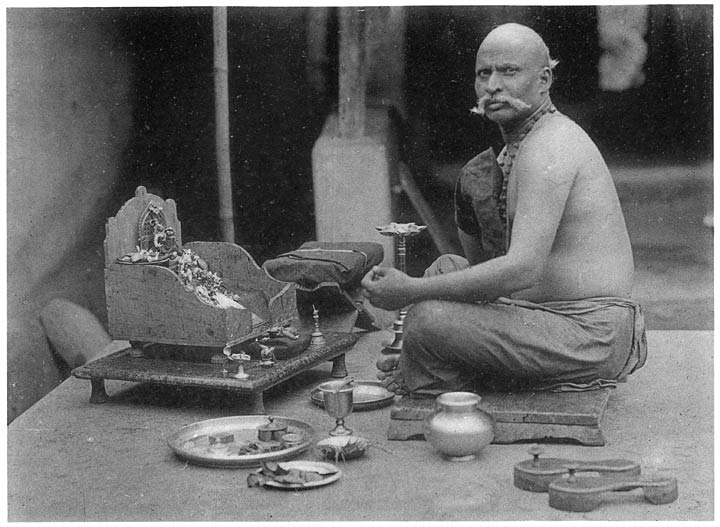
Brāhman worshipping his household gods.
“This is the daily cult of the Brāhman of Benāres, and on holidays it is still further complicated. Since the great epoch of Brāhmanism it has remained the same. Some details may alter, but as a whole it has always been thus tyrannical and thus extravagant. As far back as the Upanishads appears the same faith in the power of articulate speech, the same imperative and innumerable prescriptions, the same singular formulas, the same enumeration of grotesque gestures. Every day, for more than twenty-five hundred years, since Buddhism was a protest against the tyranny and absurdity of rites, has this race mechanically passed through this machinery, resulting in what mental malformations, what habitual attitudes of mind and will, the race is now too different from ourselves for us to be able to conceive.”
Secular Brāhmans now, however, greatly abridge the length of their prayers, and an hour or an hour and a half in the morning suffices for the daily bath and purification, the worship of the household deities and the morning meal.
17. The sacred thread.
Brāhman boys are invested with the sacred thread between the ages of five and nine. The ceremony is called Upanayana or the introduction to knowledge, since by it the boy acquires the right to read the sacred books. Until this ceremony he is not really a Brāhman, and is not bound to observe the caste rules and restrictions. By its performance he becomes Dvija or twice-born, and the highest importance is attached to the change or initiation. He may then begin to acquire divine knowledge, and perhaps in past times it was thought that he obtained the divine character belonging to a Brāhman. The sacred thread is made of three strands of cotton, which should be obtained from the cotton tree growing wild. Sometimes a tree is grown in the yard of the house for the provision of the threads. It has several knots in it, to which great importance is attached, the number of knots being different for a Brāhman, a Kshatriya and a Vaishya, the three twice-born castes. The thread hangs from the left shoulder, falling on to the right hip. Sometimes, when a man is married, he wears a double thread of six strands, the second being for his wife; and after his father dies a treble one of nine strands. At the investiture the boy’s nails are cut and his hair is shaved, and he performs the hom or fire sacrifice for the first time. He then acquires the status of a Brahmachari or disciple, and in former times he would proceed to some religious centre and begin to study the sacred books. The idea of this is preserved by a symbolic ritual. Some Brāhmans shave the boy’s head completely, make a girdle of kusha or munj grass round his waist, provide him with a begging-bowl and tongs and the skin of an antelope to sit on and make him go and beg from four houses. Among others the boy gets on to a wooden horse and announces his intention of going off to Benāres to study. His mother then sits on the edge of a well and threatens to throw herself in if he will not change his mind, or the maternal uncle promises to give the boy his daughter in marriage. Then the boy relinquishes his intention and agrees to stay at home. The sacred thread must always be passed through the hand before saying the Gayatri text in praise of the sun, the most sacred Brāhmanical text. The sacred thread is changed once a year on the day of Rakshabandhan; the Brāhman and all his family change it together. The word Rakshabandhan means binding or tying up the devils, and it would thus appear that the sacred thread and the knots in it may have been originally intended to some extent to be a protection against evil spirits. It is also changed on the occasion of a birth or death in the family, or of an eclipse, or if it breaks. The old threads are torn up or sewn into clothes by the very poor in the Marātha districts. It is said that the Brāhmans are afraid that the Kunbis will get hold of their old threads, and if they do get one they will fold it into four strings, holding a lamp in the middle, and wave it over any one who is sick. The Brāhmans think that if this is done all the accumulated virtue which they have obtained by many repetitions of the Gayatri or sacred prayer will be transferred to the sick Kunbi. Many castes now wear the sacred thread who have no proper claim to do so, especially those who have become landholders and aspire to the status of Rājpūts.
18. Social position.
A man of low caste meeting a Brāhman says ‘Pailagi’ or ‘I fall at your feet,’ and touches the Brāhman’s foot with his hand, which he then carries to his own forehead to signify this. A man wishing to ask a favour in a humble manner stands on one leg and folds his cloth round his neck to show that his head is at his benefactor’s disposal; and he takes a piece of grass in his mouth by which he means to say, ‘I am your cow.’ Brāhmans greeting each other clasp the hands and say ‘Salaam,’ this method of greeting being known as Namaskar. Since most Brāhmans have abandoned the priestly calling and are engaged in Government service and the professions, this exaggerated display of reverence is tending to disappear, nor do the educated members of the caste set any great store by it, preferring the social estimation attaching to such a prominent secular position as they often attain for themselves.
19. Titles.
Any Brāhman is, however, commonly addressed by other castes as Mahārāj, great king, or else as Pandit, a learned man. I had a Brāhman chuprāssie, or orderly, who was regularly addressed by the rest of the household as Pandit, and on inquiring as to the literary attainments of this learned man, I found he had read the first two class-books in a primary school. Other titles of Brāhmans are Dvija, or twice-born, that is, one who has had the thread ceremony performed; Bipra, applied to a Brāhman learned in the Shāstras or scriptures; and Srotriya, a learned Brāhman who is engaged in the performance of Vedic rites.
20. Caste panchāyat and offences.
The Brāhmans have a caste panchāyat, but among the educated classes the tendency is to drop the panchāyat procedure and to refer matters of caste rules and etiquette to the informal decision of a few of the most respected local members. In northern India there is no supreme authority for the caste, but the five southern divisions acknowledge the successor of the great reformer Shankar Achārya as their spiritual head, and important caste questions are referred to him. His headquarters are at the monastery of Sringeri on the Cauvery river in Mysore. Mr. Joshi gives four offences as punishable with permanent exclusion from caste: killing a Brāhman, drinking prohibited wine or spirits, committing incest with a mother or step-mother or with the wife of one’s spiritual preceptor, and stealing gold from a priest. Some very important offences, therefore, such as murder of any person other than a Brāhman, adultery with a woman of impure caste and taking food from her, and all offences against property, except those mentioned, do not involve permanent expulsion. Temporary exclusion is inflicted for a variety of offences, among which are teaching the Vedas for hire, receiving gifts from a Sūdra for performing fire-worship, falsely accusing a spiritual preceptor, subsisting by the harlotry of a wife, and defiling a damsel. It is possible that some of the offences against morality are comparatively recent additions. Brāhmans who cross the sea to be educated in England are readmitted into caste on going through various rites of purification; the principal of these is to swallow the five products of the sacred cow, milk, ghī or preserved butter, curds, dung and urine. But the small minority who have introduced widow-marriage are still banned by the orthodox.
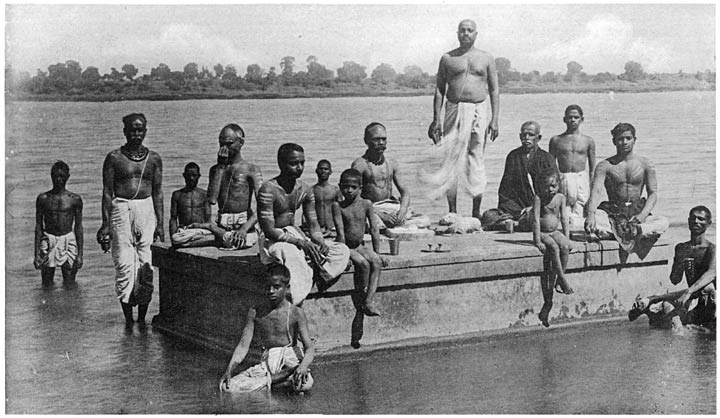
Brāhman bathing party.
21. Rules about food.
Brāhmans as a rule should not eat meat nor drink intoxicating liquor. But it is said that the following indulgences have been recognised: for residents in eastern India the eating of flesh and drinking liquor; for those of northern India the eating of flesh; for those in the west the use of water out of leather buckets; and in the south marriage with a first cousin on the mother’s side. Hindustāni Brāhmans eat meat, according to Mr. Joshi, and others are now also adopting this custom. The kinds of meat permitted are mutton and venison, scaly, but not scaleless, fish, hares, and even the tortoise, wild boar, wild buffalo and rhinoceros. Brāhmans are said even to eat domestic fowls, though not openly, and wild jungle fowls are preferred, but are seldom obtainable. Marātha Brāhmans will not eat meat openly. Formerly only the flesh of animals offered in sacrifice could be eaten, but this rule is being disregarded and some Brāhmans buy mutton from the butchers. A Brāhman should not eat even pakki rasoi or food cooked without water, such as sweetmeats and cakes fried in butter or oil, except when cooked by his own family and in his own home. But these are now partaken of abroad, and also purchased from the Halwai or confectioner on the assumption that he is a Brāhman. A Brāhman should take food cooked with water only from his own relations and in his own home after the place has been purified and spread with cowdung. He bathes before eating, and wears only a yellow silk or woollen cloth round his waist, which is kept specially for this purpose, cotton being regarded as impure. But these rules are tending to become obsolete, as educated Brāhmans recognise more and more what a hindrance they cause to any social enjoyment. Boys especially who receive an English education in high schools and universities are rapidly becoming more liberal. They will drink soda-water or lemonade of which they are very fond, and eat European sweets and sometimes biscuits. The social intercourse of boys of all castes and religions in school and games, and in the latter the frequent association with Europeans, are having a remarkable effect in breaking down caste prejudice, the results of which should become very apparent in a few years. A Brāhman also should not smoke, but many now do so, and when they go to see a friend will take their own huqqa with them as they cannot smoke out of his. Marātha and Khedawāl Brāhmans, however, as a rule do not smoke, but only chew tobacco.
22. Dress.
A Brāhman’s dress should be white, and he can have a coloured turban, preferably red. Marātha Brāhmans were very particular about the securing of their dhoti or loin-cloth, which always had to have five tucks, three into the waistband at the two sides and in front, while the loose ends were tucked in in front and behind. Buttons had to be avoided as they were made of bone, and shoes were considered to be impure as being of leather. Formerly a Brāhman never entered a house with his shoes on, as he would consider the house to be defiled. According to the old rule, if a Brāhman touches a man of an impure caste, as a Chamār (tanner) or Basor (basket-maker), he should bathe and change his loin-cloth, and if he touches a sweeper he should change his sacred thread. Now, however, educated Brāhmans usually wear white cotton trousers and black or brown coats of cloth, alpaca or silk with the normal allowance of buttons, and European shoes and boots which they keep on indoors. Boys are even discarding the choti or scalp-lock and simply cut their hair short in imitation of the English. For the head small felt caps have become fashionable in lieu of turbans.
23. Tattooing.
Men are never tattooed, but women are freely tattooed on the face and body. One dot is made in the centre of the forehead and three on the left nostril in the form of a triangle. All the limbs and the fingers and toes may also be tattooed, the most common patterns being a peacock with spread wings, a fish, cuckoo, scorpion, a child’s doll, a sieve, a pattern of Sīta’s cookroom and representations of all female ornaments. Some women think that they will be able to sell the ornaments tattooed on their bodies in the next world and subsist on the proceeds.
24. Occupation.
25. Character of Brāhmans.
Many hard things have been said about the Brāhman caste and have not been undeserved. The Brāhman priesthood displayed in a marked degree the vices of arrogance, greed, hypocrisy and dissimulation, which would naturally be engendered by their sacerdotal pretensions and the position they claimed at the head of Hindu society. But the priests and mendicants now, as has been seen, contribute only a comparatively small minority of the whole caste. The majority of the Brāhmans are lawyers, doctors, executive officers of Government and clerks in all kinds of Government, railway and private offices. The defects ascribed to the priesthood apply to these, if at all, only in a very minor degree. The Brāhman official has many virtues. He is, as a rule, honest, industrious and anxious to do his work creditably. He spends very little on his own pleasures, and his chief aim in life is to give his children as good an education as he can afford. A half or more of his income may be devoted to this object. If he is well-to-do he helps his poor relations liberally, having the strong fellow-feeling for them which is a relic of the joint family system. He is a faithful husband and an affectionate father. If his outlook on life is narrow and much of his leisure often devoted to petty quarrels and intrigues, this is largely the result of his imperfect, parrot-like education and lack of opportunity for anything better. In this respect it may be anticipated that the excellent education and training now afforded by Government in secondary schools for very small fees will produce a great improvement; and that the next generation of educated Hindus will be considerably more manly and intelligent, and it may be hoped at the same time not less honest, industrious and loyal than their fathers.