Volume 2 / Part 2 — Baiga
Reading edition
List of Paragraphs
1. The tribe and its offshoots.
2. Tribal legends.
3. Tribal subdivisions.
4. Marriage.
5. Birth and funeral rites.
6. Religion.
7. Appearance and mode of life.
8. Dress and food.
9. Occupation.
10. Language.
1. The tribe and its offshoots.
2. Tribal legends.
3. Tribal subdivisions.
The following seven subdivisions or subtribes are recognised: Binjhwār, Bharotia, Narotia or Nāhar, Raibhaina, Kathbhaina, Kondwān or Kundi, and Gondwaina. Of these the Binjhwār, Bharotia and Narotia are the best-known. The name of the Binjhwārs is probably derived from the Vindhyan range, which in turn comes from the Sanskrit vindhya, a hunter. The rule of exogamy is by no means strictly observed, and in Kawardha it is said that these three subcastes intermarry though they do not eat together, while in Bālāghāt the Bharotias and Narotias both eat together and intermarry. In both places the Binjhwārs occupy the highest position, and the other two subtribes will take food from them. The Binjhwārs consider themselves as Hindus and abjure the consumption of buffalo’s and cow’s flesh and rats, while the other Baigas will eat almost anything. The Bharotias partially shave their heads, and in Mandla are apparently known as Mundia or Mudia, or “shaven.” The Gondwainas eat both cow’s flesh and monkeys, and are regarded as the lowest subcaste. As shown by their name they are probably the offspring of unions between Baigas and Gonds. Similarly the Kondwāns apparently derive their name from the tract south of the Mahānadi which is named after the Khond tribe, and was formerly owned by them.
Each subtribe is divided into a number of exogamous septs, the names of which are identical in many cases with those of the Gonds, as Markām, Marāvi, Netām, Tekām and others. Gond names are found most frequently among the Gondwainas and Narotias, and these have adopted from the Gonds the prohibition of marriage between worshippers of the same number of gods. Thus the four septs above mentioned worship seven gods and may not intermarry. But they may marry among other septs such as the Dhurua, Pusām, Bania and Mawār who worship six gods. The Baigas do not appear to have assimilated the further division into worshippers of five, four, three and two gods which exist among the Gonds in some localities, and the system is confined to the lower subtribes. The meanings of the sept names have been forgotten and no instances of totemism are known. And the Binjhwārs and Bharotias, who are more or less Hinduised, have now adopted territorial names for their septs, as Lapheya from Lāpha zamīndāri, Ghugharia from Ghughri village in Mandla, and so on. The adoption of Gond names and septs appears to indicate that Gonds were in former times freely admitted into the Baiga tribe; and this continues to be the case at present among the lower subtribes, so far that a Gond girl marrying a Baiga becomes a regular member of the community. But the Binjhwārs and Bharotias, who have a somewhat higher status than the others, refuse to admit Gonds, and are gradually adopting the strict rule of endogamy within the subtribe.
4. Marriage.
5. Birth and funeral rites.
They also think that they can shut up the tiger’s dār or jaws, so that he cannot bite them, by driving a nail into a tree. The forest track from Kānha to Kisli in the Banjar forest reserve of Mandla was formerly a haunt of man-eating tigers, to whom a number of the wood-cutters and Baiga coolies, clearing the jungle paths, fell victims every year. In a large tree, at a dangerous point in the track, there could recently be seen a nail, driven into the trunk by a Baiga priest, at some height from the ground. It was said that this nail shut the mouth of a famous man-eating tiger of the locality and prevented him from killing any more victims. As evidence of the truth of the story there were shown on the trunk the marks of the tiger’s claws, where he had been jumping up the tree in the effort to pull the nail out of the trunk and get his man-eating powers restored.
6. Religion.
7. Appearance and mode of life.
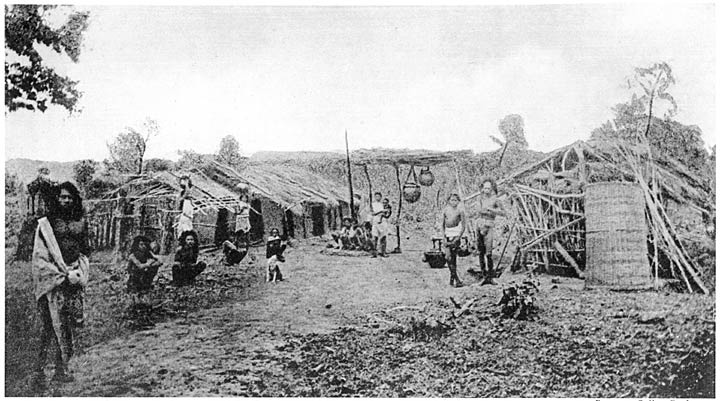
Baiga village, Bālāghāt District.
8. Dress and food.
Their dress is of the most simple description, a small strip of rag between the legs and another wisp for a head-covering sufficing for the men, though the women are decently covered from their shoulders to half-way between the thighs and knees. A Baiga may be known by his scanty clothing and tangled hair, and his wife by the way in which her single garment is arranged so as to provide a safe sitting-place in it for her child. Baiga women have been seen at work in the field transplanting rice with babies comfortably seated in their cloth, one sometimes supported on either hip with their arms and legs out, while the mother was stooping low, hour after hour, handling the rice plants. A girl is tattooed on the forehead at the age of five, and over her whole body before she is married, both for the sake of ornament and because the practice is considered beneficial to the health. The Baigas are usually without blankets or warm clothing, and in the cold season they sleep round a wood fire kept burning or smouldering all night, stray sparks from which may alight on their tough skins without being felt. Mr. Lampard relates that on one occasion a number of Baiga men were supplied by the Mission under his charge with large new cloths to cover their bodies with and make them presentable on appearance in church. On the second Sunday, however, they came with their cloths burnt full of small holes; and they explained that the damage had been done at night while they were sleeping round the fire.
A Baiga, Mr. Lampard continues, is speedily discerned in a forest village bazār, and is the most interesting object in it. His almost nude figure, wild, tangled hair innocent of such inventions as brush or comb, lithe wiry limbs and jungly and uncivilised appearance, mark him out at once. He generally brings a few mats or baskets which he has made, or fruits, roots, honey, horns of animals, or other jungle products which he has collected, for sale, and with the sum obtained (a few pice or annas at the most) he proceeds to make his weekly purchases, changing his pice into cowrie shells, of which he receives eighty for each one. He buys tobacco, salt, chillies and other sundries, besides as much of kodon, kutki, or perhaps rice, as he can afford, always leaving a trifle to be expended at the liquor shop before departing for home. The various purchases are tied up in the corners of the bit of rag twisted round his head. Unlike pieces of cloth known to civilisation, which usually have four corners, the Baiga’s headgear appears to be nothing but corners, and when the shopping is done the strip of rag may have a dozen minute bundles tied up in it.
9. Occupation.
The Baigas formerly practised only shifting cultivation, burning down patches of jungle and sowing seed on the ground fertilised by the ashes after the breaking of the rains. Now that this method has been prohibited in Government forest, attempts have been made to train them to regular cultivation, but with indifferent success in Bālāghāt. An idea of the difficulties to be encountered may be obtained from the fact that in some villages the Baiga cultivators, if left unwatched, would dig up the grain which they had themselves sown as seed in their fields and eat it; while the plough-cattle which were given to them invariably developed diseases in spite of all precautions, as a result of which they found their way sooner or later to the Baiga’s cooking-pot. But they are gradually adopting settled habits, and in Mandla, where a considerable block of forest was allotted to them in which they might continue their destructive practice of shifting sowings, it is reported that the majority have now become regular cultivators. One explanation of their refusal to till the ground is that they consider it a sin to lacerate the breast of their mother earth with a ploughshare. They also say that God made the jungle to produce everything necessary for the sustenance of men and made the Baigas kings of the forest, giving them wisdom to discover the things provided for them. To Gonds and others who had not this knowledge, the inferior occupation of tilling the land was left. The men never become farmservants, but during the cultivating season they work for hire at uprooting the rice seedlings for transplantation; they do no other agricultural labour for others. Women do the actual transplantation of rice and work as harvesters. The men make bamboo mats and baskets, which they sell in the village weekly markets. They also collect and sell honey and other forest products, and are most expert at all work that can be done with an axe, making excellent woodcutters. But they show no aptitude in acquiring the use of any other implement, and dislike steady continuous labour, preferring to do a few days’ work and then rest in their homes for a like period before beginning again. Their skill and dexterity in the use of the axe in hunting is extraordinary. Small deer, hares and peacocks are often knocked over by throwing it at them, and panthers and other large animals are occasionally killed with a single blow. If one of two Baigas is carried off by a tiger, the survivor will almost always make a determined and often successful attempt to rescue him with nothing more formidable than an axe or a stick. They are expert trackers, and are also clever at setting traps and snares, while, like Korkus, they catch fish by damming streams in the hot weather and throwing into the pool thus formed some leaf or root which stupefies them. Even in a famine year, Mr. Low says, a Baiga can collect a large basketful of roots in a single day; and if the bamboo seeds he is amply provided for. Nowadays Baiga cultivators may occasionally be met with who have taken to regular cultivation and become quite prosperous, owning a number of cattle.
10. Language.
As already stated, the Baigas have completely forgotten their own language, and in the Satpūra hills they speak a broken form of Hindi, though they have a certain number of words and expressions peculiar to the caste.