Volume 2 / Part 2 — Chamār
Reading edition
List of Paragraphs
1. General notice of the caste.
2. Endogamous divisions.
3. Subcastes continued.
4. Exogamous divisions.
5. Marriage.
6. Widow-marriage and divorce.
7. Funeral customs.
8. Childbirth.
9. Religion.
10. Occupation.
11. The tanning process.
12. Shoes.
13. Other articles made of leather.
14. Customs connected with shoes.
15. The Chamār as general village drudge.
16. Social status.
17. Character.
1. General notice of the caste.
Karia Brāhman, gor Chamār, Inke sāth nā utariye pār,
that is, ‘Do not cross a river in the same boat with a black Brāhman or a fair Chamār,’ both being of evil omen.” The latter description would certainly apply to the Chamārs of the Central Provinces outside the Chhattīsgarh Districts, but hardly to the caste as a whole within that area. No satisfactory explanation has been offered of this distinction of appearance of some groups of Chamārs. It is possible that the Chamārs of certain localities may be the descendants of a race from the north-west, conquered and enslaved by a later wave of immigrants; or that their physical development may owe something to adult marriage and a flesh diet, even though consisting largely of carrion. It may be noticed that the sweepers, who eat the broken food from the tables of the Europeans and wealthy natives, are sometimes stronger and better built than the average Hindu. Similarly, the Kasais or Muhammadan butchers are proverbially strong and lusty. But no evidence is forthcoming in support of such conjectures, and the problem is likely to remain insoluble.
2. Endogamous divisions.
3. Subcastes continued.
4. Exogamous divisions.
The caste is also divided into a large number of exogamous groups or sections, whose names, as might be expected, present a great diversity of character. Some are borrowed from Rājpūt clans, as Sūrajvansi, Gaharwār and Rāthor; while others, as Marai, are taken from the Gonds. Instances of sections named after other castes are Banjar (Banjāra), Jogi, Chhipia (Chhipi, a tailor) and Khairwār (a forest tribe). The Chhipia section preserve the memory of their comparatively illustrious descent by refusing to eat pork. Instances of sections called after a title or nickname of the reputed founder are Mālādhāri, one who wears a garland; Māchhi-Mundia or fly-headed, perhaps the equivalent of feather-brained; Hathīla, obstinate; Bāghmār, a tiger-killer; Māngaya, a beggar; Dhuliya, a drummer; Jadkodiha, one who digs for roots, and so on. There are numerous territorial groups named after the town or village where the ancestor of the clan may be supposed to have lived; and many names also are of a totemistic nature, being taken from plants, animals or natural objects. Among these are Khunti, a peg; Chandaniha, sandalwood; Tarwāria, a sword; Borbans, plums; Miri, chillies; Chauria, a whisk; Baraiya, a wasp; Khalaria, a hide or skin; Kosni, kosa or tasar silk; and Purain, the lotus plant. Totemistic observances survive only in one or two isolated instances.
5. Marriage.
“As the bridegroom’s party approached the home of the bride the boy’s friends lifted him up on their shoulders, and, surrounding him on every side, they made their way to the bride’s house, swinging round their sticks in a threatening manner. On coming near the house they crossed sticks with the bride’s friends, who gradually fell back and allowed the bridegroom’s friends to advance in their direction. The women of the house gathered with baskets and fans and some threw about rice in pretence of self-defence. When the sticks of the bridegroom’s party struck the roof of the bride’s house or of the marriage-shed her friends considered themselves defeated and the sham fight was at an end.” Among the Marātha Chamārs of Betūl two earthen pots full of water are half buried in the ground and worship is paid to them. The bride and bridegroom then stand together and their relatives take out water from the pots and pour it on to their heads from above. The idea is that the pouring of the sacred water on to them will make them grow, and if the bride is much smaller than the bridegroom more water is poured on to her in order that she may grow faster. The practice may symbolise the fertilising influence of rain. Among the Dohar Chamārs of Narsinghpur the bride and bridegroom are seated on a plough-yoke while the marriage ceremony is performed. Before the wedding the bride’s party take a goat’s leg in a basket with other articles to the janwāsa or bridegroom’s lodging and present it to his father. The bride and bridegroom take the goat’s leg and beat each other with it alternately. Another ceremony, known as Pendpūja, consists in placing pieces of stick with cotton stuck to the ends in an oven and burning them in the name of the deceased ancestors; but the significance, if there be any, of this rite is obscure. Some time after the wedding the bride is taken to her husband’s house to live with him, and on this occasion a simple ceremony known as Chauk or Pathoni is performed.
6. Widow-marriage and divorce.
Widows commonly remarry, and may take for their second husband anybody they please, except their own relatives and their late husband’s elder brother and ascendant relations. In Chhattīsgarh widows are known either as barandi or randi, the randi being a widow in the ordinary sense of the term and the barandi a girl who has been married but has not lived with her husband. Such a girl is not required to break her bangles on her husband’s death, and, being more in demand as a second wife, her father naturally obtains a good price for her. To marry a woman whose husband is alive is known as chhandwe banāna, the term chhandwe implying that the woman has discarded, or has been discarded by, her husband. The second husband must in this case repay to the first husband the expenses incurred by him on his wedding. The marriage ceremony for a widow is of the simplest character, and consists generally of the presentation to her by her new husband of those articles which a married woman may use, but which should be forsworn by a widow, as representing the useless vanities of the world. Thus in Saugor the bridegroom presents his bride with new clothes, vermilion for the parting of her hair, a spangle for her forehead, lac dye for her feet, antimony for the eyes, a comb, glass bangles and betel-leaves. In Mandla and Seoni the bridegroom gives a ring, according to the English custom, instead of bangles. When a widow marries a second time her first husband’s property remains with his family and also the children, unless they are very young, when the mother may keep them for a few years and subsequently send them back to their father’s relatives. Divorce is permitted for a variety of causes, and is usually effected in the presence of the caste panchāyat or committee by the husband and wife breaking a straw as a symbol of the rupture of the union. In Chānda an image of the divorced wife is made of grass and burnt to indicate that to her husband she is as good as dead; if she has children their heads and faces are shaved in token of mourning, and in the absence of children the husband’s younger brother has this rite performed; while the husband gives a funeral feast known as Marti Jīti kā Bhāt, or ‘The feast of the living dead woman.’ In Chhattīsgarh marriage ties are of the loosest description, and adultery is scarcely recognised as an offence. A woman may go and live openly with other men and her husband will take her back afterwards. Sometimes, when two men are in the relation of Mahāprasād or nearest friend to each other, that is, when they have vowed friendship on rice from the temple of Jagannāth, they will each place his wife at the other’s disposal. The Chamārs justify this carelessness of the fidelity of their wives by the saying, ‘If my cow wanders and comes home again, shall I not let her into her stall?’ In Seoni, if a Chamār woman is detected in a misdemeanour with a man of the caste, both parties are taken to the bank of a tank or river, where their heads are shaved in the presence of the caste panchāyat or committee. They are then made to bathe, and the shoes of all the assembled Chamārs made up into two bundles and placed on their heads, while they are required to promise that they will not repeat the offence.
7. Funeral customs.
8. Childbirth.
9. Religion.
10. Occupation.
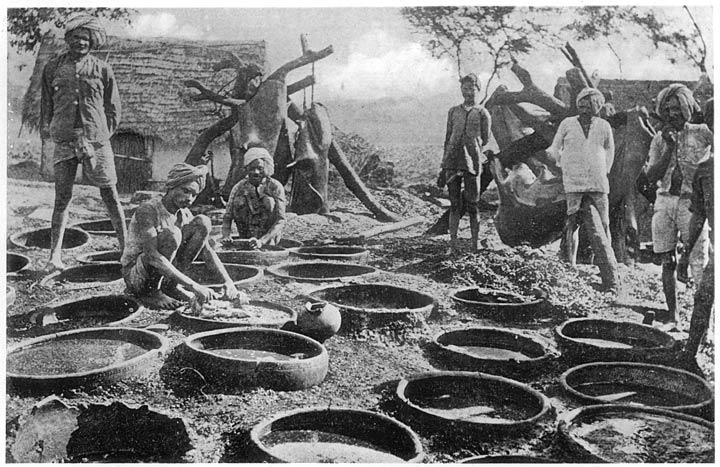
Chamārs tanning and working in leather.
11. The tanning process.
12. Shoes.
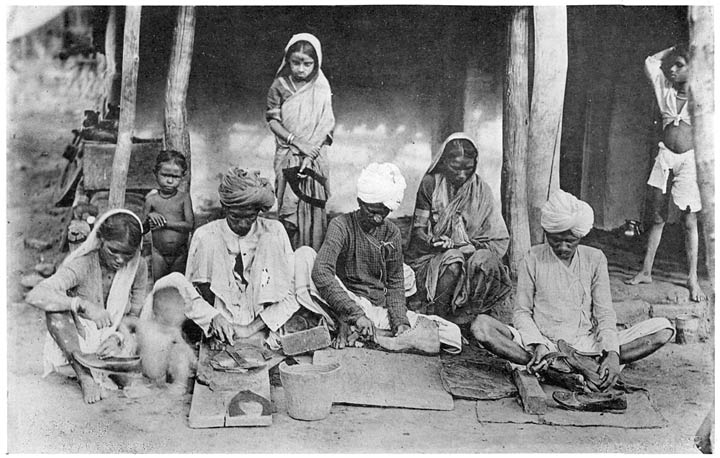
Chamārs cutting leather and making shoes.
13. Other articles made of leather.
Other articles made of leather are the thongs and nose-strings for bullocks, the buckets for irrigation wells, rude country saddlery, and mussacks and pakhāls for carrying water. These last are simply hides sewn into a bag and provided with an orifice. To make a pair of bellows a goat-skin is taken with all four legs attached, and wetted and filled with sand. It is then dried in the sun, the sand shaken out, the sticks fitted at the hind-quarters for blowing, and the pair of bellows is complete.
14. Customs connected with shoes.
The shoe, as everybody in India knows, is a symbol of the greatest degradation and impurity. This is partly on account of its manufacture from the impure leather or hide, and also perhaps because it is worn and trodden under foot. All the hides of tame animals are polluted and impure, but those of certain wild animals, such as the deer and tiger, are not so, being on the contrary to some extent sacred. This last feeling may be due to the fact that the old anchorites of the forests were accustomed to cover themselves with the skins of wild animals, and to use them for sitting and kneeling to pray. A Bairāgi or Vaishnava religious mendicant much likes to carry a tiger-skin on his body if he can afford one; and a Brāhman will have the skin of a black-buck spread in the room where he performs his devotions. Possibly the sin involved in killing tame animals has been partly responsible for the impurity attaching to their hides, to the obtaining of which the death of the animal must be a preliminary. Every Hindu removes his shoes before entering a house, though with the adoption of English boots a breach is being made in this custom. So far as the houses of Europeans are concerned, the retention of shoes is not, as might be imagined, of recent origin, but was noticed by Buchanan a hundred years ago: “Men of rank and their attendants continue to wear their shoes loose for the purpose of throwing them off whenever they enter a room, which they still continue to do everywhere except in the houses of Europeans, in which all natives of rank now imitate our example.” In this connection it must be remembered that a Hindu house is always sacred as the shrine of the household god, and shoes are removed before stepping across the threshold on to the hallowed ground. This consideration does not apply to European houses, and affords ground for dispensing with the removal of laced shoes and boots.
To be beaten or sometimes even touched with a shoe by a man of low caste entails temporary social excommunication to most Hindus, and must be expiated by a formal purification and caste feast. The outcaste Mahārs punish a member of their community in the same manner even if somebody should throw a shoe on to the roof of his house, and the Pharasaical absurdities of the caste system surely find their culminating point in this rule. Similarly if a man touches his shoe with his hand and says ‘I have beaten you,’ to a member of any of the lower castes in Seoni, the person so addressed is considered as temporarily out of caste. If he then immediately goes and informs his caste-fellows he is reinstated with a nominal fine of grain worth one or two pice. But if he goes back to his house and takes food, and the incident is subsequently discovered, a penalty of a goat is levied. A curious exception recognised is that of the Sirkāri jūta, or shoe belonging to a Government servant, and to be beaten with this shoe does not entail social punishment.
15. The Chamār as general village drudge.
In return for his perquisite of the hides of cattle the Chamār has to act as the general village drudge in the northern Districts and is always selected for the performance of bigār or forced labour. When a Government officer visits the village the Chamār must look after him, fetch what grass or fuel he requires, and accompany him as far as the next village to point out the road. He is also the bearer of official letters and messages sent to the village. The special Chamār on whom these duties are imposed usually receives a plot of land rent-free from the village proprietor. Another of the functions of the Chamār is the castration of the young bullocks, which task the cultivators will not do for themselves. His method is most primitive, the scrotum being held in a cleft bamboo or a pair of iron pincers, while the testicles are bruised and rubbed to pulp with a stone. The animal remains ill for a week or a fortnight and is not worked for two months, but the operation is rarely or never fatal. In the northern Districts the Chamārs are said to be very strong and to make the best farmservants and coolies for earthwork. It is a proverb that ‘The Chamār has half a rib more than other men.’ Notwithstanding his strength, however, he is a great coward, this characteristic having probably been acquired through centuries of oppression. Many Chamār women act as midwives. In Raipur the cultivators give her five annas at the birth of a boy and four annas for a girl, while well-to-do people pay a rupee. When the first child of a rich man is born, the midwife, barber and washerman go round to all his friends and relations to announce the event and obtain presents. It is a regular function of the Chamārs to remove the carcases of dead cattle, which they eat without regard to the disease from which the animal may have died. But a Chamār will not touch the corpse of a pony, camel, cat, dog, squirrel or monkey, and to remove the bodies of such animals a Mehtar (sweeper) or a Gond must be requisitioned. In Raipur it is said that the Chamārs will eat only the flesh of four-legged animals, avoiding presumably birds and fish. When acting as a porter the Chamār usually carries a load on his head, whereas the Kahār bears it on his shoulders, and this distinction is proverbial. In Raipur the Chamārs have become retail cattle-dealers and are known as Kochias. They purchase cattle at the large central markets of Baloda and Bamnidih and retail them at the small village bazārs. It is said that this trade could only flourish in Chhattīsgarh, where the cultivators are too lazy to go and buy their cattle for themselves. Many Chamārs have emigrated from Chhattīsgarh to the Assam tea-gardens, and others have gone to Calcutta and to the railway workshops at Kharagpur and Chakardharpur. Many of them work as porters on the railway. It is probable that their taste for emigration is due to the resentment felt at their despised position in Chhattīsgarh.
16. Social status.
17. Character.
Like all other village artisans the Chamār is considered by the cultivators to be faithless and dilatory in his dealings with them; and they vent their spleen in sayings such as the following:—“The Kori, the Chamār and the Ahīr, these are the three biggest liars that ever were known. For if you ask the Chamār whether he has mended your shoes he says, ‘I am at the last stitch,’ when he has not begun them; if you ask the Ahīr whether he has brought back your cow from the jungle he says, ‘It has come, it has come,’ without knowing or caring whether it has come or not; and if you ask the Kori whether he has made your cloth he says, ‘It is on the loom,’ when he has not so much as bought the thread.” Another proverb conveying the same sense is, ‘The Mochi’s to-morrow never comes.’ But no doubt the uncertainty and delay in payment account for much of this conduct.