Volume 2 / Part 2 — Bohra
Reading edition
List of Paragraphs
1. Origin of the sect.
2. Their religious tenets.
3. The Mullahs.
4. Bohra graveyards.
5. Religious customs.
6. Occupation.
7. Houses and dress.
1. Origin of the sect.
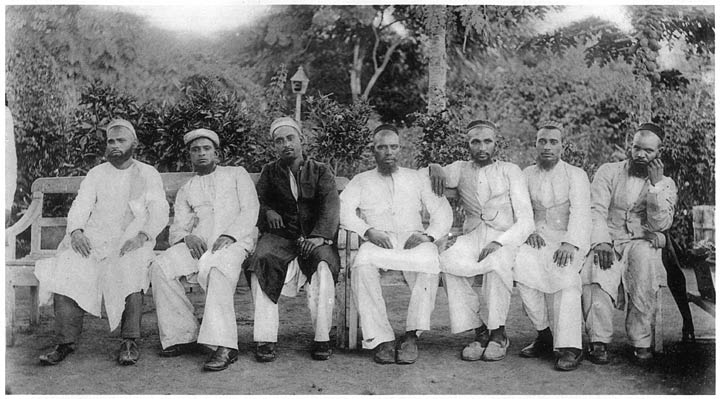
Group of Bohras at Burhānpur (Nimār).
2. Their religious tenets.
Gujarāt contains two classes of Bohras: the traders who are all Shias and are the only immigrants into the Central Provinces, and a large class of cultivating Bohras who are Sunnis. The latter may be the descendants of the earliest converts and may have been forced to become Sunnis when this sect was dominant in Gujarāt as noticed above, while the Shias are perhaps descended from the later immigrants from Arabia. The Shia Bohras themselves are further divided into several sects of which the Dāudi are the principal.
3. The Mullahs.
“Their leader, both in things religious and social, is the head Mullah of Surat. The ruling Mullah names his successor, generally, but it is said not always, from among the members of his own family. Short of worship the head Mullah is treated with the greatest respect. He lives in much state and entertains with the most profuse liberality. On both religious and civil questions his authority is final. Discipline is enforced in religious matters by fine, and in case of adultery, drunkenness and other offences, by fine, excommunication and rarely by flogging. On ceremonial occasions the head Mullah sits on his throne, and in token of his power has the flyflapper, chauri, held before him. As the Bohras enter they make three prostrations, salaams, close their hands and stand before him. To such as are worthy he says ‘Be seated,’ to others ‘Stand.’ Once a year, on the 18th Rajjab, every Dāudi lays his palm within the head Mullah’s hand and takes an oath to be faithful. On this day when he goes to the mosque the Bohras are said to kiss the Mullah’s footsteps and to apply the dust he treads to their heads and eyes.” Each considerable settlement of the sect has a deputy Mullah of its own.
4. Bohra graveyards.
“Their burial-grounds have a pleasing appearance, the tombs being regularly arranged in streets, east and west. The tombs themselves, which are, of course, north and south, the corpse resting on its right side, differ in no respect from those of Sunnis, with the exception of a small chirāgh takia or lamp-socket, cut out of the north face, just like the cavity for the inscription of our own tombs.”
5. Religious customs.
It has been seen that when a Bohra is buried a prayer for pity on his soul and body is laid in the dead man’s hands, of which Mr. Farīdi gives the text. But other Muhammadans tell a story to the effect that the head Mullah writes a letter to the archangel Gabriel in which he is instructed to supply a stream of honey, a stream of milk, water and some fruit trees, a golden building and a number of houris, the extent of the order depending on the amount of money which has been paid to the Mullah by the departed in his lifetime; and this letter is placed beneath the dead man’s head in the grave, the Bohras having no coffins. The Bohras indignantly repudiate any such version of the letter, and no doubt if the custom ever existed it has died out.