Volume 2 / Part 2 — Ahīr
Reading edition
List of Paragraphs
1. General notice.
2. Former dominance of the Abhīras.
3. Ahīr dialects.
4. The Yādavas and Krishna.
5. The modern Ahīrs an occupational caste.
6. Subcastes.
7. The Dauwa or wet-nurse Ahīrs. Fosterage.
8. Exogamy.
9. Marriage customs.
10. Birth customs.
11. Funeral rites. Bringing back the soul.
12. Religion. Krishna and other deified cowherds.
13. Caste deities.
14. Other deities.
15. The Diwāli festival.
16. Omens.
17. Social customs.
18. Ornaments.
19. Occupation.
20. Preparations of milk.
1. General notice.
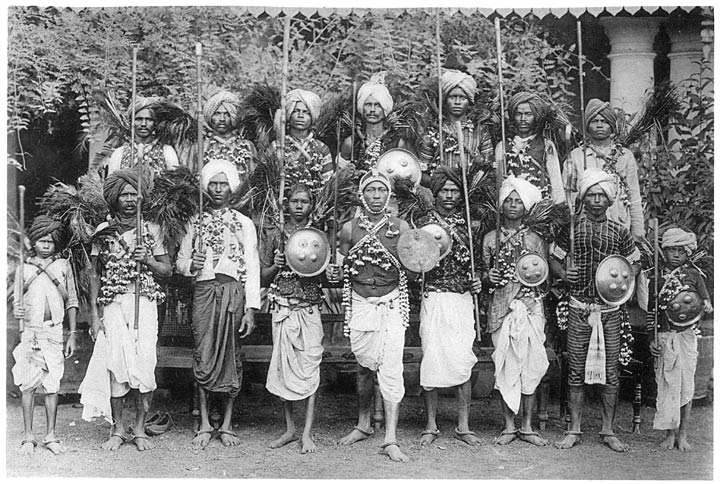
Ahīrs decorated with cowries for the Stick Dance at Diwāli.
2. Former dominance of the Abhīras.
3. Ahīr dialects.
4. The Yādavas and Krishna.
This argument is interesting as showing that Abhīra was not originally an occupational term for a herdsman, nor a caste name, but belonged to an immigrant tribe. Owing apparently to the fact that the Abhīras, like the Gūjars, devoted themselves to a pastoral mode of life in India, whereas the previous Aryan immigrants had settled down to cultivation, they gave their name to the great occupational caste of herdsmen which was subsequently developed, and of which they may originally have constituted the nucleus. The Gūjars, who came to India at a later period, form a parallel case; although the Gūjar caste, which is derived from them, is far less important than the Ahīr, the Gūjars have also been the parents of several Rājpūt clans. The reason why the early Mathura legends of Krishna make no mention of the Ahīrs may be that the deity Krishna is probably compounded of at least two if not more distinct personalities. One is the hero chief of the Yādavas, who fought in the battle of the Pandavas and Kauravas, migrated to Gujarāt and was killed there. As he was chief of the Yādavas this Krishna must stand for the actual or mythical personality of some leader of the immigrant nomad tribes. The other Krishna, the boy cowherd, who grazed cattle and sported with the milkmaids of Brindāban, may very probably be some hero of the indigenous non-Aryan tribes, who, then as now, lived in the forests and were shepherds and herdsmen. His lowly birth from a labouring cowherd, and the fact that his name means black and he is represented in sculpture as being of a dark colour, lend support to this view. The cult of Krishna, Mr. Crooke points out, was comparatively late, and probably connected with the development of the worship of the cow after the decay of Buddhism. This latter Krishna, who is worshipped with his mother as a child-god, was especially attractive to women, both actual and prospective mothers. It is quite probable therefore that as his worship became very popular in Hindustān in connection with that of the cow, he was given a more illustrious origin by identification with the Yādava hero, whose first home was apparently in Gujarāt. In this connection it may also be noted that the episodes connected with Krishna in the Mahābhārata have been considered late interpolations.
5. The modern Ahīrs an occupational caste.
6. Subcastes.
The principal subcastes of the Ahīrs in northern India are the Jāduvansi, Nāndvansi and Gowālvansi. The Jāduvansi claimed to be descended from the Yādavas, who now form the Yādu and Jādon-Bhatti clans of Rājpūts. The probability of a historical connection between the Abhīras and Yādavas has already been noticed. The Nāndvansi consider their first ancestor to have been Nānd, the cowherd, the foster-father of Krishna; while the name of the Gowālvansi is simply Goāla or Gauli, a milkman, a common synonym for the caste. The Kaonra Ahīrs of Mandla and the Kamarias of Jubbulpore are considered to belong to the Nāndvansi group. Other subcastes in the northern Districts are the Jijhotia, who, like the Jijhotia Brāhmans, take their name from Jajhoti, the classical term for Bundelkhand; the Bharotia; and the Narwaria from Narwar. The Rāwats of Chhattīsgarh are divided into the Jhadia, Kosaria and Kanaujia groups. Of these the Jhadia or ‘jungly,’ and Kosaria from Kosala, the ancient name of the Chhattīsgarh country, are the oldest settlers, while the Kanaujia are largely employed as personal servants in Chhattīsgarh, and all castes will take water from their hands. The superior class of them, however, refuse to clean household cooking vessels, and are hence known as Thethwār, or exact or pure, as distinguished from the other Rāwats, who will perform this somewhat derogatory work.
7. The Dauwa or wet-nurse Ahīrs. Fosterage.
The Gaolis or milkmen appear to form a distinct branch of the caste with subcastes of their own. Among them are the Nāndvans, common to the Ahīrs, the Mālwi from Mālwa and the Rāghuvansi, called after the Rājpūt clan of that name. The Rānyas take their designation from rān, forest, like the Jhādia Rāwats.
8. Exogamy.
The caste have exogamous sections, which are of the usual low-caste type, with titular or totemistic names. Those of the Chhattīsgarhi Rāwats are generally named after animals. A curious name among the Mahākul Ahīrs is Mathānkāta, or one who bit his mother’s nipples. The marriage of persons belonging to the same section and of first cousins is prohibited. A man may marry his wife’s younger sister while his wife is living, but not her elder sister. The practice of exchanging girls between families is permissible.
9. Marriage customs.
As a rule, girls may be married before or after puberty, but the Golkars of Chānda insist on infant marriage, and fine the parents if an unmarried girl becomes adolescent. On the other hand, the Kaonra Ahīrs of Mandla make a practice of not getting a girl married till the signs of puberty have appeared. It is said that in Mandla if an unmarried girl becomes pregnant by a man of the caste the panchāyat give her to him and fine him Rs. 20 or 30, which they appropriate themselves, giving nothing to the father. If an Ahīr girl is seduced by an outsider, she is made over to him, and a fine of Rs. 40 or 50 is exacted from him if possible. This is paid to the girl’s father, who has to spend it on a penalty feast to the caste. Generally, sexual offences within the community are leniently regarded. The wedding ceremony is of the type prevalent in the locality. The proposal comes from the boy’s family, and a price is usually given for the bride. The Kaonra Ahīrs of Mandla and the Jharia and Kosaria Rāwats of Chhattīsgarh employ a Brāhman only to write the lagun or paper fixing the date of the wedding, and the ceremony is conducted by the sawāsins or relatives of the parties. In Chhattīsgarh the bridegroom is dressed as a girl to be taken to the wedding. In Betūl the weddings of most Gaolis are held in Māgh (January), and that of the Rānya subcaste in the bright fortnight of Kārtik (October). At the ceremony the bride is made to stand on a small stone roller; the bridegroom then takes hold of the roller facing the bride and goes round in a circle seven times, turning the roller with him. Widow remarriage is permitted, and a widow is often expected to marry the younger brother of her deceased husband. If a bachelor wishes to marry a widow he first goes through the ceremony with a dagger or an earthen vessel. Divorce is freely permitted. In Hoshangābād a strip is torn off the clothes worn by husband and wife as a sign of their divorce. This is presumably in contrast to the knotting of the clothes of the couple together at a wedding.
10. Birth customs.
Among the Rāwats of Chhattīsgarh, when a child is shortly to be born the midwife dips her hand in oil and presses it on the wall, and it is supposed that she can tell by the way in which the oil trickles down whether the child will be a boy or a girl. If a woman is weak and ill during her pregnancy it is thought that a boy will be born, but if she is strong and healthy, a girl. A woman in advanced pregnancy is given whatever she desires to eat, and on one occasion especially delicate kinds of food are served to her, this rite being known as Sidhori. The explanation of the custom is that if the mother does not get the food she desires during pregnancy the child will long for it all through life. If delivery is delayed, a line of men and boys is sometimes made from the door of the house to a well, and a vessel is then passed from hand to hand from the house, filled with water, and back again. Thus the water, having acquired the quality of speed during its rapid transit, will communicate this to the woman and cause her quick delivery. Or they take some of the clay left unmoulded on the potter’s wheel and give it her to drink in water; the explanation of this is exactly similar, the earth having acquired the quality of swiftness by the rapid transit on the wheel. If three boys or three girls have been born to a woman, they think that the fourth should be of the same sex, in order to make up two pairs. A boy or girl born after three of the opposite sex is called Titra or Titri, and is considered very unlucky. To avert this misfortune they cover the child with a basket, kindle a fire of grass all round it, and smash a brass pot on the floor. Then they say that the baby is the fifth and not the fourth child, and the evil is thus removed. When one woman gives birth to a male and another to a female child in the same quarter of a village on the same day and they are attended by the same midwife, it is thought that the boy child will fall ill from the contagion of the girl child communicated through the midwife. To avoid this, on the following Sunday the child’s maternal uncle makes a banghy, which is carried across the shoulders like a large pair of scales, and weighs the child in it against cowdung. He then takes the banghy and deposits it at cross-roads outside the village. The father cannot see either the child or its mother till after the Chathi or sixth-day ceremony of purification, when the mother is bathed and dressed in clean clothes, the males of the family are shaved, all their clothes are washed, and the house is whitewashed; the child is also named on this day. The mother cannot go out of doors until after the Bārhi or twelfth-day ceremony. If a child is born at an unlucky astrological period its ears are pierced in the fifth month after birth as a means of protection.
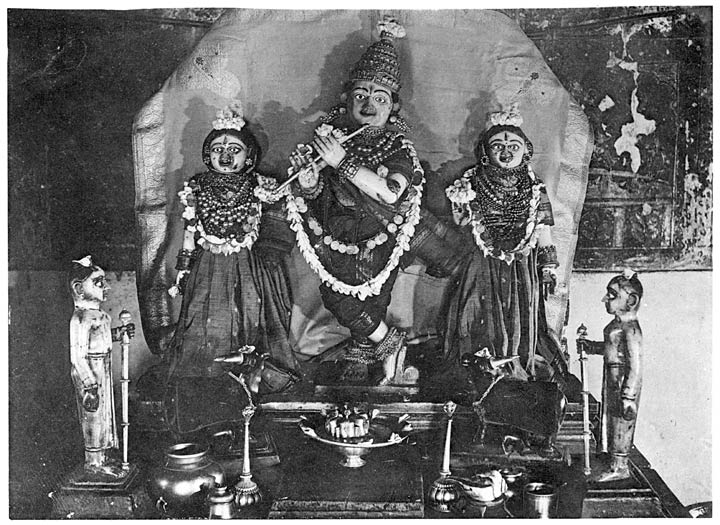
Image of Krishna as Murlidhar or the flute-player, with attendant deities.
11. Funeral rites. Bringing back the soul.
The dead are either buried or burnt. When a man is dying they put basil leaves and boiled rice and milk in his mouth, and a little piece of gold, or if they have not got gold they put a rupee in his mouth and take it out again. For ten days after a death, food in a leaf-cup and a lamp are set out in the house-yard every evening, and every morning water and a tooth-stick. On the tenth day they are taken away and consigned to a river. In Chhattīsgarh on the third day after death the soul is brought back. The women put a lamp on a red earthen pot and go to a tank or stream at night. The fish are attracted towards the light, and one of them is caught and put in the pot, which is then filled with water. It is brought home and set beside a small heap of flour, and the elders sit round it. The son of the deceased or other near relative anoints himself with turmeric and picks up a stone. This is washed with the water from the pot, and placed on the floor, and a sacrifice of a cock or hen is made to it according as the deceased was a man or a woman. The stone is then enshrined in the house as a family god, and the sacrifice of a fowl is repeated annually. It is supposed apparently that the dead man’s spirit is brought back to the house in the fish, and then transferred to the stone by washing this with the water.
12. Religion. Krishna and other deified cowherds.
13. Caste deities.
Among the special deities of the Ahīrs is Kharak Deo, who is always located at the khirkha, or place of assembly of the cattle, on going to and returning from pasture. He appears to be the spirit or god of the khirkha. He is represented by a platform with an image of a horse on it, and when cattle fall ill the owners offer flour and butter to him. These are taken by the Ahīrs in charge, and it is thought that the cattle will get well. Matar Deo is the god of the pen or enclosure for cattle made in the jungle. Three days after the Diwāli festival the Rāwats sacrifice one or more goats to him, cutting off their heads. They throw the heads into the air, and the cattle, smelling the blood, run together and toss them with their horns as they do when they scent a tiger. The men then say that the animals are possessed by Matar Deo. Guraya Deo is a deity who lives in the cattle-stalls in the village and is worshipped once a year. A man holds an egg in his hand, and walks round the stall pouring liquid over the egg all the way, so as to make a line round it. The egg is then buried beneath the shrine of the god, the rite being probably meant to ensure his aid for the protection of the cattle from disease in their stalls. A favourite saint of the Ahīrs is Haridās Bāba. He was a Jogi, and could separate his soul from his body at pleasure. On one occasion he had gone in spirit to Benāres, leaving his body in the house of one of his disciples, who was an Ahīr. When he did not return, and the people heard that a dead body was lying there, they came and insisted that it should be burnt. When he came back and found that his body was burnt, he entered into a man and spoke through him, telling the people what had happened. In atonement for their unfortunate mistake they promised to worship him.
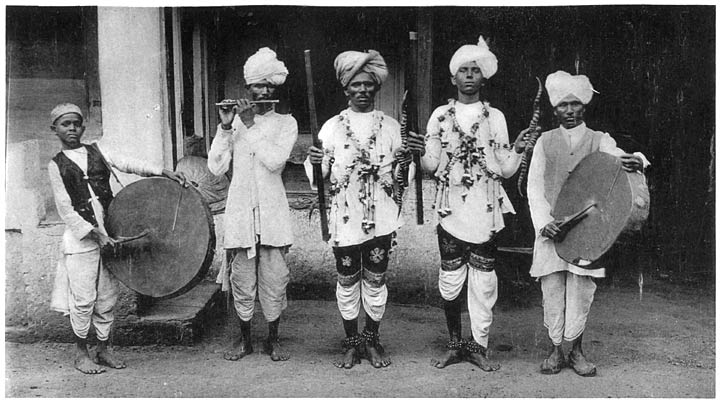
Ahīr dancers in Diwāli costume.
14. Other deities.
The Mahākul Ahīrs of Jashpur have three deities, whom they call Mahādeo or Siva, Sahādeo, one of the five Pāndava brothers, and the goddess Lakshmi. They say that the buffalo is Mahādeo, the cow Sahādeo, and the rice Lakshmi. This also appears to be an instance of the personification of animals and the corn into anthropomorphic deities.
15. The Diwāli festival.
The principal festival of the Ahīrs is the Diwāli, falling about the beginning of November, which is also the time when the autumn crops ripen. All classes observe this feast by illuminating their houses with many small saucer-lamps and letting off crackers and fireworks, and they generally gamble with money to bring them good luck during the coming year. The Ahīrs make a mound of earth, which is called Govardhan, that is the mountain in Mathura which Krishna held upside down on his finger for seven days and nights, so that all the people might gather under it and be protected from the devastating storms of rain sent by Indra. After dancing round the mound they drive their cattle over it and make them trample it to pieces. At this time a festival called Marhai is held, at which much liquor is drunk and all classes disport themselves. In Damoh on this day the Ahīrs go to the standing-place for village cattle, and after worshipping the god, frighten the cattle by waving leaves of the basil-plant at them, and then put on fantastic dresses, decorating themselves with cowries, and go round the village, singing and dancing. Elsewhere at the time of the Marhai they dance round a pole with peacock feathers tied to the top, and sometimes wear peacock feathers themselves, as well as aprons sewn all over with cowries. It is said that Krishna and Balārām used to wear peacock feathers when they danced in the jungles of Mathura, but this rite has probably some connection with the worship of the peacock. This bird might be venerated by the Ahīrs as one of the prominent denizens of the jungle. In Raipur they tie a white cock to the top of the pole and dance round it. In Mandla, Khila Mutha, the god of the threshing-floor, is worshipped at this time, with offerings of a fowl and a goat. They also perform the rite of jagāna or waking him up. They tie branches of a small shrub to a stick and pour milk over the stone which is his emblem, and sing, ‘Wake up, Khila Mutha, this is the night of Amāwas’ (the new moon). Then they go to the cattle-shed and wake up the cattle, crying, ‘Poraiya, god of the door, watchman of the window, open the door, Nānd Gowāl is coming.’ Then they drive out the cattle and chase them with the branches tied to their sticks as far as their grazing-ground. Nānd Gowāl was the foster-father of Krishna, and is now said to signify a man who has a lakh (100,000) of cows. This custom of frightening the cattle and making them run is called dhor jagāna or bichkāna, that is, to wake up or terrify the cattle. Its meaning is obscure, but it is said to preserve the cattle from disease during the year. In Raipur the women make an image of a parrot in clay at the Diwāli and place it on a pole and go round to the different houses, singing and dancing round the pole, and receiving presents of rice and money. They praise the parrot as the bird who carries messages from a lover to his mistress, and as living on the mountains and among the green verdure, and sing:
“Oh, parrot, where shall we sow gondla grass and where shall we sow rice?
“We will sow gondla in a pond and rice in the field.
“With what shall we cut gondla grass, and with what shall we cut rice?
“We shall cut gondla with an axe and rice with a sickle.”
It is probable that the parrot is revered as a spirit of the forest, and also perhaps because it is destructive to the corn. The parrot is not, so far as is known, associated with any god, but the Hindus do not kill it. In Bilāspur an ear of rice is put into the parrot’s mouth, and it is said there that the object of the rite is to prevent the parrots from preying on the corn.
16. Omens.
On the night of the full moon of Jesth (May) the Ahīrs stay awake all night, and if the moon is covered with clouds they think that the rains will be good. If a cow’s horns are not firmly fixed in the head and seem to shake slightly, it is called Maini, and such an animal is considered to be lucky. If a bullock sits down with three legs under him and the fourth stretched out in front it is a very good omen, and it is thought that his master’s cattle will increase and multiply. When a buffalo-calf is born they cover it at once with a black cloth and remove it from the mother’s sight, as they think that if she saw the calf and it then died her milk would dry up. The calf is fed by hand. Cow-calves, on the other hand, are usually left with the mother, and many people allow them to take all the milk, as they think it a sin to deprive them of it.
17. Social customs.
18. Ornaments.
In Chhattīsgarh the Rāwat women are especially fond of wearing large churas or leg-ornaments of bell-metal. These consist of a long cylinder which fits closely to the leg, being made in two halves which lock into each other, while at each end and in the centre circular plates project outwards horizontally. A pair of these churas may weigh 8 or 10 lbs., and cost from Rs. 3 to Rs. 9. It is probable that some important magical advantage was expected to come from the wearing of these heavy appendages, which must greatly impede free progression, but its nature is not known.