Volume 2 / Part 2 — Bhāt
Reading edition
List of Paragraphs
1. Origin of the Bhāts.
2. Bhāts and Chārans.
3. Lower-class Bhāts.
4. Social status of the caste.
5. Social customs.
6. The Bhāt’s business.
7. Their extortionate practices.
8. The Jasondhis.
9. The Chārans as carriers.
10. Suicide and the fear of ghosts.
11. Instances of haunting and laying ghosts.
12. The Chārans as sureties.
13. Suicide as a means of revenge.
14. Dharna.
15. Casting out spirits.
16. Sulking. Going bankrupt.
17. Bhāt songs.
1. Origin of the Bhāts.
2. Bhāts and Chārans.
3. Lower-class Bhāts.
But besides the Birm or Brāhman Bhāts and the Rājpūt Chārans there is another large body of the caste of mixed origin, who serve as bards of the lower castes and are probably composed to a great extent of members of these castes. These are known as the Brid-dhari or begging Bhāts. They beg from such castes as Lodhis, Telis, Kurmis, Ahīrs and so on, each caste having a separate section of Bhāts to serve it; the Bhāts of each caste take food from the members of the caste, but they also eat and intermarry with each other. Again, there are Bairāgi Bhāts who beg from Bairāgis, and keep the genealogies of the temple-priests and their successors. Yet another class are the Dasaundhis or Jasondhis, who sing songs in honour of Devi, play on musical instruments and practise astrology. These rank below the cultivating castes and sometimes admit members of such castes who have taken religious vows.
4. Social status of the caste.
5. Social customs.
The customs of the Bhāts resemble those of other castes of corresponding status. The higher Bhāts forbid the remarriage of widows, and expel a girl who becomes pregnant before marriage. They carry a dagger, the special emblem of the Chārans, in order to be distinguished from low-class Bhāts. The Bhāts generally display the chaur or yak-tail whisk and the chhadi or silver-plated rod on ceremonial occasions, and they worship these emblems of their calling on the principal festivals. The former is waved over the bridegroom at a wedding, and the latter is borne before him. The Brāhman Bhāts abstain from flesh of any kind and liquor, and other Bhāts usually have the same rules about food as the caste whom they serve. Brāhman Bhāts and Chārans alone wear the sacred thread. The high status sometimes assigned to this division of the caste is shown in the saying:
Age Brāhman pīchhe Bhāt tāke pīchhe aur jāt,
or, ‘First comes the Brāhman, then the Bhāt, and after them the other castes.’
6. The Bhāt’s business.
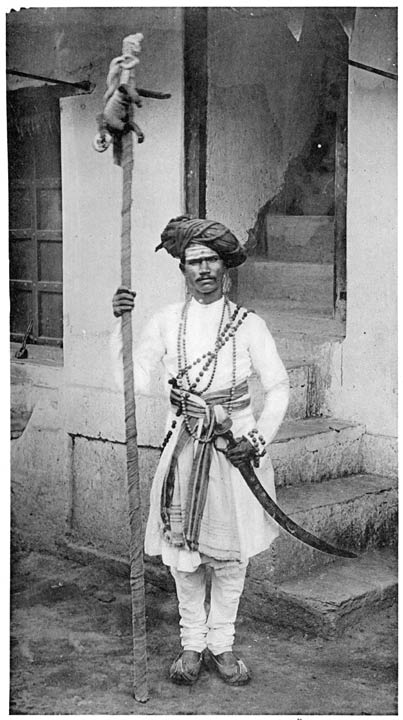
Bhāt with his putla or doll.
7. Their extortionate practices.
8. The Jasondhis.
Some of the lower classes of Bhāts have become religious mendicants and musicians, and perform ceremonial functions. Thus the Jasondhis, who are considered a class of Bhāts, take their name from the jas or hymns sung in praise of Devi. They are divided into various sections, as the Nakīb or flag-bearers in a procession, the Nāzir or ushers who introduced visitors to the Rāja, the Nagāria or players on kettle-drums, the Karaola who pour sesamum oil on their clothes and beg, and the Panda, who serve as priests of Devi, and beg carrying an image of the goddess in their hands. There is also a section of Muhammadan Bhāts who serve as bards and genealogists for Muhammadan castes. Some Bhāts, having the rare and needful qualification of literacy so that they can read the old Sanskrit medical works, have, like a number of Brāhmans, taken to the practice of medicine and are known as Kavirāj.
9. The Chārans as carriers.
As already stated, the persons of the Chārans in the capacity of bard and herald were sacred, and they travelled from court to court without fear of molestation from robbers or enemies. It seems likely that the Chārans may have united the breeding of cattle to their calling of bard; but in any case the advantage derived from their sanctity was so important that they gradually became the chief carriers and traders of Rājputāna and the adjoining tracts. They further, in virtue of their holy character, enjoyed a partial exemption from the perpetual and harassing imposts levied by every petty State on produce entering its territory; and the combination of advantages thus obtained was such as to give them almost a monopoly in trade. They carried merchandise on large droves of bullocks all over Rājputāna and the adjoining countries; and in course of time the carriers restricted themselves to their new profession, splitting off from the Chārans and forming the caste of Banjāras.
10. Suicide and the fear of ghosts.
11. Instances of haunting and laying ghosts.
On the third day after the Chāran’s death his Bhūt (ghost) threw the Rāni downstairs so that she was very much injured. Many other persons also beheld the headless phantom in the palace. At last he entered the chief’s head and set him trembling. At night he would throw stones at the palace, and he killed a female servant outright. At length, in consequence of the various acts of oppression which he committed, none dared to approach the chief’s mansion even in broad daylight. In order to exorcise the Bhūt, Jogis, Fakīrs and Brāhmans were sent for from many different places; but whoever attempted the cure was immediately assailed by the Bhūt in the chief’s body, and that so furiously that the exorcist’s courage failed him. The Bhūt would also cause the chief to tear the flesh off his own arms with his teeth. Besides this, four or five persons died of injuries received from the Bhūt; but nobody had the power to expel him. At length a foreign Jyotishi (astrologer) came who had a great reputation for charms and magic, and the chief sent for him and paid him honour. First he tied all round the house threads which he had charged with a charm; then he sprinkled charmed milk and water all round; then he drove a charmed iron nail into the ground at each corner of the mansion, and two at the door. He purified the house and continued his charms and incantations for forty-one days, every day making sacrifices at the cemetery to the Bhūt’s spirit. The Joshi lived in a room securely fastened up; but people say that while he was muttering his charms stones would fall and strike the windows. Finally the Joshi brought the chief, who had been living in a separate room, and tried to exorcise the spirit. The patient began to be very violent, but the Joshi and his people spared no pains in thrashing him until they had rendered him quite docile. A sacrificial fire-pit was made and a lemon placed between it and the chief. The Joshi commanded the Bhūt to enter the lime. The possessed, however, said, ‘Who are you; if one of your Deos (gods) were to come, I would not quit this person.’ Thus they went on from morning till noon. At last they came outside, and, burning various kinds of incense and sprinkling many charms, the Bhūt was got out into the lemon. When the lemon began to jump about, the whole of the spectators praised the Joshi, crying out: ‘The Bhūt has gone into the lemon! The Bhūt has gone into the lemon!’ The possessed person himself, when he saw the lemon hopping about, was perfectly satisfied that the Bhūt had left his body and gone out into the lemon. The Joshi then drove the lemon outside the city, followed by drummers and trumpeters; if the lemon left the road, he would touch it with his stick and put it into the right way again. On the track they sprinkled mustard and salt and finally buried the lemon in a pit seven cubits deep, throwing into the hole above it mustard and salt, and over these dust and stones, and filling in the space between the stones with lead. At each corner, too, the Joshi drove in an iron nail, two feet long, which he had previously charmed. The lemon buried, the people returned home, and not one of them ever saw the Bhūt thereafter. According to the recorder of the tale, the cure was effected by putting quicksilver into the lemon. When a man is attacked with fever or becomes speechless or appears to have lockjaw, his friends conclude from these indications that he is possessed by a Bhūt.
12. The Chārans as sureties.
As was the case with the Bhāt and the Brāhman, the source of the Chāran’s power lay in the widespread fear that a Chāran’s blood brought ruin on him who caused the blood to be spilt. It was also sometimes considered that the Chāran was possessed by his deity, and the caste were known as Deoputra or sons of God, the favourite dwelling of the guardian spirit.
13. Suicide as a means of revenge.
That condition of mind which leads to the taking of one’s own life from motives of revenge is perhaps a fruit of ignorance and solitude. The mind becomes distorted, and the sufferer attributes the unhappiness really caused by accident or his own faults or defects to the persecution of a malignant fate or the ill-will of his neighbours and associates. And long brooding over his wrongs eventuates in his taking the extreme step. The crime known as running amok appears to be the outcome of a similar state of mind. Here too the criminal considers his wrongs or misery as the result of injury or unjust treatment from his fellow-men, and, careless of his own life, determines to be revenged on them. Such hatred of one’s kind is cured by education, leading to a truer appreciation of the circumstances and environment which determine the course of life, and by the more cheerful temper engendered by social intercourse. And these crimes of vengeance tend to die out with the advance of civilisation.
14. Dharna.
The word dharna means ‘to place or lay on,’ and hence ‘a pledge.’ Mr. Hīra Lāl suggests that the standing with a weight on the head may have been the original form of the penance, from which the other and severer methods were subsequently derived. Another custom known as dharna is that of a suppliant placing a stone on the shrine of a god or tomb of a saint. He makes his request and, laying the stone on the shrine, says, “Here I place this stone until you fulfil my prayer; if I do not remove it, the shame is on you.” If the prayer is afterwards fulfilled, he takes away the stone and offers a cocoanut. It seems clear that the underlying idea of this custom is the same as that of standing with a stone on the head as described above, but it is difficult to say which was the earlier or original form.
15. Casting out spirits.
As a general rule, if the guilt of having caused a suicide was at a man’s door, he should expiate it by going to the Ganges to bathe. When a man was haunted by the ghost of any one whom he had wronged, whether such a person had committed suicide or simply died of grief at being unable to obtain redress, it was said of him Brahm laga, or that Brahma had possessed him. The spirit of a Brāhman boy, who has died unmarried, is also accustomed to haunt any person who walks over his grave in an impure condition or otherwise defiles it, and when a man is haunted in such a manner it is called Brahm laga. Then an exorcist is called, who sprinkles water over the possessed man, and this burns the Brahm Deo or spirit inside him as if it were burning oil. The spirit cries out, and the exorcist orders him to leave the man. Then the spirit states how he has been injured by the man, and refuses to leave him. The exorcist asks him what he requires on condition of leaving the man, and he asks for some good food or something else, and is given it. The exorcist takes a nail and goes to a pīpal tree and orders the Brahm Deo to go into the tree. Brahm Deo obeys, and the exorcist drives the nail into the tree and the spirit remains imprisoned there until somebody takes the nail out, when he will come out again and haunt him. The Hindus think that the god Brahma lives in the roots of the pīpal tree, Siva in its branches, and Vishnu in the choti or scalp-knot, that is the topmost foliage.
16. Sulking. Going bankrupt.
Another and mild form of Dharna is that known as Khātpāti. When a woman is angry with her husband on account of his having refused her some request, she will put her bed in a corner of the room and go and lie on it, turning her face to the wall, and remain so, not answering when spoken to nor taking food. The term Khātpāti signifies keeping to one side of the bed, and there she will remain until her husband accedes to her request, unless indeed he should decide to beat her instead. This is merely an exaggerated form of the familiar display of temper known as sulking. It is interesting to note the use of the phrase turning one’s face to the wall, with something of the meaning attached to it in the Bible.
A custom similar to that of Dharna was called Diwāla nikālna or going bankrupt. When a merchant had had heavy losses and could not meet his liabilities, he would place the lock of his door outside, reversing it, and sit in the veranda with a piece of sackcloth over him. Or he wrapped round him the floor-carpet of his room. When he had displayed these signs of ruin and self-abasement his creditors would not sue him, but he would never be able to borrow money again.
17. Bhāt songs.
In conclusion a few specimens of Bhāt songs may be given. The following is an account of the last king of Nāgpur, Raghuji III., commonly known as Bāji Rao:
They made a picture of Bāji Rao; Bāji Rao was the finest king to see; The Brāhmans told lies about him, They sent a letter from Nāgpur to Calcutta, They made Bāji Rao go on a pilgrimage. Brothers! the great Sirdārs who were with him, They brought a troop of five hundred horse! The Tuesday fair in Benāres was held with fireworks, They made the Ganges pink with rose-petals. Bāji Rao’s gifts were splendid, His turban and coat were of brocaded silk, A pair of diamonds and emeralds He gave to the Brāhmans of Benāres. Oh brothers! the Rāja sat in a covered howdah bound on an elephant! Many fans waved over his head; How charitable a king he was!
In the above song a note of regret is manifest for the parade and display of the old court of Nāgpur, English rule being less picturesque. The next is a song about the English:
The English have taken the throne of Nāgpur, The fear of the English is great. In a moment’s time they conquer countries. The guns boomed, the English came strong and warlike, They give wealth to all. They ram the ramrods in the guns. They conquered also Tippoo’s dominions, The English are ruling in the fort of Gāwilgarh.
The following is another song about the English, not quite so complimentary:
The English became our kings and have made current the kaldār (milled) rupee. The menials are favoured and the Bhāts have lost their profession, The mango has lost its taste, the milk has lost its sweetness, The rose has lost its scent. Bāji Rao of Nāgpur he also is gone, No longer are the drums beaten at the palace gate. Poona customs have come in. Brāhmans knowing the eighteen Purāns have become Christians; The son thinks himself better than his father, The daughter-in-law no longer respects her mother-in-law. The wife fights with her husband. The English have made the railways and telegraphs; The people wondered at the silver rupees and all the country prospered.
The following is a song about the Nerbudda at Mandla, Rewa being another name for the river:
The stream of the world springs out breaking apart the hills; The Rewa cuts her path through the soil, the air is darkened with her spray. All the length of her banks are the seats of saints; hermits and pilgrims worship her. On seeing the holy river a man’s sins fall away as wood is cut by a saw; By bathing in her he plucks the fruit of holiness. When boats are caught in her flood, the people pray: ‘We are sinners, O Rewa, bring us safely to the bank!’ When the Nerbudda is in flood, Mandla is an island and the people think their end has come: The rain pours down on all sides, earth and sky become dark as smoke, and men call on Rāma. The bard says: ‘Let it rain as it may, some one will save us as Krishna saved the people of Brindāwan!’
This is a description of a beautiful woman:
A beautiful woman is loved by her neighbours, But she will let none come to her and answers them not. They say: ‘Since God has made you so beautiful, open your litter and let yourself be seen!’ He who sees her is struck as by lightning, she shoots her lover with the darts of her eyes, invisible herself. She will not go to her husband’s house till he has her brought by the Government. When she goes her father’s village is left empty. She is so delicate she faints at the sight of a flower, Her body cannot bear the weight of her cloth, The garland of jasmine-flowers is a burden on her neck, The red powder on her feet is too heavy for them.
It is interesting to note that weakness and delicacy in a woman are emphasised as an attraction, as in English literature of the eighteenth century.
The last is a gentle intimation that poets, like other people, have to live:
It is useless to adorn oneself with sandalwood on an empty belly, Nobody’s body gets fat from the scent of flowers; The singing of songs excites the mind, But if the body is not fed all these are vain and hollow.
All Bhāts recite their verses in a high-pitched sing-song tone, which renders it very difficult for their hearers to grasp the sense unless they know it already. The Vedas and all other sacred verses are spoken in this manner, perhaps as a mark of respect and to distinguish them from ordinary speech. The method has some resemblance to intoning. Women use the same tone when mourning for the dead.