Volume 2 / Part 2 — Bania
Reading edition
List of Paragraphs
1. General notice.
2. The Banias a true caste: use of the name.
3. Their distinctive occupation.
4. Their distinctive status.
5. The endogamous divisions of the Banias.
6. The Banias derived from the Rājpūts.
7. Banias employed as ministers in Rājpūt courts.
8. Subcastes.
9. Hindu and Jain subcastes: divisions among subcastes.
10. Exogamy and rules regulating marriage.
11. Marriage customs.
12. Polygamy and widow-marriage.
13. Disposal of the dead and mourning.
14. Religion: the god Ganpati or Ganesh.
15. Diwāli festival.
16. Holi festival.
17. Social customs: rules about food.
18. Character of the Bania.
19. Dislike of the cultivators towards him.
20. His virtues.
21. The moneylender changed for the worse.
22. The enforcement of contracts.
23. Cash coinage and the rate of interest.
24. Proprietary and transferable rights in land.
25. The Bania as a landlord.
26. Commercial honesty.
List of Subordinate Articles on Subcastes
1. General notice.
2. The Banias a true caste: use of the name.
3. Their distinctive occupation.
4. Their distinctive status.
5. The endogamous divisions of the Banias.
6. The Banias derived from the Rājpūts.
7. Banias employed as ministers in Rājpūt courts.
8. Subcastes.
9. Hindu and Jain subcastes: divisions among subcastes.
10. Exogamy and rules regulating marriage.
11. Marriage customs.
12. Polygamy and widow-marriage.
13. Disposal of the dead and mourning.
14. Religion: the god Ganpati or Ganesh.
15. Diwāli festival.
16. Holi festival.
17. Social customs: rules about food.
18. Character of the Bania.
19. Dislike of the cultivators towards him.
20. His virtues.
21. The moneylender changed for the worse.
22. The enforcement of contracts.
23. Cash coinage and the rate of interest.
24. Proprietary and transferable rights in land.
25. The Bania as a landlord.
26. Commercial honesty.
1. General notice.
Bania, Bāni, Vāni, Mahājan, Seth, Sāhukār.—The occupational caste of bankers, moneylenders and dealers in grain, ghī (butter), groceries and spices. The name Bania is derived from the Sanskrit vanij, a merchant. In western India the Banias are always called Vānia or Vāni. Mahājan literally means a great man, and being applied to successful Banias as an honorific title has now come to signify a banker or moneylender; Seth signifies a great merchant or capitalist, and is applied to Banias as an honorific prefix. The words Sāhu, Sao and Sāhukār mean upright or honest, and have also, curiously enough, come to signify a moneylender. The total number of Banias in the Central Provinces in 1911 was about 200,000, or rather over one per cent of the population. Of the above total two-thirds were Hindus and one-third Jains. The caste is fairly distributed over the whole Province, being most numerous in Districts with large towns and a considerable volume of trade.
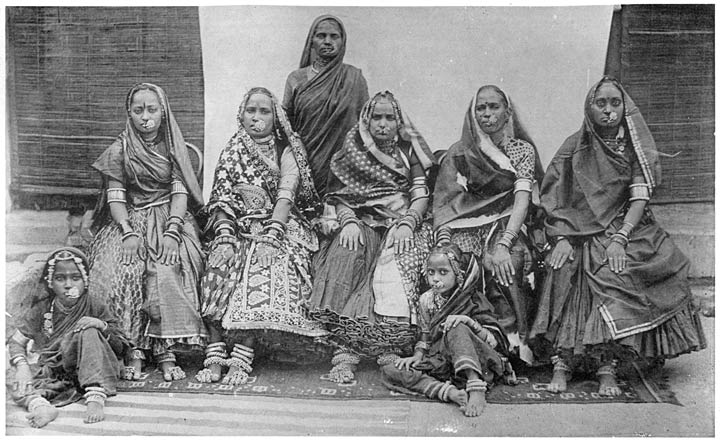
Group of Mārwāri Bania women.
2. The Banias a true caste: use of the name.
3. Their distinctive occupation.
4. Their distinctive status.
The Banias have also a distinctive social status. They are considered, though perhaps incorrectly, to represent the Vaishyas or third great division of the Aryan twice-born; they rank just below Rājpūts and perhaps above all other castes except Brāhmans; Brāhmans will take food cooked without water from many Banias and drinking-water from all. Nearly all Banias wear the sacred thread; and the Banias are distinguished by the fact that they abstain more rigorously and generally from all kinds of flesh food than any other caste. Their rules as to diet are exceptionally strict, and are equally observed by the great majority of the subdivisions.
5. The endogamous divisions of the Banias.
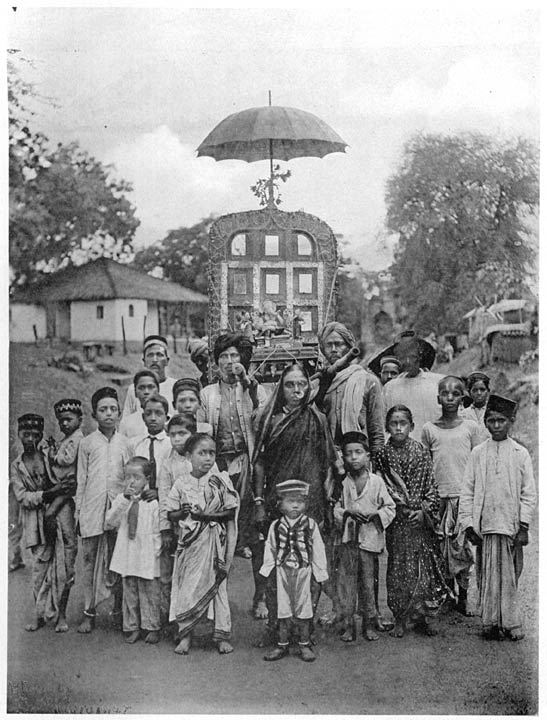
Image of the god Ganpati carried in procession.
6. The Banias derived from the Rājpūts.
The Banias have been commonly supposed to represent the Vaishyas or third of the four classical castes, both by Hindu society generally and by leading authorities on the subject. It is perhaps this view of their origin which is partly responsible for the tendency to consider them as several castes and not one. But its accuracy is doubtful. The important Bania groups appear to be of Rājpūt stock. They nearly all come from Rājputāna, Bundelkhand or Gujarāt, that is from the homes of the principal Rājūt clans. Several of them have legends of Rājpūt descent. The Agarwālas say that their first ancestor was a Kshatriya king, who married a Nāga or snake princess; the Nāga race is supposed to have signified the Scythian immigrants, who were snake-worshippers and from whom several clans of Rājpūts were probably derived. The Agarwālas took their name from the ancient city of Agroha or possibly from Agra. The Oswāls say that their ancestor was the Rājpūt king of Osnagar in Mārwār, who with his followers was converted by a Jain mendicant. The Nemas state that their ancestors were fourteen young Rājpūt princes who escaped the vengeance of Parasurāma by abandoning the profession of arms and taking to trade. The Khandelwāls take their name from the town of Khandela in Jaipur State of Rājputāna. The Kasarwānis say they immigrated from Kara Mānikpur in Bundelkhand. The origin of the Umre Banias is not known, but in Gujarāt they are also called Bāgaria from the Bāgar or wild country of the Dongarpur and Pertābgarh States of Rājputāna, where numbers of them are still settled; the name Bāgaria would appear to indicate that they are supposed to have immigrated thence into Gujarāt. The Dhūsar Banias ascribe their name to a hill called Dhūsi or Dhosi on the border of Alwar State. The Asātis say that their original home was Tīkamgarh State in Bundelkhand. The name of the Maheshris is held to be derived from Maheshwar, an ancient town on the Nerbudda, near Indore, which is traditionally supposed to have been the earliest settlement of the Yādava Rājpūts. The headquarters of the Gahoi Banias is said to have been at Kharagpur in Bundelkhand, though according to their own legend they are of mixed origin. The home of the Srimālis was the old town of Srimāl, now Bhinmāl in Mārwār. The Palliwāl Banias were from the well-known trading town of Pāli in Mārwār. The Jaiswāl are said to take their name from Jaisalmer State, which was their native country. The above are no doubt only a fraction of the Bania subcastes, but they include nearly all the most important and representative ones, from whom the caste takes its status and character. Of the numerous other groups the bulk have probably been brought into existence through the migration and settlement of sections of the caste in different parts of the country, where they have become endogamous and obtained a fresh name. Other subcastes may be composed of bodies of persons who, having taken to trade and prospered, obtained admission to the Bania caste through the efforts of their Brāhman priests. But a number of mixed groups of the same character are also found among the Brāhmans and Rājpūts, and their existence does not invalidate arguments derived from a consideration of the representative subcastes. It may be said that not only the Banias, but many of the low castes have legends showing them to be of Rājpūt descent of the same character as those quoted above; and since in their case these stories have been adjudged spurious and worthless, no greater importance should be attached to those of the Banias. But it must be remembered that in the case of the Banias the stories are reinforced by the fact that the Bania subcastes certainly come from Rājputāna; no doubt exists that they are of high caste, and that they must either be derived from Brāhmans or Rājpūts, or themselves represent some separate foreign group; but if they are really the descendants of the Vaishyas, the main body of the Aryan immigrants and the third of the four classical castes, it might be expected that their legends would show some trace of this instead of being unitedly in favour of their Rājpūt origin.
It would appear, then, that the Banias are an offshoot from the Rājpūts, who took to commerce and learnt to read and write for the purpose of keeping accounts. The Chārans or bards are another literate caste derived from the Rājpūts, and it may be noticed that both the Banias and Chārans or Bhāts have hitherto been content with the knowledge of their own rude Mārwāri dialect and evinced no desire for classical learning or higher English education. Matters are now changing, but this attitude shows that they have hitherto not desired education for itself but merely as an indispensable adjunct to their business.
7. Banias employed as ministers in Rājpūt courts.
8. Subcastes.
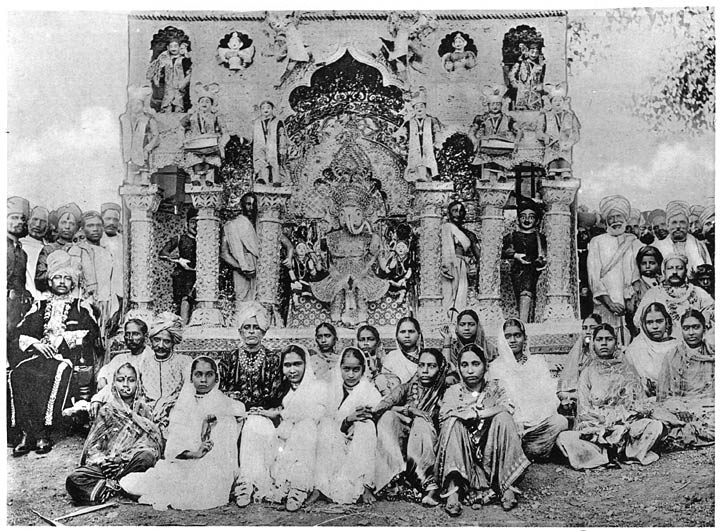
The elephant-headed god Ganpati. His conveyance is a rat, which can be seen as a little blob between his feet.
9. Hindu and Jain subcastes: divisions among subcastes.
Another classification may be made of the subcastes according as they are of the Hindu or Jain religion; the important Jain subcastes are the Oswāl, Parwār, Golapūrab, Saitwāl and Charnāgar, and one or two smaller ones, as the Baghelwāl and Samaiya. The other subcastes are principally Hindu, but many have a Jain minority, and similarly the Jain subcastes return a proportion of Hindus. The difference of religion counts for very little, as practically all the non-Jain Banias are strict Vaishnava Hindus, abstain entirely from any kind of flesh meat, and think it a sin to take animal life; while on their side the Jains employ Brāhmans for certain purposes, worship some of the local Hindu deities, and observe the principal Hindu festivals. The Jain and Hindu sections of a subcaste have consequently, as a rule, no objection to taking food together, and will sometimes intermarry. Several of the important subcastes are subdivided into Bīsa and Dasa, or twenty and ten groups. The Bīsa or twenty group is of pure descent, or twenty carat, as it were, while the Dasas are considered to have a certain amount of alloy in their family pedigree. They are the offspring of remarried widows, and perhaps occasionally of still more irregular unions. Intermarriage sometimes takes place between the two groups, and families in the Dasa group, by living a respectable life and marrying well, improve their status, and perhaps ultimately get back into the Bīsa group. As the Dasas become more respectable they will not admit to their communion newly remarried widows or couples who have married within the prohibited degrees, or otherwise made a mésalliance, and hence a third inferior group, called the Pacha or five, is brought into existence to make room for these.
10. Exogamy and rules regulating marriage.
Most subcastes have an elaborate system of exogamy. They are either divided into a large number of sections, or into a few gotras, usually twelve, each of which is further split up into subsections. Marriage can then be regulated by forbidding a man to take a wife from the whole of his own section or from the subsection of his mother, grandmothers and even greatgrandmothers. By this means the union of persons within five or more degrees of relationship either through males or females is avoided, and most Banias prohibit intermarriage, at any rate nominally, up to five degrees. Such practices as exchanging girls between families or marrying two sisters are, as a rule, prohibited. The gotras or main sections appear to be frequently named after Brāhman Rīshis or saints, while the subsections have names of a territorial or titular character.
11. Marriage customs.
There is generally no recognised custom of paying a bride- or bridegroom-price, but one or two instances of its being done are given in the subordinate articles. On the occasion of betrothal, among some subcastes, the boy’s father proceeds to the girl’s house and presents her with a māla or necklace of gold or silver coins or coral, and a mundri or silver ring for the finger. The contract of betrothal is made at the village temple and the caste-fellows sprinkle turmeric and water over the parties. Before the wedding the ceremony of Benaiki is performed; in this the bridegroom, riding on a horse, and the bride on a decorated chair or litter, go round their villages and say farewell to their friends and relations. Sometimes they have a procession in this way round the marriage-shed. Among the Mārwāri Banias a toran or string of mango-leaves is stretched above the door of the house on the occasion of a wedding and left there for six months. And a wooden triangle with figures perched on it to represent sparrows is tied over the door. The binding portion of the wedding is the procession seven times round the marriage altar or post. In some Jain subcastes the bridegroom stands beside the post and the bride walks seven times round him, while he throws sugar over her head at each turn. After the wedding the couple are made to draw figures out of flour sprinkled on a brass plate in token of the bridegroom’s occupation of keeping accounts. It is customary for the bride’s family to give sīdha or uncooked food sufficient for a day’s consumption to every outsider who accompanies the marriage party, while to each member of the caste provisions for two to five days are given. This is in addition to the evening feasts and involves great expense. Sometimes the wedding lasts for eight days, and feasts are given for four days by the bridegroom’s party and four days by the bride’s. It is said that in some places before a Bania has a wedding he goes before the caste panchāyat and they ask him how many people he is going to invite. If he says five hundred, they prescribe the quantity of the different kinds of provisions which he must supply. Thus they may say forty maunds (3200 lbs.) of sugar and flour, with butter, spices, and other articles in proportion. He says, ‘Gentlemen, I am a poor man; make it a little less’; or he says he will give gur or cakes of raw cane sugar instead of refined sugar. Then they say, ‘No, your social position is too high for gur; you must have sugar for all purposes.’ The more guests the host invites the higher is his social consideration; and it is said that if he does not maintain this his life is not worth living. Sometimes the exact amount of entertainment to be given at a wedding is fixed, and if a man cannot afford it at the time he must give the balance of the feasts at any subsequent period when he has money; and if he fails to do this he is put out of caste. The bride’s father is often called on to furnish a certain sum for the travelling expenses of the bridegroom’s party, and if he does not send this money they do not come. The distinctive feature of a Bania wedding in the northern Districts is that women accompany the marriage procession, and the Banias are the only high caste in which they do this. Hence a high-caste wedding party in which women are present can be recognised to be a Bania’s. In the Marātha Districts women also go, but here this custom obtains among other high castes. The bridegroom’s party hire or borrow a house in the bride’s village, and here they erect a marriage-shed and go through the preliminary ceremonies of the wedding on the bridegroom’s side as if they were at home.
12. Polygamy and widow-marriage.
Polygamy is very rare among the Banias, and it is generally the rule that a man must obtain the consent of his first wife before taking a second one. In the absence of this precaution for her happiness, parents will refuse to give him their daughter. The remarriage of widows is nominally prohibited, but frequently occurs, and remarried widows are relegated to the inferior social groups in each subcaste as already described. Divorce is also said to be prohibited, but it is probable that women put away for adultery are allowed to take refuge in such groups instead of being finally expelled.
13. Disposal of the dead and mourning.
The dead are cremated as a rule, and the ashes are thrown into a sacred river or any stream. The bodies of young children and of persons dying from epidemic disease are buried. The period of mourning must be for an odd number of days. On the third day a leaf plate with cooked food is placed on the ground where the body was burnt, and on some subsequent day a feast is given to the caste. Rich Banias will hire people to mourn. Widows and young girls are usually employed, and these come and sit before the house for an hour in the morning and sometimes also in the evening, and covering their heads with their cloths, beat their breasts and make lamentations. Rich men may hire as many as ten mourners for a period of one, two or three months. The Mārwāris, when a girl is born, break an earthen pot to show that they have had a misfortune; but when a boy is born they beat a brass plate in token of their joy.
14. Religion: the god Ganpati or Ganesh.
15. Diwāli festival.
At the Diwāli festival the Banias worship Ganpati or Ganesh, in conjunction with Lakshmi, the goddess of wealth. Lakshmi is considered to be the deified cow, and, as such, the other main source of wealth, both as mother of the bull, the tiller of the soil, and the giver of milk from which ghī (clarified butter) is made; this is another staple of the Bania’s trade, as well as a luxurious food, of which he is especially fond. At Diwāli all Banias make up their accounts for the year, and obtain the signatures of clients to their balances. They open fresh account-books, which they first worship and adorn with an image of Ganesh, and perhaps an invocation to the god on the front page. A silver rupee is also worshipped as an emblem of Lakshmi, but in some cases an English sovereign, as a more precious coin, has been substituted, and this is placed on the seat of the goddess and reverence paid to it. The Banias and Hindus generally think it requisite to gamble at Diwāli in order to bring good luck during the coming year; all classes indulge in a little speculation at this season.
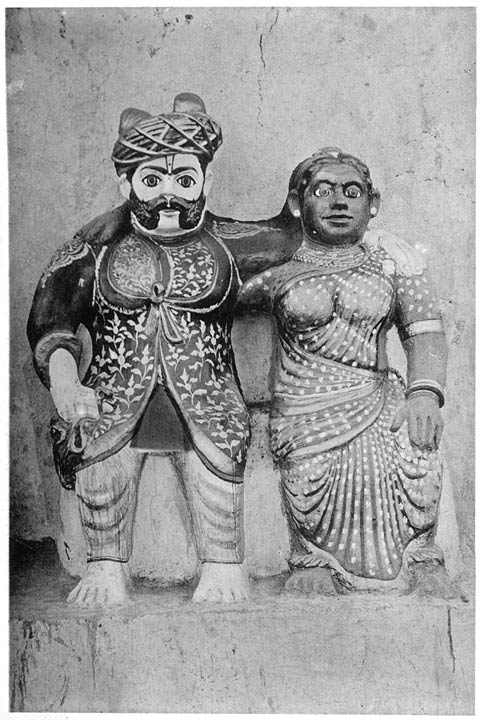
Mud images made and worshipped at the Holi festival.
16. Holi festival.
In the month of Phāgun (February), about the time of the Holi, the Mārwāris make an image of mud naked, calling it Nāthu Rām, who was supposed to be a great Mārwāri. They mock at this and throw mud at it, and beat it with shoes, and have various jests and sports. The men and women are divided into two parties, and throw dirty water and red powder over each other, and the women make whips of cloth and beat the men. After two or three days, they break up the image and throw it away. The Banias, both Jain and Hindu, like to begin the day by going and looking at the god in his temple. This is considered an auspicious omen in the same manner as it is commonly held to be a good omen to see some particular person or class of person the first thing in the morning. Others begin the day by worshipping the sacred tulsi or basil.
17. Social customs: rules about food.
The Banias are very strict about food. The majority of them abstain from all kinds of flesh food and alcoholic liquor. The Kasarwānis are reported to eat the flesh of clean animals, and perhaps others of the lower subcastes may also do so, but the Banias are probably stricter than any other caste in their adherence to a vegetable diet. Many of them eschew also onions and garlic as impure food. Banias take the lead in the objection to foreign sugar on account of the stories told of the impure ingredients which it contains, and many of them, until recently, at any rate, still adhered to Indian sugar. Drugs are not forbidden, but they are not usually addicted to them. Tobacco is forbidden to the Jains, but both they and the Hindus smoke, and their women sometimes chew tobacco. The Bania while he is poor is very abstemious, and it is said that on a day when he has made no money he goes supperless to bed. But when he has accumulated wealth, he develops a fondness for ghī or preserved butter, which often causes him to become portly. Otherwise his food remains simple, and as a rule he confined himself until recently to two daily meals, at midday and in the evening; but Banias, like most other classes who can afford it, have now begun to drink tea in the morning. In dress the Bania is also simple, adhering to the orthodox Hindu garb of a long white coat and a loin-cloth. He has not yet adopted the cotton trousers copied from the English fashion. Some Banias in their shops wear only a cloth over their shoulders and another round their waist. The kardora or silver waist-belt is a favourite Bania ornament, and though plainly dressed in ordinary life, rich Mārwaāris will on special festival occasions wear costly jewels. On his head the Mārwāri wears a small tightly folded turban, often coloured crimson, pink or yellow; a green turban is a sign of mourning and also black, though the latter is seldom seen. The Banias object to taking the life of any animal. They will not castrate cattle even through their servants, but sell the young bulls and buy oxen. In Saugor, a Bania is put out of caste if he keeps buffaloes. It is supposed that good Hindus should not keep buffaloes nor use them for carting or ploughing, because the buffalo is impure, and is the animal on which Yama, the god of death, rides. Thus in his social observances generally the Bania is one of the strictest castes, and this is a reason why his social status is high. Sometimes he is even held superior to the Rājpūt, as the local Rājpūts are often of impure descent and lax in their observance of religious and social restrictions. Though he soon learns the vernacular language of the country where he settles, the Mārwāri usually retains his own native dialect in his account-books, and this makes it more difficult for his customers to understand them.
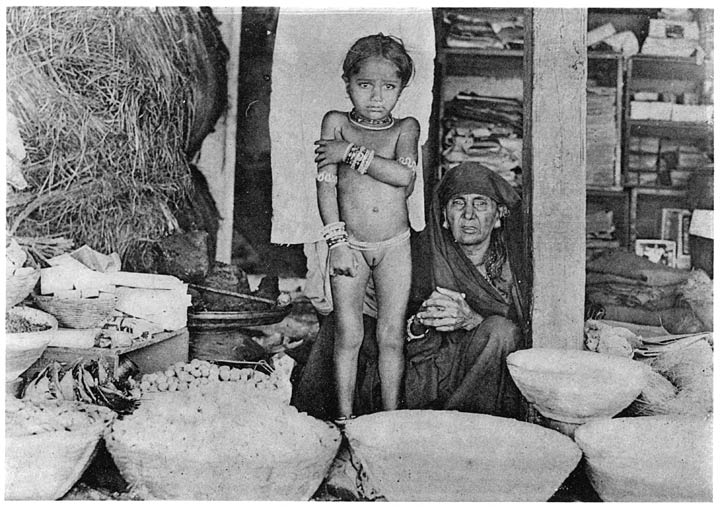
Bania’s shop.
18. Character of the Bania.
19. Dislike of the cultivators towards him.
20. His virtues.
21. The moneylender changed for the worse.
The progress of administration, bringing with it easy and safe transit all over the country; the institution of a complete system of civil justice and the stringent enforcement of contracts through the courts; the introduction of cash coinage as the basis of all transactions; and the grant of proprietary and transferable rights in land, appear to have at the same time enhanced the Bania’s prosperity and increased the harshness and rapacity of his dealings. When the moneylender lived in the village he had an interest in the solvency of the tenants who constituted his clientèle and was also amenable to public opinion, even though not of his own caste. For it would clearly be an impossibly unpleasant position for him to meet no one but bitter enemies whenever he set foot outside his house, and to go to bed in nightly fear of being dacoited and murdered by a combination of his next-door neighbours. He therefore probably adopted the motto of live and let live, and conducted his transactions on a basis of custom, like the other traders and artisans who lived among the village community. But with the rise of the large banking-houses whose dealings are conducted through agents over considerable tracts of country, public opinion can no longer act. The agent looks mainly to his principal, and the latter has no interest in or regard for the cultivators of distant villages. He cares only for his profit, and his business is conducted with a single view to that end. He himself has no public opinion to face, as he lives in a town among a community of his caste-fellows, and here absolutely no discredit is attached to grinding the faces of the poor, but on the contrary the honour and consideration accruing to him are in direct proportion to his wealth. The agent may have some compunction, but his first aim is to please his principal, and as he is often a sojourner liable to early transfer he cares little what may be said or thought about him locally.
22. The enforcement of contracts.
Again the introduction of the English law of contract and transfer of property, and the increase in the habit of litigation have greatly altered the character of the money-lending business for the worse. The debtor signs a bond sometimes not even knowing the conditions, more often having heard them but without any clear idea of their effect or of the consequences to himself, and as readily allows it to be registered. When it comes into court the witnesses, who are the moneylender’s creatures, easily prove that it was a genuine and bona fide transaction, and the debtor is too ignorant and stupid to be able to show that he did not understand the bargain or that it was unconscionable. In any case the court has little or no power to go behind a properly executed contract without any actual evidence of fraud, and has no option but to decree it in terms of the deed. This evil is likely to be remedied very shortly, as the Government of India have announced a proposal to introduce the recent English Act and allow the courts the discretion to go behind contracts, and to refuse to decree exorbitant interest or other hard bargains. This urgently needed reform will, it may be hoped, greatly improve the character of the civil administration by encouraging the courts to realise that it is their business to do justice between litigants, and not merely to administer the letter of the law; and at the same time it should have the result, as in England, of quickening the public conscience and that of the moneylenders themselves, which has indeed already been to some extent awakened by other Government measures, including the example set by the Government itself as a creditor.
23. Cash coinage and the rate of interest.
Again the free circulation of metal currency and its adoption as a medium for all transactions has hitherto been to the disadvantage of the debtors. Interest on money was probably little in vogue among pastoral peoples, and was looked upon with disfavour, being prohibited by both the Mosaic and Muhammadan codes. The reason was perhaps that in a pastoral community there existed no means of making a profit on a loan by which interest could be paid, and hence the result of usury was that the debtor ultimately became enslaved to his creditor; and the enslavement of freemen on any considerable scale was against the public interest. With the introduction of agriculture a system of loans on interest became a necessary and useful part of the public economy, as a cultivator could borrow grain to sow land and support himself and his family until the crop ripened, out of which the loan, principal and interest, could be repaid. If, as seems likely, this was the first occasion for the introduction of the system of loan-giving on a large scale, it would follow that the rate of interest would be based largely on the return yielded by the earth to the seed. Support is afforded to this conjecture by the fact that in the case of grain loans in the Central Provinces the interest on loans of grain of the crops which yield a comparatively small return, such as wheat, is twenty-five to fifty per cent, while in the case of those which yield a large return, such as juāri and kodon, it is one hundred per cent. These high rates of interest were not of much importance so long as the transaction was in grain. The grain was much less valuable at harvest than at seed time, and in addition the lender had the expense of storing and protecting his stock of grain through the year. It is probable that a rate of twenty-five per cent on grain loans does not yield more than a reasonable profit to the lender. But when in recent times cash came to be substituted for grain it would appear that there was no proportionate reduction in the interest. The borrower would lose by having to sell his grain for the payment of his debt at the most unfavourable rate after harvest, and since the transaction was by a regular deed the lender no longer took any share of the risk of a bad harvest, as it is probable that he was formerly accustomed to do. The rates of interest for cash loans afforded a disproportionate profit to the lender, who was put to no substantial expense in keeping money as he had formerly been in the case of grain. It is thus probable that rates for cash loans were for a considerable period unduly severe in proportion to the risk, and involved unmerited loss to the borrower. This is now being remedied by competition, by Government loans given on a large scale in time of scarcity, and by the introduction of co-operative credit. But it has probably contributed to expedite the transfer of land from the cultivating to the moneylending classes.
24. Proprietary and transferable rights in land.
Lastly the grant of proprietary and transferable right to land has afforded a new incentive and reward to the successful moneylender. Prior to this measure it is probable that no considerable transfers of land occurred for ordinary debt. The village headman might be ousted for non-payment of revenue, or simply through the greed of some Government official under native rule, and of course the villages were continually pillaged and plundered by their own and hostile armies such as the Pindāris, while the population was periodically decimated by famine. But apart from their losses by famine, war and the badness of the central government, it is probable that the cultivators were held to have a hereditary right to their land, and were not liable to ejectment on the suit of any private person. It is doubtful whether they had any conception of ownership of the land, and it seems likely that they may have thought of it as a god or the property of the god; but the cultivating castes perhaps had a hereditary right to cultivate it, just as the Chamār had a prescriptive right to the hides of the village cattle, the Kalār to the mahua-flowers for making his liquor, the Kumhār to clay for his pots, and the Teli to press the oil-seeds grown in his village. The inferior castes were not allowed to hold land, and it was probably never imagined that the village moneylender should by means of a piece of stamped paper be able to oust the cultivators indebted to him and take their land himself. With the grant of proprietary right to land such as existed in England, and the application of the English law of contract and transfer of property, a new and easy road to wealth was opened to the moneylender, of which he was not slow to take advantage. The Banias have thus ousted numbers of improvident proprietors of the cultivating castes, and many of them have become large landlords. A considerable degree of protection has now been afforded to landowners and cultivators, and the process has been checked, but that it should have proceeded so far is regrettable; and the operation of the law has been responsible for a large amount of unintentional injustice to the cultivating castes and especially to proprietors of aboriginal descent, who on account of their extreme ignorance and improvidence most readily fall a prey to the moneylender.
25. The Bania as a landlord.
Still, under the influence of education, and the growth of moral feeling, as well as the desire to stand well with Government officers and to obtain recognition in the shape of some honour, many of the Mārwāri proprietors are developing into just and progressive landlords. But from the cultivator’s point of view, residence on their estates, which are managed by agents in charge of a number of villages for an absent owner, cannot compare with the system of the small cultivating proprietor resident among tenants of his own caste, and bound to them by ties of sympathy and caste feeling, which produces, as described by Sir R. Craddock, the ideal village.
26. Commercial honesty.
As a trader the Bania formerly had a high standard of commercial probity. Even though he might show little kindliness or honesty in dealing with the poorer class of borrowers, he was respected and absolutely reliable in regard to money. It was not unusual for people to place their money in a rich Bania’s hands without interest, even paying him a small sum for safe-keeping. Bankruptcy was considered disgraceful, and was visited with social penalties little less severe than those enforced for breaches of caste rules. There was a firm belief that a merchant’s condition in the next world depended on the discharge of all claims against him. And the duty of paying ancestral debts was evaded only in the case of helpless or hopeless poverty. Of late, partly owing to the waning power of caste and religious feeling in the matter, and partly to the knowledge of the bankruptcy laws, the standard of commercial honour has greatly fallen. Since the case of bankruptcy is governed and arranged for by law, the trader thinks that so long as he can keep within the law he has done nothing wrong. A banker, when heavily involved, seldom scruples to become a bankrupt and to keep back money enough to enable him to start afresh, even if he does nothing worse. This, however, is probably a transitory phase, and the same thing has happened in England and America at one stage of commercial development. In time it may be expected that the loss of the old religious and caste feeling will be made good by a new standard of commercial honour enforced by public opinion among merchants generally. The Banias are very good to their own caste, and when a man is ruined will have a general subscription and provide funds to enable him to start afresh in a small way. Beggars are very rare in the caste. Rich Mārwāris are extremely generous in their subscriptions to objects of public utility, but it is said that the small Bania is not very charitably inclined, though he doles out handfuls of grain to beggars with fair liberality. But he has a system by which he exacts from those who deal with him a slight percentage on the price received by them for religious purposes. This is called Deodān or a gift to God, and is supposed to go into some public fund for the construction or maintenance of a temple or similar object. In the absence of proper supervision or audit it is to be feared that the Bania inclines to make use of it for his private charity, thus saving himself expense on that score. The system has been investigated by Mr. Napier, Commissioner of Jubbulpore, with a view to the application of these funds to public improvements.