Volume 2 / Part 2 — Dhīmar1
Reading edition
Dhīmar1
List of Paragraphs
1. General notice.
2. Subcastes.
3. Exogamous groups.
4. Marriage.
5. Childbirth
6. Disposal of the dead.
7. Religion.
8. Occupation: fisherman.
9. Water-carrier.
10. Palanquin-bearer and personal servant.
11. Other occupations.
12. Social status.
13. Legend of the caste.
1. General notice.
Dhīmar, Kahār, Bhoi, Pālewār, Baraua, Machhandar.—The caste of fishermen and palanquin-bearers. In 1911 the Dhīmars numbered 284,000 persons in the Central Provinces and Berār, being most numerous in the Marātha Districts. In the north of the Province we find in place of the Dhīmars the Kahārs and Mullāhs, and in the east or Chhattīsgarh country the Kewats. But the distinction between these castes is no more than nominal, for in some localities both Kahār and Kewat are returned as subcastes of Dhīmar. In some parts of India the Bhois and Dhīmars are considered as separate castes, but in the Central Provinces they are not to be distinguished, both names being applied indiscriminately to the same persons. The name of Bhoi perhaps belongs more particularly to those who carry litters or palanquins, and that of Dhīmar to the fishermen. The word Dhīmar is a corruption of the Sanskrit Dhīvara, a fisherman. Bhoi is a South Indian word (Telugu and Malayalam boyi, Tamil bovi), and in the Konkan people of this class are known as Kahār Bhui. Among the Gonds Bhoi is considered as an honorific name or title; and this indicates that a large number of Gonds have become enrolled in the Dhīmar or Kahār caste, and consider it a rise in status. Pālewār is the name of the Telugu fishermen of Chānda. Machhandar signifies one who catches fish.
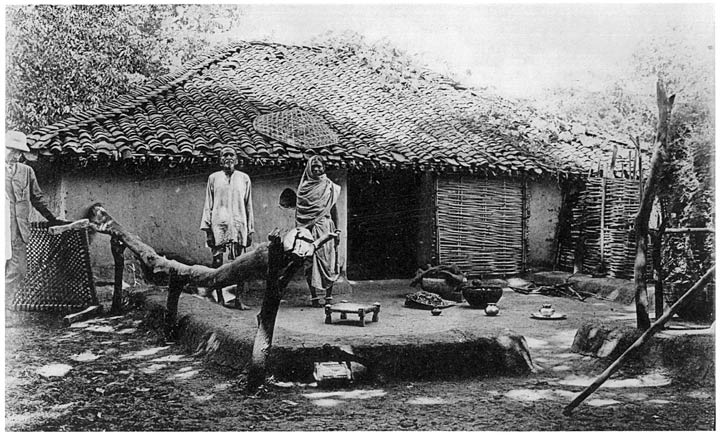
Dhīmar or fisherman’s hut.
2. Subcastes.
The caste has a large number of subdivisions of a local or occupational nature; among occupational names may be mentioned the Singaria or those who cultivate the singāra nut, the Nadha or those who live on the banks of streams, the Tānkiwālas or sharpeners of grindstones, the Jhīngas or prawn-catchers, the Bansias and Saraias or anglers (from bansi or sarai, a bamboo fishing-rod), the Bandhaiyas or those who make ropes and sacking of hemp and fibre, and the Dhurias who sell parched rice. These last say that their original ancestors were created by Mahādeo out of a handful of dust (dhūr) for carrying the palanquin of Pārvati when she was tired. They are probably the same people as the Dhuris who also parch grain, and in Chhattīsgarh are considered as a separate caste. Similarly the Sonjhara Dhīmars wash for gold, the calling of the separate Sonjhara caste. The Kasdhonia Dhīmars wash the sands of the sacred rivers to find the coins which pious pilgrims frequently drop or throw into the river as an offering when they bathe in it. The Gondia subcaste is clearly an offshoot from the Gond tribe, but a large proportion of the whole caste in the Central Provinces is probably derived from the Gonds or Kols, members of this latter tribe being especially proficient as palanquin-bearers. The Suvarha subcaste is named after the suar or pig, because members of this subcaste breed and eat the unclean animal; they are looked down on by the others. Similarly the Gadhewāle Dhīmars keep donkeys, and are despised by the other subcastes who will not take food from them. They use donkeys for carrying loads of wood, and the bridegroom rides to his wedding on this animal; and among them a donkey is the only animal the corpse of which can be touched without conveying pollution. The Bhanāre Dhīmars appear to be named after the town of Bhandāra.
3. Exogamous groups.
A large number of exogamous groups are also returned, either of a titular or totemistic nature: such are Bāghmār, a tiger-slayer; Ojhwa, from Ojha, or sorcerer; Guru pahchān, one who knows his teacher; Midoia, a guardian of boundaries, from med, a boundary or border; Gidhwe, a vulture; Kolhe, or jackal; Gadhekhāya, a donkey-eater; and Kastūre, musk; a few names are from towns or villages, as Tumsare from Tumsar, Nāgpurkar from Nāgpur; and a few from other castes as Mādgi, Bhoyar, Pindāria from Pindāri, a freebooter; Gondia (Gond) and Gondhali; and Kachhwāha, a sept of Rājpūts.
4. Marriage.
5. Childbirth
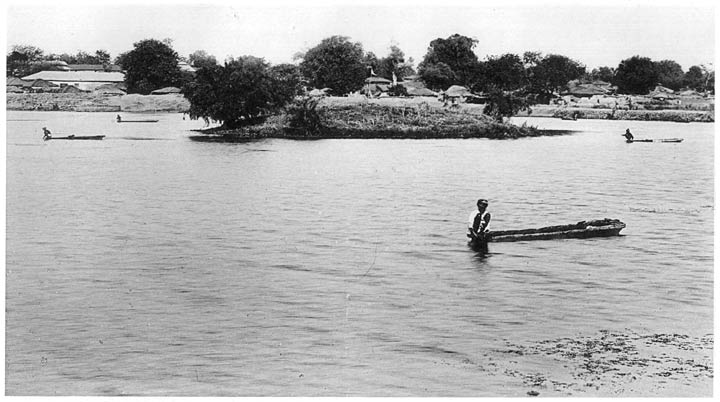
Fishermen in dug-outs or hollowed tree trunks.
6. Disposal of the dead.
7. Religion.
8. Occupation: fisherman.
The occupations of the Dhīmar are many and various. He is primarily a fisherman and boatman, and has various kinds of nets for taking fish. One of these is of triangular shape about 150 feet wide at the base and 80 feet in height to the apex. The meshes vary from an inch wide at the top to three inches at the bottom. The ends of the base are weighted with stones and the net is then sunk into a river so that the base rests on its bed and the top is held by men in boats at the surface. Then other Dhīmars beat the surface of the water for some distance with long bamboos on both sides of the net, driving the fish towards it. They call this a kheda, the term used for a beat of the forest for game.
9. Water-carrier.
The Dhīmar’s connection with water has led to his becoming the water-carrier for Hindus, or that section of the community which can afford to employ one. This is more especially the case in the Hindustāni Districts where women are frequently secluded and therefore cannot draw water for the household, while in the Marātha Districts where the women go to the well no water-bearer is required. In this capacity the Dhīmar is usually the personal servant of the village proprietor, but in large villages every house has a ghinochi, either an earthen platform or wooden stand just outside the house, on which four or five earthen water-pots are kept. These the Dhīmar fills up morning and evening and receives two or three annas or pence a month for doing so. He also brings water for Government servants when they come to the village, and cleans their cooking-vessels and prepares the hearth with fresh cowdung and water in order to cleanse it.
If he cleans the mālguzār’s vessels he gets his food for doing so. When the tenants have marriages he performs the same duties for the whole wedding party and receives a present of one or two rupees and some clothes if the families are well off, and also his food every day while the marriage is in progress. In his capacity of waterman the title Baraua is used to him as an honorific method of address; and to his wife Baroni. In a hot country like India water is revered as the source of relief, comfort and life itself, like fire in cold countries, and the waterman participates in the regard paid to his element.
Another business of the Dhīmar’s is to take sweet potatoes and boiled plums to the fields at harvest-time and sell them. He supplies water for drinking to the reapers and receives three sheaves a day in payment. On the fifteenth of Jesth (May) the Dhīmar goes round to the cultivators, throwing his fishing-net over their heads and receives a small present.
10. Palanquin-bearer and personal servant.
At the period prior to the introduction of wheeled transport when palanquins or litters were largely used for travelling, the carriers belonged to the Kahār caste in northern India and to the Dhīmars or Bhois in the south. Though litters are now practically not used for travelling except occasionally by high-caste women, a survival of the old custom is retained in the marriage ceremony, the bride and bridegroom being always carried back from the marriage-shed to the temporary lodging of the bridegroom in a pālki, though for the longer journey to the bridegroom’s village some less cumbrous conveyance is utilised. Four Dhīmars carry the pālki and receive Rs. 1–4. Well-to-do people will be carried in procession round the town. When employed by the village proprietor the Dhīmar accompanies him on his journey, carrying his cooking-vessels and other necessaries in a banhgi or wooden cross-bar slung across the shoulders, from which two baskets are suspended by loops of rope. Water he will always carry in a banhgi and never on his head or shoulders. From waterman and litter-carrier the Dhīmar has become a personal servant; it is he to whom the term ‘bearer’ as designating a body-servant was first applied because he bears or carries his master in a pālki and his clothes in a banhgi. He is commonly so employed in native houses, but rarely by Europeans, whether because he is too stupid or on account of caste objections of his own. When employed as a cook the Dhīmar or his wife is permitted to knead flour with water and make it into a cake which the Brāhman will then take and put on to the girdle with his own hands. He can also boil water and pour pulse into the cooking-pot from above so long as he does not touch the vessel after the food has been placed in it. He or she will also take any remains of food which is left in the cooking-pot as this is not considered to be polluted, food only becoming polluted when the hand touches it on the dish after having touched the mouth. When this has happened all the food on the dish becomes jūtha or leavings of food, and as a general rule no caste except the sweepers will eat the leavings of food of another caste or of another person of their own. Only the wife, whose meal follows her husband’s, will eat his leavings. As a servant the Dhīmar is very familiar with his master; he may enter any part of the house, including the cooking-place and the women’s rooms, and he addresses his mistress as ‘Mother.’ In northern India Mr. Crooke states that the Kahārs are sometimes known as Mahra, from the Sanskrit Mahila, a woman, because they have the entry of the female apartments. When he lights his master’s pipe he takes the first pull himself to show that it has not been tampered with, and then presents it to him with his left hand placed under his right elbow in token of respect. Maid-servants also frequently belong to the Dhīmar caste, and it often happens that the master of the household has illicit intercourse with them. Hence there is a proverb, ‘The king’s son draws water and the water-bearer’s son sits on the throne,’ similar intrigues on the part of high-born women with their servants being not unknown. The Dhīmar often acts as a pimp, this being an incident of his profession of indoor servant.
11. Other occupations.
12. Social status.
Once a year at the Muharram festival the Dhīmars will eat at the hands of Muhammadans. They go round and beg for offerings of food and take them to the Fakīr, who places a little before the tāzia or tomb of Husain and distributes the remainder to the Dhīmars and other Hindus and Muhammadans who have been begging. Except on this occasion they will eat nothing touched by a Muhammadan. The Dhīmar, the Nai or barber, and the Bāri or indoor servant are the three household menials of the northern Districts, and are known as Pauni Parja. Sometimes the Ahīr or grazier is an indoor servant and takes the place of the Dhīmar or the Bāri. These menials are admitted to the wedding and other family feasts and allowed to eat at them. They sit in a line apart from the members of the caste and one member of the family is deputed to wait on them. Their food is brought to them in separate dishes and no food from these dishes is served to guests of the caste.
13. Legend of the caste.
The Dhīmars are proverbially of a cheerful disposition, though simple and easily cheated. When carrying pālkis or litters at night they talk continually or sing monotonous songs to lighten the tedium of the way. In illustration of these qualities the following story is told: One day when Mahādeo and Pārvati were travelling the goddess became very tired, so Mahādeo created four men from the dust, who bore her in a litter. On the way they talked and laughed, and Pārvati was very pleased with them, so when she got home she told them to wait while she sent them out a reward. The Bhois found that they could get plenty of liquor, so they went on drinking it and forgot all about going for the reward. In the meantime a Mārwāri Bania who had heard what the goddess said, waited at the door of the palace, and when the servants brought out a bag of money he pretended that he was one of the Bhois and got them to give him the money, with which he made off. After a time the Bhois remembered about the reward and went to the door of the palace to get it, when the goddess came out and found out what had happened. The Bhois then wept and asked for another reward, but the goddess refused and said that as they had been so stupid their caste would always be poor, but at the same time they would be cheerful and happy.