Volume 2 / Part 2 — Bairāgi
Reading edition
List of Paragraphs
1. Definition of name and statistics.
2. The four Sampradāyas or main orders.
3. The Rāmānujis.
4. The Rāmānandis
5. The Nīmānandis.
6. The Mādhavachāryas.
7. The Vallabhachāryas.
8. Minor sects.
9. The seven Akhāras.
10. The Dwāras.
11. Initiation, appearance and customs.
12. Recruitment of the order and its character.
13. Social position and customs.
14. Bairāgi monasteries.
15. Married Bairāgis.
1. Definition of name and statistics.
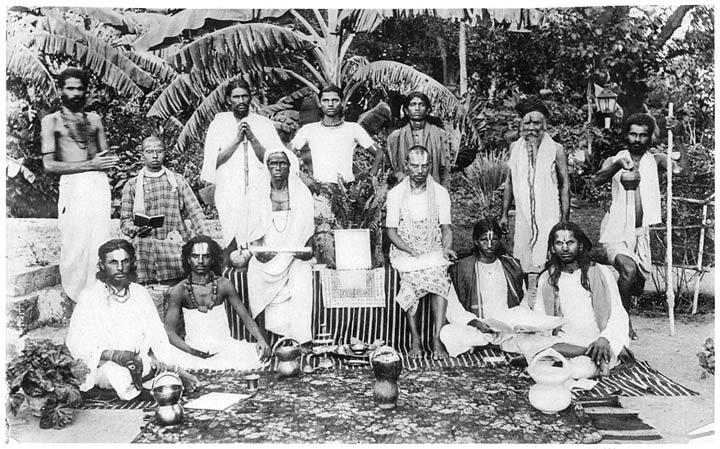
Hindu mendicants with sect-marks.
2. The four Sampradāyas or main orders.
It is generally held that there are four Sampradāyas or main sects of Bairāgis. These are—
(a) The Rāmānujis, the followers of the first prominent Vishnuite reformer Rāmānuj in southern India, with whom are classed the Rāmānandis or adherents of his great disciple Rāmānand in northern India. Both these are also called Sri Vaishnava, that is, the principal or original Vaishnava sect.
(b) The Nīmānandi, Nīmāt or Nīmbāditya sect, followers of a saint called Nīmānand.
(c) The Vishnu-Swāmi or Vallabhachārya sect, worshippers of Krishna and Rādha.
(d) The Mādhavachārya sect of southern India.
It will be desirable to give a few particulars of each of these, mainly taken from Wilson’s Hindu Sects and Dr. Bhattachārya’s Hindu Castes and Sects.
3. The Rāmānujis.
Rāmānuj was the first great Vishnuite prophet, and lived in southern India in the eleventh or twelfth century on an island in the Kāveri river near Trichinopoly. He preached the worship of a supreme spirit, Vishnu and his consort Lakshmi, and taught that men also had souls or spirits, and that matter was lifeless. He was a strong opponent of the cult of Siva, then predominant in southern India, and of phallic worship. He, however, admitted only the higher castes into his order, and cannot therefore be considered as the founder of the liberalising principle of Vishnuism. The superiors of the Rāmānuja sect are called Achārya, and rank highest among the priests of the Vishnuite orders. The most striking feature in the practice of the Rāmānujis is the separate preparation and scrupulous privacy of their meals. They must not eat in cotton garments, but must bathe, and then put on wool or silk. The teachers allow their select pupils to assist them, but in general all the Rāmānujis cook for themselves, and should the meal during this process, or while they are eating, attract even the look of a stranger, the operation is instantly stopped and the viands buried in the ground. The Rāmānujis address each other with the salutation Dasoham, or ‘I am your slave,’ accompanied with the Pranām or slight inclination of the head and the application of joined hands to the forehead. To the Achāryas or superiors the other members of the sect perform the Ashtanga or prostration of the body with eight parts touching the ground. The tilak or sect-mark of the Rāmānujis consists of two perpendicular white lines from the roots of the hair to the top of the eyebrows, with a connecting white line at the base, and a third central line either of red or yellow. The Rāmānujis do not recognise the worship of Rādha, the consort of Krishna. The mendicant orders of the Sātanis and Dasaris of southern India are branches of this sect.
4. The Rāmānandis
5. The Nīmānandis.
The second of the four orders is that of the Nīmānandis, called after a saint Nīmānand. He lived near Mathura Brindāban, and on one occasion was engaged in religious controversy with a Jain ascetic till sunset. He then offered his visitor some refreshment, but the Jain could not eat anything after sunset, so Nīmānand stopped the sun from setting, and ordered him to wait above a nīm tree till the meal was cooked and eaten under the tree, and this direction the sun duly obeyed. Hence Nīmānand, whose original name was Bhāskarachārya, was called by his new name after the tree, and was afterwards held to have been an incarnation of Vishnu or the Sun.
6. The Mādhavachāryas.
The third great order is that of the Mādhavas, named after a saint called Mādhavachārya in southern India. He attempted to reconcile the warring Sivites and Vishnuites by combining the worship of Krishna with that of Siva and Pārvati. The doctrine of the sect is that the human soul is different from the divine soul, and its members are therefore called dualists. They admit a distinction between the divine soul and the universe, and between the human soul and the material world. They deny also the possibility of Nirvāna or the absorption and extinction of the human soul in the divine essence. They destroy their thread at initiation, and also wear red clothes like the Sivite devotees, and like them also they carry a staff and water-pot. The tilak of the Mādhavachāryas is said to consist of two white lines down the forehead and continued on to the nose where they meet, with a black vertical line between them.
7. The Vallabhachāryas.
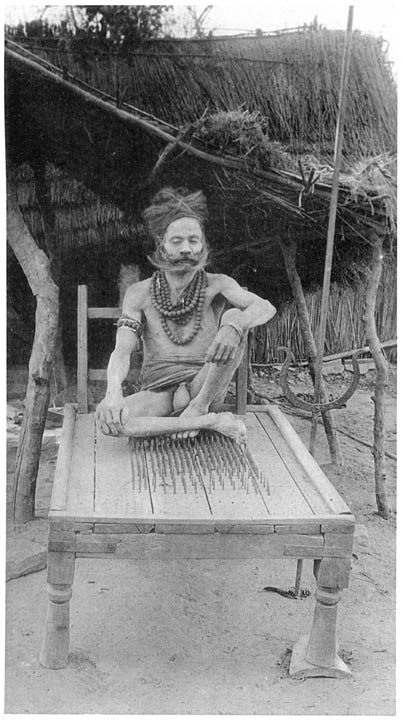
Anchorite sitting on iron nails.
For homage by sight Rs. 5.
For homage by touch Rs. 20.
For the honour of washing the Mahārāja’s foot Rs. 35.
For swinging him Rs. 40.
For rubbing sweet unguents on his body Rs. 42.
For being allowed to sit with him on the same couch Rs. 60.
For the privilege of dancing with him Rs. 100 to 200.
For drinking the water in which he has bathed Rs. 17.
For being closeted with him in the same room Rs. 50 to 500.
The public disapprobation caused by these practices and their bad effect on the morality of women culminated in the great Mahārāj libel suit in the Bombay High Court in 1862. Since then the objectionable features of the cult have to a large extent disappeared, while it has produced some priests of exceptional liberality and enlightenment. The tilak of the Vallabhachāryas is said to consist of two white lines down the forehead, forming a half-circle at its base and a white dot between them. They will not admit the lower castes into the order, but only those from whom a Brāhman can take water.
8. Minor sects.
Besides the main sects as described above, Vaishnavism has produced many minor sects, consisting of the followers of some saint of special fame, and mendicants belonging to these are included in the body of Bairāgis. One or two legends concerning such saints may be given. A common order is that of the Bendiwāle, or those who wear a dot. Their founder began putting a red dot on his forehead between the two white lines in place of the long red line of the Rāmānandis. His associates asked him why he had dared to alter his tilak or sect-mark. He said that the goddess Jānki had given him the dot, and as a test he went and bathed in the Sarju river, and rubbed his forehead with water, and all the sect-mark was rubbed out except the dot. So the others recognised the special intervention of the goddess, and he founded a sect. Another sect is called the Chaturbhuji or four-armed, Chaturbhuj being an epithet of Vishnu. He was taking part in a feast when his loin-cloth came undone behind, and the others said to him that as this had happened, he had become impure at the feast. He replied, ‘Let him to whom the dhoti belongs tie it up,’ and immediately four arms sprang from his body, and while two continued to take food, the other two tied up his loin-cloth behind. Thus it was recognised that the Chaturbhuji Vishnu had appeared in him, and he was venerated.
9. The seven Akhāras.
Among the Bairāgis, besides the four Sampradāyas or main orders, there are seven Akhāras. These are military divisions or schools for training, and were instituted when the Bairāgis had to fight with the Gosains. Any member of one of the four Sampradāyas can belong to any one of the seven Akhāras, and a man can change his Akhāra as often as he likes, but not his Sampradāya. The Akhāras, with the exception of the Lasgaris, who change the red centre line of the Rāmanāndis into a white line, have no special sect-marks. They are distinguished by their flags or standards, which are elaborately decorated with gold thread embroidered on silk or sometimes with jewels, and cost two or three hundred rupees to prepare. These standards were carried by the Nāga or naked members of the Akhāra, who went in front and fought. Once in twelve years a great meeting of all the seven Akhāras is held at Allahābād, Nāsik, Ujjain or Hardwār, where they bathe and wash the image of the god in the water of the holy rivers. The quarrels between the Bairāgis and Gosains usually occurred at the sacred rivers, and the point of contention was which sect should bathe first. The following is a list of the seven Akhāras: Digambari, Khāki, Munjia, Kathia, Nirmohi, Nirbāni or Niranjani and Lasgari.
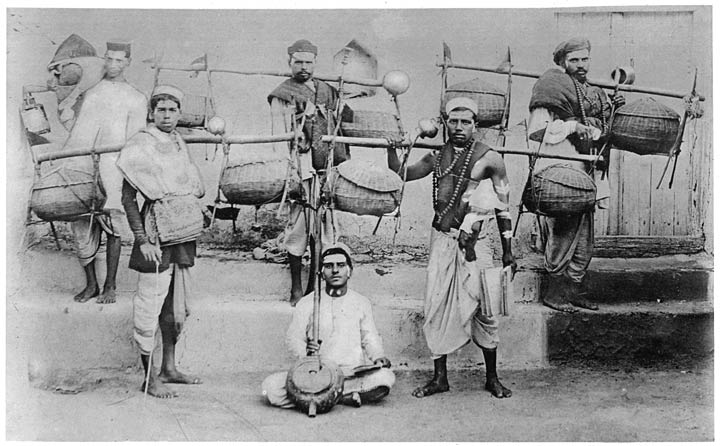
Pilgrims carrying water of the river Nerbudda.
The name of the Digamber or Meghdamber signifies sky-clad or cloud-clad, that is naked. They do penance in the rainy season by sitting naked in the rain for two or three hours a day with an earthen pot on the head and the hands inserted in two others so that they cannot rub the skin. In the dry season they wear only a little cloth round the waist and ashes over the rest of the body. The ashes are produced from burnt cowdung picked up off the ground, and not mixed with straw like that which is prepared for fuel.
The Khāki Bairāgis also rub ashes on the body. During the four hot months they make five fires in a circle, and kneel between them with the head and legs and arms stretched towards the fires. The fires are kindled at noon with little heaps of cowdung cakes, and the penitent stays between them till they go out. They also have a block of wood with a hole through it, into which they insert the organ of generation and suspend it by chains in front and behind. They rub ashes on the body, from which they probably get their name of Khāki or dust-colour.
The Munjia Akhāra have a belt made of munj grass round the waist, and a little apron also of grass, which is hung from it, and passed through the legs. Formerly they wore no other clothes, but now they have a cloth. They also do penance between the fires.
The Kathias have a waist-belt of bamboo fibre, to which is suspended the wooden block for the purpose already described. Their name signifies wooden, and is probably given to them on account of this custom.
The Nirmohi carry a lota or brass vessel and a little cup, in which they receive alms.
The Nirbāni wear only a piece of string or rope round the waist, to which is attached a small strip of cloth passing through the legs. When begging, they carry a kawar or banghy, holding two baskets covered with cloth, and into this they put all their alms. They never remove the cloth, but plunge their hands into the basket at random when they want something to eat. They call the basket Kāmdhenu, the name of the cow which gave inexhaustible wealth. These Bairāgis commonly marry and accumulate property.
Others say that the Lasgari are a branch of the Digambari Akhāra, and that the Munjia and Kathia are branches of the Khāki Akhāra. They give three other Akhāras—Nīralankhi, Mahānirbāni and Santokhi—about which nothing is known.
10. The Dwāras.
Besides the Akhāras, the Bairāgis are said to have fifty-two Dwāras or doors, and every man must be a member of a Dwāra as well as of a Sampradāya and Akhāra. The Dwāras seem to have no special purpose, but in the case of Bairāgis who marry, they now serve as exogamous sections, so that members of the same Dwāra do not intermarry.
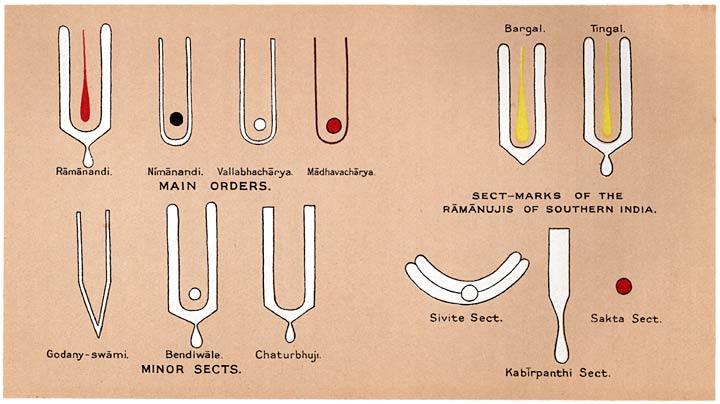
Examples of Tilaks or sect-marks worn on the forehead.
11. Initiation, appearance and customs.
A candidate for initiation has his head shaved, is invested with a necklace of beads of the tulsi or basil, and is taught a mantra or text relating to Vishnu by his preceptor. The initiation text of the Rāmānandis is said to be Om Rāmāya Nāmah, or Om, Salutation to Rāma. Om is a very sacred syllable, having much magical power. Thereafter the novice must journey to Dwārka in Gujarāt and have his body branded with hot iron or copper in the shape of Vishnu’s four implements: the chakra or discus, the guda or club, the shank or conch-shell and the padma or lotus. Sometimes these are not branded but are made daily on the arms with clay. The sect-mark should be made with Gopichandan or the milkmaid’s sandalwood. This is supposed to be clay taken from a tank at Dwārka, in which the Gopis or milkmaids who had been Krishna’s companions drowned themselves when they heard of his death. But as this can seldom be obtained any suitable whitish clay is used instead. The Bairāgis commonly let their hair grow long, after being shaved at initiation, to imitate the old forest ascetics. If a man makes a pilgrimage on foot to some famous shrine he may have his head shaved there and make an offering of his hair. Others keep their hair long and shave it only at the death of their guru or preceptor. They usually wear white clothes, and if a man has a cloth on the upper part of the body it should be folded over the shoulders and knotted at the neck. He also has a chimta or small pair of tongs, and, if he can obtain it, the skin of an Indian antelope, on which he will sit while taking his food. The skin of this animal is held to be sacred. Every Bairāgi before he takes his food should dip a sprig of tulsi or basil into it to sanctify it, and if he cannot get this he uses his necklace of tulsi-beads for the purpose instead. The caste abstain from flesh and liquor, but are addicted to the intoxicating drugs, gānja and bhāng or preparations of Indian hemp. A Hindu on meeting a Bairāgi will greet him with the phrase ‘Jai Sītārām,’ and the Bairāgi will answer, ‘Sītārām.’ This word is a conjunction of the names of Rāma and his consort Sīta. When a Bairāgi receives alms he will present to the giver a flower and a sprig of tulsi.
12. Recruitment of the order and its character.
A man belonging to any caste except the impure ones can be initiated as a Bairāgi, and the order is to a large extent recruited from the lower castes. Theoretically all members of the order should eat together; but the Brāhmans and other high castes belonging to it now eat only among themselves, except on the occasion of a Ghosti or special religious assembly, when all eat in common. As a matter of fact the order is a very mixed assortment of people. Many persons who lost their caste in the famine of 1897 from eating in Government poor-houses, joined the order and obtained a respectable position. Debtors who have become hopelessly involved sometimes find in it a means of escape from their creditors. Women of bad character, who have been expelled from their caste, are also frequently enrolled as female members, and in monasteries live openly with the men. The caste is also responsible for a good deal of crime. Not only is the disguise a very convenient one for thieves and robbers to assume on their travels, but many regular members of the order are criminally disposed. Nevertheless large numbers of Bairāgis are men who have given up their caste and families from a genuine impulse of self-sacrifice, and the desire to lead a religious life.
13. Social position and customs.
On account of their sanctity the Bairāgis have a fairly good social position, and respectable Hindu castes will accept cooked food from them. Brāhmans usually, but not always, take water. They act as gurus or spiritual guides to the laymen of all castes who can become Bairāgis. They give the Rām and Gopāl Mantras, or the texts of Rāma and Krishna, to their disciples of the three twice-born castes, and the Sheo Mantra or Siva’s text to other castes. The last is considered to be of smaller religious efficacy than the others, and is given to the lower castes and members of the higher ones who do not lead a particularly virtuous life. They invest boys with the sacred thread, and make the sect-mark on their foreheads. When they go and visit their disciples they receive presents, but do not ask them to confess their sins nor impose penalties.
If a mendicant Bairāgi keeps a woman it is stated that he is expelled from the community, but this rule does not seem to be enforced in practice. If he is detected in a casual act of sexual intercourse a fine should be imposed, such as feeding two or three hundred Bairāgis. The property of an unmarried Bairāgi descends to a selected chela or disciple. The bodies of the dead are usually burnt, but those of saints specially famous for their austerities or piety are buried, and salt is put round the body to preserve it. Such men are known as Bhakta.
14. Bairāgi monasteries.
15. Married Bairāgis.
Large numbers of Bairāgis now marry and have children, and have formed an ordinary caste. The married Bairāgis are held to be inferior to the celibate mendicants, and will take food from them, but the mendicants will not permit the married Bairāgis to eat with them in the chauka or place purified for the taking of food. The customs of the married Bairāgis resemble those of ordinary Hindu castes such as the Kurmis. They permit divorce and the remarriage of widows, and burn the dead. Those who have taken to cultivation do not, as a rule, plough with their own hands. Many Bairāgis have acquired property and become landholders, and others have extensive moneylending transactions. Two such men who had acquired possession of extensive tracts of zamīndāri land in Chhattīsgarh, in satisfaction of loans made to the Gond zamīndārs, and had been given the zamīndāri status by the Marāthas, were subsequently made Feudatory Chiefs of the Nāndgaon and Chhuikhadan States. These chiefs now marry and the States descend in their families by primogeniture in the ordinary manner. As a rule, the Bairāgi landowners and moneylenders are not found to be particularly good specimens of their class.