Volume 2 / Part 2 — Chhīpa
Reading edition
1. Constitution of the caste.
Chhīpa, Rangāri, Bhaosar, Nirāli, Nīlgar.—The Hindu caste of cotton printers and dyers. They are commonly known as Chhīpa in the northern Districts and Rangāri or Bhaosar in the Maratha country. The Chhīpas and Rangāris together number about 23,000 persons. In the south of the Central Provinces and Berār cotton is a staple crop, and the cotton-weaving industry is much stronger than in the north, and as a necessary consequence the dyers also would be more numerous. Though the Chhīpas and Rangāris do not intermarry or dine together, no essential distinction exists between them. They are both of functional origin, pursue exactly the same occupation, and relate the same story about themselves, and no good reason therefore exists for considering them as separate castes. Nīlgar or Nirāli is a purely occupational term applied to Chhīpas or Rangāris who work in indigo (nīl); while Bhaosar is another name for the Rangāris in the northern Districts.
2. Its origin and position.
The Rangāris say that when Parasurāma, the Brāhman, was slaying the Kshatriyas, two brothers of the warrior caste took refuge in a temple of Devi. One of them, called Bhaosar, threw himself upon the image, while the other hid behind it. The goddess saved them both and told them to adopt the vocation of dyers. The Rangāris are descended from the brother who was called Bhaosar and the Chhīpas from the other brother, because he hid behind the image (chhipna, to hide). The word is really derived from chhāpna, to print, because the Chhīpas print coloured patterns on cotton cloths with wooden stamps. Rangāri comes from the common word rang or colour. The Chhīpas have a slightly different version of the same story, according to which the goddess gave one brother a needle and a piece of thread, and the other some red betel-leaf which she spat at him out of her mouth; and told one to follow the vocation of a tailor, and the other that of a dyer. Hence the first was called Chhīpi or Shimpi and the second Chhīpa. This story indicates a connection between the dyeing and tailoring castes in the Marātha Districts, which no doubt exists, as one subcaste of the Rangāris is named after Nāmdeo, the patron saint of the Shimpis or tailors. Both the dyeing and tailoring industries are probably of considerably later origin than that of cotton-weaving, and both are urban rather than village industries. And this consideration perhaps accounts for the fact that the Chhīpas and Rangāris rank higher than most of the weaving castes, and no stigma or impurity attaches to them.
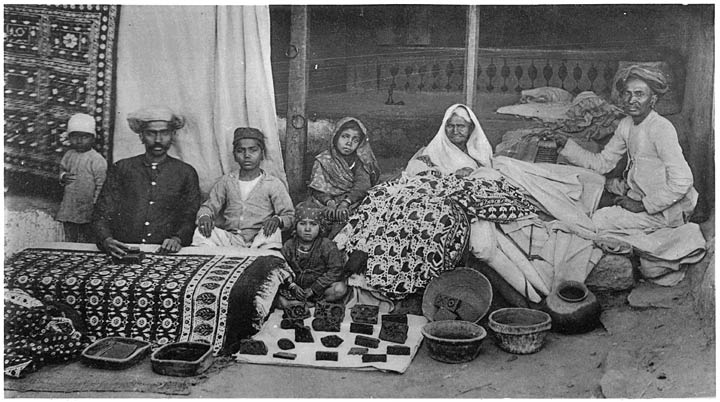
Chhīpa or calico-printer at work.
3. Caste subdivisions.
The caste have a number of subdivisions, such as the Malaiyas or immigrants from Mālwa, the Gujrāti who come from Gujarāt, the Golias or those who dye cloth with goli ka rang, the fugitive aniline dyes, the Nāmdeos who belong to the sect founded by the Darzi or tailor of that name, and the Khatris, these last being members of the Khatri caste who have adopted the profession.
4. Marriage and other customs.
Marriage is forbidden between persons so closely connected as to have a common ancestor in the third generation. In Bhandāra it is obligatory on all members of the caste, who know the bride or bridegroom, to ask him or her to dine. The marriage rite is that prevalent among the Hindustāni castes, of walking round the sacred post. Divorce and the marriage of widows are permitted. In Narsinghpur, when a bachelor marries a widow, he first goes through a mock ceremony by walking seven times round an earthen vessel filled with cakes; this rite being known as Langra Biyāh or the lame marriage. The caste burn their dead, placing the head to the north. On the day of Dasahra the Chhīpas worship their wooden stamps, first washing them and then making an offering to them of a cocoanut, flowers and an image consisting of a bottle-gourd standing on four sticks, which is considered to represent a goat. The Chhīpas rank with the lower artisan castes, from whose hands Brāhmans will not take water. Nevertheless some of them wear the sacred thread and place sect-marks on their foreheads.