Volume 2 / Part 2 — Banjāra
Reading edition
List of Paragraphs
1. Historical notice of the caste.
2. Banjāras derived from the Chārans or Bhāts.
3. Chāran Ranjārans employed with the Mughal armies.
4. Internal structure.
5. Minor subcastes.
6. Marriage: betrothal.
7. Marriage.
8. Widow remarriage.
9. Birth and death.
10. Religion: Banjāri Devi.
11. Mīthu Bhūkia.
12. Siva Bhāia.
13. Worship of cattle.
14. Connection with the Sikhs.
15. Witchcraft.
16. Human sacrifice.
17. Admission of outsiders: kidnapped children and slaves.
18. Dress.
19. Social customs.
20. The Nāik or headman. Banjāra dogs.
21. Criminal tendencies of the caste.
22. Their virtues.
1. Historical notice of the caste.
2. Banjāras derived from the Chārans or Bhāts.
“The vast consumption that attends a Marātha army necessarily superinduces the idea of great supplies; yet, notwithstanding this, the native powers never concern themselves about providing for their forces, and have no idea of a grain and victualling department, which forms so great an object in a European campaign. The Banias or grain-sellers in an Indian army have always their servants ahead of the troops on the line of march, to purchase in the circumjacent country whatever necessaries are to be disposed of. Articles of consumption are never wanting in a native camp, though they are generally twenty-five per cent dearer than in the town bazārs; but independent of this mode of supply the Vanjāris or itinerant grain-merchants furnish large quantities, which they bring on bullocks from an immense distance. These are a very peculiar race, and appear a marked and discriminated people from any other I have seen in this country. Formerly they were considered so sacred that they passed in safety in the midst of contending armies; of late, however, this reverence for their character is much abated and they have been frequently plundered, particularly by Tipu.”
The reference to the sacred character attaching to the Banjāras a century ago appears to be strong evidence in favour of their derivation from the Chārans. For it could scarcely have been obtained by any body of commissariat agents coming into India with the Muhammadans. The fact that the example of disregarding it was first set by a Muhammadan prince points to the same conclusion.
One may suppose that the Chārans having acted as carriers for the Rājpūt chiefs and courts, both in time of peace and in their continuous intestinal feuds, were pressed into service when the Mughal armies entered Rājputāna and passed through it to Gujarāt and the Deccan. In adopting the profession of transport agents for the imperial troops they may have been amalgamated into a fresh caste with other Hindus and Muhammadans doing the same work, just as the camp language formed by the superposition of a Persian vocabulary on to a grammatical basis of Hindi became Urdu or Hindustāni. The readiness of the Chārans to commit suicide rather than give up property committed to their charge was not, however, copied by the Banjāras, and so far as I am aware there is no record of men of this caste taking their own lives, though they had little scruple with those of others.
3. Chāran Ranjārans employed with the Mughal armies.
Ranjan kā pāni Chhappar kā ghās Din ke tīn khūn muāf; Aur jahān Asaf Jāh ke ghore Wahān Bhangi Jhangi ke bail,
4. Internal structure.
5. Minor subcastes.
6. Marriage: betrothal.
At a betrothal in Nimār the bridegroom and his friends come and stay in the next village to that of the bride. The two parties meet on the boundary of the village, and here the bride-price is fixed, which is often a very large sum, ranging from Rs. 200 to Rs. 1000. Until the price is paid the father will not let the bridegroom into his house. In Yeotmāl, when a betrothal is to be made, the parties go to a liquor-shop and there a betel-leaf and a large handful of sugar are distributed to everybody. Here the price to be paid for the bride amounts to Rs. 40 and four young bullocks. Prior to the wedding the bridegroom goes and stays for a month or so in the house of the bride’s father, and during this time he must provide a supply of liquor daily for the bride’s male relatives. The period was formerly longer, but now extends to a month at the most. While he resides at the bride’s house the bridegroom wears a cloth over his head so that his face cannot be seen. Probably the prohibition against seeing him applies to the bride only, as the rule in Berār is that between the betrothal and marriage of a Chāran girl she may not eat or drink in the bridegroom’s house, or show her face to him or any of his relatives. Mathuria girls must be wedded before they are seven years old, but the Chārans permit them to remain single until after adolescence.
7. Marriage.
8. Widow remarriage.
9. Birth and death.
After the birth of a child the mother is unclean for five days, and lives apart in a separate hut, which is run up for her use in the kuri or hamlet. On the sixth day she washes the feet of all the children in the kuri, feeds them and then returns to her husband’s hut. When a child is born in a moving tānda or camp, the same rule is observed, and for five days the mother walks alone after the camp during the daily march. The caste bury the bodies of unmarried persons and those dying of smallpox and burn the others. Their rites of mourning are not strict, and are observed only for three days. The Banjāras have a saying: “Death in a foreign land is to be preferred, where there are no kinsfolk to mourn, and the corpse is a feast for birds and animals”; but this may perhaps be taken rather as an expression of philosophic resignation to the fate which must be in store for many of them, than a real preference, as with most people the desire to die at home almost amounts to an instinct.
10. Religion: Banjāri Devi.
11. Mīthu Bhūkia.
12. Siva Bhāia.
13. Worship of cattle.
14. Connection with the Sikhs.
15. Witchcraft.
16. Human sacrifice.
17. Admission of outsiders: kidnapped children and slaves.
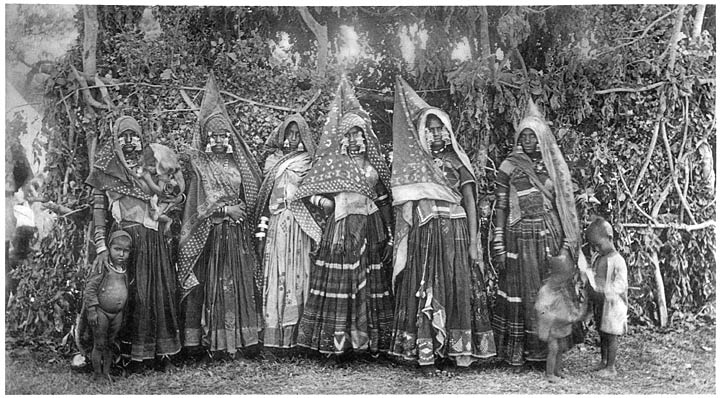
Banjāra women with the singh or horn.
18. Dress.
19. Social customs.
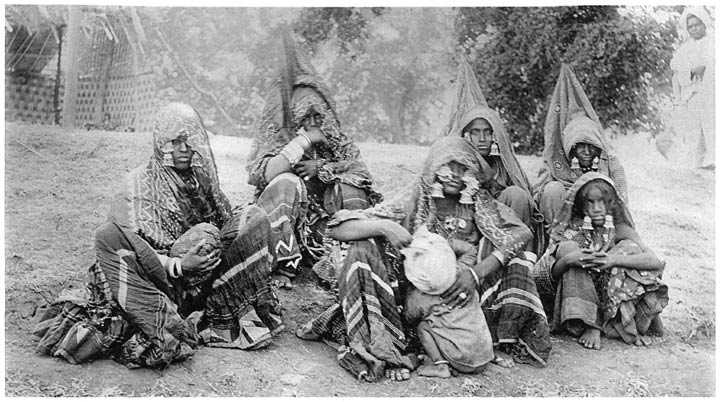
Group of Banjāra women.
20. The Nāik or headman. Banjāra dogs.
The Banjāras are credited with great affection for their dogs, and the following legend is told about one of them: Once upon a time a Banjāra, who had a faithful dog, took a loan from a Bania (moneylender) and pledged his dog with him as security for payment. And some time afterwards, while the dog was with the moneylender, a theft was committed in his house, and the dog followed the thieves and saw them throw the property into a tank. When they went away the dog brought the Bania to the tank and he found his property. He was therefore very pleased with the dog and wrote a letter to his master, saying that the loan was repaid, and tied it round his neck and said to him, ‘Now, go back to your master.’ So the dog started back, but on his way he met his master, the Banjāra, coming to the Bania with the money for the repayment of the loan. And when the Banjāra saw the dog he was angry with him, not seeing the letter, and thinking he had run away, and said to him, ‘Why did you come, betraying your trust?’ and he killed the dog in a rage. And after killing him he found the letter and was very grieved, so he built a temple to the dog’s memory, which is called the Kukurra Mandhi. And in the temple is the image of a dog. This temple is in the Drūg District, five miles from Bālod. A similar story is told of the temple of Kukurra Math in Mandla.