Volume 2 / Part 2 — Bahna
Reading edition
1. Nomenclature and internal structure.
2. Marriage.
Some Bahnas have exogamous sections with Hindu names, while others are without these, and simply regulate their marriages by rules of relationship. They have the primitive Hindu custom of allowing a sister’s son to marry a brother’s daughter, but not vice versa. A man cannot marry his wife’s younger sister during her lifetime, nor her elder sister at any time. Children of the same foster-mother are also not allowed to marry. Their marriages are performed by a Kāzi with an imitation of the Nikāh rite. The bridegroom’s party sit under the marriage-shed, and the bride with the women of her party inside the house. The Kāzi selects two men, one from the bride’s party, who is known as the Nikāhi Bāp or ‘Marriage Father,’ and the other from the bridegroom’s, who is called the Gowāh or ‘Witness.’ These two men go to the bride and ask her whether she accepts the bridegroom, whose name is stated, for her husband. She answers in the affirmative, and mentions the amount of the dowry which she is to receive. The bridegroom, who has hitherto had a veil (mukhna) over his face, now takes it off, and the men go to him and ask him whether he accepts the bride. He replies that he does, and agrees to pay the dowry demanded by her. The Kāzi reads some texts and the guests are given a meal of rice and sugar. Many of the preliminaries to a Hindu marriage are performed by the more backward members of the caste, and until recently they erected a sacred post in the marriage-shed, but now they merely hang the green branch of a mango tree to the roof. The minimum amount of the mehar or dowry is said to be Rs. 125, but it is paid to the girl’s parents as a bride-price and not to herself, as among the Muhammadans. A widow is expected, but not obliged, to marry her deceased husband’s younger brother. Divorce is permitted by means of a written deed known as ‘Fārkhati.’
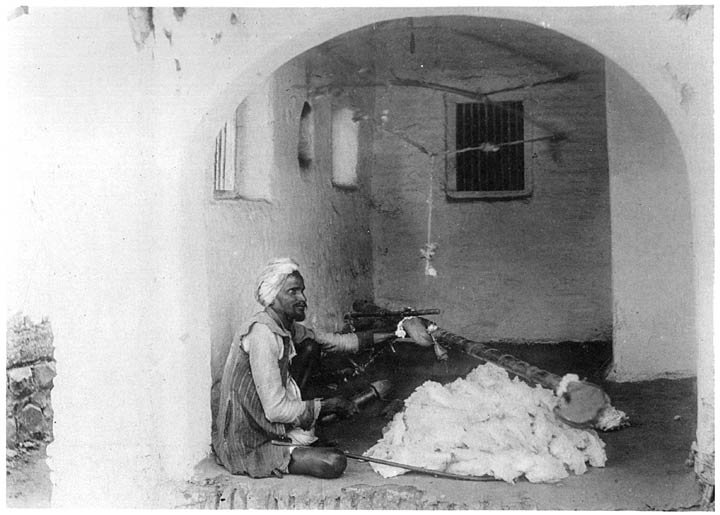
Pinjāra cleaning cotton.
3. Religious and other customs.
The Bahnas venerate Muhammad, and also worship the tombs of Muhammadan saints or Pīrs. A green sheet or cloth is spread over the tomb and a lamp is kept burning by it, while offerings of incense and flowers are made. When the new cotton crop has been gathered they lay some new cotton by their bow and mallet and make an offering of malīda or cakes of flour and sugar to it. They believe that two angels, one good and one bad, are perched continually on the shoulders of every man to record his good and evil deeds. And when an eclipse occurs they say that the sun and moon have gone behind a pinnacle or tower of the heavens. For exorcising evil spirits they write texts of the Korān on paper and burn them before the sufferer. The caste bury the dead with the feet pointing to the south. On the way to the grave each one of the mourners places his shoulder under the bier for a time, partaking of the impurity communicated by it. Incense is burnt daily in the name of a deceased person for forty days after his death, with the object probably of preventing his ghost from returning to haunt the house. Muhammadan beggars are fed on the tenth day. Similarly, after the birth of a child a woman is unclean for forty days, and cannot cook for her husband during that period. A child’s hair is cut for the first time on the tenth or twelfth day after birth, this being known as Jhālar. Some parents leave a lock of hair to grow on the head in the name of the famous saint Sheikh Farīd, thinking that they will thus ensure a long life for the child. It is probably in reality a way of preserving the Hindu choti or scalp-lock.
4. Occupation.
5. Proverbs about Bahnas.
Various sayings show that the Bahna is not considered a proper Muhammadan, as
Turuk to Turuk Aur Bahna Turuk,
or ‘A Muhammadan (Turk) is a Muhammadan and the Bahna is also a Muhammadan’; and again—
Muhammad se dūr, Dīn se niyāra,
or ‘The Kachera and Pinjāra are lost to Muhammad and far from the faith’; and again—
Adho Hindu adho Musalmān Tinkhon kahen Dhunak Pathān,
or ‘Half a Hindu and half a Muhammadan, that is he who is a Dhunak Pathān.’ They have a grotesque imitation of the Muhammadan rite of halāl, or causing an animal’s blood to flow on to the ground with the repetition of the kalma or invocation; thus it is said that when a Bahna is about to kill a fowl he addresses it somewhat as follows:
Kāhe karkarāt hai? Kāhe barbarāt hai? Kāhe jai jai logon ka dāna khāt hāi? Tor kiāmat mor niāmat, Bismillāh hai tuch,
or “Why do you cackle? Why do you crow? Why do you eat other people’s grain? Your death is my feast; I touch you in the name of God.” And saying this he puts a knife to the fowl’s throat. The vernacular verse is a good imitation of the cackling of a fowl. And again, they slice off the top of an egg as if they were killing an animal and repeat the formula, “White dome, full of moisture, I know not if there is a male or female within; in the name of God I kill you.” A person whose memory is not good enough to retain these texts will take a knife and proceed to one who knows them. Such a man will repeat the texts over the knife, blowing on it as he does so, and the Bahna considers that the knife has been sanctified and retains its virtue for a week. Others do not think this necessary, but have a special knife, which having once been consecrated is always kept for killing animals, and descends as an heirloom in the family, the use of this sacred knife being considered to make the repetition of the kalma unnecessary. These customs are, however, practised only by the ignorant members of the caste in Raipur and Bilāspur, and are unknown in the more civilised tracts, where the Bahnas are rapidly conforming to ordinary Muhammadan usage. Such primitive Bahnas perform their marriages by walking round the sacred post, keep the Hindu festivals, and feed Brāhmans on the tenth day after a death. They have a priest whom they call their Kāzi, but elect him themselves. In some places when a Bahna goes to the well to draw water he first washes the parapet of the well to make it ceremonially clean, and then draws his water. This custom can only be compared with that of the Rāj-Gonds who wash the firewood with which they are about to cook their food, in order to make it more pure. Respectable Muhammadans naturally look down on the Bahnas, and they retaliate by refusing to take food or water from any Muhammadan who is not a Bahna. By such strictness the more ignorant think that they will enhance their ceremonial purity and hence their social consideration; but the intelligent members of the caste know better and are glad to improve themselves by learning from educated Muhammadans. The other menial artisan castes among the Muhammadans have similar ideas, and it is reported that a Rangrez boy who took food in the house of one of the highest Muhammadan officers of Government in the Province was temporarily put out of caste. Another saying about the Bahnas is—
Sheikhon kī Sheikhi, Pathānon kī tarr, Turkon kī Turkshāhi, Bahnon kī bharrr ...
or ‘Proud as a Sheikh, obstinate as a Pathān, royal as a Turk, buzzing like a Bahna.’ This refers to the noise of the cotton-cleaning bow, the twang of which as it is struck by the club is like a quail flying; and at the same time to the Bahna’s loquacity. Another story is that a Bahna was once going through the forest with his cotton-cleaning bow and club or mallet, when a jackal met him on the path. The jackal was afraid that the Bahna would knock him on the head, so he said, “With thy bow on thy shoulder and thine arrow in thy hand, whither goest thou, O King of Delhi?” The Bahna was exceedingly pleased at this and replied, ‘King of the forest, eater of wild plums, only the great can recognise the great.’ But when the jackal had got to a safe distance he turned round and shouted, “With your cotton-bow on your shoulder and your club in your hand, there you go, you sorry Bahna.” It is said also that although the Bahnas as good Muhammadans wear beards, they do not cultivate them very successfully, and many of them only have a growth of hair below the chin and none on the under-lip, in the fashion known as a goat’s beard. This kind of beard is thus proverbially described as ‘Bahna kaisi dārhi’ or ‘A Bahna’s beard.’ It may be repeated in conclusion that much of the ridicule attaching to the Bahnas arises simply from the fact that they follow what is considered a feminine occupation, and the remainder because in their ignorance they parody the rites of Islām. It may seem ill-natured to record the sayings in which they are lampooned, but the Bahnas cannot read English, and these have an interest as specimens of popular wit.