Volume 2 / Part 2 — Bhīl
Reading edition
List of Paragraphs
1. General notice. The Bhīls a Kolarian tribe.
2. Rājpūts deriving their title to the land from the Bhīls.
3. Historical notice.
4. General Outram and the Khāndesh Bhīl Corps.
5. Subdivisions.
6. Exogamy and marriage customs.
7. Widow—marriage, divorce and polygamy.
8. Religion.
9. Witchcraft and amulets.
10. Funeral rites.
11. Social customs.
12. Appearance and characteristics.
13. Occupation.
14. Language.
1. General notice. The Bhīls a Kolarian tribe.
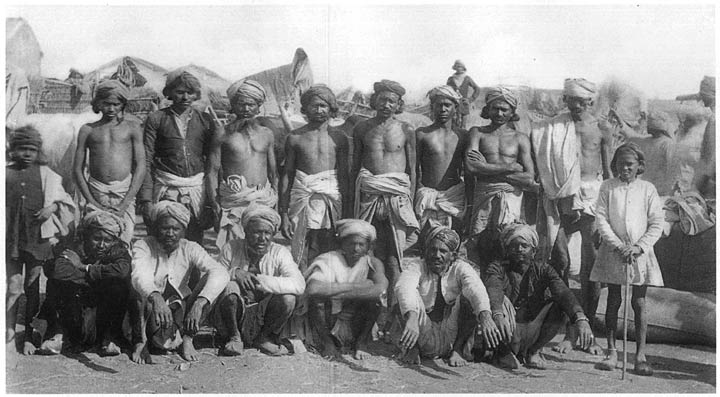
Group of Bhīls.
2. Rājpūts deriving their title to the land from the Bhīls.
3. Historical notice.
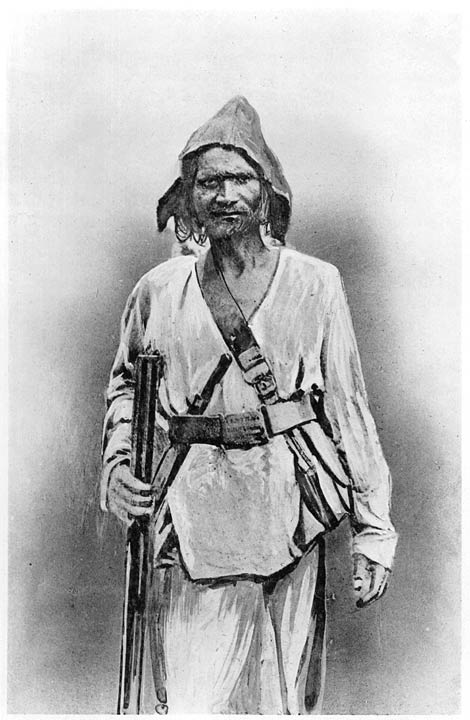
Tantia Bhīl, a famous dacoit.
4. General Outram and the Khāndesh Bhīl Corps.
5. Subdivisions.
6. Exogamy and marriage customs.
7. Widow—marriage, divorce and polygamy.
The remarriage of widows is permitted, but the widow may not marry any relative of her first husband. She returns to her father’s house, and on her remarriage they obtain a bride-price of Rs. 40 or 50, a quarter of which goes in a feast to the tribesmen. The wedding of a widow is held on the Amāwas or last day of the dark fortnight of the month, or on a Sunday. A wife may be divorced for adultery without consulting the panchāyat. It is said that a wife cannot otherwise be divorced on any account, nor can a woman divorce her husband, but she may desert him and go and live with a man. In this case all that is necessary is that the second husband should repay to the first as compensation the amount expended by the latter on his marriage with the woman. Polygamy is permitted, and a second wife is sometimes taken in order to obtain children, but this number is seldom if ever exceeded. It is stated that the Bhīl married women are generally chaste and faithful to their husbands, and any attempt to tamper with their virtue on the part of an outsider is strongly resented by the man.
8. Religion.
9. Witchcraft and amulets.
10. Funeral rites.
The dead are usually buried lying on the back, with the head pointing to the south. Cooked food is placed on the bier and deposited on the ground half-way to the cemetery. On return each family of the sept brings a wheaten cake to the mourners and these are eaten. On the third day they place on the grave a thick cake of wheaten flour, water in an earthen pot and tobacco or any other stimulant which the deceased was in the habit of using in his life.
11. Social customs.
The Hindu Bhīls say that they do not admit outsiders into the caste, but the Muhammadans will admit a man of any but the impure castes. The neophyte must be shaved and circumcised, and the Kāzi gives him some holy water to drink and teaches him the profession of belief in Islām. If a man is not circumcised, the Tadvi or Muhammadan Bhīls will not bury his body. Both classes of Bhīls employ Brāhmans at their ceremonies. The tribe eat almost all kinds of flesh and drink liquor, but the Hindus now abjure beef and the Muhammadans pork. Some Bhīls now refuse to take the skins off dead cattle, but others will do so. The Bhīls will take food from any caste except the impure ones, and none except these castes will now take food from them. Temporary or permanent exclusion from caste is imposed for the same offences as among the Hindus.