THE DICTIONARY OF GARDENING,
Reading edition
An Encyclopædia of Horticulture.
The following are the Abbreviations used:—fl. flowers; fr. fruit; l. leaves; h. height; deg. degrees; rhiz. rhizomes; cau. caudex; sti. stipes.
The Asterisks (*) indicate plants that are especially good or distinct.
A. In compound words from the Greek the initial a has usually a privative meaning; as aphyllus, without leaves; acaulis, without a stem, &c.
AARON'S BEARD. See Hypericum calycinum and Saxifraga sarmentosa.
AARON'S ROD. See Verbascum Thapsus.
ABELE TREE. White Poplar. See Populus alba.
ABELIA (named after Dr. Clarke Abel, Physician to Lord Amherst's Embassy to China, in 1817, and author of a "Narrative of a Journey to China" (1818); died 1826). ORD. Caprifoliaceæ. Very ornamental shrubs. Corolla tubular, funnel-shaped, five-lobed. Leaves petiolate, dentately crenated. Well suited for the cold greenhouse, either as trellis or pot plants; free-flowering when well grown, and of easy culture. May be treated in sheltered and warm climates as hardy; and can be grown out of doors during summer in less favoured spots. They thrive in a compost of peat and loam in equal parts, to which a small quantity of silver sand may be added. Increased by cuttings in summer, and by layers in spring, under a frame. Only two species, floribunda and rupestris, are much grown in England.
A. floribunda (many-flowered).* fl. rosy-purple, about 2in. long, in axillary clusters. March. l. opposite, oblong. h. 3ft. Mexico, 1842. The best and freest flowering evergreen species.
A. rupestris (rock).* fl. sweet-scented, small, pink, in pairs at the ends of the branches; sepals of leafy texture, with a reddish tinge. September. l. small, oblong. h. 5ft. China, 1844. A deciduous, branching, hairy shrub.
A. serrata (serrate-leaved). fl. pretty pale red, sweet-scented, very large, in one-flowered terminal peduncles; sepals leafy. March. h. 3ft. China, 1844. A fine evergreen species.
A. triflora (three-flowered).* fl. pale yellow, tinged with pink, small, arranged in threes at the ends of the branches; sepals long and linear, clothed with long hairs. September. l. small, lanceolate. h. 5ft. Hindostan, 1847. A small evergreen branching shrub.
ABERRANT. Deviating from the natural or direct way; applied, in natural history, to species or genera that deviate from the usual characters of their allies.
ABIES (from abeo, to rise; alluding to the aspiring habit of growth of the tree; or, according to some, from apios, a Pear-tree, in allusion to the form of the fruit). Spruce Fir. The synonymy of this genus is much confused, plants belonging to several genera being frequently referred to Abies in nurserymen's catalogues and gardening periodicals. ORD. Coniferæ. A genus of about twenty-five species, widely distributed over the mountainous regions of the Northern hemisphere. Cones cylindrical, or but slightly tapering, erect; catkins generally solitary; the carpels not thickened at the tip; and the leaves solitary, partially scattered in insertion, and more or less two-ranked in direction. Scales deciduous, falling off as soon as the seed is ripe, leaving the axis on the tree. All the species bear seeds at a comparatively early age; most are hardy. For culture, see Pinus.
A. amabilis (lovely).* shoots rather rigid, furrowed with elongated cushions, covered with numerous small dark hairs. l. scattered, crowded, 1½in. to 2in. long; linear obtuse, dark green above, silvery beneath. The cones are described as cylindrical, and about 6in. long. h. 180ft. California, 1831. A magnificent conifer, very massive in appearance.
A. baborensis.* l. linear, dark green, silvery on the under surface, very numerous, those of the larger branches shortly pointed, and those of the branchlets more obtuse and pointless, ½in. to 1in. long. cones erect, cylindrical, usually in clusters of four or five, 5in. to 8in. long, and about 2in. in diameter; scales reniform, greyish-brown, inclosing a thin, dry, and shrivelled bract. h. 40ft. to 60ft. Algiers, 1864. This is a very beautiful medium-sized tree. SYN. A. Numidica.
A. balsamea (Balm of Gilead or Balsam Fir).* l. silvery beneath, apex emarginate or entire, somewhat recurved and spreading, ¾in. long. cones cylindrical, violet-coloured, pointing upwards, 4in. to 5in. long, and ½in. broad; scales ¾in. broad, and the same in length. h. 40ft. to 60ft. United States and Canada, &c., 1696. A medium-sized slender tree.
A. bifida (bifid). Identical with A. firma.
A. brachyphylla (short-leaved).* l. linear, spirally inserted round the branchlets, but pointing laterally in two directions, ¾in. to 1½in. in length; lower ones longest, obtusely pointed or emarginate, bright green above, with two silvery lines beneath. cones 3in. to 4in. long, purple. h. 120ft. Japan, 1870. A recently introduced magnificent fir, with an erect stem, regularly whorled horizontal branches.
A. bracteata (bracted).* l. rigid, linear, flat, distichous, 2in. to 3in. long, bright glossy green above, and glaucous beneath. cones about 4in. long, with the bracts developed into long rigid leaf-like linear spines, 2in. long, and slightly curved inwards. h. 25ft. Southern California, 1853. A very handsome tall slender tree, but, owing to its very early growth of new shoots, it is much injured by the spring frosts.
A. Brunoniana (Brown's). Synonymous with Tsuga Brunoniana.
A. canadensis (Canadian). A synonym of Tsuga canadensis.
A. cephalonica (Cephalonian).* l. subulate, flat, dark green above, and silvery beneath, acute. cones erect, cylindrical, green when young, afterwards reddish, and brown when ripe, 5in. to 6in. in length, and about 1½in. in diameter; scales broad, thin, and rounded, shorter than the bracts. h. 50ft. to 60ft. Mountains of Greece, 1824. A very desirable tree for growing in exposed situations.
A. cilicica (Cilician). l. linear, slightly curved or straight, 1in. to 1½in. long, dark green above, and glaucous beneath, crowded, in two ranks. cones cylindrical, 6in. to 8in. long; scales broad, thin, entire, coriaceous. h. 40ft. to 60ft. Mount Taurus, in Asia Minor. This species seldom produces a good specimen tree in England, and cannot, therefore, be recommended for general cultivation.
A. concolor (one-coloured).* l. linear, flat, obtuse, glaucous green, distichously arranged in double rows, those in the lower rows 2in. to 3in. long, upper ones shorter, channelled above. cones cylindrical, obtuse both at base and top, 3in. to 5in. long, 2in. to 2½in. in diameter; scales numerous, imbricated, larger than the bracts. h. 80ft. to 150ft. California, &c., 1851. A very beautiful species, with yellow bark on the young branches. SYNS. A. lasiocarpa and A. Parsonii.
A. Douglasii (Douglas'). A synonym of Pseudotsuga Douglasii.
A. dumosa (short-leaved). Synonymous with Tsuga Brunoniana.
A. excelsa (tall). A synonym of Picea excelsa.
A. firma (solid).* l. rigid, coriaceous, spirally arranged around the branchlets, but point laterally in two directions, 1in. to 1¼in. long, very variable in young and old trees. cones cylindrical, obtuse at both ends, 3in. to 6in. long; scales imbricated, bearing protruding keeled bracts. h. 100ft. Japan, 1861. An erect tree, of great beauty.
A. Fortunei (Fortune's). It is said that in its native country, its aspect is peculiar rather than handsome, and that but one living representative is believed to be in existence in this country—at Veitch's Nursery. SYN. Keteleeria Fortunei.
A. Fraseri (Fraser's). Double Balsam Spruce Fir. l. linear, emarginate, silvery beneath. cones oblong, squarrose, somewhat leafy, obcordate, mucronate, half exserted, reflexed. h. 30ft. to 40ft. North Carolina, 1811. This species closely resembles A. balsamea, from which it differs in having shorter and more erect leaves, and smaller cones.
A. grandis (splendid).* l. in double rows, on each side of the branchlets, flat, obtuse, emarginate, pectinate, silvery beneath, from ¾in. to 1in. long. cones lateral, solitary, cylindrical, obtuse at base and apex, 4in. to. 5in. long, 2in. wide; bracts ovate, acuminate, irregularly dentate, very short. h. 100ft. California, 1831. A handsome tree of symmetrical habit, and rapid growth.
A. lasiocarpa (woolly-coned). Synonymous with A. concolor.
A. magnifica (magnificent).* l. densely crowded, two-rowed, 1in. to nearly 2in. long, olive green, very glaucous on the upper surface when young, becoming duller with age, and marked with two silvery lines beneath. cones 6in. to 7in. long, 2½in. to 3in. in diameter; scales, outer edge incurved. h. 200ft. North California, 1851. A very tall and stately species, with, at successive intervals, whorls of horizontal branches.
A. Mariesii (Maries'). l. erect, evenly disposed around the stem, linear-oblong, obtuse; apex notched, ⅓in. to not quite 1in. long; bracts ovate, oblong, retuse. cones erect, cylindrical, 3½in. to 5½in. long, 1½in. to 2in. wide, narrowed at the base and apex, blackish purple; scales entire, nearly 1in. wide, not quite so long as wide. Japan, 1879. A tall, pyramidal tree.
A. Mertensiana (Merten's). Synonymous with Tsuga Mertensiana.
A. miniata (vermilion). Synonymous with Picea eremita.
A. Morinda (Morinda). Synonymous with Picea Morinda.
A. nobilis (noble).* l. linear, mostly on one side of the branches, falcate, short, acute, silvery beneath, 1¾in. long. cones cylindrical, erect, sessile, 6½in. long, 2¾in. broad, brownish; scales triangular, without the bractea, 1¼in. long, and the same in breadth; bractea spathulate, imbricated backwards, ⅝in. long. h. 200ft. to 300ft. California, 1831. A majestic tree.
A. Nordmanniana (Nordmann's).* l. linear, rigid, flat, and minutely bifid at the apex, on young trees spreading in two rows, with a half-twist at the base, 1in. long. cones erect, slightly ovoid, pedunculate, 4in. to 6in. long, and 2¼in. to 2¾in. wide; bracts large, coriaceous, three-lobed, fringed, greatly exceeding the scales. h. 80ft. to 100ft. Crimea, &c., 1848. A magnificent and stately tree, of regular growth.
A. Numidica (Numidian). Synonymous with A. baborensis.
A. obovata (reversed-egg-coned). A synonym of Picea obovata.
A. orientalis (eastern). Synonymous with Picea orientalis.
A. Parsonii (Parson's). Synonymous with A. concolor.
A. pectinata (comb-like).* l. linear, solitary, flat, obtuse, stiff, turned-up at the points, two-ranked, ½in. to 1in. long, shining green above, with two lines of silvery white on each side of the midrib beneath. cones axillary, cylindrical, erect, 6in. to 8in. long, 1½in. to 2in. broad, when ripe, brown; scales with a long dorsal bractea, 1/6in. to 1¼in. long, and 1¼in. broad. h. 80ft. to 100ft. A very noble silver fir, of slow growth when young only. Central Europe, 1603. There are several unimportant varieties of this splendid species.
A. Pindrow (Pindrow). In its native home, the Himalayas, this is a very beautiful tree, attaining the height of 150ft., but it has generally failed in England, in consequence of our late spring frosts destroying the young growth. It comes very near A. Webbiana, but is readily distinguished by its longer and more acutely bidented leaves, and smaller cones.
A. Pinsapo (Pinsapo).* The Spanish Silver Fir. l. linear, disposed around the branches, nearly terete, and entire at the apex, not quite ½in. long, bright green, with faint silvery lines on the inner side. cones sessile, oval, or oblong, 4in. to 5½in. long, about 2in. wide; bracts short, concealed by the broad rounded scales. h. 60ft. to 80ft. South Spain, 1839. A very magnificent species, very regular and symmetrical in habit. The one or two varieties offered for sale are not desirable.
A. polita (neat).* l. arranged spirally, short, erect, rigid, falcate, acute at the apex, tetragonal, but compressed. cones ellipsoid, 3in. to 4in. long; scales light brown, coriaceous, minutely notched at the edge. Island of Nippon, 1861. This is a beautiful species, admirably adapted as a specimen tree for lawns.
A. religiosa (sacred). l. linear, acute, quite entire, 1½in. long. cones roundish-oval, 2¾in. long, and 2½in. broad; scales trapezoided-cordate; bracts the length of the scapes, spathulate-oblong. h. 100ft. to 150ft. Mexico, 1839. A very handsome species, but not hardy in this country.
A. sachalinensis (Sachalin). l. in many rows, 1in. or very slightly more long, ¹/₁₂in. broad, twisted to one side, rigid, linear, obtuse. cones sessile, erect, cylindrical, bluntly rounded at the apex, 3in. long, 1in. wide; scales transversely oblong, reniform; margin inflexed, denticulate; bracts ½in. wide, ¼in. long, obovate, serrulate, terminating in a reflexed angular point, exceeding the scale. Japan, 1879. A tall pyramidal robust species.
A. Schrenkiana (Schrenk's). Synonymous with Picea Schrenkiana.
A. sibirica (Siberian). Like the last, this species is not recommended; its growth is very slow, even under the most favourable circumstances. Siberia.
A. Smithiana (Smith's). A synonym of Picea Morinda.
A. subalpina (sub-alpine).* On the high mountains of Colorado, &c., a tree 60ft. to 100ft. in height. Has not been long enough in English gardens for any decided opinion to be formed as to its merits as an ornamental tree.
A. Tsuga (Tsugan). A synonym of Tsuga Sieboldi.
A. Veitchii (Veitch's).* l. crowded, lateral ones spreading in a distichous manner, those on the upper side much shorter and pointing forwards, ½in. to 1in. long, linear, flat, glaucous above, silvery beneath; emarginate on the sterile branches, entire on the fertile ones. cones erect, sub-cylindrical, purplish-brown, 2in. to 2½in. long, ¾in. to nearly 1in. wide; scales horizontal, reniform, densely packed, each enclosing a short, wedge-shaped bract as long as the scale. h. 120ft. to 140ft. Japan, 1860, and again in 1879. Described as a beautiful and interesting tree, as well as perfectly hardy; it should be planted on elevated spots open to the south or south-east.
A. Webbiana (Webb's).* l. two-rowed, linear, flat, obtusely emarginate, silvery beneath, 1½in. to 2½in. long. cones cylindrical, 6½in. to 7in. long, 2in. or more broad, deep purple; scales kidney-shaped, roundish, closely compressed, imbricated, about 1in. long, and 1¼in. broad; bracts oblong, apiculate. h. 70ft. to 90ft. Himalayan Mountains, 1822. A large handsome pyramidal tree, with numerous branches spreading horizontally, much divided, and densely clothed.
A. Williamsoni (Williamson's). A synonym of Tsuga Pattoniana.
ABOBRA (its Brazilian name). ORD. Cucurbitaceæ. A genus of stove or greenhouse plants, having solitary axillary diœcious flowers, and finely divided leaves. The only species in cultivation is a very pretty half-hardy climbing perennial, having a fleshy root about 1ft. or more beneath the surface of the soil. It thrives well in warm sunny spots, and in a light soil; seeds may be sown in pots or pans of light soil early in April; the young plants can be planted out about the middle of June. The fleshy tuberous roots may be stored during winter in a greenhouse or frame. See also Gourds.
A. viridiflora (green-flowered). fl. pale green, fragrant; females succeeded by small oval scarlet fruits, which are about as large as a filbert. l. dark green, glossy, much divided into narrow segments. South America. A rapid growing plant, admirably adapted for training over arbours or trellis-work. It is a very pretty form of ornamental gourd.
ABORTION. An imperfect formation, or the non-formation of an organ; any fruit or produce that does not come to maturity, or anything which fails in its progress before it is matured, frequently from a defect in the male or female flowers.
ABRAXAS GROSSULARIATA. See Gooseberry or Magpie Moth.
ABRICOCK. A former mode of writing Apricot.
ABROMA (from a, not, and broma, food; from its unwholesomeness). ORD. Sterculiaceæ. Handsome, free-flowering evergreen trees, with hairy lobed leaves, and extra axillary or terminal few-flowered peduncles. Of easy culture, in a stove temperature, in loam and peat soil. Propagated by seeds or cuttings, the former sown in March, the latter made in April from half-ripened wood, and placed under a bell glass.
A. augusta (smooth-stalked).* fl. dingy purple, drooping. August. l. lower, cordate, three to five lobed; upper, ovate-lanceolate, undivided. h. 10ft. East India, 1770.
A. fastuosa (prickly-stalked). fl. dark purple. June. l. lower, cordate, acutely five lobed; upper, ovate, entire. h. 10ft. New Holland, 1800.
ABRONIA (from abros, delicate; referring to its involucrum). Sand Verbena. ORD. Nyctaginaceæ. A small genus of seven species, mostly natives of California, four of which only are known in general cultivation. They are of a dwarf trailing habit, producing showy blossoms in dense verbena-like clusters. Corolla funnel-shaped; limb spreading. They succeed best in light sandy soil, in a position fully exposed; if well drained, the rockery is perhaps the best place. Increased by seeds, the outer skin of which should be peeled off before sowing; sow during autumn in pots of sandy soil, and keep in a frame until the following spring, when they may be placed in their flowering quarters; or by young cuttings, set in spring, and also in sandy soil.
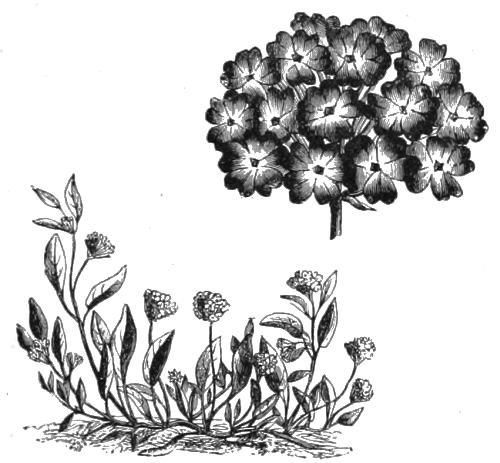
FIG. 1. ABRONIA UMBELLATA, showing Flower and Habit.
A. arenaria (sand-loving).* fl. lemon-yellow, about ½in. long, in dense clusters, with a honey-like fragrance. July. l. broadly ovate, or reniform, on short, thick petioles. h. 9in. to 18in. 1865. Half-hardy perennial. SYN. A. latifolia.
A. fragrans (fragrant).* fl. pure white, in terminal and axillary clusters, very delicately perfumed, expanding in the evening. May. 1865. A perennial, more or less erect in growth, forming large branching tufts from 1ft. to 2ft. high. Imported seeds only of this species will grow.
A. latifolia (broad-leaved). A synonym of A. arenaria.
A. pulchella (pretty). fl. pink. July. h. 6in. 1848.
A. rosea (rose-coloured). fl. rose-coloured. June. h. 6in. 1847. An unimportant species.
A. umbellata (umbel-flowered).* fl. rosy pink, in dense terminal clusters, slightly scented. April. l. oval or oblong. h. 6in. to 24in. 1823. An elegant prostrate half-hardy annual; but under greenhouse culture it is a perennial. SYN. Tricratus admirabilis. See Fig 1.
ABRUPT. Suddenly terminating, as abruptly pinnate; when pinnate leaves are without a terminal or odd leaflet.
ABRUS (from abros, soft, in reference to the extreme softness of the leaves). ORD. Leguminosæ. A very ornamental and delicate much branched deciduous stove climber, whose roots have the virtues of the common liquorice. Leaves abruptly pinnate, bearing many pairs of leaflets. Requires a strong heat to keep it in a growing, healthy condition, and to flower it well; and thrives best in sandy loam. Increased by cuttings under a hand glass, in sand, or seeds raised in heat.
A. precatorius (prayer). fl. pale purple, butterfly-shaped, disposed in axillary clusters. Seeds bright scarlet, with a black spot at the base, used by the Buddhists for making rosaries, whence the specific name. March to May. l. leaflets ligulate, oblong. h. 12ft. East Indies, 1680. Varieties are now and then met with having rose coloured or white flowers.
ABSORPTION. The action by which liquids and gases become incorporated with various bodies, through molecular or other invisible means, to which function all parts of a growing plant contribute, the roots more especially.
ABUTA (native name). ORD. Menispermaceæ. A strong growing ornamental stove evergreen climber. Used medicinally in Cayenne. Flowers diœcious, fascicled, males racemosely panicled; females loose and simply racemose. It grows freely in a mixture of loam and peat. Cuttings will root readily if planted in a pot of sand, with a hand glass placed over them, in heat. About half-a-dozen species are known.
A. rufescens (rusty-coloured). fl. grey-velvety on the outside, dark purple on the inside. March. l. ovate; under surface brownish. h. 10ft. Cayenne, 1820.
ABUTILON (Arabic name for a plant analogous to the Marsh Mallow). ORD. Malvaceæ. Very showy, decorative, and free-growing shrubs, both for the greenhouse and outside culture. Calyx naked, five-cleft, usually angular; style multifid at apex. The many beautiful hybrids (of which Fig. 2 represents a group) now in cultivation, far supersede the true species. Cultivation: Few plants are more easily grown and worthy of liberal treatment than these. The best soil for them is equal parts turfy loam, peat, and leaf mould, with some gritty sand. They may either be grown in pots, or planted out; but in all cases thorough drainage is indispensable, as they require an abundance of water, and stagnancy must be guarded against. At the end of May they may be planted outside, when they will flower profusely through the summer. In a free growing and flowering state they enjoy weak manure water. From the latter part of autumn till early spring they may be kept almost dry without injury, though in a warm conservatory some of the later struck plants will go on flowering throughout the greater part of the winter; or plants may be specially prepared for winter flowering. They are admirably adapted for forming standards of various heights, from 2ft. to 6ft. Some of the taller sorts are very useful for training under roof rafters. As pillar plants, too, very loosely trained, so as to allow the upper and side branches to droop to a considerable distance from the pillar, they are very effective. Propagation: They strike readily from cuttings made of the young wood, at almost any season; the best time, however, is early spring and September. Inserted in pots, in a compost of equal parts peat, leaf mould, loam, and sand, and placed in a temperature of from 65deg. to 70deg., they will then quickly root, and form good plants. Seeds may be sown in pans filled with soil as recommended for cuttings, and placed in a similar temperature. Those followed by a dagger (†) are the best for training to pillars, roofs, &c.
A. Bedfordianum (Bedford's). fl. yellow and red. November. l. deeply-lobed. h. 15ft. Brazil, 1838.
A. Darwini (Darwin's).†* fl. bright orange, with darker veinings, fine cupped form. April. l. large, broad. h. 4ft. Brazil, 1871. A handsome species, of good habit, equally suitable as a stove or greenhouse plant during winter, and for outdoor culture during summer months. There are a great number of garden hybrids from this.
A. globiflorum (globe-flowered). fl. solitary, large, globose, cream-coloured. November. l. on long stalks, cordate, serrate. h. 4ft. to 5ft. Mauritius, 1825.
A. igneum (bright). Synonymous with A. insigne.
A. insigne (handsome-flowered).* fl. large, purplish crimson, with dark venation, in axillary pendulous racemes; petals short, broad, much reflexed. Winter. l. large, cordate, thick, rugose. Stem deep green, with short brown hairs. h. 6ft. New Grenada, 1851. SYN. A. igneum. See Fig. 3.
A. megapotamicum (big river).†* fl. small, bell-shaped, singularly beautiful, the sepals being dark red, petals pale yellow, and stamens dark brown. Autumn and winter. l. small, pointed. h. 3ft. Rio Grande, 1864. A free-flowering species, with a graceful drooping habit; the shoots should be well pressed in during spring. SYN. A. vexillarium.
A. pæoniflorum (pæony-flowered). fl. pink, smaller than those of A. insigne, but very distinct. January. l. large, ovate. h. 6ft. Brazil, 1845.
A. pulchellum (pretty).†* fl. white, on few-flowered axillary racemes. July. l. cordate, unequally crenated, downy beneath. h. 8ft. Habit very branching. New Holland, 1824.
A. striatum (striped).* fl. orange yellow, with a thick veining of blood-red, on long curving stalks. l. large, lobed, on long slender petioles. Brazil, 1837. A free grower, and makes an excellent greenhouse plant. In sheltered positions, in the south-west of England, this species proves to be almost hardy. It requires to be freely pinched. A very continuous bloomer.
A. Thompsoni (Thompson's). fl. striated yellow, large. Summer. l. small, vine-like, richly mottled with yellow and dark green. h. 3ft. or 4ft. Habit very neat and erect.
A. venosum (veined).†* fl. orange, with red veins, very large, bell shaped, 3in. long; pedicels nearly 12in. long. July. l. large, deeply palmate. h. 10ft. This splendid species is distinguished by its unusually large flowers.
A. vexillarium (standard). Synonymous with A. megapotamicum.
A. vitifolium (vine-leaved).* fl. porcelain blue, large, cupped. May. l. cordate, five to seven lobed, assuming, towards the autumn, a fine golden hue. h. 30ft. Chili, 1837. This fine shrub, or tree, is hardy in Ireland and the south of England, but should have a protection from frost. It is not a fast grower.
The following are some of the best varieties, which, although they do not include all the newest sorts, yet afford a good selection of first-rate kinds, which will give general satisfaction. They are arranged according to their respective colours. Those marked with a dagger (†) are best for roofs and pillars.
Orange-flowered. AUREUM GLOBOSUM,* flowers deep orange, heavily red shaded, of medium size, with good form and substance; DARWINI MAJUS,* bright orange, deeply veined, extremely free, and of good form and size; FLEUR D'OR,† light orange, veined pale red, very free and dwarf; GRANDIFLORUM,* deep orange, red shaded, deeply veined with red, a robust, large-flowered variety; LEO, flowers pale below, deeper above, red-veined, of medium size; PRINCE OF ORANGE,†* a strong grower, and very free.
Ornamental-foliaged. DARWINI TESSELATUM,†* foliage mottled with yellow, invaluable for sub-tropical bedding; SELLOWIANUM MARMORATUM,* very large maple-like foliage, heavily mottled with bright yellow, a most effective variety; THOMPSONI, leaves very freely blotched with yellow; VEXILLARIUM IGNEUM,†* very free, of good habit, prettily blotched. All these ornamental-foliaged varieties are invaluable for bedding purposes.
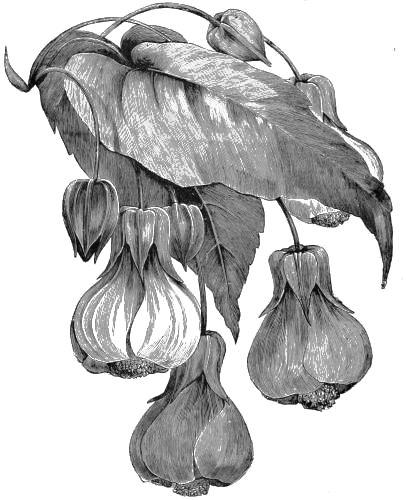
FIG. 2. GROUP OF ABUTILONS.
Purple-coloured. EMPEROR,* flowers large, rich purple magenta shaded, habit vigorous; LOUIS VAN HOUTTE, very free, rosy purple; PURPUREA,* deep purple shaded lake, very attractive; SOUVENIR DE ST. MAURICE, flowers medium size, very profuse; VIOLET QUEEN,* bright violet purple, very distinct and free.
Red and Crimson-flowered. BRILLIANT,* flowers of good form and substance, brilliant red inside, rather paler outside, dwarf and free; CRIMSON BANNER,* rich crimson, dwarf, very floriferous; FIRE KING,* bright red, orange shaded, veined with crimson; LUSTROUS,* brilliant red crimson, large, most profusely produced, habit dwarf; NE PLUS ULTRA,* intense crimson, of excellent form; SCARLET GEM,* flowers medium sized, brilliant scarlet, habit dwarf and free.
Rose-coloured. ADMIRATION, light pink, shaded salmon, of good form and shape; ANNA CROZY,* deep pink, lilac shade, veined white, very showy; CLOCHETTE,* deep rosy pink, with crimson veins, very dwarf and free; DELICATUM, pale salmon rose, with deeper vein, flowers very large; KING OF THE ROSES,* rich deep rose, of good size and substance, habit dwarf and very free; LADY OF THE LAKE,* flowers medium sized, rich pink; LOUIS MARIGNAC, pale pink, veined white, splendid habit, a charming variety; PRINCESS MARIE,†* flowers rich rosy lake, very profuse, of excellent form; ROSÆFLORUM,†* pale salmon rose, veined with crimson.
White-flowered. BOULE DE NIEGE,†* very fine pure white flowers, the best in its class; PURITY,* very free, of good habit, and pure white; SERAPH,* dwarf, and very floriferous.
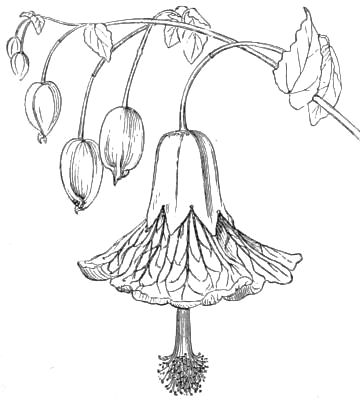
FIG. 3. FLOWER OF ABUTILON INSIGNE.
Yellow-flowered. CANARY BIRD,†* similar in habit to Boule de Niege, bright primrose, very lovely; COURONNE D'OR,* bright yellow, of the finest form and substance, very bold foliage; GOLDEN GEM, rich canary yellow, extremely free, of dwarf habit; LEMOINEI,† very fine, pale yellow, good size; QUEEN OF THE YELLOWS,* very large, lemon yellow, good substance; YELLOW PRINCE,* rich golden yellow, of medium size, very profuse.
ABYSSINIAN PRIMROSE. A common name for Primula Boveana (which see).
ACACIA (from ac, a point, in Celtic; or from akazo, to sharpen; many of the species are furnished with spines). See also Albizzia. ORD. Leguminosæ. Shrubs or trees, very variable in habit and leaves. Flowers yellow, white, rarely red, disposed in globular heads or spikes, decandrous or polyandrous. Spines stipular, scattered, or wanting. This is a very polymorphous genus, and the majority of species described are known in this country only from herbarium specimens. It is very doubtful whether the entire genus is represented in our gardens by more than about fifty species, many of which are only to be found in botanic gardens; but this number is, without doubt, sufficiently characteristic. The number of species is close upon 400, and the genus one of the largest known. In our enumeration, we have strictly confined ourselves to describing such as are unquestionably in cultivation, and to this end we have adopted the only accurate method of deciding which are and which are not grown, viz., by consulting the trade lists of nurserymen, both in this country and on the Continent. Such lists, however, are not always correct, from a scientific point of view, in the matter of nomenclature. The species best deserving of cultivation are all natives of Australia, New South Wales, or other temperate regions, and are among the hardiest and most easily cultivated of all greenhouse plants. They are very floriferous. The greenhouse species are sufficiently hardy to withstand the winter in a temperature very little higher than freezing point. Cultivation: Some have a tendency to make long straight shoots; these should be selected for training upon rafters or pillars, on which they thrive well and form splendid ornaments in spring; whilst the more shrubby kinds will be equally at home in pots in the form of bushes. Roots and tops grow with great rapidity, and an abundance of water is required at all times. Immediately after flowering (usually about May) is the best time to prune Acacias; they may then be placed in the open air, and fully exposed to the sun, until October. They make a far healthier, cleaner growth, and ripen their wood much better outside than under glass; all they require is copious waterings, never allowing them to become dry, and keeping clear of weeds. In the first week in October house the plants, and winter in a temperature of 40deg. to 50deg. They delight in a light rich compost of equal parts turfy loam and leaf mould, freely intermixed with sand, or peat may be used instead of the leaf mould. Propagation: Cuttings of the half-ripened wood, put in with a heel, root readily during the summer. They do not bear heat well, nor do they require it. The soil should be equal parts peat and sand, covered with pure sand, thoroughly consolidated. Insert the cuttings as soon as made; water home, and leave them in the shade till dry. Then place the bell glasses over them, shade and water so as to prevent flagging. Pot off as soon as rooted, and keep in a close pit or house until the plants are thoroughly established. Seeds should be sown as soon as ripe, in sandy peat; about ¼in. deep, or a little more, for large seeds. A temperature of 55deg. to 60deg. suits them well. Pot off when large enough to handle, and place in a cool close pit or house until quite established. The culture and propagation of the stove species are the same as for the greenhouse sorts, but the former require, of course, greater heat. Their flowers, however, are much less frequently produced than their more temperate congeners, consequently they are not so much grown.
A. affinis.* fl. yellow. May. h. 5ft. New Holland, 1822. Greenhouse species.
A. albicans (whitish).* fl. white; heads, two to five, aggregate, rising in racemes from the axils to the leaves. l. with eight to nine pairs of pinnæ, each pinna bearing nineteen to twenty-two pairs of oblong linear-leaflets. h. 5ft. Swan River.
A. amœna (pleasing). This closely resembles A. heterophylla.
A. angustifolia (narrow-leaved). fl. yellow, in heads two to four together, pedunculate. April. l. with fifteen to twenty pairs of pinnæ, each pinna bearing thirty to forty pairs of linear-acute, ciliated leaflets. h. 4ft. New South Wales, 1816. One of the numerous varieties of A. longifolia.
A. arabica (Arabian).* Gum Arabic. fl. white; heads pedunculate, axillary, usually in threes. l. with four to six pairs of pinnæ, each pinna bearing ten to twenty pairs of oblong-linear leaflets. h. 20ft. Arabia, East Indies, &c., 1820. Greenhouse species. See Fig. 4.
A. argyrophylla (silver-leaved). A synonym of A. brachybotrya.
A. armata (armed, simple leaved).* fl. yellow, in solitary globular heads. April. l. phyllodia obliquely ovate-oblong, quite entire, one-nerved. h. 6ft. to 10ft. Australia, 1803.
A. Benthami (Bentham's). A synonym of A. cochlearis.
A. brachybotrya (short-bunched).* fl. yellow, in axillary stalked globular heads. April. l. phyllodia silvery silky, obliquely obovate, or oblong. h. 8ft. Swan River. SYN. A. argyrophylla.
A. Catechu (catechu). fl. yellow; spikes cylindrical, solitary, twin, or tern, axillary. March. l. with ten pairs of pinnæ, each of which bears forty to fifty pairs of linear pubescent leaflets. h. 20ft. to 40ft. East Indies, 1790.
A. cavenia (Cavenia).* fl. yellow, disposed in globose heads, peduncles, axillary, aggregate. l. with usually about five pairs of pinnæ, each of which bears nine to ten pairs of linear-oblong leaflets, clothed with scabrous pubescence. h. 20ft. Chili. Greenhouse species.
A. cochlearis (spoon-leaved). fl. yellow, in solitary globular heads. April. l. phyllodia linear lanceolate, many-nerved at the base, quite entire, mucronate. h. 4ft. West Australia, 1818. SYN. A. Benthami.
A. cultriformis (knife-formed).* fl. yellow, in crowded heads, disposed in either axillary or terminal racemes. April. l. phyllodia eight to ten lines long, four lines broad, cultriform, ending in an acute hooked point, which bears to one side. h. 4ft. New South Wales, 1820.
A. cuneata (wedge-shaped).* fl. yellow. April. Swan River, 1837. Greenhouse species.
A. cyanophylla (blue-leaved). fl. yellow; racemes axillary; heads globose. March. l. phyllodia lanceolate, often 1ft. long, glaucous green, almost blue; branches drooping. h. 18ft. Swan River, 1838. Arboreous.
A. dealbata (whitened).* The Silver Wattle. fl. yellow, in pedicellate heads, disposed in racemes along the axillary branches. July. l. from ten to twenty pairs of pinnæ, each of which bears thirty to thirty-five pairs of linear, much crowded pubescent leaflets. h. 10ft. to 20ft. Australia and Tasmania, 1820.
A. diffusa (spreading). fl. yellow, in globular heads, which are usually twin. May. l. phyllodia linear, one-nerved, ending in an oblique acumen; branches diffusely procumbent, angular. h. 2ft. Victoria and Tasmania, 1814.
A. Drummondi (Drummond's).* fl. pale lemon; spikes axillary, drooping, cylindrical, simple. April. l. with two pairs of pinnæ, each pinna bearing two to three pairs of linear obtuse leaflets. Plant unarmed, silky. h. 10ft. Swan River. Very handsome and one of the best grown, forming a somewhat dwarf shrub.
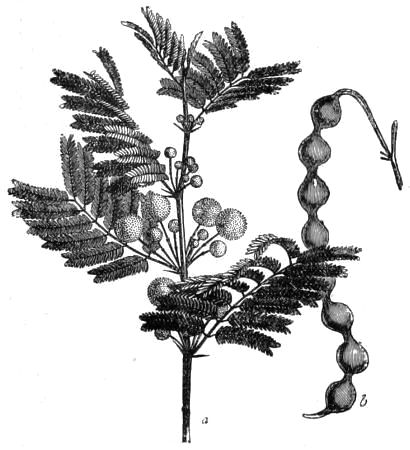
FIG. 4. ACACIA ARABICA (a) Flowering Branch, (b) Seed-pod.
A. Farnesiana (Farnesian). fl. yellow, sweet-scented, disposed in axillary, usually twin, unequally pedunculate heads. July. l. with five to eight pairs of pinnæ, each pinna bearing from fifteen to twenty pairs of linear glabrous leaflets. h. 6ft. to 10ft. St. Domingo, 1656. Greenhouse species.
A. glauca (milky white).* fl. white; spikes globose, stalked, axillary, usually twin. July. l. with four to six pairs of pinnæ, each pinna bearing about twelve to fifteen pairs of linear, distant, acute leaflets, which are glaucous beneath. h. 5ft. to 10ft. South America, 1690.
A. glaucescens (greyish). fl. yellow; spikes twin, but solitary on the peduncles, axillary. June. l. phyllodia linear-lanceolate, attenuated at both ends, falcate, three-nerved. h. 6ft. to 8ft. Queensland, 1822. SYN. A. homomalla.
A. grandis (great).* fl. yellow; heads globular; peduncles solitary or twin, axillary, one-headed. February to May. l. with one pair of pinnæ, each pinna bearing eight to ten pairs of linear-lanceolate leaflets; branches hairy. h. 6ft. West Australia, 1850. A variety of A. pulchella.
A. heterophylla (variable-leaved).* fl. yellow, in heads, disposed in a kind of raceme. May. l. phyllodia linear, attenuated at both ends, many-nerved. h. 5ft. Isle of Bourbon, 1824. A. amœna is very like this.
A. hispidissima (hairiest). A variety of A. pulchella.
A. holosericea (all silky). fl. yellow, in axillary spikes, usually twin. May. l. 6in. long, oblong-lanceolate, ending in a soft point at the apex, three-nerved. h. 10ft. to 20ft. Australia, 1818. The whole aspect of this tree is silky. SYN. A. leucophylla.
A. homomalla (equal-woolled). A synonym of A. glaucescens.
A. Hugelii (Baron Hugel's). fl. pale yellow. February. West Australia, 1846. Greenhouse species.
A. ixiophylla (Ixia-leaved). fl. yellow; heads about twenty-flowered; peduncles downy, shortly racemose or solitary. March. l. narrow, oblong-lanceolate, sub-falcate, obtuse, obliquely mucronate, much branched. h. 2ft. New South Wales, 1844.
A. juniperina (juniper-leaved). fl. yellow, in solitary heads. May. l. linear-subulate, ending in a pungent point; branches terete, pubescent. h. 6ft. Australia and Tasmania, 1790. Greenhouse.
A. Lebbek (Lebbek).* fl. yellow, sweet-scented; heads many-flowered, pedunculate, three or four together, from the crowded upper nodes. May. l. with two to four pairs of pinnæ, each pinna bearing about six to eight pairs of oval, somewhat dimidiate leaflets, which are obtuse at both ends. h. 20ft. East and West Indies, 1823. Stove species.
A. leprosa (leprous). fl. yellow, mostly five-parted, numerous in a globular head; peduncles mostly in pairs or clusters, ¼in. long. May. l. narrow, linear-lanceolate, acute or obtuse with a small callous point, narrowed at base, 1½in. to 3in. long, those of the barren shoots broader. Branchlets pendulous, more or less glutinous. Australia, 1817. (B. R. 1441.)
A. leucophylla (white-leaved). A synonym of A. holosericea.
A. lineata (lined). fl. yellow, mostly five-parted, ten to fifteen or rarely more in a small, globular head; peduncles slender, rarely exceeding the leaves. April. l. linear, with a small hooked point, about ½in., rarely ¾in., long, one-nerved. Branches nearly terete, usually pubescent or villous. h. 6ft. Australia, 1824. (B. M. 3346.)
A. l. longissima (longest). Synonymous with A. longissima.
A. longifolia (long-leaved).* fl. yellow; spikes loose, axillary, cylindrical. March. l. phyllodia linear-lanceolate, narrowed at each end, three-nerved, striated. h. 10ft. Australia, 1792. A fine erect-growing greenhouse species.
A. longissima (longest-leaved). fl. yellow; spikes several, axillary, generally branched. May. l. phyllodia very long, filiform, one-nerved, spreading. h. 4ft. New South Wales, 1819. Stove species. SYN. A. linearis longissima.
A. lunata (half-moon).* fl. yellow; heads disposed in racemes, which are longer than the phyllodia. April. l. phyllodia obliquely oblong, rather falcate, narrowed at the base, terminating in an oblique callous mucrone. h. 2ft. to 4ft. Australia, 1810. Greenhouse species. SYN. A. oleæfolia.
A. melanoxylon (black wooded). fl. yellow; heads few, disposed in a kind of raceme. April. l. phyllodia lanceolate-oblong, rather falcate, obtuse, quite entire, many-nerved. h. 6ft. to 10ft. Australia, 1818. Greenhouse species.
A. mollissima (softest-leaved).* fl. yellow; heads pedicellate, disposed in racemes along the axillary peduncles. July. l. with eight to eighteen pairs of pinnæ, each pinna bearing thirty to forty pairs of linear, much crowded, pubescent leaflets, which are clothed with yellowish velvety down when young; branches and petioles angular. h. 10ft. to 20ft. Van Diemens Land, 1810.
A. oleæfolia (olive-leaved). A synonym of A. lunata.
A. oxycedrus (sharp-cedrus).* fl. yellow; spikes axillary, solitary, elongated. April. l. phyllodia scattered, or somewhat verticillate, lanceolate-linear, ending in a pungent point, three-nerved. h. 6ft. to 10ft. New South Wales, 1823. Greenhouse species.
A. paradoxa (paradoxical). fl. yellow, disposed in solitary heads. March. l. phyllodia obliquely oblong-lanceolate, entire, wavy, one-nerved; branches clammy, glabrous. h. 6ft. New Holland. Greenhouse species.
A. penninervis (feather-nerved). fl. yellow; heads about the size of a pea, racemose. April. l. phyllodia oblong, acuminated at both ends, straight, 2in. to 3in. long, ½in. broad, feather veined. h. 4ft. to 6ft. New Holland, 1824.
A. platyptera (broad-winged).* fl. yellow; heads solitary, on short peduncles. March. l. phyllodia short, bifarious, decurrent, obliquely truncate, mucronate; branches broadly winged. h. 3ft., Swan River, 1840. Greenhouse species.
A. pubescens (downy).* fl. yellow; heads small, globose pedicellate, disposed in racemes along the axillary peduncles. March. l. with three to ten pairs of pinnæ, each pinna bearing six to eighteen pairs of linear glabrous leaflets. h. 6ft. to 10ft. Branches terete, hairy. New Holland, 1790.
A. pulchella (pretty).* fl. yellow; heads solitary. April. l., pinnæ bearing five to seven pairs of oblong-ovate, obtuse leaflets. h. 2ft. to 3ft. New Holland, 1803. Greenhouse species. The variety hispidissima has white flowers.
A. Riceana (Rice's).* fl. pale yellow, in long, solitary, axillary spikes. May. l. linear, in clusters, dark green, scattered or whorled. h. 20ft. Tasmania. Habit graceful, like a weeping willow. Very handsome and distinct. SYN. A. setigera. See Fig. 5.
A. rotundifolia (round-leaved). fl. yellow; heads globose, solitary, on long peduncles. March. l. phyllodia on short petioles, obliquely rounded, obtuse or retuse, mucronate. Branches angular, puberulous. h. 6ft. New Holland, 1842.
A. saligna (willow-like). fl. yellow; heads solitary, on short peduncles. March. l. phyllodia linear, attenuated at both ends, quite entire, almost nerveless. h. 6ft. to 10ft. New Holland, 1818. Greenhouse species.
A. Senegal (Senegal). Gum Senegal. fl. white, small, glabrous, distant; spikes axillary, solitary, slender. l. with five to eight pairs of pinnæ, each pinna bearing fifteen to eighteen pairs of oblong-linear, obtuse, glabrous leaflets; branches white; prickles sometimes wanting. h. 20ft. Arabia, 1823. Stove species.
A. setigera (bristly). Synonymous with A. Riceana.
A. sophoræ (sophora-podded). fl. yellow; spikes usually twin, axillary. May. l. phyllodia obovate, oblong or lanceolate, quite entire, many nerved; sometimes there are bipinnate leaves at the tops of the branches. h. 20ft. New Holland, 1805.
A. sphærocephala (round-headed).* fl. yellow; racemes axillary, usually twin, ovate-roundish. l. with numerous close-set linear falcate pinnules, which are usually tipped by a glandular yellow "food body;" spines twin, hollow. Mexico. A very remarkable stove species, inhabited by ants during certain seasons in its native country.
A. uncinifolia (hook-leaved). fl. yellow; spikes usually twin, dense, on short peduncles, cylindrical. March. l. phyllodia long, linear-subulate, flat, recurved, mucronate, three-nerved; branches angular. h. 6ft. Swan River, 1846.
A. vera (true). Egyptian Thorn; Gum Arabic. fl. white, usually in twin heads, pedunculate, axillary. July. l. with two pairs of pinnæ, each pinna bearing eight to ten pairs of oblong linear leaflets; branches and spines red. h. 20ft. Egypt, 1596.
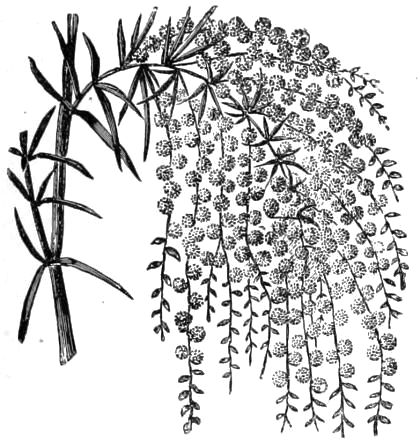
FIG. 5. A FLOWERING BRANCH OF ACACIA RICEANA.
A. verticillata (whorl-leaved).* fl. yellow; spikes axillary, solitary, oblong. March. l. phyllodia linear, ending in a pungent mucrone, disposed somewhat verticillately. h. 6ft. to 10ft. A spreading, prickly, greenhouse species, of variable habit. New Holland, 1780.
A. vestita (clothed).* fl. yellow, in loosely racemose heads, along the peduncles; upper ones solitary. June. l. phyllodia obliquely elliptic-lanceolate, one-nerved, ending in an awnlike mucrone, hispid. h. 4ft. New Holland, 1820.
A. viscidula (clammy).* fl. yellow; heads globular, on short stalks, axillary, solitary or twin. February. l. linear, clammy; branches slender, clammy. h. 6ft., erect. New South Wales, 1844.
ACÆNA (from akaina, a thorn; in allusion to the slender spines on the calyx or fruit). ORD. Rosaceæ. A genus of dwarf sub-shrubby plants. Flowers capitate, or interruptedly spicate, uninteresting; petals absent. Leaves alternate, impari-pinnate. Excepting for rockwork, or as edgings to flower beds, they are not of much value; their habit is, however, very compact and neat. They require similar treatment to other hardy herbaceous plants, in ordinary soil. Increased by cuttings, creeping rootlets, divisions, and by seeds.
A. microphylla (small-leaved).* fl. green, small, in close heads, furnished with showy, long crimson spines. Summer. l. small, pinnate. h. 1in. to 2in. New Zealand. A neat evergreen with a compact and cushion-like growth; it is a very effective subject for the rock garden, and grows freely in most situations. The crimson globular heads of spine-formed calyces form a conspicuous and ornamental feature of the plant. SYN. A. Novæ Zealandiæ. See Fig. 6.
A. millefolia (myriad-leaved).* fl. inconspicuous. A very distinct species with finely-cut pale green leaves. The fruiting spikes of this are not collected in globular heads, as in the others, and their presence detract from its value as an ornamental plant. Otherwise, it is very graceful.
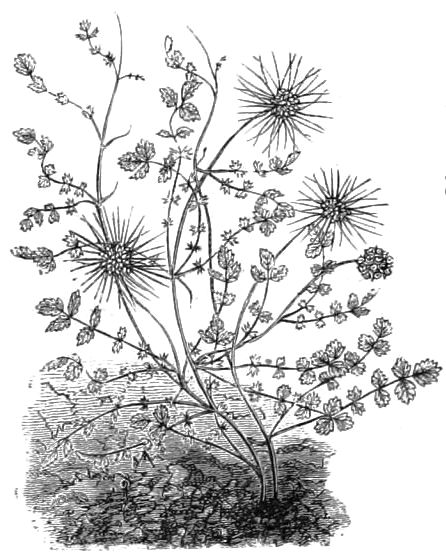
FIG. 6. ACÆNA MICROPHYLLA.
A. myriophylla (many-leaved).* fl. green, small, in rounded spikes. June. l. pinnate; leaflets deeply cut. h. 6in. to 1ft. Chili, 1828. Small, fern-like.
A. Novæ Zealandiæ (New Zealand). A synonym of A. microphylla.
A. ovalifolia (oval-leaved). fl. green. Summer. h. 9in. Chili, 1868. Good for rock gardens.
A. pulchella (pretty).* fl. inconspicuous. A pretty bronzy-leaved species, admirably suited for rockwork crevices, where space is no object. It grows very rapidly, and forms handsome tufts.
ACALYPHA (the name given by Hippocrates to the Nettle). ORD. Euphorbiaceæ. Stove ornamental and variegated nettle-like leaved shrubs. Flowers greenish or reddish, inconspicuous, in erect or drooping bracted axillary or terminal spikes; those of the upper portion sterile, of the lower, fertile. The undermentioned only are those most worthy of cultivation. They are very easily grown, with ordinary stove treatment, and in a peat and loam compost. When well cultivated, the leaves of the hybridised varieties are highly coloured, but rather coarse than otherwise. Increased by cuttings under a glass in sandy soil, in stove heat, during April.
A. Macafeeana (Macafee's). l. red, blotched with bronzy crimson. 1877.
A. macrophylla (large-leaved).* l. cordate ovate, russet brown, blotched with paler spots. The best and handsomest stove species.
A. marginata (margined). l. large, very hairy, ovate-acuminate, centre brown, with a distinct margin of rosy carmine, about ¼in. wide. Fiji Islands, 1875.
A. musaica (mosaic).* l. bronzy green, variegated with orange and dull red. Polynesia, 1877.
A. torta (twisted). l. dark olive, tinted green; margin cut into blunt, oblong segments. Samoan Islands. Remarkable for its curiously contorted foliage. It has erect stems, which are terete, and covered by the leaves in a very singular way.
A. tricolor (three-coloured). A synonym of A. Wilkesiana.
A. Wilkesiana (Wilkes').* l. ovate-acuminate, curiously blotched, mottled, and splashed with red and crimson; ground colour coppery green. h. 6ft. to 10ft. New Hebrides, 1866. SYN. A. tricolor.
A. W. marginata (Wilkes's margined).* l. large, olive brown, margined with rosy carmine. Fiji Islands, 1875.
ACANTHACEÆ. A large order of soft-wooded, herbaceous plants, usually having gamopetalous axillary flowers; calyx composed of deeply imbricated scales; bracts large, leafy.
ACANTHEPHIPPIUM (the derivation of this word is not apparent). ORD. Orchideæ. A peculiar class of terrestrial stove orchids. Flowers rather large, racemose, few; sepals combined in a broad oblique pitcher, including the petals, which are adnate to the base of the column; column short, produced into a long foot. Pseudo-bulbs oblong. Leaves few, large, longer than the scapes. The best species are the two first-mentioned. They will thrive well in sandy peat, with a quantity of small stones, broken pots, or gravel. A great deal of heat and moisture are absolutely essential during the growing period. Propagated, as soon as growth commences, by dividing the pseudo-bulbs.
A. bicolor (two-coloured).* fl. purple and yellow, about 2in. long, campanulate, produced in clusters of three or four together; petals oblong-lanceolate, acutish; lateral lobes of lip rounded. June. h. 9in. Ceylon, 1833.
A. Curtisii (Curtis's).* fl. same shape as above (except the lip), with numerous purple spots, light rose, and flush; column white, nail of lip yellow, keels yellowish, laciniæ white with purple. Malay Archipelago, 1881. The five keels between the side laciniæ distinguish it from the foregoing species and A. sylhetense.
A. javanicum (Javanese).* fl. yellow and red, with distinct longitudinal stripes; petals triangular; lip three-lobed; lateral lobes truncate; intermediate lobe constricted in middle, ovate, and tuberculate at the apex, fleshy on both sides at base, with truncate emarginate inflexed teeth. September. h. 1½ft. Java, 1843.
A. sylhetense (Sylhet). fl. white, with many irregular spots and blotches towards the extremities of the outer portions. June. h. 9in. Sylhet, 1837.
ACANTHOLIMON (from akanthos, a spine, and limon, sea lavender). ORD. Plantagineæ. Dwarf hardy tufted evergreen plants, distinguished from allied genera in having sharp-pointed rigid leaves. They are of rather slow growth, thriving best in a sandy soil, and sunny position, on rockwork more particularly. The flowers are similar to Statice and Armeria. Increased by seeds (which germinate slowly), sown carefully on a warm but rather shaded border, and transplanted when large enough to handle; or by cuttings and very carefully made divisions. The cuttings should be made in late summer, and placed in a frame, to remain there during the winter.
A. glumaceum (prickly).* fl. rose, spicate, about ½in. across, six to eight in a spikelet. Summer. l. densely packed and sharply pointed with spines. h. 6in. Armenia, 1851. Very compact and distinct. SYN. Statice Ararati.
A. Kotschyi (Kotschy's). fl. white. A good species, but very rarely seen in British gardens.
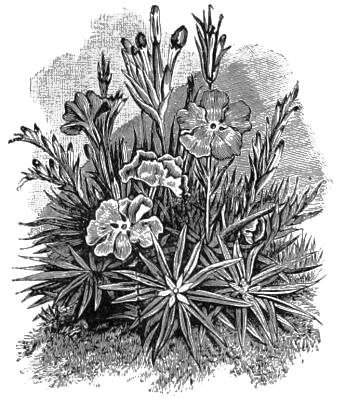
FIG. 7. ACANTHOLIMON VENUSTUM.
A. venustum (charming).* fl. rose, spicate, from twelve to twenty in each spike. Summer. l. broader than in the last, and glaucous. h. 6in. or 8in. Cilicia, 1873. A rare and handsome alpine. Larger than the preceding. See Fig. 7.
ACANTHOPHOENIX (from akantha, a spine, and phoinix, the Date Palm). ORD. Palmæ. A very elegant stove palm, differing from Areca principally in habit, and requiring a light sandy soil and a summer temperature of 65deg. to 80deg., winter 55deg. to 65deg. Increased by seeds only; these germinate best in a moist bottom heat, and a well decomposed compost of one part loam, one of peat, one of leaf mould, and the remainder of sand. They may remain in this soil for two or three years.
A. crinita (hairy).* fl. spirally arranged, in threes, the central one being female. l. the fronds are arched, broadly ovate in outline, pectinately pinnate in division, with long linear acuminate segments, paler beneath. The stem is densely armed with black, needle-shaped spines, and much swollen towards the base. Seychelles, 1868.
ACANTHORHIZA (from akantha, a spine, and rhiza, a root). ORD. Palmæ. A small genus of stove palms, differing from Trithrinax by the aërial roots of the trunk hardening into spines (which are horizontal or pointed upwards), and by the blade of the leaf being divided down to the petiole. They delight in a rich loamy soil, and are propagated by seeds, in a moist, sweet hotbed, in spring.
A. aculeata (spiny).* l. orbicular, palmately slit into numerous linear-lanceolate, glabrous segments, deep-green above, silvery beneath; petioles slender; the trunk is covered with a network of branching spines. Mexico, 1879. SYN. Chamærops stauracantha.
A. Wallisii (Wallis's).* A recent introduction from tropical America, and not yet much cultivated; it is a tall palm with orbicular palmate leaves.
A. Warzcewiczii (Warzcewicz's).* This differs from the preceding species by its more irregularly divided leaf blade, which is white below. Tropical America.
ACANTHOSTACHYUM (from akanthos, a spine, and stachys, a spike). ORD. Bromeliaceæ. A monotypic genus of stove evergreen herbaceous plants; of easy culture in a compost of equal parts sand, decayed wood, and rotten leaves. Propagated by suckers, which strike readily in bottom heat.
A. strobilacea (cone-fruited). fl. red and yellow; scape simple, long, scurfy; bracts coloured. June. l. radical, very long, incurved, narrow, thick, pungent, channelled, spiny-toothed, covered with white scurf. h. 4ft. Brazil, 1840.
ACANTHUS (from akanthos, a spine; several species being spiny or prickly). Bear's Breech. ORD. Acanthaceæ. A group of stately, ornamental perennial plants, mostly hardy, remarkable for their vigorous growth and beautiful foliage. Flowers sessile, crowded, spicate; corolla tubular, one-lipped; lip three lobed. To attain perfection they require a deep soil, and a situation fully exposed to the sun. They will, however, thrive moderately well in common soil and partial shade. The habit being generally a bold one, they are most suited for isolated tufts, backgrounds of mixed borders, and the wild garden. Propagated by seeds, sown in gentle heat, or by division of the roots, in autumn or early spring.
A. carduifolius (thistle-leaved). fl. blue. August. h. 3ft. Cape of Good Hope, 1816. Greenhouse species.
A. hispanicus (Spanish). fl. white. August. l. large, shining, and deeply cut. h. 2ft. Spain, 1700.
A. longifolius (long-leaved).* fl. purple, rose, in the axils of the bracts, which are oval, acuminate, spiny, of a reddish hue, forming a spike nearly 1ft. long. June. l. radical, 2ft. to 3ft. long; numerous. h. 3ft. to 4½ft. Dalmatia, 1869.
A. lusitanicus (Portugal). Synonymous with A. mollis latifolius.
A. mollis (soft).* fl. white or rose, sessile in the axils of the deeply-toothed bracts; spikes about 1½ft. Summer. l. sinuated, unarmed, heart-shaped in outline, 2ft. long by 1ft. broad. h. 3ft. to 4ft. Italy, 1548.
A. m. latifolius (broad-leaved).* A variety of A. mollis, but larger and more robust in every part. This very handsome form is probably the best grown; it is one of the most suitable for sub-tropical gardening. A warm sunny spot is needful. SYN. A. lusitanicus. See Fig. 8.
A. montanus (mountain).* fl. rose. August. h. 3ft. West Africa, 1865. A shrubby species.
A. niger (black). fl. purplish white. July to September. l. sinuated, unarmed, glabrous, shining green. h. 3ft. Portugal, 1759.
A. spinosissimus (most spiny).* fl. rosy, sessile, on a very handsome spike, with acute, recurved spines. Autumn. l. laciniate, pinnatifid, blistered, spiny; spines white. h. 3½ft. South Europe, 1629.
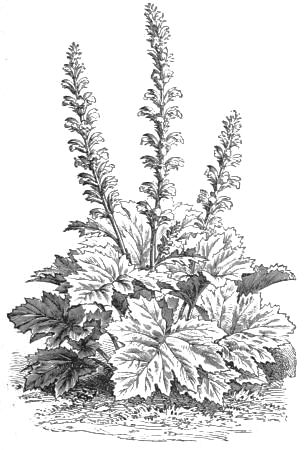
FIG. 8. ACANTHUS MOLLIS LATIFOLIUS.
A. spinosus (spiny).* fl. purplish, spicate; sepals spiny. Summer. l. deeply and regularly cut, each division terminated by a short spine. h. 3ft. to 4ft. South Europe. See Fig. 9.
ACAULESCENT. With apparently no stem.
ACCESSORY. Something additional, not usually present.
ACCRETE. Fastened with another body, and growing with it.
ACCUMBENT. Lying against anything, in distinction to incumbent, or lying upon.
ACER, (from acer, hard or sharp; wood is extremely hard, and was formerly much used for making pikes and lances). Maple. ORD. Sapindaceæ. A genus comprised, for the most part, of handsome hardy deciduous shrubs, or trees, adapted for forming shrubberies, plantations, &c. Flowers greenish, except where mentioned. A. Pseudo-platanus is one of our most useful forest trees. Several of the species produce very useful timber; sugar is one of the constituent parts of the sap of all of them, and is obtained in large quantities from A. saccharinum, in North America. They all prefer a somewhat sheltered position. The most satisfactory soil is one free, deep, loamy, and well drained; the latter is especially desirable with some of the Japanese varieties. The varieties of A. japonicum, and palmatum are well worth growing in pots for conservatory decoration. Propagation: By seeds, sown either in autumn or spring, covering them not more than a ¼in. deep; the common varieties may be sown outside, while the rarer ones should be sown in a frame. By layers, and by grafting; the latter method is adopted with many of the rarer species and varieties, especially the variegated kinds; they are also readily increased by budding in summer.
A. austriacum (Austrian). Synonymous with A. campestre austriacum.
A. campestre (field).* Common Maple. fl. on erect racemes. May. fr. wings of fruit much divaricated. l. small, cordate, with five-toothed lobes. h. 20ft. Britain. A small tree with rough bark, full of deep fissures; wood often beautifully veined, when it is highly valued.
A. c. austriacum (Austrian).* fl. much larger than those of the species. fr. smooth. Lobes of leaves somewhat acuminated. SYN. A. austriacum.
A. c. collinum (hill-loving).* fl. smaller. fr. smooth. Lobes of leaves obtuse. France.
A. c. hebecarpum (downy-fruited).* fr. clothed with velvety pubescence.
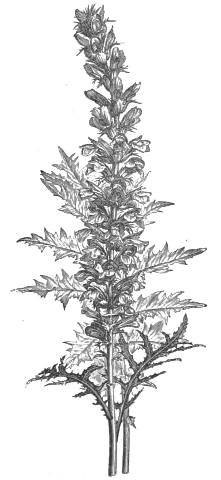
FIG. 9. LEAF AND FLOWER SPIKE OF ACANTHUS SPINOSUS.
A. c. lævigatum (smooth-leaved). l. very smooth and shining.
A. c. nanum (dwarf). Dwarf habit.
A. c. tauricum (Taurian).* l. larger and less divided than in the species.
A. c. variegatum (variegated).* l. beautifully variegated with blotches and stripes of white or whitish yellow; very distinct.
A. circinatum (circinate).* fl. deep red, umbellate. April. l. seven to nine-lobed, serrulated. h. 5ft. to 6ft. North West America, 1827. A very beautiful species, having pendulous branches clothed with leaves, which change into a bright scarlet colour in the autumn.
A. creticum (Cretan). fl. on few-flowered erect corymbs. May. fr. smooth, with the wings hardly diverging. l. cuneated at the base, acutely three-lobed at the top. h. 4ft. Levant, 1752. Nearly evergreen.
A. dasycarpum (thick-fruited).* fl. conglomerate, on short pedicels, apetalous. April. l. truncate at the base, palmately five-lobed, with blunt recesses, and unequally and deeply-toothed lobes. h. 40ft. North America, 1725. SYNS. A. eriocarpon, A. tomentosum, A. glaucum, and A. virginianum.
A. Douglasii (Douglas). Synonymous with A. glabrum.
A. eriocarpon (hairy-fruited). Synonymous with A. dasycarpum.
A. Ginnala (Ginnalian).* fl. on compound, crowded, erect racemes. Amur River. This is generally classed as a variety of A. tartaricum, but its habit is much more graceful, and in this form the leaves are prettily cut and lobed, whilst the leafstalks and midrib are more deeply coloured.
A. glabrum (smooth).* fl. corymbose, on short two-leaved branchlets, greenish-yellow. June. l. roundish-cordate, deeply three to five-lobed, or partite; the lobes biserrate, of a light green. h. 15ft. to 30ft. North West America. SYNS. A. Douglasii, A. tripartitum.
A. glaucum (glaucous). Synonymous with A. dasycarpum.
A. heterophyllum (various-leaved).* fl. corymbose. May. l. small, ovate, entire, and three-lobed, slightly serrated, smooth. h. 4ft. Levant, 1759. An evergreen. SYN. A. sempervirens.
A. ibericum (Iberian). fl. corymbose. May. l. bluntly three-lobed; lobes with one or two teeth, lateral ones marked with the middle nerve to the insertion of the petiole. h. 20ft. Iberia, 1826.
A. japonicum (Japanese).* fl. deep purplish-red, large. April. l. many-lobed, in early spring very light green. h. 20ft. Japan, 1863. The varieties of this species, although not well fixed in many cases, rank amongst the most handsome of the deciduous small shrubs grown, but often change in character as they attain any considerable size. Plants from 1½ft. to 3ft. high are very useful in cool conservatories, and in the highly kept grounds surrounding the house.
A. laurifolium (laurel-leaved). Synonymous with A. oblongum.
A. Lobelii (Lobel's). l. very slightly heart-shaped, irregularly toothed, five-lobed; lobes more or less abruptly pointed.
A. macrophyllum (large-leaved).* fl. on erect, compound, racemes. May. l. digitately five-palmate, with roundish recesses; lobes somewhat three-lobed. h. 60ft. Northern California, 1812.
A. monspessulanum (Montpelier).* fl. on few-flowered corymbs, erect. May. l. cordate, three-lobed; lobes almost or quite entire, equal. h. 10ft. to 20ft. South Europe, 1739.
A. montanum (mountain). fl. on compound, erect racemes. May. l. cordate, three or slightly five-lobed, unequally and coarsely serrated. h. 18ft. Canada, 1750. SYN. A. spicatum.
A. Negundo. See Negundo fraxinifolium.
A. oblongum (oblong). fl. on compound racemes, pale yellow. February. l. oblong-lanceolate, acuminated, quite entire. h. 20ft. Nepaul, 1824. SYN. A. laurifolium.
A. obtusifolium (obtuse-leaved). fl. drooping, corymbose. May. l. rounded, bluntly three-lobed, crenately serrulate, about the length of the petioles. h. 15ft. Crete.
A. Opalus (Opalus). A synonym of A. opulifolium.
A. opulifolium (Guelder-rose-leaved).* fl. on nearly sessile corymbs. May. Ovaries and fruit smooth. l. cordate, five-lobed; lobes obtuse, bluntly and coarsely toothed. h. 8ft. France, 1823. SYN. A. Opalus.
A. o. obtusatum (bluntish).* A larger, strong growing, round-headed tree, with dark green leaves, which are covered with a whitish or rusty tomentum on the under surface.
A. palmatum (palmate-leaved).* fl. on five to seven-flowered umbels. May. l. palmately divided into five to seven lobes beyond the middle; lobes oblong, acuminated, serrated. h. 20ft. Japan, 1820.
A. p. atropurpureum (dark purple).* A vigorous handsome plant, with bold dark purple foliage. Japan.
A. p. crispum (crispy or waved).* l. green, with red stalked, convoluted edges. Japan, 1871. Very distinct, and like a miniature Lombardy poplar in habit of growth.
A. p. dissectum (finely-divided).* fl. red, on terminal-stalked racemes, five to six-flowered. May. l. nine to ten parted; lobes oblong, acuminated, deeply serrated. h. 30ft. Japan, 1845.
A. p. ornatum (beautiful).* Very ornamental, having finely cut deep red leaves, with lighter midribs. Japan, 1871. This variety is also known as dissectum.
A. p. palmatifidum (palmatifid).* l. very finely palmately divided, the lobes cut down quite to the midrib, of a beautiful light green colour. 1875.
A. p. reticulatum (netted).* l. palmately seven-lobed; lobes unequal, sharply serrate, emerald green, with dark green veins. Japan, 1875. A very elegant variety, with slender branches.
A. p. roseo-marginatum (rose-margined).* l. freely divided, the lobes deeply cut, light green, margined with rose. Japan, 1874. A very distinct and charming variety.
A. p. sanguineum (blood-red).* l. deeply five-lobed, the lobes serrated, of a deep reddish-crimson colour, much brighter than the variety atropurpureum. 1874. This presents a very striking contrast to the last.
A. p. septemlobum (seven-lobed).* fl. purplish, on numerous flowered umbels. Spring. l. varying much, from palmately five-lobed, with toothed undivided lobes, to deeply seven to nine-lobed, with more or less finely cut divisions. Japan, 1864. There are numerous beautiful forms of this variety.
There are many varieties of this much varying species, but we have only mentioned those best known; many are only known by their native names, and there is some doubt as to their distinctive characteristics. They are all extremely handsome.
A. pennsylvanicum (Pennsylvanian).* fl. in long drooping, simple racemes. May. l. cordate, three-lobed, acuminated, finely and acutely serrated. h. 20ft. Trunk elegantly striped with white lines. North America, 1755. SYN. A. striatum.
A. pictum (painted).* fl. corymbose, stalked. l. five to seven-lobed; lobes triangular or oblong, entire, acuminated. h. 15ft. to 20ft. Temperate Asia, 1840. A. p. connivens (converging), A. p. marmoratum (spotted), A. p. rubrum (red), and A. p. variegatum (variegated), are varieties differing principally in the colouring of the leaves. All are very desirable.
A. platanoides (plane-like).* The Norway Maple. fl. on nearly erect stalked corymbs. May, June. l. cordate, smooth, five-lobed; lobes acuminated, with a few coarse acute teeth. h. 50ft. Europe, 1683. A very ornamental hardy tree, growing with great rapidity when young. It prefers a deep, well-drained soil.
A. p. aureo variegatum (golden-variegated).* l. variegated with yellow. Europe, 1383. This, to retain the variegation, requires to be propagated by budding or grafting. The same remarks are equally applicable to the other varieties.
A. p. laciniatum (cut-leaved).* l. deeply and variously cut, green and yellow.
A. p. Schwedleri (Schwedler's).* l. very large, deep bronzy-red. A vigorous grower, and most effective.
A. p. variegatum (variegated).* l. variegated with white. There are several other varieties, but of less importance than the foregoing.
A. Pseudo-platanus (Mock-plane tree).* Sycamore. fl. on rather compound pendulous racemes. May. l. cordate, with five acuminated unequally-toothed lobes. h. 30ft. to 60ft. Europe. There are few deciduous trees so well adapted for standing singly in rough exposed situations. A deep, soft, dry soil is most suitable for it, but it will grow in soils of very opposite qualities.
A. P. albo variegata (white-variegated).* A very beautiful form, in spring especially. l. white and green.
A. P. flavo variegata (yellow-variegated). l. variegated with yellow.
A. P. longifolia (long-leaved).* l. more deeply cut, and the petioles much longer than in the species.
A. P. purpureum (purple).* l. purple underneath. The tree, when slightly ruffled by the wind, alternately appearing clothed in purple and pale green. Numerous other varieties of more or less excellence are grown.
A. rubrum (red).* Scarlet Maple. fl. scarlet, handsome, conglomerate, corymbose. l. cordate at the base, deeply and unequally toothed, palmately five-lobed, with acute recesses. Branches and fruit also scarlet. h. 20ft. Canada, 1656. A variety with leaves splashed with yellow is rare. An excellent species, thriving well in damp, swampy situations, and is commonly increased by layers.
A. rufinerve (red-nerved).* "The leaves vary both in size and outline, from 2½in. to 4in. each way; three to five-lobed, with irregularly toothed margins, glabrous above, but with reddish hairs along the nerves beneath. The young branches are conspicuous on account of the bluish-grey glaucescence with which they are covered."
A. r. albo-limbatum (white-margined).* differs only from the species in having a very distinct white margin—not always constant. Japan, 1869.
A. saccharinum (Sugar Maple).* fl. yellow, on drooping corymbs, on short peduncles; pedicels pilose. April. l. cordate, smooth, palmately five-lobed; lobes accuminated, sinuately toothed. h. 40ft. N. America, 1735.
A. s. nigrum (blackish).* fl. on sessile corymbs, nodding. April, May. l. cordate, with the recess closed; palmately five-lobed. h. 40ft. North America, 1812.
A. Semenovi (Semenov's).* A slender and graceful species, with leaves closely resembling those of A. Ginnala, but smaller. Turkestan, 1879.
A. sempervirens (evergreen). Synonymous with A. heterophyllum.
A. spicatum (spiked). Synonymous with A. montanum.
A. striatum (striated). Synonymous with A. pennsylvanicum.
A. tartaricum (Tartarian).* fl. white, on crowded, erect, compound racemes. May. l. more or less cordate, acuminated, serrated, with obsolete lobes. h. 20ft. 1759. This species is one of the first to expand its leaves in spring.
A. tomentosum (tomentose). Synonymous with A. dasycarpum.
A. tripartitum (three-parted). Synonymous with A. glabrum.
A. Van Volxemii (Van Volxem's). fl. not known in England. l. palmately three to five-lobed, very large, light green above, silvery and quite glabrous beneath. Caucasus, 1877. Distinct and fine.
A. villosum (hairy). fl. fragrant, on lateral racemes. April. Buds, fruit, and young leaves, silky, villous. l. cordate, five-lobed, villous beneath as well as the petioles; lobes ovate acute. h. 50ft. Himalaya, at high elevations. Not hardy.
A. virginianum (Virginian). Synonymous with A. dasycarpum.
ACERACEÆ. An order of very ornamental hardy trees, of which the sycamore and maple are well-known representatives.
ACERAS (from a, without, and keras, a horn; the lip having no spur). ORD. Orchidaceæ. An interesting genus of terrestrial orchids. Calyx of three ovate, equal, converging sepals; petals two, narrow, oblong; lip spurless, much longer than the calyx, narrow, oblong, with four linear lobes. The most interesting species is the native one. Indigenous to dry, chalky pastures in the south-east of England, and it will only thrive in similar soils when grown in gardens. Propagated by careful divisions of tubers only.

FIG. 10. FLOWER OF ACERAS ANTHROPOPHORA.
A. anthropophora (The Green Man Orchis). fl. greenish, on a long spike, lip longer than the ovary; lip and petals often margined with red. June. l. lanceolate. h. 1ft. See Fig. 10.
ACERATIUM (from a, not, and keras, a horn; the stamens being destitute of the terminal bristles so conspicuous in its near ally, Elæocarpus). ORD. Tiliaceæ. An interesting stove evergreen tree, very closely allied to Tilia. It thrives well in a mixture of loam and peat, and is increased by ripe cuttings, which root readily if placed in sand, under a hand glass, in heat.
A. oppositifolium (opposite-leaved).* fl. white, on terminal three-flowered peduncles. June. l. opposite, elliptic-oblong, furnished with a few mucronated teeth. h. 20ft. Amboyna, 1818.
ACEROSE, ACEROSUS. Needle-pointed, fine, and slender, with a sharp point.
ACETARIOUS. An adjective applied to plants used in salads.
ACEUS. A termination expressing a resemblance to the thing whose name it terminates—foliaceus, leaf-like, of the texture of a leaf or folium.
ACHANIA. See Malvaviscus.
ACHENE. A hard, dry, one-seeded, superior seed-vessel.
ACHERONTIA ATROPOS. See Sphinx Atropos.
ACHILLEA (named after Achilles, who is said to have first discovered the medicinal qualities of this plant). Including Ptarmica. Milfoil. ORD. Compositæ. A large genus (about fifty species), containing numerous hardy, border and alpine plants. Flower-heads small, corymbose; involucral scales oblong, often with a shrivelled appearance; receptacle with membranous scales, resembling chaff; ray florets few, sometimes rather large and showy; pappus none. Leaves ternate, simple or compound. All the species are easily cultivated in ordinary garden soil. A. Eupatorium and other large-growing kinds are well suited for borders or groups, whilst the alpine section should be planted on the rockery. A great number of species, although excellent for naturalising in rough shrubberies, are totally unfitted for garden culture. Propagated, during spring, by root divisions, cuttings, and seeds.
A. ægyptiaca (Egyptian).* fl.-heads rich bright yellow, in closely packed terminal corymbs, which are from 2in. to 4in. across. Summer. l. pinnate; leaflets obtusely lanceolate, serrate, silvery white, 6in. to 8in. long. h. 1½ft. to 2½ft. Levant, 1640. Handsome perennial, thriving best in a warm position.
A. Ageratum (ageratum-leaved).* fl.-heads pure white, large, borne singly on stalks about 6in. or 8in. high. Summer. l. narrow, arranged in a dense silvery rosette, the margins prettily crimped. Greece. A pretty alpine, of compact habit.
A. asplenifolia (asplenium-leaved).* fl.-heads rose-coloured, small, in a compound corymb. June to September. l. lower ones stalked, pinnatifid, lobes pinnate; upper ones pinnate. h. 18in. North America, 1803.
A. atrata (black-cupped).* fl.-heads white. August. l. in a rosette, pinnatifid, deep shining green. Austria, 1596. A pretty alpine.
A. aurea (golden-flowered).* fl.-heads golden yellow, borne singly on stems 18in. high. Summer and autumn. l. larger than in A. ageratifolia, with which species it is sometimes confused. Levant, 1739. Habit tufted. Requires a warm position.
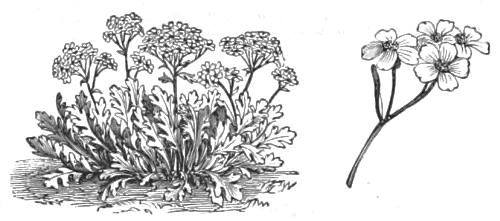
FIG. 11. ACHILLEA CLAVENNæ, showing Habit and detached Flower-heads.
A. Clavennæ (Clavenna's).* fl.-heads white, in neat and compact heads. Spring and summer. l. bipinnatifid; segments linear, obtuse, slightly denticulated at the apex. h. 10in. Austria, 1656. A very neat and pretty species, having dwarf tufted habit and a hoary appearance. See Fig. 11.
A. decolorans (staining). fl.-heads whitish yellow. July. l. undivided. h. 1ft. Native country unknown. 1798.
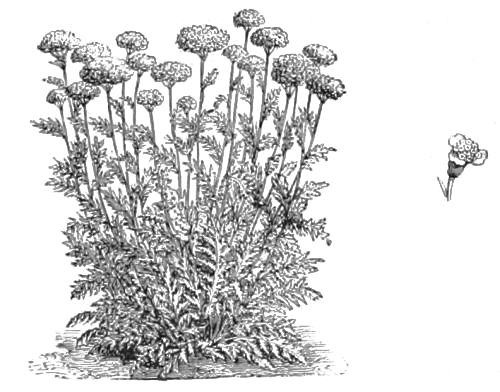
FIG. 12. ACHILLEA EUPATORIUM, showing Habit and detached Flower-head.
A. Eupatorium (fern-leaved).* fl.-heads brilliant yellow, in dense convex, compound corymbs, which are often 5in. across, lasting two months in full beauty. June to September. l. numerous, linear, pinnate, lobed and serrated, hairy, rough. h. 4ft. to 5ft. Caucasus, 1803. This noble plant should be grown at the back of the border, and kept neatly staked. SYN. A. filipendula. See Fig. 12.
A. filipendula (dropwort-leaved). Synonymous with A. Eupatorium.
A. Herba-rota (Herba-rota).* fl.-heads white, in lax corymbs, on slender stems. May. l. lanceolate, serrated. h. 6in. France, 1640. When touched, this pretty little plant gives off an agreeable aromatic perfume. To attain full beauty it requires sandy loam and a sunny position.
A. macrophylla (large-leaved). fl.-heads white. July. l. long and broad pinnate; leaflets horizontal. h. 3ft. Italy, 1810.
A. Millefolium roseum (rosy).* fl.-heads rose-coloured, in small ovoid heads, which are produced continuously for several months. l. strap-shaped; segments very narrow. h. 1ft. to 3ft. England. It is well worth growing, both as a border plant, and for cutting purposes.
A. mongolica (Mongolian). fl.-heads white. July. l. undivided. h. 1½ft. Siberia, 1818.
A. moschata (musky).* fl.-heads white, in lax corymbs. June. h. 6in. l. bright green, about 2in. long, pinnatifid. Italy, 1775. A pretty tufted alpine.
A. nana (dwarf). fl.-heads white. June to August. l. pinnate; leaflets horizontal. h. 6in. Italy, 1759. A rockery species.
A. odorata (sweet-scented). fl.-heads white, fragrant. June to August. l. bipinnate. h. 6in. Spain, 1729.
A. pectinata (comb-leaved).* fl.-heads white. June. l. bright green, about 2in. long, pinnatifid. Italy, 1775. A pretty tufted alpine.
A. Ptarmica flore-pleno (double sneezewort).* fl.-heads pure white, freely produced in terminal corymbs. All through the summer and autumn. l. lanceolate, serrulate. h. 1ft. to 2ft. England. This is one of the most useful white border perennials grown, increasing very readily. When out of flower the stems should be cut down to the surface.
A. santolinoides (lavender-cotton-like). fl.-heads white. July. l. pinnate; leaflets transverse. h. 1ft. Spain.
A. serrata (serrated).* fl.-heads clear white, large, in small corymbose clusters, forming a somewhat spreading panicle. Summer. l. white, with adpressed hairs, sessile, lanceolate, deeply serrated. h. 15in. Switzerland, 1686.
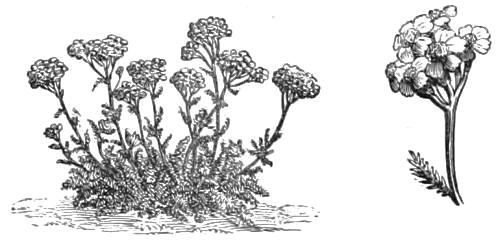
FIG. 13. ACHILLEA TOMENTOSA, showing Habit and detached Portion of Inflorescence.
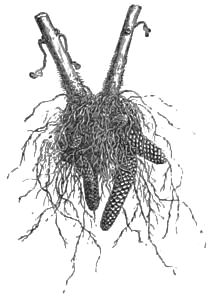
FIG. 14. ROOT OF THE ACHIMENE, showing Tubercles.
A. tomentosa (downy).* fl.-heads bright yellow, in repeatedly compound corymbs. Summer. l. woolly, bipinnatifid; segments linear, acute. h. 8in. to 12in. Europe. One of the best yellow-flowered species for the rock garden, having a dense habit. See Fig. 13.
A. umbellata (umbel-flowered).* fl.-heads white, six to eight in a simple umbel. June. l. regularly lobed; lobes obovate, entire; clothed with a dense, silvery pubescence, on which account the plant is chiefly cultivated. h. 4in. to 5in. Greece. A very pretty, dwarf rock plant.
A. vallesiaca (Vallesian). fl.-heads white. June to August. l. pinnate; leaflets horizontal. h. 1ft. Switzerland, 1819.
ACHIMENES (from cheimaino, to suffer from cold; alluding to the general tenderness of the species). Including Scheeria. ORD. Gesneraceæ. A large genus of handsome, stove or warm greenhouse, branched, generally hairy, herbaceous perennials, with scaly, catkin-like stolons underground (see Fig. 14), and sometimes from the axils of the leaves. Corolla funnel-shaped; tube rather oblique, gibbous behind at the base; pedicels one-flowered, axillary, solitary or fasciculated, bracteated. Leaves opposite, or three in a whorl, serrated.
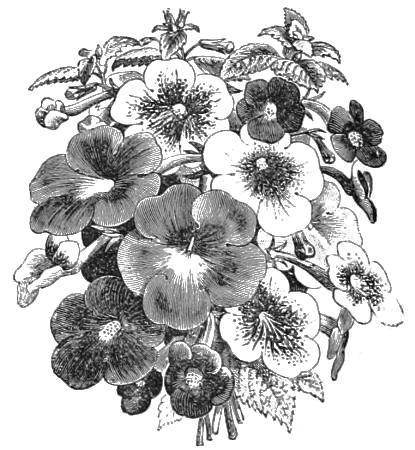
FIG. 15. BOUQUET OF VARIOUS ACHIMENES.
To be successfully cultivated, they must be started and grown in stove heat till they commence flowering, when they may be removed to the conservatory or greenhouse, there to remain till after flowering. Batches of tubercles should be started in heat from February till the end of April, so as to give a succession of blossom. Shake each variety out of the old compost and insert separately in light, sandy soil; water sparingly at first, but when active they may receive more frequent supplies. When the shoots are about 2in. high, the tubercles may be transplanted to the pots, pans, or baskets in which it is intended to grow them, using as potting compost fibrous peat and leaf-soil in equal proportions, with about a sixth part of sheep's or rotten cow manure, and sufficient silver sand to make the whole porous and of a whitish appearance. Thorough drainage is indispensable, and a layer of the rougher soil, or sphagnum, should be placed over the potsherds, to prevent the loose soil stopping the drainage. Place the pans as near the glass as possible, and shade from bright sunshine. Give liberal supplies of water, with occasional doses of liquid manure; and, as the shoots lengthen, they may be pinched, to induce sturdy growth and a larger number of flowering branches. Place neat stakes to each stem, and keep well tied, arranging the stakes as symmetrically as possible, so as to ensure an even outline, but do not allow them to be seen. Light syringing with clear water, morning and evening, is beneficial. After the plants have done flowering, they should gradually have less water as the foliage and stems decay; a light airy situation is needed to mature and ripen the tubers. When the tops are quite dead, they may be removed, and the pots stored on the sides in any warm dry corner where the temperature will not fall below 50deg., keeping the plants quite dry until the time of starting again. Achimenes are liable to attacks of thrips, red-spider, and green-fly, especially if the atmosphere is kept dry; these are easily destroyed by fumigation with tobacco. This must only be done when the foliage is quite dry, otherwise the plants will suffer. Achimenes are especially beautiful when well arranged, especially if two or three varieties are mixed together, as white, red, and purple (Fig. 15). There are several methods of increasing these:—(1) By cuttings; these need not be cut off at a joint, as they will root from any portion of the stem. Insert them thickly in well-drained pots of sandy soil—say a mixture of equal parts of peat and sand—and place in bottom heat. (2) By leaves, which should be severed from the stems, and pricked in pots of similar soil to the cuttings, placing all the petiole below the surface; stand the pots in bottom heat. (3) By scales from the corms, which should be carefully rubbed off and sown, like seeds, in pots or pans of the same compost, barely covered with sand, and placed in bottom heat. (4) By seeds, which are very small, and, consequently, require to be carefully sown. The pans must be thoroughly drained and filled nearly to the rim, levelled, and well watered with a fine rose, after which the seed should be thinly scattered, covered very lightly with sand, and placed in a shady position. Keep nicely moist, and apply water very lightly, or the tiny germs will be disturbed. Place a sheet of glass over the seed-pans. When the seedlings are large enough to handle, they may be pricked off and afterwards treated like rooted cuttings. The best time for all modes of propagating is early spring.
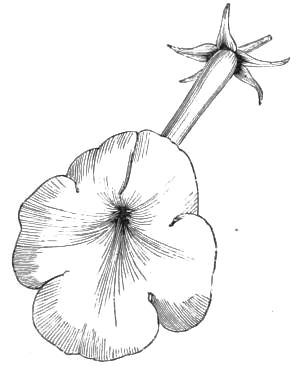
FIG. 16. FLOWER OF ACHIMENES LONGIFLORA.
A. atrosanguinea (dark-crimson).* fl. crimson; tube of corolla 1½.in. long, cylindrical, saccate at base, pilose; limb small, spreading; peduncle one-flowered. July, August. l. pilose, oblong, sub-cordate, serrated, unequal. h. 1½ft. Guatemala, 1848.
A. candida (white).* fl. white; tube of corolla gibbous at base; limb oblique, the front segment largest; peduncles axillary, pilose, three-flowered. June. l. unequal, oblique at base, serrated, pilose. h. 1½ft. Guatemala, 1848.
A. coccinea (scarlet).* fl. scarlet; peduncles solitary, axillary. August. l. three in a whorl, ovate, acuminated, serrated, with minute leaves in the axils. h. 1½ft. Jamaica, 1778.
A. cupreata (coppery). fl. scarlet; calyx spotted inside, with a fringed mouth; petals ciliately toothed; peduncles one-flowered. April. l. elliptic, serrated, wrinkled, coloured. h. 6in. Mexico, 1845. Plant creeping, downy.
A. gloxiniæflora (gloxinia-flowered).* fl. whitish, large, axillary; tube of corolla 2in. long; limb broad, spreading; lobes finely serrated, dotted with purple inside. June. l. serrated from middle to top. Stem slender, flexuous. h. 1ft. Mexico, 1845.
A. grandiflora (large-flowered).* fl. violet purple, very large, solitary, axillary; limbs of corolla spreading. June. l. equal, ovate, oblique at base, sparingly serrated. h. 1½ft. Mexico, 1842.
A. heterophylla (various-leaved). fl. solitary or twin; corolla scarlet; lobes ciliated. July. l. opposite, one smaller than the other, cordate ovate, acuminated, coarsely serrated. h. 1ft. Mexico. Plant rather hairy.
A. hirsuta (hairy). fl. reddish, with yellow eye; limb of corolla flat, with rounded serrulate segments; peduncles one-flowered. July. l. cordate, serrated. h. 2½ft. Stem bulbiferous. Guatemala, 1842. Plant hairy.
A. Kleei (Klee's).* fl. lilac; corolla dark near the mouth, with a dash of yellow in the throat; calyx downy; peduncles one-flowered. August. l. ovate, acuminate, serrated. h. 6in. Guatemala, 1848. Plant hairy.
A. longiflora (long-flowered).* fl. violet; segments of calyx lanceolate, erect; corolla with a long tube, and an ample spreading limb; pedicels one-flowered. July and August. l. three to four in a whorl, ovate or oblong, coarsely serrated. h. 1ft. Guatemala, 1841. Plant hairy. See Fig. 16.
A. multiflora (many-flowered).* fl. pale lilac; sepals linear; corolla funnel-shape; tube curved; lobes roundish, lower one fringed; peduncles axillary, three to five-flowered. August. l. opposite, or three in a whorl, ovate, deeply and doubly serrated. h. 1ft. Brazil, 1843. Plant hairy.
A. ocellata (eye-spotted).* fl. reddish yellow, with dark spots, solitary, drooping; petals nearly equally spotted. Autumn. l. on longish petioles, ovate, acuminate, serrated, wrinkled, coloured beneath. h. 1½ft. 1845. Plant hairy.
A. patens (spreading). fl. violet, blue; calyx downy; tube of corolla shorter than limb, which is spreading. June. l. ovate, acuminate, hispid above, serrate. h. 1ft. Mexico, 1845.
A. pedunculata (long-stalked).* fl. scarlet, with yellow eye; corolla drooping, gibbous at base; peduncles in the axils of the upper leaves. July. l. rather unequal, obliquely cordate, ovate, serrated. h. 2ft. Stem simple, downy. Guatemala, 1840.
A. picta (painted).* fl. scarlet, with yellow eye; tube of calyx turbinate; lobes of corolla roundish, three lower ones smallest; peduncles solitary or two-flowered, axillary one-flowered. July. l. opposite, or three in a whorl, cordate-ovate, coarsely serrated, velvety, and elegantly painted. h. 1½ft. Mexico, 1843.
A. rosea (rosy). fl. rose, pilose; limb of corolla equal to tube; peduncles filiform, many-flowered. June. l. sometimes three in a whorl, pilose. h. 1½ft. Guatemala, 1848.
The foregoing are the most important species known. Hybrid varieties are innumerable, and even surpass the species in beauty, the best of which are enumerated below in their respective colours.
Blue and Purple Flowered. ADVANCE,* flowers reddish-purple, lighter at the eye, dwarf, and free habit; ARGUS,* rich plum, with deep orange eye, large and free; DR. BUENZOD,* flowers rich crimson purple, spotted with orange in the centre, very free; EXCELSIOR, rich violet-purple, very large and free, with compact habit; GEM,* flowers small, of good form, rich carmine-purple; GIBSONI,* flowers very large, clear mauve, with the tube white outside; GRANDIS, rich violet purple, with large orange eye, carmine shaded, a charming variety; LADY SCARSDALE,* flowers of fair size, very free, rich plum purple, shaded carmine; LONGIFLORA MAJOR,* a stronger grower than the type, freely producing large rich blue flowers, one of the finest varieties grown; MADAME GEORGE, deep purple shaded crimson; MAUVE QUEEN,* flowers very large, of a distinct mauve, with a brownish eye-shade, very profuse, with a grand habit, one of the best; PURPUREA ELEGANS,* deep claret purple, orange throat with dark spots, a very attractive variety; ROLLISONII,* flowers large, deep lavender-blue, yellow throat, spotted with deep crimson, very effective; VIVICANS,* dark carmine-purple, with crimson eye, a few blue rays streaking from the eye, habit good, and very free.
Crimson and Scarlet Flowered. AURORA,* rich rosy-scarlet, with yellow throat, very large, fully 2in. across; CARL WOOLFORTH,* deep crimson, shaded lighter at the eye, very free; DAZZLE, flowers small, brilliant scarlet, pale yellow eye, very pretty and free; DIADEM,* crimson lake, shaded carmine, with deep yellow eye; ECLIPSE,* rich orange-scarlet, spotted with carmine, extremely floriferous, with a good habit; FIREFLY,* deep carmine red, golden eye, spotted with crimson, one of the best; HARRY WILLIAMS,* bright cerise red, yellow, maroon spotted, the edge prettily fringed, a very charming variety; LOVELINESS, rich magenta crimson, golden eye, spotted with maroon; METEOR, flowers rather large, bright crimson-scarlet, yellow eye, spotted carmine, very dwarf and free; SCARLET PERFECTION,* rich carmine-scarlet, deep orange eye, very beautiful; SIR TREHERN THOMAS,* deep crimson-lake, very profuse, with a good habit; STELLA, deep magenta, with orange eye, the margins fringed, very large and free, 2in. or more across; WILLIAMSII,* flowers large, stout, brilliant scarlet, orange throat, habit dwarf and free-branching, one of the finest varieties grown.
Orange-Flowered. GEORGIANA DISCOLOR, flowers large, bright orange, with a distinct yellow centre; HENDERSONI,* rich orange-salmon, with yellow eye; MAGNET,* deep orange, spotted with crimson, with a distinct carmine zone, a very free-flowering and beautiful variety; PARSONSI* is a decided improvement upon the last.
Rose-Flowered. ADMIRATION, deep rose, white throat, spotted with carmine; CARMINIATA SPLENDENS,* bright rose yellow, spotted in the centre, a charming variety; LEOPARD, bright magenta rose, freely spotted at the throat; LONGIFLORA ROSA,* rich lilac rose, deeper in centre, of medium size, very free and dwarf; MASTERPIECE,* deep rose, violet shaded, with a distinct white throat; Pink Perfection,* rich rose, the eye rich carmine and violet rayed, one of the best; ROSEA MAGNIFICA,* bright rose, with a yellow eye, very finely spotted, a very lovely variety; ROSE QUEEN,* flowers very large, rich rosy-lake, shaded deep purple, with a well defined orange throat; UNIQUE,* rosy-pink, deep yellow eye, spotted crimson, a very charming variety.
White-Flowered. AMBROSE VERSCHAFFELT,* flowers of good size, pure white, with a dark rayed centre; LONGIFLORA ALBA,* similar in form and habit to Longiflora, but with large white flowers, slightly marked in the centre; MADAME A. VERSCHAFFELT,* flowers large, pure white ground, heavily veined with purple, a very attractive variety; MARGARETTA,* flowers of medium size, pure white, and destitute of any markings whatever.
ACHLAMYDEOUS. Without floral envelope.
ACHRAS. See Sapota.
ACHYRANTHES. See Chamissoa and Iresine.
ACHYRONIA. Included under Priestleya (which see).
ACHYROPAPPUS. Included under Schkuhria (which see).
ACICULAR. Needle-shaped.
ACINETA (from akineta, immovable; the lip being jointless). ORD. Orchideæ. A small genus of cool house, robust, sub-terrestrial orchids allied to Peristeria. Flowers sub-globose, fleshy, arranged on stout, pendulous racemes. Leaves lanceolate, membranous, ribbed. Pseudo-bulbs angular, about as large as hens' eggs. The compost should consist of equal parts of fibrous peat and living sphagnum. In planting, first place a somewhat thick layer of the moss all round the inside of the basket, and press the soil firmly round the plant. During the growing season, the baskets should be taken down twice or three times a week and dipped into a tub of water, so that the whole may become saturated. In addition, the plants should be sprinkled with the syringe morning and evening, for they delight in an abundant supply of water and plenty of shade. When the growth is finished, they must be kept very dry, an occasional syringing, to keep the leaves from shrivelling, being all that is necessary.
A. Arcei (Arce's). fl. yellow. Central America, 1866.
A. Barkeri (Barker's).* fl. yellow and dark crimson, on stout scapes, produced from the base of the bulbs, and bearing fifteen to thirty fragrant flowers. Midsummer. l. broadly lanceolate, 2ft. long. Pseudo-bulbs 5in. to 7in. long. Mexico, 1837. SYN. Peristeria Barkeri.
A. chrysantha (yellow-flowered).* fl. yellow, white, and crimson, fragrant; lower part of the lip having a blunt, papillose horn; racemes erect. May. h. 2ft. Mexico, 1850.
A. densa (dense-flowered).* fl. sub-globose, and of a waxy consistence, lemon-yellow, dotted brown, sweet-scented; racemes rather short. Costa Rica, 1849. A robust-growing species, very like A. Barkeri. SYN. A. Warczewiczii.
A. Humboldtii (Humboldt's).* fl. straw-colour, dotted with brown; scapes 2ft. long. May. l. broadly lanceolate, generally four. Columbia, 1872. A handsome species, but the flowers speedily fade. SYNS. Anguloa superba, Peristeria Humboldtii fulva.
A. sulcata (grooved). fl. bright yellow. Columbia, 1879. Very like the last species, from which it differs in mere botanical detail.
A. Warczewiczii (Warczewicz's). A synonym of A. densa.
ACINOS. See Calamintha.
ACIOTIS (from akis, a point, and ous, an ear; in allusion to the shape of the petals). ORD. Melastomaceæ. A small genus of pretty, stove, evergreen plants. Flowers small; panicles slender, loose, terminal; petals four, obliquely awned at the apex. Leaves thin, membranous. For culture, see Melastoma..
A. aquatica (water-loving). fl. white, small, on loose, terminal, filiform panicles. June. l. cordate, ovate-oblong. h. 6in. to 12in. South America, 1793. The pots in which this species is grown should be kept in pans of water.
A. discolor (various-coloured).* fl. small, red, in spicate racemes. l. petiolate, elliptic-oblong, purple beneath, deep shining green above. h. 1ft. Trinidad, 1816.
ACIPHYLLA (from ake, a point, and phyllon, a leaf, referring to the sharply pointed segments of the leaf). ORD. Umbelliferæ. A genus of curious and remarkable erect hardy perennials, with densely fascicled, spicate, or panicled umbels of flowers; and pinnate or bi-tripinnate leaves. They are most suited for the rockwork, in a light sandy soil. Propagated by seeds or divisions in spring.
A. Colensoi (Colenso's).* fl. white. This extraordinary evergreen forms a circular bush, 5ft. or 6ft. in. diameter, of bayonet-like spines, having flowering stems 6ft. to 9ft. high, covered with spreading spinous leaflets. New Zealand, 1875.
A. squarrosa (rough-headed).* fl. white. h. 6ft. to 9ft. New Zealand. More frequently met with than the preceding, of very dense growth. Commonly known as the Bayonet Plant.
ACIS (named after Acis, shepherd of Sicily, son of Faunus and the nymph Simæthis). ORD. Amaryllidaceæ. A genus of very pretty dwarf bulbous plants, suitable for the rockery, in sunny sheltered situations. This genus was formerly included with Leucojum, from which it is distinguished by its dwarf slender habit, filiform style, and membranous capsule. All are delicate little plants, with narrow linear leaves and bell-shaped flowers. They require a free, open, rich soil, and should remain and bloom undisturbed for years; divide the clumps every three or four years, and renew the soil.
A. autumnalis (autumn-blooming).* fl., perianth white, delicate pink at the base, preceding the leaves; two to three on a stem. Autumn. l. few in number, very slender, sheathing the stems at the base. h. 4in. to 6in. Portugal, 1629. A charming species, and the only one at all common.
A. grandiflorus (large-flowered).* fl., perianth white, larger than those of the last. August. h. 6in. Numidia, 1820. Somewhat rare in cultivation.
A. roseus (rose-coloured).* fl., perianth rose red, not more than ¼in. long; scape one to three-flowered. August. l. narrow, blunt, linear. h. 3in. Corsica, 1820. Very rare.
A. tingitanum (Tangiers). Of recent introduction; has a many-flowered umbel, and very long leaves.
A. trichophyllus (hair-leaved).* fl., perianth white, about ½in. long; segments loosely nerved, with a faint flush of red at the base. January. h. 6 in. Spain, 1820.
ACISANTHERA (from akis, a point, and anthera, an anther; anthers jointed). ORD. Melastomaceæ. A monotypic stove genus allied to Rhexia, of semi-shrubby habit. It grows well in a mixture of loam, sand, and peat; and cuttings root freely in the same soil in stove temperature.
A. quadrata (square-branched). fl. purple, ventricose, alternate, axillary, solitary. July. l. three-nerved, ovate, crenated; branches square. Habit erect, branched at the apex. h. 1ft. to 1½ft. Jamaica, 1804. More curious than ornamental.
ACMADENIA (from akme, a point, and aden, a gland; in allusion to the anthers being terminated by pointed glands). ORD. Rutaceæ. A small genus of beautiful greenhouse shrubs. Flowers terminal, solitary, or few, furnished with imbricate sepal-like bracts; petals five, with long claws, which are bearded on the inside. Leaves imbricate, linear-oblong, or roundish. They thrive best in a mixture of peat and sand, with a little turfy loam; thorough drainage is also necessary. Young cuttings pricked in a pot of very sandy soil, covered with a bell glass, and shaded, will root freely in a cool house.
A. tetragona (four-angled).* fl. white, large, sessile, solitary. June. l. roundish-rhomboidal, with scabrous margins. h. 1ft. to 2ft. Cape of Good Hope, 1798.
ACMENA (from Acmenæ, nymphs of Venus, who had an altar at Olympia). ORD. Myrtaceæ. A small genus of greenhouse evergreen shrubs. Flowers in dense trichotomous cymes, with five small distant petals, and very conspicuous and pretty berries. They grow well in an equal mixture of peat, loam, and sand. Propagated readily by placing half-ripened cuttings in sand, under a glass, without heat.
A. floribunda (many-flowered).* fl. white, in threes, disposed in a terminal panicled thyrse. May to September. l. full of pellucid dots, oval-lanceolate, acuminated at both ends. Berries globose, bright purple. h. 4ft. New Holland, 1790.
A. ovata (ovate-leaved).* A new species, having, according to Mr. W. Bull, ovate leaves, which, along with the stems and petioles, are dark purple, giving the plants, when making new growth, a striking appearance. It has a neat habit.
ACOKANTHERA. See Toxicophlœa.
ACONIOPTERIS. See Acrostichum.
ACONITE. See Aconitum.
ACONITE, WINTER. See Eranthis.
ACONITUM (from Aconæ, or Acone, a harbour of Heraclea, in Bithynia, near where it is said to abound). Aconite; Monk's Hood; Wolf's Bane. ORD. Ranunculaceæ. An extensive genus of very ornamental hardy perennials. Flowers in terminal racemes; sepals five, the upper one helmet shaped, the two sides broader than the two back ones; petals five, small, the two upper with long claws hooded at the tip; the three inferior smaller or undeveloped. Leaves palmate. They thrive well in any ordinary garden soil. If left undisturbed for several years, they will attain a goodly size, and produce fine panicles of handsome flowers. They are invaluable for growing beneath the shade of trees, where they succeed better than almost any other class of plants. All are very easily propagated by divisions of the roots and seeds; the latter should be sown as soon as ripe in a cold frame. Care should be taken not to leave pieces of the roots about, for, with but one exception, those of all the species are very poisonous. Although very unlike horse-radish, they have frequently been mistaken for it, with fatal results; and none of the species should be cultivated in or near the kitchen garden.
Sect. I. Roots Tuberous.
A. acuminatum (taper-pointed). fl. bluish purple; spur capitate; helmet closed, conical, beaked. July. l. with cuneate, bipinnate lobes. h. 2ft. to 4ft. Switzerland, 1819.
A. album (white-flowered).* fl. pure white, large, with erect helmet, very freely produced. l. dark green, with oblong-cuneate divisions. August. h. 4ft. to 5ft. Levant, 1752. This is a rare and very handsome species.
A. alpinum (alpine). Synonymous with A. rostratum.
A. ampliflorum (large-flowered). fl. bluish-purple, large; spur obtuse, straight. June. l. with blunt segments. h. 2ft. to 3ft. Austria, 1823.
A. angustifolium (narrow-leaved).* fl. deep blue, in spiked panicles; spur capitate; helmet closed, hemispherical; lip bifid. June. l. palmately cut into linear lobes. h. 2ft. to 3ft. Siberia, 1824.
A. biflorum (twin-flowered).* fl. pale blue, usually twin, sessile, the middle rather obscure and with yellowish edges, covered on the back with spreading down; spur truncate; helmet depressed; beak drawn out. June. l. lower ones on long stalks, with linear segments. h. 6in. Siberia, 1817. A very rare alpine species.
A. Cammarum (Cammarum). fl. rich deep purple, on rather loose spikes; spur capitate; helmet closed, hemispherical. July to September. l. with short, bluntish lobes. h. 3ft. to 4ft. Austria, 1752.
A. cernuum (drooping). fl. violet, large, on nodding, loose, hairy racemes; spur capitate, or a little hooked; helmet large, arched, beaked. July and August. l. with trapeziform, pinnate lobes. Branches axillary, spreading. h. 3ft. to 4ft. Europe, 1800.
A. delphinifolium (Delphinium-leaved).* fl. pale bluish purple, large, on loose racemes; spur a little hooked; helmet hemispherical. June. l. smooth, deeply cut into five parts. Stems slender. h. 6in. to 2ft. North America, 1820. A rare alpine species.
A. elatum (tall). fl. blue, very large, in loose panicled spikes; peduncles pubescent; spur capitate, inclining. June. l. with linear acute segments. h. 3ft. to 4ft. Europe, 1822.
A. eminens (eminent).* fl. blue, on erectly spreading pubescent peduncles; spur capitate; helmet closed; lip very long, refracted. June. l. with cuneate bipinnate lobes. h. 2ft. to 4ft. Europe, 1800.
A. eriostemon (woolly-stamened). fl. bluish-purple, disposed in long, beautiful, erect-spreading spikes; spur capitate; helmet closed, arched. June. l. with cuneate, bipinnate lobes. h. 4ft. Switzerland, 1821.
A. exaltatum (exalted). fl. blue, on loose panicles, with ascending stiff branches; spur thick, somewhat hooked; helmet conical; beak elongated. July. l. with trapeziform, pinnate lobes. h. 6ft. Pyrenees, 1819. SYN. A. hamatum.
A. flaccidum (flaccid). fl. pale violet, large, on erect spreading peduncles; racemes branched; spur hooked at the apex; helmet high, arched, inclining forwards, gaping. July and August. l. multifid, ciliated (as well as the petioles), when young. h. 6ft. Siberia, 1822.
A. gibbosum (swollen). Synonymous with A. nasutum.
A. Gmelini (Gmelin's). fl. cream-coloured, middle-sized, on very long loose racemes; spur straight, obtuse; bottom of the helmet rounded, cylindrical. July. l. on long stalks, villous beneath and shining above; lobes divided into narrow segments. h. 2ft. Siberia, 1817. SYN. A. nitidum.
A. gracile (slender).* fl. pale blue or violet, large, on loose racemes; spur erect, clavated-hooked; helmet with a middle sized beak. June. l. smooth, with trapeziform, pinnate lobes. Stems slender. h. 2ft. Italy, &c.
A. Halleri (Haller's).* fl. opaque violet, on elongated, loose racemes, with a few lateral ascending ones; spur capitate; helmet convex-hemispherical, gaping. June. l. lobes linear, dilated, very long. Stem straight, long, branched. h. 4ft. to 6ft. Switzerland, 1821.
A. H. bicolor (two-coloured).* fl. white, variegated with blue, disposed in spikes or panicles. June.
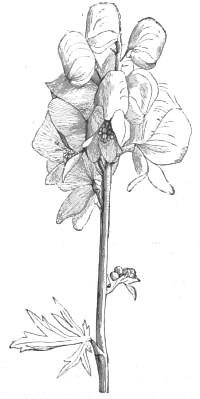
FIG. 17. FLOWER OF ACONITUM NAPELLUS, nearly Full Size.
A. hamatum (hooked). Synonymous with A. exaltatum.
A. hebegynum (blunt-styled). Synonymous with A. paniculatum.
A. heterophyllum (various-leaved). fl. pale yellow, and deep blue in front, large, numerous, dense. August. l. petiolate below, sessile above, broadly cordate, coarsely toothed at the edge, and deep green. h. 2ft. Himalayas, 1874. A new introduction, said to be non-poisonous, and used as a tonic in India.
A. illinitum (anointed). fl. pale or deep violet, on very loose and much branched panicles, large; spur thick, long, abruptly pointed; beak blunt; helmet sub-conical. July. l. with broad cuneiform lobes, and obtuse lobules. h. 4ft. 1821.
A. intermedium (intermediate). fl. blue, on a loose panicle, with ascending stiff branches; spur supine, somewhat hooked; helmet arched. June. l. with trapeziform, pinnate lobes. h. 3ft. to 4ft. Alps of Europe, 1820.
A. japonicum (Japanese).* fl. flesh-coloured, on loose panicles, with ascending branches; helmet exactly conical, abruptly mucronate; beak acute, straight. July to September. l. stalked, trifid; lateral lobes bifid, middle lobe trifid, all blunt and deeply toothed. Stem round, smooth. h. 6ft. Japan, 1790. One of the best species grown.
A. j. cœruleum (blue). fl. blue. Japan.
A. laciniosum (jagged). fl. pale blue, or with a white base, large, on somewhat contracted racemes; spur clavated-hooked; helmet arched, conical. June. l. with jagged, trapeziform pinnate lobes. h. 3ft. Switzerland, 1820.
A. lycoctonum (true Wolf's-bane).* fl. livid-violet, rather large; racemes more or less pubescent, branched at the base; bottom of helmet cylindrical; beak elongated. July. l. large, seven-parted. Stem slender, simple, upright. h. 4ft. to 6ft. Europe, 1596.
A. maximum (largest). fl. pale blue; panicle loose, furnished with a few long distant, few-flowered, pubescent branches; spur short, incurved; helmet hemispherico-conical, obtuse. July. l. multifid, large, smooth. h. 6ft. Kamtschatka, 1823.
A. meloctonum (Badger's-bane). fl. cream-coloured, loose, pubescent; panicle large, with diverging branches; spur arched; bottom of helmet conico-cylindrical. July. l. five to seven-parted, deep green. h. 2ft. to 4ft. Piedmont, 1821.
A. Meyeri (Meyer's). fl. bluish purple, on pubescent peduncles; spur capitate, inclining. June. l. with cuneate bipinnate lobes. h. 2ft. to 4ft. Bavaria, 1823.
A. molle (soft). fl. violet, large, puberulous; racemes panicled, pubescent; helmet irregularly conical, obtuse; front erect; spur capitate, or a little hooked. June. l. smooth, with trapeziform, pinnate lobes. h. 2ft. to 6ft. 1820.
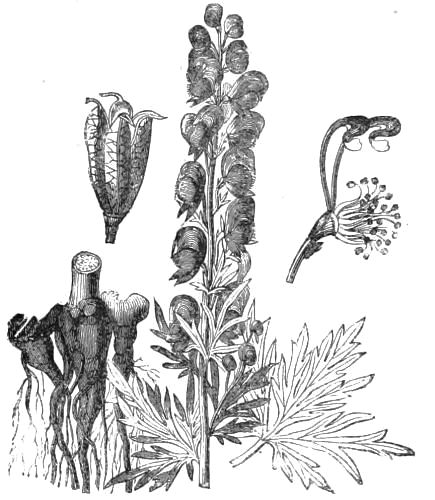
FIG. 18. ACONITUM NAPELLUS, showing Root, Seed-pod, Flower-spike, Leaf, and Flower with Sepals removed.
A. Napellus (little turnip).* Common Monk's Hood. fl. blue, large, on a large terminal raceme; peduncles erect, pubescent; spur capitate; helmet convex-hemispherical, gaping, smoothish; lip revolute. Summer. l. pedately five-lobed. h. 3ft. to 4ft. There are a great number of varieties of this species cultivated and introduced. The following are some of the names representing slightly varying forms which have, however, been regarded as species by Reichenbach and other authors: acutum, amœnum, Bernhardianum, Braunii, callibotryon, Clusianum, commutatum, firmum, formosum, Funkianum, hians, Hoppeanum, Kœhleri, lætum, laxiflorum, laxum, Mielichhoferi, napelloides, neomontanum, neubergense, oligocarpus, rigidum, strictum, tenuifolium, venustum, virgatum. One of the most virulent of poisonous plants, both to cattle as well as human beings; and, notwithstanding its eminently handsome appearance, it should only be planted in places where no danger is likely to arise from its presence. See Figs. 17 and 18.
A. nasutum (great-nosed). fl. violet; panicle contracted, quite smooth; spur elongated, arched; helmet conical, bending forward; beak short. June. l. with broad, trapeziform, pinnate lobes. h. 3ft. Caucasus, &c., 1818. SYN. A. gibbosum.
A. nitidum (shining). Synonymous with A. Gmelini.
A. Ottonianum (Otto's).* fl. blue, variegated with white; young peduncles nodding; spur supine, somewhat hooked; helmet arched. July, August. l. with trapeziform, pinnate lobes. h. 2ft. to 4ft. Carpathian Mountains, 1824.
A. paniculatum (paniculate).* fl. large, violet; panicle terminal, much branched, loose or contracted, more or less pubescent; helmet conical, beaked; front sinuate. June to September. l. smooth, with trapeziform, pinnate lobes. h. 2ft. to 3ft. France and Switzerland, 1815. SYN. A. hebegynum.