THE DICTIONARY OF GARDENING, (continued 7)
Reading edition
Gathering. The three following tests are sure indications of the gathering period: (1) The apples will begin to fall of their own accord; (2) their seeds will be plump and brown in colour; and (3) the fruit will separate with a mere touch from the trees; the second test may be said to be infallible. All Apples should be gathered before the end of October, for none will bear frost with impunity. They must be gathered in dry weather, and handled with the greatest care, laid gently in baskets and trays, in single file only, and conveyed to the store room.
Storing. The simplest and best method is in choosing or forming some room or place free from extremes of heat and cold, dryness or damp, where a temperature of about 45deg. is maintained. A current of air is not necessary. The shelves should be made of poplar, sycamore, lime, or other white wood. Deal, oak, ash, elm, and almost all other woods, give a bad taste to the fruit. One sheet of paper—and paper only—should be placed under the fruit. They ripen best, and are of the highest flavour when left fully exposed to the free atmosphere of the fruit room, and in order to preserve a more even temperature the light should be shut out. Early and late ripening varieties must be stored in separate places, as well as all inferior or injured fruit. The plan of isolating each fruit by packing in tissue paper, sand, burnt earth, or other substances, often destroys the flavour of the fruit, and possesses no material benefit otherwise.
Diseases. Apple Mussel Scale, Apple or Codlin Grub, Canker, Mildew, American Blight, Scale, and Insect Pests, such as Caterpillars, Maggots, and Weevils, see under their separate headings.
The following are some of the best varieties in cultivation:—
Adams' Pearmain. Dessert. Fruit medium, very handsome; flavour juicy and sugary. December to March.
Alexander. Kitchen. Very large, showy, and good. September to December.
Alfriston. Kitchen. Very fine, large, white flesh. November to April.
Ashmead's Kernel, or Cockle Pippin. Dessert. Fruit below medium; flavour very rich and sugary. This variety is, according to Mr. Rivers, much esteemed in Gloucestershire. November to January.
Bedfordshire Foundling. Kitchen. Fruit large. One of the finest and most useful sorts, a great bearer. February to May.
Bess Pool. Kitchen. Fruit large. Good late cooking apple. December to May.
Betty Geeson. Kitchen. Fruit large, produced in great abundance. February to May. A valuable sort.
Blenheim Pippin. One of the best kitchen sorts. November to February.
Boston Russet. Dessert. Fruit medium; flavour very sugary and rich, similar to the Ribston Pippin. An excellent American variety. January to May.
Brabant Bellefleur. Kitchen. Fruit large, round, pale yellow, red-streaked. A most useful cooking variety, also useful for dessert. November to April.
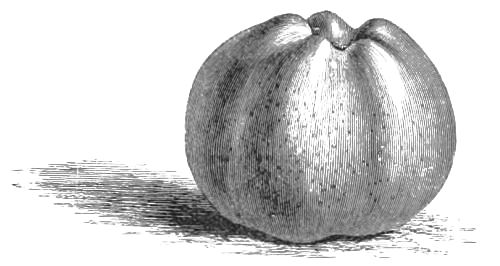
FIG. 123. APPLE, CALVILLE BLANCHE.
Calville Blanche. Dessert. Fruit large; flavour first-class. October to December. See Fig. 123.
Cellini. Kitchen. Fruit perfect in form, size, colour, and quality. October to January.
Claygate Pearmain. Dessert. Fruit medium; flavour rich, aromatic, excellent, same as Ribston Pippin. January to May.
Coe's Golden Drop. Dessert. Fruit small, with a crisp and juicy flavour. November to January. A delicious variety.
Cornish Aromatic. Dessert. Fruit medium; flavour rich, juicy, and aromatic. October to December.
Cornish Gillyflower. Dessert. Fruit medium; flavour very rich, quite aromatic. October, November to January. An excellent variety, thriving best in a warm situation.
Court of Wick. Dessert. Fruit medium, very handsome; flavour somewhat similar to Golden Pippin. December to March.
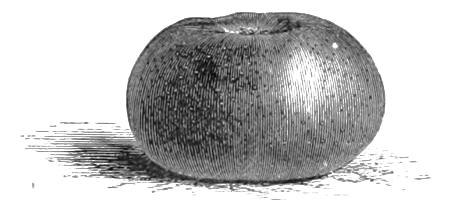
FIG. 124. APPLE, COURT PENDU PLAT.
Court Pendu Plat. Dessert or kitchen. Fruit medium, rich russet brown, of first-rate quality, and the tree is a good cropper. November to April. See Fig. 124.
Cox's Orange Pippin. Dessert. Fruit medium, very handsome; flavour rich aromatic. October to December. One of the best apples grown.
Cox's Pomona. Kitchen. Fruit very large, of superior quality. October.
Devonshire Quarrenden. Dessert. Fruit medium, excellent quality, and handsome. July to September. A very prolific sort.
D. T. Fish. Kitchen. Fruit large, roundish, of a clear straw-colour, with small specks of russet, slightly flushed with crimson on the side where the sun strikes it; flavour sub-acid. November to January. A fine and handsome variety.
Duchess of Oldenburgh. Kitchen. Fruit large, red-striped. August to October. A very desirable and handsome Russian variety.
Duke of Devonshire. Dessert. Fruit medium; flavour crisp, juicy, rich and sugary. December to March.
Dumelow's Seedling, or Wellington, or Normanton Wonder. Kitchen. Fruit firm, large, and somewhat acid. November to March.
Early Harvest. Dessert. Fruit medium; flavour juicy, excellent, with a pleasant sharpness. July to September. According to Mr. Rivers this variety is equally good for cooking or dessert, and is a very fertile tree on the Paradise stock.
French Crab. Kitchen. Fruit large, pale green, firm, acid. An excellent sort, and the longest keeper.
Golden Pippin. Dessert. Fruit small, very excellent flavour. November to January. A well-known and highly-esteemed sort.
Golden Reinette. Dessert. Fruit rather small, yellowish red, streaked with red; flavour excellent, sweet and rich. One of the best and most useful of dessert apples. October to December.
Gravenstein. Kitchen. Fruit large, handsome, sweet and crisp. November to January. A very prolific sort.
Greenup's Pippin. Kitchen. Fruit very large. February to May. A vigorous grower and abundant bearer.
Irish Peach. Dessert. Fruit medium, yellowish-green, very early; flavour juicy, excellent. July and August. A very good variety, often known as Early Crofton.
Jolly Beggar. Kitchen. Fruit large, pale yellow, tender and juicy. November to January. A very desirable sort and an extraordinary cropper.
Keddlestone Pippin. Dessert. Fruit small, yellow or golden colour, specked with russet; flavour delicious, highly aromatic. December to March. An excellent variety.
Kerry Pippin. Dessert. Fruit medium, firm, yellow, and red; flavour sugary and rich. September to October.
Keswick Codlin. Kitchen. Fruit large and early. August to October. An admirable sort for market purposes.
King of the Pippins. Dessert. Fruit medium, yellow and red; flavour juicy and rich. October to January.
Lady Henniker. Kitchen. Fruit yellow, with crimson streaks near the sun, highly flavoured, and with a pleasant perfume. February to May. An excellent sort, suitable for dessert or kitchen.
Lodgemore Nonpareil. Dessert. Fruit small; flavour rich, sugary, and aromatic. January to May. An excellent sort.
Lord Suffield. Kitchen. Fruit very large, white, soft, excellent for sauce and tarts. August to September.
Manx's Codlin. Kitchen. Fruit large. September and October. One of the finest and most useful of kitchen sorts.
Mère de Ménage. Kitchen. Large and good. October to March.
Mr. Gladstone. Dessert. Fruit large and handsome, very early, scarlet cheek, striped and shaded; of excellent quality. July and August. New.
New or Winter Hawthornden. Kitchen. Fruit very large, excellent. November to January. An extraordinary bearer, one of the best for sauce and cooking.
Nonsuch. Kitchen. Fruit large, juicy. August to October. An admirable sort, unequalled for sauce and cooking.
Norfolk Beefing. Kitchen. Large and good flavour, excellent keeper, most useful for baking whole and preserving. November to July.
Norfolk Greening. Kitchen. Fruit medium; rather acid. Keeps till April or May.
Northern Spy. Dessert. Fruit large, tender; flavour highly aromatic. December to May.
Old Nonpareil. Dessert. Fruit medium, tender, and juicy. November to January. A prolific variety.
Pitmaston Pineapple. Dessert. Fruit small; flavour very rich. July to September. According to Mr. Rivers this variety is a very abundant bearer on the Paradise stock; it is not a vigorous grower.
Red Astrachan. Dessert. Fruit good size, bright; flavour delicate and rich. August to September.
Red Ingestrie. Dessert. Fruit very pretty bright red next the sun, on a yellow ground, flesh pale yellow; flavour brisk and sparkling, like the Golden Pippin in quality. August and September. An excellent sort.
Red Juneating, or Margaret. Dessert. Fruit medium, early, very good quality. July and August. A well-known sort, with numerous synonyms.
Red Quarrenden. Dessert. Fruit under medium, bright scarlet; flavour crisp and sweet. August. One of the best summer sorts.
Reinette du Canada. Dessert. Fruit greenish-yellow and brown, large; flavour juicy, brisk, sub-acid. November to May. See Fig 125.
Reinette Grise. Dessert. Flesh yellowish-white, sugary, pleasant; flavour sub-acid. November to April. It does best on the Paradise stock, and is an abundant cropper. See Fig. 126.
Ribston Pippin. Dessert. Fruit greenish-yellow and red, medium; flavour rich, aromatic, excellent. October to December.
Sam Young. Dessert. Fruit small, yellowish with russet spots; flavour delicious, tender, and juicy. October to December. An excellent Irish sort.
Scarlet Crofton. Dessert. Fruit medium, yellow and red; flavour crisp, juicy, and sweet. October to December.
Scarlet Nonpareil. Dessert. Fruit well coloured, large; flavour crisp and juicy. January to March.
Small's Admirable. Kitchen. Fruit large, green, crisp, sweet, and juicy. November to January. A prolific cropper.
Stamford Pippin. Dessert. Fruit large, with a brisk flavour and an agreeable aroma. November to January. A very desirable sort.
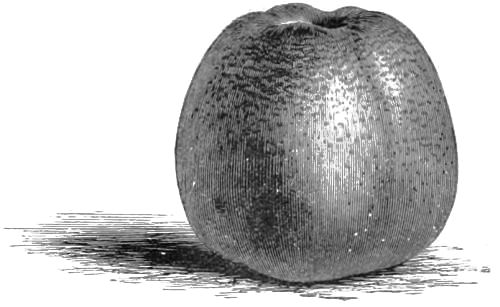
FIG. 125. APPLE, REINETTE DU CANADA.
Sturmer Pippin. Dessert. Fruit medium; flavour brisk and rich. February to June.
Syke House Russet. Dessert. Fruit small; flavour very rich. January to May. An excellent sort.
Tower of Glammis. Kitchen. Fruit yellow, very large, square-shaped, crisp, and excellent. February to May. A very excellent sort.
Van Mons Reinette. Dessert. Fruit small, with a rich, aromatic, and excellent flavour. November to January.
Waltham Abbey Seedling. Kitchen. Fruit large. November and December. An admirable sort.
Warner's King. Kitchen. Fruit large, handsome, and good. November to March.
Worcestershire Pearmain. Kitchen. Fruit large, conical, of a very brilliant colour; flavour crisp and juicy. August to October. A splendid variety, said to be as prolific as Lord Suffield.
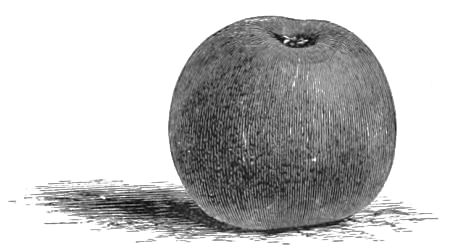
FIG. 126. APPLE, REINETTE GRISE.
White Juneating. Dessert. Fruit small, very early, and good quality, but a bad keeper. July and August. A prolific sort.
White Nonpareil. Dessert. Fruit medium, very delicious. March to June. A very desirable sort.
Winter Quoining, or Queening. Dessert. Fruit very bright, almost red; flavour excellent. November to May. An excellent sort, useful for dessert or culinary purposes.
Winter Strawberry. Dessert. Fruit yellow, medium, striped with red; flavour brisk aromatic. November to March. A very useful sort.
Wormsley Pippin. Kitchen or dessert. Fruit of an excellent quality, large, pale green; excellent for kitchen or dessert. September to October.
Yorkshire Greening. Kitchen. Fruit large, juicy, tender. November to January.
For Cordons the following are the best:—BETTY GEESON, COE'S GOLDEN DROP, COX'S ORANGE PIPPIN, DUKE OF DEVONSHIRE, KING OF THE PIPPINS, LODGEMORE NONPAREIL, NORTHERN SPY, REINETTE DU CANADA, RIBSTON PIPPIN, SCARLET NONPAREIL.
For Pyramidal, Bush, and Espalier Trees, the best are:—ADAMS' PEARMAIN, ASHMEAD'S KERNEL, BOSTON RUSSET, CLAYGATE PEARMAIN, CORNISH GILLYFLOWER, COURT OF WICK, COURT PENDU PLAT, COX'S ORANGE PIPPIN, EARLY HARVEST, GOLDEN PIPPIN, GOLDEN REINETTE, IRISH PEACH, KEDDLESTONE PIPPIN, KERRY PIPPIN, RED INGESTRIE, RED QUARRENDEN, REINETTE DU CANADA, RIBSTON PIPPIN, SAM YOUNG, SCARLET CROFTON, SCARLET NONPAREIL, STURMER PIPPIN, SYKE HOUSE RUSSET, WORMSLEY PIPPIN. The following Kitchen sorts are well adapted to this method:—ALFRISTON, BED-FORDSHIRE FOUNDLING, BRABANT BELLEFLEUR, CALVILLE BLANCHE, CELLINI, COX'S POMONA, D. T. FISH, DUCHESS OF OLDENBURGH, DUMELOW'S SEEDLING, JOLLY BEGGAR, KESWICK CODLIN, LORD SUFFIELD, MANX'S CODLIN, NEW HAWTHORNDEN, NONSUCH, WALTHAM ABBEY SEEDLING, WARNER'S KING.
For Cold and Exposed Situations, the following are the best:—BESS POOL, CLAYGATE PEARMAIN, FRENCH CRAB, GREENUP'S PIPPIN, KESWICK CODLIN, NONSUCH, STURMER PIPPIN, TOWER OF GLAMMIS, WINTER STRAWBERRY, WORMSLEY PIPPIN.
For Cottage Gardens: ALEXANDER, BEDFORDSHIRE FOUNDLING, BLENHEIM PIPPIN, KING OF THE PIPPINS, MANX'S CODLIN, NEW HAWTHORNDEN, REINETTE DU CANADA, RIBSTON PIPPIN, STURMER PIPPIN, WALTHAM ABBEY SEEDLING, WARNER'S KING, WORMSLEY PIPPIN.
APPLE BERRY. See Billardiera.
APPLE-BLOSSOM WEEVIL (Anthonomus pomorum). This is a small beetle of a reddish-brown colour, with three inconspicuous stripes of a paler colour behind the head; the wing cases show a large pitchy-coloured blotch, with oblique striæ and yellowish spots thereon. The female busily engages herself in piercing the flower buds; while the male may be usually seen flying about the trees during the breeding season, which, of course, varies according to the earlier or later expansion of the buds. The female, by means of strong jaws at the end of the long proboscis, bores a hole in the bud, in which she lays a single egg, finally closing the opening, then passing on to other buds. The laying season lasts for two or three weeks, or, indeed, as long as the buds remain unexpanded; eggs are never laid in open blossoms. In warm weather, the eggs are hatched in six or seven days, usually about the end of April, into small, white, legless maggots, which feed upon the stamens and pistil; hence, although the petals are normally coloured, and expand, the flowers ultimately wither, and in some seasons very serious consequences have arisen from these injurious little pests. The maggot is fleshy, whitish, with a few hairs and a black, hard head; in a few days, it turns into a brown chrysalis or pupa, which, in turn, is changed into the Weevil, only about a month having elapsed from the deposition of the egg till the Weevil is developed. It feeds upon the foliage during summer, and hybernates in crannies of the bark, or under the soil at the base of the trees, during winter, waking up in the following spring to go through the same performances as its parents.
Remedies. Some of the methods advised for the extirpation of the American Blight will prove very useful for the destruction of this pest. Clear away all useless portions of the bark and rubbish round about the tree during the winter, and many will be destroyed. Place bandages of tarred cloth around the stem in spring; this will prevent the females crawling up, as they seldom fly. If a white cloth is placed beneath the tree affected when in bud, and the tree is severely shaken, a large number will be caught, as the Weevil falls to the ground when alarmed. Timely thinning of the trees, allowing the free admission of light and air, is also a very effectual preventive, as it has been proved that the greatest ravages are committed where neglect of this has been the rule; and that, on the other hand, in proportion to its being done, the pest has been lessened in numbers.
APPLE MUSSEL SCALE (Aspidiotus conchiformis). This insect attacks the bark of Apple and Pear-trees. It is in outward appearance like the half of a mussel shell. Under the scale is the insect. It is closely allied to the true scale insects, and has similar habits. The scales are about ⅛in. long, brown, and wider at one end than at the other. The female is like a fat, green, fleshy maggot, without jointed limbs. The eggs of this curious insect are not laid, but simply remain in the body of the mother until she dies, thus leaving a protecting shield or case from which the hatched larvæ emerge. To get rid of this insect, therefore, the females containing eggs should be destroyed. It differs from most other species in the absence of the long tail filaments. If numerous, this Scale causes the trees to become sickly and unfruitful. It is difficult to extirpate.
Soft-soap Lather. When the leaves fall, in autumn, the trees should be treated with a stiff sash-tool, and all the Scale rubbed off, keeping the brush just moist, and not rubbing the buds. Applied for two seasons, this should clear the trees. All loose bark should be removed.
Seal Oil is sometimes recommended as a good remedy: but oils are rather unsafe applications to the bark of trees, especially of the young branches.
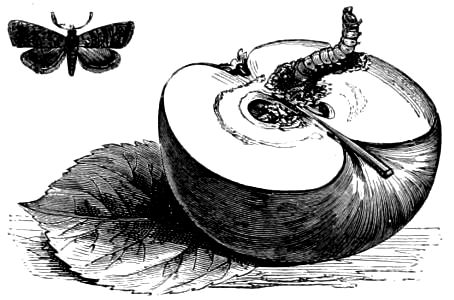
FIG. 127. CODLIN MOTH AND GRUB (CARPOCAPSA POMONANA).
APPLE OR CODLIN GRUB (Carpocapsa pomonana). During the month of May, the well-known Codlin Moth (see Fig. 127) lays its eggs in the calyces, usually one in each, of the young, quickly-growing apple. The moth itself is a small insect; the fore-wings are grey, prettily speckled with delicate, darker streaks, and with a curved golden mark on the hinder part, inclosing one of a reddish-brown colour. The hind wings are usually dark, as is also the body. The caterpillar, when hatched, is white, with black head and neck, and with four rows of black marks along the whole body. The colours soon, however, become less decided, taking an indistinct brownish or grey hue. After being hatched, the caterpillar gnaws its way down the fruit, keeping clear of the core, and gradually forces its gallery towards the rind of the fruit, which it finally pierces, the opening serving as the outlet for the dirt. When nearly full grown, it pierces the core and feeds upon the pips, which injury speedily causes the fruit to drop. The insect then emerges therefrom, and finds a suitable shelter in a cranny of the bark, where it spins a cocoon; and, according to British authorities, it remains in the larval state for some weeks, finally assuming the chrysalis form, and thus passing the winter; the moth emerges the following season. Shortly after development, the moths pair, the female depositing eggs in the fruit in June or July, according to the season.
Practically, there is no preventive; but the following hints will serve to greatly reduce the numbers. All apples that fall ere they are ripe should be picked up as promptly as possible, and be given to the pigs; or pigs should be turned into the orchard to clear off the fallen fruit. The following is the only serviceable remedy:
Hayband Trap. This is simply a loosely made hayband twisted around the stems of the trees, about 1ft. from the ground. The grubs, in searching for a suitable place in which to make a cocoon, will generally choose the bands. At the end of the season, all the haybands should be collected and burnt, and the stems of the trees from which they were removed should be cleared of any cocoons which may adhere to them. All loose bark and other rubbish should be removed from the tree trunks, and also from the ground below.
APPLE OR CODLIN GRUB TRAP. An exceedingly ingenious and effective method of alluring that obnoxious pest, the Apple Grub. The trap (Fig. 128) consists of two, three, or more thin pieces of board, 12in. to 20in. in length, and 2in. to 4in. wide, with a screw (a) through their centre. The screw must be long enough to be firmly driven into the trunk of the tree, so as to hold the boards in position. Small slips of wood (b) are inserted between the boards, to keep them sufficiently open to allow of the entry of the grubs, as shown at d. The boards are cut on each side of the screw, as at c, to facilitate their separation when fastened together by the silken threads of the grubs, and to better expose the latter when the trap is opened. This handy trap, which is of American origin, is very cheap. A great number of them may be collected with little trouble, submitted to a killing heat, and replaced again; and they can be used either on the ground or on the trees. As regards killing the grubs when caught, Mr Weir, the inventor, says: "The quickest and best way is to have a large tin pan, bent in on one side, so as to fit closely to the trunk of the tree. When you reach the tree, drop upon your knees, place the depression in the pan against the trunk of the tree, hold it there by pressing your body against it, and you have both hands free to open the trap. When opening it, many of the pupæ or chrysalids will fall into the pan. The trap must be turned clear around, as many will be found between it and the bark. A person will open and kill the worms in from four hundred to eight hundred traps in a day."
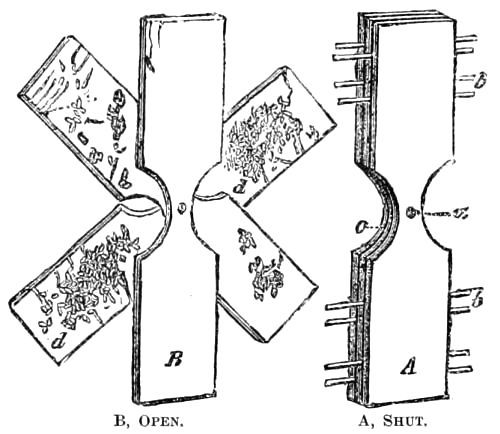
FIG. 128. APPLE OR CODLIN GRUB TRAP.
APPOSITE. Placed side by side.
APPROXIMATE, APPROXIMATED, APPROXIMATING. Near together.
APRICOT (Armeniaca vulgaris). The Apricot, or, as it was formerly written, "Abricock," is a much esteemed and luscious fruit. It is said to have been introduced into this country during the reign of Henry VIII. The Apricot is one of the earliest flowering of fruit-trees (see Fig. 129), and is generally in bloom during February. This fact is a great drawback, as it is a difficult matter to save the flowers from destruction by the spring winds and frosts. The fruit (see Fig. 130) contains less acid than most stone fruits, and in appearance it is perhaps the handsomest of all. Success with its culture in many gardens is by no means certain, but with careful preparation of borders and protection of the flowers in spring, satisfactory results are often obtained. Large quantities of fruit are annually imported to this country from France; but their quality and flavour cannot be compared with that of good home-grown produce.
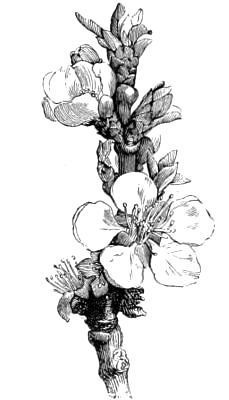
FIG. 129. BLOSSOM OF APRICOT.
Propagation is effected by seeds or budding. The stones, selected from the best varieties, may be sown as soon as the fruit is ripe, in August or September, in light rich soil, and covered with about 2in. of earth, over which a little litter should be spread during winter. After one season's growth, the plants should be lifted, and the tap roots slightly cut back if the trees are intended for walls. They should then be planted in nursery lines, allowing about a yard between the rows, and 2ft. from plant to plant.
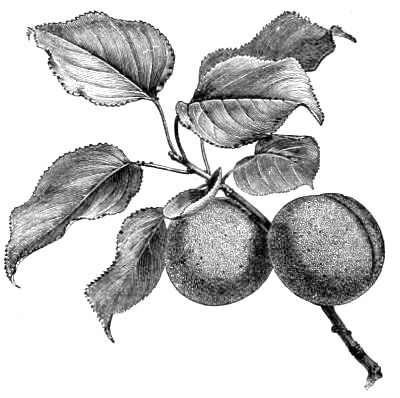
FIG. 130. FRUITING BRANCH OF APRICOT.
Budding is the most general mode of propagating Apricots. They are frequently budded from the beginning to the middle of June on seedling, and also on plum stocks, of which latter the Mussell, Saint Julien, Brussels, and Black Damson are the best. For dwarf trees, the stock should be budded about 1ft. from the ground. There are many disadvantages in having a great length of stem. "Rider" trees require a stem from 3½ft. to 6ft.; half-riders, 2½ft. to 3ft. Grafting by the Whip method is sometimes employed, but, for many reasons, it is much inferior to Budding.
Planting, &c. South-west and western aspects suit the Apricot best, but the fruit has been ripened in warm localities on walls facing several points north. Large areas of garden wall (see Figs. 131 and 132), the walls of stables, barns, outbuildings, and two sides of at least hundreds of cottages, might thus be utilised for the cultivation of this tree. If well drained, almost any garden soil will bring these fruits to perfection; light, fibrous, rather sandy loam will, however, prove most satisfactory. There should be a considerable depth of soil; a yard is not too much, provided it be on a dry base, which is most important. Heavy soils may be improved for Apricot culture by the addition of an equal portion of light loam, mortar rubbish, or charred refuse. In furnishing walls, the distance apart may vary from 2ft. between Cordons, to 12ft., 15ft., or even 20ft. between Fan-shaped trees. The roots should be carefully arranged, interlayered at all points with fine soil, and the whole covered to a depth of 3in. or 4in. Not only should the roots have a good covering of suitable earth, but a secondary one of litter, or other light material, should be added, to render them frost proof in winter, and drought and heat proof in summer. Newly planted trees should, on no account, be allowed to get dry at the root. A thorough soaking of soft rain, or manure water, will often save a crop, and restore the trees, when all other surface remedies or appliances fail. Surface sprinklings overhead with the garden engine, in the afternoons of bright days, are beneficial, and help to keep the foliage clean and healthy. So soon as the trees are cleared of their fruit, attention should be directed to the maturation of the wood. All superfluous shoots should be removed, any excess of growth left on the shoots cut back, and every effort made to perfect the wood already made, rather than force the tree to make more. Unless the weather be very dry, water should not be applied after this stage.
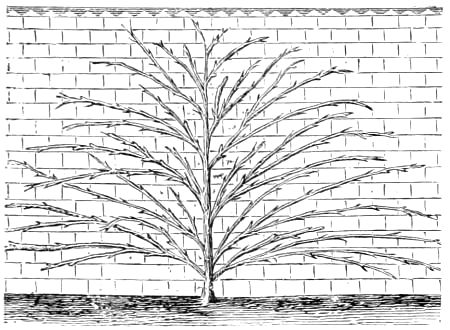
FIG. 131. APRICOT TREE, showing method of Wall Training.
Protection. It is almost hopeless to expect a crop unless the blossoms are protected, by mats or other means, from spring frosts. Temporary wooden copings, from 1ft. to 2ft. wide, laid on iron brackets, are indispensable for warding off storms, and keeping other coverings away from the flowers. These should not be put up till the trees are just bursting into bloom, and may safely be removed about the end of May. A few fish or other nets, spread over the trees, afford considerable resistance to the radiation of heat. This is assuredly one of the easiest, if not one of the most efficient, modes of protection. Frigi-domo and other thick shadings are sometimes used, but they require to be removed from the trees in the day time. The thinner nets mentioned are generally not in use for other purposes at this time of year, and may remain over the trees altogether. Glass copings are the best, but, being rather expensive, they cannot be used by the majority of cultivators. They have, however, been applied with good results to trees that had previously failed.
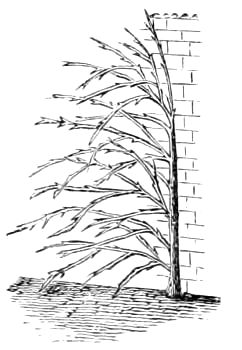
FIG. 132. APRICOT TREE, showing method of Training suitable for Gable Ends of Cottages.
Cropping, &c. Thinning of the fruit needs early and careful attention. The average of 3in. apart may be chosen for a maximum yield. As the fruit approach maturity, overhanging leaves, or branches of young wood, must be removed, to admit sun and light to properly ripen and colour them. Apricots for preserving should be gathered quite dry, and with the sun upon them. For dessert, they should be plucked in the morning, and placed in a cool room till wanted.
Under Glass. The Apricot will hardly bear forcing. It is more sensitive to heat than almost any other of our semi-hardy fruits. Practically, it is found that a confined atmosphere, or the slightest excess of heat, brings its blooms off in showers, and this, of course, mars all prospect of fruit. But in cold climates and northern latitudes under glass is the best and only means of growing them. Should red-spider appear, it is proof that the roots or the atmosphere, probably both, have been too dry; more moisture, and syringing over the leaves, are the surest remedies. The borders need to be about 2ft. or 2ft. 6in. deep, of any light rich soil. Fresh planted trees should be frequently syringed overhead before and after the flowering period. After they have become fully established, less overhead sprinkling is needed. During all the earlier stages of growth, and until the fruit are stoned, an artificial temperature of 45deg. should not be exceeded. After that stage, the fruit will bear a heat of 50deg. or 55deg. It is hardly safe or desirable to exceed the latter under glass, and unless abundance of air is given, 55deg. may bring off the fruit, even at an advanced stage. A thorough soaking, at intervals of fourteen days during the height of the growing season, may be applied; and, should the trees be heavily cropped, manure water may be given at every alternate watering. It is also a good practice to mulch the surface of heavily cropped trees with 3in. or 4in. of good dung. The fruit should, however, be freely thinned to distances of from 4in. to 6in. apart at the most. There are three general methods of growing them under glass: The trees may be trained on trellises or walls; grown as natural standards, tall or dwarf; and as bushes, either planted out or in pots.
Varieties. The varieties of Apricot, unlike most other fruit, are not numerous; and the following will be found in every way representative and satisfactory:
Blanche, or White Masculine. A small and delicate fruited sort. Fruit pale whitish-yellow, tinged with brownish-red next the sun, covered with a fine white down; rich, delicate, and sugary.
Blenheim, or Shipley's.* Very early and prolific. Colour deep yellow; flesh medium, rich, and juicy. Ripe in July.
Breda.* A small sort, of excellent quality. Colour deep orange; flesh firm, juicy, and rich. Hardiest sort grown.
Kaisha.* Fruit round, much smaller than Moorpark. Colour pale citron; flesh tender, rich, juicy; flavour delicate and delicious; kernel very sweet.
Large Red. The deepest coloured of all. Fruit very large; colour deep reddish-orange; flesh rich and juicy; kernel bitter.
Moorpark.* The sort most generally grown; large, handsome, and of excellent quality. Colour brownish-orange; flesh rich, juicy, and sweet. It is one of the best and most useful sorts in cultivation.
Peach, or Grosse Peche. Distinct and very desirable. Fruit very large; flesh rich, firm, and juicy. One of the very best.
Royal.* Not unlike Moorpark, but with a more robust constitution, and less given to limb dying. Fruit large, dull, yellow, rich, and juicy.
Turkey.* A good variety. Colour pale yellow; flavour rich and juicy; flesh firm.
For modes of Training and Budding, Diseases, Insect Pests, &c., full information will be found under each individual title.
APTERANTHES. See Boucerosia.
APTEROUS. Without wings.
AQUATIC PLANTS. The culture of Aquatic Plants, both indoors and in the open air, has been greatly neglected of late years; they are, therefore, rarely seen to perfection in places other than where their culture is made a speciality. Generally speaking, they are most easily grown. The following stove and greenhouse genera are well worth attention: Aponogeton, Cyperus, Damasonium, Herpestis, Limnocharis, Nelumbium, Nymphœa, Ouvirandra, Pistia, Pontederia, Salvinia, Thalia, Trianea, Victoria. Many species belonging to some of the foregoing genera are hardy, as are also the following: Alisma, Butomus, Calla, Hottonia, Menyanthes, Nuphar, Polygonum, Sagittaria, Trapa, Typha, Villarsia.
AQUATICUS. Living in water.
AQUATILIS. Living under water.
AQUIFOLIACEÆ. See Ilicineæ.
AQUILEGIA (from aquila, an eagle; in reference to the form of the petals). Columbine. ORD. Ranunculaceæ. Erect hardy perennial herbs with fibrous roots. Flowers solitary or panicled, drooping; sepals five, petaloid, deciduous; petals five, concave, spurred; spurs very large, produced downwards into hollow tubes, and frequently curved at the extremity; carpels five, sessile, free. Radical leaves on long stalks, twice or thrice ternate, with trifid-toothed, usually blunt segments. Too much praise can scarcely be lavished upon this elegant genus of plants. They prefer a moist and sheltered situation, with exposure to the sun. The more robust species will thrive in ordinary garden soil, but the rarer and more delicate kinds require a good friable sandy loam and leaf soil, with good drainage. Seed is produced in abundance, and must be sown very thinly, as soon as practicable after being ripe, in a shady place or in pans in a cold frame. When up, and strong enough to remove, the seedlings may be planted out where they are to bloom, allowing every plant at least 9in. each way. The strong-growing kinds may be placed in the border, the dwarf ones on the rockery. When in bloom, the inferior sorts should be weeded out, retaining only the best varieties. To obtain seed true of any species, it is absolutely necessary to plant the separate kinds far apart, and cover them with fine muslin, to prevent the access of insects to the flowers, as none are more easily cross-fertilised. Division of the root is the only way to perpetuate any particular variety with certainty, unless seed is saved in the way mentioned, or imported from the native habitats of particular species. There are many beautiful hybrids, as well as species, in cultivation.
A. alpina (alpine).* fl. from 2in. to 3in. in diameter when expanded, deep blue or blue and white, on leafy, two to three-flowered stems; spurs straight, but somewhat incurved at the apex, one-half shorter than the petal limb. May. l. with segments deeply divided into linear lobes. h. 1ft. Alps of Switzerland, in shady humid places, 1731. Plant this on the rockery.
A. arctica (Arctic). A form of A. formosa.
A. atropurpurea (dark purple). fl. dark purple or bluish violet, about 1in. or 1½in. in diameter when expanded, two or three in a head; spurs straight, equal in length with the petals' limb; sepals about as long as the petals. May. l. petioled, biternate. h. 2ft. to 3ft. Siberia. Border plant.
A. aurea (golden).* A synonym of A. chrysantha flavescens.
A. Bertoloni (Bertoloni's).* fl. about 1in. across, blue-violet throughout; sepals about ¾in. long, rounded; petals about the same length; spurs very short, knobbed; stems two to four flowered. June and July. l. small, dark green, and glaucous. A very pretty little alpine, growing about 1ft. high. SYN. A. Reuteri.
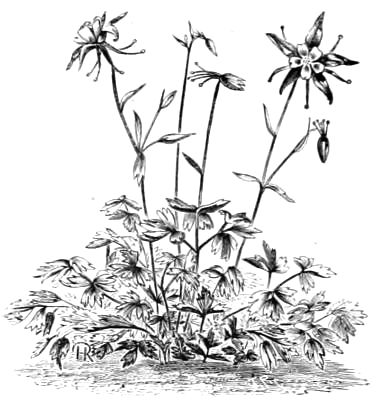
FIG. 133. AQUILEGIA CÆRULEA.
A. cærulea (sky-blue).* fl. several on a stem, blue and white, sometimes more or less tinted with lilac or claret, rarely pure white, when expanded 2½in. to 3in. in diameter; spur very slender, nearly straight, green tipped, about 2in. long. April to July. l. large, biternate. h. 9in. to 15in. Rocky Mountains, 1864. A very lovely species for the border or base of the rockery. SYNS. A. leptoceras, A. macrantha. See Fig. 133.
A. c. alba (white).* fl. the same size and form as the type, white throughout. Rocky Mountains. A very rare and lovely variety; sometimes met with under the name of A. grandiflora.
A. c. hybrida (hybrid).* fl. blue and white, not so wide across as the type, but more numerous, and the plant has a much more vigorous habit. Of garden origin.
A. californica (Californian).* A form of A. formosa.
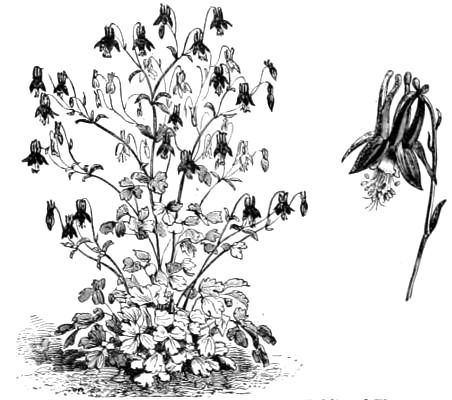
FIG. 134. AQUILEGIA CANADENSIS, showing Habit and Flower.
A. canadensis (Canadian).* fl. scarlet, mixed with yellow, less than 1in. in diameter; spur straight, longer than the limb; styles and stamens protruding; sepals acutish, a little longer than the petals' limb. April to June. l., segments three-parted, bluntish, and deeply toothed at the apex. h. 1ft. to 2ft. North America, 1640. Border or rockery; very pretty. See Fig. 134.
A. chrysantha (yellow-flowered).* fl., sepals primrose yellow, spreading horizontally in full expansion, nearly or quite 1in. long, tinted claret at the tip; limb of petals deeper yellow, not quite so long; spur straight, very slender, divergent, 1½in. to 2in. long; stems many-flowered. May to August. l. biternate. h. 3ft. to 4ft. California, 1873. One of the finest of all hardy perennials for the border.
A. c. flavescens (yellow). fl. of a uniform bright canary yellow, tinged with red; spur somewhat shorter than in A. canadensis, and slightly incurved. California, 1872. SYN. A. aurea.
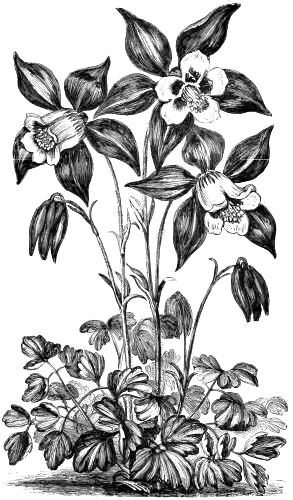
FIG. 135. AQUILEGIA GLANDULOSA.
A. eximia (choice). Synonymous with A. formosa.
A. formosa (handsome).* fl., sepals bright red, usually less than 1in. long, with an obtuse green tip; limb of petals yellow, about half as long as the sepals; spurs ½in. to ¾in. long, slender in the lower half, nearly straight, distinctly knobbed at the tip; stems many-flowered. May to September. l. biternate. h. 2ft. to 4ft. North America. Border. The following are synonyms and varieties: A. arctica, A. californica, A. eximia, and A. f. truncata, revealing only trivial differences. There is a very beautiful hybrid known in gardens as A. californica hybrida, with the sepals and petals yellowish, or tinged with orange, while the long slender spurs are orange red; it is one of the handsomest of all. All the forms are very showy, and well worth growing.
A. fragrans (fragrant).* fl. white or pale claret purple, finely pubescent, very fragrant; sepals about 1½in. long, not reflexing, twice longer than the broad petals' limb; spur slender, slightly curved, knobbed at the top, same length as the petals; stems few-flowered. May to July. l. biternate. h. 1½ft. to 2ft. Himalayas, 1839. This requires a warm position.
A. glandulosa (glandular).* fl., sepals bright lilac blue, about 1½in. long, more than twice the length of the petals' limb; petals white; spur ¼in. long, or but little more, stout, much incurved; stems one to three-flowered. Spring. l. biternate. h. 8in. to 12in. Siberia, 1822. Extremely pretty. See Fig. 135.
A. g. jucunda (pleasant). fl. rather smaller. Very handsome little plants, freely hybridised, and it is necessary to keep raising fresh batches, as they are scarcely more than biennial.
A. glauca (glaucous). fl. white, tinted claret, fragrant; sepals 1in. long, not reflexing; limb of petals ¾in. long; spur straight, or a little curved, about ⅓in. long; stem three to four-flowered. June. l. biternate. h. 1ft. to 1½ft. Himalayas, 1839. Rather tender; plant in a warm dry position.
A. leptoceras (slender-horned). A synonym of A. cærulea.
A. macrantha (large-flowered). A synonym of A. cærulea.
A. olympica (Olympic).* fl. large, delicate mauve blue; petals white, rather shorter than the sepals; spur stout, short, obtuse. l. bi- or triternate, glaucous. h. 1½ft. 1880. Mount Olympus. See Fig. 136.
A. pyrenaica (Pyrenean).* fl., sepals bright lilac blue, about 1in. long, but not quite as much broad; limb of petals about ½in. long, and half as broad; spur slender, nearly straight, or rather incurved, nearly or quite ¾in. long, scarcely knobbed at the end; stem one to three-flowered, with small and little compound deep green leaves. Summer. h. 9in. to 12in. Pyrenees, 1818. Plant on the rockery.
A. Reuteri (Reuter's). Synonymous with A. Bertoloni.
A. sibirica (Siberian).* fl. bright lilac; sepals very blunt, 1in. or a little more in length, spreading or slightly reflexing when fully expanded; limb of petals sometimes white, about ½in. long; spur stout, much incurved, ½in. to ¾in. long; stems many-flowered, glabrous. Summer. l. biternate. h. 1ft. Siberia, 1806. Rockery species. Here are referred, by Mr. Baker, A. bicolor, A. Garnieriana, and A. speciosa. See Fig. 137.
A. thalictrifolia (Thalictrum-leaved). fl., sepals oblong, acute, lilac blue, about ½in. long; limb of petals about as long, and rounded at the top; spurs slender, not quite as long as the sepals; stems about three-flowered. Summer. l. with three-stalked segments cut into deep oblong lobes. h. 2ft. Tyrol, 1879. Entire plant clothed with fine pubescence.
A. viridiflora (green-flowered). fl., sepals oval-oblong, shorter than the petals; spurs straight and longer than the petals; stems two to three-flowered. h. 1ft. to 1½ft. Siberia, 1780. Border. Rather a pleasing and sweet-scented green-flowered species, but not very ornamental.
A. vulgaris (common). Common Columbine. fl. variously coloured; sepals ovate acute, about 1in. long, and half as broad; limb of the petal rarely exceeding ¾in. long, and half as much broad, rounded at the apex; spur much incurved, stout, knobbed at the end, as long as the petals; stems many-flowered. Spring and early summer. l. biternate. England, &c. There are numerous varieties of this very handsome species, both double and single-flowered.
A. v. alba (white). fl. pure white.
A. v. a. fl.-pl. Double white flowers.
A. v. cærulea nana fl.-pl. Very dwarf, with double deep blue flowers.
A. v. hybrida (hybrid). fl., sepals lilac purple, oblong-lanceolate, less than 1in. long; limb of the petals white, about ½in. long; spur scarcely incurved.
A. v. Vervæneana. This variety has pretty yellow mottled foliage.
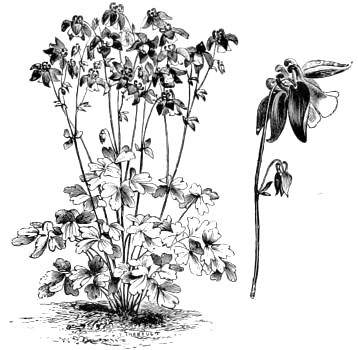
FIG. 136. AQUILEGIA OLYMPICA, showing Habit and Flower.
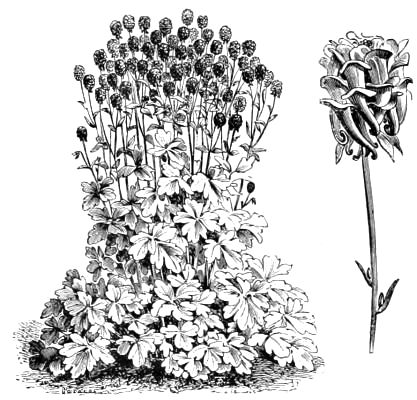
FIG. 137. AQUILEGIA SIBIRICA FLORE-PLENO, showing Habit and Flower.
A. v. Wittmanniana (Wittmann's). fl. large, bright lilac purple; sepals ovate-acute, 1in. to 1¼in. long, more than half as much broad; limb of petals white, about half the length of sepals; spur curved. A very fine variety.
The following names are also met with in gardens, some of which represent specific forms, but none are effective as garden ornaments: advena, Burgeriana, Haylodgensis (hybrid), grata, longissima, nevadensis, oxysepala, &c.
AQUOSUS. Watery.
ARABIS (origin of the word not clear). Wall Cress; Rock Cress. ORD. Cruciferæ. Hardy perennial trailers, except where otherwise stated. Flowers mostly white; racemes terminal; pedicels bractless. Radical leaves usually stalked; cauline ones sessile or stem-clasping, entire or toothed, rarely lobed. Most members of this genus are peculiarly well adapted for rockwork and the alpine garden, both from their natural hardihood as well as their early and profuse flowering habits. They are of the easiest possible culture in any dry soil. The perennial species may either be increased by divisions of the root, by cuttings, placed in a shady border during the summer, or by seed. The latter may be sown outside, or in pans, in spring, when most of them will germinate in two or three weeks. The annuals and biennials are for the most part devoid of any cultural beauty.
A. albida (whitish).* fl. white; racemes terminal; pedicels longer than the calyx. January to May. l. few-toothed, hoary, or downy with branched hairs; radical ones obovate-oblong; cauline ones cordately sagittate, clasping the stem. h. 6in. to 9in. Tauria and Caucasus, 1798. SYN. A. caucasica.
A. a. variegata (variegated).* A very pretty variegated form for edgings.
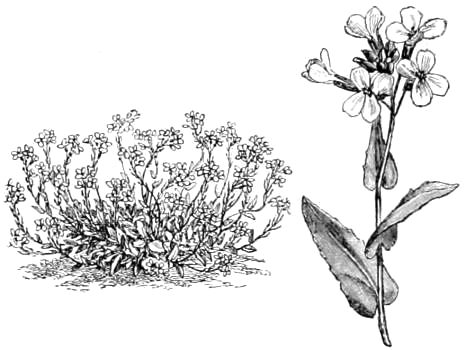
FIG. 138. ARABIS ALPINA, showing Habit and Flowers.
A. alpina (alpine).* fl. white, smaller than those of A. albida; racemes terminal; pedicels longer than the calyx, which is smoothish. March to May. l. many-toothed, lanceolate, acute, villous with branched hairs; radical ones somewhat stalked; cauline ones cordate, clasping the stem. h. 6in. European rocks, in sunny places, 1596. There are one or two varieties, including a variegated-leaved form, in cultivation. See Fig. 138.
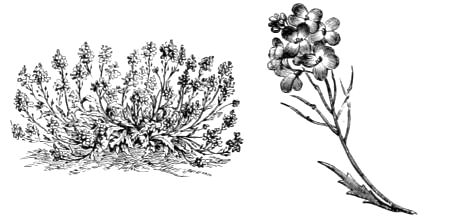
FIG. 139. ARABIS ARENOSA, showing Habit and Flowers.
A. arenosa (sand-loving).* fl. rose coloured, very rarely white or bluish; petals obovate; pedicels spreading. April to July. l. villous, with forked hairs; radical ones pinnatifid, with the upper lobes much larger than the lower; cauline ones deeply toothed. Stem branched, hispid, with simple hairs. h. 6in. Middle Europe, 1798. See Fig. 139.
A. blepharophylla (fringed-leaved).* fl. rosy purple; petals roundish, narrowing to the base, with slender claws. Spring. l. naked, except the margins, which are fringed with very stiff hairs; radical ones spathulate; cauline ones oblong, sessile. h. 3in. to 4in. California, 1874. This succeeds best in a cool frame, where it will flower in January.
A. caucasica (Caucasus). A synonym of A. albida.
A. lucida (shining).* fl. white; petals entire, narrowed at the base, twice as long as the calyx. Summer. l. obovate, thickish, shining, clasping the stem. h. 4in. to 6in. Hungary, 1790. A very pretty species, with a dwarf habit; it is especially adapted for edgings, borders, or rockwork.
A. l. variegata (variegated).* A great improvement upon the type, being broadly edged with yellow, and the green somewhat lighter. When grown in tufts or as edging, it is very effective, and should be prevented from flowering. This exceedingly desirable variety is a gem for the rockwork, and when seen in crevices, or in bold tufts, it is very striking. It must be increased by slips or rootlets, which should be taken in early summer.
A. mollis (soft). fl. white, in terminal racemes. May to July. l. grossly toothed, somewhat pubescent, with small stellate hairs; lower ones on long petioles, cordate-roundish; cauline ones ovate-cordate, clasping the stem. h. 2ft. Caucasus, 1823.
A. petræa (rock).* fl. white; petals ovate, with stalks. June. l. smooth, ciliated or scabrous, with simple or bifid radical ones on longish stalks, entire, toothed; cauline ones oblong-linear, entire, or toothed. h. 3in. or 4in. Britain.
A. præcox (early). fl. white; petals obovately cuneated, double the length of the calyx. April to June. l. oblong, acute, sessile, quite entire, smooth. Stem covered with close pressed rigid hairs. h. 6in. to 9in. Hungary.
A. procurrens (procurrent). fl. white; petals obovate, double the length of the calyx. May and June. l. ovate, quite entire, smooth, ciliated with two-parted hairs; radical ones narrowed into a petiole; cauline ones sessile, pointed. Stolons creeping. h. 9in. Servia, 1819. There is a brilliantly variegated form of this pretty species well worth growing.
A. rosea (rosy).* fl. rosy purple; petals oblong, somewhat wedge-shaped, double the length of the calyx; pedicels longer than the calyx. May to July. l., cauline ones oblong, somewhat cordate, and rather stem-clasping, scabrous with branched hairs. h. 1ft. Calabria, 1832.
A. verna (spring). fl. small, purple, with a white claw; pedicels shorter than the calyx. May to June. l., cauline ones cordate, clasping the stem, toothed, scabrous with three-parted hairs. h. 3in. to 6in. South Europe, 1710. The best annual species.
ARACEÆ or AROIDEÆ. An extensive order of herbaceous plants, with tuberous rhizomes. Flowers on a spadix, unisexual or hermaphrodite, protected by a spathe. Leaves large, radical. Well known genera belonging to this order are: Alocasia, Arum, Caladium, Colocasia, and Dieffenbachia.
ARACHIS (from a, without, and rachis, a branch; plant branchless). Ground or Earth Nut. ORD. Leguminosæ. A stove annual, of economical value. Corolla resupinate; calyx a long tube, with a bilabiate limb; ovary stipitate, inclosed in the tube of the calyx; the stipe at first short, but afterwards becoming elongated. Sandy loam is the soil most suitable for their cultivation. Seeds should be sown in heat; and, when the plants have grown to a sufficient size, they should be potted off singly, and placed among other stove annuals. After the plant has finished flowering, and the pods begin to lengthen, the pedicels force them into the earth, where they ripen their seeds.
A. hypogæa (underground). Monkey Nut. fl. yellow, five to seven together in the axils of the leaves. May. l. abruptly-pinnate, bearing two pairs of leaflets, without any tendril; stipulas elongated, adnate to the petioles. h. 1ft., or procumbent. South America, 1812. See Fig. 140.
ARACHNIMORPHA. A synonym of Rondeletia (which see).
ARACHNOID. Resembling a cobweb in appearance; seeming to be covered with cobweb, in consequence of the entanglement of long, white hairs.
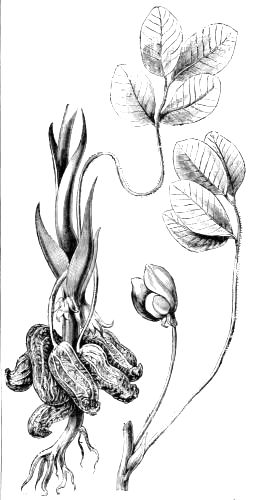
FIG. 140. ARACHIS HYPOGÆA, showing Leaf, Flower, &c., and Cluster of short wrinkled Pods.
ARALIA (meaning unknown). ORD. Araliaceæ. This widely-grown genus includes stove, greenhouse, and hardy, herbaceous and shrubby plants. Flowers inconspicuous, umbellate, the umbels usually disposed in panicles; petals five, inserted on the margin of the disk; stamens five (see Fig. 142). Leaves usually compound. These plants are of moderately free growth, and the majority are easy to manage. Those requiring indoor treatment thrive well under the ordinary routine of management. One most important requirement, however, is that they must be kept well supplied with water at the roots. The finer, or stove varieties, should be potted in a mixture of sandy loam and peat, with the addition of a little fibrous leaf soil, and sufficient sand to keep the whole porous. The stronger growing kinds thrive in a richer compost. Propagation by cuttings of the roots is a common and very successful method. To obtain the roots, one of the strongest plants should be turned out of the pot, and the roots should be cleared of soil by shaking or washing it out; the requisite number of pieces should then be selected. As each piece is removed, it should have the end nearest the stem cut horizontally, to distinguish it from the other or furthermost end. In planting cuttings of the roots, it is best to place the end nearest the stem uppermost. The pieces may be left about 2in. long, and should be inserted in pots, well drained, and filled with sandy soil, leaving the tops of the cuttings about level with the surface of the soil. A square of glass must be placed over the top of each pot, plunging them in moderate bottom heat. The stems of the plants from which the roots have been taken may be cut into pieces 1in. or 1½in. long, leaving an eye or bud near the top; a slice of half the shoot may be taken off opposite the bud. When prepared, these pieces should be pressed into pots of sand or sandy soil, and plunged into bottom heat. The stems may be cut down without disturbing the roots; in that case, if the pots are plunged in bottom heat, and kept moderately supplied with water, they will probably throw up several suckers or shoots from the roots. These, if taken off with a portion of root to each, and placed in small sized pots, will, with a little care, soon make useful plants. All the hardy species and most of the greenhouse ones are propagated readily by cuttings or pieces of roots. Some of the stove species, however, are very difficult to increase, except by grafting. Among these are A. leptophylla, A. Veitchii, &c. These should be worked on stocks of A. Guilfoylei or A. reticulata, the latter being the better of the two. Cuttings of either of these strike readily, and stocks fit for grafting are easily procured. In sheltered and warm positions, the greenhouse species are admirably suited for sub-tropical gardening, either planted singly or in groups. See also Dimorphanthus, Fatsia, Hedera, Heptapleurum, Monopanax, Oreopanax, and Panax.
A. canescens (greyish). A garden synonym of A. chinensis.
A. Chabrierii (Chabrier's).* l. alternate, pinnate, about a foot long; pinnæ opposite, 6in. to 9in. long, linear-lanceolate, deep green, with a heavy crimson midrib. 1882. Suitable for table decoration. A charming stove species.
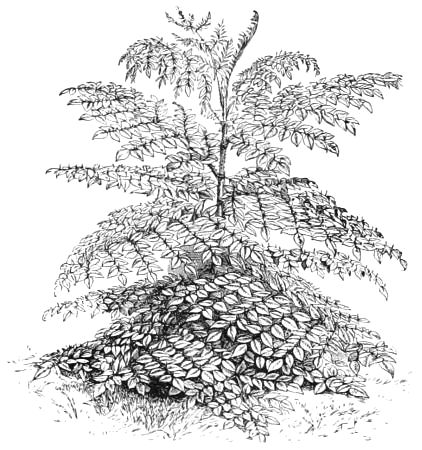
FIG. 141. ARALIA CHINENSIS.
A. chinensis (Chinese).* fl. white; panicles terminal; peduncles umbelliferous. l. petiolate, coriaceous, woolly on both surfaces when young (only); pinnæ seven, ovate, serrated at the apex, erect and distinct. h. 5ft. to 6ft. 1838. This species, if planted in a soil with a dry porous bottom, will prove to be hardy. SYN. A. canescens, of gardens. See Fig. 141.
A. concinna (neat). l. unequally pinnate; pinnæ lobed and serrate. Stem spotted. New Caledonia, 1879. A handsome stove species, but very rare. SYNS. A. spectabilis, Delarbrea spectabilis.
A. crassifolia (thick-leaved). A synonym of Pseudopanax crassifolium.
A. edulis (edible).* fl. numerous, white; umbels globose, axillary and terminal, united into simple or compound racemes. Summer. l., lower ones pinnate, with five leaflets, or three pinnate, with divisions of three to five leaflets; upper ones generally simple, with stalked leaflets, having a cordate base, ovate, acute, finely toothed, downy. h. 4ft. to 6ft. Japan, 1843. Hardy, herbaceous, perennial, hairy, and spineless.
A. elegantissima (most elegant).* l. digitate, on long dark green footstalks, which are mottled with white; leaflets seven to ten, filiform, and, being pendulous, impart a very graceful character to the plant. Stem straight, erect. South Sea Islands, 1873. Stove species, excellent for table decoration.
A. filicifolia (fern-leaved).* l., leafstalks sheathing at the base, and terete in the upper part, expanding into a broad leafy limb which is impari-pinnately divided; pinnæ opposite, deeply pinnatifid, bright green, with a purplish midrib. Stem and leafstalks purplish, thickly marked with oblong white spots. Polynesia, 1876.
A. gracillima (most graceful). Synonymous with A. Veitchii gracillima.
A. Guilfoylei (Guilfoyle's).* l. pinnate, on long smooth terete petioles; leaflets oblong-elliptic, bluntish, from three to seven, they are sometimes obscurely lobed, and irregularly spinose, serrate, varying in size from 2in. to 3in. long, neatly and evenly margined with creamy white, the surface being in addition occasionally splashed with grey. Stem erect, copiously dotted with lenticular markings. South Sea Islands, 1876. Stove species.
A. heteromorpha (many-formed).* l. sometimes ovate-lanceolate and serrated, and at others bifid or even trifid at the apex, about 6in. to 8in. or 9in. long, bright shining green. A very desirable species, of robust and compact habit.
A. japonica (Japanese). Another name for Fatsia japonica.
A. Kerchoveana (Count Kerchove's). l. digitate, almost circular in outline; leaflets nine to eleven, spreading, elliptic-lanceolate, conspicuously serrated or undulated margins, of a deep glossy green relieved by a pale midrib. 1883. A very elegant slender-stemmed plant from the South Sea Islands, and likely to prove valuable for decorative purposes. Stove species.
A. leptophylla (slender-leaved).* l. compound, bearing often seven or more petiolate leaflets of a somewhat pendent character, and dark green in colour. 1862. An elegant stove or greenhouse slender growing species.
A. longipes (long-stalked). l. digitate, long stalked, and rather distant; leaflets oblanceolate acuminate, slightly undulated at the edge; petioles elongated. Stems simple. North Australia, 1882. A very distinct erect-growing evergreen stove species.
A. maculata (spotted). l. of a light green colour; leaflets oblong-acuminate, in about four pairs. Stem erect, which, as well as the stalks of the leaves, is of a blackish-purple hue, thickly spotted with green dots. This peculiar colouring is very distinct and conspicuous. South Pacific Islands. Stove species.
A. Maximowiczii (Maximowicz's).* l. on long stalks, palmately five to seven-lobed; lobes lanceolate, 3½in. long, serrate. Japan, 1874. An elegant and distinct hardy shrub, with erect spiny stem. SYN. Acanthopanax ricinifolium.
A. monstrosa (monstrous).* l. pendent, pinnate; leaflets three to seven, oblong elliptic, deeply and irregularly serrated (this serration sometimes takes most fantastic forms), broadly margined with creamy white, the surface blotched with grey. South Sea Islands, 1880. Stove species.
A. nudicaulis (naked-stemmed).* fl. greenish; scape trifid at the apex, shorter than the leaf, each division bearing a many-flowered umbel. June. l. radical, the divisions pinnately five foliate; leaflets oblong-oval, with a long tapering point, serrate. Root horizontal, very long. h. 3ft. to 4ft. North America, 1731. Quite hardy, herbaceous perennial.
A. Osyana (Osyan).* Resembling A. leptophylla, but with leaflets deeply bifid at the ends; surface colour bright green; primary veins and tips of the leaflets chocolate brown. South Sea Islands, 1870. Very elegant stove species.
A. pentaphylla (five-leaved).* l. digitate, or sometimes only three leaflets are produced, each varying from 6in. to 10in. in length, and from 1in. to 2in. in breadth, deeply lobed or pinnatifid, bright shining green. Stem arboreous, prickly. h. 20ft. Japan. SYN. Panax spinosa.
A. p. variegata (variegated). l. broadly edged with creamy white. Japan, 1874.
A. quercifolia (oak-leaved).* l. opposite, trifoliate; leaflets deeply sinuate; lower petioles about 3in. long, light shining green. New Britain, 1880. Very pretty stove species.
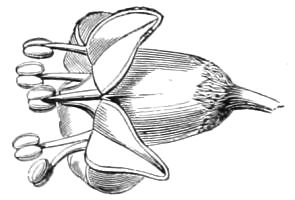
FIG. 142. FLOWER OF ARALIA RACEMOSA, enlarged.
A. racemosa (raceme-flowering).* fl. greenish-white, petals spreading; peduncles axillary, disposed in a terminal raceme, umbelliferous. June. l. petioles tripartite, the partitions bearing each three to five ovate or cordate, acuminated, serrated, smoothish leaflets. h. 3ft. to 4ft. North America, 1658. Hardy herbaceous species, highly ornamental. See Fig. 142.
A. reticulata (netted). l. alternate, strap-shaped when young, becoming larger with age, dark green, reticulated with a lighter shade of the same colour. A very handsome species, requiring stove heat during winter. In spring and summer it is admirably suited for conservatory or indoor decoration, having a light and graceful aspect.
A. rotunda (round). l. sometimes of a single leaflet only, which is spreading, orbicular, cordate at the base, margined with distinct white tipped teeth; at other times, especially when approaching maturity, the leaves are trifoliate, the leaflets being rounded and toothed, and the terminal one being about double the size of the lateral ones. Stems erect, brownish-green, spotted when young with pale elongate blotches. Polynesia, 1882.
A. Scheffleri (Scheffler's). l. on long petioles, digitate; leaflets five, petiolulate, lanceolate, attenuated at the base, serrulated, glabrous on both surfaces. Stem shrubby, smooth. New Zealand. Greenhouse species.
A. spectabilis (showy). A synonym of A. concinna.
A. spinosa (thorny).* Angelica Tree. l. doubly and triply pinnate; leaflets ovate, acuminated, deeply serrated. Stem simple, prickly (as are also the petioles), forming into an umbrella-like head, deciduous. h. 8ft. to 12ft. North America, 1688. A very fine hardy species for sheltered spots.
A. spinulosa (small-spined). l. alternate, pinnate; pinnæ ovate acuminate, dark green, margined with little reddish-crimson spines or prickles. Stems and petioles spotted and suffused with crimson. 1880. A bold and robust stove plant.
A. ternata (three-leafleted).* l. opposite, ternate; leaflets oblong-lanceolate; margins in some cases deeply serrate, in others sinuate, light green. New Britain, 1879. A slender growing species.
A. trifolia (three-leaved). A synonym of Pseudopanax Lessonii.
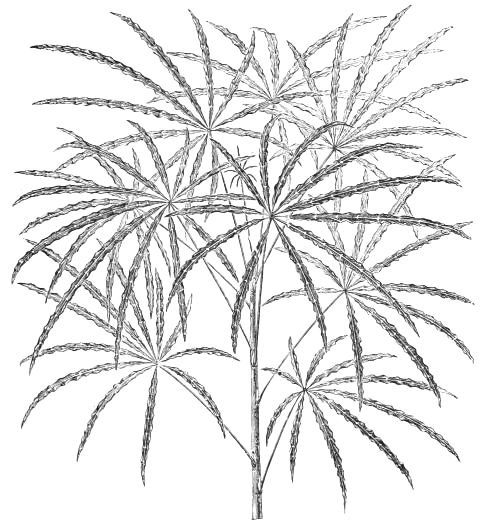
FIG. 143. ARALIA VEITCHII.
A. Veitchii (Veitch's).* l. digitate, with about eleven filiform undulated leaflets, glossy green above, dark red beneath; petioles long and slender. New Caledonia, 1867. A very handsome (said to be the best) species, with slender, erect growing stem. See Fig. 143, for which we are indebted to Messrs. Veitch and Sons.
A. V. gracillima (most graceful).* l. alternate, spreading; leaflets nearly linear, but slightly narrowed at both ends, having a prominent ivory-white central rib. South Sea Islands, 1876. An erect growing species, with an elegantly graceful habit. It is allied to A. reticulata, but is more handsome. This charming variety is undoubtedly the finest for table decoration, and is frequently grafted upon stocks of the typical form. It enjoys plenty of heat. SYN. A. gracillima.
ARALIACEÆ. An order of trees, shrubs, or (rarely) herbaceous plants, often pubescent, and sometimes spiny. Flowers variously disposed, hermaphrodite or unisexual, regular; petals usually five, and valvate. Leaves alternate, or (rarely) opposite. This order is closely allied to Umbelliferæ; and the best known genera are Aralia and Hedera.
ARAR-TREE. A common name for Callitris quadrivalvis (which see).
ARAUCARIA (from Araucanos, its name in Chili). SYN. Eutacta. ORD. Coniferæ. A noble genus of diœcious or sub-diœcious evergreen trees, with usually imbricated persistent flat sessile scale-like leaves. Male cones large, cylindrical, terminal; female ones very large, globular, terminal, with dense ligneous deciduous scales, each bearing a solitary seed. The majority of the species are not, unfortunately, sufficiently hardy to withstand our winters out of doors. Few trees can compete with them in symmetry and elegant proportion for conservatory decoration, where they may be grown in large tubs, or planted out. Small plants grown in pots are most serviceable for table and other decorative purposes. They thrive in a good fibrous loam, mixed with leaf soil and sand. Propagation by means of seed is the surest and most satisfactory method; the seed should be sown in pans or boxes, or if in large quantities, in a bed, with but gentle heat; they usually take some time to germinate. Cuttings are procured by taking off the leading shoots, and fixing them firmly in a pot of sand; they first require a cool place, but may afterwards be subjected to slight warmth. When rooted, they should be potted off into the soil above mentioned. The young growths which afterwards shoot from the plant, whence the cutting, may be taken off and treated in much the same manner. These are the only methods of propagation worth pursuing.
A. Balansæ (Balansa's). male cones cylindrical-conical, 2in. female cones elliptic globose, 4in.; scales obovate, cuneate. l. arcuately-uncinate, ovate triangular, imbricated round the distichous, simple branchlets. h. 130ft. to 160ft. New Caledonia, 1875. A fine greenhouse plumosely branched tree.
A. Bidwillii (Bidwill's).* Bunya-Bunya Pine; Moreton Bay Pine. cones sub-globose, longest diameter 10in. to 12in., shortest 9in. to 10in. l. ovate-lanceolate, in two nearly horizontal rows, acuminated, slightly convex above, concave beneath, leathery, deep shining green. h. 150ft. Moreton Bay. Habit very regular and symmetrical. Greenhouse species.
A. brasiliensis (Brazilian). l. oblong-lanceolate, much attenuated at the point, loosely imbricated, deep green; lower part of the trunk usually free from branches, terminating in a rounded head. h. 70ft. to 100ft. Brazil, 1819. A. b. gracilis, and A. b. Ridolfiana are two forms of this species.
A. columnaris (columnar). A synonym of A. Cookii.
A. Cookii (Cook's).* l. awl-shaped, short, densely imbricated around the frondose branches. Described by Mr. Abbay as having "a somewhat curious habit, even when growing alone, of shedding their branches for five-sixths or more of their height, and then replacing them by a smaller and more bushy growth, so that the tree at a distance presents a very columnar appearance, the resemblance being increased by the summit being crowned with a mass of foliage somewhat like a capital." h. 200ft. New Caledonia, 1851. SYN. A. columnaris.
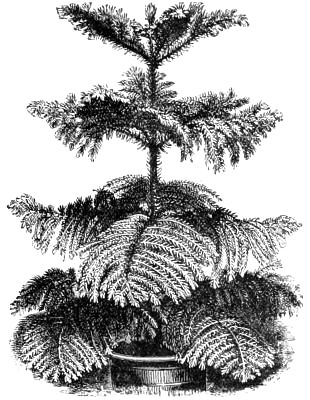
FIG. 144. ARAUCARIA EXCELSA.
A. Cunninghami (Cunningham's).* l. on the sterile branches needle-shaped, obscurely quadrangular, rigid, acute; on the fertile branches shorter, stouter, closely appressed, bright green; upper branches ascending, lower ones horizontal. h. 100ft. Moreton Bay. This fine species we have found to be quite hardy on the south-west coast of England.
A. C. glauca (milky-green). A very handsome variety, with silvery glaucous leaves.
A. excelsa (lofty).* The Norfolk Island Pine. l. awl-shaped, curved, sharply acuminated, bright green, densely packed on the frondose, deltoid, horizontal, or pendulous branches. When well grown, this is a beautifully symmetrical greenhouse or conservatory species, attaining to a height of 150ft., and a circumference of 20ft. or more. Norfolk Island. This is especially desirable in a small state. There are several varieties known, the best being: A. e. glauca, having lighter green, and very glaucous foliage; and A. e. robusta, which is larger in all its parts. See Fig. 144.
A. Goldieana (Goldie's).* Allied to A. Rulei. l. produced in whorls, pendulous, dark green, varying in size. New Caledonia. Most distinct and elegant for conservatory decoration.
A. imbricata (imbricated).* The Monkey Puzzle. fl., male and female catkins on separate trees; the males are six or seven in a cluster, pedunculate, yellow, and oval with numerous scales, imbricated, long, and recurved at the points; the female catkins are oval, with numerous wedge-shaped scales, with narrow oblong brittle points; they are produced at the ends of the branches. cones, when fully ripe globular, from 3in. to 4in. in diameter, dark brown. The branches are horizontal, inflexed, and ascending at the extremities, and are produced in whorls. l. ovate-lanceolate, sessile, thickened at the base, stiff, leathery, straight, somewhat keeled-shaped below, and strongly mucronate at the apex; verticillate, with seven or eight in a whorl, imbricate, and closely encircling the branches, concave, glabrous, shining, marked with longitudinal lines, dotted on both sides. h. 50ft. to 100ft. Chili, 1796. A well known hardy tree, of striking aspect, and indispensable to Arboreta and shrubberies. See Fig. 145.
A. Rulei (Rule's).* male cones oblong obtuse; female cones oval. l. oblong-lanceolate, with a prominent dorsal nerve, more closely appressed, and less sharply pointed than in the foregoing species; imbricated in four rows. Branches horizontal; branchlets often quite pendulous. h. 50ft. Papuan Archipelago.
A. R. elegans (elegant).* l. smaller; whorls of branches closer together; branchlets more slender. An elegant form; and, from its comparative dwarf and graceful habit, should be very generally grown.
ARBOR. A tree. A perennial plant, having a distinct bole or trunk, from which the main branches grow.
ARBORESCENT. Having a tendency to become a tree.
ARBORETUM. A collection of hardy trees formed for pleasure or instruction, and which, when well managed, is a source of much interesting study. They afford shelter, improve the local climate, renovate bad soils, &c., and also, by concealing or hiding disagreeable objects, heighten the effect of agreeable ones, create beauty, and add value. A properly arranged Arboretum should be constructed with a view to picturesque beauty, and not systematically, as is usually the case in Botanic Gardens, although scientific purposes are best served by a systematic arrangement.
ARBOR-VITÆ. See Thuja.
ARBOUR. A seat surrounded by lattice work, covered by Vines, Wistarias, or other climbing plants.
ARBUTUS (from arboise, Celtic for austere bush; in allusion to the austere quality of the fruit). Strawberry Tree. ORD. Ericaceæ. Trees and shrubs, with evergreen alternate laurel-like leaves. Corolla globose, or ovately campanulate; petals five, reflexed. Very ornamental subjects for lawns and shrubberies, thriving well in a light sandy or peaty soil. They may be propagated by seeds, which should be sown in sand during March; by budding, and by inarching; the first mentioned method is the one most generally employed, with good results. The various sorts may be grafted, budded, or inarched upon A. Unedo. The greenhouse species are rare in cultivation, but their management does not materially differ from other plants requiring a similar temperature.
A. Andrachne (Andrachne).* fl. greenish-white; panicles terminal, erect, clothed with viscid down. March and April. l. oblong, bluntish, entire in some, a little serrated in others, glabrous. h. 10ft. to 14ft. Greece, 1724. A fine ornamental tree.
A. A. serratifolia (saw-edge-leaved). fl. yellowish, disposed in rather large terminal clusters. l. serrated, and narrower than those of the species. SYN. A. serratifolia.
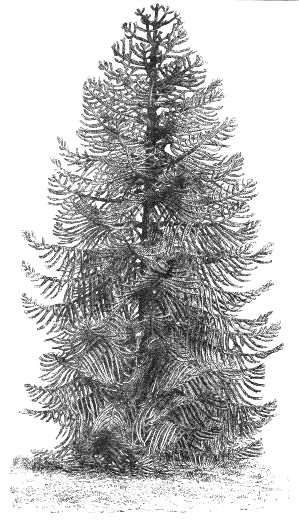
FIG. 145. ARAUCARIA IMBRICATA.
A. andrachnoides (Andrachne-like). A synonym of A. hybrida.
A. canariensis (Canary). fl. greenish-white; panicles erect, hispid. May. l. oblong-lanceolate, serrated, glaucous beneath. h. 8ft. to 10ft. Canary Islands, 1796. Greenhouse.
A. densiflora (thickly-flowered).* fl. white; corolla oval; pedicels furnished with three bracteas at the base; panicle terminal, composed of closely packed racemes. l. 4in. to 5in. long, on long petioles, oblong, acute, sharply toothed, coriaceous, glabrous above and shining, but downy beneath, the middle nerve with rusty villi; branches angular, hairy. h. 20ft. Mexico, 1826. Greenhouse.
A. hybrida (hybrid).* fl. white; panicle terminal, pendulous, downy. September to December. l. oblong, acute, serrated, glabrous; branches pilose. h. 10ft. to 0ft. A half-hardy garden hybrid; it originated about 1800. SYN. A. andrachnoides.
A. Menziesi (Menzies').* fl. white; racemes axillary and terminal, panicled, dense-flowered. September. l. broad-oval, quite entire, glabrous, on long petioles. h. 6ft. to 10ft. North-west America, 1827. A noble hardy tree. A. laurifolia comes close to this species. SYN. A. procera.
A. mollis (soft). fl. rosy, drooping; panicle terminal, crowded, racemose. June. l. oblong-acute, sharply toothed, coriaceous, clothed with soft pubescence above, and white tomentum beneath. h. 6ft. Mexico. Greenhouse shrub.
A. mucronata (mucronate). A synonym of Pernettya mucronata.
A. pilosa (pilose). A synonym of Pernettya pilosa.
A. procera (tall).* A synonym of A. Menziesi.
A. serratifolia (saw-edge-leaved). A synonym of A. Andrachne serratifolia.
A. Unedo (Unedo).* The Strawberry Tree. fl. white, deep red in some of the varieties, nodding, in terminal racemose, bracteate panicles. September. fr. large, scarlet, nearly globose, granular, edible. l. oblong-lanceolate, glabrous, serrulated; branchlets clothed with glandular hairs. h. 8ft. to 10ft. West of Ireland, and South Europe. There are several varieties of this plant in cultivation. It is one of the greatest ornaments in the months of October and November—the season when it is in flower, and when, also, the fruit of the former year is ripe.
A. Xalapensis (Xalapan). fl. reddish white; corolla ovate; panicle terminal, composed of many racemes. April. l. petiolate, oblong, acute, quite entire, about 2in. long, glabrous above, but clothed with brownish tomentum beneath; epidermis separating, brownish purple. Young branches glabrous, but beset with ramentæ. h. 6ft. to 9ft. Mexico. Greenhouse species.
ARCHEGONIUM. The female organ in ferns, &c., analogous with the ovary in flowering plants.
ARCTOSTAPHYLOS (from arktos, a bear, and staphyle, a grape; bears eat the fruit of some species). ORD. Ericaceæ. Handsome hardy or half-hardy shrubs or sub-shrubs, agreeing in generic characters with Arbutus, except that the fruit is five-celled and the cells one-seeded, and not granular on the outside. For culture, &c., see Arbutus.
A. alpina (alpine).* Black Bearberry. fl. white or flesh-coloured, in terminal, reflexed racemes; pedicels rather hairy. April. l. obovate, acute, wrinkled, serrated, deciduous. Stems procumbent, trailing. Scotland (but rare), &c. SYN. Arbutus alpina.
A. nitida (shining).* fl. white; racemes terminal. May. l. oblong-lanceolate, acute, smooth on both sides and shining above. h. 4ft. Mexico, 1839. An erect half-hardy evergreen.
A. pungens (stinging).* fl. white; pedicels close; racemes short, at first terminal, but at length lateral. February. l. ovate-oblong, acute, mucronate, rather pungent, quite entire, coriaceous, clothed with fine down on both surfaces; branchlets angular, downy. h. 1ft. Mexico, 1839. A dwarf, much branched, half-hardy evergreen shrub.
A. tomentosa (tomentose).* fl. pure white, campanulately urceolate, bracteate; peduncles axillary, shorter than the leaves, somewhat capitately racemose. December. l. oval, acute, sub-cordate at the base, clothed with white tomentum beneath, on short petioles; branches hispid. h. 4ft. North-west America, 1826. Shrubby species; hardy.
A. Uva-ursi.* Bearberry. fl. flesh-coloured, with a red mouth, growing in small clusters at the extremities of the branches. April. l. obovate, quite entire, coriaceous, shining. Highlands of Scotland and Wales. A hardy evergreen procumbent trailer. SYN. Arbutus Uva-ursi.
ARCTOTHECA (from arktos, a bear, and theke, a capsule; so named from the roughness of the fruit). ORD. Compositæ. Greenhouse herbaceous perennial, allied to Arctotis. Heads radiate; involucral scales imbricate in many rows, the outer linear, herbaceous, inner larger, scariose, very obtuse; receptacle honeycombed, bearing many little fringes; achenes ovate, somewhat four-sided, without wings or pappus. It thrives in a compost of peat, leaf soil, and loam. Propagated by divisions of the plant, or cuttings, in spring. Several species formerly classed in this genus are now included under Arctotis.
A. repens (creeping). fl.-heads yellow. July. l. petioled, lyrate-pinnatifid, green and mostly smooth above, white-woolly beneath. Cape of Good Hope, 1793. A stemless, creeping or decumbent herb.
ARCTOTIS (from arktos, a bear, and ous, an ear; in reference to the shaggy fruit). ORD. Compositæ. Mostly half-hardy herbaceous perennials. Involucral bracts numerous, imbricated, scariose on the margin; receptacle pitted, studded with bristles between the florets; achenes grooved, crowned with a pappus of membranous scales. The species of this genus are of easy culture in a compost of loam and leaf soil. Propagated by cuttings at any time of the year; these should be pricked in pots of very sandy soil, and placed in gentle warmth; they must be kept uncovered and moderately dry, or they will rot. The Arctotis are very handsome plants in sunny, dry positions outside during the summer months, but they must be protected during winter.
A. acaulis (stemless).* fl.-heads yellow and red. Summer. l. hoary on each side, ternate, lyrate. Stem very short, decumbent. h. 4in. Cape of Good Hope, 1759. Very rarely met with.
A. arborescens (tree-like).* fl.-heads, ray-florets white above, pink beneath; disk-florets yellow; disposed in large circular Daisy-like heads. Summer. l. linear-oblong, pinnate; upper ones amplexicaul; lower ones stalked. h. 2ft. Cape of Good Hope, 1815.
A. argentea (silvery). fl.-heads orange. August. l. lanceolate-linear, entire, downy. h. 1ft. Cape of Good Hope, 1774.
A. aureola (golden). Synonymous with A. grandiflora.
A. breviscapa (short-stalked). Synonymous with A. speciosa.
A. grandiflora (large-flowered).* fl.-heads orange; outer scales of involucre reflexed, cuneate, oblong, with a broad short point, somewhat cobwebbed. July. l. pinnatifid, serrulate, three-nerved. h. 1½ft. Cape of Good Hope, 1710. SYNS. A. aureola and A. undulata.
A. reptans (creeping). fl.-heads white, orange. July. l. hairy beneath; lower lyrate toothed; upper lanceolate toothed. Stem ascending. h. 8in. Cape of Good Hope, 1795.
A. rosea (rosy). fl.-heads pink. Autumn. l. spathulate-lanceolate, repand-toothed, hoary. Stem procumbent. Cape of Good Hope, 1793.
A. speciosa (showy).* fl.-heads yellow; outer scales of involucre linear recurved. July. l. lyrate, pinnatifid, hoary beneath, three-nerved. Plant stemless. h. 1½ft. Cape of Good Hope, 1812. Closely allied to A. acaulis. SYN. A. breviscapa.
A. undulata (wavy). Synonymous with A. grandiflora.
ARCUATE, ARCUATED. Curved or bent like a bow; forming an arch.
ARDISIA. (from ardis, a point; in reference to the acute, spear-pointed anthers). SYN. Pyrgus. ORD. Myrsineæ. An extensive genus of greenhouse or stove, mostly ornamental, evergreen trees and shrubs. Flowers white or rose-coloured, more or less panicled; panicles sometimes many-flowered at the extremities of the branches, and longer than the leaves, sometimes few-flowered and in the axils of the leaves. Leaves alternate, rarely almost opposite, or three in a whorl, dotted. Propagated by cuttings of the half-ripened wood taken from the side shoots of the plant any time from March to September; but, as the points of these side shoots bear the blossoms and fruit, they are not well adapted for making good plants. To obtain the best plants, the largest, ripest, and best-coloured berries should be sown early in spring, as soon as gathered, in a wide-mouthed pot or seed pan, well drained and filled with loam and peat in equal parts, with the addition of some sand, and plunged in bottom heat, the soil being kept moderately moist. The seeds will germinate in a few weeks after sowing, and when about 2in. high, the strongest seedlings should be selected and placed in 3in. pots, the same mixture of soil being used, with the addition of a fourth part well decomposed manure. After potting, the plants must be moistened overhead twice a day with a fine rose or syringe, and be kept in a close atmosphere until the roots have taken to the fresh soil. When the plants begin to grow again, they should be removed to a light situation in the house; and when the pots are well filled with roots, a shift into 6in. pots may be effected, water being given judiciously until well established, and here they may remain to fruit. Until the berries are coloured, clear manure water, given once or twice a week, will be found beneficial. The plants arrive at their best when about 18in. or 2ft. high; after that, they begin to get naked at the bottom. It will then be wise to cut the worst plants down to within 2in. of the pots, in early spring, allowing them to become dry at the roots before this operation is performed. By giving moisture to the roots when the cut has become dry, the plants will soon break into growth again, when some of the worst placed shoots should be rubbed off, leaving only one or two of the strongest and best placed, calculated to develop into a well formed plant. When the shoots have grown 2in. or 3in., the plants should be turned out of their pots, the soil shaken out from the roots, and the long ends of the roots trimmed in a little with a knife; they must then be placed in a pot sufficiently large to hold the roots without squeezing. The plants should now occupy the warmest end of the house in which they are grown, care being taken in watering until new roots are formed, when they may have more air and somewhat liberal supplies of water. As soon as they are sufficiently advanced in growth, they should be transferred to a larger-sized pot. With proper treatment, they will flower and fruit the same season as they are cut down, and form handsome plants. Although most species of this genus are classed as stove plants, they will succeed very well in a temperature that does not fall below 45deg. in winter; and, when so grown, they are not so liable to become infested with large brown scale and other insect pests. This is particularly the case with A. crenulata, and cool treatment is also favourable to the ripe berries hanging on the plants for a much longer time than when grown in a stove. Moreover, they do not suffer so much when removed for decorative purposes.
A. acuminata (taper-pointed). fl. nearly white; petals small, acute, dotted; panicles terminal and axillary, many-flowered. July. l. entire, glabrous, oblong, acuminated, attenuated at the base. h. 6ft. to 8ft. Guiana, 1803.
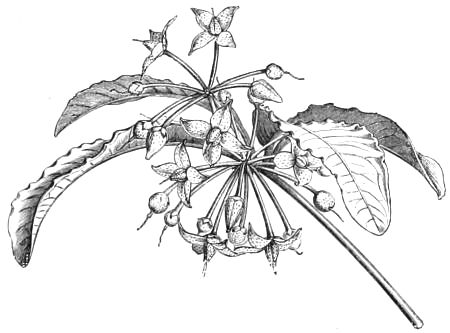
FIG. 146. FLOWERING BRANCH OF ARDISIA CRENULATA.
A. crenulata (round-notched-leaved).* fl. reddish violet; panicles terminal; pedicels umbellate. June. Berries numerous, bright coral-like. l. lanceolate-ovate, tapering at both ends, repandly crenulated, pilose. h. 3ft. to 6ft. Mexico, 1809. When grown in a cool atmosphere, as previously alluded to, it is quite common for one crop of berries to hang on the plants until another crop is ripe. This is a splendid plant, superior even to the red-berried Solanums for decorative purposes, for which it is largely grown. See Fig. 146.
A. crispa (curled). fl. small, drooping, red; cymes terminal, usually solitary, often compound; pedicels smooth, finely veined, umbellate, drooping. July. Berries red, size of peas. l. bluntish, oblong-lanceolate, attenuated at both ends, with repandly crenulated glandular edges, glabrous. h. 4ft. India, 1809.
A. humilis (humble). fl. rose-coloured; peduncles solitary, bearing each a simple racemose umbel of many pretty, large, drooping flowers; petals lanceolate, first recurved, afterwards revolute. June. Berries size of peas, shining, black, juicy. l. oblong-lanceolate, acuminated at both ends, glabrous, veined, shining. h. 4ft. India, 1820.
A. japonica (Japanese).* fl. white; pedicels red, sub-umbellate, secund, drooping; racemes simple, axillary. June. l. nearly opposite, or three to five in a whorl, on short petioles, cuneate-oblong, acute, glabrous, serrated; 4in. long. h. 1ft. Japan. Perhaps the hardiest of all the species.
A. macrocarpa (large-fruited).* fl. flesh-coloured, dotted; petals ovate, obtuse; racemes terminal, corymbose, almost sessile, slightly hairy. Berries vermilion coloured, as large as gooseberries. l. oblong, acute, tapering downwards, glandularly crenated, dotted, close together, leathery, 6in. to 8in. long, paler beneath, veinless. h. 5ft. to 6ft. Nepaul, 1824. A beautiful shrub.
A. Oliveri (Oliver's).* fl. rose pink, white eye: corolla rotate, ½in. across; lobes obtuse; heads terminal, consisting of a number of stalked, many-flowered corymbs; pedicels about twice as long as the flower. July. l. nearly sessile, entire, glabrous, 6in. to 8in. long, by 2in. in the broadest portion; oblanceolate, acuminate, tapering towards the base. Costa Rica, 1876.
A. paniculata (panicled).* fl. rose-coloured; panicles terminal, composed of many alternate compound branches, large and elegant; petals and sepals ovate. July. Berries red, smooth, size of a pea, juicy. l. glabrous, cuneate-oblong, almost sessile, reflexed, 6in. to 20in. long, and from 3in. to 5in. broad, crowded at the ends of the branches. h. 8ft. to 10ft. India, 1818.
A. punctata (dotted). fl. greyish white, sub-campanulate, secund, beset with dark dots, and the pedicels with dark lines; peduncles umbellate, terminal, and axillary; umbels involucrated by deciduous bracts. June. l. glabrous, lanceolate, leathery, repandly crenated, tapering to the base. h. 6ft. to 10ft. China, 1822.
A. serrulata (finely serrated).* fl. deep red; petals ciliated; calyces and pedicels coloured; panicles terminal; pedicels umbellate. July. l. glabrous, lanceolate, acuminated, wrinkled, serrulated, beset with rusty dots beneath; branches downy. h. 2ft. to 3ft. China, 1820.
A. villosa (hairy). fl. whitish, umbels axillary and terminal, very villous. October. Berries villous. l. lanceolate, acuminated, villous beneath, crenulated, 5in. to 7in. long, tapering to the base, copiously dotted. China. All the upper parts of the plant are densely beset with hairs.
A. v. mollis (soft).* This variety has very fine red berries, and is superior to the type.
A. Wallichii (Wallich's). fl. red, in loose racemes; peduncles axillary, one-half shorter than the leaves, and are, as well as the pedicels, pilose. July. l. obovate, acute, or obtuse, narrowed into the marginate petioles, repandly crenulated, 4in. to 5in. long, and 2in. broad, thickish. h. 2ft. India.
ARDUINA (in honour of P. Arduini, curator of the Economical Garden of Padua, in the time of Linnæus). ORD. Apocynaceæ. A singular and pretty greenhouse evergreen shrub, of easy culture in carefully drained pots of peat and loam, mixed in equal proportions. Propagated by cuttings in sand, under a glass. The winter temperature should not be allowed to fall below 40deg.
A. bispinosa (two-spined). fl. small, white, sweet-scented, terminal, corymbose. March to August. Berry red. l. cordate-ovate, mucronate, nearly sessile, dark green, larger than those of Box. Spines twin, simple, but usually bifid; in this last case, one of the clefts points downwards, and the other upwards. h. 3ft. to 5ft. Cape of Good Hope, 1760. SYN. Carissa Arduina.
ARECA (Areec is its name in Malabar, when an old tree). The Cabbage Palm. ORD. Palmeæ. This genus is now broken up into several, and many species formerly here arranged are now found under Acanthophœnix, Euterpe, Hyophorbe, Kentia, Oncosperma, Phænicophorum. Very ornamental and graceful stove palms, with a branching spadix, and double spathe, which incloses the flowers. Flowers unisexual, borne upon the same spike; female flowers having six rudimentary stamens, and male flowers a six-cleft perianth. Fruit one-seeded. They thrive in a compost of loam, peat, and leaf soil, in equal parts, with a liberal addition of sand; but when they are fully grown, loam should preponderate to the extent of about two-thirds, and some rotten cow-manure may be added. Propagated from seeds, which should be sown in a compost similar to above, and placed in a moist gentle heat. They are employed, when young, with much success for the decoration of drawing rooms and dinner tables.
A. Aliciæ (Princess Alice's). l. pinnatisect; segments sessile. North Australia. A very handsome species, with a comparatively dwarf habit; it is a valuable decorative plant.
A. Catechu (Catechu). l. pinnate, from 3ft. to 6ft. long; leaflets 12in. to 24in. in length, and about 2in. broad, light green; petioles broadly sheathed at the base. h. 30ft. India, 1690. One of the best and oldest species in cultivation, very effective, in a young state, for dinner table decoration. It produces the Betel nut, of which enormous quantities are used in India.
A. concinna (neat). l. pinnatisect, sub-glabrous; segments sickle-shaped, much acuminated. Stem green, 8ft. to 12ft. high, 1in. to 2in. in diameter. Ceylon. The Cingalese chew the albumen of the seeds with their Betel.
A. gigantea (gigantic). A synonym of Pinanga ternatensis.
A. glandiformis (gland-formed). l. pinnatisect, 9ft. to 12ft. long when fully grown. h. 30ft. Moluccas. A handsome stove palm, of bold aspect, and very suitable, when young, for decorative purposes.
A. Normanbyi (Normanby's). A synonym of Ptychosperma Normanbyi.
A. triandra (three-stamened). l. pinnate, like those of A. Catechu in size, &c. h. 20ft. India, introduced to Britain about 1810.
ARENARIA (from arena, sand; in which most of the species are found). Sandwort. ORD. Caryophyllaceæ. TRIBE Alsineæ. A very large genus of hardy herbaceous plants, consisting of about 150 species. It is distinguished by having generally three styles. The perennials only are worth growing; these are extremely pretty little alpine plants, and will thrive in any ordinary soil in exposed places; the rarer species may be grown in small pots, well drained, in a mixture of sand, loam, and leaf soil, or in well-drained crannies of the rockery. They may be increased by either division, seeds, or cuttings; the latter, placed under a hand-glass, will root freely. The best time to divide the plants is early spring, or July and August. Seeds should be sown in spring in a cold frame.
A. balearica (Balearic).* fl. white, sepals erect; peduncles elongated, one-flowered. March to August. l. very small, ovate, shining, rather fleshy, ciliated. h. 3in. Corsica, 1787. A pretty little creeper, one of the best plants for covering damp borders of the rockwork.
A. cæspitosa (tufted). Synonymous with A. verna cæspitosa.
A. ciliata (ciliated). fl. white, usually solitary; sepals ovate, acute, five to seven ribbed; petals obovate, twice as long as the sepals. July. l. ovate, or obovate, roughish, with a few hairs, one-nerved, and ciliated. Ireland. h. 6in. A thick, tufted, spreading, procumbent plant.
A. graminifolia (grass-leaved).* fl. white; panicle three-forked, hairy, loose; sepals very blunt, much shorter than the obovate petals. June. l. long, awl-shaped, filiform, scabrous on the margins from serratures. Stem erect, simple. h. 6in. to 9in. Caucasus, 1817.
A. grandiflora (large-flowered).* fl. white, usually solitary; peduncles very long, pubescent; sepals ovate, awned, three-nerved, smaller than the petals. June. l. awl-shaped, broadish, flat, three-nerved, ciliated, radical ones crowded. h. 3in. to 6in. France, 1783. A. g. biflora is a two-flowered, and A. g. triflora a three-flowered, variety.
A. laricifolia (Larch-leaved).* fl. white; sepals bluntish, triple nerved, hairy; petals twice as long as the sepals; stems ascending, one, three, or six flowered, somewhat scabrous; calyx cylindrical. June. l. awl-shaped, denticulately ciliated. h. 6in. Switzerland, 1816.
A. longifolia (long-leaved). fl. white; sepals ovate, obtuse, not half the length of the obovate petals; panicle three-forked, glabrous, crowded. June. l. awl-shaped, filiform, serrulated. Stem erect, simple. h. 6in. to 9in. Siberia, 1823.
A. montana (mountain). fl. large, white; peduncles terminal, very long, one-flowered; sepals lanceolate, acuminated, much shorter than the corolla. April. l. lanceolate-linear; sterile stems very long, procumbent. h. 3in. France and Spain, 1800.
A. peploides (Peplis-like). fl. white; sepals ovate, shorter than the oblong petals. May to July. l. ovate, light green, rather fleshy; branches procumbent, fleshy, deciduous. h. 3in. to 4in. Sea shores of Britain. SYN. Honckenya peploides.
A. purpurascens (purplish).* fl. purplish; pedicels tomentose, scarcely exceeding the leaves; sepals lanceolate, smooth, with shrivelled margins, longer than the corolla; branches two to three-flowered. May. l. ovate-lanceolate, acuminated, glabrous. Plant tufted, decumbent. h. 6in. Higher Pyrenees.
A. rotundifolia (round-leaved).* fl. white, solitary; petals roundish-ovate, longer than the sepals. July and August. l. about ¼in. across, roundish, ciliated, on spreading tufted branches. h. 4in. to 6in. Siberia.
A. tetraquetra (four-angled). fl. white, somewhat capitate; sepals stiff, acute, keeled, ciliated, almost equal in length to the corolla. August. l. ovate, keeled, recurved, edged, imbricated in four rows. Stem straight, pubescent. h. 3in. to 6in. France, 1731.
A. verna (spring-flowering). fl. small, white; sepals ovate, lanceolate, acuminated, with three remote equal ribs, longer than the obovate petals. May. l. awl-shaped, bluntish. Stems panicled, elongated. h. about 3in.
A. v. cæspitosa (turfy). A variety having very leafy stems. Calyces and peduncles smoothish. Europe. SYN. A. cæspitosa.
ARENGA (name of doubtful origin). SYN. Saguerus. ORD. Palmæ. An extremely useful and interesting palm. The medulla of the trunk is used as sago, and the saccharine juice forms excellent sugar. It requires a strong heat and rich mould. Propagated by seeds only.
A. saccharifera (sugar-bearing). fl. striped. June. h. 40ft. Moluccas, 1829.
AREOLATE. Divided into distinct angular spaces, or areolæ.
ARETHUSA (mythological: named after a nymph of Diana's, who was changed into a fountain; in allusion to the habit of the plants). ORD. Orchideæ. A small genus of very pretty, but rare, terrestrial orchids. They require a moist shady spot with a northern aspect, and thrive best in a compost of well-rotted manure and sphagnum. A mulching in winter, by way of protection, is needed.
A. bulbosa (bulbous).* fl. large, bright rose purple, solitary, sweet-scented, terminal; lip dilated, recurved, spreading towards the summit, bearded-crested down the face; scape one-leaved. May. l. linear, nerved. h. 8in. Carolina.
ARETIA. See Androsace.
ARGANIA (from argam, its aboriginal name). ORD. Sapotaceæ. A very fine greenhouse evergreen tree, said by Don to flourish against a south wall, out of doors, with the protection of a mat in severe weather. It will thrive in ordinary garden soil. Increased by layers and cuttings in autumn and spring, the latter requiring a bell glass covering; both operations must be performed in a moderately heated greenhouse.
A. Sideroxylon (Iron-wood). fl., corolla greenish yellow, cup-shaped, five-parted, with ovate-lanceolate, sub-emarginate segments; lateral and axillary, scattered, crowded, sessile. fr. dotted with white, size of a plum, full of white, milky juice. July. l. lanceolate, entire, bluntish, glabrous, paler beneath; branches terminated by strong spines. h. 15ft. to 20ft. Morocco, 1711. As the specific name implies, the wood is excessively close and hard, so much so that it sinks in water. SYNS. Elæodendron Argan, Sideroxylon spinosum.
ARGEMONE (from argema, cataract of the eye; in allusion to some real or fancied medicinal properties). ORD. Papaveraceæ. Very handsome annuals and perennials, abounding with yellow juice, and covered with stiff prickles. Sepals two to three, concave, mucronate; petals four to eight; peduncles axillary, always erect. Leaves sessile, repand-sinuated, usually spotted with white; recesses spiny-toothed. The species will thrive in almost any garden soil in the open border. Seed may be sown out of doors about the end of March; those of the rarer species on a hotbed, and planted out about the end of June.
A. albiflora (white-flowered).* fl. white; petals usually three. July and August. l. sessile, feather-nerved. h. 1ft. Georgia, 1820. Hardy annual.
A. grandiflora (great-flowered).* fl. large, panicled, white with yellow anthers. July. l. sinuated, smooth, glaucous, spiny-toothed; nerves unarmed. h. 2ft. to 3ft. Mexico, 1827. This species, when raised from seed, does not flower until October; but when the roots have existed through the winter, the plants produce flowers early in the summer. Hardy perennial. See Fig. 147.
A. hirsuta (hairy).* fl. pure white, 3in. to 5in. in diameter. September. l. pinnatifid, bristly. h. 2ft. California, 1879. A very beautiful hardy annual.
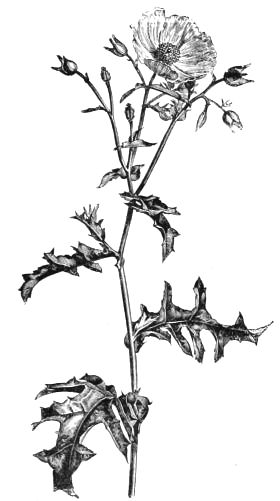
FIG. 147. INFLORESCENCE OF ARGEMONE GRANDIFLORA.
A. mexicana (Mexican). Devil's Fig. fl. solitary, yellow; petals four to six. June. l. profoundly repand-sinuated, spiny, blotched with white. h. 2ft. Mexico, 1592. Hardy annual.
A. ochroleuca (yellowish-white).* fl. pale yellow, solitary; petals six. August. l. profoundly sinuated or pinnatifid, glaucescent nerves with prickly bristles, blotched with white. Stem prickly. Mexico, 1827. Hardy annual.
ARGENTEUS. Silvery. A pale colour resembling silver.
ARGOLASIA. See Lanaria.
ARGIYREIA (from argyreios, silvery; in reference to the silvery undersides of the leaves). Silver-weed. ORD. Convolvulaceæ. An elegant genus of greenhouse and stove climbers. Sepals five; corolla campanulate. Shrubs for the most part silvery, but sometimes silky and tomentose. The greater number of the species are robust, extensive twiners or climbers, usually requiring plenty of room to run, before they will flower. A. cuneata, and one or two others, are of dwarf habit, and produce their splendid blossoms in abundance. All the species grow well in light rich soil, or a mixture of peat, loam, and sand. Cuttings root readily if planted in sand, with a hand glass placed over them, in a little bottom heat.
A. capitata (headed). fl., corolla 1in. to 2in. long, rose coloured or purple, hairy outside; peduncles exceeding the petioles. July. l. cordate-ovate, acuminated, 2in. to 5in, long, and 1in. to 3in. broad, hairy on both surfaces; hairs glandular at the base. Plant clothed with strigose hairs. Silhet, 1823.
A. cuneata (wedge-leaved).* fl., corolla large, of a beautiful deep bright purple; peduncles downy, shorter than the leaves, three to six-flowered. July. l. obovate-cuneate, emarginate, glabrous above, but beset with short, crowded hairs beneath, hardly petiolate. Stem clothed with powdery down at top. h. 2ft. to 5ft. India, 1822.
A. cymosa (cyme-flowered).* fl., corolla pale pink, tubularly funnel-shaped, villous outside; peduncles as long or longer than the leaves, leafy at top, and cymosely many-flowered. l. roundish-cordate, or reniformly-cordate, obtuse, terminated by a very short prickle, glabrous on both surfaces, or clothed with pruinose down. Malabar (mountains), 1823.
A. malabarica (Malabar). fl. rather small; bottom of the bell deep purple; throat pink, with the edges paler, almost white, and slightly ten-lobed; peduncles as long or longer than the leaves, many-flowered at the apex. June. l. roundish-cordate, acute, glabrous, or furnished with a few scattered hairs on both surfaces. Coromandel, 1823.
A. pomacea (Apple-fruited). fl. large, rose coloured; peduncles villous, exceeding the petioles a little, cymose, many-flowered. Berry size of a cherry, yellow. l. ovate-elliptic, obtuse, clothed with cinerous, velvety down on both surfaces, but especially beneath, sometimes sub-emarginate at apex. Mysore, 1818.
A. speciosa (showy).* fl., corolla nearly 2in. long, of a deep rose colour; peduncles about equal in length to the petioles, umbellately capitate. July. l. 3in. to 12in. long, and 2in. to 4in. broad, cordate, acute, glabrous above, or rarely villous, thickly nerved beneath, and clothed with silky, silvery down. India, 1818.
A. splendens (splendid).* fl., corolla tubularly campanulate, 1½in. long, rather villous outside, pale red; peduncles exceeding the (hoary) petioles, corymbosely many-flowered. November. l. ovate-oblong or ovate-elliptic, entire or pandurately sinuated, sometimes somewhat three-lobed, smooth above, but clothed with silvery, silky down beneath, 6in. long, acuminated. India, 1820.
ARGYROCHÆTA. A synonym of Parthenium (which see).
ARGYROXYPHIUM (from argyros, silver, and xyphion, a corn-flag; in allusion to the leaves). ORD. Compositæ. An ornamental greenhouse perennial herb. Involucre campanulate; receptacle conical; heads pedunculate, racemose, or in thyrsoid panicles. Leaves alternate; lower ones close, elongated, thick, on both sides silver-lined. Stems simple or slightly branched. It thrives well in rich sandy loam and leaf mould. Propagated by seed-heads.
C. sandwicense (Sandwich Islands). fl.-heads purplish. l. linear lanceolate, imbricate, clothed, like the stems, with silvery hairs. h. 3ft. Sandwich islands, 1872. SYN. Argyrophyton Douglasii.
ARIA. See Pyrus Aria.
ARISÆMA (from aron, Arum, and sana, a standard; in reference to the close alliance to Arum). ORD. Aroideæ. Small tuberous rooted greenhouse (except where stated otherwise) herbaceous plants. Spathe rolled round the spadix at the base; spadix bearing unisexual flowers below. and rudimentary flowers in the upper part. Leaves peltate, pedate, palmate, or simple. For culture, &c., see Arum.
A. concinna (neat).* fl., spathe convolute, tubular at the base; upper portion bent over at the mouth, and gradually narrowed into a tail-like appendage about 3in. long; spathe of the female plant longitudinally barred with white and green, the latter colour being replaced with blue-purple in the male. June. l. solitary, sheathing at the base, and made up of ten or twelve lanceolate, entire, light green leaflets, which radiate from the top of the petiole, the latter being 1ft. to 2ft. high. Sikkim, 1871.
A. curvatum (curved).* fl. crowning a scape which overtops the foliage; tube of spathe cylindrical, green, obscurely striped with white; the elliptic blade arches forward, green on the inner surface, and brownish-red on the outer; spadix produced into a purplish-red tail, about 1ft. long. April. l. pedate. The large bracts, which sheath the base of the stem, are beautifully marbled with dark olive green, red, and light green. h. 4ft. Himalayas, 1871. SYN. A. helleborifolium.
A. galeata (helmeted).* fl., spathe about 4in long; tube and cylindrical side of spathe green, tinted purplish at base, with many longitudinal white lines; inside of the tube purple. July. l. solitary, trifoliate; middle leaflet 6in. long by 3¾in. broad; lateral ones 7in. long and nearly 4in. broad. h. 1ft. Himalayas, Sikkim, 1879.
A. Griffithi (Griffith's).* fl., spathe large, hood-like, brown-violet, with green veins; spadix brown-violet, and the barren end at the base above the flowers has a disk-like projection, while its free extremity is prolonged into a long thread-like appendage. Spring. l. with bold roundish leaflets. h. 1ft. to 1½ft. Sikkim, 1879. Hardy; very handsome. SYN. A. Hookerianum.
A. helleborifolium (Hellebore-leaved). A synonym of A. curvatum.
A. Hookerianum (Hooker's). A synonym of A. Griffithi.
A. nepenthoides (Nepenthes-like).* fl., spathe above the tubular portion extended into two decided auricles, which serve to distinguish it from other species, ochre, brown, green; spadix yellowish Spring. l. pedate, of five lanceolate or oblanceolate leaflets; central one 6in. long, the others shorter. h. 2ft. Himalayas, 1879.
A. præcox (early). A synonym of A. ringens.
A. ringens (gaping).* fl., spathe striped green and white, erect and cylindrical below, then arching suddenly over, and again contracting into a rather small deep purple orifice, with broad, reflexed margins; spadix erect, pale yellow-green. Spring. l., leaflets three, ovate-oblong, acuminate, and produced into a filiform point; peduncle short. Japan. Hardy. SYNS. A. præcox and A. Sieboldi.
A. Sieboldi (Siebold's). A. synonym of A. ringens.
A. speciosa (showy).* fl., spadix deep glossy purple, greenish and white, with a long flexuous prolongation, sometimes nearly 20in. in length; spathe also terminating with a filiform elongation. March. l. solitary, trifoliate; leaflets petioled, dark green, conspicuously edged with blood red; petioles long, mottled with white. h. 2ft. Temperate Himalayas, 1872.
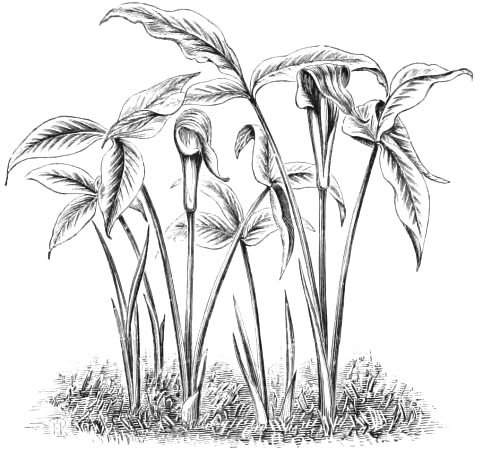
FIG. 148. ARISÆMA TRIPHYLLA.
A. triphylla (three-leaved).* fl., spathe 4in. to 6in. long, striped with broad lines of purplish-brown, with about 1in. of green in the middle; spadix 3in. long, spotted with brown. June to July. l. on long stout petioles, trifoliate; leaflets entire, equal, acuminated. h. 9in. to 1ft. North America, 1664. This is quite hardy. SYNS. A. zebrina and Arum triphyllum. See Fig. 148.
A. zebrina (zebra). A synonym of A. triphylla.
ARISARUM (name of Greek origin). ORD. Aroideæ. A small genus of half-hardy herbaceous plants, possessing but little horticultural interest, and allied to Arisæma. Flowers unisexual, spadix having no rudimentary flowers. Leaves on long stalks, heart-shaped or spear-shaped. The only species in cultivation thrives in a sand, loam, and peat compost. Propagated by seeds or divisions of the root in spring.
A. vulgate (common). fl., spathe livid purple. May. h. 1ft. South Europe, 1596.
ARISTATE. Having a beard or awn, as the glumes of barley.
ARISTEA (from arista, a point or beard; in reference to the rigid points of the leaves). ORD. Iridaceæ. A genus of greenhouse herbaceous perennials from the Cape of Good Hope. Flowers blue; perianth rotate, six-parted, twisted after flowering; scape two-edged, rigid, often branched. Leaves narrow, sword-shaped. The species are more interesting than ornamental, and may be grown in a compost of three parts turfy peat, and one of loam. Easily propagated by divisions and seeds. They vary in height from 3in. to 3ft., and flower generally in summer.
A. capitata (headed). fl. blue. July. h. 3ft. Cape of Good Hope, 1790.
A. cyanea (bright blue). fl. blue. June. h. 6in. Cape of Good Hope, 1759.
ARISTOLOCHIA (from aristos, best, and locheia, parturition; in reference to its supposed medicinal character). Birthwort. ORD. Aristolochiaceæ. A very large genus of stove, greenhouse, or hardy, evergreen or deciduous, climbing or erect shrubs. Flowers axillary, clustered, or solitary, pendulous, of most extraordinary forms; perianth tubular, curved, or straight, with an oblique, cordate limb; stamens six, rarely four, or numerous, adhering to the stigma; capsule six-valved. Leaves cordate entire or lobed. Good loam, with a small proportion of decayed manure and a slight addition of sharp sand to secure efficient drainage, is a good compost for the whole. They will thrive when planted out in the conservatory more satisfactorily than elsewhere; for as they usually grow a considerable height before flowering, they require very long trellises in pots, and have to be trained up and down; or, better still, round a pillar of uniform circumference, a pyramid form being useless. The best way is to train them round, close down to the pot, and keep on about 2in. from one turn to the next. Some of the larger sorts will require more room. Cuttings root freely in sand under a bell glass with bottom heat.