THE DICTIONARY OF GARDENING, (continued 12)
Reading edition
B. Lindleyana (Lindley's). A garden synonym of B. incarnata. (Gardens.)
B. longipes (long-stalked). S. Stem 3ft. or more high, stout, succulent, furrowed, covered with glands. l. large, rotundate-cordate; margin irregular, serrated, both sides green, pubescent when young. fl. numerous, small, white; peduncle 1ft. long, branched. Winter. Colombia, 1829. (B. M. 3001.)
B. longipila (long-haired). A variety of B. heracleifolia.
B. lucida (shining). Synonymous with B. scandens.
B. Lynchiana (Lynch's). S. Stem erect, tall, succulent, smooth. l. fleshy, 10in. long, oblique, ovate-cordate, crenulate, green, smooth. fl. axillary, in drooping cymes, numerous, large, deep reddish-crimson. Winter. Mexico, 1880. One of the finest of the tall-growing winter-flowering species. When well managed, the flower-heads are almost a foot in diameter. SYN. B. Roezlii, of gardens. (B. M. 6758.)
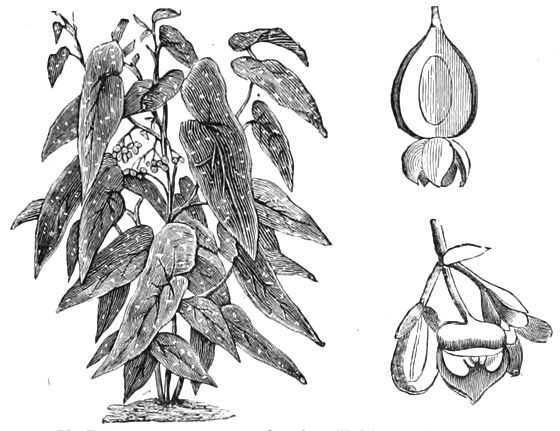
FIG. 230. BEGONIA MACULATA, showing Habit, Section of Capsule, and Flower.
B. maculata (spotted).* S. A woody shrub. Stems branching, smooth. l. oblique, ovate-oblong, leathery, slightly undulate; margins entire, under side bright crimson, above green, with numerous large round blotches of silvery white. fl. in drooping panicles, coral-like, handsome. Capsule with one long, narrow wing. Summer. Brazil, 1821. (B. R. 666.) There are numerous varieties of this species, some with leaves almost green, others with the markings more striking than in the type; in the flowers they differ also, ranging from white to coral-red. The beautiful B. corallina is probably a variety of this. SYN. B. argyrostigma. See Fig. 230.
B. magnifica (magnificent).* S. Stem erect, fleshy, smooth. l. ovate, unequal sided, toothed. fl. in terminal, cymose panicles, rosy-carmine, 1½in. long. New Grenada, 1870. (R. H. 1870, 271.)
B. magnifica (magnificent). Synonymous with B. ferruginea.
B. malabarica (Malabar).* Stem thick, succulent, 2ft. high, branching. l. numerous, cordate, acute, unequal-sided, crenate or serrate, hairy above and sometimes below, or altogether glabrous, spotted white. fl. rose-coloured; peduncles axillary, short, few-flowered. Capsule wings equal, joined above and below. Summer. Malabar and Ceylon, 1828. B. dipetala is made a variety of this, by Sir Joseph Hooker, in "Flora of British India." (L. B. C. 1730.)
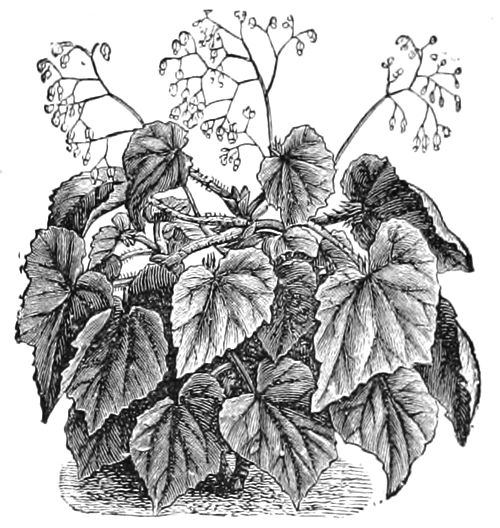
FIG. 231. BEGONIA MANICATA.
B. manicata (tunicated).* Stem fleshy, twisted, short. l. oblique, ovate-acute, cordate, dentate-ciliate, smooth on both sides, shining green nerves on under side, with fleshy, scale-like hairs. fl. pink, dipetalous, in branching cymes; upper portion of stalk scaly. Capsule wings nearly equal. Winter. Mexico, 1842. See Fig. 231.
B. Manni (Mann's). S. Stem succulent, 2ft. to 3ft. high, branched, green; branchlets, young parts, petioles, and leaf-nerves clothed with rusty, furfuraceous pubescence. l. petioled, 5in. long, 2in. wide, lanceolate, cordate, acuminate, toothed. fl. numerous, rose-red, in axillary cymes; peduncle 1in. long. Capsule linear, densely tomentose. Winter. Fernando Po, 1862. (B. M. 5434.)
B. marmorea (spotted). A variety of B. xanthina.
B. Martiana (Martin's). A variety of B. gracilis.
B. maxima (large).* Rhizome thick, hairy, creeping. l. large, oblique, orbicular-ovate, cordate, shortly acuminate; margins denticulate ciliate; petiole long, pilose. fl. in branching cymes; sepals orbicular, pilose on the outside, white. Summer. Mexico, 1853.
B. megaphylla (large-leaved).* Stem short, thick, fleshy. l. large, palmate, cordate; lobes numerous, pointed; margins hairy, under side slightly pilose; nerves with scaly hairs. fl. in diffuse cymes, small, white; peduncles pilose. Capsule wings wide. Winter. Mexico.
B. metallica (metallic). A variety of B. incarnata.
B. Meyeri (Meyer's). S. Stem erect, stout, woody when mature. l. large, broadly and obliquely ovate, fleshy, pale green; margin sinuate, under side tinged with rose; both petiole and blade covered with short hairs. fl. on long axillary peduncles, in large paniculate heads, white. Capsule wings equal. Summer. Brazil, 1844. (B. M. 4100.)
B. microphylla (small-leaved). Synonymous with B. foliosa.
B. microptera (small-winged). Stem 1ft. high, terete, green, pubescent, as in the rest of the plant. Branches few. l. sub-distichous, 4in. to 6in. long, ovate-lanceolate, acuminate, serrated, dark green; petiole short; stipules as long as petiole. fl. in terminal panicles, medium-sized, white, tinted rose. Capsule long, triangular, two angles wingless, the other with a narrow wing. Winter. Borneo, 1856. (B. M. 4974.)
B. miniata (vermilion). A variety of B. fuchsioides.
B. monoptera (single-winged).* Stem erect, 1ft. to 2ft. high, rounded, swollen at the joints, dull red, papillose and downy. Radical leaves on long red stalks, large, reniform, truncate at the base; caulescent leaves smaller, on short petioles, angled, crenate, dark green above, red below, and minutely papillose. fl. on an elongated terminal raceme, white. Capsule three-angled, two wingless, the other with a long pointed wing. Summer. Brazil, 1826. A distinct and pretty species. (B. M. 3564.)
B. Moritziana (Moritz's). Synonymous with B. scandens.
B. natalensis (Natal).* T. Rootstock thick, fleshy. Stem 1½ft. high, succulent, thick at the base, articulate, branched, smooth. l. unequal, semicordate, acuminate, lobed, toothed, spotted with white. fl. on axillary cymose peduncles, pale rose. fr. three-winged, two large, one small. Winter. Natal, 1855. (B. M. 4841.)
B. nelumbiifolia (Nelumbium-leaved).* Rhizome thick, fleshy, creeping. l. on long hairy petioles; blade 12in. to 18in. long, 8in. to 12in. wide, peltate, hairy on under side; scape 1ft. to 2ft. high. fl. in cymose head, numerous, small, white or rose coloured. Winter. Mexico. A noble-foliaged plant. SYN. B. hernandiæfolia.
B. nemophila. Synonymous with B. Cathcartii.
B. nigro-venia (black-veined). Synonymous with B. glandulosa.
B. nitida (shining).* S. Stem 4ft. to 5ft. high, erect, branched, woody when aged, smooth, shining. l. large, glossy, green on both sides, obliquely ovate, acute, crenated at margin. fl. in terminal and axillary panicles, numerous, large, deep rose, handsome. Capsule three-winged, one much larger than others. Jamaica, 1777. One of the best winter, and almost a perpetual, flowering species. SYNS. B. obliqua, B. pulchra, B. purpurea. (B. M. 4046.)
B. obliqua (oblique). Synonymous with B. nitida.
B. octopetala (eight-petaled).* T. Stemless. l. on long succulent downy petioles, 1½ft. or more in length, cordate, 6in. long, deeply lobed and serrated at the margin, bright green; scape as long as petioles, rounded, downy. fl. in corymbs, greenish-white, males with eight petals, females generally fewer. Capsule three-angled, two wings almost suppressed, the other 1in. long; apex blunt, toothed. Autumn. Peru, 1835. SYN. B. grandiflora. (B. M. 3559.)
B. odorata (sweet-scented). Synonymous with B. suaveolens.
B. opuliflora (Guelder-rose-flowered).* S. Stem 1ft. high, branching, smooth. l. ovate oblong-acuminate, toothed, smooth above, hairy below. fl. white, in compact umbels, on erect scapes. Spring. New Grenada, 1854.
B. Ottoniana (Otton's). A hybrid from B. conchæfolia and B. coriacea. (R. G. 1859, p. 15.)
B. papillosa (papillose). A variety of B. incarnata.
B. Pearcei (Pearce's).* T. Stem 1ft. high, succulent, branching. l. lance-shaped, cordate, pointed, toothed, glabrous above, tomentose beneath, and pale red. fl. in loose axillary panicles, large, bright yellow. Summer. Bolivia, 1865. Interesting because of its being one of the progenitors of the handsome race of garden tuberous Begonias.
B. peltata (shield-like). Stem short, tomentose; leaves 6in. by 4in., peltate, ovate, densely pilose. fl. in branching cyme, small, white; peduncle 6in. to 9in., pilose. Brazil, 1815. Interesting because of its distinctly peltate foliage and silvery appearance of whole plant. SYNS. B. coriacea, B. Hasskarlii, B. hernandiæfolia, B. peltifolia.
B. peltifolia (peltate-leaved). Synonymous with B. peltata.
B. phyllomaniaca (proliferous-stemmed). S. Stem thick, fleshy, rather twisted, green, hairy, clothed, when old, with small viviparous buds bearing small leaves, by which means the plant may be multiplied. l. ovate, acuminate, cordate, sinuately lobed, ciliate, smooth above and below. fl. in axillary cymes, drooping, pale rose. Capsule with one large wing. Winter. Guatemala, 1861. (B. M. 5254.)
B. picta (ornamented).* T. Stem generally smooth, succulent, 6in. to 12in. high. l. ovate acuminate, nearly equally cordate, serrated, hairy above and on the nerves below, sometimes variegated. fl. pale rose, large, handsome; peduncle hairy, erect, short, few-flowered. Autumn. Himalaya, 1870. (S. E. B. 101.)
B. platanifolia (plane-leaved).* S. Stem 5ft. to 6ft. high, erect, robust, smooth, green; joints annulated. l. 8in. to 10in. in diameter, reniform, lobed, hispid on both sides, dark green; lobes acute, toothed, ciliated. fl. in axillary, dichotomous cymes, large, white, tinted rose, handsome. Summer. Brazil, 1834. (B. M. 3591.)
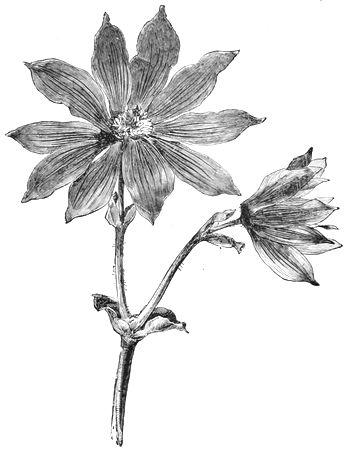
FIG. 232. BEGONIA POLYPETALA.
B. polypetala (many-petaled). Stem about 1ft. high, covered with a soft whitish tomentum. l. ovate-acute, toothed, pubescent above, and densely tomentose below. fl., petals nine or ten, of a fine red colour, smooth, external ones ovate-oblong, pointed; internal ones somewhat shorter and narrower; sepals two, ovate-elliptic. Capsule tomentose, three-winged, with one wing larger, ascendent. Winter. Andes of Peru, 1878. See Fig. 232. (Garden, Dec. 14, 1878.)
B. prestoniensis (Preston).* A garden hybrid between B. cinnabarina and B. nitida. l. green, lobed, glabrous. fl. brilliant orange-red, in drooping axillary cymes, very fragrant. Autumn and winter. 1867. (G. M. B. 3, 149.)
B. prismatocarpa (prism-fruited).* Stems small, creeping, hairy; branchlets ascending. l. long, petioled, also hairy, obliquely cordate, ovate, three to five-lobed; lobes pointed, serrated; peduncles axillary, longer than foliage, bearing a small umbel of two to four dipetalous orange and yellow flowers, one female in each umbel. Capsule four-angled, scarcely winged. Summer. Tropical West Africa, 1861. The smallest of cultivated Begonias, and especially interesting because of its four-angled fruit. It forms a pretty cushion of bright shining green foliage, thickly studded with its brightly coloured flowers. Requires a stove temperature and a stony soil. (B. M. 5307.)
B. pruinata (frosted).* Stem short, thick, fleshy, smooth. l. large, peltate, ovate, angular-sinuate, minutely-toothed; surface smooth, glaucous; margins pilose, on stout, fleshy petioles. fl. in large dense dichotomous, or small cymes, white. Winter. Central America, 1870. (R. B. 247.)
B. pulchra (fair). Synonymous with B. nitida.
B. punctata (dotted). A variety of B. heracleifolia.
B. purpurea (purple). Synonymous with B. acutifolia.
B. purpurea (purple). Synonymous with B. nitida.
B. Putzeysiana (Putzeys'). S. Stem erect, branching, smooth. l. oblong-lanceolate, acute, toothed, glabrous, under side spotted with white. fl. in copious small corymbs, white and rose, small. Capsule small, with rather large obtuse wings. Winter. Venezuela, 1871.
B. radiata (rayed). Synonymous with B. heracleifolia.
B. ramentacea (scaly).* S. Stem erect, branching, brown, scaly, as also are the leafstalks and peduncles. l. ovate, reniform, oblique; margins slightly angulate, recurved, under side red, scaly; peduncles branching. fl. drooping, pink and white, pretty. Capsule, when ripe, a bright scarlet; wings large. Spring. Brazil, 1839. (P. M. B. 12-73).
B. reniformis (kidney-formed). Synonymous with B. Dregei. (Gardens.)
B. reniformis (kidney-formed). Synonymous with B. vitifolia. (Hook.)
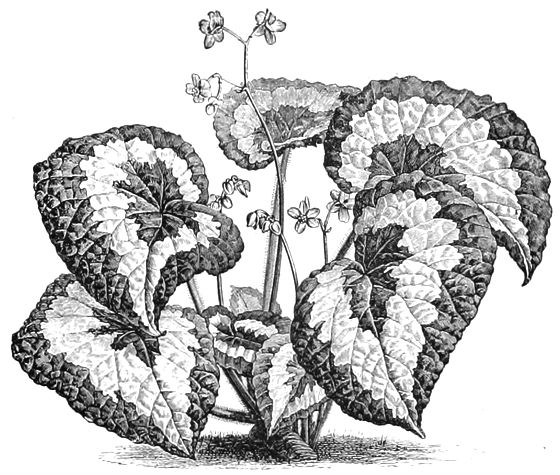
FIG. 233. BEGONIA REX.
B. Rex (Royal).* Stemless; rhizome fleshy, creeping, subterraneous. Leafstalk round, red, setose. l. 8in. to 12in. long, 6in. to 8in. broad, ovate, oblique, sides unequal, cordate, villose; margins toothed, surface bullate, dark olive-green, with a metallic lustre, a broad silvery zone running all round, about 1in. from the margin. fl. in erect branching cyme, large, pale rose. Capsule wings, two short, one long and rounded. Assam, 1858. See Fig. 233. (B. M. 5101.) This magnificent species is the principal progenitor of the numerous ornamental-foliaged Begonias, a selection of which are given below. Most of them are well worth growing, but those named have been selected from a large number: MADAME WAGNER,* l. large, profound green, banded by a broad silvery zone, especially fine; MARSHALLI, l. very large, the margins and very centre dark green, while the greater portion of the surface is covered with a silvery-grey; REGINA,* l. rich olive-green, banded with a broad zone of bronze-red and silvery-grey, rendering it very attractive; ROI LEOPOLD,* l. on long stout petioles, very large, deep bronze-red in the centre, with a broad border of a rather lighter shade, very effective; ROLLISONI,* l. large, on long stalks, rich velvety-green, banded with silvery-grey; SPLENDIDA ARGENTEA,* l. large, of a greyish hue, veined with white, and tinged with bronze-red, very beautiful. The following varieties are also very good: ADRIEN ROBINE,* BERTHE PROUTIERE, CHARLES HOVEY, DISTINCTION,* JULIA SEROT,* LOUISE CHRETIEN,* MADAME J. MENOREAU,* NARGA,* NAVALA,* TALISMAN, W. E. GUMBLETON.
B. Richardsiana (Richards').* T. Stem 1ft. high, erect, fleshy, with slender branches. l. palmately lobed, the lobes sinuate or toothed. fl. white, males bipetalous, females with five petals. Cymes axillary near ends of branches, few-flowered. Capsule three-winged, wings equal. Summer. Natal, 1871. (G. C., 1871, p. 1065.)
B. R. diadema (of gardens).* This is referred to here because of its close resemblance to the above. It is most likely a hybrid between B. Richardsiana and B. dipetala. l. palmately lobed, rather large, spotted with white. fl. large, rose-coloured. Summer. 1881.
B. ricinifolia (Ricinus-leaved).* A garden hybrid between B. heracleifolia and B. peponifolia. l. large, bronzy green, in shape like those of the Castor-oil plant. fl. numerous, on an erect scape. Winter. 1847.
B. Roezlii (Roezl's). Synonymous with B. Lynchiana.
B. rosacea (rosy). Stem succulent, short. l. ovate obtuse, slightly pubescent, toothed; petioles long, pilose. fl. in few-flowered cymes, medium-sized, rose-coloured. New Grenada, 1860. (Garden, pl. 152.)
B. rosæflora (rose-flowered).* T. Stemless. Petioles, scapes, bracts, and stipules bright red. l. green, 2in. to 4in. wide, on stout hairy petioles, 2in. to 6in. long, orbicular-reniform, concave; margins lobed, red, toothed. Scapes stout, villous, three-flowered. fl. 2in. across, bright rose-red. Summer. Peru, 1867. One of the parents of the popular race of tuberous-rooted large-flowered Begonias. (B. M. 5680.)
B. rubricaulis (red-stalked).* Stemless. Leafstalks, peduncles, pedicels, and ovaries, a deep red colour. l. obliquely ovate, 4in. to 6in. long, slightly hairy, bright green, wrinkled; margins toothed and ciliated. Scape 1ft. high, erect, stout, branching at the top, forming a head of about a dozen flowers, which are large, white inside, rose-tinted outside. Capsule with one large wing, the others almost suppressed. Summer. Peru, 1834. (B. M. 4131.)
B. rubro-venia (red-veined).* Rootstock thick. Stems 12in. to 18in. high, red, pubescent. l. 4in. to 6in. long, elliptic or lanceolate acuminate, entire or slightly angular, toothed, green spotted with white above, purplish-brown below. Scapes axillary, red. fl. in cymose head; outer segments white with rose-red veins, inner segments pure white. Summer. Sikkim, &c., 1853. (B. M. 4689.)
B. sanguinea (blood-red). S. Stems woody when old, tall, stout, red, with scattered paler spots. l. 4in. to 6in. long, unequally cordate, acuminate, thick and somewhat fleshy in texture, minutely crenate, green above, deep red below; peduncles axillary, long, erect, red. fl. in a branching cyme, rather small, white. Capsule wings sub-equal. Spring. Brazil, 1836. (B. M. 3520.)
B. scabrida (rough). Stem stout, erect, somewhat succulent, covered with small tubercles. l. 6in. long, oblique, ovate-acute, cordate, toothed, slightly hairy. fl. white, small; cyme many-flowered. Capsule wings equal, large. Venezuela, 1857.
B. scandens (climbing).* Stem flexuose, fleshy, creeping or climbing, smooth. l. 4in. long, ovate acuminate, sub-cordate; margins irregularly toothed, pale shining green. fl. in axillary branching cymes, white, small. South America, 1874. Useful either as a basket plant or for training against moist walls. SYNS. B. elliptica, B. lucida, B. Moritziana. (R. G. 758.)
B. sceptrum (princely). S. l. obliquely ovate in outline, deeply lobed on one side; lobes oblong; obtuse, veins sunk, and the raised spaces between marked with large silvery blotches, and numerous smaller dots of silver grey. Brazil, 1883.
B. Schmidtiana (Schmidt's).* Stems 1ft. high, branching, herbaceous. l. obliquely cordate, ovate-acute, small, dark metallic green above, tinged with red below. fl. in loose drooping axillary panicles, white, small, numerous. Winter. Brazil, 1879. (R. G. 990.)
B. scutellata (salver-like). Synonymous with B. conchæfolia.
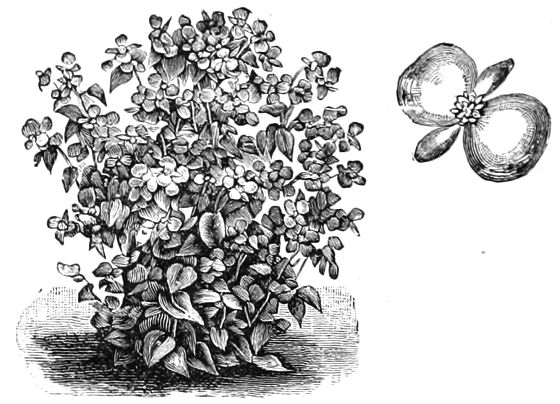
FIG. 234. BEGONIA SEMPERFLORENS FRAU MARIA BRANDT, showing Habit and Flower.
B. Sedeni (Seden's). T. A garden hybrid between B. boliviensis and B. Veitchii. Summer. 1869. A handsome plant, but much inferior to many of the more recent hybrids. (R. H. 1872, 90.)
B. semperflorens (always-flowering).* Stem fleshy, erect, smooth, reddish-green. l. ovate-rotundate, hardly cordate; margins serrated, ciliated, surface smooth, shining green. fl. on axillary stalks, near apex of stems, white or rose, rather large. Capsule wings two short, one long, rounded. Autumn. Brazil, 1829. A useful summer and autumn flowering species, of which there are several named varieties more or less distinct from the type, either in colour or size of flowers, or in habit of plant. The varieties carminea, gigantea, and rosea are perhaps the best. SYN. B. spathulata. (B. M. 2920.)
B. s. Frau Maria Brandt. A dwarf compact variety, with rose-tinted flowers. See Fig. 234.
B. socotrana (Socotra).* Stem annual, stout and succulent, forming at base a cluster of bulbils, each of which produces a plant the following year; sparsely hairy. l. dark green, orbicular, peltate, 4in. to 7in. across, centre depressed; margin recurved, crenate. fl. in terminal, few-flowered cymes, 1½in. to 2in. wide, bright rose. Capsule three-angled, one-winged. Winter. Socotra, 1880. Should be rested through the summer, and started in heat in September. A distinct and beautiful species. (B. M. 6555.)
B. spathulata (spathulate). Synonymous with B. semperflorens.
B. stigmosa (branded).* Rhizome creeping, fleshy. l. 6in. to 8in. long, oblique, cordate-acute, irregularly toothed, smooth above, hairy beneath, green, with brownish-purple blotches; stalks scaly, as in B. manicata. fl. in cymose panicles, white, medium-sized, numerous. Brazil, 1845.
B. strigillosa (strigillose).* Rhizome short, fleshy, creeping, l. 4in. to 6in. long, oblique, ovate-acute, cordate-toothed; margins ciliate, red; stalk and blade covered with fleshy scales; blade smooth, blotched with brown. fl. in branching cymes, dipetalous, small, rose-coloured. Summer. Central America, 1851.
B. suaveolens (sweet-scented). S. Stem branching, 2ft. high, smooth. l. 3in. to 4in. long, oblique-ovate, cordate-acute, crenulate, glabrous. fl. in axillary panicles, large, white. Winter. Central America, 1816. Resembles B. nitida, but may be distinguished by its distinctly crenulate leaves and smaller flowers, which are white, and not pale rose, as in B. nitida. SYN. B. odorata. (L. B. C. 69.)
B. Sutherlandi (Sutherland's).* T. Stems annual, 1ft. to 2ft. high, slender, graceful, red-purple. l. on slender red petioles, 2in. to 3in. long; blade 4in. to 6in. long, ovate-lanceolate, deeply lobed at base; margins serrate, bright green; nerves bright red. fl. in axillary and terminal cymes, numerous, orange-red, shaded with dark vinous-red. Capsule wings equal. Summer. Natal, 1867. (B. M. 5689.)
B. Teuscheri (Teuscher's). S. A strong, erect-growing, large-leaved plant, from the Dutch Indies, not yet flowered. l. cordate-ovate, acute, olive-green above, with greyish blotches; under side rich claret-coloured. Hort. Linden. (I. II. 1879, 358.)
B. Thwaitesii (Thwaites's).* Stemless. l. 2in. to 4in. in diameter, obtuse or sub-acute, cordate at base, minutely toothed, slightly pubescent, very shaggy when young, rich coppery-green, red-purple and blotched with white; under side blood red. fl. in an umbel, medium-sized; scape short, white. Capsule shaped like a Beech nut; wings short. Ceylon, 1852. One of the most beautiful of coloured-leaved Begonias, requiring a close, moist atmosphere in a stove. (B. M. 4692.)
B. ulmifolia (Elm-leaved). S. Stem 2ft. to 4ft. high, branching. l. 3in. to 4in. long, ovate-oblong, unequal-sided, toothed, rugose, hairy. fl. on hairy peduncles, numerous, small, white. Capsule wings two small, one large, ovate. Winter. Venezuela, 1854. (L. C. 638.)
B. undulata (wavy-leaved). S. Stem 2ft. to 3ft. high, erect, branching freely, turgid below, green, succulent until old. l. distichous, oblong-lanceolate, undulated, smooth, shining green. fl. in nodding axillary cymes, white, small. Winter. Brazil, 1826. (B. M. 2723.)
B. urophylla (caudate-leaved). Stemless. Leafstalks terete, succulent, clothed with scattered bristly hairs. l. large, 12in. long, broad, cordate; margin irregularly cut, toothed; apex long-pointed, green, smooth above, hairy beneath; peduncle stout, paniculate. fl. crowded, large, dipetalous, white. Spring. Brazil. (B. M. 4855.)
B. Veitchii (Veitch's).* T. Stem very short, thick, fleshy, green. l. orbiculate, cordate, lobed and incised; margins ciliated, green, principal nerves radiating from bright carmine spot near centre; under side pale green; petiole thick, terete, with a few hairs on the upper portion; scape 10in. to 12in. high, thick, terete, pilose, two-flowered. fl. 2¼in. in diameter, cinnabar red. Capsule smooth, two short, one long wings. Summer. Peru, 1867. One of the species from which the popular garden tuberous-rooted Begonias have been obtained. (B. M. 5663.)
B. Verschaffeltiana (Verschaffelt's).* A hybrid between B. carolinæfolia and B. manicata, with large ovate acutely-lobed leaves and flowers in large cymes, rose-coloured and pendent. Winter. (R. G. 1855, p. 248.)
B. vitifolia (Vine-leaved). S. Stem 3ft. to 4ft. high, thick, smooth, and fleshy. l. large as vine foliage, and similar in shape; peduncles axillary, erect, branching into a cymose head of small white flowers. Capsules three-angled, one-winged. Winter. Brazil, 1833. SYNS. B. grandis, B. reniformis. (B. M. 3225.)
B. Wagneriana (Wagner's). S. Stem 2ft. to 3ft. high, erect, glabrous, green, succulent, branched. l. cordate-ovate, acuminate; margins obscurely lobed, slightly serrate, quite glabrous; peduncles axillary and terminal, cymose. fl. numerous, white. Capsules, which are ripened in abundance, three-angled, one wing long, two short. Winter. Venezuela, 1856. (B. M. 4988.)
B. Warscewiczii (Warscewicz's). Synonymous with B. conchæfolia.
B. Weltoniensis (Welton). A garden hybrid; one of the oldest of cultivated winter-flowering kinds, with light pink flowers, very free.
B. xanthina (yellow-flowered).* Stem short, thick, fleshy, horizontal, along with petioles thickly-clothed with brown scaly hairs; petioles 6in. to 12in. long, stout, terete, fleshy, reddish-brown; blade 8in. to 12in. long, cordate-ovate, acuminate, sinuate-ciliated, dark green above, purplish beneath. Flower-stalks erect, 1ft. high, bearing a cymose head of large golden flowers. Capsule with one large wing. Summer. Boutan, 1850. (B. M. 4683.)
B. x. Lazuli (Lapis-lazuli).* Foliage metallic purple, with a bluish tinge.
B. x. pictifolia (ornamented-leaved).* l. with large silvery spots, and pale yellow flowers.
The following list comprises a selection of some of the best and most distinct of the innumerable varieties now existing in gardens, and which have been obtained by crossing and re-crossing the several tuberous-rooted species found in the temperate regions of South America.
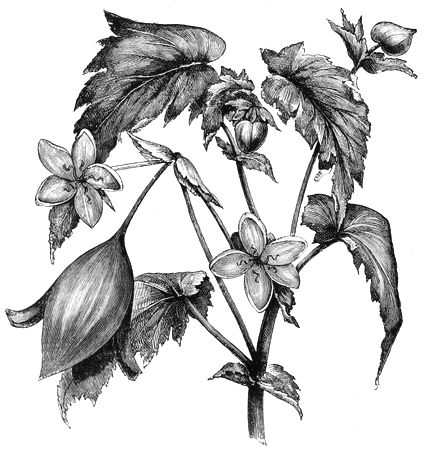
FIG. 235. FLOWERING BRANCH OF BEGONIA ADMIRATION.
Single-Flowered Varieties. Crimson and Scarlet Shaded: ADMIRATION, flowers vivid orange-scarlet, of dwarf, compact habit, and free flowering (see Fig. 235); ARTHUR G. SOAMES,* brilliant crimson scarlet, of excellent form, and very free; BALL OF FIRE,* glowing fiery-scarlet, flowers large and compact, very free; BLACK DOUGLAS,* dark carmine crimson, flowers large, of the finest form, one of the best; BRILLIANT, deep orange-scarlet, very free; CHARLES BALTET, rich velvety vermilion; COMMODORE FOOT,* brilliant velvety crimson, very free and showy; DAVISII, flowers small, dazzling scarlet, habit dwarf and free; DR. MASTERS,* flowers large, with immense spikes, deep red-crimson, very attractive; DR. SEWELL,* glowing crimson, grand form; EXONIENSIS, brilliant orange-scarlet, immense flowers; F. E. LAING, deep velvety crimson, full and free; HON. MRS. BRASSEY,* deep glowing crimson, very rich and floriferous; J. H. LAING,* brilliant scarlet, one of the freest; J. W. FERRAND,* rich vermilion, dwarf and free, one of the finest for bedding; LOTHAIR,* dark scarlet-carmine, crimson shaded, of grand form and size; MARQUIS OF BUTE, brilliant carmine-crimson, of the finest form, and immense flowers; SCARLET GEM,* very dark scarlet, flowers medium-sized, dwarf and very floriferous; SEDENI, rich rosy-crimson, dwarf, a good bedder; VESUVIUS,* bright orange-scarlet, compact and free, one of the finest bedders.
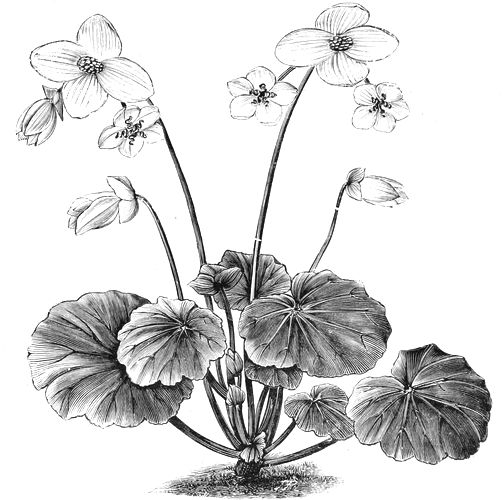
FIG. 236. BEGONIA QUEEN OF WHITES.
Rose-Coloured: ALBERT CROUSSé,* bright salmon-rose, very free; ANNIE LAING,* large and free, rich pink; CAPT. THOMPSON, rich salmon-rose, very free and compact; DELICATUM, pale flesh-rose; EXQUISITE,* rich deep rose, very free and showy; J. AUBREY CLARK, flowers very large, rich, deep; JESSIE,* soft rosy-pink, with the tips of the petals shaded carmine, a very fine, perfect variety; LADY BROOKE,* dark rose, shaded magenta, very perfect in form, and large; LADY HUME CAMPBELL,* pale pink, of good form and size, an exquisite variety; MADAME STELLA,* flowers perfect in form, large, bright rosy-pink, one of the best; MARCHIONESS OF BUTE, light rosy-pink, with an immense bloom and handsome foliage; PENELOPE,* rich salmon-rose, very free and good; PRINCESS OF WALES, very delicate pink, and free; ROSE D'AMOUR, rich rose, delicately shaded.
White-Flowered: ALBA FLORIBUNDA, flowers medium-sized, very free; MOONLIGHT, very free, with good flowers and handsome foliage; MRS. LAING,* flowers exquisite in form and shape, pure white, one of the best; NYMPH,* large and round, white, tinted with rose at the base; PRINCESS BEATRICE,* flowers large, of excellent form, and pure in colour; PURITY, flowers round, good size and colour; QUEEN OF WHITES,* flowers pure white, large, most freely produced (see Fig. 236, for which we are indebted to Messrs. Veitch and Sons); REINE BLANCHE,* one of the best, very pure; SNOWFLAKE,* flowers large, in full spikes, pure white, habit compact, and very free.
Yellow and Orange-Flowered: CHROMATELLA,* habit dwarf and compact, pure yellow; EMPRESS OF INDIA, deep yellow, very showy; GEM OF YELLOWS,* rich deep yellow, of grand form and size, one of the best; GOLDEN GEM,* rich golden yellow, of excellent form and size, habit free, with prettily mottled foliage; J. L. MACFARLANE, rich orange, freest form, and large; LADY TREVOR LAWRENCE,* orange-yellow, of good form, with handsome foliage; MAUDE CHURCHILL,* pale yellow, deeper shaded, with elegant foliage; MRS. PONTIFEX,* rich orange yellow, very large flowers, copiously produced; POLLIE, pale yellow, fine round flower; SULPHUR QUEEN,* pale sulphur-yellow, of good form and size.
Double-Flowered Varieties. Crimson and Scarlet Shaded: ACHILLES, rich dark crimson, very large and free; DAVISII HYBRIDA FL.-PL.,* rich coral-red, very full and free; DAVISII FL.-PL. SUPERBA,* brilliant crimson-scarlet, of good size, and extremely free; DR. DUKE,* brilliant scarlet, very large and double, one of the best; FRANCIS BUCHNER,* rich cerise-red, very double, perfect in form, and very large; FULGURANT, rich crimson, full, with dark foliage; GLOIRE DE NANCY,* rich vermilion, very free; HERCULES,* bright orange-scarlet, very large and extremely free, habit compact and vigorous; LEMOINEI, deep orange-vermilion, very floriferous; MONSIEUR BAUER, deep red, tinged with violet; NIMROD,* rich red-scarlet, very large and full, with a free and very vigorous habit; PRESIDENT BURELLE,* glowing red, tinted with scarlet, very free; QUEEN OF DOUBLES,* rich rosy-crimson, very double and floriferous, one of the best varieties; ROBERT BURNS,* brilliant orange-scarlet, tinted vermilion, very double and free; SIR GARNET, deep orange-scarlet, very vigorous; WM. BEALBY,* deep velvety scarlet, immense size and perfect form, very free.
Rose-Coloured: ADA,* bright rosy-salmon, fringed at the edge, very full and free; COMTESSE H. DE CHOISEUL, pale rose, at first nearly white, very handsome; ESTHER,* rich rosy pink, with a distinct crimson margin; FORMOSA,* rich rosy carmine, with a white centre and crimson margin, very distinct and showy; GLORY OF STANSTEAD,* deep rose, with a well-defined white centre, very distinct and handsome; JOHN T. POE,* bright rose, tinted with cerise, of excellent form and vigorous habit; MADAME COMESSE,* rich satiny salmon-rose, immense, and most profuse; MADAME LEON SIMON, soft pale rose, very full and free; MARIE LEMOINE, light salmon with a rose centre; MRS. BRISSENDEN,* salmon-rose, with a cream-white centre, of excellent form and very free; PæONIFLORA, flowers enormous, rich salmon-rose, very full; QUEEN OF SCOTS,* satiny-pink, salmon-shaded, of a perfect form and very large, habit compact and very free; ROSINA,* deep rose, violet shaded, of exquisite form, very vigorous and free.
White-Flowered: ANTOINETTE QUERIN,* pure white, cream, shaded centre, very large and full, a magnificent variety; BLANCHE JEANPIERRE, pure white, cream tinted, of excellent form and very free; LITTLE GEM,* pure white, of the best form and good size, habit dwarf and extremely floriferous; MRS. LUDLAM,* white, tinted with pink, a very handsome variety; PRINCESS OF WALES,* flowers very full and profuse, almost pure in colour, and immense.
Yellow-flowered: CANARY BIRD,* flowers large, of the finest form, deep yellow, habit dwarf and very free; GABRIEL LEGROS,* pale sulphur, changing to yellow, very full and imbricated, extremely showy.
BEGONIACEÆ. An order comprising a large number of useful garden plants. The only genera are Begonia and Begoniella (which is not yet in cultivation). Flowers apetalous; perianth single; pistillate flowers having the perianth two to eight-cleft, staminate ones two to four-cleft; stamens numerous, collected into a head. Leaves alternate, stipulate. See Begonia.
BEJARIA. See Befaria.
BELLADONNA. See Atropa.
BELLADONNA LILY. See Amaryllis Belladonna.
BELLEVALIA (named in honour of P. R. Belleval, a French botanist). ORD. Liliaceæ. This genus is now usually placed under Hyacinthus. Hardy, bulbous-rooted plants, admirably adapted for spring bedding or forcing, and invaluable as cut flowers. Flowers small, whitish, or violet, tinged with green. Leaves few, radical, broadly linear. They are of extremely easy culture in ordinary garden soil. Propagated by offsets; also by seeds, which should be sown as soon as ripe.
B. operculata (lid-covered). Synonymous with B. romana.
B. romana (Roman).* Roman Hyacinth. fl. white, racemose; perianth campanulate; pedicels longer than the flowers. April. l. from 4in. to 5in. long. h. 6in. Italy, 1596. A most desirable plant, and the best of the genus for forcing purposes. SYNS. B. operculata and Hyacinthus romanus. (B. M. 939, under the name of Scilla romana.) See Hyacinthus.
B. syriaca (Syrian).* fl. white; peduncles spreading, racemose. May. l. glaucous, 1ft. long, channelled, rather scarious on the margins. h. 1ft. Syria, 1840.
BELL-FLOWER. See Campanula.
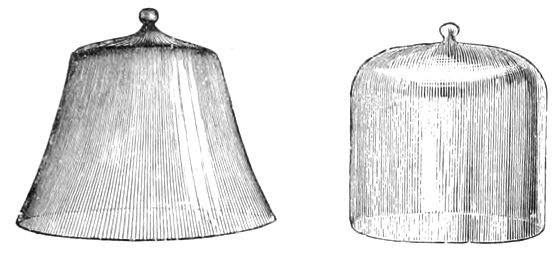
FIG. 237. FRENCH BELL GLASS, OR CLOCHE. FIg. 238. ENGLISH BELL GLASS.
BELL GLASSES, or CLOCHES. These are used for the purpose of protecting or accelerating the growth of a plant or plants. The French Cloche (see Fig. 237) is largely employed for this purpose. Ordinary Bell Glasses (see Fig. 238) are exceedingly useful for propagating purposes, especially for hard-wooded plants; or for placing over subjects which require a very moist atmosphere, such as Filmy ferns, Cephalotus, &c.; or for covering half-hardy plants or rare alpines, and thus protecting them from excessive moisture. Large Bell Glasses, inverted, serve as miniature aquaria, and many small aquatics are easily grown in them.
BELLIDIASTRUM (from bellis, a daisy, and astrum, a star; flower-heads being star-like). ORD. Compositæ. A pretty dwarf, hardy, herbaceous perennial, allied to Aster. It thrives in a compost of loam, leaf soil, and peat. Increased by divisions in early spring, or directly after blooming.
B. Michelii (Michel's).* fl.-heads white; scape one-headed, naked; involucre with equal leaves; pappus simple. June. l. in a rosette, shortly stalked, obovate, repand. h. 1ft. Austria, 1570.
BELLIS (from bellus, pretty, in reference to the flowers). Daisy. ORD. Compositæ. A genus of hardy herbaceous perennials, distinguished from allied genera in having conical receptacles and an absence of pappus. They grow well in all loamy soils. The garden varieties are increased by division after flowering, each crown making a separate plant. The soil must be pressed about them moderately firm. Seeds may also be sown in March, but the plants thus obtained are seldom of sufficient floricultural merit to perpetuate.
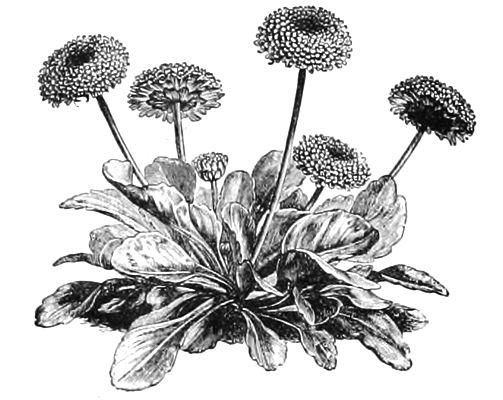
FIG. 239. BELLIS PERENNIS FLORE-PLENO.
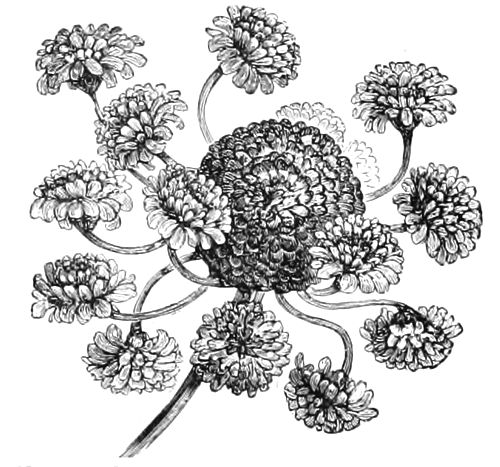
FIG. 240. HEN AND CHICKENS DAISY (BELLIS PERENNIS PROLIFERA).
B. perennis (perennial).* Common Daisy. fl.-heads white. June. l. numerous, lying flat on the ground, obovate, crenate, slightly hairy, tapering at the base. h. 3in. England. The varieties are very numerous, the double ones being particularly fine. See Fig. 239. The handsome variegated form, aucubæfolia, has its leaves richly stained and veined with yellow. There are both red and white-flowered forms of this variety. The Hen and Chickens Daisy is a proliferous form, rather more quaint than pretty. See Fig. 240. Good garden kinds are B. p. conspicua, red; CROWN, pink; ELIZA, purple; RUBENS, red; SNOWFLAKE, white.
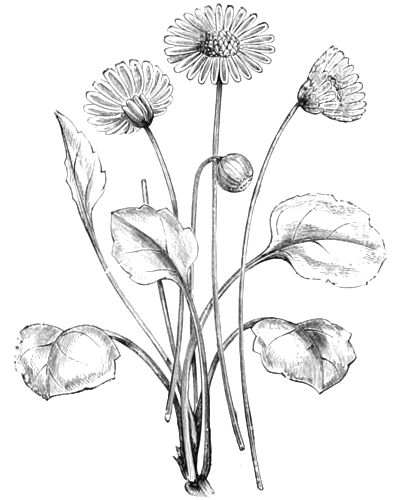
FIG. 241. BELLIS ROTUNDIFOLIA CŒRULESCENS.
B. rotundifolia cœrulescens (round-leaved, bluish).* fl.-heads from ¾in. to 1¼in. in diameter, resembling those of the common Daisy, but with fewer, often broader, ray-flowers, which vary from white to pale blue. l. more or less hairy, with slender stalks, 1in. to 3in. long; blade ovate or sub-cordate, sinuate toothed, three-nerved. Morocco, 1872. A very beautiful perennial, requiring the shelter of a cold frame during severe winters. See Fig. 241. (B. M. 6015.)
BELLIUM (from bellis, a Daisy; the flowers resembling those of that plant). ORD. Compositæ. A genus of pretty little, free-flowering plants, differing from the common Daisy only in having a pappus of six to eight broad scales, torn at the apex, alternating with a like number of long scabrous bristles. They thrive best in a mixture of sandy loam and peat. Propagation is readily effected by means of seeds or divisions; the latter should be made in spring.
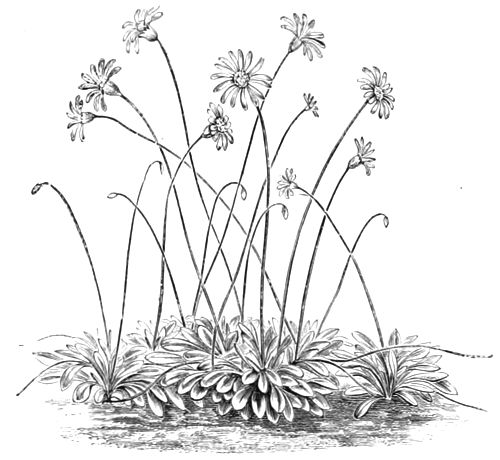
FIG. 242. BELLIUM BELLIDIOIDES.
B. bellidioides (Daisy-like).* fl.-heads white, solitary. June to September. l. spathulate, radical. Stolons creeping. h. 4in. Italy, 1796. Annual. See Fig. 242.
B. crassifolium (thick-leaved). fl.-heads whitish-yellow; scapes much exceeding the leaves, downy. June. l. sub-radical, thick, obovate, entire, attenuate at base, rather downy. Stems many, ascending. h. 6in. Sardinia, 1831. Hardy perennial. (S. B. F. G. 2, 278.)
B. minutum (very small).* fl.-heads white and yellow, ½in. across, on slender stalks, longer than the foliage. June to September. l. narrow spathulate, attenuated at the base, slightly hairy. h. 3in. Levant, 1772. A rare little species, requiring a warm, well-drained position on the rockery.
BELLOWS. These were formerly employed for fumigating, but are now entirely superseded by the ordinary fumigators. The Sulphur Bellows is a very useful instrument for the uniform distribution of flowers of sulphur on vines and other subjects infested with mildew. In form it is very like those in common domestic use, but has a rose of small holes at the end of its nozzle, through which the sulphur is ejected.
BELL-PEPPER. See Capsicum grossum.
BELOPERONE (from belos, an arrow, and peronne, a band; in reference to the arrow-shaped connectivum). SYN. Dianthera. ORD. Acanthaceæ. Very pretty stove evergreen shrubs, allied to Justicia. Flowers blue or purple, borne in secund, axillary, or terminal spikes, frequently subtended with coloured bracts; corolla gaping, the upper lip concave, the lower trifid. They are easily cultivated in a compost of loam, leaf soil, peat, and sand. Propagated by young cuttings, taken in spring. Beloperones may also be treated like Justicias (which see), and will succeed admirably. There are a large number of species, but few of which have been introduced.
B. oblongata (oblong). fl. rosy-purple; spikes axillary; anthers calcarate at base; bracts bracteolate. Summer. l. oblong-lanceolate, opposite. h. 3ft. Brazil, 1832. (B. H. 9, 9.)
B. violacea (violet-coloured).* fl. violet. l. lanceolate, acuminate, entire. h. 3ft. New Grenada, 1859. (B. M. 5244.)
BENDING-DOWN the branches of fruit trees, by means of weights or string attached to pegs driven into the ground, is sometimes resorted to for the purpose of acquiring a particular shape, or fruitfulness; but authorities differ as to the usefulness of the plan for the latter purpose. Young trees that are inclined to grow strong in the middle may be more evenly balanced by adopting the plan of Bending the strong branches, and so diverting the sap to the weaker ones.
BENGAL QUINCE. See Ægle Marmelos.
BENJAMIN-TREE. See Ficus Benjamina.
BENT GRASS. See Agrostis.
BENTHAMIA (in honour of George Bentham, a distinguished English botanist). ORD. Cornaceæ. Hardy evergreen shrubs or low trees, now referred to the genus Cornus. The first-named species is rather tender in the neighbourhood of London, and can only be grown successfully against a wall, for which purpose it is very suitable. In Cornwall and other mild places, it attains a height of 20ft. in the open. Loudon thinks it might be rendered hardier by grafting it on Cornus sanguinea. Flowers disposed in heads, each head attended by an involucre, which consists of four petal-like parts, and resembles a corolla; calyx with a minute four-toothed limb; petals four, fleshy, wedge-shaped; stamens four; style one. Leaves opposite, exstipulate, sub-evergreen, entire. Fruit constituted of many pomes grown together. They thrive in rather moist, loamy soil, in a sheltered spot. Propagated by seeds, sown when ripe, in a cool-house; or by layering, in autumn.
B. fragifera (Strawberry-flowered).* fl. large, white, sessile, densely aggregate, forming a round head. June to October. fr. large, about the size of that of the common Arbutus, reddish. l. lanceolate, acuminated at both ends, on short petioles, rather rough, with small, adpressed down. Branches spreading, smooth. h. 10ft. to 15ft. Nepaul, 1825. (G. C. xiv., 728.)
B. japonica (Japanese). fl. yellowish-red. Spring. h. 8ft. Japan, 1847. (S. Z. F. J. 16.)
BERARDIA (named after M. Berard, a Professor of Chemistry at Montpelier). ORD. Compositæ. A genus containing a single species, confined to the high mountains of Western Europe. It makes a pretty rock plant, and grows best in thoroughly well-drained spots amongst rocky débris. Propagated by seeds, sown in spring.
B. subacaulis (almost stemless). fl.-heads whitish, solitary, very large. l. rounded oval, nearly heart-shaped at base, cottony. h. 3in. or 4in. (A. F. P. 3, 38.)
BERBERIDACEÆ. An order of shrubs or herbaceous perennials. Flowers terminal or axillary, usually racemose; sepals three, four, or six in a double row; petals as many or double in number; stamens four to eight, opposite the petals. Fruit, a berry or capsule. Leaves alternate, compound. The order contributes a great number of handsome plants to our gardens. Well-known genera are Berberis, Epimedium, and Nandina.
BERBERIDOPSIS (from Berberis, the Barberry, and opsis, like; resembling the Barberry). ORD. Berberidaceæ. A handsome evergreen shrub, with climbing habit. Sepals and petals nine to fifteen; outer small, spreading; intermediate orbicular, concave; inner obovate-cuneate, erect, inserted upon the fleshy torus. Stamens eight to nine, free. With a slight winter protection, or planted at the foot of a south wall, it will prove quite hardy, being of easy culture in ordinary garden soil. It is an excellent plant for the cool greenhouse. Increased by seeds, which should be sown in spring; by layering, in autumn; or by young cuttings, in spring.
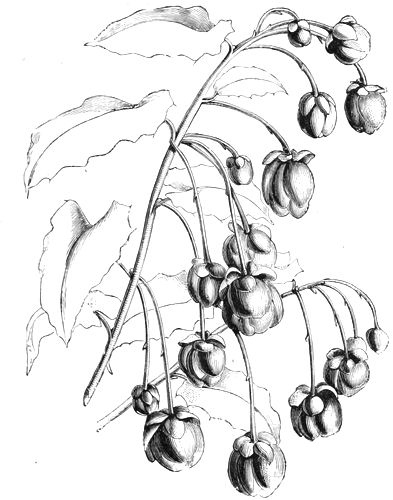
FIG. 243. FLOWERING BRANCHES OF BERBERIDOPSIS CORALLINA.
B. corallina (coral-red).* fl. crimson, in terminal, drooping racemes, leafy at the base. l. about 3in. long, alternate, simple, petiolate, oblong-cordate, obtuse or acute, spiny-toothed. Chili, 1862. See Fig. 243. (B. M. 5343.)
BERBERIS (Berberys is the Arabic name of the fruit, signifying a shell; many authors believe this to be the original derivation of the word, because the leaves are hollow, like a shell). Barberry. ORD. Berberidaceæ. Including Mahonia. A genus of hardy erect or trailing shrubs. Flowers yellow or orange, racemose or fascicled; sepals and petals similar, in two series. Leaves simple or compound, alternate or fascicled from the non-development of the branches, often spinose, or reduced to spines. The common sorts thrive well in any ordinary garden soil, but the rarer kinds require a compost of loam, peat, and a little sand. Propagation may be effected by suckers or layers, put down in the autumn; by ripened cuttings, taken at the same time, and planted in sandy soil, in a cold frame; or by seeds, sown in the spring, or, preferably, in the autumn, when, if fresh from the pulp or berry, they will germinate in the open in the following spring. The last-named is the method generally adopted.
B. Aquifolium (Holly-leaved).* fl. yellow; racemes nearly erect, much crowded. Spring. l., leaflets two to three pairs, with an odd one, the lower part distant from the petiole; ovate, approximate, cordate at the base, one-nerved, spiny-toothed. h. 3ft. to 6ft. North America, 1823. This is extensively planted in woodlands as an excellent covert plant. SYN. Mahonia aquifolia. (S. E. B. 49.)
B. aristata (bearded). fl. yellow; racemes nodding, many-flowered, longer than the leaves; pedicels trifid, three-flowered. Spring. l. obovate-oblong or lanceolate, mucronate, membranous, smooth, serrated with four or five spinulose teeth; lower spines three-parted, upper ones simple, and hardly bidentate at the base. h. 6ft. Nepaul, 1820. (B. R. 729, under name of B. Chitria.)
B. asiatica (Asiatic). fl., racemes short, many-flowered, corymbose, shorter than the leaves; pedicels elongated, one-flowered. l. oval, cuneated, or elliptical, mucronate, smooth; under surface glaucous, entire, or spinulosely-toothed; spines trifid, or simple. h. 4ft. to 8ft. 1820. Half-hardy.
B. buxifolia (Box-leaved).* fl. solitary, on slender peduncles. Spring. l. nearly sessile, oval or oblong, about ½in. long, entire. h. 8ft. Straits of Magellan, 1830. Nana is a charming little variety, not exceeding 18in. in height. SYN. B. dulcis. (B. M. 6505.)
B. canadensis (Canadian).* fl., racemes many-flowered, nodding. Spring. l. obovate-oblong, remotely serrated; upper ones nearly entire; spines three-parted. h. 4ft. Canada, 1759.
B. cratægina (Hawthorn-like). fl., racemes many-flowered, crowded, spreading, scarcely longer than the leaves. Spring. l. oblong, reticulated, hardly serrated; spines simple. h. 4ft. to 8ft. Asia Minor, 1829.
B. cretica (Cretan). fl., racemes three to eight-flowered, rather shorter than the leaves. Spring. l. oblong-oval, entire, or somewhat serrated; spines three to five-parted. h. 4ft. to 5ft. Crete and Cyprus, 1759. The variety serratifolia has leaves ciliately-serrated. (S. F. G. 342.)
B. Darwinii (Darwin's).* fl. orange, racemose, very numerous. May, and sometimes again in autumn. l. oval or oblong, about 1in. long, with usually five spiny teeth. h. 2ft. South Chili, 1849. This very fine species is, perhaps, the best; it forms a densely-branched, spreading, evergreen bush, thus making an excellent covert plant. (B. M. 4590.)
B. dulcis (sweet). Synonymous with B. buxifolia.
B. emarginata (emarginate). fl., racemes scarcely pendulous, shorter than the leaves. Spring. l. lanceolate-obovate, ciliately serrated; spines three-parted. h. 6ft. Siberia, 1790.
B. empetrifolia (Empetrum-leaved).* fl. few, terminal, sub-umbellate, on slender pedicels. May. l. in fascicles of about seven, linear, closely revolute, sharply mucronate. h. 1½ft. to 2ft. Straits of Magellan, 1827. (B. R. 26, 27.)
B. fascicularis (fascicled). fl., racemes erect, much crowded. Spring. l., leaflets three to six pairs, with an odd one, the lower pair distant from the base of the petiole; ovate-lanceolate, rather distant, one-nerved, spiny toothed, with four to five teeth on each side. h. 6ft. to 8ft. New Spain, 1820. Half-hardy. SYN. Mahonia fascicularis. (B. M. 2396.)
B. floribunda (many-flowered).* fl., racemes many-flowered, loose, solitary, pendulous. June. l. obovate-lanceolate, or obovate-oblong, tapering much towards the base, ending in a mucrone at the apex, paler beneath, spiny-ciliated; spines three-parted, unequal. h. 10ft. Nepaul. A variety of aristata.
B. Fortunei (Fortune's).* fl. small, in terminal clustered racemes. l., leaflets about seven, linear-lanceolate, distant, with numerous small spiny teeth, lower pair remote from the base of the petiole. China.
B. glumacea (glumaceous). A synonym of B. nervosa.
B. iberica (Iberian). fl., racemes many-flowered, pendulous. Spring. l. obovate-oblong, quite entire; spines simple and three-parted. h. 8ft. to 10ft. Iberia, 1818.
B. ilicifolia (Holly-leaved). fl., peduncles short, four-flowered; pedicels elongated, somewhat corymbose. July. l. ovate, tapering at the base, coarsely and spinulosely toothed; spines three-parted. h. 2ft. to 3ft. Tierra del Fuego, 1791. (B. M. 4308.)
B. japonica (Japanese).* fl., racemes in terminal clusters. Spring. l., leaflets usually nine, about 3in. long, quite sessile, broadly cordate, or rotundate at the base, oblique, with about five long spiny teeth, and a terminal one, the lowest pairs close to the base of the petiole. China and Japan. Very distinct, with unbranched stems and leaves about 1ft. long. B. Beali and B. intermedia are mere forms of this species, the latter differing from it in having narrower leaves and longer, slender racemes. (B. M. 4852.)
B. loxensis (Loxanese). fl. unusually small, erect, in panicled racemes on a long peduncle quite clear of the leaves. l. very shining, blunt, obovate; sides often with several teeth; spines small, palmated. h. 3ft. to 4ft. Peru. Evergreen, not hardy. (P. F. G. 1, p. 13.)
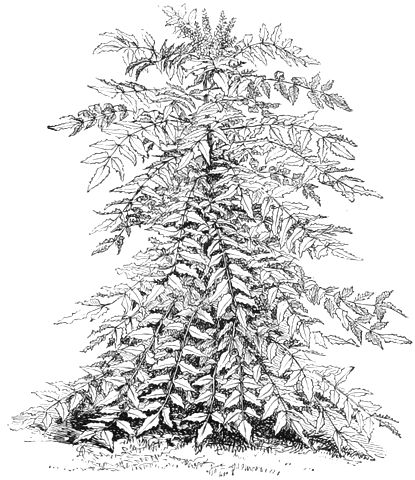
FIG. 244. BERBERIS NEPALENSIS.
B. nepalensis (Nepaulese).* fl. yellow; racemes few, elongated, slender. l. 1ft. to 2ft. long; leaflets five to nine pairs, obovate-oblong, cuspidate, rounded at the base, repand-toothed, with five to ten spiny teeth on each side, tricuspidate at the apex. h. 4ft. to 6ft. Nepaul. A very handsome species, thriving best in the southern parts of England. SYN. Mahonia nepalensis. See Fig. 244.
B. nervosa (large-nerved). fl., racemes elongated. October. l., leaflets five to six pairs, with an odd one, the lower pair distant from the petiole; ovate, acuminated, remotely spiny toothed, somewhat three to five-nerved, with twelve to fourteen teeth on each side. h. 1ft. to 3ft. North America, 1826. SYNS. B. glumacea, Mahonia nervosa. (B. M. 3949.)
B. repens (creeping).* fl., racemes terminal, numerous, fascicled, diffuse, rising from the scaly buds. Spring. l., leaflets, two to three pairs, with an odd one, roundish-ovate, opaque, spiny toothed. h. 1ft. to 2ft. North America, 1822. SYN. Mahonia repens. (B. R. 1176.)
B. ruscifolia (Ruscus-leaved). fl. a little larger than those of B. vulgaris; peduncles short, bearing four to five flowers at the apex. l. oblong, tapering at the base, mucronate, entire, or grossly and spiny toothed. h. 4ft. to 8ft. South America, 1823. Half-hardy.
B. sinensis (Chinese).* fl., racemes many-flowered, nodding. May. l. oblong, obtuse, entire, or the lower ones are a little toothed; spines three-parted. h. 3ft. to 6ft. China, 1815. (B. M. 6573.)
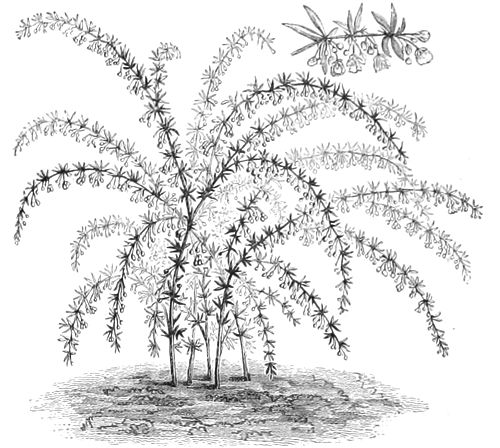
FIG. 245. BERBERIS STENOPHYLLA, showing Habit and Flowering Twig.
B. stenophylla (naked-leaved),* with narrow mucronate leaves, is said to be a hybrid between B. empetrifolia and B. Darwinii. See Fig. 245.
B. trifoliata (three-leafleted). fl., racemes small, axillary, sessile, three to five-flowered. Spring. l., leaflets three, sessile at the ends of the petioles, deeply scalloped, bluish-green, variegated, glaucous beneath. h. 5ft. Mexico, 1839. Evergreen, not quite hardy. (P. F. G. 2, 168.)
B. trifurcata (three-forked). fl., racemes compound, erect. Spring. l. pinnate; leaflets broad, three-forked. h. 6ft. China, 1850. Evergreen. (P. F. G. 3, 258.)
B. umbellata (umbellate). fl., peduncles solitary, erect, bearing at the top several umbellate pedicels. l. obovate-oblong, mucronate, entire, glaucous beneath; spines three-parted, long, equal. h. 6ft. Nepaul, 1842. (P. F. G. 2, 181.)
B. vulgaris (common).* Common Barberry. fl., racemes many-flowered, pendulous. Spring. l. somewhat obovate, ciliately-serrated; spines three-parted. h. 8ft. to 20ft. Britain, &c. There are yellow, violet, purple, black, and white fruited, and purple-leaved forms. (Sy. En. B. 51.)
B. Wallichiana (Wallich's).* fl. on drooping, aggregated peduncles, six to eight or more in a cluster. Spring. l. in alternate fascicles, 2in. to 3in. long, spreading or recurved, lanceolate, sinuato-serrate; spines deeply three-parted, slender but rigid. h. 6ft. to 10ft. Nepaul, 1820. See Fig. 246. (B. M. 4656.)
BERCHEMIA (in honour of M. Berchem, a French botanist). ORD. Rhamnaceæ. A genus of erect, or twining, deciduous, mostly greenhouse shrubs. Flowers sub-umbellate, in the axils of the upper leaves, or disposed in terminal panicles. Leaves alternate, many-nerved, entire. The species mentioned below is probably the only one yet in cultivation. It is quite hardy, will grow in any common soil, and is well adapted for bowers or trellis-work. Propagated by ripened cuttings, and slips of the root, planted under a hand glass; or by layering the young shoots.
B. volubilis (twining).* fl. greenish-white; panicles small, axillary and terminal. Drupe oblong, violaceous. June. l. oval, mucronate, a little wavy. Branches smooth. Carolina, 1714. A deciduous twiner. (G. G. 165.)
BERGAMOT. See Mentha odorata.
BERGERA (named after C. J. Berger, a distinguished Danish botanist). ORD. Rutaceæ. Interesting stove evergreen trees, now usually referred to Murraya. Leaves impari-pinnate; leaflets alternate, acuminated, pubescent. They thrive in a mixture of turfy loam and peat. Propagated by ripened cuttings, taken off at a joint, and placed in sand, under a hand glass, in bottom heat; or by layers.
B. Kœnigi (Konig's). fl. whitish-yellow, small; racemes many, forming a corymb at the top of the branches. June. l., leaflets serrated. h. 40ft. India, 1820. (L. B. C. 1019.)
BERKHEYA (named after M. J. L. de Berkhey, a Dutch botanist), ORD. Compositæ. A genus of ornamental greenhouse or hardy thistle-like herbs or shrubs. Flower-heads surrounded by a spiny involucre, the scales of which are united at the base only; pappus of many flat, obtuse, or pointed, scales. They are of easy cultivation in a sandy loam soil. The perennials are increased by cuttings placed under a glass; the herbaceous perennials usually by divisions of the plant in spring. The species most frequently seen in English gardens is B. purpurea.
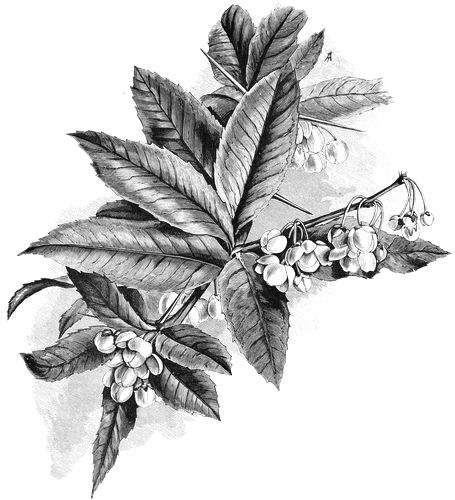
FIG. 246. BERBERIS WALLICHIANA.
B. grandiflora (large-flowered).* fl.-heads yellow; scales of involucre spiny toothed. July. l. opposite, lanceolate, three-nerved, spiny toothed, downy beneath. h. 2ft. Cape of Good Hope, 1812. Greenhouse evergreen. (B. M. 1844.)
B. pinnata (pinnate). fl.-heads yellow; involucral scales spine-pointed, entire or toothed. Autumn. l. oblong, woolly beneath, deeply cut into lance-shaped segments. SYN. Stobæa pinnata. (B. M. 1788.)
B. purpurea (purplish).* fl.-heads numerous, pedunculate, corymbose, circular, 3in. across, surrounded by an involucre of spreading or reflexed linear oblong bracts. l., lower ones 15in. to 18in. long, 2in. to 2½in. wide, dark green, viscid above, paler and cottony beneath. h. 3ft. South Africa. A very handsome, hardy, herbaceous perennial. (G. C. 1872, p. 1261.) SYN. Stobæa purpurea.
B. uniflora (one-flowered). fl.-heads yellow; scales of involucre spiny toothed. June. l. alternate, lanceolate, three-nerved, spiny toothed, downy beneath. h. 3ft. Cape of Good Hope, 1815. Greenhouse evergreen. (B. M. 2094.)
BERMUDA CEDAR. See Juniperus bermudiana.
BERRY. A fleshy fruit, containing seeds.
BERTHOLLETIA (in honour of Louis Claude Berthollet, a celebrated French chemist). Brazil Nut Tree. TRIBE Lecythideæ of ORD. Myrtaceæ. B. excelsa is a tall tree, having the young branches leafy at the apex. Leaves alternate, oblong, quite entire, rather coriaceous. From this Brazilian species are obtained the well-known Brazil or Para Nuts of commerce. The tree is of no value for decorative purposes.
BERTOLONIA (named after A. Bertoloni, an Italian botanist, author of "Rariorum Italiæ Plantarum Decades," &c.). ORD. Melastomaceæ. Elegant little creeping or dwarf-growing stove plants, chiefly cultivated for their exquisitely marked leaves. Flowers white or purple. Leaves stalked, ovate-cordate, five to eleven-nerved, crenulated; cymes corymbose, terminal. They thrive in a compost of equal parts peat, leaf mould, and sand, in a warm, close, and moist atmosphere, but are most successfully cultivated under a bell glass in the stove; in fact, the latter is the only plan of growing them where a constantly humid atmosphere cannot be otherwise obtained without such means. They are easily propagated by cuttings or seeds.
B. ænea (coppery). fl. purple. h. 6in. Brazil.
B. guttata (spotted). See Gravesia.
B. maculata (spotted).* fl. violet-purple; peduncles axillary, bearing at the apex a short raceme of six to seven flowers. l. on long petioles, cordate, ovate, quite entire, pilose on both surfaces and on the margins, five-nerved. Branches, petioles, peduncles, and calyces hispid from long bristles. Stem rooting at the base. Brazil, 1850. (B. M. 4551.)
B. marmorata (marbled).* l. 5in. to 8in. long, ovate-oblong, hairy, five-nerved; upper side vivid bright green, beautifully marked with irregular streaks of pure white; under surface of a uniform rich purple. Stem fleshy. h. 6in. Brazil, 1858.
B. pubescens (downy).* l. ovate-acuminate, 3in. to 4in. long, and 2in. to 3in. broad; bright light green, with a broad chocolate-coloured band down the centre; upper surface clothed with long white hairs. Ecuador.
BERZELIA (named in honour of Berzelius, a celebrated Swedish chemist). ORD. Bruniaceæ. Very pretty little greenhouse evergreen shrubs. Heads of flowers naked, with three bracts at the base of each; usually crowded at the tops of the branches. Leaves short, somewhat trigonal, imbricate or spreading. They require a mixture of peat, loam, and sand, with thorough drainage and moderately firm potting. Young cuttings root freely in sand, under a bell glass, in gentle heat.
B. abrotanoides (Abrotanum-like). fl.-heads white, the size of a filbert, terminal, crowded, sub-corymbose; bracts clavate, green, smooth, ustulate at the apex. May to July. l. ovate, ustulate at the apex, smooth, spreading, on short petioles. h. 1½ft. Cape of Good Hope, 1787. (L. B. C. 355.)
B. lanuginosa (woolly).* fl.-heads white, about the size of a pea, at the tops of lateral branches, disposed in a fastigiate panicle; bracts spathulate, callose at the apex. June to August. l. triquetrous, spreading, callose at the apex, rather hairy. Branches erect, villous when young. h. 1ft. to 2ft. Cape of Good Hope, 1774. (L. B. C. 572.)
BESCHORNERIA (in honour of H. Beschorner, a German botanist). ORD. Amaryllidaceæ. Greenhouse evergreen succulents, allied to Littæa and Fourcroya. Perianth deeply six-parted; segments linear spathulate, tubulose-connivent, often spreading at the point; stamens six, about as long as the perianth. For culture, &c., see Agave and Aloe.
B. bracteata (bracteate). fl. at first green, turning yellowish-red when mature; panicle 2ft. to 3ft. long; branches many-flowered and corymbose, subtended by large scariose reddish bracts. l. in a dense rosette, 12in. to 18in. long, thin, glaucous green with scabrous margin. h. 5ft. to 6ft. Mexico. See Fig. 247. (B. M. 6641.)
B. Decosteriana (Decoster's). fl. green, tinged with red, pendulous, bracteate; panicle 2ft. to 3ft. long, inclined, with numerous bracts. l. numerous, spreading, 18in. to 24in. long, by 1in. to 1½in. broad; edges minutely serrulate. h. 8ft. Mexico, about 1880.
B. Tonelii (Tonel's).* fl. tubular, 2½in. long, drooping, pedicellate, dark blood-red below and down the centre, the rest very bright verdigris green; panicle 2ft. long, slender, inclined; bracts several to each fascicle of flowers; scape 4ft. high, red-purple. l. few, spreading, 15in. to 20in. long, by 2½in. broad, acuminate and keeled beneath towards the top, minutely serrulate. Mexico, 1872. (B. M. 6091.)
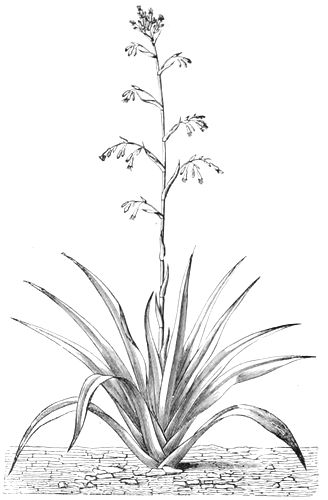
FIG. 247. BESCHORNERIA BRACTEATA.
B. tubiflora (tube-flowered). fl. greenish-purple, nutant, fascicled, bracteate; fascicles remote, secund; scapes erect, long, simple. May. l. radical, linear, channelled, recurved, spinosely denticulate. h. 6ft. Mexico, 1845. (B. M. 4642.)
B. yuccoides (Yucca-like). fl. bright green, pendent, racemose, with rich rosy-red bracts; scapes slender, coral-red, simple. May and June. l. radical, thickish, lanceolate, acute, 1ft. to 1½ft. long. h. 4ft. Mexico.
BESLERIA (named in honour of Basil Besler, an apothecary at Nuremberg). SYN. Eriphia. ORD. Gesneraceæ. Very pretty stove sub-shrubs, usually erect, branched. Peduncles axillary, few-flowered. Leaves opposite, petiolate, thickish; nerves and veins very prominent beneath. Stems sub-tetragonal. A light rich earth, or a mixture of sand, loam, and peat, and a moist atmosphere, are necessary for successful cultivation. Beslerias may be increased by cuttings, which root readily in heat.
B. coccinea (scarlet-berried).* fl. yellow; peduncles axillary bearing three to six flowers in an umbel at top; bracts two, at the division of the common peduncle, orbicularly cordate, toothed, scarlet. l. ovate, glabrous, stiff, a little toothed. Guiana, 1819. Climbing shrub. (A. G. 255.)
B. cristata (crested). fl., corolla yellowish, hairy outside; peduncles axillary, solitary, one-flowered; bracts cordate, toothed, sessile, scarlet. June. l. ovate, serrated. Guiana, 1739. Climbing shrub.
B. grandiflora (large-flowered).* fl. large, campanulate, spotted with red; peduncles axillary, elongated, many-flowered. l. ovate-oblong, acuminated, crenated, densely pilose above, villous beneath, as well as on the branches. h. 3ft. Brazil.
B. Imrayi (Imray's). fl. rather small, yellow, in axillary whorls. l. large, lanceolate, serrate, glabrous. Stems quadrangular. Dominica, 1862. Herbaceous perennial. (B. M. 6341.)
B. incarnata (flesh-coloured-berried).* fl., corollas purplish; tube very long, ventricose; lobes of limb reflexed, roundish, unequal, fringed; peduncles axillary, solitary, one-flowered. l. oblong, crenated, tomentose on both surfaces. h. 2ft. Guiana, 1820. Herbaceous perennial.
B. violacea (purple-berried). fl. purple, small; corolla with a curved tube and spreading limb; peduncles racemosely panicled, terminal. Berry purple, edible. l. ovate, acute, quite entire, stiff. Guiana, 1824. Climbing shrub. (A. G. 254.)
BESOM, or BROOM. Birch-brooms are best for garden purposes, and are generally used. The most suitable for paved yards are those made of the common Ling (Calluna vulgaris). Those made of bass fibres are frequently used on paths, for which they are very suitable, but their expensiveness prevents them being generally employed. Whatever material is used in its composition, a Besom will last much longer if soaked in water for some time before using.
BESSERA (in honour of Dr. Besser, Professor of Botany at Brody). ORD. Liliaceæ. An elegant little half-hardy, Squill-like, bulbous plant, from Mexico. Perianth bell-shaped, six-parted. Leaves narrow, linear. It requires a compost of loam, leaf soil, peat, and sand, with good drainage. If cultivated in pots, a plentiful supply of water must be given from the commencement of growth until ripening off. When at rest, however, it should be kept dry and cool, but secure from the effects of frost. If planted out, a well-drained sunny position must be chosen, such as close to the wall of a greenhouse with a southern aspect. Propagation may be effected by offsets.
B. elegans (elegant).* fl. scarlet, or scarlet and white. July to September. l. 1ft. to 2ft. long, narrow, furrowed on the upper side. h. 2ft. Mexico, 1850. This is the only species. The colour of the flowers varies considerably, on which account other names have originated. (B. R. 25, 34.)
BETA (from bett, the Celtic word for red; in reference to the colour of the Beet). Beetroot. ORD. Chenopodiaceæ. Perianth single, half-inferior, five-cleft, persistent. Seed one, reniform, imbedded in the fleshy base of the calyx. B. Cicla is largely used as a decorative plant in sub-tropical and other styles of gardening. They require the same culture as the ordinary Beet. The other sorts, with dark blood-red leaves, are largely employed in flower gardens, and the roots utilised for culinary purposes. See also Beet.
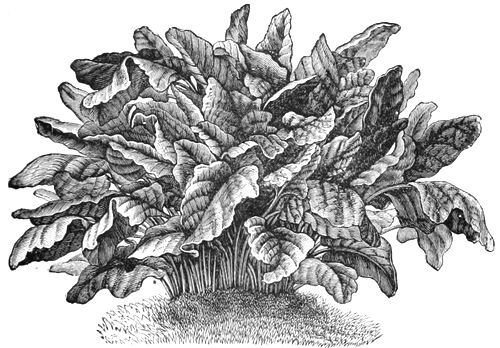
FIG. 248. BETA HORTENSIS METALLICA, or VICTORIA BEET.
B. Cicla (Sicilian). fl. greenish, disposed in threes. August. l. with very thick ribs. Roots scarcely any. h. 6ft. Portugal, 1570. The variety, B. c. variegata, usually known as the Chilian Beet, is a very handsome plant, having its leaves often more than a yard in length and over 1ft. in diameter, with a remarkably handsome variegation. The midribs are usually dark orange or scarlet. It is a most desirable and effective plant for sub-tropical gardening.
B. hortensis metallica (metallic). Victoria Beet. An ornamental variety with glistening deep blood-red leaves. Useful for decorative purposes in summer, either as a single specimen or in a mass. Roots may also be used for cooking. See Fig. 248.
B. maritima (sea). fl. greenish, disposed in hairs. August. l., lower ones rhomboid-ovoid, acute; upper ones lanceolate. Stem diffuse. Root scarcely any. h. 1ft. Britain.
B. vulgaris (common). The Common Beetroot. fl. greenish, clustered. August. l., lower ones ovate. Root fleshy. h. 4ft. South Europe, 1548.
BETCKEA. See Plectritis.
BETEL, or BETLE. See Piper Betle.
BETONICA. This genus now forms a sub-division of Stachys (which see). Betony (Stachys Betonica) is a native herb formerly much used in medicine, but now almost entirely discarded.
BETONY. See Stachys Betonica.
BETULA. (according to some authorities, from Betu, its Celtic name; others give the derivation of the word as from batuo, to beat, the fasces of the Roman lictors, which were made of Birch rods, being used to drive back the people). Birch. ORD. Cupuliferæ. TRIBE Betuleæ. Ornamental, hardy (except where otherwise specified), deciduous trees or shrubs, allied to Alnus, having round, slender, often drooping branches, and the bark in most species in thin membranous layers. The flowers appear at the same time as the leaves. Male catkins cylindrical, lax, imbricated all round with ternate concave scales, the middle one largest, ovate; corolla none; filaments ten to twelve, shorter than the middle scale, to which they are attached. Female catkins similar, but more dense; scales horizontal, peltate, dilated outwards, three-lobed, three-flowered; corolla none. Nut oblong, deciduous, winged at each side. The Betulas are easily cultivated in any ordinary soil; but a light sandy loam suits them best. Most of the species are best increased by seeds, which ripen in September, and need to be dried, in order to prevent fermentation. They should be sown in March, in a sandy soil, the surface of which has been previously made perfectly level. They must be spread on the surface, and not covered with soil, but pressed down with the feet. When grown in quantities, beds 4ft. in width are preferred, with an alley of 1ft. between them. In early summer, if the weather be warm and dry, the beds should be shaded with branches. The young seedlings must be transplanted when a year old. The dwarfer kinds may be propagated by layering in the autumn. The numerous beautiful varieties are best increased by grafting or budding upon seedling stocks of the common kinds, the former being done in spring, and the latter in summer when the buds are ready. Those most useful as forest trees and for protection are quick-growing and very ornamental. The time of maturity of the Birch depends very much upon the soil and situation, but it seldom increases in size after it is thirty years old. The common species (B. alba) is one of the hardiest and most useful trees in cultivation, growing quickly, and withstanding exposure better than many others; consequently it is invaluable for skirting and nursing more tender subjects, and is especially desirable for clothing mountainous and exposed districts. It is also very beautiful and picturesque. It is the commonest tree throughout Russia, from the Baltic to the Eastern Sea, frequently monopolising gigantic forests. In Italy, it forms excellent forests up to 6000ft. altitude, and in our own Highlands of Scotland it occurs up to a height of 2500ft. In Greenland, although much reduced in size, it holds its own as the only arboreal vegetation.
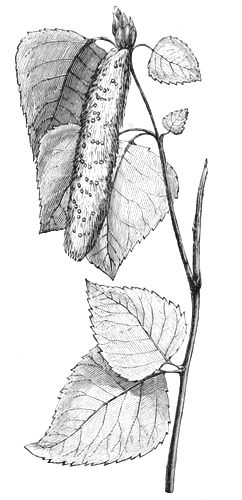
FIG. 249. LEAVES AND CATKIN OF BETULA ALBA.
B. alba (white).* Silver, White, or Common Birch. fl. whitish. February and March. fr. brown, ripe in September and October. l. ovate, acute, somewhat deltoid, unequally serrated; autumnal tints rich yellow, scarlet, or red. A diminutive shrub in the extreme north, but a tree from 50ft. to 60ft. high in the middle regions. Britain. A most beautiful and invaluable forest tree, with a large number of varieties. See Fig. 249.
B. a. alba-purpurea (white and purple).* l. rich purple above, with a lustrous metallic hue, pale beneath. Branches with a sub-pendulous disposition. A very effective variety.
B. a. dalecarlica (Dalecarlian).* l. deeply pinnatifid, with the lobes toothed.
B. a. foliis-variegatis (variegated-leaved).* l. blotched with yellowish white.
B. a. laciniata pendula (pendulous and laciniate).* l. rather larger than the typical form, deeply laciniated, deep green, and decidedly pendulous. It appears there are two forms of this, but that known as Young's variety is the best.
B. a. macrocarpa (large-fruited).* Female catkins twice as long as those of the type.
B. a. pendula (pendulous).* A well-known tree, distinct from the species in having the shoots more slender, smoother, and pendulous.
B. a. pontica (pontic). l. somewhat larger than in the species, and the plant of more robust growth. (W. D. B. 2, 94.)
B. a. pubescens (downy). l. covered with hairs.
B. a. urticifolia (nettle-leaved).* l. deeply laciniated, serrated, and hairy. Several others, reputed as distinct, are mere forms of the typical B. alba.
B. Bhojpattra (Bhojpattra).* fl., female catkins erect, cylindrical, oblong; bracts smooth, woody, two-parted, blunt, much longer than the fruit, which has narrow wings. May. l. oblong-acute, with nearly simple serratures, somewhat cordate at the base; their stalks, veins, and twigs hairy; the bark is of a pale cinnamon colour. h. 50ft. Himalayas, 1840. This requires a sheltered position.
B. carpinifolia (Hornbeam-leaved). Synonymous with B. lenta.
B. daurica (Daurian).* fl., catkins whitish-brown, larger than those of the common Birch. February and March. l. ovate, narrow at the base, quite entire, unequally dentate, glabrous; scales of the strobiles ciliated on their margins; side lobes roundish. h. 30ft. to 40ft. Siberia, 1786. The variety parvifolia has smaller leaves than the type.
B. excelsa (tall). Synonymous with B. lutea.
B. fruticosa (shrubby).* fl. whitish-brown; female catkins oblong. February and March. l. roundish-ovate, nearly equally serrated, glabrous. h. 5ft. to 6ft. in moist situations, but much higher on mountains. Eastern Siberia, 1818. (W. D. B. 2, 154.)
B. glandulosa (glandular).* fl. whitish; female catkins oblong. May. l. obovate, serrate, quite entire at the base, glabrous, almost sessile; branches beset with glandular dots, glabrous. h. 2ft. Canada, 1816. A handsome little shrub. (F. D. 2583.)
B. lenta (pliant). fl. greenish-white. May to June. l. cordate, ovate, acutely serrated, acuminate; petioles and nerves hairy beneath; scales of the strobiles smooth, having the side lobes obtuse, equal, with prominent veins. h. 60ft. to 70ft. Canada to Georgia, 1759. SYN. B. carpinifolia. (W. D. B. 2, 144.)
B. lutea (yellow).* fl. greenish-white. May. l. 3½in. long, and 2½in. broad, ovate, acute, serrated; petioles pubescent, shorter than the peduncles; young shoots and leaves, at their unfolding, downy, but ultimately quite glabrous, except the petiole, which remains covered with fine short hairs; scales of the strobiles having the side lobes roundish. h. 70ft. to 80ft. Nova Scotia, 1767. SYN. B. excelsa.
B. nana (dwarf).* fl. whitish-green; catkins erect, stalked, cylindrical, obtuse; the barren ones lateral, and the fertile ones terminal; scales of the latter three-lobed, three-flowered, permanent. April and May. l. orbicular, crenate, reticulated with veins beneath. h. 1ft. to 3ft. Scotland, Lapland, Sweden, Russia, &c. A shrub with numerous branches, slightly downy when young, and beset with numerous little, round, firm, smooth, sharply crenated leaves, beautifully reticulated with veins, especially beneath; and furnished with short footstalks, having a pair of brown lanceolate stipules at their base. There is also a pretty variety named pendula, with drooping branches.
B. nigra (black).* The Black Birch. fl. greenish-white; female catkins straight, and nearly cylindrical, about 2in. long. May. l. rhomboid-ovate, doubly serrated, acute, pubescent beneath, entire at the base; scales of the strobiles villose; segments linear, equal. h. 60ft. to 70ft. New Jersey to Carolina, 1736. SYN. B. rubra. (W. D. B. 2, 153.)
B. papyracea (papery).* fl. greenish-white; female catkins on long footstalks, drooping; scales having the side lobes short, somewhat orbiculate. May to June. l. ovate, acuminate, doubly serrate; veins hairy beneath; petiole glabrous; the branches are much less flexible than those of the common Birch, and are more ascending. h. 60ft. to 70ft. North America, 1750. (W. D. B. 2, 152.)
B. p. fusca (brown). l. smaller than those of the type, and less downy.
B. p. platyphylla (broad-leaved).* l. very broad.
B. p. trichoclada (hairy-branched).* l. cordate. Branches extremely hairy, and twigs in threes.
B. populifolia (Poplar-leaved).* fl. greenish-white. April, May. l. deltoid, much acuminated, unequally serrated, quite smooth; scales of the strobiles having roundish side lobes; petioles glabrous. h. 30ft. Canada, 1750. This species, although very closely resembling B. alba, grows with less vigour, and does not attain so large a size. (W. D. B. 2, 151.)
B. p. laciniata (laciniated).* l. large, shining, and deeply cut.
B. p. pendula (pendulous).* Spray drooping, like that of B. alba pendula.
B. pumila (dwarf).* fl. whitish; female catkins cylindrical. May and June. l. roundish ovate, on long footstalks, densely clothed with hairs on the under surface. Branches pubescent, dotless. h. 2ft. to 3ft. Canada, 1762. A very beautiful kind, suitable for furnishing large rockeries, or planting on hill sides, or rocky ground. (W. D. B. 2, 97.)
B. rubra (red).* Synonymous with B. nigra.
BETULEÆ. A tribe of deciduous shrubs or trees. Perianth none, or bract-like; flowers monœcious, in catkins, in twos or threes. Fruit, a dry, compressed, lenticular, often winged, indehiscent nut. Leaves alternate, simple, stipulated. The genera are Alnus and Betula.
BI. In compound words, this signifies twice.
BIANCEA SCANDENS. See Cæsalpinia sepiaria.
BIARUM (an ancient name of a plant). ORD. Aroideæ. A genus of small, hardy, tuberous-rooted perennials, much more curious than pretty, allied to Sauromatum. This genus, according to Dr. Masters, differs from Arum in its spathe being tubular at the base, with the limb spreading. The female flowers have a distinct style, and the fruit contains only one ovule. They will thrive in any light, rich, well-drained soil, and may otherwise be treated similar to the hardy Arums. There are several other species besides those named, but they are not yet in general cultivation.
B. constrictum (constricted). A synonym of B. tenuifolium.
B. gramineum (grassy). A synonym of B. tenuifolium.
B. tenuifolium (slender-leaved).* fl., spathe dark brown-purple, reflexed in the upper part; spadix very long, subuliform. June. l. linear-lanceolate. h. 6in. South Europe, 1570. SYNS. B. gramineum and B. constrictum. (B. R. 512, under name of Arum tenuifolium.)
BIAURICULATE. Having two auricles.
BIBRACTEATE. Furnished with two bracts.
BIBRACTEOLATE. Furnished with two secondary bracts.
BICARINATE. Two-keeled.
BICOLOR. Two-coloured.
BICONJUGATE. Having two secondary petioles, each with a pair of leaflets.
BICORNUTE. With two horn-like processes.
BIDENS (from bis, twice, and dens a tooth; in reference to the seed). Bur Marigold. ORD. Compositæ. A rather large genus of mostly hardy annual and perennial herbs, distinguished by the pericarp having from two to four rigid awns, which are rough with minute deflexed points. Involucre erect, of several oblong, nearly equal, parallel scales. Most of the species of this genus are of no merit as garden plants. Two are natives of Britain, viz., B. cernua and B. tripartita. They thrive in any ordinary garden soil. Propagated by divisions of the plant; or by seeds.
B. atro-sanguinea (dark-bloody). fl.-heads black-crimson, very freely produced. Late summer and autumn. Leaves pinnate. Root tuberous. h. 3ft. Mexico. (B. M. 5227.)
B. ferulæfolia (Ferula-leaved). fl.-heads yellow. Autumn. l. bipinnatifid. h. 2ft. Mexico, 1799. SYN. Coreopsis ferulæfolia. (B. M. 2059.)
B. procera (tall). fl.-heads yellow, large. l. finely divided, deep green. A handsome perennial. h. 6ft. to 8ft. Mexico, 1820. (B. R. 684.)
B. striata (striped). fl.-heads rather large, in a panicled leafy corymb; ray florets white; disk yellow. l. ternately pinnated, glabrous. h. 2ft. to 3ft. Autumn. Mexico. (B. M. 3155.)
BIDENTATE. With two teeth.
BIEBERSTEINIA (named after Frederic Marschall Bieberstein, a Russian naturalist, author of "Flora Taurico-Caucasica," and other works). ORD. Rutaceæ. A genus of half-hardy herbaceous perennials. They thrive in a compost of loam, peat, and sand. Propagated by cuttings, placed under a hand glass in early summer; or by seeds, sown in a slight hotbed in March or April.
B. odora (sweet). fl. yellow; racemes terminal, simple; petals entire. May. l. impari-pinnate; leaflets roundish, deeply toothed. Plant beset with glandular hairs. h. 1ft. Altaia, 1837.
BIENNIAL. A term applied to plants occupying two years in the development from seed to the maturation of seed: growing one year, flowering, fruiting, and dying the next. Seeds of Hardy Biennials are, as a rule, sown from June to August, to flower the succeeding season. Tender varieties are sown in a frame or cool house, and kept there all winter, being transferred from the frames or houses to the open border, in June. Wallflowers, Foxgloves, Canterbury Bells, and Sweet Williams, may be taken as fair types of Biennials, although they often assume more than a Biennial character on light sandy soils.
BIFARIOUS. Two-ranked; arranged in two opposite rows.
BIFID. Divided about half-way down into two parts; two-cleft.
BIFOLIATE. Compound leaves with two leaflets.
BIFRENARIA (from bis, twice, and frænum, a strap; in reference to a double strap or band, by means of which the pollen masses are connected with their gland). ORD. Orchideæ. A genus of pretty stove orchids, allied to Maxillaria, and distinguished from it by having two fræna or caudicles to their pollen masses. For culture, see Maxillaria.
B. aurantiaca (orange-coloured).* fl. orange; lateral lobes of lip semi-cordate, middle one transverse, sub-undulated, callous at the base; raceme erect. October. l. oblong, plicate. Pseudo-bulb roundish, compressed, two-leaved. h. 9in. Demerara, 1834. (B. R. 1875.)
B. aureo-fulva (orange-tawny). fl. orange, on long pedicels; lip unguiculate, three-lobed; scape radical, many-flowered. October. l. oblong-lanceolate. Pseudo-bulb roundish-ovate, wrinkled, one-leaved. h. 1ft. Brazil, 1840.
B. Hadwenii (Hadwen's). fl. each nearly 4in. across; petals and sepals ½in. broad, yellow green, beautifully blotched or mottled with a rich brown; lip large, above 1in. broad, white, with striped spots of rose. June. l. long, ¼in. broad. h. 1½in. Brazil, 1851. SYN. Scuticaria Hadwenii. (B. M. 4629.)
B. H. bella (charming).* A new variety with sepals and petals whitish yellow outside, brilliant shining cinnamon inside, with a few spots, bars, and blotches of whitish sulphur colour; lip wide, white, with one light brown spot behind, and a larger one in front of the callus; radiating light brown lines on lateral lobes, and mauve ones on anterior lobe.
B. H. pardalina (leopard-marked).* A very beautiful variety, having sepals and petals with brown circles or polygonal figures on a light yellow ground; lip light ochre-coloured at its basilar part, white in front, with radiating mauve-purple streaks. This variety is extremely rare.
B. vitellina (yolk-coloured).* fl. yellowish purple; lip cuneate, three-lobed; lateral lobes acute, crenulated; racemes drooping. July. l. lanceolate. Pseudo-bulb ovate, bluntly angular, one-leaved. h. 1ft. Brazil, 1838.
BIFURCATE. Twice-forked.
BIGELOVIA (named after Dr. Jacob Bigelow, author of "Florula Bostoniensis," &c.). ORD. Compositæ. A genus of hardy shrubs, sub-shrubs, or herbaceous plants, as now understood, comprising several subjects formerly referred to Chrysothamnus, Linosyris, &c. Flower-heads disposed in corymbs; involucre imbricated, oblong, or campanulate; receptacle flat. Leaves alternate, linear or lanceolate. They thrive in any ordinary garden soil. Propagated by cuttings.
B. Howardii (Howard's). fl.-heads yellow; involucre narrow. A low shrub. SYN. Linosyris Howardii.
B. nudata (naked). fl.-heads yellow. September. l. scattered, oblanceolate or linear. h. 1ft. to 2ft. New Jersey. Perennial.
B. paniculata (panicled). fl.-heads yellow, barely ½in. long, loosely panicled, five-flowered. California. Shrubby.
BIGEMINATE. Doubly paired.
BIGLANDULARIA. See Sinningia.
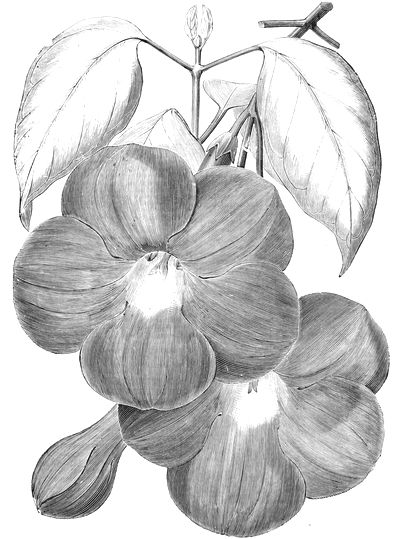
FIG. 250. BRANCH AND FLOWERS OF BIGNONIA MAGNIFICA.
BIGNONIA (so named by Tournefort, in compliment to the Abbé Bignon, librarian to Louis IV.). ORD. Bignoniaceæ. A large genus of usually scandent shrubs, furnished with tendrils; rarely erect trees or shrubs. Flowers axillary and terminal, usually panicled; corolla with a short tube, a campanulate throat, and a five-lobed, bilabiate limb. Leaves opposite, simple, conjugate, ternate, digitate or pinnatifid. These handsome plants are particularly suited for large houses, where, if well grown, they give great satisfaction. The primary point in their culture is to obtain free and, at the same time, sturdy growth, giving due attention to training, pruning, &c., or the plants soon exceed all limits. Like all free-growing plants, Bignonias thrive best planted out in the borders of the stove or greenhouse, or out of doors, as the case may be; but the space allowed should be limited, in order to restrict root production. They may either be trained to cover the back wall, or be planted in a border in front, and trained up the rafters, or on wires, arranged where most desirable. In summer, allow all the strongest shoots to grow, training them so as to have as much sunlight as possible—which is absolutely necessary to well ripen the wood, and make it capable of producing flowers—without entirely shutting it out from the plants below. Soil: A compost of two part fibrous loam, one part peat, one of leaf mould, and a due proportion of sand, will be found most satisfactory. The loam and peat should be used in a rough state, unsifted, as this will keep the border open for some years, and thorough drainage should be effected. Propagation: Seed being rarely procurable, the most satisfactory method of propagation is by cuttings, made of good strong shoots, in early spring. Three joints are sufficient to make a cutting, if short-jointed; if long-jointed, two are sufficient. Place them in a well-drained pot of sandy soil, under a bell glass, in bottom heat. As these cuttings are young and fleshy, they are liable to damp off; hence it is necessary, for the first two or three weeks, to wipe the moisture from the glasses every morning, and water sparingly. If well managed, they will root in about two months, and should then have the glasses left off every night for a week; they should then be transferred to small pots in the compost above described, passing it through a coarse sieve, to extract the stones and rough pieces of soil. After potting, the plants should be kept close for a short time, till they are able to bear full exposure to the light. In a year's time, they will be large enough to plant out in their permanent quarters. Bignonias may also be increased by layering.
B. æquinoxialis (equinoxial). fl. yellow; peduncles two-flowered, terminal ones racemose. June to October. l. glabrous, conjugate; leaflets oblong-lanceolate. Tendrils simple, axillary. Cayenne, 1768.
B. æ. Chamberlaynii (Chamberlayn's).* fl., corolla yellow, funnel-shaped; segments obtuse; racemes axillary, six to eight-flowered. April to October, l., leaflets ovate, acuminated, glabrous, shining above. Tendrils strong, simple. Brazil, 1820. (B. R. 741.)
B. æsculifolia (Chestnut-leaved). A synonym of Tabebiua æsculifolia.
B. apurensis (Apuran). fl. pedicellate, 2in. long; corolla yellow, funnel-shaped, with roundish, spreading, nearly equal lobes; spikes terminal, sessile. l. ternate; leaflets elliptic-oblong, short-acuminated, acutish at the base. Shady banks of the river Apures, near El Diamante, 1824.
B. argyreo-violascens (silvery-violet). l. white-veined, in a young state violet. South America, 1865. (F. M. 1865, 26.)
B. aurantiaca (orange). fl. orange-coloured. South America, 1874.
B. capreolata (tendrilled).* fl., corolla orange; peduncles axillary, one-flowered, crowded. April to August. l. conjugate; leaflets cordate oblong; lower ones simple. Tendrils small, trifid. North America, 1710. Hardy in south of England. (B. M. 864.)
B. c. atro-sanguinea (dark blood-red). fl. red-purple. Summer. United States. (B. M. 6501.)
B. Cherere (Chirere).* fl., corollas orange, 2in. long; cymes axillary. June to November. l., lower ones ternate, upper ones conjugate, cirrhose; leaflets ovate, acuminated, sometimes sub-cordate, glabrous. Guiana (in woods and on the banks of rivers), 1824. (B. R. 1301.)
B. Chica (Chica). fl., corolla funnel-shaped, violaceous; limb with nearly equal, rounded segments; panicles axillary, pendulous. l. 8in. to 10in. long, abruptly bipinnate; leaflets conjugate, elliptic-ovate, acuminated, deeply cordate, glabrous. Tendrils simple. Banks of the Orinoco, 1819.
B. chrysantha (yellow-flowered). fl. terminal, crowded; corolla yellow, 2in. long. May. l., leaflets five, ovate, acuminated, tomentose, on pedicels 5in. long. h. 12ft. to 26ft. Caraccas, 1823. Tree.
B. chrysoleuca (yellowish-white). fl., corolla yellow, with a white limb, glabrous, 1½in. long; peduncles three to five-flowered. June, July. l. conjugate; leaflets 5in. to 6in. long, 2in. broad, oblong acuminated, glabrous, rounded at the base, shining. Tendrils undivided. Banks of the River Magdalena, 1824.
B. Clematis (Clematis-like).* fl., corolla white, yellowish inside; lobes nearly equal, roundish, red; panicles axillary, downy. l. 7in. to 8in. long, conjugately pinnate, with an odd one; leaflets 2in. long, 1in. broad, ovate, narrowed at top, acute, cordate at the base, glabrous. Branches quadrangular, glabrous. Caraccas, 1820.
B. diversifolia (diverse-leaved). fl., corolla yellow, campanulately funnel-shaped; panicles terminal. l. conjugate and simple; leaflets roundish-ovate, acuminated, sub-cordate, glabrous, shining. Tendrils undivided. Branches quadrangular, striated. Mexico, 1825.
B. floribunda (many-flowered).* fl., corolla purplish, funnel-shaped, eight lines long; panicles axillary, powdery, with opposite branches and dichotomous branchlets. l. conjugate; leaflets 2½in. long, oblong-elliptic, acuminated, acute at the base, glabrous, shining. Tendrils undivided. Branches beset with white warts and fine powder. Mexico, 1824.
B. lactiflora (milk-flowered). fl., corolla milk white, 1½in. long, villously tomentose on the outside; racemes twin, with a petiolate bract at the base of each pedicel. April and July. l. conjugate; leaflets 2in. long, cordate, ovate, glabrous. Branches striated. Tendrils trifid. Santa Cruz, 1823.
B. leucoxyla (white-wooded). A synonym of Tabebiua leucoxyla.
B. litoralis (shore). fl., corolla funnel-shaped, red, downy outside; panicles axillary, dichotomously branched. May to July. l. ternate; leaflets roundish-ovate, acuminated, clothed with soft hair on both surfaces. Branches terete, glabrous; branchlets hairy. Mexico, 1824.
B. magnifica (magnificent).* fl. varying from delicate mauve to rich purplish-crimson; throat light primrose colour, very large, 3½in. across; panicles large, branching. Summer. l. opposite, on rather long petioles, broadly ovate. Columbia, 1879. A very handsome species. See Fig. 250, for which we are indebted to Mr. Bull.
B. mollis (soft). fl. small, downy; panicle terminal, many-flowered. l. trifoliate; leaflets 5in. long, ovate, sub-cordate, downy on both surfaces. Cayenne, 1818.
B. molissima (very soft). fl., corollas somewhat funnel-shaped, downy inside; panicles axillary, dichotomously branched, downy. l. conjugate and simple; leaflets 2½in. long, 1½in. broad, ovate, acute, cordate, clothed with soft hairs above. Caraccas, 1820.
B. pallida (pale).* fl. axillary, usually solitary; corolla 2in. long, funnel-shaped, with a yellow tube, and a pale lilac limb; lobes crenately ciliated. July. l. simple, opposite, oblong, obtuse, rather cordate at the base. Branches terete. St. Vincent, 1823. (B. R. 965.)
B. picta (painted). A synonym of B. speciosa.
B. radicans (rooting). See Tecoma radicans.
B. reticulata (netted). Columbia, 1873.
B. Roezlii (Roezl's). Columbia, 1870.
B. SALICIFOLIA (Willow-leaved). fl., corolla funnel-shaped, 1½in. long, copper-coloured, with a white limb; peduncles axillary, three to six-flowered, downy. Summer. l. conjugate; leaflets lanceolate, 3in. long, acute at both ends, quite glabrous, shining. Branches terete, sulcate. Trinidad, 1824.
B. speciosa (beautiful).* fl. pink, stained with purple; calyx spathaceous, split on one side; panicles terminal. May. l. pinnate, ternate and verticillate; leaflets oblong-lanceolate, acuminate, shining, serrate. h. 4ft. Uruguay, 1840. A glabrous evergreen shrub. SYN. B. picta. (B. M. 3888.)
B. spectabilis (showy). fl., corolla 3in. long, rather coriaceous, glabrous, purple; racemes terminal, short, having the two lower pedicels three-flowered, and the rest one-flowered. l. conjugate; leaflets ovate-oblong, acuminated, obtuse. Santa Cruz, &c., 1820.
B. Tweediana (Tweedie's). fl. yellow; corolla glabrous, limb deeply five-parted, ciliated; segments emarginate; peduncles one-flowered. Summer. l. conjugate; leaflets lanceolate, acuminate; petioles downy. Buenos Ayres, 1838. (B. R. 26, 45.)
B. variabilis (variable).* fl., corolla 3in. long, with a greenish-yellow tube; limb ultimately white; racemes simple, short, many-flowered, terminal. June to August. l., lower ones biternate; superior ones conjugate; divisions ternate. Branches tetragonal. Tendrils trifid. Caraccas, 1819.
B. venusta (lovely). fl., corolla crimson, clavately funnel-shaped, with a spreading border, villous inside; corymbs terminal, many-flowered. August to December. l., lower ones ternate; superior ones conjugate; leaflets oblong-ovate, acuminated oblique at the base. Brazil, 1816. (B. R. 249.)
BIGNONIACEÆ. A large order of trees, or twining or climbing shrubby plants. Flowers usually trumpet-shaped; corolla usually irregular, four or five-lobed, and with a swollen portion below its mouth; stamens five, unequal. Fruit, a two-valved, often pod-like capsule. Leaves usually opposite, compound. The best-known genera are Bignonia, Catalpa, Eccremocarpus, Jacaranda, and Tecoma.
BIJUGATE. A compound leaf, with two pairs of leaflets.
BILABIATE. Having two lips.
BILBERRY. See Vaccinium Myrtillus.
BILIMBI TREE. See Averrhoa Bilimbi.
BILL. A cutting instrument, curved forward, or hook-shaped toward the point, and fitted with a handle, like a hatchet. It is used for pruning, &c. When short, it is called a Hand-bill; when long, a Hedge-bill, or Hedge-hook.
BILLARDIERA (in honour of Jacques Julien Labillardiere, a celebrated French botanist and traveller). Apple Berry. ORD. Pittosporaceæ. Very desirable greenhouse evergreen climbers. Peduncles solitary from the apex of the branches, one-flowered, pendulous; calyx of five subulate sepals; petals five, combined into a tube below, generally yellow; stamens five. Fruit edible. Leaves alternate. They thrive either in pots or planted out in a compost of fibrous loam, leaf soil, and peat, in equal proportions, with thorough drainage. Cuttings, dibbled in a pot of sandy soil, placed under a bell glass, in gentle heat, root readily. They may also be raised from seed, which several of the species produce in abundance.
B. angustifolia (narrow-leaved). A synonym of B. scandens.
B. longiflora (long-flowered).* fl. greenish-yellow, often changing to purple, solitary; pedicels glabrous. Berries blue. May to August. l. lanceolate, entire. Van Diemen's Land, 1810. A very free-growing and profuse-flowering species. SYN. B. ovalis. See Fig. 251. (B. M. 1507.)
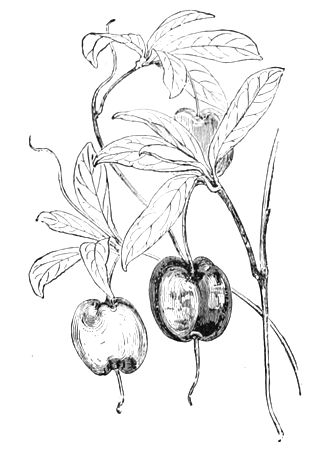
FIG. 251. FRUITING PORTION OF BILLARDIERA LONGIFLORA.
B. mutabilis (changeable). A synonym of B. scandens.
B. ovalis (oval-leaved). A synonym of B. longiflora.
B. scandens (climbing).* fl. cream-coloured, at length purplish, solitary; pedicels same length as the flower. June to September. l. lanceolate-linear, entire. Branches, when young, villous. New Holland, 1795. SYNS. B. mutabilis, B. angustifolia. (B. M. 1313.)
BILLBERGIA (named after J. G. Billberg, a Swedish botanist). ORD. Bromeliaceæ. A genus of handsome stove plants. Flowers borne on light panicles; calyx three-parted; corolla of three convolute petals, scaly at the base; stamens inserted into the base of the perianth. Leaves harsh, rigid. These require much the same treatment as recommended for Æchmea. The most suitable soil is a mixture of peat, leaf soil, and loam in about equal parts, to which is added some sharp sand, to keep it open and porous. Free and perfect drainage is absolutely necessary for the successful culture of this class of plants, and a layer of moss should be placed over the crocks previous to filling the pots with soil. Although fond of heat, Billbergias will, when in flower, bear removal to a cooler house than a stove; and, if they are kept a little dry at the same time, the change will greatly prolong their blooming period. The stronger growing kinds thrive well in rich, well-drained loam and leaf mould. Propagation is effected by carefully taking off the suckers which form at the base, after the plants have done flowering; but, before doing this, they should be allowed to attain a good size. The suckers grow quickly when attached to the parent stem, from which they derive their strength, and feel the check less when severed; besides which, they become more mature, and are in better condition for rooting. The best method to adopt is as follows: Take the sucker in the hand and gently twist it off the stem; next trim the base by the removal of a few of the lower leaves, and then insert each sucker separately in a small pot, in sharp soil. A bottom heat of about 80deg. will greatly facilitate new root-growth; failing this, they will root freely in the temperature of a stove if placed in a shaded position for two or three weeks, after which they will bear increased light and sunshine during the later part of the day. See also Æchmea and Androlepis.
B. amœna (pleasing). fl. greenish-white, tipped with blue, loosely panicled; bracts rose-coloured. July to winter. l. ligulate, abruptly acuminate, slightly spiny. h. 2ft. Brazil, 1817. (B. R. 344.)
B. Baraquiniana (Baraquin's).* fl. green; spikes long, the upper portion pendulous, bearing four or five large, oblong-lanceolate, bright scarlet bracts at the base of the flowers; the stem above the bracts is hoary white. Early spring. l. ligulate, tapering to a point, where, as well as at the edges, they are armed with sharp reddish spines, arched, transversely variegated with white scurfy bars. h. 1½ft. Brazil, 1865. (I. H. 1864, 421.)
B. chlorosticta (green-spotted). Synonymous with B. Saundersii.
B. iridifolia (Iris-leaved).* fl. red and yellow, tipped with blue, in drooping spikes; rachis and bracts crimson. March. l. lanceolate, ensiform, 1½ft., grey beneath. h. 1ft. Rio de Janeiro, 1825. (B. R. 1068.)
B. Liboniana (Libon's).* fl., outer perianth segments beautiful coral red, about half as long as the inner ones, which are whitish at the base, and a splendid purple upwards. Winter. l. in a dense rosette. h. 1ft. Brazil, 1858. (B. M. 5090.)
B. Lietzei (Lietz's).* fl. in loose terminal racemes, each subtended by lanceolate pink bracts; sepals rosy pink, half as long as the greenish corolla. l. tufted, ligulate, acute; margin spiny. Brazil, 1881. A double-flowered variety, with petaloid stamens, is mentioned by M. Morren, which is interesting in being the first double-flowered Bromeliad yet recorded. (B. H. 1881, 97.)
B. marmorata (marbled).* fl. deep blue; calyces green, tipped with blue; bracts very large, leafy, oblong, bright scarlet; panicles erect, branched, much longer than the leaves. l. broadly ligulate, sheathing at the base, truncate-mucronate at the apex; edges very regularly toothed, deep green, freely blotched and barred with dull reddish-brown. (I. H. 2, 48.)
B. Moreli (Morel's).* fl., sepals red, densely woolly, less than half as long as the purplish-violet petals; spike dense, drooping; bracts large, deep rosy red, much longer than the solitary sessile flowers. February. l. arching, lanceolate, shining green on both surfaces; marginal spines few and weak, h. 1ft. Brazil, 1848. An excellent basket plant. SYN. B. Moreliana. (B. H. 1873, 1, 2.)
B. Moreliana (Morel's). Synonymous with B. Moreli.
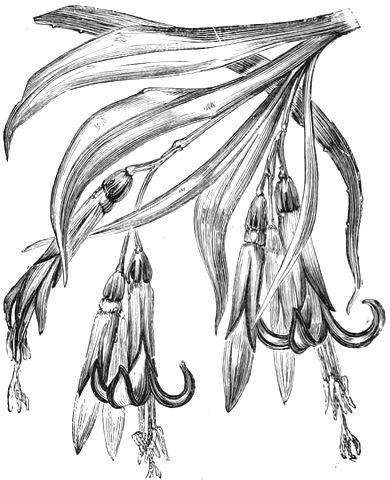
FIG. 252. FLOWERS OF BILLBERGIA NUTANS.
B. nutans (nodding). fl., sepals reddish; petals yellowish-green, both with a blue margin; scapes slender, nodding, with a few large rosy bracts, terminating in a short drooping spike. Winter. l. numerous, long, narrow, ensiform, remotely spiny. h. 1½ft. Brazil, 1868. See Fig. 252. (B. M. 6423.)
B. pallescens (pallid). fl. greenish-white; ovary deeply grooved; spike pendulous; bracts lanceolate, of a beautiful rose-pink. Winter. l. dark green, and spotted on the upper surface, paler beneath, with transverse bars. h. 1½ft. Brazil, 1856. SYNS. B. pallida and B. Wioti.
B. pallida (pale). Synonymous with B. pallescens.
B. pyramidalis (pyramidal). fl. red, with purple margin, in erect spikes; bracts lanceolate, rosy. February. l. curved, ligulate-lanceolate, with white bands beneath. h. 1ft. Peru, 1822. (B. H. 1873, 16.)
B. Quesneliana (Quesnel's).* fl. deep purple; bracts flesh-coloured; upper ones variegated with white. h. 6ft. Guiana, 1874. An erect growing species, possessing the same habit as B. rosea-marginata, but having the leaves more acuminate, and deep green in colour. SYN. Quesnelia rufa. (F. d. S. 10, 1026.)
B. rosea-marginata (rose-margined).* fl., inflorescence a dense oblong spike of light blue, subtended by large, broad, deep, rose-coloured bracts, with scarious margins. January. l. sheathing at the base, about 2ft. long, channelled, spiny on the margin, and marked with transverse mealy bands. h. 1½ft. Tropical America, 1880. SYNS. B. rubro-marginata and Quesnelia roseo-marginata.
B. rubro-marginata (red-margined). Synonymous with B. rosea-marginata.
B. Saundersii (Saunders').* fl. about 2in. long, disposed in a loose pendulous inflorescence; sepals crimson, half the length of the petals, which are yellow outside and blue within. l. tufted, ligulate, rounded at the apex, terminated by a short mucro, saw-toothed, green above, purple beneath, and spotted white on both surfaces. Brazil, 1868. SYN. (according to Morren) B. chlorosticta. (F. M. n. s. 106.)
B. thyrsoidea (thyrsoid). fl. dense, in thyrsoid spikes, almost without bracts. June. l. green, ligulate, shortly acuminate, the margin toothed. h. 1ft. Brazil, 1850. (B. M. 4756.)
B. vittata (striped). fl. indigo blue, with crimson calyces and bracts; racemes nodding. l. banded, ligulate, elongate, shining. h. 1½ft. Brazil, 1843. (B. H. 1871, 14, 15.)
B. Wioti (Wiot's). Synonymous with B. pallescens
B. zebrina (zebra-streaked).* fl. greenish; scape clothed with large, pale, salmon-coloured bracts; inflorescence gracefully curved downwards. Early spring. l. sheathing for about half their length, forming thus a sort of tube, deep green, with zones of grey, the whole deepening with age. h. 1½ft. South America, 1826. SYN. Helicodea zebrina. (L. B. C. 1912.)
BILOBATE. Two-lobed.
BINATE. In pairs.
BINDING. The process of securing a graft or bud in its place by means of Raffia or Bast. The same term is applied to hard clay or other soil impervious to water, in summer.
BINDWEED. See Convolvulus.
BIOPHYTUM (from bios, life, and phyton, a plant; the leaves of one species being sensitive to the touch). TRIBE Oxalideæ of order Geraniaceæ. A genus of pretty and interesting perennials, differing from Oxalis, in which genus it has been included, in the valves of the capsule being patent and separate to the base. They will thrive in a mixture of loam and peat. Propagated by seeds, which should be sown in spring, on a hotbed. Probably the only species in cultivation is the following:
B. sensitivum (sensitive). fl. yellow, small. July. l., leaflets oblong, obtuse, mucronate. h. 6in. India and China, 1823. The leaves of this plant contract on the slightest touch. SYN. Oxalis sensitiva. (B. R. 31, 68.)
BIOTA. See Thuja.
BIOTIA. See Aster corymbosus.
BIPARTITE. Divided into two nearly to the base.
BIPINNATE. Twice pinnate.
BIPINNATIFID, or BIPINNATIPARTED. Having both primary and secondary segments of a leaf divided, but not to the base.
BIPLICATE. Having two folds or plaits.
BIRCH. See Betula.
BIRD-CHERRY. See Cerasus Padus.
BIRDLIME. A preparation made from Mistletoe berries and Holly bark. It is used for catching birds.
BIRD-PEPPER. See Capsicum baccatum.
BIRDS. As a class, Birds are very much more useful than hurtful in gardens. Owls are of great use in catching mice, and Night-jars in catching night-flying insects. Rooks are very useful in lessening the numbers of wire-worms, and of hurtful insects in general; but, if very numerous, they may be driven to eat potatoes and other vegetable food, and may then do harm. The same may be said of Starlings. Blackbirds and Thrushes feed much on snails and worms, but they also feed on the ripe fruits in gardens. As a rule, slender-billed birds feed almost wholly on insects or other animals, and are to be encouraged in gardens at all seasons. Among these may be enumerated the Tree-creeper, Wryneck, Warblers, and Wrens of various kinds, Chats, Hedge-sparrow, Larks, Redstart, Robin, Titmice, and Wagtails. Swifts, Swallows, and Martins, are also great destroyers of insects. The Finches feed, in part, on insects, but also eat large quantities of seeds, and often do considerable damage among plants grown for seed, e.g., Cabbages, and in the seed-beds. Sparrows are about the most troublesome, though they are often assisted by Buntings, Chaffinches, Linnets, and others. When seed-beds or fruits have to be protected, this may be done by nets; or, more simply, by threads tied to sticks a few inches above the surface of the ground, or in front of the trees.
BIRD'S-EYE PRIMROSE. See Primula farinosa.
BIRD'S-FOOT. See Ornithopus.
BIRD'S-FOOT FERN. See Pellæa ornithopus.
BIRD'S-NEST FERN. See Asplenium Nidus.
BIRTHWORT. See Aristolochia.
BISCUTELLA (from bis, double, and scutella, a saucer; in allusion to the form of the silicles). Buckler Mustard. ORD. Cruciferæ. Perennial or annual herbaceous plants, usually hispid, but sometimes downy or smoothish. Flowers yellow, scentless; pedicels filiform, bractless. Leaves oblong, entire, toothed or pinnatifid, somewhat radical or cauline. Stems round, erect, usually corymbosely branched at the top by racemes, which, when in flower, are short, but elongated at the time of fruiting. All the species produce seeds freely. The annuals should be sown in the open borders. Some of the perennial kinds are well adapted for ornamenting rockwork, in a dry, sunny situation. Of the annuals, columnæ, lyrata, maritima, and obovata, are best. Of the perennials, coronopifolia, lævigata, and sempervirens are the most desirable, but none are worth cultivation outside botanical collections.
BISERIAL, or BISERIATE. Arranged in two parallel rows.
BISERRATE. Toothed in a saw-like manner, but with the primary teeth again serrated.
BISULCATE. Doubly furrowed.
BITERNATE. Twice ternate.
BITTER ALMOND. See Amygdalus communis amara.
BITTER APPLE. See Cucumis Colocynthis.
BITTER-SWEET. See Solanum Dulcamara.
BITTER VETCH. See Orobus.
BITUMINOUS. Clammy, adhesive.
BIVONÆA (named after Antonio Bivona-Bernardi, a Sicilian botanist, author of "Sicularum Plantarum Centuria I. et II.," Palermo, 1806). ORD. Cruciferæ. A pretty little monotypic genus, well adapted for ornamenting rockwork or the front of flower borders. A dry sandy soil is most suitable for its culture. Propagated by seeds, sown in spring where the plants are intended to remain, thinning-out being necessary to ensure full growth.
B. lutea (yellow).* fl. yellow, small; racemes terminal, elongated as they grow; pedicels filiform, bractless. April. l. alternate, lower ones stalked, the rest sessile, cordate, stem-clasping at the base, ovate, toothed, bluntish. Stem filiform, sparingly branched. h. 3in. to 6in. Sicily, 1823. An annual.
BIXA (its South American name). Arnatto. ORD. Bixineæ. Stove evergreen trees, with dichotomous panicles of large reddish flowers, broad cordate leaves, and prickly capsules. A compost of loam and peat is well adapted to their culture. Propagated by seed, sown when ripe in bottom heat; or by cuttings, which root freely in sand, under a hand glass, in heat; the latter is the better method. If grown from seed, the trees attain a large size before they flower; whereas cuttings, taken from a flowering plant and struck, may be brought to flower when small plants.
B. Orellana (Orellana). fl. pale peach-coloured; corymbs terminal, panicled; peduncles two, three, and four-flowered. May to August. l. cordate, ovate, acuminated, entire or angular, smooth on both surfaces. The drug called Arnatto is prepared from the red pulp which covers the seed of this species. It is used in the preparation of chocolate, and by farmers for colouring cheese, and also as an orange or yellow dye for silks. h. 30ft. West Indian Islands, 1690. See Fig. 253. (B. M. 1456.)
BIXINEÆ. An order of smoothish tropical trees or shrubs, not remarkable for any particular beauty. Flowers with or without petals, when present five and sepal-like; stamens indefinite in number, inserted in the receptacle or at the bottom of the calyx; peduncle axillary or terminal, bracteate, one or many-flowered, usually forming terminal panicles. Fruit fleshy or dry. Leaves alternate, simple, entire, or slightly lobed, generally full of pellucid dots. The genera best known are Azara, Bixa, and Flacourtia.
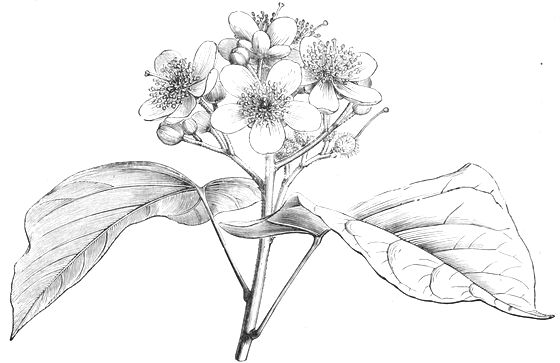
FIG. 253. FLOWERING BRANCH OF BIXA ORELLANA.
BLACK BEARBERRY. See Arctostaphylos alpina.
BLACK BEETLES. See Cockroaches.
BLACK BRYONY. See Tamus communis.
BLACK BULLACE. See Prunus insititia.
BLACKBURNIA. See Xanthoxylum.
BLACK FLY or BEAN FLY (Aphis rumicis), also called Collier and Black Dolphin. This Fly (see Fig. 254) is found on many herbaceous plants. It is very injurious to Beans; hence, immediate means of destruction must be employed directly the insect appears. Its extermination is an extremely difficult matter; but the following remedies are very effectual:
Tobacco Water. This, made and applied as recommended for Aphides (which see) is a good remedy; but it is rendered more certain by the employment of soapsuds, instead of clear water, in its manufacture.
FIG. 254. THE BEAN FLY. a, Female, magnified; b, Male, natural size, and magnified.
Paris Green (Arseniate of Copper). Owing to its poisonous nature, this should not be used where there is fruit on the trees or vegetables under them; but there is no better destroyer of hard-dying insects. Its application is very simple. Mix 1lb. of the green with 30gals. of water, and well wet the infested parts of the trees, using a fine-rosed watercan or garden engine for the purpose. The operator's hands should be free from sores and scratches, or dangerous ulcerations may ensue.