THE DICTIONARY OF GARDENING, (continued 2)
Reading edition
A. plicatum (folded). Synonymous with A. tauricum.
A. productum (long-lipped). fl. violet, downy, on few-flowered, loose, pubescent racemes; helmet straight, irregularly convex-conical, with a drawn-out beak; spur capitate. June. l. on long stalks with three-parted lobes. h. 1ft. Siberia.
A. rostratum (beaked).* fl. violet; panicle rather loose; spur thick, depressed, globose; helmet conical, elongated, abruptly pointed in front; beak stretched out. June. l. with trapeziform, pinnate lobes. h. 1ft. to 2ft. Switzerland, 1752. SYN. A. alpinum.
A. Schleicheri (Schleicher's). fl. blue or violet, middle sized, on short racemes; spur capitate; helmet convex-hemispherical, gaping, smoothish. Summer. l. with finely jagged lobes. Stem straight (or infracted), simple, slender. h. 2ft. to 3ft. Europe. SYN. A. vulgare.
A. semigaleatum (half-helmeted). fl. pale blue, pubescent when young, on very loose racemes; peduncles elongated; spur hooked; helmet convex, navicular. June. l. multifid, few, membranous, smooth; root about the size and form of a pea. h. 6in. to 2ft. Kamtschatka, 1818.
A. Sprengelii (Sprengel's). fl. bluish purple; spur obtuse, straight. June. l. with blunt, bipinnate lobes. h. 3ft. to 4ft. Europe, 1820.
A. tauricum (Taurian).* fl. deep blue, disposed in dense racemes; peduncles erect, smooth; lateral sepals smooth inside; spur blunt; helmet closed, hemispherical. June. l. segments almost pedately disposed and divided into linear acuminate lobes. h. 3ft. to 4ft. Germany, 1752. SYN. A. plicatum.
A. tortuosum (twisting). fl. pale or deep violet, large; panicle loose, few flowered; spur thick, long, abruptly pointed (neither arched, nor convolute). July. l. smooth, with narrow wedge-shaped lobes, and acute lobules. h. 6ft. to 8ft. North America, 1812.
A. toxicum (very poisonous). fl. violet, large, pubescent, on loose, also pubescent, racemes; spur hooked; helmet large, arched, with a blunt beak. June. l. smooth, with trapeziform pinnate lobes. Stem flexuous, almost simple. h. 2ft. America, 1825.
A. uncinatum (hooked).* fl. generally lilac, large, smooth; racemes loose, rather umbellate at the apex, very rarely panicled; spur somewhat spiral, inclined; helmet regularly conical, compressed. July. l. with trapeziform pinnate lobes. Stem with branches rising from the axils of the leaves. h. 4ft. to 8ft. North America, 1768.
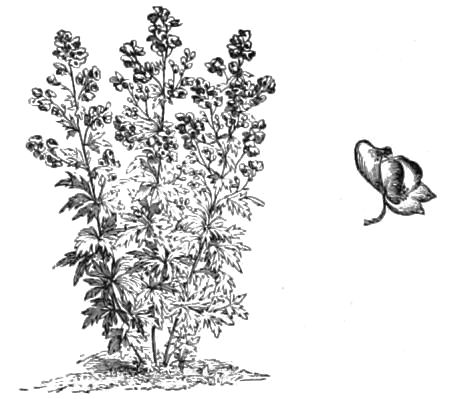
FIG. 19. ACONITUM VARIEGATUM, showing Habit and Flower.
A. variegatum (variegated).* fl. blue, large, smooth; racemes panicled, loose; spur erect, clavated-hooked; helmet bent forward, inflated; beak ascending. July. l. lower, on long stalks; upper, sessile, smooth, thickish. h. 1ft. to 6ft. Europe, 1597. See Fig. 19.
A. v. albiflorum (white-flowered).* fl. white, small; helmet straight.
A. v. bicolor (two-coloured).* fl. white, edged with blue or lilac; helmet straight.
A. vulgare (common). A synonym of A. Schleicheri.
A. Willdenovii (Willdenow's).* fl. bluish-purple; peduncles pubescent; spur obtuse, straight. June. l. with blunt segments. h. 2ft. to 3ft. Carniola, 1823.
Sect. II. Roots Fibrous or Napiform.
A. Anthora (Anthora).* fl. pale yellow; panicles generally pubescent; spur refracted; lip obcordate; helmet arched. July. l. palmately cut into linear lobes. h. 1ft. to 2ft. Pyrenees, 1596. The following varieties of A. Anthora are erroneously classed as species by some authors:
A. a. Decandollii (Decandolle's). fl. yellow; panicle and flowers pubescent; helmet rather conical, bent, with a short, abrupt, and acuminated beak. l. with rather large dark green lobes. Alps of Jura, 1873.
A. a. eulophum (well-crested). fl. yellow; panicles and flowers puberulous; helmet conical. Caucasus, 1821.
A. a. grandiflorum (large-flowered). fl. yellow, large; panicle, flowers, and fruit pubescent; helmet rather conical. Alps of Jura, 1821.
A. a. Jacquinii (Jacquin's). fl. yellow, smooth; helmet somewhat conical, drawn out into an elongated beak.
A. a. nemorosum (grove-loving).* fl. yellow; panicle and flowers pubescent; helmet somewhat conical, bent; beak short. l. with broad lobes.
A. autumnale (autumn-flowering).* fl. bluish-purple, in loose panicles; peduncles rigidly spreading; spur capitate; helmet closed; lip very long, refracted. July. l. with cuneate, bipinnate lobes. h. 3ft. to 4ft. Europe.
A. barbatum (bearded).* fl. cream coloured, middle sized; racemes dense, puberulous; spur straightish, obtuse; bottom of helmet conical; middle sepals densely bearded. July. l. opaque, with the lobes divided into many linear segments, on long stalks, which are villous as well as the nerves. h. 2ft. to 6ft. Siberia, 1807. SYN. A. squarrosum.
A. chinense (Chinese).* fl. intense and very bright blue, in large compound racemes; pedicels slightly hairy above. Summer. l. lower ones large, deeply cut into three wedge-shaped segments, tapering at the base; upper ones sessile, gradually becoming more entire. h. 4ft. to 6ft. China, 1833.
A. Lamarckii (Lamarck's). fl. cream-coloured, pubescent; racemes long, cylindrical, crowded, branched at the base; spur spiral; helmet constricted, clavate. July. l. large, seven to nine-parted, with the lobes unequally cleft. h. 2ft. to 3ft. Pyrenees, 1800.
A. lupicidum (Wolf's-bane). Synonymous with A. Vulparia.
A. macrophyllum (large-leaved). fl. yellow, numerous, panicled; spur arched; helmet large, somewhat ventricose at the apex. July. l. large, more or less dissected. h. 4ft. to 8ft. Germany.
A. Nuttallii (Nuttall's). Synonymous with A. ochroleucum.
A. ochroleucum (yellowish-white).* fl. cream coloured, large; spur arched; bottom of helmet conico-cylindrical; middle sepals covered with short hairs; racemes puberulous, rather loose. July. l. five to seven-parted, deep green, the first ones are puberulous above. h. 2ft. to 4ft. Russia, 1794. SYNS. A. Nuttallii, A. pallidum.
A. Pallasii (Pallas'). Probably a mere variety, with a continuous spur, of A. anthora.
A. pallidum (pale). Synonymous with A. ochroleucum.
A. pyrenaicum (Pyrenean).* fl. yellow, rather large; spur hooked; bottom of helmet cylindrical, rounded; racemes elongated, dense, puberulous. June. l. parted almost to the base, with pinnatifid lobes, rather hispid beneath, but smooth above, on long stalks. h. 2ft. Pyrenees, &c., 1739.
A. squarrosum (rough). Synonymous with A. barbatum.
A. vulparia (Fox-bane).* fl. pale yellow, smooth; spur spiral; helmet cylindrical, large; beak stretched out, acute; racemes crowded. July. l. three or five-lobed, ciliated. h. 1ft. to 3ft. Europe, 1821. SYN. A. lupicidum. The principal varieties of this species are:—
A. v. carpaticum (Carpathian). fl. panicled, of a lurid colour, sometimes variegated with yellow; helmet conico-cylindrical, compressed; peduncles smooth. l. profoundly cut. Stems smooth. h. 2ft. to 3ft. Carpathian Mountains, 1810.
A. v. Cynoctonum (tall Dog's-bane). fl. (and stem) yellow, smoothish, numerous, panicled. h. 3ft. to 4ft. France, 1820.
A. v. moldavicum (Moldavian). fl. violet, panicled; helmet cylindrical, compressed. h. 3ft. to 4ft. Moldavia.
A. v. rubicundum (reddish). fl. livid violet, panicled, villous, variegated with yellow; helmet conico-cylindrical, compressed. h. 2ft. to 3ft. Siberia, 1819.
A. v. septentrionale (northern).* fl. blue, panicled, villous; helmet conico-cylindrical, compressed. h. 4ft. North Europe, 1800.
ACONTIAS. See Xanthosoma.
ACORN. The seed or fruit of the oak. See Quercus.
ACORUS (from a, without, and kore, the pupil of the eye; in allusion to its reputed medicinal qualities). ORD. Aroideæ. A small genus of hardy herbaceous plants. Flowers on a sessile spadix; perianth six-cleft, inferior, persistent. They thrive best in a moist soil, and are very suitable for the banks of water, or even as aquatics in shallow water. Propagated easily by divisions during spring.
A. Calamus (sweet-flag).* fl. yellowish, small, borne on a cylindrical spadix 4in. to 6in. long. Summer. l. sword-shaped, erect, striated 3ft. long. The root is cylindrical, channelled, and very fragrant. Europe. The variety with gold-striped leaves is more useful as a decorative plant. See Fig. 20.
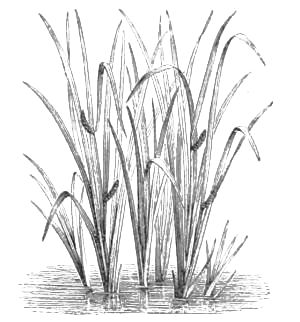
FIG. 20. ACORUS CALAMUS.
A. gramineus (grass-leaved). China, 1796. This is much smaller in all its parts than the above, but very pretty.
A. g. variegatus.* A pretty variety with white striped leaves, forming handsome little tufts.
ACOTYLEDONS. Plants having no cotyledons, or seed leaves, as in Cuscuta, but usually applied to cryptogamic or flowerless plants, such as ferns, mosses, &c.
ACRADENIA (from akra, top, and aden, a gland; referring to the five glands on the top of the ovary). ORD. Rutaceæ. An excellent neat and compact evergreen bush, suitable for the cool conservatory. It requires a rich loam and leaf mould. Propagated by seeds and cuttings under a bell glass.
A. Frankliniæ (Lady Franklin's).* fl. white, produced in great profusion, in terminal clusters. August. l. fragrant, opposite, trifoliate, gland-dotted. h. 8ft. Tasmania, 1845.
ACRE (from agros, an open field). The English Statute acre consists of 160 square rods (perches, poles, roods, or lugs); or 4840 square yards; or 43,560 square feet. The following list shows the differentiation in the number of square yards per acre in the various districts of Great Britain and Ireland: Cheshire, 10,240; Cornish, 5760; Cunningham, 6250; Derby (W.), 9000; Devonshire, 4000; Herefordshire, 3226⅔; Irish, 7840; Leicestershire, 2308¾; Scotch, 6150; Wales, North (customary), 3240; ditto (erw), 4320; Westmoreland, 6760; Wiltshire, 3630.
ACRIDOCARPUS (from akris, a locust; and karpos, fruit; meaning not obvious). ORD. Malpighiaceæ. A handsome sub-tropical or warm greenhouse climber, requiring plenty of water, and a very free drainage. Increased by imported seeds, and by cuttings in bottom heat.
A. natalitius (Natal).* fl. pale yellow; petals five, rounded, wedge-shaped, crenately-toothed at the edge; racemes simple, elongated, terminal. July. l. oblong or obovate, obtuse, leathery. Natal, 1867.
ACRIOPSIS (from akros, top, and opsis, eye). ORD. Orchidaceæ. A small genus of pretty stove epiphytal orchids, almost unknown to cultivation. Flowers small, arranged in loose panicles; lip adnate to the very curious column, from which it projects at right angles.
A. densiflora (crowded-flowered).* fl. green and pink. May. l. linear-lanceolate. h. 6in. Borneo, 1845.
A. javanica (Javanese). fl. yellow, green. May. l. linear-lanceolate. h. 3in. Java, 1840.
A. picta (painted).* fl. white, green, and purple. May. l. solitary, linear. h. 6in. Bantam, 1843.
ACROCLINIUM (from akros, top, and kline, a bed; referring to the open flowers). ORD. Compositæ. A small genus of elegant half hardy annuals with "everlasting" flower heads, which are solitary, terminal, and consist of tubular florets; involucrum many-leaved, imbricated. Leaves numerous, linear, smooth, acuminated. Stems numerous, erect. They thrive best in a loamy soil, and constitute very neat summer flowering annuals if sown out of doors in patches in June; they are also useful as winter decorative greenhouse plants if seed is sown in August in pots placed in a cold frame. The flower-heads should be gathered when young, if it is desired to preserve them.
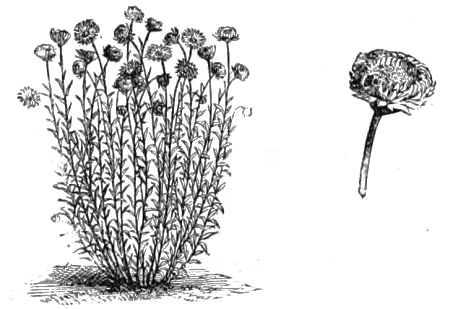
FIG. 21. ACROCLINIUM ROSEUM, showing Habit and Flower-head.
A. roseum (rosy).* fl.-heads pretty rose, solitary, terminal, on erect, slender, and gracefully disposed branches. l. linear, acute. h. 1ft. to 2ft. S. W. Australia, 1854. See Fig. 21.
A. r. album (rosy white).* A very pretty white form of the preceding.
A. r. grandiflorum (large-flowered).* fl.-heads rose, larger than in the type.
ACROCOMIA (from akros, top, and kome, tuft; referring to the position of the leaves). ORD. Palmeæ. A genus of South American palms, containing about eleven species, which are not easily distinguished, but having the following general characteristics: Trunk from 20ft. to 50ft. high, and clad with long prickles. The flowers, which appear in the axils of the lower leaves, are greenish or yellow, and their drupes are much the same colour. Leaves pinnate, with seventy to eighty leaflets on each side of the pinnæ. They require a warm greenhouse and rich sandy loam. Increased by suckers. Two species only are in general cultivation.
A. aculeata (prickly). h. 40ft. West Indies, 1791.
A. fusiformis (spindle-shaped). h. 40ft. Trinidad, 1731.
A. globosa (globular). h. 20ft. St. Vincent, 1824.
A. horrida (horrid). h. 30ft. Trinidad, 1820.
A. lasiospatha (hairy spathed). l. drooping. Trunk about 40ft. high, smooth and ringed. Para, 1846.
A. sclerocarpa (hard-fruited).* A very elegant species bearing a head of spreading pinnate leaves, with the rachises and petioles aculeate, and the leaflets linear, taper-pointed, glaucous underneath, about 1ft. long. h. 40ft. West Indies, 1731. SYN. Cocos fusiformis.
A. tenuifolia (fine-leaved). h. 30ft. Brazil, 1824.
ACROGENS. Plants increasing at the summit, as Ferns, &c.
ACRONYCHIA (from akron, tuft, and onux, a claw; referring to the curved points of the petals). ORD. Rutaceæ. An ornamental rue-like greenhouse evergreen shrub. Petals and sepals four; stamens eight, inserted on a disk; fruit berry-like. It requires ordinary greenhouse treatment. Increased by cuttings in July in sand, under a bell glass.
A. Cunninghami (Cunningham's).* fl. white, in clusters, resembling those of an orange, with an exquisite fragrance. July. h. 7ft. Moreton Bay, 1838.
ACROPERA. See Gongora.
ACROPHORUS. See Davallia.
ACROPHYLLUM (from akros, top, and phyllon, a leaf; referring to the way in which the leaves are produced at the summit of the branches, above the flowers). ORD. Cunoniaceæ. Handsome greenhouse small, erect-growing, evergreen shrubs, flowering profusely during the spring months. They require a mixture of fibrous peat, a little loam, and sharp sand; thorough drainage, an airy situation, and as little artificial heat as possible, are important to its well-being. Re-pot in February. Propagated by cuttings of the half ripened shoots, which strike freely in a soil of sand and peat, if covered with a hand glass, and placed in a cool house. The roots should not be allowed to get dry, and light syringing during late spring and summer will be found beneficial in assisting to keep down thrips.
A. verticillatum (whorled). A synonym of A. venosum.
A. venosum (veined).* fl. pinkish white, in dense axillary spikes, which are borne on the upper part of the stems and branches. May and June. l. nearly sessile, oblong, cordate, acute, serrate, in whorls of threes. h. 6ft. New South Wales. SYN. A. verticillatum.
ACROPTERIS. See Asplenium.
ACROSTICHUM (from akros, top, and stichos, order; meaning very obscure). ORD. Filices. This genus includes Aconiopteris, Chrysodium, Egenolfia, Elaphoglossum, Gymnopteris, Olfersia, Photinopteris, Pœcilipteris, Polybotrya, Rhipidopteris, Soromanes, Stenochlæna, Stenosemia. A large and almost entirely tropical genus; it includes groups with a wide range in venation and cutting. Sori spread over the whole surface of the frond or upper pinnæ, or occasionally over both surfaces. The species having long fronds, are admirably suited for growing in suspended baskets, and the dwarfer sorts do well in Wardian cases. A compost of peat, chopped sphagnum, and sand, is most suitable. For general culture, see Ferns.
A. acuminatum (taper-pointed).* rhiz. thick, climbing. sti. 4in. to 6in. long, firm, erect, scaly throughout. barren fronds 1ft. to 2ft. long, 1ft. or more broad, deltoid, bipinnate; upper pinnæ oblong-lanceolate, slightly lobed, truncate on the lower side at the base, 2in. to 3in. long, ¾in. to 1in. broad; lower pinnæ, 6in. to 8in. long, 4in. to 5in. broad, with several small pinnules on each side; light green, with a firm texture. fertile fronds 1ft. long, deltoid, tripinnate. Brazil. Stove species. SYN. Polybotrya acuminatum.
A. alienum (foreign). rhiz. woody. sti. 6in. to 18in. long, scaly downwards. barren fronds 1ft. to 2ft. long, often 1ft. broad, the upper part deeply pinnatifid, with lanceolate lobes, the lower part pinnate, with entire or deeply pinnatifid lower pinnæ. fertile fronds much smaller, with distant narrow linear or pinnatifid leafy pinnæ. Tropical America. Stove species. SYN. Gymnopteris aliena.
A. apiifolium (parsley-leaved).* cau. stout, woody, erect. sti. of barren fronds 2in. to 3in. long, erect, densely clothed with tomentum. barren fronds 4in. to 6in. each way, deltoid, tripinnate; pinnæ close, only the lowest pair with pinnatifid pinnules, ultimate divisions oblong-rhomboidal, ¼in. to ⅓in. long, the base cuneate, the outer edge slightly toothed. fertile fronds on a slender naked stem 6in. to 8in. long, the fronds panicled with a few distant, slender, simple, or compound branches. Philippine Islands, 1862. Stove species. SYN. Polybotrya apiifolia.
A. apodum (stemless).* cau. thick, woody, the scales dense, linear, brown, crisped. sti. tufted, very short, or obsolete. barren fronds 1ft. or more long, 1½in. to 2in. broad, the apex acuminate, the lower part narrowed very gradually, the edge and midrib densely fringed with soft, short, brown hairs. fertile fronds much smaller than the barren ones. West Indies to Peru, 1824. Stove species. SYN. Elaphoglossum apodum.
A. appendiculatum (appendaged).* rhiz. firm, woody. barren fronds 6in. to 18in. long, 4in. to 8in. broad, simply pinnate. sti. 3in. to 6in. long, erect, naked, or slightly scaly; pinnæ 2in. to 4in. long, ⅜in. to ¾in. broad, the edge varying from sub-entire to cut half-way down to the midrib of the blunt lobes, the upper side often auricled, the lower one obliquely truncate, dark green. fertile fronds narrower, on a longer spike, the pinnæ roundish or oblong, often distinctly stalked. India, &c., 1824. Stove species. SYN. Egenolfia appendiculata.
A. aureum (golden).* cau. erect. sti. erect, 1ft. to 2ft. long, strong. fronds 2ft. to 6ft. long, 1ft. to 2ft. broad, the upper pinnæ fertile, rather smaller than the barren ones, which are usually stalked, ligulate oblong, 3in. to 1ft. long, ½in. to 3in. broad, acute or blunt, sometimes retuse with a mucro; edge quite entire, base sub-cuneate. Widely distributed in the tropics of both hemispheres, 1815. An evergreen aquatic stove species, requiring abundance of heat and moisture. SYN. Chrysodium aureum.
A. auritum (eared).* cau. erect, woody. barren fronds with a stipe 6in. to 9in. long, deltoid, 8in. to 12in. each way, ternate, the central segments deeply pinnatifid, with lanceolate entire lobes; the lateral ones unequal sided, with lanceolate oblong-lobed lower pinnules. fertile fronds with a stem 12in. to 18in. long, deltoid, with distant linear pinnæ half line broad; upper simple, lower pinnatifid. Philippine Islands. Stove species. SYN. Stenosemia aurita.
A. axillare (axillary). rhiz. slender, wide scandent. barren fronds 6in. to 18in. long, about 1in. broad, simple, the point bluntish, the edge entire, the lower half tapering very gradually to the base or short stem. fertile fronds 6in. to 12in. long, one to three lines broad, flexuose, on a stem 1in. to 6in. long. Himalayas. Greenhouse species. SYN. Chrysodium axillare.
A. barbatum (bearded). Synonymous with A. scolopendrifolium.
A. bifurcatum (twice-forked). sti. densely tufted, 2in. to 4in. long, slender, stramineous, naked. fronds 3in. to 4in. long, about ½in. broad, pinnate; lower pinnæ of fertile fronds two or three cleft, with linear divisions; those of the barren pinnæ broader, and not so deep. St. Helena. Greenhouse species. SYN. Polybotrya bifurcata.
A. Blumeanum (Blume's).* rhiz. woody, wide climbing. sti. of barren fronds 6in. long, scaly. barren fronds 1ft. to 3ft. long, 1ft. or more broad, with numerous sessile pinnæ on each side, which are 4in. to 6in. long, 1in. broad; apex acuminate, the edge slightly toothed; base rounded. fertile fronds with distant pinnæ 4in. to 8in. long, ⅛in. to ¼in. broad. Assam. Greenhouse species. SYN. Chrysodium Blumeanum.
A. callæfolium (calla-leaved). A form of A. latifolium.
A. canaliculatum (channelled).* rhiz. woody, wide climbing, spinulose and scaly. sti. 1ft. or more long, scaly throughout. fertile fronds 2ft. to 3ft. long, 12in. to 18in. broad, tripinnate; lower barren pinnæ, 6in. to 9in. long, 4in. to 5in. broad; pinnules lanceolate, stalked, with oblong segments, both surfaces naked; fertile pinnules close, the segments ¼in. long, bearing three to four sessile balls of sori. Venezuela. Stove or greenhouse species. SYN. Polybotrya canaliculata.
A. caudatum (tailed). A synonym of A. petiolosum.
A. cervinum (stag-horned).* rhiz. woody, creeping, scaly. sti. 1ft. or more long, scaly. barren fronds 2ft. to 4ft. long, pinnate; pinnæ 4in. to 9in. long, 1in. to 2in. broad, entire or nearly so, unequal at the base; fertile pinnæ distant, linear, lanceolate, bipinnate, with short spreading sub-cylindrical pinnules. Brazil, 1840. Stove species. SYN. Olfersia cervina.
A. conforme (conformed). rhiz. wide creeping, scaly. sti. 1in. to 12in. long, firm, erect, stramineous, naked or slightly scaly. fronds 2in. to 9in. long, ½in. to 2in. broad, acute or bluntish, the base cuneate or spathulate, the edge entire. barren fronds narrower than the fertile one. A. laurifolium, A. obtusilobum, and several others, are identical with the foregoing. Tropical America, also in the Old World. Stove species. SYN. Elaphoglossum conforme.
A. crinitum (hairy).* cau. woody, erect. sti. of barren fronds 4in. to 8in. long, densely clothed with long scales. barren fronds 9in. to 18in. long, 4in. to 9in. wide, broadly oblong; apex blunt, base rounded, edge entire and ciliated, texture subcoriaceous, both sides scattered over with scales like those of the stipes. fertile fronds like the others, but much smaller, the stipes longer. West Indies, &c., 1793. Stove species. SYNS. Chrysodium and Hymenodium crinitum.
A. cylindricum (cylindrical). Synonymous with A. osmundaceum.
A. Dombeyanum (Dombey's). A form of A. lepidotum.
A. flagelliferum (rod-shaped). rhiz. woody, creeping. sti. of barren fronds 6in. to 12in. long, nearly naked. barren fronds simple or with one to three pairs of pinnæ, the terminal one ovate lanceolate, entire or repand, often elongated and rooting at the point, the lateral ones 3in. to 6in. long, 1in. to 2in. broad; fertile pinnæ 2in. to 3in. long, about ½in. broad. India, &c., 1828. Stove species. SYN. Gymnopteris flagellifera.
A. fœniculaceum (fennel-leaved).* rhiz. slender, creeping. sti. distant, slender, 2in. to 8in. long, scaly. barren fronds 1in. to 2in. broad, usually dichotomously forked, with filiform divisions. fertile fronds ⅜in. broad, two-lobed. Andes of Ecuador. Stove species. (For culture, see A. peltatum). SYN. Rhipidopteris fœniculaceum.
A. Herminieri (Herminier's).* rhiz. stout, creeping. sti. very short, or none. barren fronds 1½ft. to 3ft. long, 1in. to 1½in. broad, simple, acuminate, the lower part narrowed very gradually. fertile fronds short-stalked, 3in. to 4in. long, 1in. to 1½in. broad. Tropical America, 1871. Stove species. SYN. Elaphoglossum Herminieri.
A. heteromorphum (various-formed). rhiz. slender, wide creeping, scaly. sti. 1in. to 3in. long, slender, slightly scaly. barren fronds 1½in. to 2in. long, ¾in. to 1in. broad, simple, bluntish, the base rounded, both surfaces scattered over with linear dark castaneous scales. fertile fronds much smaller, and the stipes much longer. Columbia and Ecuador. Stove species. SYN. Elaphoglossum heteromorphum.
A. Langsdorffii (Langsdorff's). Synonymous with A. muscosum.
A. latifolium (broad-leaved).* rhiz. thick, woody, creeping, scaly. sti. 6in. to 12in. long, firm, erect, naked, or scaly. barren fronds 9in. to 18in. long, 2in. to 4in. broad, simple, acute, gradually narrowed below, entire; texture leathery. fertile fronds considerably narrower than the barren ones. A. longifolium, A. callæfolium, &c., are only varieties of this species. Mexico, Brazil, &c. Stove species. SYN. Elaphoglossum latifolium.
A. lepidotum (scaly).* rhiz. thick, woody, very scaly. sti. 1in. to 3in. long, firm, scaly throughout. barren fronds 3in. to 6in. long, about ½in. broad, simple, usually blunt, the base cuneate or rather rounded, both surfaces and midrib very scaly. A. Dombeyanum, of garden origin, is a varietal form of this, of which there are several others. Tropical America. Stove species. SYN. Elaphoglossum lepidotum.
A. longifolium (long-leaved). A form of A. latifolium.
A. Meyerianum (Meyer's). Synonymous with A. tenuifolium.
A. muscosum (mossy).* rhiz. woody, densely scaly. sti. 4in. to 6in. long, firm, clothed with large pale brown scales. barren fronds 6in. to 12in. long, 1in. to 1½in. broad, simple, narrowed at both ends; upper surface slightly scaly; lower quite hidden by imbricated brownish scales. barren fronds much smaller than the others, the stipes longer. Madeira. Greenhouse species. SYN. A. Langsdorffii.
A. Neitnerii. Synonymous with A. quercifolium.
A. nicotianæfolium (tobacco-leaved).* rhiz. woody, wide creeping, scaly. sti. 1½ft. to 2ft., scaly below. barren fronds 1ft. to 3ft. long, 1ft. or more broad, with a large terminal pinna, and one to three lateral pairs, which are 6in. to 9in. long, 1in. to 3in. broad, acuminate, entire, or nearly so, the base slightly rounded, fertile pinnæ distant, 3in. to 4in. long, ¾in. broad. Cuba, &c. Stove species. SYN. Gymnopteris nicotianæfolium.
A. osmundaceum (osmunda-like).* rhiz. woody, wide scandent, scaly. sti. 12in. to 18in. long, firm, erect, scaly at the base. barren fronds ample, bi- or tripinnate; the lower pinnæ 1ft. to 2ft. long, 4in. to 8in. broad; pinnules stalked, lanceolate, with closely set sub-entire segments, of a light green colour; both surfaces naked. fertile fronds nearly or quite as large as the barren ones; segments linear cylindrical, ¼in. to ½in. long. Tropical America. Stove species. SYNS. A. cylindricum, and Polybotrya osmundaceum.
A. paleaceum (chaffy). Synonymous with A. squamosum.
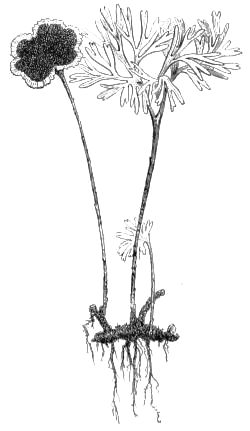
FIG. 22. ACROSTICHUM PELTATUM.
A. peltatum (peltate-leaved).* rhiz. slender, wide creeping. sti. distant, slender, 1in. to 4in. long, scaly throughout. barren fronds 1in. to 2in. each way, repeatedly dichotomously forked, with narrow linear ultimate divisions, quarter to half line broad. fertile fronds ½in. broad, often two-lobed. West Indies. Stove or greenhouse species. This elegant little fern requires a liberal supply of water all the year round, and is best grown in a well drained pan of good fibrous peat, leaf soil, and sand, with some nodules of sandstone raised above the rim of the pan; do not disturb it more than is necessary. SYN. Rhipidopteris peltata. See Fig. 22.
A. petiolosum (petioled). rhiz. woody, wide scandent. sti. woody, erect, scaly at the base. fronds bipinnate, or tripinnatifid, 2ft. to 4ft. long, 1ft. to 3ft. broad, deltoid; the upper barren pinnæ lanceolate, pinnatifid, the longest sometimes 18in. long, and 6in. to 10in. broad; pinnules with long falcate lobes reaching half-way down to the midrib, both surfaces naked; fertile pinnules very narrow, and dangling, continuous or beaded. West Indies, Mexico, &c. Stove species. SYNS. Polybotrya and A. caudatum.
A. piloselloides (mouse ear-leaved). Synonymous with A. spathulatum.
A. platyrhynchos (broad-beaked). sti. tufted, scarcely any. fronds 12in. to 16in. long, 1in. broad, simple. sori in a patch at the apex, 1in. to 2in. long, ⅜in. broad, which does not reach to the entire edge; the lower part narrowed gradually, with naked surfaces, and a coriaceous texture. Philippines. Stove species. SYN. Hymenolepis platyrhynchos.
A. quercifolium (oak-leaved).* rhiz. stout, wide creeping. sti. of barren fronds 1in. to 2in. long, clothed with brownish hairs. barren fronds 3in. to 4in. long, 1½in. to 2in. broad, the terminal pinnæ with blunt rounded lobes. fertile fronds with a terminal pinna, 1in. to 2in. long, one line broad, and a pair of smaller lateral ones, with slender stipes 6in. to 9in. long, hairy at the base. Ceylon. Stove species. SYNS. A. Neitnerii (of gardens), Gymnopteris quercifolia.
A. scandens (climbing).* rhiz. woody, wide climbing. sti. 3in. to 4in. long, firm, erect, naked. fronds 1ft. to 3ft. long, 1ft. or more broad, simply pinnate; barren pinnæ, 4in. to 8in. long, ¾in. to 1½in. broad, acuminate, the edge thickened and serrulate, the base cuneate, sessile, or slightly stalked, articulated; fertile pinnæ, 6in. to 12in. long, one and a half to two lines broad, the lower ones distant. Himalayas, &c., 1841. Stove or greenhouse species. SYN. Stenochlæna scandens.
A. scolopendrifolium (scolopendrium-leaved).* rhiz. woody, creeping, scaly. sti. 4in. to 12in. long, firm, erect, densely clothed with blackish scales. barren fronds often 1ft. long, 1½in. to 3in. broad, simple, acute, the base narrowed gradually; edge and midrib scaly. fertile fronds much smaller than the barren ones. Guatemala, &c. Stove species. SYN. A. barbatum.
A. serratifolium (serrate-leaved). rhiz. woody, short creeping. sti. of barren fronds 12in. to 18in. long, slightly scaly. barren fronds 2ft. long, 6in. to 12in. broad, with numerous sessile pinnæ on each side, 3in. to 6in. long, ¾in. to 1½in. broad, inciso-crenate, the base cuneate; fertile pinnæ distant, 2in. to 3in. long, ¼in. to ½in. broad, blunt, entire. Venezuela, &c. Stove species. SYN. Chrysodium serratifolium.
A. simplex (simple-leaved). rhiz. woody, creeping, scaly. sti. 1in. to 4in. long, firm, erect, naked. barren fronds 4in. to 12in. long, about 1½in. broad, very acute, the lower part narrowed very gradually. fertile fronds narrower than the barren ones, with longer stipes. Cuba to Brazil, 1798. Stove species. SYN. Elaphoglossum simplex.
A. sorbifolium (service-leaved).* rhiz. thick, woody, often 30ft. to 40ft. long, clasping trees like a cable, sometimes prickly. fronds 12in. to 18in. long, 6in. to 12in. broad, simply pinnate; barren pinnæ 4in. to 6in. long, about ½in. broad, three to twenty on each side, articulated at the base, entire or toothed; fertile pinnæ 1in. to 2in. apart, 2in. to 4in. long, about ¼in. broad. West Indies, 1793. There are several varieties of this species, chiefly differing in the number of pinnæ. Stove species. SYN. Stenochlæna sorbifolia.
A. s. cuspidatum (cuspidate).* This is only a variety of the above species with long-stalked, ligulate-cuspidate pinnæ; but it is usually regarded as a distinct species in gardens.
A. spathulatum (spoon-shaped). sti. tufted, 1in. to 2in. long, firm, erect, scaly. barren fronds ½in. to 4in. long, ¼in. to ½in. broad, obovate-spathulate, blunt, tapering narrowly or gradually at the base, with a coriaceous texture; both surfaces and the margins copiously scaly. fertile fronds smaller than the barren, with longer stipes. Tropical America, South Africa, &c. Stove species. SYN. A. piloselloides.
A. spicatum (spiked). rhiz. woody, short creeping. sti. 1in. to 2in. long, firm. fronds 6in. to 18in. long, ½in. to 1in. broad, the upper part contracted and fertile, entire, the lower part narrowed very gradually. Himalayas, &c. Greenhouse species. SYN. Hymenolepis brachystachys.
A. squamosum (scaly).* rhiz. woody, densely scaly. sti. 2in. to 4in. long, densely clothed with pale or dark-coloured scales. barren fronds 6in. to 12in. long, about 1in. broad, simple, acute, the base narrowed gradually; both sides matted, and the edge densely ciliated with reddish scales. fertile fronds as long as the barren ones, but much narrower, the stipes much longer. Widely distributed in both hemispheres. Stove or greenhouse species. SYN. A. paleaceum.
A. subdiaphanum (semi-transparent).* cau. woody, erect. sti. tufted, 2in. to 6in. long, firm, erect, scaly. barren fronds 4in. to 8in. long, 1in. to 1½in. broad, simple, both ends narrowed, the edge entire. fertile fronds much narrower, on longer stipes. St. Helena. Greenhouse species. SYN. Aconiopteris subdiaphana.
A. subrepandum (slighty-waved).* rhiz. woody, wide-creeping. sti. of barren fronds stout, erect, nearly naked. barren fronds from 1ft. to 2ft. long, 2in. to 12in. broad, copiously pinnate, with linear-oblong entire or subrepand pinnæ on each side, which are sometimes 6in. to 8in. long, and 2in. broad. fertile fronds like the others, but smaller. Isle of Luzon, &c. Stove species. SYN. Gymnopteris subrepanda.
A. taccæfolium (yew-leaved).* cau. woody, densely scaly. sti. of barren fronds 1in. to 4in. long, scaly. barren fronds from 1ft. to 2ft. long, 3in. to 12in. broad, simple, oblong-lanceolate, entire, copiously pinnate, with oblong-lanceolate pinnæ, 1in. to 6in. long, ½in. to 1½in. broad, the upper ones narrowly decurrent, the lower ones forked at the base on the under side. fertile fronds simple, 6in. to 12in. long, ⅛in. broad, or pinnate, with forked linear pinnæ. The three-lobed form of this species is sometimes known as A. trilobum. Philippines. Stove species. SYN. Gymnopteris taccæfolia.
A. tenuifolium (narrow-leaved).* rhiz. wide scandent, woody, slightly scaly. barren fronds simply pinnate, the stipes 4in. to 6in. long, naked, firm, erect, the fronds 3ft. to 5ft. long, 12in. to 18in. broad; pinnæ 6in. to 9in. long, ¾in. to 1½in. broad, acuminate, the edge thickened and serrulate, short-stalked. fertile fronds bipinnate, with longer stipes; pinnæ long-stalked, with numerous distant pinnules. South Africa. Stove or greenhouse species. SYNS. A. Meyerianum and Stenochlæna tenuifolia.
A. trilobum (three-lobed). A form of A. taccæfolium.
A. villosum (hairy).* rhiz. woody, densely scaly. sti. 2in. to 4in. long, slender, densely clothed with scales. barren fronds 6in. to 9in. long, 1in. to 1½in. broad, acute, the lower part narrowed gradually; both surfaces scaly, and the edge more or less ciliated. fertile fronds much smaller than the others. Mexico, &c. Stove species.
A. viscosum (clammy).* rhiz. woody, creeping, densely scaly. sti. 3in. to 6in. long, firm, erect, scaly, often viscous. barren fronds 6in. to 12in. long, ½in. to 1in. broad, simple, acute, the lower part narrowed gradually; both surfaces more or less viscid, and minutely scaly. fertile fronds smaller, with longer stipes. Tropical America and the tropics of the Old World, 1826. Very variable in form. Stove species.
ACROTRICHE (from akros, top, i.e., outermost—and thrix, a hair; the tips of the petals are bearded). ORD. Epacridaceæ. A genus of eight or nine species of dwarf, much branched, ornamental greenhouse evergreen shrubs. Flowers white or red; spikes axillary, short; corolla funnel-shaped; petals with deflexed hairs at apex. Cultivated in an equal mixture of sandy loam and peat, and propagated by cuttings made of the young shoots, pricked in sand, covered with a bell glass, and placed in a cool house; afterwards treated like Epacris.
A. cordata (heart-leaved).* fl. white, small, axillary, twin, or solitary. April. l. cordate, flat, striated below. h. 1ft. New Holland, 1823.
A. divaricata (straggling).* fl. white, small, in axillary spikes. May. l. lanceolate, mucronate, divaricate, flat, both surfaces green. h. 6in. to 1ft. New South Wales, 1824.
A. ovalifolia (oval-leaved). fl. white, small, in axillary spikes. March. l. ovate and oval, obtuse, flat, with smooth margins. h. 6in. to 1ft. New Holland, 1824.
ACTÆA (from aktaia, an Elder; in allusion to the resemblance of the foliage to that of the Elder). Baneberry. ORD. Ranunculaceæ. A small genus of perennial herbaceous plants, with bi- or triternate leaves, and long, erect racemes of whitish flowers, which are succeeded by poisonous berries. They are excellent subjects for shady places, beneath trees, or in the wild garden. Easily increased by division of the roots, and seed during spring.
A. alba (white).* fl. white; racemes simple. May, June. l. ovate-lanceolate, serrate or cut. Berries white, ovate-oblong, h. 1ft. to 1½ft. N. America.
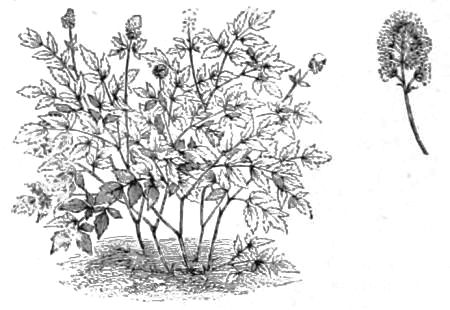
FIG. 23. ACTÆA SPICATA, showing Habit and Raceme of Flowers.
A. spicata (spiked).* fl. white, or bluish; racemes ovate. Summer. l. bi- or triternate, serrated. Berries oblong, black, poisonous. h. 1ft. England. See Fig. 23.
A. s. rubra (red).* This differs from the type in having bright red berries, which are disposed in dense clusters on spikes overtopping the foliage. North America. A very handsome hardy perennial.
ACTINELLA (from aktin, a ray; small rayed). SYN. Picradenia. ORD. Compositæ. A small genus of hardy herbaceous plants, having radiate capitules. The only species worth cultivating is A. grandiflora. It thrives in an open border with a light soil. Increased by divisions of the root in spring.
A. grandiflora (large-flowered).* fl.-heads yellow, large, and handsome, 3in. in diameter. Summer. h. 6in. to 9in. Colorado. A very pretty branched perennial, suitable for the alpine garden.
A. lanata (woolly). See Eriophyllum cæspitosum.
ACTINIDIA (from aktin, a ray; the styles radiate like the spokes of a wheel). ORD. Ternstrœmiaceæ. A genus of ornamental hardy deciduous climbing shrubs, with axillary corymbs of flowers; sepals and petals imbricate. Leaves entire. Excellent for trellis-work or walls, and thriving best in a light rich soil. Increased by seeds, layers, or cuttings; the latter should be put in under a hand light in autumn, in sandy soil.
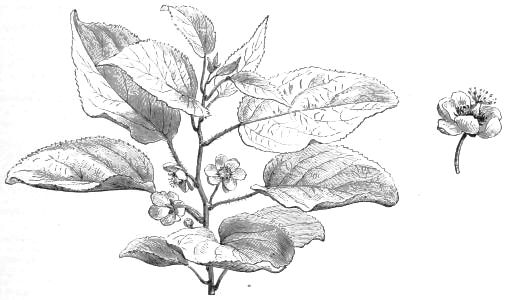
FIG. 24. ACTINIDIA VOLUBILIS.
A. Kolomikta (Kolomikta).* fl. white, solitary, axillary, or cymose, ½in. in diameter; peduncles about ½in. long. Summer. l. ovate-oblong, petiolate, rounded or sub-cordate at the base, and tapering into a long point, serrate; the autumnal tints are very handsome, changing to white and red. N. E. Asia, 1880. Rarely met with.
A. polygama (polygamous). fl. white, fragrant. Summer. l. cordate, serrate, petiolate. Japan, 1870. The berries of this species are edible.
A. volubilis (twining).* fl. white, small. June. l. oval on flowering branches, elliptic on climbing stems. Japan, 1874. A very free growing species. See Fig. 24.
ACTINIOPTERIS (from aktin, a ray, and pteris, a fern; the fronds are radiately cut into narrow segments). ORD. Filices. Sori linear-elongated, sub-marginal; involucres (= indusia) the same shape as the sorus, folded over it, placed one on each side of the narrow segments of the frond, opening towards the midrib. A small genus of beautiful and distinct stove ferns. They thrive in a compost of equal parts crocks and charcoal, about the size of peas, which must be mixed with silver sand and a very small portion of loam and peat. About half the pot should be filled with crocks, perfect drainage being necessary. A moist atmosphere is also essential, and the plants may be syringed two or three times a day. A mean summer temperature of 78deg. to 80deg., with a night one of not less than 65deg., is desirable. In winter, a mean temperature of about 73deg., and a night one of not less than 60deg., should be maintained.
A. radiata (rayed).* sti. densely tufted, 2in. to 6in. long. fronds fan shaped, 1in. to 1½in. each way, composed of numerous dichotomous segments, half line broad, those of the fertile frond longer than those of the barren one. India, &c. (very widely distributed), 1869. In form this elegant little species is a perfect miniature of the Fan Palm, Latania borbonica.
A. r. australis (southern).* fronds, segments fewer, larger, and subulate at the point. Plant much larger and more vigorous.
ACTINOCARPUS (from aktin, a ray, and karpos, fruit; referring to the curiously radiated fruit, resembling a star fish). ORD. Alismaceæ. Pretty little aquatic perennials, with habit and inflorescence of Alisma. Carpels six to eight, connate at base, spreading horizontally. Excellent for naturalising in bogs and pools. Increased by seeds and divisions during spring.
A. Damasonium (Damasonium). Ray Pod. fl. white, very delicate; each petal has a yellow spot at the base; scapes with a terminal umbel. June. l. radical, on long petioles, sometimes floating, elliptical, five-nerved. A native aquatic. The proper name of this plant is Damasonium stellatum.
A. minor (smaller).* This greenhouse species, also with white flowers, from New South Wales, is smaller.
ACTINOMERIS (from aktin, a ray, and meris, a part; referring to the radiated aspect of the plants). SYN. Pterophyton. ORD. Compositæ. A small genus of herbaceous perennials allied to Helianthus, but with compressed and winged achenes. Flower-heads corymbose, Coreopsis-like. Leaves ovate or lanceolate, serrate. They are hardy, ornamental plants, and of easy cultivation, in a loamy soil. Increased in spring, by seeds and division of the roots, on a warm border, with or without hand lights, or in cold frames. With the exception of A. helianthoides, they are but little known in this country.
A. alata (wing-stalked). fl.-heads yellow. July. h. 3ft. America. 1803.
A. helianthoides (sunflower-like).* fl.-heads yellow, 2in. across, July to September. h. 3ft. S. America, 1825.
A. procera (tall).* fl.-heads yellow. September. h. 8ft. N. America, 1766.
A. squarrosa (rough-headed).* fl.-heads yellow, in loose terminal panicles. July and August. l. decurrent, broadly lanceolate, coarsely toothed. Stem square, winged. h. 3ft. North America, 1640. SYN. Verbesina Coreopsis.
ACTINOPHYLLUM. See Sciadophyllum.
ACTINOSTACHYS. Included under Schizæa (which see).
ACTINOTUS (from actinotos, furnished with rays; referring to the involucre). ORD. Umbelliferæ. An Australian genus of greenhouse herbaceous perennials. Flowers shortly pedicellate, numerously disposed in simple umbels; petals none. Leaves alternate, petiolate. They thrive best in loam and peat, and are increased by root division and seeds. The latter should be sown on a hotbed, in spring, and in May the seedlings may be transplanted out in the open border in a warm situation, where they will flower and seed freely.
A. helianthus (sunflower).* fl. white, in many-flowered capitate umbels; involucre many leaved, radiating, longer than the flowers. June. l. alternate, bipinnatifid; lobules bluntish. h. 2ft. 1821. SYN. Eriocalia major.
A. leucocephalus (white-headed). fl. white. June. h. 2ft. 1837.
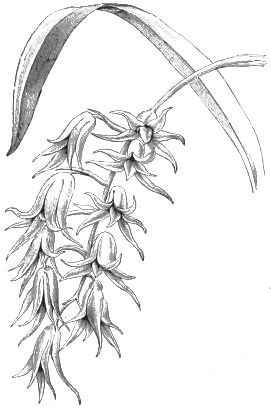
FIG. 25. ADA AURANTIACA.
ACULEATUS. Armed with prickles.
ACULEOLATUS. Armed with small prickles.
ACULEUS. A prickle; a conical elevation of the skin of a plant, becoming hard and sharp-pointed.
ACUMEN. An acute terminal angle.
ACUMINATE. Extended into an acute terminal angle; this word is confined to considerable extension.
ACUNNA OBLONGA. See Bejaria æstuans.
ACUTE. Sharp-pointed.
ACYNTHA. A synonym of Sanseviera (which see).
ADA (a complimentary name). ORD. Orchideæ. An evergreen orchid, very closely allied to Brassia, from which it differs chiefly in having the lip parallel with, and solidly united to, the base of the column. Some authorities now refer the plant to the genus Mesospinidium. It requires to be potted in peat and sphagnum, in equal parts. The drainage must be perfect, and, during summer, the water supply profuse. Although in winter far less will suffice, the plant should not be allowed to become dry. Propagated by divisions as soon as the plant commences growth.
A. aurantiaca (orange).* fl. orange-scarlet, in long terminal nodding racemes, each bearing from six to ten blossoms; petals elongated, streaked with black inside. Winter and spring. l. two or three to each plant, linear, dark green, about 6in. in length. Habit erect, with somewhat cylindrical pseudo-bulbs, which taper upwards. See Fig. 25.
ADAMIA (named after John Adam, some time Governor-General of India, and a promoter of natural history). ORD. Saxifrageæ. A small genus of Hydrangea-like greenhouse evergreen shrubs, having many flowered terminal corymbs of flowers, and opposite, petiolate, oblong-lanceolate, serrated leaves. They thrive well in a mixture of loam, peat, and sand; and cuttings will root readily in a similar compost, under a hand glass.
A. cyanea (blue-berried). fl. whitish, or pink. June. h. 6ft. Nepaul, in rocky places, 1829.
A. sylvatica (wood). fl. blue; cymes nearly undivided, on short peduncles, disposed in a close panicle. June. h. 6ft. Java, 1846.
A. versicolor (many-coloured). fl. blue. August. China, 1844.
ADAM'S APPLE. See Citrus Limetta and Musa paradisiaca.
ADAMSIA. See Geum, Puschkinia, Sieversia.
ADAM'S NEEDLE. See Yucca.
ADANSONIA (named after Michael Adanson, an eminent French botanist). Baobab Tree. ORD. Sterculiaceæ. This is reputed to be one of the largest trees in the world, as far as the girth of the trunk is concerned; but it is seldom seen in cultivation in this country.
A. digitata (finger-leaved). fl. white, about 6in. across, with purplish anthers, on long, axillary, solitary pedicels. l. palmate, with three leaflets in the young plants, and five to seven in adult ones. h. 40ft. Africa.
ADDER'S FERN. See Polypodium vulgare.
ADDER-SPIT. See Pteris aquilina.
ADDER'S TONGUE. See Ophioglossum.
ADELOBOTRYS (from adelos, obscure, and botrys, a cluster). ORD. Melastomaceæ. Stove climbing shrubs with terete branches. Flowers white, crowded in cymose heads at the tops of the branches. Leaves clothed with rufous hairs on both surfaces when young, but in the adult state glabrous, except the nerves, petiolate, ovate, cordate, acuminated, ciliately serrated, five-nerved. For general culture, see Pleroma.
A. Lindeni (Linden's).* fl. white, changing to purple. Brazil, 1866.
A. scandens (climbing).* This, the original species, possibly not now in cultivation, is a native of French Guiana.
ADENANDRA (from aden, a gland, and aner, a male; the anthers terminate in a globose gland). ORD. Rutaceæ. Very beautiful little greenhouse shrubs from the Cape of Good Hope. Flowers large, usually solitary at the tops of the branches; stamens ten, the five opposite the petals sterile, five fertile ones similar in form, but shorter. Leaves usually alternate, flat, glandularly dotted. They thrive in a mixture of sand and peat, with a little turfy loam. The young tops, before they begin to throw out their buds, made into cuttings, and planted in a pot of sand, with a bell glass placed over them, will root without bottom heat.
A. acuminata (acuminate). Synonymous with A. amœna.
A. amœna (pleasing).* fl. large, whitish above, and reddish beneath, solitary, sessile, terminal. June. l. scattered, oblong or oval, bluntish, smooth, dotted beneath. h. 1ft. to 2ft. 1798. SYN. A. acuminata.
A. coriacea (leathery-leaved). fl. large, pink, usually solitary on the tops of the branches. June. l. scattered, oblong, obtuse, revolute, quite smooth. h. 1ft. to 2ft. 1720.
A. fragrans (fragrant).* fl. rose colour, on long peduncles, fragrant; pedicels clammy, aggregate, umbellate. May. l. scattered, smooth, spreading very much, ovate-oblong, glandular, a little crenulated. h. 1ft. to 2ft. 1812.
A. linearis (linear-leaved). fl. white, terminal, on long, usually solitary, pedicels. June. l. opposite, linear, obtuse, spreading; branches and pedicels smooth. h. 1ft. 1800.
A. marginata (margined).* fl. pale flesh-colour, on long peduncles; umbels terminal. June. l. scattered, smooth, transparent, cordate, lower ones ovate, upper ones lanceolate. h. 1ft. to 2ft. 1806.
A. umbellata (umbel-flowered).* fl. pink, almost sessile, terminal, umbellate, petals fringed. June. l. oblong or obovate, dotted beneath, fringed on the edges. h. 1ft. to 2ft. 1790.
A. u. speciosa (showy).* fl. large, pink, nearly sessile, terminal, umbellate. June. l. scattered, oblong or obovate, revolute, dotted beneath, smooth, but a little fringed on the edges. h. 1ft. to 2ft. 1790.
A. uniflora (one-flowered).* fl. large, whitish inside, and pinkish outside, nearly sessile, solitary, terminal. June. l. scattered, oblong-lanceolate, somewhat pointed, revolute, smooth, dotted beneath. h. 1ft. to 2ft. 1775.
A. villosa (shaggy).* fl. pink, nearly sessile, terminal, umbellate; sepals, petals, and stamens fringed. June. l. crowded, ovate-oblong, fringed, pubescent and glandular beneath. h. 1ft. to 2ft. 1786.
ADENANTHERA (from aden, a gland, and anthera, an anther; in reference to the anthers, which are each terminated by a deciduous, pedicellate gland). ORD. Leguminosæ. A small genus of stove evergreen trees, with racemose spikes of small flowers and bipinnate or decompound leaves. They thrive well in a mixture of peat and loam. Increased by cuttings, which should be taken off at a joint and planted in heat in a pot of sand, placing a bell glass over them.
A. chrysostachys (golden-spiked). fl. golden. h. 15ft. Mauritius, 1824.
A. falcata (sickle-shaped). fl. yellowish. h. 6ft. India, 1812.
A. pavonina (peacock-like).* Peacock Flower Fence. fl. white and yellow mixed. May. l. leaflets oval, obtuse, glabrous on both surfaces. h. 5ft. India, 1759.
ADENANTHOS (from aden, a gland, and anthos, a flower; referring to the glands on the flowers). ORD. Proteaceæ. Ornamental greenhouse evergreen pilose shrubs, thriving in sandy peat. Propagated in spring by cuttings, which should be placed in sandy soil under a bell glass, with a gentle bottom heat.
A. barbigera (bearded).* fl. red, axillary, solitary, pedunculate; perianth pilose, bearded at top; involucre spreading, villous. June. l. oblong-lanceolate, obtuse, triple-nerved. h. 7ft. Swan River, 1845.
A. cuneata (wedge-leaved). fl. red. July. h. 5ft. New Holland, 1824.
A. obovata (obovate-leaved).* fl. red. July. h. 5ft. New Holland, 1826.
ADENIUM (from Aden, where it is found). ORD. Apocynaceæ. Greenhouse evergreen succulent shrubs. The species mentioned below is remarkable in having a globose thick caudex or stem; branches dichotomous; corolla salver-shaped. They require a well-drained compost of sand and loam. Half-ripened cuttings strike root readily in sand, under a hand glass. But little water is required when the plants are not in a growing state.
A. obesum (fat). fl. pinky-crimson, downy; corymbs terminal, many-flowered; pedicels short. June. l. close together at the tops of the branches, 3in. long, oblong, narrowed at the base, abruptly terminated by a hard, short point. h. 3ft. or 4ft. Aden, 1845.
ADENOCALYMNA (from aden, a gland, and calymna, a covering; referring to the conspicuous glands on the leaves and floral coverings). ORD. Bignoniaceæ. An elegant genus of stove evergreen climbers. Flowers racemose, trumpet-shaped, bracteate. Leaves ternate or binate. Stems slender. They require a hot and moist temperature to grow them successfully, and thrive best in a compost of loam and peat. Cuttings will root in sand, if placed under a bell glass, with bottom heat.
A. comosum (hairy).* fl. yellow; racemes spicate, axillary, and terminal; bracts comose. September. l. trifoliate and conjugate, tendrilled; leaflets ovate, leathery, glandular. h. 10ft. Brazil, 1841.
A. longeracemosum (long-racemed). fl. yellow. October. Brazil.
A. nitidum (shining).* fl. yellow; racemes axillary, nearly terminal, velvety; corolla velvety; bracts narrow, glandular. February. l. trifoliate or conjugate, tendrilled; leaflets elliptic, oblong. h. 10ft. Brazil, 1848.
ADENOCARPUS (from aden, a gland, and karpos, a fruit; in reference to the legumes being beset with pedicellate glands). ORD. Leguminosæ. Shrubs, with numerous racemes of yellow flowers; divaricate branches, trifoliate usually aggregate leaves, having petiolar stipulas, and complicated leaflets. All the species are elegant when in flower, and well suited for ornamenting the fronts of shrubberies. Except where otherwise mentioned, all are hardy. They thrive best in a mixture of loam, peat, and sand; and may be readily increased by seeds or layers, or by grafting the rarer on the commoner kinds. Young cuttings will root freely in sand, covered by a hand glass, which should be taken off and wiped occasionally. Seeds may be sown in March, the hardy species out of doors, and the others in a cold house.
A. foliolosus (slightly-leaved).* fl. yellow; racemes terminal; calyx covered with glandless hairs, with the lower lip elongated and trifid at the apex; the segments equal. May. l. (and branches) much crowded, hairy, trifoliate. h. 4ft. to 6ft. Canary Islands, 1629. A half-hardy evergreen species.
A. frankenioides (frankenia-like).* fl. yellow, crowded; racemes terminal; calyx beset with glandular pubescence, with the lower lip having the middle segment longer than the lateral ones, and exceeding the lower lip. April. l. trifoliate, much crowded, hairy; branches velvety. h. 1ft. to 3ft. Teneriffe, 1815. Requires protection in winter; an evergreen.
A. hispanicus (Spanish).* fl. yellow, crowded; racemes terminal; calyx beset with glands and hairs; lower lip of calyx with three equal segments, hardly longer than the upper lip. June. l. trifoliate, grouped; branchlets hairy. h. 2ft. to 4ft. Spain, 1816. Deciduous.
A. intermedius (intermediate).* fl. yellow, not crowded; racemes terminal; calyx beset with glandular pubescence, with the lower lip trifid, the lateral segments shorter than the middle ones, and much exceeding the upper lip. May. l. trifoliate, grouped; branches rather shaggy. h. 3ft. to 4ft. Sicily and Naples, on mountains, 1816. Deciduous.
A. parvifolius (small-leaved).* fl. yellow, not crowded; racemes terminal; calyx clothed with glandular pubescence, with the middle segment of the lower lip longer than the lateral ones, much exceeding the upper lip. May. l. trifoliate, grouped, small; branches glabrous. h. 3ft. to 4ft. France, on exposed heaths, 1800. Deciduous.
A. telonensis (Toulon).* fl. yellow, not crowded; racemes terminal; calyx clothed with glandless pubescence, the segments of the lower lip about equal in length, a little longer than the upper lip. June. l. trifoliate, grouped; branchlets smoothish. h. 2ft. to 4ft. South France, 1800. Deciduous.
ADENOPHORA (from aden, a gland, and phoreo, to bear; in reference to the cylindrical nectary which girds the base of the style). ORD. Campanulaceæ. A genus of elegant hardy border perennials, very similar in habit, shape of flower, &c., to Campanula, from which genus Adenophora differs in having the style surrounded by a cylindrical gland. Flowers stalked, drooping, spicate. Leaves broad, stalked, somewhat whorled. They grow best in light rich garden soil, with a warm sunny position, and should be increased by seeds, as dividing the roots is the sure way to lose them. They are easily raised from seeds, which may be sown as soon as ripe, or in spring, in pots placed in a cold frame.
A. coronopifolia (buckhorn-leaved).* fl. blue, large, three to ten, racemose, at the top of the stem, on short pedicels. July. l. radical ones petiolate, ovate-roundish, cordate, crenately toothed; upper ones sessile, linear-lanceolate, nearly entire, quite glabrous. h. 1ft. to 2ft. Dahuria, 1822.
A. denticulata (toothed-leaved).* fl. blue, small, numerous, on short pedicels, disposed in a more or less loose elongated raceme. July. l. serrated, smoothish; radical ones petiolate, rounded; upper ones sessile, ovate-lanceolate. h. 1½ft. Dahuria, 1817. SYN. A. tricuspidata.
A. Fischeri (Fischer's).* fl. blue, or whitish blue, numerous, sweet-scented, disposed in a more or less compound, elongated, and loose pyramidal panicle. August. l. radical ones petiolate, ovate-roundish, cordate, crenately toothed; upper ones sessile, ovate-lanceolate, coarsely serrated. h. 1½ft. Siberia, 1784. SYN. A. liliiflora.
A. Gmelini (Gmelin's). fl. blue, secund, three to ten, on the top of each stem, rising from the axils of the upper leaves, disposed in a long raceme. July. l. upper ones erect, linear, very narrow, entire, glabrous. h. 1ft. to 2ft. Dahuria, in dry stony places, 1820.
A. intermedia (intermediate). fl. pale blue, small, racemose. May. l. radical ones petiolate, cordate, toothed; upper ones lanceolate, tapering to a point at the base, serrated, crowded. h. 3ft. Siberia, 1820.
A. Lamarckii (Lamarck's).* fl. blue; corolla funnel-shaped, disposed in an elongated, many-flowered, raceme, which is compound at the base. June. l. ovate-lanceolate, acutely serrated, ciliated, glabrous, except on the margins. h. 1ft. to 2ft. Eastern Europe, 1824.
A. latifolia (broad-leaved). Synonymous with A. pereskiæfolia.
A. liliiflora (lily-flowered).* fl. numerous, sweet-scented, in a loose pyramidal panicle. Central and Eastern Europe.
A. pereskiæfolia (pereskia-leaved).* fl. blue, rather numerous, scattered over the upper part of the stems, rarely subverticillate; peduncles one to two, or three-flowered. July. l. three to five in a whorl, ovate-oblong, acuminated, coarsely serrated, roughly ciliated. h. 1½ft. Dahuria, 1821. SYN. A. latifolia.
A. periplocæfolia (periploca-leaved). fl. pale blue, at the top of the stem, sometimes only one. June. l. petiolate, ovate, acute, somewhat cordate, crenately serrated. Stem ascending. h. 3in. Siberia, 1824. Rockery species.
A. stylosa (long-styled).* fl. pale blue, small, few, disposed in a loose, naked, raceme. May. l. petiolate; lower ones obovate, sinuate; upper ones ovate, acuminated, glabrous. Stem ascending. h. 1ft. to 1½ft. Eastern Europe, 1820.
A. tricuspidata (three-cusped). Synonymous with A. denticulata.
A. verticillata (whorl-leaved).* fl. pale blue, small, irregularly disposed at the tops of the stems; lower whorls many flowered, distant; peduncles one to three-flowered. June. l. in whorls, serrately toothed; radical ones petiolate, roundish; upper ones ovate-lanceolate; stems simple. h. 2ft. to 3ft. Dahuria, 1783.
ADENOSTOMA (from aden, a gland, and stoma, a mouth). ORD. Rosaceæ. Hardy shrubs, having small racemose, five-petalled flowers. They grow freely in rich loam and peat in equal proportions. Propagated in spring or autumn, by cuttings made of the young shoots, placed in sand, under glass.
A. fasciculata (fascicled).* fl. white, small, produced in terminal panicles. h. 2ft. California, 1848. A hardy, heath-like evergreen bushy plant, allied to Alchemilla.
ADESMIA (from a, without, desmos, a bond; in reference to the stamens being free). ORD. Leguminosæ. Chiefly greenhouse evergreen shrubs, or trailers, from South America, with lanceolate stipulas, abruptly pinnate leaves, ending in a bristle; axillary one-flowered pedicels, or the flowers racemosely disposed at the tops of the branches, in consequence of the upper leaves being abortive. They will grow well in a mixture of loam, peat, and sand. Propagated by cuttings placed in sand, covered by a hand glass, in a gentle heat; or by seeds, which are generally more satisfactory. The annual species—A. muricata, A. papposa, and A. pendula—are not worth growing. The following are fairly representative of the most ornamental species.
A. glutinosa (sticky).* fl. yellow; racemes elongated, terminal, simple, spinescent, and are (as well as the linear bracteas) clothed with white hairs. May. l. with about three pairs of elliptic, hairy leaflets; branches spreading, beset with glandular, glutinous hairs. Stem shrubby; legumes three-jointed, very long. h. 1ft. to 2ft. 1831.
A. Loudonii (Loudon's). fl. yellow. May, h. 2ft. Valparaiso, 1830.
A. microphylla (small-leaved).* fl. yellow; racemes somewhat capitate, terminal, simple, spinescent. June. l. with six pairs of small orbicular leaflets, on short petioles, pubescent; branches spinose. Stem shrubby. h. 1ft. to 2ft. 1830.
A. Uspallatensis (Uspallatan). fl. yellow. July. h. 1ft. China, 1832.
A. viscosa (clammy). fl. yellow. August. h. 12ft. Chili, 1831.
ADHATODA (its native name). ORD. Acanthaceæ. Allied to Justicia. Very ornamental stove shrubs, requiring a good fibrous peat and loam, with a moderate addition of silver sand. To grow them well, they require liberal treatment and plenty of heat, when the flowers will be produced in great profusion. Increased by young cuttings in spring, placed in sandy soil, in bottom heat. See Justicia.
A. cydoniæfolia (quince-leaved).* fl. produced in rather dense clusters at the point of every branch; tube of corolla white, the upper lip white tipped with purple; the lower lip large, rich deep purple, with a white stripe down the centre. October. l. opposite, ovate, dark green, and are, as well as the branches, slightly downy. Brazil, 1855. This species is an excellent subject for training up pillars or rafters; and, when in bloom, makes a pretty basket plant. It has a somewhat straggling habit, but a little care only is needed in pruning and training to grow it into an elegant shape.
A. vasica (Vasica). fl. purple. July. h. 10ft. India, 1699.
ADHERENT. Strictly signifies sticking to anything, but is more commonly employed in the sense of adnate.
ADHESION. The union of parts usually distinct.
ADIANTOPSIS. See Cheilanthes.
ADIANTUM (from adiantos, dry, as if plunged in water it yet remains dry). Maidenhair. ORD. Filices. A large genus of handsome tropical and temperate ferns. Sori marginal, varying in shape from globose to linear, usually numerous and distinct, sometimes confluent and continuous. Involucre the same shape as the sorus, formed of the reflexed margin of the fronds, bearing the capsules on its upper side. None of the Adiantums are truly hardy except the American A. pedatum; even our own native species requires protection. The chief requirements of this handsome genus of ferns are good drainage, and a compost of fibrous peat, loam and sand. In most cases, plenty of pot room is essential, and a larger quantity of loam will be needed for strong-growing sorts. For general culture, see Ferns.
A. æmulum (rival).* sti. slender, about 6in. long. fronds slender, pyramidate, tri-subquadripinnate; pinnæ distinct, obliquely pyramidate, unequally-sided; pinnules rhomboid or oblong, tapering to the base, the terminal one distinctly cuneate, all sparingly lobate. sori, 2in. to 4in., circular, or nearly so. Brazil, 1877. Stove or greenhouse species.
A. æthiopicum (Æthiopian).* sti. 6in. to 9in. long, rather slender, erect. fronds 12in. to 18in. long, 6in. to 9in. broad, deltoid, tri- or quadripinnate; lower pinnæ 3in. to 4in. long, 2in. to 3in. broad, deltoid; ultimate segments ¼in. to ½in. across, ¼in. deep, suborbicular, the upper part broadly lobed; rachis and surfaces naked. sori in several roundish patches. A. Chilense (Chilian), A. scabrum (scurfy), A. sulphureum (sulphured) are mere forms of this species. Spain, and almost cosmopolitan. A very pretty greenhouse fern. SYNS. A. assimile, A. emarginatum.
A. affine (related).* sti. 6in. to 9in. long, erect. fronds with a terminal central pinna 4in. to 6in. long, 1in. to 1½in. broad, and several smaller erecto-patent lateral ones, the lowest of which are again branched; pinnules, ½in. to ¾in. long, ¼in. deep, dimidiate, the lower edge straight, the upper nearly parallel with it, crenate, like the oblique or bluntly rounded outer edge. sori numerous, roundish. New Zealand. Greenhouse species. SYN. A. Cunninghami.
A. amabile (lovely). Synonymous with A. glaucophyllum. Also a garden name for A. Moorei.
A. amœnum (pleasing). Synonymous with A. flabellulatum.
A. andicolum. A synonym of A. glaucophyllum.
A. aneitense (Aneiteum).* sti. and rachises castaneous, the latter glabrous beneath, ferrugino-pilose above; fronds deltoid, three to four pinnate, 1½ft. to 2ft. long, and broad; segments, about ½in. long, rhomboidal, ascending, nearly sessile, inner side close to rachis, lower erecto-patent, shallowly lobed. sori round, reniform, in centre of lobes, four to six to a segment. Aneiteum Isles, 1880. Stove or greenhouse species.
A. assimile (assimilated). An Australian form of the widely-distributed A. æthiopicum.
A. Bausei (Bause's).* fronds 1½ft. to 2½ft. long, spreading, triangular, tri-quadripinnate; pinnæ stalked, the lower ones obliquely triangular; pinnules broad, laterally deflexed, the basal ones obliquely ovate with a truncate base, the intermediate somewhat trapeziform, the terminal cuneate—all shallowly lobed and pedicellate. sori oblong reniform, set across the apices of the lobes, 1879. A beautiful stove or greenhouse hybrid, between A. trapeziforme and A. decorum.
A. bellum (handsome).* fronds tufted, 3in. to 6in. high, bipinnate. ovate-lanceolate; pinnæ of three to six pinnules, ½in. to 1½in. long, stalked; pinnules cuneate or irregular transverse-oblong, the somewhat larger terminal ones cuneate, lobed, the margin erose, all shortly stalked. sori two to three on the smaller pinnules, roundish, or sublunate. Bermuda, 1879. Greenhouse or Wardian case species.
A. Capillus-Veneris (Venus's hair).* Common Maidenhair. sti. sub-erect, rather slender, 4in. to 9in. long. fronds very variable in size, with short terminal and numerous erecto-patent lateral branches on each side, the lowest slightly branched again; segments ½in. to 1in. broad, deeply lobed, and the lobes again bluntly crenated. sori placed in roundish sinuses of the crenation. Great Britain, and world-wide in its distribution. Greenhouse, case, or frame species.
A. C.-V. cornubiense (Cornish).* fronds very numerous, and dwarf, more or less oblong in general outline, with large, broad pinnules of a deep green, with finely-waved margins, and an almost pellucid, but firm texture. One of the best forms, but somewhat delicate in constitution.
A. C.-V. crispulum (crisped).* fronds, with the stipes, from 6in. to 12in. long, more attenuated than those of the type, and narrower at the base; pinnules less numerous, but broad and thin, crisp, of a light green colour, more or less cut at the broadest part. A handsome variety, of vigorous growth.
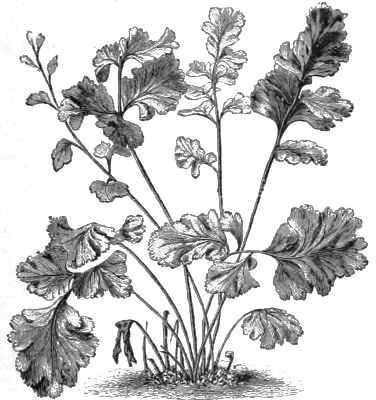
FIG. 26. ADIANTUM CAPILLUS-VENERIS DAPHNITES.
A. C.-V. daphnites (glistening).* sti. and rachises dark brown, reaching a height of from 9in. to 14in. pinnæ and ultimate pinnules more or less confluent, the latter being broad, and of a dull green colour, usually forming a tufted crest at the extremities of the fronds. A charming subject for the Wardian case. Very distinct. See Fig. 26.
A. C.-V. fissum (divided). Very dwarf in habit, with pinnules rather broader than those of the type, which are deeply and variously cut, so as to give the plant a distinctive appearance from most of the forms.
A. C.-V. Footi (Foot's). Closely allied to the variety fissum, having fronds a foot or more long, with very ample pinnules deeply incised, light green. Vigorous.
A. C.-V. incisum (deeply cut). Very closely allied to A. C.-V. fissum, but rather more vigorous in growth; pinnules broad, and deeply slit into segments near the base.
A. C.-V. magnificum (magnificent).* fronds from 9in. to 16in. long, more or less elongated in outline, 3in. to 4in. across; pinnules ample, rich green, with the margins finely cut and imbricated. The arching character gives this form a most distinct appearance. A very fine variety.
A. C.-V. rotundum (rounded). Pinnules usually round, without the cuneiform base of the normal form; neither are the fronds so broad. Isle of Man. Variable in its habit.
A. C.-V. undulatum (wavy).* fronds dense, compact, having broad, roundish dark green pinnules, which are undulated at the edges. An elegant dwarf-growing form.
A. cardiochlæna (heart-form indusium). A synonym of A. polyphyllum.
A. caudatum (tailed).* sti. 2in. to 4in. long, tufted, wiry. fronds 6in. to 12in. long, simply pinnate, often elongated, and rooting at the extremity; pinnæ about ½in. long, ¼in. deep, dimidiate, nearly sessile, the lower line straight and horizontal, the upper rounded, more or less cut, the point usually blunt, the lower ones slightly stalked. sori roundish or transversely oblong on the edge of the lobes; rachis and both sides of the frond villose. A. ciliatum (of gardens) is probably a mere form, if not a synonym, of this species. Throughout the Tropics everywhere. Greenhouse or stove species; very fine for hanging baskets.
A. colpodes (deep hollow).* sti. 4in. to 6in. long, slender, slightly fibrillose. fronds 9in. to 18in. long, 4in. to 8in. broad, deltoid, tripinnate, light green; lower pinnæ spreading at right angles from the rachis, 2in. to 4in. long, 1½in. broad, slightly branched below; ultimate segments about ½in. long, ¼in. broad, the lower line often straight, the upper rounded, lobed, and toothed, all nearly or quite sessile. sori placed in distinct teeth of the outer edge. Ecuador and Peru, 1875. Greenhouse species.
A. concinnum (neat).* sti. 4in. to 8in. long. fronds 12in. to 18in. long, 6in. to 9in. broad, ovate-deltoid, tripinnate; pinnæ numerous, spreading, flexuous, the lowest 4in. to 6in. long, 2in. to 3in. broad; segments ¼in. to ⅜in. across, broadly cuneate at the base, the upper edge irregularly rounded, deeply lobed, the lobes crenate, the lowest segment of each pinna and pinnule large, sessile. sori numerous, ob-reniform. Tropical America. A most elegant species for baskets and the rockery.
A. c. Flemingi (Fleming's). This variety, of garden origin, is also very handsome.
A. c. latum (broad).* Differs from the type in being more erect and robust in habit, and broader in all its parts. It constitutes an excellent stove plant.
A. crenatum (crenated).* sti. 6in. to 9in. long. fronds with a terminal central pinna 6in. to 9in. long and several large erecto-patent lateral ones on each side, the lowest of which are branched again; segments about ½in. long, ¼in. deep, dimidiate, the lower line upcurved, the upper nearly straight, slightly crenate. sori numerous, round, placed on the upper and sometimes outer edge. This is closely allied to A. tetraphyllum. Mexico. Stove species. SYN. A. Wilesianum.
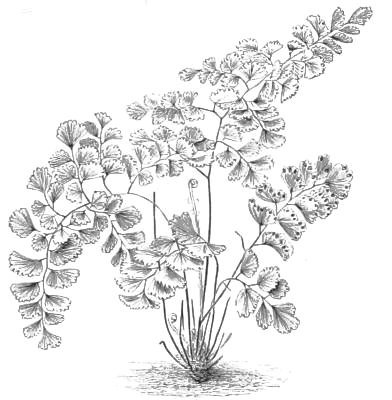
FIG. 27. ADIANTUM DECORUM.
A. cristatum (crested). sti. 6in. to 12in. long, strong, erect, tomentose. fronds 1½ft. to 3ft. long, 9in. to 12in. broad, with a terminal central pinna 6in. to 9in. long, 1in. to 1½in. broad, and numerous rather distant lateral ones on each side, the lowest of which are sometimes again branched; segments ½in. to ¾in. long, ¼in. to ⅜in. broad, dimidiate, the lower line nearly straight, the upper nearly parallel or rounded, the point blunt. sori in several oblong or linear patches. West Indies and Venezuela, 1844. Stove species. SYN. A. Kunzeanum.
A. cubense (Cuba).* sti. 4in. to 8in. long, nearly black, erect. fronds 6in. to 12in. long, 2in. to 4in. broad, simply pinnate, or with a single pair of short branches; pinnæ 1in. to 2in. long, and about ¾in. to 1in. broad, unilateral, the lower line slightly recurved, the upper rounded and broadly lobed, of a deep green colour, with a soft herbaceous texture. sori in hollows of the lobes. Cuba and Jamaica. A very distinct stove species.
A. cuneatum (wedge-shaped).* sti. 6in. to 9in. long, slender, erect. fronds 9in. to 18in. long, 6in. to 9in. broad, deltoid, tri- or quadripinnate; lower pinnæ 4in. to 6in. long, 2in. to 3in. broad; segments numerous, ¼in. to ⅜in. broad, cuneate at the base, the upper edge deeply lobed. sori four to six, obversely reniform. Brazil, 1820. This fine greenhouse species is more generally grown than any other; and a number of garden forms have received distinctive names.
A. c. dissectum (dissected).* A pretty variety, with the pinnules more deeply lobed than in the type.
A. c. Lawsonianum (Lawson's). This is a very abnormal form, curiously and finely cut, with the ultimate segments narrowly cuneate at the base, stalked, and distant. Of garden origin. Greenhouse variety.
A. c. mundulum (neat).* sti. 3in. to 4in. high. fronds dwarf, tufted, erect, hardly 3in. broad, deltoid, tripinnate; pinnæ and pinnules crowded; pinnules narrowly cuneate, rarely three-parted, with narrow wedge-shaped lobes; apex slightly crenate, and bears a roundish sorus set in a notch of the lobe or crenature. Of garden origin, 1879. Greenhouse variety.
A. Cunninghami (Cunningham's). Synonymous with A. affine.
A. curvatum (curved).* sti. 6in. to 12in. long. fronds dichotomous, with main divisions again once or twice forked; pinnæ 8in. to 12in. long, 2in. to 3in. broad; pinnules 1¼in. to 1½in. long, about ½in. deep, not truly dimidiate, but only the lower two-thirds of the under half cut away, the upper margin rounded and broadly lobed, with the lobes finely toothed and point often lengthened out. sori linear, or transversely oblong. Tropical America, 1841. Stove species.
A. decorum (decorous).* sti. 4in. to 6in. long. fronds sub-deltoid, 9in. to 15in. long, three to four pinnate; lower pinnæ and pinnules stalked, deltoid; side segments rhomboid, ¼in. to ⅜in. long; outer edge distinctly lobed; lower segments equilateral, imbricated over main rachis. sori round, in final lobes, four to six to a segment. This greenhouse species ranks midway between A. concinnum and A. cuneatum. Peru. SYN. A. Wagneri. See Fig. 27.
A. deltoideum (deltoid).* sti. densely tufted, 3in. to 4in. long, wiry, erect. fronds 4in. to 6in. long, ¾in. broad, with a terminal lobe and numerous sub-opposite pinnæ, the lower ones distant, distinctly stalked, ½in. long, ¼in. to ⅜in. broad, hastate-deltoid, cordate or cuneate at the base. sori in interrupted lines along the sides of the pinnæ. West Indian Islands. Stove species.
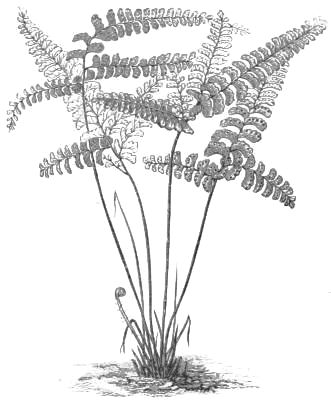
FIG. 28. ADIANTUM DIAPHANUM.
A. diaphanum (transparent).* sti. 4in. to 8in. long, slender, erect. fronds 6in. to 7in. long, simply pinnate, or with one to three branches at the base; pinnules ½in. long, ¼in. broad, the lower line rather decurved, the upper nearly parallel with it, crenate like the blunt outer edge. sori obversely reniform, numerous. S.E. China, New Zealand, &c. Greenhouse species. SYN. A. setulosum. See Fig. 28.
A. digitatum (finger-leaved).* sti. 12in. to 18in. long, erect. fronds 1ft. to 3ft. long, 6in. to 1ft. 6in. broad, furnished with numerous distant spreading or erecto-patent branches, gradually shortened upwards, the lowest of which are branched again; lower pinnæ 6in. to 9in. long, 3in. to 4in. broad; segments ¾in. to 1in. each way, varying from deflexed to cuneate at the base, the upper edge rounded, deeply cut, and the lobes again less deeply cut, the lower ones distinctly stalked. sori in lines along the edge of the lobes. Peru. It is generally cultivated under the name of A. speciosum. Stove or greenhouse species.
A. dolabriforme (axe-shaped). Synonymous with A. lunulatum.
A. dolosum (deceiving). Synonymous with A. Wilsoni.
A. Edgworthii (Edgeworth's).* This differs from caudatum by having more membranous texture, glabrous surfaces, and sub-entire pinnæ. Himalaya and China.
A. emarginatum (notched at the end). Synonymous with A. æthiopicum.
A. excisum (bluntly cut).* sti. 2in. to 3in. long, wiry, densely tufted. fronds 6in. to 18in. long, 3in. to 6in. broad, with numerous flexuose short pinnæ on each side, the lowest of which are slightly branched again; segments two to three lines broad, cuneate at the base, the upper edge rounded and bluntly lobed. sori two to four, large, obversely reniform, placed in distinct hollows on the lobes. Chili.
A. e. Leyi (Ley's).* This is a very dwarf, copiously crested form, of garden origin, most suitable for case culture. Greenhouse variety.
A. e. multifidum (much-cut).* A handsome garden variety; the apex of every frond is frequently divided into several branches, which oftentimes are again divided and crested, thus forming a beautiful tassel 2in. to 3in. long. Greenhouse species.
A. Feei (Fee's).* sti. 12in. to 18in. long, strong, scandent. fronds 1ft. to 2ft. long, 1ft. or more broad, tripinnate, the main and secondary rachises zigzag, all the branches firm and spreading at a right angle; lower pinnæ 6in. to 9in. long, 3in. to 4in. broad; pinnules 1in. to 2in. long, ½in. broad, consisting of a terminal segment and several distant suborbicular-cuneate lateral ones. sori marginal, roundish, more than half line deep. Tropical America. Stove species. SYN. A. flexuosum.
A. flabellulatum (small fan-leaved).* sti. erect, strong. fronds dichotomously branched, and the divisions once or twice branched again; central pinnæ 4in. to 8in. long, ¾in. broad; pinnules about ¼in. broad and deep, dimidiate, the lower edge nearly straight, the upper rounded, the outer blunt, both entire or slightly toothed. sori in several transversely oblong notches. Tropical Asia. Stove species. SYN. A. amœnum.
A. flexuosum (zigzagly-bent). Synonymous with A. Feei.
A. formosum (beautiful).* sti. 12in. to 18in. long, strong, erect. fronds 18in. to 24in. long, 12in. to 18in. broad, bi-, tri-, or quadripinnate; lower pinnæ 12in. to 15in. long, 6in. to 9in. broad, deltoid; pinnules deltoid; ultimate segments ¼in. to ⅜in. broad, one and a half to two lines deep, dimidiate, the lower edge straight, the upper and outer rather rounded and deeply lobed, the lower ones distinctly stalked. sori numerous, between obreniform and transversely oblong. Australia, 1820. Greenhouse species.
A. fovearum. Synonymous with A. intermedium.
A. fulvum (tawny).* sti. 6in. to 9in. long, strong, erect. fronds 9in. to 12in. long, 6in. to 8in. broad, deltoid in general outline, with a terminal pinna 4in. to 6in. long, about 1½in. broad, and several erecto-patent branches, the lower of which are branched again; pinnules about ¾in. long, ¼in. deep, dimidiate, the lower edge nearly straight, the upper almost parallel, sharply toothed like the oblique outer edge. sori large, numerous. New Zealand. Greenhouse species.
A. Ghiesbreghti (Ghiesbreght's).* fronds 18in. to 30in. long, ovate, deltoid, tripinnate; pinnules large, slightly crenate on the margins. A very fine stove fern, with the habit of A. tenerum Farleyense, but less dense. It is undoubtedly a variety of tenerum, having originated in Mr. Williams's nursery some years since. SYN. A. scutum.
A. glaucophyllum (grey-leaved).* sti. 6in. to 9in. long, erect. fronds 12in. to 24in. long, 9in. to 15in. broad, deltoid, quadripinnate; lower pinnæ 6in. to 9in. long, 3in. to 6in. broad, deltoid, erecto-patent; segments ¼in. broad, cuneate at the base, the upper edge irregularly rounded, more or less lobed. sori four to six, obversely reniform, placed in distinct hollows in the apex of the lobes of the upper edge, deep green above, glaucous beneath. Closely allied to A. cuneatum. Mexico. Greenhouse. SYNS. A. amabile, A. andicolum, A. mexicanum.
A. gracillimum (most graceful).* fronds deltoidly ovate, 9in. to 24in. long, and 6in. to 10in. across, decompound, rich green; ultimate pinnules distant, minute, distinctly stalked, obovate, emarginate, or two to three lobed, the sterile lobes blunt. sori solitary on the entire pinnules, two to three on the larger lobed ones. One of the most graceful and beautiful of greenhouse ferns; the very numerous minute segments and the ramifications of the rachis impart to a well grown plant a very charming appearance. Of garden origin. A form of A. cuneatum.
A. Henslovianum (Henslow's).* sti. 6in. to 12in. long, erect. fronds 12in. to 18in. long, 6in. to 9in. broad, ovate, tripinnate, furnished with numerous distant pinnæ on each side, the upper of which are simple, but the lowest slightly branched; segments ½in. to ¾in. broad, ¼in. to ⅜in. deep, dimidiate, the lower line nearly straight, the upper rather rounded and lobed, the point bluntly rounded. sori obversely reniform, placed in the hollows of the lobes. Columbia, Peru, &c., 1833. A most distinct and beautiful stove species. SYNS. A. lætum, A. Reichenbachii, A. sessilifolium.
A. Hewardia (Heward's). sti. 6in. to 9in. long, erect. fronds simply pinnate or bipinnate, with a terminal pinna and two to four lateral ones on each side, the lowest pair of which sometimes with two to four pinnules each; pinnules 3in. to 4in. long, about 1in. broad, nearly equal sided, ovate lanceolate, nearly entire. sori in continuous lines along both edges. Jamaica, &c., occurring over a wide area. Stove species. SYN. Hewardia adiantoides.
A. hispidulum (hairyish).* sti. 6in. to 15in. long, strong, erect. fronds dichotomous, with the main divisions flabellately branched; central pinnæ 6in. to 9in. long, ½in. to 1in. broad; pinnules ⅜in. to ¾in. long, two to four lines broad, dimidiate, subrhomboidal, the outer edge bluntly rounded, upper and outer margin finely toothed, slightly stalked. sori roundish, numerous, contiguous. Tropics of Old World, 1822. Greenhouse. SYN. A. pubescens.
A. intermedium (intermediate). sti. 6in. to 12in. long, erect, strong. fronds with a terminal pinna 6in. to 9in. long, 2in. to 3in. broad, and one to three small spreading lateral ones on each side; pinnules 1in. to 1½in. long; ¼in. to ½in. broad, unequal sided, but not dimidiate, the point bluntish or acute, the inner edge nearly parallel with the stem, the upper nearly straight, scarcely toothed. sori in interrupted marginal patches, one to two lines across, placed round the upper and lower edges. Stove. Tropical America, from the Antilles southwards to Peru and Rio Janeiro, 1824. SYNS. A. fovearum, A. triangulatum.
A. Kunzeanum (Kunze's). Synonymous with A. cristatum.
A. lætum (joyful). Synonymous with A. Henslovianum.
A. Lathomi (Lathom's).* A garden variety, said to be a sport from A. Ghiesbreghti, which it closely resembles, being between it and A. Farleyense. It is a magnificent plant, producing fronds from 18in. to 24in. long, with imbricated deeply-cut pinnules. Stove variety.
A. Legrandi (Legrand's). Very closely allied to, if not identical with, A. Pecottei. Greenhouse variety, of garden origin.
A. Lindeni (Linden's).* sti. black, naked. fronds erect, large, pentagonal, tripinnate; rachises pubescent above, naked beneath; segments sub-distant, 1½in. long, oblong-rhomboidal, falcate, acuminate, outer margins closely but bluntly lobed, of a deep green colour, the lobes toothed. sori oblong or reniform. Amazons, 1866. A magnificent stove species.
A. lucidum (shiny).* sti. 6in. to 9in. long, strong, erect. fronds 9in. to 15in. long, 4in. to 8in. broad, simply pinnate, with a large terminal pinna and six to ten lateral ones on each side, or the lowest very slightly branched, 3in. to 4in. long, ½in. to 1in. broad, nearly equal sided, lanceolate acuminate, slightly serrated towards the point. sori in a continuous row along each side. West Indian Islands and Tropical America. Stove species.
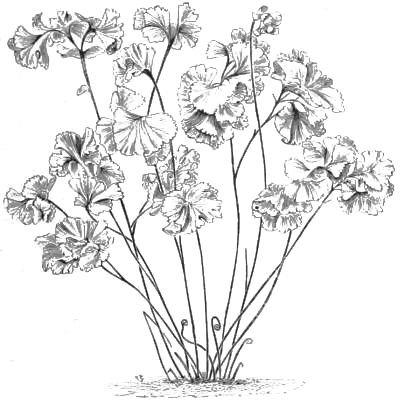
FIG. 29. ADIANTUM LUDDEMANNIANUM.
A. Luddemannianum (Luddemann's).* A very striking variety of the common Maidenhair, A. Capillus-Veneris, of garden origin, with smooth, dark, almost black stipes, branching about a third of the way up, while the pinnules are crested, usually clustered, at the extremities of the branches, of a deep green, sub-glaucous character. It is a very elegant little greenhouse variety. See Fig. 29.
A. lunulatum (crescent-leaved).* sti. 4in. to 6in. long, tufted, wiry. fronds 6in. to 12in. long, 1in. to 2in. broad, simply pinnate; pinnæ ¾in. to 1in. broad, ½in. to 1in. deep, sub-dimidiate, the lower edge nearly in a line with the petiole, the upper edge rounded and, like the sides, usually more or less lobed. sori in continuous lines along the edge. Hongkong, &c., widely distributed in both hemispheres. Stove species. SYN. A. dolabriforme.
A. macrocladum (long-branched). Synonymous with A. polyphyllum.
A. macrophyllum (long-leaved).* sti. 6in. to 12in. long, strong, erect, nearly black. fronds 9in. to 15in. long, 4in. to 8in. broad, simply pinnate; the lower pinnæ of the barren frond 3in. to 4in. long, 2in. broad, ovate, so broad at the base that the opposite ones frequently overlap, the margin rather deeply lobed; fertile ones narrower. sori in long continuous, or slightly interrupted, marginal lines. Tropical America, 1793. One of the finest stove species in cultivation.
A. macropterum (long-winged). Synonymous with A. Wilsoni.
A. mexicanum (Mexican). Synonymous with A. glaucophyllum.
A. microphyllum (short-leaved). A synonym of A. venustum.
A. monochlamys (one-covered).* sti. 6in. to 9in. long, wiry, erect, dark, chestnut brown; fronds 6in. to 12in. long, 4in. to 6in. broad, ovate-deltoid, tripinnate, the pinnæ rather distantly placed; segments ¼in. broad, cuneate at the base, the upper edge rounded, slightly toothed, of a light green colour, with a firm texture. sori single, or very rarely two, in a hollow of the upper edge. Japan. A very distinct and pretty greenhouse species.
A. monosorum (uni-soriate). A pretty species, from Solomon Islands, not yet in cultivation.
A. Moorei (Moore's).* sti. 6in. to 8in. long. fronds deltoid, 6in. to 15in. long, two to three pinnate; side segments about ½in. long, rhomboid, lower edge deflexed from tip of pedicel, outer lobed half way down. sori round, placed in tip of lobes. Andes of Peru. Stove or greenhouse species. SYN. A. amabile, under which name it is frequently grown.
A. Moritzianum (Moritz's). This appears to be a stronger, more robust grower (fronds from 12in. to 18in. high), with thicker stipes and larger pinnules than the typical A. Capillus-Veneris. South America. Greenhouse species.
A. neoguineense (New Guinea).* sti. 6in. to 8in. long, chestnut brown, erect. fronds spreading, deltoid, tri-quadripinnate, dark olive green with a glaucous tinge on both surfaces; pinnæ ovate; terminal pinnules cuneate, lateral ones trapezoid, about ½in. long, crenately lobed, the lobes rather large, entire. sori small, 6in. to 8in., orbicular, entirely sunk in closed sinuses of the marginal lobes. New Guinea, 1877. A very charming stove species.
A. obliquum (oblique). sti. 3in. to 6in. long, erect, wiry, pubescent. fronds 6in. to 12in. long, 2in. to 4in. broad, with a terminal lobe and three to twelve pairs of alternate pinnæ, the lowest 1in. to 2in. long, ½in. to ¾in. broad, costate nearly to the apex, the upper half the largest, rounded at the base, the lower half obliquely truncate at the base, those of the barren frond slightly toothed. sori in numerous interrupted marginal patches, one to two lines broad. West Indies, &c., 1826. Stove species.
A. palmatum (palmate).* fronds with elongated zigzag rachises, elongate-oblong, narrowed to the apex, tripinnate, often reaching 3½ft. long, 10in. broad; pinnules distinct; ultimate segments large, smooth, distant, distinctly stipitate, varying from obovate wedge-shaped to semi-orbicular in outline, but all deeply, palmately cut, 1in. to 1¾in. broad. sori oblong, variable in length, situate at the tips of the segments, usually one to each. This is a very beautiful and graceful stove or greenhouse species. Peru, 1877.
A. patens (spreading). sti. 6in. to 9in. long, erect. fronds dichotomously divided and the branches once or twice divided again; central pinnæ 6in. to 9in. long, 1½in. broad; pinnules ½in. to ¾in. long, ¼in. deep, dimidiate, the two sides nearly parallel, the upper and outer ones broadly and bluntly lobed. sori placed round the upper and outer edge, obversely reniform. Brazil, &c., 1824. Stove species.
A. Pecottei (Pecot's).* This is a charming little variety, of garden origin, with short decompound fronds, imbricated segments, comparatively large, of a deep green colour, and likely to prove one of the most useful maidenhair ferns grown.
A. pedatum (pedate).* sti. 9in. to 24in. long, erect, polished. fronds dichotomous, with the main divisions flabellately branched; central pinnæ 6in. to 12in. long, 1in. to 1½in. broad; pinnules ½in. to ¾in. long, ¼in. deep, dimidiate, broadest on the side nearest the stem, the upper and outer margin lobed, shortly stalked. sori roundish, one to two lines broad. North Hindostan, the United States, &c. Hardy species. See Fig. 30.
A. peruvianum (Peruvian).* sti. 9in. to 18in. long, strong, erect. fronds simply pinnate, or with one to three branches at the base, some of the latter sometimes again slightly divided; pinnules 2in. or more broad, 1½in. deep, unequally ovate, cuneate at base, finely toothed and lobed round the upper and outer edge. sori in interrupted patches round the sides of the pinnules. Peru. This is one of the finest of the large growing, evergreen stove kinds.
A. polyphyllum (many-leaved).* sti. 12in. to 18in. long, strong, erect. fronds 2ft. to 3ft. long, 12in. to 18in. broad, the upper part simply pinnate; lower pinnæ sometimes 1ft. long; 6in. broad, with a long terminal and numerous lateral pinnules; segments ¾in. to 1in. long, ¼in. deep, dimidiate, with nearly parallel edges, the point obtuse, the upper edge sharply toothed. sori in numerous sub-orbicular patches, placed in hollows in lobes along the upper edge. Columbia. A magnificent stove species. SYNS. A. cardiochlæna and A. macrocladum.
A. populifolium (poplar-leaved). A synonym of A. Seemanni.
A. princeps (princely).* sti. 9in. to 12in. long, stout, nearly erect. fronds large, 12in. to 24in. long, 9in. to 18in. across the base, deltoid, pendent, quadripinnate, pale greyish; lower pinnæ obliquely elongate, triangular, the posterior side tripinnate, the anterior bipinnate; upper ones pinnate, with a large cuneately flabellate terminal pinnule, apex of fronds pinnate; pinnules 1in. long, ¾in. broad, roundish rhomboidal or shortly trapeziform, shortly stalked; basal margin entire, slightly concave, the anterior margins and apex lobate, the lobes serrulate in the sterile parts, and, where fertile, bearing each a concave sorus, so that the lobes appear two-horned. New Grenada, 1875. A magnificent stove species.
A. prionophyllum (saw-leaved). Synonymous with A. tetraphyllum.
A. pubescens (downy). Synonymous with A. hispidulum.
A. pulverulentum (covered with powder).* sti. 6in. to 12in. long, strong, erect; fronds with a terminal pinna and several spreading lateral ones on each side, which are 4in. to 8in. long, 1in. broad; pinnules ½in. long, one and a half to two lines deep, dimidiate, the lower line nearly straight, the upper one nearly parallel, both it and the outer edge finely toothed. sori in a continuous line along the lower and upper edges. West Indies, &c. Stove species.
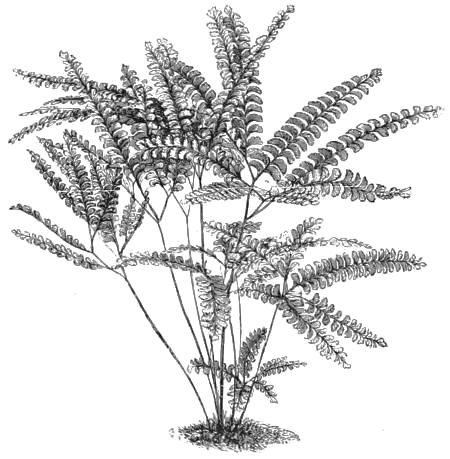
FIG. 30. ADIANTUM PEDATUM.
A. Reichenbachii (Reichenbach's). Synonymous with A. Henslovianum.
A. reniforme (kidney-shaped).* sti. tufted, 4in. to 9in. long. fronds simple, orbicular, reniform, of a deep green colour, 1½in. to 2½in. across, with usually a broad, open sinus. sori all around the edge, one and a half to three lines broad. Madeira, &c., 1699. Greenhouse species.
A. r. asarifolium (asarum-leaved). A rather larger growing variety of above species.
A. rhomboideum (rhomboid). S. America, 1820. Probably identical with A. villosum.
A. rubellum (reddish).* sti. 4in. to 6in. long. fronds 4in. to 6in. long, deltoid, bipinnate; uppermost side of the pinnules cuneate, flabellate, nearly sessile, entire; lower rhomboid ½in. long, with lower border in a line with petiole, or rather decurved, inner produced over rachis, outer deeply lobed and finely toothed; end and lowest pinnules deltoid, ½in. broad. sori round, placed in the tips of the lobes. This pretty species is purplish crimson when in a young state, changing to light green with age, but even then tinged with pink. Allied to A. tinctum and A. decorum. Bolivia, 1868. Greenhouse species.
A. scutum (shield). Synonymous with A. Ghiesbreghti.
A. Seemanni (Seemann's).* sti. 6in. to 12in. long, erect. fronds 9in. to 20in. long, simply pinnate or the lower pinnæ compound; pinnæ 3in. to 4in. long, 1½in. to 2in. broad, ovate, acuminate; but rather unequally sided, the barren ones finely serrated, one side usually cordate at the base, the other obliquely truncate, petioles of the lowest, nearly an inch long. sori in long continuous marginal lines. This is a very fine and distinct stove species. Central America, 1868. SYNS. A. populifolium, A. Zahnii (of gardens).
A. sessilifolium (sessile-leaved). Synonymous with A. Henslovianum.
A. setulosum (bristly). Synonymous with A. diaphanum.
A. speciosum (showy). Synonymous with A. digitatum.
A. subvolubile (somewhat twining). fronds subscandent, 2ft. to 4ft. long, oblong, tripinnate, 6in. to 8in. broad, with naked glossy castaneous stipes and zigzag rachises; central pinnæ lanceolate, with a few short spreading pinnules; side pinnules rhomboidal, about ¼in. long, lower edge in a line with petiole, or deflexed, inner end touching or wrapped over rachis, outer shallowly lobed; lowest pinnules equilateral, much wrapped over rachis. sori minute, round, six to twelve to a segment. E. Peru. Stove species.
A. tenerum (tender).* sti. 1ft. or more high, erect. fronds 1ft. to 3ft. long, 9in. to 18in. broad, deltoid, tri- or quadripinnate; segments ½in. to ¾in. broad, cuneate or tending towards rhomboidal, dimidiate in shape, the upper edge rounder or somewhat angular, broadly and deeply lobed, all stalked. sori placed in numerous roundish patches in the lobes of the upper half. Mexico, &c., widely distributed. Stove species.
A. t. Farleyense (Farley's).* A subfertile, subcristate variety of the foregoing; but, is, nevertheless, one of the most magnificent of Adiantums. It is nearly always known under the name of A. Farleyense. Barbados, 1865. Stove variety.
A. tetraphyllum (four-leaved).* sti. 6in. to 12in. long, strong, erect. fronds nearly as broad as long, with a terminal pinna 6in. to 9in. long, 1in. to 1½in. broad, and numerous spreading lateral ones; segments ½in. to ¾in. broad, ¼in. deep, subdimidiate, the lower line straight or somewhat decurved, the upper nearly parallel, finely toothed, the outer oblique. sori interrupted, marginal. Tropical America. Stove species. SYN. A. prionophyllum.
A. t. Hendersoni (Henderson's). A stove variety with small blunt pinnules.
A. tinctum (tinted).* sti. 6in. to 9in. long. fronds 6in. to 12in. long, deltoid, bipinnate; side pinnules rhomboid, three to four lines long, lower edge straight, inner parallel with rachis, or just wrapped over it, outer shallowly, bluntly lobed; lower pinnules equilateral, imbricated over main rachis; surfaces glabrous, when young of a delicate rose red colour, changing to a bright green. sori round, placed in final lobes. Tropical America. Stove or greenhouse species.
A. trapeziforme (rhomb-leaved).* sti. 6in. to 12in. long, firm, erect. fronds 12in. to 24in. long, with a central pinna 4in. to 8in. long, 2in. to 3in. broad, and two to four large spreading ones on each side, the lowest of which are often branched again; segments 1½in. to 2in. long, ½in. to ¾in. broad, dimidiate, the sides nearly parallel, the outer edge oblique, both it and the upper one bluntly lobed, the lowest on stalks ¼in. to ½in. long. sori numerous, contiguous, placed round the upper and outer edge. West Indies, 1793. Stove species.
A. t. cultratum (sharpened).* Outer edge of the segment bluntly rounded.
A. t. pentadactylon (five-fingered). Lower margin of the segments somewhat decurved obliquely from the petiole.
A. t. Sanctæ Catherinæ (of gardens).* This is a deeply cut, rather copiously divided variety of A. trapeziforme.
A. t. S. C. Funcki (Funck's).* A deeply lobed, drooping variety, of garden origin.
A. triangulatum (triangle-leaved). Synonymous with A. intermedium.
A. varium (various). Probably identical with A. villosum.
A. Veitchianum (Veitch's).* sti. 6in. to 9in. long. fronds 9in. to 18in. long, deltoid, bipinnate in lower half, reddish when young; side pinnules rhomboid, about ½in. long, lower border straight, more or less deflexed from tip of pedicel, inner distant from rachis, upper and outer shallowly lobed; end segments ½in. to ¾in. broad, equilateral, rounded in upper, deltoid in lower half. sori eight to ten to a segment, round, minute. Peruvian Andes, 1868. A very elegant and distinct stove species.
A. velutinum (velvety).* sti. as long as fronds, slightly velvety. fronds deltoid, 1½ft. to 2ft. long, three to four pinnate; rachises densely pubescent on both sides; pinnæ 6in. to 9in. long; segments twenty to thirty-jugate, sub-sessile, sub-rhomboidal, 1in. long, ½in. broad, lower border decurved, outer blunt or sub-acute, upper straight, shallowly, bluntly lobed. sori straight, one to one and a half lines long at tips of lobes of upper edge, four to six to a segment. Columbia, 1866. A magnificent stove species.
A. venustum (charming).* sti. 6in. to 9in. long, wiry, erect, glossy. fronds 6in. to 12in. long, 4in. to 8in. broad, deltoid, tri-quadripinnate; ultimate segments about ¼in. across, cuneate at the base, the upper edge rounded, and usually finely toothed, of a light green colour, with a firm texture. sori one to three, roundish; in hollows of the upper edge. Himalayas, up to 8000ft. Greenhouse or frame, nearly hardy in sheltered places. SYN. A. microphyllum.
A. villosum (hairy stalked).* sti. 9in. to 12in. long, strong, erect. fronds with a terminal central and several spreading pinnæ on each side, 6in. to 12in. long, 1½in. to 2in. broad; pinnules dimidiate, about 1in. long, ½in. broad, the lower line nearly straight, the upper edge nearly parallel with it, but considerably larger, slightly toothed, and the outer edge auriculed at the base. sori in a continuous line round the upper and outer edge. West Indies, &c., 1775. Stove species.
A. Wagneri (Wagner's). Synonymous with A. decorum.
A. Wilesianum (Wiles's). Synonymous with A. crenatum.
A. Williamsii (Williams's).* sti. 6in. to 8in. long. fronds 9in. to 18in. long, tripinnate, triangular; pinnæ ovate, distant, pinnules sub-rotund, slightly trapeziform, the basal line rather concave, the margin entire or slightly undulated, or divided into three to four lobes, crenately notched between the sori, the sterile portions with an erose diaphanous margin. sori eight to ten, elongate reniform or lunate, occupying the whole of the semicircular outer edge. Mountains of Peru, 1877. In a young state, the stipes and fronds are dusted with a yellow powder. This is one of the most beautiful of the Maidenhair ferns. Greenhouse species.
A. Wilsoni (Wilson's).* sti. 6in. to 12in. long, erect. fronds 9in. to 12in. long, 6in. to 12in. broad, simply pinnate, with a large terminal pinna and two to six sub-sessile lateral ones on each side, which are 4in. to 6in. long, 1in. to 2in. broad, ovate or ovate-lanceolate, acuminate, nearly entire. sori in continuous lines along both edges. Jamaica. Stove species. SYNS. A. dolosum, A. macropterum.
A. Zahnii (Zahn's). Synonymous with A. Seemanni.
ADIKE. A synonym of Pilea (which see).
ADINA (from adinos, crowded; in reference to the flowers being disposed in heads). ORD. Rubiaceæ. A very pretty evergreen cool stove shrub, with opposite terete branches, and solitary, axillary peduncles. It thrives in a mixture of loam, sand, and peat. Propagated by cuttings, inserted in a rich, loamy soil, under a hand glass, in heat.
A. globifera (globe-bearing).* fl. yellowish, sessile, crowded, collected into globose heads; corolla funnel-shaped; peduncles axillary, rarely terminal, solitary. July. l. lanceolate, glabrous, longer than the peduncles. h. 3ft. to 4ft. China, 1804.
ADLUMIA (from adlumino, to fringe with purple; flowers bordered with purple). ORD. Fumariaceæ. An interesting, delicate, and nearly hardy climber from North America. Flowers with four spongy, cohering petals. A warm, good soil is most suitable; sow seeds about May in a shady spot. It is a biennial, but in favourable spots is self-sowing, and thus may be treated as a perennial. If placed either against a wall or in the open it is a pretty subject for trailing over a shrub or twiggy branch. From its fragile character, it can only be seen to the best advantage under glass.
A. cirrhosa (tendrilled).* fl. pale rose-coloured, about ½in. long; peduncles axillary, generally four-flowered. June. l. triply pinnate, pale green. h. 15ft. 1788. The Maidenhair fern-like leaves are borne in profusion on the slender twining stems. SYN. Corydalis fungosa.
ADNATE. Grown to anything by the whole surface; anthers are said to be Adnate when they are attached to the filaments by their whole length.
ADONIS (name of classical derivation). ORD. Ranunculaceæ. Handsome hardy herbaceous plants. Flowers solitary, terminal; petals five to fifteen. Leaves divided into numerous linear segments. Some of the annuals are much inferior to the perennial species. The latter section constitute very ornamental subjects for rockwork, borders, margins of shrubberies, &c. All the species will grow freely in common soil, and are propagated by seeds. The perennials may be divided at the root.
A. æstivalis (summer).* Pheasant's Eye. fl. deep crimson; petals flat, oblong, obtuse, one-half longer than the calyx. June. Stem almost simple, elongated. h. 1ft. South Europe, 1629. Annual. See Figs. 31 and 32.
A. autumnalis (autumnal).* Pheasant's Eye; Red Morocco. fl. of an intense blood-red, with a black centre, rarely pale, globose from the six to eight concave conniving petals, which are scarcely larger than the calyx. May. Stems branched. h. 1ft. Britain. Annual.
A. pyrenaica (Pyrenean).* fl. almost sessile, yellow; petals eight to ten, smaller and more obtuse than in A. vernalis. July. l., lower ones on long stalks, with trifid petioles and many-parted segments; upper ones sessile, multifid, with linear very entire lobules. Stem 1ft. or more high, and usually much branched. Pyrenees, 1817. Perennial.
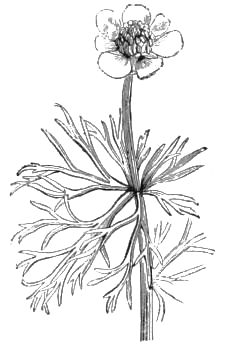
FIG. 31. FLOWER OF ADONIS æSTIVALIS.
A. vernalis (spring).* fl. yellow, large; petals, ten to twelve, oblong, rather denticulated. March. l. lower ones abortive, or reduced to somewhat sheathing scales, the middle and upper ones sessile and multifid, with very entire lobes. h. 9in. to 1ft. Europe, 1629. Charming rock plant. This handsome species requires a rich moist sandy loam, and should not be disturbed for years. Perennial.
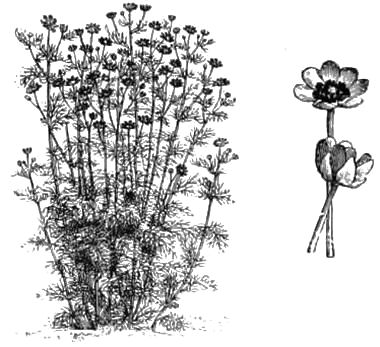
FIG. 32. ADONIS æSTIVALIS, showing Habit and Flowers.
A. v. sibirica (Siberian) differs only in having larger flowers.
A. volgensis (Volga). An intermediate species between A. vernalis and A. pyrenaica, differing from the first in the stems being branched, leaves more distant; from the last by the lower leaves being abortive, and formed like scales; and from both in the sepals being pubescent on the outside, not smooth. fl. yellow. h. 1ft. Russia, 1818.
ADPRESSED. Brought into close contact with anything without adhering.
ADULT. The full grown of anything. Full grown leaves are termed adult.
ADVENTITIOUS. Developed in an unusual position. Applied to buds, roots, &c.
ADVENTURE BAY PINE. See Phyllocladus rhomboidalis.
ADVERSE. Opposite.
ÆCHMEA (from aichme, a point; in reference to the rigid points on the calyces, or flower-envelopes). Including Pironneaua. ORD. Bromeliaceæ. Very handsome stove plants. Flowers scapose, panicled; perianth six-cleft, three outer segments sepaloid, longer than the three inner or petaloid ones. Leaves ligulate or sword-shaped, sometimes with marginal spines. The species thrive best in a well-drained compost of rich fibrous loam and leaf mould. They like plenty of light, which may be afforded by standing them on inverted pots, so as to raise their heads well up above the surrounding plants. Propagation: When the flower-spikes, which are sent up from the heart or crown of the plant, die away, suckers or offsets are produced near the base, and from these other flowers appear the year after. If large plants are desired, these suckers should be left to grow and spread around; but to produce single plants, the suckers must be taken off and potted singly, in sharp soil, and then stood where they can get a moist heat till rooted. To enable them to do this it is necessary to strip off a few of the lower leaves, and trim the bottom with a sharp knife, in order that it may heal over and callus more readily than it otherwise would. When rooted, the plants may be shifted into larger-sized pots; but for single crowns 32-sized pots are large enough, as the plants, being epiphytal in their nature, do not require much soil or any great supply of water, except when growing freely or sending up their flower-spikes. In winter, they should be kept rather on the dry side, to induce partial rest; and an important point is to see that water is not allowed to lie for any length of time in the crown of the plant, as when that is the case it is likely to cause them to rot.
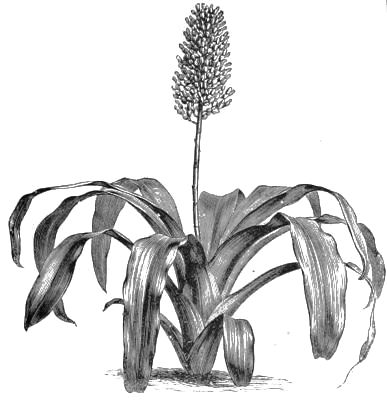
FIG. 33. ÆCHMEA FULGENS.
Æ. calyculata (calycled).* fl. bright yellow, tubular, with red bracts, borne in close roundish heads at the top of an erect scape. l. strap-shaped, with the ends having the appearance of being cut off, but armed with a sharp spine. h. 9in. Brazil, 1862. SYN. Hoplophytum calyculatum.
Æ. cœlestis (heavenly blue).* fl. sky-blue, in close pyramidal panicles, on erect snipes. Winter. l. ligulate, concave, spiny-edged, scaly beneath. Brazil, 1874. SYN. Hoplophytum cœleste.
Æ. cœrulescens (bluish). fl. bluish. h. 1ft. South America, 1870. This pretty species is very attractive on account of the large dense head of deep blue and pure white berries which are produced in October. SYN. Lamprococcus cœrulescens.