THE DICTIONARY OF GARDENING, (continued 14)
Reading edition
B. oleracea (herb-like). fl. pale yellow, large. May and June. l. glaucous, waved, lobed, smooth. Root-stem cylindrical, fleshy. h. 1ft. to 3ft. England. Biennial.
B. o. acephala (headless). Borecole or Kale. Stem round, elongated. l. expanded, racemes panicled.
B. o. botrytis asparagoides (Asparagus-like). The Broccoli. fl. abortive. Stem taller than that of the Cauliflower. l. greyish-glaucous, elongated. Branchlets fleshy, bearing small flower-buds at the top.
B. o. b. cauliflora (Cauliflower). Heads of flower-buds thick, terminal. Stem short. l. oblong, of a greyish-glaucous colour.
B. o. bullata gemmifera (bud-bearing). Brussels Sprouts. Heads small, numerous, rising from the axils of the leaves along an elongated stem.
B. o. b. major (larger). Savoy Cabbage. Heads of leaves loose, thick, terminal, roundish. l. blistered.
B. o. capitata (headed). The Cabbage. Stem round, short. l. concave, not blistered, crowded into a head before flowering; racemes panicled.
B. o. Caulo-rapa (Kohl-Rabi). Stem tumid and somewhat globose at the origin of the leaves.
B. Rapa (Rape). The Turnip. Radical leaves lyrate, destitute of glaucous bloom, green, covered with bristly hairs; middle cauline ones cut; upper ones quite entire, smooth.
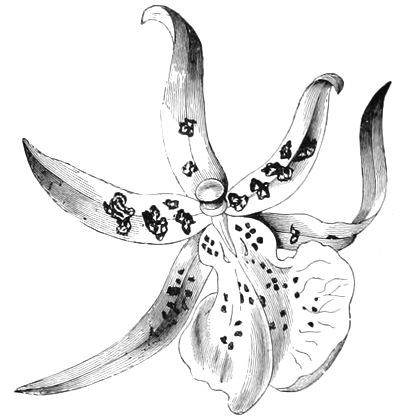
FIG. 276. SINGLE FLOWER OF BRASSIA MACULATA.
BRASSICACEÆ. See Cruciferæ.
BRAVOA (named after Bravo, a Mexican botanist). ORD. Amaryllidaceæ. A pretty little graceful bulbous plant, hardy in very sheltered positions, but in exposed situations requiring a slight protection in winter. It is an admirable plant for cool-house culture, and delights in a compost of light rich loam, leaf mould, and sand. Propagated by offsets, which are obtainable in autumn; or by seeds, which should be sown as soon as ripe.
B. geminiflora (twin-flowered).* Twin Flower. fl. rich orange-red, tubular, drooping, disposed in the upper part of the flower-stems, which are sometimes 2ft. long. July. l. linear, ensiform, pale green. Mexico, 1841. (B. M. 4741.)
BRAZILIAN TEA. See Ilex paraguariensis and Stachytarpheta jamaicensis.
BRAZIL NUT. See Bertholletia.
BRAZIL WOOD. See Cæsalpinia brasiliensis.
BREAD FRUIT. See Artocarpus.
BREAD NUT. See Brosimum.
BREDIA (named in honour of Professor J. G. S. van Bred). ORD. Melastomaceæ. An ornamental greenhouse shrub, thriving in rich light loam, leaf soil, and peat. Propagated by cuttings of the ripened shoots, inserted in sandy loam, under a hand glass, in heat; or by seeds.
B. hirsuta (hairy).* fl. rose-pink, about ½in. across, disposed in loose, terminal, many-flowered cymes. Autumn. l. ovate acuminate, hairy. Japan, 1870. (B. M. 6647.)
BREEZE. The small particles or refuse of gas coke. It constitutes a very cheap fuel, but, unless mixed with good coke, is only suitable for boilers of the saddle type, having a good draught. Breeze must not, however, be confounded with coke-dust.
BREVOORTIA COCCINEA. See Brodiæa coccinea.
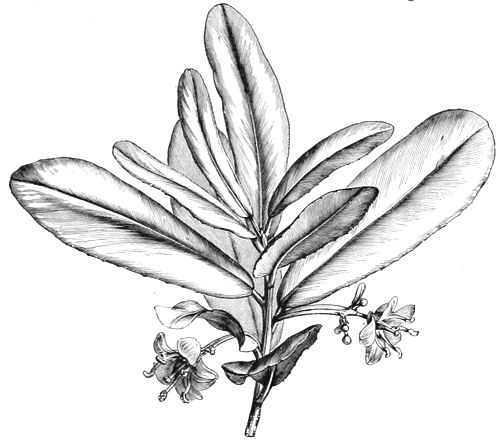
FIG. 277. FLOWERING BRANCH OF BREXIA MADAGASCARIENSIS.
BREXIA (from brexis, rain; the large leaves afford protection against rain). ORD. Saxifrageæ. Excellent stove trees. Flowers green, in axillary umbels, surrounded by bracts on the outside. Leaves alternate, simple, dotless, and furnished with minute stipules. Stems nearly simple. They require a compost of two parts loam and one of peat, with the addition of a little sand, to keep the whole open. A liberal supply of water must be given at all seasons. Cuttings, with their leaves not shortened, strike readily in sand under a hand glass, in heat; or a leaf taken off with a bud attached will grow. Leaves as in accompanying illustration (Fig. 277), and long, narrow, spiny-toothed ones, are often produced on the same plant. Probably the two species enumerated below are simply forms of one. Well hardened off, strong growing plants of B. madagascariensis are very suitable for sub-tropical gardening.
B. madagascariensis (Madagascar).* l. obovate or oblong, entire, while young minutely gland-toothed. h. 20ft. Madagascar, 1812. See Fig. 277.
B. spinosa (spiny). l. lanceolate, 20in. long, 2in. broad, spiny-toothed. h. 20ft. Madagascar, 1820.
BREXIACEÆ. A section of Saxifrageæ.
BRIAR. See Rosa.
BRICKS. In England, the standard thickness of brick walls is a Brick and a-half, that is, the length of one brick and the breadth of another. Thirty-two paving bricks, laid flat, will form one square yard of flooring; if set on edge, eighty-four will be required for the same space. The best Bricks for walls are those termed Stocks, which are well burnt. Grizzells and Place Bricks, being only partially burnt, are soft and not durable. In various parts of the kingdom, different clays and methods of manufacture cause a disparity in the weight and appearance of the finished article. Several forms are made to suit various purposes, but the standard size is 9in. long by 4½in. wide, by 2½in. thick, although, since the remission of the duty, some slight variations occur, owing to shrinkage and other causes. Fire Bricks are made of a particular kind of clay, which will stand intense heat when once burnt, and are used in furnaces and other places where durability under great heat is a desideratum. Fire-clay should always be used in place of mortar in building with these.
BRILLANTAISIA (named after M. Brillant). ORD. Acanthaceæ. A very small genus of erect, branching, stove evergreen shrubs. Flowers large, in terminal panicles; corolla ringent; upper lip falcate and overarching, with a trifid apex, the lower one large, spreading, shortly trifid. Leaves ovate-cordate, on long petioles. For culture, see Barleria.
B. owariensis (Owarian).* fl. violet-blue; cymes sub-sessile, loose; panicles terminal. March. l. large, opposite, petiolate. h. 3ft. Western Africa, 1853. This plant, in its habit of growth, resembles some of the largest species of Salvia. (B. M. 4717.)
BRISTLES. Stiff hairs.
BRISTLY. Covered with stiff hairs.
BRISTLY-TOOTHED. Furnished with teeth like bristles, or with the teeth ending each in a bristle.
BRIZA (from briza, to nod). Quaking Grass. ORD. Gramineæ. A genus of ornamental hardy grasses. Panicle loose; calyx two-valved; corolla two-valved, awnless; exterior one ventricose, interior small and flat. Fruit adnate with the corolla. These extremely graceful plants delight in a soil composed of loam, leaf soil, and peat. Seeds may be sown in spring or autumn. For decorative purposes, the branches should be gathered as soon as full grown, and loosely placed in flower-stands, to dry. Tufts of these plants look extremely pretty on the rockery, or amongst hardy ferns.
B. gracilis (graceful). Synonymous with B. minor.
B. maxima (greatest).* fl., spikelets oblong-cordate, thirteen to seventeen-flowered; panicle nodding at the end. June and July. l. long, linear-acuminate. h. 1½ft. South Europe, 1633. See Fig. 278.
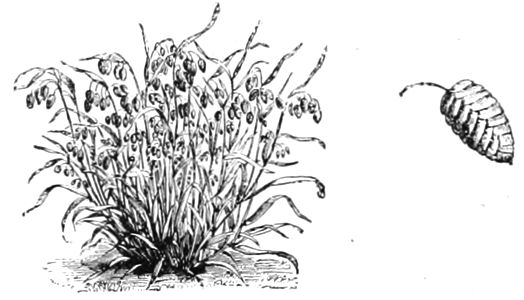
FIG. 278. BRIZA MAXIMA, showing Habit and single Flower.
B. media (middle).* Common Quaking Grass. fl., spikelets broadly ovate, of about seven florets (calyx shorter than the florets), tremulous with the slightest breeze, very smooth, shining purple. Branches of the panicle thread-shaped, divaricating, purple. June. l. short, linear acuminate. h. 1ft. Britain. (S. E. B. 1774.)
B. minima (least). Synonymous with B. minor.
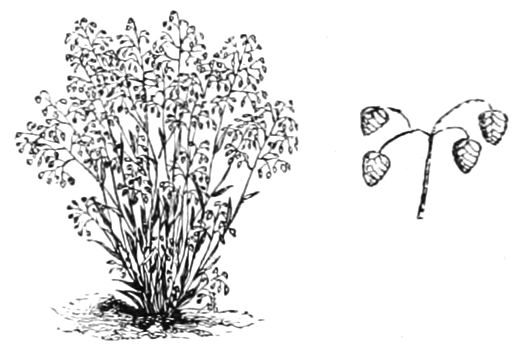
FIG. 279. BRIZA MINOR, showing Habit and small Panicle of Flowers.
B. minor (small).* Little Quaking Grass. fl., spikelets triangular, seven-flowered; glumes longer than the flowers; panicle with hair-like branches. June and July. l. pale green, short, narrow. h. 8in. England (but very rare). An exceedingly pretty little annual or perennial grass. SYNS. B. gracilis and B. minima. See FIG. 279. (S. E. B. 1775.)
B. spicata (spiked). A recent introduction from Brazil, described as being very graceful and quite distinct, having erect spikes about 8in. in height.
BROADCAST. A method of sowing seeds by means of the hand, scattering them over the surface of the ground as equally as possible. It is now superseded, for the majority of garden and field crops, by drilling, which not only economises the quantity of seed used, but greatly facilitates subsequent weeding and thinning out.
BROCCOLI (Brassica oleracea botrytis asparagoides). A cultivated variety of the Cabbage, having the young inflorescence condensed into a fleshy, edible head (see Fig. 280). To grow this popular vegetable successfully, it is necessary to have rich soil of a good depth, in an open situation, where the plants can have plenty of sun and air to keep them sturdy. They succeed the autumn Cauliflower, and are in season from November till May.
Soil. In preparing ground for Broccoli, trench, in the autumn, to the depth of from 1½ft. to 2ft., and during the process work in a liberal dressing of rotten farmyard manure. Ground which has carried a crop of Celery is very suitable for the strong-growing kinds, as, by planting where the Celery rows have been, the necessity of trenching is, to a great extent, obviated. Smaller kinds, however, need to be planted closer in order to obtain a profitable crop.
Cultivation. At the beginning of May, prepare seed beds on a south border, and sow the earlier and sprouting kinds. The later varieties would, perhaps, be best sown in April, but they must not be put in early and allowed to remain too long in the seed bed. Sow thinly, to get the plants as sturdy as possible; and, to prevent clubbing, work in a little soot or wood ashes on the surface of the beds. Care must also be taken to pick off the club excrescences at planting time, should there be any, and to destroy the grub inside. Clubbing is not so frequent in ground which has been well trenched, and where the plants are not allowed to suffer from drought. Showery weather should be selected for transferring them to their permanent quarters. If it is desired that they should succeed potatoes, they may be planted between every two alternate rows, and the latter crop can be removed when ready. Broccoli succeed best where the ground is firm, and not recently dug or manured. Planting with a crowbar is preferable to digging the ground afresh. If grown by themselves, a distance of from 2ft. to 3ft. should be allowed between the rows, and an equal distance from plant to plant. Some of the early varieties will, in favourable seasons, follow the later Cauliflowers, while the latest will not be fit for use until the following spring. The heads should be cut as soon as they are large enough; they will keep good for a week in a cold place, while a day or two might open them too much if allowed to remain on the plants. Broccoli which have to stand the winter are liable to injury from severe frosts, and some method of protection is necessary. Two plans are recommended for both large and small gardens, and either or both may be adopted, as found convenient. The first is to apply a covering of fern or other dry protective material, not using too much, but giving sufficient to break the rays of the sun, which, perhaps, do as much harm as the actual frost. The other plan is to take up the plants as soon as the flowers can be seen, and lay them in under a hedge or wall until required for use. In sheltered positions, or where there are trees to break the force of the wind, the covering with dry litter during severe weather will generally be found sufficient; still, a little precaution in lifting will frequently save a valuable crop. Broccoli should never follow a crop of any other kind of cruciferous plants, particularly Cabbage.
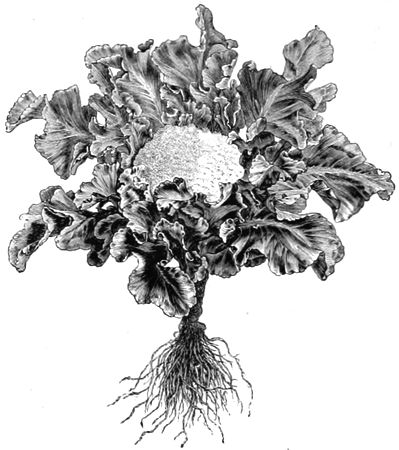
FIG. 280. BROCCOLI.
Sorts. Veitch's Self-protecting Autumn, Purple and White Cape, Grange's Early White, and Snow's Winter White. These are the best for autumn and mid-winter supplies. A good selection for spring and late purposes is Mitchinson's Penzance, Knight's Protecting, Cooling's Matchless, Purple Sprouting, Model, Willcove, Leamington, and Cattell's Eclipse.
BRODIÆA (named after J. J. Brodie, a Scotch cryptogamist). SYN. Hookera. ORD. Liliaceæ. Pretty, slender, hardy, or in some positions only half-hardy, bulbs. The flowers are usually borne in large clusters or umbels; the prevailing colour is blue; coccinea is, however, an exception, the flowers being scarlet. The scape is usually straight and slender, but strong. Leaves from two to four in number, enveloping the part of the scape beneath the surface, and procumbent thereon. Most of them are of easy culture in rich sandy loam; if grown in pots, a mixture of loam, leaf soil, and sand, suits them well. Increased freely by offsets, which should be left undisturbed with the parent bulbs till they reach a flowering state, when they may be divided and replanted in autumn.
B. capitata (headed).* fl. deep violet-blue, funnel-shaped, disposed in a compact, many-flowered umbel; valves of the spathe also deep violet. May. l. narrow, linear. h. 1ft. to 2ft. California, 1871.
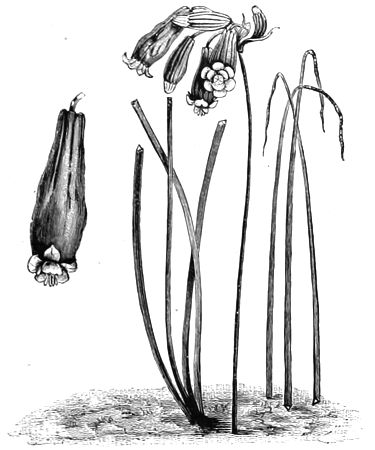
FIG. 281. BRODIÆA COCCINEA, showing Flower and Habit.
B. coccinea (scarlet).* fl. 1½in. long, tubular, rich blood-red below, the apex of the tube and the segments yellowish-green; umbels composed of five to fifteen drooping flowers. June. l. linear, loose, shorter than the scape. h. 1½ft. California, 1870. Very handsome, distinct from all other species, requiring a warm, well-drained, and sunny position, and to remain undisturbed. SYN. Brevoortia coccinea. See Fig. 281. (B. M. 5857.)
B. congesta (close-headed).* fl. blue, with the crown paler; segments cleft at the top; umbel bearing six to eight blooms. The stamens in this species are metamorphosed into fleshy scales, which adhere to the mouth of the perianth. Summer. l. few, long, slender, channelled on the inside. Bulb small, roundish, and much wrinkled. h. 1ft. Georgia, &c., 1806. A very free-growing and rapidly increasing species.
B. c. alba (white).* fl. white; in other respects like the type, but not so vigorous.
B. gracilis (graceful).* fl. deep yellow, with brown nerves, ½in. or rather more long, in few-flowered umbels. July. l. solitary, about ¼in. broad, longer than the scape. h. 3in. to 4in. California, 1876. A scarce and rather tender little species, but very pretty.
B. grandiflora (large-flowered).* fl. bluish-purple, with entire pointed segments; umbels bearing two to seven somewhat scattered blooms. Summer. l. two to three or more, linear, pointed, slender, grooved on the inside, furnished with a few membranous scales. Bulb small, roundish, dry and wrinkled. h. 1½ft. North America, 1806. SYN. Hookera coronaria. (B. R. 1183.)
B. Howellii (Howell's).* fl. purplish-blue, about ¾in. across, sub-bell-shaped, in many-flowered umbels. July and August. l. narrow acute, grooved, shorter than the scape. h. 18in. to 24in. California, 1880.
B. ixioides (Ixia-like). See Calliprora lutea.
B. lactea (milky-white).* fl. white, usually with green midribs, ½in. to ¾in. across, saucer-shaped, in many-flowered umbels. June and July. l. linear, acute, nearly as long as the scape. h. 1ft. to 2ft. California, 1833. SYNS. Hesperoscordum lacteum, Milla hyacinthina.
B. multiflora (many-flowered).* fl. blue-purple, very numerous, in sub-globose heads. May. l. linear, elongate, 1ft. to 2ft. long, rather fleshy. h. 1ft. to 1½ft. California, 1872. (B. M. 5989.)
B. volubilis (twining). fl. rose-coloured, in dense umbels, each containing fifteen to thirty blooms; scape twining, sometimes 12ft. long. July. l. narrow, linear-lanceolate, 1ft. long, synanthous. California, 1874. Half-hardy bulb. (B. M. 6123.)
BROMELIA (named after Bromel, a Swedish botanist). ORD. Bromeliaceæ. A genus of stove herbaceous perennials, allied to the Pineapple. Flowers, corolla three-petaled, convolute, erect, or spreading at the top. Leaves densely packed, rigid, lanceolate, with spiny margins. Stems short. These plants require much the same treatment as Billbergia. Allied genera are Æchmea, Ananassa, Billbergia, Disteganthus, Greigia, Karatas, Ruckia (which see).
B. antiacantha (opposite-spined). fl. purple, scarlet. Brazil, 1864. SYN. B. sceptrum.
B. bicolor (two-coloured).* fl. scarlet, in a close central sessile head. March. l. numerous, narrow, ensiform, outer green, central crimson; elegantly radiate. Chili, 1872. SYNS. B. Joinvillei, B. pitcairniæfolia. (B. H. 14.)
B. bracteata (red-bracted).* fl. pink; scape elongated; raceme compound; bracts red, ovate-lanceolate. September. l. serrate, spiny. h. 2ft. Jamaica, 1785.
B. Fernandæ (Fernanda's).* fl. yellowish, in ovoid heads; bracts orange-red. July. l. linear-ligulate, 24in. to 30in. long, recurved, spiny-edged. Para, 1872.
B. Joinvillei (Joinville's). A synonym of B. bicolor.
B. Karatas. See Karatas Plumieri.
B. pitcairniæfolia (Pitcairnia-leaved). A synonym of B. bicolor.
B. sceptrum (sceptre-like). A synonym of B. antiacantha and Karatas Plumieri.
BROMELIACEÆ. An extensive order of stemless or short-stemmed plants, having rigid, channelled, and usually spiny leaves. Flowers very showy; outer perianth three-cleft, persistent, inner one of three withering segments; stamens six, inserted in the tube of the perianth. To this order belongs the Pineapple. The genera best known in gardens are Ananassa, Æchmea, Billbergia, Bromelia, and Tillandsia.
BROMHEADIA (in honour of Sir Edward Finch Bromhead). ORD. Orchideæ. A small genus of stove orchids, comprising a couple of species, with erect stems, large flowers, and cucullate lip, which is parallel with the column. For culture, see Ansellia.
B. palustris (marsh).* fl., sepals and calyx white; lip white externally, within streaked with purple, and having a yellow blotch in centre; spike terminal, distichous, flexuous, many-flowered, on a long peduncle; bracts short, stiff, tooth-like. June. l. distichous, oblong-linear, emarginate. h. 2ft. Singapore, 1840. (B. R. 30, 18.)
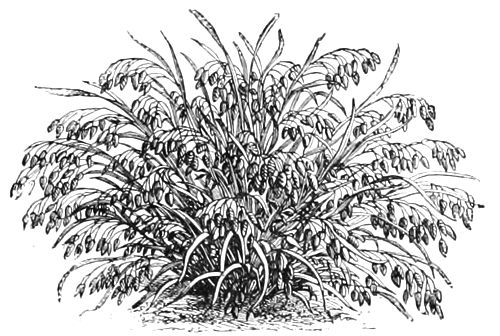
FIG. 282. BROMUS BRIZÆFORMIS.
BROMUS (from bromos, the Greek name for a wild oat). Ord. Gramineæ. B. brizæformis (see Fig. 282) is an elegant biennial grass, with drooping panicles of spikelets, about as large as those of Briza maxima. It grows about 2ft. high, and is of very easy culture in common garden soil. Sow seeds outside in patches, in July, thinning out the plants when necessary. There are numerous other species belonging to this genus, but the above-mentioned is the only one worth growing in gardens. It forms a beautiful object in the mixed border, or among ferns.
BRONGNIARTIA (in honour of Adolphe Brongniart, a distinguished botanist, and one of the editors of "Annales des Sciences Naturelles"). ORD. Leguminosæ. Handsome greenhouse evergreen sub-shrubs, clothed with silky villi. Flowers large, purple; pedicels twin, axillary, one-flowered. Leaves impari-pinnate, with many pairs of leaflets, the terminal one not remote from the rest. They require a compost of sandy loam, leaf soil, and fibry peat, with perfect drainage. Cuttings of the young shoots, if firm at the base, will root if dibbled in sand, under a bell glass, in a cool house.
B. podalyrioides (Podalyria-like).* fl. purple, large. September. l. with two to five pairs of leaflets; leaflets elliptic-oblong, rounded, and mucronate at the apex, clothed with adpressed hairs on both surfaces, but silky when young. h. 1ft. New Spain, 1827.
B. sericea (silky).* fl. purple. September. h. 1ft. l., leaflets ovate-oblong, acute, very silky on both surfaces. Mexico, 1843.
BROOK-LIME. See Veronica Beccabunga.
BROOM. See Besom.
BROOM. See Cytisus scoparius.
BROOM RAPE. See Orobanche.
BROOM, SPANISH. See Spartium junceum.
BROSIMUM (from brosimos, edible; fruit edible). Bread Nut. ORD. Urticaceæ. A genus of stove evergreen shrubs or trees, principally of economic value in their native countries. Male and female flowers generally in a globular head, but sometimes borne on separate trees; calyx and corolla wanting. Leaves entire. They generally thrive in a rich fibry loam. Cuttings of ripe wood, with their leaves on, root if placed in sand, in moist heat.
B. Alicastrum. fl., catkins globose, stalked, twin, axillary. fr. coated. l. ovate-lanceolate. h. 6ft. Jamaica, 1776.
BROUGHTONIA (named after Mr. Arthur Broughton, an English botanist). ORD. Orchideæ. A very compact-growing stove evergreen, allied to Lælia, succeeding best if suspended from the roof on a block of wood, with a little moss; it requires a free supply of heat and water when in a growing state. Propagated by dividing the plant. The colour of the flowers is very distinct.
B. sanguinea (blood-coloured).* fl. blood-coloured, rather large, disposed in a terminal panicle; scape divided; column distinct, or at the very base united with the unguiculate lip, which is lengthened at the base into a tube, connate with the ovarium. Summer. l. twin, oblong, seated on a pseudo-bulb. h. 1½ft. Jamaica, 1793. (B. M. 3076.)
BROUSSONETIA (named after P. N. V. Broussonet, a French naturalist, who wrote numerous works on Natural History). ORD. Urticaceæ. Ornamental fast-growing, deciduous, Mulberry-like trees. They require rather good open garden soil, and prove hardy in situations which are not very exposed. Propagated by suckers and cuttings of ripened wood, inserted in autumn, in a cool house; and by seeds, sown when ripe, or kept till the following April.
B. papyrifera (paper-bearing).* The Paper Mulberry. fl. greenish, diœcious; males in pendulous, cylindrical catkins, each flower in the axil of a bract; females in peduncled, axillary, upright globular heads. May. l. simple, alternate, exstipulate, variously lobed or entire, hairy, large. h. 10ft. to 20ft. China, 1751. There are several varieties, differing in the shape and character of the leaves. (B. M. 2358).
BROWALLIA (named in honour of John Browall, Bishop of Abo, who defended the sexual system of Linnæus against Siegesbeck, in a book entitled "Examen epicriseos," &c., 1739). ORD. Scrophularineæ. A genus of handsome shrubs or herbs. Flowers blue or white, axillary and terminal; corolla salver-shaped, resupinate from the contortion of the peduncle; tube fifteen-nerved, ventricose at top. Leaves alternate, stalked, ovate in outline. They thrive best in a rich, open, sandy soil. To have strong plants in bloom by Christmas and after, seeds should be sown in July, in pans or pots of light rich sandy soil, and kept in a close frame, or hand light, where they can be shaded till germination takes place. When large enough to handle, the seedlings may either be pricked out, three in a pot, or potted singly, according to the size of the specimens required. In the former way, they form fine masses for conservatory or greenhouse decoration, or to cut from; and in the latter, they are very suitable for window recesses, &c. After potting, they should be stood in a pit or frame, and syringed every morning and evening, to ward off attacks of insect pests. An abundance of well-diluted liquid manure is required as soon as the flower-buds appear. To keep the plants dwarf and bushy, it will be needful to stop them about three times during the remainder of the summer and autumn, keeping as near the glass as possible; they should be housed by the end of September. These elegant little greenhouse annuals are unrivalled for affording choice, neat sprays for bouquets during the winter and early spring months, or for growing as pot plants, to furnish warm greenhouses or sitting-room windows. Many of the species and varieties are largely employed for summer decoration of the flower garden, with highly satisfactory results; for this purpose, seeds should be sown in gentle heat early in spring, and the plants transferred to the flower borders late in June, or early in July, having been previously encouraged in pots, and well hardened off.
B. abbreviata (shortened). fl. light red; pedicels shorter than the calyx; calyx campanulate, with teeth as long as the tube. l. oval, hairy when young, quite glabrous when mature. 1852. (R. G. 94.)
B. demissa (low).* fl. of a bright but pale blue colour, sometimes red or purple; peduncles axillary, one-flowered, downy. June. l. ovate-oblong, acuminated, oblique at the base. h. 6in. to 1ft. Panama, 1735. (B. M. 1136.)
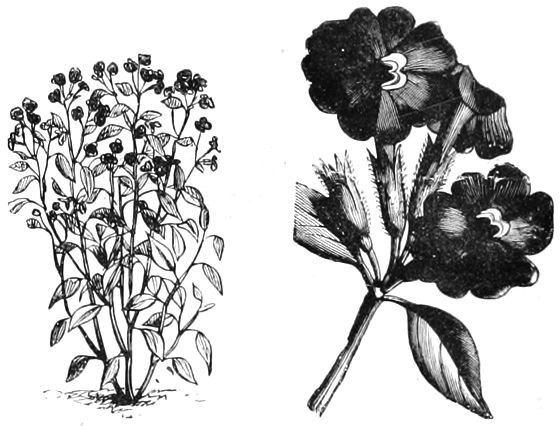
FIG. 283. BROWALLIA ELATA, showing Habit and Flower.
B. elata (tall).* fl. deep blue; calyx beset with glandular hairs; peduncles axillary, one or many-flowered. July. l. oval, acuminated. h. 1½ft. Peru, 1768. Of this extensively-grown species there are two varieties, one with white flowers, and the other, grandiflora, with pale blue, both of which are well worth growing. See Fig. 283. (B. M. 34.)
B. grandiflora (large-flowered).* fl., corolla with a greenish-yellow tube, which is clothed with glandular villi, and a white or very pale lilac limb; peduncles one-flowered, axillary, racemose at the tops of the branches. July. l. ovate, acute, attenuated into the petioles at the base. h. 1ft. to 3ft. Peru, 1829. (B. M. 3069.)
B. Jamesoni (Jameson's).* fl. bright orange, with lighter-coloured throat, tubular. June. h. 4ft. New Grenada, 1850. This species has been recently re-introduced, after having been lost to cultivation for over thirty years. (B. M. 4605.)
B. Roezli (Roezl's). fl. large, either of a delicate azure blue, or white, with a yellow tube. Spring to autumn. l. shining green. An exceedingly pretty species, having flowers double the size of any other, and forming a dense compact bush, 1½ft. to 2ft. in height. Rocky Mountains.
BROWNEA (named after Patrick Browne, M.D., author of a History of Jamaica). ORD. Leguminosæ. Very handsome stove evergreen trees or shrubs, allied to Amherstia. Flowers of a rose-scarlet colour, rising in fascicled heads from the axillary buds. Leaves abruptly-pinnate, when young flaccid, and with the leaflets revolute at the edges; leaf-bud long and stipulaceous. All the species are well worthy of the most extensive cultivation. A mixture of loam, peat, and sand, is a soil well adapted for them, and great care should be taken not to over-water the plants in winter, as too great a supply will be sure to kill them. Propagated by cuttings, taken from ripened wood, planted in a pot of sand, and placed under a hand glass, in a moist heat.
B. Ariza (Ariza).* fl. richest scarlet, produced in a large, globular, drooping head of immense size. Summer. l. pinnate, usually with six or eight pairs of pinnæ, which are oblong-lanceolate, and sharply tapered to a point. h. 20ft. to 40ft. Columbia, 1843. This noble tree requires a large house to fully perfect its beauty. SYN. B. princeps. (B. M. 6459.)
B. Birschellii (Birschell's). fl. rose-coloured, in drooping racemes. April to July. l. pinnate; leaflets oblanceolate, 6in. long. h. 10ft. to 20ft. La Guayra, 1872. (B. M. 5998.)
B. coccinea (scarlet).* fl. scarlet, fascicled. July to August. l. with two to three pairs of oval-oblong, acuminated leaflets. h. 6ft. to 10ft. Venezuela, 1793. (B. M. 3964.)
B. grandiceps (large-headed).* fl. red, in dense capitate spikes. July. l. with usually twelve pairs of oblong-lanceolate glandless leaflets, ending in a long cuspidate acumen; branches and petioles pubescent. h. (in its native home) 60ft. Caraccas, 1829. (B. M. 4859.)
B. latifolia (broad-leaved). fl. red, in dense fascicles; involucre tomentose. l. with one to three pairs of ovate or obovate-cuspidate leaflets. h. 6ft. to 8ft. Caraccas, 1824.
B. macrophylla (large-leaved).* fl. orange-scarlet, in dense heads, often measuring nearly 3ft. in circumference. Central America, 1879. (G. C. 1873, p. 779.)
B. princeps (chief). A synonym of B. Ariza.
B. racemosa (clustered).* fl. rose-coloured, racemose; involucre and calyx clothed with fine tomentum. l. with four pairs of unequal-sided, oblong, or oblong-lanceolate, cuspidately-acuminated leaflets, which are glanduliferous at the base. h. 4ft. Caraccas, 1826.
B. Rosa del Monte. fl. scarlet, in dense heads; leaflets of the involucre roundish, imbricated, and, when in a young state, rather velvety. June. l. with two to three pairs of oval-oblong acuminated leaflets; branches and petioles glabrous. h. 8ft. South America, 1820. (B. R. 1472.)
BROWNLOWIA (named in honour of Lady Brownlow, daughter of Sir Abraham Hume, and a great patroness of botany). ORD. Tiliaceæ. Very handsome greenhouse evergreen trees, thriving well in a mixture of loam and peat. Cuttings of ripe shoots will root if placed in sand, under a hand glass, in heat.
B. elata (tall).* fl. yellow; panicle terminal, conical, spreading. May. l. large, cordate, acute, seven-nerved, smooth. h. 60ft. India, 1823. (B. R. 1472.)
BRUCEA (commemorative of James Bruce, the celebrated African traveller). ORD. Simarubeæ. Ornamental stove evergreen shrubs. Flowers small, purplish inside, disposed in interrupted glomerate spikes, or racemes. Leaves impari-pinnate, with six pairs of opposite, entire or serrated leaflets, without dots. Branches, peduncles, petioles, and nerves of leaves, clothed with rufescent down. They thrive in a loamy soil; and cuttings from ripened wood strike freely, in a pot of sand, under a hand glass, in a moderate heat.
B. antidysenterica (antidysenteric). fl., racemes simple, spike-like. May. l., leaflets quite entire, clothed with rusty villi on the nerves beneath. h. 8ft. Abyssinia, 1775.
B. sumatrana (Sumatra).* fl. dark purple; racemes usually compound. May. l., leaflets serrated, villous beneath. h. 20ft. Sumatra, 1822.
BRUCHUS GRANARIUS. See Bean Beetle.
BRUCHUS PISI. See Pea Weevil.
BRUGMANSIA. See Datura.
BRUNFELSIA (named after Otto Brunfels, of Mentz, first a Carthusian monk, and afterwards a physician; he published the first good figures of plants in 1530). SYN. Franciscea. ORD. Scrophularineæ. Elegant free-flowering stove evergreens. Flowers sweet-scented; corolla large, funnel or salver-shaped, with a long tube, and a flat, five-lobed, obtuse, nearly equal limb. A light rich soil, or a compost of loam, leaf soil, and peat, is necessary to grow these plants successfully. Propagated by cuttings, planted in sand, and placed under bell glasses, in a moderate heat. When rooted, they should be placed in small pots, in a compost somewhat more sandy than that already mentioned. While growing, they require to be kept in a moist stove temperature, and should be hardened by placing them in a drier, and somewhat cooler, temperature after each growth is completed; the pots should be changed as often as the roots become thick around the ball of earth. The larger plants flower freely, and should be slightly pruned in annually, before commencing their new growth, thus securing neat and compact specimens. Repotting should be effected directly they have done flowering. The plants should then be placed in a temperature ranging from 60deg. to 68deg., and both the roots and foliage liberally supplied with water. When flowers appear—about October or November—the syringing must be less frequently performed. At this period, if it be desirable to prolong the flowering season, the plants should be removed to a temperature of about 48deg. A few administrations of weak liquid manure during the growing season are of great value.
B. acuminata (taper-pointed-leaved).* fl. bluish-violet, few, sub-cymose, terminal. April. l. oblong, acuminated, attenuated a little at the base, glabrous; bracts lanceolate, acuminated, glabrous. h. 1ft. to 2ft. Rio Janeiro, 1840. (B. M. 4189.)
B. americana (American).* fl. first yellow, then white, very sweet-scented; axillary flowers solitary, terminal ones numerous. June. l. obovate, elliptic, acuminated, longer than the petioles. h. 4ft. to 6ft. West Indies, 1735. There are narrow and broad-leaved varieties of this species. (B. M. 393.)
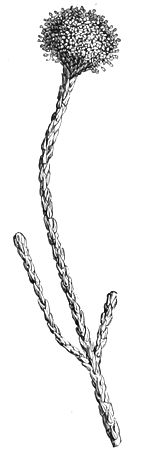
FIG. 284. FLOWER OF BRUNIA NODIFLORA.
B. calycina (cup-shaped).* fl. purple, disposed in large trusses, which are produced in succession throughout the whole year. l. large, lanceolate, shining light green. h. 2ft. Brazil, 1850. One of the largest-flowered species grown. (B. M. 4583.)
B. confertiflora (dense-flowered). fl. soft blue, cymosely crowded, terminal. January to June. l. nearly sessile, oblong-acute, attenuated at the base, rather pilose, ciliated, yellowish-green above; bracteoles oblong, attenuated at the base, and are, as well as the calyces, clothed with rusty hairs. h. 1ft. to 2ft. Brazil.
B. eximia (choice).* fl. produced from the points of the shoots, upwards of 2in. in diameter, deep purple. January to July. l. oblong-lanceolate, dark green, but not glossy. h. 2½ft. Brazil, 1847. (B. M. 4790.)
B. grandiflora (large-flowered). fl. greenish; limb of corolla 2in. in diameter, corymbose, terminal. June. l. elliptic-oblong, acuminated. Branches twiggy. h. 3ft. Peru.
B. hydrangeæformis (Hydrangea-like).* fl. beautiful bluish-violet; cymes terminal, hemispherical, large. April. l. oblong, acute, cuneiform at base, quite glabrous, 1ft. long; bracts lanceolate, aggregate. h. 1ft. to 3ft. Brazil, 1840. This is one of the most elegant species of the genus. (B. M. 4209.)
B. latifolia (broad-leaved). fl. at first lavender-colour, with a distinct white eye, eventually becoming almost white; deliciously fragrant, sub-cymose, terminal. Winter to early spring. l. broad-elliptic, acutish, greyish-white, 6in. to 7in. long, and 2in. to 2¾in. broad. h. 2ft. to 3ft. Brazil, 1840. (B. M. 3907.)
B. Lindeniana (Linden's).* fl. rich purple, with a light eye. l. ovate-acuminate, dark green. Brazil, 1865. (B. H. 1865, 226.)
B. uniflora (one-flowered). fl. solitary; corolla with a whitish tube, and a bluish-violet or purple limb. Winter. l. elliptic, acute; branches greenish, hoary, diffuse, spreading. h. 1ft. to 3ft. Brazil, 1826. (L. B. C. 1332.)
BRUNIA (named after Corneille de Bruin, better known under the name of Le Brun, a Dutchman, a traveller in the Levant). ORD. Bruniaceæ. Elegant little greenhouse evergreen Heath-like shrubs, more or less branched, with the branches in whorls, erect or spreading. Flowers capitate, furnished with three bracts each, or sometimes deficient of the two lateral ones. Leaves small, closely imbricate. They require a compost of peat and sand, with a little leaf soil added, firm potting and good drainage. Cuttings of young shoots root freely in sand, under a hand light, in summer.
B. nodiflora (knot-flowered).* fl. white; heads globose, size of a cherry, on the tops of the branches. July. l. lanceolate, awl-shaped, trigonal, acute, smooth, closely imbricate, not ustulate at the apex. h. 1ft. to 3ft. Cape of Good Hope, 1786. See Fig. 284.
BRUNIACEÆ. An order of much-branched Heath-like shrubs, usually having small leaves, which are crowded and entire. Flowers in terminal heads; petals five, alternating with the lobes of the calyx. The typical genus is Brunia.
BRUNONIA (named after Robert Brown, the most eminent botanist of his time). ORD. Goodenoviæ. A stemless greenhouse perennial herb, with the habit of Scabiosa, downy from glandless simple hairs. Flowers distinct, with a whorl of five membranous bracts; corolla blue, marcescent. Radical leaves quite entire, spathulate; scapes undivided, each bearing one head; head hemispherical, lobate; lobes involucrated by foliaceous bracts. It thrives in a compost of decayed manure, or leaf soil and peat, with a little loam added; thorough drainage is necessary. Propagated by divisions, in early spring, previous to repotting.
B. australis (southern)* is the only species known to be in cultivation. h. 1ft. New Holland, 1834. (B. R. 1833.)
BRUNSVIGIA (named after the noble House of Brunswick). ORD. Amaryllideæ. Very showy greenhouse bulbous plants, from the Cape of Good Hope. Flowers red, on very long pedicels. Bulbs large. Leaves broad, horizontal; perianth with an evident longer or shorter tube, curving upwards, funnel-shaped, deeply six-parted, deciduous; segments sub-equal, many-nerved, flat, and recurved at the apex; stamens on the tube much curved upwards; scape appearing in summer without the leaves; umbels many-flowered. Propagation is effected by offsets, of which the large bulbs produce but few. These, when secured, may be removed after reaching some considerable size, carefully potted in a mixture of sandy loam and peat, with good drainage, and kept tolerably warm and close until established; water must be given but sparingly until root-action has commenced. The best place for growing the offsets into a flowering size is on a shelf near the glass, in a temperature of from 50deg. to 55deg. With an abundance of water while growing, and kept dry while semi-dormant, thus allowing them a rest, the bulbs will speedily increase in size; but it may be years before flowers are produced. Culture: This may be divided into two periods—one of growth, and one of rest. After the latter period, they should be allowed to start into fresh growth, without stimulation, and, as soon as started, liberal supplies of water should be given, and a genial temperature of from 60deg. to 65deg. maintained, to make them grow vigorously. Good-sized pots are also necessary, with a mixture of loam, peat, and sand, in equal parts. They are usually confined to the greenhouse, or warm conservatory, but are sometimes successfully grown in a south border at the base of a wall, planted out in a pit, upon which the lights may be placed in winter, and matted if necessary, as they cannot endure frost. A good depth of soil, consisting of fibrous loam, peat, and sand, in equal proportions, with good drainage, should be prepared. In all cases, the bulbs should be planted somewhat deeply. One of the most satisfactory methods of ensuring the flowering of these plants consists in subjecting the bulbs, when at rest, to a hot dry heat of 70deg. or more, which thoroughly ripens them; but, after this treatment, it will be necessary to encourage the after-growth to the fullest possible extent.
B. ciliaris (hair-fringed). fl. dull purple. l. strongly fringed with white hairs. h. 1ft. 1752. (B. R. 1153.)
B. Cooperi (Cooper's).* fl. sulphur-coloured, edged with red; umbels twelve to sixteen-flowered. l. ligulate-obtuse, bifarious, fleshy. h. 1½ft. 1872. (Ref. B. 330.)
B. falcata (sickle-leaved).* fl. red. May. l. sickle-shaped, with a muricated, discoloured, cartilaginous edge. h. 9in. 1774. (B. M. 1443.) SYN. Ammocharis falcata.
B. Josephineæ (Josephine's).* fl. scarlet; scape twice as long as the rays of the many-flowered umbel. l. strap-shaped, erect, spreading, glaucous. h. 1½ft. This handsome species is much grown. 1814. (B. M. 2578.) Minor and striata are varieties.
B. multiflora (many-flowered).* fl. red, loosely umbellate. June. l. linguiform, smooth, lying on the ground. h. 1ft. 1752. (B. M. 1619.)
B. toxicaria (poison-bulb).* fl. pink; umbel hemispherical, many-flowered. September to October. l. many, erect, oblique, glaucous. h. 1ft. 1774. (B. R. 567.) B. coranica is a variety of this. 1815. (B. R. 139.)
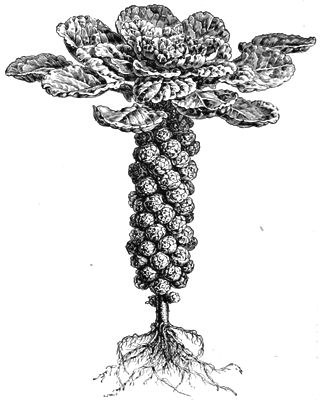
FIG. 285. BRUSSELS SPROUTS.
BRUSSELS SPROUTS (Brassica oleracea bullata gemmifera). A cultivated variety of the Cabbage (Fig. 285). Leaves blistered. Stems covered with small, close heads. To secure this vegetable in its best form, it must be grown on deeply-worked and rich ground. In addition, the seeds should be obtained from a good source, as there are many spurious stocks in cultivation. Plenty of room must be allowed the plants to develop, and the tops and leaves should not be removed till after the sprouts are gathered; dead leaves, of course, excepted. It is a bad plan to plant Brussels Sprouts amongst potatoes or other crops, as they become unduly weakened, and never give such good returns as when grown by themselves.
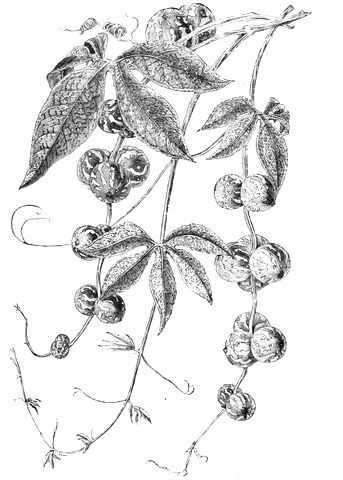
FIG. 286. BRYONIA LACINIOSA.
Soil and Cultivation. In February, and early in March, sow thinly in a cold frame, or carefully prepare seed beds on a warm south border. As soon as the plants are large enough, prick them off into prepared soil, to grow on; about the end of April, transplant into a piece of rich ground, which has been previously prepared for them, setting in rows from 2ft. to 3ft. asunder, and 2ft. apart in the rows. The earlier the plants are put out, the better; and they should be watered-in when planted, so that they receive as little a check as possible. They must be kept clear of weeds, and earthed up as soon an they get a good size. During severe frost, some light dry litter may with advantage be thrown over them for protection; and the less they are interfered with when frozen, the better.
Sorts. The Imported is the best strain for general use; other good sorts are: Sutton's Matchless, The Aigburth, and Scrymger's Giant.
BRYA (from bryo, to sprout; the seeds germinate before falling from the tree). ORD. Leguminosæ. A small genus of stove shrubs or small trees, furnished with stipular spines, and solitary, or clustered, or pinnate leaves. The undermentioned species thrives in a rich fibry loam. Propagated by seeds, or by cuttings, placed in a hotbed.
B. Ebenus (ebony). Jamaica Ebony. fl. bright yellow; peduncles two to three together, axillary, one to two-flowered, shorter than the leaves. July and August. l., leaflets aggregate, obovate. h. 12ft. to 14ft. West Indies, 1713. (B. M. 4670.)
BRYANTHUS (from bryon, a moss, and anthos, a flower). ORD. Ericaceæ. A genus of small trailing shrubs, allied to Loiseleuria. Flowers terminal, somewhat racemose; calyx five-leaved, imbricate; corolla deeply five-parted, spreading. Leaves crowded, spreading, flattish. For culture, see Menziesia.
B. empetriformis (Crowberry-leaved). fl. reddish-purple, clustered near the extremities of the branches. l. crowded, linear, on short adpressed petioles. h. 6in. North-west America, 1829. SYN. Menziesia empetrifolia. (B. M. 3176.)
B. erectus (erect). fl. red, pentamerous, broadly campanulate. l. linear, obtuse, obscurely serrated. h. about 1ft. Siberia. Trailer. (L. & P. F. G. 1, 19.)
B. Gmelini (Gmelin's). fl. red; peduncles glandular, many-flowered. l. with denticulated margins. h. 2in. or 3in. Kamtschatka and Behring's Island.
BRYONIA (from bryo, to sprout; in allusion to the annual growth from the tuber). Bryony. ORD. Cucurbitaceæ. Tuberous-rooted perennial herbaceous plants, producing annual climbing stems. The native species is well worth growing over unsightly hedges, fences, &c., and in the wild garden; it is a rapid grower, and of extremely easy culture. The stove perennial species should be grown in pots, and the stems trained up the rafters. Rich loam is the soil most suitable for their cultivation. Propagated by seeds, or by divisions of the tuber.
B. dioica (diœcious). fl. greenish-white, racemose, diœcious. fr. globose, red. May to September. l. cordate, palmately five-lobed, toothed, scabrous, from callous points. England. (Sy. En. B. 517.)
B. laciniosa (cut-leaved). fl. yellow, solitary; corollas hairy inside, smooth outside. fr. size of a cherry, striated with white. July. l. palmately five-parted, cordate, rough, and blistered, with oblong-lanceolate, acuminated, serrated segments; petioles muricated. Ceylon, 1710. Stove species. SYN. Bryonopsis laciniosa. See Fig. 286.
BRYONY. See Bryonia.
BRYOPHYLLUM (from bryo, to sprout, and phyllon, a leaf; plants spring from the notches on the edges of the leaves when taken off the plant, and placed in a moist situation). ORD. Crassulaceæ. This very curious stove succulent thrives in pots of rich loamy soil; perfect drainage is essential, and but little water is at any time needed.
B. calycinum (large-cupped). fl. yellowish-red; cymes panicled, terminal. April. l. opposite, thick, petiolate; some impari-pinnate, with one or two pairs of segments, the terminal one large; others solitary; all ovate and crenated. h. 2ft. to 3ft. India, 1806. A fleshy, erect, branched evergreen shrub, grown chiefly for curiosity.
BUCCO. See Agathosma.
BUCIDA. See Terminalia.
BUCKBEAN. See Menyanthes.
BUCKLANDIA (named after Dr. Buckland, a former Dean of Westminster, and Professor of Geology at Oxford). ORD. Hamamelideæ. A handsome greenhouse tree, allied to Liquidambar. It thrives in rich sandy loam, peat, and leaf mould; or peat may be left out if the leaf soil is good; perfect drainage is also essential. Cuttings of ripened shoots will strike in sandy loam, under a hand glass, with moderate heat. They must be watered carefully, or they are liable to rot off.
B. populnea (Poplar-like). l. pale green, large, leathery, cordate, ovate-acute, on long stalks, pinkish when young; stipules very curious, large red, consisting of two leafy oblong plates, placed face to face in an erect position between the leafstalk and the stem. h. 100ft. Himalayas, 1875. (B. M. 6507.)
BUCKLER MUSTARD. See Biscutella.
BUCKTHORN. See Rhamnus.
BUCKWHEAT. See Fagopyrum esculentum.
BUCKWHEAT-TREE. See Mylocaryum.
BUDDING. This process consists of taking an eye or bud attached to a portion of the bark, and transferring it to another and different plant; it is an operation almost confined to woody plants, but has been practised with more or less success upon herbaceous perennials. The stock should not be budded unless the sap is in circulation, which is assured if the bark will detach itself easily, when gently lifted, from the wood.
There are many ways of performing the different systems, in preparing and inserting the Buds, &c., and all may prove more or less successful if undertaken when the Buds and stock are both in a suitable condition. The principal methods are Shield or T-budding, including the Circular, Square, and Inverted forms; Flute or Tube-budding, and Annular or Ring-budding.
The first-named method, which is fully described below, is very extensively practised for propagating Roses and stone fruits. It is also coming more in use for the propagation of many other fruit trees, including Apples and Pears, especially new or scarce varieties, as the great advantage of making use of many more of the eyes, to form separate trees, is thereby attained. In large nurseries, where skilful propagators are employed, thousands of trees are annually budded, the majority of them with very successful results. It is, in most cases, preferable to purchase established fruit trees, as cultivators require the produce much quicker than they could get it by propagating trees themselves. The same system of Budding is, however, applicable for increasing Roses; and this may be adopted with every chance of success by even a cottager, if he takes the necessary care in performing the work.
Rare varieties of ornamental deciduous trees are largely propagated in this way; for instance, many of the Acers, Elms, Horse Chestnuts, &c. Evergreen shrubs, such as Rhododendrons and Hollies, are also rapidly increased in some establishments by this means.
In the case of fruit-frees, plump wood Buds must be selected, from medium-sized branches. On some sorts these are scarce, the majority being Flower-buds, and it is rather difficult to distinguish between them at the Budding season. The best time for the operation is from June to the end of August; but surrounding influences, condition of Buds, stocks, &c., must be taken into account. Clean cuts, with gentle and skilful handling, are even more important in the Budding of stone fruits than of Roses or other plants, and the ties should be lightly but firmly made. In all cases, the operation must be performed as quickly as possible, as both Bud and bark are injured if exposed to the air for any length of time.
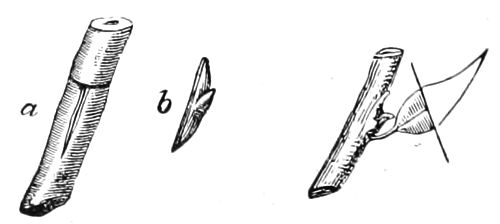
FIG. 287. FIG. 288.
To proceed with the ordinary system of Shield-budding, the stock (see Fig. 287 a) should first have a longitudinal and a transverse incision made in the bark, the former about 1in. long. Next, the Bud should be prepared, removing half the leaf (see Fig. 288). Hold the branch with the left hand, and pass the knife from about ½in. below, gradually upwards and inwards under the Bud, bringing it out in a similar way at a somewhat shorter distance above. A portion of wood will also be taken out, and this is generally removed the opposite way to that in which the Bud has been cut. By skilful Budders, it is removed by a sort of twitch from either end. Great care must be taken not to pull out the base or root of the Bud at the same time, as this would render it useless. Should the whole come out together, leaving a hollow place under the eye of the Bud, it must be thrown away, and another prepared. The Bud being ready, loosen the bark at the point where the incisions meet, with the ivory knife handle, and insert it by means of the piece of leaf attached. It must then be tied in with soft matting or bast, to exclude air, but not tight enough to injure the bark. Shading from bright sun is advisable for a few days afterwards, and, as soon as the union takes place, the ties must be frequently examined, and loosened if necessary. Some prefer Budding late in the season, in order that the Bud may remain dormant during the winter, and breaking stronger the following spring. Occasionally, they are inserted in spring, just at the commencement of growth. The stocks of the Summer-budded trees should only be allowed a moderate amount of foliage during the autumn, and should be cut back to the established Bud before growth commences in spring.
Square and Circular Shield-budding consists in cutting out a piece of bark of either shape from the stock, and inserting another piece of exactly the same size, containing a Bud, and covering with a bandage, or piece of sticking plaster, all except the eye. This mode is seldom made use of. Inverted T or Shield-budding is preferred in the south of France for propagating Orange-trees, but is not otherwise much used. The only difference is that the transverse incision is made below, instead of above, the other, and the Bud inserted upwards, making it fit with the bark at the point where the stock is cut across.
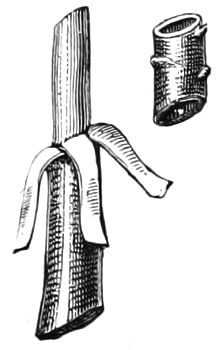
FIG. 289.
Flute-budding is sometimes used, and answers well for some trees (see Fig. 289). A cylinder of bark is removed from the stock, and one of a similar size from the scion. containing Buds, is fitted in its place, being carefully made air-tight by means of a bandage or grafting wax. Some prefer splitting the hark, as shown in the illustration. and laying it over the tube or cylinder; but the parts cannot be fitted so well as when it is removed.
Ring Budding. By this mode, it is not necessary to cut off the top of the stock. A ring of bark may be removed from any convenient part (see Fig. 290 b) and replaced with one containing eyes (see Fig. 290 a). The latter should be taken from a little larger branch than the stock, as the bark could then be made to fit better. As in Flute-budding, air must be excluded by means of adhesive paper and bandages or grafting wax.
Budding operations may be performed at any time during the season; but dull cloudy weather, and morning or evening, are most suitable. If the branch, containing Buds, cannot be obtained as required for use, the ends may be placed in water, to keep them fresh; but unnecessary delay should be avoided.
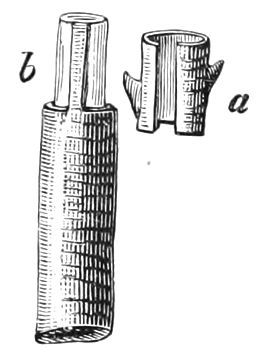
FIG. 290.
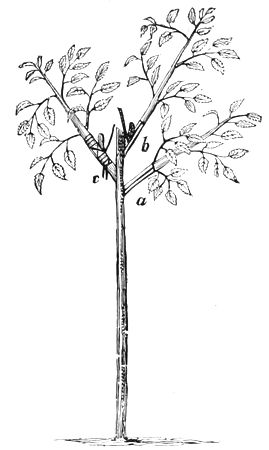
FIG. 291.
Stocks for Budding upon. For the Cherry, the Wild Gean, and seedlings from the Morello. make capital stocks for tall trees and those of moderate growth; and the Mahaleb, or Perfumed Cherry, for small trees for pots, bushes, pyramids, or cordons. For the Plum, the Mussel, Mirabelle, Magnum Bonum, St. Julian, &c., are mostly used for stocks, the Mirabelle being best for small trees. Peaches and Nectarines are generally budded on the Mussel, St. Julian, or Mirabelle Plums; the last are best for dwarfs. The Apricot is budded on the Mussel or Mirabelle Plums, for small plants; and the St. Julian Plum for standards. In France, the Damas Noir, or Black Damask, and the Cerisette, are also used. They should all be raised from seeds, and not from suckers. Seeds for raising plants for stocks may be sown as soon as ripe; but where quantities are used, the stones are thrown into heaps, so as to slightly ferment during winter. In the spring, they are sown in drills or beds, and transplanted the next year in rows 2ft. or 3ft. apart. and 10in. or 12in. from plant to plant. The dwarfs are generally budded the second year, and the standards the third or fourth. Dwarf trees are budded from within a few inches of the ground to 1ft. above; standards and riders from 3ft. to 9ft.; cordons, pyramids, &c., can hardly be budded too low.
Rose Budding. Propagation of Roses by Budding is very extensively practised both with standard trees and dwarf plants. It is perhaps easier and more certain to succeed with these than with fruit trees; but the mode adopted is precisely the same—that of the shield-shaped Bud with the core, or root, and the bark attached. For standards, the common briar of the Dog Rose is the best. The earlier these are obtained and planted in November, the better, as roots are then formed at once. For dwarf plants, the Manetti stock is mostly used, being easily obtained and had in proper condition almost at any time when Buds are ready. Plants on this stock do not succeed in all soils, and suckers are also very liable to be produced. Budding on the seedling briar is attended with good results, and is practised more than hitherto. The De la Grifferaie stock is also used, more for Tea Roses than others, and is considered by some to produce better plants than the Manetti. The shoots on standard briars should be reduced to about three of the strongest, selected as close together as possible, and near the top, the briars having been previously cut back the desired height at planting time. Two Buds are sufficient for a good head; but, for certainty, three may be inserted. Fig. 291 represents a tall briar with three shoots; a shows the shoot slit for the Bud; b, the Bud inserted; c, the Bud tied in. Fig. 292 is a branch showing Buds, the lowest ones of which are most suitable, being in firmer wood. Those at the top are often useless. Fig. 293 represents a Bud taken from Fig. 292, a, b, and Fig. 294 gives an idea of how the wood is removed. As previously remarked when describing the system, experienced Budders remove the wood from either end. Fig. 294 shows its removal from the lower end.
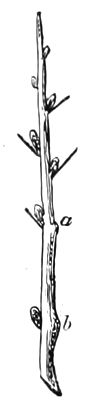
FIG. 292.
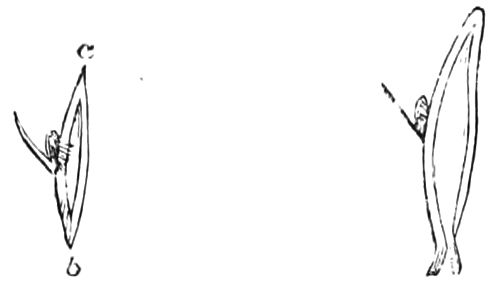
FIG. 293. FIG. 294.
Budding as close as possible to the main stem is most desirable. Raffia grass is superior in every way for tying, which should be performed as soon after the Bud is inserted as possible. It requires much care, and, of course, the Bud itself must be entirely free. As soon as the Buds swell, the tying material should be loosened, and the top of the stock cut back to the level of the budded shoot. By Budding late, the Buds lie dormant till the next spring, and the necessity of tying the young shoots is dispensed with for that season. The shoots of the briar in advance of the Rose Buds must be cut back, as shown in Fig. 295, so soon as the Buds are safely established. The Manetti and other dwarf stocks are budded on the main shoot nearly close to, or underneath the ground, and if low enough to cover part of the rose stem when grown, the latter often roots as well and assists the stock. Being small, they may be grown in pots and removed to the required position at any time.
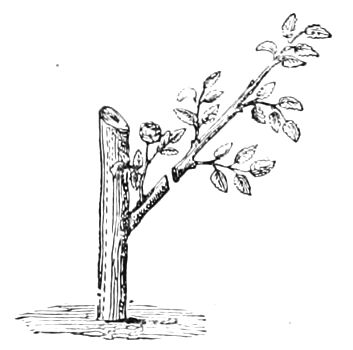
FIG. 295.
Dog Roses, used for standards, are usually collected from hedgerows, and sold at about 8s. per hundred. Manetti stocks are increased by cuttings, which, after making one season's good growth, will be fit for use. Briars are raised from seed, which may be collected from hedges, and sown in the autumn, in drills. The seedlings should be transplanted the first year after sowing, and the following season they will be ready for working.
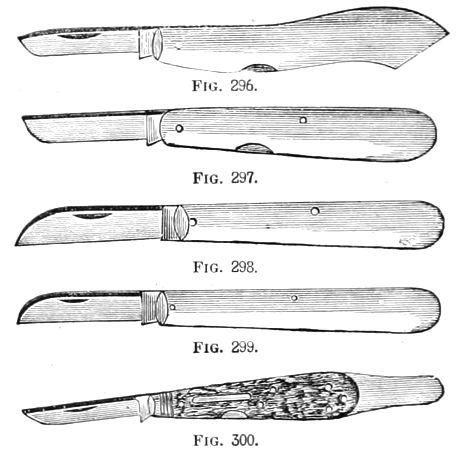
BUDDING KNIVES. The best Budding Knives are those manufactured by Messrs. Saynor and Co., and Messrs. G. Hall and Son. They are made with handles of ivory, shaped in different ways at the end, for the purpose of opening the bark, in order to insert the Bud. Some of the blades are made with the edge rounded at the point, so as to cut the bark without the knife entering the wood underneath (see Figs. 296 and 297). Others, which may be used for Budding, and are much better for ordinary use for cutting flowers, &c., are made with the edge of the blade carried to a point, as in ordinary knives (see Figs. 298 and 299). Another form has the handle made of some other material, and a piece of ivory inserted for opening the bark; this is represented in Fig. 300. The first-named is the best, if required for Budding only; the second is the most useful for ordinary purposes, and answers admirably for Budding as well. None of the other shapes have any material advantages over these.
BUDDING KNIVES.
BUDDLEIA (named after Adam Buddle, who is so often mentioned in Ray's "Synopsis"; his collection of dried British plants is preserved in the British Museum). ORD. Loganiaceæ. A large genus of stove, greenhouse, or half-hardy shrubs. Flowers small, often tomentose, axillary, spicate, capitate, or thyrsoid; calyx equally four-toothed; corolla tubular-campanulate, regular; limb spreading, four-toothed. Leaves opposite, reticulately veined. Branches quadrangular.
The species most extensively grown is B. globosa, which, among all our other shrubs, is quite unique; but it is only in the southern or favoured counties of England where it can be fairly termed hardy. It is readily propagated by cuttings or by seeds. The latter should be sown in a gentle heat the spring following the ripening, when they will vegetate pretty freely. With careful treatment and nurturing in pots for the first winter, in a frost-proof pit or house, they may soon be grown into elegant plants. Cuttings of the ripened wood, put in under bell glasses or hand lights, in a cool but frost-proof pit, will root slowly during the winter. They will root all the surer and quicker if each cutting has a heel of older wood attached to that of the current year's growth. They are best inserted in fine sand or in very sandy soil, and require but little water until rooted. As soon as fairly calloused over or rooted, their further progress may be much advanced by potting them off, and plunging them in a bottom-heat of 60deg. or 65deg. This is by no means an essential to secure success, but it hastens it, and promotes growth in an extraordinary manner. The surface temperature should range about the same as the bottom-heat. Under such treatment, the plants will be quite fit to place out about the middle of July. A warm, sheltered situation should be chosen, and a light, rich soil prepared for them; and if dry weather ensues, they only require water. South or west walls are, without doubt, the best situations for them. In all cool or unfavourable localities, much may be done to ensure success by planting on a dry bottom, and on poorish soil. A loose, free-and-easy style of training suits the plants best. This enables them to yield a great number of their peculiarly formed, distinct, and beautiful flowers; whereas, anything like a close, trim course of pruning or of training reduces the flowers to the lowest number.
Throughout the southern parts of England, and, indeed, in many places in the north, B. globosa makes an excellent bush for the shrubbery. It is only during severe winters that it gets badly cut.
For the other presumably hardy species much the same plan as the foregoing may be adopted. The greenhouse and stove kinds may have the same routine of culture usually employed with plants requiring similar temperatures.
Stove species, except where specified otherwise.
B. americana (American). fl. yellow; spikes disposed in a terminal panicle, nearly 1ft. long; glomerules nearly globose, size of a sloe, on short peduncles. August. l. ovate, acuminated, narrowed at the base, serrately crenated. h. 8ft. to 12ft. Peru, 1826.
B. asiatica (Asiatic).* fl. white, small, disposed in long, dense racemes. l. lanceolate, finely serrated. h. 3ft. India, 1874. A graceful and sweet-scented shrub. SYN. B. Neemda. (B. M. 6323.)
B. crispa (curled). fl. lilac, with a white eye; numerously produced in long terminal branching spikes, forming a pyramidal head about 5in. long. March. l. ovate-lanceolate, crenately curled; lower ones cordate at the base; superior ones rounded, all thick and wrinkled, clothed with soft tomentum on both surfaces. h. 13ft. Western Himalayas. Half-hardy. (B. M. 4793.)
B. globosa (globose).* fl. orange, or honey-colour; heads large, terminal, globose, pedunculate. May. l. lanceolate, acuminated, petiolate, crenated, 6in. long. Branches sub-tetragonal, clothed with hoary tomentum, as well as the under side of the leaves. h. 15ft. to 20ft. Chili, 1774. Hardy in most places. (B. M. 174.)
B. Lindleyana (Lindley's). fl. purplish-red, hairy; disposed in terminal racemose spikes. September. l. ovate, shortly petiolate, serrate. Branches angular, glabrous. h. 6ft. China, 1844. Half-hardy. (B. R. 32, 4.)
B. Neemda (Neemda). A synonym of B. asiatica.
BUDS, FLOWER. These are developed like Leaf-buds, from which they differ chiefly in containing one or more incipient flowers within the leaves—the flowers being wrapped up in their own floral-leaves, within the ordinary leaves, which have their outer covering of scales. If a Bud be gathered from a Lilac or Horse-chestnut very early in spring, all the rudiments of the future flowers and leaves will be found within it, though the Bud itself may not be more than half-an-inch long, and the flowers not larger than the points of the smallest pins.
BUDS, LEAF. These consist of rudimentary leaves, surrounding a growing vital point, and appear like a collection of scales arranged symmetrically one above the other. Leaf-buds universally originate in the horizontal or cellular system, and are formed under the bark at the extremity of the medullary rays, and at the margin or on the surface of leaves, whether perfect or rudimentary. Deciduous trees lose their leaves, but in the axil of each a little Bud previously forms, from which fresh leaves expand the following spring. In some cases, as in the Horse-chestnut, the Buds are covered with a gummy exudation. In Privet-trees, Leaf-buds are generally smaller and more elongated than Flower-buds.
BUETTNERIA (named after David Sigismund Augustus Byttner, once a Professor of Botany in the University of Göttingen). ORD. Sterculiaceæ. Erect or scandent stove or greenhouse shrubs. Flowers small, usually dark purple; calyx and corolla valvate; umbels simple, disposed in something like racemes or panicles, rarely in corymbs. Leaves simple. All are of easy culture in a compost of loam and peat. B. dasyphylla, hermanniæ-folia, microphylla, and scabra, are occasionally met with, but they are hardly worth growing.
BUETTNERIEÆ. A section of Sterculiaceæ.
BUFF-TIP MOTH (Pygæra bucephala). This large and beautiful Moth is very common in many districts; it is easily recognised by the buff-coloured tips of the fore-wings—whence its common name; the head, and body between the wings and abdomen, are ochreous. According to Newman's "British Moths," "the caterpillars, when full grown, are about an inch and three-quarters long, and sprinkled with silky hairs; the general colour yellow, with black head, black lines running from the head to the tail, interrupted by a transverse orange band on each ring, and a black horny plate above the tail segment." They feed on the leaves of the Lime, Elm, and Oak, among other trees, and apparently the only remedy is that generally adopted in exterminating caterpillars, viz., to shake the branches which are infested, when the pest will be quickly dislodged, and fall to the ground. Miss Ormerod is of opinion that "as the caterpillars come down the tree to the ground for their change to chrysalids, it might be worth while to throw a few spadefuls of gas-lime, or of anything they would not cross, in a circle at about a yard from the tree; or a rough band of any material soaked in tar, or tar and oil, which would keep wet longer, would stop them from straying off ... and they might be cleared in sufficient numbers so as to considerably lessen future attack." This plan of prevention deserves a trial in any place where the destructive caterpillars of these Moths abound. It is almost a hopeless task to destroy them altogether when once established on the trees, such specimens as large Oaks being often almost or wholly denuded of foliage.
BUGLE. See Ajuga.
BUGLOSSUM BARRELIERI. See Anchusa Barrelieri.
BUGWORT. See Cimicifuga.
BULBIFEROUS. Bearing bulbs.
BULBINE (from bolbos, a bulb). ORD. Liliaceæ. A genus of rather pretty hardy, or nearly hardy, herbaceous or bulbous plants, allied to Anthericum. Flowers showy, fragrant; perianth with spreading segments. Leaves somewhat fleshy, narrow. Stems short. They are all of easy culture in a compost of sandy loam. The bulbous-rooted species are increased by offsets, and the herbaceous sorts by suckers and divisions. The only species which can be grown satisfactorily in the open air is B. annua. All the others should be grown in the greenhouse, but may be placed in the open during the summer months.
B. alooides (Aloe-like).* fl. yellow, disposed in a terminal panicle. April. l. fleshy, tongue-shaped, lanceolate, flat on both sides. h. 1ft. Cape of Good Hope, 1732. SYN. Anthericum alooides. (B. M. 1317.)
B. annua (annual). fl. yellow; scape racemose. May, June. l. fleshy, subulate, rounded. h. 9in. Cape of Good Hope, 1731. An annual species, the seeds of which should be sown in a gentle heat during spring, and the seedlings may be transplanted to the open when large enough to handle. SYN. Anthericum annuum. (B. M. 1451.)
B. caulescens (caulescent).* fl. yellow. March. l. fleshy, rounded. Stem shrubby, erect, branched. h. 2ft. Cape of Good Hope. 1702. A shrubby species, which should be propagated by cuttings, placed under a hand glass. SYN. B. frutescens. (B. M. 816.)
B. frutescens (shrubby). Synonymous with B. caulescens.
BULBOCODIUM (from bolbos, a bulb, and kodion, wool; referring to the woolly covering of the bulbs). ORD. Liliaceæ. TRIBE Colchiceæ. A very pretty little bulbous plant, much resembling the Crocus, from which it differs principally in having a superior ovary and six stamens. It is amongst the earliest of spring-flowering plants, the flowers preceding the foliage; and, like the majority of bulbs, delights in rich sandy loam. In such positions, they multiply rapidly from offsets. It is a good plan to take up the bulbs, divide, and replant them every second year, selecting in autumn, and renewing the soil or planting in new positions. Few plants prove more welcome in the garden, in February, than B. vernum, either in beds, patches, or masses.
B. Aitchisoni (Aitchison's). A synonym of Merendera Aitchisoni.
B. Eichleri (Eichler's). A synonym of Merendera caucasica.
B. trigynum. A synonym of Merendera caucasica.
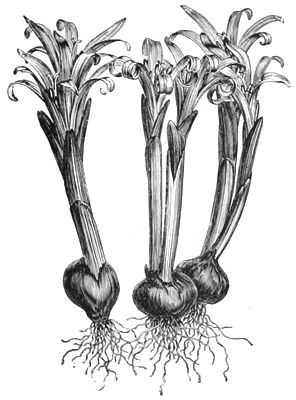
FIG. 301. BULBOCODIUM VERNUM.
B. vernum (spring).* fl. violet-purple, with a white spot on the claw; long, tubular, funnel-shaped, two to three from each bulb; preceding the appearance of the leaves. Very early spring. l. usually three in number, broadly strap-shaped, concave, and surrounded at the base by well-developed sheaths. Bulb black, oblong. h. 4in. to 6in. Spain, 1649. See Fig. 301. There is a variety with the leaves striped white, which is also desirable.
BULBOPHYLLUM (from bulbos, a bulb, and phyllon, a leaf; referring to the leaves issuing from the apex of the pseudo-bulbs). SYNS. Anisopetalum, Bolbophyllum, Tri-brachium. ORD. Orchideæ. Of this rather large genus of orchids but few are worth cultivating except as curiosities. Racemes long or spike-like, very rarely one-flowered or sub-umbellate; sepals usually nearly equal and free; lip jointed to the foot of the column. They are of easy culture when grown on small blocks of wood with a little moss, and suspended in a warm part of the house; the roots require a good supply of water. Propagated by dividing the pseudo-bulbs.
The following comparative few of the aggregate number of species already introduced are really all that are worth the cultivator's attention; what the botanist often regards as being very pretty, &c., does not always appear such in the eyes of the grower.
B. barbigerum (bearded).* fl., sepals and petals greenish-brown; lip covered with dark-coloured hair, and so loosely attached at the base as to be moved with the slightest breath. Sierra Leone, 1835. A curious dwarf-growing plant, with dark green leaves and pseudo-bulbs. (B. R. 1942.)
B. Beccarii (Beccari's). fl. light brownish and painted with violet; lip brown, with a violet hue, proceeding from a rhizome at the base of the leaf (just below the small pseudo-bulb), and at once turning downwards; racemes dense, cylindrical, nodding. l. three, 25in. long, 18in, across, very thick. Rhizome 20in. long. Brazil, 1879. A remarkable and gigantic climbing species; the odour of this plant is intolerably fœtid and the leaves are larger than those of any other known orchid. This species requires plenty of heat. (B. M. 6517.)
B. Lobbi (Lobb's).* fl. large; sepals and petals yellow, the upper part spotted with purple; solitary, on radical scapes. Summer. Java, 1845. (B. M. 4532.)
B. maculatum (spotted). fl. prettily spotted, l. long, obtuse, bright green. India.
B. reticulatum (netted-leaved).* fl. in pairs, white, striped inside with purple; lip spotted with the same colour. l. somewhat heart-shaped, with the nerves of a deeper green than the rest of the leaf, giving it a beautifully reticulated appearance. Brazil, 1866. Perhaps the handsomest of the genus. (B. M. 5605.)
B. saltatorum (dancing). fl. greenish-brown, lasting some time in perfection. Winter. h. 6in. Sierra Leone, 1835. (B. R. 1970.)
B. siamense (Siamese).* fl. pale yellow, striped with purple; lip yellow, streaked with purplish lines. A very pretty species, closely allied to B. Lobbi, but with longer and stouter leaves. Pseudo-bulbs ovate. Siam, 1867. Should be grown in a pot of peat and sphagnum.
BULBOSTYLES (from bolbos, a bulb, and stylos, the style). ORD. Compositæ. A. small genus of stove evergreen plants, now referred to Eupatorium.
BULBS. A Bulb is formed upon or beneath the ground, and is a swollen stock, consisting, in the first place, of a more or less fleshy disk, which below gives rise to the roots; secondly, of more or less fleshy coats, or scales, borne on the disk; thirdly, of a more or less central shoot, equally borne by the disk, protected by the coats or scales already mentioned, and formed of rudimentary leaves and flowers. In some instances, small Bulbs, called Cloves, are formed at the base of the scales of the original Bulb; these are destined to reproduce the plant. Shallot and Garlic are good examples. Bulbs are, in fact, storehouses, husbanding the strength and energy acquired by the plant during one season, for the exigencies of the next. They are classified under two sections—Scaly and Tunicated. In the former, the scales of the Bulb are imbricated, as in the Lily; in the latter, they form continuous coatings, one within the other, as in the Hyacinth, &c. In several Lilies, young Bulbs are found growing in the axils of the leaves, when they are known as Bulbils. Bulbs is also a popular term given to Dutch Flower Roots, mostly arriving here in the autumn for spring flowering. Crocus, Colchicum, Cyclamen, Gladiolus, and several others, are not Bulbs, but Corms. The flowering season varies according to the different sorts of Bulbs. The majority may be lifted and kept tolerably dry during the resting period; but they wither and become exhausted if not replanted at the proper time, thereby causing many failures. Dutch Bulbs generally arrive in September, and the best results are obtained from those potted or planted at once, although some for succession may be kept in reserve up till the beginning of November. The failure in cultivating imported Liliums and other Bulbs may be often caused by their long-continued confinement in a dry atmosphere, whereby their vitality is often almost lost. The roots of some Bulbs are nearly always, more or less, in action, and these, especially, should not be kept out of the ground for any length of time.
BULLACE. See Prunus insititia.
BULLACE, or MUSCADINE. See Vitis vulpina.
BULLATE. Blistered or puckered.
BULRUSH, or CLUB-RUSH. See Typha.
BUNCHOSIA (from bunchos, the Arabic name for Coffee; in allusion to the similarity between the seeds of this genus and those of Coffee). ORD. Malpighiaceæ. Ornamental greenhouse evergreen shrubs, nearly allied to Malpighia, but having the racemes of flowers axillary. Fruit fleshy, indehiscent, externally smooth, and containing two or three seeds. They thrive best in a compost of loam, peat, leaf soil, and sand, in about equal proportions. Cuttings of ripened shoots will root in sand under a bell glass, in moist bottom heat, taking several weeks to do so. Good drainage is essential, both in striking cuttings and in the cultivation of the plants.
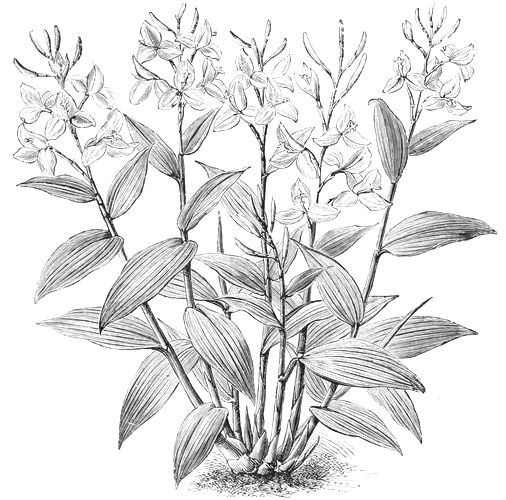
FIG. 302. BURBIDGEA NITIDA.
B. argentea (silvery).* fl. yellow; racemes opposite, simple, pubescent. July. l. lanceolate, silvery beneath. Branches puberulous. h. 10ft. Caraccas, 1810.
B. glandulifera (gland-bearing). fl. yellow; racemes simple, axillary. March to May. l. elliptical-ovate, on short petioles, wavy, pubescent on both surfaces, furnished with four glands beneath at the base. h. 10ft. Caraccas, 1806.
B. nitida (shining). fl. yellow; racemes elongated, almost the length of the leaves. July. fr. large, red; it is much eaten by turkeys and other large fowl. l. 4in. long, oblong, acuminated, smooth, glandless. h. 4ft. Jamaica, 1800.
B. odorata (fragrant).* fl. yellow, sweet-scented; racemes opposite. May. l. ovate, emarginate, downy on both surfaces. h. 7ft. Carthagena, 1806.
BUPHTHALMUM (from bous, an ox, and ophthalmos, the eye; the disk of the flower being ox-eye-like). Oxeye. ORD. Compositæ. Very showy and ornamental hardy perennial plants, thriving freely in common garden soil. They are propagated by divisions, made in autumn or spring.
B. grandiflorum (large-flowered).* fl.-heads yellow, large; involucre naked. June to October. l. alternate-lanceolate, somewhat toothleted, smooth. h. 1½ft. Austria, 1722. Hardy herbaceous perennial.
B. salicifolium (Willow-leaved).* fl.-heads yellow, solitary, rather large, terminal; involucre naked. June. l. alternate, oblong-lanceolate, sub-serrated, three-nerved, villous. h. 1½ft. Austria, 1759. Hardy herbaceous perennial.
B. speciosissimum (showiest).* fl.-heads yellow. July. h. 2ft. South Europe, 1826. Hardy herbaceous perennial. SYN. Telekia speciosissima.
BUPLEURUM (derivation not satisfactorily explained). Hare's-Ear. ORD. Umbelliferæ. A somewhat extensive genus of quite glabrous shrubs or herbaceous plants. Flowers yellowish; umbels compound. Leaves mostly quite entire. But few of this genus are worth growing, and all are of the easiest culture in common garden soil. Seeds of the annuals may be sown out of doors in March or April; divisions of the herbaceous perennials made in autumn or spring; and cutting or divisions of the greenhouse species, in March or April.
B. fruticescens (shrubby).* fl., umbels small, three to five-rayed; involucre of three to five, very short, subulate leaves. August. l. linear-subulate, stiff, striated, five to seven-nerved. Branches slender, elongated, erect. h. 1ft. Spain, 1752. Hardy and evergreen.
B. fruticosum (shrubby).* Leaves of involucre oblong. July. l. of a sea-green colour; oblong, attenuated at the base, coriaceous, one-nerved, quite entire, sessile. Bark of branches purplish. h. 3ft. to 6ft. Spain, 1596. Hardy. This is nearly the only species grown. (W. D. B. 1, 14.)
B. gibraltarica (Gibraltar). fl. yellow. June. l. lanceolate, one-nerved, coriaceous. h. 3ft. Gibraltar, 1784. Evergreen, half-hardy.
B. graminifolium (Grass-leaved).* fl. green-yellow. June. l. linear, grass-like. h. 6in. Switzerland, 1768. Hardy perennial.
B. longifolium (long-leaved). fl. green-yellow. June. l. ovate-oblong; radical ones stalked; cauline ones amplexicaul. h. 3ft. Switzerland, 1713. Hardy perennial.
BUR. See Centotheca lappacea.
BURBIDGEA (named after F. W. Burbidge, the discoverer of the genus, a traveller in Borneo, and author of several horticultural works). ORD. Scitamineæ. A very large, brilliant-flowered stove herbaceous perennial, allied to Hedychium. For culture, see Alpinia.
B. nitida (shining).* fl., perianth-tube 1in. to 1½in. long, slender; outer segments 1½in. to 2in. in diameter, bright orange-scarlet; panicle terminal, 4in. to 6in. long, many-flowered. Summer. l. 4in. to 6in. long, elliptic-lanceolate, cordate-acuminate, rather fleshy, bright green above. Stems tufted, 2ft. to 4ft. high, slender, terete, leafy. N. W. Borneo, 1879. See Fig. 302, for which we are indebted to Messrs. Veitch and Sons. (B. M. 6403.)
BURCHARDIA (named after H. Burchard, M.D., a botanical author). ORD. Liliaceæ. An ornamental greenhouse herbaceous perennial, allied to Androcymbium. It thrives best in sandy peat, or peat mixed with a little loam. Propagated by offsets or divisions, made just previous to potting, in spring. It is best to repot annually. Good drainage should be allowed, and the plant must not be potted too firmly.
B. umbellata (umbelled). fl. white, green. August. h. 2ft. New Holland, 1820.
BURCHCHELLIA (named after W. Burchell, a botanical traveller in the Cape of Good Hope, and in Brazil). ORD. Rubiaceæ. A stove evergreen shrub from the Cape of Good Hope. Flowers scarlet, disposed in heads at the tops of the branches, sessile upon a villous receptacle, intermixed with small distinct bracteoles; and each head is propped up by the ultimate pair of leaves; corolla of a clavate-funnel-shape. Leaves ovate, acute, a little cordate at the base, petiolate; stipules interpetiolar, broad, cuspidate at the apex, deciduous. It grows well in a rich light soil, or a mixture of turfy loam, turfy peat, and sand. Cuttings, not too ripe, root readily if planted in sand, and placed under a hand glass, in a gentle heat.
B. bubalina (buffalo). A synonym of B. capensis.
B. capensis (Cape).* fl. deep scarlet, nearly 1in. long. March. l. ovate, acute, clothed with hispid pubescence; stipules very broad, and very short. h. 3ft. to 5ft.; 12ft. to 14ft. in a wild state. SYN. B. bubalina. (B. M. 2339.)
BURLINGTONIA (named after the "amiable and accomplished" Countess of Burlington). ORD. Orchideæ. A small genus of epiphytal orchids, all of which are beautiful and eminently well worth growing. They may be grown upon small blocks of wood, or in rustic baskets, suspended from the roof of the plant stove, where, if liberally treated with water, and a genial moisture in the air during the growing season, very little else will be required to ensure health and vigour. In the dull days of winter, they should be watered less frequently, but the plants must not be allowed to exhibit the slightest signs of distress from drought, or the consequences may be fatal to their health. When fastening these plants to blocks of wood, a little sphagnum should be used, for experience proves that they thrive best when their thin white roots can escape and hang exposed to the air. If growing them in baskets, it is preferable first to fasten them securely upon small pieces of bare cork, then to fill the basket, and finally to cover the whole thinly with a layer of sphagnum.
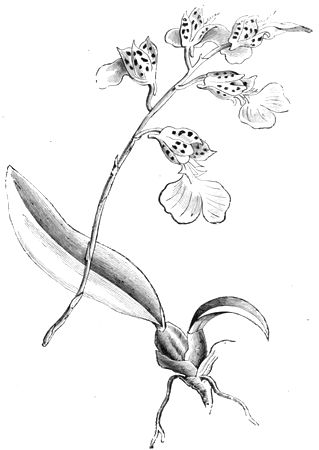
FIG. 303. FLOWER-SPIKE, PSEUDO-BULB, AND LEAF OF BURLINGTONIA DECORA.
Generally speaking, this genus is not a difficult one to cultivate; its great enemy is a small white scale, which secretes itself in the sheathing bases of the leaves. Here it rapidly multiplies, to the great detriment of the plants; the leaves soon turn yellow at the base, and drop off; the whole plant looks sickly, and soon dies, or else requires a very long time and much trouble to achieve its recovery to health. To prevent this, the bases of the leaves must be carefully looked into every time the plants are taken down to be dipped in water; and, should the slightest sign of this pest appear, a thorough washing with soft soap and tepid water must be given, repeating the operation every day until all traces of the insect are removed. Red thrip are also apt to work much mischief with these plants. They take up their abode in the same way as the white scale, and if not speedily removed or destroyed, soon make sad havoc. To put a stop to the ravages of this pest, a wash should be given, as before recommended, and after the soap has been rinsed out of the base of the leaf, a little tobacco powder should be sprinkled into the hollows, and allowed to remain for a day or two before brushing it off. This process will, however, cause a somewhat dirty appearance, but it will ensure ultimate health and vigour. Propagated by dividing the plants.
B. Batemanni (Bateman's).* fl. white, deliciously-scented; lip beautiful mauve. A very pretty South American species, resembling B. candida.
B. candida (white).* fl. snowy-white, with a slight stain of yellow on the upper part of the lip, in substance and appearance like white satin, trimmed with gold; large, sweet-scented, in gracefully drooping three to four-blossomed racemes, produced from the axils of the leaves. April and May, lasting about three weeks in perfection, and sometimes having a second flowering season. l. one or two in number, dark green, and firm in texture. h. 1ft. Demerara, 1834. A very compact species, well suited for basket culture; it should never be allowed to get dry. It may be distinguished from other species by having a single row of tubercles, forming a ridge upon each side of the slightly hastate lip. (B. R. 1927.)
B. decora (comely).* fl. white or rose-coloured, spotted with red; lip pure white; scapes erect, five to ten-flowered. Winter. Brazil, 1852. This species differs entirely from B. candida, inasmuch as it possesses a long slender-rooting stem, from different parts of which arise small oval pseudo-bulbs, each bearing a leaf; a lesser leaf appears at the base of a bulb, and from the axil of this the scape springs. It is a rather straggling but nevertheless beautiful species, and is best grown fastened upon long strips of cork, a little sphagnum being used in the operation; whilst, to prevent the plant getting too much "away from home," the young growths should be twisted back as they advance, and the practice continued until the pseudo-bulb is ultimately left near the centre, or in any spot which may appear bare. It likes strong heat and a very moist atmosphere, when growing; but during the period of rest, it should be kept cool and dry. See Fig. 303. (B. M. 4834.)
B. d. picta (painted).* A beautiful variety, differing from the type in having shorter and more acute leaves; flowers produced in greater profusion, rose-coloured, beautifully mottled and blotched with dark purple. October. Brazil. (B. M. 5419.)
B. fragrans (fragrant).* fl. very gratefully fragrant, disposed in erect racemes. April, remaining in perfection about three weeks. l. long, rigid, dark green. Habit compact. Brazil, 1850.
B. pubescens (downy). fl., sepals and petals snow-white; distinguished by the somewhat hastate lip, which has three yellow ridges on each side, and also by the downy column. November. h. 6in. Brazil, 1850.
B. rigida (rigid).* fl. purplish-white, spotted with pink on the lip; produced in heads. h. 1ft. Brazil, 1838. A handsome plant, but difficult to flower. (L. S. O. 36.)
B. venusta (charming).* fl. white, slightly tinted with pink; produced in heavy pendulous clusters at various seasons of the year; lip stained with yellow. l. rigid, dark green. Brazil, 1840. It forms a compact mass, and requires less heat than the kinds previously described. It is often confounded with B. pubescens, from which it may be distinguished by its larger and more loosely arranged flowers, by its smooth column, by the lip not being hastate in shape, and by the numerous shallow ridges borne near the base upon each side. (L. S. O. 2.)
BUR MARIGOLD. See Bidens.
BURNET (Poterium Sanguisorba; from poterion, a cup; being used in cooling drinks). ORD. Rosaceæ. A native perennial. The leaves are sometimes used in soups, and with Borage in cooling drinks; they are also put in salads. The foliage only being useful, keep the flower-spikes removed, as this tends to increase the luxuriance of the plants. It thrives in any light soil. Propagated by division.
BURNET SAXIFRAGE. See Pimpinella.
BURNING BUSH. See Euonymus atropurpureus and E. americanus.
BURN ONION. See Potato Onion.
BUR REED. See Sparganium.
BURSARIA (from bursa, a pouch; the capsules very much resemble those of the Shepherd's Purse). ORD. Pittosporaceæ. A handsome, much-branched, greenhouse evergreen shrub, forming a very pretty object when covered all over with its elegant white blossoms. It thrives well in a compost of sandy loam and peat, in equal proportions. Young cuttings will root freely in sand, under a bell glass, with a little bottom heat.
B. spinosa (thorny).* fl. white, small, disposed either in lateral or terminal panicles. July to December. l. small, oblong-cuneated, entire. h. 10ft. New Holland, 1793. (B. M. 1767.)
BURSERA (named after Joachim Burser, a disciple of Caspar Bauhin). ORD. Burseraceæ. Stove balsam-bearing trees. Flowers polygamous, or hermaphrodite; calyx small, four to six-toothed; petals four to six, spreading, generally valvate in æstivation; stamens eight to twelve; disk annular, with usually six to ten teeth; drupe oblong, covered by a three-valved succulent rind, containing three to five nuts. They thrive in a compost of loam and peat. Propagated by cuttings, placed under a glass, with bottom heat.
B. gummifera (gum-bearing). fl. whitish, hexandrous; racemes terminal and axillary. l. deciduous, usually impari-pinnate; leaflets ovate, acute, membranous. h. 60ft. West Indies, 1690.
B. serrata (serrate).* fl. whitish, decandrous; panicles axillary, shorter than the leaves. l. impari-pinnate, with three to five pairs of broad-lanceolate, bluntly-acuminated, serrulated leaflets; petioles and pedicels pubescent. h. 25ft. India, 1818.
BURSERACEÆ. An order of shrubs or trees, abounding in resinous juice; with opposite compound leaves, full of pellucid dots, and axillary and terminal fascicles of flowers. Fruit indehiscent, somewhat drupaceous. The genera best known are Amyris, Balsamodendron, Boswellia, Bursera, and Canarium.
BURTONIA (named after D. Burton, a plant collector for Kew Gardens). ORD. Leguminosæ. A genus of handsome greenhouse dwarf Heath-like shrubs, natives of West Australia. Flowers axillary, often thickly gathered at the ends of the branches; corollas rich purple; keel generally of a deeper colour, and the standard having sometimes a yellow blotch at its base. Leaves simple or trifoliolate, sessile, usually awl-shaped. They thrive well in a mixture of loam, peat, leaf soil, and sand, in equal proportions, with thorough drainage; but care must be taken not to give them too much water, as they require to be kept moderately dry, and are difficult to preserve in a living state. Young cuttings root freely in a pot of sandy soil, in a cool house, with a bell glass placed over them; but some of the species produce seed in abundance, which are the best means of increasing them.
B. conferta (cluster-flowered).* fl. violet. July. l. simple, very much crowded, six to eight lines long, linear-subulate, with revolute margins, and are, as well as the branches, smooth. h. 2ft. 1830. (B. R. 1600.)
B. minor (smaller). A synonym of Gompholobium minus.
B. pulchella (beautiful). A synonym of B. scabra.
B. scabra (rough).* fl. purple; peduncles axillary, bi-bracteate. April. l., leaflets glabrous, linear-mucronate. Branches puberulous. h. 2ft. 1846. SYN. B. pulchella. (B. M. 5000.)
B. villosa (villose). fl. purple, large; peduncles axillary, bi-bracteate. May. l., leaflets linear-subulate, bluntish, scabrid. h. 2ft. 1846. (B. M. 4410.)
BUSHEL. See Measures.
BUTCHER'S BROOM. See Ruscus aculeatus.
BUTEA (commemorative of John, Earl of Bute, once a munificent patron of botany). ORD. Leguminosæ. A genus of very ornamental stove evergreen unarmed trees. Racemes many-flowered; flowers three together, on short pedicels, and furnished with two bracteoles each, under the calyx; corolla deep scarlet; down on the calyces usually black and velvety. Leaves pinnately-trifoliate; leaflets large, ovate, roundish, stipellate. For culture, &c., see Erythrina.
B. frondosa (leafy). fl. 2in. long. l., leaflets roundish, obtuse, or emarginate, rather velvety beneath. Branches pubescent. h. 40ft. India, 1796. (B. F. S. 176.)
B. superba (superb).* l., leaflets roundish, obtuse, velvety beneath. Branches glabrous. Coromandel, 1798. This approaches the preceding species, from which it differs mainly by its scandent habit, and not by any botanical characters. (B. F. F. 143.)
BUTOMACEÆ. An order of aquatic plants, now usually included under Alismaceæ.
BUTOMUS (from bous, an ox, and temno, to cut; in reference to the sharp leaves, which injure the mouths of cattle that browze upon them). Flowering Rush. ORD. Alismaceæ. A very handsome hardy perennial aquatic, of extremely easy culture on the margins of ponds or muddy banks. Propagated by divisions of the roots, in spring.
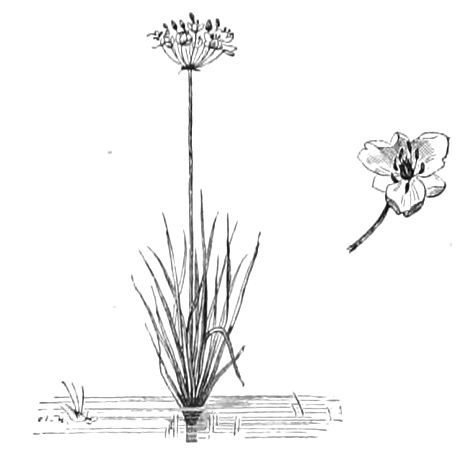
FIG. 304. BUTOMUS UMBELLATUS, showing Habit and single Flower.
B. umbellatus (umbelled).* fl. rose-coloured, umbellate; pedicels with scariose sheathing bracts at the base; scape naked, terete, longer than the leaves. Summer. l. all radical, 2ft. to 3ft. long, linear, acuminate, triquetrous. Ditches and ponds; frequent in England, and rare in Ireland. See Fig. 304.
BUTTER AND EGGS. The double-flowered variety of Narcissus aurantius (which see).
BUTTER AND TALLOW TREE. See Pentadesma.
BUTTER-BUR. See Petasites vulgaris.
BUTTERCUPS. See Ranunculus.
BUTTERFLY ORCHIS. See Habenaria bifolia and H. chlorantha.
BUTTERFLY PLANT. See Oncidium Papilio.
BUTTER NUT. See Caryocar and Juglans cinerea.
BUTTERWORT. See Pinguicula.
BUTTON FLOWER. See Gomphia.
BUTTON-TREE. See Conocarpus.
BUTTON-WOOD. See Cephalanthus.
BUXUS (from pyknos, dense; referring to the hardness of the wood). Box Tree. ORD. Euphorbiaceæ. A genus of hardy evergreen shrubs or small trees. Flowers unisexual, monœcious; male flowers, calyx of four minute segments, stamens four, inserted under the rudiment of a pistil; female flowers singly, at the tips of groups of male ones. Fruit, a regma, leathery, beaked with the styles. Leaves simple, opposite, exstipulate, evergreen. These well-known plants thrive in any light, well-drained soil. Seeds should be sown in similar situations as soon as ripe. Cuttings, made of the young shoots, from 4in. to 6in. in length, inserted in a shady place, in August or September, root readily. Layers of either young or old wood, made in autumn or early spring, will make good plants. They can also be increased by suckers and division.
B. balearica (Balearic).* l. yellowish-green, oblong-elliptical, emarginate, coriaceous, about 2in. long, with a cartilaginous margin. h. 15ft. to 20ft. South Europe, 1780. This is a handsome species. The cuttings will require a shelter in winter, and in exposed situations it will be better to afford the plants protection.
B. sempervirens (evergreen).* Common Box. l. oval-oblong, retuse, convex, coriaceous, shining; stalks slightly hairy. h. various. England. There are numerous forms of this popular shrub: argentea, silver-variegated; aurea has its leaves variegated with a golden colour; marginata has leaves with a golden margin; myrtifolia has small, oblong, narrowish leaves; obcordate-variegata is a variegated variety, with obcordate leaves, from Japan; suffruticosa is the form usually cultivated for edgings, its leaves are small, obovate, this is readily increased by divisions, and requires to be planted firmly, in order to keep it dwarf.
BYRSONIMA (from byrsa, a hide, and nimius, much used; because the bark of some of the species is used in tanning, in Brazil). ORD. Malpighiaceæ. Ornamental stove evergreen trees or shrubs. Flowers racemose, terminal, simple or branched. All the species thrive very well in any light soil, or a mixture of loam and peat. Cuttings made of half-ripened shoots will root freely in sand, under a hand glass, in a moist bottom heat.
B. altissima (tallest).* fl. white; racemes clothed with rufous hairs. July. l. ovate-oblong, covered with rufous down beneath, but beset with bristles above, which are fixed by the centre. h. 60ft. Guiana, 1820.
B. chrysophylla (golden-leaved).* fl. yellow; racemes simple. August. l. oblong, short, acuminated, acute at the base, rather wavy on the margin, and revolute, smooth above, clothed beneath with silky down, which is of a rusty golden colour. h. 14ft. South America, 1823.
B. coriacea (leathery-leaved). fl. yellow, sweet-scented; racemes densely spiked, pubescent, erect. May. l. ovate, acute, quite entire and smooth. h. 30ft. Jamaica, 1814.
B. crassifolia (thick-leaved). fl. yellow; racemes erect, elongated, brownish-velvety. July. l. ovate, acute at both ends, at length smooth above, but clothed with brownish down beneath. h. 6ft. Guiana, 1793.
B. lucida (shining).* fl. pink; petals hastately kidney-shaped; pedicels hispid; racemes spiked, erect, short, smooth. May. l. obovate, cuneiform, obtuse, or mucronate, smooth, veinless, shining. h. 8ft. Caribbee Islands, 1759. Described as "a beautiful shrub."
B. verbascifolia (Verbascum-leaved). fl. yellow; racemes terminal. July. l. lanceolate-obovate, quite entire, downy on both surfaces. h. 6ft. Guiana, 1810.
BYSTROPOGON (from byo, to close, and pogon, a beard; in reference to the throat of the flower being closed up with hairs). ORD. Labiatæ. Greenhouse evergreen sub-shrubs, nearly allied to Mentha. Flowers small, in dichotomous, sub-corymbose, or panicled cymes; or else disposed in dense spicate whorls. Bracts lanceolate or subulate. This genus contains easily cultivated species, which are, however, of no value for garden purposes.
CAA-CUYS. See Ilex paraguariensis.
CAA-MINI. See Ilex paraguariensis.
CAAPEBA. See Cissampelos Pareira.
CAAPIM DE ANGOLA. See Panicum spectabile.
CAA-QUAZU. See Ilex paraguariensis.
CABARET. The French name of Asarum europæum.
CABBAGE. The common name for Brassica; but especially applied to the plain-leaved hearting garden varieties of Brassica oleracea. To obtain good tender Cabbages in early spring and throughout the summer, it is necessary that they should be planted on rich, deeply-trenched ground, in a position free from the shade of fruit or other trees. Stable dung or good farmyard manure is best for this crop, and should be applied when trenching is being done, burying the manure a spit below the surface. Cabbages should not be planted successionally on the same ground, nor should they follow any of the other species of Brassica, if it can be avoided. A warmer position, not too much sheltered to make the plants tender, will be found beneficial for the earliest spring crop. This should not be planted too soon in autumn, as the plants are more subject to run to seed, especially if the winter be mild. The several forms of Cabbage are well known, being so much cultivated by cottagers as well as gardeners. None of those forming close hearts will bear severe frost, but the Savoys are improved by a little in the early autumn. The Coleworts are very useful in winter, being perhaps the hardiest of all; and, as the hearts do not get so close and hard as the Savoy and other Cabbages, the frost, unless it is very severe, does not injure them so much.
Cultivation. The crop obtained in April and May is usually the most important one, young Cabbages being then much appreciated by everyone. The time for seed-sowing varies in different localities, from the third week in July to the middle of August. The first date would probably prove suitable for the northern parts of the country; and the latter would be early enough for the south. The seed should be sown thinly in beds of rather light, well pulverised soil, afterwards covering these with netting, to protect the seed from birds. The plants will be ready, in most cases, for placing out during September, or as soon as the ground can be cleared of other crops and prepared for their reception. The Early Battersea, or one of its many allied sorts, is best for sowing at this season; and, when planting out, an allowance of 2ft. apart each way will be sufficient. Seed should again be sown on a mild hotbed in February, and occasionally afterwards, for succession; and a second crop may be obtained from the plants put out in autumn if they are allowed to remain. Drumhead and other strong-growing sorts, sown in spring, will require from 6in. to 1ft. more space when planted out. These are not, however, of such good quality as the smaller-growing varieties.
Savoys. The seed of these should be sown in March or April, according to the locality, in the same way as described above, in seed beds; and the after treatment is also very similar. The young plants must not be allowed to starve in the seed bed, but should be kept watered, and planted out in June and July, choosing dull weather for the operation. The ground should occasionally be hoed between the plants, to keep the surface open and destroy weeds. Distances of from 15in. to 30in. between the plants, according to the variety, must be allowed. See Fig. 305.
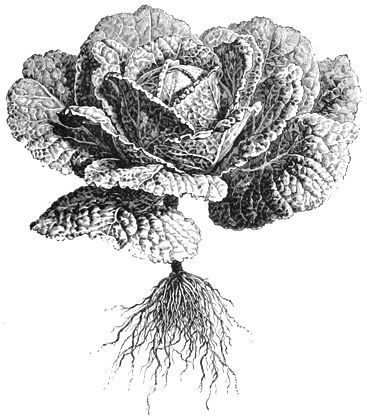
FIG. 305. SAVOY CABBAGE.
Coleworts. Seed of these should be sown about the end of June, and planted out 1ft. apart on a sheltered border, when large enough. Rosette is one of the best varieties; but the early Cabbages are often grown and used as Coleworts before they have had time to form close hearts.
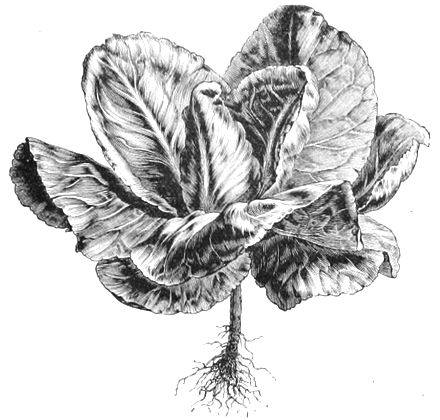
FIG. 306. EARLY YORK CABBAGE.
Pickling Cabbage. The Red Dutch is the variety generally grown for pickling, and is probably the best to keep its colour when so treated. Seed should be sown in August, to stand the winter, and again in February for a succession; only a few plants will, in the majority of cases, be required, as, if liberally treated, they grow to a good size.
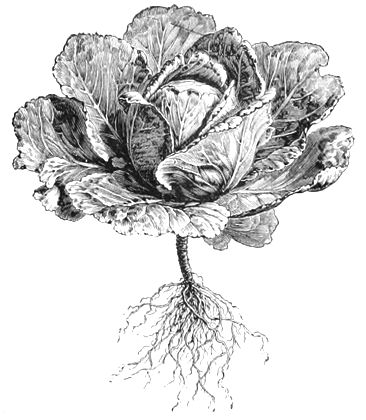
FIG. 307. OXHEART CABBAGE.
Sorts of White Cabbage. These are extremely numerous, and selections or improved forms are of annual appearance. Some of the old types are, however, still much cultivated. The following are a selection of the best sorts for general purposes: Atkins' Matchless, Carter's Heartwell, Early Battersea, Early York (see Fig. 306), Ellam's Early Dwarf, Enfield Market, Little Pixie, Oxheart (see Fig. 307), St. John's Day (see Fig. 308), Sugarloaf, Wheeler's Imperial, and Portugal or Couve Tronchuda. The last-named variety was introduced from Portugal some years ago, where it is much grown. It has a large midrib, and does not form very close hearts. It is very tender when cooked, and is only suitable for culture in summer. Under the name of Gilbert's Cabbage Broccoli, or Chou de Burghley, a variety of Cabbage was recently distributed which produces, if left long enough, hearts resembling Broccoli. Although there are different opinions as to its merits, it is said to be very tender when cooked, and is considered a decided acquisition.
Of Savoys, the best are: Drumhead, Dwarf Green Curled, Early Ulm, Large Late Green, and Tom Thumb.
FIG. 308. ST. JOHN'S DAY CABBAGE.
Insects, &c. The majority of the Cabbage tribe is attacked by a very large number of different caterpillars and other pests, both above and below ground. The plants in their young stages are always a prey for snails and slugs, and often require a dusting of soot and lime as a protection. When planting out, many of the plants are often found with a protuberance at the root, caused by an insect, and termed "clubbing." Those so injured should be thrown away if they can possibly be spared, and the others dipped in a thick solution of soot water. This is the worst kind of disease the Cabbage tribe is subject to. The caterpillars of several moths and butterflies are very destructive in summer, often eating through the hearts of Cabbages and Cauliflowers, and so rendering them totally unfit for use. Hand-picking, or dusting with lime, is apparently the only means of diminishing the numbers of these pests.