THE DICTIONARY OF GARDENING, (continued 11)
Reading edition
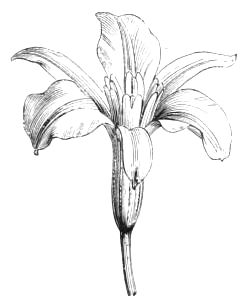
FIG. 205. FLOWER OF BARBACENIA PURPUREA.
B. purpurea (purple).* fl. funnel-shaped, six-cleft, terminal, solitary; ovarium elongated, tuberculated. July. l. linear, keeled, with spiny serratures. h. 1½ft. Brazil, 1825. See Fig. 205. (B. M. 2777.)
B. Rogieri (Rogers').* fl. purple; scape and ovaria tubercled; filaments broad, bifid. July. l. linear, acuminated, imbricate, with broad stem-clasping bases, finely spinely serrated on the margin, and keel recurved; caudex short. h. 1½ft. Brazil, 1850. (L. J. F. 82.)
BARBADOS CHERRY. See Malpighia.
BARBADOS GOOSEBERRY. See Pereskia aculeata.
BARBADOS LILY. See Hippeastrum equestre.
BARBAREA (anciently called Herb of St. Barbara). Winter Cress; American Cress. ORD. Cruciferæ. Hardy glabrous perennial herbs. Flowers yellow; racemes erect, terminal. Stems erect. They are of easy culture, but scarcely worth growing in the pleasure garden. Propagated by cuttings, suckers, divisions, or seeds.
B. præcox (early). l., lower ones lyrate; terminal lobe ovate; upper ones pinnate-parted; lobes linear-oblong, quite entire. h. 1ft. to 1½ft. Commonly known as American, or Black American Cress. Here and there on roadsides, and in dry gravelly places in Great Britain. An escape from cultivation. (Sy. En. B. 124.)
B. vulgaris (common). l., lower ones lyrate; terminal lobe roundish; upper ones obovate, toothed, or pinnatifid. h. 1¼ft. The double flowering form of this native species is the only one of this genus worth growing for beauty; it is generally known as Double Yellow Rocket. The variegated form is also rather pretty, and comes true from seed. (Sy. En. B. 120.)
BARBATUS. Having long weak hairs, in one or more tufts; bearded.
BARBERRY. See Berberis.
BARBIERIA (in honour of J. B. G. Barbier, M.D., a French physician and naturalist, author of "Principes Generaux de Pharmacologie ou de Matière Medicale," Paris, 1806). ORD. Leguminosæ. An ornamental stove evergreen, requiring a mixture of peat, loam, and sand. Propagated by cuttings of half-ripened wood, which should be placed in sand, under a glass, in stove heat.
B. polyphylla (many-leaved).* fl. scarlet, 2in. long; racemes axillary, few-flowered, shorter than the leaves. l. impari-pinnate, with nine to eleven pairs of elliptic-oblong, mucronate leaflets, pubescent in an adult state. Porto Rico, 1818. SYNS. Clitorea polyphylla and Galactia pinnata.
BARBS. Hooked hairs.
BARK. The outer integuments of a plant beyond the wood, and formed of tissue parallel with it.
BARK-BOUND. This condition is generally the result of very rich soil, or insufficient drainage. In most fruit trees a gummy exudation takes place. If caused by stagnancy, thorough drainage should immediately be effected. Scrubbing the stem is also recommended. Slitting the bark with a knife is likely to do more harm than good, particularly so in the hands of the inexperienced.
BARKERIA (name commemorative of the late G. Barker, of Birmingham, an ardent cultivator of orchids). ORD. Orchidaceæ. From a scientific point of view, this genus should be included in Epidendrum. Very handsome, deciduous, epiphytal, cool-house orchids, having slender pseudo-bulbs, from 6in. to 12in. high, from the top of which the numerous flower-stems are produced. In a cool, airy temperature, these plants grow vigorously, suspended in pans or small baskets close beneath the glass, and slightly shaded with tiffany. They succeed well also on flat blocks of wood, on the top of which they should be tied, without any moss, as their freely-produced, thick, fleshy roots soon cling to the blocks. During the season of growth, a good supply of water is needed, and in hot weather it may be applied three or four times daily; the blocks and plants are best immersed in water; but when at rest, a slight watering twice or three times a week will suffice. Propagated by divisions, just previous to the commencement of new growth.
B. elegans (elegant).* fl. in loose racemes, four or five in each; each blossom about 2in. across; sepals and petals dark rose; lip reddish crimson, spotted and edged with a lighter colour. Winter. h. 2ft. Mexico, 1836. Of this beautiful slender-growing species, there are two or three varieties in cultivation. (B. M. 4784.)
B. Lindleyana (Lindley's).* fl., raceme 2ft. long, very slender, bearing from five to seven blossoms near its apex; sepals and petals rosy purple; lip white, with a deep purple blotch at its apex. September, remaining in beauty for a considerable time. h. 2ft. Costa Rica, 1842. (B. M. 6098.)
B. L. Centeræ (Center's).* fl. rosy lilac; lip oblong; margins crenulated or crisped; apex blotched deep purple. Costa Rica, 1873.
B. melanocaulon (dark-stemmed).* fl. on an erect spike; sepals and petals rosy lilac; lip broader at the base than at the top, reddish-purple, having a blotch of green in the centre. August. h. 1ft. Costa Rica, 1848. Very rare.
B. Skinneri (Skinner's).* fl. deep rose-coloured; spikes 6in. to 9in. long, from the apices of the ripened growth, often branched, forming a dense mass of deep purple blossoms, which, if kept dry, lasts from eight to ten weeks. h. 1½ft. Guatemala. (P. M. B. 15, 1.)
B. S. superbum (superb).* fl. dark rose; lip somewhat deeper tinted, and marked towards the base with yellow streaks. Guatemala. This far surpasses the type in size and number of flowers, as well as in brilliancy of colour. (W. S. O. 38.)
B. spectabilis (showy).* fl. quite 2in. across, produced eight or ten together, on a spike issuing from the top of the pseudo-bulb; sepals and petals oblong, acuminate, rosy lilac; lip white, margined with deep lilac or rosy purple, and dotted or spotted with crimson. This very distinct and desirable species lasts from eight to ten weeks in beauty, and forms a very handsome object when placed in the drawing-room and covered over with a large glass shade. Guatemala, 1843. (B. M. 4094.)
BARKING-IRONS. Instruments used in taking off the bark of trees.
BARKLYA (named after Sir H. Barkly, formerly Governor of South Australia). ORD. Leguminosæ. A large greenhouse tree, thriving in a compost of loam and leaf mould. Propagated by seeds and cuttings; the latter should be half ripened, and placed in sandy soil, under a bell glass, in a cool house.
B. syringifolia (Syringa-leaved). fl. golden yellow, numerous, disposed in axillary or terminal racemes. l. alternate, simple, coriaceous. h. 30ft. Moreton Bay, 1858.
BARK STOVE. A hothouse adapted for moisture-loving exotics, and having a pit from 2ft. to 4ft. deep, containing fermenting matter, chiefly tanners' bark, by which means a steady heat is maintained for a considerable time. The Bark Stove is now almost obsolete. Bark is, however, still largely used in pine pits, and in some propagating beds; but such beds are generally superseded by hot-water or hot-air tanks.
BARLERIA (named after J. Barrelier, a French botanist of the seventeenth century). ORD. Acanthaceæ. A genus of interesting and ornamental stove evergreen shrubs. Flowers axillary or terminal; calyx four-sepaled, the two outer larger than the others. They thrive best if grown in loam and peat, with a little rotten dung added. Propagated by cuttings made of the young wood, and placed in a similar compost, under a bell glass, in stove temperature, with bottom heat.
B. flava (yellow).* fl. yellow, aggregate, terminal, tubular; bracts very narrow, setose. Summer. l. lanceolate, hairy, entire. Plant unarmed. h. 3ft. India, 1816. SYN. B. mitis. (B. M. 4113.)
B. Gibsoni (Gibson's). fl. pale purple, rather large, sub-terminal. Winter. l. ovate or oblong-lanceolate. India, 1867. A glabrous stove shrub, of branched habit. (B. M. 5628.)
B. Leichtensteiniana (Leichtenstein's).* fl. very curious; spikes axillary, 2in. to 3in. long, ovoid or oblong, consisting of a large number of closely packed overlapping bracts, all turned to the fore or lower part of the spike; bracts ovate-acuminate, mucronate, spine-toothed, one-ribbed, with prominent and curved veins, and 1in. to 1½. long. l. opposite, 1in. to 2in. long, linear-lanceolate, entire, mucronate, tapering at the base into a very short stalk. Branches slender, virgate, sub-angular. South Africa, 1870. This plant is covered over its whole surface with close, white, hoary down. (G. C. 1870, p. 73.)
B. longifolia (long-leaved). fl. white; spines of whorls six. Summer. l. ensiform, very long, rough. h. 2ft. India, 1781. This is a biennial.
B. lupulina (Hop-headed). fl. yellowish; spikes ovate; bracts ovate, concave, imbricated. August. l. lanceolate, quite entire; spines simple, spreading. h. 2ft. Mauritius, 1824.
B. Mackenii (MacKen's).* fl. purple, large, in a terminal raceme. Spring. l. recurved, narrow-ovate, or elliptic-lanceolate, sub-acute, petioled. Natal, 1870. (B. M. 5866.)
B. mitis (small). Synonymous with B. flava.
B. prionitis (Prionitis-like). fl. orange; spines axillary, pedate, in fours. Summer. l. quite entire, lanceolate-ovate. h. 3ft. India, 1759.
BARLEY. See Hordeum vulgare.
BARNADESIA (named after Michael Barnadez, a Spanish botanist). ORD. Compositæ. Pretty greenhouse deciduous shrubs, requiring a dry atmosphere. They should be grown in peat, loam, and sand, in equal proportions. Propagated either by seeds, sown in hotbeds in March, or by cuttings, made of half-ripened wood in April, and placed in sand under a bell glass.
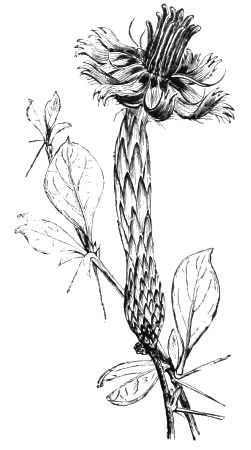
FIG. 206. BARNADESIA ROSEA.
B. rosea (rosy).* fl.-heads rose-coloured, solitary, ovate-cylindrical, downy, sessile; florets bilabiate, one lip oblong-emarginate, villous, the other filiform; hairs on receptacle twisted; pappus stiff, plumose. May. l. alternate, ovate, acute at both ends. h. 1½ft. South America, 1840. See Fig. 206. (B. M. 4232.)
BARNARDIA. Included under Scilla (which see).
BAROMETER. An instrument for measuring the density of the atmosphere, and hence determining the probable changes of weather, or the height of any ascent. To the gardener the Barometer is indispensable as a warning to take due precaution.
BAROSMA (from barys, heavy, and osme, smell; referring to the powerful scent of the leaves). Name often incorrectly spelt Baryosma. SYN. Parapetalifera. ORD. Rutaceæ. Very pretty small, Heath-like, greenhouse evergreen shrubs, from the Cape of Good Hope. Calyx equally five-parted; petals five, oblong; stamens ten. Leaves opposite or scattered, coriaceous, flat, dotted, with their margins sometimes glandularly serrulated, sometimes almost entire or revolute. They thrive in a mixture of sand, peat, and a little turfy loam, with good drainage and firm potting. Cuttings, taken from ripened wood, inserted in a pot of sand, and placed in a shady position in a cool house, with a bell glass over them, will root readily in a few weeks.
B. betulina (Birch-leaved). fl. white, axillary, solitary. February to September. l. opposite, obovate, serrulate, sessile, spreading. h. 1ft. to 3ft. 1790. (B. M. Pl. 45.)
B. dioica (diœcious).* fl. purplish; peduncles axillary, usually in threes, shorter than the leaves. April. l. scattered; upper ones ternate, lanceolate, tapering to both ends, full of glandular dots, spreading. h. 1ft. to 2ft. 1816. (B. R. 502.)
B. latifolia (broad-leaved). fl. white, usually solitary, lateral. July. l. opposite, ovate-oblong, sessile, serrulated, smoothish, without glandular dots; branches villous. h. 1ft. 1789.
B. pulchella (pretty).* fl. pale red or purple; peduncles axillary, usually solitary, exceeding the leaves. February. l. crowded, ovate, quite smooth, with thickened, crenate-glandular margins. h. 1ft. to 3ft. 1787.
B. serratifolia (saw-edged-leaved).* fl. white; peduncles axillary, sub-divided. March to June. l. nearly opposite, lanceolate, stalked, glandularly serrulated, smooth. h. 1ft. to 3ft. 1789. (B. M. 456, and B. Z. 1853, 12.)
BARRED. Marked in spaces with a paler colour, resembling bars.
BARREN FLOWERS. The male or staminate flowers of many plants, such as the Cucumber, Melon, &c., are popularly known as Barren Flowers, i.e., they produce no fruit. This condition is, in some respects, similar to "blind" Strawberries or "blind" Cabbages, so far as fruition is concerned, but structurally and functionally it is widely different. The Barren Flowers of the Cucumber, Melon, &c., are produced by what are known as monœcious plants, i.e., having male and female organs in different flowers, but on the same plant. In the Strawberry, &c., Barren Flowers are generally the result of unfavourable surroundings, or unskilful cultivation. A good example of Barren Flowers is seen in the ray-florets of many Composite plants, which are frequently really neuter, having neither male nor female organs.
BARREN SOILS. A term signifying such soils as are normally unprofitable. The term can only be correctly applied in very few cases; as almost any soil may be rendered capable of affording a basis for some kind of vegetable life, arboreal or other. The question of planting up the enormous quantity of what is now waste land, might well engage the most practical consideration. Of course, the natural state of any land will, to a great extent, determine what would be its ultimate condition, after all that could be effected by mechanical agency has been accomplished. Drainage, irrigation, enrichment, pulverisation, are all matters which can only be considered upon a particular basis; but we doubt not that the thousands of acres of land now practically almost useless, might, by the adoption of proper means, be rendered fairly remunerative.
BARREN-WORT. See Epimedium.
BARRINGTONIA (named after the Hon. Daines Barrington, F.R.S.). ORD. Myrtaceæ. A genus of stove evergreen trees and shrubs, very difficult to cultivate. Flowers large, racemose. Leaves opposite or whorled, generally obovate; margins toothed or entire. Fruit one-seeded, fleshy. They require a compost of two parts loam, one peat, and one sand. Water should be given in abundance, and a moist atmosphere at all times maintained, the temperature ranging from 65deg. to 95deg. Propagated by cuttings obtained from the lateral shoots; these, taken off at a joint when the wood is ripe, planted in sand, with a hand glass over them, root readily. The cuttings should not be stripped of any of their leaves.
B. racemosa (raceme-flowered). fl. red; racemes pendulous, very long. l. cuneate-oblong, acuminated, serrulated. h. 30ft. Malabar, 1822. (B. M. 3831.)
B. speciosa (showy).* fl. purple and white, large and handsome, disposed in an erect thyrse. l. shining, cuneate-oblong, obtuse, quite entire. h. 20in. to 30in. in England. This beautiful species seldom attains a height of more than 6ft. or 8ft. (G. C. 1845, p. 56.)
BARROW. Garden Barrows are very numerous, both with and without wheels. The Flower-pot Barrow has a wheel and a flat surface, on which plants, pots, or leaves are placed, either directly, or, when small, in shallow baskets. The Haum Barrow is an open box or case, of wicker or other work, placed on, or suspended from, a pair of handles, with or without a wheel, and is useful for carrying litter, leaves, &c. The Water Barrow, instead of a box, contains a barrel, tub, or cistern, in which fluid manure, or ordinary water, is conveyed to different parts of the garden. The Hand-barrow is a frame of wood, carried by two levers, which form four handles; for removing large pots or tubs of trees or shrubs it is very useful.
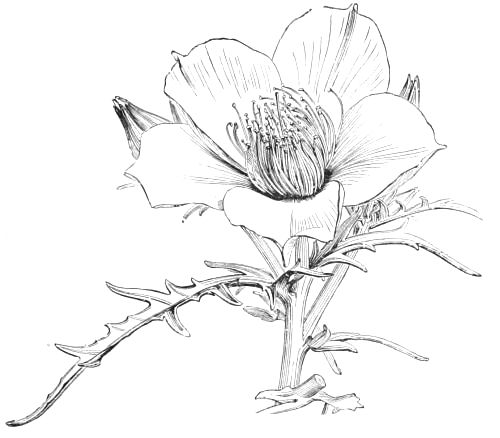
FIG. 207. FLOWER OF BARTONIA AUREA.
BARTLINGIA. A synonym of Plocama (which see).
BARTONIA (in honour of Benjamin S. Barton, M.D., formerly Professor of Botany at Philadelphia). ORD. Loasaceæ. Hardy annuals or biennials, downy, with stiff and bearded hairs. This genus is now placed under Mentzelia in most standard botanical works. Flowers white or yellow, large, terminal, expanding in the evening, when they are very fragrant, and becoming reddish as they fade. Leaves alternate, interruptedly pinnatifid. The species are very showy, and well worth growing. Any ordinary garden soil suits them. Seeds should be raised in a gentle heat in spring; and, when the seedlings are sufficiently large, they should be potted singly into small, well-drained pots. In winter, they should be placed on a dry shelf in a greenhouse or frame. B. aurea is one of the brightest of hardy annuals, and may be sown either in a frame, or in the open border in April.
B. albescens (whitish).* fl., petals ten, pale yellow, disposed in a leafy panicle. July. l. sinuately toothed. Stem with a white shining epidermis. h. 1ft. to 4ft. Chili, 1831. Annual or biennial. (S. B. F. G. ii., 182.)
B. aurea (golden).* fl. two or three together, terminal, bright golden yellow, as large as a half-crown; petals five. June. h. 1ft. California, 1834. Annual. See Fig. 207. (B. M. 3649.)
B. nuda (naked) and B. ornata (adorned) are two very pretty white-flowered biennial species. h. 2ft. Missouri, 1811.
BARYOSMA. See Barosma.
BASAL, or BASILAR. Situated at the base of anything; as the embryo, when situated at the bottom of the seed.
BASELLA (its Malabar name). Malabar Nightshade. ORD. Basellaceæ. Annual or biennial stove trailers, with white or pinkish flowers, of no great horticultural value. In India, and elsewhere throughout the tropics, some of the species are cultivated as pot herbs, and are used as a substitute for Spinach.
B. alba (white).* fl. white. August. l. heart-shaped, pointed. h. 8in. India, 1688. This plant, either when allowed to fall in festoons from the roof of a warm house, or treated as a basket plant, forms an elegant object when in flower.
BASELLACEÆ. A series of usually herbaceous climbers, and considered a tribe of Chenopodiaceæ.
BASIL, SWEET (Ocymum basilicum). This is a tender annual from India, and must be raised in gentle heat. The foliage is somewhat largely used for flavouring purposes. Seeds should be sown in April, the seedlings pricked out into boxes to strengthen, and finally planted out about 8in. asunder, in beds of light rich soil, in June, being well watered until fully established. As soon as they bloom, they should be cut down to within a few inches of the ground, and the portions cut off should be tied up in small bunches and dried in the shade for winter use. Some of the plants can be lifted in September, potted up, and placed in a warm greenhouse for the winter, when the fresh green leaves will be found very useful. Bush Basil (Ocymum minimum) is a dwarfer plant, but may be treated in the same way. Wild Basil is botanically known as Calamintha Clinopodium.
BASIL-THYME. See Calamintha Acinos.
BASI-NERVED. When the nerves of a leaf spring from the base.
BASING-UP. The raising of a small bank of earth entirely round a plant, so as to retain water immediately about the root. The term is sometimes used to signify Earthing or Moulding, which see.
BASKETS. Few objects contribute more to the adornment of a window, or the decoration of the diningroom, drawing-room, or glass-house, than Hanging Baskets, tastefully filled with handsome foliaged and flowering plants. Baskets are made in different forms and of various materials, such as wire, terra-cotta, wood, and cork. The Wire Baskets have a very light and elegant appearance, and are generally used. In filling Baskets, the inside should be lined with a thick layer of moss, or Selaginella Kraussiana, next to which a layer of coarse sacking must be placed, to prevent the soil from working through. Terra-cotta Baskets are very pretty, and are extensively employed in domestic rooms, but they should always have one or more holes at the bottom, to facilitate drainage. Rustic Baskets, of cork or wood, are also very suitable for floral arrangements; those composed of teak-wood are very generally used for orchids. The compost should be prepared according to the requirements of the plant or plants intended to be grown, which can be easily ascertained on reference to such plants in this work. The soil should not be allowed to get dry; in the event of this happening, however, a thorough soaking by immersion must be given. As a rule, attention should be given in the matter of watering every other day, and light syringing every morning and evening during the spring and summer months will be most beneficial. The Baskets should be examined every week, all dead or decaying leaves being removed, and any insects, which are so likely to get a foothold, destroyed. In arranging the subjects, the centre plant should be the tallest, the next outer ones shorter, and the marginal ones of a trailing or drooping habit, so that the whole may present a symmetrical, and at the same time a natural, appearance. Wickerwork Baskets are used for carrying or transferring plants, and are generally made 18in. wide by 20in. deep; they are extremely useful, and should be in every garden. Split wood and withes are largely employed in making Baskets. The Planter's Basket, described by Loudon as a flat, rectangular utensil of wickerwork or boards, partitioned into three or more parts, for the purpose of carrying with the gardener when about to plant or remove plants, is now, unfortunately, almost obsolete. One division is for the plants, another for those taken up, and a third for the tools to be made use of, and for any decayed parts of plants, stones, weeds, or other refuse which may be collected. By using this Basket, order, accuracy, and neatness are secured. The Sussex "Truck" Baskets, made of willow-wood, are very useful, being both light and durable. See also Measures.
BASSIA (named after Ferdinando Bassi, Curator of the Botanic Garden at Bologna). ORD. Sapotaceæ. Handsome lofty-growing lactescent stove trees, with axillary, solitary, or aggregate flowers, and quite entire, smooth, coriaceous leaves. They require stove heat, and a compost of peat and loam. Cuttings, taken from ripened wood, strike readily in sand, under a hand glass, in a strong moist heat.
B. butyracea (buttery). The Indian Butter Tree. fl., pedicels aggregate, and are, as well as the calyces, woolly. l. obovate, 8in. to 9in. long, and 4in. to 5in. broad, tomentose beneath. h. 30ft. to 70ft. Nepaul, 1823. (B. F. F. 35.)
B. latifolia (broad-leaved). The Mahwah Tree of Bengal. fl., corolla thick and fleshy; pedicels drooping, terminal. l. oblong or elliptic, smooth above, whitish beneath, 4in. to 8in. long, and 2in. to 4in. broad. h. 50ft. India, 1799. (B. F. S. 41.)
B. longifolia (long-leaved). fl., pedicels axillary, drooping, crowded round the ends of the branchlets. l. ovate-lanceolate, approximate at the tops of the branches, 6in. long, deciduous. h. 50ft. Malabar, 1811. (B. F. S. 42.)
BASS or BAST MATS. These are prepared, chiefly in Russia, from the inner bark of various Limes (Tilia), and are very largely used in this country by nurserymen for packing purposes. They are also extensively employed as coverings, being excellent preventatives of the effects of frost. They are beneficial as a covering for beds of early vegetables, to prevent radiation during the night. For tying purposes they are now greatly superseded by Raffia Grass. Archangel Mats are larger, and of better quality than the St. Petersburgh. Dunnage Mats are heavy, and generally used for covering, as they are much cheaper.
BASTARD ACACIA. See Robinia Pseudo-acacia.
BASTARD BALM. See Melittis.
BASTARD BOX. See Polygala chamæbuxus.
BASTARD CABBAGE-TREE. See Geoffroya.
BASTARD CHERRY. See Cerasus Pseudo-cerasus.
BASTARD CINNAMON. See Cinnamomum Cassia.
BASTARD CORK TREE. See Quercus pseudo-suber.
BASTARD INDIGO. See Amorpha.
BASTARD LUPINE. See Trifolium Lupinaster.
BASTARD QUINCE. See Pyrus Chamæmespilus.
BASTARD VERVAIN. See Stachytarpheta.
BASTARD VETCH. See Phaca.
BASTARD WIND-FLOWER. See Gentiana Pseudo-pneumonanthe.
BASTARD WOOD-SAGE. See Teucrium Pseudo-scorodonia.
BAST MATS. See Bass Mats.
BATATAS (its aboriginal name). ORD. Convolvulaceæ. This genus is now referred to Ipomæa. Strong, free-growing, greenhouse or stove deciduous twiners. Calyx of five sepals; corolla campanulate; stamens inclosed. They are of easy culture, only requiring plenty of room to spread, and are well adapted for trellis work, or to run up pillars. They are all tuberous rooted, and therefore require to be kept dry when in a dormant state. A rich, open, loamy soil is most suitable. Young cuttings strike readily under a hand glass, in heat.
B. bignonioides (Bignonia-like).* fl., corolla dark purple, funnel-shaped, with a curled limb; peduncles many-flowered, nutant, shorter than the petioles. July. l. three-lobed; hind lobes rounded, imbricate. Cayenne, 1824. (B. M. 2645.)
B. Cavanillesii (Cavanilles').* fl. pale whitish-red; lobes of corolla obtuse, crenulated; peduncles one to three-flowered. August. l. quinate; leaflets ovate, entire, unequal. Native country unknown, 1815.
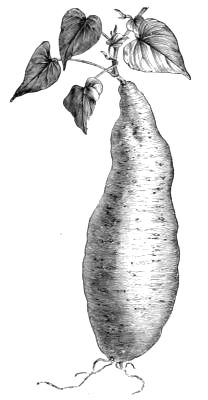
FIG. 208. BATATAS EDULIS, showing Tuber.
B. edulis (edible).* Sweet Potato. fl., corolla 1in. long, white outside and purple inside; peduncles equal in length to the petioles, or exceeding them, three to four-flowered. l. variable, usually angular, also lobed. Stem creeping, rarely climbing. East Indies, 1797. See Fig. 208.
B. glaucifolia (milky-green-leaved). fl., corolla small, purplish, with an inflated tube, and ovate, acute segments; peduncles two-flowered, length of leaves. May. l. sagittate, truncate behind, on long petioles. Mexico, 1732.
B. heterophylla (various-leaved). fl. blue; peduncles solitary, axillary, bearing each three sessile flowers. July. l. quinately palmate; lobes or leaflets ovate-spathulate, acute. Plant very villous. Cuba, 1817.
B. paniculata (panicled).* fl. large, purple; peduncles much exceeding the petioles, many-flowered, dichotomously and corymbosely panicled. June l. palmate, five to seven-cleft; lobes ovate-lanceolate or elliptic, bluntish, rarely sub-acuminated. India, 1799. (G. C. n. s., x., 341.)
B. senegalensis (Senegalese). fl. white or purplish, large; peduncles three-flowered. June. l. quinately palmate; lobes ovate, obtuse, middle one the largest. Stem white, tubercular. Guinea, 1823.
B. venosa (veiny). fl. purple; peduncles umbellate, with an ovate-cordate, solitary leaf at the base of each pedicel. July. l. digitately quinate; leaflets petiolate, acuminated, quite entire. France, 1820.
BATEMANNIA (named after Mr. J. Bateman, a collector and cultivator of orchids, and author of a "Monograph of Odontoglossum," and other works on orchidaceous plants). ORD. Orchidaceæ. A small and easily-grown genus of dwarf, compact-growing epiphytes, closely allied to Maxillaria, but differing from that genus in having the anther-bed with a membranous border. They may be grown in pots, in a compost of peat and moss, or on blocks of wood with moss. They require an intermediate house and plenty of water in the growing season. Propagated by divisions and offsets. They have generally a free-flowering habit; but some of the species are not so ornamental as many other orchids.
B. armillata (braceleted). fl. green, white. 1875. (R. X. O. 316.)
B. Burtii (Burt's). fl. red-brown, yellow base, 3in. across; lip white, tipped chocolate. Autumn. l. elliptic-oblong, or ligulate, sub-distichous. Plant bulbless. Costa Rica, 1872. (B. M. 6003.)
B. Colleyi (Colley's). fl. on a pendulous raceme, rising from the base of the pseudo-bulbs; sepals and petals brownish-purple within, green without; lip white. Autumn. h. 6in. Demerara, 1834. (B. R. 1714.)
B. grandiflora (large-flowered).* fl., flower-spike coming up with the young growth, bearing three or four flowers, of curious structure; sepals and petals olive-green, striped with reddish-brown; lip white, with reddish-purple streaks, orange or yellow towards the base. Pseudo-bulbs ovate, 3in. or 4in. long, and bearing two large, broad, leathery leaves. New Grenada, 1866. (B. M. 5567.)
B. Wallisii (Wallis').* fl., sepals light greenish-yellow outside, olive-green to chestnut-brown inside, with some yellow at the base; petals with scarlet stripes at the very base, but otherwise coloured like the sepals; lip blade greenish, with a brownish hue at the anterior part; peduncles slender, corymbose. h. 1ft. Columbia, 1876.
BATSCHIA. See Lithospermum.
BAUERA (named after Francis and Ferdinand Bauer, German botanical draughtsmen). ORD. Saxifragaceæ. Small shrubs, natives of Australia, New Zealand, &c. Flowers axillary, solitary, pedunculate. Leaves six in a whorl, approximating by threes, and therefore, as it were, opposite and ternate, exstipulate. Easily cultivated in a compost of sandy loam and peat. Propagated by cuttings, placed in sandy soil, under a glass. These very pretty little greenhouse evergreens flower nearly the whole year through.
B. humilis (low). fl., corolla red, one-half smaller than B. rubioides, and the plant is altogether much smaller. July to December. l. oblong, crenated. h. 1ft. New South Wales, 1804. (L. B. C. 1197.)
B. rubiæfolia (madder-leaved). Synonymous with B. rubioides.
B. rubioides (madder-like).* fl. pale red, or pink. l. lanceolate, crenated. h. 1ft. to 2ft. New South Wales, 1793. SYN. B. rubiæfolia. (A. B. R. 198.)
BAUHINIA (in honour of John and Caspar Bauhin, two famous botanists of the sixteenth century). Mountain Ebony. ORD. Leguminosæ. Very showy stove evergreen shrubs. Flowers racemose; petals five, spreading, oblong, rather unequal, upper one usually distant from the rest. Leaves two-lobed, constantly composed of two jointed leaflets at the top of the petiole, sometimes nearly free, but usually joined together, more or less, and with an awn in the recess. They succeed well in a mixture of sand, loam, and peat, requiring good drainage and moderately firm potting. Propagated by cuttings, which should be taken when the wood is neither very ripe nor very young; the leaves must be dressed off, and the cuttings planted in sand, under a glass, in moist heat. Although glorious objects in the tropics, few of the species flower under our comparatively sunless skies; those which hitherto have succeeded well in Britain are marked with an asterisk.
B. acuminata (taper-pointed-leaved). fl. pure white; petals broadly ovate, hardly stipitate. June. l. rather cordate at the base, smoothish; leaflets connected beyond the middle, ovate, acuminated, parallel, four-nerved. h. 5ft. to 6ft. Malabar, 1808.
B. aurita (eared). fl. white; petals ovate, on short stipes. August. l. glabrous, cordate at the base; leaflets connected the fourth part of their length, oblong-lanceolate, nearly parallel, six to eight-nerved. h. 4ft. to 6ft. Jamaica, 1756.
B. corymbosa (corymbose).* fl. in loose racemes; petals pinkish, regular, crenulated at the edge. Summer. l., leaflets semi-oval, obtuse, parallel, connected nearly to the middle, three-nerved, cordate at the base, the nerves on the under surface, as well as the petioles, branches, and calyces, clothed with rufous villi. Shrubby climber. India, 1818. (G. C. 1881, xvi., p. 204.)
B. inermis (unarmed). fl. white; petals linear; racemes terminal, leafless, simple. l. ovate at the base, ferruginous beneath; leaflets oblong, acute, four-nerved, parallel, connected a little beyond the middle. h. 6ft. to 8ft. Mexico, 1810.
B. multinerva (many-nerved). fl. snow-white; petals linear. Legume 8in. to 12in. long. l. elliptic, rounded at the base, membranous, shining above, rather pilose beneath; nerves ferruginous; leaflets semi-ovate, obtuse, approximate, five-nerved; free. h. 20ft. Caracas, 1817.
B. natalensis (Natal).* fl. white, 1½in. across, opposite the leaves. September. l. small, alternate, of two obliquely-oblong rounded leaflets. Natal, 1870. (B. M. 6086.)
B. petiolata (long-petioled). fl. white, 3in. long, in terminal clusters. Autumn. l. stalked, ovate-acuminate, five-nerved, glabrous. Columbia, 1852. SYN. Casparia speciosa. (B. M. 6277.)
B. pubescens (downy). fl. white, large, much crowded; petals obovate; peduncles three to four-flowered. l. rather cordate at the base, pubescent beneath and on the petioles; leaflets connected beyond the middle, oval, obtuse, four-nerved, nearly parallel. h. 4ft. to 6ft. Jamaica, 1823.
B. purpurea (purple). fl., petals red, one of them streaked with white on the claw, lanceolate, acute. Legume linear, 1ft. long. l. cordate at the base, coriaceous, ultimately glabrous; leaflets connected much above the middle, broadly ovate, obtuse, four-nerved; free. h. 6ft. India, 1778.
B. racemosa (racemose). fl. white; petals obovate, obtuse; raceme somewhat corymbose. l. cordate at the base, clothed with silky villi beneath, as well as on the peduncles, petioles, branches, calyces, and petals; leaflets broadly ovate, obtuse, connected to the middle, five-nerved. India, 1790. Shrubby climber. (B. F. S. 182.)
B. tomentosa (tomentose). fl., petals pale yellow, with a red spot at the claw, obovate, obtuse; peduncles one to three-flowered. l. ovate or roundish at the base; under surface villous, as well as the petioles, branches, stipules, peduncles, bracts, and calyces; leaflets connected beyond the middle, oval, obtuse, three to four-nerved. h. 6ft. to 12ft. Ceylon, 1808.
B. variegata (variegated).* fl. red, marked with white, and yellow at the base, in loose terminal racemes; petals ovate, nearly sessile. June. l. cordate at the base, glabrous; leaflets broadly-ovate, obtuse, five-nerved, connected beyond the middle; free. h. 20ft. Malabar, 1690.
B. v. chinensis (Chinese). fl., petals lilac, with one purple spot at the base of each, acute. l. rounded at the base. China.
BAWD-MONEY. See Meum.
BAY-TREE. See Laurus nobilis.
BEAK. Anything resembling the beak of a bird, as in Aconitum; the point which ends the helmet or upper sepal; hard, sharp points.
BEAM TREE. See Pyrus Aria.
BEAN BEETLE (Bruchus granarius). This insect, by depositing its eggs in the seeds of Beans and Peas, causes a great amount of injury. It is about an eighth of an inch long, black, with brown hairs and white spots; tip of the tail prolonged, downy; front pair of legs reddish. The most effectual means of prevention is to destroy, when sowing, all seeds infested by it; and this may be detected by the skin of the seed being unusually transparent above the tunnel for exit. Imported seeds of Broad Beans are often much infested. "Dipping the Beans or Peas in boiling water for one minute is stated to kill the grub inside; but, as dipping for four minutes generally destroys the germinating power, the experiment is much too hazardous for general use", (Ormerod).
BEAN CAPER. See Zygophyllum.
BEAN FLY. See Aphides and Black Fly.
BEANS. There are three sections of these in cultivation for garden purposes, viz.: The Dwarf or French Bean; the Climbing, or Scarlet Runner; and the ordinary Broad Bean. See also Faba and Phaseolus.
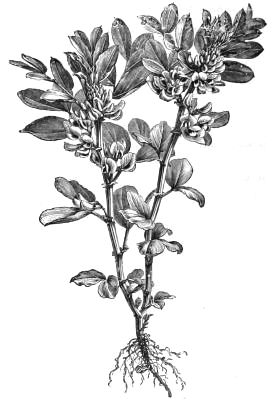
FIG. 209. BROAD BEAN PLANT IN FLOWER (FABA VULGARIS).
Soil. All Beans like a somewhat loamy soil, which, to secure good crops, must be deeply worked and heavily manured. The Kidney Beans, dwarf and tall, however, do not care for so heavy a soil as the Broad and Long-podded kinds; and this fact should be borne in mind when selecting their respective situations. The term Kidney is generally applied to both the Dwarf or French and the Climbing or Scarlet Runner.
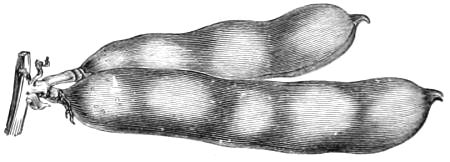
FIG. 210. PODS OF BROAD BEAN.
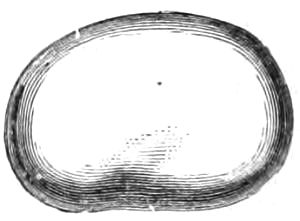
FIG. 211. BROAD BEAN SEED.
BROAD AND LONG-PODDED (Faba vulgaris). Cultivation: As early as possible in the autumn, deeply trench a piece of ground, and work in a heavy dressing of manure, leaving the surface of the soil in ridges, to become well aërated by winter frosts. Where desired, a piece of ground on a warm, protected border, can also be deeply dug in November, and a few rows of Mazagans sown to stand the winter. When up, draw a ridge of soil on either side the rows, and in frosty weather strew a few handfuls of bracken, or other light, dry litter, over them. Not much is, however, gained by this winter sowing. Early in January, level the ridges with a fork, working the whole of the surface soil over, and towards the end of the month, make the first sowing, choosing Mazagan and other early varieties. Mark out two rows, 9in. asunder, leave a space of 30in., then another two rows, and so on throughout the piece sown. If preferred, they may be sown in single rows at intervals of 1½ft. The drills should be about 3in. deep, and the seed from 7in. to 9in. apart in the rows. Where the double-row system is adopted, arrange the seed for the plants to come alternately. In March, get in the main sowing of the Broad and later Long-podded kinds, in the manner already described; another sowing for late use may be made in April. When the plants are about 6in. high, earth up as recommended for those sown in the autumn. As soon as a good crop is set, pinch out the tops of the plants, to assist the maturation of the Beans, and prevent the attacks of the fly. Figs. 209, 210, and 211 are excellent representations of the flowering plant, pods, and seed of the Broad Bean.
Sorts. For early use: Early Mazagan, Long-pod, Marshall's Early Prolific, and Seville Long-pod. For late use: Carter's Mammoth Long-pod, and Broad Windsor (white variety). These are all distinct and good varieties.
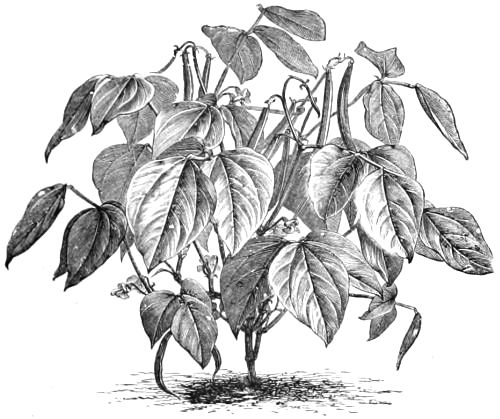
FIG. 212. FRUITING PLANT OF DWARF OR FRENCH BEAN (PHASEOLUS VULGARIS).
DWARF OR FRENCH KIDNEY BEANS (Phaseolus vulgaris). Cultivation: This class (see Fig. 212) also requires a rich and deeply trenched rather light soil. A very important point is to get the ground into a good condition, by frequently forking it over; and, as the seeds are not sown till the beginning of May, there is plenty of time for the work. The finer the soil is, and the more it is aërated, the better will it suit the crop. From the beginning of May till the end of June, at intervals, draw out drills about 2ft. apart, and 3in. deep, and in these place the Beans tolerably thick, as generally they are not all certain to grow. As soon as up, carefully thin them, and slightly earth up to prevent the wind blowing them about. They should not, however, be earthed higher than the seed leaves, or they will probably rot off in wet weather. Keep free from weeds, and maintain a sharp look out for slugs. In dry weather, water occasionally, giving good drenchings, and not mere sprinklings, which do more harm than good. A good mulching of half-rotted manure is very beneficial, as it prevents evaporation to a great extent, besides affording some amount of nourishment to the plants. Great care must be taken to pick off the Beans as soon as large enough for use, or they will exhaust the plants. Where seeds are needed, a number of plants should be left for the purpose, and these should be some of the best, to prevent deterioration, or loss of the true variety.
Forcing. French Beans require more heat than can be obtained in either a frame or an ordinary greenhouse; and, although easy enough to grow in a structure suited to their requirements, yet, if such does not exist, they are almost sure to fail. A good heat, from 60deg. to 70deg., with abundance of moisture, is necessary for successful results. Plenty of light is also most essential. A position such as that of a cucumber house is generally a suitable one; but the plants must not be placed under the cucumbers. Successional sowings in pots or boxes must be made, from the end of August till March, to keep up a supply. For soil, use good maiden loam, with a little well-rotted manure added. Use 8in. pots, sowing five or six beans in each. The first sowing should be placed in a frame and kept well watered, bringing into heat in October; but the subsequent sowings should be placed directly in the house. Keep the soil moist, and the plants free from aphides and other insect pests, and give air at every favourable opportunity. The plants should be as near the light as possible, and kept from falling about by tying or placing small pieces of Birch wood round them. In dull weather, it will be found that the blooms will not set so freely as when the sun shines brightly; therefore, every care should be taken to secure both heat and ventilation when sunshine prevails. When the pots get full of roots, and the plants are bearing fruit freely, a little liquid manure is of great assistance; at no time must the plants get dry enough to flag. Allow plenty of room for the full development of foliage, and maintain a minimum temperature of 60deg., with plenty of moisture.
Sorts. These are very numerous, among the best being Black Negro, Canadian Wonder, Canterbury, Fulmer's Forcing, Golden Dun, Newington Wonder, Osborn's Early Forcing, Sion House, and Sir Joseph Paxton.
RUNNERS OR CLIMBING KIDNEY BEANS (Phaseolus multiflorus). Cultivation: Being tall growers, these need a greater space than the Dwarf French varieties, and they also require support. Rich soil is indispensable for them, and liberal supplies of water on light soils and in dry weather. A good overhead syringing from time to time is also advantageous. Trench and heavily manure a piece of ground in autumn, leaving it in ridges for the winter. In March, level the ridges down, and well work the ground, to render it friable and in good condition. The plants being extremely tender, it is not safe to sow before the end of April or the first week in May. It is preferable to sow in rows, which should be from 6ft. to 12ft. apart, and crop the ground between with other vegetables. Earth up and stake them as soon as ready, to prevent injury from rough wind. A good plan, which may be adopted to obtain early produce, is to raise the seeds in boxes in a cold frame, getting them ready for planting out in the middle of May. Plant at the same distances, and treat afterwards as recommended for those sown out of doors.
If preferred, they can be grown on the ground without stakes. Under this treatment, they must have their tops pinched off when about 18in. high, continuing this pinching from time to time as necessary. If this plan is adopted, the rows need only be 3ft. apart, the ground not being otherwise cropped. In dry seasons and on light soils, there is an advantage attached to this method, namely, that those on sticks are liable to injury from drought, while the foliage of those pinched back keeps the soil moist underneath.
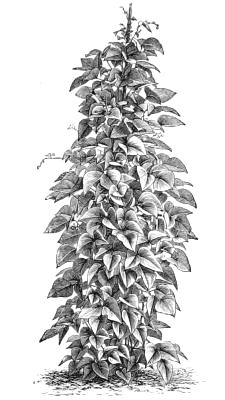
FIG. 213. RUNNER OR CLIMBING KIDNEY BEAN (PHASEOLUS MULTIFLORUS).
Runner Beans may also be planted to cover arches or fences, and in various places of a like description. See Fig. 213.
Sorts. Common Scarlet Runner, Champion, Painted Lady, and Giant White. The first two are those generally grown.
BEAN-TREE. See Ceratonia Siliqua.
BEARBERRY, and BEAR'S GRAPE. See Arctostaphylos Uva-ursi.
BEARD-TONGUE. See Pentstemon.
BEARS BREECH. See Acanthus.
BEAR'S FOOT. See Helleborus fœtidus.
BEATONIA. See Tigridia.
BEAUCARNEA (a commemorative name). ORD. Liliaceæ. A small genus of curious greenhouse plants, natives of Mexico. Leaves narrow, gracefully depending. Stems slender, and woody, with a peculiar swollen, somewhat napiform base. Mr. B. S. Williams recommends that these plants be potted in rich fibrous loam and sand, with ample drainage, and, during the growing season, liberally supplied with water. Propagated by cuttings, when obtainable; but chiefly by seeds, which have to be imported from their native country. Beaucarneas are principally grown for the beauty of their foliage, and are grotesque, graceful, and extremely curious in habit and form.
B. glauca (grey).* l. pendent, glaucous, 2ft. to 3ft. long. Stem slender, the swollen base becoming woody with age.
B. g. latifolia (broad-leaved) differs from the type only in its stouter and more robust stem and broader leaves.
B. longifolia (long-leaved).* l. 6ft. to 10ft. long, narrow, pendent, dark green, forming a beautiful vase-like centre. h. 10ft. Mexico, 1868. Very distinct. (G. C. 1877, vii., 493.)
B. recurvata (recurved-leaved).* l. very long, linear, gracefully pendulous, bright green. Mexico, about 1845. This is an excellent subject for open-air culture during the summer, as well as for the conservatory. SYN. Pincenictitia tuberculata. (G. C. 1870, 1445.)
B. r. rubra (red). l. red at base.
B. stricta (upright). l. 3ft. or more long, less than 1in. broad, very glaucous. Stem stout. Mexico, 1870.
BEAUFORTIA (commemorative of Mary, Duchess of Beaufort, a botanical patroness). Including Schizopleura. ORD. Myrtaceæ. Elegant free-flowering greenhouse Australian shrubs. Flowers scarlet; calyx with a turbinate tube; stamens in bundles opposite the petals. Leaves sessile, opposite or scattered. Beaufortias require a compost of peat, leaf soil, and loam, lightened, if necessary, by the addition of sand. Cuttings of half-ripened shoots root freely in sandy soil, under a glass, with very little heat.
B. decussata (decussate). fl. scarlet; bundles of stamens on very long claws; filaments radiating. May. l. opposite, decussate, ovate, or oval, many-nerved. h. 3ft. to 10ft. New Holland, 1803. (B. M. 1733.)
B. purpurea (purple).* fl. purplish-red, in dense globular heads. l. three to five-nerved, erect or spreading, ovate-lanceolate to lanceolate-linear. New Holland.
B. sparsa (few-leaved). fl. bright scarlet. l. many-nerved, scattered, ovate-elliptical, obtuse. West Australia. SYN. B. splendens. (P. F. G. xiii., 145.)
B. splendens (splendid). Synonymous with B. sparsa.
BEAUMONTIA (in honour of Mrs. Beaumont, formerly of Bretton Hall, Yorkshire). ORD. Apocynaceæ. A very ornamental stove twiner, remarkable for its handsome flowers. It succeeds best when planted out in the borders of a temperate house, in rich lumpy loam and peat. Propagated by cuttings, placed in sand, with bottom heat.
B. grandiflora (large-flowered).* fl., corolla large, white, greenish outside near the base, and dark throat, with a short tube, and a large campanulate five-lobed limb; corymbs axillary and terminal, many-flowered. June. l. opposite, broad, oblong-ovate, with a little point, tapering towards the base, smooth and shining above, but rather downy beneath; young leaves and branches rusty. Chittagong and Sylhet, 1820. (B. M. 3213.)
BED. A term usually applied to pieces of ground laid out in gardens for sowing small seeds, or for the isolation and better protection of small collections of plants in the reserve ground. The oblong is the best shape for this purpose, about 4ft. or 5ft. wide, somewhat raised, and having a narrow path on each side, so that the workman may attend to the plants or seeds without having to tread on the bed. Any one part of a flower-garden design, cut out in grass, or otherwise formed, is also generally termed a Bed. When required to be planted for effect, as in this case, the Bed should be proportionate in size to the plants that are to be put in it, always planting the highest in the centre and gradually sloping, with other sizes, to the edges, which should be the lowest. Circular Beds are best with one centre plant; and oblong or other shapes should have the height of the centre plants carried nearly the whole length, not, however, placing them in too formal a manner.
BEDDING-IN. A method of seed-sowing, now almost obsolete, and chiefly employed in nurseries. "In this method, the ground being dug and formed by alleys into Beds, 4ft. or 5ft. wide, each alley being a spade's width or more between Bed and Bed, and the earth being drawn off the top of the Bed with a rake or spade, ½in. or 1in. deep into the alleys, the seed is then sown all over the surface of the Bed; which being done, the earth in the alleys is immediately cast over the Bed, again covering the seeds the same depth, and the surface is raked smooth" (Johnson). In the case of small seeds, a very light covering is needed, and that only of very fine soil.
BEDDING-OUT. The temporary placing out of doors of greenhouse and other tender plants during the summer months. It is considered by some to be the showiest, most expensive, and most unnatural of any style. The geometrical arrangement of gaudy colours is not at all times satisfactory, and under the most favourable conditions the design is rarely retained more than two or three months, say, from July to September. The method is, however, so extensively adopted as to demand due notice in this work. Bedding usually commences in May. An important consideration is the proper preparation of the soil for the reception of the plants. It will be found to materially assist the growth if the soil is well dug over a fortnight before the plants are put in. By this means, it will acquire a certain amount of solidity, a point of great importance with fibrous-rooted plants that are subject to injury from the fine roots not taking a firm hold of the soil. Having decided upon the arrangement of the plants, proceed to work with the planting. With round, oval, or, indeed, almost any shaped bed, begin in the centre and work towards the edge; in borders, commence at the back and finish with the front row. Plant with a trowel, disturbing the balls as little as possible, and when in the holes press the soil moderately firm. After the Bed is finished, give a good soaking of water to settle the soil at the roots. Manure for Flower-beds should always be perfectly rotten, such as that from a spent hotbed. When the plants are thoroughly established, water must only be given if they show signs of distress; and then a good soaking should be applied. A careful hoeing of the surface after planting will be most beneficial, leaving it smooth and tidy. A Dutch hoe will be the best to use. Injudicious use of manure and water will only cause a foliaceous growth. The proper treatment of the various Bedding Plants will be found under their respective headings. For spring decoration, the Beds may be filled with Dutch bulbs, and spring-flowering annuals and perennials ad infinitum; or, after the plants are removed in autumn, the Beds may be filled with evergreens plunged in pots, such as Aucuba, Arbor vitæ, Euonymus, and various little Conifers, which have a bright appearance through the winter, and can be removed at any time. With the relative value, or advisability of adoption, of either or any system of gardening, it scarcely comes within the province of this work to deal. No hard-and-fast rules can be laid down as regards "style," and each individual may follow his own taste and inclination.

FIG. 214. DESIGN FOR CARPET BEDDING.
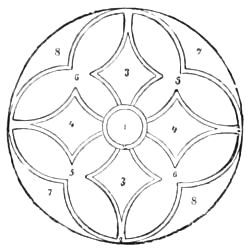
FIG. 215. DESIGN FOR CARPET BEDDING.
Carpet Bedding. This mode of gardening, although not so generally employed as it was some few years ago, has many admirers, and small plots, geometrically arranged in multi-coloured beds on lawns, are frequently seen. In our large public parks, the system is largely adopted, and evidently proves very gratifying to the multitudes who visit these places; but probably no system is more unnatural or expensive, as such a large number of plants are necessary in order to produce a desirable effect. The illustrations (Figs. 214 and 215) represent two designs for Carpet Beds. The numbers placed in the various compartments indicate the way the different colours should be arranged, repeats being marked by the same cypher. A very varied and large selection of plants can be used for Carpet Bedding, some of which are quite hardy, such as Herniaria glabra and Veronica repens, two of the best dwarf green plants; Sempervivum californicum, Sedum lydium, S. glaucum, Antennaria tomentosa, &c. These may be planted early in the season, with Golden Feather, and are especially valuable, as they are generally employed to a great extent. Other plants, not quite so hardy, are Mentha Pulegium gibraltarica and Echeveria secunda glauca, both of which are extensively used; while the tenderest subjects are Alternantheras of various kinds, Coleus Verschaffeltii and Mesembryanthemum cordifolium variegatum. These latter should not be planted till the first or second week in June. As the plants are usually small, and require to be planted thickly, the work is best accomplished with the fingers, pressing the soil moderately firm. First of all, work out the design, and plant the leading lines; afterwards fill in the "panels."
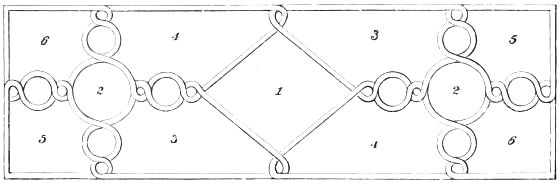
FIG. 216. DESIGN FOR BEDDING.
Sub-Tropical Bedding. This term is applied to the arrangement of tropical plants in Beds or groups outside for the summer months, and if discriminately adopted a very attractive and unique display may be made, depending greatly upon position, and mainly upon the material at command. If a sheltered and partially shady situation is enjoyed, a grand effect may be produced by the grouping of tree and other large ferns with palms, Cannas, Aralias, Dracænas, &c., avoiding, of course, formal arrangement, and yet, when finished, a symmetrical appearance should be produced. In more open positions, palms, Castor Oil Plants, Cannas, Humea elegans, Aralias, Phormiums, Wigandias, Nicotianas, &c., may be employed, the result being, if properly arranged, most gratifying. Sub-Tropical Bedding should not be done till the middle or end of June, and the Beds should be well dug and freely manured for those that are to be planted out.
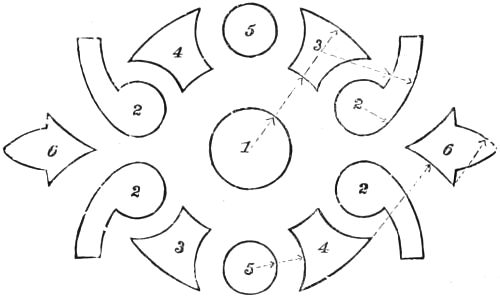
FIG 217. DESIGN FOR BEDDING.
Fig. 216 represents a Border or long piece of ground, which may be either marked out permanently with Box edging, dwarf-growing silver or golden leaved plants, tiles, stones, or pebbles, and filled in with silver sand or bright-coloured stones or gravel; or the lines may be widened out into walks. The whole of the small circles not numbered are intended for specimen foliage and other plants, such as Fuchsias, Yuccas, Aloes, Cannas, Solanums, variegated or plain Reeds, Grasses, Maize (Zea), &c. No. 1, tall plants of Echeveria metallica, edged with E. glauca; 2, 2, yellow or orange Calceolaria; 3, 3, Mrs. Leavers Pelargonium; 4, 4, Triomphe de Stella ditto; 5, 5, purple or blue Verbena; 6, 6, white ditto. The narrow border round the side may then be filled in with Golden-feather Pyrethrum, blue Lobelia, or Alternanthera amabilis. This same plan may also be treated in quite a different manner, according to the taste of those adopting it, or the stock of plants at command.
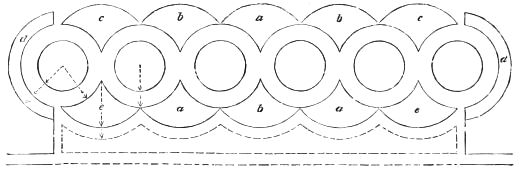
FIG. 218. DESIGN FOR BEDDING OR CARPET BEDDING.
Fig. 217 illustrates a design admirably adapted for a rosery or small flower garden. Its only fault is the number of sharp angles at the corners of some of the Beds; but this can be counteracted by the predominance of curved lines. It is easily formed, and the effect is good if furnished in the following manner: The circle in the centre, 1, Centaurea ragusina compacta, edged with a double line of Coleus Verschaffeltii; the four figures 2, 2, 2, 2, scarlet Pelargoniums, such as Vesuvius, Bonfire, Triomphe de Stella, or others; 3, 3, Mrs. Pollock, golden-zoned Pelargoniums, edged with Alternanthera amœna; 4, 4, Lady Cullum, ditto, ditto, edged with ditto; 5, 5, Lobelia speciosa, Imperial Dwarf Ageratum, or Purple King Verbena; 6, 6, white Verbena or white Ivy-leaved Pelargonium.
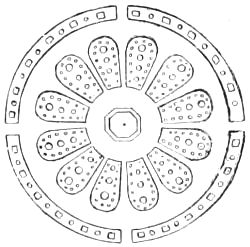
FIG. 219. ARRANGEMENT OF NURSERY FOR ROSE TREES AND SHRUBS.
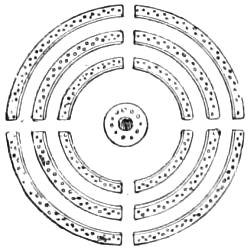
FIG. 220. ARRANGEMENT OF NURSERY FOR ROSE TREES AND SHRUBS.
The group of Beds illustrated in Fig. 218 is effective on grass or gravel. If on the latter, the lines should be defined with Box, Golden Thyme, Cerastium, or Santolinas. The design is pretty on level, but is still more effective on sloping ground; in the latter case, it should rise from the straight walk (dotted line). Thus each Bed may be seen to the best advantage, and the group may be extended to any length. The circular Beds should be planted with two distinct colours, such as good pink and scarlet Pelargoniums of similar habits of growth, placing the colours in alternate Beds. The Beds, a, a, a, Flower of Spring, or another silver-leaved Pelargonium; b, b, b, Purple King Verbena, or Imperial Dwarf Ageratum; c, c, White Perfection Verbena, and silver-leaved or white-flowered Ivy-leaved Pelargonium; d, d, Alternanthera magnifica; e, e, Blue Lobelia. The long border, Alternanthera paronychioides, edged with Antennaria tomentosa; or Iresine Lindenii, edged with Pyrethrum, Golden Fleece or Crystal Palace Gem Pelargonium. The two sides may also be planted alike. The colours are reversed above to produce a greater variety and a more striking effect. This design is also well adapted for Carpet Bedding.
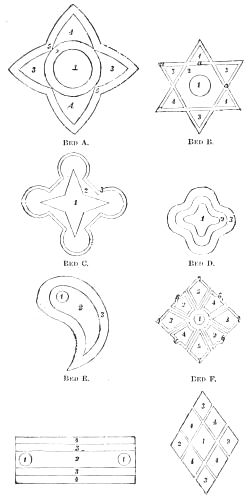
FIG. 221. BEDDING-OUT DESIGNS.
Nursery Bed. This is merely a reserve ground or nursery for a large stock of plants of various sorts, such as Roses, &c. One of the first requirements is an easy access to the individual plants, and with the least possible waste of space. This may be obtained by arranging the Beds in regular geometric figures, as shown in Figs. 219 and 220, and, by exercising a little care and taste, the whole can be so contrived as to present an ornamental appearance.
We are indebted to Messrs. Cannell and Sons for the diagrams of Bedding-out designs shown at Fig. 221, which may be made very effective:
Bed A. This Bed may be planted with the following: Summer-flowering: 1, Gain's Yellow Calceolaria or Ageratum Lady Jane; 2, Geranium Vesuvius or another scarlet; 3 and 4, Viola Blue-bell or Purple King Verbena; 5, edged with Gnaphalium lanatum, or Antennaria tomentosa, white foliaged plants. Summer Foliage: 1, Coleus Verschaffeltii; 2, Centaurea ragusina compacta; 3 and 4, Mrs. Pollock Geranium; 5, band of any of the Echeverias, or Kleinia repens.
Bed B. Plants mentioned for A will do for this.
Bed C. This is really intended for a Carpet Bed. 1, Alternanthera amabilis, with a narrow line of amœna for the edge; 2, Mentha, or Herniaria glabra; 3, band of Mesembryanthemum cordifolium variegatum. Flowering: 1, Any kind of Scarlet Geranium; 2, Golden-leaved ditto; 3, Blue Lobelia (edge). Spring: 1, White Arabis; 2, Myosotis dissitiflora; 3, Golden Feather.
Bed D. Summer: 1, Pink Geranium; 2, Iresine Lindenii; 3, Golden Feather. Carpet: 1, Alternanthera versicolor grandis; 2, Mesembryanthemum cordifolium variegatum; 3, Alternanthera magnifica, edged with Sempervivum montanum.
Bed E. 1, Scarlet Geranium; 2, Pink ditto; 3, Lobelia speciosa; or, 1, Alternanthera amœna; 2, Mesembryanthemum cordifolium variegatum; 3, Echeveria secunda glauca.
Bed F. 1, Dracæna, Chamæpeuce, or any other graceful foliage plant for the centre; 2 and 4, Alternanthera amabilis, the divided lines, 6, being filled with Mentha or Echeverias; 3 and 5, Alternanthera amœna; and the outer edge, 7, with Sempervivum californicum. This bed would look well if planted with any of the above-mentioned spring flowers. Spring: Bed might be raised to a mound, and lined out with hardy Sedums, or Sempervivums, placing a larger growing one in the centre; and 2, 3, 4, and 5 divisions may be filled with any spring-flowering dwarf-growing plants.
Bed G. 1, Small plant of Yucca; 2, Coleus Verschaffeltii; 3, Alyssum variegatum; 4, Lobelia pumila magnifica.
Bed H. 1, Golden Feather; Mesembryanthemum; 3, Mentha; 4, Alternanthera amabilis; or 1, Coleus Verschaffeltii; 2, Centaurea ragusina; 3, Calceolaria Golden Gem; 4, Ageratum Lady Jane.
BEDDING PLANTS. This term applies to many half-hardy subjects which are planted out in beds for summer display, such as Ageratums, Calceolarias, Geraniums, Heliotropes, Lobelias, Verbenas, &c., all of which will be treated under their respective headings. They are mostly soft-wooded plants and are easily cultivated with proper means, in spring and autumn.
BEDFORDIA (named in honour of a former Duke of Bedford). ORD. Compositæ. Greenhouse evergreen shrubs, allied to Cacalia. They thrive in a mixture of sand, peat, loam, and brick rubbish, in equal proportions. Propagated by cuttings, which should be dried a little before inserting them in rough, sandy soil.
B. salicina (willow-like). fl.-heads yellow, axillary and solitary, or few together. April. l. alternate, lanceolate, linear, glossy above, covered with white tomentum underneath. h. 3ft. Victoria and Tasmania, 1820. SYN. Cacalia salicina. (B. R. 923.)
BEDSTRAW. See Galium.
BEECH. See Fagus.
BEES. See Honey Bees, Humble Bees, and Wasps.
BEET (Beta, which see). The present varieties of Beetroot are the offspring of Beta vulgaris, a plant of biennial duration, and a native of the sea coasts of Southern Europe. It was cultivated in this country about 1656, but was probably long previously introduced by the ancient Romans. Beetroot is largely used as salad, more extensively on the Continent than with us, also pickled; medium sized, deeply coloured roots being the chief desideratum. Some varieties are largely grown for their highly-coloured foliage, being planted in bedding-out designs, and generally proving extremely effective.
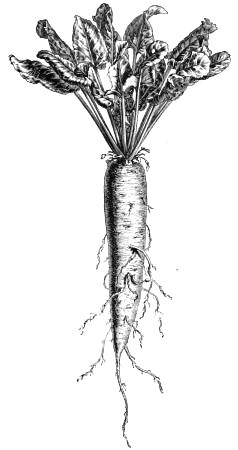
FIG. 222. LONG YELLOW BEETROOT.
Cultivation: For obtaining the best results, an open situation should be chosen, free from the shade of trees. The ground should be light and sandy, and, if possible, that which has been previously manured for some other crop, French beans, for instance. Trench the soil to a depth of 2ft. in the autumn, and ridge it up for the winter. As soon as dry enough to allow of working in spring, dig over the whole bed with a steel digging fork, and break the soil tolerably fine. Sow any time from the last week in April to the end of May. Prepare the drills about a foot or 15in. apart, and from 1in. to 2in. deep. The seeds grow quicker if steeped in water previous to sowing, afterwards allowing them to get dry enough to separate from each other. Sow thinly, and fill in the drills with a rake. As soon as the plants are up, hoe between the rows, and keep free from weeds. In a fortnight or three weeks after this hoeing, if the weather has been favourable, the plants will be large enough for thinning. Thin out to about 9in. apart, and carefully fill up, in dull weather, any blanks that may occur. Transplanting is, however, not generally a very satisfactory method. Carefully lift the roots in autumn, before frost comes, and wring off the leaves about an inch from the crowns. Place the roots in a cool shed or house, and allow the soil on them to get quite dry, when they may be stored for winter use in dry sand, or soil, in a shed free from frost. It is preferable to keep the crowns free from soil, to prevent decay from the ends of the leaves left on them. If this be carefully done, the roots will keep till the next season's early crop is ready. In all processes connected with the growing, storing, or cooking of this vegetable, the greatest care must be taken to avoid bruising or otherwise injuring the roots, as deficiency of colour would be the result, especially in the case of the red-fleshed kinds, in some cases rendering them valueless for table use. Seed Saving: When lifting the crop in autumn, select as many of the best formed and coloured roots as required, and store them separately from the rest. In April, plant them in a spot by themselves, where there is no danger of impregnation from other varieties, and in due time good seed will ripen. If good foliaged varieties are required, the best should be selected when growing in the summer, and either be marked by some means, or have the inferior ones removed from them.
Sorts. These are somewhat numerous—almost every seedsman having a so-called "improved strain." Nutting's Dwarf Red, Chelsea, Pine Apple, Dell's Crimson and Red Castelnaudary, are the best of the crimson or red-fleshed kinds. The Egyptian Turnip-rooted is a distinct variety, with flesh of a good colour, and fine flavour; excellent for summer salads. Betterave de Bretagne is a Continental variety; the roots grow to a good size, with a distinct outer skin of a dark colour; flesh rich purple. The best of the yellow-fleshed kinds are Small Yellow and Long Yellow (see Fig. 222); but these are not grown nearly so much as the deep-coloured section; in fact, they are almost useless for garden purposes.
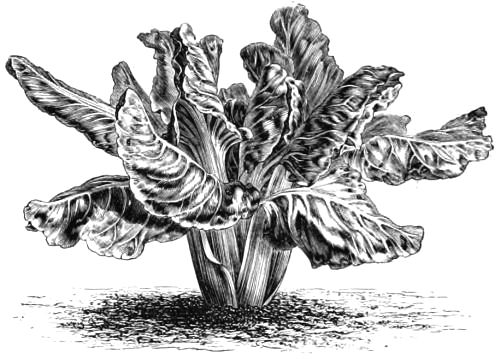
FIG. 223. WHITE LEAF BEETROOT.
Beetroot for Bedding Purposes: In this case, where the foliage is the main object, the seed may be sown in a reserve bed, and the plants transferred to their positions in the flower garden. If, however, a line is required in a ribbon or other border, the best plan is to sow there, and thin out the plants to equal distances. Dell's Crimson is one of the best varieties for this purpose, being very compact and of a good dark colour.
Varieties of the Leaf Beet (Beta Cicla), and Sea or Perennial Beet (Beta maritima), are sometimes, but very seldom, cultivated for the use of the leafstalks and leaves, the roots being hard and unfit for cooking purposes. They are at the best but substitutes for other vegetables—namely, the midrib for Sea-kale and the leaves for Spinach. If desired, seeds may be sown in the way described for Beetroot, in April for using in autumn and winter, and in August for spring use, plants of the latter sowing being protected in severe weather. The best sorts are Red-stalked, Yellow-stalked, and White (see Fig. 223) or Silver Leaf.
BEET CARRION BEETLE (Silpha opaca). This destructive insect is frequently found in dead animals, but often its grub almost destroys the leaves of Beet and Mangold Wurzel crops. The grubs, which are black and shining, when full grown are from ⅓in. to ½in. long; the three segments next the head are rounded at the sides, but the other segments are sharp, and the tail segment has a sharp spine on each side. "When full-fed, the grubs bury themselves, and form cells at the depth of 3in. or 4in. below the surface of the earth, in which they turn to pupæ, and from these the Beetle has been seen to come up in about the space of a fortnight or three weeks" (Ormerod). The Beetles are flattish, and about five lines long, brown-black, with a tawny down; eyes large and oval; horns club-shaped; body somewhat oval; wing-cases very flat, turned up at the outer edge, each case having three sharp ridges running along it; tip of abdomen dull red. Any manures or methods of cultivation that would stimulate growth in the plants, so as to permit renovation of injuries, would be found useful. If farmyard manure were applied to the soil intended for Beet in the autumn instead of in spring, it would lessen the risk of attack to the Beets.
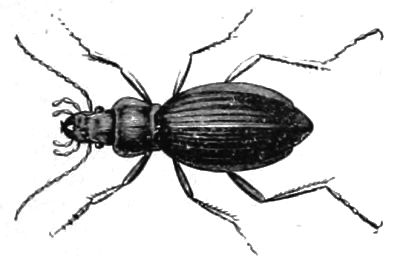
FIG. 224. COMMON GARDEN BEETLE.
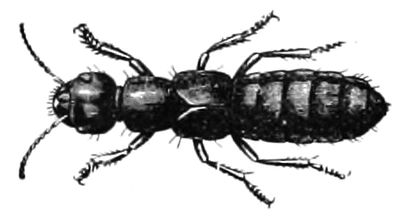
FIG. 225. DEVIL'S COACH HORSE.
BEETLES (Coleoptera). Beetles form one of the most extensive orders of insects, there being upwards of 3000 known British species. They vary much in appearance, but a Beetle is readily recognised by its front wings, or elytra; these form a tough horny sheath or case, which lies over the real wings, and protects them when the insect is not flying. Sometimes, the elytra are very short (see Fig. 225); the mouth is fitted with jaws for cutting. The metamorphosis is complete, i.e., the larva or grub is very unlike either the quiescent pupa or the perfect insect. The period that elapses before Beetles arrive at their perfect state varies from a few weeks to two or three years, but is usually rather longer than in Butterflies or Bees. Various Beetles attack growing plants and roots. Thus, Otiorhynchus sulcatus and O. picipes attack Vines, Roses, and other plants, gnawing off the bark. Some species of Beetles attack Mushrooms, while others bore into the wood of old trees, or eat leaves (e.g. Turnip Fly), or burrow in the leaves, or form galls on roots (Cabbage-gall Weevil). Of some kinds, the beetles are hurtful; of others, the larvæ. Many kinds, however, are beneficial, such, for instance, as the common Ground Beetle (Carabus, Fig. 224), and the Devil's Coach Horse (Ocypus olens, Fig. 225). These live upon other insects and snails. One kind of Beetle—the Ladybird (see Figs. 226 and 227)—is very beneficial in a garden, as it preys upon the aphides, or plant lice. For instructions in dealing with the noxious kinds, see Asparagus Beetle, Bean Beetle, Beet Carrion Beetle, Click Beetle, Cockchafer, Lily Beetle, Rosechafer, and Turnip Fly.
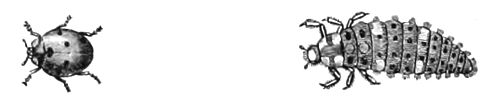
FIG. 226. SEVEN-SPOTTED LADYBIRD. FIG. 227. GRUB OF LADYBIRD. (Enlarged).
BEET or MANGOLD FLY (Anthomyia betæ). The maggots of this fly do considerable damage by feeding on the pulp of the Beet or Mangold leaves. The eggs are small, white, and oval, and are laid in small patches beneath the leaves; the maggots are about ⅓in. long, legless, cylindrical, and yellowish-white. As it is of such recent appearance in this country, specifics for its eradication are by no means numerous; but, according to Miss Ormerod, "the best treatment appears to be to nip it in the bud, where such treatment is possible, by destroying the infested plants, but generally by all means of good cultivation, or by special applications of artificial manure, to ensure a hearty growth, which may run the plants on past the power of average attacks to weaken the leafage to a serious extent."
BEFARIA (named in honour of Bejar, a Spanish botanist). ORD. Ericareæ. SYN. Bejaria. An elegant genus of greenhouse evergreen shrubs, closely allied to Rhododendron. Flowers bracteate; corolla very deeply seven-cleft, spreading. Leaves racemose or corymbose, crowded, quite entire, coriaceous. They thrive in a compost of peat and loam. Propagated by cuttings, made of the young wood, and placed in sandy soil, in gentle heat.
B. æstuans (glowing).* fl. purple; corymbs terminal, simple; peduncles, pedicels, rachi, calyces, and branchlets clothed with clammy glandular hairs. l. elliptic, rather glabrous above, but downy and glaucous beneath, while young clothed with rusty tomentum. Plant much branched; branchlets sub-verticillate. h. 10ft. to 15ft. Peru, 1846. SYN. Acunna oblonga. (G. C. 1848, 119.)
B. cinnamomea (cinnamon-coloured). fl. purple; panicles close, terminal; peduncles woolly, hispid. l. slightly downy above, rusty tomentose beneath. Branches downy, hispid. h. 4ft. Peru, 1847.
B. coarctata (close-headed). fl. purple; corymbs terminal, simple; peduncles, pedicels, rachi, and calyces clothed with rusty tomentum. l. oblong, glabrous, glaucous beneath. Shrub much branched. h. 4ft. to 5ft. Peru, 1847. (G. C. 1848, 175.)
B. glauca (glaucous).* fl. flesh-coloured; racemes terminal and axillary; pedicels somewhat fastigiate. June. l. oblong, obtuse, glaucous beneath. Shrub much branched; branchlets angular. h. 3ft. to 6ft. South America, 1826.
B. ledifolia (Ledum-leaved).* fl. purple; racemes terminal; peduncles, pedicels, rachi, branchlets, and calyces clothed with clammy glandular hairs. l. oblong, somewhat mucronate, with revolute edges, glaucous beneath, glandular. Shrub much branched; branches purplish. h. 3ft. to 4ft. South America, 1847. (F. d. S. 3, 195.)
B. racemosa (racemed). fl. purple, disposed in racemose terminal panicles. July. l. ovate-lanceolate, glabrous; branchlets smooth or hispid. h. 3ft. to 5ft. Georgia, 1810.
BEGONIA (named after M. Begon, a French patron of botany). ORD. Begoniaceæ. A large genus of succulent herbs or undershrubs (a few climbers), in many of which the stem is reduced to a tuberous rhizome, whilst some are distinctly tuberous. Flowers usually showy and large, white, rose, scarlet, or yellow, unisexual; perianth segments petaloid, four to five divisions, rarely two. Stamens numerous, filaments free or united at the base. Ovary inferior, styles two to four, free, sometimes connate, stigmas brandied or twisted. Fruit capsular, rarely succulent, often winged. Seeds numerous, minute. Leaves alternate, more or less unequal-sided, entire, or lobed, or toothed. Flower-stalks axillary, cymose. Distribution: Species about 350, in all tropical moist countries, especially South America and India; not known in Australia. Cultivated species (exclusive of garden hybrids and varieties) about 150. A large number of genera, or what were considered as such are now merged in Begonia—viz., Barya, Baryandra, Casparya, Pritzelia, &c. The rich colours and beautiful form of the flowers of Begonias, their prettily-marked foliage, and free-growing, free-blooming nature, have long marked them out as favourite garden plants. Within the last twenty years a new race, characterised by a tuberous root-stock, annual herbaceous stem, and large handsome flowers, has been introduced from the Andes of South America, from which, by means of careful cross-fertilisation and selection, a large number of beautiful and almost hardy kinds have been raised. The size, substance, and rich colours of the flowers of the majority of the plants of this race of Begonias are witness to what may be done by skilful cultivation and careful cross-breeding among plants. In the same way the large-leaved, stemless section, of which B. Rex may be taken as the type and principal progenitor, have been improved both in the size and the coloration of their foliage, and countless forms are now in cultivation, both as garden plants and for the decoration of rooms, &c. The propagation of Begonias may be accomplished by means of seeds, which are freely produced by almost all the cultivated kinds, by cuttings, by division of the rhizomes, and—in the case of the large-leaved kinds—by leaf-cuttings. For the first of these methods it is necessary that the seeds should be well ripened before they are gathered, and kept dry until sown. Where it is desired to increase any particular kind of garden origin, seeds are useless, none of the hybrid or seedling forms perpetuating themselves through their seeds, although equally beautiful sorts may be raised from them. The characters of all true species are, however, reproduced in their seedlings. For the successful raising of Begonia seeds it is necessary to sow them on pans or pots of well-drained, light, sandy soil, which should be well watered before the seeds are sown. The seeds should not be covered with soil, or they will fail to germinate. Over the pans a pane of glass should be placed, and they should then be stood in warm house or a frame where a temperature of about 65deg. can be maintained, and shaded from sunshine. As soon as the plantlets are large enough to be safely manipulated, they should be pricked off into pans of light leaf-mould soil, in which they may remain until large enough to be placed singly in pots. Cuttings: These strike freely if planted in small pots, in sand and leaf mould, and placed on a bottom heat of 70deg. Where large quantities are required, a bed of cocoa nut-fibre in a stove or propagating frame may be used, and in this the cuttings may be planted and remain until well rooted. Leaf cuttings succeed best when laid on sand or cocoa-nut fibre, and shaded from bright sunlight. In preparing the leaves, old, well-matured ones should be selected, and incisions made with a sharp knife across the principal nerves on the underside. They should then be placed on the sand or fibre and held down by means of a few pieces of crock. Under this treatment, bulbils will form on the lower ends of the nerves of each section of the leaf, and these, when large enough, may be removed from the bed and potted. With the exception of B. Evansiana (discolor), an almost hardy species from North China, all the shrubby species require a warm or intermediate house for their cultivation, although during the summer months a frame or sheltered bed answers for most of them, provided they are removed into their warm winter quarters on the approach of cold weather. Some of the species, such as B. Dregei, B. semperflorens, B. nitida, B. fuchsioides, B. Lindleyana, B. Richardsiana, along with the hybrids Ascotensis, Knowsleyana, Weltoniensis, and Ingramii, are grown in pots out of doors all the summer, and under liberal treatment they form large handsome specimens, which are of great value as flowering plants for the conservatory in winter. The tuberous-rooted herbaceous kinds should be started in heat in February, and, when vigorous growth has commenced, be gradually hardened off, for use either as bedding plants or as pot specimens for flowering in the greenhouse. A mixture of loam and leaf mould with a little sand and rotten cow-dung is suitable for the cultivation of these plants in pots. Liberal supplies of water should be given during the growing season. As the growth decays, water should be withheld until finally the tubers may be shaken out of the soil and placed in dry sand or cocoa-nut fibre, in a house or shed where a temperature above freezing can be maintained. B. gracilis and its varieties, diversifolia and Martiana, are beautiful greenhouse plants, which thrive well if treated as advised for the other tuberous-rooted kinds, with the addition of a few more degrees of heat.
The Rex section requires a light rich soil, plenty of moisture, and a shaded position in a warm greenhouse. These kinds are often employed with good effect for clothing peat-covered walls in ferneries, or as an undergrowth in large tropical houses. Large specimens have been grown under the stage in a warm house, the shade and moisture of such a position being exactly what they best delight in.
B. socotrana, an interesting species from the island of Socotra, is somewhat singular in its requirements. The stem is herbaceous and annual, and about its base a cluster of bulbils are formed, from every one of which a plant will be developed the following year. The growing season for this species is from September to March, after which it goes to rest for the whole summer. A tropical temperature and all the light possible, are essential to the well-doing of this plant.
It is interesting to note the apparent impossibility to cross any of the shrubby Begonias with the distinctly tuberous-rooted species; and even the species of the shrubby section, whose stems are semi-tuberous, have hitherto refused to commingle with the South American tuberous kinds, of which B. Veitchii, B. rosæflora, and B. boliviensis may be said to be typical. The infusion of the blood of these large, handsome-flowered kinds into the tall, shrubby species, would almost certainly result in the production of a race of splendid winter-flowering greenhouse plants, and it is therefore in every way desirable that no pains should be spared to break through the obstacle to the union of the two races.
Explanation of contractions: T, tuberous-rooted; S, shrubby.
B. acerifolia (Acer-leaved). S. A tall-growing, thick, succulent-stemmed species, with green, lobed, serrated foliage, and large branching cymes of small white flowers; sepals of male flowers hairy; styles three, two-horned. Capsule triangular, with one of the angles prolonged into an obtuse wing. Spring. Quito, 1829.
B. acuminata (taper-pointed-leaved). S. A low shrubby species, having semi-cordate, oblong, pointed leaves, with toothed margins, and the nerves on the under side and the petiole pilose. fl. white, in cymes, nearly 1in. across. Capsule wings, two short, the third ½in. long. Spring. Jamaica, 1798. (B. M. 4025.)
B. acutifolia (acute-leaved). S. A smooth-stemmed, semi-erect species, 3ft. to 4ft. high, with cordate-oblong leaves, both sides and petiole glabrous, the margins denticulate. fl. in cymes, white and red, about 1in. in diameter. Capsule winged, one wing twice as long as the others. Spring. Jamaica, 1816. SYN. B. purpurea.
B. acutiloba (acute-lobed).* A species with thick fleshy rhizomes, and palmate cordate leaves which are divided into five to seven lobes, with toothed margins and pointed apices, under side thinly covered with brown hairs. Flower-stalk tall, hairy, surmounted by a branching head of rather large white flowers. Summer. Mexico.
B. albo-coccinea (white and red).* Stemless, with a thick root-stock. l. broadly ovate, peltate, entire, 3in. to 4in. long; petiole 3in. to 6in., pubescent. Flower-scape 6in. to 9in. long. fl. in dense cluster, bright rose on the outside, white within. Capsule regularly triangular, with short wings. Summer. India, 1844. SYN. B. Grahamiana. (B. M. 4172.)
B. alchemilloides (Alchemilla-like). Stem fleshy, creeping. l. rotundate, with toothed, undulate, ciliated margins and short stalks. Flower-stem slender, few-flowered. fl. small, rose-coloured. Summer. Brazil.
B. amabilis (lovely).* Stem creeping, fleshy, short. l. ovate, crenulate, acuminate, about 6in. long, tomentose, dark green, blotched with white, under side purple-red. Flower-stalk 9in. long. fl. rose or white, in clustering cymes. Capsule irregular. Summer. Assam, 1859. The foliage sometimes comes wholly green, but, under good treatment, it is handsomely variegated.
B. amœna (pleasing).* Rhizome tuberous. Stem none, or very short. l. 3in. by 2in.; leafstalk 3in. Flower-stem 6in. long, few-flowered. fl. medium sized, pale rose. Capsule wings small, nearly equal. Summer. North India, 1878. SYN. B. erosa.
B. ampla (large). S. Stem 1ft. to 2ft. high, very stout, woody. l. long-stalked, 8in. to 10in. in diameter, broadly ovate, cordate, pointed, when young densely covered with rusty stellate down. fl. on short petioles, rose-coloured, 2in. wide. Fruit a succulent berry, small. Summer. Guinea.
B. aptera (wingless). Stem herbaceous. l. heart-shaped, pointed, shining green. fl. in short axillary cymes, white, small. Capsule four-angled. Spring. Celebes, 1878.
B. arborescens (tree-like). S. A large growing species, sometimes forming a bush 8ft. to 10ft. in height. l. pale green, ear-shaped, 6in. long. fl. in large cymose clusters, white, small. Summer. Brazil.
B. argyrostigma (silvery-spotted). Synonymous with B. maculata.
B. Arnottiana (Arnott's). Synonymous with B. cordifolia.
B. asplenifolia (Asplenium-leaved). S. A slender-stemmed, beautifully cut-leaved species, the foliage of which is pinnatisect, giving the plant the appearance of a Thalictrum rather than a Begonia. fl. very small, white. Guinea.
B. assamica (Assam). Stem short, fleshy. fl. pinkish flesh-colour. l. oblique ovate, olive-green, marbled with silvery blotches above, and of a pale purplish-pink beneath; petioles pale green, softly hairy. Assam, 1883.
B. attenuata (attenuated). Synonymous with B. herbacea.
B. aucubæfolia (Aucuba-leaved). Synonymous with B. incarnata.
B. auriformis (ear-formed). Synonymous with B. incana.
B. barbata (bearded). S. Stem short, hairy. l. toothed, oval-shaped, pointed, hispid beneath, 4in. long. fl. medium-sized, white or pink; flower-stalk hairy. Capsule equal-winged. Summer. India.
B. Berkeleyi (Berkeley's).* T. A garden hybrid, with thick, fleshy stems, and long ear-shaped foliage. fl. in erect panicles, rose-coloured. A useful winter-flowering kind.
B. bipetala (two-petaled). Synonymous with B. dipetala.
B. biserrata (doubly-serrated). S. Stem erect, branched, 2ft. to 3ft. high. l. 6in. long, 2in. to 3in. wide, deeply lobed, toothed, pale green. fl. in loose cymes, drooping, rose-coloured, 1½in. wide, serrated edges. Capsule pilose, two short and one long wings. Summer. Guatemala, 1847. (B. M. 4746.)
B. boliviensis (Bolivian).* T. Stem herbaceous, succulent, 2ft. high, branching. l. lanceolate, pointed, serrate, 3in. to 5in. long. fl. in drooping panicles, large, scarlet, males twice as large as females. Capsule three-winged. Summer. Bolivia, 1857. (B. M. 5657.)
B. Bowringiana (Bowring's). Synonymous with B. laciniata. (B. M. 5657.)
B. braziliana (Brazilian). S. Stem erect, tall, succulent. l. oblique, ovate, toothed, slightly pubescent; principal nerves brownish; stalk hairy. fl. white or rose, small, in short, few-flowered cymes. Capsule wing ½in. long. Summer. Brazil.
B. Bruantii (Bruant's).* B. A garden hybrid between B. Schmidti and B. semperflorens. l. green, with a brownish tint. fl. white or rose, in erect panicles. Summer, 1883. Used as a bedding plant in summer.
B. bulbifera (bulb-bearing). Most likely a form of B. gracilis.
B. caffra (Kaffrarian). A variety of B. Dregei.
B. carolineæfolia (Carolinea-leaved). S. Stem erect, thick, fleshy. l. palmate, curiously divided into six to eight long ovate segments, each 6in. long. fl. in a dichotomous cyme, on long stalk, rose-coloured, small. Capsule small, wings one longer than others. Winter. Mexico, 1876. A singular-leaved species. (R. G. 1-25.)
B. Cathcartii (Cathcart's). S. Caulescent. l. heart-shaped, acute, glabrous; stalks of flowers and leaves hairy; flowers and fruit as in B. barbata. Summer. India. SYN. B. nemophila. (C. H. P. 13.)
B. Chelsoni (Chelsea).* T. A garden hybrid between B. Sedeni and B. boliviensis. Stem fleshy, 2ft. high. l. oblique, lance-shaped, irregularly lobed. fl. large, orange-red, drooping. Summer, 1874.
B. cinnabarina (vermilion).* S. Stem erect, short, herbaceous. l. 2in. to 4in. long, oblique, toothed; peduncles 6in. long, few-flowered. fl. (male), medium, red; female flowers very small. Summer. Capsule irregularly-winged. Bolivia, 1848. (B. M. 4483.)
B. cinnabarina (vermilion). A variety of B. fuchsioides.
B. Clarkii (Clarke's).* T. Stem purplish, fleshy, stout. l. oblique-cordate, serrate. fl. in pendulous racemes, abundant, large, bright red, very handsome, nearly related to B. Veitchii. Summer. Peru and Bolivia, 1867. (B. M. 5675.)
B. coccinea (red).* S. Habit suffruticose. Stem sub-erect, 1ft. to 2ft. high, thick at the base. l. ovate-oblong, pointed; margins undulate and toothed. fl. in pendulous racemes, medium-sized; flowers and peduncles red. Capsule nearly regular; wings short. Summer. Brazil, 1842. (B. M. 3990.)
B. conchæfolia (shell-leaved). Stem creeping, rhizomatous, thick. l. peltate, ovate, 3in. to 5in. long, edges almost entire; under side, along with leaf and flower-stalks, covered with ferruginous hairs; scape 9in. long, erect, surmounted by corymb of small whitish fragrant flowers. Capsule wings, one long, two short. Autumn and winter. South America, 1852. SYNS. B. scutellata, B. Warscewiczii. (R. B. 246.)
B. corallina (coral-flowered). S. Stem woody, branching, sub-erect, brownish when matured. l. ovate-oblong, pointed, undulate, smooth, dull green, under side purple. fl. in long pendent racemes, numerous, medium-sized, bright coral-red. Summer. Brazil (?), 1875. A rare species, and one of the handsomest of the shrubby kinds, most likely closely related to B. maculata.
B. cordifolia (heart-shaped). T. Stemless; root-stock fleshy. l. cordate, orbicular, toothed, 3in. wide, pilose above, pubescent below; flower-scape 6in. long, dichotomous. fl. numerous, medium-sized. Capsule with three narrow wings. Winter. Ceylon and India. SYN. B. Arnottiana.
B. coriacea (leathery).* T. Stem 6in. high, herbaceous. l. reniform, 5in. wide by 3in. long, smooth above, pilose below. fl. rose-coloured, large, in twos or threes on the end of an erect scape, 8in. to 10in. long. Wings of capsule short, red. Summer. Bolivia.
B. coriacea (leathery). Synonymous with B. peltata.
B. crassicaulis (thick-stemmed). Stem short, thick, articulated, succulent. l. palmate; segments acuminate, toothed, under side clothed with rusty down. fl. in many-flowered cymes, dipetalous, white or rose-coloured, medium-sized. Capsule wings unequal. Near to B. heracleifolia. Spring. Guatemala, 1841. (B. R. 28, 44.)
B. crinita (hairy).* S. Stem 1ft. high, fleshy, bright red, more or less hairy. l. ovate-cordate; margins toothed, dark green; petiole red and hairy, like the stems. fl. in lax, branching cymes, rose-coloured, 1½in. in diameter. Fruit three-winged, one long and acute, two short and rounded. Spring. Bolivia, 1870. (B. M. 5897.)
B. cucullata (hooded). A variety of B. semperflorens.
B. dædalea (adorned).* Stem short, thick, succulent. l. large, green, thickly covered with a close network of russet-brown, scarlet when young; edges pilose. fl. white and rose, in loose panicles. Mexico, 1860. A handsome foliaged plant. (I. H. 1861, 269.)
B. Daveauana. See Pellionia Daveauana.
B. Davisii (Davis's).* T. stemless, l. springing directly from root-stock, ovate-cordate, shining green, slightly hairy, underside red; petiole short, fleshy. Flower-scapes, pedicels, and flowers bright red; scape 4in. high, bearing half a dozen flowers in umbel. Capsule three-winged, one long, two very short. Summer. Peru, 1876. A handsome tuberous-rooted species, dwarf. See Fig. 228, for which we are indebted to Messrs. Veitch and Sons. (B. M. 6252.)
B. dichotoma (branching). S. Stem tall, stout, fleshy. l. 5in. long by 4in. wide, lobed, dull green. fl. white, on long axillary scapes, numerous. Winter. 1860.
B. Digswelliana (Digswell's). Stem short, semi-decumbent, large, green; margins red. fl. on long, erect scapes, pale pink, small, numerous. Useful for winter flowering purposes. A garden hybrid. (F. M. 236.)
B. dipetala (two-petaled). Stems springing from a fleshy root-stock, erect, 18in. high, brown. l. half heart-shaped; margins toothed, upper surface thickly spotted with white, under side red. fl. in loose axillary cymes, two-petaled, large, pink. Capsule equal-winged. Spring. India, 1828. A handsome species. (B. M. 2849.) SYN. B. bipetala.
B. discolor (two-coloured). Synonymous with B. Evansiana.
B. diversifolia (diverse-leaved). A variety of B. gracilis.
B. Dregii (Drege's).* Rootstock fleshy. Stems succulent; annual, 1ft. high. l. oblique, thin, green, slightly spotted with grey, reddish on the under side. fl. white, about 1in. across, in axillary cymes. Capsule three-winged, one much longer than the other two, and acute-pointed. Summer. Cape, 1840. SYNS. B. caffra, B. reniformis.
B. echinosepala (spiny-sepaled).* Stem green, succulent, 18in. high. l. small, obliquely-oblong, serrulate. fl. on axillary peduncles, white, with curiously papillose sepals. Summer. Brazil, 1872. (R. G. 707.)
B. elliptica (elliptic). Synonymous with B. scandens.
B. erecta multiflora (erect, many-flowered). fl. bright reddish-pink, produced for several months, but especially during the winter. l. oblique, deep bronze coloured, very conspicuous. A decidedly handsome and very useful garden variety.
B. erosa (bitten). Synonymous with B. amœna.
B. Evansiana (Evans's).* T. Stem herbaceous, branching, smooth, 2ft. high. l. oblique, ovate-acute, sub-cordate, lobed; margins denticulate, green above, under side and petioles deep red; flower-stalks branching, axillary. fl. numerous, flesh-coloured, large. Capsule wings blunt-pointed, one longer than the others. Summer. Java, China, Japan, 1812. A handsome species, and almost hardy. SYNS. B. discolor, B. grandis. (B. M. 1473.)
B. eximia (excellent).* A hybrid, raised from B. rubro-venia and B. Thwaitesii. Stem short, succulent. l. bronzy-purple, tinged with red. A handsome foliage plant. (I. H. 1860, 233.)
B. falcifolia (sickle-leaved).* S. Stem 1ft. to 2ft. high, erect, branching. l. 6in. long, 1½in. wide, curved, tapering to a narrow point; margins toothed, upper surface green, more or less spotted with white, under side deep red. fl. on short axillary peduncles, drooping, dipetalous, bright red. Wings of capsule equal, ½in. wide. Summer. Peru, 1868. A pretty flowering plant. (B. M. 5707.)
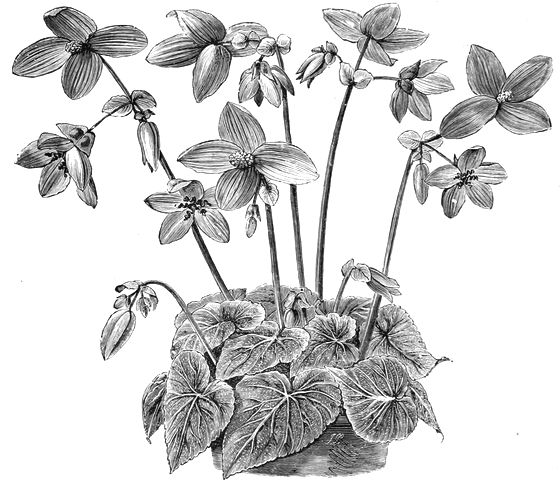
FIG. 228. BEGONIA DAVISII.
B. ferruginea (rust-coloured). S. Stem woody, erect, smooth branching, covered with ferruginous hairs. l. oblique, ovate-acute, acuminate, lobed; margins toothed. fl. in branching cymes, large red. Capsule unequal-winged. Summer. Bogota. SYN. B. magnifica.
B. Fischeri (Fischer's). Similar to B. falcifolia, except that the foliage is unspotted, and the flowers are white and small. Brazil, 1835. (B. M. 3532.)
B. foliosa (leafy).* S. Stem slender, branching, fleshy. l. small, ovate-oblong, dark green, numerous, distichous on stems. fl. small, numerous, white, tinged with pink. Summer. New Grenada, 1868. Useful for growing hanging baskets. SYN. B. microphylla. (Ref. B. 222.)
B. frigida (frigid). S. Stem 1ft. high, smooth, green, succulent. l. cordate, acuminate, lobed, serrated, slightly pilose; upper side coppery-green, beneath deep rose-red, especially upon the veins. fl. small, white, in erect branching cymes. Capsule wings two long, one short. Summer. Country unknown, 1860. (B. M. 5160.)
B. Frœbeli (Frœbel's).* T. Stemless. l. numerous, cordate, acuminate, green, covered with purplish-velvety hairs. fl. in tall, lax, drooping, branching cymes, brilliant scarlet, large. Winter. Ecuador, 1872. A beautiful flowering plant, useful for conservatory work in winter. (Garden, pl. 96.)
B. fuchsioides (Fuchsia-like).* S. Stem tall, drooping, herbaceous, smooth, green, tinged with red. l. copious, distichous, 1½in. long, oblong-ovate, slightly falcate, serrated, smooth; margins tinged with red. fl. in branching pendulous panicles, numerous, rich, deep scarlet. Capsule wings two very short and one long. Summer. New Grenada, 1846. A handsome greenhouse plant, useful for covering pillars, &c. SYN. B. miniata. (B. M. 4281.)
B. f. miniata (vermilion). l. smaller than in type. fl. cinnabar red. (F. d. S. 8, 787.)
B. gemmipara (bud-bearing). S. Stem 1ft. high, from a tuberous root-stock, succulent, l. ovate-acuminate, cordate, lobed, smooth above, pilose below. fl. medium-sized, white, or with rose stripes, on pendulous, axillary peduncles; sometimes the peduncles bear, instead of flowers, quadrangular cups, which are closely packed with oblong viviparous bulbils. Summer. Himalaya. (C. H. P. 14.)
B. geranifolia (Geranium-leaved).* Rootstock tuberous. Stem 1ft. high, erect, angular, succulent, green, with a purplish tinge, branched dichotomously. l. cordate, cut into unequal serrated lobes, green; margins red, whole plant perfectly smooth; peduncles terminal, bearing two to three flowers, which are inclined, drooping while in bud; outer petals orbicular, red, the two inner obovate, waved white. Summer. Lima, 1833. (B. M. 3387.)
B. geranioides (Geranium-like).* T. Rootstock fleshy. Stemless. l. radical, somewhat reniform, lobed, serrated; surface scabrid, deep green; leafstalks red, hairy. fl. white, in lax, drooping panicle. Summer. Natal, 1866. A pretty, though delicate, species. (B. M. 5583.)
B. glandulosa (glandular-leaved).* Stem a stout rhizome, scaly. Leafstalks thick, terete, erect, hairy, 9in. high. l. 6in. broad, fleshy, cordate, lobed, green; veins dark. fl. on tall, dark, erect scapes, numerous, greenish-white. Capsule wings, one very large, blunt. Costa Rica, 1854. SYNS. B. hernandiæfolia, B. nigro-venia. (B. M. 5256.)
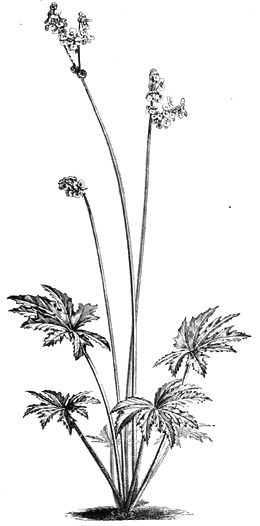
FIG. 229. BEGONIA HERACLEIFOLIA.
B. gogoensis (Gogoan).* l. peltate, ovate-orbicular, oblique, acute when young, with a bronzy metallic hue, ultimately changing to a deep velvety-green, intersected by the paler midribs and veins; the under surface deep red. fl. pale rose, in a lax panicle. Gogo, in Sumatra, 1881. A very handsome, ornamental-foliaged species.
B. gracilis (slender).* T. Stem erect, unbranched, very succulent, l. thinly scattered along stems, half heart-shaped, slightly hairy, lobed, denticulate-ciliate. fl. on short axillary peduncles; umbel of few male and female flowers, two larger petals serrate, colour pink. Capsule winged, green. Mexico, 1829. In axils of leaves between stipules a cluster of bulbils are borne; these may be gathered and sown as seeds. This and its varieties, annulata, diversifolia, Martiana, &c., are beautiful summer flowering greenhouse Begonias, requiring a sandy peat soil and shade. When well grown, they are exceedingly ornamental. (B. M. 2966.)
B. Grahamiana (Graham's). Synonymous with B. albo-coccinea.
B. grandiflora (large-flowered). Synonymous with B. octopetala.
B. grandis (great). A variety of B. Rex.
B. grandis (great). Synonymous with B. Evansiana.
B. grandis (great). Synonymous with B. vitifolia.
B. Griffithii (Griffith's). Stemless; rhizome subterraneous. l. large, obliquely-cordate; margin crenate, hairy; surface granulated, colour a dark green; margin purple, zoned with grey, under side green, centre and margin deep purple. fl. on cymes, large, white internally, outside tinged with blush, slightly pilose. Capsule tubercled, one wing large, projecting. Winter. India, 1856. (B. M. 4984.)
B. Hasskarlii (Hasskarl's). Synonymous with B. peltata.
B. heracleifolia (cow-parsnip leaved). Rootstock thick, fleshy. l. radical, on long pilose stalks, palmate, large, bronzy green; margins toothed, hairy. Flower-stalks long, stout, erect, hairy, many-flowered. fl. rose-coloured. Capsule wings nearly equal. Spring. Mexico, 1831. This and the following varieties are handsome both in foliage and flowers. SYNS. B. jatrophæfolia, B. punctata, B. radiata. See Fig. 229. (B. M. 3444.)
B. h. longipila (long-haired). l. greyish in middle; outer portions dark bronzy, blotched with green. Whole plant covered with long, stiff, fleshy hairs. fl. as in the type.
B. h. nigricans (dark). This differs from the type in having foliage of a blackish tint all round the margins of the lobes, and the petals of the flowers nearly white. (B. M. 4983.)
B. h. punctata (dotted). l. green, reddish near margin. fl. rose-colour, with deep red spots on the outside.
B. herbacea (herbaceous).* Rhizome creeping. l. oblong-acute, lanceolate, toothed, ciliated. Flower-stalks shorter than leaves; male flowers in a cymose head, white, small; female flowers solitary, on very short stalks. Spring. Brazil, 1873. A small species, very succulent, with the appearance of a primrose when not in flower. SYN. B. attenuata. (G. C. 1873, 679.)
B. hernandiæfolia (Hernandia-leaved). Synonymous with B. glandulosa. (Seemann.)
B. hernandiæfolia (Hernandia-leaved). Synonymous with B. nelumbiifolia. (Gardens.)
B. hernandiæfolia (Hernandia-leaved). Synonymous with B. peltata. (B. M. 4676.)
B. hirsuta (hairy). Synonymous with B. humilis.
B. Hookeri (Hooker's). A variety of B. semperflorens.
B. Hookeriana (Hooker's). S. Stem woody, 5ft. to 6ft. high, branching, covered with minute rusty tomentum. l. ovate, unequal sided, blunt, 8in. long, tomentose, like the stem. fl. in axillary cymes, small, white. Spring. Brazil, 1850.
B. humilis (dwarf).* Stem erect, fleshy, hairy. l. semicordate-oblong, acuminate, ciliate-serrate, hairy above, smooth beneath. fl. few, in cymes, small, white. Capsule unequal winged. Summer. Trinidad, 1788. Annual. SYN. B. hirsuta.
B. humilis (dwarf). Synonymous with B. suaveolens. (B. R. 294.)
B. hybrida floribunda (many-flowered).* A very beautiful summer blooming hybrid between B. fuchsioides and B. multiflora. fl. bright rose, medium sized, produced in abundance. Summer. One of the best.
B. hydrocotylifolia (Penny-wort-leaved).* Stem succulent, short, creeping. l. rotundate cordate, almost equal-sided; petiole short. Whole plant hairy. Flower-stalks 1ft. high, pilose. fl. in cymose head, medium-sized, dipetalous, rose-coloured, as also are pedicels and stalk. Capsule wings equal-sized, large. Summer. Mexico, 1841. (B. M. 3968.)
B. h. asarifolia (Asarum-leaved). Leaves and flowers smaller than in the type, the latter white. Mexico.
B. imperialis (imperial).* Stem rhizomatous, short, thick. l. large, broad, ovate-acute, cordate, rugose, hairy, dark olive-green; nerves banded with greyish-green colour. fl. in cymes, white, medium-sized. fr. unequal winged. Mexico, 1861. A handsome foliage species. (I. H. 1860, 262.)
B. i. smaragdina (emerald-like). l. shining emerald green.
B. incana (hoary). Stem erect, fleshy, tomentose. l. leathery, peltate, oblong-acute, sub-angular, whitish beneath. Flower-stalks long. fl. in small downy panicles, white. Winter. Mexico, 1840. SYN. B. auriformis.
B. i. auriformis (ear-like). l. divided at the base, not peltate. fl. glabrous.
B. incarnata (fleshy).* S. Stem erect, fleshy, 2ft. high, smooth; nodes swollen, reddish, spotted. l. on short, smooth petioles, unequally cordate, acuminate, sinuately-serrate, green. fl. large, rose-coloured, handsome; peduncles terminal, nodding. Capsule with unequal wings, the largest acute. Winter. Mexico, 1822. SYNS. B. aucubæfolia, B. insignis, B. Lindleyana. (B. M. 2900.)
B. i. maculosa (spotted). l. spotted with white.
B. i. metallica (metallic-leaved). l. with a bronzy-purple metallic lustre.
B. i. papillosa (papillose). Foliage margined with bright rose; upper surface covered with little papillæ. (B. M. 2846.)
B. i. purpurea (purple-leaved). Foliage deep bronzy-purple.
B. Ingramii (Ingram's).* A garden hybrid, raised at Frogmore in 1849, from B. fuchsioides and B. nitida. It combines the characters of the two parents. A useful winter-flowering plant; may be grown out of doors in summer. (G. M. B., p. 153.)
B. insignis (remarkable). Synonymous with B. incarnata.
B. involucrata (involucrate). S. Stem erect, tall, angular, covered with a reddish tomentum. l. oblique, ovate-acuminate, cordate; margins toothed and ciliate. fl. enclosed in a wrapper, or involucre, when young; peduncles graceful, bearing umbel of white, largish flowers. Capsule wings unequal, the largest falcate. Winter. Central America.
B. jatrophæfolia (Jatropha-leaved). Synonymous with B. heracleifolia.
B. Josephi (Joseph's). Stemless. l. radical, on petioles 6in. to 10in. long, ovate-acuminate, three-lobed, or orbicular, with numerous acute lobes, slightly pubescent; scape 1ft., branched. fl. small, rose-coloured. Capsule wings unequal; upper margins horizontal. Summer. Himalaya.
B. Kunthiana (Kunth's).* S. Stem erect, smooth, slender, purple-brown. l. on short petioles, lance-shaped, acuminate, regularly serrated, smooth, dark green above, bright crimson below. fl. axillary, on short nodding peduncles, white, large, handsome. Summer. Venezuela, 1862. A pretty species. (B. M. 5284.)
B. laciniata (cut-leaved).* Rhizome thick, fleshy. Stem short, thick, jointed, reddish, woolly. l. large, 6in. to 10in. long, 4in. to 6in. broad, unequally cordate; margins irregularly cut, serrated; upper side green, under dull, rufous. fl. on short axillary peduncles, large, white, tinted with rose. Capsule wings, one very long, others short. Spring. Nepaul to Birma, South China, 1858. SYN. B. Bowringiana. (B. M. 5182.)
B. Leopoldi (Leopold's). A hybrid from B. Griffithii and B. splendida, with large variegated foliage. 1858.
B. Lindleyana (Lindley's).* S. Stem erect, fleshy, covered with ferruginous hairs. l. on long petioles, peltate, ovate, acute, 5in. to 6in. long, 3in. to 4in. wide, irregularly lobed, toothed, green above, tomentose below. fl. on branching peduncles, medium sized, white. Winter. Guatemala.