THE DICTIONARY OF GARDENING, (continued 6)
Reading edition
A. modestum (modest).* fl. pure white, 1in. to 1½in. across. l. distichous, 3in. to 6in. long, 1in. to 1½in. broad, elliptic or linear-oblong, acute, tip entire, pale bright green, leathery, nerveless. Stem short. Madagascar, about 1880.
A. pellucidum (transparent).* fl. white, of a delicate semi-transparent texture, and with a finely fringed labellum; racemes from the axils of the lowest leaves, hanging perpendicularly from the stems, about 1ft. long, bearing thirty to forty blossoms. l. 12in. long by 2in. or 3in. broad. Sierra Leone, 1842. Must be grown in a suspended basket.
A. pertusum (broken).* fl. pure white; spur comparatively short, with a well-marked yellow tinge; racemes from the axils of two-year-old leaves, horizontal, or slightly nodding, 6in. to 7in. long, with from forty to sixty densely packed, small blossoms. l. dark green, arching, 10in. long by 1in. broad. h. 1ft. Sierra Leone, 1836. Very distinct and attractive.
A. Scottianum (Scott's).* fl. pure white, very delicate in texture, the lip is uppermost, 1in. or more across; spur narrow, yellowish, 3in. to 4in. long; peduncle slender, a little longer than the spur, usually but one-flowered. l. narrow, terete—thus differing from most of its congeners—tapering or awl-shaped, about 4in. long, ⅛in. to ¼in. in diameter, channelled in the upper surface and ridged below. Comoro Islands, 1878.
A. Sedeni (Seden's). A rare form of A. arcuatum.
A. sesquipedale (foot-and-a-half).* fl. beautiful ivory white, on stout, solitary, axillary peduncles, with sepals and petals spreading out like rays, from 6in. to 8in. across; the whip-like spur or nectary hangs down from the labellum, often from 10in. to 18in. long. November, December, and January, and lasts about three weeks in beauty. l. dark green, distichous, about 10in. long. h. 1ft. Madagascar, 1823. It is one of the grandest of winter flowering orchids.
A. virens (green). An inferior variety of A. eburneum.
ANGULAR. Having angles, or forming angles.
ANGULOA (commemorative of Angulo, a Spanish naturalist). ORD. Orchidaceæ. A small genus containing about six species. The flowers, which are large and beautiful, are borne singly on scapes from 12in. to 16in. high, several of which are produced from the ripened pseudo-bulbs of the preceding year's growth. Pseudo-bulbs from 5in. to 8in. high, as thick as a man's wrist, bearing two to three erect, broad, lanceolate leaves, 2ft. to 4ft. long. Temperature, summer, day (maximum), 70deg.; night (minimum), 60deg. Winter, day (maximum), 60deg.; night (minimum), 45deg. These are bold growing cool-house plants, best grown in rough fibrous peat, with good drainage. They delight in an abundant supply of water both to the roots and foliage when growing, and require to be kept in a somewhat dark or heavily-shaded place. During the season of rest, and until young shoots commence growth, they should be kept rather dry. They are propagated by dividing the pseudo-bulbs, just before they commence to grow. The flowering season is summer.
A. Clowesii (Clowes's).* fl. fragrant; sepals and petals concave, clear golden yellow; lip pure white; whole conformation globular, or tulip-like. Columbia (at 5000ft. to 6000ft. elevation), 1842. This is the largest growing species, of which there are one or two rare varieties.
A. eburnea (ivory-flowered).* fl., sepals and petals of the purest white; lip spotted with pink. New Grenada. In other respects similar to above, but is very rare.
A. Ruckeri (Rucker's).* fl., sepals and petals yellow, with crimson spots; lip deep crimson. Columbia, 1845. Not so large a grower as either of the foregoing, but with same sized flowers.
A. R. sanguinea (bloody).* This variety has flowers of a deep blood red colour, but is rare.
A. superba (superb).* Synonymous with Acineta Humboldtii.
A. uniflora (one-flowered).* fl. sub-globose, pure white, sometimes freckled with brown, spotted profusely with pink inside. Columbia, 1844. One of the best in cultivation.
ANGURIA (one of the Greek names for the cucumber). ORD. Cucurbitaceæ. A stove genus of evergreen climbers allied to Momordica. Flowers monœcious; corolla joined to the calyx, ventricose, red, with a five-parted spreading border. Fruit somewhat tetragonal. Several species have been introduced from time to time, but they are rarely seen in our gardens. Some of them are handsome plants, and well worthy of cultivation.
ANHALONIUM. See Mammillaria.
ANIGOZANTHUS (from anoigo, to expand, and anthos, a flower; in reference to the branching expansion of the flower stalks). SYN. Schwægrichenia. ORD. Hæmodoraceæ. Greenhouse or half-hardy perennial herbs. Flowers large, racemose or corymbose; perianth tubular, elongated, woolly. Leaves linear ensiform. The species thrive in a turfy compost of peat and loam, three parts of the former to one of the latter; the whole intermixed with sand to make it porous. In the growing season they must be kept well watered, and somewhat dry during their period of rest in winter. They are very easily propagated by dividing the roots in spring.
A. coccineus (scarlet).* fl. scarlet; perianth swelling towards the summit, hairy, segments a little reflexed; disposed in dichotomously-forked panicles; pedicels rather long. June. l. lanceolate, deep green. Stem ciliated. h. 5ft. Swan River, 1837.
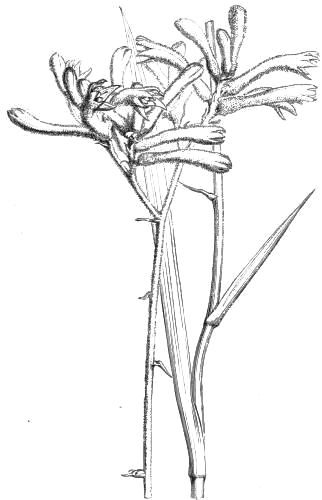
FIG. 103. INFLORESCENCE AND LEAF OF ANIGOZANTHUS FLAVIDUS.
A. flavidus (yellowish-green-flowered).* fl. yellowish green, panicled; scapes long. May. l. lanceolate, smooth, as is also the stem; down of branches deciduous. h. 3ft. New Holland, 1808. There is a scarlet and green-flowered variety of this species. See Fig. 103.
A. Manglesii (Mangle's). fl. green; stigma capitate, projecting beyond the tube, in a short terminal spiked raceme. May. Stem erect, clothed with short thick crimson persistent velvety down. h. 3ft. Swan River, 1833.
A. pulcherrimus (beautiful).* fl. yellow; panicles much branched, clothed with rufous bristles. May. l. equitant, linear falcate, covered with stellate tomentum. h. 3ft. Swan River, 1844.
A. tyrianthinus (purple).* fl. purple and white; panicle clothed with purple tomentum. May. l. linear, stiff, straight, glabrous. Stem tall, ternate, panicled, clothed with hoary tomentum below. h. 3ft. Swan River, 1844.
ANIL. See Indigofera Anil.
ANIME RESIN. See Hymenæa Courbaril.
ANIMATED OAT. See Avena sterilis.
ANISANTHUS. See Antholyza.
ANISE (Pimpinella Anisum). A hardy annual, occasionally used for garnishing or seasoning. Sow seed, in ordinary garden soil, on a warm sunny border, in May, where it is intended for the plants to remain.
ANISEED TREE. See Illicium.
ANISOCHILUS (from anisos, unequal, and cheilos, a lip; in reference to the inequality of both lips of calyx and corolla). ORD. Labiatæ. A very ornamental genus of stove perennials or biennials. Whorls of flowers densely imbricate into oblong cylindrical spikes; corolla with an exserted, defracted tube, inflated throat, and bilabiate limb. They thrive in any light rich soil. Cuttings will root in a sandy soil under a bell glass, in heat; seeds may be sown in February in heat.
A. carnosum (fleshy). fl. lilac; whorls densely imbricate into oblong cylindrical pedunculate spikes. June to September. l. petiolate, ovate-roundish, obtuse, crenated, cordate at the base, thick, fleshy, tomentose on both surfaces. Stem erect. h. 2ft. East Indies, 1788.
ANISOMELES (from anisos, unequal, and melos, a member; in reference to the anthers of the longer stamens being halved). ORD. Labiatæ. Ornamental greenhouse or evergreen stove shrubs, herbaceous perennials, or annuals. Whorls sometimes densely many-flowered, at others few, and loose; corolla with upper lip erect, oblong, entire; lower lip larger, spreading, and lateral lobes ovate, obtuse. They are of very easy culture in light rich soil; young cuttings strike freely in spring, in heat, under a bell glass. A. furcata requires little or no artificial heat, but the protection of a bell glass is beneficial. Seeds of A. ovata may be sown in spring, in heat, and, after due hardening off, the seedlings may be planted outside in May.
A. furcata (forked).* fl. small, elegantly variegated with white, red, and purple, in loose many-flowered racemose cymes. July. l. petiolate, ovate, acuminated, crenated, cordate at the base, hispid on both surfaces. h. 4ft. to 6ft. Nepaul, 1824.
A. malabarica (Malabar). fl. purplish; whorls distant, many-flowered, dense. July. l. oblong-lanceolate, 2in. to 4in. in length, obtuse, serrately crenated in the upper part, quite entire at the base. h. 2ft. to 5ft. Tropical Asia, in humid places, 1817. Shrub.
A. ovata (ovate-leaved).* fl. purple; lower lip of a deeper colour; whorls many-flowered, lower ones distant, upper ones interruptedly spicate. August. l. ovate, obtuse, broadly crenated. h. 2ft. to 3ft. Nepaul, 1823. An annual. Habitat similar to last.
ANISOMEROUS. Unequally-parted; unsymmetrical.
ANISOPETALUM. See Bulbophyllum.
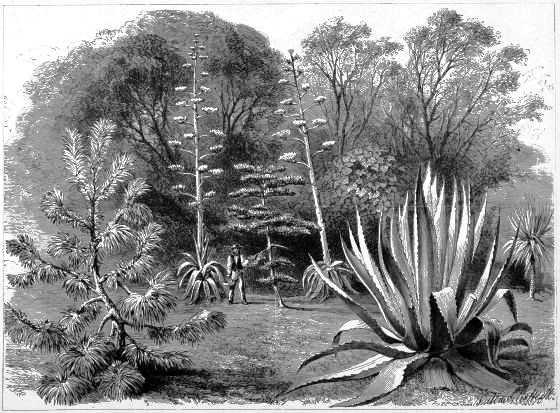
THREAD-LEAVED PINE, AGAVES, AND YUCCA, IN A GUERNSEY GARDEN.
[See larger version]
ANNUALS. All plants which spring from the seed, flower, and die within the course of a year. A number of things, however, which are not strictly of annual duration, but which are sown every year in preference to housing the roots before they are killed by late autumn or winter frosts, are generally classed, for the sake of convenience, under the head of Annuals. Hardy Annuals are those which require no artificial aid to enable them to develop, but grow and flower freely in the open air. These are best sown in the spots where they are intended to remain during March and April, and care must subsequently be taken to keep the ground clear of weeds, and also to thin out the seedlings, allowing each sufficient room to develop and exhibit its true character. If allowed to remain too crowded, the plants, as a matter of course, suffer, and the size and number of the flowers and the general effect are considerably decreased. Successional sowings of a good many of the showy species will be found to prolong their flowering season. In well-kept establishments, where Annuals are duly appreciated, several sowings are made in pots at intervals of a few weeks. As the previously-sown clumps begin to get shabby, they are removed, and replaced by others which have still to flower. By this means a continual sheet of blossom can be maintained for a long time. It is much better to trust to plants grown in pots in order to carry out the plan just sketched, as these receive no check when placed in their new quarters; whilst transplanted clumps frequently fail, and many species do not transplant at all readily from an open border. In order to secure, in early spring, a fine show of such plants as several of the Silenes, Myosotis, Saponaria, and a number of others, it is best to sow the seeds in an open, sheltered border, about the end of July or beginning of August, taking care to keep a small reserve stock in a cold frame, in case very severe weather kills the unprotected plants. Half-hardy Annuals are those for which our climate is not sufficiently warm, or, rather, our summer is not, as a rule, either hot enough or long enough, to allow them to grow, flower well, and ripen seeds, if sown in the open air. Many of these are amongst the showiest of garden plants, so it is worth while to give them the shelter of a warm frame during their earlier stages, and gradually harden them off, planting out at the end of May or beginning of June, when danger resulting from severe weather is passed. After germination, the seedlings should have plenty of light and air, or a weak, spindly growth, and, as a consequence, poor flowers, will result. The most satisfactory method of watering very tiny seeds is to place a piece of fine muslin over the seed-pot, through which the water will be easily conveyed to the seeds, and thus prevent disturbance. Tender Annuals require the same treatment as the half-hardy ones, except that they need throughout their existence the protection of a glass structure. All, or nearly all, garden Annuals delight in full sunlight and plenty of air. In the open, these requirements, as a rule, obtain, but sometimes mistakes are made under glass by keeping the plants too close and over much shaded, as well as too great a distance from the glass.
ANNULAR. Having a ring-like form.
ANNULATE. With the appearance of rings.
ANŒCTOCHILUS (from anoiktos, open, and cheilos, a lip; in reference to the spreading apex of the lip). SYNS. Anecochilus, Chrysobaphus. ORD. Orchideæ. Stove terrestrial orchids, the radical leaves of which are the chief attraction, being amongst the most beautiful and delicate objects in the vegetable kingdom. The flowers, which should be pinched off so soon as they appear, are, as a rule, small and unattractive. Few of the species exceed 6in. in height, with leaves from 2in. to 6in. long, including the fleshy petioles. They require a good deal of attention. To one part of silver sand, thoroughly washed twice or three times, add two of sphagnum, which should also be well washed and picked over, when it should be chopped into minute particles, in order that it may freely amalgamate with the sand; mix a little loam and peat with the whole. In the pots, when well drained by first placing a large piece of potsherd over the bottom and nearly half filling up with pieces broken small and of uniform size, place a thin layer of crude sphagnum, afterwards filling firmly with the mixture above mentioned, and bringing it up more or less in the form of a cone above the rim of the pot, into which the plants should be firmly fixed. Plants which have been propagated by division should be carefully transferred to 32-sized pots. About five separate pieces might be placed evenly over the surface. Make holes with a neat dibble, and into these drop the roots their entire length, pressing the soil firmly with the dibble. Fix them so that they may grow inwardly, and not out over the rim of the pots, pegging each creeping root needing such attention firmly down upon the surface of the soil afterwards; after a good soaking, they may be replaced in any warm, shady situation. For propagating, a strong plant is necessary; it may be cut into pieces just below the first joint, each piece having a root. The bottom piece should have two eyes—one to root from, and the other to push into a shoot. The "bottom," or plant which has been cut, should be replaced in its pot, and then put under a bell glass. It will soon throw up a young shoot; this ought to be left on until well rooted, when it may be separated and treated similarly to the portion first removed, still leaving the old part in the pot. These plants must be grown in glass cases, or under bell glasses, but they should always have a little air, for, as Mr. Williams says, when too much confined, they grow up spindly, and damp off in the stem; the latter, being fleshy, requires more substance and sturdiness. Air should be admitted through a space of about 1in. or 2in. The following ranges of temperature are advised: Winter, night, 55deg. to 60deg.; day, 65deg. to 70deg. during March, April, and May; night, 60deg. to 70deg.; and, afterwards, a few degrees higher, with a maximum day temperature of 80deg. Bottom heat should not be given, as it induces a weak, fast growth. Great care will be needed to prevent ravages of insects. The most suitable month for repotting is March, just before growth commences, when the plants will need plenty of water up to October, excepting when it is desirous to utilise them as drawing-room ornaments, in which case they should be kept rather dry for a short time previous. See also Dossinia, Goodyera, Hæmeria, Macodes, Physurus, and Zeuxine.
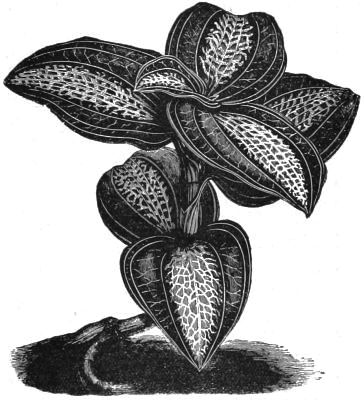
FIG. 104. ANŒCTOCHILUS FRIDERICI-AUGUSTI.
A. argenteus pictus (silvery-painted). A synonym of Physurus pictus.
A. argyroneurus (silvery-veined).* l. light green, dark mottled; veins forming a beautiful silvery network. Java.
A. Boylei (Boyle's).* l. ovate, acuminate, 2in. long and broad, olive-green, netted and pencilled with gold. India.
A. Bullenii (Bullen's).* l. 2½ in. long, ground colour bronzy green, with three broad distinct lines of coppery-red, or golden stripes running the entire length. Borneo, 1861.
A. concinnus (neat). l. ovate, acuminate, rounded at base, dark olive-green, netted and striped with shining coppery-red. Assam.
A. Dawsonianus (Dawson's).* l. ovate, of a dark velvety, rich olive-green, traversed by about seven longitudinal copper-coloured veins; the space on each side of the midrib being filled with fine reticulations of the same colour. Malay Archipelago, 1868. The proper name of this plant is Hæmeria discolor Dawsoniana.
A. Dayi (Day's). A synonym of Dossinia marmorata Dayi.
A. Dominii (Dominy's). l. dark olive-green, streaked down the centre with pale coppery-yellow, the main ribs marked by pale lines. Hybrid between Goodyera discolor and A. Friderici Augusti.
A. Eldorado (Eldorado). l. dark green, with small tracery of a lighter colour, deciduous. Central America.
A. Friderici-Augusti (Frederick Augustus').* l. 2½in. long, and 1½in. broad, dark velvety green, with broad orange and green stripes down the centre, covered with a beautiful golden network. h. 5in. Very distinct. See Fig. 104. SYN. A. xanthophyllus.
A. Heriotii (Heriot's). l. 3½in. long, 2½in. broad, dark mahogany-colour, golden-reticulated, and with shadowy network. India.
A. hieroglyphicus (hieroglyphic-marked). l. small, dark green, with hieroglyphic-like, silvery-grey blotches. Assam.
A. intermedius (intermediate).* l. 2½in. long, and 1½in. broad, with a silky surface, dark olive, striped and veined with gold. h. 3in. Will succeed with a glass covering, in a stove, if shaded.
A. javanicus (Java). fl. pink, small, spicate; scape 9in. high. l. 2in. long, 1½in. broad, dark olive-green, with lighter blotches and faint golden reticulation, pinkish beneath. Java.
A. latimaculatus (broad-spotted).* l. dark green, with silvery markings. Borneo. A distinct and free-growing kind.
A. Lowii (Low's).* l. 4in. to 5in. long, 3in. broad, dark velvety-green, shading to orange-brown, lined from base to apex with deep golden veins, crossed by lines of the same hue. h. 6in. Borneo. The correct name of this plant is Dossinia marmorata.
A. L. virescens (greenish).* l. brighter green, with brighter markings over the whole surface.
A. Ordianus (Ordi's).* l. shape and habit of A. Dawsonianus, but the colour is a vivid green, and lined with golden veins. Java, 1869. The proper name of this plant is Hæmeria discolor Ordiana.
A. pictus (painted). A synonym of Physurus pictus.
A. querceticola (forest-dwelling). A synonym of Physurus querceticolus.
A. regalis (royal).* King Plant. l. 2in. long, 1½in. broad; surface a beautiful velvety green, veined in regular lines, and covered with a network of gold. h. 4in. Java, 1836. If examined with a lens in sunshine, the beauty of the network will be plainly seen. SYN. A. setaceus (of gardens). There are several varieties, the best of which are:
A. r. cordatus (heart-shaped). l. rounder, and gold markings broader. Very rare.
A. r. grandifolius (large-leaved).* l. light green, beautifully laced and banded with a network of gold. Also rare.
A. r. inornatus (unadorned). l. dark rich velvety, with a few slight markings, destitute of the golden reticulation. Java.
A. Reinwardtii (Reinwardt's).* l. rich, deep velvety-bronze, intersected with bright golden lines. Java.
A. Roxburghii (Roxburgh's).* l. 2½in. long, 1½in. broad, dark velvety-green, striated with well-defined lines of silver. h. 3in. India. The true species is very rare; several are sold as such.
A. Ruckerii (Rucker's).* l. broadly ovate-bronzy-green, with six rows of distinct spots running from base to apex. Borneo, 1861.
A. setaceus (bristly). A garden synonym of A. regalis.
A. striatus (striated). A synonym of Zeuxine regia.
A. Turneri (Turner's).* l. large, rich bronze, freely golden-reticulated. One of the handsomest; a very free grower.
A. Veitchii (Veitch's). A synonym of Macodes Petola.
A. xanthophyllus (yellow-leaved). A synonym of A. Friderici-Augusti.
A. zebrinus (striped).* l. ovate-lanceolate, deep olive green, with copper-coloured veins. India, 1863. Dwarf and elegant.
ANOMATHECA (from anomos, singular, and theca, a capsule, or seed-pod). ORD. Irideæ. Very pretty little bulbous perennials. Perianth hypocrateriform; tube triquetrous, constricted at the throat. The species are hardy when planted in warm sunny situations in the open border. Their dwarf stature, brilliance, profusion of flowers, and habit of blossoming continuously over a long period, render them very popular subjects amongst growers of hardy perennials. Although generally credited with being hardy, when cultivated out of doors they should be lifted and stored in frost-proof quarters before winter commences, until the following March. They are excellent as window garden plants, and also for pot culture. If grown in pots, they should be shaken out, and repotted in February or March. They multiply very rapidly, and may be divided in patches, not by single bulbs, once yearly. Light sandy loam, mixed with a little leaf mould, is the best compost. Anomathecas are sometimes increased by seed, which may be sown so soon as ripe, very thinly, in seed pans. Thin out the seedlings if growing very close together; the next season they may be put out four or five in a pot. When they become crowded, shift into a much larger pot, but do not disturb the ball. The young seedlings will probably produce flowers the second season.
A. cruenta (bloody).* fl. rich carmine-crimson; perianth segments elliptical, three lower ones broader than the others, with a dark blotch at the base; tube long, whitish; scapes secund, bearing about five or six flowers. Summer and autumn. l. two-ranked, about ½in. broad, sword-shape, somewhat tapering. Bulb ovate, rather large. h. 6in. to 12in. Cape of Good Hope, 1830.
A. juncea (rushy). fl. very bright pink, with a dark spot at the base, produced in profusion. The leaves are narrower than those of the foregoing. Cape of Good Hope, 1791. A rare species.
ANONA (Anona is the name applied to these plants in St. Domingo). Custard Apple. ORD. Anonaceæ. Stove evergreen shrubs, with fragrant leaves. Petals six, in two rows. Carpels indefinite, joined into one fleshy, many-celled, edible, roundish fruit, with a muricated, scaly, or reticulated skin. Anonas thrive best in rich loamy soil, mixed with a little peat. Ripened cuttings, with leaves intact, will root if inserted in sand and placed under a hand glass, in a moist heat. When seeds are procurable, they should be sown in pots, and plunged into a hotbed.
A. Cherimolia (The Cherimoyer). fl. outer petals somewhat concave, linear-oblong, brown on the outside, each marked with a dark spot at the base; peduncles opposite the leaves, solitary. July. fr. somewhat globose and scaly, dark purple; esteemed by the Peruvians as one of their most delicate, and as being not inferior to any fruit in the world. l. ovate-lanceolate, not dotted; under surface silky tomentose, strong scented. h. 20ft. Peru, 1739.
A. glabra (smooth-fruited).* fl. outer petals ovate, obtuse, brown; calyx leathery, large; peduncles opposite the leaves, two-flowered. July. fr. greenish-yellow, conoid, blunt, smooth. l. ovate-lanceolate, smooth. h. 10ft. West Indies, 1774.
A. longifolia (long-leaved). fl. purplish; outer petals concave, thick, all acute, large, axillary, solitary, stalked. May. fr. ovate-globose, dotted, and reticulated, flesh-coloured. l. oblong, acuminated, mucronate, smooth. h. 20ft. Guiana, 1820.
A. muricata (muricated-fruited).* The Sour Sop. fl. outer petals cordate, concave, thick, acuminated, green on the outside, yellow inside, and spotted; peduncles solitary, one-flowered, sweet-scented. fr. muricated, with fleshy points, green. l. ovate-lanceolate, smooth, shining. h. 15ft. West Indies, 1656.
A. palustris (marsh). Alligator Apple; Cork-wood. fl. yellow; petals all acute. fr. rather areolate, large, heart-shaped, sweet-scented. l. ovate-oblong, leathery, quite smooth. h. 10ft. to 20ft. South America, 1788.
A. reticulata (netted). The Custard Apple, or Bullock's Heart. fl. outer petals oblong-lanceolate, acute, somewhat concave at the base, brownish on the outside, whitish-yellow on the inside, marked with dark purple spots. fr. ovate-globose, reticulate, as large as a tennis ball, with yellowish soft flesh; it is much esteemed by some people. l. oblong-lanceolate, acute, smooth, somewhat dotted. h. 15ft. to 25ft. Brazil, 1690.
A. squamosa (scaly). Sweet Sop. fl., outer petals linear-oblong, somewhat concave at the base, nearly closing, greenish-yellow. fr. egg-shaped, scaly. l. oblong, bluntish, smooth, full of pellucid dots, rather glaucous beneath. h. 20ft. South America, 1739.
ANONACEÆ. An order of trees or shrubs, mostly tropical, with axillary peduncles, lateral or opposite the leaves, and with alternate, simple, entire or hardly toothed leaves, without stipules. Anona is the typical genus.
ANONYMO. A synonym of Saururus (which see).
ANONYMOS BRACTEATA. See Zornia tetraphylla.
ANOPLANTHUS (in part). A synonym of Phelipæa (which see).
ANOPLOPHYTUM. See Schlumbergeria and Tillandsia.
ANOPTERUS (from ano, upwards, and pteron, a wing; in reference to the seeds, which are winged at the apex). ORD. Saxifrageæ. A very handsome greenhouse evergreen shrub, having a free branching habit, large dark shining green leaves, and long panicles of salver-shaped flowers. It would probably prove quite hardy in the south and west of England, and parts of Scotland, provided it had a slight winter protection. It grows well in sandy loam and peat. When grown in pots, it requires plenty of room and water. Half-ripened cuttings root freely under a bell glass in a cool house or frame in summer.
A. glandulosa (glandular).* fl. white, rose tinted, large; racemes erect, simple, terminal. April, May. l. alternate, rarely nearly opposite, ovate-oblong, attenuated at both ends, nearly sessile, leathery, toothed. h. 3ft. Van Diemen's Land, 1823.
ANSELLIA (named after Mr. Ansell, the botanical collector who accompanied the ill-fated Niger Expedition). ORD. Orchidaceæ. Strong growing, free flowering stove epiphytal orchids. Best grown in large pots, as they produce a quantity of roots. They require a compost of turfy peat, with moderate drainage. An ample supply of water during the growing season is needed; but care must be taken not to let any remain in the heart of the plants, as they are very likely to rot. During the season of rest, little or no water, but a damp atmosphere, are the chief requirements. Propagated by divisions of the bulbs just after flowering.
A. africana (African).* fl., sepals and petals nearly 2in. long, greenish yellow, spotted with brownish red; lip small, yellow; spikes large, drooping, branched, each sometimes bearing nearly a hundred blooms. Stems 3ft. to 4ft. high, with light evergreen foliage. Fernando Po, 1844. Lasts two months in perfection.
A. a. gigantea (gigantic).* fl. on upright spikes from the top of the pseudo-bulbs, but smaller, of a light yellow tint, with very few narrow, transverse, brown bars, and a deep yellow lip, without warts of any kind on its middle lobe, and with more or less crenulated keels. Natal, 1847. The perfume is very peculiar. Very rare.
A. a. lutea (yellow). Not so strong a grower; producing clusters of light yellow flowers from the top of the pseudo-bulbs. Natal.
A. a. nilotica (Nile district).* As a garden plant this is much superior to the type. The habit is dwarfer, the colours of the flowers brighter and more distinctly defined. The sepals and petals, too, are more spreading. Eastern Africa.
ANSERINA. See Potentilla anserina.
ANTENNÆ. Two movable, articulated organs attached to the heads of insects and crustacea, commonly called "horns" or "feelers." They are variable in form and length. Antennæ seem to serve for touch, and, perhaps, for smell and hearing.
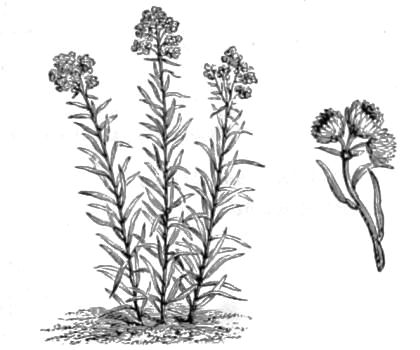
FIG. 105. ANTENNARIA MARGARITACEA, showing Habit and Inflorescence.
ANTENNARIA (from antennæ; in reference to the similarity which exists between the seed down of the plant and the antennæ, or feelers, of an insect). ORD. Compositæ. Hardy herbaceous perennials, distinguished by the dry, coloured, chaffy scales encircling each head of flowers, of which the stamens and pistils are on different plants. These are charming little alpine plants, admirably adapted for rockwork, pots, edgings, or borders, in any light soil. Propagated by divisions of the roots in spring, and seeds; the latter should be sown in spring in a cold frame. Grown chiefly for their leaves.
A. dioica (diœcious).* fl.-heads pink, in crowded corymbs, 3in. to 4in. high. June. l. radical ones spathulate, woolly chiefly beneath; upper ones lanceolate. Stems simple; shoots procumbent. Britain. The two or three varieties of this pretty species exceed the type in beauty. SYN. Gnaphalium dioicum.
A. d. hyperborea (northern). l. woolly on both surfaces.
A. d. minima (smallest).* A very small growing variety.
A. margaritacea (pearly).* fl.-heads white, corymbose. August. l. linear-lanceolate, acute, alternate, cottony, especially beneath. Stems branched above. h. 2ft. Naturalised in England and on the Continent. Said to have been introduced from America about the sixteenth century. The prettier but much rarer A. triplinervis, from Nepaul, comes close to this species. See Fig. 105.
A. tomentosa (downy).* fl.-heads corymbose. Summer. One of the dwarfest and best of silvery-leaved plants, either as an edging for small beds or for covering the higher portions of rockwork; it is much used in carpet bedding. It scarcely grows more than 1in. high, and forms a dense carpet in a short space of time. It should be grown separate from other plants. It is frequently known under the name of A. candida.
ANTERIOR. Placed in front, or outwards.
ANTHEMIS (from anthemon, a flower; referring to their general floriferous character). Camomile. ORD. Compositæ. Receptacle convex, chaffy. Involucre hemispherical or nearly flat; scales imbricated, membranaceous at the margin. Pappus none; ray florets ligulate; disk tubular. This is a large genus, principally of medicinal value, and contains very few species worth the cultivator's trouble. Of easy culture in any ordinary soil. Propagated by divisions.
A. Aizoon (Aizoon).* fl.-heads resembling a white Daisy; florets of the ray fourteen to eighteen, trifid, twice as long as the breadth of the disk. Summer. l. lanceolate, or broadly so, acutely and deeply serrated, narrowed towards the base, covered with white down; lower ones crowded; stem-leaves rather acute, gradually lessening in size. h. 2in. to 4in. Northern Greece. Free grower, dwarf, and compact.
A. Biebersteinii (Bieberstein's).* fl.-heads yellow. Summer. l. pinnately divided into linear three-lobed segments, which are covered with white silky pubescence. h. 1ft. to 2ft. Caucasus.
A. Chamomilla fl. pl. See Matricaria.
A. nobilis (noble). Common Chamomile. fl.-heads solitary; disk yellow; ray white; scales of the receptacle membranaceous, scarcely longer than the disk. l. bipinnate, segments linear-subulate, a little downy. Stem procumbent, and much branched. England. A very strong smelling plant, of great medicinal value. For culture, see Chamomile.
A. tinctoria (dyer's). fl. bright yellow, in large heads. July and August. l. bipinnatifid, serrate, downy beneath. Stem angular. h. 1½ft. England. A very pretty plant.
ANTHER. The male part of a flower containing the pollen.
ANTHERICUM (from anthos, a flower and kerkos, a hedge; in reference to the tall flower stems). SYN. Phalangium. ORD. Liliaceæ. A large genus, belonging to the capsular group of the order, and inhabiting, for the most part, the Cape of Good Hope. Flowers white, racemose or panicled, scapose; perianth segments either spreading from near the base or campanulately united; stamens short, with naked or bearded filaments. Leaves radical, filiform or linear. The hardy varieties are now extensively grown, and are among the most ornamental of border plants. They thrive best in rich light soil, and are excellent subjects for pot culture; for which purpose use a compost of fibrous loam, leaf mould, or well-decayed manure, and coarse sand. The pots should be about 12in. across, well drained, and the plants potted just previous to, or so soon as, growth commences. During activity, plenty of water is needed, until the plants have finished flowering, when the quantity may be lessened; but never allow them to get dry. Propagated by division of the roots or seeds, sowing the latter, as early as possible after they are ripe, in a cold frame.
A. graminifolium (grass-leaved). A garden name of A. ramosum.
A. Hookeri (Hooker's). See Chrysobactron Hookeri.
A. Liliago (Liliago).* St. Bernard's Lily. fl. pure white, 1in. to 1½in. across; perianth segments spreading; style curved. May to August. l. tufted, narrow, channelled, 12in. to 18in. high. South Europe, 1596. A very free flowering species, of which there is a major variety in gardens. SYNS. Phalangium and Watsonia Liliago.
A. Liliastrum (Liliaster).* St. Bruno's Lily. fl. much larger than the last, 2in. long, and as much across, fragrant, of a transparent whiteness, with a delicate green spot on the point of each segment, campanulate, arranged in loose spikes. Early summer. l. long, narrow, six or eight to each plant, about 1ft. to 2ft. long, h. 1ft. to 2ft. South Europe, 1629. SYNS. Czackia Liliastrum and Paradisia Liliastrum (this is the correct name). See Fig. 106.
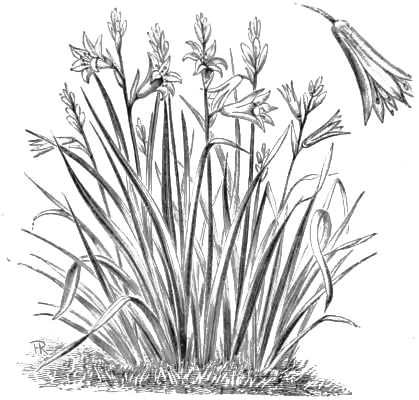
FIG. 106. ANTHERICUM LILIASTRUM, showing Habit and Flower.
A. L. major (greater). fl. about 1in. larger than the type. h. about 6ft. A very desirable border plant.
A. ramosum (branched).* fl. white, rather smaller than those of A. Liliago; perianth segments narrow and spreading; style straight; flower stems much branched. June. l. long, narrow, channelled, grass-like. h. 2ft. South Europe, 1570. A rapid grower. SYN. A. graminifolium (of gardens).
A. serotinum (late-flowering). See Lloydia.
A. variegatum (variegated). l. keeled, grass-like, striped and margined with white. South Africa, 1875. Half hardy. The proper name of this plant is Chlorophytum elatum variegatum. SYNS. A. Williamsii and Phalangium argenteo-lineare.
A. Williamsii (Williams'). Synonymous with A. variegatum.
ANTHERIDIA. The reproductive organs in cryptogamic plants, analogous to anthers in flowering plants.
ANTHERIFEROUS. Bearing anthers.
ANTHESIS. The opening period of flowers.
ANTHOCARPOUS. Bearing a fruit resulting from many flowers.
ANTHOCERCIS (from anthos, a flower, and kerkis, a ray; in reference to the radiated corolla). ORD. Solanaceæ. Handsome greenhouse evergreen shrubs, with alternate leaves, attenuated into the petioles or base, thick, sometimes glandularly dotted. Flowers axillary, generally solitary; corolla campanulate. Cuttings strike freely in sand under a bell glass, with a mild bottom heat. So soon as they have well rooted, pot off into very small pots in two-thirds good loam and one of peat. After having made a little headway, the leading shoots should be pinched off, to induce a lateral growth; they may be transferred to pots a size larger when the roots have filled the first pot. Continue growing throughout the summer in frames or in the greenhouse, near the glass, allowing plenty of air. Vigorous growth should be checked; thus encouraging bushy plants.
A. albicans (whitish-leaved).* fl. white, streaked with bluish-purple inside the tube, fragrant; petals longer than the tube. April. l. oblong, obtuse, densely tomentose on both surfaces, as well as the branches. h. 1½ft. to 2ft. New South Wales, 1824.
A. floribunda (many-flowered). fl. white. h. 3ft. New South Wales.
A. ilicifolia (Holly-leaved). fl. yellowish green. June. h. 6ft. Swan River, 1843.
A. littorea (shore). fl. white. June. h. 3ft. New Holland, 1803.
A. viscosa (clammy).* fl. large, white. May. l. obovate, glandularly dotted with scabrous margins; young leaves and branches clothed with fine down. h. 4ft. to 6ft. New Holland, 1822.
ANTHOLOMA (from anthos, a flower, and loma, a fringe; in allusion to the fringed or crenulated limb of the corolla). ORD. Tiliaceæ. A very fine greenhouse evergreen tree; it thrives best in a light loamy soil, mixed with a little peat. Cuttings of ripened wood will strike root in sand, under a hand glass.
A. montana (mountain).* fl. white; corolla ovately cylindrical, with a crenate, rather toothed margin; racemes axillary, somewhat umbellate, reflexed. May. l. elliptical-oblong, leathery, stalked, scattered at the top of the branchlets. h. 20ft. New Caledonia, 1810.
ANTHOLYZA (from anthos, a flower, and lyssa, rage; in reference to the opening of the flowers, which resemble the mouth of an enraged animal). SYN. Petamenes. Including Anisanthus. ORD. Irideæ. A very pretty genus of bulbous plants from the Cape of Good Hope, having narrow, erect, Iris-like leaves, and flower-spikes that over-top the foliage, bearing numerous bright-coloured flowers. Perianth tubular, six-cleft, unequal, the upper segments longest; stamens three. The species may be grown in a greenhouse, or planted out in a frame. They also thrive excellently out of doors, and should be planted 8in. or 9in. deep for fear of frost, or have a winter protection of several inches of cocoa-nut fibre refuse or litter. The safer plan is to raise the roots, winter them in some dry part of the greenhouse; but, previous to storing, divide the clumps, clean them, and re-plant or pot in February, or early in March. A mixture of equal parts peat, sandy loam, and leaf soil is most suitable for their culture. Just previous to flowering, if in pots, frequent doses of weak manure water will be found beneficial. They may be propagated by offsets, which are produced in abundance, at almost any time. Seeds are sometimes procured, which should be sown so soon as ripe, in light soil, in a cool house, where they will germinate the following spring, and will be fit to plant out in the summer of the same year. With the exception of A. Cunonia, they all much resemble each other. Only four or five species of this genus are worth cultivating.
A. æthiopica (Æthiopian).* fl. scarlet and green. June. h. 3ft. 1759. SYNS. A. floribunda, A. præalta.
A. æ. ringens (gaping). fl. red and yellow, rather smaller than those of the type. SYN. A. vittigera.
A. bicolor (two-coloured). Synonymous with A. Cunonia.
A. caffra (Caffrarian).* fl. rich scarlet; spike distichous, many-flowered. June. l. long, linear, or linear-ensiform. h. 2ft. 1828. A very showy and pretty species, but rarely seen in our gardens. SYN. Anisanthus splendens.
A. Cunonia (Cunon's).* fl. scarlet and black, a combination of colours uncommon among bulbous plants; spikes secund. June. h. 2ft. 1756. SYN. Anisanthus Cunonia.
A. floribunda (much-flowered). A synonym of A. æthiopica.
A. præalta (very tall). Synonymous with A. æthiopica.
A. vittigera (glandular). Synonymous with A. æ. ringens.
ANTHOMYIA. See Beet Fly, Cabbage Fly, and Onion Fly.
ANTHONOMUS. See Grubs.
ANTHOSPERMUM (from anthos, a flower, and sperma, a seed). Amber Tree. ORD. Rubiaceæ. An ornamental greenhouse evergreen shrub from the Cape of Good Hope. It thrives in peat, loam, and sand, with a summer temperature of 50deg. to 65deg., and winter, 40deg. to 45deg. Increased by cuttings, in sand, under a bell glass. There are above twenty other species belonging to this genus.
A. æthiopicum (Æthiopian).* fl. diœcious, male brownish, and the female ones green, disposed in verticillate spikes. June. l. linear-lanceolate, three in a whorl, shining above, glabrous beneath, about ¼in. long. Stem much branched, downy above. h. 2ft. to 3ft. 1692.
ANTHOTAXIS. The arrangement of flowers on an inflorescence.
ANTHOXANTHUM (from anthos, a flower, and xanthus, yellow). Spring Grass. Calyx of two valves, glumaceous, one-flowered; corolla double, each of two valves: the exterior awned; the interior small, awnless; stamens two, not three, as is usually the case with grasses. ORD. Gramineæ. A pretty native hardy perennial, of easy culture in common garden soil.
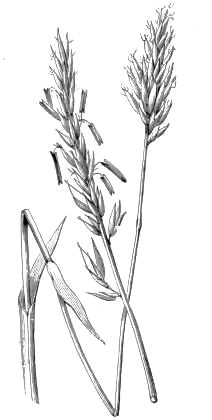
FIG. 107. ANTHOXANTHUM ODORATUM.
A. odoratum (sweet). fl. panicle spiked, oblong, dense, becoming dullish yellow. l. short, pale green. h. 1ft. The pleasant smell of new-made Hay is chiefly owing to this plant, which in drying emits an odour similar to that of Asperula odorata. See Fig. 107.
ANTHURIUM (from anthos, a flower, and oura, a tail; referring to the inflorescence). ORD. Aroideæ. Flowers densely disposed on a cylindrical spadix, at the base of which is a large bract-like spathe, that ultimately bends backwards. Leaves of various shapes. This very large genus of handsome stove and greenhouse plants is remarkable both for the peculiar inflorescence and often noble leaves, and is distinguished in structure from all the European members of the order in the flowers being hermaphrodite. Fibry peat, loam, sphagnum, broken crocks, or charcoal, and silver sand, form the most suitable compost. In preparing the peat, it should be broken up into small lumps, and then have most of the earthy matter knocked out of it by giving it a few raps with a stick, or by shaking it about in a sieve. To this, after so treated, add about one-fourth its bulk of sphagnum, and about half its bulk of fibrous loam, and just a sprinkling of fresh broken crocks, or small pieces of charcoal and sharp silver sand. In placing them in the pots—which must be well drained—carefully spread out the roots and work the mixture among them, keeping the plant well up, so that when finished it stands clear above the rim of the pot at least 2in. or 3in., and forms a kind of mound or hillock. They must then be kept freely syringed or watered, and placed in a moist atmosphere, where they can enjoy a temperature ranging between 60deg. and 70deg., or a few degrees lower for the less tender species. Raising plants from seed requires patience. About a year elapses from the time the flowers are fertilised—which should be done artificially—before the seed ripens, and often another to get up plants. Sow as soon as ripe in shallow, well-drained pans or pots, filled with the potting mixture, and cover slightly, and place in a close, moist propagating case, where a temperature of from 75deg. to 85deg. is maintained, or they may be covered with bell glasses. The principal thing is to keep the air about them constantly humid, and the material in which they are sown in a uniformly moist condition; if this is done, the young seedlings will make their appearance in due course. When these are of sufficient size to handle, they should be pricked off in the same sort of compost, and be kept close and moist till they get a start, after which gradually inure them to more air. January is the best month of the year wherein to propagate these plants by divisions. This is done by carefully turning them out of their pots and shaking out what soil they have amongst their roots, which must be tenderly dealt with, so as not to bruise or injure them. This done, they may then be pulled apart, and as many plants made as there are separate crowns, or the mass may be simply halved or quartered, according to the stock required. Treat now as recommended above for potting. They are all moisture-loving plants, and must have a copious supply of water at all times, although, of course, much less during the winter than spring and summer months. There is no season of the year when they can be handled for any purpose with less risk or check than January. A moderate moist stove heat is advisable for them generally. The species enumerated are selected from nearly 150, and will be found to be a very representative collection. See also Spathiphyllum.
A. acaule (stemless).* fl., spadix blue in a young state, borne on long footstalks, sweetly scented. Spring. l. broad, oblong, acuminate, 1ft. to 3ft. in length, erect, arranged in a rosulate manner, dark shining green on the upper surface, somewhat paler beneath. West Indies, 1853. A noble species.
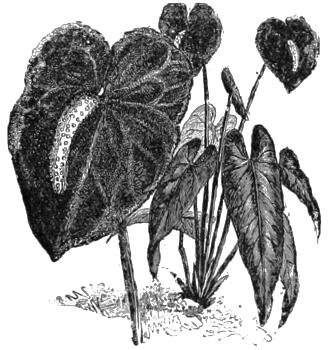
FIG. 108. ANTHURIUM ANDREANUM.
A. Andreanum (André's).* fl., spadix about 3in. long, yellowish, with a broad central band of white; spathe open, cordate-ovate, orange red, leathery, 3in. to 4in. across, and 6in. to 9in. long; surface irregularly corrugated. l. ovate-lanceolate, deeply cordate, green. Columbia, 1876. A very beautiful species. See Fig. 108.
A. Bakeri (Baker's).* fl., spathe small, green, reflexed; the spadix, wherein lies the plant's principal beauty, exhibits a lovely combination of pink and bright scarlet; the fleshy rachis being pink, and the pea-sized fruits bright scarlet. July. l. linear, leathery, green, with stout midribs. Costa Rica, 1872.
A. cordifolium (cordate-leaved).* l. 3ft. long and 20in. broad, heart-shaped, deep shining green on the upper surface, and paler below. h. 4ft. New Grenada. One of the best, and may be grown in a greenhouse or even in a sheltered spot of the sub-tropical garden during July and August. A. Browni, although quite distinct, comes close to this species.
A. coriaceum (leathery).* l. very thick, leathery, ovate, about 2ft. long; petioles stout, about the same length. Brazil. An admirable sub-tropical species.
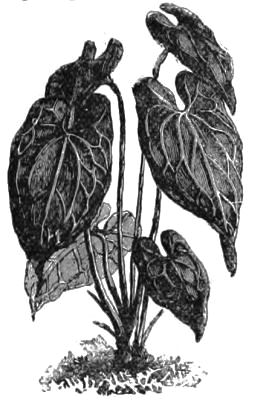
FIG. 109. ANTHURIUM CRYSTALLINUM.
A. crystallinum (crystalline).* l. large, ovate-cordate, acuminate, bright rich velvety green, principal veins elegantly banded with pure crystal white; when young, the leaves are violet colour; petioles terete. h. 2ft. Columbia. See Fig. 109.
A. cuspidatum (cuspidate). fl., spathe crimson, reflexed, shorter than the purplish spadix. l. ovate-oblong, acuminate, 10in. to 20in. long, green. h. 2ft. to 3ft. Columbia.
A. ferrierense (Ferrières).* fl., spathe cordate, about 5in. long, and 4in. wide, bright red; spadix erect, about 4in. long, ivory white. l. large, cordate. A handsome hybrid between A. ornatum and A. Andreanum.
A. fissum (cut-leaved). fl., spathe green, erect, narrowly lanceolate-acuminate. l. cut into four to seven elliptic oblong-acuminate segments, green; petioles longish, terete. h. 2ft. Columbia, 1868.
A. Harrisii pulchrum (beautiful).* fl., spathe linear-lanceolate, creamy white, deflexed, and pinkish at top; spadix erect, deep crimson; scape about 1ft. long, pale green. l. lanceolate, rounded at the base, pale green, with confluent white markings intermixed with dark green. Stem short. Brazil, 1882. A beautiful variegated plant. The typical A. Harrisii is extremely rare.
A. Hookeri (Hooker's). fl., spathe green; spadix green or violet. l. obovate-spathulate, narrowed to a wedge-shaped base, and shortly stalked, shining, about 30in. long and 8in. broad. h. 3ft. Tropical America, 1840. SYNS. A. Huegelii, Pothos acaulis.
A. Huegelii (Huegel's). A synonym of A. Hookeri.
A. insigne (showy).* l. three-lobed, middle lobe lanceolate, the two lateral ones are nearly ovate, and have from three to five longitudinal ribs; when young, the leaves have a bronzy tinge; petioles terete, slightly sheathing at the base. Columbia, 1881. A very handsome species.
A. Kalbreyeri (Kalbreyer's).* l. palmate, about 2½ft. across; leaflets nine, obovate-oblong, acuminate, sinuate, thick, glabrous, rich deep green, those furthest from the stem are much larger than those next the axis; petiole cylindrical, thickened at the top. New Grenada, 1881. A very handsome climbing species.
A. lanceolatum (lanceolate). fl., spathe lanceolate, deflexed, yellowish green; spadix dark brown. l. lanceolate, stalked, green, 1ft. long, narrowed to the base. There appears to be much confusion as regards this and many varieties of A. Harrisii; and the specific designation is indiscriminately applied to lanceolate-leaved forms generally. The true species was introduced to Kew from the West Indies. SYN. A. Wildenowii.
A. leuconeurum (white-nerved). Green. Mexico, 1862.
A. Lindenianum (Linden's).* fl. fragrant, spathe very pretty, white, not reflexed, but the pointed apex slightly arches over and shelters the white or purplish spadix. October. l. deeply cordate, of a roundish outline; petioles long. h. 3ft. Columbia, 1866. SYN. A. Lindigi (of gardens).
A. Lindigi (Lindig's). A garden synonym of A. Lindenianum.
A. macrolobum (large-lobed).* l. large, deflexed, cordate, acuminate, with an open sinus at the base, and about three acute marginal lobes, dark green, marked with about five pale green ribs; petioles green, terete. Stem erect, short. A fine hybrid.
A. nymphæifolium (Nymphæa-leaved). fl., spathe white; spadix purplish. Venezuela, 1854.
A. ornatum (adorned).* fl., spathe linear-oblong, white, 5in. to 6in. long, on terete green scapes, enclosing cylindrical purplish spadices of about the same length as the spathes, and studded with white points arranged spirally. Spring. l. ovate or oblong-cordate, on slender terete petioles. h. 2½ft. Venezuela, 1869.
A. regale (royal).* l. large, cordate-acuminate, 1ft. to 3ft. long, dull metallic green, with white veins; young leaves tinged with rose, on long smooth footstalks. East Peru, 1866. An excellent species for conservatory or window decoration during summer.
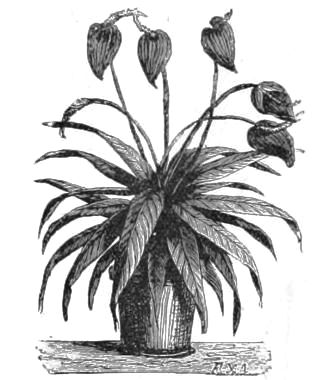
FIG. 110. ANTHURIUM SCHERZERIANUM.
A. Scherzerianum (Scherzer's).* fl. on bright red peduncles, which spring from among the base of the leafstalks; spathe ovate-oblong, 3in. long and nearly 2in. broad, intense and brilliant scarlet; spadix orange coloured. l. oblong-lanceolate, 12in. to 18in. long, and 2in. or more broad, deep rich green, leathery. Costa Rica. A very compact dwarf-growing evergreen about 1ft. high. It continues in beauty about four months. See Fig. 110.
A. S. album (white). A synonym of A. Scherzerianum Williamsii.
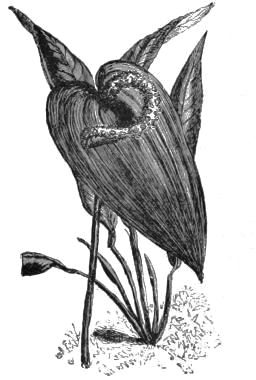
FIG. 111. ANTHURIUM SCHERZERIANUM MAXIMUM.
A. S. maximum (greater).* A very fine variety, with "gigantic flower spathes, which measure about 9in. in length by 4in. in breadth, and are of the most brilliant scarlet colour." See Fig. 111.
A. S. pygmæum (small).* Altogether smaller than the type, with narrow leaves, which are from 4in. to 6in. long, and about ½in. broad. It is one of the best varieties, and produces flowers very freely. 1880.
A. S. Rothschildianum (Rothschild's). fl., spathe creamy white, spotted with crimson; spadix yellow. 1880. Exactly intermediate between its parent plants—the typical species and the following variety.
A. S. Wardii (Ward's).* fl., spathe 6in. long, 4in. broad, very brilliant. l. broader and more robust than those of the typical species. A splendid variety.
A. S. Williamsii (Williams's).* fl., spathe white; spadix yellowish. May. l. lanceolate-acuminate. Costa Rica, 1874. SYN. A. Scherzerianum album.
A. signatum (well-marked). l. apparently three-lobed; front lobe about 1ft. long and 4in. wide; the two side ones 4in. long, and about 6in. from the midrib to the extremity, dark green; petioles about 1ft. long. Venezuela, 1858.
A. spathiphyllum (Spathiphyllum). fl., spathe about 1¾in. long, and nearly as much broad, erect, boat-shaped, broadly ovate, white; spadix nearly 1in. long, very obtuse, pale yellow. l. narrow lanceolate, 16in. to 24in. long, and about 2in. wide, bright green above, pale greyish green beneath; midrib prominent; petiole 3in. to 6in. long, trigonous. h. 1½ft. Tropical America, 1875.
A. splendidum (splendid).* l. cordate, with an open sinus, the lobes meeting behind; "the course of the nerves is marked by a broadish band of deep lustrous velvety green, the intervening spaces of about equal width being in striking contrast, of a pale yellowish green; the leaf surface is scabrous, and the portions between the ribs strongly bullate, as if raised in papillose blisters; the veins on the under surface are angular, with tooth-like projections at intervals, while the whole under surface is punctuated with small pallid dots" (W. Bull). Stem short, thick. South America, 1882. A very beautiful species, quite distinct from any others of the genus. See Fig. 112.
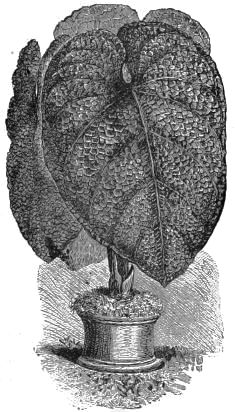
FIG. 112. ANTHURIUM SPLENDIDUM.
A. subsignatum (nearly allied to Signatum).* l. thick and fleshy, hastate, with blunt points, 12in. to 18in. long, and as much in breadth at the widest part; dark shining green above, paler beneath; petioles about 1ft. long. h. 1½ft. Costa Rica, 1861. An excellent species.
A. tetragonum (four-angled). l. erect, commences very narrow, 1ft. wide at its broadest part; margins undulate, deep shining green on the upper surface, paler below; petioles short, quadrangular. Tropical America, 1860. An excellent sub-tropical species.
A. triumphans (superior). fl., spathe narrow, green; spadix stout, greenish-white; peduncle quadrangular. l. alternate, elongately cordate, bright green; ribs prominent, and of a paler hue. Stem erect. Brazil, 1882. A handsome plant.
A. Veitchii (Veitch's).* l. ovate-oblong, greatly elongated, 2ft. to 3ft. long, with a breadth of less than one-third of these dimensions, leathery, deep green, with a glossy metallic surface when first expanded that becomes paler with age; the principal nerves are arched and deeply sunk, imparting a curiously waved appearance to the surface. h. 2½ft. Columbia, 1877. Rare but very handsome.
A. Waluiewi (Walujew's).* l. broadly cordate, 12in. to 14in. long, 8in. to 10in. broad, olive metallic green, when young, bright reddish crimson; petioles four to five-angled. h. 2ft. Venezuela, 1880. A very distinct and noble species.
A. Waroqueanum (Waroque's).* l. elongated, from 24in. to sometimes 36in. long, and 8in. to 11in. broad, very rich deep green, of a velvety lustre; midribs and veins light, forming a very pleasing contrast. Columbia, 1878. A very free grower.
A. Wildenowii (Wildenow's). A synonym of A. lanceolatum.
It may be here remarked that by far the majority of species enumerated in the Supplement of Johnson's Dictionary are chiefly of botanical interest, and will, therefore, never become extensively cultivated.
ANTHYLLIS (from anthos, a flower, and ioulos, down; flowers usually downy). Kidney Vetch. ORD. Leguminosæ. Herbaceous or sub-shrubby plants, of variable habit. Flowers in spikes or heads; calyx tubular, five toothed, permanent after flowering, more or less inflated. Petals nearly equal. Although not extensively grown, all the species are very beautiful when in flower, the hardy sorts being admirably adapted for rockwork. The herbaceous perennials may be easily propagated by seed or division. The seeds of the annual kinds should be sown in a rather dry, warm situation in the open ground. The shrubby evergreens will need the protection of a frame or cool greenhouse in cold northern climates, and are best grown in a mixture of loam, sand, and peat. Young cuttings of most species will root in a pot of sandy soil, with a bell glass placed over them, in a cool house or frame.
A. Barba-Jovis (Jupiter's beard).* fl. pale yellow, numerous, in globose, bracteate heads. March. l. pinnate, and are as well as the branches, clothed with silky tomentum; leaflets nine to thirteen, oblong-linear. h. 4ft. to 8ft. Spain, 1640. Shrub.
A. erinacea (prickly).* fl. bluish-purple; heads few flowered, on short peduncles, bracteate. April. l. very few, oval, or oblong. h. 6in. to 12in. Spain, 1759. A much branched, spiny, almost leafless, and slow-growing species; hardy in a dry sunny position on the rockery. SYN. Erinacea hispanica.
A. Hermanniæ (Hermann's). fl. yellow; heads few flowered, nearly sessile in the axils of the upper leaves. April. l. almost sessile, simple, or trifoliate; leaflets oblong-cuneated, glabrous or clothed with adpressed pubescence. h. 2ft. to 4ft. Corsica, 1739. Shrubby, much branched.
A. montana (mountain).* fl. pink or purplish, in dense heads, on peduncles, with a leafy involucre. June. l. pinnate, and are as well as the branches, silky and hoary; leaflets numerous, oval-oblong, acute, small, entire. h. 3in. to 6in. Alps of Europe, 1769. A very handsome little rock plant, with a dwarf and tufted habit.
A. tetraphylla (four-leaved). fl. white; heads axillary, sessile, few flowered. July. l. pinnate, the terminal leaflets ovate and large, the other three small and acute. South Europe, 1640. A procumbent annual.
A. Vulneraria (Common Woundwort).* fl. generally yellow, sometimes white, red, or pinkish, in crowded twin heads. Summer. l. pinnate, with five or more unequal leaflets; the lower ones smallest. An elegant native herbaceous, perennial, admirably adapted for rockwork. It is plentiful in most dry pastures. There are several varieties, the best of which is alba.
ANTIARIS TOXICARIA. This is the famous Upas tree of Java, from which is obtained poison of a most deadly nature. It belongs to the NAT. ORD. Urticaceæ.
ANTIGONON (from anti, against, or opposite, and gonia, an angle). ORD. Polygonaceæ. Elegant stove climbers. Flowers racemose, cirrhose at the apex of the rachides; petals five, three outer ones broadly cordate, two inner oblong. Leaves alternate, cordate. Although extremely handsome plants, they are difficult to flower. They seem to succeed best when planted out in a very thoroughly drained border over hot-water pipes or flues, the long climbing stems being trained near the glass in full light.
A. amabile (lovely).* fl. bright rose, profusely borne in axillary and terminal racemes. l. 3in. to 5in. long, ovate-cordate, and deeply lobed at the base. It is of free slender growth, the young shoots are pubescent, and having a slight reddish tinge. An exceedingly attractive and effective species.
A. guatemalensis (Guatemala). Probably the same as A. insigne.
A. insigne (remarkable).* fl. very numerous, borne in tufts along the sides of long racemes or panicles, which terminate in branched tendrils; the calyx, which is the showy part of the flower, has five membranous sepals, the three outer are of a beautiful rosy pink colour, about 1in. in length by rather less in breadth, cordate at the base, oblong, rounded towards the apex; the two inner sepals about the same length as the outer ones, but much narrower, falcate, lanceolate; pedicels ¾in. long. l. broadly ovate oblong, deeply cordate at the base, with two rounded lobes; 4in. by 3in., the upper ones smaller, supported on short terete downy stalks. Stems slender, angular, pubescent. Columbia, 1876.
A. leptopus (slender-stemmed). fl. numerous; the outer three sepals of a beautiful rose colour, the centre of a much deeper tint; racemes secund, bearing several coloured bracts as well as flowers, and end in a branched tendril. l. alternate, cordate, petiolate. Stem slender, sub-pubescent. Mexico, 1868.
ANTIGRAMME. See Scolopendrium.
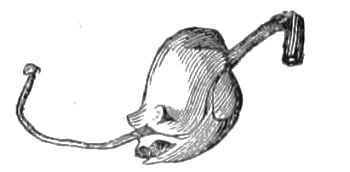
FIG. 113. ANTIRRHINUM CAPSULE, with Persistent Style.
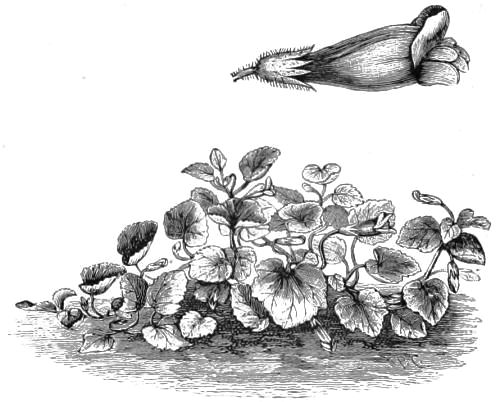
FIG. 114. ANTIRRHINUM ASARINA, showing Habit and Flower.
ANTIRRHINUM (from anti, like, and rhin, a nose or snout; alluding to the shape of the corolla). Snapdragon. ORD. Scrophulariaceæ. Hardy herbaceous plants. Flowers in terminal racemes, or solitary and axillary; corolla personate; tube ample, saccate at the base; lobes of the upper lip erect; lower lip spreading, having the middle lobes smaller than the lateral ones, with an ample bearded palate, which closes the throat. Seed pod or capsule two-celled, upper cell bursting by one pore, lower by two many-toothed pores. See Fig. 113. Leaves entire, rarely lobed. The genus contains several very handsome species, suitable for borders and the rockery, while innumerable varieties have originated from A. majus, which are very popular, and extremely useful for bedding purposes; these may be increased by cuttings or seeds; if it is desired to increase certain colours or varieties, the former is the only sure method to adopt. They should be taken in September, when they will readily root in a cold frame, or under a hand glass, or they may be rapidly propagated in gentle heat in spring. Seeds should be sown in July or August, when they will produce good plants by the following season; or if sown in March in warmth, the plants will bloom late in the same year. The "Tom Thumb" strain is especially desirable for bedding, being very dwarf and free. All the other species may be increased by cuttings and seeds treated in the same way. Light soil, well enriched with manure, is most suitable for all of them, especially for the varieties of A. majus.
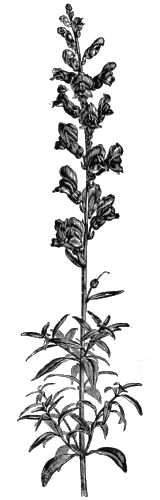
FIG. 115. FLOWER-SPIKE OF ANTIRRHINUM MAJUS.
A. angustifolium (narrow-leaved). Synonymous with A. siculum.
A. Asarina (Asarina).* fl. axillary, solitary; corolla 1½in. long, white, sometimes tinged with red; palate yellow; tube glabrous, compressed on the back, marked by purple spots, and bearded by yellow hairs inside. June. l. opposite, on long petioles, five-nerved, five-lobed, cordate, and crenated. South France, &c., 1699. A greyish clammy procumbent plant, requiring a warm position on the rockery. See Fig. 114.
A. hispanicum (Spanish). fl. in loose spikes; corolla hardly an inch long, purple, with a golden yellow palate; tube villous. Summer. l. oblong-lanceolate, contracted at the base, bluntish; lower ones opposite; superior ones alternate, narrower. h. 1ft. Spain, 1878. SYN. A. latifolium.
A. latifolium (broad-leaved). Synonymous with A. hispanicum.
A. majus (large).* Greater, or Common Snapdragon. fl. racemose, approximate; corolla 1in. to 2in. long, shades infinite; palate yellow at top, very prominent; tube downy outside. Spring, summer, and autumn. l. oblong-lanceolate, 1in. to 3in. long; upper ones narrower, attenuated at both ends, glabrous. Branches erect, usually branched again. h. 2ft. Europe (naturalised in Britain). The named varieties are numerous, but it is unnecessary to enumerate any, as an equal amount of variation can be obtained from seed. See Fig. 115.
A. molle (soft).* fl. few, at the tops of the branchlets; corolla 1in. long, whitish, with a yellow palate; upper lip striped with purple. July. l. opposite, petiolate, clothed with glandular and clammy hairs, about ½in. long, and little more than ¼in. broad; branches procumbent, slender, clothed with woolly hairs. Pyrenees, 1752. A very pretty plant, which should have a warm position on the rockery. A. sempervirens comes close to this species.
A. Orontium (Orontium). fl. axillary, distant; corolla rose-coloured or white, striped with purple; tube furnished with a few glandular hairs; palate veined with purple; sepals linear-lanceolate, large. June. l. oblong-lanceolate, acutish, attenuated at both ends, glabrous, 2in. long. h. 6in. to 12in. Europe (British cornfields). Annual. See Fig. 116.
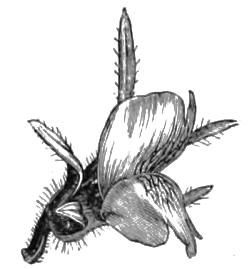
FIG. 116. ANTIRRHINUM ORONTIUM.
A. O. grandiflorum (large-flowered). A variety with larger, paler, and more approximate flowers, and with broader leaves, than the type. Europe (British cornfields).
A. siculum (Sicilian). fl. in loose racemes; corolla hardly 1in. long, white or yellowish, rarely purple; tube rather hairy; lobes of the upper lip and the middle lobe of the lower lip emarginate. July. l. 1in. to 1½in. long, linear-lanceolate, opposite, alternate or three in a whorl, narrowed into petioles at the base. Branches erect. h. 1ft. to 2ft. Sicily, 1804. SYN. A. angustifolium.
A. tortuosum (twisted).* fl. disposed in spiked racemes, approximating by threes and fours; corolla (the largest of the genus) purple; tube short; upper lip large. June. l. linear, acute, opposite or three in a whorl, 2in. long, attenuated at both ends; upper ones very narrow. Branches erect. h. 1ft. to 1½ft. Italy.
ANTONIA. A synonym of Rhynchoglossum (which see).
ANTROPHYUM (from antron, a cavern, and phuo, to grow; referring to its place of growth). Including Polytænium. ORD. Filices. A small genus of stove ferns, very rarely seen in cultivation, all with simple fronds, of firm but fleshy texture, and copious, uniform, hexagonal areolæ. Sori carried along the veins, imperfectly reticulated. For culture, &c., see Ferns.
A. cayennense (Cayenne). sti. 1in. to 4in. long. fronds 6in. to 9in. long, 1in. to 1½in. broad, lanceolate-oblong, narrowed at both ends; edge thickened, entire; areolæ half as broad as long. sori sub-superficial, often forked. Guiana, &c.
A. coriaceum (leathery). fronds 6in. to 8in. long, about ½in. broad, narrowed very gradually from the centre to the base, very acute at the apex, very thick; areolæ very long and narrow, distinctly raised on the upper surface. sori quite immersed, sometimes confluent. Himalayas, &c.
A. lanceolatum (lance-leaved).* fronds 1ft. or more long, ¼in. to ½in. broad, point acute, edge entire, the lower half narrowed very gradually to the base; areolæ two or three times as long as broad, about three rows between the midrib and the edge. sori slender, superficial, often joining. West Indies, southwards to New Grenada, 1793.
ANTS (Formicidæ). Well-known pests, easily distinguished from all other insects. There are a great number of species, differing more or less in habits; but, as a rule, they dwell underground in communities, and construct extensive ant-cities, which are occupied by three classes—the neuters or workers (by far the most numerous), the males, and the females. There are often, in addition to these, larger and stronger neuters, known as the "soldiers," or defenders of the community. Ants have a long, slender body, supported on long and slender legs. The head bears a pair of elbowed horns or antennæ, constantly waving about and touching everything the insect comes across. They have powerful mandibles for cutting, sawing, and biting, and it is with these instruments that Ants do mischief in gardens. The winged males and females become mature in summer, and on a warm day they ascend in a body into the air; after a short time, they fall to the ground, the females at once free themselves from the henceforth useless wings, and begin to form new colonies. Vast numbers of eggs are laid, from which issue larvæ, and these soon become pupæ, and then perfect Ants. Some kinds are injurious from their habit (in some species) of collecting aphides together, and farming them for the sake of the honey secreted by the aphides, and that passes out from their honey-tubes (thus helping to perpetuate the stock of these most injurious insects); and also from the mechanical damage they do in pots, and other receptacles for plants. They likewise cause unsightly hills on lawns and paths, and the large black species that live in decayed wood often injure the framing of greenhouses, &c., when the woodwork has become somewhat decayed. Where fruit, such as peaches or wall pears, are grown, Ants will at times inflict damage, and, therefore, they should be kept away; but this is a comparatively easy matter, as the placing of an obnoxious substance along the base of the walls and around the stems of the trees will deter them. For the extirpation of Ants from indoors, the Arsenical solution described below is most efficacious, but it is extremely dangerous.
Lime. Air-slaked lime plentifully dusted, in warm, dry, weather, over and around the hills and other places infested, will cause the Ants to vacate them in a short time. A thick chalk line drawn round a smooth tree, or across an upright board or post, will render it impassable.
Arsenic. This must be used with the utmost caution, as it is a poison most fatal to animal life. Recipe: 1oz. of ordinary arsenic is placed in an old iron pot with a quart of water, and then boiled until reduced to a pint or a little more of liquid, to which is added ½lb. of coarse sugar. This mixture can either be dropped about the runs and around the nests, or placed in saucers in the Ants' haunts.
Ferrocyanide of Potassium. This is also very dangerous: Ferrocyanide of potassium, 1dr.; raspings of quassia, 1dr.; and enough sugar to form a syrup. Use in the same way as the preceding.
Calomel and Sugar. Mix together one part of calomel and ten parts of finely-powdered loaf sugar, and lay it in little heaps about their nests and runs; the Ants will eat it and die. Spring is the best season for this method.
Guano, when fresh, if sprinkled on and around their quarters, is said to be efficacious in driving them away.
Camphor. If a piece of camphor, about the size of a filbert, be placed in two quarts of hot water, and this, when cool enough, applied to pot or other plants infested with Ants, the insects will be driven off without injury to the plants.
Bones. Lay a quantity of partially-picked boiled bones in the haunts, and they will be quickly covered with insects. As soon as this occurs, throw the bones into hot water. Before laying them down again, let all superfluous moisture drain off. This is a cheap remedy, and, if persisted in, is very effectual.
Carbolic Acid. This, if of good strength, diluted with about ten or twelve times its bulk of water, and well sprinkled over paths or other places where there is no vegetation, will keep the Ants away. It has, however, an objectionable smell.
Paraffin Oil. Paraffin, mixed with six times its bulk of water, and sprinkled over the nests every few days, will kill and drive away Ants; but the smell is disagreeable.
Quassia. 4oz. of quassia chips, boiled in a gallon of water for about ten minutes, and 4oz. of soap added to the liquor as it cools, if used like the preceding, is fairly effectual; but this, like the other remedies, must be persisted in for some time.
Fly pans or saucers, nearly filled with thin honey or sweet oil, attract Ants, and they are drowned in them. Ants are very hard to clear effectually out of a place, and therefore it is very desirable, in all attempts to be rid of them, to persist in the above remedies. When not living close to the roots or stems of plants, the best and surest remedy of all is to flood them out or scald them in with boiling water. The specifics are endless, but the best are mentioned above.
ANTWERP HOLLYHOCK. See Althæa ficifolia.
AOTUS (from a, without, and ous, an ear; in allusion to the absence of appendages in the calyx, which distinguishes it from its allied genus, Pultenæa). ORD. Leguminosæ. Elegant little greenhouse evergreen shrubs, with yellow flowers, and simple, linear-subulate leaves, revolute at the margins, alternate or nearly opposite, or three in a whorl. They should be grown in a compost of equal parts loam, sand, and peat, with a little charcoal, and the pots should be well drained. Cuttings of half-ripened wood, made in April, root freely in sand, under a bell glass.
A. gracillima (most slender).* fl. yellow and crimson, small, on long, dense, graceful spikes, which are often over a foot long; pedicels short. May. h. 3ft. New Holland, 1844. A very pretty slender growing shrub.
A. villosa (soft-haired). fl. axillary, disposed in racemose spikes along the branches; calyx silky. April. l. smoothish on the upper surface. h. 1ft. to 2ft. New Holland, 1790.
APEIBA (the native name in Guiana.) ORD. Tiliaceæ. Very handsome stove evergreen trees or shrubs, clothed with starry down. Flowers large, golden yellow, pedunculate, bracteate. Capsule spherical, depressed, rough from rigid bristles. Leaves broad, alternate, entire or serrate. They thrive in a mixture of loam and peat. The best way to induce them to flower in this country is by cutting a ring round the bark of a large branch; by this means the growth is stopped. Well ripened cuttings should be planted in sand in heat, under a bell glass, which should be tilted occasionally, so as to give a little air to the cuttings, otherwise they are apt to damp off.
A. aspera (rough).* fl. golden yellow; peduncles opposite the leaves, branched, many flowered. May. l. ovate-oblong, somewhat cordate, quite entire, smooth. h. 30ft. to 40ft. Guiana, 1792.
A. Petoumo (Petoumo). fl. yellow, similarly disposed to A. aspera. August. fr. densely clothed with bristles. l. ovate-oblong, somewhat cordate at the base, entire, hoary beneath. h. 40ft. Guiana, 1817.
A. Tibourbou (Tibourbou).* fl. dark yellow. August. fr. densely clothed with bristles. l. cordate, ovate-oblong, serrated, hairy beneath. h. 10ft. Guiana, 1756.
APETALOUS. Without petals.
APEX. The summit or point of anything.
APHELANDRA (from apheles, simple, and aner, a male; the anthers being one-celled). ORD. Acanthaceæ. Very handsome stove evergreen shrubs, mostly of an erect habit of growth, and having handsome shining leaves, which in some instances are variegated. Flowers produced in terminal four-sided spikes—the preponderating colours being brilliant shades of orange or scarlet—conspicuously situated above the foliage; they are exceedingly attractive; corolla ringent, two-lipped, upper lip three-lobed; central lobe large. They bloom generally during the autumn months, and if the plants are removed to a warm dry atmosphere so soon as the flowers begin to open, they will continue much longer in perfection than if left in the moisture-laden atmosphere of the stove. From the time the flower spikes are at first seen till they bloom, the plants will derive much benefit from frequent applications of clear manure water. When the plants have finished flowering, they should be allowed to rest, by reducing the supply of water, but never allow them to shrivel. During this time they may be kept in a house or pit, where the atmosphere is rather dry, with a night temperature of 50deg. to 55deg. Here they may remain till March, when they should be pruned. This operation is commenced by thinning out the weakest shoots altogether, and cutting the others back to one or two of the strongest joints or buds above the old wood in order to keep the plants dwarf and bushy. When pruned, the plants should be placed in the stove, giving moderate supplies of water at the roots, and occasionally sprinkling the stems overhead till growth commences. When the young shoots have attained an inch or so in length, the plants should be turned out of the pots, removing the crocks and as much of the old soil as can be got away easily, at the same time shortening-in any of the straggling roots. They should then be placed into smaller-sized pots, keeping them rather close, and watering them carefully for a time till growth has commenced. When fairly started, they may be transferred into larger-sized pots, in which they are to flower. During the summer, these plants require a moist atmosphere, with a temperature of 65deg. by night, allowing it to rise 15deg. or 20deg. by day, and whilst active growth is taking place they should be frequently supplied with moisture at the roots, keeping them well exposed on all sides to the light. After growth has commenced, it is not advisable to stop the shoots, for the stouter and stronger they grow up the finer will be the flower spikes when they appear. The compost should consist of equal parts fibry loam, leaf soil, and peat, with a good proportion of sand added. In preparing it, it should be rather lumpy, and, before using, should be warmed to about the temperature of the house in which the plants are grown. Clean pots and perfect drainage are most essential. Cuttings are best prepared from half ripened wood, or taken off when young with a heel. The base of each cutting should invariably be cut clean across. These may be inserted an inch apart, in pots of sandy soil, and plunged in a brisk bottom heat. To obtain young shoots for cuttings, if the old plants break freely after pruning, and very large specimens are not required, when the shoots are 2in. long they should be thinned out, leaving the requisite number of the strongest to form the plant. If the surplus pieces are removed with a slight heel of the older wood, they make good cuttings, and should be treated the same as the others. These cuttings strike root quickest, and when rooted, if potted into 5in. or 6in. pots, and allowed to grow up without stopping or pinching out the tops, they will flower the first season. Although Aphelandras can be grown into large sized specimens, it will be found to be more generally satisfactory to have specimens of neat and moderate dimensions. The mealy bug and scale insects are very troublesome, and must be kept down, otherwise they will prove most prejudicial to the plants.
A. acutifolia (acute-leaved). fl. large, deep vermilion red; the upper lip of corolla concave, and projected forward, the lower one consists of three oblong-obtuse spreading lobes. October. l. broad, oblong-ovate, acuminate. Columbia, 1868.
A. aurantiaca (orange-coloured).* fl. deep orange scarlet; upper lip of corolla erect, bidentate, concave; lower one spreading horizontally, three lobed. December. l. broad, ovate, opposite, dark green, somewhat wavy at the edge. h. 3ft. Mexico, 1844.
A. a. Roezlii (Roezl's).* Differs chiefly from the type in the curiously twisted leaves, which are dark green, shaded with a silvery hue between the primary veins; in the brighter scarlet of the flowers; and a few other, but purely technical, points. It is one of the best. Mexico, 1867. SYN. A. Roezlii.
A. cristata (crested).* fl. brilliant orange scarlet, 2in. or 3in. long, in large terminal branching spikes. August to November. l. large, broadly ovate, and tapering to a point. h. 3ft. West Indies, 1733. A handsome and continuous bloomer. SYN. Justicia pulcherrima.
A. fascinator (fascinating).* fl. bright vermilion, in very large spikes. Autumn. l. ovate acuminate, olive green, beautifully banded with silvery white, whilst the under side is of a uniform purplish violet. h. 1½ft. New Grenada, 1874.
A. Leopoldi (Leopold's).* fl. citron-yellow. l. opposite, ovate-oblong, acuminate; ground colour on the upper surface dark green, the midrib and primary veins pure white; under surface uniformly pale green. Brazil, 1854.
A. medio-aurata (golden-centred). fl. unknown. l. ovate-lanceolate, sinuate, bright green, with yellow central brand. Brazil, 1871. SYN. Graptophyllum medio-auratum.
A. nitens (shining).* fl. glowing vermilion-scarlet, very large, in erect, simple, terminal spikes, which, after the flowers have fallen, are clothed with the imbricating, lanceolate, appressed bracts. l. ovate, sub-acute, leathery, brilliant glossy on the upper surface, dark vinous purple underneath. h. 2ft. to 3ft. Columbia, 1867.
A. Porteana (Porte's).* fl. in fine terminal heads; corolla and bracts bright orange. l. rich green, with metallic silvery-white veins. h. 2ft. Brazil, 1854.
A. pumila (dwarfish).* fl. orange-coloured; upper lip erect, concave, entire; bracts large, purplish. l. large, cordate, ovate-oblong, acute. h. 8in. Brazil, 1878. Very distinct from all others.
A. punctata (dotted).* fl. bright yellow, in large and rather dense spikes; the spiny-edged long pointed bracts are also yellow, with the exception of the tip, which is green, and forms a pleasing contrast. November. l. opposite, elliptic, acuminate; the green midrib is conspicuous in the middle of a white central band, which also extends beside the green veins, this silvery band breaking up on its margin into numerous small white dots, producing a pretty and distinct form of variegation. South America, 1881.
A. Roezlii. A synonym of A. aurantiaca Roezlii.
A. variegata (variegated). fl. yellow; spike, 6in. long, with bright orange-red bracts. l. ovate-lanceolate, acuminate, dark green with white veins. h. 1½ft. Brazil.
APHELEXIS (from apheles, simple, and exis, habit). ORD. Compositæ. A genus of elegant dwarf evergreen greenhouse shrubs. Flower-heads large, solitary, or small and two or more together. Leaves small. These plants are valuable for exhibition purposes, on account of their bright colours, and the length of time they last in perfection; they are included among what are familiarly known as "everlastings." The most suitable soil is a compost of two parts of good fibrous peat and one of leaf mould, with a liberal supply of silver sand, and a few pieces of charcoal added to it. Repot the plants firmly in February, and allow thorough drainage. Cuttings can be made in spring or summer; small half-ripened side shoots are best; and these will root in sandy soil, under a bell glass, in a cool greenhouse.
A. ericoides (heath-like).* fl.-heads white. April. l. very small, three-cornered, imbricated, appressed; branches numerous, very fine, filiform. h. 1ft. Cape of Good Hope, 1796.
A. fasciculata (fascicled). fl.-heads purplish, solitary, terminal; peduncles scaly. March. l. acerose linear, roundish, downy above; lower spreading; upper appressed. h. 2ft. Cape of Good Hope, 1779. There are two or three forms of this species, varying in the colour of the flowers.
A. humilis (humble, or dwarf).* fl.-heads pink, solitary, terminal, opening only in sunshine; peduncles scaly. April. l. subulate, erect, imbricate. Branches numerous, slender, covered with white tomentum. h. 2ft. Cape of Good Hope, 1810. A handsome greenhouse plant, with much-branched stems, terminated by the flower-head. SYNS. A. macrantha and Helipterum humile.
A. h. grandiflora (large-flowered).* fl.-heads rosy-purple, produced in great abundance. Habit rather dwarf, and free branching. Very highly esteemed.
A. h. purpurea (purple).* fl. dark purple, very abundant. l. silvery white and shining. A vigorous grower, and perhaps the best for exhibition purposes. It is known in gardens as A. macrantha purpurea; also under the name of A. spectabilis.
A. h. rosea (rose-coloured).* fl.-heads delicate rose, very profuse. Habit very compact and free-branching. A very showy and desirable variety, known in gardens as A. macrantha rosea.
A. macrantha (large-flowered). Synonymous with A. humilis.
A. sesamoides (Sesamum-like). fl.-heads purple and white, sessile, solitary, terminal. April. l. acerose linear, keeled, smooth, appressed. h. 2ft. Cape of Good Hope, 1739.
APHIDES, or PLANT LICE. These belong to the order Homoptera, meaning "same winged," and the name has reference to the fact that the fore wings are uniform in their structure from base to apex, not divided into a leathery base and a membranous tip. Aphides are all minute in size, soft bodied, and generally long legged; the mouth is furnished with a curiously-constructed beak, or rostrum, for sucking the juice of plants; the antennæ, or feelers, are long and slender; the legs have usually two joints in the tarsi, one of which is generally very ill-developed; and near the tip of the abdomen, on the back of a ring, in many kinds, stand two prominent tubes, called honey-tubes, from which a sweet secretion, much sought after by ants, is emitted. They are very destructive, and nearly every plant has its own peculiar Aphis; but among the worst are the cherry fly and bean fly. All these insects are very destructive to the young shoots and foliage of plants, on which they cluster in large numbers, sometimes completely hiding the stems, increasing with marvellous rapidity. They produce eggs in autumn, which lie dormant through the winter, and upon the approach of warm weather in spring, hatch and produce individuals which, during the summer, are viviparous, budding off young insects at a surprising rate, which quickly in turn become possessed of the same marvellous power; hence the enormous number which are produced in so surprisingly short a time. It has been computed that in a few weeks many millions of young might be produced directly or descended from a single female. See also Black Fly and Bean Fly.
The following remedies may be successfully employed:
Tobacco. This is applied, as a rule, in three forms, each of which is useful for particular purposes. Tobacco powder is useful as a dry application to plants where, from any cause, the other modes of employing it are not desirable. It causes no smell, and is useful in conservatories, &c., for that reason. The mode of applying it is to dredge or dust it over the foliage of the plants affected, and to syringe off in from three to thirty hours, according to the nature of the plants. Fumigation with tobacco, if done in a proper way, is very effective, but it leaves an unpleasant smell. The foliage of the plants should be quite dry, and a still day must be chosen for the work; the house should be filled with smoke, but no flame must arise in the burning. The plants should be well syringed the next morning, and full ventilation allowed; if the fumigation is repeated twice or thrice, it will prove very effectual. Tobacco water is made by soaking a pound of coarse shag in 6gals. of hot water, to which ½lb. of size or soft soap has been added. The plants should be dipped into or syringed with this mixture, and well syringed with clean tepid water about twelve hours after. It should not be employed for plants having woolly or hairy foliage. Tobacco paper and cloth are used for fumigating in the same manner as tobacco; but as they vary in strength, more care is necessary, as they sometimes cause the leaves to become spotted. Judiciously employed, they are cheaper than Tobacco.
Quassia. Boil 1lb. quassia chips in 4gals. of soft water, for about ten minutes, and after straining off the chips, add 1lb. of soft soap. Apply in the same way as Tobacco water, and syringe the plants with clean water after ten minutes or a quarter of an hour.
Soft Soap. This, in proportion of 8lb. to 12gals. of rain water, and 1gal. of tobacco water added after it is cold, is a cheap and good remedy out of doors, and requires the same mode of application as tobacco water.
Soap Suds. Where bleaching powder, or much soda, is not mixed with these, they make a good insect killer for hard-foliaged plants, but should be washed off with clean water in twelve hours. No mixture containing chloride of lime should be used.
Various. Fir-tree Oil, Gishurst's Compound, and Fowler's Insecticide, are all serviceable, if used as directed on the labels. Hardeman's Beetle Powder, applied with the little French powder-bellows which is sold with it, is very efficacious. For outdoor work, nothing surpasses clean cold water, applied often and forcibly with a syringe.
The best mode of clearing Aphis off Beaus, Currants, &c., is to remove the tops of the infested shoots, and to wash the plants with soapy water, or a solution of Gishurst's Compound. In some cases, a good dusting with soot and wood ashes, while the plants are wet, will keep them in check. The "Golden Eyes" or "Lacewing" fly, and also ladybirds, are to be encouraged, as the larvæ of each of these wage incessant war against Aphides, especially the green varieties, and thin them out considerably.
APHROPHORA. See Frog Hopper.
APHYLLANTHES (from aphyllos, leafless, and anthos, a flower; the flowers are on rush-like branches). ORD. Liliaceæ. A very pretty rush-like hardy perennial, forming dense, erect tufts. It thrives best in sandy peat, requires a warm sunny situation, and slight protection in winter. Increased by division of the roots, and seeds; the latter should be sown in pots in a cool greenhouse as soon as ripe.
A. monspeliensis (Montpelier).* fl., perianth six-cleft, spreading at the apex, deep blue, nearly an inch across, disposed in a small head, on slender scapes. June. l. absent; the very slender scapes are leaflike, with membranous sheaths at the base. South of France, 1791.
APHYLLOUS. Without leaves.
APICRA (from apicros, not bitter). ORD. Liliaceæ. A group of succulents allied to Aloe, and having the following among other characters:—Flowers small, loosely sub-spicate; perianth regular, cylindrical, with short spreading segments; peduncles simple or forked. Plants small; rosette leaves always elongated. Leaves thick, diffuse, never spinosely dentated. They require treatment similar to Aloes, under which genus they are included by some authors.
A. aspera (rough).* fl., perianth ½in. long; raceme loose, 3in. to 4in.; pedicels three to four lines long; peduncle slender, simple, nearly 1ft. l. dense, in many rows, spreading, rounded, deltoid, six to seven lines long and broad; face rather flat; middle three to four lines thick; back convex hemispherical, wrinkled. Cape of Good Hope, 1795.
A. bicarinata (double-keeled).* fl. unknown. l. dense, in many rows, ascending, deltoid-lanceolate, nine to twelve lines long, six lines broad, dirty green; face flat; middle two lines thick; margin scabrous; back copiously tubercled. Cape of Good Hope, 1824.
A. congesta (congested). fl., perianth six to seven lines, whitish; raceme loose, sub-spicate, about 1ft.; pedicels short; peduncles 6in. long, simple. l. dense, spreading, in many rows, deltoid-lanceolate, eighteen to twenty-one lines long, three to four lines thick; back convex; top unevenly keeled towards the margins. 1843.
A. deltoidea (deltoid). fl., perianth greenish, five to six lines long; raceme about 1ft. long, sub-spicate; pedicels short; peduncles 6in., simple or branched. l. in five regular rows, spreading, nine to twelve lines long, deltoid, shining green; when mature, upper surface rather flat, apex pungent; middle two to three lines thick; back distinctly keeled upwards; margins and keels minutely serrated. South Africa, 1873.
A. foliolosa (small-leafy).* fl., perianth greenish, five to six lines long; raceme loose, sub-spicate, about 1ft.; pedicels two to three lines long; peduncle 6in., simple. l. dense, spreading, in many rows, rounded deltoid, cuspidate, six to eight lines long and broad, without spots or tubercles; face rather flat; middle one and a half to two lines thick; back obliquely keeled upwards towards the margins. Cape of Good Hope, 1795.
A. imbricata (imbricated). Synonymous with A. spiralis.
A. pentagona (five-angled).* fl., perianth whitish, ½in. long; raceme about 1ft., loose; lower pedicels two to three lines long; peduncles 1ft., often branched. l. dense, regular, lower ones spreading, upper ones ascending, lanceolate-deltoid, fifteen to eighteen lines long; bottom six to eight lines broad, shining green; face flat; middle three to four lines thick; apex pungent; margin scabrous; back irregularly one to two keeled at top. Cape of Good Hope, 1731.
A. p. bullulata (little-blistered). l. irregularly spiral, five rowed; back with spreading close wrinkled tubercles.
A. p. spirella (small spiral). l. smaller and more deltoid, 1in. long, six to eight lines broad at the bottom, irregularly five rowed, or as if in many rows.
A. spiralis (spiral).* fl., perianth reddish-white, ½in. long; raceme loose, nearly 1ft.; pedicels ascending, two to three lines long; peduncles 6in., simple or branched. l. dense, in many rows, strong, ascending, lanceolate-deltoid, twelve to fifteen lines long, six to eight lines broad; face almost flat, without tubercles; apex pungent; back swollen, scarcely keeled; margins obscurely crenulated. Cape of Good Hope, 1790. SYN. A. imbricata.
APICULATE, APICULATED. Terminated in a little point.
APIOS (from apion, a pear; in reference to the form of the tubers of the root). ORD. Leguminosæ. An elegant little hardy twining perennial, easily trained into almost any shape. It must have a well-exposed, sunny position, and the soil should be of a warm or light sandy nature. Propagated by division of the tubers.
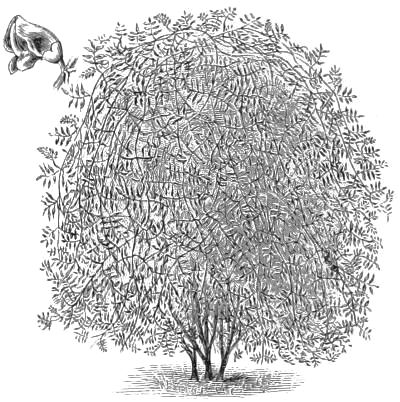
FIG. 117. APIOS TUBEROSA, showing Habit and Flower.
A. tuberosa (tuberous).* Ground Nut. fl. brownish-purple, sweet-scented, in axillary racemes. Summer and early autumn. l. pinnate. Tubers edible, farinaceous. Habit very light and graceful. Pennsylvania, 1640. SYN. Glycine Apios. See Fig. 117.
APIOSPERMUM. A synonym of Pistia (which see).
APIUM (from apon, Celtic for water; in reference to the habitat). ORD. Umbelliferæ. This genus contains no species worth growing for ornament, and nearly all are more or less acrid and poisonous. A. graveolens is the Celery of gardens, for culture of which, see Celery.
APLECTRUM (from a, without, and plectron, a spur; flower spurless). ORD. Orchideæ. A monotypic genus from North America. A curious, hardy, terrestrial orchid, requiring a shady spot in light loam and leaf mould, moderately damp. Very difficult to cultivate.
A. hyemale (wintry).* fl. greenish-brown, large, racemose, borne on a naked scape after the leaves have died down; labellum as long as the sepals; column sessile, rather long, wingless. April. Stem pseudo-bulbous, with one large, broad, ribbed leaf. h. 1ft. 1827.
APLOTAXIS. Included under Saussurea (which see).
APOCARPOUS. Having the carpels or fruit separate, or disunited.
APOCYNACEÆ. A large order of trees, shrubs, or rarely herbs, usually with a poisonous, milky sap. Flowers regular, solitary or corymbose; corolla salver-shaped or campanulate. Leaves simple, opposite, sometimes alternate or whorled. Well known genera belonging to this order are: Allamanda, Nerium, Tabernæmontana and Vinca.
APOCYNUM (from apo, away, and kyon, a dog; adopted by Dioscorides, because the plant was supposed to be poisonous to dogs). ORD. Apocynaceæ. Dog's Bane. Perennial erect herbs, with cymose flowers and membranous, opposite leaves. There are several species belonging to this genus, but only the one described below is worthy of being cultivated. They are of extremely easy culture, thriving in any ordinary soil; and may be propagated by suckers, divisions, or seeds. The best time to divide is just as they are starting into fresh growth in spring.
A. androsæmifolium (Tutsan-leaved).* fl. pale red, with darker stripes; corolla campanulate; cymes terminal and lateral. July. l. ovate, glabrous, petiolate, pale beneath. h. 1ft. to 2ft. Virginia, and Canada, 1683. A very old garden favourite, thriving best in peaty soil, with Azaleas, &c. See Fig. 118.
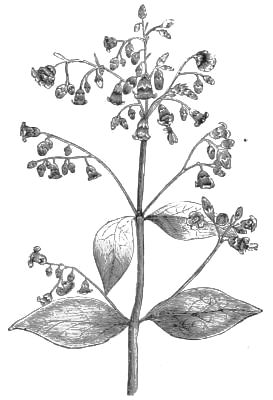
FIG. 118. INFLORESCENCE OF APOCYNUM ANDROSÆMIFOLIUM.
APONOGETON (from apon, Celtic for water, and geiton, neighbour; alluding to the habitat of these plants). ORD. Naiadaceæ. Very ornamental aquatic perennials. There are several species, but A. distachyon is superior to the others. This species may be cultivated in small tanks or aquaria; it delights in an abundance of light and air, and is perfectly hardy, having become naturalised in many parts of the country. Pot the plants in rich sandy loam and rotten cow manure, using, of course, small pots, if the vessel in which it is to be grown is restricted. When introducing it to large tanks or lakes, commence with strong, previously well-established plants, in large pots, breaking the latter when the plants are immersed. Place them in positions where the water is about 1ft. 6in. to 2ft. deep; they will then rapidly increase by offsets and seeds, and, when established, will flower nearly all the year round. The other kinds will thrive with the same treatment; but they are neither so hardy nor so vigorous, and should only be grown in small tanks or aquaria.
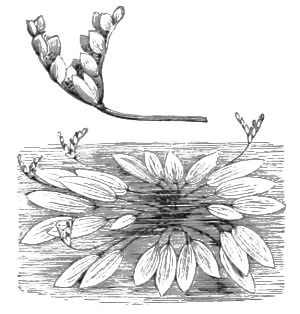
FIG. 119. APONOGETON DISTACHYON, showing Habit and Flower-spikes.
A. angustifolium (narrow-leaved). fl. white. July. Cape of Good Hope, 1788. Half hardy.
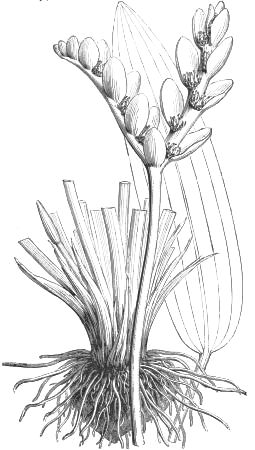
FIG. 120. APONOGETON DISTACHYON, showing Flower-spikes, Leaf, and Root.
A. distachyon (two-spiked).* Cape Pond Weed; Winter Hawthorn. fl. with a delicious Hawthorn-like perfume; petals none; bracts, or showy portion oval, entire, white; anthers purple-brown; scape two-spiked, each spike being from 2in. to 4in. long. l. oblong-lanceolate, entire, bright green, on long stalks, floating. Cape of Good Hope, 1788. See Figs. 119 and 120.
A. monostachyon (simple-spiked). fl. pink. September. h. 1ft. East Indies, 1803. Stove species. Rare.
A. spathaceum junceum (rush-like).* A very pretty, but rare, half-hardy aquatic plant, with the forked inflorescence having both bracts and flowers suffused with a delicate blush colour. l. rush-like, standing clear up out of the water. South Africa, 1879.
APORETICA. A synonym of Schmidelia (which see).
APPENDICULATE, APPENDICULATED. Having appendages.
APPLANATE. Flattened out.
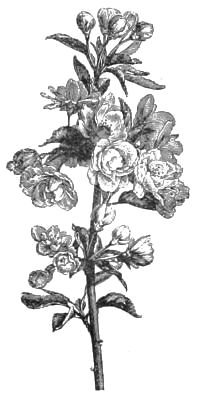
FIG. 121. APPLE BLOSSOM.
APPLE (Pyrus Malus). The Apple is one of the most useful, and probably most largely cultivated, of our hardy fruits. It is known as the Crab in its wild state, and is indigenous to Britain and to all the temperate and warmer parts of Europe. It is supposed that the progenitors of the varieties now grown were introduced to this country at various times from the Continent, and not obtained here as direct improvements on the native Crab. Those now cultivated are extremely numerous, and include good varieties that can be made to prolong the season all the year round. Apart from its great value as a fruit, the apple is a strikingly handsome tree when in flower (see Fig. 121). A fruiting branch is shown at Fig. 122.
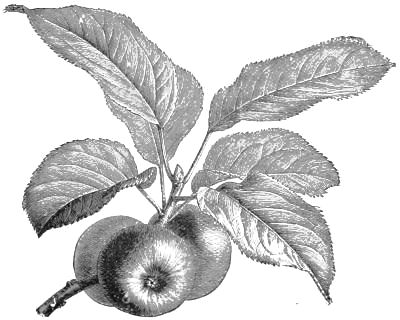
FIG. 122. FRUITING BRANCH OF APPLE.
Propagation. Seeds are sown extensively, chiefly for raising stocks to graft approved sorts on; also with a view to raising new varieties. The seeds do not retain their germinative properties very long, consequently they must be sown soon after being taken from the fruit. As grown in this country, they are generally sown in the autumn, transplanted the following year, and so on until they are of sufficient size for Grafting purposes. The standard of excellence being at present so high, improved forms raised from seed are comparatively scarce.
Grafting. This method of propagation is the one generally adopted for most purposes, the stocks being previously prepared for size or height of tree required. Cordon and other dwarf-trained trees should be worked near but not below the ground, while standards are best worked on stocks of the desired height. The practice of working standard trees low, and growing the scion to form the stem of the future tree, is not recommended, as many of the tenderer sorts will not grow straight or strong enough for the purpose. Whip-grafting is the most preferable mode adopted. The scions should be selected from healthy trees not later than January, and laid in singly in the ground until the stocks have slightly advanced in growth, which is generally about the middle of April. Several other methods of Grafting may be adopted with success, but the one above recommended is considered the best.
Budding. Apples may be successfully propagated by Budding, and this method is practised much more now than formerly. It has many advantages, as it requires to be performed at a season when there is not so much work in hand. It should be done in damp, dull weather, if possible, as the weather if dry soon destroys the buds. July and August is the proper time for the purpose. The stocks and woods from which the buds are taken should be as much as possible in the same condition.
Propagation by Cuttings, Layers, &c. This system may be made use of in the case of new varieties or where it is desired to increase any one variety with a limited number of scions, but the results are uncertain—at least in the case of cuttings; consequently, it is much better to resort to the safer method of Grafting.
Pruning. See Pruning.
Training. See Training.
Planting. The best time to plant is as soon as most of the leaves have fallen, which is generally about the end of October. The roots being then in an active state, and the ground still retaining a certain amount of heat, they will form new roots before winter, which is a material advantage. Where it is impossible to plant at this time, it may be done in suitable weather any time during the winter, but it is best not deferred till spring. It is important in planting that the soil should be moderately dry and free from frost; this condition cannot always be obtained during winter. The effects of soil and situation have a very important bearing on the Apple, specimens of the same sort from different places being often hardly recognisable. Although not over fastidious in the matter of soil as far as growing is concerned, the best results are obtained where it is of a rich loamy character and well drained. Dry, sandy soils invariably produce canker, while the trees are often overgrown with lichens in undrained land. The addition of heavier loam, or sometimes trenching and mixing the sub-soil with that at the top, will convert light soils into those suitable for Apple culture; while, on the other hand, heavy soils may be improved by drainage, the addition of lime, vegetable refuse, burnt earth, and other matters. Rank manure should on no account be used anywhere near the roots, but a little well-decayed manure, mixed with the soil or used as a mulching, is beneficial. The site best suited is an open, though not exposed one, with a south, south-east, or south-west aspect. Shelter from north-east winds in spring, which destroys the bloom, and from west and south-west winds in autumn, which blow down the fruit, should be the aim of cultivators. Planting in a valley should be avoided on account of spring frosts. In Planting, care must be taken to make the bottom of the hole tolerably firm, and slightly raised under the base or bole of the tree. The roots should then be carefully spread out all round, and if any have been ruptured in transplanting, cut them clean off on the upper side, thus inducing new roots to be formed near the surface. The soil should be trodden firmly after a quantity has been filled in, if it is in a dry, suitable condition, as previously recommended. Secure with stakes in proportion to the size of tree, or injury will be caused by the wind. The distance at which Apple trees are planted varies considerably. Standards in orchards may be planted in good soil, from 20ft. to 40ft. apart, especially if they are strong-growing culinary sorts. Pyramids may be planted from 5ft. to 15ft., according to size; and similar distances will suit Bush trees. The oblique Cordon system of training admits of a large number of varieties being cultivated in a small space, as they may be planted as close as 18in. or 2ft. apart. Horizontal Cordons should be planted about 5ft. asunder, and one branch trained each way. Watering will be necessary after planting in most cases, especially should the winter and following season be at all dry. Thinning the fruit is sometimes advisable for obtaining good specimens, but it is not generally necessary, at least with many of the shy-setting sorts. If, however, the crop should be exceptionally heavy, it is best to thin the fruit, or the tree may be unable to make and ripen its wood for the crop of the succeeding year.