THE DICTIONARY OF GARDENING, (continued 9)
Reading edition
A. acuminatum (taper-pointed).* sti. 6in. to 9in. long. fronds 1ft. to 2ft. long, 9in. to 12in. broad, with very numerous close-placed lanceolate-oblong pinnæ on both sides, which are 4in. to 6in. long, 1½in. to 2in. broad; pinnules numerous, unequal-sided, lanceolate, acuminate; edges sharply toothed, the lower base obliquely truncate. sori in two rows in the upper part, of the pinnules, often diplazioid. Sandwich Islands. Greenhouse species. SYN. A. polyphyllum.
A. Adiantum-nigrum (Black Spleenwort). sti. tufted, 6in. to 9in. long. fronds 6in. to 12in. long, 4in. to 6in. broad sub-deltoid; lower pinnæ deltoid, 2in. to 3in. long, 1½in. to 2in. broad; all the pinnæ pinnate. sori copious, at last often occupying the whole under surface of the segments. Great Britain. World-wide in its distribution. Hardy. A. solidum, from Cape Colony, is supposed to be a mere form of this species. There are several varieties the best of which are described below. See Fig. 168.
A. A.-n. acutum (acute). fronds 9in. to 15in. long, deltoid, tripinnate; ultimate segments linear, and very acute. Ireland. A copiously divided and very elegant variety. Habit more graceful than the type.
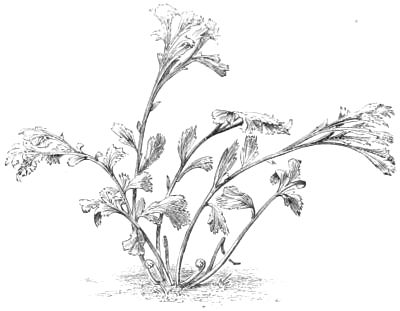
FIG. 169. ASPLENIUM ADIANTUM-NIGRUM GRANDICEPS.
A. A.-n. grandiceps (large-crested). fronds 6in. to 12in. long; pinnæ comparatively short, and slightly crested; apex freely divided, and expanded into a broad crest, which gives the frond a very graceful contour. Frame or greenhouse variety. See Fig. 169.
A. A-n. oxyphyllum (sharp-leaved). fronds 4in. to 6in. long, ovate-lanceolate; ultimate segments narrow and very acute. A very pretty little variety.
A. affine (related). sti. 6in. to 12in. long. fronds 12in to 18in. long, 6in. to 12in. broad, bipinnate, with numerous pinnæ on each side, the lower ones lanceolate-rhomboidal; pinnules rhomboidal, inciso-serrate. sori copious, linear. Mascaren Islands, &c. Stove or warm greenhouse species. SYN. A. spathulinum.
A. alatum (winged).* sti. 4in. to 6in, long, slender, the upper part and the rachis, winged. fronds 1ft. to 1½ft. long, 3in. to 4in. broad, with twelve to twenty horizontal sessile pinnæ on each side, which are 1in. to 1½in. long, and about ½in. broad, bluntish; edge uniformly inciso-crenate, the base nearly equal on both sides. sori distant, not reaching either the midrib or edge. West Indies, &c. A very elegant stove species.
A. alismæfolium (Alisma-leaved). sti. 2in. to 6in. long. fronds varying in shape, from simple oblong-lanceolate, 6in. to 9in. long, 2in. to 3in. broad; apex acuminate; edges entire, to ternate or pinnate, with a large terminal and three pairs of lateral pinnæ, each like the entire frond of the simple state; texture coriaceous. Isle of Luzon. Stove species. SYN. Anisogonium alismæfolium.
A. alternans (alternated). sti. tufted, 1in. to 2in. long. fronds 6in. to 8in. long, 1in. to 1½in. broad, lanceolate-oblong, cut down into numerous bluntly-rounded lobes on each side, which reach very nearly down to the rachis, the lower gradually reduced. sori copious. N. W. Himalayas. Greenhouse species. SYN. A. Dalhousiæ.
A. alternifolium (alternate-leaved). Synonymous with A. germanicum.
A. angustifolium (narrow-leaved).* sti. tufted, about 1ft. long. fronds 18in. to 24in. long, 4in. to 6in. broad, simply pinnate, lanceolate-oblong, flaccid, with twenty to thirty sub-sessile pinnæ on each side, sterile ones largest, 2in. to 3in. long, ½in. broad, acuminate; edge obscurely-crenate, base rounded and equal on both sides; fertile pinnæ narrower and more distant. sori very close and regular, extending from the midrib nearly to the edge. Canada, &c. Greenhouse species.
A. anisophyllum (unequal-leaved). sti. tufted, 6in. to 12in. long. fronds 1ft. to 2ft. long, 6in. to 9in. broad, oblong-lanceolate, simple pinnate, with ten to sixteen sub-sessile pinnæ on each side which are 3in. to 5in. long, about 1in. broad, acuminated, crenate, the two sides unequal, the upper one narrowed suddenly, the lower one obliquely truncate at the base. sori distant, elliptical, reaching half-way from the edge to the margin. Cape Colony, &c. Greenhouse species.
A. apicidens (apex-toothed). A variety of A. Vieillardii.
A. arborescens (tree-like). cau. oblique. sti. 1ft. to 2ft. long. fronds 3ft. to 4ft. long, 2ft. to 3ft. broad, deltoid, tripinnatifid, with numerous pinnæ, the lower ones 12in. to 18in. long, 4in. to 6in. broad; pinnules 3in. long, about ½in. wide, acuminate, edge cut two-thirds of the way down to the rachis into nearly entire lobes, ¼in. deep, ⅛in. broad. Lower sori ⅛in. long. Mauritius, &c., 1826. Stove species. SYN. Diplazium arborescens.
A. Arnottii (Arnott's). sti. smooth, angular. fronds ample, tripinnatifid; lower pinnæ 9in. to 12in. long, 4in. to 6in. broad; pinnules 3in. to 4in. long, 1in. or more broad, cut down below to a distinctly winged rachis into deeply crenate, blunt, oblong lobes, ½in. deep, ¼in. broad. sori copious, nearly all diplazioid, and filling up when mature nearly the whole surface of the lobes. Sandwich Islands, 1877. Greenhouse species. SYNS. A. diplazioides and Diplazium Arnottii.
A. aspidioides (Aspidium-like). sti. tufted, 6in. to 12in. long. fronds 1ft. to 2ft. long, 8in. to 12in. broad, ovate-deltoid, tripinnatifid; lower pinnæ 6in. to 8in. long, lanceolate-deltoid; pinnules lanceolate, cut down below nearly to the rachis into inciso-pinnatifid ovate segments, two lines broad. sori copious, oblong, the lower ones curved. Tropical America, &c. Greenhouse species. SYN. A. multisectum.
A. attenuatum (attenuated). sti. tufted, 3in. to 4in. long. fronds simple, linear-lanceolate, about 1ft. long, about ½in. broad, narrowed upwards very gradually, sometimes proliferous at the point, the margin toothed; the lower third also lobed; the lowest roundish, lobes reaching down nearly or quite to the rachis. sori reaching nearly to the edge. Queensland, &c. Greenhouse species.
A. aureum (golden). A variety of A. Ceterach.
A. auriculatum (auriculated).* sti. tufted, 4in. to 8in. long. fronds 12in. to 18in. long, 4in. to 6in. broad, simply pinnate, lanceolate-oblong, with ten to twenty-stalked horizontal pinnæ on each side, which are 2in. to 4in. long, ¾in. to 1in. broad, lanceolate, often sub-falcate; edge deeply crenate, the two sides unequal, the upper one with a cordate auricle, the lower one obliquely truncate. sori distant, not reaching either the midrib or edge. Tropical America, 1820. Stove species.
A. auritum (eared). sti. tufted, 4in. to 8in. long. fronds 6in. to 12in. long, 2in. to 4in. broad, simply pinnate, with ten to fifteen stalked horizontal pinnæ on each side, which are 2in. to 3in. long, and about ½in. broad, acute or bluntish; edge sharply toothed or often lobed, especially on the upper side towards the base. sori in two broad rather oblique rows. Tropical America. Stove species.
A. australasicum (Australian). A variety of A. Nidus.
A. Baptistii (Baptist's).* sti. 6in. to 8in. long. fronds 1ft. long, bipinnate, broadly ovate; pinnæ stipitate, the lower about 5in. long, with four narrow stipitate linear-toothed pinnules, 2in. long, and a terminal lobe, 3½in. long, ¼in. broad, furnished with distinct linear marginal teeth, pointing forwards, and terminating in a long attenuated point, which is toothed nearly to the end. sori linear-oblong, straight, parallel with, and close to, the midrib. South Sea Islands, 1879. A very handsome stove species.
A. Belangeri (Belanger's).* sti. tufted, 4in. to 8in. long. fronds 12in. to 18in. long, 2in. to 3in. broad, bipinnate; pinnæ numerous, 1in. to 1½in. long, ½in. broad, rounded at the point, truncate at the base on the lower side; pinnules linear, erecto-patent, half line broad; one vein and sorus to each segment, the latter marginal. Malayan Peninsula. Stove species. SYNS. A. Veitchianum, Darea, Belangeri, &c.
A. bipartitum (twice-partite). sti. tufted, 3in. to 6in. long. fronds 6in. to 8in. long, 2in. to 3in. broad, bipinnate, with about ten to fifteen stalked pinnæ on each side, which are 1in. to 1½in. long, ½in. to ¾in. broad, bluntish, cut down at the base on the upper side into one distinctly-stalked cuneate pinnule, sometimes into two or three, the outer edge inciso-crenate, the base on the lower side obliquely truncate. sori in two regular rows, reaching nearly to the edge. Mascaren Isles. Stove species.
A. bisectum (bisected).* sti. tufted, 4in. to 6in. long. fronds 12in. to 18in. long, 4in. to 6in. broad, bipinnatifid, with twenty to thirty horizontal pinnæ on each side, which are 2in. to 3in. long, ¼in. broad, with a very long, narrow, deeply inciso-pinnatifid upper portion, the base on the upper side narrowed suddenly, on the lower obliquely truncate. sori almost all in two parallel rows close to the midrib. West Indies, &c. Stove species.
A. brachypteron (broadly-winged). sti. tufted, 2in. to 4in. long. fronds 4in. to 6in. long, 1in. to 1½in. broad, bipinnate, with twelve to twenty-four horizontal pinnæ on each side, of which from half to nearly the whole of the lower side is cut away, the largest ½in. to ⅝in. long, cut down to the rachis into simple or forked linear pinnules, 1in. to 1½in. long. sori solitary, often quite marginal. Madagascar, &c. Stove species. SYN. Darea brachypteron.
A. brevisorum (shortly-soriate). sti. 12in. to 18in. long. fronds 2ft. to 3ft. long, 9in. to 18in. broad, tripinnate; lower pinnæ 1ft. or more long; pinnules lanceolate, distant, 2in. to 3in. long, and 1½in. broad; segments lanceolate, ¾in. long, two lines broad, deeply and sharply toothed. sori small, six to twelve to a segment, in two rows near the midrib, the lower ones curved, often double. Jamaica, &c. Stove species. SYN. Athyrium brevisorum.
A. bulbiferum (bulb-bearing). sti. tufted, 6in. to 12in. long. fronds 1ft. to 2ft. long, 8in. to 12in. broad, oblong-deltoid, with numerous horizontal pinnæ on each side, which are often proliferous from the upper surface, the largest 4in. to 8in. long, 1½in. to 2in. broad; pinnules lanceolate-deltoid, slightly toothed. sori oblong, when mature often filling the whole breadth of the segments. New Zealand, &c., very widely distributed. Greenhouse species.
A. b. Fabianum (Fabia's). Lower segments deeply pinnatifid, with narrow divisions and sub-marginal sori. SYN. A. Fabianum.
A. b. laxum (loose). Habit more slender; segments narrow, so that the sori are often as if marginal.
A. caudatum (tailed). Probably a form of A. falcatum, but having the sori more confined to the centre of the pinnæ, being often restricted to two parallel rows close to the rachis. Polynesia, &c. Greenhouse species.
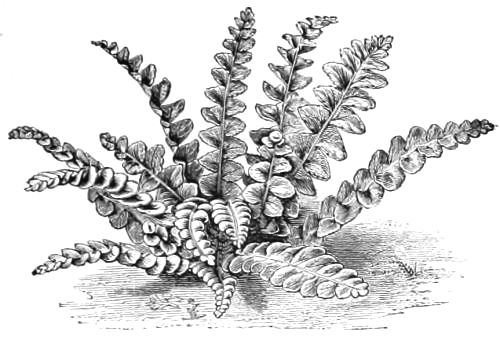
FIG. 170. ASPLENIUM CETERACH.
A. Ceterach.* Scale or Scaly Fern. sti. densely tufted, 1in. to 3in. long, scaly. fronds 4in. to 6in. long, ½in to 1in. broad, cut down nearly or quite to the rachis into alternate, blunt, sub-entire, broadly-oblong or roundish pinnæ, with a rounded sinus between them; upper surface naked, lower densely clothed with deep brown membranous scales. sori linear oblique. Britain, throughout Europe, Northern Asia, &c. This is a variable species, but the forms do not remain constant under cultivation. It should be firmly planted in a vertical chink of the rockery in loam, lime rubbish, rock chippings, and sand, and be watered freely during the summer. SYN. Ceterach officinarum. See Fig. 170.
A. C. aureum (golden).* A large variety, producing fronds from 9in. to 15in. long, 1½in. to 3in. broad, and pinnæ more oblong than the type; scales toothed. Canaries and Madeira. This is a charming fern, requiring greenhouse treatment. SYN. Ceterach aureum.
A. cicutarium (Cicuta-leaved).* sti. tufted, 4in. to 8in. long. fronds 6in. to 15in. long, 4in. to 6in. broad, tripinnate, with ten to fifteen horizontal pinnæ on each side, the lower ones 2in. to 3in. long, 1in. broad, cut down to the rachis into numerous ovate-rhomboidal pinnules, which are ⅜in. to ½in. long, ¼in. broad, obliquely-truncate on the lower side; segments once or twice cleft at the apex. sori principally in two rows along the pinnules. Tropical America, &c. Stove species.
A. Colensoi (Colenso's). sti. tufted, 3in. to 4in. long. fronds 6in. to 9in. long, 2in. to 4in. broad, tripinnatifid, with numerous rather rigid erecto-patent pinnæ, the lower on stalks ¼in. to ½in. long; lower pinnules spreading, deeply inciso-pinnatifid, with linear segments. sori oblong, solitary. New Zealand. A beautiful greenhouse species. SYN. A. Hookerianum.
A. compressum (compressed). sti. tufted, 6in. to 8in. long. fronds 2ft. to 3ft. long, 8in. to 12in. broad, simply pinnate, lanceolate-oblong, with ten to twenty sessile pinnæ on each side, which are 4in. to 6in. long, about 1in. broad, acute or bluntish at the point, edge slightly dentate, the upper ones decurrent at the base upon the stout fleshy compressed rachis, the upper side narrowed suddenly at about a right angle, the lower one obliquely truncate. sori broad, distant, not reaching either the midrib or edge. St. Helena. Stove or greenhouse species.
A. contiguum (contiguous). sti. tufted, 6in. to 9in. long. fronds 12in. to 18in. long, 4in. to 6in. broad, with twenty to thirty horizontal sub-falcate pinnæ on each side, which are acuminated at the apex; edge more or less serrated, the base narrowed suddenly, and sometimes auricled on the upper, obliquely truncate in a curve on the lower side. sori close, copious, falling considerably short of the margin. Sandwich Isles. Greenhouse species.
A. crenatum (crenated).* sti. 6in. to 12in. long, scattered. fronds 9in. to 15in. each way, deltoid, tri- or quadripinnate, with nine to twelve pinnæ on each side, the lowest much the largest, 6in. to 9in. long, 1½in. to 2in. broad; pinnules lanceolate, cut down to the rachis except towards the point on each side into four to six blunt oblong segments, two lines long, one line broad, which are bluntly toothed. sori two to six to a segment, oblong, usually nearly straight, often double. Scandinavia, &c. Hardy species.
A. cultrifolium (hook-leaved).* sti. 4in. to 6in. long. fronds 6in. to 12in. long, 4in. to 6in. broad, bipinnate, deltoid-ovate, with a lobed terminal point and six to ten pinnæ on each side, which are 3in. to 4in. long, ½in. to ¾in. broad, acute; edge broadly toothed, sometimes lobed below nearly or quite to the rachis, the base nearly at a right angle on the upper, but obliquely truncate on the lower side. sori falling short both of the edge and midrib. West Indies, 1820. Stove species. SYN. Diplazium cultrifolium.
A. cuneatum (wedge-shaped). sti. tufted, 6in. to 9in. long. fronds 6in. to 15in. long, 6in. to 9in. broad, tripinnatifid, narrow-deltoid, with numerous spreading pinnæ on each side, the lower 3in. to 4in. long, 1in. to 1½in. broad, lanceolate-deltoid, cut down to the rachis into several distinct ovate-cuneate pinnules, which are dentate and cut down in the lower part nearly or quite to the rachis. sori linear, sub-flabellate. West Indies, and widely distributed in both hemispheres, 1832. A very handsome stove species.
A. Dalhousiæ (Dalhouse's). Synonymous with A. alternans.
A. decussatum (decussate). sti. 1ft. to 2ft. long. fronds 2ft. to 4ft. long, simply pinnate, with numerous pinnæ on each side, which are 6in. to 12in. long, 1in. to 2in. broad, often proliferous in the axils; edge nearly entire. sori reaching nearly to the edge, and copiously double. Polynesian and Malayan Islands, &c. Stove species. SYN. Anisogonium decussatum.
A. dentatum (dentated).* sti. tufted, 2in. to 6in. long. fertile fronds 2in. to 3in. long, 1in. broad, with six to eight pairs of stalked, sub-opposite pinnæ, which are ½in. broad, ⅜in. deep, oblong-rhomboidal, the lower side at the base truncate in a curve, the outer edge irregularly crenate. sterile fronds smaller, on shorter stalks. sori copious, in two parallel rows. West Indies, &c., 1820. A pretty little greenhouse species.
A. dimidiatum (unequal-sided).* sti. tufted, 6in. to 12in. long. fronds 6in. to 15in. long, 4in. to 6in. broad, deltoid, simply pinnate, with six to nine opposite pairs of pinnæ, which are 2in. to 3in. long, ¾in. to 1in. broad, acuminated, sharply serrated. sori radiant, narrow, long linear. Tropical America. Stove species.
A. dimorphum (two-formed).* sti. tufted, 6in. to 12in. long. fronds 2ft. to 3ft. long, 12in. to 15in. broad, ovate-deltoid, sterile and fertile ones different or combined; lower pinnæ ovate-deltoid, 6in. to 8in. long, 2in. broad, bluntly toothed, and the base on the lower side obliquely truncate; fertile pinnæ the same size, but with very narrow simple or forked pinnules. sori linear, solitary, marginal. Norfolk Island. One of the handsomest warm greenhouse species. SYNS. A. diversifolium (of gardens), and Darea dimorpha.
A. diplazioides (Diplazium-like). A synonym of A. Arnottii.
A. diversifolium (diverse-leaved). A garden synonym of A. dimorphum.
A. diversifolium (diverse-leaved). Synonymous with A. maximum.
A. ebeneum (ebony-stalked).* sti. tufted, 3in. to 6in. long. fronds 12in. to 18in. long, 2in. to 3in. broad, linear-lanceolate, with twenty to forty sessile pinnæ on each side, which are about 1in. long, ⅛in. broad; point acute or bluntish; edge faintly serrate; base hastately auricled, often cordate. sori ten to twelve on each side, oblong, short. Canada, &c., widely distributed, 1779. Greenhouse species. A. ebenoides is very like this, but the pinnæ are not cut down to the rachis, and the frond has an elongated point, which is only sinuated with a single row of sori on each side.
A. erectum (erect). Synonymous with A. lunulatum.
A. erosum (bitten). sti. tufted, 6in. to 9in. long. fronds 6in. to 12in. long, 4in. to 8in. broad, deltoid, with nine to fifteen pinnæ on each side, which are 3in. to 4in. long, ½in. to ¾in. broad, the edge slightly lobed and crenato-dentate, the point acuminate, the two sides unequal. sori falling short of the edge. West Indies. Stove species.
A. esculentum (edible).* cau. sub-arborescent. sti. 1ft. to 2ft. long. fronds 4ft. to 6ft. long, pinnate or bipinnate; lower pinnæ 12in. to 18in. long, 6in. to 8in. broad; pinnules 3in. to 6in. long, about 1in. broad, acuminate; edge more or less deeply lobed; base narrowed suddenly, often auricled; lines of sori often on all the lateral veinlets. India, &c., 1822. Stove species. SYN. Anisogonium esculentum.
A. extensum (extended). sti. tufted, 4in. to 6in. long. fronds 12in. to 24in. long, about 1in. broad, with twenty to forty sessile pinnæ on each side, which are ½in. long, ¼in. to ⅜in. deep, blunt and entire, the upper side rather the broadest and often cordate, the lower merely rounded at the base. sori linear-oblong, two or three on each side of the midrib. Andes of Columbia and Peru. A very rare greenhouse species, allied to our native A. Trichomanes.
A. Fabianum (Fabia's). Synonymous with A. bulbiferum Fabianum.
A. falcatum (hooked).* sti. tufted, 6in. to 9in. long. fronds 6in. to 18in. long, 4in. to 6in. broad, lanceolate, with six to twenty stalked, nearly horizontal pinnæ on each side, which are 2in. to 3in. long, ½in. to 1in. broad, acuminated, the edges lobed often one-third of the way down, and the lobes sharply toothed, the two sides unequal, and the lower one at the base obliquely truncate. sori in long irregular lines reaching nearly to the edge. Polynesian Islands, &c., widely distributed. A very elegant greenhouse species.
A. fejeense (Fijian).* rhiz. wide-climbing. sti. 6in. long, scaly below. fronds 18in. to 24in. long, 1in. to 1½in. broad, lanceolate, caudate, or acuminate at the apex, and often proliferous, narrowed below to a truncate base, the margin nearly entire. sori reaching from the midrib nearly to the edges. Fiji, Samoa. &c. Stove species.
A. Fernandesianum (Juan Fernandez). A variety of A. lunulatum.
A. Filix-fœmina (Lady Fern).* sti. tufted, 6in. to 12in. long. fronds 1ft. to 3ft. long, 6in. to 12in. broad, oblong-lanceolate, with numerous pinnate pinnæ, the lower ones spreading, lanceolate, 3in. to 6in. long, 1in. to 1½in. broad; pinnules deeply inciso-pinnatifid. sori linear-oblong, the lower ones often curved. Britain, and world-wide in its distribution. SYN. Athyrium Filix-fœmina. This handsome deciduous species has a great number of varieties, the most important of which are described below:
A. F.-f. acrocladon (summit-branched).* fronds 9in. to 15in. long, slender, bi- or tripinnate, the lower part very narrow, with the apices of the pinnæ sometimes crested; upper portion of the frond freely branched, divisions narrow and crested, the whole forming a broad head.
A. F.-f. acuminatum (taper-pointed).* fronds 9in. to 12in. long, lanceolate-acuminate in outline, with closely set pinnæ, which are similarly characterised, and particularly tapering at the apices.
A. F.-f. apiculatum (apiculate).* fronds 6in. to 15in. long, 2in. to 4in. broad, lanceolate-acuminate in outline, with variously furcate apices; pinnæ closely set with distinctly acuminated apices, and small roundish obtuse serrated pinnules.
A. F.-f. Applebyanum (Appleby's).* fronds narrow, 12in. to 24in. long, with short blunt pinnæ, while the extremities are dilated into a broad furcated crest, which is very striking upon such a narrow frond.
A. F.-f. Barnesii (Barnes's).* fronds 9in. to 15in. long, 3in. to 4in. wide, lanceolate in outline, abrupt at the top, bipinnate; pinnæ alternate, closely set, lanceolate, acutely pointed, with densely set, narrow, acutely serrate pinnules, with a very membranous texture.
A. F.-f. calothrix (beautiful-hair).* fronds 9in. to 15in. long, copiously divided into exquisitely fine segments, so that the fronds present a very light and delicate appearance.
A. F.-f. contortum (contorted).* fronds very diversified, the various pinnæ occasionally combining the characters of the varieties Applebyanum and Victoriæ.
A. F.-f. coronatum (coronate).* fronds 6in. to 12in. long, 2in. wide; pinnæ distinctly forked, sometimes slightly crested at the apices; the upper extremity of the frond copiously forked, and by the ramification of the divisions a broad crest is formed, about 3in. to 4in. across.
A. F.-f. corymbiferum (corymbose).* fronds 12in. to 18in. long, 4in. to 7in. broad, lanceolate-acuminate in general outline; pinnæ closely set, usually forked and crested at the apices, while the extremities of the fronds are dilated into broad crests, nearly or quite as wide at the broadest portion of the frond.
A. F.-f. crispum (crispy or curled).* fronds 6in. long, densely set with very finely divided pinnæ, which are thickly curled, presenting a crispy appearance.
A. F.-f. dissectum (dissected).* fronds 6in. to 12in. long, ovate or broadly lanceolate in form, with irregular and unequal pinnæ; the pinnules also differ very much, and are deeply cut, nearly down to the rachises.
A. F.-f. Elworthii (Elworth's).* fronds 12in. to 20in. long, lanceolate, tripinnate, terminated with a very dense crest, from 4in. to 6in. across; pinnæ and frequently the pinnules also more or less forked and crested.
A. F.-f. Fieldiæ (Field's).* fronds 12in. to 20in. long, narrow, with regular or variously-forked divided pinnæ, sometimes arranged crosswise, with a very graceful disposition.
A. F.-f. Friselliæ (Frisell's).* fronds pendent, sometimes 2ft. long, rarely exceeding 1in. wide, bi- or tripinnate; pinnæ alternate, imbricated, flabellate, with the margins of the pinnules or ultimate divisions dentated.
A. F.-f. grandiceps (large-crested).* fronds 9in. to 15in. long, lanceolate in outline, copiously forked both at the extremities of the pinnæ and frond. The latter is furnished with a very large globose crest, which causes the frond to present a beautifully arched appearance.
A. F-f. Grantæ (Grant's).* fronds 9in. to 12in. long, lanceolate, or broadly so, very thickly set with pinnæ, copiously divided, with the apices of the latter turned up, so that the plant has a crisp or bristly appearance.
A. F.-f. Jonesii (Jones's).* fronds 12in. to 18in. long, oblong-lanceolate in outline, slightly acuminate, bipinnate, furnished at the extremities with a small crest; pinnæ alternate, copiously forked and crested at the apices, even having larger crests than the one at the upper extremity of the frond; pinnules narrow, dentate, slightly crested.
A. F.-f. minimum (smallest).* fronds 4in. to 6in. long, 1in. wide, lanceolate, bipinnate; pinnules densely set, imbricated, and crispy.
A. F.-f. Moorei (Moore's).* fronds 4in. to 8in. long, linear, terminated with a broad tasselled crest, 3in. or more in diameter; pinnæ small, scattered, variously forked, crested, and slender.
A. F.-f. multifidum (many-fid).* A very vigorous growing variety, producing fronds as large as those of the type, terminated with large tasselled crests; pinnæ and pinnules narrow, the former furnished with small crested apices. A variety known as nanum much resembles the foregoing, but the crests are more dense, and the fronds are usually not more than half the length.
A. F.-f. pannosum (pannose).* fronds 10in. to 20in. long, lanceolate in outline, from 4in. to 6in. in the broadest part, bi- or (rarely) tripinnate; pinnæ thickly set, closely alternated, lanceolate-acuminate in form, with deep cut pinnules, and distinctly but irregularly lobed; the whole frond is frequently tinged with reddish-purple.
A. F.-f. plumosum (feathery).* fronds 12in. to 30in. long, 4in. to 10in. broad, broadly lanceolate in outline, tripinnate, beautifully arched; pinnæ of the same form as the frond, copiously divided; pinnules again divided into very fine segments. There are several forms of this charming variety.
A. F.-f. Pritchardii (Pritchard's).* fronds 12in. to 30in. long, very narrow, tapering especially towards the apices; pinnæ decussate, imbricate, rather irregular, with the margins of the pinnules dentate. There is also a variety named cristatum, which is finely crested at the apices of the pinnæ, and is particularly striking.
A. F.-f. ramosa (branched).* fronds 9in. to 12in. long, the lower portion sparsely set with short irregular pinnæ, sharply cut into finely dentate pinnules; the upper part is divided into two main branches, which are again variously forked, and furnished with short pinnæ, the ultimate divisions furcate and slightly crested.
A. F.-f. scopæ (heavily-crested).* fronds 6in. to 16in. long, with a few scattered irregular pinnæ along the main rachis; some of the pinnæ are almost obsolete, while others are an inch long with oblong-dentate pinnules and a heavy terminal crest; the upper portion has several ramifications, each of which is copiously forked and heavily crested, the whole forming a corymbose head 3in. or 4in. in diameter, which gives the plant a pendent habit.
A. F.-f. sub-lunatum (half-crescent-shaped).* fronds 9in. to 20in. long, less than 1in. wide, with curious alternated, nearly crescent-shaped, much contracted pinnæ, sparingly divided, arching.
A. F.-f. Victoriæ (Victoria's).* fronds long, lanceolate in outline, with the apices crested, as well as those of the pinnæ; the latter are forked at the base, the divisions being divergent, and crossing those of the neighbouring pinnæ. A form named gracilis has narrower fronds, is more compact, and cresting rather thicker. There is also another form named lineare, having very small heavily crested fronds, and an extremely elegant appearance. The foregoing are the most important varieties, but a very comparative few of the total number. Although forms of an essentially hardy species, the greater number—and particularly the rarer sorts—should have a winter protection; or, what is far more preferable and satisfactory, they should be grown in the frame or temperate fernery.
A. firmum (firm-textured). Synonymous with A. abscissum.
A. fissum (cut).* sti. tufted, 2in. to 6in. long. fronds 2in. to 5in. long, 1in. to 2in. broad, oblong-deltoid, tripinnatifid, with a few distant pinnæ on each side; pinnules flabellato-cuneate, deeply pinnatifid; ultimate segments under half a line broad. sori linear-oblong, when mature occupying the whole breadth of the segments. South Europe. A pretty little frame or greenhouse species.
A. flabellifolium (fan-leaved).* sti. tufted, 3in. to 6in. long. fronds procumbent, wide straggling, elongated, and rooting at the apex, 6in. to 12in. long, ¾in. to 1in. broad, with ten to fifteen sessile flabellate pinnæ on each side, which are ¼in. to ½in. each way, broadly lobed; lobes sharply toothed, the base cut away in a curve on the lower side. sori oblique, irregular, copious. Temperate Australia, &c. Greenhouse species.
A. f. majus (greater). This is a larger form, with longer fronds and broader pinnæ.
A. flaccidum (relaxed). sti. tufted, 4in. to 8in. long. fronds 1ft. to 3ft. long, 4in. to 8in. broad, often pendent, with numerous lanceolate pinnæ, which are 4in. to 8in. long, and about ½in. broad, sometimes rather rigid and recurved, sometimes quite flaccid and drooping, like the main rachis, sometimes deeply pinnatifid, but more often cut down to the thick rachis in oblique or sub-falcate linear lobes. sori in the divided form quite marginal. New Zealand, &c. SYNS. A. odontites and Darea flaccida.
A. fœniculaceum (Fennel-like). A variety of A. fragrans.
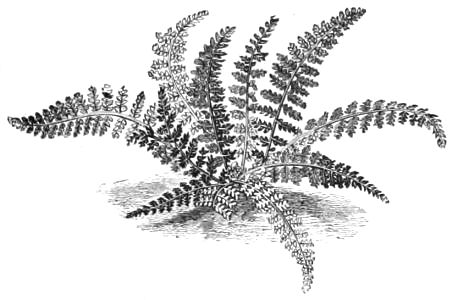
FIG. 171. ASPLENIUM FONTANUM.
A. fontanum (rock).* sti. tufted, 2in. to 4in. long. fronds 3in. to 6in. long, 1in. to 1½in. broad, oblong-lanceolate; lower pinnæ short, reflexed; central ones horizontal, about ½in. long; pinnules stalked, lower ones oblong, deeply inciso-pinnatifid. sori copious, covering nearly the whole under surface of the pinnule. England, &c. Hardy. This requires to be planted in a well-drained chink of the rockery, in rich gritty soil. SYN. A. Halleri. A. refractum is a well-marked variety. See Fig. 171.
A. formosum (beautiful). sti. tufted, very short. fronds 12in. to 18in. long, 1in. broad, with twenty to thirty sessile horizontal pinnæ on each side, which are ½in. long, one and a-half to two lines deep; upper edge deeply cut, point rather obtuse, lower edge truncate in a straight line. sori linear-oblong, short, oblique, placed one to four on each side of the midrib. Tropical America, &c., 1822. A very elegant stove species.
A. fragrans (fragrant).* sti. tufted, 4in. to 8in. long, fronds 6in. to 9in. long, 3in. to 6in. broad, sub-deltoid, tripinnate, with numerous close placed deltoid pinnæ on each side, the lowest 3in. long, 1in. to 1½in. broad; pinnules lanceolate-deltoid; segments sub-spathulate, one line broad, dentate round the outer edge. sori copious. Tropical America, 1793. A. fœniculaceum is a variety with narrowly linear ultimate segments. Both are very handsome stove plants, the latter being especially beautiful.
A. Franconis (Franconis).* sti. tufted, 1ft. long. fronds 1ft. to 2ft. long, 9in. to 15in. broad, deltoid, with numerous pinnæ on each side, the lower ones 6in. to 8in. long, much acuminated, cut down in the lower half into distinct pinnules, 1½in. to 2in. long, ½in. broad, lanceolate, unequal sided, the edge cut half-way down below into oblong sharply-toothed lobes; the lower side obliquely truncate. sori in parallel rows, not reaching the edge. Mexico, &c. Stove species. SYN. Diplazium Franconis.
A. furcatum (forked).* sti. tufted, 4in. to 8in. long, fronds 6in. to 18in. long, 4in. to 6in. broad, with twelve to twenty pinnæ on each side, which are lanceolate-deltoid, 2in. to 3in. long, ¾in. to 1in. broad, nearly or quite pinnate; pinnules linear-cuneate, sharply serrated on the outer edge. sori linear, distant. Very widely distributed in the tropical and sub-tropical regions of both hemispheres. A most elegant greenhouse species. SYN. A. præmorsum.
A. germanicum (German).* sti. densely tufted, 2in. to 4in. long. fronds 2in. to 3in. long, ½in. to 1in. broad, lanceolate, cut down to the rachis into a few narrow flabellato-cuneate pinnæ on each side, the lowest of which are again deeply cleft. sori linear, when mature covering the whole breadth, but falling short of the point of the pinnæ. Scotland and Norway to Hungary and Dalmatia. Hardy or frame species. SYN. A. alternifolium.
A. giganteum (gigantic). A synonym of A. radicans.
A. Goringianum pictum (painted).* A very pretty form of A. macrocarpum; the fronds are from 6in. to 18in. long, pendulous, somewhat lanceolate in form; rachis reddish, with the pinnæ next it on each side variegated, forming a central grey band throughout its entire length. Japan. Greenhouse species, or hardy in sheltered positions.
A. grandifolium (large-leaved). sti. 1ft. or more long. fronds 2ft. to 3ft. long, 9in. to 12in. broad, deltoid-lanceolate, the point pinnatifid, with twelve to twenty pinnæ on each side; the lower ones 2in. or more apart, distinctly stalked, 4in. to 6in. long, 1in. to 1½in. broad, acuminate; edge slightly toothed, and sometimes broadly lobed below, the base equally rounded on both sides. sori irregular, falling slightly short of both midrib and edge. Tropical America, 1793. Stove species. SYN. Diplazium grandifolium.
A. Grevillei (Greville's). fronds undivided, 12in. to 18in. long, 2in. to 3in. broad, lanceolate-spathulate, narrowed to an acute apex, and suddenly below to a broadly winged stipe, which grows very gradually narrower downwards; the margin entire. sori usually extending within a short distance of the edge. India. Stove species.
A. Halleri (Haller's). Synonymous with A. fontanum.
A. Hemionitis (Hemionitis).* sti. tufted, 4in. to 8in. long. fronds 4in. to 6in. each way, hastate, with a triangular, acute terminal lobe, and two large, cordate, acute lateral ones, again bluntly or acutely lobed at the base; the basal sinus rounded, 1in. or more deep, and the lobes on each side imbricated over one another and the petiole. sori narrow upon the simple veins. South Europe, &c. A pretty greenhouse species. SYN. A. palmatum.
A. H. cristatum (crested).* Similar in frond form and size to the species, but the apices are crested and tasselled. Where variety is sought, this should certainly be grown.
A. H. multifidum (much-divided).* fronds quite as broad as long; the main divisions again freely divided or deeply cut, so as to give them a fringed outline. Azores.
A. heterocarpum (various-fruited).* sti. scattered, 4in. to 9in. long. fronds 6in. to 15in. long, 1½in. to 2in. broad, narrow-lanceolate, with very numerous close-placed dimidiate pinnæ on each side, which are ¾in. to 1in. broad, ¼in. deep; the lower edge quite entire, the upper broadest towards the base, where it is narrowed suddenly, deeply incised throughout. sori one, or rarely two, together in the teeth. Himalayas, and widely distributed in south-eastern Asia. A very lovely stove or greenhouse species.
A. heterodon (variously-toothed). Synonymous with A. vulcanicum.
A. Hookerianum (Hooker's). Synonymous with A. Colensoi.
A. incisum (incised). sti. tufted, 1in. to 3in. long. fronds 6in. to 12in. long, 1½in. to 2in. broad, lanceolate, with numerous pinnæ on each side; lower distant and blunt, central ones 1in. long, ½in. broad, lanceolate-deltoid; pinnules ovate-rhomboidal, pinnate, much truncated at the base on the lower side and deeply inciso-pinnatifid. sori linear-oblong, one to each vein. Japan, &c. Greenhouse species.
A. javanicum (Javanese). See Allantodia Brunoniana.
A. lanceolatum (lanceolate).* sti. tufted, 3in. to 4in. long. fronds 6in. to 9in. long, 2in. to 4in. broad; lower pinnæ distant, 1in. to 1½in. long, ¼in. to ⅜in. broad; pinnules oblong-rhomboidal, sharply toothed, and often broadly lobed below. sori copious, when mature covering nearly the whole under surface. South-west Europe, including southern England, &c. Hardy species.
A. l. crispatum (curled).* fronds 4in. to 8in. long, broadly-lanceolate, bipinnate, with the margins of the pinnules involute and sharply toothed, giving them a curled appearance.
A. l. microdon (small-toothed).* fronds 4in. to 6in. long, simply pinnate, with deeply lobed pinnæ, the margins of the lobes very finely dentated and toothed. A pretty little gem, well adapted for case culture.
A. lanceum (lance-shaped). sti. scattered, 4in. to 6in. long. fronds 6in. to 9in. long, ¾in. to 1in. broad, attenuated gradually upwards and downwards, the edge entire or slightly undulated. sori linear, irregular, reaching nearly to the edge, but not to the midrib. Himalayas, &c. Greenhouse species. SYN. A. subsinuatum and Diplazium lanceum.
A. laserpitiifolium (Laserpitium-leaved).* sti. tufted, 6in. to 12in. long, naked. fronds 1ft. to 4ft. long, 4in. to 18in. broad, deltoid-lanceolate, with numerous pinnæ on each side, 2in. to 9in. long, and from 2in. to 6in. broad, cut down to the rachis into numerous distinct pinnules, the lowest with rhomboidal-cuneate segments. sori short, irregular. Polynesian Islands, North Australia, &c. A very handsome greenhouse species.
A. laxum (loose). A variety of A. bulbiferum.
A. lineatum (streaked). sti. tufted, 6in. to 9in. long. fronds 1ft. to 2ft. long, 4in. to 8in. broad, oblong-lanceolate, with twenty to thirty pinnæ on each side, which are 3in. to 4in. long, about ½in. broad, acuminate, dentate, nearly or quite sessile, the base cuneate. sori very regular, reaching from the midrib nearly to the edge. Mauritius, &c. There are several forms of this species: those with small narrow cuneate pinnules, inequale; those with deeply bifid or pinnatifid pinnules, bifida. Stove species.
A. longissimum (longest).* sti. tufted, 3in. to 12in. long. fronds 2ft. to 8ft. long, 4in. to 8in. broad, lanceolate-elongate, pendulous, proliferous, and rooting at the apex, with very numerous pinnæ on each side, which are 2in. to 4in. long, ¼in. broad, acuminated, the two sides nearly equal, with a distinct central midrib; edge slightly toothed, the base on both sides often auricled. sori numerous, in two regular rows on each side the midrib, and reaching nearly to the edge. Malacca, &c., 1840. A very distinct stove fern for baskets.
A. lucidum (clear). A synonym of A. obtusatum lucidum.
A. lunulatum (crescent-shaped).* sti. tufted, 2in. to 4in. long. fronds 6in. to 18in. long, 1½in. to 2in. broad, simply pinnate, narrowly lanceolate-oblong, with twelve to twenty pinnæ on each side, which are 1in. to 1½in. long, ¼in. to ½in. broad, bluntish or acute, more or less deeply inciso-crenate throughout, the two sides unequal; the upper one on the base narrowed suddenly, the lower one obliquely truncate; lower pinnæ often deflexed. sori falling short of both edge and midrib. Tropics. SYN. A. erectum.
A. l. Fernandesianum (Fernandez).* A form with a more rigid rachis and sub-coriaceous, rather narrower pinnæ. Juan Fernandez.
A. macrocarpum (large-fruited). sti. 6in. to 9in. long. fronds 12in. to 24in. long, 6in. to 12in. broad, ovate-lanceolate, with numerous pinnæ on each side, the lowest 3in. to 6in. long, 1in. to 1½in. broad, lanceolate; pinnules oblong-rhomboidal, inciso-crenate or pinnatifid. sori copious, large. Himalayas. Greenhouse species. SYN. Athyrium macrocarpum.
A. macrophyllum (long-leaved). Synonymous with A. nitens.
A. marginatum (margined). sti. 2ft. to 3ft. long, strong, erect woody, about ½in. thick at the base. fronds simply pinnate, 4ft. to 6ft. long; pinnæ in several opposite pairs, the lowest 1ft. to 2ft. long, 3in. to 4in. broad, the edge entire, the base often cordate. sori long, linear, confined to the free veins. Tropical America. Stove species. SYN. Hemidictyum marginatum.
A. marinum (sea).* Sea Spleenwort. sti. tufted, 3in. to 6in. long. fronds 6in. to 18in. long, 2in. to 4in. broad, oblong-lanceolate, apex pinnatifid; pinnæ of the lower half quite deltoid, the point acute or obtuse, margin crenato-dentate. sori broad, falling short of the edge. Europe, including Britain. Although perfectly hardy, this requires to be grown in a frame or cool house.
A. m. coronans (crowned).* fronds 4in. to 6in. long, simply pinnate; pinnæ for two-thirds of the way up variable in form, and irregularly lobed and cut; the upper third freely branched with numerous imbricated, curled, and slightly crested divisions, forming a dense head 2in. or more across. A dwarf and pretty form.
A. m. crenatum (crenated). fronds 4in. to 8in. long, broadly-lanceolate; pinnæ nearly trapeziform, obtuse, with deeply crenated margins. A very pretty form.
A. m. mirabile (wonderful).* sti. 2in. to 4in. long. fronds about the same length, the rachis divided about half way down from the top into two nearly equal divisions, which are again freely forked, with the pinnules and segments obtusely lobed; the whole expanded, but not crested, into a breadth equal to the length of the frond; the lower pinnæ are more or less abnormal and bluntly lobed.
A. m. plumosum (feathery).* sti. 3in. to 4in. long. fronds 6in. to 15in. long, bi- or tripinnatifid, broadly-lanceolate; pinnæ very variable, closely set, and imbricated, cut nearly to the rachis into ovate or oblong divisions, which are again more or less deeply cut and lobed, the entire frond having a very elegant appearance.
A. m. ramo-plumosum (branched and feathery).* fronds divided nearly to the top of the stipes into two main branches, which are distinctly pinnate; pinnæ distant below, imbricated upwards, cut nearly to the rachis into ovate or oblong lobes, the margins of which are slightly dentated. It is a very handsome form, the width of the frond being greater than its length.
A. m. ramosum (branched). fronds from 4in. to 8in. long, branched at the apices; pinnæ oblong, with the margins obtusely-dentate, and slightly undulated.
A. m. sub-bipinnatum (half-bipinnate). fronds 6in. to 12in. long, lanceolate; pinnæ distant, deeply lobed, or cut nearly to the midribs. A very rare and pretty variety.
A. m. Thompsonii (Thompson's).* sti. 3in. to 4in. long, smooth. fronds 6in. to 10in. long, ovate-lanceolate, bipinnatifid; pinnæ closely set, sub-deltoid, unequal-sided, deeply cut into oblong, slightly undulated lobes below, gradually less divided upwards. A very rare and handsome variety. All the forms of A. marinum require a very moist atmosphere, consequently they will not thrive in the open air, unless along the sea-coast.
A. maximum (largest). cau. erect. sti. 2ft. or more long. fronds several feet long, 2ft. to 3ft. broad, deltoid-lanceolate, with numerous pinnæ on each side, the lowest 9in. to 18in. long, 4in. to 8in. broad; pinnules sub-sessile, 2in. to 4in. long, ¾in. broad; edge more or less lobed. sori medial, the lowest two lines long. North India. Stove species. SYNS. A. diversifolium and Diplazium decurrens.
A. melanocaulon (black-stiped).* sti. 1ft. to 2ft. long. fronds 2ft. to 3ft. long, 9in. to 18in. broad; lower pinnæ 4in. to 9in. long, 4in. to 6in. broad; pinnules lanceolate, 2in. to 3in. long, ¾in. broad, cut down two-thirds of the way to the rachis into linear-oblong, falcate, inciso-crenate lobes. sori short, oblong, not touching either midrib or edge. Fiji. Stove species. SYN. Diplazium melanocaulon.
A. Michauxii (Michaux's).* cau. stout. sti. 4in. to 8in. long. fronds 9in. to 24in. long, 3in. to 9in. broad, ovate-deltoid, bi- or tripinnate; pinnules oblong, deeply serrate, or cut quite to the rachis. United States. A very handsome hardy species, closely related to the Lady Fern, of which it may be only a variety.
A. monanthemum (one-flowered).* sti. densely tufted, 3in. to 6in. long. fronds 12in. to 18in. long, about 1in. broad, with twenty to forty horizontal, sessile, sub-dimidiate pinnæ on each side, which are about ½in. long and ¼in. deep, the upper side crenate, suddenly narrowed at the base, the lower more or less distinctly cut away in a straight, or, in the lower pinnæ, decurved line. sori linear-oblong, usually one or two, parallel with the lower edge of the pinnæ. Temperate regions of both hemispheres. Greenhouse species.
A. montanum (mountain).* sti. tufted, 2in. to 3in. long. fronds 2in. to 3in. long, 1in. broad, lanceolate-deltoid; lowest pinnæ distinctly stalked, deltoid, sharply serrated round the outer edge. sori short, copious. United States, 1812. Frame or greenhouse species.
A. multisectum (much-cut). Synonymous with A. aspidioides.
A. musæfolium (Musa-leaved). A variety of A. Nidus.
A. myriophyllum (myriad-leaved). A variety of A. rhizophyllum.
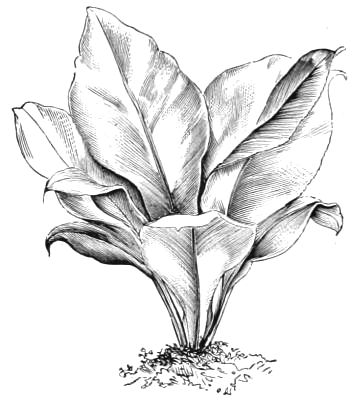
FIG. 172. ASPLENIUM NIDUS.
A. Nidus (nest).* Bird's-nest Fern. fronds undivided, 2ft. to 4ft. long, 3in. to 8in. broad, lanceolate, acute or acuminate at the apex, tapering gradually below into a short stem; the edge entire, the midrib rounded on the back; veins fine and parallel, about ½in. apart. sori reaching about half way towards the margin. India, &c., 1820. SYN. A. australasicum. See Fig. 172.
A. N. australasicum (Australian). Midrib keeled on the back, often black. Australia, &c. The two former are best treated in the stove; the latter thrives well in the greenhouse. SYN. Thamnopteris australasicum.
A. N. musæfolium (Musa-leaved).* fronds larger, sometimes 6ft. long, 1ft. broad. sori extending nearly to the edge.
A. nitens (shining). sti. scattered, 6in. to 9in. long. fronds 1½in. to 2in. long, 6in. to 9in. broad, with twelve to twenty ascending or sub-falcate pinnæ on each side, which are 4in. to 6in. long, ½in. to 1in. broad, much acuminated; edge finely toothed, base broadly rounded on the upper, truncate in a curve on the lower side. sori in close regular rows, not extending more than half way from the midrib to the edge. Mauritius. Stove species. SYN. A. macrophyllum, of gardens only.
A. nitidum (shining).* sti. 1ft. long, naked. fronds 2ft. to 3ft. long, 6in. to 12in. broad, with many lanceolate-deltoid pinnæ on each side, which are cut down to the rachis into numerous stalked deltoid pinnules, these are again cut into broad fan-shaped cuneate segments, sharply serrated round the outer edge. sori short. North India, Ceylon, &c. Greenhouse species.
A. novæ-caledoniæ (New Caledonian).* sti. tufted, 6in. to 12in. long. fronds 9in. to 12in. long, 6in. to 9in. broad, sub-deltoid, tripinnate; lower pinnæ and pinnules deltoid; segments rigid, scarcely flattened, ½in. or more long, distant, and erecto-patent. sori long, linear, marginal. New Caledonia. A rare greenhouse species. SYN. Darea novæ-caledoniæ.
A. obtusatum (obtuse). sti. tufted, 3in. to 6in. long. fronds 6in. to 12in. long, 3in. to 4in. broad, oblong or ovate-deltoid, with a terminal pinna not much longer than the others, and two to six pairs on each side, which are 1in. to 2in. long and about ½in. broad, obtuse, edge crenate, the base truncato-cuneate, shortly stalked. sori copious, broad, linear-oblong, falling short of the edge. Peru. A. difforme is a variety with an ovate-deltoid frond, and the pinnæ cut quite down to a narrow-winged rachis in the lower part into distinctly separated roundish or oblong-sinuated pinnules. New Zealand, Australia, &c. Greenhouse kinds.
A. o. lucidum (clear).* fronds often 2ft. long, with fifteen to twenty pairs of pinnæ on each side, which are more herbaceous in texture, darker green in colour, the lowest 6in. long, 1in. to 1½in. broad, narrowed gradually to a long acuminated point, edge more deeply toothed. Greenhouse variety. SYN. A. lucidum.
A. obtusifolium (obtuse-leaved).* sti. almost tufted, 6in. to 9in. long. fronds 12in. to 18in. long, 4in. to 6in. broad, ovate-lanceo-late, with twelve to twenty stalked horizontal pinnæ on each side, which are 2in. to 3in. long, ½in. to ¾in. broad, acute; edges slightly undulato-crenate, the upper side with a distinct auricle at the base, and then narrowed suddenly, the lower side obliquely truncate. sori distant, in two regular rows, falling short of the edge. West Indies, &c., 1838. Stove species.
A. obtusilobum (obtuse-lobed).* sti. tufted, 2in. to 4in. long. fronds 4in. to 6in. long, 1½in. to 2in. broad, with nine to twelve sub-deltoid pinnæ on each side, of which only the inner third on the lower side is cut away, the largest nearly 1in. long, ¾in. broad; lowest pinnules ⅜in. deep, flabellately cut into three to five linear blunt lobes. sori sub-marginal. New Hebrides, 1861. A very pretty little stove species. SYN. Darea obtusiloba.
A. odontites (much-toothed). Synonymous with A. flaccidum.
A. oxyphyllum (sharp-leaved).* sti. firm, 6in. to 12in. long. fronds 1ft. to 2ft. long, 6in. to 12in. broad, lanceolate, with several pinnæ on each side, which are 3in. to 6in. long, 1in. to 2in. broad; pinnules lanceolate, in the larger forms again pinnatifid; teeth mucronate. sori in two rows on the pinnæ or pinnules midway between the midrib and edge. Himalayas. A very variable greenhouse species. SYNS. Athyrium oxyphylla and Lastrea eburnea.
A. paleaceum (scaly).* sti. densely tufted, 1in. to 3in. long, spreading, densely scaly. fronds 6in. to 9in. long, 1½in. to 2in. broad, sometimes proliferous and rooting at the apex, with twelve to twenty sub-sessile pinnæ on each side, which are 1in. long, about ½in. broad, bluntish; edge inciso-dentate, the upper base auricled and narrowed suddenly, the lower obliquely-truncate; the lower ones stalked, and nearly as broad as long. sori linear, extending nearly to the edge. Tropical Australia. Stove or warm greenhouse species.
A. palmatum (palmate). Synonymous with A. Hemionitis.
A. parvulum (small). Synonymous with A. trilobum.
A. persicifolium (Peach-leaved). sti. and rachis grey, with a few scattered minute grey scales. fronds oblong-lanceolate, 2ft. to 3ft. long, often gemmiferous at the apex; pinnæ ascending, fifteen to thirty-jugate, sub-petiolate, 4in. to 5in. long, linear-ligulate-acuminate, ½in. to ¾in. broad, distinctly crenate throughout. sori regular, reaching nearly to midrib and edge. Philippine and Sandwich Isles. Stove species.
A. Petrarchæ (Petrarch's).* sti. densely tufted, 1in. to 2in. long. fronds 2in. to 3in. long, ½in. broad, linear-lanceolate, with six to ten horizontal sessile pinnæ on each side, which are ¼in. long and nearly as much broad, cordate-ovate, blunt; edge sinuated; the base unequal, slightly truncate on the lower side. sori oblong, very short, four to six on each side of the midrib. South Europe, 1819. A very rare little gem, best treated in a cool house.
A. pinnatifidum (pinnatifid). sti. tufted, 2in. to 4in. long. fronds 3in. to 6in. long, 1in. or more broad at the base, lanceolate-deltoid, with a long, gradually narrowing point, which is sinuated only; the lobes below this ¼in. to ½in. deep; the lowest ovate-oblong, ½in. deep by nearly as broad, sinuated and reaching down nearly to the rachis. sori copious. Pennsylvania. Greenhouse or sheltered places outside.
A. planicaule (flat-stiped).* sti. tufted, 3in. to 6in. long, naked. fronds 6in. to 12in. long, 2in. to 3in. broad, with twelve to twenty stalked horizontal pinnæ on each side, which are 1in. to 1½in. long, ¼in. to ⅜in. broad, acute; edge lobed about half-way down, and deeply serrated. sori copious, reaching nearly to the edge. Himalayas, up to 6000ft., &c., 1841. Greenhouse species.
A. plantagineum (Plantain-like). sti. tufted, 6in. to 9in. long. fronds 6in. to 9in. long, 2in. to 3in. broad, simple, acuminate, base rounded; edge slightly undulato-dentate upwards, sometimes lobed towards the base. sori slender, linear, sometimes nearly touching both edge and midrib. West Indies, &c., 1819. Stove species. SYN. Diplazium plantagineum.
A. polyphyllum (many-leaved). Synonymous with A. acuminatum.
A. præmorsum (bitten). Synonymous with A. furcatum.
A. prolongatum (prolonged). Synonymous with A. rutæfolium.
A. pulchellum (pretty).* sti. tufted. 1in. to 2in. long. fronds 3in. to 6in. long, 1in. to 1½in. broad, with twelve to eighteen pinnæ on each side, which are ½in. to ¾in. long, two lines to three lines broad, bluntish, almost dimidiate; the upper edge crenate, and narrowed suddenly at the base. sori linear, oblique, falling short of the edge. Tropical America. Stove species.
A. pumilum (small). sti. tufted, 3in. to 4in. long. fronds 4in. to 6in. each way, deltoid, the upper part sinuated only, the lower cut down to the rachis into distinct pinnæ, of which the lowest pair are much the largest; the pinnules on the lower side sometimes 2in. long, reaching down to a slightly winged rachis, acuminate and deeply lobed. sori very oblique, the lower ones sometimes 1in. long. West Indies, &c., 1823. A very rare and pretty stove species.
A. rachirhizon (rachis-rooting). A variety of A. rhizophorum.
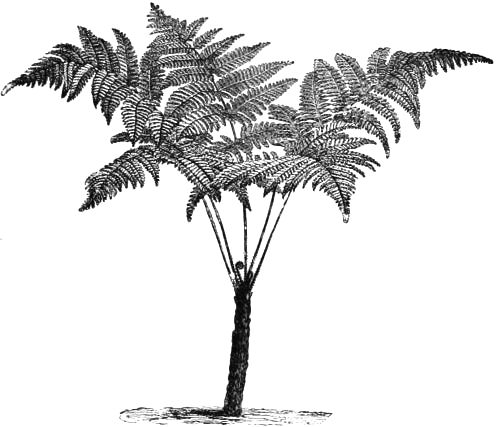
FIG. 173. ASPLENIUM RADICANS.
A. radicans (rooting). cau. erect, sub-arborescent. sti. 1ft. to 2ft. long, tufted. fronds 3ft. to 5ft. long, 2ft. to 3ft. broad, deltoid; lower pinnæ 12in. to 18in. long, 6in. to 8in. broad; pinnules lanceolate, sessile, the upper ones entire, lower ones 3in. to 4in. long, ¾in. to 1in. broad, with blunt lobes, ¼in. broad, reaching about half way down to the rachis. Lower sori sometimes ¼in. long. Tropical America. A very variable species. SYNS. A. giganteum, Diplazium radicans, D. umbrosum, &c. See Fig. 173.
A. refractum (refracted). A variety of A. fontanum.
A. resectum (cut or pared).* sti. scattered, 4in. to 8in. long. fronds 6in. to 15in. long, 2in. to 4in. broad, lanceolate-oblong, with ten to thirty sub-sessile horizontal pinnæ on each side, which are 1in. to 3in. long, ¼in. to ½in. broad, almost dimidiate, the point bluntish, all except the truncate part crenate, the upper half at the base narrowed nearly at a right angle. sori not reaching either the midrib or edge. India, &c., widely distributed, 1820. Greenhouse species.
A. rhizophorum (root-bearing).* sti. tufted, 4in. to 8in. long. fronds 1ft. to 2ft. long, 4in. to 6in. broad, elongated, and rooting at the apex; pinnæ twelve to thirty on each side, sub-sessile, 1½in. to 2in. long, about ½in. broad, inciso-dentate throughout; the two sides unequal, the upper one auricled and narrowed, the lower one obliquely cuneate. sori not reaching either to the edge or midrib. Tropical America. A very variable stove species. A. r. rachirhizon, has distinctly separated oblong-rhomboidal pinnules, again deeply cut into narrow segments.
A. rhizophyllum (leaf-rooting). sti. tufted, 2in. to 6in. long. fronds 6in. to 12in. long, 1½in. to 2in. broad, cut down into numerous close-placed horizontal pinnæ on each side; central ones 1in. long, ¼in. to ⅜in. broad, cut down throughout nearly to the centre into simple or forked erecto-patent pinnules, the lowest on the under side suppressed. sori solitary, sub-marginal. A. r. myriophyllum is a variety with broader fronds; central pinnæ 1½in. long, with lower pinnules cut down into several simple or forked linear segments. North America, &c., 1680. Both handsome greenhouse kinds.
A. rutæfolium (Rue-leaved).* sti. tufted, 4in. to 9in. long. fronds 6in. to 15in. long, 2in. to 4in. broad, ovate deltoid, with twelve to twenty pinnæ on each side, the lowest sub-deltoid, 2in. or more long, cut down to the rachis into numerous erecto-patent distant pinnules on each side, the lowest on the upper side again cut down into erecto-patent linear segments. sori small, marginal. Cape Colony. A beautiful greenhouse species. SYNS. A. prolongatum and Darea rutæfolia.
A. Ruta-muraria (Wall-rue).* sti. tufted, 2in. to 4in. long. fronds 1in. to 2in. long, about 1in. broad, deltoid, cut down to the rachis into a few pinnæ on each side, the lower ones again cut down into spathulato-cuneate pinnules, which are serrated round the outer edge. sori copious. Great Britain, and almost worldwide in its distribution. Hardy species. This requires a well-drained position, and a soil composed mainly of old mortar rubbish.
A. salicifolium (Willow-leaved). sti. tufted, 6in. to 12in. long. fronds 12in. to 18in. long, 6in. to 9in. broad, oblong, with a terminal pinna and four to ten distinctly stalked ones on each side, which are 4in. to 6in. long, ¾in. to 1in. broad, acuminate; edge usually entire, the base equally truncato-cuneate on both sides. sori falling short both of the edge and midrib. West Indies, &c. Stove species.
A. Sandersoni (Sanderson's).* sti. tufted, 1in. to 2in. long. fronds 6in. to 9in. long, ½in. to ¾in. broad, linear, often gemmiferous at the apex, with twelve to twenty horizontal dimidiate pinnæ on each side, which are deeply crenate on the upper edge, and at the base narrowed suddenly into a winged petiole, the lower one nearly straight and quite entire. sori oblong. Natal, &c. A very rare greenhouse species.
A. schizodon (cut-toothed). Synonymous with A. Vieillardii.
A. Schkuhrii (Schkuhr's). cau. erect. sti. 1ft. to 1½ft. long. fronds deltoid, 1½ft. to 2ft. long, tripinnatifid; lower pinnæ distant, oblong-lanceolate, 6in. to 8in. long, 1½in. to 2in. broad, rachis winged to base; pinnules ligulate-oblong, ⅜in. broad, sessile, cut into shallow, close, oblong blunt lobes. sori ⅛in., medial in a single row in the pinnules. Ceylon. Stove species. SYN. Diplazium Schkuhrii.
A. Selosii (Selose's).* sti. densely tufted, 1in. to 2in. long, wiry. fronds ½in. to ¾in. long, palmately cleft, usually into three nearly equal forks, which are about one line broad, the edge slightly inciso-serrate. sori copious, ultimately occupying the whole surface. Tyrol and Carinthia. A very rare and curious little species, requiring the protection of the frame or cool house; it should be firmly potted between pieces of sandstone in loam, leaf-soil, rock chippings and sand, with good drainage.
A. septentrionale (northern).* sti. densely tufted, 3in. to 4in. long. fronds simple, or cleft from the apex into two or three cuneate divisions, 1in. to 1½in. long, one line broad, with a few sharp lateral and terminal teeth. sori elongated, copious, often at last hiding the whole under surface. Great Britain, and widely distributed in both hemispheres. This rare little species requires to be securely planted in a well-drained elevated chink of the fernery outside, in loamy, gritty soil.
A. Shepherdi (Shepherd's).* sti. tufted, 1ft. long. fronds 12in. to 18in. long, 6in. to 9in. broad; lower pinnæ stalked, 4in. to 6in. long, 1in. to 1½in. broad, point acuminate, edge lobed above, ¼in. broad, somewhat toothed. sori linear, not reaching the edge. South America. Stove species. SYN. Diplazium Shepherdi.
A. S. inæquilaterum (unequal-sided). fronds, texture firm, colour duller than that of the type; pinnæ much acuminated; the lobes deeper, more uniform, and falcate, the two sides unequal, the lower one unequally truncate at the base.
A. spathulinum (spathulate). A synonym of A. affine.
A. spinulosum (very spiny).* sti. 6in. to 12in. long, scattered. fronds 9in. to 12in. each way, deltoid, tri- or quadripinnatifid, with nine to twelve pinnæ on each side, the lowest much the largest, 6in. to 9in. long, 2½in. to 3in. broad, ovate-lanceolate; pinnules lanceolate, cut down to the rachis on each side into six to nine oblong-rhomboidal mucronate segments, two lines long, one line broad, which are sharply toothed. sori two to ten to a segment, usually round, but occasionally oblong. Amur-land, &c. Greenhouse species. SYN. Athyrium spinulosum and Cystopteris spinulosa.
A. splendens (splendid). rhiz. creeping, scaly. sti. 6in. to 9in. fronds deltoid, 6in. to 1ft. long, two to three-pinnate; lower pinnæ stalked, deltoid, 1in. to 2in. broad, pinnate or bipinnate; segments cuneate-flabellate, ¼in. to ½in. broad, slightly lobed, sharply toothed round outer edge. sori copious, slender, irregular, reaching from base nearly to tip of segments. Cape Colony. A very rare greenhouse species.
A. subsinuatum (half-waved). Synonymous with A. lanceum.
A. sundense (Sundanese). Synonymous with A. vittæforme.
A. sylvaticum (woods). cau. decumbent. sti. 1ft. long. fronds 1ft. to 2ft. long, 4in. to 8in. broad, ovate-lanceolate, with numerous spreading pinnæ, the largest 3in. to 4in. long, ½in. to ¾in. broad, acuminated; edge broadly and briefly lobed; base narrowed suddenly on both sides. sori in long slender lines, reaching nearly to the edge. India, &c. Stove species.
A. thelypteroides (Thelypteris-like). sti. 1ft. long. fronds 1ft. to 2ft. long, 6in. to 12in. broad, lanceolate, with numerous spreading pinnæ, the lower ones 4in. to 6in. long, 1in. broad, cut down to a broadly-winged rachis into numerous nearly entire elliptical spreading pinnules. sori in close regular rows, reaching nearly from the midrib to the edge, slightly curved, the lower ones often double. North America, &c., 1823. Hardy or cool house species. SYN. Athyrium thelypteroides.
A. Thwaitesii (Thwaites's).* rhiz. wide-creeping, stout. sti. 6in. long, slender, densely clothed with strong white woolly hairs. fronds 1ft. or more long, 4in. to 6in. broad, with eight to ten distinct pinnæ beneath the pinnatifid apex, the largest 3in. long, ⅝in. broad, cut down two-thirds of the way to the rachis in oblong crenulated lobes, ¼in. deep, two lines across. sori reaching half-way to the edge, the lowest about one line long. Ceylon. Very fine stove species. SYN. Diplazium Thwaitesii.
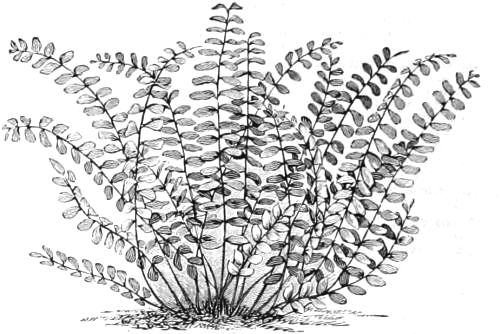
FIG. 174. ASPLENIUM TRICHOMANES.
A. Trichomanes (maiden-hair).* Maidenhair Spleenwort. sti. densely tufted, 1in. to 4in. long. fronds 6in. to 12in. long, about ½in. broad, with fifteen to thirty opposite pairs of sessile horizontal pinnæ, which are ¼in. to ⅜in. broad, one and a-half to two lines deep, edge slightly crenate, the two sides unequal, the upper one the broadest, and narrowed suddenly at the base. sori linear-oblong, three to six on each side of the midrib. Great Britain, and almost cosmopolitan. Hardy species. See Fig. 174. There are several varieties in cultivation, of which the following are the most important:
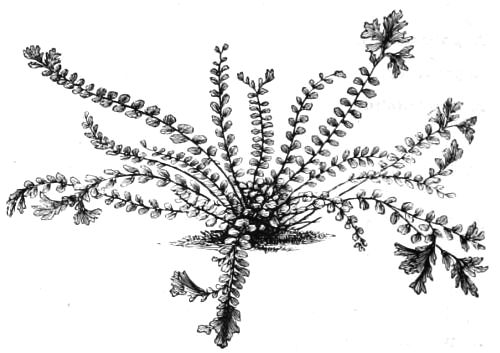
FIG. 175. ASPLENIUM TRICHOMANES CRISTATUM.
A. T. cristatum (crested).* fronds 4in. to 6in. long, simply pinnate, with roundish pinnæ, and broad crests at their extremities, sometimes divided, each fork crested. A very pretty little variety, requiring frame or greenhouse treatment. See Fig. 175.
A. T. incisum (deeply-cut).* fronds 3in. to 6in. long; pinnæ deeply pinnatifid, the lobes again deeply cut or serrated. A very rare and pretty form.
A. T. multifidum (much-divided).* fronds 3in. to 6in. long, once, twice, thrice, or, rarely, quadri-furcate, each division terminated with a little crest. A free-growing kind.
A. T. ramosum (branched).* fronds 5in. to 8in. long, freely branched, each division being again forked; pinnæ deeply cut or crenated, or serrate. More hardy than any of the other forms.
A. trilobum (three-lobed).* sti. tufted, 2in. to 3in. long. fronds 1in. to 1½in. long, 1in. broad, rhomboidal, apex acute, base cuneate, entire, the margin undulato-crenate, or the lower part deeply lobed, with broad inciso-crenate divisions. sori broad and short. Chili and South Brazil. A very rare little stove species. SYN. A. parvulum.
A. umbrosum (shady). sti. 1ft. or more long, scaly at the base. fronds 2ft. to 5ft. long, 12in. to 18in. broad, ovate-deltoid; pinnæ ovate-lanceolate, 6in. to 9in. long, 3in. to 6in. broad, with lanceolate pinnules, which are again cut down to the midribs into unequal-sided rhomboidal lobes, with the margins sharply crenated. sori copious, oblong, with large tumid membranous involucres. Madeira, Canaries, Himalayas, &c. Very widely distributed. A very handsome greenhouse species. SYNS. Allantodia australe, Athyrium umbrosum.
A. varians (variable). sti. tufted, 1in. to 3in. long. fronds 4in. to 6in. long, 1in. broad, oblong-lanceolate, with eight to twelve pairs of pinnæ on each side, lower ones sub-deltoid, ½in. to ¾in. long, ¼in. broad, cut down to the rachis into a few cuneato-flabellate pinnules, the lowest two lines across, sharply toothed on the outer edge. sori copious, when mature, covering nearly the whole under surface of the pinnules. Himalayas, and widely distributed. Greenhouse species.
A. Veitchianum (Veitch's). Synonymous with A. Belangeri.
A. Vieillardii (Vieillard's).* sti. tufted, 4in. to 6in. long. fronds 6in. to 9in. long, 6in. to 8in. broad, with large linear-lanceolate terminal pinna, lengthened out at the point, and deeply serrated, and three to four pairs of erecto-patent similar lateral ones, which are 3in. to 4in. long, upwards of ½in. broad, equally truncato-cuneate, and the lower ones slightly stalked at the base. sori distant, falling short of both edge and margin. New Caledonia. A very graceful greenhouse species. SYN. A. schizodon. A. apicidens is but a variety of this, with shortened sori and more obtuse venation.
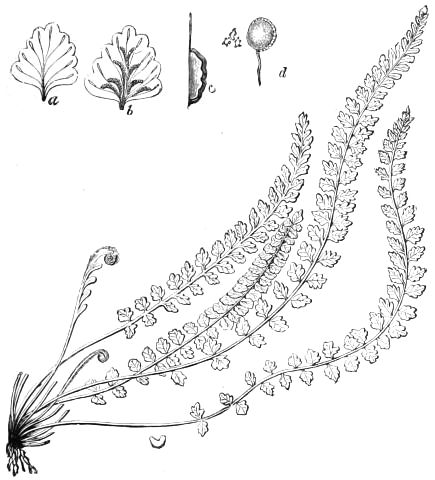
FIG. 176. ASPLENIUM VIRIDE, showing Barren and Fertile Pinnæ (a and b), Sorus (c), and Sporangium (d).
A. viride (green). Green Spleenwort.* sti. densely tufted, 2in. to 4in. long. fronds 4in. to 6in. long, ½in. broad, with twelve to twenty sub-sessile pinnæ on each side, ovate-rhomboid; upper edge narrowed suddenly at the base, the lower one obliquely truncate, outer part deeply crenated. sori copious, linear-oblong, oblique. Great Britain, &c., widely distributed in both hemispheres. It requires to be planted in a well-drained but moist situation. Hardy species. See Fig. 176.
A. vittæforme (narrow-fronded).* rhiz. creeping. sti. short, erect. fronds entire, lanceolate, 12in. to 18in. long, 1½in. to 3in. broad, narrowed to an acute point, and very gradually into the stem below; margin obscurely toothed. sori copious, often reaching from the midrib nearly to the edge. Java, &c. Stove species. SYN. A. sundense.
A. viviparum (plant-bearing).* sti. tufted. 6in. to 9in. long. fronds 1ft. to 2ft. long, 6in. to 8in. broad, ovate-lanceolate, with numerous close-placed erecto-patent pinnæ on each side, which are 3in. to 4in. long, 1½. to 2in. broad, cut down to a compressed rachis into numerous pinnatifid pinnules, the lower segments of which are again forked; ultimate segments ¼in. to ⅜in. long, quarter-line broad. sori solitary, marginal. Mauritius, &c., 1820. A very handsome stove species.
A. vulcanicum (volcanic). sti. 6in. to 9in. long. fronds 1ft. to 2ft. long, 4in. to 8in. broad, oblong-lanceolate, with a linear-terminal pinna, or gemmiferous at the apex, and six to twelve lateral ones on each side; lower ones stalked, 2in. to 4in. long, ¾in. to 1in. broad, acuminated; edge slightly dentate; the base truncate. sori very regular and parallel, falling short of the edge. Malay Islands. Stove species. SYN. A. heterodon.
A. zeylanicum (Ceylonese).* sti. scattered, 4in. to 8in. long. fronds 6in. to 12in. long, 1in. to 2in. broad, the point acuminated, apex slightly lobed, the lower two-thirds more deeply so, and the base quite down to the rachis; lobes blunt, ¼in. to ½in. across. sori linear, two to three lines long. Ceylon. Stove species. SYN. Diplazium zeylanicum.
ASSONIA (commemorative of Ignatius de Asso, a distinguished Spanish botanist, who wrote on the plants of Arragon). ORD. Sterculiaceæ. This genus is now included by best authorities under Dombeya. Ornamental stove evergreen trees, with undivided leaves, and axillary, bifid, sub-corymbose peduncles. They are of easy culture; thriving freely in any light rich soil, or a mixture of loam and peat. Young cuttings will root freely in sand, with a brisk bottom heat, if covered by a bell glass.
A. populnea (Poplar-leaved). fl. white, disposed in a terminal, bifid corymb; peduncles scarcely longer than the petioles. June. l. cordate, acuminated, smooth, a little serrated. h. 10ft. to 20ft. Bourbon, 1820.
A. viburnoides (Viburnum-like). fl. white; peduncles three times longer than the petioles. l. cordate, somewhat acuminate, crenated, tomentose beneath, as well as younger leaves. h. 10ft. to 20ft. Bourbon, 1822.
ASTARTEA (a mythological name: Astarte, the Syrian Venus). ORD. Myrtaceæ. An ornamental greenhouse evergreen shrub, requiring a mixture of loam, peat, leaf soil, and sand. Young cuttings root readily in sand under a bell glass in gentle heat.
A. fascicularis (bundle-flowered). fl. white, pedicellate, solitary, axillary. May. l. opposite, linear, fleshy; when young, disposed in axillary fascicles. h. 6ft. to 9ft. West Australia, 1830.
ASTELMA (from a, not, and stelma, a crown; in reference to the construction of the fruit). ORD. Compositæ. Greenhouse evergreen shrubs from the Cape of Good Hope. Some species of this genus, which is now generally referred to Helipterum, are very handsome, and thrive well in a mixture of fibrous peat, leaf soil, and sand, with thorough drainage. Fill the pots one-third full of crocks; water carefully, and only when absolutely necessary; and place in a situation near the glass, allowing a free admission of air. Seeds should be sown in pots of light, open soil, and placed in a gentle heat; half-ripened cuttings will strike readily in sandy soil with a hand glass placed over them. They are now but rarely seen under cultivation.
A. canescens (hoary). fl.-heads purple; scales of involucre ovate; branches one-flowered. May to June. l. oblong, blunt, imbricated. h. 1½ft. 1794.
A. eximium (fine).* fl.-heads crimson; corymbs sessile. July. l. sessile, ovate, close, erect, white with thick woolly pubescence. Stem stout. h. 3ft. 1793. This is a very beautiful species.
A. speciosissimum (showiest). fl.-heads white, large, solitary, terminal. July. l. sessile, lanceolate-obovate, acute, three-nerved, woolly. h. 8ft. 1691.
ASTEPHANUS (from a, without, and stephanos, a corona; corona absent). ORD. Asclepiadeæ. A genus of pretty evergreen greenhouse twiners. Flowers few, small, disposed in interpetiolar umbels; corolla campanulate. Leaves small, opposite. They thrive in a compost of turfy peat, leaf soil, and loam, in equal parts. Very little water is required when the plants are at rest. Cuttings root readily in sandy soil in a moderate heat. Propagation may also be effected by division.
A. linearis (linear). fl. white; umbels dividing in threes, lateral and terminal. July. l. 1in. long, opposite, linear-lanceolate. Stem glabrous. Cape of Good Hope, 1816.
A. triflorus (three-flowered).* fl. white; umbels generally three-flowered. July. l. opposite, lanceolate, villous beneath. Stems hairy. Cape of Good Hope, 1816.
ASTER (from aster, a star; general shape of flower-heads). Michaelmas Daisy; Star-wort. SYN. Pinardia (of Necker). ORD. Compositæ. Hardy herbaceous perennials, except where otherwise stated. Heads solitary, corymbose, or panicled, heterogamous, rayed; ray florets pistiliferous, one or two-seriate, fertile or neuter; ligule elongated, white, blue, or purple; disk florets hermaphrodite, fertile, tubular, yellow, five-cleft; involucre campanulate or hemispheric; bracts few or many-seriate, outer smaller or larger; receptacle flat or convex; pappus hairs few or copious, scabrid, outer sometimes shorter, rigid, and paleaceous. Leaves alternate. This large genus contains many handsome border and alpine deciduous perennials (rarely biennials) of easy culture in ordinary soil. They may be propagated by divisions in autumn or spring, or by seeds in spring. The greenhouse species are mostly evergreen shrubs, requiring a compost of peat, leaf soil, and loam. Cuttings root readily in a sandy soil, under a hand glass, with very little heat.
A. acris (acrid). fl.-heads blue; involucre imbricated, twice as short as the disk. August. l. linear-lanceolate, not dotted, three-nerved. h. 2ft. South Europe, 1731.
A. acuminatus (taper-pointed).* fl.-heads white; panicle corymbose. September. l. broad-lanceolate, narrowed at base, entire, with a very long point. Stem simple, flexuous, angular. h. 2ft. North America, 1806.
A. adulterinus (false). fl.-heads violet; involucre squarrose, shorter than the disk. September. l. amplexicaul, lanceolate; lower ones sub-serrate, smooth; those of the branches linear squarrose. h. 3ft. North America.
A. æstivus (summer-flowering).* fl.-heads blue. July. l. lanceolate, somewhat amplexicaul, narrowed at the end, scabrous at edge. Stem erect, hispid; branchlets pilose. h. 2ft. North America, 1776.
A. albescens (whitish). fl.-heads purple or whitish, nearly 1in. across; corymbosely panicled; scales of involucre ovate-linear, apiculate; ray twenty-flowered. August. l. lanceolate on short petioles, denticulate, downy. Plant beset with rusty down. h. 3ft. Nepal, 1842.
A. alpinus (alpine).* fl.-heads bright purple, 1in. to 2in. across; scales of involucre nearly equal, lanceolate, bluntish. July. l., radical ones lanceolate-spathulate; those of the stem lanceolate. Stem one-flowered. h. 6in. to 9in. Europe, 1658. A very attractive species, having a dwarf, stout habit; it forms a useful and handsome subject for edging, and its flowers are valuable for cutting purposes. See Fig. 177.
A. a. albus (white).* fl.-heads white, in other respects resembling the type; but it is much less desirable, and has not nearly so vigorous a habit. Europe, 1827.
A. altaicus (Altaian).* fl.-heads blue-purple, about 2in. across; stem simple, corymbose, downy. June, July. l. linear-lanceolate, entire, blunt mucronate, three-nerved at base, veiny. h. 1ft. Siberia, 1804. This, which is frequently considered a variety of A. alpinus, is one of the handsomest.
A. alwartensis (Alwart). fl.-heads red; ray very fine; involucre loosely squarrose. May. l. ovate, narrowed at base, entire, about five-nerved. h. 1ft. Caucasus, 1807.
A. Amellus (Amellus).* fl.-heads purple, solitary, numerous; involucre imbricated squarrose; leaves blunt; inner membranous, coloured at edge. August. l. oblong-lanceolate, scabrous. h. 2ft. Italy, 1596. One of the best border kinds.
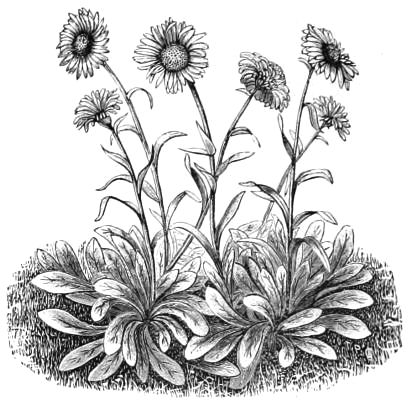
FIG. 177. ASTER ALPINUS.
A. A. bessarabicus (Bessarabian).* A most desirable variety, frequently seen in gardens; it is rather taller than the type, with larger flower-heads, of a deep purple colour. One of the showiest of all the Asters. See Fig. 178.
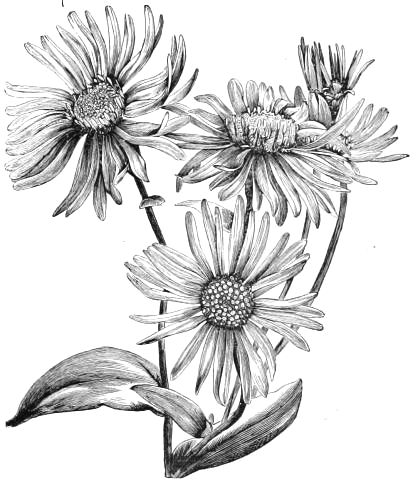
FIG. 178. ASTER AMELLUS BESSARABICUS.
A. amplexicaulis (stem-clasping). fl.-heads violet. July. l. ovate-oblong, acute, amplexicaul, cordate, serrated, smooth. Stem panicled, smooth; branches one to two-headed. h. 3ft. North America.
A. amygdalinus (Almond-leaved). fl.-heads white; involucre closely imbricated. August. l. lanceolate, narrowed at base, acuminated, scabrous at edge. Stem simple, corymbose at end. h. 2ft. North America, 1759.
A. argenteus (silvery).* fl.-heads purple. August. l. oblong-lanceolate, silky, sessile. Stem slender, decumbent, loosely branched; branches and branchlets one-headed. h. 1ft. North America, 1801.
A. bellidiflorus (Daisy-flowered). fl.-heads pale red; involucre with spreading scales. September. l. amplexicaul, narrow-lanceolate, scabrous above, lower sub-serrated. Stem much branched. h. 3ft. North America.
A. Bigelovii (Bigelow's).* fl.-heads corymbose, 2½in. diameter, ray-florets lilac, disk yellow. Summer. l. scabrous pubescent, oblong-spathulate; cauline ones amplexicaul, ovate-oblong, crenate, obscurely-toothed. h. 2½ft. Colorado, 1878. A very handsome biennial species. SYN. A. Townshendi.
A. blandus (charming). fl.-heads pale purple; racemes scarcely longer than the leaves. October. l. sub-amplexicaul, oblong-lanceolate, acuminate, sessile, smooth. Stem pyramidal. h. 2ft. North America, 1800.
A. canescens (hoary). fl.-heads pale purple; involucre imbricated, very acute, longer than disk. September. l. linear. Panicle corymbose, much branched, leafy. h. 2ft. North America, 1812. Biennial or perennial.
A. cassiarabicus (Arabian Cassia). fl.-heads pink; panicles corymbose. September. l. ovate, acute, serrated, tapering at the petioles. Plant erect, pilose. h. 2ft. Russia, 1834.
A. caucasicus (Caucasian).* fl.-heads purple, solitary; scales of involucre nearly equal, linear. July. l. ovate, sessile, scabrous. h. 1ft. Caucasus, 1804.
A. ciliatus (ciliated). fl.-heads white. September. l. ciliated; cauline ones linear-lanceolate, nerved; those of the branches very short lanceolate, three-nerved. Stem branched, downy; branches downy. h. 3ft. North America.
A. concinnus (neat).* fl.-heads purple; involucre closely imbricated. October. l. sub-amplexicaul, lanceolate; lower ones sub-serrate, smooth. Stem simple, panicled at end. h. 2ft. North America, 1800.
A. concolor (one-coloured). fl.-heads purple; raceme terminal. October. l. oblong-lanceolate, hoary on each side. Stem simple, erect, downy. h. 1ft. North America, 1759.
A. conyzioides (Conyza-like). Synonymous with Seriocarpus conyzioides.
A. cordifolius (heart-leaved). fl.-heads blue, small, disposed in crowded racemes, which are slightly drooping. July. l. cordate, pilose beneath, finely serrated, stalked. Stem smoothish, panicled; panicle spreading. h. 2ft. North America, 1759.
A. coridifolius (Coris-leaved). fl.-heads pale blue. October. l. very numerous, linear, blunt, reflexed, hispid at edge. Stem branched, diffuse, smooth; branches one-headed. h. 1ft. North America.
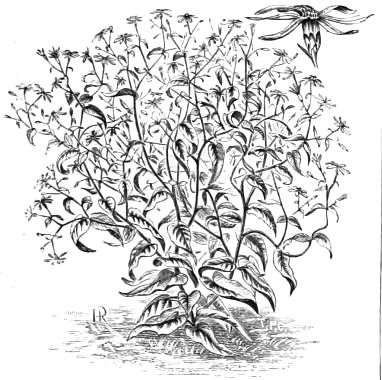
FIG. 179. ASTER CORYMBOSUS, showing Habit and Flower-head.
A. corymbosus (corymbose). fl.-heads corymbose, about 1in. in diameter; ray-florets few, narrow, white; disk-florets pale yellow. Autumn. l. 3in. long, cordate acute, lobed at the base, coarsely toothed. Stems brittle, blackish purple. h. 2ft. to 3ft. SYN. Biotia corymbosa. See Fig. 179.
A. diffusus (diffuse). fl.-heads white; involucres imbricated. October. l. elliptic-lanceolate, equal, serrated, smooth. Branches spreading. Stem pubescent. h. 2ft. North America, 1777.
A. Douglasii (Douglas's).* fl.-heads purple; involucral scales linear or spathulate-linear, loosely imbricated. August. l. lanceolate, acute, entire, or rarely serrate, mostly tapering at the base. Stem smooth, slender, paniculately branched, leafy. h. 3ft. to 4ft. California, &c.
A. dracunculoides (Tarragon-like).* fl.-heads white, about 1in. across, disposed in dense cymose clusters; involucre imbricated. September, October. l. linear, acuminated, entire; lower ones linear-lanceolate, sub-serrate. Branches corymbose. h. 3ft. North America, 1811. A very handsome species.
A. dumosus (bushy).* fl.-heads white, about ½in. across, disposed in broad clusters; involucre cylindrical, closely imbricated. October. l. linear, glabrous; those of the branches very short. Branches panicled. h. 2ft. North America, 1734.
A. d. albus (white).* fl.-heads quite white, and rather smaller than those of the species. North America.
A. d. violaceus (violet). fl.-heads violet-purple. North America.
A. elegans (elegant). fl.-heads blue, small; corymb contracted, drooping; scales of involucre oblong-cuneate, blunt, squarrose. September. l. scabrous; cauline ones oblong-lanceolate, acute; radical ones oblong, stalked. h. 2ft. North America, 1790. A very elegant species, having a graceful habit.
A. eminens (eminent). fl.-heads light blue. October. l. linear-lanceolate, acuminate, scabrous at edge; lower ones sub-serrated. Stem panicled; branches one-headed. h. 2ft. North America.
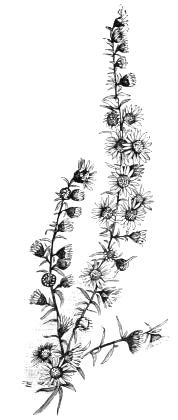
FIG. 180. ASTER ERICOIDES.
A. ericoides (Heath-like).* fl.-heads white; involucre squarrose, leaflets acute. September. l. linear, glabrous; those of the branches subulate, close together; and those of the stem long. h. 3ft. North America, 1758. A very pretty species. See Fig. 180.
A. floribundus (many-flowered).* fl.-heads light purple. September. l. sub-amplexicaul, lanceolate; lower ones serrated. Stem smooth; branches corymbose. h. 4ft. North America.
A. foliosus (leafy). fl.-heads pale blue; involucre imbricate. September. l. linear-lanceolate, acuminate, narrowed at each end. Stem downy, panicled, erect; branches few-headed. h. 3ft. North America, 1732.
A. fragilis (fragile). fl.-heads flesh-coloured, small; involucre imbricated. September. l. linear, acuminate, entire; radical ones oblong, serrate. Branches in corymbose panicles. h. 2ft. North America, 1800.
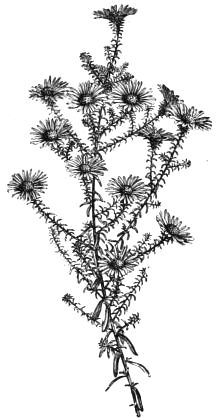
FIG. 181. ASTER GRANDIFLORUS.
A. grandiflorus (large-flowered).* fl.-heads purple, large, terminal; scales of involucre squarrose. November. l. linear, rigid, acute, sub-amplexicaul; those of the branches reflexed, hispid at edge. h. 2ft. North America, 1720. See Fig. 181.
A. hyssopifolius (Hyssop-leaved).* fl.-heads white, or purple shaded; scales of the involucre about half as long as the disk. August to October. l. linear-lanceolate, acute, with the margins scabrous. Branches fastigiate and corymbose, smooth. h. 1½ft. to 2ft. North America.
A. lævigatus (smooth-stemmed). fl.-heads flesh-coloured, about 1in. across, disposed in large panicles. September. l. sub-amplexicaul, broad-lanceolate, sub-serrate, smooth. Stem glabrous. Branches many-headed. h. 3ft. North America, 1794.
A. lævis (smooth).* fl.-heads blue; involucre imbricated with cuneiform leaflets. September. l. sub-amplexicaul, remotely oblong, entire, lucid; radical ones sub-serrated. h. 2ft. North America, 1758. One of the best border species.
A. laxus (loose-flowered). fl.-heads white, about 1in. across; clusters loose. October. l. linear-lanceolate, scabrous at edge; lower ones sub-serrated; stem ones reflexed. Stem loosely panicled. h. 2ft. North America.
A. linarifolius (Toad-flax-leaved). fl.-heads pale blue. September. l. numerous, linear, mucronated, nerveless, not dotted, keeled, scabrous, rigid. Branches fastigiate, one-headed. h. 1ft. North America, 1699.
A. linifolius (Flax-leaved). fl.-heads white; involucre imbricated, short. July. l. linear, nerveless, dotted, scabrous, reflexed, spreading. Branches corymbose, fastigiate, leafy. h. 2ft. North America, 1739.
A. longifolius (long-leaved).* fl.-heads white, 1in. across, in dense corymbose panicles; involucre squarrose. October. l. linear-lanceolate, rarely toothed, very long, smooth. h. 3ft. North America, 1798. There are several varieties of this handsome species.
A. l. formosus (charming).* fl.-heads pink, produced in dense corymbs. h. 1½ft. to 2ft.
A. macrophyllus (large-leaved). fl.-heads white. August. l. large, ovate, stalked, serrated, scabrous; upper ones cordate, sessile. Stem branched, diffuse. h. 2ft. North America, 1739.
A. multiflorus (many-flowered).* fl.-heads white, small; corymb large, elongated; involucre imbricated; scales oblong, squarrose, acute. September. l. linear, glabrous. Stem much branched, diffuse, downy; branchlets one-sided. h. 3ft. North America, 1732.
A. myrtifolius (Myrtle-leaved). fl.-heads white; involucre imbricated; scales length of disk. August. l., stem ones, amplexicaul, scabrous; those of the branches small. h. 2ft. 1812.
A. novæ-angliæ (New England).* fl.-heads purple, in terminal clusters. September. l. linear-lanceolate, pilose, amplexicaul, auricled at base. Stem simple, pilose, straight. h. 6ft. North America, 1710. One of the best; having a tall and robust habit.
A. n.-a. rubra (red).* fl.-heads deep red pink, in other respects like the type. North America, 1812.
A. novæ-belgii (New York).* fl.-heads pale blue. September. l. sub-amplexicaul, lanceolate, glabrous, scabrous at edge; lower ones sub-serrated. Branches divided. h. 4ft. North America, 1710. There is a variety known in gardens which belongs to this species, under the name of amethystinus, the flowers of which are much larger and very showy.
A. obliquus (oblique). fl.-heads numerous; ray white; disk purplish. Autumn. l. alternate; lower ones linear-lanceolate, oblique; upper stem ones smaller. h. 5ft. North America. A very fine species, forming large tufts.
A. paniculatus (panicled).* fl.-heads light blue; involucre loose. September. l. ovate-lanceolate, sub-serrated, stalked, smooth; petioles naked. Stem much branched, smooth. h. 4ft. North America, 1640.
A. pannonicus (Pannonian). fl.-heads violet; scales of involucre lanceolate, blunt, equal. July. l. linear-lanceolate, hispid at edge. Stem simple, corymbose. h. 2ft. Hungary, 1815.
A. patens (spreading). fl.-heads light purple, about 1in. across. October. l. oblong-lanceolate, ciliate, cordate, amplexicaul, scabrous on each side, hairy. Stem branched, hairy. h. 2ft. North America, 1773.
A. pendulus (drooping).* fl.-heads pure white at first, ultimately rosy pink, small. September. l. elliptic-lanceolate, serrate, smooth, those of the branches distant. Branches much spreading, pendulous. h. 2ft. North America, 1758. A very pretty species.
A. peregrinus (foreign).* fl.-heads bluish purple, 2in. across. July, August. l. lanceolate, sub-acute, entire, smooth, those of the stem rather narrower than the radical ones. Stem smooth, or nearly so, two or three-flowered. h. 1ft. North America. A very pretty little species for the rockery or border.
A. pilosus (pilose). fl.-heads pale blue; involucre oblong, loose, imbricated. September. l. linear-lanceolate, hoary. Stem branched, villous; branchlets somewhat one-sided, one-headed. h. 2ft. North America, 1812.
A. præcox (early). fl.-heads violet; involucre imbricated; scales nearly equal; outer scales somewhat spreading. July. l. oblong-lanceolate, narrowed at the base. Stem hairy. h. 2ft. North America, 1800.
A. pulchellus (beautiful).* fl.-heads purple, solitary; scales of involucre nearly equal, linear, acuminate. June. l., radical ones spathulate; cauline ones linear-lanceolate. h. 1ft. Armenia.
A. puniceus (red-stalked). fl.-heads blue, about 1in. across; panicle large, pyramidal; involucre loose, longer than the disk. September. l. amplexicaul, lanceolate, serrate, roughish. Branches panicled. h. 6ft. North America, 1710.
A. pyrenæus (Pyrenean).* fl.-heads lilac-blue (disk yellow), large, three to five in a short corymb. July. l. scabrous on both sides; cauline ones oblong-lanceolate, acute, sessile, sharply serrated on the upper part. h. 1ft. to 1½ft. Pyrenees.
A. Reevesi (Reeves's). fl.-heads white, with yellow centre, small; panicle dense, pyramidal. Autumn. l. linear, acute. Branches slender. h. 9in. to 12in. North America. A very desirable species, suitable for rockwork.
A. reticulatus (netted). fl.-heads white. July. l. lanceolate-oblong, acute at each end, sessile, revolute at end, netted, and three-nerved beneath. Plant hoary all over. h. 3ft. North America, 1812.
A. rubricaule (red-stemmed). Synonymous with A. spurius.
A. salicifolius (Willow-leaved). fl.-heads flesh-coloured; involucre lanceolate, imbricate; scales acute, spreading at end. September. l. linear-lanceolate, nearly entire, smooth. Stem smooth, panicled at end. h. 6ft. North America, 1760.
A. salsuginosus (salt-plains).* fl.-heads violet-purple; involucral scales linear, loose, glandular. July. l. entire, the lower spathulate, obovate, tapering into a margined petiole; the upper ones lanceolate, acute, with broad base, usually sub-amplexicaul. Stem minutely pubescent, leafy nearly to the top, few-flowered. h. 9in. to 18in. North America, 1827. A very handsome species.
A. s. elatior (tallest). This variety grows 2ft. or more high, and has rather larger flowers than the type. North America.
A. sericeus (silky). fl.-heads deep blue; terminal, about 1½in. across. Summer and autumn. l. oblong-lanceolate, sessile, entire, three-nerved, silky with down. h. 3ft. Missouri, 1802. This is a half-hardy evergreen shrub, and requires a warm, well-drained soil.
A. serotinus (late-flowering). fl.-heads blue. September. l. oblong-lanceolate, acuminate, sessile, smooth, scabrous at edge; lower ones serrated; branches corymbose, smooth. h. 3ft. North America.
A. Shortii (Short's). fl.-heads purplish blue, about 1in. across; panicles long, racemose. Autumn. l. lanceolate, elongated, acuminated, cordate at the base. h. 2ft. to 4ft. Stem slender, spreading. North America.
A. sibiricus (Siberian). fl.-heads blue; involucre loose; leaflets lanceolate, acuminate, hispid. August. l. lanceolate, sub-amplexicaul, serrate, pilose, scabrous. h. 2ft. Siberia, 1768.
A. sikkimensis (Sikkimese).* fl.-heads purple; leaflets of involucre linear, acuminate, sub-squarrose. October. l. lanceolate, acuminate, spinosely denticulate; radical ones on longer petioles; cauline ones sessile; corymbs large, of many heads, leafy, erect, glabrous, branched. h. 3ft. Sikkim, 1850.
A. spectabilis (showy).* fl.-heads blue; scales of involucre loose, leafy. August. l. lanceolate, roughish, somewhat amplexicaul; lower ones serrate in the middle. h. 2ft. North America, 1777. A very pretty species.
A. spurius (spurious). fl.-heads purple, large, few; inner scales of involucre coloured. September. l. linear-lanceolate, amplexicaul, polished. Stem virgate, panicled. Branches racemose. h. 4ft. North America, 1789. SYN. A. rubricaule.
A. tardiflorus (late-flowering). fl.-heads blue, numerous. Autumn. l. sessile, serrated, smooth, spathulate-lanceolate, narrowed at base, and bent down towards each side. h. 2ft. North America, 1775.
A. Townshendi (Townshend's). Synonymous with A. Bigelovii.
A. Tradescanti (Tradescant's).* fl.-heads white; involucre imbricated. August. l. lanceolate-sessile, serrated, smooth; branches virgate. Stem round, smooth. h. 3ft. North America, 1633. A. multiflorus is very much like this species, and, perhaps, a mere form thereof, with somewhat smaller flowers and more obovate-oblong leaves.
A. tripolium (Tripoli). Michaelmas Daisy. fl.-heads blue; disk yellow; scales of involucre lanceolate, membranous, obtuse, imbricated. August. l. linear-lanceolate, fleshy, obscurely three-nerved. Stem glabrous, corymbose. h. 2ft. Britain.
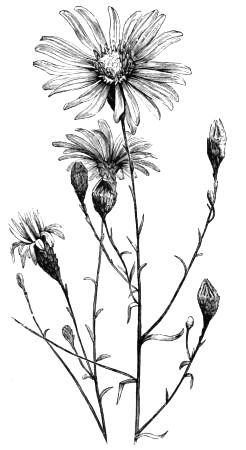
FIG. 182. ASTER TURBINELLUS.
A. turbinellus (turbinate). fl.-heads delicate mauve, disposed in panicles; involucre top-shaped, scales imbricate. Summer and autumn. l. lanceolate, smooth, entire, with fringed margins, somewhat stem-clasping; those of the branchlets awl-shaped. h. 2ft. to 3ft. North America. A very desirable species. See Fig. 182.
A. undulatus (undulated). fl.-heads pale blue. August. l. oblong-cordate, amplexicaul, entire; petioles winged. Stem panicled, hispid. Branchlets one-sided. h. 3ft. North America, 1699.
A. versicolor (various-coloured).* fl.-heads white, changing to purple; scales of involucre shorter than disk. August. l. sub-amplexicaul, broad-lanceolate, sub-serrate, smooth. Stem glabrous. h. 3ft. North America, 1790.
The annuals (Callistemma hortensis), usually known as French, German, or China Asters, are very extensively grown, both for beds and pots, and their diversity and generally compact growth render them almost universal favourites. They require a rich loamy soil, and as the roots are produced near the surface, a mulching of rotten dung will be found most beneficial. Seeds may be raised in a cold frame in March or April, and, when the seedlings are large enough, they must be transplanted into beds from 9in. to 12in. apart each way. If it is desired to have them in pots, they may be removed thence with a good ball of earth adhering just before they commence flowering, liberally watered, and kept lightly shaded from the sun, until root action is resumed. Those kinds required for exhibition purposes should have several of the side shoots removed, so that the whole growing energy of the plant may be centralised into from five to seven flower-heads, by which means fine blooms may be obtained. The dwarf kinds are most valuable for bedding and pots, as the taller kinds frequently require stakes for support. The following are the most important sections:
Betteridge's Prize. Very beautifully formed and brilliantly coloured varieties, unsurpassed for exhibition purposes. As this class has rather a straggling habit of growth, it is less suitable for bedding and borders than many of the others.
Boltze's Miniature Bouquet Pyramidal. Dwarf and elegant, in compact bouquets of six or eight; the truss of flower-heads springs directly from the ground, having only a few leaves at base. Colours very varied. h. 6in. to 8in.
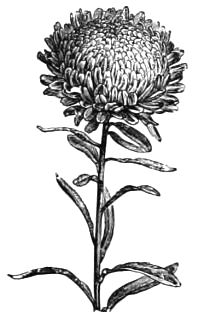
FIG. 183. TRUFFAUT'S PEONY-FLOWERED ASTER.
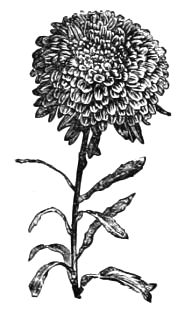
FIG. 184. TRUFFAUT'S PERFECTION ASTER.
Crown.* Distinct. The central portion, or disk, of the head of flowers is pure white, surrounded by a broad margin of coloured ray florets, such as purple, violet, crimson, rose, &c. Flower-heads large, flat, freely produced. h. 1ft. to 1½ft.
Dwarf Chrysanthemum-flowered.* In size of flower-heads and habit of growth, this surpasses all other dwarf varieties. The flowers are full, Chrysanthemum-shaped, produced in clusters, or bouquets, from ten to twenty in a truss, very delicate and beautiful in colour. h. 1ft.
Dwarf Pyramidal or Dwarf Bouquet. A pretty little class, and extremely floriferous, each plant producing from twenty to fifty heads of bloom. Some of the colours are: Exquisite carmine with white points, white with blue or carmine points, white with salmon centre, &c. h. 1ft.
Improved Imbricate. The best strain of pyramidal Asters with recurved florets; fine regular form of flowers, double to the centre, producing but few seeds. Colours very brilliant. h. 2ft.
Improved Rose. A handsome class, producing a branched head, displaying no less than fifty large double flower-heads, the outer florets finely imbricated, and filled up to the centre when quite open. The colours are of great brilliancy, and of many shades. h. 2ft.
Pompone Goliath.* Flower-heads globular, and florets very closely set. Valuable for bouquets, as the flowers remain intact for a considerable time.
Pyramidal Hedgehog. Singular and unique. Stems upright, and branched; each branch terminated by a single flower-head, which is filled up with quill-like florets. Colours various. h. 1½ft.
Truffaut's Pæony Perfection.* Vigorous upright growers, having large, hemispherical-formed heads of flowers with incurved florets, 4in. across. The colours also are very varied. h. about 2ft. See Figs. 183 and 184.
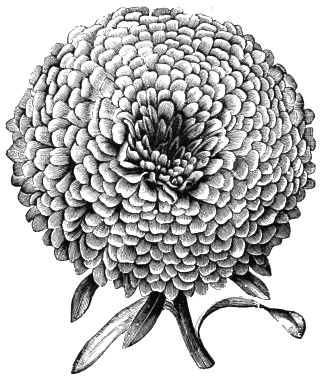
FIG. 185. VICTORIA ASTER.
Victoria.* One of the most popular classes of Asters grown; flower-heads very double, imbricate, globular, 4in. in diameter, from ten to twenty on a plant, of various shades. h. 1ft., with a pyramidal habit. See Fig. 185.
ASTERACANTHA (from aster, a star, and acantha, a spine; referring to the disposition of the spines). ORD. Acanthaceæ. A handsome greenhouse herbaceous perennial, of easy culture in sandy loam. It should be grown in a sunny position, and be kept moderately dry, otherwise little but foliaceous growth will be produced; but, if thus treated, it flowers freely. Propagated by divisions in spring; or by seeds, sown in August.
A. longifolia (long-leaved). fl. yellow, in dense axillary fascicles. July. l. lanceolate, tapering to the base, narrow, sessile, serrately ciliated. Stem quadrangular. Plant rather hairy. h. 2ft. India, 1781.
ASTERACEÆ. See Compositæ.
ASTEROCEPHALUS. See Scabiosa.
ASTILBE (from a, without, and stilbe, brilliancy; in allusion to the inconspicuous flowers of some of the species). ORD. Saxifragaceæ. Tall branching herbs, with triternate or biternate leaves, allied to Spiræa, from which they differ in having not more than three carpels, eight or ten stamens, and numerous albuminous seeds. They are all more or less graceful, and some indispensable, either when grown in isolated clumps, or intermingled with other herbaceous plants. They thrive well in almost any rich garden soil, preferring damp positions, and are easily propagated by division, which is best done in early spring. A. japonica is grown very extensively for decorative purposes, its elegant spikes of pure white flowers rendering it especially valuable. The majority of the plants cultivated are imported, but they may be grown fairly well in this country in heavily manured soil. They should be potted as early as possible in the autumn, and plunged in ashes or fibre outside, when they will soon commence to root, after which they may be placed in heat, and forced as required, always giving an abundance of water. Indeed, the pots may be stood in pans of water, especially when the plants are well furnished with growth.
A. barbata (bearded). A synonym of A. japonica.
A. decandra (ten-stamened). fl. white, in spicate racemose panicles. May. l. biternate; leaflets cordate, deeply lobed and serrated, glandular beneath, and on the petioles. h. 2ft. to 3ft. North America, 1812.
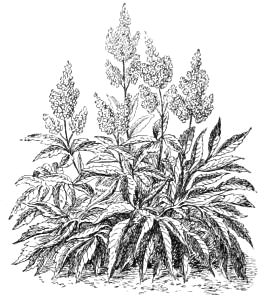
FIG. 186. ASTILBE JAPONICA.
A. japonica (Japanese).* fl. small, pure white, in large branching racemose panicles. May. l. triternate or pinnate, serrated. h. 1ft. to 2ft. Japan. This is best grown in pots, as early frosts generally cut it down in the open air. SYNS. Spiræa barbata and japonica, also Hoteia and A. barbata. See Fig 186.
A. j. variegata (variegated).* l. prettily variegated with yellow; panicles much more dense than the type; indeed, it is far superior in that respect.
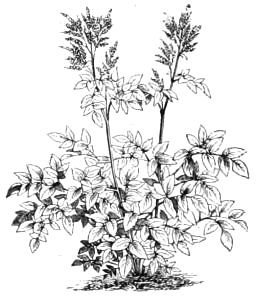
FIG. 187. ASTILBE RIVULARIS.
A. rivularis (brook).* fl. yellowish-white, or reddish, in large panicled spikes. Late summer. l. biternate; leaflets ovate, doubly serrated, villous beneath and on the petioles. h. 3ft. Nepaul. A grand plant for the margins of lakes or damp woodlands. See Fig. 187.
A. rubra (red).* fl. rose, very numerous, in dense panicles. Late summer and autumn. l. biternate; leaflets oblique, cordate, 1in. to 2in. long, with elongated, serrated points. h. 4ft. to 6ft. India, 1851. A very pretty, but rare species; excellent for sub-tropical gardening.
A. Thunbergi (Thunberg's).* fl. small, white, very numerous, in erect, much branched, pyramidal panicles, with reddish and slightly downy stalks. May. l. unequally pinnate or bipinnate; leaflets broad, yellowish green, sharply toothed. h. 1½ft. Japan, 1878. This pretty little sub-shrub is extensively propagated on the Continent for forcing purposes.
ASTRAGALUS (a name applied to a shrub by Greek writers). Milk Vetch. ORD. Leguminosæ. A very large genus of hardy herbs or sub-shrubs. Flowers in axillary clusters; standard larger than the wings. Leaves unequally pinnate. About one hundred species have from time to time been introduced in English gardens; many of these are lost to cultivation; the comparative few here described are still generally grown, and are good representative species. They are all of easy culture. The shrubby kinds grow well in any light dry soil, and are slowly increased by cuttings placed in a cold frame, or by seeds. The herbaceous perennials prefer a dry light soil, and may be increased by divisions or seeds; the latter mode is preferable, as many species are very liable to die if transplanted or divided, which is at best but a slow method. Seed should be sown in pots of sandy soil placed in a cold frame as soon as ripe, or very early in the spring, as they may lie a long time before germinating. The dwarfer species constitute admirable rockwork plants, and can be grown in pots containing a mixture of loam, peat, and sand. Seeds of the two annual species, A. Cicer and A. Glaux, merely require to be sown in the open border early in spring.
A. adsurgens (adsurgent).* fl. bluish purple; spikes oblong, pedunculate, longer than the leaves, densely packed. June. l. with eleven to twelve pairs of ovate-lanceolate acute leaflets; stipules acuminated, length of leaves. Plant ascending, smoothish. Siberia, 1818. A very handsome and rare perennial species.
A. aduncus (hooked). fl. rose purple, in oblong spikes; peduncles rather shorter than the leaves. June and July. l. with numerous pairs of roundish-ovate, smooth leaflets, sometimes downy. h. 6in. to 9in. Caucasus, 1819. Perennial.
A. alopecuroides (foxtail-like).* fl. yellow, disposed in thick dense ovate-oblong spikes, on short axillary peduncles. June. l. with numerous ovate-lanceolate, pubescent leaflets; stipules ovate-lanceolate, acuminated. Plant erect. h. 2ft. to 5ft. Siberia, 1737. One of the finest perennial species grown.
A. alpinus (alpine). fl. bluish-purple, sometimes whitish, drooping, disposed in racemes of about ½in. long. Summer. l. impari-pinnate, with eight to twelve pairs of ovate or oblong leaflets. Britain. A very desirable, hairy, prostrate perennial.
A. arenarius (sand-loving).* fl. blue; peduncles few-flowered, rather shorter than the leaves. June. l. with linear-obtuse leaflets; stipules connate, opposite the leaves. Plant diffuse, tomentose from white adpressed down. h. 6in. Denmark, 1800. Perennial.
A. austriacus (Austrian).* fl. few; upper petal, or vexillum, blue, the rest purple; racemes pedunculate, longer than the leaves. May. l., leaflets glabrous, linear, truncately emarginate. Plant diffusely procumbent. South Europe, 1640. Perennial.
A. canadensis (Canadian). fl. yellow, disposed in spikes; peduncles about as long as the leaves. July. l. with ten to twelve pairs of elliptic-oblong, bluntish leaflets. Plant nearly erect, rather hairy. h. 2ft. to 3ft. North America, 1732. Perennial.
A. Cicer (Vetch-like). fl. pale yellow, disposed in spike-like heads; peduncles longer than the leaves. July. l. with ten to thirteen pairs of elliptic-oblong mucronate leaflets. Plant diffusely procumbent. Europe, 1570. Annual.
A. dahuricus (Dahurian). fl. purple, in dense racemes, which are longer than the leaves. July. l., leaflets, seven to nine pairs, oblong, mucronate. Plant erect, pilose. h. 1ft. to 2ft. Dahuria to China, 1822. Perennial.
A. dasyglottis (thick-tongued).* fl. purple, blue, and white mixed, in capitate spikes; peduncles a little longer than the leaves. June. l., leaflets elliptic-oblong, somewhat emarginate; stipules connate, opposite the leaves. h. 3in. to 4in. Plant diffuse. Siberia, 1818. A charming little alpine perennial.
A. falcatus (hooked). fl. greenish yellow, in spikes; peduncles rather longer than the leaves. June. l. with sixteen to twenty pairs of elliptic-oblong, acute leaflets. Plant erect, rather hairy. h. 1ft. to 2ft. Siberia (in wet, grassy places). Perennial. SYN. A. virescens.
A. galegiformis (Galega-like).* fl. pale yellow, pendulous, racemose; peduncles longer than the leaves. June. l. with twelve to thirteen pairs of elliptic-oblong leaflets. Plant erect, glabrous. h. 3ft. to 5ft. Siberia, 1729. A showy perennial species.
A. Glaux (Milkwort). fl. purplish, in dense heads; peduncles longer than the leaves. June. l. with eight to thirteen pairs of small, oblong, acutish leaflets. Spain, 1596. Procumbent annual, clothed with whitish hair.
A. glycyphyllos (sweet-leaved).* fl. sulphur coloured, in ovate-oblong spikes; peduncles shorter than the leaves. June. l. with four, five, to seven pairs of oval, bluntish, smooth leaflets; stipules ovate-lanceolate, entire. h. 2ft. to 3ft. Britain. A perennial prostrate trailer.
A. hypoglottis (under-tongued).* fl. variegated with purplish, blue and white, disposed in roundish heads; peduncles longer than the leaves, ascending. June. l. with numerous little ovate, obtuse, dark green leaflets, somewhat emarginate; stipules connate, ovate. Stems prostrate, rather hairy. h. 3in. Britain, &c. Perennial trailer.
A. h. alba (white-flowered).* This resembles the type, except in the colour of the flowers.
A. leucophyllus (hoary-leaved).* fl. pale yellow, about ½in. long, in dense racemes; peduncles much longer than the leaves. July and August. l., leaflets in numerous pairs, broadly-linear, covered with soft, silky pubescence. h. 2ft. to 3ft. North America. Perennial.
A. maximus (largest).* fl. yellow; spike sessile, cylindrical, nearly terminal. June. l. with ovate-lanceolate, pubescent leaflets; stipules oblong-lanceolate. h. 2ft. to 3ft. Armenia. A very handsome, erect, perennial species.
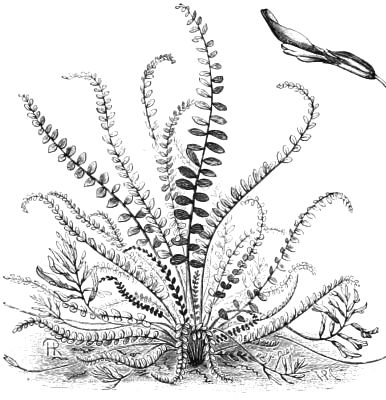
FIG. 188. ASTRAGALUS MONSPESSULANUS, showing Habit and Flower.
A. monspessulanus (Montpelier).* fl. usually purplish, spicate; peduncles longer than the leaves. June. l., leaflets twenty-one to forty-one, ovate or lanceolate, outer ones rather the smallest. Leaves hoary, and plant almost stemless when growing in dry exposed situations; but in rich earth or moist places the leaves are almost glabrous, and the stem becomes elongated. South Europe, 1710. This species is much appreciated, and well deserves a place in all collections. Evergreen trailer. See Fig. 188.
A. narbonensis (Narbonne). fl. yellow, disposed in somewhat globose spikes, on short axillary peduncles. June. l. with oblong-linear leaflets; stipules lanceolate. h. 2ft. to 3ft. Narbonne and Madrid, 1789. An erect hairy perennial.
A. odoratus (sweet-scented). fl. pale yellow, sweet-scented, disposed in spikes; peduncles same length as leaves. June. l. with eleven to fourteen pairs of oblong acute leaflets; stipules connate. Plant erect, rather ascending. h. 6in. Levant, 1820. Perennial.
A. onobrychioides (Onobrychis-like).* fl. beautiful purple, in capitate spikes on long peduncles. July. l. with eight to ten pairs of elliptic leaflets; stipules connate, opposite the leaves. Plant rather diffuse, shrubby at the base, clothed with adpressed hairs. h. 9in. to 12in. Iberia, Persia, &c., 1819. A very handsome perennial species.
A. Onobrychis (Onobrychis). fl. purple; spikes oblong-ovate, pedunculate, longer than the leaves. June. l. with seven to sixteen pairs of oblong leaflets. h. 1½ft., or procumbent. Mountains Southern Europe, 1640. This is an elegant perennial, and ranks among the very best. The varieties, all white flowered, are: alpinus, major, microphyllus and moldavicus, but only the first-named is now in cultivation.
A. pannosus (woolly).* fl. rose-coloured, in compact globose heads, with peduncles shorter than the leaves. July. l. with four, five, to nine pairs of ovate-lanceolate leaflets, thickly coated with long white woolly hairs. h. 6in. to 9in. Siberia. Perennial.
A. ponticus (Pontic). fl. yellow; spikes sessile, almost globose. July. l. oblong, smoothish; stipules lanceolate. Stem rather hairy. h. 2ft. Tauria, 1820. A very showy, erect, border perennial.
A. purpureus (purple). fl. purplish blue, disposed in capitate spikes; peduncles longer than the leaves. June. l., leaflets obovate, bidentate at the apex; stipules connate, opposite the leaves. Plant diffuse, procumbent, rather hairy. h. 3in. to 6in. Provence, 1820. Perennial.
A. sulcatus (furrowed).* fl. pale violet, but with a white keel, tipped with brown; racemes pedunculate, longer than the leaves. July. l. with linear-lanceolate leaflets. Plant erect, glabrous; stem furrowed. h. 2ft. to 3ft. Siberia, 1783. Perennial.
A. Tragacantha (great goat's thorn).* Gum Tragacanth. fl. pale violet, two to five together, axillary, sessile. June. l. with eight to nine pairs of linear hispid leaflets; young stipules connate, clothed with silky hairs; adult ones glabrous; petioles permanent, at length becoming hardened spines. h. 1½ft. to 3ft. Levant, 1640. Evergreen shrub. Tragacanth, a partially soluble gum, was formerly supposed to be furnished by this plant. It is, however, now known that A. Tragacantha yields none. Several species from mountainous regions in Asia Minor, &c., furnish the gum.