THE DICTIONARY OF GARDENING, (continued 4)
Reading edition
A. aurea (yellow).* fl. pale yellow, upright; peduncle very long, erect, spreading. June. l. linear-lanceolate, flat. h. 2ft. 1818.
A. fastigiata (peaked).* fl. white; peduncle very long, spreading. May. l. linear, flattish, longer than the scape. h. 1½ft. 1774.
A. flaccida (weak). fl. pale yellow, with a green keel, drooping, six to eight in a loose raceme; peduncles spreading at right angles. July. l. lanceolate-linear, obliquely bent. h. 2ft. 1791.
A. Nelsoni (Nelson's).* fl., perianth, 1½in. long, ascending, white, with a dull red stripe down the back of each segment; scape stout, 4ft. to 5ft. high. Summer. l. bright green, very concave at the basal part, nearly flat in the upper part, 3ft. to 3½ft. long, l¼in. to 2¼in. broad, at about one-third the way up, whence they are gradually narrowed to an acute point. Natal, 1880. This very handsome species is the best of the genus.
ALBUMEN. The substance under the inner coat of the testa of seeds, surrounding the embryo. It is sometimes absent.
ALBUMINOUS. Furnished with albumen.
ALBURNUM. The white wood of a tree; the younger wood, not choked up by sedimentary deposit, and therefore permeable to fluids.
ALCHEMILLA (from Alkemelyeh, the Arabic name of one of the species). Lady's Mantle. ORD. Rosaceæ. Hardy herbaceous perennials, with corymbose, apetalous flowers; calyx tubular, with the tube rather contracted at the apex. Leaves palmate or lobed. Of very easy culture, in common, but well drained soil. They are well adapted for rockwork and planting near the front of borders. Easily increased by divisions of the roots, and seeds. All here described are hardy, except A. sibbaldiæfolia.
A. alpina (alpine).* fl. greenish, small; corymbose. June. l. digitate; leaflets five to seven, lanceolate-cuneated, obtuse, serrated, clothed with white satiny down beneath. h. 6in. Britain.
A. pubescens (pubescent). fl. greenish; corymbs terminal, crowded, clothed with a coating of long weak hairs. June. l. roundish-reniform, seven-lobed, toothed, silky beneath. h. 6in. to 8in. Caucasus (Higher), 1813.
A. sericea (silky).* fl. greenish, corymbose. June. l. digitate; leaflets seven, lanceolate-obovate, obtuse, connected at the base, serrated at the apex, clothed with satiny down beneath. h. about 6in. Caucasus, 1813. Much larger in every part than A. alpina, to which it is closely allied.
A. Sibbaldiæfolia (Sibbaldia-leaved). fl. white, conglomerate; stem corymbosely many-flowered at the apex. July. l. deeply three-parted, clothed with adpressed pubescence beneath; segments deeply serrated, lateral ones bifid. h. 6in. Mexico, 1823. A greenhouse species, which should be grown in small well-drained pots, with a mixture of leaf soil and sandy loam.
ALDEA. A synonym of Phacelia (which see).
ALDER. See Alnus.
ALETRIS (from aletron, meal; referring to the powdery appearance of the whole plant). The American Star Grass. SYN. Tritonia. ORD. Hæmodoraceæ. Interesting hardy herbaceous perennials, closely allied to the Amaryllids. Perianth half-inferior, tubular; limb spreading or funnel-shaped; stamens inserted at base of perianth segments, filaments flat. They delight in a sunny but damp situation, with peat, leaf mould, and sand, and are slowly increased by division of the roots.
A. aurea (golden).* fl. yellow, bell-shaped. h. 1ft. to 2ft. North America, 1811. Similar in habit to A. farinosa.
A. capensis (Cape). See Veltheimia viridifolia.
A. farinosa (mealy).* fl. white, bell-shaped, in a terminal spiked raceme, upon stems 1½ft. to 2ft. high. l. lanceolate, ribbed. North America, 1768. A pretty species, forming a spreading tuft, and possessing intensely bitter properties.
ALEURITES (from the Greek word signifying floury; all the parts of the plant seeming to be dusted with a farinaceous substance). ORD. Euphorbiaceæ. A handsome stove evergreen tree, with small, white, clustered flowers. Leaves alternate, stalked, exstipulate. Of easy culture in a loamy soil. Ripe cuttings, with their leaves untouched, root readily in sand, under a hand-glass.
A. triloba (three-lobed).* Candleberry Tree. l. three-lobed, 4in. to 8in. long. h. 30ft. to 40ft. Moluccas and South Pacific Islands, 1793.
ALEXANDERS. See Smyrnium.
ALEXANDRIAN LAUREL. See Ruscus racemosus.
ALGAROBA BEAN, or CAROB. See Ceratonia.
ALGAROBIA. Included under Prosopis (which see).
ALHAGI (its Arabian name). ORD. Leguminosæ. Manna Tree. Greenhouse shrubs or sub-shrubs, with simple leaves, and minute stipulas. Flowers few, in clusters. They thrive in pots filled with a mixture of sand, loam, and peat. Young cuttings will root in sand, with a bell glass placed over them, in heat; but by seeds, if they can be procured, sown in a hotbed, is a preferable mode of increasing the plants. They may be placed out of doors during the summer months.
A. camelorum (camels). fl. red, few, disposed in racemes along the peduncles. July. l. lanceolate, obtuse, simple; stipulas minute. Stem herbaceous. h. 1ft. to 2ft. Caucasus, 1816.
A. maurorum (Moors'). fl. purple in the middle, and reddish about the edges, disposed in racemes along the axillary, spinose peduncles. July. l. obovate-oblong, simple; spines strong, and longer than those of the above species. h. 2ft. to 3ft. Egypt, &c. The Manna is a natural exudation from the branches and leaves of this shrub, which takes place only in very hot weather.
ALIBERTIA (in honour of M. Alibert, a celebrated French chemist, author of "Traite des Fievres Attaxiques," wherein he mentions the effects of Peruvian bark). ORD. Cinchonaceæ. A small stove evergreen tree, very ornamental when in flower. Flowers solitary or fascicled, diœcious; corolla leathery, tubular. A mixture of loam and peat is the best soil. Cuttings strike root freely, in a similar kind of soil, under a hand glass, in a moist heat.
A. edulis (edible). fl. cream-coloured, solitary or in fascicles, terminating the branches, almost sessile. June. fr. edible. l. opposite, leathery, oblong, acuminated, shining above, and bearded in the axils of the veins beneath. h. 12ft. Guiana, 1823.
ALICANT SODA. See Salsola.
ALISMA. (from alis, the Celtic word for water). Water Plantain. SYN. Actinocarpus. ORD. Alismaceæ. A genus entirely composed of hardy aquatic species. Flowers three-petalled. Leaves parallel-veined. Increased by division or seeds. The latter should be sown in a pot immersed in water, filled with loam, peat, and sand, and the former root freely in a moist loamy soil. The British species are most easily grown.
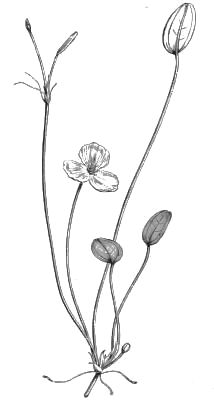
FIG. 56. ALISMA NATANS.
A. natans (floating).* fl. white; peduncles simple. July. l. elliptical-obtuse; stem ones floating, on long stalks, scarcely nerved; those at the base of the plant are long, linear-lanceolate, membranous scales, or abortive root leaves. North Wales and Cumberland, but very rare; abundant in other parts of Europe. See Fig. 56.
A. Plantago (plantain).* fl. delicate pale rose coloured; scape branched upwards. July. l. ovate, acute, all radical, on long stalks; branches all whorled, bracteated, compound. h. 2ft. to 3ft. Britain. A very handsome aquatic for naturalising. See Fig. 57.
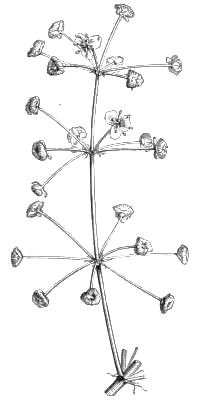
FIG. 57. PORTION OF INFLORESCENCE OF ALISMA PLANTAGO.
A. P. lanceolata (lance-shaped leaves). fl. pure white. July. l. lanceolate. Britain.
A. ranunculoides (ranunculus-like). In general appearance very like the last named species, but smaller. Britain.
ALISMACEÆ. A small order of aquatic or marsh plants, with three-petaled flowers, on leafless scapes, and simple radical leaves. The genera best known are Alisma and Sagittaria.
ALKANET. See Anchusa tinctoria.
ALLAMANDA (named in memory of Dr. Allamand, of Leyden, who first communicated seeds of this genus to Linnæus). ORD. Apocynaceæ. Elegant climbing evergreen stove plants. Peduncles terminal and many-flowered; corolla funnel-shaped, with a narrow tube, gamopetalous, large, inflated, five-cleft at the apex. Leaves verticillate. This genus differs from all others of the same order, in the figure of the corolla. Of comparatively easy culture. To obtain their beauty of foliage and flowers, the shoots should be tied to wires placed within 8in. or 9in. of the glass that forms the roof of the structure in which the plants are growing. Trained in this way, and the shoots allowed to ramble in a somewhat natural manner, the effect, when the plants are in flower, is grander and more pleasing in every respect than when the shoots are tied to a formal trellis, of whatever shape. When thoroughly established, they succeed admirably in a compost of three parts good fibry loam, and one part wood charcoal or coarse river sand, with some rotten cow manure added. When potting the plants, make the fresh compost firm round the old balls of soil, and do not fill the pots too full; leave room for plenty of water, as, when in active growth, they require a liberal daily supply. They must be pruned annually in January or February, cutting the previous year's shoots back to within a joint or two of the old wood. Allamandas should be exposed to the light as much as possible at all seasons of the year. In winter months they require but little water, but the drainage must always be perfect. They are remarkably free from insect attacks of any kind. It may be also observed that the temperature should never fall below 55deg. This genus is easily propagated by cuttings, which will root at any time of the year in a bottom heat of from 70deg. to 80deg. The usual time is, however, in spring, when the old plants are pruned back. Choose the tops of the shoots, retaining two or three joints to each cutting; place these in a compost of sand and peat or leaf mould in equal proportions, singly, in small pots. Press the soil firmly around each cutting, and, when all are inserted, give a good watering, and plunge the pots in the propagating bed. Attend to shading and watering, and in about three weeks' time they will have emitted roots, and started to grow at the tops. The pots should now be raised out of the plunging material, and placed upon the surface thereof, and there allowed to remain two or three weeks longer; when the young roots will have, by this time, filled the little pots, and a shift into the larger ones will be necessary. Return the plants to the propagating bed, but do not plunge them therein. As soon as it is certain that the roots have commenced growth in the fresh soil, pinch the point of each plant that is intended to be grown on a trellis. This will cause the remaining buds to push out fresh shoots; and these, as soon as they have made two joints or whorls of leaves each, should have their points pinched out also. By repotting the plants as often as they fill their pots with roots during the first season of their growth, and pinching the points out of the shoots twice or thrice in the same time, a good foundation will be formed, from which the future specimens will spring. In the case of plants intended to be trained up rafters or pillars, they should not have their points pinched out until they attain to the height where it is desirable they should have more than one shoot, and be repotted as recommended above, for the first year; but, after that, they will require to be repotted only once a year, and this should be done soon after the buds have started to grow afresh in the spring.
A. Aubletii (Aublet's).* fl. yellow, large. June. l. four to five in a whorl, broad-oblong, acuminated, rather hairy beneath. Guiana, 1848.
A. cathartica (purging).* fl. yellow, large. June. l. four in a whorl, obovate, obtuse, acutish, with sub-undulated edges, glabrous. Guiana, 1785. SYN. A. Linnæi.
A. chelsoni (Chelsea).* fl. yellow, large. Summer. This splendid plant is least suited of any for trellis training, from its wood being stiffer and harder, and is therefore best for the roof of a house; it is one of the best kinds for cutting. Garden hybrid.
A. grandiflora (large-flowered).* fl. distinct pale yellow, rather large, very free bloomer. June. Brazil, 1844.
A. Linnæi (Linnæus's). Synonymous with A. cathartica.
A. neriifolia (oleander-leaved).* fl. deep golden yellow, elegantly streaked with orange, between funnel and bell shaped, the tube being wide, 1in. long; panicle many-flowered. June. l. oblong, on short petioles, acuminate. h. 3ft. South America, 1847. Shrub erect, glabrous.
A. nobilis (noble).* fl. bright yellow, rather deeper tinted in the throat, large, full circular form, but without streaks or any other markings. July. l. in whorls of four or of three, tapered to the base, sessile, oblong, abruptly acuminate, membranaceous, hairy on both surfaces, especially beneath and on the midrib. Brazil, 1867. One of the best species.
A. Schottii (Schott's).* fl. yellow, large, throat beautifully striped with rich brown. September. l. oblong, acuminated, four in a whorl, quite glabrous, on both surfaces. h. 10ft. Brazil, 1847. This species is a very strong grower, and suits the roof system best; it is also a very free bloomer.
A. verticillata (whorl-leaved). fl. yellow, large. June. l. usually six in a whorl, ovate-oblong, obtuse, quite glabrous. South America, 1812.
A. violacea (violet). fl. purple. Brazil, 1859.
ALLANTODIA (from allantos, a sausage; in reference to the cylindrical form of the indusium). ORD. Filices. A greenhouse monotypic genus, differing from Asplenium in the dehiscence of the involucre, and it may receive similar treatment to the Spleenworts. Sori dorsal, linear-oblong, attached to the primary veins. Involucre the same shape as the sorus and quite inclosing it, bursting in an irregular line down to the centre.
A. Brunoniana (Brown's).* fronds often 1ft. to 2ft. long, ½ft. to 1ft. broad; pinnæ 3in. to 6in. long, 1in. broad, entire. sori confined to the anterior vein of the first fork. Himalayas, up to 6000ft., &c. SYN. Asplenium javanicum.
ALLARDTIA. See Tillandsia.
ALLEYS. Small walks of various widths, but generally 1½ft. or 2ft. wide, and formed in right lines, parallel to the main walks, or borders, sometimes covered with a thin coat of sand, gravel, or shells, or paved with flints, pebbles, &c. Spaces left between beds of seedling plants are generally meant when alleys are referred to.
ALL-HEAL. See Prunella vulgaris.
ALLIACEOUS. Pertaining to the Garlic family.
ALLIARIA. See Sisymbrium.
ALLIGATOR APPLE. See Anona palustris.
ALLIGATOR PEAR. See Persea gratissima.
ALLIUM (from all, meaning hot or burning; in allusion to the well-known properties of the Onion tribe). Including Porrum, Schœnoprasum. ORD. Liliaceæ. Hardy bulbous plants, with flat or terete radical leaves, and capitate or umbellate flowers, enclosed in a membranous spathe at the summit of a slender, naked, or leafy scape; perianth spreading or campanulate. They are of very easy culture, increasing rapidly by offsets. The little bulbs, which are produced in clusters, may be separated and replanted, in autumn or early spring, about 4in. deep. Seeds are also easily obtainable. These may be sown thinly in light soil, in February or March, where they should remain until the autumn or following spring, when they may be transplanted to their flowering situations. During the growing season, all the attention required will be to keep the plants free of weeds, and place stakes to the tall-growing kinds.
A. acuminatum (taper-pointed).* fl. deep rose, ½in. to 1in. across, in many-flowered umbels. July and August. l. rather shorter than the stems, very narrow, only about a line wide. h. 6in. to 10in. North-West America, 1840.
A. a. rubrum (red). fl. deep red-purple; in other respects like the type. California.
A. ascalonicum (Eschallot). fl. purple; umbels globose; scape rounded. Summer. l. subulate. h. 9in. Palestine, 1546. For culture, see Eschallot.
A. azureum (sky-blue).* fl. deep sky-blue, with a dark line through the middle of each division; umbels dense, globular, longer than the spathes which envelop them before expanding. Summer. l. triangular, from 6in. to 12in. long. h. 1ft. to 2ft. Siberia, 1830. One of the handsomest species grown.
A. Bidwelliæ (Mrs. Bidwell's).* fl. bright rose, about ½in. across, in few-flowered umbels. July. l. narrow, rather longer than the stem. h. 2in. to 3in. Sierra Nevada, 1880. A very charming little species for the rockery.
A. Breweri (Brewer's).* fl. deep rose, nearly or quite 1in. across, in few-flowered umbels. July. l. much longer than the flower-stem, ¼in. or more broad. h. 1in. to 3in. California, 1882.
A. Cepa (common Onion). fl. white; scape ventricose, longer than the leaves. June, July. l. fistular, rounded. h. 3ft. For culture, see Onion.
A. C. aggregatum. Aggregated, Tree, or Potato Onion. See Onion.
A. cœruleum (blue-flowered).* fl. blue, in large compact globular heads. June. h. 8in. Russia, 1840. Very distinct.
A. Douglasii (Douglas'). Synonymous with A. unifolium.
A. Erdelii (Erdel's). fl. white, keeled with green, in compact umbels. h. 6in. Palestine, 1879. A rare but pretty species, and should be planted in a warm position on the rockery.
A. falcifolium (sickle-leaved).* fl. pale rose, ½in. to ¾in. across, in few-flowered umbels. August. l. two in number, thick, broadly linear, falcate. h. 2in. to 3in. North-West America, 1880.
A. falciforme (sickle-formed). Probably a variety of A. unifolium, with pure white flowers, in several-flowered umbels. h. 6in. California, 1882.
A. flavum (golden). fl. yellow, bell-shaped, and somewhat drooping, in pretty umbels; scape leafy at the base. l. round, not hollow, flattish above the base. h. about 1ft. Italy, 1759. A slender species.
A. fragrans. See Nothoscordum.
A. karataviense (Karatavian). fl. white, in dense globose heads. May. l. very broad, flat, glaucous, sometimes variegated. h. 6in. Turkestan, 1878.
A. Macnabianum (MacNab's).* fl. deep magenta, a colour quite unique in this family, in large umbels. l. nearly as long as the stem, channelled, about ¼in. broad. h. 1ft. North America.
A. magicum (enchanting). Synonymous with A. nigrum.
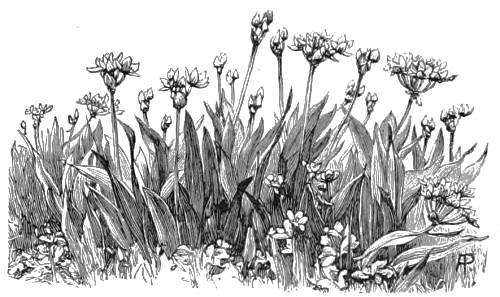
FIG. 58. ALLIUM MOLY.
A. Moly (Moly).* fl. bright yellow, numerous, in compact umbels. Spring. l. few, broadly lanceolate. Stem sub-cylindrical. h. 10in. to 15in. South Europe, 1604. A very old favourite; bright-flowered and very fine in masses. See Fig. 58.
A. Murrayanum (Murray's).* fl. rosy purple, in large heads. l. narrow, longer than the stem. h. 1ft. North America. A good variety of A. acuminatum.
A. mutabile (changeable). fl. white, changing to rose, in many-flowered umbels. July. l. shorter than the stem, narrow, channelled. h. 12in. to 24in. North America, 1824.
A. neapolitanum (Neapolitan).* fl. white, with green stamens, numerous, in a loose umbel, on stems exceeding the leaves in length; pedicels much longer than the flowers. Early summer. l. two or three, sheathing the flower stem, strap-shaped, about 1in. across. h. 15in. to 18in. South Europe, 1823. Probably the most ornamental white-flowered species.
A. nevadense (Sierra Nevada). fl. white, or pale rose, about ½in. across, in several-flowered umbels. July. l. flat, rather longer than the stem, about ¼in. wide. h. 3in. to 6in. Sierra Nevada and Utah, 1882.
A. nigrum (blackish).* fl. dull violet, or whitish, with a green vein, very numerous, in a large umbel. Summer. l. thick, broadly lanceolate, acute, ciliated, toothed at the edges, at first erect and glaucescent, afterwards green and spreading, much shorter than the stem. h. 2½ft. to 3¼ft. South of Europe. Very vigorous and free flowering. SYN. A. magicum.
A. paradoxum (wonderful). fl. white, gracefully pendulous, borne on long footstalks springing from little nests of yellow bulbils. Spring. l. one or two, as long as the scape, linear-lanceolate, acute, keeled, striated, smooth, ¼in. broad, drooping and recurved. h. 9in. to 14in. Siberia, 1823.
A. pedemontanum (Piedmont).* fl. rosy-purple, large, bell-shaped, in large, graceful drooping clusters. July. l. lanceolate, shorter than the stem. Piedmont, 1817. A neat little plant for rockwork, or warm border. One of the handsomest species grown.
A. reticulatum (netted). fl. varying from pink to white. Summer. l. narrow, or almost filiform, shorter than the stem. h. 9in. to 15in. North-West America, 1882. A rare species.
A. r. attenuifolium (attenuate-leaved).* This may be regarded as an extremely handsome white-flowered variety. North-West America.
A. roseum (rose-coloured).* fl. pale lilac-rose, large, in umbels of ten or twelve; stems round, rather longer than the leaves. Summer. l. strap-shaped, channelled, rolled inwards at the top, not hairy. h. 12in. to 16in. South Europe, 1752.
A. sativum (cultivated). Garlic. fl. white; umbel bulbiferous. Summer. l. flat. h. 1½ft. Sicily, 1548. For culture, see Garlic.
A. schœnoprasum (rush-leaved onion). Chives. fl. purple; umbel many-flowered, globose, without bulbils. June and July. l. cylindrical, somewhat tapering towards the point; stem with one leaf, or naked. h. 1ft. England. For cultivation, see Chives.
A. Scorodoprasum. Rocambole; Sand Leek. fl., perianth ⅓in. long, the segments red-purple, with white margins; head loose-flowered, with purple bulbils; scape slender. May to August. l. 6in. to 8in. long, flat, keeled, the edges scabrid. h. 3ft. Europe (Britain), 1596. See also Rocambole.
A. sphærocephalum (globe-headed).* fl. densely packed in a subspherical head; in a bud state the upper ones are reddish-purple, the lower green. June. l. narrow, shorter than the long terete stems. h. 1½ft. to 2½ft. South Europe, 1759.
A. stramineum (straw-coloured). fl. yellow, in dense globular umbels. July. l. narrow, shorter than the stems. h. 1½ft. to 2ft. Siberia.
A. striatum (striated). See Nothoscordum.
A. triquetrum (three-cornered). fl. white, somewhat bell-shaped, with a narrow streak of pure green down each petal, in a loose, slightly drooping umbel, on erect triangular stems shorter than the leaves. Summer. l. green, broadly strap-shaped, keeled in a triangular manner, sometimes very long. h. 12in. to 18in. South Europe, 1789.
A. unifolium (one-leaved). fl. bright rose. July. h. 1ft. to 2ft. California, 1873. A handsome species, from California, resembling A. roseum, but differing from all known species by the circumstance that its bulbs are developed at a distance from each other, and are connected by a thread-like rhizome, ½in. to 1in. long. SYN. A. Douglasii.
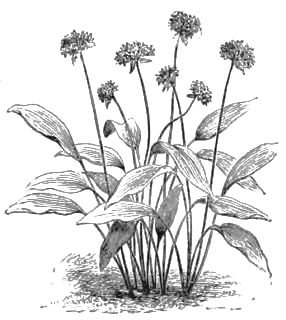
FIG. 59. ALLIUM URSINUM.
A. ursinum (bear). Broad-leaved Garlic; Ramsons. fl. pure white, with acute perianth segments; umbel level at top; scape triangular. Summer. l. one or two, radical, ovate-lanceolate, stalked, large, bright green. h. 1ft. Britain. See Fig. 59.
A. validum (strong). fl. pure white or rose-coloured, in large, rather drooping umbels. Summer. l. ¼in. to ½in. broad, nearly as long as the stem. h. 12in. to 30in. Oregon and California, 1881. A pretty species.
A. Victorialis (Victoria's). fl. greenish-white, in many-flowered, spicate umbels. May. l. broadly ovate-oblong, channelled, shorter than the stem. h. 1½ft. to 2ft. Southern and Eastern Europe, 1739. Conspicuous from its broad leaves. Rare.
ALLOBROGIA. A synonym of Paradisia (which see).
ALLOCHLAMYS. A synonym of Pleuropetalum (which see).
ALLOPHYLLUS. A synonym of Schmidelia (which see).
ALLOPLECTUS (from allos, diverse, and pleco, to plait; the calyx appears as if it was plaited in diverse directions). ORD. Gesneraceæ. Very handsome stove evergreen shrubs. Corolla tubular or club-shaped, straightish; calyx coloured. Leaves opposite, one in each pair smaller than the other, petiolate, fleshy, scattered or decumbent, or erect, the under surface generally reddish; branches opposite. For cultivation, see Gesnera.
A. bicolor (two-coloured). fl. yellow, purple; corolla pilose; pedicels axillary, one-flowered. June. l. ovate, oblong, acuminate, denticulate, pilose above, downy beneath; branches tetragonal. h. 1ft. New Grenada, 1840. Plant erect, rather woody.
A. capitatus (headed). fl. capitate; sepals red, leafy; corolla silky, ventricose above the middle; peduncles axillary. March. l. large, ovate, serrated, downy, reddish beneath. Stem bluntly tetragonal, red. h. 2ft. South America, 1847.
A. dichrous (two-coloured). fl. purple, yellow, axillary, crowded, nearly sessile. l. ovate-lanceolate, quite entire, pubescent. Brazil, 1845. A climber.
A. peltatus (peltate-leaved).* fl. whitish, about 2in. long, in axillary tufts. August. l. opposite, one is 1in. to 2in. long, and the other 6in. to 9in. long, and 2in. wide, oblong, shortly acuminate, rounded, peltate at the base, and raised on stout footstalks, 1in. to 2in. long. h. 1ft. Costa Rica, 1877.
A. repens (creeping). fl. yellow; corolla with curved tube, four lobed; sepals ovate, spotted; peduncles axillary, solitary. February. l. ovate, rather fleshy, serrate, on short petioles. St. Martha, 1845. Plant downy; an evergreen trailer.
A. vittatus (striped). fl., calyx crimson; corolla pale yellow; terminal and fasciculate, surrounded by vivid red foliaceous bracts. l. large, shortly-stalked, broadly-ovate, of a deep velvety green, having a broad greyish-green band down the centre, branching off along the course of the principal veins. Stems erect, fleshy. Peru, 1870.
A. zamorensis (Zamora).* fl. yellow; sepals orange-red. h. 1ft. Columbia, 1875.
ALLOSORUS. See Cryptogramme and Pellæa.
ALLOTMENT GARDENS. A system of assigning small portions of land to be cultivated by labourers after their ordinary day's work.
The following are the most important rules to be carried out; but, should occasion arise, other rules must be made to meet particular cases:—
1. Each Allotment should consist of a rood of land (=¼ acre) to be let yearly at a rent of not more than 10s.
2. The Allotment to be let for one year only, to be re-let to the same occupier, provided his character has been satisfactory during the preceding year.
3. The rent shall be considered due at Michaelmas. If it remains unpaid for one month after that date, the Allotment shall be forfeited.
4. The Allotment to be cultivated solely by spade husbandry, and the same crop shall not be planted on the same part two years in succession.
5. Separate Allotments shall be divided by a space not less than 18in.
6. Any occupier trespassing on his neighbour's Allotment, or in any way interfering or damaging the same, shall not be allowed to hold his Allotment after the expiration of the year.
ALLSPICE. See Calycanthus.
ALLSPICE TREE. See Pimenta.
ALMEIDEA (in honour of J. R. P. de Almeida, a Brazilian, who was of great assistance to St. Hilaire while travelling in Brazil). ORD. Rutaceæ. Stove trees or shrubs with alternate, simple, entire, stalked leaves. Racemes terminal, divided at the apex into compound thyrse-like panicles. The undermentioned species will grow freely in a mixture of loam, sand, and peat. Partly ripened cuttings will root in sand under a hand glass, in heat.
A. rubra (red). fl. pink; petals very blunt; racemes compound. September. l. lanceolate, acute at base. h. 12ft. Brazil, 1849. Evergreen shrub.
ALMOND. See Amygdalus.
ALMOND-LEAVED WILLOW. See Salix triandra.
ALNUS (from al, near, and lan, the bank of a river; general habitat of the genus). The Alder Tree. ORD. Betulaceæ. A genus of deciduous trees and shrubs. Flowers monœcious; barren ones in long drooping autumnal catkins, lasting through the winter; fertile ones, produced in spring, in oval catkins, resembling a fir-cone in shape, the fleshy scales of which become indurated and ligneous as they approach maturity. Leaves stalked, roundish, blunt. Propagated usually by seeds, which are gathered towards the end of October; they require to be well dried, in order that the cones do not become mouldy. The seeds are sprinkled lightly on the ground with the slightest possible covering. Towards the end of the year, the seedlings will be about 10in. high. They are then planted in rows 1½ft. apart, and 6in. from each other, where they may remain for two years, after which they can be placed out in the situations where they are intended to stand. Planting is best done in November or March; and, if it is designed to make a plantation of Alder, the young trees should be put in holes, made with an ordinary garden spade, about 9in. deep, and about 4ft. apart. They are also increased, but rarely, by cuttings, by suckers, and by grafting.
A. cordifolia (heart-shaped-leaved).* fl. greenish-brown. March and April, before the development of the leaves. l. heart-shaped, acuminate, dark green, and shining. h. 15ft. to 50ft. Calabria and Naples, 1820. A large, very distinct, and handsome round-headed tree. It grows rapidly in dry soil, and is one of the most interesting of ornamental trees.
A. firma (firm).* l. oval lanceolate, acuminate, sharply serrated, many-nerved. Japan. One of the most distinct of all the Alders.
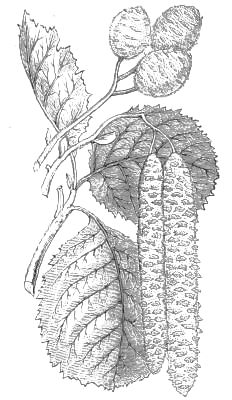
FIG. 60. ALNUS GLUTINOSA, showing Catkins and Fruit.
A. glutinosa (sticky).* barren catkins long, large, and cylindrical, pendent, their footstalks branched. fertile catkins small, ovate, with deep red scales. Spring. l. roundish-cuneiform, obtuse lobed at the margin, and serrated, somewhat glutinous, downy in the axils of the nerves beneath. h. 50ft. to 60ft. Britain. The Alder affects moist and damp situations, and, as it grows quickly, it is a useful tree to plant in bare situations. It is valuable as a nurse to other trees by the sea-side. See Fig. 60.
A. g. aurea (golden).* Foliage golden colour.
A. g. incisa (incised).* Compact form, with leaves quite like those of common hawthorn. SYN. A. g. oxyacanthifolia.
A. g. laciniata (cut).* l. oblong and pinnatifid, with the lobes acute. This has elegant drooping branches and fern-like leaves, and is one of the best.
A. g. oxyacanthifolia (sharp-prickled). Synonymous with A. g. incisa.
A. g. quercifolia (oak-leaved).* l. with a sinuate outline, like that of the common oak. A very distinct form. The variety imperialis (=asplenifolia) slightly differs in its more or less lobed or cut foliage; A. g. variegata is a variegated form.
A. incana (hoary).* l. broadly oval or ovate, rounded at the base, sharply serrate, whitened, and mostly downy beneath. h. 8ft. to 20ft. North Temperate regions. This affects drier situations than our native A. glutinosa.
A. viridis (green). fertile catkins slender stalked, clustered, ovoid. l. round oval or slightly heart-shaped, glutinous and smooth or softly downy beneath, serrate, with very sharp and closely set teeth. Mountainous regions of northern hemisphere.
ALOCASIA (from a, without, and Colocasia). Allied to Colocasia. ORD. Aroideæ. Stove plants of great beauty, often with large and handsomely variegated, usually peltate, leaves, and shortly petiolate glaucous spathes. They are not difficult to grow, with a strong moist heat, and an abundant supply of water to the roots. The soil should consist of fibrous peat, with a little light fibry loam, in large lumps; to this add a good proportion of sphagnum and lumps of charcoal, with plenty of silver sand. Keep the bulbs and soil raised well above the rim of the pots, and finish off with a surfacing of either sphagnum or cocoa-nut fibre. The latter will soon encourage new rootlets. Crock the pot quite two-thirds up with clean, broken potsherds. Water freely when in good growth, and give liquid manure once or twice a week through the growing season. Shade during bright sunshine in the spring and summer months. Increased by seeds and division of the stems or rhizome. Winter temperature, 60deg. to 65deg.; summer, 75deg. to 85deg. See also Caladium and Colocasia.
A. alba (white). fl. white. h. 1½ft. Java, 1854.
A. amabilis (lovely). Synonymous with A. longiloba.
A. chelsonii (Chelsea).* An interesting hybrid between A. cuprea and A. longiloba. l. large, upper surface deep green, glossy and metallic, under side purplish, as in A. cuprea.
A. cucullata (hood-leaved). fl. green, whitish. Spring. h. 2ft. India, 1826.
A. cuprea (coppery).* fl., spathe purplish-red, with short lamina. l. cordate-ovate, peltate, deflexed, 12in. to 18in. long, rich bronze colour, purple beneath. h. 2ft. Borneo, 1860. SYNS. A. metallica, Xanthosoma plumbea.
A. gigantea (gigantic). Synonymous with A. longiloba.
A. guttata (spotted). fl., spathe white, spotted with purple. l. leafstalk also spotted. h. 2½ft. Borneo, 1879.
A. hybrida (hybrid).* A cross between A. Lowii and A. cuprea. l. elliptic in outline, with a very short acuminate point, and very slightly parted at the base, deep olive-tinted green on the upper surface, having stout, well-defined ribs, and the margin of an ivory white; dull purple at the back.
A. illustris (bright). l. ovate-sagittate, rich green, with olive-black patches, deflexed, 1½ft. long. India, 1873.
A. Jenningsii (Jennings's).* l. peltate, cordate-ovate, acuminate, with their blades deflexed from the top of the erect mottled stalks, ground colour green, surface marked with large wedge-shaped blotches of dark brown; veins bright green, 6in. to 8in. long. India, 1867. A very distinct and free growing species.
A. Johnstoni (Johnston's).* l. semi-erect, arrow-shaped, peltate, the front lobe being about 12in. long, and the two back lobes 14in. long and divergent, olive-green, prettily variegated and strikingly veined with bright rosy red. The leafstalks are furnished at intervals with irregular whorls of stiff spines, the points of which are turned upwards. Stem darkly mottled with flesh-coloured bands just above the spines. Solomon Isles, 1875. This plant has quite a unique appearance.
A. Liervalii (Lierval's). l. bright green. Philippines, 1869.
A. longiloba (long-lobed). l. large, sagittate, with the upper part spreading out, green, with silvery veins. h. 4ft. Java, 1864. SYNS. A. amabilis, A. gigantea.
A. Lowii (Low's). fl., spathe white. l. cordate-sagittate, 14in. to 16in. long, peltate, deflexed, olive-green, with thick white ribs, deep purple beneath. Borneo, 1862.
A. macrorhiza (long-rooted). fl. green, whitish. h. 5ft. Polynesia.
A. m. variegata (variegated). l. large, somewhat cordate, with slightly waved margins, bright green, blotched and marbled with white, sometimes nearly quite white; footstalks broadly streaked with pure white. Ceylon. A very striking and effective large growing plant.
A. Marshallii (Marshall's). l. green, with dark blotches, and broad central silvery band. India, 1811.
A. metallica (metallic). Synonymous with A. cuprea.
A. navicularis (boat-shaped spathe). fl., spathe boat-shaped, whitish. h. 1ft. India, 1855.
A. Roezlii. See Caladium marmoratum.
A. scabriuscula (roughish).* fl., spathe entirely white; limb 3in. long, oblong, cuspidate. l. spreading, not deflexed, sagittate, not in the least peltate, deep shining green above, pale green beneath, extreme length 22in. to 31in. h. 4ft. to 4½ft. North-West Borneo, 1878. Although this is not such an ornamental species as A. Lowii, A. Thibautiana, or A. cuprea, it has the merit of being a much larger and bolder plant than either of these, and is one of the largest species in the genus.
A. Sedeni (Seden's).* A hybrid between A. Lowii and A. cuprea. l. oval, cordate, sagittate, deflexed, bronzy green, purple beneath, veins distinct ivory white.
A. Thibautiana (Thibaut's).* l. ovate-acute, deeply cordate; basal lobes rounded and not sharply pointed, deep olive greyish-green, traversed by numerous grey veinlets branching from the midrib, which is greyish-white, purple beneath. Borneo, 1878. This is said to be by far the finest of the genus.
A. variegata (variegated). fl. whitish. l. leafstalk mottled with violet. India, 1854.
A. zebrina (zebra).* l. erect, broadly sagittate, rich dark green borne upon stout footstalks, which are pale green, mottled and striped with zigzag bands of dark green. h. 4ft. or more. Philippine Isles, 1862.
ALOE (from Alloeh, its Arabic name). Allied genera: Apicra, Haworthia, Pachidendron, Phylloma. Including Rhipodendron. ORD. Liliaceæ. This hitherto much confused genus, and its allies, have been completely revised by Mr. J. G. Baker (vide "Journal of the Linnean Society," vol. xxviii. pp. 152-182), to whose account we are indebted for many of the following particulars:—Plant with or without stems; shrubs or (rarely) trees; leaves thick, fleshy, frequently in a rosette; peduncles simple or racemed, endowed with few or many empty bracts. Flowers racemed; pedicels bracteated at base, solitary; perianth-tube straight or slightly recurved; segments elongated; stamens hypogynous, as long as the perianth, or longer. Mr. Baker describes over eighty species, many of which, for various and important reasons, have no claim upon our space. Natives of the Cape of Good Hope, except where otherwise stated. These very interesting and curious plants thrive well in a mixture of open loam and peat, together with a small quantity of well decomposed manure. If old brick rubbish, or any other similar material is mixed with the soil to ensure perfect and rapid drainage, so much the better. Water, especially during winter, must be carefully administered. They thrive in an ordinary greenhouse, and cannot have too much light at any time.
A. abyssinica (Abyssinian).* fl., perianth twelve to fifteen lines long; raceme dense-oblong, 3in. to 4in. long, and 2in. to 3in. broad; lower pedicels nine to twelve lines long; peduncle branched, 1½ft. to 2ft. l. about twenty in a rosette, ensiform, 1½ft. to 2½ft. long, acuminate, green, sometimes spotted, five to six lines thick in middle; back rounded; marginal prickles distant, deltoid, one to two lines long. Stem simple, 1ft. to 2ft. long, 2in. to 3in. in diameter. Abyssinia, 1777. SYN. A. maculata.
A. a. Peacockii (Peacock's). This is a rare variety.
A. africana (African). fl., perianth yellow, fifteen to eighteen lines long; racemes dense, 1ft. in length, 3in. in diameter; peduncle very strong, branched. l. in a dense rosette, ensiform, 1½ft. to 2ft. long, 2½in. to 3in. broad, slowly narrowing from base to the apex, channelled above the middle, where it is four to five lines thick; marginal prickles close, one and a half to two lines long. Stem simple, when fully grown, 20ft.
A. albispina (white-spined).* fl., perianth red, 1½in. long; raceme dense, nearly 1ft. long, 4in. broad; lower pedicels fifteen to eighteen lines long; peduncles simple, 1½ft. l. loosely disposed, lanceolate, ascending, 6in. to 8in. long, 2in. broad, green, without spots or lines; face concave upwards; middle three to four lines thick; back sparingly tubercled; marginal prickles white, horny, two lines long. Stem simple, short, 1in. to 1½in. in diameter. 1796.
A. albocincta (white-banded).* fl., perianth brilliant red, ten to twelve lines long; racemes twenty or more, shortly capitate, 2in. to 2½in. in diameter when expanded; pedicels ascending, six to nine lines long; scape stout, branched, 1½ft. to 2ft. l. twelve to twenty in a dense rosette, outer ones recurved, lanceolate, 1½ft. to 2ft. long, 4in. to 6in. broad, glaucous, obscurely lined and spotted; middle three to four lines thick; margin red or white tinted. Stems in old specimens, 1ft. to 2ft. long, 3in. to 4in. in diameter. SYNS. A. Hanburyana, A. paniculata, and A. striata.
A. arborescens (tree-like).* fl., perianth red, fifteen to eighteen lines long; raceme dense, about 1ft.; pedicels ascending, twelve to fifteen lines long; peduncles strong, 1½ft., simple or branched. l. (rosette 3ft. to 4ft. in diameter) dense, aggregate, ensiform, 1½ft. to 2ft.; base 2in. broad, thence to apex attenuated, acuminated, green, rather glaucous, without spots or lines; middle three to four lines long; base five to six lines thick; upper surface beyond the base channelled; marginal prickles close, one and a half to two lines long, horny. Stem simple, finally 10ft. to 12ft. long, 2in. to 3in. in diameter. 1700.
A. a. frutescens (shrubby). Dwarfer. l. often loose, and shorter, intensely glaucous; peduncle simple. Stem slender, sometimes racemosed.
A. aristata (awned). fl., perianth red, fourteen to sixteen lines long; raceme simple, loose, 4in. to 6in. long, and about 4in. broad; pedicels sub-patent, thirteen to eighteen lines long; scape simple, 1ft. l. about fifty in a dense rosette, ascending, lanceolate, 3in. to 4in. long, six to eight lines broad, without spots or lines; face flat, sparingly tubercled; middle one and a half lines thick; back copiously tubercled; apex bearded with a pellucid awn; marginal teeth diffuse, white, half line long. 1824.
A. Bainesii (Baines').* fl., perianth fifteen to sixteen lines long, yellowish red; raceme simple, dense, oblong, 3½in. to 4in. in diameter when expanded; pedicels thick, two to three lines long; peduncles upright, strong, eight to nine lines in diameter. l. closely packed at the top of the branch, ensiform, 1ft. to 1½ft. long, 2in. to 3in. in diameter, green, spotted, deeply channelled, recurved; middle two to three lines thick; marginal prickles pale, rather distant, one to one and a half lines long. Arborescent, branched. h. 40ft. to 60ft.; trunk 4ft. to 5ft. in diameter. SYNS. A. Barberæ, A. Zeyheri.
A. barbadensis (Barbadoes). Synonymous with A. vera.
A. Barberæ (Barber's). Synonymous with A. Bainesii.
A. brevifolia (short-leaved).* fl., perianth red, fifteen to eighteen lines long; raceme dense, 6in. long, 2½in. to 3in. in diameter; pedicels upright, six to twelve lines long; peduncles simple, hardly 1ft. long. l. thirty to forty in a dense rosette, lanceolate, 3in. to 4in. long, and 1in. broad at the base, glaucous, without spots or lines; face unarmed, below swollen or flat; middle three to four lines thick; back convex, sparingly tubercled; marginal teeth whitish, one to one and a half lines long. Stem short, simple. SYN. A. prolifera.
A. b. depressa (depressed). fl. somewhat larger; peduncles 1½ft. to 2ft. long. l. 6in. long; bottom 1½in. to 2in. broad; face sometimes sparingly tubercled.
A. cæsia (bluish-grey).* fl., perianth red, fifteen to sixteen lines long; racemes dense, nearly 1ft. long, 2in. to 3in. in diameter; pedicels twelve to fifteen lines long; scape simple, 6in. l. rather dense, lanceolate acuminate, 1ft. to 1½ft.; bottom 2in. to 3in. broad, intensely glaucous, without spot or lines, slightly channelled upwards; middle 3in. to 4in. thick; marginal prickles red, one to one and a half lines long. Stem simple, finally, in old specimens, 12ft. to 14ft. 1815.
A. Candollei (De Candolle's). A mere form of A. humilis.
A. chinensis (Chinese). fl., perianth yellow, 1in. long; raceme loose, simple, 6in. to 8in. long, and 2in. broad; pedicels one and a half to two lines long; peduncle simple, 6in. to 12in. l. fifteen to twenty in a dense rosette, ensiform, 9in. to 12in. long, 1½in. broad at the bottom, pale green, not lined; base nearly flat; middle three to four lines thick; upper surface channelled; marginal prickles distant, pale, one to one and a half lines long. Stem short, simple. China, 1817.
A. ciliata (ciliated).* fl., perianth brilliant red, twelve to fifteen lines long; raceme simple, loose, 2in. to 4in. long; pedicels three to four lines long; peduncles slender, simple. l. linear, widely spreading, amplexicaul, green, 4in. to 6in. long; base six to nine lines broad, slowly narrowing towards the apex, without spots or lines; middle one line thick; marginal teeth minute, white. Stems long, sarmentose; branches three to four lines in diameter; internodes six to twelve lines long, obscurely striated with green. 1826.
A. Commelyni (Commelin's). A mere form of A. mitræformis.
A. consobrina (related). fl., perianth yellowish red, twelve to fifteen lines long; raceme rather loose, oblong, cylindrical, 3in. to 4in. long, and 2in. in diameter; pedicels three to four lines long; scape 1½ft., slender, branched. l. loosely disposed, ensiform, 6in. to 8in. long, and 1in. broad, green, spotted white; face channelled; middle three lines thick; marginal prickles minute, brownish; rosette 10in. to 12in. (sometimes 2ft.) in diameter; upper leaves ascending; central ones spreading half open; lower ones deflexed. Stem 2ft., simple, 1in. in diameter. South Africa, 1845.
A. Cooperi (Cooper's).* fl., perianth fifteen to eighteen lines long; raceme close, 3in. to 6in. long, and 3in. to 4in. in diameter; lower pedicels 1in. to 2in. long; scape simple, 1½ft. to 2ft. l. when mature, 8in. to 10in. long, distichous, falcate, lined; outer ones 1½ft. to 2ft., above the base six to eight lines broad, greenish, deeply channelled, sparingly spotted; middle one and a half to two lines thick; marginal teeth minute, close, white. Plant stemless. Natal, 1862. SYN. A. Schmidtiana.
A. dichotoma (two-branched).* Quiver-tree. fl., perianth oblong, ten to twelve lines long; raceme loose, 2in. to 4in. long, and 2in. in diameter; pedicels three to four lines long; peduncles stout, branched. l. closely packed, at the top of the branch, lanceolate, 8in. to 12in. long; bottom twelve to fifteen lines broad, glaucous, without spots or lines, slightly channelled above the base; middle three to four lines thick, narrow-margined with white; marginal prickles minute, pale. Trunk short, sometimes 3ft. to 4ft. in diameter. h. 20ft. to 30ft. 1781. Arborescent, branched.
A. distans (distant).* fl., perianth pale red, fifteen to eighteen lines long; raceme densely capitate, 3in. to 4in. in diameter; lower pedicels twelve to fifteen lines long; peduncles 1½ft., usually simple. l. ascending, loosely disposed, ovate-lanceolate, 3in. to 5in. long, and 1½in. to 2in. broad, green, slightly glaucous, without spots and lines; face concave; middle three to four lines thick; back sparingly tubercled; marginal prickles close, white, horny, one to one and a half lines long. Stem short, simple, 1in. in diameter; internodes pale, striated green. 1732.
A. glauca (milky-green).* fl., perianth pale red, fifteen to sixteen lines long; peduncles simple, 1ft. to 1½ft. long, 3½in. to 4in. in diameter; pedicels 1in. to 1½in. long. l. thirty to forty in a dense rosette, lanceolate, 6in. to 8in. long; at the base 1½in. to 2in. broad, slowly narrowing towards the apex, intensely glaucous, spotless, obscurely lined; middle three to four lines thick; face above the base slightly concave; back tubercled at apex; marginal teeth spreading, brownish, one to one and a half lines long. Stem simple, at length, about 1ft., 1½in. to 2in. in diameter. 1731.
A. gracilis (graceful). fl., perianth yellow, straight, fourteen to sixteen lines long; raceme densely packed, simple, 2in. to 3in.; pedicels three to four lines long; peduncle simple, 6in. to 9in. long, two-edged at the base. l. loosely disposed, spreading, 6in. to 10in. long; base ten to twelve lines broad, ensiform, acuminated, glaucous, spotless and without lines; face slightly channelled; back rounded; marginal prickles close, minute. Stem leafy, simple. 1822.
A. Greenii (Green's).* fl., perianth pale red, fourteen to fifteen lines long; raceme oblong, 4in. to 8in. long, and 3in. in diameter; lower pedicels five to six lines long; scape 2ft. long. l. in a dense rosette, lanceolate, 15in. to 18in. long; bottom 2½in. to 3in. broad, slowly narrowing from middle to the apex; middle three to four lines thick; face flat, shining green, obscurely lined and spotted white; marginal prickles spreading, one and a half to two lines long, horny. Stem short, simple, 1½in. in diameter. South Africa, 1875.
A. Hanburyana (Hanbury's). Synonymous with A. albocincta.
A. humilis (humble).* fl., perianth brilliant red, eighteen lines long; raceme loose, simple, 6in. long, and 2in. to 2½in. in diameter; pedicels nine to twelve lines long; peduncles about 1ft. l. thirty to forty in a dense rosette, ascending, lanceolate, acuminate, 3in. to 4in. long, six to eight lines broad, glaucous green, obscurely lined; face slightly concave above, sparingly tubercled; middle three lines thick; back convex; marginal prickles pale, one line long. Plant stemless. 1731.
A. h. acuminata (taper-pointed). l. ovate-lanceolate, 4in. to 5in. long, fifteen to eighteen lines broad; marginal prickles pale, two to two and a half lines long. A. incurva, A. suberecta, and A. subtuberculata, of Haworth; A. Candollei, and A. macilenta, of Baker, are mere forms of the foregoing species.
A. incurva (incurved). A mere form of A. humilis.
A. latifolia (broad-leaved).* fl., perianth brilliant golden scarlet, fifteen to eighteen lines long; raceme dense, corymbose, terminal, 4in. to 5in. long and wide; lower pedicels 1½in. to 2in. long; peduncle robust, 2ft., often branched. l. twelve to twenty in a dense rosette, ovate-lanceolate, 6in. long, 2½in. to 3½in. broad at bottom, slowly narrowing from below the middle upwards, green, not lined, but copiously spotted white; middle three to four lines thick; marginal prickles one and a half to two lines long, horny, brownish. Stem at length, 1ft. to 2ft., 1½in. to 2in. in diameter, simple. 1795.
A. lineata (line-marked).* fl., perianth red, fifteen to eighteen lines long; raceme dense, 6in.; pedicels hardly perpendicular, fifteen to eighteen lines long; scape simple, 1ft. l. in a dense rosette, lanceolate, 6in. long, 2in. broad at base, narrowing slowly from thence to the apex, pale green, spotless, lined; middle three lines thick, channelled upwards on both sides, unarmed; marginal teeth numerous, red, one and a half to two lines long. Stem finally 6in. to 1ft., simple, 2in. in diameter. 1789.
A. macilenta (thin). A mere form of A. humilis.
A. macracantha (long-spined). fl. unknown. l. fifteen to twenty in a dense rosette, lanceolate, 15in. to 20in. long, and 3in. to 4in. broad at the bottom, slightly narrowed from middle to apex; middle four lines thick; face flat, green, obscurely lined, spotted; marginal prickles horny, three to four lines long. Stem simple, 2ft. to 3ft., 1½in. to 2in. in diameter. South Africa, 1862.
A. macrocarpa (large-fruited).* fl., perianth club-shaped, brilliant red, fifteen to sixteen lines long; raceme loose, terminal, 6in. long, and 2½in. to 3in. in diameter; lower pedicels ½in. long; peduncles 2ft. l. twelve to twenty in a dense rosette, ovate-lanceolate, less than 1ft. long; bottom 3in. to 4in. broad; top channelled; middle three to four lines thick, green, copiously spotted; marginal prickles spreading, half line long. Stem short, simple. Abyssinia, 1870.
A. maculata (spotted). Synonymous with A. abyssinica.
A. margaritifera (pearl-bearing). See Haworthia margaritifera.
A. mitræformis (mitre-shaped).* fl., perianth brilliant red, eighteen to twenty-one lines long; raceme dense, corymbose, 4in. to 6in. long, and nearly as much in diameter; pedicels ascending; lower ones fifteen to eighteen lines long; peduncles strong, 1½ft., sometimes branched. l. rather loosely disposed, ascending, lanceolate, about 1ft. long, 2in. to 3in. broad; green, slightly glaucous, without spots or lines; face concave; middle three to four lines thick; back convex, sparingly tubercled; apex horny, pungent; marginal prickles rather close, pale, one to one and a half lines long. Stem finally 3ft. to 4ft., simple, 1in. to 2in. in diameter.
A. m. flavispina (yellow-spined). Differs from the type in having narrower and more lanceolate leaves, and yellow spines. A. Commelyni, A. spinulosa, A. pachyphylla, and A. xanthacantha, are also forms of this species.
A. myriacantha (many-spined). fl., perianth pale red, eight to nine lines long; racemes densely capitate, 2in. in diameter; pedicels four to six lines long; peduncles slender, simple, 1ft. l. ten to twelve, falcate, linear, 5in. to 6in. long, four to five lines broad, green, glaucous; face deeply channelled; back convex, spotted white; marginal teeth numerous, white. Plant stemless. 1823.
A. nobilis (noble).* fl., perianth red, fifteen to eighteen lines long; raceme dense, 6 or more inches long, 4in. broad; lower pedicels 1½in. to 2in. long; peduncles simple, 1½ft. l. rather loosely disposed, lanceolate, 9in. to 12in. long, 2¼in. to 4in. broad; face green, without spots or lines, concave above the base; middle three to four lines thick; apex rather pungent; back prickly upwards; marginal prickles rather close, one and a half to two lines long, horny. Stem simple, at length 3ft. to 4ft. high, 1½in. to 2in. in diameter. 1800.
A. pachyphylla (thick-leaved). A mere form of A. mitræformis.
A. paniculata (panicled). Synonymous with A. albocincta.
A. Perryi (Perry's).* fl., perianth greenish, nine to ten lines long; raceme dense, 3in. to 4in. long; pedicels three to four lines long; inflorescence 1½ft. long, commonly two-headed. l. in a rosette, lanceolate, 7in. to 8in. long, and 2½in. broad, from below the middle to the apex narrowed, pale glaucous green, spotless, obscurely lined, channelled above the base; middle three to four lines thick; marginal teeth close, horny, one line long. Stem simple, 1in. in diameter. Socotra, 1879.
A. prolifera (proliferous). Synonymous with A. brevifolia.
A. purpurascens (purplish). fl., perianth reddish, twelve to fifteen lines long; raceme dense, 6in. to 9in. long, and about 3in. in diameter; pedicels nine to twelve lines long; scape strong, simple, 1½ft. to 2ft. l. forty to fifty in a dense rosette, 1ft. to 1½ft. long, ensiform, 2in. broad at the base, slowly narrowed towards the apex, green; base flat; middle three lines thick, slightly channelled upwards, sometimes spotted; marginal prickles small, white. Stem 2ft. to 3ft., sometimes forked. 1789.
A. rhodocincta (red-margined), of gardens, is probably a form of A. albocincta.
A. saponaria (soapy).* fl., perianth brilliant red, eighteen to twenty-one lines long; raceme dense, corymbose, 3in. to 4in. long and wide; lower pedicels 1½in. to 2in. long; scape 1ft. to 2ft., simple, or sparingly branched. l. twelve to twenty in a dense rosette, lanceolate, 9in. to 12in. long, eighteen to twenty-four lines broad, narrowed from below the middle upwards; middle three to four lines broad; face flat at bottom; back swollen, green, copiously spotted, distinctly lined; marginal prickles adjoining, horny, one and a half to two lines long. Stem short, simple, 1½in. to 2in. in diameter. 1727.
A. Schimperi (Schimper's).* fl., perianth bright red, eighteen to twenty-one lines long; racemes densely corymbose, 4in. in diameter; pedicels twelve to fifteen lines long; scape strong, 3ft. long, strongly branched above. l. twenty in a dense rosette, oblong-lanceolate, about 1ft. long, 4in. broad, glaucous green, lined, sometimes spotted, three to four lines thick at middle, above which they are channelled; teeth minute, spreading. Stem short, simple. Abyssinia, 1876.
A. Schmidtiana (Schmidt's). Synonymous with A. Cooperi.
A. serra (saw). fl., perianth brilliant red, eighteen lines long; raceme simple, dense, 6in. long or more, 3in. to 4in. in diameter; pedicels six to twelve lines long; scape simple, 1½ft. to 2ft. l. thirty to forty in a dense rosette, lanceolate, 3in. to 5in. long, twelve to eighteen lines broad below, without spots and lines; base swollen, concave towards the apex; middle three to four lines thick, sparingly tubercled; marginal prickles close, one to one and a half lines long. Plant shortly stemmed. 1818.
A. serratula (finely-toothed).* fl., perianth red, fifteen to eighteen lines long; raceme rather dense, 6in. long; pedicels six to nine lines long; peduncles simple, about 1ft. l. twelve to twenty in a dense rosette, lanceolate, 6in. to 9in. long; bottom 1½in. to 2¼in. broad, pale green; face below the top flat or slightly concave, obscurely lined, spotted; margin minutely denticulated. Stem simple, finally 1ft. to 2ft. high, 1½in. to 2in. in diameter. 1789.
A. spinulosa (spiny). A mere form of A. mitræformis.
A. striata (striated). Synonymous with A. albocincta.
A. striatula (slightly striped).* fl., perianth yellow, twelve to fifteen lines long; raceme oblong, rather dense, simple, 3in. to 6in. long, and 2in. in diameter; pedicels short; peduncles simple, nearly 1ft. l. linear, spreading, green, 6in. to 9in. long; base not dilated, six to eight lines broad, above the base upwards narrowed, slightly channelled; middle one line thick; marginal prickles deltoid. Stem long, sarmentose; floral branches three to six lines in diameter; internodes 6in. to 12in. long. 1823.
A. suberecta (slightly erect). A mere form of A. humilis.
A. subtuberculata (slightly knobbed). A mere form of A. humilis.
A. succotrina (Socotrine).* fl., perianth reddish, fifteen lines long; raceme dense, about 1ft. long, 2½in. to 3in. in diameter; lower pedicels nine to twelve lines long; peduncles simple, 1½ft. l. thirty to forty in a dense rosette, ensiform, acuminate, falcate, 1½ft. to 2ft. long; base 2in.; middle 1in. broad, green, slightly glaucous, sometimes spotted, slightly channelled upwards; marginal prickles pale, one line long. Stem 3ft. to 5ft., often forked. Isle of Socotra. 1731.
A. tenuior (thinned). fl., perianth pale yellow, five to six lines long; racemes rather loose, simple, oblong, nearly 1ft. 2in. in diameter; pedicels three to four lines long; peduncles slender, simple, 4in. to 8in. l. loose, linear, 5in. to 8in. long, slowly narrowing from middle towards apex, green, spotless, slightly channelled; middle one line thick; marginal prickles minute, pale. Stem long, sarmentose. 1821.
A. tricolor (three-coloured).* fl., perianth coral red, fleshy; raceme loose, oblong, 3in. to 4in. long, and 2in. broad; pedicels ascending, three to four lines long; scape 1½ft. long, glaucous purple; panicle deltoid. l. twelve to sixteen in a close rosette, lanceolate, 5in. to 6in. long, 1½in. to 2in. broad at bottom, slowly narrowing from below the middle to apex; middle five to six lines thick; back rounded; face slightly swollen, copiously spotted, not lined; marginal prickles close, spreading, about one line long. Stem short, simple. South Africa, 1875.
A. variegata (variegated).* fl., perianth reddish, fifteen to sixteen lines long; raceme simple, loose, 3in. to 4in. long and about 3in. in diameter; pedicels three to four lines long; scape simple, tapering, 6in. to 8in. l. close, erecto-patent, lanceolate, 4in. to 5in. long, 1in. broad; face concave; back keeled, bright green, copiously spotted grey on both sides; margin whitish, denticulated. 1790. This is the variegated Aloe so frequently seen in cottage windows.
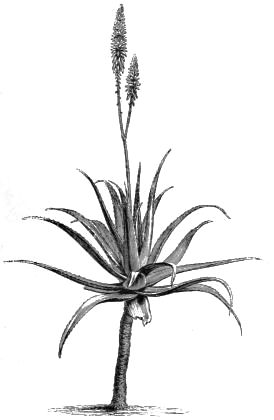
FIG. 61. ALOE VERA.
A. vera (true).* fl., perianth yellow, cylindrical, ¾in. to 1in. long; raceme dense, 6in. to 12in. long; scape strong, 2ft. to 3ft. long, simple or branched. l. ensiform, dense, aggregate, 2in. to 4in. broad, narrowing from the base to apex, pale green; middle about ½in. thick; face channelled above the base; marginal prickles subdistant, deltoid, horny. Stem rarely more than 1ft. or 2ft. 1596. SYNS. A. barbadensis, A. vulgaris. See Fig. 61.
A. vulgaris (common). Synonymous with A. vera.
A. xanthacantha (yellow-spined). A mere form of A. mitræformis.
A. Zeyheri (Zeyher's). A garden synonym of A. Bainesii.
ALOMIA (from a, not, and loma, a fringe). ORD. Compositæ. Allied to Eupatoria. An ornamental half-hardy evergreen plant. Grows freely in sandy loam, and may be propagated by cuttings.
A. ageratoides (ageratum-like). fl.-heads white, many flowered; involucrum campanulate, imbricate; scales narrow, acute; receptacle naked, convex. July. l. opposite, or upper ones alternate, petiolate, denticulated. h. 1½ft. New Spain, 1824.
ALONA (primitive name, Nolana—letters transposed; from nola, a little bell, in allusion to the shape of the flowers). ORD. Nolanaceæ. A genus of pretty evergreen shrubs closely allied to Nolana, but differing principally in having several ovaries from one to six-celled, whereas Nolana has five four-celled ovaries. Leaves fasciculate; stems woody. They require ordinary greenhouse treatment, in a peat and loam compost. Cuttings root freely in sandy loam, with a very gentle bottom heat, in about a fortnight.
A. cœlestis (sky-blue).* fl. pale blue, very large, axillary, solitary; peduncle elongated. July. l. terete, fascicled; plant nearly glabrous. h. 2ft. Chili, 1843. This pretty species is an excellent one for growing out-of-doors during summer months.
ALONSOA (in honour of Z. Alonso, formerly Spanish secretary for Santa Fe de Bogota). ORD. Scrophularineæ. A genus of very pretty little half-hardy shrubs, herbaceous perennials, or annuals, with axillary, sub-racemose flowers, which are resupinate, with a sub-rotate five-cleft limb. Leaves opposite, or ternately whorled. They will grow freely in light rich soil; and are readily increased by cuttings in August or March, which should be placed in sandy soil in gentle heat, or by seeds sown in March. The herbaceous species may be treated as outdoor summer annuals, and should be raised in a little heat, and planted out early in May.
A. albiflora (white-flowered).* fl. pure white, with yellow eye, in long terminal spikes. h. 1½ft. to 2ft. Mexico, 1877. This is recommended for pot culture, as in the conservatory it will provide a succession of flowers throughout the autumn and winter.
A. caulialata (wing-stemmed). fl. scarlet, racemose. June. l. ovate, acute, serrated. Stems and branches quadrangular, winged. h. 1ft. Peru, 1823. Half-hardy, herbaceous.
A. incisifolia (cut-leaved).* fl. scarlet; peduncles long, alternate, disposed in terminal racemes. May to October. l. opposite, ovate, acute, deeply toothed, or serrate. h. 1ft. to 2ft. Chili, 1795. Glabrous greenhouse shrub. SYN. Hemimeris urticifolia.
A. linearis (linear-leaved). fl. scarlet, with a dark bottom, like most of the species. May to October. l. opposite, or three in a whorl, linear, entire or remotely denticulated; young leaves fascicled in the axils of the old ones. h. 1ft. to 2ft. Peru, 1790. Greenhouse shrub. SYN. Hemimeris coccinea.
A. linifolia (flax-leaved).* fl. scarlet. h. 1ft. to 1½ft. New Holland. This is an elegant little annual, forming symmetrical, graceful, and very free flowering plants, either for pot or outdoor culture.
A. Matthewsii (Matthew's). fl. scarlet, in loose, terminal racemes. July. l. lanceolate, toothed, about 1in. long. Stem slender, quadrangular. h. 1ft. Peru, 1871. Greenhouse shrub.
A. myrtifolia (myrtle-leaved). fl. scarlet, very large. New and pretty species.
A. Warscewiczii (Warscewicz's).* fl. rosy scarlet. h. 1½ft. Chili, 1858. This is probably a herbaceous variety of A. incisifolia, and one of the best annuals.
ALOYSIA (in honour of Maria Louisa, mother of Ferdinand VII., King of Spain). Sweet-scented Verbena. ORD. Verbenaceæ. This genus is nearly allied to Verbena, which see for generic characters. A greenhouse deciduous shrub, with a very fine perfume and graceful habit. The most satisfactory plan of culture is to obtain well-grown thrifty young plants in spring, and grow them on for the season. As the wood ripens, give less water until they are at rest, when it must be nearly withheld. About the end of January, bring into the light and warmth, and water thoroughly. As soon as the plants break, cut back to three or four eyes; and when the young shoots are about an inch long, transfer into rich sandy soil, using pots a size or two smaller than those they were in before. When the pots are full of roots, transfer to those that are to hold the plants for the season. By this mode of culture, good plants are to be maintained for any length of time. Aloysias form excellent pillar subjects for either a cold greenhouse, or out-of-doors, in which latter situation they thrive remarkably well, but require thorough protection, with straw bands or mats, from November until March, and afterwards at night, until danger from severe frosts has passed. They require no summer training, their young growth being continually cut off for the many purposes of decoration to which they are applied, and to which they are so well adapted. They are easily increased by young cuttings in spring, which should be placed in sandy soil and gentle heat, when they will root in about three weeks.
A. citriodora (lemon-scented).* fl. whitish or lilac, very small, in terminal panicles. August. l. pale green, lanceolate, agreeably scented, arranged in whorls of threes; branches slender. Chili, 1781. SYNS. Lippia citriodora, Verbena triphylla.
ALPINE GARDEN. A very interesting style of gardening, which succeeds best by imitating Nature as closely as possible. The situation may be an open or a sheltered one. In building a Rock or Alpine Garden, it should be so arranged that all aspects are secured—shady and sunny—fully or in degree only. Pockets and crevices of various sizes may be made, and filled with soil suitable for the subjects to be planted therein, each one having a direct connection with the bulk of the soil; and the constructing material should be arranged with a gentle fall, so that moisture drains towards rather than from the roots. Alpine plants, as a rule, flourish better on a properly constructed rockery than if placed in any other position, because thorough drainage is effected, and the long and fine roots can run down in the crevices, where the soil is cool and moist. Although most alpine plants are naturally exposed to the full action of sun and wind, they should be placed out in early autumn, or early spring, so as to become thoroughly established before the approach of scorching summer weather. Failing materials necessary for the construction of a rockery, many alpines are easily grown in the ordinary border, in a naturally or artificially well drained situation. Excavate to the depth of 18in., put in a layer of stones, broken bricks, &c., 6in. deep; fill up with rich fibrous loam and leaf mould, adding sufficient sand to keep the soil porous. When the desired subjects are firmly planted, cover the surface with small gravel or stone chippings, which, while allowing the rain to penetrate the soil, effectually checks evaporation, and keeps it moist and cool, as well as giving the appearance of rocky débris. The effect will be better if the surface is slightly undulated.
ALPINE ROSE. See Rhododendron ferrugineum.
ALPINIA (in honour of Prosper Alpinus, an Italian botanist). ORD. Zingiberaceæ. A rather large genus of stove herbaceous perennials, with considerable grace and beauty. Flowers disposed in terminal spikes. Leaves lanceolate, smooth, even, entire, sheathed at the base, and having transverse veins. Roots fleshy, branched, having much of the smell and taste of ginger. The soil can hardly be too rich for the successful culture of these plants. A mixture of equal parts loam, peat, leaf mould, or thoroughly rotted hotbed manure, freely mixed with sharp sand or fine charcoal dust, forms an excellent compost. During the growing season, a top dressing of rotten dung, and a frequent application of weak manure water, prove excellent stimulants. They grow rapidly and consume a great deal of food in the production of so much stem and so many leaves. Unless the former is vigorous and of considerable thickness, it will fail to be crowned with spikes of flower. Alpinias require a high temperature, a rich, light soil, abundance of water, and not a little space, to grow them well. Soon after flowering, the plants will assume the yellow leaf, when water may be gradually withheld; but no attempt should be made to dry them off too severely, even after the stems die down. Nor must they be stored when at rest in a low temperature; in fact, they require as much heat to preserve them in health when resting as at any other time. The best time to divide the plants is after the young shoots have made an inch of growth in spring.
A. albo-lineata (white-lined).* l. elliptic lanceolate, pale green, marked with oblique broad bands of white. h. 3ft. to 4ft. New Guinea, 1880.
A. mutica (beardless). fl. in pairs on a spike-like raceme; calyx white; corolla duplex, consisting of three outer oblong white segments; upper lobe concave and projecting, broad; lip large, bright yellow, veined with crimson; mouth finely crispulate at the edge. Borneo, 1882. A very handsome species.
A. nutans (nodding).* fl. pink, sweetly-scented; racemes drooping. May. l. lanceolate, smooth, even, entire. h. 13ft. India, 1792. This species looks best in considerable masses, even larger than those shown in the illustration, grown in large pots or tubs, or planted out in borders of tropical houses. It should on no account be severely divided. See Fig. 62.
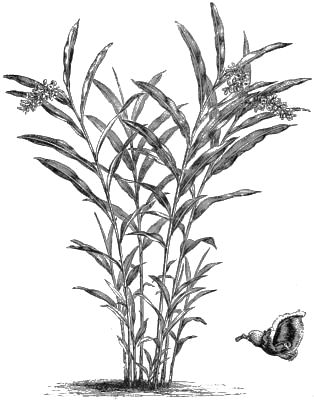
FIG. 62. ALPINIA NUTANS, showing Form of Individual Flower.
A. vittata (striped).* l. 6in. to 8in. long, elliptic lanceolate, tapering to a long fine point, and also narrowed gradually towards the sheathing base, pale green, marked by broad stripes of dark green and creamy white, running off from the midrib in divergent lines, corresponding to the venation. South Sea Islands. See Fig. 63, for which we are indebted to Mr. Bull.
ALSIKE. See Trifolium hybridum.
ALSODEIA (from alsodes, leafy; plants thickly beset with leaves). ORD. Violarieæ. Ornamental evergreen stove shrubs. Flowers small, whitish, racemose; petals equal; racemes axillary and terminal; pedicels bracteate jointed. Leaves usually alternate, feather-nerved; stipules small, deciduous. They thrive best in a mixture of loam and sand, and young cuttings root readily under a bell glass if planted in sand, in heat.
A. latifolia (broad-leaved).* fl. on dense, glabrous racemes. l. ovate, obtusely acuminated. h. 6ft. Madagascar, 1823.
A. pauciflora (few-flowered). fl. few, somewhat corymbose; pedicels reflexed. l. wedge-shaped, on short footstalks. h. 4ft. Madagascar, 1824.
ALSOPHILA (from alsos, a grove, and phileo, to love; in reference to the situation which they affect in Nature). ORD. Filices. A magnificent genus of tropical and temperate tree ferns. Sori globose, dorsal, on a vein or in the forking of a vein; receptacle mostly elevated, frequently villous; involucre none. The species of this genus require an abundant supply of water, particularly in summer, and the young fronds must be carefully shaded from solar heat. They thrive well in a peat and loam compost. For general culture, see Ferns.
A. aculeata (prickly).* fronds ample, tripinnate. rachises brown-stramineous; pinnæ ovate-lanceolate, 1ft. to 1½ft. long; pinnules sessile, ligulate, 3in. to 4in. long, ½in. to ¾in. broad; segments close, ligulate, blunt, denticulate, often less than one line broad; both sides bright green, slightly hairy on the ribs, not scaly. sori minute, medial; texture herbaceous. Tropical America; very common. A very effective stove species. SYN. A. ferox, &c. See Fig. 64.
A. armata (armed).* fronds ample, tripinnatifid or tripinnate. rachises stramineous, densely pilose; pinnæ oblong-lanceolate, 1½ft. to 2ft. long; pinnules ligulate-lanceolate, sessile, 3in. to 5in. long, ¾in. to 1in. broad; segments falcate, blunt, one to one and a half lines broad, sub-entire or toothed; both sides densely pilose on the ribs, not scaly. sori subcostular. Tropical America; extremely abundant. Stove species.
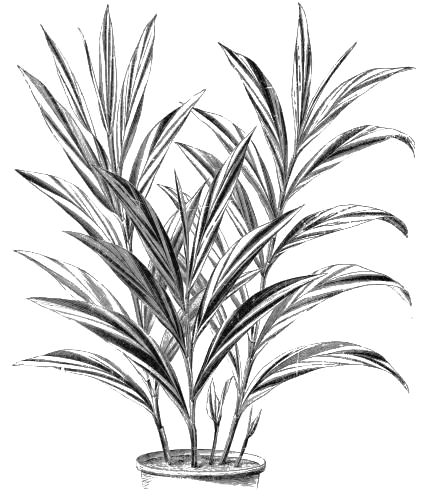
FIG. 63. ALPINIA VITTATA.
A. aspera (rough).* cau. slender, 10ft. to 30ft. high. sti. and rachises strongly aculeated; main and partial rachis above strigillose, slightly scaly beneath and on the costa, the rest glabrous, often glossy. fronds bipinnate; pinnules shortly petiolate, oblong; apex acuminated, pinnatifid half or two-thirds of the way down to the costa; lobes oblong-ovate, often acutely serrulate; costa bearing small, deciduous, bullate scales beneath. sori very deciduous. West Indies, &c. Stove species.
A. australis (southern).* sti. with very long, firm, subulate scales, 1½ft. long, and as well as the main rachises, muricato-asperous, stramineous. fronds ample, subglaucous beneath, more or less villous on the costæ and costule above, and very minutely bullato-paleaceous beneath, often quite naked, from 6ft. to 30ft. long; primary pinnæ 1½ft. long, 6in. to 10in. wide; pinnules 3in. to 4in. long, ½in. to ¾in. wide, oblong, acuminate, deeply pinnatifid, or towards the base even pinnate; ultimate pinnules or lobes oblong, acute, serrated, subfalcate. sori copious, rather small. New Holland, &c., 1833. A very handsome greenhouse species.
A. comosa (hairy). Synonymous with A. Scottiana.
A. contaminans (contaminating).* cau. slender, growing from 20ft. to 50ft. high. sti. and rachises purplish brown, glossy, aculeate. fronds 6ft. to 10ft. long, ample, glabrous, deep green above, glaucous beneath; primary pinnæ 2ft. or more in length, oblong-ovate, acuminate; pinnules sessile, 4in. to 5in. long, ½in. to 1in. wide, deeply pinnatifid, linear-oblong, sub-falcate, entire. sori nearer the costule than the margin. Java and Malaya. Stove species. SYN. A. glauca.
A. Cooperi (Cooper's).* fronds ample, tripinnate. rachises stramineous, muricated, glabrous beneath; basal scales large, linear, pale, spreading; pinnæ oblong-lanceolate, 1½ft. to 2ft. long; pinnules ligulate, 4in. to 5in. long, ¾in. to 1in. broad, lowest long-stalked; segments ligulate, blunt, toothed, one and a half to two and a half lines broad. sori small. Queensland, &c. Greenhouse.
A. excelsa (tall).* trunk about 30ft. high. sti. and main rachises muricated. fronds ample, dark green above, paler beneath; primary pinnæ 1½ft. to 2ft. long, 6in. to 10in. wide; pinnules numerous, oblong-lanceolate, acuminated, deeply pinnatifid, often quite pinnate; ultimate divisions ¼in. to ¾in. long, oblong, acute or obtuse, falcate, the margins sub-recurved, serrated. sori copious near the costules. Norfolk Island. This rapid-growing and splendid species proves nearly hardy in the neighbourhood of Cornwall; and is a most effective plant for sub-tropical gardening purposes generally. Greenhouse species.
A. ferox (fierce). Synonymous with A. aculeata.
A. Gardneri (Gardner's). Synonymous with A. paleolata.
A. gigantea (gigantic). cau. growing from 20ft. to 40ft. high. sti. asperous; fronds, primary pinnæ 1½ft. to 2ft. and more long, deeply pinnatifid at the apex; pinnules, upper ones sessile, lower ones petiolate, oblong-acuminate, 3in. to 6in. long, five to nine lines wide, deeply pinnatifid; lobes triangular or rounded, serrated. sori copious. India, &c. Stove species. SYN. A. glabra.
A. glabra (glabrous). Synonymous with A. gigantea.
A. glauca (grey). Synonymous with A. contaminans.
A. infesta (troublesome). fronds ample, tripinnatifid; pinnæ oblong-lanceolate, 1ft. to 1½ft. long; pinnules ligulate, 3in. long, ½in. to 1in. broad, cut down to a narrow wing; segments ⅛in. broad, ligulate, blunt, nearly entire; texture sub-coriaceous; colour deep green on both sides. Tropical America; widely distributed. Stove species.
A. Leichardtiana (Leichardt's).* cau. 10ft. to 20ft. high. sti. jointed upon the caudex; main and secondary rachises purple, deciduously powdery, spiny. fronds 6ft. to 10ft. long, firm, dark green above, sub-glaucous beneath, naked and glaucous (or nearly so), tripinnate; primary pinnæ 1½ft. to 2ft. long, 8in. wide, oblong-lanceolate, acuminate; pinnules oblong-acuminate, sessile, pinnatifid only at the apex; ultimate divisions linear-oblong, acute, spinulose-serrate. sori copious, close to the costa. Australia, 1867. Greenhouse species. SYNS. A. Macarthurii, A. Moorei.
A. lunulata (moon-shaped pinnuled). fronds ample, tripinnate. rachises stramineous, glabrous below, densely muricated; pinnæ oblong-lanceolate, 1½ft. to 2ft. long; pinnules close, ligulate, sessile, 4in. to 5in. long, ¾in. to 1in. broad; segments close, ligulate, falcate, blunt, one line broad, obscurely crenulate. sori minute. h. 25ft. Polynesia. Greenhouse species.
A. Macarthurii (MacArthur's). Synonymous with A. Leichardtiana.
A. Moorei (Moore's). Synonymous with A. Leichardtiana.
A. paleolata (scaly).* cau. slender, 10ft. to 20ft. high. fronds ample, tripinnatifid. rachises stramineous, smooth, pubescent below; pinnæ oblong-lanceolate, 1½ft. to 2ft. long; pinnules ligulate, sessile or shortly stalked, 3in. to 4in. long, ½in. to ¾in. broad, deeply cut, the segments blunt and nearly entire; texture sub-coriaceous; colour deep green, both surfaces deeply pilose, the lower scaly on the ribs. sori large, medial. Columbia, &c. Stove species. SYN. A. Gardneri.
A. procera (tall). sti. aculeated and paleaceous below, with large glossy, dark brown scales. fronds bipinnate, glabrous, pinnatifid at the apex; primary pinnæ 1ft. or more long, the rachis winged above; pinnules 2in. to 3in. long, oblong-acuminate or obtuse, pinnatifid half way down to the costa; lobes short, sub-rotundate, often acute, mostly entire. sori small on all the lobes, between the costule and the margin. Tropical America. Stove species.
A. pruinata (as if hoar-frosted).* sti. densely woolly at the base. fronds glaucous, bi-tripinnate; primary pinnæ petiolate, 12in. to 18in. long, ovate-lanceolate; pinnules 3in. to 4in. long, 1in. wide, petiolulate, from a broad base, oblong-acuminate, deeply pinnatifid, or again pinnate; ultimate divisions ½in. long, lanceolate, very acute, deeply and sharply serrated. sori solitary. Tropical America, extending to Chili. Stove or greenhouse species.
A. radens (rasping). cau. 3ft. high, 3in. diameter. sti. 2ft. to 3ft. long, clothed with ovate, pale brown scales. fronds 6ft. to 8ft. long, lanceolate-ovate, bipinnatisect; primary segments 1½ft. long, elongato-oblong, acuminate; secondary ones 2in. to 3in. long, petiolulate, linear-lanceolate, pinnati-partite; segments oblong, denticulate. sori between the costule and the margin. Brazil. Stove species.
A. Rebeccæ (Rebecca's).* cau. slender, 8ft. high. fronds ample, bipinnate; pinnules twenty to thirty on each side, the lower ones stalked, linear, 2in. to 3in. long, more or less inciso-crenate, apex acuminate. sori principally in two rows between the midrib and edge. Queensland. Greenhouse species. See Fig. 65, for which we are indebted to Mr. Bull.
A. sagittifolia (arrow-leaved).* fronds oblong-deltoid, 4ft. to 6ft. long, bipinnate. rachises stramineous, muricated; pinnæ lanceolate, ¾ft. to 1ft. long, the lower shorter, deflexed; pinnules sessile, ligulate, crenulate, cordate on both sides at the base, 1in. to 1½in. long, nearly ¼in. broad. sori large. Trinidad, 1872. Very handsome and distinct stove species.
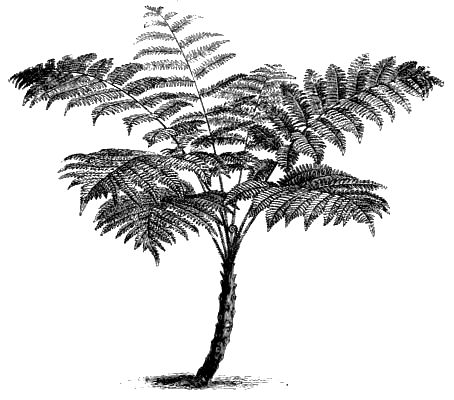
FIG. 64. ALSOPHILA ACULEATA.
A. Scottiana (Scott's).* fronds ample, tripinnatifid. rachises castaneous, naked and smooth beneath; pinnæ oblong-lanceolate, 1½ft. to 2ft. long; pinnules sessile, 3in. to 4in. long, about ½in. broad, ligulate, cut down to a narrow wing on the rachis; segments ligulate, blunt, dentate, sub-falcate, not ⅛in. broad. sori sub-costular. Sikkim, 1872. Greenhouse species. SYN. A. comosa.
A. Tænitis (Tænitis-like).* fronds 3ft. to 6ft. long, bipinnate; pinnules distant, 3in. to 5in. long, lanceolate, acuminate, glabrous, sub-entire, petioled; petiole articulated on the rachis. sori in a single series, equidistant between the costa and the margin, mixed with long, copious hairs. Brazil. An elegant stove species.
A. villosa (villous).* cau. 6ft. to 12ft. high. sti. 1ft. or more long, tubercular, densely clothed at the base with ferruginous scales. fronds from 6ft. to 8ft. long, bi- or sub-tripinnate, broadly lanceolate in outline; pinnules 1in. to 3in. long, oblong-lanceolate, obtusely acuminate, deeply pinnatifid; lobes oblong, obtuse, entire or coarsely serrated. sori copious. Tropical America. A very beautiful stove species.
ALSTONIA (in honour of Dr. Alston, once Professor of Botany at Edinburgh). ORD. Apocynaceæ. Usually tall, lactescent, or milk-bearing stove evergreen shrubs or trees, with small white flowers, which are disposed in terminal cymes. Leaves entire, opposite or often whorled. Of easy culture, thriving best in a mixture of peat, loam, and sand. Cuttings root readily in sand, in heat. Besides the one mentioned, there are eleven other species.
A. scholaris (school). fl., corolla salver-shaped, white; cymes on short peduncles. March to May. l. five to seven in a whorl, obovate-oblong, obtuse, ribbed; upper surface glossy, under white, and having the veins approximating the margin. h. 8ft. India, 1803. SYN. Echites scholaris.
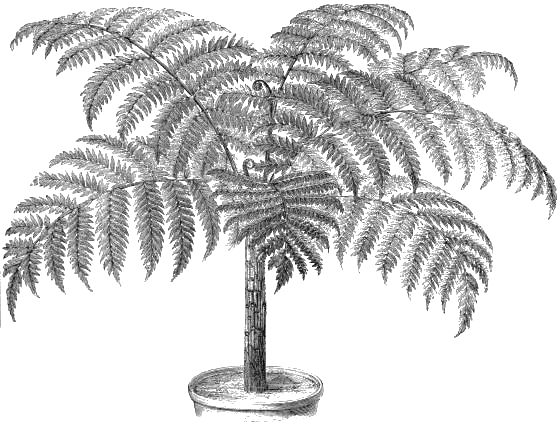
FIG. 65. ALSOPHILA REBECCæ.
ALSTRÖMERIA (in honour of Baron Alströmer, a Swedish botanist and friend of Linnæus). ORD. Amaryllidaceæ. Tall handsome hardy or half-hardy tuberous rooted plants, with leafy stems and terminal umbels of richly-coloured flowers; perianth regular, six-parted, subcampanulate; inner segments narrower, two of which are somewhat tubulose at the base; stamens included within, and inserted with perianth; stigma trifid. Leaves linear, lanceolate, or ovate, and resupinate, or inverted in position by the twisting of the petiole. Cultivation: Few plants need less attention to grow them successfully, either in pots or planted out. The best position for those kinds which succeed outside is a deep and dry, sloping, sheltered border, in a compost of two-parts peat and leaf soil, and one loam with some sharp sand. Water freely if severe drought sets in; a surface covering of common moss, or cut fern in winter, will prove an advantage. They are very effective in masses. Propagation: They may be increased by seed or root division. Sow the former when ripe, or in early spring, thinly in pans, pots, or boxes, and place in a cool house or frame, so that they will receive some fostering in their early stages. The seedlings should be pricked out singly, when large enough to handle, and grown on till well established under glass. A mixture of peat, leaf mould, and sandy loam, is the best compost in which to sow the seeds and grow the young plants. When sufficiently established, they may be placed in a warm sheltered spot outside, and about 1ft. apart. The fasciculated masses of fleshy roots are readily separated into as many pieces as there are crowns; this operation may be performed during September or October, or February and March; but it must be done carefully. Except for the sake of increase, the less they are disturbed the better. They are excellent subjects for pot culture (some can only be managed thus, unless planted out in a house), and may be potted as early in the autumn as possible, in 8in., 10in., or 12in. pots. Thorough drainage is essential; arrange the crocks carefully, and place a layer of thin turfy loam over them. A compost of equal parts turfy loam, leaf mold, and fibrous peat, with an abundance of sand, will suit them admirably. Water sparingly at first, but when root-action is fully resumed, they must never be allowed to get dry. Support the stems by staking when they require it, and just previous to flowering, top-dress with some rotten manure and leaf soil. Occasional syringings will be necessary to keep down red spider, especially if the atmosphere is very dry. As the plants finish flowering, and the leaves fade, gradually diminish the supply of water until the stems are quite down, when they may be placed somewhere out of the way, free from frost, for the winter, but not kept dry enough to make them shrivel. In repotting, as much of the old soil as is practicable should be removed, without seriously disturbing the roots, and the plants shifted into larger or the same sized pots, according to their condition. Alströmerias were at one time much more largely grown than they are at present, and the genus was represented in nearly every garden.
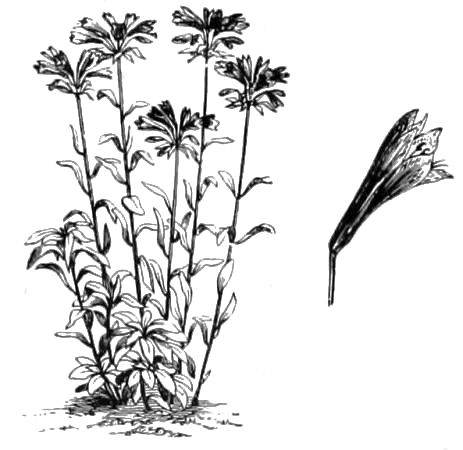
FIG. 66. ALSTRöMERIA AURANTIACA, showing Habit and Flower.
A. aurantiaca (golden).* fl. orange; two upper perianth segments lanceolate, streaked with red; arranged in a five to six stalked umbel, bearing ten to fifteen blooms. Summer and autumn. l. numerous, linear-elliptical, obtuse, glaucous, twisted and turned back at the base, about 4½in. long. h. 3ft. to 4ft. Chili, 1831. A variable but very showy species, quite hardy. See Fig. 66.
A. caryophyllæa (clove-like scent).* fl. scarlet; very fragrant, perianth two-lipped; peduncles longer than the involucre. February and March. l. spathulate-oblong. Stem erect. h. 8in. to 12in. Brazil, 1776. This stove species requires perfect rest in winter. SYN. A. Ligtu.
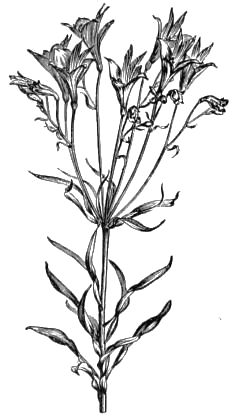
FIG. 67. FLOWER OF ALSTRöMERIA PELEGRINA.
A. chilensis (Chilian).* fl. blood-red or pink, large, the two upper interior petals longer and narrower, variegated with yellow lines; in pairs on a five to six stalked umbel. Summer and autumn. l. scattered, obovate, spathulate; upper ones lanceolate, twisted at the base, minutely fringed on the edges, glaucescent. h. 2ft. to 3ft. Chili, 1849. Hardy. There are many varieties of this species, varying in colour from a rosy white to a deep orange or red.
A. densiflora (thickly-flowered).* fl., perianth scarlet, dotted with black spots inside towards the base; umbels many-flowered, dense; pedicels pubescent, rarely bracteated. l. alternate, ovate, shortly acuminate, pubescent underneath. Stem climbing, glabrous. Peru, 1865. Tender species.
A. Flos Martini (St. Martin's flower). Synonymous with A. pulchra.
A. Hookeri (Hooker's). Synonymous with A. Simsii.
A. Ligtu (Ligtu). Synonymous with A. caryophyllæa.
A. Pelegrina (the native name).* fl. white, or pale yellow, striped with rose, and yellow spot on each segment; pedicels one-flowered, on a six or more stalked umbel. Summer. l. lanceolate, twisted at the base. h. 1ft. Chili, 1754. Rather tender. See Fig. 67.
A. p. alba (white).* Lily of the Incas. fl. white. Perhaps this is the most chaste of all the Alströmerias, and more tender than many others; it should have a specially warm spot, or the protection of glass. 1877.
A. peruviana (Peruvian). Synonymous with A. versicolor.
A. psittacina (parrot-like).* fl. bright crimson at the base, greenish upwards, spotted with purple; upper perianth segments slightly hooded, hence the specific name; umbels many-flowered; peduncles angular. September. l. oblong-lanceolate, acute, twisted at the base. Stem erect, spotted. h. 6ft. Mexico, 1829. Hardy.
A. p. Erembaulti (Erembault's). fl. white, spotted with purple. August. h. 2ft. 1833. A beautiful but rather tender hybrid.
A. pulchella (pretty). Synonymous with A. Simsii.
A. pulchra (fair).* St. Martin's Flower. fl. in umbels of from four to eight in each; the lower perianth segments purplish outside, and edges of a sulphur-white; the upper part of the upper segments of a fine yellow, dotted with deep red spots, the lower part of a flesh colour; pedicels twisted. l. linear lanceolate. Stem erect. h. 1ft. Chili, 1822. A beautiful species, but one requiring protection. SYNS. A. Flos Martini, A. tricolor.
A. rosea (rosy). A synonym of A. Simsii.
A. Simsii (Sims's).* fl. brilliant yellow, with red streaks, very showy; umbels many-flowered; peduncles two-flowered. June. l. spathulate, ciliated. Stem weak. h. 3ft. Chili, 1822. Tender species. SYNS. A. Hookeri, A. pulchella, A. rosea.
A. tricolor (three-coloured). A synonym of A. pulchra.
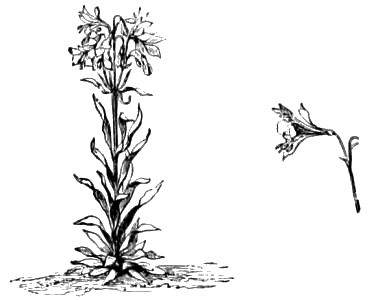
FIG. 68. ALSTRöMERIA VERSICOLOR, showing Habit and Flower.
A. versicolor (various coloured).* fl. yellow, with purple marks; lowest segment the broadest; umbel of usually three shortly-stalked blooms, very floriferous. Late summer. l. linear-lanceolate, sessile, scattered. h. 2ft. to 4ft. Peru, 1831. This is a very robust species, with several beautiful varieties, which are both easily obtained and very cheap. SYN. A. peruviana. See Fig. 68.
A. v. niveo-marginata (snowy-margined).* fl. rose, crimson and white, with green tips and black spots. l. lanceolate, stalked, white-edged. 1875. A charming but scarce variety.
ALTERNANTHERA (in allusion to the anthers being alternately barren). ORD. Amaranthaceæ. Well known ornamental-leaved half-hardy plants, with inconspicuous flowers in axillary heads. Some of the undermentioned species and varieties belong, technically speaking, to Telanthera, in which genus the five stamens are inseparate below, and alternate with as many sterile filaments. They are so universally known in gardening under the present generic name, that we have here included them for convenience' sake. Where Alternantheras are used in large quantities (and if they are to be used effectively, a considerable number must be provided), their economical propagation becomes a matter of importance. A good colour can only be secured by growing them in some house or pit in the full light and warmth of the sun; for, unless so grown, green or badly coloured plants will be the result. The best and quickest way of producing this class of plants in large quantities, is to make up a special hotbed for them about the end of March or beginning of April. If a pit be used, it should be filled up within 6in. of the glass with leaves and manure, or any other material that will produce a steady bottom heat of 80deg. or 85deg., and will last for three weeks or so at that point; which, at this season, will be an easy matter. When the heat has become regular and steady, about 4in. or 5in. of light, rich, sandy soil should be placed all over the surface, adding, at the same time, a sprinkling of silver sand on the top, and pressing it moderately firm with a flat board. The cuttings may now be prepared and dibbled in, 1in. apart each way. If kept close, moist, and shaded from bright sunshine, in a few days they will be forming roots, and so soon as that takes place the shading should be discontinued, and the ventilation gradually increased until they are finally hardened off and planted out. If carefully lifted, and placed in trays or baskets, with a rhubarb leaf over them, they may be taken any distance, and planted without flagging; with this advantage—that the plants being in good colour, the beds are effective at once. April is early enough to commence striking them, and these will be fit to plant out by the middle of June. The several species quoted in various dictionaries hitherto are unknown in English gardens.
A. amabilis (lovely).* l. elliptic, acuminate, greenish in some stages, with the principal ribs stained with red, but under free growth becoming almost entirely suffused with rose colour, mixed with orange, the midribs continuing to be of a deep red hue. Brazil, 1868.
A. a. amœna (charming).* l. small, spathulate, orange red and purple in colour, which is shaded with deep green and bronze. Brazil, 1865. A most elegant little plant, with a spreading habit.
A. a. tricolor (three-coloured).* l. broadly ovate, glabrous, dark green at the edge, and have a centre of vivid rose, traversed by purple veins, an irregular band of orange yellow intervening between the centre and margin. Brazil, 1862.
A. Bettzichiana (Bettzich's). l. olive and red. Brazil, 1862.
A. B. spathulata (spathulate-leaved). l. spathulate, but more elongated than the others; the principal colours are reddish pink and light brown; these are shaded with bronze and green. Brazil, 1865. A rather tall species.
A. ficoidea (fig-like).* l. variegated with green, rose, and red. India, 1865.
A. paronychioides (Paronychia-like).* l. narrow, spathulate, ground colour deep orange red, beautifully shaded with olive green. Dense and compact grower, forming a little clump about 4in. high.
A. p. magnifica (magnificent).* A very fine variety, with a much higher colour than the type.
A. p. major (greater).* l. bronze, with rich orange tips; very effective.
A. p. m. aurea (greater-golden).* l. bright golden yellow, which colour they retain all through the season.
A. versicolor (various-colour).* l. medium sized, ovate, bright rosy pink and crimson, shaded with bronzy green, branching freely, and making a compact and handsome plant. Brazil, 1865.
ALTERNATE. Placed on opposite sides of an axis on a different line, as in alternate leaves.
ALTHÆA (from altheo, to cure; in reference to the medicinal qualities of some of the species). Marsh Mallow. ORD. Malvaceæ. Hardy biennials or perennials, closely allied to Malva. Outer calyx six to nine-cleft, inner one five-cleft. Most species belonging to this genus are worthy of cultivation, particularly in woods, coppices, and shrubberies; they will thrive in almost any kind of soil. They may be either increased by dividing the plants at the roots, or by seeds; the biennial species must be raised from seed every year, which may be sown in spring where they are intended to remain, or in pans placed in a cold frame, from which the young plants may be removed when large enough.
A. cannabina (Hemp-leaved).* fl. rose-coloured; peduncles axillary, many-flowered, loose, longer than the leaves. June. l. pubescent, lower ones palmately-parted, upper ones three-parted; lobes narrow, and grossly toothed. h. 5ft. to 6ft. South France, 1597. Perennial.
A. caribæa (Caribean).* fl. rose coloured, with a yellow base, solitary, almost sessile. March. l. cordate, roundish, lobed, crenate-serrated. Stem straight, hispid. h. 3ft. Caribbee Islands, 1816. Biennial.
A. ficifolia (fig-leaved). Antwerp Hollyhock. fl. generally yellow or orange coloured, in terminal spikes, large, single or double. June. l. divided beyond the middle into seven lobes; lobes oblong, obtuse, irregularly toothed. h. 6ft. Siberia, 1597. Biennial.
A. flexuosa (zigzag).* fl. scarlet, axillary, solitary, stalked; petals obcordate. June. l. cordate, somewhat seven-lobed, obtuse, on long footstalks. h. 2ft. to 3ft. North India, 1803. Perennial.
A. frutex (shrubby). Synonymous with Hibiscus syriacus.
A. narbonensis (Narbonne).* fl. pale red; peduncles many-flowered, loose, longer than the leaves. August. l. pubescent, lower ones five or seven-lobed, upper ones three-lobed. h. 3ft. to 6ft. France, 1780. Perennial.
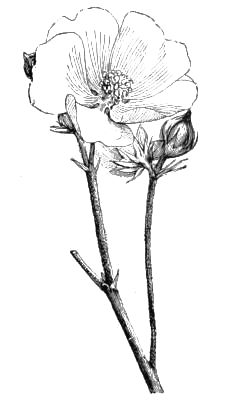
FIG. 69. FLOWER AND BUDS OF ALTHÆA OFFICINALIS.
A. officinalis (officinal). Common Marsh Mallow. fl. of a delicate, uniform blush colour; peduncles axillary, many-flowered, much shorter than the leaves. July. l. clothed with soft, white tomentum on both surfaces, cordate or ovate, toothed, undivided, or somewhat five-lobed. h. 3ft. to 4ft. Marshes, Britain. Perennial. See Fig. 69.
A. rosea (rose).* Hollyhock. fl. rose-coloured, large, axillary, sessile, somewhat spiked at the top. July. l. cordate, with five or seven angles, crenated, rough. Stem straight, hairy. h. 8ft. China, 1573. For special culture and varieties, see Hollyhock.
A. striata (streaked). fl. white, 2½in. in diameter, solitary, on short pedicels; calyx striped. July. l. cordate, bluntly three-lobed, crenated. Stem puberulous, and somewhat scabrous. h. 5ft. Biennial.
ALUMINOUS. Pertaining to, or containing alum, or alumina; as Aluminous soils.
ALUM-ROOT. See Heuchera.
ALYSSUM (from a, not, and lyssa, rage; in reference to a fable that the plant allayed anger). Madwort. Including Psilonema, Ptilotrichum, Schivereckia. ORD. Cruciferæ. Annuals or dwarf, branching, shrubby perennials, often clothed with hoary, stellate hairs. Flowers small, cruciform, white or yellow. Leaves distant, or the radical ones tufted, usually entire. Several of the species are very much alike. They are excellent plants for the rockery, or for the front of borders, growing freely in common but well-drained garden soil. They may be increased by cuttings, by division of the roots, or by seed. The cuttings should be made from young shoots, 2in. to 3in. in length, inserted in sandy loam, early in the season, in a shady place. Seed may be raised outside, or in a frame in pans in sandy soil, most of them germinating in two or three weeks.
A. alpestre (alpine).* fl. yellow; raceme simple. June. l. obovate, hoary. Stem rather shrubby at the base, diffuse, greyish. h. 3in. South Europe, 1777. Perennial. A very neat little tufted species. A. argenteum (silvery), A. Bertolonii (Bertoloni's), and A. murale (wall), are larger growing species allied to the above, but of less cultural merit.
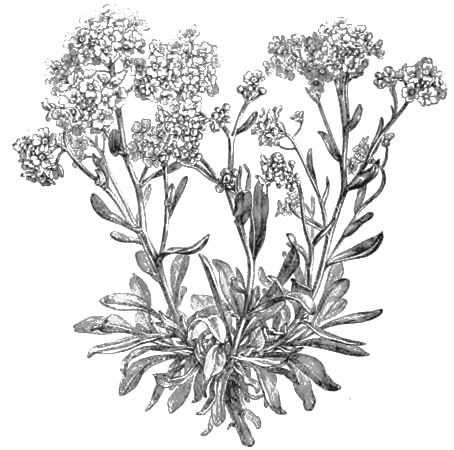
FIG. 70. ALYSSUM SAXATILE.
A. a. obtusifolium (obtuse-leaved). fl. yellow, corymbose. June. l. obovate-spathulate, blunt, silvery on the under surface. h. 3in. Tauria, 1828. A rare alpine.
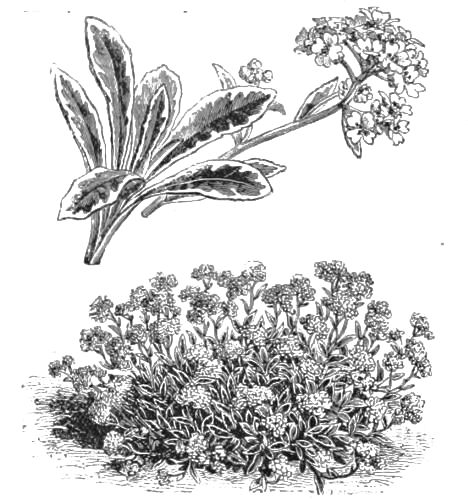
FIG. 71. ALYSSUM SAXATILE VARIEGATUM, showing Flower and Habit.
A. atlanticum (Atlantic). fl. yellow; raceme simple. June. l. lanceolate, hoary, and pilose. Stems shrubby at the base, erect. h. 6in. to 1ft. S. Europe, 1820. A. Marschallianum is intermediate between A. alpestre and A. a. obtusifolium; but is seldom met with under cultivation.
A. gemonense (German).* fl. yellow, in close corymbs. April to June. l. lanceolate, entire, greyish-velvety from stellate down. Stem shrubby at the base. h. 1ft. Italy, 1710. Closely allied to A. saxatile, but not so hardy; it is very desirable for rockeries.
A. macrocarpum (large-fruited). fl. white, racemose. June. l. oblong, blunt, silvery. Stem shrubby, branched, somewhat spiny. h. 8in. South of France, 1828. A. spinosa (thorny), and A. halimifolia (purslane-leaved), are very like this species. A. dasycarpum (thick-fruited) is an annual with yellow flowers.
A. maritimum. See Kœniga.
A. montanum (mountain). fl. yellow, sweet-scented; raceme simple. May to July. l. somewhat hoary; lower ones obovate; upper ones oblong. Stems rather herbaceous, diffuse, pubescent. h. 2in. or 3in. Europe, 1713. A distinct and charming species for the rockery, forming compact tufts of slightly glaucous green. A. cuneifolium (wedge-leaved), A. diffusum (diffuse), and A. Wulfenianum (Wulfenius') come close to this species, the latter being the most desirable.
A. olympicum (Olympian). fl. deep yellow, small, in roundish corymbose heads. Summer. l. spathulate, sessile, very small, greyish. h. 2in. to 3in. Northern Greece.
A. orientale (Oriental).* fl. yellow, corymbose. May. l. lanceolate, repandly-toothed, waved, downy. Stems suffruticose at the base. h. 1ft. Crete, 1820. There is a variety with variegated leaves.
A. saxatile (rock).* fl. yellow, in close corymbose heads. April. l. lanceolate, entire, clothed with hoary tomentum. Stems shrubby at the base. h. 1ft. Eastern Europe, 1710. A very common and showy spring plant. See Fig. 70.
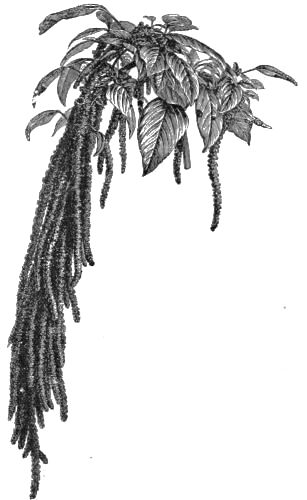
FIG. 72. FLOWER SPIKE OF AMARANTHUS CAUDATUS.
A. s. variegatum (variegated).* A constant and prettily variegated form, which is even more handsome than the type. On the rockery it does well, as it requires a sunny, well drained, position. See Fig. 71.
A. serpyllifolium (Thyme-leaved).* fl. pale yellow, in simple racemes. April to June. l. very small, ¼in. to ½in. long, ovate, scabrous, hoary. h. 3in. to 4in. Branches spreading, sub-woody at the base. South Europe, 1822.
A. tortuosum (twisted). fl. yellow; raceme corymbose. June. l. hoary, somewhat lanceolate. Stem shrubby at the base, twisted, diffuse. h. 6in. Hungary, 1804.
A. Wiersbeckii (Wiersbeck's).* fl. deep yellow, in close corymbose heads, about 1½in. across. Summer. l. 2in. long, oval-oblong-pointed, sessile, attenuated at the base, roughish and hairy. Stems erect, scabrous, simple, rigid. h. 1½ft. Asia Minor.
AMARANTHACEÆ. An extensive order of herbs or (rarely) shrubs, with opposite or alternate leaves, and inconspicuous apetalous flowers, which are spicately or capitately disposed. The majority of this order are weeds; well-known exceptions being many species of Amaranthus.
AMARANTH, GLOBE. See Gomphrena.
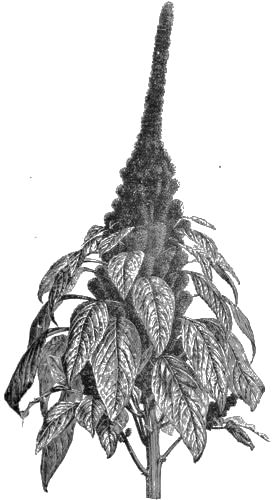
FIG. 73. FLOWER SPIKE OF AMARANTHUS HYPOCHONDRIACUS.
AMARANTHUS (from a, not, and maraino, to wither; in reference to the length of time some of the flowers retain their colour). ORD. Amaranthaceæ. Hardy or half-hardy annuals, with alternate entire leaves and small green or red flowers in large bracteate clustered spikes. Flowers polygamous, furnished with three bracts at the base of a three or five-lobed glabrous perianth. Stamens four or five. Of very easy culture; they thrive best in rich loamy soil, and are largely employed for sub-tropical and other bedding, for vases and conservatory decorations, being very ornamental. The seed should be sown in April in a hotbed, and the plants thinned out in the same situation when about ½in. high. About the end of May, they can be transplanted out of doors in their permanent situations. They are also very handsome when grown in pots. The young plants should be potted off early, and freely encouraged, allowing plenty of pot-room and moisture, and be kept near the glass, to bring out their brightest colouring. To develop their full beauty, plenty of room is required. There are about twelve species (indigenous to warm and tropical countries).
A. bicolor (two-coloured). l. green, variously streaked with light yellow. h. 2ft. India, 1802. This species is rather delicate, and must have a warm sunny situation.
A. b. ruber (red).* l. brilliant glistening scarlet, merging into a dark violet red, mixed with green. Hardier than the type.
A. caudatus (caudate).* Love Lies Bleeding. fl. dark purplish, collected in numerous whorls, which are disposed in handsome drooping spikes. August. h. 2ft. to 3ft. India, 1596. A very common and vigorous growing hardy annual. There is a yellowish-flowered variety, which, though less ornamental, is an effective contrast. See Fig. 72.
A. cruentus (dark bloody). Synonymous with A. hypochondriacus.
A. Henderi (Hender's). l. lanceolate, undulated, intense rosy carmine, varying with orange buff, golden yellow, and olive green. h. 3ft. A garden hybrid, closely allied to A. salicifolius. Pyramidal habit.
A. hypochondriacus (hypochondriac).* Prince's Feather. fl. deep crimson, on densely packed, erect spikes. July. l. purplish beneath. h. 4ft. to 5ft. Asiatic, 1684. SYN. A. cruentus. See Fig. 73.
A. h. atropurpureus (dark purple).* An improved variety of above.
A. melancholicus ruber (melancholy-red).* h. about 1ft. Japan. A compact growing variety, with large shaded crimson leaves. Largely used for bedding purposes.
A. salicifolius (willow-leaved).* l. 7in. to 15in. long, willow-shaped, linear, and wavy, which, by their drooping outline, present a very elegant and effective appearance. When fully grown, the leaves are brilliantly banded and tipped with orange, carmine, and bronze. h. 3ft. Philippine Isles, 1871.
A. s. Princess of Wales.* l. carmine, orange green, and bright yellow, beautifully blended. h. 3ft. A garden hybrid.
A. sanguineus (bloody). fl. purple, disposed partly in small heads in the axils of the upper leaves, and partly in slender, flexible spikes, which form a more or less branching panicle. July. l. blood red. h. 3ft. Bahama, 1775.
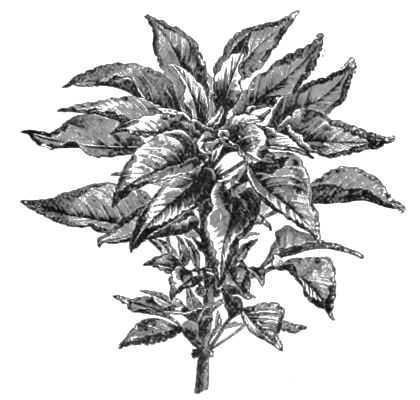
FIG. 74. AMARANTHUS TRICOLOR.
A. speciosus (showy).* fl. dark crimson purple, disposed in large erect spikes, forming a fine plumy panicle. July. l. suffused with a reddish tinge, which disappears at the time of flowering. h. 3ft. to 5ft. Nepaul, 1819.
A. s. aureus (golden). fl. of a fine brownish-golden hue. Very effective when grown in masses.
A. tricolor (three-coloured).* l. of a fine, transparent, purplish-red or dark carmine from the base to the middle; a large spot of bright yellow occupies the greater part of the upper end of the leaf; point generally green; leafstalks yellow. h. 1½ft. East Indies, 1548. See Fig. 74. There are several garden varieties of this species, requiring a somewhat warmer situation.