Chapter IX · THE MARITIME REPUBLICS IN THE FOURTEENTH AND FIFTEENTH CENTURIES
Reading edition
THE AFFAIRS OF PISA AND GENOA
In the disputes between the emperors and the popes, the Pisans followed the Ghibelline, the Genoese, the Guelf party. Both republics, too, late in the twelfth century, often replaced their consuls by podestas, and both were the frequent theatre of strife between the nobles and the populace. In Genoa, from 1190 to 1216, there appears to have been a struggle whether consuls or the podesta should govern the state, for during that period we find both, and, from 1216 to 1252, podestas alone. But, as the popular assemblies were still convoked whenever any important decision was to be made, and as the podesta, like the consul, was elected, the citizens still retained some of their ancient privileges. These, however, were not the only changes in the form of the executive; the podesta was sometimes replaced by the capitano, sometimes by the abbate, and at other times by the anziano—dignities of which we find frequent instances in the thirteenth century. But none appear to have enjoyed a long lease of power; often the very next election, according as faction or prejudice or love of novelty prevailed, ended their name with their administration; they could, however, hope that in the perpetually revolving wheel of change their dignity might again attain the summit—a hope which was almost sure to be realised. “At present,” says the archbishop of Genoa, who wrote towards the close of the same century, “we have an abbot and elders; whether we must soon change them or not, no one can tell; but at least let us pray God that we may change for the better, so that we are governed well, no matter whether we obey consuls, or podestas, or captains, or abbots.”
[1262-1298 A.D.]
The good prelate proceeds to illustrate this truth by quaintly comparing the different forms of government to three keys, one of gold, one of silver, the third of wood; though the material of these, he observes, is very differently estimated, one is in reality as good as another, provided it does its office, that of opening. The first capitano surnamed Boccanera, owed his election to the mob, whom he had gained by flattery, and whom he persuaded to be no longer governed by tyrannical podestas; his election was for ten years; a council of thirty-two elders was elected to aid, or, rather, to obey him; a judge, two secretaries, and twelve lictors were constantly to await his orders; and a knight and fifty archers were appointed his body-guard. A man with powers so ample was sure to become a tyrant; and we accordingly find that in the second year of his administration a conspiracy was formed to depose him. This time he triumphed; but when half his term was expired, a confederacy of the nobles, aided by the populace, compelled him to retire into private life.
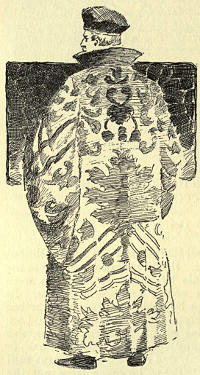
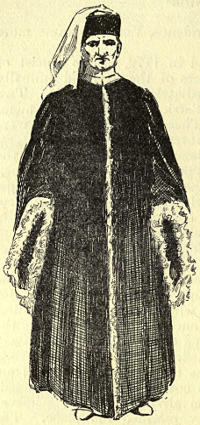
A Lombard Ambassador
Into the endless domestic quarrels of the Guelfs and Ghibellines at Genoa and Pisa, and the consequent alliances—alliances of momentary duration—contracted in both cities with the emperor, the pope, or the king of Naples, we cannot enter; and if we could, nobody would thank us for the wearisome detail. As in Lombardy, the nobles were often banished, and as often recalled. The year 1282 is more famous in the annals of both republics, as the origin of a ruinous war between them. Pisa, with her sovereignty over Corsica, Elba, and the greater part of Sardinia; with her immense commerce, her establishments in Spain, Asia, and Greece, her revenues and stores, had little to gain and much to lose, by contending with a poor and perhaps braver power. If Genoa had less wealth, she had equal enterprise, an equal thirst for gain, and equal ambition. Where so much rivalry existed, it would easily degenerate into discord; and petty acts of offence were followed by general hostilities. In one of their expeditions the fleet of the Pisans was almost destroyed by a tempest; a second, by the enemy; a third, after a bloody conflict off the isle of Meloria, was all but annihilated, and the loss in killed was five thousand, in prisoners eleven thousand. These prisoners the victors refused to ransom and for a reason truly Italian—that the retention of so many husbands in captivity would prevent their wives from renewing the population, and that Pisa must in consequence decline. This infernal policy succeeded; when, after sixteen years’ warfare, peace was made, scarcely a thousand remained to be restored to their country.
But Pisa had other enemies; all the cities of Tuscany, with Florence at their head, entered into an alliance with Genoa to crush the falling republic, which had rendered itself so obnoxious by its Ghibelline spirit. In this emergency, convinced how feeble must be the divided efforts of its municipal magistrates, Pisa subjected itself to the authority of an able and valiant noble, Ugolino della Gheradesca, who dissipated the formidable confederacy, and, by some sacrifice of territory, procured peace. Not less distracted was the internal state of the republic, now the Ghibellines, now the Guelfs being called by the populace to usurp the chief authority. Though the Genoese had less domestic liberty, since they were more frequently under the control of some one tyrant, they were in general much more tranquil. In 1312 they submitted to the emperor Henry of Luxemburg, but evidently with the resolution of throwing off the yoke the moment he repassed the Alps; while the submission of the Pisans was sincere. Two years afterwards the capitano or dictator of the latter reduced Lucca, and humbled the Florentines; but such was his own tyranny that the people expelled him. His fate is that of all the petty rulers of Italy; yet, though after this expulsion the forms of a republic were frequently restored, the spirit was gone; there was no patriotism, no enlightened notions of social duties; violence and anarchy triumphed, until the citizens, preferring the tyranny of one to that of many, again created or recalled a dictator. The war of the Pisans with Aragon for the recovery of Sardinia was even more disastrous than that with the Genoese. It ended in the loss of that important island, which had formed a considerable source of their resources.
The evils, indeed, were partly counterbalanced by the conquest of Lucca, which had sometimes proved a troublesome neighbour; but nothing could restore them to their ancient wealth or power, so long as they were menaced by so many rival states, especially those of Tuscany, and so long as they were distracted by never-ceasing domestic broils. In fact, at one time, their existence depended only on the imperial support; at another, on the dissensions or misfortunes of their enemies.
[1284-1369 A.D.]
The little republic of Genoa, which, in imitation of Venice, had forsaken its podestas, abbots, elders, and captains for a doge and senate—but a senate much less aristocratic than that of the ocean queen, was scarcely more enviable, though doubtless more secure. This republic, too, had its pretensions to Sardinia, and consequently a perpetual enemy in the Aragonese kings. Often vanquished, it implored the protection of the king of Naples or the duke of Milan, according as policy or inclination dictated. It had, however, a better defence in its natural position, in the barren rocks which skirted it to the north and east, and in the valour of its sailors; and when, as was sometimes the case, its protectors became its masters, the foreign garrison, being cut off from supplies both by sea and land, was soon compelled to surrender.
But Pisa had no such defence; and in 1369 she had the mortification to see the republic of Lucca restored to independence by the emperor Charles IV. On this occasion the Lucchese remodelled their constitution; they retained their anziani, or elders, with a gonfalonier at their head; both, however, in the fear of absolute sway, they renewed every two months. Ten anziani, with the gonfalonier, formed the seigniory, or executive government, and were assisted by a council of thirty-six, called boni homines, and elected every six months. Over these was the college of 180 members, who were annually elected.b
[1339-1458 A.D.]
Of all the republics, Genoa, in the fourteenth century, was accounted the most wealthy and powerful. But after throwing off the yoke of Robert, king of Naples, the city was agitated by continual commotions, in which the Guelfs and Ghibellines were alternately expelled. The institution of an officer called the abbot of the people, like that of the Roman tribunes, had been intended to repress the power of the nobles; and the attempt to dispense with this office was resisted by the commons, who chose for their abbot, Simone Boccanera, a nobleman of the Ghibelline party, and a zealous advocate for the popular cause. But his noble descent impelled him to decline an office which had hitherto been held by only one of the people; and the multitude overcame his scruples by changing the title of abbot to that of duke, or doge, in imitation of the Venetians (1339). A select few of the popular leaders were nominated as his council; but the authority of Boccanera appears to have been almost unlimited. He governed with firmness and discretion, and according to Giovanni Villani a conspiracy of the nobles was promptly and capitally punished. His reign was, however, suspended in 1344; the members of the noble families, Doria, Spinola, Fieschi, and Grimaldi reassembled in the suburbs, and the doge avoided a violent deposition by a secret retreat to Pisa. After some confusion, a nobleman, Giovanni da Murta, was proclaimed doge; but as renewed disorder convulsed the city, the contending factions agreed to submit their differences to Lucchino Visconti, and the rapacious arbitrator was prevented by death alone from occupying the distracted state.
After the death of Da Murta, a new doge was set up; but disorder within and defeat without induced Genoa to throw herself under the protection of Giovanni Visconti. On the death of that prelate she reassumed her independence; her original doge was recalled, and continued to rule until 1363. But from the death of Boccanera the state was torn by dissension for upwards of thirty years, and two rival families of the mercantile class, the Adorni, adherents of the Guelfs, and the Fregosi of the opposite party, alternately furnished Genoa with an ephemeral sovereign. In 1396 the reigning doge, Antonio Adorno, by an act of miserable impolicy, surrendered the state to Charles VI, king of France, who deputed the government to a renowned captain, Jean le Maingre, marshal of France, and lord of Boucicault. The stern severity of this approved soldier was manifested on his entry into the city; and two of the most refractory citizens, Battista Boccanera and Battista Luciardo, were at his command led out to execution. Boccanera’s head was severed from the body, and his companion was about to suffer, when a new commotion in the assembled crowd distracted the attention of the French guard. The criminal seized the propitious moment, and darting into the dense throng was lost among the multitude; but his place was instantly supplied by the officer whose neglect had permitted his escape, and whose head immediately rolled upon the ground at the mandate of the peremptory Boucicault. For eight years the Genoese were overawed by his rigorous government; but his absence favouring insurrection, the French lieutenant was assassinated, and the state was delivered from the yoke of France.
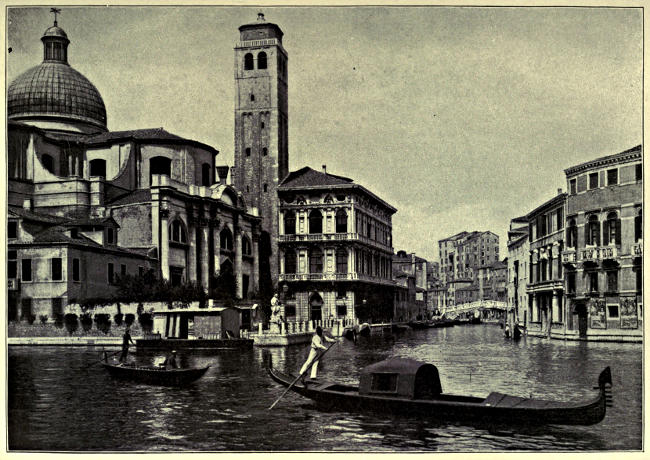
GRAND CANAL, VENICE
[1458-1478 A.D.]
But the spirit of independence was extinguished in Genoa, and she withdrew herself from the bondage of France to acknowledge Filippo, duke of Milan, as her master. Revolt from Milan and reinstatement of the doge were immediately followed by his deposition, and a new form of government was introduced by creating ancients and captains of the people. After a few months’ duration this government was dissolved, and Raffaello Adorno was created doge, and permitted to retain his power for nearly four years. A new struggle between the rival families once more convulsed the city; and whilst Alfonso, king of Naples, threatened Genoa with a most formidable invasion, a grievous pestilence raged among her citizens. In this complication of distress, the doge, Pietro Fregoso, with the approbation of the principal citizens, craved the protection of Charles VII, king of France; and the city being by treaty surrendered to that monarch was occupied in his name by John of Anjou. The union of the families Adorni and Fregosi enabled the Genoese to expel the French; an Adorno was for a moment raised to the duchy and then expelled by the Fregosi, and a Fregoso had scarcely mounted the throne ere he was displaced by his kinsman, the archbishop Paolo. The odious character of Paolo Fregoso threatened a speedy dissolution of his authority; and the keen-eyed Francesco Sforza, duke of Milan, already regarded Genoa as his own. He obtained from Louis XI of France the cession of his rights; he secured a strong party amongst the discontented citizens; and a general revolt in April, 1464, enabled his friends to proclaim him lord of the city.
During the residue of the reign of Francesco and that of his son, Galeazzo Sforza, Genoa continued in repose; but the murder of the latter prince incited the family of Fieschi to attempt a revolt from Milan. The storm was, however, lulled by the presence of Lodovico and Ottaviano Sforza, the young duke’s uncles; and their creature Prospero Adorno was accepted by the people as their doge under the authority of the duke of Milan. A few months dispelled his authority; and Battistino Fregoso was proclaimed independent sovereign of Genoa.[17]
In the midst of these perpetual commotions, a new and singular association of private individuals took place in Genoa. The bank, or company, of St. George had been instituted about 1402, when a long course of warfare had drained the public treasury. The contributions, therefore, of private citizens were called in requisition, in security for the repayment of which the customs were pawned by the republic; whilst each lender participated in the receipts in proportion to the extent of his advances.
The administration of their affairs required frequent meetings of the body of creditors; and the palace over the custom-house being assigned to them, they organised a particular form of government. A great council of one hundred was established for deliberation on their common weal; whilst the supreme management of their affairs was entrusted to a directory of eight. The good order of their little government insured their prosperity; the increasing necessities of the republic required new advances; and the public lands were mortgaged to the bank, until that body became possessed of nearly all the territory appertaining to the state of Genoa. To the regulation and defence of this extending territory the company alone were attentive; and, without any interference on the part of the commonwealth, an annual election of their own officers furnished an adequate supply of governors and magistrates for the provinces. They wisely abstained from taking part in the unceasing changes in the government; and, alike indifferent to the cry of Adorni or Fregosi, were intent only on preserving their own independence, and securing from the successful ruler the due recognition of their laws and privileges. The administration of this society formed a striking contrast to that of public affairs. Instead of tyranny, corruption, and licentiousness, the bank of St. George presented a model of order, good faith, and justice; and the people obtained thereby an influence in the state, which more effectually preserved their liberty than all their violent attempts to depress the aristocracy.
Naval Exploits
[1337-1354 A.D.]
Notwithstanding the perpetual dissensions of Genoa, she long continued to maintain her naval renown; and whilst the plebeians were intent on the depression of the nobles, the family of Doria were conducting her fleets to the discomfiture of her enemies. Like her ancient rival Venice, she had long been acquainted with the Levant; and Galata and Pera, the suburbs of Constantinople, were the reward of services rendered to the Greek emperor.
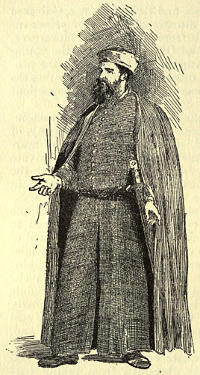
A Venetian Naval Officer
(After Vicellio)
After the peace of 1299 the Venetians, though strengthened by the alliance of the Aragonese, abstained for a time from renewing the contest; and the first attack upon the galleys of Genoa was punished by defeat and disgrace. A breach of faith on the part of Venice was resented by the seizure of all her traders in the Black Sea; but Genoa paid dearly for this aggression, and a signal defeat by the Venetians off Caristo nearly annihilated her fleet. In 1351 a powerful armament sailed from Venice under the command of Niccolo Pisani, one of the most distinguished commanders of his age; and a fierce encounter in the Dardanelles covered the sea with the fragments of the hostile vessels. But severely as the Genoese suffered on this occasion, they might fairly claim the victory, since the destruction of the Venetian and Aragonese galleys was more than double the loss which they themselves sustained; and Pisani admitted the defeat by leaving his enemies in possession of the scene of action. Even the seat of empire was threatened by the conquerors; and the Greek emperor averted their vengeance by the expulsion of his former allies from the capital. But the pride of Genoa soon afterwards sustained a severe check; her fleet, under Antonio Grimaldi, was surprised off Cagliari on the anniversary of the defeat of Caristo; and the loss of more than thirty ships and forty-five hundred prisoners reduced the public to despair. This disaster, however, was amply compensated by a splendid victory in the following year, achieved over Pisani by Andrea Doria and his nephew Giovanni; and to the bold and spirited manœuvre of the latter the success of the day was chiefly to be attributed. Whilst the Venetians lay within the harbour of Sapienza, a little island of the Morea, the younger Doria dashed into the port with twelve galleys, and, placing his force between the shore and the enemy, commenced a furious assault. Meanwhile the residue of the Genoese fleet attacked the galleys of Pisani in front, and most complete victory was obtained. The Venetians suffered an enormous loss of both vessels and men; and amongst the six thousand prisoners led in triumph to Genoa was the renowned commander Niccolo Pisani.
[1354-1379 A.D.]
The Genoese thus triumphant swept the coast of Barbary, assaulted and plundered Tripoli, and sold the city to a wealthy Saracen for 50,000 pieces of gold. A more important conquest was achieved eighteen years afterwards. At the coronation of Peter de Lusignan, king of Cyprus, a dispute for precedence arose between the consuls of Genoa and Venice, which the Cypriote authorities decided in favour of the latter. Irritated by this award, the Genoese attempted to assert their right by violence; and the Cypriotes, resenting an affront offered in the royal presence, flew to arms, and immediately put the offenders to death. Not content with this summary vengeance, they set on foot a general massacre through the island, and a single Genoese was left alive to convey the heavy tidings to the republic. A new fleet was forthwith sent from Genoa, commanded by Pietro Fregoso, and the island of Cyprus offered little resistance to the invaders. Nor can they be accused of want of moderation, since only three lives were sacrificed to the manes of their slaughtered countrymen. The king was restored to liberty, and even permitted to retain his title; but a yearly tribute of 40,000 florins was exacted by the conquerors.
A new offence soon kindled another war with Venice. So low had the Greek Empire fallen that the Genoese had taken upon themselves to dethrone the emperor Joannes Palæologus in favour of his son Andronicus, who promised them in return the island of Tenedos. But the deposed tyrant was supported by their ancient rival, who took advantage of the imperial schism to get possession of Tenedos; and Genoa, strengthened by the alliance of Louis, king of Hungary, Francesco da Carrara, lord of Padua, and the patriarch of Aquileia, declared war against the Venetians. The fleet of Genoa was commanded by Luciano Doria, that of Venice by Vittore Pisani. Fortune from the commencement favoured the Genoese; and in the month of May, 1379, a great and sanguinary battle off Chioggia was attended by a brilliant victory. The death of their admiral Doria, who fell in the first onset, inspired them with vindictive fury; and fifteen Venetian galleys and upwards of a thousand prisoners fell into the hands of the conquerors. Many of these were inhumanly butchered by the Genoese in revenge for the fall of Doria; whilst the defeated Pisani, returning to the capital, was plunged into a dungeon by the implacable government of Venice.
A reinforcement under Pietro Doria now enabled the Genoese to follow up their victory, and the island and city of Chioggia were captured with immense loss to the Venetians. The utmost consternation prevailed throughout Venice, and the most humiliating terms of peace were proposed by the disheartened senate. But the haughty Doria rejected all terms of accommodation. “Never, by the faith of God!” he exclaimed, “never, my lords of Venice, shall ye have peace till we have bridled those brazen horses of St. Mark’s; when they are bitted, ye may dare to talk of peace.”
Nothing can more strongly mark the consternation of the Venetian government than their yielding on this trying occasion to the outcries of the populace. In obedience to their urgent call Pisani was delivered from his dungeon and once more placed in command of the armament. Despair prompted the most vigorous preparations for defence; great rewards were promised to all whose exertions should be most conspicuous; and nobility was to be the reward of the thirty citizens who should pre-eminently distinguish themselves in preserving the state. The great aim of Pisani was now to blockade the Genoese fleet, which had taken up its station within the port of Chioggia. This daring enterprise was achieved with incredible labour and severe loss on the part of the Venetians. By sinking vessels laden with stones at the mouths of the several channels which led into the Lagune, he rendered all egress impossible.g
[1379-1381 A.D.]
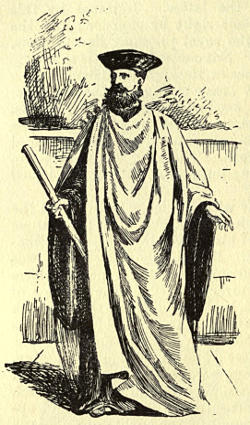
A Venetian General
The circumstances of the two combatants were thus entirely changed. But the Genoese fleet, though besieged in Chioggia, was impregnable, and their command of the land secured them from famine. Venice, notwithstanding her unexpected success, was still very far from secure; it was difficult for the doge to keep his position through the winter; and if the enemy could appear in open sea, the risks of combat were extremely hazardous. It is said that the senate deliberated upon transporting the seat of their liberty to Candia, and that the doge had announced his intention to raise the siege of Chioggia, if expected succours did not arrive by the 1st of January, 1380. On that very day, Carlo Zeno, an admiral, who, ignorant of the dangers of his country, had been supporting the honour of her flag in the Levant and on the coast of Liguria, appeared with a reinforcement of eighteen galleys and a store of provisions. From that moment the confidence of Venice revived. The fleet, now superior in strength to the enemy, began to attack them with vivacity. After several months of obstinate resistance, the Genoese, whom their republic had ineffectually attempted to relieve by a fresh armament, blocked up in the town of Chioggia, and pressed by hunger, were obliged to surrender. Nineteen galleys only out of forty-eight were in good condition, and the crews were equally diminished in the ten months of their occupation of Chioggia. The pride of Genoa was deemed to be justly humbled; and even her own historian Stellah confesses that God would not suffer so noble a city as Venice to become the spoil of a conqueror.
Each of the two republics had sufficient reason to lament their mutual prejudices and the selfish cupidity of their merchants, which usurps in all maritime countries the name of patriotism. Though the capture of Chioggia did not terminate the war, both parties were exhausted, and willing, next year, to accept the mediation of the duke of Savoy. By the Peace of Turin, Venice surrendered most of her territorial possessions to the king of Hungary. That prince and Francesco da Carrara were the only gainers. Genoa obtained the isle of Tenedos, one of the original subjects of dispute—a poor indemnity for her losses. Though, upon a hasty view, the result of this war appears more unfavourable to Venice, yet in fact it is the epoch of the decline of Genoa. From this time she never commanded the ocean with such navies as in days gone by; her commerce gradually went into decay; and the fifteenth century, the most splendid in the annals of Venice, is, till recent times, the most ignominious in those of Genoa. But this was partly owing to internal dissensions, by which her liberty, as well as glory, was for a considerable space of time suspended.
THE AFFAIRS OF VENICE[18]
[1172-1319 A.D.]
While Genoa lost even her political independence, Venice became more conspicuous and powerful than before.
The great Council of Venice, as established in 1172, was to consist of 480 citizens, equally taken from the six districts of the city, and annually renewed. But the election was not made immediately by the people. Two electors, called tribunes, from each of the six districts, appointed the members of the council by separate nomination. These tribunes, at first, were themselves chosen by the people; so that the intervention of this electoral body did not apparently trespass upon the democratical character of the constitution. But the great council, which was principally composed of men of high birth, and invested by the law with the appointment of the doge, and of all the councils of magistracy, seem, early in the thirteenth century, to have assumed the right of naming their own constituents. Besides appointing the tribunes, they took upon themselves another privilege; that of confirming or rejecting their successors, before they resigned their functions.
These usurpations rendered the annual election almost nugatory; the same members were usually renewed, and though the dignity of councillor was not yet hereditary, it remained, upon the whole, in the same families. In this transitional state the Venetian government continued during the thirteenth century; the people actually debarred of power, but a hereditary aristocracy not completely or legally confirmed. The right of electing, or rather of re-electing, the great council was transferred, in 1297, from the tribunes, whose office was abolished, to the council of Forty; they ballotted upon the names of the members who already sat, and whoever obtained twelve favouring balls out of forty retained his place. The vacancies occasioned by rejection or death were filled up by a supplemental list formed by three electors, nominated in the great council. But they were expressly prohibited, by laws of 1298 and 1300, from inserting the name of anyone whose paternal ancestors had not enjoyed the same honour. Thus an exclusive hereditary aristocracy was finally established. And the personal rights of noble descent were rendered complete in 1319, by the abolition of all elective forms. By the constitution of Venice as it was then settled, every descendant of a member of the great council, on attaining twenty-five years of age, entered as of right into that body, which of course became unlimited in its numbers.
[1297-1319 A.D.]
These gradual changes between 1297 and 1319 were first made known by Sandi.i All former writers, both ancient and modern, fix the complete and final establishment of the Venetian aristocracy in 1297.
But an assembly so numerous as the great council, even before it was thus thrown open to all the nobility, could never have conducted the public affairs with that secrecy and steadiness which were characteristic of Venice; and without an intermediary power between the doge and the patrician multitude the constitution would have gained nothing in stability to compensate for the loss of popular freedom. The great council had proceeded, very soon after its institution, to limit the ducal prerogatives. That of exercising criminal justice, a trust of vast importance, was transferred in 1179, to a council of forty members annually chosen. The executive government itself was thought too considerable for the doge without some material limitations. Instead of naming his own assistants or pregadi, he was only to preside in a council of sixty members, to whom the care of the state in all domestic and foreign relations, and the previous deliberation upon proposals submitted to the great council was confided.
A Venetian Senator
This council of pregadi, generally called in later times the senate, was enlarged, in the fourteenth century, by sixty additional members; and as a great part of the magistrates had also seats in it, the whole number amounted to between two and three hundred. Though the legislative power, properly speaking, remained with the great council, the senate used to impose taxes, and had the exclusive right of making peace and war. It was annually renewed, like almost all other councils at Venice, by the great council. But since even this body was too numerous for the preliminary discussion of business, six councillors, forming, along with the doge, the seigniory, or visible representative of the republic, were empowered to despatch orders, to correspond with ambassadors, to treat with foreign states, to convoke and preside in the councils, and perform other duties of an administration. In part of these they were obliged to act with the concurrence of what was termed the college, comprising, besides themselves, certain select councillors, from different constituted authorities.
It might be imagined, that a dignity so shorn of its lustre as that of doge, would not excite an overweening ambition. But the Venetians were still jealous of extinguished power; and while their constitution was yet immature, the great council planned new methods of restricting their chief magistrate. An oath was taken by the doge on his election, so comprehensive as to embrace every possible check upon undue influence. He was bound not to correspond with foreign states, or to open their letters, except in the presence of the seigniory; to acquire no property beyond the Venetian dominions, and to resign what he might already possess; to interpose, directly or indirectly, in no judicial process, and not to permit any citizen to use tokens of subjection in saluting him.
As a further security, they devised a remarkably complicated mode of supplying the vacancy of his office. Election by open suffrage is always liable to tumult or corruption, nor does the method of secret ballot, while it prevents the one, afford in practice any adequate security against the other. Election by lot incurs the risk of placing incapable persons in situations of arduous trust. The Venetian scheme was intended to combine the two modes without their evils, by leaving the absolute choice of their doge to electors taken by lot.
[1296-1310 A.D.]
It was presumed that, among a competent number of persons, though taken promiscuously, good sense and right principles would gain such an ascendency, as to prevent any flagrantly improper nomination, if undue influence could be excluded. For this purpose, the ballot was rendered exceedingly complicated, that no possible ingenuity or stratagem might ascertain the electoral body before the last moment. A single lottery, if fairly conducted, is certainly sufficient for this end. At Venice, as many balls as there were members of the great council present were placed in an urn. Thirty of these were gilt. The holders of gilt balls were reduced by a second ballot to nine. The nine elected forty, whom lot reduced to twelve. The twelve chose twenty-five by separate nomination. The twenty-five were reduced by lot to nine; and each of the nine chose five. These forty-five were reduced to eleven, as before; the eleven elected forty-one, who were the ultimate voters for a doge.
A hereditary prince could never have remained quiet in such trammels as were imposed upon the doge of Venice. But early prejudice accustoms men to consider restraint, even upon themselves, as advantageous; and the limitations of ducal power appeared to every Venetian as fundamental as the great laws of the English constitution do to ourselves. Many doges of Venice, especially in the Middle Ages, were considerable men; but they were content with the functions assigned to them, which, if they could avoid the tantalising comparison of sovereign princes, were enough for the ambition of republicans. For life the chief magistrates of their country, her noble citizens forever, they might thank her in their own name for what she gave, and in that of their posterity for what she withheld.
For some years after what was called the closing of the great council by the law of 1296, which excluded all but the families actually in possession, a good deal of discontent showed itself among the commonalty. Several commotions took place about the beginning of the fourteenth century, with the object of restoring a more popular regimen. Upon the suppression of the last, in 1310, the aristocracy sacrificed their own individual freedom along with that of the people, to the preservation of an imaginary privilege. They established the famous Council of Ten, that most remarkable part of the Venetian constitution. This council, it should be observed, consisted in fact of seventeen, comprising the seigniory, or the doge and his six councillors, as well as the ten properly so called. The Council of Ten had by usage, if not by right, a controlling and dictatorial power over the senate and other magistrates; rescinding their decisions, and treating separately with foreign princes. Their vast influence strengthened the executive government, of which they formed a part, and gave a vigour to its movements, which the jealousy of the councils would possibly have impeded. But they are chiefly known as an arbitrary and inquisitorial tribunal, the standing tyranny of Venice. Excluding the old council of Forty, a regular court of criminal judicature, not only from the investigation of treasonable charges but of several other crimes of magnitude, they inquired, they judged, they punished, according to what they called reason of state.
The public eye never penetrated the mystery of their proceedings; the accused was sometimes not heard, never confronted with witnesses; the condemnation was secret as the inquiry, the punishment undivulged like both. The terrible and odious machinery of a police, the insidious spy, the stipendiary informer, unknown to the carelessness of feudal governments, found their natural soil in the republic of Venice. Tumultuous assemblies were scarcely possible in so peculiar a city, and private conspiracies never failed to be detected by the vigilance of the Council of Ten. Compared with the Tuscan republics, the tranquillity of Venice is truly striking. The names of Guelf and Ghibelline hardly raised any emotion in her streets, though the government was considered in the first part of the fourteenth century as rather inclined towards the latter party. But the wildest excesses of faction are less dishonouring than the stillness and moral degradation of servitude.j
[1289-1325 A.D.]
On the death of Giovanni Dandolo in 1289, the long delay of the electors to name a successor furnished an excuse to the populace to resume their ancient privilege; and they tumultuously hailed Jacopo Tiepolo as their doge. But Tiepolo, wisely declining an honour thus irregularly conferred, withdrew for a time from Venice, and the Forty-one at length fixed on Pietro Gradenigo, a nobleman extremely obnoxious to the people. With him originated a measure which forever shut out the commonalty; and the Forty, who were entrusted with the annual election of the council, were enjoined to re-elect all such members of the old council as were not declared unfit by twenty-nine voices. Not to render the people desperate, three commissioners were appointed to make supplemental lists of such other citizens as might be fit to fill vacancies caused by the rejection of the former, or the death of existing members of the council; which lists were in like manner subject to the approval of the Forty. But as three commissioners were appointed by the council itself, it was easy to foresee that this body would be careful to name such persons only as favoured their own order; and lest the electors should err on the popular side, a decree was soon afterwards made, by which they were forbidden to insert any person in their lists, who himself or whose ancestor had not formerly belonged to the great council. In course of time the commissioners were wholly suppressed; the council was declared permanent; and all who could prove themselves descended from one of this body were entitled to inscribe their names in the Golden Book, and to enter this noble assembly at the age of twenty-five.
The Tiepolo Conspiracy, and the Council of Ten
[1325-1355 A.D.]
These changes were not effected without some movement on the part of the people; and the suppression of a feeble conspiracy, and the punishment of its leaders, did not deter others from plotting against the power of the aristocracy. A numerous band of citizens, headed by Baiamonte Tiepolo (son of Jacopo), was formed, and extensive preparations were made for the subversion of the government. But detection having prematurely driven the conspirators into open revolt, they were easily overwhelmed and destroyed in the narrow streets of Venice; and this new conspiracy furnished an excuse for erecting that fearful tribunal—the Council of Ten. This formidable assembly, though originally only a temporary measure, was afterwards, in 1325, declared permanent. It was invested with arbitrary and almost unlimited powers; under pretence of watching over the safety of the republic, the Ten gradually assumed the government of the state, made peace and war, disposed of the finances, and even abrogated the proceedings of the great council. Their spies and emissaries pervaded every quarter of the city; they seized, imprisoned, or put to secret death, without responsibility to any higher authority; whilst no rank was secure from their machinations. Even the doge himself might tremble at their vigilance and severity; and the fate of Marino Falieri, thirty years after the permanent institution of this council, forms a striking event in the annals of this extraordinary oligarchy.g
The Story of Marino Falieri
Falieri, who had passed his fifteenth lustre, had married a young lady of great beauty and elegance, and the union was naturally, perhaps inevitably, accompanied by suspicions on the part of the doting husband. They chiefly fell on the president of the old or “criminal forty” (so called to distinguish that tribunal from two others of less dignity, which took cognisance of minor matters), whom he somewhat rudely expelled from his house at an entertainment he had given to the nobility. The president felt the insult the more deeply, as his attentions had not been devoted to the wife of the doge, but to one of her women. In the impulse of the moment he wrote on the throne of the doge a verse which, whether founded on truth or not, he knew must sorely wound him, as reflecting on his honour and the fidelity of his consort. It ran:
“Marin Falieri dalla bella moglie, Altri la gode ed egli mantiene”
(Marino Falieri of the beautiful wife; others enjoy her, he maintains her). Falieri discovered the writer, and denounced him to the public advocates; but, contrary to his expectation, those men, considering the offence a venial one, carried the cause, not before the tremendous Council of Ten, but the Criminal Forty—the very tribunal of which the accused was president. The culprit met with favour; he was condemned only to one month’s imprisonment.
From this moment the doge indulged uncontrolled animosity against the tribunal, and even the whole order of nobles, whom he regarded as the betrayers of his honour. It was followed by the hope of revenge. He knew the dissatisfaction entertained by both the plebeians and the less privileged nobles towards the government, and he artfully endeavoured to foment it. His reply to a citizen who one day complained before him that a wife or daughter had been dishonoured or insulted by a member of the grand council, produced great impression: “You will never obtain justice. Have not I myself been insulted, without the hope of adequate redress?” In a short time he organised a conspiracy, the object of which was to open the grand council to the nobility and the election of the members of all the public functionaries, of the doge himself, to the citizens at large. The evening before the day fixed for its execution, it was denounced by one of the conspirators; others were arrested and tortured; numbers were executed.b
But the demands of justice were not yet satisfied, and the law claimed a larger sacrifice, a nobler victim. The process against Marino Falieri followed. On the morning of Thursday, the 16th of April, 1355, the old man was led from his apartments, attired in his robes of state, to the great council chamber, where he was confronted with his accusers and his judges. The bench was composed of the six privy councillors, nine of the decemvirs, and a giunta of twenty sages, which had been specially convoked to meet the extreme gravity of the occasion. The latter had a deliberative voice merely, and no vote.
The articles of arraignment were no sooner read than Falieri made a candid and unreserved confession. He avowed all. He stigmatised himself as the worst of criminals, and as one deserving of the highest penalty which it was in the power of the laws to inflict. Without further preamble it was then put to the vote, whether the accused should suffer death. Five of the privy council and the nine decemvirs recorded their suffrages in the affirmative. It was a majority of fourteen to one. One voice alone, it seemed, asked mercy for him who had in the eyes of the aristocracy aggravated the crime of treason by fraternising with tradesmen and plebeians. After the delivery of the verdict the condemned was led back to the palace. It had been ordered that “Marino Falieri, being convicted of conspiring against the constitution, should be taken to the head of the grand staircase of St. Mark’s, and there, being stripped of the ducal bonnet and the other emblems of his dignity, should be decapitated.” The sentence was one which could not fail to strike an icy chill into every heart. But it was received by the doge with a placid equanimity worthy of the hero of Lucca.
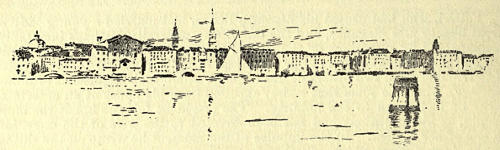
Venice from San Giorgio
The execution took place on the following morning at the hour of tierce. Giovanni Mocenigo, the senior privy councillor, followed by his five colleagues, the decemvirs, the advocates of the commune, and the other great officers of state, advanced to meet his serenity, who had been conducted under guard from his own apartments to the great council saloon. Forming a circle round him, they escorted him to the fatal spot which had been selected for the horrid catastrophe. A stupendous concourse of persons of all conditions had congregated to witness the spectacle. A gloomy and awful stillness reigned throughout the Piazza. The doge, amid a silence in which a whisper or a sigh would have been audible, implored the forgiveness of his countrymen, and extolled the equity of the doom which he was about to undergo. He was then uncrowned and disrobed. A black cap was substituted for the biretta, and a cloak of the same colour was cast across his shoulders. At an appointed signal he laid his head on the block, and at a single stroke the executioner severed it from his body. Immediately after the removal of the latter, the doors of St. Mark’s were thrown open, and the crowd entered in wild disorder, eager to catch a glimpse of the mutilated corpse, which was there exposed to view preparatory to burial (Friday, April 17th, 1355).
[1355-1405 A.D.]
Thus miserably perished, at the ripe age of seventy-seven, one of the greatest soldiers and statesmen whom Venice could boast; that same Falieri who during two and forty years of public services had earned as count of Valdemarino a splendid and enviable reputation. Such was the ignominious fall of a man whose versatile talents had enabled him to shine in every branch of official life, and whose uncontrollable passions brought his white hairs before the close of seven months from a throne to a scaffold. Falieri had survived most of his early friends, if not his domestic happiness; it was ruled that he should survive his honour also.
The ducal remains were interred without any mark of pomp at San Giovanni e Paolo, behind the monastery, and in the direction of the chapel of Santa Maria della Pace; and from a mixed motive of delicacy and pride the Ten directed their secretary to omit all direct allusions in the books of their transactions to his sentence and execution. The words, “Let it not be written” formed the sole clew afforded by the Misti to a great crime and a great tragedy. The effigy of Falieri found its place after the sepulture in the hall, where the portraits of all his predecessors were hung. It was not till twelve years posterior to the event which has been narrated that the Ten, by a decree dated the 16th of March, 1367, caused it to be cancelled, and a black crape arras to be substituted, surmounted by the words, “Hic est locus Marini Faletri decapitati pro criminibus.”
Three centuries had passed away, when some labourers digging near the spot accidentally exhumed a sarcophagus. The discovery did not at the moment attract much curiosity, but the sarcophagus was eventually opened, and it was then found to contain a skeleton with the skull placed between the knees. This peculiarity was designated to indicate that the person, whose spirit was once dwelling in the now uniformed clay, had died by the hand of the executioner; and if any doubt still remained, the half-defaced inscription on the urn served to show that the bones of the unhappy Falieri were there.k
Venetian Wars and Conquests
[1405-1450 A.D.]
We have already earlier in this chapter told of the wars between Genoa and Venice, culminating in the humiliation of the former at Chioggia. The first success of Venice whetted the appetite of her people for further conquests. And the queen of maritime cities did not confine her aspirations to the scenes of her former victories.a
Her anxiety once more to display her banners upon terra firma induced Venice to lend her aid to Gian Galeazzo Visconti against the Carraras, under the promise of the restitution of Treviso, which she had lost during the war of the Chioggia. The bad faith of the lord of Milan would fain have defrauded the Venetians of their share of the spoil, had not dread of their power compelled their ally to be reluctantly honest in his spoliation. By their friendly demonstrations towards Caterina, the widowed duchess of Milan, the Venetians next obtained the cession of Vicenza, Feltre, and Belluno; and Francesco Novello da Carrara, who already counted Vicenza as his prey, was ever baffled in his hopes. His son-in-law, the marquis of Ferrara, was compelled to declare against him; and the citizens of Verona, worn out by siege and famine, opened their gates to the troops of Venice. This important acquisition was followed up by a succession of easy victories; the greatest part of the Paduan territory submitted without a struggle; and the capital itself, wasted by hunger and the plague, promised a speedy surrender. A last desperate sortie was repulsed with terrible slaughter; and treachery opened the gates and admitted the forces of Venice. Carrara and his son Francesco Terzo had now no hope save in the clemency of the conquerors. They proceeded to Venice, were received with apparent cordiality, and immured in a dungeon. In this horrible vault they had the miserable satisfaction of embracing a son and brother, Jacopo da Carrara. After lingering nearly two months in this region of despair, the father was privately strangled in prison; and on the following day his two sons perished in a similar manner. Two brothers of this illustrious family still survived; of these, Ubertino terminated his life by sickness soon after the ruin of his house; and Marsilio expiated a rash attempt to regain Padua by a public execution in 1435. Thus by the destruction of the once potent families of Scala and Carrara, the tyrant of the Adriatic was predominant in Lombardy, and invested with a splendid territory, including Padua, Verona, and Vicenza. Fifteen years afterwards Friuli was wrested from the patriarch of Aquileia.g
An illustrious fugitive, Francesco Carmagnola, who arrived about this time at Venice, accomplished what Florence had nearly failed in, by discovering to the Venetians the project of the duke of Milan to subjugate them. Francesco Carmagnola had, by the victories he had gained, the glory he had acquired, and the influence he obtained over the soldiers, excited the jealousy, instead of the gratitude, of Filippo Maria, who disgraced him, and deprived him of his employment, without assigning any reason. Carmagnola returned to court, but could not even obtain an interview with his master. He retired to his native country, Piedmont; his wife and children were arrested, and his goods confiscated. He arrived at last, by Germany, at Venice; soon afterwards some emissaries of the duke of Milan were arrested for an attempt to poison him. The doge, Francesco Foscari, wishing to give lustre to his reign by conquest, persuaded the senate of Venice to oppose the increasing ambition of the duke of Milan.l
Francesco Carmagnola was amongst the first soldiers, if not the first captain of Italy, and well acquainted with all the troops, plans, secrets, and resources of Visconti, for his talents had recovered the duchy and he had long been that prince’s chief favourite and counsellor. Seeing Guido Torelli and others preferred before him, his enemies more heeded, and himself deprived of the Genoese government, he retired from court, but having secret notice, whether true or false, that Filippo intended to poison him, now fled to Venice and proved his sincerity, of which that government doubted, by this explanation. He also discovered many of Visconti’s secrets and his designs against Venice after the fall of Florence, most of which seem to have been corroborated by confidential letters of Visconti unfairly made use of by the Florentine government and sent to Ridolfi for that purpose.
A gentleman named Perino Turlo, who enjoyed the favour and confidence of Philip, was taken in an attack on Faenza, and being carried prisoner to Florence, there received his liberty accompanied by great attentions and flattery, and was finally dismissed (after declaring his belief that Philip wished the friendship of Florence) with an earnest entreaty to make peace between them. This was a scheme to ascertain Visconti’s real designs on Venice, in order to facilitate the pending negotiations with that state; but Perino soon returned with various propositions of peace which Philip, he said, most earnestly desired, and as a proof of his sincerity produced a carte-blanche besides several letters which the seigniory instantly despatched to Venice because they contained matter of infinite danger to that republic. Lorenzo Ridolfi lost no time in showing them, and the Venetians, seeing the liberal offers therein made to Florence, the bold confidence of the Florentine ambassador in urging the league, the important communications and promises of Carmagnola, and the temptation of conquering Brescia which that captain had promised, determined to accept the alliance, and a treaty was completed early in 1426.
[1426-1427 A.D.]
This league with Florence was to endure for ten years with conditions extremely favourable to Venice whose real sources of strength still lay in commerce, and whose geographical position gave her considerable advantages in treating with Florence, to whom her co-operation both in force and situation was of the last importance in a Lombard war. The Venetian territory in that province from its recent acquisition had not yet become an integral portion of her national strength; it was but a lucky addition to an already consolidated power—a power still rising, absorptive, and hitherto unweakened by expansion, which therefore might be again lost without much dismay, because no national interests had as yet taken root or identified themselves in any way with those provinces. But for Florence war with Milan was ever a matter of vitality, and especially after so many disasters; wherefore she eagerly consented to any conditions, and peace, truce, and war were now equally submitted to the fiat of that cunning and unbending aristocracy. Venice also made some jealous terms about the Alexandrian trade, was moreover to have every conquest that might be achieved in Lombardy, and Florence all those in Romagna and Tuscany not already belonging to the church. Sixteen thousand cavalry and eight thousand infantry were to constitute the minimum of the combined force, and strong armaments of galleys on the Main and flotillas on the Po were to act vigorously against Genoa and every other tangible point of Visconti’s territory. Pope Martin refused to join, but Siena followed Florence. Niccolo, marquis of Ferrara, accepted the command of the Florentines, and united with the league for the promised acquisition of Lugo and Parma if conquered. Amadeus, duke of Savoy, for his own especial objects, the lord of Mantua, and other Lombard seigniors all signed it, and Francesco, Count Carmagnola, was appointed generalissimo.
The Venetians alone brought into the field 8830 horse and 8000 foot, the Florentines 6110 of the former and 6000 of the latter at an expense of 4 and 3 florins a month respectively for every soldier of each arm. To oppose them, Filippo had 8550 horse and 8000 foot, his whole revenue amounting to 54,000 florins monthly. Other authors, and among them Cagnola, make the allied armies amount to much larger numbers and by the testimony of all there were full 70,000 of both hosts at Casa al Secco; but Cambi gives the name and following of each particular leader; those of Sforza, Piccinino, Pergola, and Tolentino being by far the most numerous of the private condottieri and equal to any of the sovereign princes.
War then commenced and Filippo withdrew his troops from Romagna; Carmagnola in performance of his promise marched directly on Brescia; by means of a secret understanding with the Avogadori family and other Guelfs all inhabiting one particular quarter of the city and all hating Visconti, he easily excited a revolt, and on the 17th of March, 1426, made such a lodgment there as immediately enabled him to lay close siege to the rest of the town. Brescia, one of the chief cities and most celebrated manufactory of arms in Italy, was then divided into three distinct fortified districts, each commanded by its citadel; and besides them a strong elevated castle which overlooked the whole.
At first Carmagnola was only master of the ground he stood on, but the battle soon began with all the fury of an assault and all the bitterness of civil war until Francesco Sforza, who defended it, was forced to yield and the allies completed their lodgment. As this news spread to Milan and Florence, the whole force of war concentrated round Brescia; Arezzo and Romagna were soon cleared of troops, and reinforcements poured in from every quarter. One continued scene of war and blood, of fire, rape, and robbery attracted the attention of all Italy for eight successive months; so that, to use the words of Cavalcanti, “never was any tavern so deluged with water as this unfortunate city was with blood.” A ditch encompassed it so closely without that no succours could enter to mitigate the general suffering; within, nothing was heard but shrieks, weeping, and lamentation mingled with the shouts of struggling warriors and the clang of arms; with a masterly hand, almost incredible perseverance, and in face of the whole Milanese army led by the greatest captains of the day, did Carmagnola in a few months subdue the three citadels successively, and finally, aided by the Ghibellines themselves, in November, 1426, that almost impregnable castle, the last stronghold of Visconti, submitted to his arms. A well-directed artillery, which under the name of bombarde was now becoming common in sieges, materially assisted him, and the castle at the moment of its surrender is described as exhibiting the appearance of a porcupine from the innumerable arrows that covered its walls, all fixed in the seams of mortar; a fact that does more honour to the zeal than the training of Italian archers and crossbowmen. Thus fell Brescia, as much to the shame of the Milanese commanders as to the glory of Carmagnola, for its capture was admired as one of the greatest military exploits of that age and added a noble territory to the Venetian Republic.
Pope Martin, who in consequence of his alliance with Filippo had from that prince’s necessities recovered not only the papal cities in Romagna but others that never had legally belonged to the church, at last bethought himself of reconciling the belligerent states; and through his exertions and Filippo’s difficulties a general peace was signed at Venice on the 30th of December, 1426, by which Savoy retained possession of all her conquests on the Milanese state; Brescia and its territory remained to Venice; all places captured from Florence were restored and her merchants relieved by Filippo, as lord of Genoa, from the obligation hitherto imposed on them of embarking their English and French goods in Genoese bottoms. Milan was once more bound not to intermeddle with the affairs of Bologna, Romagna, Tuscany, or any state between that city and Rome, while Florence subscribed to the same conditions as regarded Bologna and that part of Romagna not subject to her sway.
To the great satisfaction of Florence this treaty was proclaimed early in 1427. She had up to the 9th of November with little or no advantage expended 2,500,000 florins, and her ordinary war expenses were estimated at about 70,000 a month. Upon this Giovanni Morelli, a cotemporary historian, exclaims: “Make war, promote war, nourish those who foment war; Florence has never been free from war, and never will until the heads of four leading citizens are annually chopped off upon the scaffold.” So true was it, as it would appear, if any credit may be given to cotemporary writers though influenced by the prevalent spirit of faction, that private gain was the great aliment of foreign and domestic war in Florence.
But the ink was scarcely dry on the treaty when Filippo, either repenting of what he had done or pursuing his secret intentions, with the certainty of forever losing Brescia if he executed the treaty, invited Carmagnola in person to take possession of Chiari, a fortified town forming a strong outwork to that city on the road to Milan. Niccolo Tolentino, suspecting treachery, dissuaded his general from doing so notwithstanding orders from the Venetian seigniory, and his counsel was soon justified by information that the detachment sent on this duty was surrounded and cut to pieces within the walls. Visconti followed up this by the equipment of a large flotilla on the Po, the augmentation of his army with disbanded soldiers from the allies, and a sudden renewal of hostilities. The astonished league almost immediately took the field with what troops remained, the general having orders to make fierce war while a strong armament was preparing to meet the enemy afloat and attack all vulnerable points on the left bank of the Po.
The first encounter was at Gottolengo. Carmagnola had assembled his military cars (which in those days were an indispensable portion of all armies for the rapid movements of infantry), and filling them with crossbowmen attempted to surprise the enemy. The Milanese, however, were too experienced for this and mustering their whole force attacked him unexpectedly while in some confusion on his march, and nearly defeated the whole army; Carmagnola, however, rallied his people, and after restoring order began an obstinate contest.
The heat was excessive, the dust intolerable, the visors of helmets, the eyes and nostrils of the combatants were all choked up so that respiration became almost impossible. The Milanese were supplied with wine and water by the female peasantry, but such was the dust and obscurity that friend and foe seemed alike unknown and many of the allies received refreshment even from the hands of their enemies. Numbers fell from their horses overpowered by heat and dust; the plain was strewed with lances, shields, and wounded men; horses were galloping wildly about the field, some with saddles, some without; others had them turned under their bellies, and many men threw off all their armour to escape suffocation. Piccinino was conspicuous beyond the rest in knightly daring, and his lance’s point was felt throughout the throng; for this battle excepting amongst the infantry seems to have been a confused mass of single combats, more like the mêlée of a tournament than a scientific fight of disciplined soldiers; but the footmen, in firm well-ordered battalions, with lowered spears, charged and withstood the charges of the men-at-arms, killing both them and their horses. When the struggle had lasted some hours and the allies were ready to give way, the marquis of Mantua, hitherto deceived by false reports from a cowardly fugitive, came suddenly up with his followers and dashing forward saved all the cavalry and restored the day. The retreat was simultaneously sounded on both sides; each host had been three times broken, all but the infantry, who seem by their discipline to have preserved the rest.
The ducal forces throughout these two campaigns were smaller in numbers than the allies, but better soldiers and with a greater number of more able commanders; yet they were unsuccessful for want of a common chief, while Carmagnola was implicitly obeyed, and all his advantages were gained by bringing superior numbers against the weakest points of the enemy. To remedy this, Visconti appointed young Carlo Malatesta of Pesaro as his captain-general; a youth of no experience, but whose high rank and family reputation were likely to restrain the continual bickering of the chiefs.
Victories of Carmagnola
Meanwhile Carmagnola, angry at the somewhat disgraceful affair of Gottolengo, conceived the idea of surprising Cremona—a thoroughly Guelfic city and disaffected to every Ghibelline authority; with this view he took up a strong position at Sommo close to the town, entrenched and fortified his camp with a thousand war-cars as was his custom, and trusted to those within the city for ultimate success. Filippo, for the above reasons, became alarmed; wherefore, assembling a large force and instantly embarking on the Po, he at once occupied and saved Cremona. A council of war was of opinion that the enemy should be attacked because Cremona secured their own safety in case of defeat, and a victory would almost insure the fall of Mantua. To protect that place the army was encamped in an open space about half a mile wide, contained between the city walls and the surrounding ditch, called Le Cerchie di Cremona, the defence of which involved that of the city itself; but as the circuit was large, a continual stream of armed peasantry came pouring in at their prince’s call, ranged under various flags and banners and augmenting the aggregate of both armies to full seventy thousand combatants. The allies were superior in the number of regular troops, the Milanese in experience and discipline, and held themselves fully equal to their antagonists independent of the peasantry; these, however, in the unsettled state of that time and country well knew how to handle their weapons though despised by the condottieri, who represented them to Filippo as useful to fill up ditches and as convenient marks for exhausting the adverse missiles and sparing the regular troops; however, their vast numbers would, it was said, excite fear, “the true harbinger of defeat.”
Battle being resolved on, a corps of light-armed troops was sent forward to begin, but these were quickly driven in on the main body by Taliano Furlano, one of the adverse chiefs who, seeing the Milanese cavalry already formed and the whole country as far as the eye could reach covered with banners, instantly turned to give the alarm. Carmagnola was soon in his saddle and personally directing the defence of a narrow pass protected by a broad and deep ditch, which the enemy would be compelled to win ere his main body could be attacked. This was quickly lined with veteran soldiers and the road within it flanked by a body of eight thousand infantry armed with the spear and crossbow, and posted in an almost impenetrable thicket closely bordering on the public way. This pass was called La Casa-al-Secco, and Agnolo della Pergola first appeared before it with his followers, supported by a crowd of peasantry; the ditch was deep, broad, and well defended, and an increasing shower of arrows galled his people so sorely that he at once resolved to use the rural bands as a means of filling it. Driving the peasant multitude forward, he ordered the regular troops to put every luckless clown to death who turned his face from the enemy; so that these wretches with the spear at their back and the crossbow in front fell like grass under the scythe of the husbandman. But they were more useful in death; by Agnolo’s command both killed and wounded, all who fell, were rolled promiscuously into this universal grave, covered up with mould and buried all together.
Here were to be seen distracted fathers with unsteady hand shovelling clods upon the bodies of dead and wounded sons; sons heaping earth on their fathers’ heads; brothers covering the bloody remains of brothers; uncles, nephews; nephews, uncles—all clotted in this horrid compost! If the wretches turned, a friend’s lance or dart went instantly through their bodies; if they stood, an enemy’s shaft or javelin no less sharply pierced them; alive, they filled the pit with sons and brothers, dead or wounded, with themselves! They worked and died by thousands; even the very soldiers that opposed them at last took pity and aimed their weapons only at armed men. “And as a reward for this,” exclaims Cavalcanti, “God lent us strength and courage.” Nevertheless, so many were thus cruelly sacrificed that the moat was soon filled to the utmost level of its banks with earth and flesh and human blood, and then the knights giving spurs to their steeds dashed proudly over this infernal causeway! It was now that the fight commenced: fresh squadrons poured in on every side and all rushed madly to the combat, for on this bloody spot the day was to be decided. “Here,” says Cavalcanti, “began the fierce and mortal struggle; here every knight led up his followers and did noble deeds of arms; here were the shivered lances flying to pieces in the air, cavaliers lifeless on the ground and all the field bestrewed with dead and dying! Here too was seen young Carlo Malatesta, himself and courser cased complete in mail, and a golden mantle streaming from his shoulders! Whoever has not seen him has not seen the pride of armies! Here was store of blood, and lack of joy and fear and doubt hung hard on every mind! Nothing was heard but the clang of arms, the shock of lances, the tempest of cavalry, and the groans and cries and shouts of either host! The sun was flaming, the suffering dreadful, the thirst intolerable; everything seemed to burn, all conspired against the wish of men, but the Cremonese women brought refreshments to our enemies.”
The whole battle appears to have been concentrated in this pass, so that numbers made but little difference on either side; nevertheless the Milanese chivalry were severely handled by the veterans in the wood, who kept up a continual discharge of arrows on horse and man from the moment the ditch was passed, or else ran in with their lances and speared them. As many died from exhaustion and suffocation as from blows, for the battle was fought early in July and lasted from two hours after sunrise until evening; others it is said expired from the stench of carnage rapidly corrupted by excessive heat. Carmagnola, forced by circumstances into the thickest fight, was unhorsed, and a hard conflict between those who tried to save and those who wished to take him prisoner soon concentrated all the knightly prowess of both armies round his person; he was remounted, and dust and confusion saved him more than once, as they did Niccolo Piccinino, besides other leaders on both sides, from being recognised and captured. The squadrons charged and recharged in dust and darkness; no standards could be seen; the voice alone revealed a friend; and when a retreat was sounded whole troops of cavalry ranged themselves under adverse banners in total ignorance of their own position. One attack was made by a strong detachment upon the baggage and for a while placed the allies in great danger; but being finally repulsed with the loss of five hundred prisoners a retreat was sounded; the captives were equal, yet the victory of Casa-al-Secco was fairly claimed by Carmagnola.
Filippo previous to this battle had endeavoured to balance his ill success by a naval victory; the Venetian armament on the Po had been extremely active, and to check it he placed a strong squadron under the orders of Pacino Eustachio of Pavia with instructions to lose no time in bringing the enemy to action. The latter, commanded by Francesco Bembo, did not shun the encounter, which took place near Brescello; but losing three galleons in the commencement, Bembo, doubtful of consequences, with that rapid and bold decision that marks a superior mind, suddenly discontinued the contest and withdrawing all the crossbowmen from his remaining galleons manned them with the crews of others armed only with spears, swords, spontoons, battle-axes, and short arms of every description. These he placed in the van, while the galleons thus emptied were manned with crossbowmen alone and stationed close in the rear of his first line, with rigid orders under the penalty of death to kill either himself or any other man that should turn from the enemy. He then renewed the attack.
With the Milanese in front, in their rear the levelled crossbows ready to shoot into the first vessel that gave way, and themselves armed only with short weapons, the Venetian sailors were compelled either to fight hand to hand with their enemies or be transfixed without resistance by their own or adverse missiles. The Lombards were thus rendered the less formidable of the two, and the closer the fight the more safety, because free from the arrows of either squadron; thus excited the galleons were resolutely run alongside those of the enemy and lashed there, and the battle became more fierce and obstinate; the Venetian mariners, chiefly Greeks and Slavonians, are described as displaying all the courage, sagacity, and savage fury of those nations.
The scene was appalling; no room for tactics, no hope in flight; man encountered man with the eye and hand of death; the struggle was personal, unrelenting, resolute; a struggle for existence, not for victory; the Venetians, pressed by a double danger, had no other hope; the Greeks of Crete and Negropont with the Slavonian crews performed such deeds as have been rarely equalled and never yet surpassed. Springing with the force of tigers on their prey it many times happened that when the Italian spear had pierced a Slavonian body the wounded man would seize and draw himself forward on the slippery staff until he grappled his enemy, and then both rolled struggling into the stream below. Again, two running each other through at the same moment and sternly following up their thrust would close and wrestle as long as life endured, or fall while yet writhing into the bloody Po; for that great stream, full and broad and ample as it was, became strongly crimsoned. Pacino at last gave way, and with a few as yet ungrappled galleys made good his flight, but left fourteen captured vessels in the hands of Venice.
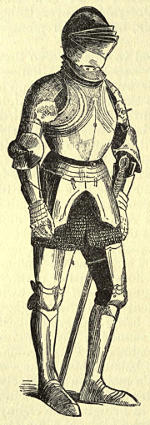
An Italian Knight, Fifteenth Century
After the battle of Casa-al-Secco Carmagnola, who as Cavalcanti asserts was now at the head of fifty thousand fighting men, laid siege to Casalmaggiore on the Po and recaptured Bina which Sforza had surprised; he then reduced the former and both armies cautiously manœuvred, narrowly watching each other’s motions until the beginning of October, when the allies were besieging Pompeiano, a town situated about six miles from Brescia on the high-road to Crema. While Malatesta was absent with Filippo, the Milanese captains had so placed their army as to impede the enemy’s progress without risking a general engagement, but when Carlo returned he posted himself between Macalo (now Maclodio) and the allies, with an intention to succour the besieged. The two camps only four miles asunder were separated by what then was an extensive swamp, now a fertile plain; what was then fetid black and stagnant pools full of reeds and thorns, and swarming with snakes and every loathsome reptile, now abounding in corn and vines and mulberries. The high-road from Orci Novi on the Oglio to Pompeiano and Brescia ran like a causeway through this waste and passed by a wooden bridge over a channel of deep water that connected the opposite marshes. Adjoining the swamp and bridge one side of the road was flanked by an extensive wood, so thick and wild and full of savage beasts that both men and domestic cattle shunned it. Just at the bridge-head the road entered a sort of enclosed space or basin of solid earth in the midst of the marshes, a sort of trap from which no army once entered and cut off from the bridge could hope to escape except by the destruction of a superior enemy.
Niccolo Tolentino, a leader of great influence, having examined this ground, advised Carmagnola to occupy the position while he and his friend Bernardino with a strong division of the army concealed themselves in the wood on the other side of the bridge and awaited Carlo’s advance, who it was supposed would run headlong into the trap. This suggestion was followed; the ambuscade was posted in the wood that night, and the other troops were under arms at daylight. Carlo Malatesta on the other hand, whether for the reasons mentioned by Corio or a wilful determination to fight, was on his march by dawn of day; he soon crossed the bridge and entered the trap with loud shouts of “Viva il Duca! Viva il Duca!” Carmagnola had marshalled his army in the shape of a crescent and slowly retired before him, but still deepening his centre as if fearful of the encounter. When he heard that all had entered, he exclaimed, “They are caught,” and from a rising ground shortly addressed his people before the battle.
The instant that the enemy’s rear was well over the bridge and engaged with their antagonists, Bernardino darted like lightning from the wood and seized it at the head of a thousand horse; he was rapidly followed by Tolentino with a much larger force, but leaving the latter to defend the bridge he snatched up a heavy and well pointed lance, and with two hundred men-at-arms dashed deep into the Milanese rear with loud cries and great confusion. The two horns of the crescent then rapidly closed in; Carmagnola charged in front; the crossbows played unceasingly from every thicket; “San Marco,” “Duca,” and “Marzocco” resounded through the field. “The shouts of men, the neighing of horses, the shock of lances, the tempest of swords was so great,” says Cavalcanti, “that the loudest thunder might have rolled above unheeded. The wild beasts fled in terror through the woods and in these infernal swamps many swarms of serpents were seen rustling through the reeds at the unwonted uproar! O reader, think how cruel must have been this conflict when so many animals, enemies to our nature, fled in so wild affright! All was terror and distraction; Niccolo held steadily to the bridge; many were driven into the marshes or dragged by their stirrups through them; the flights of arrows were sometimes so dense as to obscure the sun, and this deadly archery did infinite mischief; the air itself seemed changed and terrified, and this great multitude was full of groaning, blood, and death!” Every hope of victory at length vanished and the Milanese broke, surrendered, and fled in all directions. Carlo Malatesta and eight thousand prisoners laid down their arms, but, strange to say, almost all were then or subsequently permitted to escape by Carmagnola; and this first sowed the seeds of Venetian jealousy.
Guido Torelli, Piccinino, and Francesco Sforza escaped, and by the next morning all but four hundred prisoners had obtained their liberty; this produced strong remonstrances from the Venetian commissaries, upon which Carmagnola sent for the remaining captives and said to them, “Since my soldiers have given your comrades their liberty I will not be behind them in generosity; depart, you also are free.” This battle was the climax of Carmagnola’s glory: whether he was unwilling to reduce his old patron too low, or was secretly influenced by the desire of peace and the recovery of his wife and children who were in Visconti’s hands, or by less honourable motives, seems uncertain; but his subsequent efforts were insignificant. There is no doubt, says Poggio, that he could that day have destroyed Filippo, if he had retained the prisoners who were the flower of that prince’s army; but according to the custom of modern soldiers they remained as lookers-on, intent only on dividing the booty, and let the men-at-arms go free.
None of this was lost on the Venetians; but not a reproach was heard, not a sentence uttered, no sign of displeasure reached his ear; he could still be useful, was adding bit by bit to their conquests, and as yet in too formidable a position to be struck; on the contrary, as was their usual custom when meditating the sacrifice of a victim, more deference was shown him, more respect paid him; but he was not forgotten.
Death of Frescobaldi; the War Ended and Renewed
[1427-1428 A.D.]
The liberated army of Milan was soon remounted, equipped, and in the field; for most of these battles involved the waste of more money than blood, as dead men paid no ransoms; and Visconti had ample resources. He nevertheless became alarmed at his actual position, and sought new strength by rousing the emperor Sigismund against Venice, by marrying his daughter Maria to the duke of Savoy, and by stirring up the poor remnants of the Carrara and La Scala families to agitate Padua and Verona. He met these difficulties with an able head and a bold countenance, but was in fact a strange character and differing according to cotemporary writers from all other men. No stability, no confidence, no belief, no firmness of purpose; mutable as the wind, no regard to promises, unsteady in his friendships, and prone to sudden antipathies against those who were apparently his dearest friends; cunning, sagacious, vain of his own judgment, despising that of others; whimsically pacific and warlike by turns; fond of a solitary life, he was rarely visible but governed through his ministers and temporary favourites, and thence no doubt proceeded many of his worst misfortunes.
A slight check before Genoa, more important from the heroic death of Tommaso Frescobaldi than from any other injury, in some degree damped the joy of Florence for this recent victory. Frescobaldi had distinguished himself as Florentine commissary in the Aretine district by an able and vigorous conduct under very trying difficulties and a total neglect of him by the government; nevertheless he perseveringly withstood the Milanese forces until the siege of Brescia relieved him. Indignant at this treatment he personally and boldly reproached the Ten of War with their conduct, and in no measured terms. Niccolo d’Uzzano tried to soothe him and was respectfully heard; but Vieri Guadagni so impatiently rated him as to be told by Tommaso that nothing but his high official dignity was a protection from personal chastisement. Niccolo, who fully appreciated the worth of Frescobaldi, reproved Vieri for his intemperance, and that citizen was soon after sent as commissary to conduct the war against Genoa, where, for a while, his vigour and ability were no less conspicuous than before. At last Fregoso and the Florentines were defeated in an attempt to enter Genoa; and Tommaso, who fought to the last, after all were routed was wounded and made prisoner. The governor, a stern and cruel man, promised him life, liberty, and reward if he would divulge his government’s secrets and say who within the city of Genoa were in league with Campo Fregoso, but the alternative of death and torture if he refused. To this Frescobaldi firmly answered: “Obizzino, if for my silence on the subject of state secrets thou wilt put me to death, abandon all hope of knowing those things that duty to my country and constancy of purpose, even did I know them, would prevent my revealing; and, as I have no hope of mercy from thee, so thou needst not expect any disclosures from me, for even if I were informed I would not tell thee.” He was instantly put to the torture, his wounds broke out afresh in the agony, but he died without uttering a syllable. A noble example for his living descendants!
[1428-1430 A.D.]
Florence now wished earnestly for peace because she could no longer expect to gain anything by war, and a continually augmenting expense was exhausting her resources; the more equal action of the Catasto promoted this wish because the rich and great now bore the principal burden. They again argued, and rightly too, that if war continued, Filippo must lose his state, which Venice, not Florence, would gain by the very conditions of the league, and thence with augmented power become more formidable than Visconti himself, for there would then be none but Florence to oppose her. Naples, ruled by a weak, licentious woman, was distracted; the pontiff would not move; the emperor would be shut out by Venice, who held the keys of Italy, and France was far too distant; better, it was once more repeated, to have an unenduring enemy than an everlasting and powerful neighbour. Venice had now acquired a taste for Italian conquest, and the petty acquisitions of Carmagnola were still adding to her territory; but her suspicions were awake and she finally consented to treat, while Visconti was really anxious for peace in consequence of his recent overthrow. The sincerity of all parties soon produced its effects and the cardinal of Santa Croce at last restored tranquillity by accomplishing the signature of a treaty at Ferrara about the middle of April, 1428, after nearly five years of constant hostilities. The cost of this long and ruinous war, according to Cavalcanti, amounted to 3,500,000 florins—according to Macchiavelli, 3,050,000.
The Florentines gained nothing by it but a heavy debt and the institution of the Catasto; the Venetians, in addition to Brescia, gained part of the Cremonese state with Bergamo and its territory as far as the Adda, which now became their western boundary. Thus, says Cavalcanti, by the operation of wicked citizens our people were loaded with poverty, the Venetians with riches and territory; and pride and covetousness was the cause of all.
But the peace was not for long. The Florentines attacked Lucca; Piccinino came to its aid, and the general war recommenced. No less than fourteen towns revolted in favour of Piccinino during one night, all sending their keys, and generally imprisoning the Florentine authorities; yet amidst the sharp oppression and barbarity of the time, it is refreshing to find that some of the latter were spared in consequence of their just government, and, with their families, carried safe across the frontier by the revolted people; but such exceptions only prove the general rigour of Florentine sway.
[1430-1431 A.D.]
In this state of things Micheletto Attendolo of Cotignolo, a nephew of Sforza, was made captain of the Florentine army, to which some spirit was soon after restored by an advantage gained at Colle against Count Alberigo da Barbiano, Piccinino’s successor by Bernardino degli Ubaldini and also by the gallant behaviour of Ramondo Mannelli and Papi Tedaldi, which cast still greater credit on the Florentine arms. Stung with a late defeat on the Po, where they were completely routed by a Genoese admiral, the Venetians sent a squadron to the Tuscan coast and Riviera of Genoa to revenge this injury; they however seem to have been shy of coming to a general engagement until the Florentines, tired of such harassing inactivity, fitted out two galleys under the above officers and either forced or shamed them into an attack on the Genoese squadron. Principally by their own daring courage the latter were completely beaten near Portofino, and their admiral Francesco Spinola and eight galleys captured. But long ere this Niccolo Piccinino had ridden triumphant over most of the Florentine territory, capturing or destroying town after town from Pontremoli to the gates of Arezzo, which would also have fallen had he not unaccountably stopped to besiege the little fortress of Gargonza on his march. This unchecked career of victory riveted his favour with Filippo Visconti, while it raised the jealousy of Niccolo Tolentino, who was fed by that prince on promises alone; wherefore the latter quitted Milan in disgust and engaged with the Florentines, who lent him to the pontiff with two thousand followers, and the consequence of this defection was Piccinino’s recall to defend Lombardy now threatened by the league. Pope Martin V’s decease in February, 1431, brought joy to Florence which during all his reign he had never ceased to hate, and the election of Gabriel Condelmieri, cardinal of Siena and a Venetian, who assumed the pontificate as Eugenius IV, was scarcely less satisfactory. His first measure was an attempt to restore tranquillity; but this was done with so decided a leaning towards Florence as to disgust the Sienese, Visconti, and all her numerous enemies.
War therefore became certain, and the league between Florence and Venice was more closely riveted; but Siena, in concert with Genoa, both of whom had long been favouring Lucca and were encouraged by Piccinino, soon broke into open war; she commenced hostilities under Visconti’s general Alberigo, and by means of Genoa seduced the seignior of Piombino, a recent ward of the Florentines, to take up arms against them.
The incursions of these neighbours in Val d’Ambra increased Florentine difficulties, and an attempt was made to engage Francesco Sforza; but true to his own interest he was bought off by the promise of Visconti’s infant daughter Bianca in marriage.
To cope with him and Piccinino, Carmagnola, notwithstanding his strange conduct in the late war, was again placed at the head of the Venetian armies, and he advanced into the Cremonese state, but was defeated with great loss in a most terrible and bloody battle by Sforza on the 6th of June, 1431, at Soncino on the banks of the river Po.
The Great Naval Battle on the Po
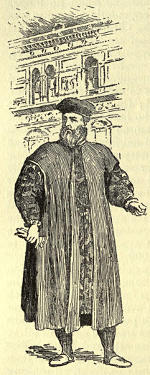
A Magistrate of Florence
A flotilla consisting of one hundred vessels of all descriptions was equipped on the Po, and, under Niccolo Trevigiano, moved straight on Cremona; Visconti had also prepared his squadron under the command of the Genoese admiral Grimaldi, or, as some say, Pacino Eustachio of Pavia, who had formerly suffered a defeat—probably both were employed; but Venice was too quick, and excelled the Milanese fleet in numbers, size, and equipment, so that for some time they had command of the river. The hostile armaments ultimately met at Bina, near Cremona, and fought until night parted them, with the loss of seven Milanese galleys. Sforza and Piccinino, who had manned the squadron from their troops and feared an attack from Carmagnola during the next day’s fight, deceived the Venetian general by means of some pretended deserters who reported that they were preparing to attack him in the heat of the naval battle. Whether Carmagnola were really deceived, or, as the Venetians thought, had come unwillingly to war, is still unsettled; but he acted as if he were, and not only remained under arms all day but refused any succour to the admiral. Sforza and Piccinino on the contrary reinforced the fleet with almost all their troops, and next day, towards the end of June, the most obstinate naval battle then on record was the consequence.
The Venetian galleys took a position with their bows to the stream, and all chained together the better to resist it; the Milanese, less in number but crowded with men, bore gallantly down on their antagonists; both fleets were glittering with steel and rough with pikes and lances. The adverse admirals had a national hatred then far from extinct; the two Milanese generals served personally on board, inspiriting their troops as if on the field of battle; the defect of a weaker line of vessels was compensated by a stronger personal force on the side of Milan, while on that of Venice the last day’s success animated every breast to new and more daring courage.
Thus prepared, the fight began, and the struggle was long and fierce; but Grimaldi observed that the Po had risen during the night, and at that season was unlikely to remain so; he therefore watched its fall, and cheering his men to a little longer struggle seconded by the efforts of both generals, looked anxiously for the grounding of the large Venetian galleys, while his own lighter craft would still be afloat and able to attack them. All turned out fortunate; the stream began to fall, the water shoaled rapidly; the Venetians felt their galleys take the ground, and turning all their attention to this accident exposed themselves to the whole fury of Grimaldi who renewed the assault with double vigour. Sforza and Piccinino fought like private men; the latter was severely wounded in the neck and lamed for life, but all dashed boldly on to victory while the Venetians struggled for existence: their admiral’s galley at last struck, he himself escaping; but this was a signal of defeat, and Grimaldi remained the conqueror. About twenty-nine galleons and eight thousand prisoners were captured; the number of dead must have been immense, but is not recorded, and Venice was furious; yet the government looked in profound silence on Carmagnola with all the mystery of its nature; no reproach, not an outward sign was suffered to awaken his apprehensions; but a squadron immediately sailed to vindicate national honour on the Tuscan and Genoese coasts, the result of which has been already narrated.
On some erroneous suspicion of the Sienese, Count Alberigo was arrested and sent prisoner to Milan where the duke absolved him; but Bernardino, who had quitted the Florentines, succeeded and waged destructive war against them, while Micheletto remained so idle and indifferent, particularly in purposely neglecting a fair occasion of surprising Lucca, that Niccolo Tolentino was ordered to supersede him. This general had some immediate success, but receiving undue praise was imprudently tempted to attack Bernardino at a place called the Capanne in Val d’Elsa, where, at the moment of defeat, Micheletto came generously up to his rescue and routed the enemy with great slaughter.
The Revolt of Pisa; The Cruel Ruse of Baldaccio
This raised the public spirits; but meanwhile the whole rural population of Pisa revolted, and elected ten persons of a superior class with authority to govern and tax them for all the purposes of war, resolving to strike for Visconti while his forces were engaged in regular hostilities; besides which a strong body of rustic youth were completely armed and fought under their countryman Count Antonio da Pontedera, the most active of Visconti’s partisans. Thus in addition to foreign war an extensively organised rebellion pervaded the whole Pisan state, and these untrained clowns battled with such valour and bitterness as shows the excessive and universal detestation of Florentine rule, for no justly governed though conquered people would have fought so rancorously. “Like mad dogs, their bite is mortal,” said the men-at-arms: “we have not to grapple with village clowns, but with demons of hell.” Wherefore none of them were bold enough to meet this furious peasantry on equal terms; “unless,” says Cavalcanti, “it were those who loved rather the requiem of death than the pleasures of this world.”
Giovanni Fiesco, lord of Pontremoli, feeling the awkward position of his states, which were alternately the prey of both parties, now sold that town to Visconti; the war then became universal, malignant, destructive, and attended with far more than common horrors; there was no present mercy, and a dismal prospect for the future: famine stalked with withering footsteps over all the land; fear and suspicion lurked in every eye; and town and country, hamlet and village, castle and cottage, were promiscuously overwhelmed in one vast flood of unutterable woe.
The condition of Pisa was lamentable: Giuliano di Guccio was the Florentine captain or governor; Giuliano de’ Ricci the archbishop; both of them men of stern, determined, and implacable natures, and the city was pining from want. In this state, and probably fearful of a siege, Guccio issued a hard command, “which for him was extreme cruelty and for others tears.”
All the women, and their young and innocent children, without distinction, were sternly driven from the town and their own homes. “This unjust command was obeyed by the wretched victims, whose bitter cries drew tears of pity even from the depths of the earth. Alas, what a sight to behold these poor defenceless women and their nurslings thus cast forth: some with an infant on each arm and on the back behind, other little creatures clinging to their mothers’ skirts, naked and barefoot; and thus they hastened along tripping and weeping with the pain of their tender feet, and crying out with streaming eyes and uplifted faces, ‘Where are we going to, mother?’ and making all beholders weep to hear their sobbing voices and infantile questions, while the wretched women answered, ‘We are going where our own evil fortune and the cruelty of perverse men are sending us. O earth! Why art thou so hard-hearted as to sustain a life which compared to death is sharpness? O profound abyss, send forth thy messengers and let them drag us to thy dark recesses, for thy bowels are sweeter than honey when placed beside the bitterness of man! From some of us they have torn our husbands, from some brothers, from others fathers; and now they cast us out desolate among strange contending people, and we know not where to go! O God, provide for thy creatures and punish us according to our sins, proportion the punishment to the crime, and vouchsafe that support which will give us patience to bear this unmitigated woe.’” Uttering such lamentations they wandered towards Genoa but finally spread in all directions, and settled particularly about Porto Venere and Pontremoli.
[1431-1432 A.D.]
The archbishop also had his share of this and other cruelties of a similar nature; the times made people hard, but it becomes a priest’s duty to try and soften them rather than ride by night, as this prelate is described in the memoirs of his own family, on a powerful war-horse, armed cap-à-pie, patrolling the streets to watch over the public tranquillity; and if any wretch came under his suspicion in these nocturnal rounds a waxen taper was instantly lighted and death and confiscation of property, or else exile, submitted to his choice before it had finished burning.