Chapter XX · THE LIBERATION OF ITALY
Reading edition
The Italian kingdom is the fruit of the alliance between the strong monarchical principles of Piedmont and the dissolvent forces of revolution. Whenever either one side or the other, yielding to the influence of its individual sympathies or prejudices, failed to recognise that thus only, by the essential logic of events, could the unity of the country be achieved, the entire edifice was placed in danger of falling to the ground before it was completed. When Garibaldi stood on Cape Faro, conqueror and liberator, clothed in a glory not that of Wellington or Moltke, but that of Arthur or Roland or the Cid Campeador; the subject of the gossip of the Arabs in their tents, of the wild horsemen of the Pampas, of the fishers in ice-bound seas; a solar myth, nevertheless certified to be alive in the nineteenth century—Cavour understood that if he were left much longer single occupant of the field, either he would rush to disaster, which would be fatal to Italy, or he would become so powerful that, in the event of his being plunged, willingly or unwillingly, by the more ardent apostles of revolution into opposition with the king of Sardinia, the issue of the contest would be by no means sure. To guard against both possibilities, Cavour decided to act.—Countess Cesaresco.b
[1848-1866 A.D.]
Only two powers, a spiritual and a worldly, the Jesuits and the Austrians, seemed to stand in the way of attaining Italian unity. Consequently the glowing hatred of the Italians directed itself against both. “Evvivas” for Gioberti, the enemy of the Jesuits, and “Death to the Germans” (Tedeschi) against Austria, mingled with the cries of acclamation for “Pio nono.” Irritation in the commercial dealings between Italians and Austrians in Padua, Milan, and the whole of upper Italy, mockeries, jests, scornful songs, and threats against the “Germans,” associations to repress tobacco and the lottery, in order to diminish the Austrian income, hostile demonstrations, and insulting agreements, increased the bitterness and anger of both nations to such a degree that the Austrian soldier lived in the cities of the Lombardic-Venetian kingdom as in the land of an enemy. Tumults and insulting demonstrations resulted in sanguinary scenes, so that the Austrian government finally declared martial law in Lombardy, in order to be able to put down the excitement and rebellion by force.
[1848 A.D.]
The February revolution of 1848 in Paris, incited those states in which military and revolutionary revolts were already under way to new efforts, and brought the fermentation to an outbreak in other states where the excitement had not yet ripened into action. In Italy the ideas of independence and national unity which had so long appeared in literature came to the surface and aroused the revolutionary spirits. When Charles Albert, king of Sardinia and Piedmont, without an actual declaration of war, sent his army into Milanese territory and drew his sword against Austria, the whole peninsula was seized by the warlike movement. Not only were the Italian governments carried away by the force of public opinion to send troops and to preserve a constitutional attitude; armed troops of volunteers also marched into the field so that the whole land of the Apennines was under arms against Austria.
Soon a double trend of opinion became perceptible; whereas Mazzini and his associates urged a popular war and republican institutions, the more moderate sought to establish national independence under the cross of Savoy, in conjunction with the constitutional king Charles Albert. The latter tendency prevailed after some wavering; in Milan and Venice the union with Piedmont was resolved upon. The princes of Parma and Modena who had allied themselves with Austria had to leave their states; even the grand duke of Tuscany, although giving way to the national and independent impulses, had to surrender his land to democrats and republicans for a short time. The pope also agreed to a constitution and appointed a lay ministry with advanced views; nevertheless the government and the body of popular representatives were to concern themselves only with the worldly and political matters of the papal state.
THE WAR BETWEEN NAPLES AND SICILY
[1848-1850 A.D.]
A state of war of insupportable animosity and irritation reigned over the whole of the Subalpine dual monarchy, when the February revolution of 1848 in Paris threw a firebrand into this inflammable material. In 1847, Metternich is said to have written to the field-marshal Radetzky: “It is not easy to fight larvæ and fantastic shapes and yet this is our ceaseless warfare, ever since the appearance of a liberal pope upon the scene.” These larvæ and fantastic shapes were now to gain body and substance.
In Sicily, where already a provincial government under the leadership of a few heads of the nobility like Ruggiero Settimo, Peter Lanza, Prince of Butera, etc., had taken charge of public affairs in Palermo and other places, negotiations with King Ferdinand, with Lord Minto as an intermediary, led to no agreement. A union of the two kingdoms, which according to the “ultimatum” of the Sicilians could have its only bond in the person of the monarch, was in opposition to Ferdinand’s desire for rule. Accordingly Sicily held to its outspoken independence from Naples and rejected every approach to an understanding with King Ferdinand II.
The Sicilian national representatives, divided into two chambers, elected the popular and respected noble Ruggiero Settimo, as president of the provisory government, and on April 13th adopted the resolution: “The throne of Sicily is declared vacant. Ferdinand Bourbon and his dynasty are forever removed from the Sicilian throne. Sicily shall be governed constitutionally and as soon as its constitution has been revised an Italian prince shall be called to the throne.” When Ferdinand, under the stress of events before Verona and in Rome, allowed himself to be moved by reactionary influence to dissolve the chambers of deputies on the very day of their opening “on account of their assuming illegal authority and exceeding their limits of power,” when he suppressed an uprisal of the militia and of the radicals by his Swiss guards and by the unloosed populace in a barricade battle, and, as Queen Caroline had done fifty years before, gave up the well-to-do population of his capital to the murderous and plundering greed of crowds of lazzaroni, then the cloth which had covered the two kingdoms was completely torn asunder. The frivolous, uneducated, and powerless people of Naples endured the hard yoke of military despotism and of a reactionary camarilla; but Sicily held all the more firmly to the exclusion of the Bourbons and proceeded to elect a new king after the new constitution had been rapidly revised in favour of democratic views. After many proposals, in which foreign influences also had a hand, the highest state authorities, the government, senate, and commune, united in the resolve to call the second son of Charles Albert, Prince Albert Amadeus of Savoy, duke of Genoa, to be the constitutional king of Sicily. But the fate of the beautiful, unfortunate island was not yet fulfilled, the sanguinary drama not yet played out. The news of the election reached the royal camp when the star of the Italian army was already in the descendant.
Charles Albert consequently declined the crown for his son in order not to incense France or England against him. Ferdinand, however, swore to preserve the integrity of his kingdom and took measures to subjugate the island from the citadel of Messina [Sept. 7th-9th], where there was a strong and well-equipped Neapolitan garrison. There now broke out a civil war full of horror, and with scenes of wild barbarity, patriotic heroism, and fanatic passion. General Filangieri, an energetic warrior from the time of Murat, bombarded Messina, so that thousands of dead bodies lay in the streets, many houses were burned, and the greater part of the surviving inhabitants sought safety and protection on the foreign ships in the harbour. From that time on Ferdinand II was designated as “King Bomba.”
After some time a truce was brought about through the intervention of France and England. In April, 1849, however, the war broke out anew. A numerous company of foreigners, commanded by the Pole, Mieroslawski, came to the aid of the Sicilians, but the military training and the better equipment of the Neapolitan mercenaries, especially of the Swiss, carried the day in the battle of Catania (April 6th, 1849).
On May 14th the Neapolitan army made its entry into Palermo, the capital of Sicily, and the unfortunate island, over which the tricoloured flag had waved for more than a year, became again enchained to the military dominion of the Bourbons. The heads of the provisory government, all of them men of culture and of noble birth and character, sought refuge among strangers. Filangieri, elevated to the rank of duke of Taormina, became governor of Sicily.
REVOLT AGAINST THE POPE; ROME A REPUBLIC
In the papal states, the enthusiasm for the pope declined when he did not satisfy the exaggerated demands quickly and completely enough, and when he earnestly rejected the desired declaration of war against Austria as incompatible with his position and religious dignity. Even the expulsion of the Jesuits, who were oppressed and threatened in all the Italian states, and the maintenance of a constitution as the “fundamental principle for the worldly rule of the papal state,” did not succeed in winning back his former popularity. The celebrated allocution in a consistory of cardinals, with the determined declaration that he would not wage war with Austria, was generally interpreted as the beginning of a reactionary change. What was the position, then, of the Roman troops and volunteers under the able general Durand which the liberal government had sent to join the army of fighters for independence across the Po? They were looked upon as rebels until Pius himself placed them under the protection of Charles Albert.
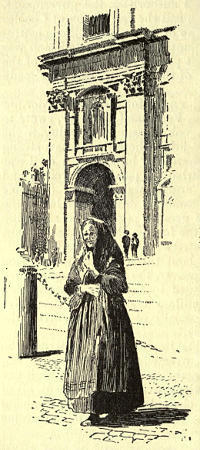
One of the Entrances to St. Peter’s, Rome
The allocution was the first backward step from the flag of national uprisal. Pius IX, therefore, soon became as much an object of hatred and enmity on the part of the patriots as he had before been their idol. In vain did he nominate the liberal champion Mamiani as president of the ministry, a position which as yet only clericals had held, and the historian Farini as under secretary of state; the feeling that the head of the church had been faithless to the national cause alienated the hearts of the Roman people more and more. He also had to endure the mortification of having his peace proposals rejected by Austria, proud over her new successes at arms. The reactionary coup d’état in Naples was regarded as the direct result of the allocution, and influenced the popular passions more and more against spiritual rule.
The clever Italian Rossi of Carrara, who had once taught law in Geneva, and had then occupied an influential position in Paris with Louis Philippe and Guizot, and had executed important diplomatic missions, was called by Pius IX to form a constitutional ministry, in order more tightly to seize the reins of government which threatened to slip out of the weak hands of the princes of the church. But, by his energetic measures against the increasing anarchy, Rossi so drew upon himself the hatred of the Roman democrats that at the opening of the chambers he was murdered on the steps of the senate on the very spot upon which Cæsar once fell.
Thereupon the unrestrained populace, led by the democratically inclined Charles Lucien Bonaparte, surrounded the Quirinal and forced the pope, through threats, to name a radical ministry, in which the advocate Galletti and the old democrat Sterbini had the greatest influence, next to Mamiani who had been recalled. From that time law and order disappeared from the holy city. The chamber of deputies was without power, and became so weakened by the withdrawal of many members that it was scarcely competent to form legal resolutions; the democratic popular club, together with the rude mob of Trastevere, controlled matters. Many cardinals withdrew; Pius IX was guarded like a prisoner.
Enraged at these acts and threatened as to his safety, the pope finally fled to Gaeta, in disguise, aided by the Bavarian ambassador Count Spaur. Here he formed a new ministry and entered a protest against all proceedings in Rome. This move procured at first the most complete victory for the republican party in the Tiberian city. A new constitutional assembly was summoned, which in its first sitting deprived the papacy of its worldly authority, established the Roman republic, and resolved to work for the union of Italy under a democratic-republican form of rule. A threat of excommunication from the pope was met with scorn by the popular union. A provisory government under the direction of three men undertook the administration of the free state, while the constitutional assembly laid hands on the church lands in order to form small farms out of them for the poor, and Garibaldi organised a considerable militia out of insurrectionary volunteers and democrats.
Garibaldi of Nice (born July 4th, 1807) was a bold insurrectionary leader who had wandered about in America and elsewhere as a political refugee for a long time, and who, on his return to his native country, had taken an active part in the struggle of the Piedmontese and Lombards against Austria. The unfortunate outcome of the renewed war in upper Italy, which had brought a large number of refugees to Rome, and the arrival of Mazzini, who for so long had been the active head of the “young Italy” party and the soul of the democratic propaganda, increased the revolutionary excitement in Rome. The union of revolutionary forces determined the powers protecting the papal states, whose help the pope had summoned, to common action and armed intervention.
THE FRENCH RESTORE THE POPE
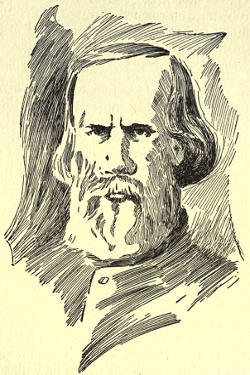
Giuseppe Garibaldi
(1807-1882)
While the Austrians after severe battles took possession of Bologna and Ancona, the Neapolitans from the south entered Roman territory, and a French army under General Oudinot, the son of the marshal, landed in Cività Vecchia and surrounded Rome, which was in a state of intense excitement. It was in vain that the French declared they came as friends, to protect order and legal liberty, to prevent Austrians and Neapolitans from occupying the papal state and its capital, and to forestall a counter revolution in favour of a reactionary and clerical movement; the democrats rejected the proffered hand of peace and propitiation, and prepared an obstinate opposition to the attacking enemy. The first assault of the French failed, May 2nd, 1849. After a brave fight against the insurgents, who were well placed and well armed, Oudinot, with severe losses, had to retreat to the sea and await reinforcements. In order to separate their opponents the triumvirs then entered into negotiations with the French general and decided on an eight days’ truce, which Garibaldi made good use of to attack the Neapolitan troops near Velletri and drive them back over the border (May 19th). Oudinot now began a new attack. But this time also they met with such determined resistance at the Pancrazio gate and in other places that they did not finally gain possession of the city, under treaty, until after weeks of sanguinary fighting (July 3rd). The barricades were at once cleared, the provisory government dissolved, and a foreign military rule established.
Garibaldi with his faithful followers climbed over the Apennines and after a thousand dangers and adventures escaped in a little boat to Genoa and from there to America. Of his companions the greater part fell into the hands of the Austrians; some of them were shot, others imprisoned in Mantua. Mazzini escaped to Switzerland, and when he was driven out from thence went to England where he continued his agitations. Pope Pius remained for a long time in his voluntary exile, and persevered in his anger towards the ungrateful city. Not until April, 1850, did he return. Quiet was preserved in Rome by a French garrison; only the bands of robbers who roamed through the country under desperate leaders bore testimony to the deep decay of social organisation, and to the impotency of the government.
REVOLUTIONS IN TUSCANY AND ELSEWHERE
The grand duke Leopold of Tuscany succeeded for a long time in keeping the favour of his subjects, by his liberal reforms, by banishing the Jesuits, and by taking part, although forced to do so, in the war against Austria. But here also the radical agitation finally succeeded in undermining the soil and in effecting the summoning of a constitutional assembly. By the activity of the demagogues public affairs soon fell into anarchy so that the grand duke found himself obliged to leave Tuscany with his family. The former ministers appeared at the head of the provisory government. In Leghorn the associates of Mazzini fanned the revolutionary fire. When the flames were too high, however, the conservative party put forth its strength and effected a revulsion of feeling. A moderate liberal government, under Gino Capponi, the Ricasoli brothers and others, took charge of affairs and invited the grand-duke, who had been residing in Gaeta, to return. He hesitated for some time until the Austrians under General d’Aspre had occupied Leghorn and the republican party had lost. Then only did Leopold re-enter his capital, Florence, and re-establish the old order (July 27th, 1849).
Duke Francis V of Modena, who had absolutistic inclinations, and Duke Charles of Parma, who had assumed the reins of government only a short time before, both of whom had placed themselves under Austrian military supremacy, did not succeed in withstanding the March storms. They left their states and attached themselves to Austria. Radetzky’s entry into Milan was for them also the day of return.
CHARLES ALBERT’S WAR WITH AUSTRIA
[1848 A.D.]
The most remarkable change in affairs was taking place in upper Italy. Charles Albert, king of Piedmont and Sardinia, a man with no steadfastness of character, had paid for the liberal sins of his youth by absolutism, but had then, in accordance with the spirit of the time, raised the flag of Italian nationality and independence, had granted a liberal constitution and summoned a patriotic ministry. He now thought the appropriate moment had come to gain the favour of the Italian people and the possession of the united kingdom of Lombardy and Venice, together with the dominion over Italy by a warlike incursion upon Austrian territory. United with the Lombards who had arisen against the Austrians after some hesitation, established a provisory government, and after an obstinate battle in the streets March 18th, 1848, and at the barricades of Milan lasting for several days had obliged the gray-headed field-marshal Radetzky to retreat with his troops; in alliance with the Venetians, who, after the liberation of their capital through the capitulation of the Austrian count Zichy, had joined the general national uprisal and supported by countless volunteers (Crociati) of middle Italy, Charles Albert marched against Mincio, advanced to the northern borders of Italy, and, after the victorious encounter at Goito (April 8th, 1848), threatened Peschiera, which with Verona, Mantua, and Legnago formed the celebrated “Quadrilateral” of fortification. Everywhere waved the tricoloured flag; most of the cities, with the exception of the strongholds of Mantua and Verona, joined the insurgents. The war took on the character of a crusade. The priesthood, from the newly appointed bishop of Milan down to the lowest brother, worked for the national cause, for the independence of Italy, and gave to the revolution the blessing of the church.
But soon the situation changed. On the 6th of May a sanguinary battle took place at Santa Lucia in which the Austrian army maintained the field against the enemy. The encounter at Santa Lucia was a turning-point in the war. Charles Albert began to doubt as to his reaching his end by arms and hoped to get better terms from the oppressed court at Vienna through the intervention of England. The source of the war between Adige and Mincio strengthened the king in his desire for peace. On the 11th of June the field marshal forced the city of Vicenza to surrender after a sanguinary battle, while the king of Piedmont occupied Rivoli, a place famous in the history of war, and undertook the siege of Mantua. The papal troops and volunteers were allowed free exit. At this time Garibaldi arrived in Charles Albert’s camp in order to take part in the war of independence. The Italians fought for freedom and nationality; the Austrians for dominion and military glory.
On the 25th of July, on a hot summer day Count Radetzky gained a victory at Custozza which established Austria’s military glory in the most brilliant fashion. The aged field marshal then advanced rapidly into Lombardy, driving before him the enemy, who were again conquered at Goito and Volta, and at the beginning of August he stood at the gates of Milan. Threatened by the mob and reviled and persecuted as a traitor, Charles Albert had left the city under the cover of night and accepted the armistice of Vigevino (August 9th, 1848) which he owed more to the generosity of the victor than to the intervening diplomacy of foreign powers. Radetzky, as gentle and humane as he was brave and powerful, stained his victory by no cruelty. A wholesale emigration made Milan a deserted city. Continued hostile demonstrations in the Lombard city made the measures of the Austrian governor more severe. Troops were quartered in the houses of the patriots; the palaces of prominent emigrants were turned into barracks, contributions were exacted, property of the nobles was confiscated. On the day after the conclusion of the truce Peschiera surrendered to General Haynau.
Thereby, however, the war between Sardinia and Austria was not concluded. The events in Vienna filled the Italians with new hopes; the efforts abroad to effect a peaceful solution between Piedmont and Austria came to nothing; the proposed congress in Brussels did not assemble; only a final decision by arms could dampen the inflamed spirits. Charles Albert, reviled by the people, pushed by the radicals, threatened by the republicans in his rulership, led astray by wounded princely pride, in his desperation formed the resolution to again try the fortune of war. In March (1849) a large Sardinian army, in which were several Polish leaders, crossed the Lombard border in order to make a second attempt to drive the Austrians out of Italy. But the sanguinary victories of the Austrian army at Montara and Novara March 23rd, 1849, put a quick stop to these undertakings and shattered the hopes of the Italian patriots.
CHARLES ALBERT ABDICATES: VICTOR EMMANUEL II SUCCEEDS
[1849 A.D.]
Charles Albert, despairing of his success but holding the feeling of his military and princely honour deep in his heart, abdicated in favour of his son, Victor Emmanuel II, fled from the land of his fathers and in distant Portugal sought a resting place for the short remainder of his days. He died in the firm belief that the power and future of Italy rested in the Piedmontese dynasty.g
Charles Albert, great only in misfortune, was not unworthy of magnanimous treatment and was now very willing to receive it. He had risked all to redeem the word pledged to the fatherland, and his plans of ambition and aggrandisement were frustrated and shattered, his sword and courage completely broken. Italy, both republican and reactionary, had left him alone on the place of election with his people; he feared and mistrusted the French Republic; he must have been tired of all the fine counsels, empty promises of England. He awaited death with calmness, and devoutly performed the last duties of the Catholic Christian; on the afternoon of the 26th of July, 1849, he succumbed to a third stroke of apoplexy.
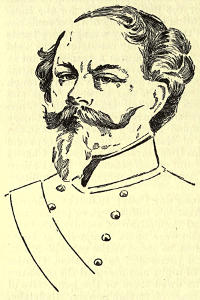
Victor Emmanuel II
(1820-1878)
The impression wrought by his death was that of an expiation, a sacrifice to the fatherland; his remains were brought to Genoa on the Piedmontese war vessel Monzambano. His body was worshipped as that of a martyr and saint, and thousands followed it to its grave on the lovely summit of Superga, eastward of Turin.
Besides his rare patience and courage, Charles Albert possessed no prominent intellectual qualities; if in the one sense he was a brave soldier, he also proved himself a very indifferent general. As a prince he had good intentions, but was wanting in all application, desire for instruction, and in determination to such a point that cunning and dissimulation were indispensable to him. Nevertheless he was a man, and the great dangers, the deep suffering which he had to undergo for a cause also borne by the noblest of the people, conciliated and glorified his memory; thus he left his successor and his state a very promising but weighty legacy.h
The young king Victor Emmanuel concluded a truce March 26th, 1849, with the victorious field marshal, but this aroused so much disfavour throughout the country that the chamber of deputies refused to ratify it and a revolt broke out in Genoa. Not until the treaty had been cancelled and the revolt put down by force, did the people succumb to the inevitable. The new chambers later confirmed the peace with Austria, which placed a great burden of debt on the country to pay for the expenses of the war. From that time the Sardinian kingdom advanced on the way of liberal reform and healthy internal development.
VENICE FAILS TO ACQUIRE FREEDOM
Only Venice, on account of the unconquerable security of its position, was able to resist the Austrian besieging army for months longer and to defy all attacks and attempts at conquest. Not until all hope of a happy outcome of the war had disappeared, after the defeat of the insurgents in all places, and not until the city had been reduced to a state of greatest misery through distractions within, and the enemy without, did Venice surrender to the Austrians under treaty. On August 30th, 1849, the field marshal made his triumphal entry into the city of lagoons. Manin, who had borne the greatest part in the heroic defence of Venice, fled to France, where, rejecting all proffered aid, he supported himself as an instructor in languages. The former dictator of Venice and the former prisoner of Spielberg, Pallavicino Trivulzio were the founders and creators of the Italian national union, in which the republicans and constitutionalists, in the fifties, rallied around the cross of Savoy for the liberation and union of the fatherland. Manin was not to live to see the day of Italy’s independence. He died on September 22nd, 1857. Ten years later his ashes were transported to Venice and buried in his liberated native city.
After the fall of Milan and Venice the double eagle spread its wings once more over the kingdom of Lombardy and Venice; in middle and upper Italy the banners of the legitimate rulers were once more erected and the Italian tricolours had a place only in Sardinia. Pius IX proclaimed his deep repentance for his sins of liberalism. However much foolhardiness and blind passion the Italian revolution may have brought to light, one point cannot be denied—the honour of the nation was rescued. For centuries the object of the scorn and contempt of other nations, the Italians showed that they also knew how to bear arms; and although this time also it was no less their own lack of order than the military superiority of their opponents which caused their surrender, yet by this uprisal the hope was awakened and strengthened that for them also the day would dawn, upon which national unity and legal freedom would lay the foundation of a happier and more worthy popular life.
After the defeat of their attempt to obtain liberty the patriots recognised the necessity of a closer union with the Sardinian-Piedmontese royal house, under the flag of which the organisation of a united Italy could alone be hoped for. This idea was seized by no one with greater zeal than by the former dictator of Venice, Daniele Manin, during his exile in Paris.
By means of pamphlets and newspaper articles, in union with Pallavicino, he sought to prepare his countrymen for a fresh national uprisal under the cross of Savoy. A propaganda of which “the head was Manin, the arm Pallavicino” worked for the realisation of the principle: “Independence and unity under Victor Emmanuel, king of Italy.” The fruit of this national movement was the Italian national union. Manin did not live to see its result, but his ideas kept gaining new followers. In La Farina the patriotic club obtained a more active and fiery co-labourer. Introduced to Cavour by Pallavicino, the active Sicilian undertook the rôle of mediator between the minister and the national union.
The propositions of Cavour, though not given the sanction of the congress, were made the programme of all the reform parties in the Italian peninsula. Piedmont which numbered, including Savoy and the island from which the kingdom took its name, scarcely five million inhabitants, could hope to form one member of the great Italian federation only after it had succeeded in breaking the rule and influence of Austria. All attempts to free Italy by force of arms having hitherto met with ill-success it was seen that Austria must first be spiritually undermined and weakened before recourse was again had to the sword. When Austria, setting its faith according to custom in the power of the bayonet and the influence of the clergy, sought to keep the people in subjection by means of spiritual pressure and a carefully organised police, Sardinia followed exactly the opposite course and weakened the power of the clergy, introduced greater political freedom and endeavoured in every way to win the confidence of the Italian people. Reforms were instituted in the system of taxation, foreign traffic and commerce were encouraged, the number of convents was reduced, and freedom of the press was allowed. In all these measures Cavour, as minister of commerce, was the moving spirit. The army was strengthened in important points, the fortification of Alexandria was begun, and the land defences all over the kingdom were placed in a state of readiness.
[1854-1857 A.D.]
In March, 1854, the despotic voluptuary Duke Charles III of Parma, who hated democrats and patriots and mistrusted all people of culture, was murdered in the open street, and two years later the prison-director Cereali, and the war-auditor Bordi, both objects of popular hatred, were assassinated in the same manner. Most terrible of all was the situation in Naples and Sicily, that part of the world fashioned by nature to be a paradise, but turned by man into a place of damnation. Ferdinand II made use of the years of European reaction to stamp out every inclination toward freedom and equal rights among his people, to fill the prisons with his political adversaries and to carry on all over his realm, a rule of despotism in which the spy-system, and judicial and official tyranny came to full luxuriance of growth. The king witnessed from his balcony the placing in chains by a special flogging-committee, of the political prisoners who numbered, it is said, from first to last 22,000.
In November the former member of parliament, Baron Bentioigna, headed an insurrection to force the readoption of the constitution of 1812, but he was defeated by the king’s troops and afterwards shot with many of his companions. In December the life of the king was attempted by a Mazzinist soldier. Armed bands, united in a secret society called the “Camorra,” perpetrated robbery and murder through all the land. Not daring to remain longer in the capital the king moved with his family to the castle of Caserta, which he kept closely guarded, allowing entrance to none but his most intimate friends. The presence of Mazzini in Genoa in the summer of 1857 brought the excitement over the whole peninsula up to fever-heat and led to several serious attempts at insurrection in Leghorn, Naples, and Capri. These insurrections were suppressed, but the causes of the discontent still remained, and the rebellious spirit was only the more ready to assert itself again at the first favorable opportunity.
LOUIS NAPOLEON’S INTERVENTION
[1857-1859 A.D.]
That war between Sardinia and Austria was merely a question of time became apparent to everyone toward the end of the fifties. Fortunately for Sardinia, Austria’s position was an isolated one owing to the enmity which her attitude during the Crimean War had won for her from Russia, and her inborn jealousy and distrust of Prussia. The many-headed German confederation was not in a position to interfere in political questions of world-importance, and it was Napoleon’s most earnest endeavour to reconcile Russia with France and Sardinia that a restoration of the alliance which had received its death-blow in the Crimean War might be made impossible for the future. It was not long before Russian men-of-war were to be seen in the Mediterranean, and Napoleon’s efforts on behalf of France were no less successful. The cautious emperor Napoleon might not have been so ready to champion the weaker side had it not been for the attempt on his life made by Orsini, as described in volume XIII.
The emperor had once held close relations with the Italian patriots, had even been a member of an Italian secret society, and now, regarded by his former associates as a traitor to their cause, he was condemned by them to death. In February a letter written by Orsini was made public in which he adjured the emperor to restore to Italy the independence it had lost in 1849 through France’s fault; to free it forever from the Austrian yoke. “Without Italian independence,” the letter closed, “the peace of Europe, even your majesty’s own safety is but an empty dream. Free my unhappy fatherland and the blessings of twenty-five million people will follow you into the next world.”
On the 13th of March Orsini and Pieri perished on the scaffold, the two remaining accomplices having been deported to America. The courage with which Orsini met death, and the love of country he manifested up to his last breath aroused universal sympathy. What Orsini living had failed to bring about, he accomplished dead. While the murderous attempt was made the pretext for robbing France of all freedom by means of the security law of the 28th of January, Napoleon in conjunction with Cavour—who with artful smoothness calmed his imperial associate’s anger toward Italy, the hotbed of conspiracies—proceeded to carry out the wishes of Orsini.
Several weeks later Cavour held a secret conference with Napoleon at which plans regarding Italy were perfected. “Italy to be free as far as Adria; the whole of upper Italy to be united in a kingdom, France to be enlarged by the annexation of Savoy,” these were the terms agreed upon in the interview. It was further proposed that the bond between the two reigning houses should be made still firmer by the betrothal of Prince Napoleon Bonaparte with Clotilde, the daughter of Victor Emmanuel.[32]
AUSTRIA DECLARES WAR: MAGENTA AND SOLFERINO
In 1859 war was brought close in sight by Victor Emmanuel’s announcement at the opening of the chamber of deputies in Turin that Sardinia could no longer remain insensible to the cries for help that were arising on all sides. Austria proceeded at once to strengthen her army, to place the whole of Lombardy under martial law, and by every means possible sought to secure her power and possessions in Italy. Austria was severely blamed by the neutral powers for beginning hostilities, and it seemed as though with the death of Field Marshal Radetzky Austria’s military star had set forever. To Franz Gyulay, a member of the Hungarian nobility who had filled many offices but had in none of them given proofs of marked ability, fell the command.
[1859 A.D.]
By shameful inactivity the Austrians allowed the Sardinians time to concentrate their 80,000 men around the fortress of Alessandria, where they were joined in May by several divisions of French troops, Garibaldi, meanwhile, with his “Alpine hunters” guarding the foot of the mountain whence he could harass the right wing of the Austrians and support the operations of the main army. The popularity of his name drew volunteers to his banner in flocks, and his appearance in the northern lake-region aroused the wildest enthusiasm among the people. About the middle of May Napoleon himself arrived in Italy; although he left the actual lead to able and experienced generals, he took his place at the head of the troops.
Count Stadion, sent out to reconnoitre with 12,000 men, came upon the French near Montebello May 20th, 1859, and was forced to retreat. The battle of Magenta followed, June 4th, in which the victory fell to the French.[33] The bravery of the Austrians in this engagement, although they suffered from the greatest lack of necessary equipments, excited the admiration even of the enemy. Never did the defects of the Austrian administration become so glaringly apparent as during the campaign in Italy. Lombardy was the prize at stake in this battle of Magenta. Gyulay, incapable of rallying his scattered forces for a new attempt, immediately gave orders for a general retreat. Milan was evacuated in the next two days so hastily that the movement bore the character of a flight, the fortifications around Pavia and Piacenza were blown up, and the army of occupation was recalled from all its garrisons.
On the 8th of June, Napoleon, at the side of Victor Emmanuel, made a triumphal entry into Milan, where he addressed the people in high-sounding speeches, the Austrians, meanwhile, continuing their retreat as far as the Mincio, where they took up a new position in the middle of a quadrangle of fortifications, Peschiera, Verona, Mantua, and Legnago.
The misfortunes that had befallen Austria confirmed and strengthened Sardinia in its ideal of Italian unity, and helped to bring about the fall of the lesser Italian sovereignties. In April the archduke Leopold of Tuscany had been forced to leave Florence and place himself under the protection of Austria. A provisory government was established under the protectorate of the king of Piedmont. But this arrangement did not meet Napoleon’s views. His secret design was to give the Tuscan throne to his cousin, Louis Napoleon, the son-in-law of Victor Emmanuel, that there might gradually grow up in Italy a circle of states tributary to France which would hinder the dream of Italian unity from ever being realised.
Unionist enthusiasm had already burned too high, however, for political or diplomatic schemes to avail against it. All over the land the flag of united Italy was raised, and conjunction demanded with Sardinia. Bologna declared itself free from the pope and invoked the dictatorship of the king of Sardinia. Many other cities of the pontifical state followed this example, indeed the greater part of the pontifical possessions would have fallen away from Rome had not the terrible storming of Perugia by the pope’s Swiss guard spread such dismay that Ancona, Ferrara, and Ravenna for a while remained true.
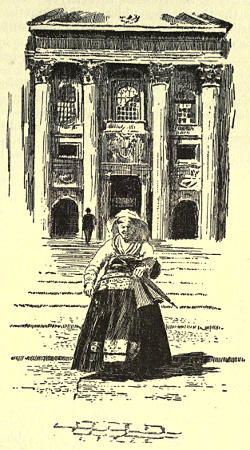
Pilgrim at St. Peters, Rome
When Austria became convinced that from neither Prussia nor Germany was help to be expected, it determined to try again single-handed the fortunes of war. Following the example of Napoleon the emperor Francis Joseph led his troops in person, and the incapable Gyulay was allowed to sink into oblivion. But even under the new leaders Austria’s operations were not crowned with success; the second encounter with the allied troops which took place beyond the Mincio resulted in a defeat for the Austrians—once more on account of serious strategical errors.
Napoleon, informed of the weak points of this position, sent his main column against the defective centre which occupied a hill near Solferino. After a murderous battle, June 24th, 1859, the height was captured by the French, despite the heroic resistance of the Austrians, and the imperial army was divided into two parts. A second blow struck by Napoleon near Cavriani met with a like success, the Austrian leaders having issued conflicting orders that brought the troops into much confusion. Benedek, who had twice repulsed the Sardinians near San Martino, continued the battle several hours after it was practically lost to the Austrians; then a severe storm came up which enabled them to retire in good order. In this engagement Marshal Niel distinguished himself above all the other leaders on the French side. It was a bloody day, with a loss of 13,000 resulting to the Austrians. On the side of the allies the loss was even heavier owing to the greater peril to which they had been exposed in attacking the height. The victory of Solferino was a fresh leaf in the laurel-crown of France, and contributed not a little to confirm Napoleon in possession of the throne.
For various reasons Napoleon, a man of caution and, self-control, determined to soften as much as possible the sting of defeat to his humiliated foe, and despatched to Francis Joseph proposals of truce which were accepted and confirmed at Villafranca. Three days later a personal meeting took place between the emperors at which the preliminaries of peace were arranged. Napoleon represented earnestly to the young Francis Joseph how isolated Austria stood among the nations. It was agreed that Lombardy should be ceded to France with the exception of Peschiera and Mantua, that Italy should form a confederacy of states under the general direction of the pope, and that the restoration of the sovereigns of Tuscany and Modena, stipulated by Austria, should take place unhindered. For the final settlement of these points, plenipotentiaries from both realms were to meet at Zurich.
The terms of peace agreed upon at Villafranca, and ratified in all essential respects at Zurich, dealt the death-blow to Austria’s influence in the Apennine peninsula, and laid the foundation, to an extent far exceeding Napoleon’s expectations, for the national unity of Italy. The rest could be left in the hands of the Italians themselves. Far from restoring their former masters to the throne the subjects of the expulsed or fugitive princes hastened to confirm in a general assembly the disposition of the old dynasties, and annexed themselves to Sardinia.
THE PAPACY VS. UNITY
We have seen how, before the battle of Solferino, Modena and Parma as well as Tuscany had declared in favour of union with Piedmont. After the Peace of Villafranca the states south of the Po united under Garibaldi in a military league which had for object the repulsion of all attacks from without and the hindrance of all attempts at restoration on the part of the particularists and reactionists within. Even Bologna and a great part of the Romagna withdrew from the pontifical state and petitioned Victor Emmanuel to take them under his protection. This request was not refused however hot might be the wrath of the holy father. Under the leadership of D’Azeglio the necessary steps towards union with Sardinia were taken throughout Romagna, and by New Year of 1860, a specially established ministry deliberated on the affairs of the new-fledged state of middle Italy, to which was given the name of Emilia, from the old Via Æmilia of Rome.
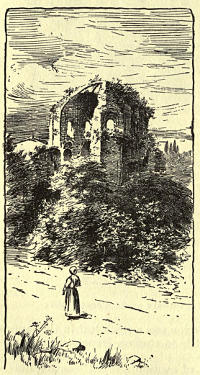
Ruins of a Temple of Minerva
Neither the curses of the Vatican nor the wrath of the ultramontanes all over Europe could retard in the least degree the march of events. Although the confederation decided upon at Villafranca and Zurich was never made a fact, owing to the disinclination of Austria and the pope to institute the necessary reforms, the neutral attitude maintained by England and France yet materially assisted Italy to realise her dream of national unity. Towards the end of 1859 a pamphlet published in Paris entitled Pope and Congress first startled the world with the thought that it was time the temporal power of the pope should cease, that his rule ought hereafter to be confined to the precincts of Rome itself. This naturally threw the whole Catholic world in an uproar, and elicited from the pope repeated violent denunciations, yet in the course of time the idea became an accomplished fact. Napoleon had never forgotten that the holy father had refused him consecration at the time of his coronation.
[1860-1861 A.D.]
The union of the middle Italian state’s with Sardinia was the forerunner of all those “annexations” which was soon to transform completely the character of the peninsula. Napoleon was willing to permit the expansion of the upper Italian kingdom provided Savoy and the countship of Nice be ceded to France. From the time of Cavour’s resumption of his place in the ministry in January, Napoleon and the crafty minister exerted every art known to diplomacy to bring about the end they had in view. At last in March, 1860, the popular vote was obtained which gave Savoy and Nice to France and made Tuscany, Parma, Modena, and the Roman legations a part of the kingdom of Sardinia. The pope excommunicated all who had taken part or even connived at this despoliation of Rome; but the papal bull, once so formidable a weapon, had in the course of time lost much of its early terrors. The 2nd of April witnessed the opening of the first Italian parliament, in which were representatives not only from Sardinia and Lombardy, but from Tuscany, Modena, Parma, and the Roman legations. “Our fatherland is no longer the Italy of Rome,” declared the crown speech, “nor of the Middle Ages; neither shall it be the arena wherein shall meet for combat the ambitions of all nations. Now and forever it is the Italy of the Italians.”
GARIBALDI DRIVES THE BOURBONS FROM SICILY
With the Peace of Zurich and the “annexation” that followed closed the first act in the drama of Italy’s freedom. The way had been paved thereto by the conviction that had gained ground among the cultivated classes since 1848 that only by a union of the whole country under the constitutional monarchy of Sardinia could any stable and permanent national position be obtained. To accomplish this end all the revolutionary and nationalist forces made common cause, and chose as their scene of action the kingdom of Naples and Sicily, which had lately passed into the hands of Francis II, the inexperienced son of Ferdinand II. The French and Russian ambassadors had in vain endeavoured, after the Peace of Villafranca, to bring about an alliance between Naples and Piedmont, thinking thus to frustrate all the efforts of the revolutionists; but the policy of tradition, which persisted in placing trust in Austria, prevailed even with the new king. By his refusal to espouse the cause of Italian unity Francis II precipitated the fall of the Bourbon dynasty and the dissolution of the Neapolitan-Sicilian kingdom.
The project of attacking a kingdom that had at its command a well-organised military force of 150,000 men was indeed a bold one; but tyranny had prepared the ground for the operations of the secret societies, and the indifference with which the warnings of the French and Russian ambassadors were received, together with the dismissal of the Swiss mercenaries, robbed the throne of its strongest and most trustworthy support at the precise moment when Garibaldi and his associates had planned to strike a decisive blow.
On the 6th of May Garibaldi set sail with 1,062 volunteers from Genoa without suffering any hinderance from the Sardinian authorities, and on the 11th of May landed at Marsala, on the west coast of Sicily. To the protest of the king of Naples and of the German courts against the impunity allowed a band of “sea-robbers,” Turin made reply that since the expedition was a private enterprise undertaken by Garibaldi and his associates, the Piedmontese authorities had no right to interfere. Before Garibaldi’s departure, however, Cavour had written to Persano: “We must support the revolution, but it must have all the appearance, in the eyes of Europe, of a volunteer enterprise.”[34]
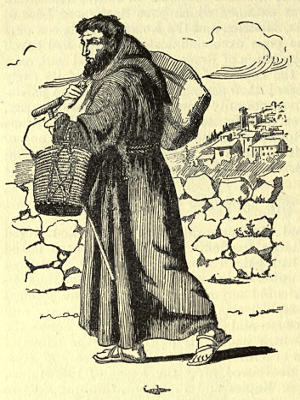
Lay Capuchine Friar
After Garibaldi had disembarked with his immediate followers he withdrew to the mountains and gathered about him, near Salemi, the scattered fragments of his volunteer corps. On the 14th of May, when the number of men had increased to 4,000 he issued a proclamation in which, in the name of Victor Emmanuel, king of Italy, he declared himself dictator over the realm of Sicily.
After several successful encounters with the king’s troops Garibaldi pressed towards the capital by way of Calatafimi and Misilmeri, keeping his confederates informed of his movements by means of watch-fires at night. On the 27th of May he stood before Palermo and immediately gave the signal for attack. In a few hours the city, whose population had risen with one accord to support the invaders, had nearly passed into the hands of Garibaldi, when General Lanza, who had been despatched to the island by the young king with an important force, caused the city to be so heavily bombarded by the citadel and ships of war in the harbour, that the next day more than half of it lay in ruins. By the intermediary of the English admiral a truce was arranged which ended with the withdrawal of the Neapolitan troops and ships, and the delivering over of the city to the revolutionists.
Almost incalculable were the effects of these events in Palermo. By them the monarchy was shaken to its base and the name of Garibaldi carried into every corner of the world. At the court of Naples confidence was totally destroyed. In vain the king sought to prop his tottering throne by restoring the constitution of 1848.
Six weeks after the victory at Palermo the “dictator” Garibaldi set sail for Messina without having fulfilled the expectations of Turin that he would announce the annexation of Sicily to Sardinia. In three days he took the fortress of Milazzo, and shortly after the commander of Messina effected a truce by the terms of which the city, with the exception of the citadel, was to be evacuated by the Neapolitan troops. Europe learned with astonishment of the first rapid successes of the great agitator, but his exploits on the mainland were to excite still greater wonder. His further progress through the southern part of the peninsula was one long triumph; nowhere was resolute opposition offered him. On the 5th of September he arrived at Eboli, not far from Salerno. The very name of Garibaldi exercised a potent spell over the people; to them he appeared as the instrument of God on earth, the discharger of a providential mission.
On the 6th of September Francis II left Naples and withdrew, with the 40,000 men who still remained to him, to the fortresses of Gaeta and Capua. The day following Garibaldi made his formal entrance into Naples in the midst of the acclamations of the people. He established a provisory government, but still deferred sending news of annexation to Piedmont. The leaders of the radical parties had filled the popular demi-god with distrust against the policy of Cavour and it was not until he was joined by Pallavicino, the martyr of Spielberg, that he again made common cause with the unionists. The foreign powers preserved a strictly neutral attitude throughout, and Napoleon’s efforts to effect the united intervention of France and England failed before the determined resistance of Palmerston and Russell.
While these events were in progress the excitement of the Italian people reached fever-heat. The fall of the Bourbon dynasty in Naples, which was now seen to be imminent, would make the union of the Apennine peninsula under the sceptre of Victor Emmanuel almost an accomplished fact. The boast of Garibaldi that from the Quirinal itself, its national capital, he would announce the birth of the United Italian kingdom, found an echo in the hearts of the people who made it apparent in every way that they would be satisfied with no less a victory. But the papal government at Rome opposed threats of excommunication to every effort of the French emperor towards reform, and a cry of horror arose from the devout all over Europe at the danger to which religion would be exposed should there be any further encroachments upon the temporal power of the pope.
There were thus but two ways left open to Napoleon; either to allow the Italian revolution to have free play, in which case Garibaldi would without doubt make an end of the temporal supremacy of the pope and select Rome as the capital of the Italian kingdom, or to permit an alliance between Garibaldi and Victor Emmanuel whereby a natural limit would be placed to the revolution, and the danger that Mazzini and the “Action” party might gain the upper hand would be removed. Napoleon chose the latter course. There is little doubt of his having sent word to the king that the latter might add Umbria and the Marches to his realm, and send his forces to occupy Naples provided he would leave Rome to the occupation of the French. However this may be, in the early days of September two divisions of the Sardinian army, under the minister of war Fanti and General Cialdini, drew near the border of the papal states.
The entrance of the Piedmontese troops was the signal for a general uprising of the people. In Pesaro, Montefeltre, Sinigaglia, and Urbino provisory governments were established, and deputations were sent to Turin. The Sardinian field-marshal laid before General Lamoricière and the papal court the demand that the people should be allowed to follow their will in all the papal states; this being rejected with indignation General Fanti advanced into Umbria, while Cialdini proceeded to the occupation of the Marches. On both sides great bravery was shown, but the papal troops were finally defeated and put to rout. Lamoricière fled with only a handful of followers, to Ancona which was obliged to surrender, after having been besieged by Cialdini on the land side and by the Sardinian admiral Persano from the sea. A few days later Victor Emmanuel arrived in Ancona and assumed command in person of all his forces.
The intention of the king in taking over the command of the army had been to effect, in conjunction with Garibaldi, the conquest of the kingdom of Naples. The attempt on the part of the volunteers to press forward as far as Capua had been balked by their defeat at Cajazzo. Although the open and straightforward revolutionist leader had little liking for Cavour, the man of devious ways and unidealistic views, he felt himself drawn by many common qualities towards the king in whom he beheld the “liberator” of Italy. Thus it was not difficult for his friend Pallavicino to induce him to adopt for his watchword, “One undivided Italy under the sceptre of the house of Savoy.” When Victor Emmanuel took up his position at the head of the united troops in Sessia, Garibaldi laid at his feet the dictatorship of Naples, and transferred to him the mission of making Italy free and giving her a place among the nations of the earth. “I am ready to obey you, Sire,” he said; then, after riding into Naples at the side of the king and commending his followers to the monarch’s favour and protection, he retired to a small property he possessed on the lonely island of Capri, refusing all honours and rewards. This was the greatest moment in the agitated life of the Italian patriot, the one in which he achieved the conquest of himself.
From now on, the war operations assumed a more definite character. After the capture of Capua by the Piedmontese and Garibaldians, King Francis, with the remnant of his best troops, was driven into the fort of Gaeta, while Victor Emmanuel, after a visit to Palermo, took possession of the double kingdom of Sicily and disbanded the Garibaldian troops, dismissing some of them to their homes and taking others into the Sardinian army.
Gaeta had now become the last bulwark of the kingdom of Naples and the Bourbon dynasty. The valorous defence of the sea-port town, during which the unfortunate young queen Maria of Bavaria displayed remarkable heroism, was afterward to constitute the one praiseworthy period in the short regency of Francis II.
The appeals for help of the beleaguered Bourbon king to the different powers of Europe failing to bring about any armed intervention, and his manifestos addressed to the Sicilian people resulting in no uprisings in his favour, lack of food and ammunition finally compelled the king to capitulate. On the 13th of February, 1861, he embarked on a French ship for Rome where he resided for the next ten years, constantly supported by the hope that his partisans in Naples would bring about a counter-revolution which would reinstate him on the throne. The following month the citadel of Messina also surrendered to General Cialdini.
With this event the kingdom of both Sicilies came to an end, and the supremacy of the Bourbons was forever destroyed in the beautiful peninsula. On the 18th of February, King Victor Emmanuel assembled in Turin about his throne representatives from all those states which acknowledged his rule, and with their joyful acquiescence adopted for himself and his legitimate descendants the title of “king of Italy.” (Law of March 17th, 1861.) The protests of the dethroned princes as well as of the pope and the emperor of Austria were received as so many empty words.
In this manner the impossible had been accomplished; the various states of Italy with the exception of Austrian Venice in the northwest and the papal city of Rome with its surroundings, had been united into a single kingdom. Cavour’s statecraft, Victor Emmanuel’s firmness and decision, Garibaldi’s patriot devotion, the political tact shown by the educated classes, had all contributed to bring about the wonderful result; and now that it had been brought about, equally powerful factors would be needed to make permanent the newly acquired possessions of freedom and unity.
A safe and satisfactory solution of the “Roman question” could be attained only by gradually accustoming the Catholic world to the idea of the separation of the spiritual power from the temporal. According to Cavour’s idea the papacy should be relieved from all obligations of worldly rule that it might the better achieve the full glory of its special mission—the spiritual guidance of Catholic Christendom. “A free church is a free state,” was the watchword of the question as understood by Cavour; but an offer which he made to the pope embodying those conditions was indignantly refused; it would be indeed a work of time to reconcile the Catholic world to the idea of a church without territorial possessions.
THE DEATH OF CAVOUR AND THE REVOLT OF GARIBALDI
Such being the condition of affairs the seditious utterances of a band of agitators calling themselves “Italians of the Italians” caused Cavour no little trouble and annoyance. Garibaldi himself, who had passed the greater part of his life in arms against monarchical power, and who in his idealism and self-sacrificing love of freedom and country was incapable of seeing existing conditions exactly as they were, was not a stranger to some of these new revolutionary movements. On the 20th of April, 1861, he appeared in the Turin parliament to condemn the action taken in disbanding his army of volunteers, and to protest against the treatment accorded some of his former comrades-at-arms. He was finally pacified and induced to return to his lonely island life by the persuasive representations of Cavour.
Shortly afterward, June 6th, 1861, occurred the death of Count Cavour, the greatest statesman the world had seen since Cardinal Richelieu. He was but fifty-one years of age, and his untimely end was undoubtedly brought about by overwork and the feverish anxiety in which his later years were passed. “For twelve years,” he declared, “I have been a conspirator in the cause of my country’s freedom—a most unique conspirator; I have avowed my aim in parliament and in every court of Europe, and now at the last I have for fellow-conspirators twenty-five millions of Italians.” His life-work had not quite reached completion, his last idea was little more than the vision of a dream; but he had at last the satisfaction of seeing his own creation, the young kingdom of Italy, advancing on the road to maturity.g
The chief thought which had haunted him in the midst of his delirium was the south. “Oh! there is great corruption down there, but it is not their fault, poor things. The country is demoralised but it is not by hurting it that it will improve.” And above all that the state should not force itself upon it, nor impose upon it the means of absolute governors. This was the chief thought of his brief illness and it was also his political testament. To-day after many years the boundless faith placed by the great minister in the salutary influence of liberty has been solemnly confirmed by the facts. The south relinquished brigandage and accomplished the work of annexation without ever veiling the statue of liberty.
The highest praise that can be given to Count Cavour was made by a great statesman whose name was not less celebrated than that of the great minister, Lord Palmerston. “The name of Cavour,” he said before the British parliament, “will always live, and will be embalmed in the memory, in the gratitude, and in the admiration of the human race. The story of which he is the ornament is truly wonderful, and the most romantic in the annals of the world. We have seen a people under his direction and authority wake up from the sleep of two centuries.”c
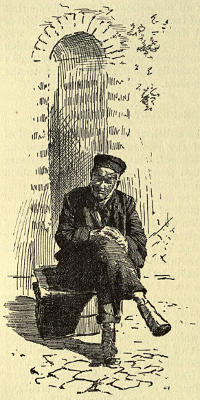
Pedler, Modern Rome
[1862-1863 A.D.]
It behoved Cavour’s successor, Ricasoli, to follow closely in the footsteps of his illustrious predecessor and confine his attention to the interior up-building of the state. He repeated Cavour’s attempt to negotiate with Rome for the establishment of a free church in a free state, but the Florentine statesman was looked upon as almost a foreigner by the papal advisers, and France unqualifiedly rejected the intervention he proposed. He resigned his office in March, 1862, whereupon Rattazzi was appointed head of the ministry.
The first official acts of the new minister were to take back into the army Garibaldi’s former volunteers, and to proclaim that the parliamentary decree of March 27th, 1861, which designated Rome as the future capital of the kingdom, must be carried out. Garibaldi being summoned from his island to assume the lead in all these undertakings the “Action” party were again fired with revolutionary ardour. Not only Rome and Venice were to be conquered, but all the Italian-speaking populations of the Tyrol and the other side of Adria were to be united under the banner of the new kingdom. Soon the tide of agitation swelled so high that the administration saw itself obliged to take strong measures to protect the country from a general war. Among the most turbulent leaders who were taken prisoners were many friends and followers of Garibaldi.
It was a misfortune for Italy that no regular sphere of activity was offered this devoted patriot in the interior administration of his country, where his high and noble qualities might have been utilised without much power of initiative being left to his defective political sense. He determined now to repeat against Rome the course of procedure that had succeeded with Naples two years ago. He set sail from Genoa and landed at Palermo where a large force of armed volunteers crowded under his banner, thirsting to strike some decisive blow that would shake from Italy the last survival of foreign rule, and to win for the kingdom its natural capital. Inasmuch as a rumour was spreading abroad which might find credence in foreign countries that the administration was secretly shielding the undertaking, and as Napoleon himself had threatened to occupy Naples if the Turin cabinet did not at once take steps to crush the revolutionary movement, the king now issued a proclamation declaring all men traitors to the flag of Italy who overstepped the limits of the law and participated in any unwarrantable act of violence or aggression.
Nevertheless, Garibaldi persisted in his design which was to “enter Rome as a conqueror or die within its walls.” On the 24th of August he landed at Melito, and passing Reggio whose strong fortifications he did not venture to attack, advanced at once into the Calabrian mountains. Meanwhile, General Cialdini had despatched a division of the main army under Colonel Pallavicini, in pursuit of the volunteers, and at Aspromonte a serious encounter took place. Garibaldi, wounded and taken prisoner, together with many of his followers, was brought back in a government steamer to Barignano, on the Gulf of Spezia, where he endured a long and painful malady.[35]
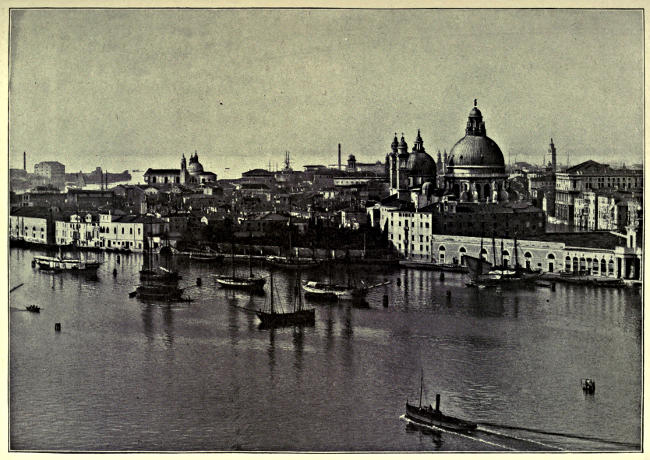
VENICE TO-DAY
FLORENCE BECOMES THE CAPITAL
[1863-1866 A.D.]
After several fruitless attempts on the part of French diplomats to bring about some kind of an understanding between the pope and Victor Emmanuel, an agreement was entered into by France and Italy, according to which the royal residence was to be transferred from Turin to Florence, and the French troops of occupation were gradually to be withdrawn from Rome. With the pope it was agreed that no hindrance should be placed in the way of the organisation, by the papal authorities, of an army which should be sufficiently large to support the authority of the holy father and to preserve peace in the interior and on the borders, but not large enough to offer resistance to the army of the king.
The provisions of this “September convention” aroused great dissatisfaction in Turin. Let Rome be chosen as the national capital and no outcry would be raised, but why should the Piedmontese be expected to make a sacrifice in favour of Florence? Sullen displeasure soon gave place to open protestations and street excesses. Instead of trying to put down the disturbance by mild measures the ministry made the mistake of using harsh ones. A great number of rioters were killed or wounded. The distress of the city, which had so long been loyal to himself and his house, pained the king deeply; and dissolving the present ministry he gave the formation of a new one into the hands of General Lamarmora, a Piedmontese by birth.
Peace succeeded quickly upon this change, but the city was none the less obliged to undergo its fate. During the following month parliament decreed the transfer of the royal residence, and preparations were at once begun for moving the court and all the paraphernalia of government to the ancient city on the Arno. On the morning of the 3rd of February, without notice or farewell, Victor Emmanuel left behind him his former capital and proceeded to Florence, where he was henceforth to have his abode.
Anger was felt in Rome that France and Italy should have held a convention without seeking the co-operation of the pope. The latter, to show how few concessions he was willing to make to modern ideas, shortly after astonished the world by publishing an Encyclica and Syllabus in which, in an array of maxims and admonitions, he condemned and cast aside as worthless all the attainments of modern times in the different fields of philosophy, science, and religion. These remarkable expressions of belief, revealing as they did a degree of enlightenment not far exceeding that of the Middle Ages, made plain to the world how hopeless would be any attempt to come to an understanding with the man who could frame them, and how unwilling and morally incapable he was of recognising the rights and necessities of present-day humanity.
The Italian chamber of deputies proceeded in its very next session to institute further changes and reforms. Civil marriage was introduced, the suppression of convents, as well as the secularisation of churchly possessions, was decided upon, and the abolition of capital punishment was proposed. In spite of the difficult financial position in which the kingdom was placed as a result of the war of freedom in which it had been engaged, and the expenses consequent upon its reorganisation, Victor Emmanuel declared his readiness to assume a great part of the Roman debt provided the papacy would give its recognition to the new state. This attempt met with the same success that had attended all others: to every overture the pope opposed his usual reply, “Non possumus.”g
THE WAR OF 1866 AND ANNEXATION OF VENICE
Italy still looked with hungry eyes at the rich Venetian territory which still remained to Austria. In 1866 Prussia and Austria fell into disputes which culminated in war, as described in the histories of Austria and Prussia. In March, Prussia was glad to secure the alliance of Italy, promising to continue war until Austria gave up to Italy the whole mainland of Venice except the city itself and the quadrilateral of fortresses. June 20th Italy declared war on Austria, which sent an army of 180,000 into the peninsula, and 27 ships. Against these Italy raised 300,000 men as well as a fleet of 36 vessels. The quadrilateral, however, gave the Austrians an excellent base, as Bertolinic says, as well as a formidable bulwark. The Italians lacked strategists, and though the king and Prince Humbert [Umberto] led them, they met with no success. March 24th they were surprised with loss, and at Custozza where, according to Bertolini,c they had only 52,000 men to the Austrians’ 75,000, they fought a drawn battle, but retreated after a loss of 3,000 men and 4,000 prisoners. Garibaldi’s volunteers, after some slight success at Monte Suello July 3rd, were surprised and completely routed at Vezza, July 5th. He retrieved his fortunes, however, at Ampola (July 16th-19th), Bezzea and Lardaro (July 21st), when word came of an armistice. The navy was also badly defeated at Lissa, July 17th. Admiral Persano on July 18th bombarded the Austrian shore batteries, but although he succeeded in temporarily silencing most of the guns he was unable to effect a landing. Two days later the Austrian fleet appeared in the harbour and at once gave battle to the Italian fleet. In this fight the Italian admiral seems to have lost his head completely, and to have given either conflicting orders, or no orders at all. The result was a complete victory for the Austrians.
The Prussians had, however, gone from victory to victory, finally reaching the triumph of Sadowa, or Königgrätz, July 5th. Austria in despair and in need of troops made Napoleon III a present of Venetia. The Italians felt it an “ignominy” to accept Venetia as a gift from the French, but finally terms were agreed upon with Austria direct, by which Italy received all the Venetian provinces, and the Iron Crown of the Lombards, the freedom of service of all Lombards in the Austrian army. Italy assumed the Lombardo-Venetian debt of 64,000,000 francs and agreed to pay 35,000,000 francs to Austria. October 19th, 1866, the Italian flag was hoisted on St. Mark’s. A plebiscite was taken and 647,384 citizens voted for the union under the constitutional monarchy of Victor Emmanuel, while only 69 voted against it. November 7th Victor Emmanuel made his formal entry into Venice amidst great enthusiasm.a
FOOTNOTES