Chapter XVII · ITALY IN THE EIGHTEENTH CENTURY
Reading edition
[1701-1800 A.D.]
Italy’s condition when she left the death-stricken hands of the dynasty of Charles V made a lively impression on her new sovereigns. It showed what could be done towards the unhappiness of a country by foreign rule—a rule which only thought from day to day of gathering fruits of conquest, without even trying to assure those of the morrow.
For a century and a half the governors of Milan and Naples, and following their example the independent sovereigns, egoists, or oppressors, with rare exceptions, had allowed ancient evils to subsist or replaced them by new ones. They had only sought to exploit to their own profit the privileges, the old institutions of the Middle Ages, instead of reforming or ameliorating them. Nobles and clergy in particular had been left in possession of their old rights over the chase, fishing, mills, furnaces, justice even, and were the real instruments of domination. Thence arose the strangest position of affairs.
Legislations, ancient and contradictory customs which in the south went back to the Normans, the Hohenstaufens, and the Angevins, or in the north at Bologna, Florence, Pisa, Siena, survived in institutions of lost republics, formed an inextricable chaos where the arbitrator reaped a rich harvest. Privileges and jurisdictions, both feudal and clerical, confused or perverted the systems of judicial and political administration; taxation varied in every country and for every person; power made itself oppressively but universally felt. The general tax-collectors, to whom finance was given over, and venal officials, who represented authority, still further augmented disorder. Lastly the power of the holy see, taking a more active part in political institutions in Italy than anywhere else, came as a final burden.
In the country the rights of primogeniture, mortgage, trusteeship, and free pasturage condemned the land to sterility. In towns the old corporations, statutes, and recent monopolies killed all commerce and industry. There were hardly any natural products in this the most fertile country of Europe, still less of manufactured products in towns which formerly had filled the markets of Europe with their exports, and the bad condition of the roads overburdened with turnpikes did not allow of transit over a peninsula so admirably situated and which in the Middle Ages had served as a link between Europe and the Levant. Moreover the deserted state of Apulia recalled the times of the decadence of the Roman Empire. In the kingdom of Naples the royal pasturage had an extent of fifty miles in length and fifteen miles in breadth. In Tuscany and the papal states the Maremma reached as far as the Mediterranean coasts. The greater part of the towns in central and southern Italy were depopulated, their palaces deserted, the houses fallen into ruins and never repaired. Even literature and art, which had maintained themselves up to that time, had now shared the common fate.h
[1701-1725 A.D.]
Politically the eighteenth century, like the sixteenth, began in Italy with fifty years of warfare; but the sufferings of the country, although often heavy, were always much lighter than those which had prevailed during the great struggle between France and the house of Charles V.
There broke out successively four European wars, into all of which the Italians were dragged by their foreign masters.f The first of these was the war of the Spanish Succession; the second, the war of the Quadruple Alliance; the third, the war of the Polish Succession; the fourth, the war of the Austrian Succession. A brief review of the effect upon Italy of these wars will form the chief topic of the present chapter. But before taking up the sweep of these political events, it may be of interest to glance at the internal conditions of the most interesting of Italian states, Tuscany, and witness the passing of its famous family of Medici, which now becomes extinct after three centuries of domination. Cosmo III, who occupied the ducal throne at the close of the century, continued to reign until 1723.a
Although neither public nor private conditions were very satisfactory under his government, the brilliancy of the court gave no indication that times were bad. There never was a time of greater luxury, nor had so many rich gifts ever found their way into foreign lands before. Cosmo had an abnormal craving for notoriety. He wished to pass for the most magnificent of sovereigns, while his ever-increasing leaning towards piety gave rise to the most singular contrasts between his private and his court life—contrasts which were intensified by the habits and surroundings of his sons and for a time of his own brother also. The latter, Francesco Maria, when cardinal, knew no moderation in his expenditure, and the learned French Benedictines who saw him in Rome, in 1687, report that the grand duke was forced on account of his extravagance to recall him to Siena, and then describe how refreshments alone cost him daily twenty-five louis d’or. Besides monks of all orders, who were always to be found in the palace (the prince had founded near the Ambrogiana an Alcantarian[21] monastery which was maintained at his expense), individuals of all nations presented themselves at court. The ambassadors took the greatest pains to gratify Cosmo’s wishes: Czar Peter sent him four Calmucks, and from the Danish king, Frederick IV, he received Greenlanders. The residences were filled with treasures and curiosities of all kinds, and the princely vineyards and gardens were of the choicest. At the end of the winter of 1719, King Frederick IV of Denmark spent nearly six weeks in Florence, which he had already visited as crown prince in 1692 under the incognito of the count of Schaumburg. The great trouble which the ceremonial gave, in spite of the incognito on that occasion, is described by the prince’s attendant, Hans Heinrich von Ahlefeld, in his account of the journey. An inscription on the archway of the Porta San Gallo commemorates the visit of the Scandinavian monarch, whose predecessor, Christian I, had passed through that very gate 235 years before. Cosmo celebrated the visit of his exalted guest, in spite of the Lenten season, by balls and music. A large print which represents the evening progress of the princess Violante Beatrice at the time of the investment of Siena on April 12th, 1717, gives some idea of the brilliancy and ceremonial as well as of the costumes and uniforms in customary use on official occasions: the princess drove through the gaily decorated town in her state carriage, almost entirely made of crystal and drawn by six horses, surrounded by pages and halberdiers bearing torches, and followed by the magnificent carriages of the nobility on to the Piazza del Campo, whose every tower and roof was brilliantly illuminated and which was filled to overflowing by a surging crowd. The privations and losses of later years so depressed Cosmo, however, that he could think of nothing but his religious exercises, and the distinguished flower of Florentine youth went into foreign lands to seek compensation for the restrictions imposed upon them at home. When in 1720 the electoral princess of the Palatinate, who was by no means a pleasure-seeker, felt it incumbent upon her to break through this severe régime by encouraging the carnival festivities, the whole nation showed unmistakably how hateful this morose existence had been to them.b
Cosmo III died at an advanced age on October 31st, 1723, leaving as his successor his son Giovan Gastone. The country at this time was plunged in debt, industries had decayed, prosperity was destroyed. The new archduke drove away the monks and priestly flatterers that had surrounded his father, suppressed several pensions that had been awarded, converted heretics, Turks, and Jews—lightened, in a word, many of the burdens that oppressed the land without displaying the energy necessary to remove the worst evils from which it suffered. He held at a distance his German wife, who had lately entered with alacrity upon the duties of her position as reigning archduchess in Florence. In matters pertaining to exterior politics he followed closely in the footsteps of his father. Entertaining little hope of setting aside the decisions of the Quadruple Alliance, he took good care to fix the allodial estates of the house of Medici and to indicate which portions could be looked upon as territorial and which must be ceded to the electress of the Palatinate as compensation for the future transfer of the feudal tenure to another family of the Medici female line.
A new turn was given to Tuscan affairs in 1725, while the belief still prevailed that the infante Charles would shortly arrive from Spain with an armed force with the intention of so establishing himself in Tuscany that his position and that of his successors could not be shaken either by the negotiations at Cambray or the pretensions of the emperor. Instead of this solution the Madrid court secretly despatched to Vienna Baron de Ripperda, an able Belgian who had recently gone over to the Catholic church. This envoy succeeded in effecting a separate contract between the emperor and Philip V whereby Tuscany and Parma were to be held as possessions of the infante Charles and his successors without the establishment there of foreign garrisons, exactly in accordance with the provisions of the Quadruple Alliance. Although this agreement (which brought to a close the congress of Cambray) dispelled the fears of the archduke as to an irruption of the Spaniards into his domains before his death, and made possible an undisturbed continuance of his dissolute mode of life, fresh mistrust arose between the courts of Vienna and Madrid which created renewed tension in the affairs of the Italian states.c
[1725-1743 A.D.]
Giovan Gastone loved conviviality, and during the first years of his reign he took part in the social functions given by the most distinguished families in the capital. Florence seemed to be suddenly transformed. The new sovereign put a stop to the prying censorship of morals with which his predecessor had tormented his subjects of all classes. After he had once made the regulations that seemed to him urgently needed, he refused to hear anything more about the affairs of administration, and he prohibited all reports on the life and doings of his subjects. The doors of his palace were closed to all the monks and clergy, and to the converts and neophytes that Cosmo had loved to gather round him. The palace, however, gained nothing by the changed company in which Giovan Gastone indulged, more especially during the last sad years of his reign. When his father’s pensions to his clerical protégés ceased, the ill-deserved gratuities bestowed upon the depraved clients of Giuliano Dami, the ruspanti (as they were called from their weekly doles of the goldpieces known as ruspo) were much worse. The depravity of morals from which the whole of Italy suffered had never been worse. And Giovan Gastone’s indifference increased with his ill-health. “The present court,” writes Johann Georg Keysler in January, 1730, “is very quiet and dreary. The sister of the grand duke has turned dévote and frequents cloisters and churches more than the court. The grand duchess, widow of the elder brother, is of a lively disposition, it is true, and particularly gracious to foreigners, but perhaps she shrinks from the thought of passing for a lover of vanities in the eyes of her sister-in-law. The grand duke himself has not left his room since last July. No traveller or foreign minister is admitted to an audience with him, and he spends most of his time in bed, partly on account of the discomforts of asthma and dropsy from which he suffers, and partly on account of the strong drinks and liquors which he takes.”
The presence of the infante Don Charles roused this gloomy court for the last time. The prince shot hares and game in the Boboli Gardens and drove through the corridor between the palace and the Uffizzi in a little carriage drawn by a stag. As soon as he had gone everything returned to its former gloom. Giovan Gastone did not leave his couch again. Only once, just before the last crisis, when he felt himself a little better, he was carried in his arm-chair to the window on the ground-floor, while the surging crowds thronged the square. He doled out money by handfuls and bought masses of things that were offered to him, such as books, pictures, stuffs and all the thousand and one strange things which were exposed for sale at this curious fair. Thus did the last of the Medici bid his last farewell to the Florentine people.b
Gastone had no bounds to his profusion and the dissipation of their wealth; and when he died (1737), his reign had inflicted many deep wounds on the prosperity of Tuscany. The death of his sister, a few years afterwards, completed the extinction of the sovereign house of Medici. A distant collateral branch of the same original stock, descended from one of the ancestors of the great Cosmo, was left to survive even to these times; but no claim to the inheritance of the ducal house was ever recognised in its members. Francis of Lorraine, the consort of Maria Theresa of Austria, to whom this inheritance was assigned by the Peace of Vienna, naturally resided little in Tuscany, and his elevation to the imperial crown seemed to consign the grand duchy to the long administration of foreign viceroys. But the governors chosen by Francis were men of ability and virtue, who strove to ameliorate the condition of the people; and on the death of the emperor Francis (1765), his will, in consonance with the spirit of the Peace of Aix-la-Chapelle, gave to Tuscany a sovereign of its own. This was his second son, Peter Leopold, to whom he bequeathed the grand duchy, while his eldest, Joseph II, succeeded to his imperial crown. Leopold was only eighteen years of age when he commenced a reign which exhibited to admiration the rare spectacle of a patriot and a philosopher on the throne.e We shall have occasion to make further reference to the life of this remarkable prince later on. Now we must take up the development of Italian history in general from the beginning of the century. Our first concern is with the wars that grew out of the extinction of the Habsburg dynasty in Spain.a
ITALY IN THE WAR OF THE SPANISH SUCCESSION
[1700-1765 A.D.]
Charles II of Spain died without sons in the year 1700, and several sovereigns, amongst whom was Victor Amadeus II, laid claim to the throne and made alliances to obtain it, or at least to divide the vast inheritance among themselves. Before dying, Charles had appointed Philip duke of Anjou, grandson of Louis XIV, to be his successor, and although the country was exhausted and a terrible war could be foreseen, the king of France accepted the inheritance for his grandson with the famous saying, “The Pyrenees are no more.” Philip V was in fact recognised in Madrid, but a European war of thirteen years’ duration followed.
The duke of Savoy was undecided what side to adopt, but willing or unwilling he was compelled to side with France, and to give in marriage to Philip V his daughter Maria Louisa, who in spite of her youth showed great judgment, and during her husband’s absence on his campaign in Italy, governed the kingdom in a wise and intelligent manner. Clement XI, exalted in that year to the pontifical see, would not side with France, but intervened to prevent war; and, seeing that he was unsuccessful, endeavoured—but in vain—to form a league among the Italian princes to save Italy from again becoming the arena of European wars. To this pope, sincerely and courageously Italian, praise is due. Eugene of Savoy, conqueror of the Turks, was despatched from Hungary to Italy against the Franco-Piedmontese, and it must have grieved him to turn his arms against his kinsman.
For two years the war was continued without any definite results, though the French were worsted at Chiari, and their mediocre General Villeroi was taken prisoner at Cremona; later at Luzzara in Modena the victory was uncertain. Meanwhile Eugene, more than ever disgusted with the arrogance of the French, endeavoured to separate the duke from the league, and had no trouble in persuading him to abandon it. Louis XIV avenged himself by taking prisoner all the Piedmontese on his territory. The duke arrested the French ambassador, and appealed to his people saying, “I prefer the honour of dying arms in hand to the shame of suffering myself to be oppressed.” Having renewed his troops, he confronted the enemy’s arms almost alone (Eugene had returned to fight in Germany); his courage appeared to become stronger in danger.
Fortune does not always favour the good and brave, and Victor lost many towns and was reduced to defending his own capital. A desperate attack was made on the latter, but the citizens maintained their ancient reputation.
[1706-1714 A.D.]
Before giving orders for the bombardment, La Feuillade, who commanded the besiegers, sent word to the duke to inquire where he was quartered, that he might spare him. “On the walls of the citadel,” replied the duke. The defence being well ordered, the duke made a sally with a few brave and tried followers. Thus threatened at close quarters, hearing distant rumours of trouble, suffering, and every kind of want, the intrepid men of Turin held out. The fury of the artillery, the laying of mines, the assaults, lasted three months, but day and night the citizens above and below ground watched and combated. Even from the orphanage the orphans came forward to labour in the mines. Aid was expected, but it came not; though the ever active Eugene was commissioned to bring reinforcements. Eventually the two princes met, and together from the hill of Superga they drew up the plan of battle, the duke promising to erect there a church in thanksgiving if the victory was his.
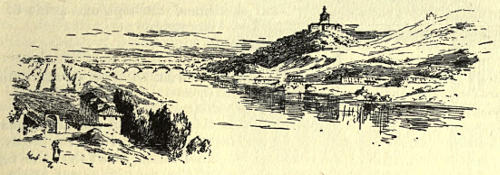
Turin
Turin was in peril. On the 29th of August a large number of the enemy reached a postern of the citadel unseen; a mine was laid at the spot, but could not be fired without danger; in this imminent peril Pietro Nicco d’Andorno, of Biella, made the companies retire, and like a new Decius offered himself to die; the match being applied, he was buried with the French under the ruins. This great deed brought glory on Turin, and the fame of it shall live forever in the country. Nevertheless the French occupied the castle of Pianezza, on the left bank of the Dora Riparia; it was imperative that the Piedmontese should dislodge them from this place, but for this it was necessary to take them unawares and they knew not how. But an old peasant woman, by name Maria Bricca, discovered on the night of the 5th of September that instead of keeping watch the French were amusing themselves, and she immediately ran to give the news in the Italian camp. At the head of the soldiers she led the way by a subterranean passage into the castle, and, hatchet in hand, crying “Viva Savoia” she informed the enemy they were prisoners.
Two days later Victor and Eugene, uniting their talents and forces, inflicted on the French a crushing defeat, so that twenty thousand were left dead on the field and the survivors fled beyond the Alps. The Franco-Spaniards evacuated Naples; and the Austrians, solely because they were the new lords, were greeted as friends and liberators. The war was continued outside Italy, and later the exhausted powers were brought to signing the Treaty of Utrecht 1713, confirmed the following year at Rastatt. By this treaty Austria obtained Milan, Naples, and Sardinia; Victor Amadeus obtained the far distant Sicily, Montferrat, Lomellina, and Val di Susa, with the title of king; a few small states were distributed—Mantua, Mirandola, and afterwards, Guastalla.
This aggrandisement of the house of Savoy and also that of Prussia was specially insisted upon by England, then the peacemaker of the continent and arbitrator in this peace, for which reason she intervened between France and Austria, and preserved European equilibrium. Thus were favoured the legitimate ambitions of two minor states, Piedmont and Prussia, that aimed at a high mark, and in the similarity of their fortunes they became the bulwarks of two nations, the hope and pride of two countries.d
WAR OF THE QUADRUPLE ALLIANCE
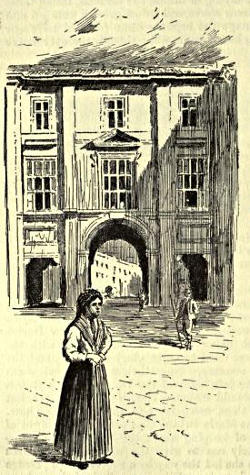
Court of Palace built by Charles VII of Naples at Portici in 1738
[1714-1718 A.D.]
It was by the ambitious intrigues of an Italian princess and an Italian priest, that the repose of the peninsula was again disturbed, only four years after this pacification. Giulio Alberoni, the son of a peasant, and originally a poor curate near Parma, had risen by his talents and artful spirit to the office of first minister of Spain. Philip V, on the death of his queen, Maria Louisa of Savoy, had espoused the princess Elizabeth Farnese; and Alberoni, by means of this marriage, of which he was regarded as the author, enjoyed the favour of the new queen, and acquired an absolute ascendency over the feeble mind of her husband.
His first object was to obtain a cardinal’s hat for himself; and being indulged with that honour by the pope, the next and more comprehensive scheme of his ambition was to signalise his public administration. To his energetic and audacious conceptions, it seemed not too gigantic or arduous an undertaking to recover for the Spanish monarchy all its ancient possessions and power in Italy, which had been totally lost by the Peace of Utrecht. He duped the wily Victor Amadeus, and enlisted him in his views by the promise of the Milanese provinces in exchange for Sicily; and the disgust which the stern and haughty insolence of the imperial government had already excited in the peninsula, rendered the pope, the grand duke of Tuscany, and other Italian princes, not adverse to the designs of the Spanish minister.
But the great powers of Europe looked with far different eyes upon his unquiet ambition. The personal interest and feelings of the duke of Orleans, who now governed France during the minority of Louis XV, placed him in opposition to Philip V; and the duke discovered a plot laid by Alberoni, through the Spanish ambassador at Paris, to deprive him of the regency of France, to which the cardinal persuaded his master to assert his claim as the nearest relative of Louis XV. The intrigues held with the Scottish Jacobites by Alberoni, who had formed a chimerical scheme of placing the pretender on the throne of Great Britain, and thus securing a new and grateful ally for Spain, rendered George I as jealous as the duke of Orleans of the designs of the court of Madrid. For their mutual protection against the machinations of Alberoni, the British monarch and the French regent negotiated a defensive league between Great Britain, France, and Holland, which, by the accession of the emperor to its objects, shortly swelled into the famous Quadruple Alliance (1718).
Besides the provision of the contracting parties for their mutual defence, the Quadruple Alliance laboured at once to provide for the continued repose of Italy, and to gratify the ambition both of the family of Austria and of the Spanish house of Bourbon. Although Parma and Piacenza were not feminine fiefs, the approaching extinction of the male line of Farnese gave Elizabeth the best subsisting claim to the succession of her uncle’s states. To the grand duchy of Tuscany she had also pretensions by maternal descent, after the failure of the male ducal line of Medici; which, like that of Farnese, seemed to be fast approaching its termination. As, therefore, the children of the young queen were excluded from the expectation of ascending the Spanish throne, which the sons of Philip by his first marriage were of course destined to inherit, the idea was conceived of forming an establishment in Italy for Don Charles, her first-born; and the Quadruple Alliance provided that the young prince should be guaranteed in the succession both of Parma and Piacenza, and of Tuscany, on the death of the last princes of the Farnese and Medicean dynasties. It was to reconcile the emperor to this admission of a Spanish prince into Italy, that Sicily was assigned to him in exchange for Sardinia. The weaker powers and the people were alone sacrificed. While the princes of Parma and Tuscany were compelled to endure the cruel mortification of seeing foreign statesmen dispose by anticipation of their inheritance, during their own lives, and without their option; and while, with a far more flagrant usurpation of natural rights, the will of their subjects was as little consulted—it was resolved to compel Victor Amadeus to receive, as an equivalent for his new kingdom of Sicily, that of Sardinia, which boasted not a third part of either its population or general value.
The provisions of the Quadruple Alliance were haughtily rejected by Alberoni, who had already entered on the active prosecution of his designs upon the Italian provinces. Having hitherto endeavoured, during his short administration, to recruit the exhausted strength of Spain, he now plunged that monarch headlong into a new contest, with such forces as had been regained in four years of peace; and his vigorous, but overwrought direction of the resources of the state, seemed at first to justify his presumption. A body of eight thousand Spaniards was disembarked on the island of Sardinia, and at once wrested that kingdom from the feeble garrisons of the imperialists (1717). In the following year, a large Spanish fleet of sixty vessels of war, convoying thirty-five thousand land-forces, appeared in the Mediterranean; and notwithstanding the previous negotiations of Alberoni with Victor Amadeus, Sicily was the first object of attack. Against this perfidious surprise, the Savoyard prince was in no condition to defend his new kingdom; and though his viceroy at first endeavoured to resist the progress of the Spanish arms, Victor Amadeus, sensible of his weakness and inability to afford the necessary succours for preserving so distant a possession, made a merit of necessity, and assented to the provisions of the Quadruple Alliance (1718). Withdrawing his troops from the contest, he assumed the title of king of Sardinia, though he yet possessed not a foot of territory in that island.
[1718-1731 A.D.]
Meanwhile the powers of the Quadruple Alliance, finding all negotiations hopeless, had begun to act vigorously against the Spanish forces. Even before the open declaration of war, to which England and France had now recourse to reduce the court of Spain to abandon its designs, Sir George Byng, the British admiral in the Mediterranean, had not hesitated to attack the Spanish fleet, which he completely annihilated off the Sicilian coast. This disaster overthrew all the magnificent projects of Alberoni. The British admiral poured the imperial troops from the Italian continent into Sicily; and the Spaniards rapidly lost ground, and made overtures for evacuating the island. The enterprises of the court of Madrid were equally unfortunate in other quarters; and Philip V, at last discovering the impracticability of Alberoni’s schemes, sacrificed his minister to the jealousy of the European powers, and acceded to the terms of the Quadruple Alliance (1719). Victor Amadeus was placed in possession of the kingdom of Sardinia, which his house has retained ever since this epoch with the regal title. The cupidity of the emperor was satisfied by the reunion of the crowns of the Two Sicilies in his favour; and the ambitious maternal anxiety of the Spanish queen was allayed by the promised reversion of the states of the Medici and of her own family to the infante Don Charles (1720).
For thirteen years after the conclusion of the war of the Quadruple Alliance, Italy was left in profound and uninterrupted repose. The first half of the eighteenth century was completely the age of political chicanery; and the intricate negotiations, which engrossed the attention and only served to expose the laborious insincerity of the statesmen of Europe, seemed to be ever threatening new troubles. But the treaties, which followed that of the Quadruple Alliance in thick succession for many years, had no other effect in Italy than to secure the Parmesan succession to the infante Don Charles of Spain. Francesco and Antonio, the two surviving sons of the duke Ranuccio II of Parma and Piacenza, who died in 1694, had both inherited the diseased and enormous corpulence of their family. Neither of them had issue; the duke Francesco terminated his reign and life in 1727; and Antonio, his successor, survived him only four years. The death of the youngest of her uncles realised the ambitious hopes which Elizabeth Farnese had cherished of conveying the states of her own house to her son (1731). The male line of Farnese having thus become extinct, the youthful Don Charles, with a body of Spanish troops, was quietly put in possession of the duchies of Parma and Piacenza, and reluctantly acknowledged by the last prince of the Medici as his destined successor in the grand duchy of Tuscany.
THE WAR OF THE POLISH SUCCESSION
[1731-1738 A.D.]
The final settlement of the Parmesan and Tuscan succession seemed to eradicate the seeds of hostilities in Italy; but it had become the unhappy fortune of that country to follow captive in the train of foreign negotiation, and to suffer and to bleed for the most distant broils of her foreign masters. Only two years had elapsed after the elevation of the Spanish prince to the ducal throne of Parma, when Italy was suddenly chosen as the field for the decision of a quarrel which had originated in the disputed election of a king of Poland. Upon this occasion, the two branches of the Bourbon dynasty united in the same league against the house of Austria, and resolved to attack its possessions in Italy. Charles Emmanuel III, the new king of Sardinia, joined their formidable confederacy, and the imperial strength in the peninsula was crushed under its weight.
While Charles Emmanuel, at the head of the French and Piedmontese troops, easily conquered the whole Milanese states in a short time, the Spaniards at Parma, being delivered of all apprehension for the issue of the war in Lombardy, found themselves at liberty to divert their views to the south. A Spanish army of thirty thousand men disembarked in the peninsula under the duke of Montemar, and joined Don Charles; and that young prince, at the age of seventeen, assuming the nominal command-in-chief of the forces of Spain in Italy, led them to attempt the conquest of the Sicilies. The duke of Montemar, who guided his military operations, gained for him a complete and decisive victory at Bitonto in Apulia over the feeble imperial army, which was intrusted with the defence of southern Italy. The opposition of language, and manners, and character, between the Germans and Italians, rendered the cold sullen tyranny of Austria peculiarly hateful to the volatile Neapolitans; and they eagerly threw off a yoke to which time had not yet habituated them. The capital had already opened its gates before the battle of Bitonto; and the provinces hastened to offer a ready submission to the conquerors. The Sicilians imitated the example of their continental neighbours; and at Naples and Palermo Don Charles received the crowns of the Two Sicilies (1735).
For the facility with which the Spaniards had effected these conquests, they were principally indebted to the powerful operations of the French in Lombardy, and to the vigour with which the armies of Louis XV pressed those of the emperor in Germany, and prevented him from despatching sufficient succours to his Italian dependencies. The court of Madrid now began to cherish again the hope of recovering the whole of the Italian provinces, which the Spanish monarchy had lost by the Peace of Utrecht; and the duke of Montemar conducted his army into Lombardy to unite with the French and Piedmontese in completing the expulsion of the Austrians from the peninsula. But the emperor, discouraged by so many reverses, made overtures of peace; and the French cabinet was not disposed to indulge the ambition of Spain with further acquisitions.
Negotiations for a general peace were opened, to which Philip V was compelled to accede; and at length the confirmation of the preliminaries by the Peace of Vienna once more changed the aspect of Italy. The crowns of Naples and Sicily were secured to Don Charles. The provinces of Milan and Mantua were left to the emperor; the duchies of Parma and Piacenza were annexed to his Lombard possessions to recompense him in some measure for the loss of the Sicilies; and the extinction of the house of Medici by the death of the grand duke Giovan Gastone, while the negotiations were yet pending, completed a new arrangement for the succession of Tuscany. Francis, duke of Lorraine, who had lately received the hand of Maria Theresa, the eldest daughter and heiress of the emperor, took possession of the grand duchy, in exchange for his hereditary states; and Charles VI was gratified by this favourable provision for his son-in-law and destined successor in the imperial dignity. Finally, the king of Sardinia, in lieu of the ambitious hopes, with which he had been amused, of possessing all the Milanese duchy, was obliged to content himself with the acquisition of the valuable districts of Tortona and Novara.
THE WAR OF THE AUSTRIAN SUCCESSION
[1738-1742 A.D.]
This general accommodation among the arbiters of Italy procured only a brief interval of repose for the degraded people of the peninsula, before they were exposed to far greater evils than those which they had suffered in the short course of the late war. The emperor Charles VI died only two years after the confirmation of the Peace of Vienna; and the very powers who by that treaty had guaranteed the famous Pragmatic Sanction—or act by which the emperor, as he had no son, was allowed to settle his hereditary states upon his daughter Maria Theresa—conspired to rob her of those dominions. The furious war of the Austrian Succession which followed, filled Italy during seven years with rapine and havoc.
In the year after the death of Charles VI, a Spanish army under the duke of Montemar, disembarked on the Tuscan coast to attempt further conquests in Italy; and although these troops arrived to attack the territories of his consort, the new grand duke was obliged to affect a neutrality and to permit their free passage through his dominions. On the other hand, the king of the Sicilies, who desired to aid his father’s forces in their operations, was equally compelled to accept a neutrality, by the appearance of a British squadron in the bay of Naples, and the threatened bombardment of that city. This humiliation, to which the exposed situation of his capital reduced him, did not, however, prevent the Neapolitan monarch at a later period from taking part in the war. But his engagement in the contest had only the effect of drawing the Austrian arms into southern Italy, and inflicting the ravages of a licentious soldiery upon the neutral states of the church and the frontiers of Naples (1742).
But northern Italy was the constant theatre of far more destructive hostilities; and the Italian sovereign, who acted the most conspicuous part in the general war of Europe, was Charles Emmanuel III, the king of Sardinia. That active and politic prince, pursuing the skilful but selfish and unscrupulous system of aggrandisement, which had become habitual to the Savoyard dynasty, made a traffic of his alliance to the highest bidder. He first offered to join the confederated Bourbons; but the court of Spain could not be induced to purchase his adherence by promising him an adequate share of the Milanese states, which the Spaniards were confident of regaining. Charles Emmanuel therefore deserted the Bourbon alliance to range himself in the party of Maria Theresa. But it was not until he had extorted new cessions of territory from that princess in Lombardy, and large subsidies from England which protected her, that he entered seriously and vigorously into the war, as the auxiliary of Austria and England. As soon as Charles Emmanuel began to declare himself against the Bourbon cause, his states became immediately the prey of invasion. Although the Spanish dynasty pretended to lay claim to the whole succession of the house of Austria, the real motive which actuated the court of Madrid in these wars was the ambition of the queen of Spain, Elizabeth Farnese, to obtain an establishment in Italy for another of her sons, the infante Don Philip; and that prince, leading a Spanish army from the Pyrenees through the south of France, overran and occupied all Savoy, which was mercilessly pillaged by his troops. But Don Philip was unable to penetrate into Piedmont; and meanwhile the duke of Montemar, with the Spanish army already in Italy, had been oppressed successfully by the Austrians and Piedmontese on these opposite frontiers of Lombardy.
[1742-1748 A.D.]
But Charles Emmanuel, even after he had formally pledged himself to England and Austria, was perpetually carrying on secret and separate negotiations with the Bourbons; and it was only because he could not obtain all the terms which he demanded of them, and because he was also as suspicious of their ill-faith as he was conscious of his own, that he maintained his alliances unchanged to the end of the war (1743). His states were almost constantly the theatre of hostilities, equally destructive to his subjects, whether success or failure alternately attended his career. Yet he displayed activity and skill and courage, scarcely inferior to the brilliant qualities which had distinguished his father, Victor Amadeus. When, however, the infante Don Philip had been joined by the prince of Conti with twenty thousand men, all the efforts of the Sardinian monarch, though he headed his troops in person, could not resist the desperate valour of the French and Spanish confederates; who, forcing the tremendous passes of the Alps, broke triumphantly into Piedmont, and for some time swept over its plains as conquerors (1744). But reinforced by the Austrians, Charles Emmanuel, before the end of the same campaign, turned the tide of fortune, and obliged the allies to retire for the winter into France. They still retained possession of the duchy of Savoy, and crushed the inhabitants under every species of oppression.
In the following year, Genoa declared for the Bourbon confederation; and the Spanish and French forces under Don Philip, being thus at liberty to form a junction in the territories of that republic with the second Spanish army from Naples, the king of Sardinia and the Austrians were utterly unable to resist their immense superiority of numbers (1745). In this campaign, Parma and Piacenza were reduced by the duke of Modena, the ally of France and Spain; Turin was menaced with bombardment; Tortona fell to the Bourbon arms; Pavia was carried by assault; and Don Philip, penetrating into the heart of Lombardy, closed the operations of the year by his victorious entry into Milan.
But such were the sudden vicissitudes of this sanguinary war, that the brilliant successes of the Spanish prince were shortly rendered nugatory by a growing misunderstanding between the courts of Paris and Madrid, and by the arrival of large reinforcements for the Austrian army in the peninsula (1746). Don Philip lost, in less than another year, all that he had acquired in the preceding campaign. He was driven out of Milan; he was obliged to evacuate all Lombardy; and the French and Spanish forces were finally compelled, by the increasing strength of the Austrians, to recross the Alps, and to make their retreat into France. The king of Sardinia and his allies carried the war into Provence, without meeting with much success; and the French in their turn endeavoured once more to penetrate into Piedmont. But while that quarter of Italy was threatened with new ravages, the peninsula was saved from further miseries by the signature of the Peace of Aix-la-Chapelle (1748).
One of the declared purposes of the European powers in their assembled congress was to give independence to Italy; and if that object could have been attained without the restoration of ancient freedom, and the revival of national virtue among the Italians, the provisions of the Treaty of Aix-la-Chapelle would have been wise and equitable. The Austrians were permitted to retain only Milan and Mantua; and all other foreign powers consented to exclude themselves from the peninsula. The grand duke Francis of Lorraine, now become emperor, engaged to resign Tuscany to a younger branch of his imperial house. The throne of the Two Sicilies was confirmed to Don Charles and his heirs, to form a distinct and independent branch of the Spanish house of Bourbon; and the duchies of Parma and Piacenza were elevated anew into a sovereign state in favour of Don Philip, who thus became the founder of a third dynasty of the same family. The king of Sardinia received some further accessions of territory, which were detached from the duchy of Milan; and all the other native powers of Italy remained, or were re-established, in their former condition.
FORTY YEARS OF “LANGUID PEACE” FOR DIVIDED ITALY
[1748-1789 A.D.]
Thus was Italy, after two centuries of prostration under the yoke of other nations, relieved from the long oppression of foreigners. A small portion only of her territory remained subject to the empire; and all the rest of the peninsula was divided among a few independent governments.
But after the Peace of Aix-la-Chapelle, Italy was still as little constituted as before to command the respect or the fear of the world. Her people for the most part cherished no attachment for rulers to whom they were indebted neither for benefits nor happiness, in whose success they could feel no community of interest, and whose aggrandisement could reflect no glory on themselves.
The condition of Italy after the nominal restoration of her independence, offers, as a philosophical writer has well remarked, a striking lesson of political experience. The powers of Europe, after having in some measure annihilated a great nation, were at length awakened to a sense of the injury which they had inflicted upon humanity, and upon the general political system of the world. They laboured sincerely to repair the work of destruction; there was nothing which they did not restore to Italy, except what they could not restore—the extinguished energies and dignity of the people. Forty years of profound peace succeeded to their attempt; and these were only forty years of effeminacy, weakness, and corruption—a memorable example to statesmen that the mere act of their will can neither renovate a degraded nation, nor replenish its weight in the political balance; and that national independence is a vain boon, where the people are not interested in its preservation, and where no institutions revive the spirit of honour, and the honest excitement of freedom.
During these forty years of languid peace (from the Treaty of Aix-la-Chapelle to the epoch of the French Revolution) the general history of Italy presents not a single circumstance for our observation; and it only remains for us to pass in rapid review the few domestic occurrences of any moment in the different Italian states of the eighteenth century. The affairs of the Sicilies, of the popedom, of the states of the house of Savoy, of the duchies of Tuscany and Modena, of the republics of Genoa and Venice, and of the Milanese and Mantuan provinces, may each require a brief notice. But the obscure or tranquil fortunes of Lucca, and of the duchies of Parma and Piacenza, would scarcely merit a separate place in this enumeration.
The duchies of Parma and Piacenza, which had once more been separated from that of Milan to form the independent appanage of a Spanish prince, relapsed into the deep oblivion from which the dispute for their possession had alone drawn them. Don Philip reigned until the year 1765, and his son, Don Ferdinand, succeeded him. The administration of both of these princes was, in a political sense, marked by no important event; but the literary and scientific tastes of Don Philip entitle him to be mentioned with respect, and shed some beneficial influence on his ducal states.
THE KINGDOM OF NAPLES AND SICILY
[1738-1765 A.D.]
The transition of the crowns of Naples and Sicily, from the extinguished Spanish branch of the house of Austria to the collateral line of Germany, and from that dynasty again to a junior member of the Spanish Bourbons, has already been noticed; and we take up the annals of the Sicilies from the epoch only at which the infante Don Charles was confirmed in the possession of their throne by the Treaty of Vienna. This sovereign, who reigned at Naples under the title of Charles VII, but who is better known by his later designation of Charles III of Spain, governed southern Italy above twenty-one years.
The general reputation of his character has perhaps been much over-rated; but, as the monarch of the Sicilies, he undoubtedly laboured to promote the welfare of his kingdom. The war of the Spanish Succession paralysed all his efforts during the first half of his reign; but after the restoration of tranquillity in 1748, he devoted himself zealously and exclusively to the pacific work of improvement. He was well seconded by the virtuous intentions, if not by the limited talents, of his minister Tanucci. The principal error of both proceeded from their ignorance of the first principles of finance; and the cultivated mind and theoretical knowledge of Tanucci fitted him less for the active conduct of affairs than for the station of professor of law, from which the king had raised him to his friendship and confidence.
It has been objected as a second mistake of Charles, or his minister, that the system of government which they adopted contemplated only the continuance of peace, and contained no provision against the possibility of war. No attempt was made either to kindle a martial spirit in the people, or to rouse them to the power of defending themselves from foreign aggression and insult. The army, the fortifications, and all warlike establishments were suffered to fall into utter decay; and the military force of the kingdom, which was nominally fixed at thirty thousand men, was kept so incomplete that it rarely exceeded half that number. The only security for the preservation of honourable peace at home was forgotten in a system which neglected the means of commanding respect abroad; but Charles occupied himself, as if he indulged the delusive hope of maintaining his subjects in eternal tranquillity. He studiously embellished his capital; and the useful public works, harbours, aqueducts, canals, and national granaries, which preserve the memory of his reign, are magnificent and numerous.
The laudable exertions of Charles were but just beginning to produce beneficial effects, when he was summoned by the death of his elder brother, Ferdinand VI of Spain, who left no children, to assume the crown of that kingdom (1759). According to the spirit of the Peace of Aix-la-Chapelle, his next brother, Don Philip, duke of Parma, should have succeeded to the vacant throne of the Sicilies; but Charles III was permitted to place one of his own younger sons in the seat which he had just quitted. His eldest son betrayed such marks of hopeless idiocy that it was necessary to set him altogether aside from the succession to any part of his dominions; the inheritance of the Spanish throne was reserved for the second, who afterwards reigned under the title of Charles IV; and it was to the third that the sceptre of the Sicilies was assigned.
[1759-1825 A.D.]
This prince, who under the name of Ferdinand IV of Naples and Sicily reigned till 1825, was then a boy of nine years of age. Charles appointed a Neapolitan council of regency to govern in his son’s name; but the marquis Tanucci remained the real dictator of the public administration; and the new monarch of Spain continued to exercise a decisive influence over the councils of the Two Sicilies during the whole of his son’s minority, and even for some time after its expiration. It was by the act of Tanucci, and in conjunction with the policy of Charles, that the Jesuits were expelled from the Two Sicilies and from Spain at the same epoch; that the ancient usurpations of the holy see were boldly repressed; and that the progress of other useful reforms was zealously forwarded.
It was the most fatal negligence of Charles III, and the lasting misfortune of his son, that the education of Ferdinand IV was entrusted to the prince of San Nicandro, a man utterly destitute of ability or knowledge. The young monarch, who was not deficient in natural capacity, was thus permitted to remain in the grossest ignorance. The sports of the field were the only occupation and amusement of his youth; and the character of his subsequent reign was deplorably influenced by the idleness and distaste for public affairs in which he had been suffered to grow up. The marriage of Ferdinand with the princess Carolina of Austria put a term to the ascendency of Charles III over the Neapolitan councils. His faithful servant Tanucci lost his authority in the administration; some years afterwards he was finally disgraced; and the ambitious consort of Ferdinand, having gained an absolute sway over the mind of her feeble husband, engrossed the direction of the state. Her assumption of the reins of sovereignty was followed by the rise of a minion, who acquired as decided an influence over her spirit as she already exercised over that of the king. This was the famous Acton, a low Irish adventurer, who, after occupying some station in the French marine, passed into Tuscany, and was received into the service of the grand duke. He had the good fortune to distinguish himself in an expedition against the pirates of Barbary; and thenceforth his elevation was astonishingly rapid. He became known to the queen, and was entrusted with the direction of the Neapolitan navy. Still young, and gifted with consummate address, he won the personal favour of Carolina; he governed while he seemed implicitly to obey her; and without any higher qualifications, or any knowledge beyond the narrow circle of his profession, he was successively raised to the office of minister of war and of foreign affairs. The whole power of government centred in his person; and Acton was the real sovereign in the Sicilies, when the corrupt court and the misgoverned state encountered the universal shock of the French Revolution.e
THE STATES OF THE CHURCH
[1700-1800 A.D.]
On the outline of government and policy in the ecclesiastical state, as these features presented themselves in the seventeenth century, very little has to be either altered or added, if we would make the picture true for the age that succeeded. It is necessary indeed to pay, at the outset, that tribute of respect which is deserved by the personal character of most of the sovereigns who ruled on the Seven Hills during the eighteenth century. Never had the bishops of Rome been so decorous, so generally unexceptionable in morals; seldom had they numbered so many men of sincere and earnest piety; never had the list included names more illustrious for talent and learning. Two popes in particular, Prospero Lambertini and the accomplished Antonio Ganganelli, would have reflected honour upon any throne in Christendom.
But those venerable priests, who, for a few years before they sank into the grave, left the altar and the closet, the breviary and the pen, to wear the triple crown and wield the keys of St. Peter, discovered by sad experience what everyone who has administered that office must have discovered before he had slept a month under the roof of the Vatican. Genius becomes a public calamity, virtue itself is paralysed into despair, when, after a lifetime spent in the library or the cloister, they are summoned, in the decrepitude of old age, to discharge duties more complicated, more difficult, requiring greater versatility and greater energy in action than those which belong to any other sovereignty in the world. Where the whole edifice of government must be overturned before effectual repair can be wrought upon any of its parts, differences in the character of successive rulers are confined in their results to individual and temporary interests. In regard to the permanent improvement or deterioration of the state, Rodrigo Borgia was as innocent as the irreproachable Barnaba Chiaramonti; Clement VII was as wise as Sixtus V; and the hermit-pope Pietro di Murrhone, with his gentle and pious ignorance, was not more helpless than Julian della Rovere, who wore armour beneath his sacerdotal robe.
The most unpleasing task which the popes of the eighteenth century had to perform was that of accommodating their prerogatives over the Catholic states to those opinions of independence which were now rooted in every cabinet of Europe. The priestly chiefs bowed with infinite reluctance to this hard necessity; some of them disgraced themselves by persecuting foreign inquirers, like Giannone and Genovesi; and, but for the activity and talent of Clement XIV, who yielded gracefully what he had no power to withhold, the papal court might have suffered losses infinitely more injurious than the sacrifice which it was obliged to make of its able servants the Jesuits. Pius VI, on whose head were to break the thunders of the French Revolution, was more a man of the world than any of his recent predecessors. Long employed in offices of the government, and familiar in an especial degree with the business of the Roman exchequer, he distinguished himself by endeavours zealous and incessant, but utterly unsuccessful, to introduce internal ameliorations. The sluggish imbecility of the papal rule cannot be better proved than by the fact that, till the middle of the eighteenth century, while internal taxes and restrictions ground the faces of the people, there was no duty (though, at several points of time, there were absolute prohibitions) on the importation of foreign manufactures; and that one of the most vaunted measures of this reign was the organisation of a force to protect the frontiers against smuggling; a measure of which, amidst all their recent tariffs, the popes do not appear to have ever dreamed.
In the details of his new system of foreign duties on merchandise, as well as in many of his regulations for agriculture and internal trade, Pius and his advisers proved singularly how much they were still in the dark as to the principles of political economy. His partial abolition of the innumerable baronial tolls did not confer benefits half sufficient to counterbalance the evils produced by his arbitrary restrictions on the corn-trade; his expensive operations for draining the Pontine marshes were rendered useless by his gift the reclaimed lands to his nephew; and his depreciation of the currency by excessive issues of paper money was an anticipation of one of the worst errors committed by the leaders of the French Revolution.
THE SARDINIAN KINGDOM
During the latter half of the eighteenth century, the counts of Savoy were precluded from prosecuting further that policy which had gained for them an extensive dominion and a kingly name. But, even amidst the wars which had preceded this period, and still more energetically after their close, the able and ambitious Victor Amadeus continued that system of internal improvement, to whose results he looked forward as likely to make him the sovereign of a people rich as well as warlike, rivals of their southern neighbours in literature and art, as they had already outstripped them in energy and public spirit.
In his endeavours for the intellectual improvement of the higher ranks (for whom exclusively his institutions were designed), he succeeded as ill as an arbitrary king may be expected to succeed when he aims at amending a corrupted, martial, and ignorant aristocracy. For commerce he was able to effect greatly more, through those regulations imposed on the silk-manufacture, which, however alien their narrow spirit may be to the genuine principles of commerce, were found to be not ill-calculated to check an equally narrow spirit abroad, and were accordingly imitated in Milan and the eastern provinces. Several excellent laws aided the rural population. One enactment expressly recognised, in contradiction to all older practice, agricultural leases for a fixed term of years, usually from nine to eighteen; and not only so, but the lawgivers studiously left loopholes for evading a rule which they were in terms obliged to enact, for making the endurance of such leases dependent on the survivance of the landlord who had granted them. This characteristic artifice shows the influence of the higher classes, against whom however Victor Amadeus carried by arbitrary interference his great and beneficial measure for an equalisation of public burdens. For, before he abdicated the throne, all the estates in Piedmont, without distinction of tenure, were subjected to an impartial land-tax, assessed in conformity to a general valuation, which likewise furnished the materials for levying all local burdens on the communes, such as those for roads, schools, and costs of administration.
When we add such improvements as these to the changes which we perceived to be in progress during the seventeenth century, we shall wonder, if we learn nothing more, how it should have happened that the subjects of this kingdom were not only the first to throw themselves into the arms of the revolutionary French, but have since complained of their government more bitterly than any other Italians. It is not difficult to find the reasons. All the reforms of the Piedmontese princes were made for their own ends, not for the sake of the people, who were kept peremptorily in subjection to the king, and left in total dependence on his character for their share of individual comfort; the nobles, likewise, being disarmed as well as the commonalty, the crown was freed from the only check on its conduct; and bitter discontents arose both from that abject submission to the priesthood, and from that childish fear of change, which for the last few generations have distinguished the princes. But, at the same time, amidst the innovations which were introduced after the middle of the seventeenth century, it had been found expedient to conciliate the alarmed aristocracy by leaving its members in possession of many personal and empty, yet invidious privileges; and the consequence was a haughtiness on the part of the upper ranks met by sullen defiance among the multitude, a mutual mistrust among all orders, ready to kindle into deadly hatred.
[1700-1740 A.D.]
Charles Emmanuel III, notorious in the early years of his reign for his ingratitude towards a father who had resigned the throne in his favour, was more creditably distinguished in later life by his endeavours to reconcile the conflicting wishes of the different orders of society, and to purify completely the administration of justice. His nobles complained of the number of commoners whom he promoted to public posts: the suitors in the courts of law marvelled at the conduct of a king who so far distrusted his own judgment, and so far honoured the judicial servants of his crown, as to refuse granting any briefs of dispensation from judicial sentences, unless after consultation with the judges by whom the decision had been pronounced. He was less prudent in his management of the military force, which he weakened greatly by the promotion of inefficient officers, the nobility being always preferred, and a commoner finding it all but impossible to rise to high rank. This abuse became greatly more flagrant in the reign of his successor, who gave the last impulse to the growing discontent of his subjects, by his superstitious subservience to confessors and bigots, and not less by increasing his army to an unreasonable size, and taxing the people severely for its pay and subsistence.
Sardinia, rude, poor, and lawless, like other provinces of Spain, was little improved by its new sovereign, Victor Amadeus II. In his son, however, it found the best ruler it had seen for ages. Much was done by him to weaken feudalism, encourage agriculture, and extirpate the bands of robbers; two universities were founded, and the inferior schools somewhat improved; and the year 1738 was a remarkable epoch in the island, from the reforms which it witnessed in every department.
THE FOUR REPUBLICS
[1736-1768 A.D.]
The history of Lucca offers no fact worthy of being mentioned. Its oligarchy grew more and more exclusive, and the peasant landholders in its rural districts became impoverished through the excessive division of property by succession.
The miniature republic of San Marino had retreated into its wonted obscurity since 1739, when the fallen intriguer, Cardinal Alberoni, then papal legate in Romagna, repeated at its expense that treachery by which he had formerly convulsed all Europe. Alleging that the government of San Marino had become a narrow oligarchy, which was true but did not justify his interference, he conquered its territory with a single company of soldiers and a few officers of police. The people appealed to Clement XII, who ordered them to determine their own fate in a general meeting: they unanimously voted against submission to the church, and the papal troops were withdrawn.
In 1746, the Genoese commonalty, unsupported by the nobles, showed, in their expulsion of the Austrians, a spirit worthy of their fathers. With this bold insurrection the history of the republic of Genoa closes for half a century. In 1718 it had increased its territory, by purchasing the imperial fief of Finale; but within a few years it lost Corsica.
The revolted Corsicans allowed their country to be formed into a mock kingdom in 1736, by the foolish ambition of Theodore von Neuhof, a German baron; and, after they had been deserted by him, they continued to resist the united forces brought against them by the Genoese and Louis XV of France. The islanders now established a republic, which, from 1755, was headed by the celebrated Pasquale Paoli: and the contest for freedom was maintained manfully till Genoa, tired of an expensive war, and deeply indebted to France, ceded Corsica to that power on receiving an acquittance. Louis renewed the attack with increased vigour, and the besieged republicans resisted bravely till the struggle became utterly hopeless. Paoli emigrated to England, and the island became a French province in 1768, the year before it gave birth to Napoleon Bonaparte.
The commerce of Venice was nearly at a end; her manufactures were insignificant; her flag was insulted on her own Adriatic by every power of Europe. She still, however, possessed an Italian territory, peopled by two millions and a half of subjects; her Dalmatian and Albanian provinces and the Ionian Isles had half a million more. Her taxes had been nearly doubled in the eighteenth century, and amounted, in 1789, to about 11,600,000 ducats (£1,919,800 or $9,599,000); her public credit was bad; and her debt was 44,000,000 ducats (£7,283,300 or $36,416,500). The gloomy government remained unchanged. The Council of Ten had resisted frequent attempts to overturn it: an attack in 1761 was checked by arrests and imprisonments in monasteries; and the Ten and the Three still exercised, though more cautiously than before, their singular functions. Their spies cost annually, in the eighteenth century, about 200,000 ducats; and more than one secret execution was laid to their charge. But licentiousness was more prevalent than cruelty; infamous women were pensioned as informers by the state; and in the public gaming-houses, amidst the masked gamesters, senators, officially appointed, presided undisguised.
In 1768, the nobles, displeased with the church, named a commission to inquire into the state of its revenues. The report, which is still extant, is curious. The commissioners estimate the gross income at 4,274,460 ducats (£719,100, $3,595,500). Of this sum, 2,734,807 ducats were permanent, being derived from lands, money invested, or perpetual rents. The remainder was casual, being made up of the alms bestowed on mendicant orders, and of the prices paid for temporary masses. The whole number of masses for which the clergy received payment was prodigious, being not less than 8,938,459. Of these the parochial and other secular clergymen celebrated 4,250,060; the monastic orders celebrated the rest, being 4,688,399, of which 3,107,682 were masses on perpetual foundations. On the latter class the Venetian commissioners sarcastically remark that the whole number of the monks and friars was 7,638, of which only 3,272 were in priest’s orders, and entitled to say mass; and that, consequently, if the monks performed all the masses for which they took payment, each of their priests would have to officiate fourteen or fifteen hundred times a year.
MILAN AND TUSCANY
[1755-1790 A.D.]
For seventeen years after the Peace of Aix-la-Chapelle, the duchies of Milan and Mantua, forming one province, and the grand duchy of Tuscany as another, were governed by viceroys appointed by Maria Theresa and her husband Francis. On the emperor’s death in 1765, the two Lombard duchies continued to constitute a province of the empire under his son Joseph II; but Tuscany was formed into an independent sovereignty for Peter Leopold, the new emperor’s younger brother. All these sovereigns were remarkable persons: the sons were worthy of their heroic mother; and Leopold, free from that ambition which stained the names of Maria Theresa and Joseph with the infamous partition of Poland, was one of the greatest men that ever filled a throne.
The statistical results of this period were highly pleasing. Austrian Lombardy, at length enabled to profit in some measure by its singular physical advantages, was, in 1790, by far the most flourishing province in Italy; while Tuscany also was prosperous, and in some respects more decidedly so than Joseph’s duchies. The institutions of both states were wonderfully improved; and the history of these changes is one of the most interesting pages in the annals of modern Italy.
That the long servitude of the Italians had ruined their character as well as their national resources, could not have been more clearly proved than by the bitter opposition with which they met all the reforms introduced by their new masters. There was hardly an improvement of any importance, especially in Lombardy, that was not absolutely forced upon the natives; and the most sweeping changes were skilfully evaded, some of them during more than a generation. Much of this delay was attributable to the wonted slowness of the Austrian court; but much also was produced by the passive resistance of the people. The great system of administration, the first draft of which had been laid before the empress in 1739, did not come into activity till 1755, and its introduction makes that year an important epoch for northern Italy.
A few only of the features which distinguished the plan of taxation can be here described. One of the worst evils to be removed was the subdivision of the state into seven districts, each of which, like a separate kingdom, has its duties on mercantile imports, exports, and transits. This abuse was swept away by a single stroke of the pen; and similar restrictions on agricultural produce shared the same fate. The excise was subjected to good regulations, and the customs based on principles as fair as any that then prevailed in Europe. Lastly, a new survey and valuation formed the rule for an equitable assessment of the land-tax. A dispassionate and well-qualified judge was able to find in the system but four serious defects: an insufficient check on the land-valuators; the retention of the unwise mercantile-tax; the imposition of a capitation-tax on the peasantry and others who paid no land-tax; and the permission to the church, which possessed a third of the lands in the state, and had till now paid no taxes for them, to retain too many of its Spanish privileges.
But the portion of the plan that most interests us is the administrative. In the general government, the obnoxious senate was retained, and formed a very injurious barrier between the subjects and the throne, generating petty cabals, and assisting in keeping up that tendency to secrecy and plotting which had been triumphant under the Spaniards. In the provincial government, the leading principle was, to subject everything in the last instance to the control of the boards of administration at Milan, while the immediate administration of every province was put under a delegate appointed by the sovereign; although, at the same time, a considerable part of the actual management was consigned to a provincial council established in every chief city. The local statutes of the old republics or petty principalities, which it was not in all cases considered safe to touch, created many diversities in the execution of this plan; but the general rule was to introduce in the provincial councils members of three orders: the representatives of the cities, who were nobles, and elected by their own class in each town; the representatives elected by the landholders of the province; and the mercantile men who represented, and were elected by, the corporation of merchants. The council so formed devolved its ordinary powers on a committee of its own body, called the prefects of government. Communal councils were also instituted, according to regulations laid down in a prolix code. Each of them administered the patrimony of the commune, under the presidency of a chancellor appointed by the sovereign. Their own members were five for each commune: three representatives of the landholders, one representative of the mercantile body, and one representative of those who were subject to the capitation-tax. They were elected annually in a meeting of all the landholders rated on the books for the land-tax; soldiers and churchmen, however, being ineligible. The same constituency also elected the consul, who was an inferior criminal judge, and the syndic, who had dignity without any real duties.
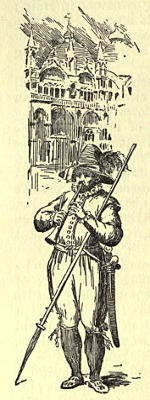
An Italian Peasant, Close of the Eighteenth Century
Joseph, seconded by his excellent viceroy Count Firmian, under whom served Verri, Carli, Neri, and other enlightened Italians, followed out the plan of amelioration which had been thus delineated for him. He improved the courts of justice and the judicial procedure, especially in criminal causes, abolishing, at the suggestion of Beccaria, torture and secret trials. He annulled or diminished the most vexatious of the feudal privileges, and imposed checks on the perpetual destination of estates. He patronised agriculture, and extended commerce and manufactures by the construction of roads, as well as by the abolition of some remaining imposts and restrictions. When the death of his mother, in 1780, freed him from her remonstrances on ecclesiastical matters, he commenced with his accustomed impetuosity a series of changes in that department, which Pius VI considered so dangerous that he made a fruitless journey to Vienna in the hope of procuring their repeal. The most material of those measures were the following: all dissenters were to enjoy toleration; the bishops were forbidden, as they had already been forbidden by other princes, to act upon any papal bull but such as should be transmitted to them by the government; the monastic clergy were declared to be dependent, not on the general of their order who lived in Rome, but directly on the resident bishop of the diocese within which their cloister was situated; lastly, all nunneries were suppressed, except those which pledged themselves to occupy their members in the education of the young. The emperor’s death interrupted the consolidation of his famous system for giving uniformity to his system of government throughout all the Austrian dominions. The decree of 1786, which promulgated this new constitution, divided the Italian provinces into eight circles, in each of which the local administration was to be vested in a chamber closely dependent upon the government. This departure from the late arrangement created in Lombardy universal discontent.
Sometimes unjust and cruel, often misjudging and imprudent, always headstrong, passionate, and despotic, doing good to his subjects by force, and punishing as ungrateful all who refused to be thus benefited, Joseph was an unconscious instrument in the hand of providence for advancing in southern Europe the great revolution of his time. One inveterate evil was extirpated, that another might be substituted for it, which, being less deeply rooted, was destined in its turn to wither and die away. “At length,” said a noble-minded Italian in the last stage of the emperor’s reign, “the obstacles which hindered the happiness of nations have mainly disappeared. Over the greater part of Europe despotism has banished feudal anarchy; and the manners and spirit of the times have already weakened despotism.”
The reforms in the grand duchy of Tuscany went infinitely further than those of Joseph and his mother in the provinces of the Po. They were commenced during the life of Francis, by the prince of Craon, his viceroy at Florence; and the plan was formed, even thus early, for consolidating into one common code all those contradictory laws which, subsisting in the old Tuscan communities, had been maintained since the subjection of all to the duchy. But it was reserved for younger hands to construct this noble edifice.
Till we reflect that Leopold’s scheme of legislation for Tuscany was devised and executed long before that change of opinions which the French Revolution diffused through the whole of Europe, we are not fully aware how very far he stood in advance of his age. In his new code the criminal section was especially bold, inasmuch as it swept away at once torture, confiscation, secret trial, and even the punishment of death. Imprisonment for debt, forbidden by one of his laws unless the claim exceeded a certain amount, was afterwards abolished altogether. All privileged jurisdictions were destroyed, and the public courts fortified in their independence and authority. Restrictions on agriculture were totally removed; and large tracts of common were brought into cultivation by being divided among poor peasants in property, subject only to a small crown-rent. The grand duke discontinued the ruinous system of farming out the taxes; he diminished their amount, and abandoned most of the government monopolies. Notwithstanding, he was able, before he left Italy, to pay off the greater part of a large national debt; for, under his new system, and especially through the absolute freedom which he allowed to commerce, industry flourished so wonderfully, that his revenue suffered hardly any diminution.
Leopold’s ecclesiastical reforms were equally daring, and gave deep offence to the papal government. They were chiefly designed for improving the condition of the parochial clergy, and for curbing the monastic orders. He suppressed the Inquisition; he imposed severe limitations on the profession of monks and nuns; he made the regular clergy dependent, not merely (as his brother had done) on their bishop, but directly on the priest of the parish; he taxed church-lands like those belonging to laymen; he even seized arbitrarily several large estates which had been destined to useless ecclesiastical purposes, and applied their proceeds towards increasing the insufficient incomes of the priests in rural parishes. This step, as well as several others, formed parts of his great scheme against tithes, of which he gradually introduced a general commutation.
In the system which this great man enforced there were unquestionably many defects. There was something (though not much) of his brother’s hasty disregard for obstacles arising from foreign quarters; a fault which made his scheme for free trade in some respects injurious to his subjects, and forced him in his later years to resume a few restrictions. There was a disposition to overstrain the principles of reform, manifested when he totally abolished trading corporations, or when, in the last year of the period, he annulled at a blow all rights of primogeniture, and all substitutions in succession to land. There was a jealous watchfulness over details, a temper exceedingly useful but very irritating, which displayed itself with equal force in the severe system of police, and in the curious circular letter which he addressed to the nobles, requesting that their ladies might be made to dress more economically. There was some fickleness of purpose, though much less than those have believed, who forget the existence of that chaos of local laws and privileges, through which he had for years to pilot his way, embarrassed, misled, and thwarted at every step. Lastly, there were two absolute wants. Leopold did not, because in a single generation he could not, renovate the heart and mind of his people; and therefore the degenerate Florentines murmured at his strictness of rule, and ridiculed his personal peculiarities. He did not give to his subjects a representative constitution; and therefore his fabric of beneficent legislation crumbled into fragments the moment his hand ceased to support its weight.
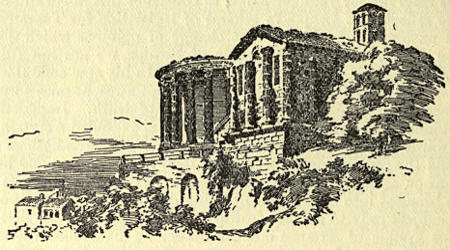
Temple of the Sibyl, Tivoli
It is said, indeed, that he had sketched a constitution before he left Tuscany; but, at all events, his reforms in the local administration went very far towards this great end. His purpose, in which, as in so much besides, he was obstructed by a multiplicity of special statutes and customs, was to introduce over the duchy one uniform system of municipal government, embracing all districts, rural as well as urban. During his whole reign, step after step led him towards this result, by organising new communal councils in various provinces, which had at length comprehended nearly the whole state. At the same time there was extended to the new boards the privilege conferred first on those in the Florentine territory, of managing their local patrimony as of old, without dependence upon the supreme government. The polity of Alessandro de’ Medici, which still prevailed in Florence, was annulled in 1781; and the elective board which administered the affairs of the city thenceforth consisted of a gonfalonier, as president, eleven priors, and twenty councillors.f
A Tuscan Estimate of Leopold
The reforms of Leopold I (Emperor Leopold II) did not suffice to drag Tuscany from the abyss into which she had been cast by the sbirocracy of the Medici. A fallen people would rise again to the enthusiasm of grand ideas, but what grand idea did Leopold I place at the head of the regenerative movement? He corrected clerical abuses, but did not enkindle the religious faith of the people after the example of the ardent preachers of the Crusades of the Middle Ages and the sixteenth century reformers. He recognised equality in civil laws, but did not make a social credo of it like the French republicans.
Leopold’s idea was a paternal government, a sort of family council, where the most touching accord would reign between the prince and the assembly elected by the commons. He wanted to make another Arcadia of Tuscany, an Arcadia simply occupied with its well-being and material progress, foreign to the use of arms and neutral in all aspects of war. But this was not the way to model character and make free citizens. The shock given to Europe by the French Revolution and the results therefrom had quite other effects. When Italy owed to the France of ’89 that moral shock which stirred up men’s minds and made them enter into communication with the universal conscience, it did not need more to convict of error those who reproached the French Revolution with having upset the reforms of Italian princes without any compensation. Abstention in this gigantic struggle was impossible. It was imperative to fight either for the powers of the past or for those of the future; so this worship of principles became the great passion of souls, and character regained all its old vigour. The Restoration came to check this salutary movement.
The sleeping sbirocracy inaugurated by Fossombroni went back to the Medici traditions and the meanness of the old régime was again substituted for the moral and political grandeur of the French epoch. But it was thenceforth impossible to stifle the germs of the new life. We shall see these germs, in spite of most unfavourable conditions, fructifying in Tuscany as in other parts of Italy; we shall see the country of Michelangelo coming out of its abasement and paying the Italian revolution the tribute of its genius, its love, and its blood.g
ITALY IN THE REVOLUTIONARY AGE
[1790-1794 A.D.]
For the sovereigns of Italy, as well as for the people, the first three years of the revolutionary age formed a time of abortive plans and earnest preparation.
Events of immediate interest cut short two visionary designs, of which, although both must have failed of success, yet either, by the very attempt, might have given another colour to the history of Europe. A few aspiring cardinals, looking back to Gregory VII and Sixtus V, devised an Italian league, to be headed by the pope; and at the court of Turin, which took example from its own more recent annals, there was planned a campaign against its Austrian neighbours. But Rome was destined to fall a passive victim to foreign aggression; and the ambitious king of Sardinia became the scapegoat of the prince whose Lombard crown he had wished to transfer to his own brows.
The emperor Joseph died in the beginning of the year 1790, and Leopold, leaving Tuscany to his second son Ferdinand, received both the hereditary dominions of Austria and the imperial dignity. He extricated himself skillfully from the foreign wars into which his brother had plunged; but neither the internal discontents of the Low Countries, nor the dangers which threatened Louis XVI, were evils so easily remedied. He employed his diplomacy in endeavouring, by means of a European congress, to impose constitutional limitations on all the contending parties in France; but disappointment in this scheme, and fresh revolts among his own provinces, embittered every moment of his life. He was tempted to become a leading party in the fatal Treaty of Pilnitz, which may be truly said to have destroyed the French monarchy; and in the spring of 1792, his death, at the age of forty-four, saved him from beholding the calamities which speedily followed. His hereditary estates descended to his eldest son Francis, who likewise succeeded him as emperor; and the policy of the new reign, warlike as well as anti-revolutionary from its very opening, accelerated the contest which soon desolated Europe.
Two other Italian courts, besides those of Lombardy and Tuscany, were deeply interested in the fate of the royal family in Paris. The queen of Naples was, like Marie Antoinette, a daughter of Maria Theresa; and the two brothers of Louis XVI were sons-in-law of the king of Sardinia. The advisers of Ferdinand prepared for the struggle by strengthening the artillery and marine, by reconciling themselves with the see of Rome, by imposing extraordinary taxes, and by seizing the money deposited in the national banks; but to these measures were added others of a different cast, designed for crushing the dreaded strength of public opinion. Arbitrary commissions were organised for trying political offences; spies were set to watch Cirillo, Pagano, Conforti, Delfico, and other men of liberal views; foreign books and newspapers were excluded; and Filangieri’s work was burned by the hands of the common hangman. In the other extremity of the peninsula, the count d’Artois imitated at Turin, on a smaller scale, the court of emigrant nobles which surrounded Monsieur at Coblenz. Simultaneously with that alliance between the emperor and the king of Prussia, which produced the abortive invasion of France in 1792, there was concluded an Italian league, headed openly by Naples and Rome, and secretly joined by Victor Amadeus, while the grand duke of Tuscany, as well as the Venetians and the Genoese, remained determinedly neutral.
Time of the French Republic under the National Convention
The little cloud which rose over the tennis-court at Versailles, had already overshadowed all the thrones in Europe; and that of Sardinia was the first on which it discharged its tempest. Where both parties were resolved on war, a pretence was readily found. Semonville, sent to negotiate for a passage for the French armies through Piedmont, was reported to have propagated revolutionary doctrines on his way: he was ordered to quit the king’s dominions, and a second envoy was refused leave to cross the frontier.
On the 18th of September, 1792, the national assembly declared war against the king of Sardinia; and an invasion of his states immediately ensued. The Savoyards, discontented and democratic, had no will to fight; the Piedmontese, ill-officered as well as mutinous, had neither will nor ability; and within a fortnight Savoy and the county of Nice were in the possession of the French troops. The atrocities, however, which took place at Paris during the autumn of that year, and the execution of the king in the beginning of the next, not only gave fresh vigour to the operations of the allied sovereigns, but added new members to their league. In 1793 a British fleet occupied Corsica; while the Austrians and Piedmontese vainly tried to fight their way against Kellermann through Savoy to Lyons. During the succeeding summer, the republicans, entering Italy with one army by the Alps, and with another through the neutral territory of Genoa, maintained a more energetic campaign, which left them masters of all the passes leading down into Piedmont. At the same time Pasquale Paoli, supported by England, arranged a constitution for Corsica, which acknowledged George III as its king.
[1793-1795 A.D.]
In the course of the year 1795, the alarm produced by the recent successes of the French not only disarmed some of their most active enemies, but gained for them allies in Italy itself, the stronghold of legitimate monarchy. Ferdinand of Tuscany, a cautious or timid man, anxious to preserve the commerce of Leghorn, and seeing no reason why he should sacrifice his people to the ambition or revenge of the greater European courts, was the first crowned head that recognised the new democratic state. In February of this year, he concluded a treaty with France, disclaiming his enforced connection with the allies, and binding himself to a strict neutrality. Soon afterwards the coalition lost three of its members, Holland, Prussia, and Spain. Within the Alps the war languished; and the Austrians and Piedmontese were able, till the end of the autumn, to keep the invading armies cooped up in the northwestern corner of the peninsula. Meanwhile that fermentation of men’s minds, which had its centre in Paris, was diffusing itself over most of the Italian provinces, among those classes that were predisposed to receive such an impulse.
Tuscany was the quarter in which the new opinions met with the least countenance. Although the grand duke had been tempted to depart from some of his father’s commercial and agricultural laws, his plan of polity remained so far entire that the constitutionalists had really little to complain of. In ecclesiastical matters, however, the priesthood renewed with success those instigations by which many of them long before had crippled the efforts of their bold reformer; and Leopold had not been twelve months at Vienna, when the peasantry clamorously demanded the re-establishment of certain religious fraternities and forms of worship which he had abolished as superstitious and hurtful. In the eastern provinces of the papal state there was much silent discontent among all classes; but in Rome itself, although a few men held democratic opinions, the only outbreak that happened was that of January, 1793, when Bassville, the French secretary of legation, an active republican agent, was stoned to death by the populace. In Parma, Duke Ferdinand had recently alarmed the thinking part of his subjects by introducing the papal Inquisition, and by exhibiting himself, in strong contrast to his early habits, as a religious formalist and devotee. The duke of Modena was perhaps more unpopular than he deserved to be. In the republics opinions were greatly divided, though from dissimilar causes. San Marino was a cipher; Lucca was made passive, not only by her own insignificance, but by a general indifference towards change; the Venetians were distracted by two opposite feelings, their fear of Austrian encroachment and their hatred of Parisian democracy; the Genoese, although the revolutionary party was strong among them, not only dreaded the destruction of their commerce, but were personally interested in the French funds.
In the remaining sections of the peninsula, the extreme south and the extreme north, were to be found the most zealous disciples of the Revolution. In the kingdom of Naples, both on the mainland and in Sicily, conspiracies were repeatedly discovered, and the plotters executed, several of them having been previously tortured to enforce a discovery of their accomplices. Even the ministers of state charged each other with treason; and Acton procured the imprisonment of the chevalier De’ Medici, with several other men high in office. The people, although strong in prejudice, were at this time discontented with the increased taxation, and the renewal of arbitrary interference by the government; many of the nobles were as eager as the middle classes in their wishes for general amelioration; and the church herself, whose property the rulers were every day seizing to satisfy the necessities of the exchequer, was not at first able to discover whether republicanism or legitimate monarchy was likely to be her most dangerous enemy. Throughout Austrian Lombardy the desire of change became almost universal. The people at large were disgusted by public burdens heavily augmented, and by the coarse insolence of the German satellites who exacted them; those classes, which had enjoyed the semblance of political power under the constitution of Maria Theresa, were provoked by that mixture of military command and absolute foreign rule which, since Leopold’s death, had been substituted for it; and reflecting men perceived, in the attitude which the cabinet of Vienna had now decidedly assumed, no prospect of improvement or relief if the allied sovereigns should be victorious. Piedmont was a still more favourable soil for republicanism, and there its principles soon rooted themselves very deeply. On the mainland, more than one conspiracy was discovered and punished; while the Sardinians, finding themselves treated as rebels when they sent deputies to demand those reforms which they conceived themselves to have merited by their brave resistance to the French fleet, broke out into open revolt, killed several members of the government, and were with difficulty dissuaded by the viceroy from giving up the island to France.
The Campaign of 1796 and its Consequences
[1796 A.D.]
The Italians were soon to learn that their wishes and interests were matters of as absolute indifference to those who now contended on their soil, as they had been during the whole preceding course of their modern history. Their future master, the French general Bonaparte, receiving from the Directory the command of the army of Italy, avowed on quitting Paris his determination to finish the war in a month by complete success or utter defeat. That which seemed to others an idle bravado, suggested by sudden elevation to a young and self-confident man, was, in the mind of the speaker himself, a pledge to be literally fulfilled. He began his attack on the 12th of April, 1796, and on the 15th of May he entered Milan in triumph as the conqueror of all Lombardy and Piedmont.
This wonderful campaign embraced several of Napoleon’s most celebrated victories. The battles of Montenotte, Millesimo, and Dego, fought on three successive days in April, amidst the mountains which lie northwest from Genoa, drove back into the plain Beaulieu’s Austrian army, and its Piedmontese allies under Colli. Victor Amadeus, not less inconstant than imprudent, deserted the contest in premature despair; and in May his ambassadors at Paris signed a discreditable peace, by which he gave up Savoy and Nice to the French Republic, admitted garrisons into some of his fortresses, dismantled the rest, and paid heavy contributions to the invaders. Bonaparte, pursuing the Austrians into Lombardy, intimidated the duke of Parma into an armistice, which was purchased by a large payment in money, and the surrender of twenty works of art, to be selected by French commissioners, and placed in the museum at Paris. The bloody passage of the bridge of Lodi, where Napoleon himself, with the generals of his staff, charged in person up to the mouths of the enemy’s guns, left the plain of the Po completely open to his armies, and kindled among the young conqueror’s soldiers that devoted confidence which bore them onward through years of victory. Milan received a provisional government and national guard, but had to contribute heavily for the support of the republican troops; and the duke of Modena, also, could not obtain an armistice without furnishing liberal supplies, to which, according to the rule thenceforth invariably followed by the invaders, was added the surrender of the choicest pictures from his gallery.
Already feared as well as honoured abroad, General Bonaparte next proceeded to intimidate the government at home. To Carnot’s order for marching upon Rome and Naples with one division of the army, while Kellermann, with another, should keep his hold of Lombardy, he replied by transmitting his resignation, and denouncing the project as ruinous. In the south, said he, there are no enemies worth conquering; the possession of Italy must be contested with the Austrians, and the plains of the Po ought to be the scene of the struggle. While he waited for the answer to his bold remonstrance, the peasantry, excited by the priests and some of the nobles, rose in several quarters against him. At Milan the disturbance was easily quieted; but at Pavia it was not suppressed till the town was taken by storm, and given up to be plundered by the soldiery. This terrible example produced its effect; the Italians trembled and submitted, and the French and Germans were left to fight their battles undisturbed. Meanwhile, the Directory, aware, as their general well knew, that they could not dispense with his services, sent an approval of all his plans, and confirmed him in the undivided command of the army, stipulating only that he should satisfy the honour of France by humbling, in his own way, the pope and the king of Naples. He received these instructions while occupying the line of the Adige; and, after having distributed troops on different points in the north, he himself prepared to march as far southwards as might be necessary for frightening his adversaries in that quarter. Before he had time to cross the Apennines, the king of Naples had lost heart, and made humiliating submissions, concluding an armistice, afterwards changed into a treaty of peace. The pope, left totally defenceless, and seeing the conqueror holding Bologna in person, concluded a truce on harder terms than any which had been yet exacted. The citadel of Ancona was to be given up with all its stores; the French were also to retain possession of the provinces of Bologna and Ferrara, where both the chief cities had organised free governments for themselves; the papal treasury was to pay large contributions in money and provisions; and Paris was to be adorned by a hundred works of art, and five hundred manuscripts from the Vatican. Having thus dealt with the enemies of the republic, Bonaparte next proceeded to dispose of the grand duke of Tuscany, its earliest friend. On a pretence that the neutrality had been violated, he seized the port of Leghorn, confiscated the goods of English traders which lay there, and attempted, though unsuccessfully, to capture their merchant-ships.
The wars of 1796 were not yet at an end. In September a second Austrian army of sixty thousand men, under the veteran marshal Wurmser, marched through the Tyrol; but his active adversary had already returned northwards; and a campaign of six days in the neighbourhood of the Lake of Garda, and along the valley of the Brenta, forced the shattered remains of the imperial forces to take refuge in the strong fortress of Mantua, which the French had already attacked, and now invested anew. In November a third Austrian army, under Alvinzi, placed its enemy in extreme peril; but the desperate battle of Arcola, fought near Verona during three whole days, drove this host likewise back into the mountains. The military events of the year were closed by the revolt of the Corsicans against the English, after which the French envoy Saliceti established in the island a provisional democratic government.