Chapter IV · THE THIRTEENTH CENTURY (continued 2)
Reading edition
[1280-1282 A.D.]
Charles, who had submitted without opposition, and without even manifesting any displeasure, to the depression of a party on which were founded all his hopes, and to a reconciliation which destroyed his influence in the Guelf republics, hastened to Viterbo as soon as he learned the death of the pope, fully resolved not to suffer another of his enemies to ascend the chair of St. Peter. He caused three cardinals, relatives of Nicholas, whom he regarded as being adverse to him, to be removed by force from the conclave; and, striking terror into the rest, he obtained, on the 22nd of January, 1281, the election of a pope entirely devoted to him. This was a canon of Tours, who took the name of Martin IV. He seemed to have no higher mission than that of seconding the ambition of the king of the Two Sicilies, and serving him in his enmities. Far from thinking of forming any balance to his power, he laboured to give him the sovereignty of all Italy. He conferred on him the title of senator of Rome; he gave the government of all the provinces of the church to his French officers; he caused the Ghibellines to be exiled from all the cities; and he encouraged, with all his power, the new design of Charles to take possession of the Eastern Empire.
Constantinople had been taken from the Latins on the 25th of July, 1261; and the son of the last Latin emperor was son-in-law of Charles of Anjou. Martin IV excommunicated Michael Palæologus, the Greek emperor, who had vainly endeavoured to reconcile the two churches. The new armament, which Charles was about to lead into Greece, was in preparation at the same time in all the ports of the Two Sicilies. The king’s agents collected the taxes with redoubled insolence, and levied money with greater severity. The judges endeavoured to smother resistance by striking terror. In the meanwhile a noble of Salerno, named John da Procida, the friend, confidant, and physician of Frederick II and of Manfred, visited in disguise the Two Sicilies, to reanimate the zeal of the ancient Ghibellines, and rouse their hatred of the French and of Charles. After having traversed Greece and Spain to excite new enemies against him, he obtained assurances that Michael Palæologus and Constanza, the daughter of Manfred and wife of Don Pedro of Aragon, would not suffer the Sicilians to be destroyed, if these had the courage to rise against their oppressors. Their assistance was, in fact, promised—it was even prepared; but Sicily was destined to be delivered by a sudden and popular explosion, which took place at Palermo, on the 30th of March, 1282. It was excited by a French soldier, who treated rudely the person of a young bride as she was proceeding to the church of Montreal, with her betrothed husband, to receive the nuptial benediction. The indignation of her relations and friends was communicated with the rapidity of lightning to the whole population of Palermo. At that moment the bells of the churches were ringing for vespers; the people answered by the cry, “To arms—death to the French!”
The French were attacked furiously on all sides. Those who attempted to defend themselves were soon overpowered; others, who endeavoured to pass for Italians, were known by their pronunciation of two words, which they were made to repeat—ceci and ciceri, and were, on their mispronunciation, immediately put to death. In a few hours more than four thousand weltered in their blood. Every town in Sicily followed the example of Palermo. Thus the Sicilian Vespers overthrew the tyranny of Charles of Anjou and of the Guelfs; separated the kingdom of Sicily from that of Naples; and transferred the crown of the former to Don Pedro of Aragon, the son-in-law of Manfred, who was considered the heir to the house of Hohenstaufen.
[1282-1288 A.D.]
Charles of Anjou, the first French king of the Two Sicilies, survived the Sicilian Vespers only three years. He died on the 7th of January, 1285, aged sixty-five years. At this period his son, Charles II, was a prisoner in the hands of the Sicilians; he was set at liberty in 1288, in pursuance of a treaty by which he acknowledged the separation and independence of the two crowns of Naples and Sicily. The first was assigned to the Guelfs and the house of Anjou; the second to the Ghibellines and the house of Aragon; but Nicholas IV, by whose influence the treaty was made, broke it, released Charles from his oath, and authorised him to begin the war anew.
WANING INFLUENCE OF KING, EMPEROR, AND POPE
[1288-1303 A.D.]
This war, which lasted twenty-four years, occupied the whole reign of Charles II. This prince was milder than his father, but weaker also. He had neither the stern character of Charles of Anjou, which excited hatred, nor his talents, which commanded admiration or respect. He always called himself the protector of the Guelf party, but ceased to be its champion; and neither the court of Rome, nor the Guelf republics, any longer demanded counsel, direction, or support from the court of Naples. He died on the 5th of May, 1309, and was succeeded by his son Robert. The influence of the emperors, as protectors of the Ghibelline party, during this period was almost extinct in Italy. Rudolf of Habsburg, who reigned with glory in Germany from 1273 to 1291, never passed the Alps to be acknowledged emperor and king of the Lombards; after him, Adolphus of Nassau, and his successor, Albert of Austria—the one assassinated in 1298, the other in 1308—remained alike strangers to Italy. The Ghibelline party was, accordingly, no longer supported or directed by the emperors, but it maintained itself by its own resources, by the attachment of the nobles to the imperial name, and still more by the self-interest of the captains, who, raised to the signoria either by the choice of the people or of their faction, created for themselves, in the name of the empire, a sovereignty to which the Italians unhesitatingly gave the name of tyranny.
Lastly, the third power, that of the pope, which till then had directed the politics of Italy, ceased about this time to follow a regular system, and consequently to give a powerful impulse to faction. Martin IV, whose life terminated two months after that of Charles I, had always acted as his creature, had seconded him in his enmities, in his thirst of vengeance against the Sicilians, and in his efforts to recover his dominion over Italy. But Honorius IV, who reigned after him, from 1285 to 1287, appeared to have no other thought than that of aggrandising the noble house of Savelli at Rome, of which he was himself a member; after him, Nicholas IV, from 1288 to 1292, was not less zealous in his efforts to do as much for that of Colonna. His predecessor, Nicholas III, had a few years previously set the example, by applying all his power as pope to the elevation of the Orsini. These are nearly the first examples of the nepotism of the popes, who had hardly yet begun to feel themselves sovereigns. They raised these three great Roman families above all their ancient rivals; almost all the castles in the patrimony of St. Peter, and in the Campagna of Rome, became their property. The houses of Colonna, Orsini, and Savelli, to support their nobility, soon began to traffic in their valour, by hiring themselves out with a body of cavalry to such as would employ them in war; whilst the peasants, their vassals, seduced by the spirit of adventure, and still more by the hope of plunder, abandoned agriculture to enlist in the troops of their liege lord. The effect of their disorderly lives was that the two provinces nearest Rome soon became the worst cultivated and the least populous in all Italy, although the treasures of Europe poured into the capital of the faithful. After Nicholas IV, a poor hermit, humble, timid, and ignorant, was raised, in 1294, to the chair of St. Peter, under the name of Celestine V. His election was the effect of a sudden burst of religious enthusiasm, which seized the college of cardinals; although this holy senate had never before shown themselves more ready to consult religion than policy. Celestine V maintained himself only a few months on the throne; all his sanctity could not serve as an excuse for his incapacity; and the cardinal Benedict Cajetan, who persuaded him to abdicate, was elected pope in his place, under the name of Boniface VIII. Boniface, able, expert, intriguing, and unscrupulous, would have restored the authority of the holy see, which during the latter pontificates had been continually sinking, if the violence of his character, his ungovernable pride, and his transports of passion, had not continually thwarted his policy. He endeavoured at first to augment the power of the Guelfs by the aid of France; he afterwards engaged in a violent quarrel with the family of Colonna, whom he would willingly have exterminated; and, finally, taking offence against Philip the Fair, he treated him with as much haughtiness as if he had been the lowest of his vassals. Insulted, and even arrested, by the French prince, in his palace of Anagni, on the 7th of September, 1303, Boniface died a few weeks afterwards of rage and humiliation.
THE REPUBLIC OF PISA
[1282-1288 A.D.]
The republic of Pisa was one of the first to make known to the world the riches and power which a small state might acquire by the aid of commerce and liberty. Pisa had astonished the shores of the Mediterranean by the number of vessels and galleys that sailed under her flag, by the succour she had given the crusaders, by the fear she had inspired at Constantinople, and by the conquest of Sardinia and the Balearic Isles. Pisa was the first to introduce into Tuscany the arts that ennoble wealth; her dome, her baptistery, her leaning tower, and her Campo Santo, which the traveller’s eye embraces at one glance, but does not weary of beholding, had been successively built from the year 1063 to the end of the twelfth century. These chefs-d’œuvre had animated the genius of the Pisans; the great architects of the thirteenth century were, for the most, pupils of Nicholas of Pisa. But the moment was come in which the ruin of this glorious republic was at hand; a deep-rooted jealousy, to be dated from the conquest of Sardinia, had frequently, during the last two centuries, armed against each other the republics of Genoa and Pisa; a new war between them broke out in 1282. It is difficult to comprehend how two simple cities could put to sea such prodigious fleets as those of Pisa and Genoa. In 1282, Ginicel Sismondi commanded thirty Pisan galleys, of which he lost the half in a tempest on the 9th of September; the following year Rosso Sismondi commanded sixty-four; in 1284, Guido Jacia commanded twenty-four, and was vanquished.b
These repeated losses obliged the Pisans to ask succour from the Venetians, in alliance with whom, in the Levant, they had often beaten the Genoese. Alberto Morosini, a Venetian, mayor of Pisa, endeavoured to effect a confederacy, but in vain; the Venetians chose to remain neutral. True policy, however, ought to have counselled them to support a power, by the ruin of which, their determined enemies, the Genoese, increased so much in strength; and they had reason enough afterwards to perceive their error. The last misfortune, instead of discouraging the Pisans, inflamed them still more with a desire for vengeance; they made one of their greatest efforts by arming seventy-two galleys, the command of which was given to Count Ugolino, already very powerful in Pisa; the flower of the nobility and Pisan citizens accompanied it, to which were added other smaller vessels. But instead of attacking the Genoese fleet, only thirty galleys strong, which were in Sardinia under the command of Giacaria, and which they might have easily overpowered, they lost precious time by insulting the city of Genoa, showing themselves before the port, throwing against it a few mortars, and challenging the Genoese to battle; and after these useless bravadoes returning home.
Pisa Defeated by Genoa near Meloria
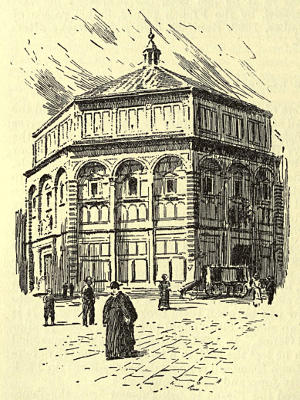
The Baptistery, Florence
Nothing is more valuable in war than season and opportunity. The Genoese had recalled the army of Giacaria with all expedition from Sardinia and soon equipped a fleet of eighty-eight galleys with many other smaller vessels, the command of which was given to Obert Doria. Putting to sea, and hearing that the Pisan armament was near Meloria, they advanced to that port. Doria, fearing that the superior number of their vessels might oblige the Pisans to refuse battle, and retire into harbour, advanced with only fifty-eight galleys, ordering the division of Giacaria to remain behind with the remaining thirty. The Pisans accepted battle, which was fought on the 6th of August with all the fury and animosity of two nations seeking to destroy each other. The succour which arrived to the Genoese with Giacaria, and which the Pisans did not expect, probably decided the fate of that day. The galley upon which was the mayor of Pisa, Alberto Morosini, fought furiously with the admiral’s ship, commanded by Admiral Doria, who was joined, however, by other principal galleys commanded by Admiral Giacaria. Even the galley which bore the great Pisan standard was taken by the galley called St. Matthew (San Matteo), where were many of the family of Doria, and by the galley Finale the great standard was torn and broken down, and the defeat was complete. Twenty-seven Pisan galleys were taken, and seven sunk; the remainder, rendered unserviceable, with the advantage of night they saved themselves in the neighbouring Pisan port, and with three of these the count Ugolino escaped. The killed amounted to four thousand, and many prisoners, among whom was the son of Count Ugolino.
These losses with those in anterior battles, amounted to about eleven thousand, and all of the most considerable persons. This event destroyed the maritime power of Pisa, which could never again recover itself and assume the rank of her rivals. Many illustrious republics, as ancient and modern history demonstrate, have risen after the most heavy losses. Pisa, however, was no longer in this condition, and various causes combined to prevent her regaining it; the first of which was the loss of her bravest and wisest citizens taken prisoners, and whom the Genoese, actuated by a cruel and useless policy, refused to set at liberty; and being kept in prison for nearly fifteen years, or so long as the war lasted, the greater part of them finished their life in wretchedness.d
Perfidy and Fall of Ugolino
[1288-1293 A.D.]
While the republic was thus exhausted by this great reverse of fortune, it was attacked by the league of the Tuscan Guelfs; and a powerful citizen, to whom it had entrusted itself, betrayed his country to enslave it. Ugolino was count of the Gherardesca, a mountainous country situated along the coast, between Leghorn and Piombino; he was of Ghibelline origin, but had married his sister to Giovan di Gallura, chief of the Guelfs of Pisa and of Sardinia. From that time he artfully opposed the Guelfs to the Ghibellines; and though several accused him of having decided the issue of the battle of Meloria, others regarded him as the person most able, most powerful by his alliance, and most proper, to reconcile Pisa with the Guelf league. The Pisans, amidst the dangers of the republic, felt the necessity of a dictator. They named Ugolino captain-general for ten years; and the new commander did, indeed, obtain peace with the Guelf league; but not till he had caused all the fortresses of the Pisan territory to be opened by his creatures to the Lucchese and Florentines—a condition of his treaty with them which he dared not publicly avow. From that time he sought only to strengthen his own despotism, by depriving all the magistrates of power, and by intimidating the archbishop Roger degli Ubaldini, who held jointly with him the highest rank in the city. The nephew of Ubaldini, having opposed him with some haughtiness, was killed by him on the spot with his own hand. His violence, and the number of executions which he ordered, soon rendered him equally odious to the two parties; but he had the art, in his frequent changes from one to the other, to make the opposite party believe him powerfully supported by that with which he at the moment sided. In the summer of 1282 the Guelfs were exiled; but finding in the Ghibelline chiefs, the Gualandi Sismondi and Lanfranchi, a haughtiness which he thought he had subdued, he charged his son to introduce anew the Guelfs into the city. His project was discovered and prevented; the Ghibellines called the people on all sides to arms and liberty. On the 1st of July, 1288, Ugolino was besieged in the palace of the signoria; the insurgents, unable to vanquish the obstinate resistance opposed to them by himself, his sons, and his adherents, set fire to the palace; and, having entered it amidst the flames, dragged forth Ugolino, two of his sons, and two of his grandsons, and threw them into the tower of the Sette Vie. The key was given to the archbishop, from whom was expected the vigilance of an enemy, but the charity of a priest. That charity, however, was soon exhausted; the key after a few months was thrown into the river; and the wretched count perished in those agonies of hunger, and of paternal and filial love, upon which poetry, sculpture, and painting have conferred celebrity.
The victory over Count Ugolino, achieved by the most ardent of the Ghibellines, redoubled the enthusiasm and audacity of that party, and soon determined them to renew the war with the Guelfs of Tuscany. Notwithstanding the danger into which the republic was thrown by the ambition of the last captain-general, it continued to believe, when engaged in a hazardous war, that the authority of a single person over the military, the finances, and the tribunals was necessary to its protection; and it trusted that the terrible chastisement just inflicted on the tyrant would hinder any other from following his example. Accordingly Guido de Montefeltro was named captain. He had acquired a high reputation in defending Forlì against the French forces of Charles of Anjou; and the republic had not to repent of its choice. He recovered by force of arms all the fortresses which Ugolino had given up to the Lucchese and Florentines. The Pisan militia, whom Montefeltro armed with crossbows, which he had trained them to use with precision, became the terror of Tuscany. The Guelfs of Florence and Lucca were glad to make peace in 1293.
FLORENCE; THE FEUD OF THE BIANCHI AND THE NERI
[1292-1300 A.D.]
While the Pisans became habituated to trusting the government to a single person, the Florentines became still more attached to the most democratic forms of liberty. In 1282 they removed the anziani, whom they had at first set at the head of their government, to make room for the priori delle arti, whose name and office were preserved not only to the end of the republic, but even to our day. The corporation of trades, which they called the arti, were distinguished by the titles of major and minor. At first only three, afterwards six, major arti were admitted into the government. The college, consisting of six priori delle arti, always assembled, and living together, during two months, in the public palace, formed the signoria, which represented the republic. Ten years later, the Florentines completed this signoria, by placing at its head the gonfalonier of justice, elected also for two months, from among the representatives of the arts, manufactures, and commerce. When he displayed the gonfalon, or standard of the state, the citizens were obliged to rise and assist in the execution of the law. The arrogance of the nobles, their quarrels, and the disturbance of the public peace by their frequent battles in the streets, had, in 1292, irritated the whole population against them. Giano della Bella, himself a noble, but sympathising in the passions and resentment of the people, proposed to bring them to order by summary justice, and to confide the execution of it to the gonfalonier whom he caused to be elected. The Guelfs had been so long at the head of the republic, that their noble families, whose wealth had immensely increased, placed themselves above all law. Giano determined that their nobility itself should be a title of exclusion, and a commencement of punishment; a rigorous edict, bearing the title of “ordinance of justice,” first designated thirty-seven Guelf families of Florence, whom it declared noble and great, and on this account excluded forever from the signoria; refusing them at the same time the privilege of renouncing their nobility, in order to place themselves on a footing with the other citizens. When these families troubled the public peace by battle or assassination, a summary information, or even common report, was sufficient to induce the gonfalonier to attack them at the head of the militia, raze their houses to the ground, and deliver their persons to the podesta, to be punished according to their crimes. If other families committed the same disorders, if they troubled the state by their private feuds and outrages, the signoria was authorised to ennoble them, as a punishment of their crimes, in order to subject them to the same summary justice. A similar organisation, under different names, was made at Siena, Pistoia, and Lucca. In all the republics of Tuscany, and in the greater number of those of Lombardy, the nobility by its turbulence was excluded from all the magistracies; and in more than one, a register of nobles was opened, as at Florence, on which to inscribe, by way of punishment, the names of those who violated the public peace.
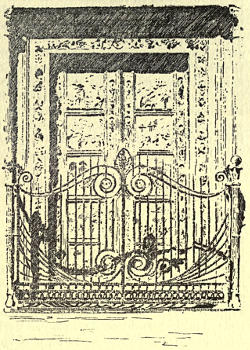
Door of the Baptistery, Florence
However rigorous these precautions were, they did not suffice to retain in subjection to the laws an order of men who believed themselves formed to rule, and who despised the citizens with whom they were associated. These very nobles, to whom was denied all participation in the government of the republic, and almost the protection and equality of the law, were no sooner entered into their mountain castles, than they became sovereigns, and exercised despotic power over their vassals. The most cultivated and wooded part of the Apennines belonged to the republic of Pistoia. It was a considerable district, bordering on the Lucchese, Modenese, Bolognese, and Florentine territory, and was emphatically designated by the name of the “Mountain.” It was covered with castles belonging either to the Cancellieri, or Panciatichi, the two families most powerful in arms and wealth in all Italy; the first was Guelf, the second Ghibelline; and as the party of the former then ruled in Tuscany, they had obtained the exile of the Panciatichi from Pistoia. The Cancellieri took advantage of this exile to increase their power by the purchase of land, by conquest, and by alliance; in their family alone they reckoned one hundred men at arms.b
The Cerchi and the Donati were, for riches, nobility, and the number and influence of their followers, perhaps the two most distinguished families in Florence. Being neighbours, both in the city and the country, there had arisen between them some slight displeasure, which however had not occasioned an open quarrel, and perhaps never would have produced any serious effect if the malignant humours had not been increased by new causes. It happened that Lore, son of Gulielmo, and Geri, son of Bertacca, both of the family of Cancellieri, playing together, and coming to words, Geri was slightly wounded by Lore. This displeased Gulielmo; and, designing by a suitable apology to remove all cause of further animosity, he ordered his son to go to the house of the father of the youth whom he had wounded, and ask pardon. Lore obeyed his father; but this act of virtue failed to soften the cruel mind of Bertacca, and having caused Lore to be seized, in order to add the greatest indignity to his brutal act, he ordered his servants to chop off the youth’s hand upon a block used for cutting meat and then said to him, “Go to thy father, and tell him that sword-wounds are cured with iron and not with words.”
[1300-1301 A.D.]
The unfeeling barbarity of this act so greatly exasperated Gulielmo that he ordered his people to take arms for his revenge. Bertacca prepared for his defence, and not only that family, but the whole city of Pistoia, became divided. And as the Cancellieri were descended from a Cancelliere who had had two wives, of whom one was called Bianca (white), one party was named by those who were descended from her, Bianca; and the other, by way of greater distinction, was called Nera (black). Much and long-continued strife took place between the two, attended with the death of many men and the destruction of much property; and not being able to effect a union amongst themselves, but weary of the evil, and anxious either to bring it to an end or, by engaging others in their quarrel, increase it, they came to Florence, where the Neri, on account of their familiarity with the Donati, were favoured by Corso, the head of that family; and on this account the Bianchi, that they might have a powerful head to defend them against the Donati, had recourse to Veri de Cerchi, a man in no respect inferior to Corso.
This quarrel, and the parties in it, brought from Pistoia, increased the old animosity between the Cerchi and the Donati, and it was already so manifest, that the priors and all well-disposed men were in hourly apprehension of its breaking out, and causing a division of the whole city. They therefore applied to the pontiff, praying that he would interpose his authority between these turbulent parties, and provide the remedy which they found themselves unable to furnish. The pope sent for Veri, and charged him to make peace with the Donati, at which Veri exhibited great astonishment, saying that he had no enmity against them, and that as pacification presupposes war, he did not know, there being no war between them, how peace-making could be necessary. Veri having returned from Rome without anything being effected, the rage of the parties increased to such a degree that any trivial accident seemed sufficient to make it burst forth, as indeed presently happened.
It was in the month of May, during which, and upon holidays, it is the custom of Florence to hold festivals and public rejoicings throughout the city. Some youths of the Donati family, with their friends, upon horseback, were standing near the church of the Holy Trinity to look at a party of ladies who were dancing; thither also came some of the Cerchi, like the Donati, accompanied with many of the nobility, and, not knowing that the Donati were before them, pushed their horses and jostled them; thereupon the Donati, thinking themselves insulted, drew their swords, nor were the Cerchi at all backward to do the same, and not till after the interchange of many wounds, they separated. This disturbance was the beginning of great evils; for the whole city became divided, the people as well as the nobility, and the parties took the names of the Bianchi and the Neri. The Cerchi were at the head of the Bianca faction, to which adhered the Adimari, the Abati, a part of the Tosinghi, of the Bardi, of the Rossi, of the Frescobaldi, of the Nerli, and of the Manelli; all the Mozzi, the Scali, Gherardini, Cavalcanti, Malespini, Bostichi, Giandonati, Vecchietti, and Arrigucci. To these were joined many families of the people, and all the Ghibellines then in Florence, so that their great numbers gave them almost the entire government of the city.
The Donati, at the head of whom was Corso, joined the Nera party, to which also adhered those members of the above-named families who did not take part with the Bianchi; and besides these, the whole of the Pazzi, the Bisdomini, Manieri, Bagnesi, Tornaquinci, Spini, Buondelmonti, Gianfigliazzi, and the Brunelleschi. Nor did the evil confine itself to the city alone, for the whole country was divided upon it, so that the captains of the Six Parts, and whoever were attached to the Guelfic party or the well-being of the republic, were very much afraid that this new division would occasion the destruction of the city, and give new life to the Ghibelline faction. They therefore sent again to Pope Boniface, desiring that, unless he wished that city which had always been the shield of the church should either be ruined or become Ghibelline, he would consider of some means for her relief. The pontiff thereupon sent to Florence, as his legate, Cardinal Matteo d’Acquasparta, a Portuguese, who, finding the Bianchi, as the most powerful, the least in fear, not quite submissive to him, he interdicted the city, and left it in anger; so that greater confusion now prevailed than previously to his coming.
The minds of men being in great excitement, it happened that at a funeral which many of the Donati and the Cerchi attended, they first came to words and then to arms, from which however nothing but merely tumult resulted at the moment. However, having each retired to their houses, the Cerchi determined to attack the Donati, but, by the valour of Corso, they were repulsed and great numbers of them wounded. The city was in arms. The laws and the seigniory were set at nought by the rage of the nobility, and the best and wisest citizens were full of apprehension. The Donati and their followers, being the least powerful, were in the greatest fear, and to provide for their safety, they called together Corso, the captains of the Parts, and the other leaders of the Neri, and resolved to apply to the pope to appoint some personage of royal blood, that he might reform Florence, thinking by this means to overcome the Bianchi. Their meeting and determination became known to the priors, and the adverse party represented it as a conspiracy against the liberties of the republic. Both parties being in arms, the seigniory, one of whom at that time was the poet Dante, took courage, and from his advice and prudence, caused the people to rise for the preservation of order, and being joined by many from the country, they compelled the leaders of both parties to lay aside their arms, and banished Corso Donati, with many of the Neri. And as an evidence of the impartiality of their motives, they also banished many of the Bianchi, who, however, soon afterwards, under pretence of some justifiable cause, returned.
The Pope sends Charles of Valois as Conciliator (1301 A.D.)
Corso and his friends, thinking the pope favourable to their party, went to Rome, and laid their grievances before him, having previously forwarded a statement of them in writing. Charles of Valois, brother of the king of France, was then at the papal court, having been called into Italy by the king of Naples, to go over into Sicily. The pope, therefore, at the earnest prayers of the banished Florentines, consented to send Charles to Florence, till the season suitable for his going to Sicily should arrive. He therefore came, and although the Bianchi, who then governed, were very apprehensive, still, as the head of the Guelfs, and appointed by the pope, they did not dare to oppose him. He had, however, agreed not to seek to acquire sovereign authority over the city, and is said to have pocketed 17,000 florins to bind the bargain.
[1301-1302 A.D.]
Thus authorised, Charles armed all his friends and followers, which step gave the people so strong a suspicion that he designed to rob them of their liberty, that each took arms, and kept at his own house, in order to be ready, if Charles should make any such attempt. The Cerchi and the leaders of the Bianchi faction had acquired universal hatred, by having, whilst at the head of the republic, conducted themselves with unbecoming pride; and this induced Corso and the banished of the Nera party to return to Florence, knowing well that Charles and the captains of the Parts were favourable to them. And whilst the citizens, for fear of Charles, kept themselves in arms, Corso, with all the banished, and followed by many others, entered Florence without the least impediment. And although Veri de Cerchi was advised to oppose him, he refused to do so, saying that he wished the people of Florence, against whom he came, should punish him. However the contrary happened, for he was welcomed, not punished by them; and it behooved Veri to save himself by flight.
Corso, having forced the Pinti Gate, assembled his party at San Pietro Maggiore, near his own house, where, having drawn together a great number of friends and people desirous of change, he set at liberty all who had been imprisoned for offences, whether against the state or against individuals. He compelled the existing seigniory to withdraw privately to their own houses, elected a new one from the people of the Nera party, and for five days plundered the leaders of the Bianchi. The Cerchi and the other heads of their faction, finding Charles opposed to them, and the greater part of the people their enemies, withdrew from the city, and retired to their strongholds. And although at first they would not listen to the advice of the pope, they were now compelled to turn to him for assistance, declaring that instead of uniting the city, Charles had caused greater disunion than before. The pope again sent Matteo d’Acquasparta, his legate, who made peace between the Cerchi and the Donati, and strengthened it with marriages and new betrothals. But wishing that the Bianchi should participate in the employments of the government, to which the Neri who were then at the head of it would not consent, he withdrew, with no more satisfaction nor less enraged than on the former occasion, and left the city interdicted for disobedience.
Both parties remained in Florence, and were equally discontented, the Neri from seeing their enemies at hand, and apprehending the loss of their power, and the Bianchi from finding themselves without either honour or authority; and to these natural causes of animosity new injuries were added. Niccolo de’ Cerchi, with many of his friends, went to his estates, and being arrived at the bridge of Affrico, was attacked by Simone, son of Corso Donati. The contest was obstinate, and on each side had a sorrowful conclusion; for Niccolo was slain, and Simone was so severely wounded that he died on the following night.
This event again disturbed the entire city; and although the Neri were most to blame, they were defended by those who were at the head of affairs; and before sentence was delivered, a conspiracy of the Bianchi with Piero Ferrante, one of the barons who had accompanied Charles, was discovered, by whose assistance they sought to be replaced in the government. The matter became known by letters addressed to him by the Cerchi, although some were of the opinion that they were not genuine, but written and pretended to be found by the Donati, to abate the infamy which their party had acquired by the death of Niccolo. The whole of the Cerchi were however banished with their followers of the Bianca party, of whom was Dante the poet, their property was confiscated, and their houses were pulled down,f Dante was at Siena at the time of the pretended conspiracy. It was decreed that if he ever returned to his native city he should be burned alive. Another of the banished was Ser Petracco di Parenzo dall’Incisa, whose son Francesco Petrarch saw the light in exile.h Charles, having effected the purpose of his coming, left the city, and returned to the pope to pursue his enterprise against Sicily, in which he was neither wiser nor more fortunate than he had been at Florence; so that with disgrace and the loss of many of his followers, he withdrew to France.f
FOOTNOTES